What is The lastest Surface Mount Technology ?

Surface Mount Technology

Introduction

Surface mount technology (SMT) refers to the method of mounting electronic components directly onto the surface of printed circuit boards (PCBs) without through-hole connectors. Originally developed in the 1960s, SMT has now become the standard method of assembling modern PCBs across consumer, industrial, automotive, telecom, and military electronics.

This comprehensive guide covers everything related to SMT including:

  • The history of surface mount assembly
  • Benefits compared to through-hole mounting
  • Description of common SMT components
  • SMT soldering and attachment methods
  • Typical SMT assembly process steps
  • SMT equipment for fabrication, printing, placement, reflow
  • Quality control and yield best practices
  • Environmental considerations for lead-free assembly
  • Latest innovations advancing SMT technology

Letโ€™s take a detailed look at what surface mount technology entails and how it has revolutionized electronics manufacturing.

History of Surface Mount Technology
Surface Mount Technology

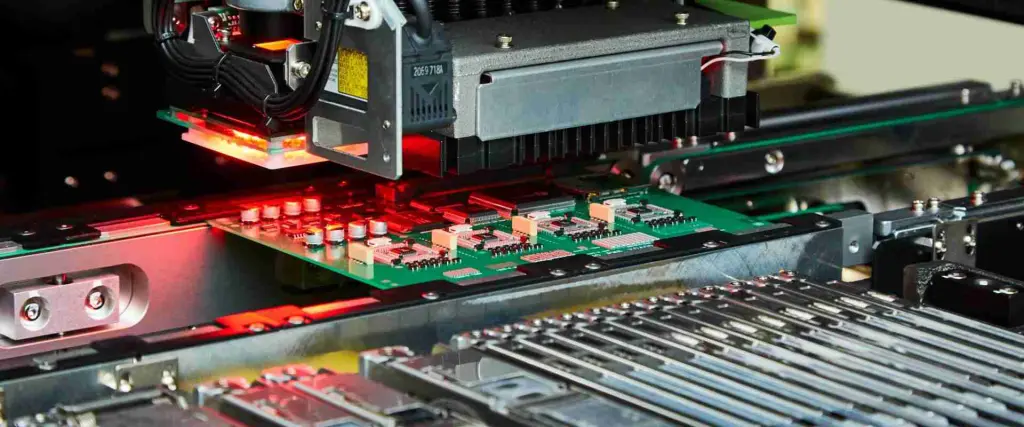
Surface mount technology evolved from earlier hybrid assembly approaches combining surface mounted and through-hole components:

1960s – Components glue-bonded onto PCB surface

1970s – Tape automated bonding (TAB) for ICs

1980s – Adoption of standard gull-wing SMT components

1990s – High speed SMT pick-and-place and reflow equipment

2000s – Lead-free manufacturing and micro-SMT advances

2010s – 01005 passives, microBGA, PoP, flip-chip, high-density SMT

Thanks to continuing innovations, SMT now supports ultra-miniature components for highly automated assembly, driving electronics product performance, size, and cost improvements.

Benefits of SMT

Compared to through-hole PCB assembly, surface mounting offers numerous advantages:

  • Smaller components and closer spacing enables miniaturization
  • Higher component density allows more functionality per PCB area
  • Simpler board layouts reduce layers and vias
  • Easier automation with faster component placement
  • Eliminates tedious lead clinching and trimming
  • Cost-effective volume manufacturing
  • Lead-free assembly improves environmental friendliness
  • Better electrical performance from reduced parasitics

Thanks to these benefits, SMT has largely replaced through-hole mounting as the standard assembly technique for high-volume production. Next weโ€™ll examine common component packages designed for SMT.

Surface Mount Component Packages

A range of standardized component packages have been developed optimized for surface mount assembly. Some popular examples include:

Quad Flat Packages (QFP)

  • Square ICs with leads extending from four sides
  • Pins underneath spaced on 0.5mm grid typically
  • Available in various sizes from 20 pins to over 200 pins
  • Allowing effective washing during assembly

Ball Grid Arrays (BGA)

  • ICs with input/output terminations in grid array of solder balls on bottom
  • Allows high density component mounting without perimeter leads
  • Larger pitch balls used for mechanical support; finer pitch for I/O
  • Advanced variants like PBGA, CBGA, EBGA, etc.

Chip Scale Packaging (CSP)

  • IC packages size nearly identical to silicon chip dimensions
  • Very compact with fine lead spacing
  • Allows maximizing PCB area utilization
  • PoP, fan-out wafer level, and other CSP configurations

Land Grid Arrays (LGA)

  • Input/output pads in grid pattern on underside of component
  • Mated with corresponding pads on PCB through compression
  • Enables contacts across entire package underside for very high I/O density
  • Common for large FPGAs, GPUs, and other complex devices

Passives

  • Rectangular chip resistors, capacitors, inductors, etc.
  • Available in sizes including 0201, 0402, 0603, 0805, 1206, etc.
  • Metric codes denote size (e.g. 1201 is 0.6mm x 0.3mm approx)

Continuing technology improvements allow steadily shrinking component sizes while increasing available I/O density. This drives electronics innovation and new product capabilities.

SMT Attachment Methods
SMT soldering Process

With no leads to insert, surface mount components are attached to pads on the PCB through methods including:

Soldering

  • By far the most common attachment approach
  • Provides both electrical connection and mechanical bond
  • Reflow or wave soldering used depending on package style

Conductive Adhesives

  • Silver epoxy glues conduct electricity for connection
  • Provides higher resistance and lower mechanical strength than solder
  • Limitations on temperature during curing

Press-Fit Connections

  • Spring-loaded pins compressed into plated through holes
  • Gas-tight, reworkable connection without solder
  • Requires precise hole machining and pad oxide cleaning

Sockets

  • Intermediate socket soldered to board mates with pins of package
  • Allows easy replacement of components like CPUs for upgrades
  • Higher cost, contact resistance, and poorer thermal performance

Among these options, soldering remains the optimal choice for most components due to superior electrical, thermal, and mechanical characteristics.

SMT Soldering Processes

Attachment of surface mount components is typically achieved using either of two primary soldering processes:

Reflow Soldering

  • Solder paste applied to pads via stencil/screen printing
  • Components placed onto paste deposits
  • Entire assembly heated in oven profile above solder melting point
  • Solder reflows wetting pads to form solder joints

Wave Soldering

  • Bottom side passed over flowing wave of molten solder
  • Solder adheres to exposed pads to form solder joints
  • Top already assembled separately with adhesive or reflow
  • Limited to durable components able to withstand wave exposure

The assembly side used depends on the package style. Sensitive small components use reflow while connectors and some passives are wave soldered.

SMT Assembly Process Overview

A typical complete surface mount assembly sequence consists of the following steps:

1. Solder Paste Printing

Solder paste containing powdered solder and flux is applied to pads through a stencil.

2. SMT Component Placement

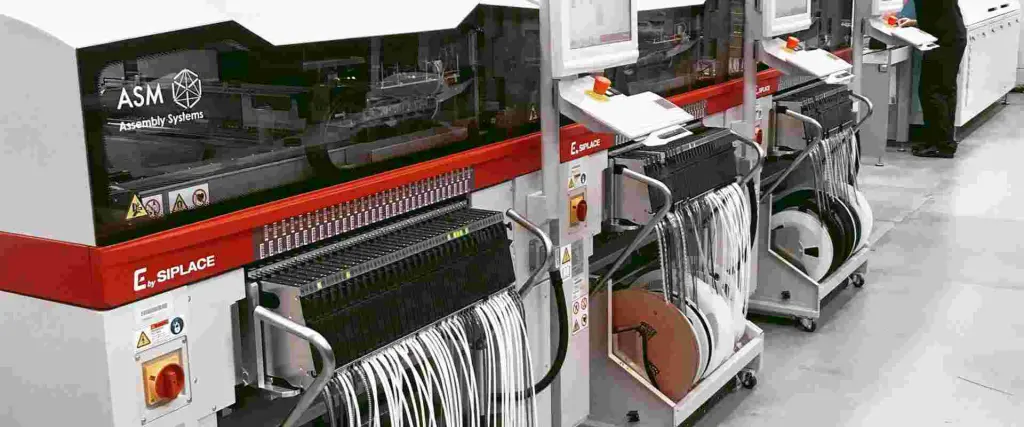
Components are precisely picked from feeders and positioned onto pads using automated pick-and-place machines.

3. Reflow Soldering

A controlled thermal reflow profile melts the solder paste deposits to wet pads and form solder joints.

4. Through-Hole Component Insertion

Any through-hole components are inserted either manually or with automated inserters.

5. Wave Soldering

The bottom side goes through a solder wave to attach remaining components.

6. Cleaning/Finishing

Excess fluxes are removed using cleaning processes. Final finishes or coats are applied.

7. Inspection/Test

Automated optical inspection and electrical testing validate assembly quality and function.

8. Conformal Coating

A protective conformal coating may be applied to shield components.

Highly optimized implementation of these process steps allows efficient, high-yield assembly of quality boards. Next letโ€™s look closer at some of the key surface mount technologies and equipment used.

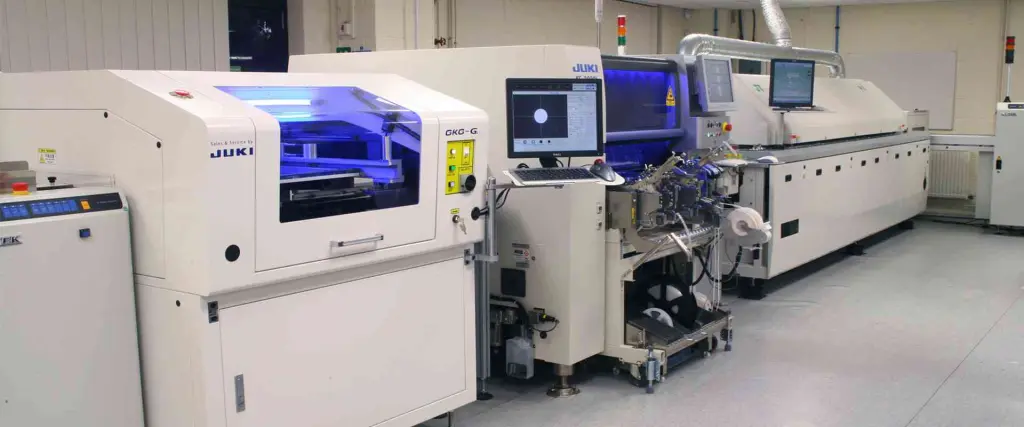
Solder Paste Printing Equipment
SMT Lines

Solder paste application tools include:

Stencils

  • Laser cut metal foils 0.1-0.15mm thick
  • Stencil apertures align with PCB pad positions
  • Allows rapid dispensing of precise paste volumes

Solder Screens

  • Steel or polyester fine mesh screen stretches on frame
  • Best for high-volume production with repeating designs
  • Allows higher height tolerance

Printers

  • Automated machines align stencil and print solder paste
  • Prints can print ~15 cm^2/sec at 150 ฮผm feature size
  • Provides consistent, high-speed, high-precision paste dispensing

With high quality stencils, precision printers, and well-tuned processes, printing delivers paste deposits with tight process margins supporting advanced assembly.

SMT Component Placement Systems

Automated pick-and-place systems position components for assembly. Key characteristics include:

  • Feeders – Tape, sticks, trays, etc. to supply components
  • Pick Heads – Nozzles for vacuum pick-up of components
  • Cameras – Pattern recognition for precise alignments
  • Work Holder – Moving PCB platform and clamping
  • Software – Programming component locations and sequences

High-end chip shooters provide fast, flexible, precision placement with advanced features like:

  • Feeder racks with hundreds of components
  • Dual gantry heads for simultaneous pickup/placement
  • Component flipping/rotation capabilities
  • Modular heads supporting various components
  • On-head barcode scanning for traceability

State-of-the-art pick-and-place systems can accurately assemble over 150,000 components per hour, enabling extremely high-volume production.

SMT Reflow Oven Options

Reflow ovens pass assembled boards through a controlled thermal profile to reflow (melt) solder paste and form solder joints. Types include:

Convection Ovens

  • Use fans to circulate hot forced air
  • Provides good heat transfer efficiency
  • Challenging to evenly heat large boards

Vapor Phase Ovens

  • Use evaporating solvent to uniformly heat PCB
  • Excellent thermal uniformity
  • Condensation/cleaning considerations

Infrared Ovens

  • Use IR lamps or panels to heat boards
  • Very fast response time
  • Can be difficult to evenly heat all areas

Laser Soldering

  • Directed laser energy to melt solder joints
  • Minimal thermal impact on rest of assembly
  • Typically used for small rework applications

Modern ovens with multiple controllable heating zones provide the thermal precision needed for lead-free solders and advanced packages.

SMT Inspection Systems

Consumer Electronics Assembly

Automated inspection validates assembly quality:

2D AOI

  • 2D machine vision inspection of joints, parts, defects
  • High-speed image matching algorithms
  • Limited ability to detect misplaced bottom-side parts

3D AOI

  • Laser profiling and scanning to obtain 3D surface data
  • Detects lifted leads, skewed parts, and solder defects
  • Significantly higher sensitivity than 2D AOI

AXI

  • Automated x-ray inspection
  • Sees inside components and connections in 3D
  • Detects defects like voids, lack of wetting, etc.
  • Complementary technique to optical AOI

These automated optical and x-ray tools replace tedious manual inspection with comprehensive analysis for process feedback and quality control.

Lead-Free SMT Assembly

Growing environmental concerns led the industry shift from tin-lead solders to lead-free alloys like SAC 305 (SnAgCu). Key considerations:

  • Higher soldering temperatures required
  • More susceptible to defects like head-in-pillow
  • Components and boards must withstand higher temps
  • Solder baths converted to lead-free
  • Process tuning for optimal wetting and joints

Despite challenges, rigorous process controls allow assembling lead-free electronics reliably.

Latest SMT Innovations

Ongoing technology developments continue advancing SMT capabilities:

  • Micro SMT – Enabling 0201 passives, microBGAs, wafer level packages, and beyond
  • 3D Packaging – Alternatives to larger chips like SiP and PoP
  • ** additive processes** – Inkjet solder printing, aerosol jetting, ultimately pick-and-place at chip scale
  • Smart Data – Analytics and machine learning for process optimization
  • Direct Integration – Flip-chip and other direct on-substrate approaches
  • Flexible Hybrid Electronics – Printing electronics onto flexible substrates

These innovations will allow packing greater functionality into smaller and smaller electronic assemblies.

Conclusion

This guide provided a comprehensive overview of surface mount technology, the transformational manufacturing approach that has enabled electronics to become ubiquitous across all areas of life today.

We traced SMTโ€™s origins in the 1960s to present-day automated factories assembling miniature components at remarkable speeds and volumes. The benefits over through-hole assembly are clear in terms of size, performance, cost, and manufacturability.

Understanding SMT provides key insight into the production processes, components, equipment, inspection methods, and innovations that allow translating circuit board designs into functioning devices. Mastering SMT fundamentals is therefore critical knowledge for electrical engineers and professionals across the electronics industry.

The next wave of SMT breakthroughs in areas like additive manufacturing and 3D integration will continue driving electronics advancement into coming decades. By leveraging these manufacturing capabilities, engineers can turn visions into reality.

Frequently Asked Questions

What are common SMT assembly defects?

Typical SMT defects include missing components, skewed/misaligned parts, insufficient solder, excess solder, solder balls/bridges, thermal damage, tombstoning, cuts/nicks, and holes/voids in joints.

What types of solder alloys are used in SMT?

Common solder pastes are SAC 305 (3% silver, 0.5% copper) and SAC 105 (lower silver). Other alloys include SnCu, SnAg, and SnZn. Lead-free solders require higher melting temperatures than tin-lead.

How small can SMT components be made?

0201 chip components measuring just 0.25mm x 0.125mm are common. New techniques allow soldering chips down to 0.15mm size. The lower limit is still advancing through micro-assembly breakthroughs.

What causes tombstoning defects in SMT?

Insufficient solder volume and surface tension imbalances during reflow can lift smaller components up on one end like a tombstone. Adjusting paste deposits, profiles, and layout helps prevent.

How does SMT affect thermal management?

The move to SMT helps by eliminating through-hole lead thermal resistance. But high density SMT heightens the need for thermal vias, internal layers, and airflow to prevent excessive component temperatures.

Conclusion

From its origins decades ago, surface mount technology has revolutionized electronics manufacturing and enabled steady improvements in capabilities, size, functionality, speed, and cost. Mastering SMT principles provides invaluable insight into the foundation underpinning electronics assembly and innovation.

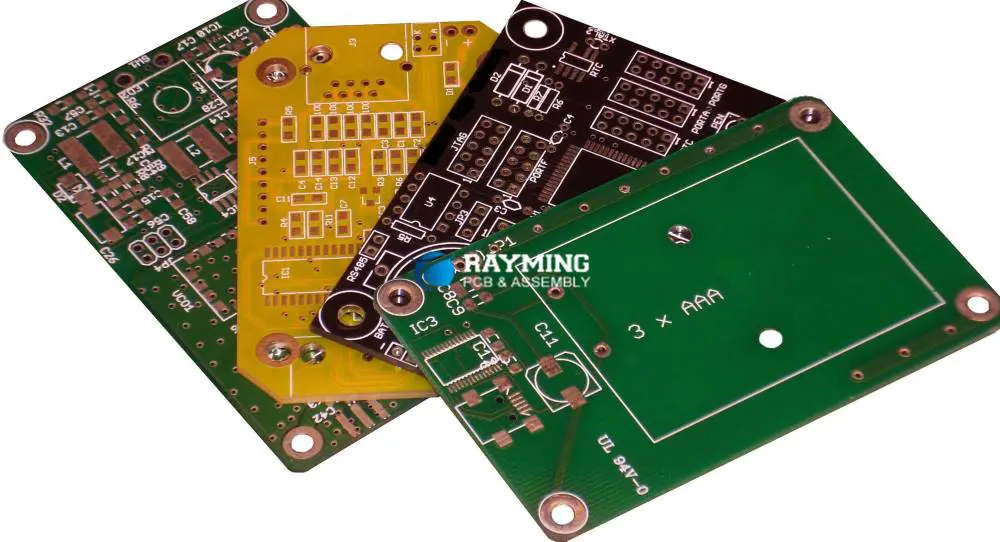
The Go-To Guide on Buying PCB

buying pcb

Printed circuit boards prove pivotal to the functioning of any electronic device. It can include your digital watch, smartphone, or large and complex industrial electronic devices. A PCB helps a device’s components communicate through electronic and electrical signals to serve their intended purpose. But regardless of the type of device, information on the type, make, and functionality of a PCB becomes instrumental in informing your purchasing choices. Otherwise, you can end up buying the wrong printed circuit board.

Are you an electronics enthusiast interested in buying PCB elements? Well, you might think that you have it figured out until you get to the market. But, unfortunately, PCBs can confuse you, especially when it comes to the right fit for your intended function. Therefore, the best buy PCB needs to have the crucial components and prove equally suitable to the intended device’s purpose. So what goes into shopping for a suitable printed circuit board?

Buying a Printed Circuit Board

Sometimes, the best way to shop for a PCB entails first understanding the type of PCB you want before shopping. Different types of PCBs exist, and each has its advantages when it comes to usage. For instance, an Eagle PCB can prove markedly from a Breadboard PCB. Secondly, you need to know the best place to get such a printed circuit board. Plenty of organizations produce PCBs with fluctuating quality, customization options, and prices. Therefore, you have to understand the available options, pricing, and other aftersales activities to get the best buying PCB experience. Finally, you have to understand the avenues available to you regarding the PCB ordering process. Companies differ in their approaches as some prefer you to order PCB online while others have alternative in-person arrangements.

Considerations to Make While Buying PCB

Buy PCB Board
  • Suitability of the PCB to your circuit needs
  • You will be amazed by the numerous PCB types available in the market. PCB types include the single-layer PCB, double-layer PCB, multi-layer PCB, rigid PCB, flexible PCB, and rigid-flex PCB. Therefore, if you aim to use your PCB order for industrial, medical, aerospace applications, then a multi-layer PCB might prove more suitable. For other uses such as cameras, calculators, etc., a single-layer PCB can suffice. Additionally, the technology used to manufacture these printed circuit boards also differ, and you have a likelihood of finding them with names such as Eagle, Kicard, etc. It becomes instrumental that in such situations, you do not get confused. Further, for testing and troubleshooting purposes, you should buy a breadboard PCB.

The bottom line for all this entails knowing all the available PBCs and what type suits your intended application the best before buying.

  • Pricing of the printed circuit boards
  • Make a decision to buy PCB board based on the pricing of that specific board. It can include a single-layer, multi-layer, or double-layer. Please note that all PCB products or services providing companies such as the RayMing PCB and Assembly use a cost-related model to attach price tags on diverse PCB products. For instance, a multi-layer printed circuit will cost more than a double-layer and single-layer PCB due to the technicality involved in the manufacturing process and more materials for the components. Additionally, companies charge more when it comes to customization services. Therefore you will have to use more money to buy these PCBs that align with your specific and unique attributes.
  • Manufacturing company. Plenty of companies produce printed circuit boards, but the quality and type of service differ from one company to the other. For example, some companies will provide manufacturing, fabrication, and assembly services, while some can only fabricate and assemble. Therefore, it becomes crucial to canvass and find the best company that will provide the required PCB at an affordable price and quality and excellent customer care service. The type of company and their product distribution services will also impact whether you can conveniently buy from them or not. For instance, if a company only provides PCB products within a specific territory or if it can allow you to place an order and buy online, complete with shipping services. Therefore, examine this crucial factor when buying a PCB to reduce potential disappointments.

Additionally, can the company produce your customized PCB design? The company you opt to procure a PCB from should have the capacity to customize the unique features you want to incorporate into your printed circuit board.

How to Order for Printed Circuit Board

Once you figure out what kind of printed circuit board you want and consider earlier stipulated, it becomes instrumental in placing an order of the PCB from your preferred PCB Company. But, before you order, try and gauge whether the manufacturing company you have settled on only produces standard sizes or short runs as well. It will assist you in buying an inexpensive set without any need to pay upfront for a large custom PCB batch, especially when you only want a single or two pieces.  

Steps.

  • Develop a circuit schematic and design. The two components become crucial for any printed circuit board, as you would not require a PCB board without a circuit. A variety of tools exist that you can use in creating a schematic. However, use a tool that will not only allow you to simulate the circuit’s behavior but test it as well. It should also allow you to develop at least a single working prototype and ensure functionality as designed before making the order.
  • Design your PCB. It is the next step after making the schematic and can prove tasking and a bit time-consuming. Here, you must demonstrate the technical know-how to route the tracks and how their outlay affects your circuitโ€™s performance. However, provided it’s a simple one for the initial circuit, the process can become less tasking. In addition, a lot of manufacturers have specific design software solutions for your use in this process. Thus, it becomes critical to search for these, complete with instructions on using them in their respective websites.

Additionally, note that you will have to set your project dimensions based on the customary sized board the company offers, as you will likely get these from your order. Otherwise, the manufacturer may decline to build your PCB at the specified price.

An excellent benefit of using such design software entails the standardization of the output files into the Gerber format. It is a file format that gets used for plotters when the actual track-printing occurs on the board. Therefore, any tool you choose to deploy needs to have the export option that will allow you to export your design in the Gerber format.

  • Double-check your design. Cross-checking and ensuring everything is in order becomes critical at this stage. Therefore, ensure the prototype, design, and board layout have no mistakes to avoid the costly replacement, especially after procurement of the boards. Once you have ascertained that everything is in order, you can upload the Gerber files, pick the board you want, and pay.
  • Once you receive the board from the manufacturer, check for any shipping damage and manufacturing defects like broken boards, defective and incomplete tracks, and undrilled holes. The process becomes vital before embarking on the soldering process of parts. It will allow you to replace parts quickly if you spot defects besides saving your costs on the replacement parts.

How Printed Circuit Board Get Priced

rogers substrate

PCBs have a diverse range of reliability, complexity, price, and quality points. However, the typical circuit board can cost as low as fifty cents to about three hundred dollars based on your requirements. But the cost of PCB gets influenced by many factors, including the following.

  • Assembly type. The type of assembly can drive the cost of a printed circuit board up or down. For instance, SMA, which entails assembling components on the surface, proves less expensive and with a faster manufacturing process compared to through-hole soldering. However, the latter has a sturdier connection concerning components than the latter. It thus proves the preferred tech by many, despite its steep price.
  • Component placement. The components placement within the board can increase or reduce the PCB price. Therefore, re-evaluate how you want them placed to reduce the manufacturing price.
  • The components number. The number of components within your circuit board will impact its price. It is because it arises from the procurement of these parts besides the cost of manufacturing. Therefore, try hard to ensure that your circuit proves as efficient as possible to reduce the PCB price.
  • Component’s package size. Industry size component package sizes lead to more affordable PCBs. Therefore, try and ensure you stick to these.
  • Component package besides the required process
  • Every component package needs to get attached using a particular process. Therefore, whenever you opt for delicate, complicated, and hefty component packages, the price also increases.  
  • Batch size and quantity. The number of PCBs you order besides the batch size will influence the overall cost of the PCB. Larger quantities of PCB fetch a lesser cost compared to smaller quantities. However, the batch size also dives the cost, something that gets overlooked often. Therefore, consult with your PCB manufacturer to understand what works best and will cost less.
  • Special component or parts preparation needs can also increase the cost of PCB. Therefore, if you can, use standard processing and size requirements.
  • Coating, potting, material and layers, and BoM also influence the cost of PCB; therefore, pick options that can reduce the cost of PCB.

How much does it cost to buy a PCB?

Introduction

Printed circuit boards (PCBs) provide the foundation for almost every electronic device. But what factors determine the cost of procuring custom PCBs?

This comprehensive guide examines the key considerations impacting PCB pricing including design complexity, board materials, manufacturing volumes, lead times, testing requirements, and more.

By understanding the drivers of PCB costs, electrical engineers can budget appropriately and make informed design tradeoffs. Weโ€™ll provide example quotes across hobbyist, prototype, and production scenarios to illustrate how widely prices can vary depending on application requirements.

Letโ€™s dive in to understand what makes some PCBs cheap while others become quite costly!

PCB Cost Dependencies

Below are some of the main factors that influence the pricing when sourcing custom PCB manufacturing:

Manufacturing Volume – Small prototyping quantities cost much more per board than high-volume production runs.

Board Size – Larger boards require more materials and cost more than smaller boards.

Layer Count – Base 2-layer boards are cheaper; each additional layer adds expense.

Board Thickness – Thinner PCBs use less material than thicker boards.

Board Shape – Rectangular boards are most cost effective. Irregular board outlines increase cost.

Materials – FR-4 glass epoxy is standard. Higher performance materials cost more.

Trace/Space – Tighter trace spacing and thinner traces increase fabrication difficulty and price.

Finishes – Immersion silver or gold cost more than standard HASL, OSP or ENIG.

Coatings – Conformal coatings add additional process steps and cost.

Hole Sizes/Counts – Many small holes and vias increase drilling time and tooling complexity versus fewer large holes.

Tolerances – Tighter fabrication and assembly tolerances require more attention and expense to fulfill.

Testing – Electrical testing, AOI inspection, x-rays, and other testing add cost but reduce escapes.

Lead Time – Faster turnaround requirements may command a premium to expedite the order.

Order Quantity – Due to setup costs, ordering many small panels costs more than fewer large panel batches.

Location – Local vs. overseas manufacturing involves tradeoffs of cost, lead time, communication, quality, and IP risk.

Weโ€™ll now explore how these factors contribute to overall board fabrication and assembly pricing across various use cases.

PCB Cost Case Studies

bare PCB layout design to cut cost

To better understand how the dependencies above impact cost, letโ€™s look at PCB price examples for hobbyist, prototype, mid-volume, and high-volume production scenarios:

Hobbyist PCB Costs

For hobby designers making boards at home in very low quantities, costs may be as little as $5-$10 per board in single unit batches.

Key characteristics:

  • Typically 2 layer FR-4 boards under 50mm x 50mm in size
  • Limited number of large through-hole parts
  • Traces and spacing around 8-10 mil resolution
  • Simple rectangular board outlines
  • Purple PLA solder mask and silkscreen
  • No special films or finishes beyond basic tin-lead HASL
  • Panels supplied to hobbyist shops like OSH Park, JLCPCB, PCBWay, etc.

At these vendors, customers upload Gerber design files which get panelized and batch processed together to amortize setup costs. The turnaround time is typically 1-2 weeks.

For hobbyists, attributes like lead time, minimum order quantity, and convenience often take priority over lowest cost per board. But unit costs up to $10 are attainable.

Prototype PCB Costs

For professional engineers making 10-100 quantity prototypes in a lab, prices typically range from $50-$300 per board.

Characteristics include:

  • Often 4-6 layer designs up to 200mm x 200mm size
  • Higher mix of SMT and fine pitch components
  • Minimum trace/space around 4-5 mil with 6/6 mil being common
  • May require non-rectangular outlines, cutouts, etc.
  • Solder mask and silkscreen for branding
  • ENIG finish preferred for unassembled boards
  • Electrical testing
  • 2 week target turnaround time

In this range, full-service domestic or regional prototyping shops are best suited to provide quick-turn fabrication with testing and engineering support.

Medium Volume PCB Cost

For bridge manufacturing runs from 100-5000 boards, pricing averages $10-$50 per board.

Attributes include:

  • Often 4+ layers and may use thicker substrates
  • HDI technology with microvias
  • High mix of component types
  • 2-3 mil trace/space tolerances
  • Tight assembly tolerances required
  • Lead-free HASL or ENIG finish
  • UL mark requirements
  • Functional testing needed
  • 8 week acceptable lead time

Chinese manufacturers offer cost advantages at this volume through high automation, purchasing scale, and labor efficiencies.

High Volume Production PCB Cost

For mass production quantities above 5000 units, costs drop below $10 per board, sometimes below $1.

Characteristics:

  • High layer counts typical to maximize density
  • Fine line traces and spacing below 2 mil
  • demanding tolerances for auto assembly
  • Gold immersion finish
  • 100% automated optical inspection
  • Full functional circuit testing required
  • 12+ week production lead time acceptable

At this scale, overseas assembly allows drastic cost reduction through extreme economies of scale and highly mature automation.

As shown by these examples, PCB cost varies tremendously based on the design requirements, order quantities, lead times, and quality needs of the application. Let’s now examine the cost structure further.

PCB Cost Breakdown

PCB assembly cost breakdown

A PCB’s total price consists of a combination of direct fabrication costs, engineering support expenses, and profit margin for the manufacturer.

Direct Fabrication Costs

This includes the raw materials, labor, and equipment usage required to produce the boards:

  • Substrate laminates
  • Photoresists and chemicals
  • Copper and other metal platings
  • Tooling for processes like drilling
  • Machine depreciation
  • Operator labor for production steps
  • Overhead like facilities and utilities

More complex boards require more processing steps and expense.

Engineering and Support Costs

Additional services wrapped into board pricing often include:

  • Design for Manufacturing analysis and recommendations
  • Testing setup and program development
  • Quality assurance oversight
  • Prototyping and new product introduction
  • Quoting services
  • Project management and production engineering
  • Documentation and certification

These value-added elements increase with order complexity.

Profit Margin

On top of base costs, manufacturers typically apply a profit margin from 10-30%. More competitive pricing requires minimizing this margin.

By understanding the underlying cost structure, engineers can identify opportunities to reduce pricing through design modifications, vendor negotiation, or fabrication process improvements.

Optimizing PCB Cost During Design

Several design-stage choices influence PCB pricing. Below are techniques designers can apply to minimize fabrication and assembly costs:

  • Standardize on fewer board sizes and materials for volume aggregation
  • Minimize layer counts whenever feasible
  • Use smaller board sizes fitting within panel arrays
  • Reduce fine features like trace/space only where required
  • Standardize on common hole sizes to minimize tooling
  • Specify tolerances only where functionally required
  • Leverage prudent design rules avoiding unneeded complexity
  • Re-spin only for critical issues to avoid added iterations

While these guidelines help reduce cost, performance and reliability should not be sacrificed solely to lower price. Like any engineering decision, design tradeoffs should aim to balance technical needs and cost impacts.

Getting PCB Cost Estimates

When budgeting for a new board project, how can accurate cost estimates be obtained? Here are some tips:

Leverage Experience

Use intuition from past boards of similar specifications to gauge initial expectations for pricing.

Request Quotes

Reach out to potential manufacturers with key project details to receive formal quotations.

Use Cost Calculators

Many fabricators provide web forms allowing input of basic project parameters to estimate price ranges. These help set expectations.

Seek Manufacturing Input

Engage potential vendors early in the design phase to get guidance around cost optimization opportunities.

Compare Multiple Vendors

Collect several quotes to benefit from competition and get a sense for pricing distributions.

Analyze Bill of Materials (BOM)

Review material, component, and processing line items making up cost structure.

While the lowest bid may be tempting, quality should not be sacrificed solely for lower cost. Vet manufacturing partners carefully based on technical capabilities.

Additional PCB Cost Considerations

Beyond base fabrication and assembly pricing, a few additional factors influence overall budgeting:

NRE Charges

Upfront non-recurring engineering fees are common to cover DFMs, testing development, stencils, etc. This adds cost prior to volume production.

IP Protection

For sensitive designs, steps like exclusively working with trusted domestic vendors, securing SBIR data rights, or even producing in-house may be warranted to protect intellectual property. These steps can increase costs.

Expediting Fees

Aggressive delivery demands requiring manufacturers to rearrange production planning often incur premium charges. Timelines should provide reasonable scheduling flexibility.

Component Supply

Long lead times and shortages of certain components adds delays and cost. Vet component availability/lead times upfront.

Shipping/Logistics

Budget for shipping costs, customs clearance, duties, and taxes when using overseas production. These expenses can accumulate.

While focusing first on base manufacturing pricing, engineers should incorporate these additional contributors into total project cost estimates as well.

Conclusion

This guide provided a comprehensive overview of the factors impacting PCB cost and how widely pricing can vary across hobbyist, prototype, medium volume, and high volume production use cases – from under $10 per board into the thousands.

Key takeaways include:

  • Cost depends greatly on volume, complexity, tolerances, materials, and lead time
  • Understanding cost drivers allows designers to optimize tradeoffs
  • Quoting early helps inform feasibility and prevents surprises
  • Vetting potential vendors on technical ability as well as cost is critical

Of course, sourcing boards is about far more than just price – quality, reliability, scalability, and manufacturability ultimately provide the value proposition. By using the knowledge provided here, engineers can make informed design and sourcing decisions optimizing all these vital factors.

Frequently Asked Questions

What are typical PCB costs for small prototype batches?

For prototypes making 10 PCBs, expect costs around $200-$500 per design. Making 50 units may reduce this to $100-$300 per board. Costs drop sharply above 100+ quantity.

How much does PCB testing and inspection add to cost?

Basic testing like in-circuit test and flying probe can add $500 per design. Full ICT plus automated optical inspection may add $2,000-$5,000 for programming, setup, and execution.

What are some common ways PCB cost reductions are achieved?

Using cheaper substrate materials, reducing layer counts, optimizing panel utilization, standardizing processes, eliminating unnecessary requirements, leveraging supplier relationships, and qualifying alternate component vendors are key tactics.

How can I estimate PCB costs during early design?

Rules of thumb for initial estimating: $10/in2 for 2 layers, add $3-$5/in2 per additional layer. Add $5K-$10K for initial DFM and NRE. Reduce cost by 30-40% above 1,000 boards. Confirm with quotes.

What is a reasonable margin to expect PCB vendors to mark up fabrication costs?

For small volumes, total markup approaching 100% including margin is common. At higher volumes above 1,000 boards, expect more competitive pricing with margin reduced to 30% or below.

Conclusion

Estimating PCB prototyping and production costs involves assessing numerous design, manufacturing, and fulfillment factors. But by leveraging the guidance provided in this guide, engineers can forecast expenses accurately throughout the development lifecycle. With greater visibility into PCB sourcing budgets, projects can achieve the best tradeoffs between capability, quality, reliability, and meeting critical time and cost targets.

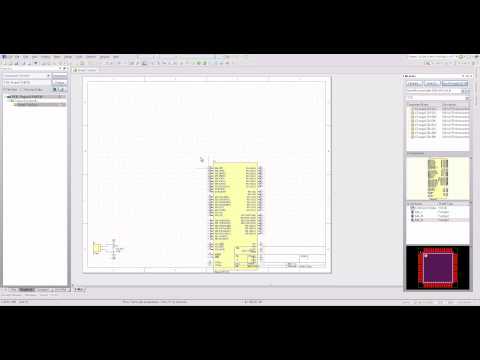
What is Protel PCB ?

Protel PCB

PCB manufacturers make use of software to design printed circuit boards. In PCB production, the use of the software is very important. Protel PCB is one of the best software for PCB design. This software helps electronic engineers to design layouts for PCBs.  Engineers make use of this software to work on the design process, get previously utilized board designs from PCB archives, and confirm circuit schematic designs.

YouTube video

Engineering companies use PCB design software for PCB development. There are several PCB design software specifically designed to meet the various needs of PCB engineers. The design of electronics requires a combination of skills and engineering science. When designing a circuit board, producers have to select a circuit configuration. Therefore, it is important to use the right software for every design.

What is Protel PCB Used for?

Protel software pcb is a comprehensive and modern solution specifically created for PCB designers. This software is the best choice among designers and engineers across the world. It is well known for its accuracy and efficiency in designing PCBs. This software represents years of development and innovation.

Protel PCB has been available since the 1980s. It is an important tool for PCB designers. It tests, verifies, and completes PCB design concepts. This software is one of the best EDA software. This software is very old and as such, requires a virtualization tool to run.

This cost-effective and easy-to-use software helps to make PCB designs accurately. Protel launched PCB 1.0 in 1991 and between 1991 and 1993, it launched PCB 2.x. Protel98 was launched in 1998. Protel has launched several versions ever since. It is now rebranded as Altium Designer.

Since the 80โ€™s, Protel PCB has been utilized for PCB design in several companies across the world. Even universities use this software to teach circuit design. Protel was designed by Altium. This software has continued to offer high-reliability and high performance PCB design. This software enables engineers to make innovative PCB designs. Protel PCB is very easy to learn and includes all design features.

Benefits of Protel PCB

Protel PCB file Viewer

Protel PCB is software specifically designed for engineers. This software has a lot of benefits discussed below;

User-friendly

Protel PCB is ideal for both experts and novices since it is very easy to understand and use. This softwareโ€™s tools come easy. The exporters, importers, and other tools can be used by any designer. Unlike other PCB software, the Protel design system is user-friendly. This software features easy-to-use tools, design templates, and a well-detailed library of components.

Reduces design complexity

This software simplifies design complexity. It makes use of a schematic and this schematic starts with selecting the right parts. You can identify and import vendor components in your design from the cloud. Engineers can design circuits on multi-layer and single-layer boards. Protel PCB simplifies complex designs into logical ones.

Saves costs on production

Protel PCB helps designers to save costs of production that could have been spent on designing physical prototypes. Quick virtual prototyping via the utilization of software tools enables manufacturers to commit resources and labor to a cost-efficient model for the final product.

Reduces Errors

When you use Protel PCB, you are more likely to encounter minimal errors. This software finds errors and fixes them early enough. It makes it easy for engineers to keep track of their job. Protel PCB can identify compatibility errors and fix them. Fewer errors will help you move on to the production process without delays.

Generates new ideas

The use of Protel PCB for designing PCB enables designers to generate new ideas. Working with this software helps you think outside of the box. You can make a design and try it out to see if it works.

This software gives you the ability to effortlessly make hierarchical designs. You can explore the features and interface of this software to get new ideas.

Features of Protel PCB

Protel is one of the first PCB software designed for personal computers. This software has continued to pioneer innovative tools that are useful in all aspects of the design process of a PCB. Protel, which is now known as Altium designer, has gained more than 30 years of experience in making great designs for PCB. This software offers some features which include;

Advanced route and place tools  

Protel features great reroute and place tools. This is one of the integral features of its design system. These tools are now more advanced in Altium designer. You can easily position and organize your components with smart placement algorithms.

This software features smart routing tools that help designers to complete PCB routing faster. The native 3D environment helps you to confirm the component position to imported mechanical design data. You can also adjust where your component is placed while working in 3D. This software now has improved core layout functionality, providing designers with the state-of-the-art tools required.

Improved utilities and functionality

Protel PCB helps you stay competitive. This software helps designers to route circuit board track much faster. It features Active BOM that helps you to directly evaluate component data and select the components into the PCB layout.

Unified Interface

Protel software PCB is specifically designed to deliver powerful designs to engineers and designers. This software is an effective application that contains advanced design tools needed to help you achieve a great design. The interface is very easy to use for both experts and newbies.

3D visualization

This is another feature this software offers. Since Protel PCB is now upgraded to altium designer, its 3D feature enables engineers and designers to clearly interact and visualize their designs. The layout tools will help you to route and place your tasks without errors. You can also see your design in a 3D format and as well as adjust your placement against any imported mechanical data.

Customer interaction use case

This software allows designers to have an interaction with their customers. The Protel design system offers customer interaction use cases. You can keep your customer informed about the progress of your design by sharing snapshots of your work. You can share these snapshots on any device.

More Facts about Protel PCB

There are various Protel PCB design softwares available for PCB designers. Protel schematic pcb is an ideal choice for electronics and electrical engineers. This packageโ€™s size for installation is 1.35 mb. PCB Creator is very easy to use. A 3D protel PCB viewer integrates into the design environment of protel PCB.

The installation management system in the advanced version of protel PCB enables designers to create an installation of the software anytime after the first installation is made. This helps designers to update, install, and eliminate additional functionality.

The editor in this software utilizes the concept of Design Rules to determine the needs of a design. These rules serve as an instruction set for the editor. They guide you through each aspect of the design, from clearances, routing, plane connection styles, widths, etc. The design rules are applied in a hierarchical way. Several rules of this type can be established.

Protel PCB features Active BOM, a management tool that provides designers with another data portal in their design. Active BOM enables you to evaluate component data. Protel PCB features Active Route that helps to make manual routing results. This helps you to direct the routing to wherever you want.

Limitations of Protel PCB

Protel PCB comes with great features and a lot of benefits. However, there are some limitations to using this software for designing a printed circuit board. The limitations are as follows;

  • It has several functions which makes it a bit difficult to use.
  • Startup times and file access can be very slow
  • The default settings seem to be unhelpful
  • It has no simulation options
  • The components and the interface are less customizable
  • The subscription cost is high

Frequently Asked Questions

How do I get the Protel PCB? Protel PCB software can be downloaded for a free trial version for two weeks. This trial version includes a virtual workshop. After the trial version, you will have to pay for a subscription to continue with this application. Protel PCB isnโ€™t free software; it requires you to pay for the services enjoyed.

Is Protel PCB ideal for a beginner? Protel PCB is one of the best softwares with an easy interface. This software is very easy to use, hence, it is an ideal option for novice designers. It is a user-friendly software that makes your journey throughout the design process very easy for you.

Conclusion

All electronic circuits are produced on PCBs. With the introduction of PCB software, PCB design has become an easy aspect for designers and engineers. The physical layout of the circuit and the choice of components is as important as the design of the circuit. Protel PCB is reliable software that features advanced tools for PCB design.

This software offers great data management tools, advanced routing technology, 3D visualizations, and release management tools. It is an ideal option for designers since it offers great features and benefits. This software guarantees accuracy for designers.

How Do You Calculate PCB Aspect Ratio ?

Printed circuit board aspect ratio

PCB manufacturing and PCB aspect ratio are the widths of a PCB split by a drilled hole’s diameter. The significance is related to plating โ€“ electroplating reagents must effectively circulate via the hole to produce satisfactory copper plating. Conversely, small hole diameters relative to the thickness of the board may provide unreasonable scale.

YouTube video

What is the PCB aspect ratio?

The PCB aspect ratio of a through is the proportion of the hole depth to the hole diameter (hole depth to hole diameter). For example, for a typical circuit board, the aspect ratio of 0.062 inches with a thru-hole of 0.020-inch would be 3 to 1.

This PCB aspect ratio is often used as a reference to ensure that while drilling troughs, the manufacturer does not violate his device’s capacity. For the typically drilled holes, the aspect ratios should generally not be more than 10:1, which would make it possible for a 0.062-inch panel to have a 0.006 inch (0.15 mm) each stir.

The aspect ratio of microvial is quite different because of its length and scale. Placing tiny holes may be challenging, and putting a small hole on a circuit board of 10 layers might create many difficulties for a PCB manufacturer. However, if the hole covers two of these layers, placing is considerably more straightforward. IPC is used for defining a microvial depends on its size equivalent to or less than 0.006 inches (0.15 mm). However, this size became widespread throughout time, and IPC chose to alter its concept to prevent its standards from constantly being updated as technology evolved. The IPC describes a microvial as a hole with an aspect ratio of 1:1, as provided as the hole is 0.010 inch or 0.25 mm in thickness.

Calculations of the aspect ratio in PCB:

PCB ASPECT RATIO

PCB via aspect ratio calculation is essential depending on whether you’re working with a picture, a creative venture, or a multimedia movie.

The PCB aspect ratios calculator is usually specified by statistics, as in a mathematical ratio that determines how many measures high your film, picture, and graphic projects should be and how many acres broadly they should be. Though aspect ratios are length and height dimensions, they frequently are lowered to the lowest acceptable ratio to suit correctly in all media.

It would help if you used an aspect ratio calculator to obtain a precise aspect ratio.

How to Use aspect ratio Calculator?

The width and length of images and videos should be determined beforehand to establish the aspect ratio. When you have such two measures already, enter them into the top calculator, determining the aspect ratio. All computations are performed automatically to ensure efficiency, precision, and smoothness!

Portrait vs Landscape:

The aspect ratio calculator may also give the modes for your images and videos. It is calculated based on the parameters. Mode for pictures or videos larger than broad will be “Landscape”, and “Portrait” will be more significant in width than elevation.

PCB trace routing:

The best strategy in prototyping is to trace it more in small intervals, as the complexity of PCB powerful tool. The usage of mentally deficient and hidden vias and inserting vias in high voltage pads have been achieved. Invisible and entombed vias are nevertheless harder to manufacture because the additional drilling stages required and the drilling process may leave debris in the holes can lead to production problems. Standard vias usually are too big to be integrated into the tiny mounting pads of supercurrent systems. Therefore, the microvia may contribute to all these issues:

  • The production of microvias aspect ratio is more straightforward than the tiny delusional and submerged vias.
  • Microvias work on tiny surface assembly pads, which are particularly helpful for large pin-count circuits like pin grid arrangements (BGA).
  • Because of their tiny size, Microvias will enable more excellent trace routing.
  • Microvias aspect ratio may also contribute to EMI reduction and other circuit design problems due to their size.

Microvias is a sophisticated way of manufacturing PCBs, and if your panel doesn’t require them, you want to remain with conventional vias to save costs. However, if your layout is thick and you need additional space, see whether microviews may assist or not. It’s indeed, as usual, a great idea to first examine their abilities with your contractor before you build a PCB using microvias.

Calculator Screen Size:

Is your 17:8 HDTV widescreen display attempting to find out the enhanced knowledge? This program calculates 3 out of 4 centimeters and inches for you. Just input any existing screen size and compute the others.

1. Choose Ratio Aspect

Aspect ratio

Choose the hyperparameters:

High HD 4K (3840 to2160)

Full HD (1920 versions of 11080)

HD-Ready (1280 tickets to 720 tickets)

WUXGA (1920 vs 11200)

UWQHD (3440 to 1440) UWQHD

Anamorphic

NTSC/PAL

2. Calculate

Select the dimension you know (hexagonal pattern, height, or width) and compute the other two.

Diagonal

Cm / centimetre = Calculate

Length

cm / cm = Calculate

Diameter

Cm / centimetre = Calculate

PCB Aspect Ratio Calculator for Photos and videos:

To compute the missing data for a particular PCB aspect ratio calculator, use the method below. For example, this helps resize pictures or videos.

Guidance:

  • Insert the original W1 width and the original H1 height values on the left.
  • Begin a new size W2 or a new level H2 to compute the rest of the number on the side.
  • Modify at any moment any of the settings or set it to the predicted parameters.

Formula:

You have a picture of 1600 x 1200 images, but your site has only 400 pixels in the room for a picture. To determine the new milestone of your picture, you have to do the account while maintaining the aspect ratio:

x new width= new height (original height/original width)

ร— 400 = 300 (1200 / 1600)

Aspect Ratios & its Importance:

Let us step back and examine before delving into aspect ratios, what PCB Vias and rings are and why they serve essential roles in your layout.

Vias are holes drilled in the tracks of the PCB layers with the ultimate aim of linking a trace on some other layer. These frequently occur in inter HDI PCBs, requiring the connection of each substrate in one manner rather than another. There are many variants in the style of blind, hidden, and hollow vias.

Buried vias:

Several or more interior layers are connected. Once again, the 2nd and 3rd layers of the four-layer PCB will have a drilled hole and will be linked, although the upper edges, either the first or fourth layers, will display no hole and will appear like a blank area on the panel.

Blind Vias:

The external layer of the PCB is connected to an interior layer of the circuitry but does not continue further. Once we have a four-layer circuit board, there’s a drilled hole in traces in the first two layers, but not in the fourth or fifth.

Through the paths:

As you’ve now decoded, the whole board linking the external first and fourth levels is physically “drawn” (or other combinations of connecting the four layers).

After these vias have been correctly constructed for the circuit board, now is the time to perform each via the placement. Enter circle vibrates. The loop is a brass ring left from around drilled hole part of the road, which provides us with a connecting surface where components are filled or mounted to provide us with beautiful plating. The greater the circular ring, the bigger our connecting area โ€“ a simple but essential part of the production puzzle.

Aspect Ratios Numbers:

The Board aspect factor is determined simply as the panel thickness to the drilled diameter. This is an essential ratio because of its impact on the plate inside the vias and the ring.

Suppose you have a 0.2″ thickness board and 0.02″ diameter each driller.” The aspect ratio is 10:1. As the ratio rises, more panels surround the via relative to the inner part of the drilled part and are thus more likely to fracture owing to z-axis displacement during soldering. Maintaining your PCB via aspect ratio reduced ensures a constant overview and provides more robustness throughout the printed circuit board’s lifetime.

Most industrial companies can achieve a 6:1 aspect ratio. With the lowest feasible diameter at around 0.013,” this allows you to have a maximum board depth of about 0.078.

If you examine both the panel width and the lowest drill Furthermore, your vias will be considerably stronger and provide you with a wider connection to attach your components.

Conclusion:

Once you have configured your PCB functional prototypes to operate with microvias, your following step will be to customize them. You will have to accomplish a lot with the technologies to work effectively with microvia design specifics. This will contain new forms and the language specification.

Microvias aspect ratio that you would usually not accomplish with ordinary vias may be stacked. Therefore your tools must be able to deal with this also.

However, Cadence already has the PCB aspect ratio design tools needed to deal with microvias. Their many schemas, libraries, models, and user interfaces include Allegro, which gives us the ability and flexibility you need microvia development.

How to Design Power PCB?

power pcb

Introduction

Power electronics circuits deliver and control high currents to drive loads like motors, heaters, or batteries. Designing robust, reliable printed circuit boards for power applications requires specialized layout techniques tailored for these unique demands.

This guide covers best practices for creating a power PCB including managing high currents, minimizing inductance, thermal design, safety, EMI control, and component selection. Following these techniques allows developing efficient PCBs that safely handle significant power levels. Let’s dive in!

Key Design Considerations

Below are some of the main considerations unique to power PCB design:

  • High current capacity – Use adequate trace widths, multiple layers, and vias to carry amps without overheating
  • Low inductance – Keep loops short and interleave supply/return paths to avoid voltage spikes
  • Noise isolation – Separate noise-sensitive analog and digital sections through partitioning and filtering
  • Thermal management – Use thermal relief and heatsinks to prevent components exceeding temperature limits
  • Safety – Design for proper insulation, spacing, fusing, and isolation to prevent hazards
  • EMI control – Contain noise emissions and immunity with shielding, filtering, and good signal routing practices
  • Reliability – Select robust components rated for continuous power cycling and transient stresses

Attention to these areas ensures an effective, reliable power PCB ready for the demands of real-world operation.

Accommodating High Currents

heavy copper pcb

Power electronics can supply hundreds or even thousands of amps in some applications. Traces must be robust enough to safely carry the expected currents without overheating.

Use Thick Traces

The first line of defense is selecting suitably thick copper traces based on the anticipated current. As a rule of thumb:

  • 10A: Use at least 0.5mm (20mil) traces
  • 50A: Use 1mm (40mil) or thicker traces

Consult ampacity tables to determine appropriate widths based on temperature rise, copper weight, and other factors. When in doubt, go thicker.

Distribute Across Layers

Use multiple board layers with entire planes dedicated to power distribution. This divides current to avoid overloading individual traces. Plated through-hole vias help conduct between layers.

Incorporate Thermal Relief

Add generous thermal relief cutouts around traces connected to inner plane layers. The additional exposed copper area helps dissipate localized heat buildup.

With careful high current handling techniques, PCBs can manage very high power levels without reliability concerns.

Minimizing Parasitic Inductance

In dynamic power circuits, parasitic trace inductance causes voltage spikes that can damage sensitive components. The layout techniques below help reduce inductance:

Use Short and Direct Paths

Keep traces short and avoid right angle turns or zig-zags which increase partial inductance. Use 45ยฐ angles when necessary along with curved traces.

Pair and Interleave

Route supply and return traces side-by-side to contain field loops. Interleaving these pairs further minimizes loop area.

Use Copper Fills

Fill unused board areas with copper fills stitched to the ground plane using closely spaced vias. This reduces partial inductance by preventing magnetic flux lines from looping.

Eliminate Loops

Avoid loop structures in high di/dt paths. Example: route traces for a buck converter output capacitor directly between joint source/load points instead of looping under device.

With careful layout, parasitic inductance can be minimized for clean and stable power delivery even during transients.

Partitioning for Noise Isolation

Power electronics with mixed analog and digital circuits should incorporate partitioning to contain noise:

  • Use ground and power planes to isolate analog circuits from noisy digital sections
  • Split planes in critical areas using isolation gaps and ferrite beads
  • Surround sensitive circuitry with guard traces to shield noise
  • Filter supply inputs and I/O lines to prevent coupling

Separation and filtering prevents mutual interference between high-speed digital logic and precision analog circuits.

Thermal Design

Many power components run hot and require heatsinking, airflow, and thermal management:

  • Use large thermal pads/polygons for heat spreading from hot parts
  • Incorporate thermal spokes and vias to conduct heat into inner layers
  • Connect directly to heavy copper regions, chassis, or heatsinks
  • Ensure sufficient air circulation around heat-sensitive parts
  • Use temperature resistant materials rated to withstand temperatures

This prevents parts from exceeding maximum junction temperatures even at high loads.

Safety

Switching Power Supply Design

Designing for safety is crucial when working with high energy levels:

  • Provide sufficient spacing and isolation between high voltage nodes
  • Incorporate proper insulation materials and distance to user interface
  • Use protection devices like fuses and current limiting resistors
  • Allow safe discharge paths for stored energy
  • Follow all relevant safety standards for enclosure, spacing, insulation, etc.

Safety cannot be an afterthought – it must be designed in from the start.

EMI Control

Switching power electronics generate significant noise emissions. Containing EMI is key for passing regulatory compliance:

  • Use shielding cans and grounded copper regions to prevent emissions
  • Incorporate feed-through capacitors and ferrite beads to filter leakage
  • Follow sound layout practices for grounding, decoupling, and bypassing
  • Keep current loops compact with short tracks and returns

Meeting EMI requirements may require multiple PCB revisions, so plan ahead.

Component Selection

All components must be spec’d adequately for power applications:

Passives

  • High wattage resistors and inductors
  • Capacitors with high ripple current ratings
  • Fuses and varistors rated for fault transients
  • Common mode chokes for EMI filtering

Actives

  • MOSFETs, IGBTs, etc. for switches
  • Controllers suited for motor, battery, or other loads
  • Robust suppliers and conservative derating

A single under-spec’d component can compromise reliability, so avoid cutting corners.

Example Power PCBs

Below are examples illustrating some effective power supply PCB implementations:

Switch Mode Power Supply

  • Interleaved input and output paths to reduce inductance
  • Shielding can contains EMI emissions
  • Thermal relief aids heatsinking
  • Safety spacing used on high voltage nodes

Power Amplifier

  • Copper fills and chassis mounting manage heat
  • Large supply layer traces feed amplifiers
  • Analog and digital sections separated
  • Input and output filtering for clean power

Battery Charger

  • Low inductance charging coil traces
  • Layers allocated for power distribution
  • Thermal relief used around hot traces
  • Safety spacing on high voltage capacitors

These examples showcase effective power supply design techniques in action.

Conclusion

Designing robust power PCBs requires managing high currents, minimizing inductance, controlling thermal performance, mitigating EMI, and selecting appropriate components rated for rigorous operation.

Careful application of the layout, partitioning, filtering, heatsinking and component selection guidelines provided in this guide allows engineers to create reliable PCBs able to deliver stable power even in demanding electrical environments.

Well-designed power supply and conversion circuitry forms the bedrock enabling everything from consumer appliances to electric vehicle drives to operate as intended. Mastering power integrity principles is key for PCB designers seeking to provide robust platforms for power electronics performance.

Frequently Asked Questions

pcb-power-supply

What are some good rules of thumb for trace width vs current capacity?

As a starting point:

  • 10A: 0.5mm width
  • 15-20A: 1mm width
  • 30A: 1.5-2mm width

Maximize use of inner layer planes to distribute higher currents.

What PCB materials work best for thermal performance?

Insulated metal substrate PCBs with aluminum or copper cores provide the best thermal conductivity. FR4 PCBs with lots of internal plane layers can also work well. High glass transition temperature materials withstand heat.

What causes ground bounce noise in power supplies?

Sudden current draws activate parasitic trace inductance, causing voltage drops across ground plane impedances. Proper decoupling and damping components help mitigate ground bounce.

How much should I budget for developing a custom power PCB?

For low complexity reference designs, $2,000-$5,000 is typical through prototyping. High complexity boards with extensive validation can exceed $50,000. Budget adequate time and review cycles to meet requirements.

What tools help assess power integrity?

The SI/PI tool suite – thermal modeling, power plane analysis, SPICE simulation, IBIS models, PDN assessment, etc. – helps verify power rail stability, thermal performance, EMI containment, and reliability factors.

Conclusion

Power supply design requires mastering specialized skills from high current layout to thermal management to EMI control to deliver stable, clean power to demanding loads. With diligent application of the techniques explored above, PCB designers can help enable the next generation of robust power electronics systems powering our modern world.

Do you Trust the Power PCB Design?

Different applications require specialized PCB customization for effective and safe use. The customization comes with specific features and design parameters. For instance, if you want an excellent hear distributor and conductor, you will go for an aluminum-backed PCB.

YouTube video

Power PCB is essential in ensuring that the board efficiently passes any amount of current without losing any power. Unlike other Printed circuit boards, which are generally utilized for low-power segments, the Power PCB should lead a lot of current without trading off effectiveness and losing power. The Power PCB is a reliable solution to the many problems facing power electronics.

Typically, the power PCB requires the capacity to carry a high current with low resistance. In this way, some converters need to manage noise generation and impedance because of the rapid exchanging of high streams, influencing the remainder of the digital and analog circuits.

In top voltage, the force PCB should incorporate fundamental safety features such as static discharge, power isolation, and earthing. IPC standards are there to ensure that manufacturers adhere to the safety policies and properly implement them.

PCB Power supply design guidelines

When discussing power, the need is generally to get a greater amount of it. When we were young, we wanted the space race to push the limits on building more powerful rockets, armies need more military power, the most powerful cars, and cities always need more electrical power for their populations. The objective of an effective PCB configuration is to give it clean force.

The PCB power supply plan needs to furnish the remainder of the hardware with perfect, continuous power. Design the PCB power supply, making less noise, and the noise created will be disengaged from the remainder of the plan.

PCB Design Considerations for Power Supply

pcb power supply

Depending on the functions of your PCB, it will require the ability to work. Ordinarily, this is cultivated with a locally available power supply. There are two fundamental categories of power supplies. They include:

Switch-mode power supplies (SMPS): They are more productive compared to linear power supplies. However, they are more intricate, and their switching noise can make EMI if care isn’t taken in their plan.

SMPSs are additionally separated by type: Non-isolated and Isolated. Higher-input voltages require the utilization of transformer segregation. Many secluded SMPS varieties are contingent upon their capacity and force rating, including full-bridge, half-bridge, push-pull, forward, and flyback. Non-detached SMPSs incorporate the accompanying sorts:

  • Buck-support: This SMPS contains both the buck and lift converters and will either venture down or venture up the yield voltage.
  • Boost: This SMPS steps up the voltage while stepping down the current.
  • Buck: This SMPS lowers the voltage while increasing the current.

Linear power supplies: They are genuinely straightforward and minimal expense to plan onto a PCB. They are utilized in frameworks where the power necessities are lower.

The configuration and type of power supply you wind up utilizing on your board should be intended to convey clean power with little to no noise. When planning the power supply on your PCB, you should consider the following:

  • Heat: A power supply will get hot, so ensure that you plan your inventory to scatter heat.
  • Noise: You should utilize the smaller bundles conceivably. Use the shortest routing, the best grounding strategy, and the most optimized and tightest component placement to diminish the opportunity of noise-making EMI for the remainder of the board.
  • Current: Your power supply will deal with a lot of currents. So ensure that you utilize satisfactorily follow widths and copper weight that can handle such current.

PCB power Supply Design Guidelines for Place and Route

Avoid potential risk to guarantee legitimate circuit activity, particularly when managing high-power PCBs, even though PCB design is challenging and exciting. As the size of electronic gadgets is consistently and continuously diminishing, we should consider the design aspects such as heat management and power supply. We will see a few rules that the creator can follow to plan a PCB that can support high-power applications.

Material

The plan of high-power PCBs requires the utilization of materials with specific attributes. The first attribute is that it should be a good heat conductor. Customary materials, for example, minimal expense FR-4, have a TC of about 0.20 W/m/K. For high-power applications, where heat builds should be limited, it is desirable to utilize explicit materials, like the Rogers RT cover.

As well as utilizing materials that can deal with heat and power with low error probabilities, you should manufacture PCB utilizing thermal and conductive materials with fundamentally the same CTE. So any extension or constriction of the materials because of high influence or temperatures happen at a similar rate, limiting mechanical weight on the material.

Decoupling capacitor

When power rail is disseminated and divided among numerous board parts, it is conceivable that the dynamic segments create hazardous phenomena, for example, ringing and ground bounce. It can cause voltage drops near the part’s power pins. Use decoupling capacitors if you want to address this problem. One terminal of the capacitor should be put to the pin of the segment getting the force supply. Connect the other terminal straight forwardly to a low impedance ground plane. The objective is to diminish the impedance between the force supply rail and the ground. Decoupling capacitors go about as an optional force source, giving segments the current they need during every transient.

Solder mask

We use this technique to permit a trace to convey bigger current measures to eliminate the solder mask from the PCB. It uncovers the hidden copper material, which would then be enhanced with extra welds to build the thickness of the copper and decline the general obstruction in the current-conveying segments of the PCB. While we may view it as even more a workaround than a design policy, this method permits PCB follows to withstand more force without requiring an increment in follow width.

Thermal management

It is essential to adhere to ideal thermal management to guard every segment inside temperature limits. The heat produced by every piece is moved to the outside through the bundle and the association pins. The intersection temperature ought never to surpass the breaking point demonstrated in the producer’s datasheet. Lately, electronic segment makers have assembled thermo-viable bundles progressively. Indeed, even with these innovative packages, heat dispersal becomes progressively intricate as incorporated circuits’ size keeps on getting smaller.

The two principal methods used to improve PCB heat management comprise the insertion of thermal vias and the production of enormous ground planes. The primary method permits you to build the region accessible on the PCB for heat dissemination. These planes are associated with the upper or lower layer of the load up to amplify the heating trade with the general climate; in any case, internal layers can likewise be utilized to separate pieces of the force scattered by the gadgets on the PCB. Heat vias are used to move heat starting with one layer then onto the next layer on a similar board. They can coordinate warmth from the most sizzling spots on the board to different layers.

Component placement

It is significant to initially build up the situation on the PCB of high-power parts, like voltage converters, or force semiconductors, which are answerable for creating a lot of heat. You should not mount high-power components close to the board’s edges, as this causes heat to develop and a huge ascent in temperature. Profoundly coordinated advanced parts, like microcontrollers, PCB power amplifier, processors, and FPGAs, ought to be situated in the focal point of the PCB, taking into account uniform heat dispersion no matter how you look at it and subsequently a reduction in temperature. Regardless, you should never concentrate the power components in similar positions to stay away from the development of problem areas; rather, a straight sort game plan is best.

Positioning should begin with the power gadgets. Place its traces short and wide enough to take out excessive ground loops and noise. By and large, the accompanying principles apply:

  • Take good grounding measures
  • Place high power circuits away from sensitive circuits
  • Minimize the resistive voltage drops
  • Identify and reduce current loops

PCB design

One needs to consider the board format from the beginning phases of PCB improvement. A significant standard that applies to any high-power PCB is to decide the way followed by the power. The amount and location of power moving through a circuit is a significant factor in assessing the measure of heat the PCB needs to disseminate. The primary variables influencing the design of a printed circuit board include:

  • The density of components that populate the board
  • The material used for manufacturing the PCB
  • Amount of airflow affecting the board
  • The ambient temperature at which the board operates
  • Power level flowing through the circuit

Even though this need is less dire with the current apparatus, in the course adjustments, it is fitting to stay away from the right points, yet to utilize 45ยฐ points or bent lines.

Trace width and thickness

On a basic level, the more drawn out the track, the more prominent its obstruction and the measure of warmth to be disseminated. Since the objective is to limit power failure and guarantee high dependability and sturdiness of the circuit, the proposal keeps the traces that lead to high currents. To effectively figure the width of a track, realizing the greatest current that can go through it, creators can depend on the recipes contained in the IPC-2221 rules or utilize an online number cruncher to calculate the maximum current and width the track.

Planning PCB Power Supplies for Successful Manufacturing

You are planning an effective PCB power supply with these suggestions, yet you need the board to be produced. With the tight situation prerequisites of a power supply format, you need to work ahead with your PCB contract producer to guarantee they can construct your planning. If not, they should work with you to concoct a planning methodology to fulfill both the electrical and assembling prerequisites of the board.

Xilinx XC7Z030-1FBG484i: The Latest Generation System-on-Chip FPGA

Xilinx XC7Z030-1FBG484i

Xilinx XC7Z030-1FBG484i is one of the microprocessors categorized under the Zynq-7000 series of microprocessors.

On its part, Zynq-7000 is a series of microprocessors under the All-Programmable System-on-Chip (SoC) families. It is one of the latest generation SoC families manufactured by Xilinx INC.

In this article, you will learn more about the XC7Z030-1FBG484i, including some of the reasons why it is one of the favorites for Field Programmable Gate Array (FPGA) designers.

Environmental Considerations

One of the features of the XC7Z030-1FBG484i is the considerations for the environment. This is paramount because designers wouldnโ€™t want to redesign or reengineer an FPGA in an environment that could complicate the entire process.

To that end, most FPGA designers and engineers prefer to work with the XC7Z030-1FBG484i FPGA because it has a wide range of environmental features.

First, there is compliance with the RoHS3 compliance. It is important to talk about the importance of this compliance. RoHS stands for Restriction of Hazardous Substances. It is a guideline set in place to restrict the use of six substances that could be harmful to health, especially if those substances are used in electronic products.

Therefore, the XC7Z030-1FBG484i is one of the best Field Programmable Gate Arrays (FPGAs), as it is compliant with RoHS 3. This also requires the restriction of four additional restricted substances (phthalates); therefore, bringing the total number of restricted substances to 10.

Second, the XC7Z030-1FBG484i FPGA also has a Moisture Sensitivity Level (MSL) of 4 to 72 hours. The MSL Level is used to describe and determine the amount of time it would likely take before the moisture-sensitive device would be exposed to the ambient room conditions.

Speed

The speed of the XC7Z030-1FBG484i FPGA could do with some improvements. For example, the 2 CPU cores may not entirely improve the performance of the board. A CPU core of 3 or more could have been preferred.

That notwithstanding, the maximum speed of 667 MHz would go a long way to speed things up a bit.

There is also a maximum processing temperature of 250 that helps to regulate the board so it doesnโ€™t overheat or underperform.

The All Programmable SoC First Generation Architecture

Xilinx pcba board

Not all Field Programmable Gate Arrays (FPGA) offer all the tools needed for full-scale programming and reconfiguration of existing conductors.

That is not the case with the XC7Z030-1FBG484i FPGA, which has more programming interfaces to offer.

The abundance of programming features on this gate array is because of the basis of the Zynq-7000 All Programmable SoC Generation Architecture. This architecture is the reason why a variety of programming features are permissible on the XC7Z030-1FBG484i.

At the core of these programming features is the integration of the feature-rich dual-core ARM Cortex โ€“A9 MPCore based Processing System (PS). This processing system is also packed with the CireSight System-on-Chip (SoC) to deliver a full programmable experience.

Besides, the XC7Z030-1FBG484i is also built with the 28 nm Xilinx Programmable Logic (PL).

The combination of these programming architectures in one Field Programmable Gate Array (FPGA) makes the XC7Z030-1FBG484i one of the versatile gate arrays that can be reconfigured and conditioned into many other applications.

Connectivity Options

The XC7Z030-1FBG484i is also designed with a wide range of connectivity options. These connectivity options combine to provide the designers with multiple options for connecting the gate arrays and other associated components.

Some of the supported connectivity options are:

  • UART/USART
  • CANbus
  • USB OTG
  • EBI/EMI
  • SPI
  • Ethernet
  • MMC/SD/SDIO
  • I2C

The Features of the Dual-Core Processing System

The ARM Cortex-A9-based Application Processing Unit (APU) is the primary processing system for the XC7Z030-1FBG484i Field Programmable Gate Array (FPGA). Here, we would expatiate on some of the features and or components of this processing unit.

1. Timer and Interrupts

The XC7Z030-1FBG484i features a variety of timers and interrupts meant to help the device in its logic functions.

The three main timers and interrupts used here are the:

  • Two triple-timer counters
  • Three watching timers
  • One global timer

2. Overall Speed and Performance

The speed and performance of the XC7Z030-1FBG484i is another important feature of the dual-core Application Processing Unit (APU).

At the core of this is:

CPU Frequency

The frequency and speed of the CPU are bolstered by the CPU frequency of up to 1 GHz. In addition, there is 2.5 DMIPS/MHz per CPU.

On the other hand, the gate array features a NEON media-processing engine that is responsible for facilitating the processing of media and other associated files on the FPGA.

It is impressive to note that the board also features the coherent multiprocessor support that goes a long way to improve the speed of the other processors on the XC7Z030-1FBG484i FPGA.

3. Improved Architecture

The XC7Z030-1FBG484i FPGA also has an improved architecture, which is possible because of the ARMv7-A Architecture.

This architecture is the reason why the board has an improved instruction set via the Thumb-2 Instruction Set. It is also the reason for the integration of the TrustZone Security architecture as a way of improving the security of the board.

4. Interconnection

The XC7Z030-1FBG484i FPGA can also interconnect with other devices. This feature is enhanced by the wide range of interconnection options that include:

  • Support for QoS. This would be used on critical masters for both bandwidth control and latency.
  • High-bandwidth connectivity within the Processing System (PS). This would be used to facilitate the connection between the PS and PL.
  • The interconnection architecture is based on ARM AMBA AXI

5. Multiple Interfaces and I/O Peripherals

The XC7Z030-1FBG484i FPGA also includes several I/O Peripherals and Interfaces.

Some of these include:

  • Two master and slave 12C interfaces
  • Two 10/100/1000 tri-speed Ethernet MAC peripherals. These peripherals also support IEEE Std 1588 revision 2.0 support and IEEE Std 802.3.
  • The board also features up to 54 flexible multiplexed (MIO). This is used for peripheral pin assignments.
  • Two USB 2.0 OTG peripherals. Each of these supports up to 12 Endpoints.
  • Two high-speed UARTs up to 1 Mb/s

Conclusion

The XC7Z030-1FBG484i FPGA is a microprocessor that makes the work of FPGA designers easier.

You want to contact a reliable vendor to get one so your designing needs can be met in real-time.

What is Dielectric Constant in PCB?

pcb dielectric constant

PCB Dielectric Constant and comparative dielectric FR4 permittivity are a statistic software developers frequently utilize, sometimes without knowing it completely. Each substance has a dielectric constant, possibly a little more than equality air. The character is usually used to evaluate multiple circuit board materials by the circuit designer, often compared to a set value for a particular frequency in a device datasheet. As with most PCB components, however, the quantity may fluctuate independently of the quality of materials. Thus, variability in the dielectric constant has little to do with performance and much to do with the usage and testing of the substance.

YouTube video

What is Dielectric Constant’s significance?

The PCB dielectric constant is measured as the stuff electrical absorbency to total space electrical permeability, and it is air; its quantity may be determined using modes condenser models.

The dielectric constant is a vital information component for constructing thin-film condensers and under other situations in which material may be anticipated to enter a loop. A coating condenser is produced of the sample film to detect it. The dielectric constant is the combination of the capacitor of the condenser as a dielectric with the voltage of a condenser as a dielectric condenser. The dielectric constant must be lowered for sheets that should be utilized to isolate electrically. Conversely, the dielectric constant must be high for films used as a dielectric in a condenser to reduce the condenser measurements. Altitude and stream frequency influence the dielectric constant.

What is Dielectric Material?

The dielectric is a substance that is weak in electrical conduction. So it’s an excellent Electromagnetic Field booster. Suppose for the electrical flux lines, the current flow between the charged sites of the considered different is kept at a low without disruption. In that case, the electrostatic fields may make electricity. This phenomenon is helpful for energy storage in gadgets. Dielectrics are also utilized in the building of electromagnetic transmission lines

Types of Dielectric Constant Material

The substances used in the electronics sector are categorized based on electrical conductivity. The three kinds are wires, semiconductors, and insulators. Dielectrics are designed to inhibit the passage of electricity. The functioning of the insulators is similar. The very recognized usage of dielectric material is seen in the condensers, where a semi medium isolates the conduction panels called an isolation material. Different condenser types are categorized according to the kind of insulating material used.

Dielectrics are often divided into two kinds.

ร˜ Dielectrics Active:

Dielectrics are put in the solid electric field directly to take the flow of work from them. These are called active dielectrics. All of those are easy to store the energy.

ร˜ Dielectrics Passive:

The load flow limitation by the dielectric is called a passive dielectric.

Dielectric materials are also categorized into three kinds depending on the condition of the substance. It is metals, liquids, and molecules.

Properties of Dielectric Material

The dielectric characteristics help us choose the finest one depending on its requirements. Some of the features are:

  • Dielectric materials are typically non-metallic. The impedance of such compounds is thus high.
  • The activation energy is significant and exceeds 3eV.
  • Electrons are exceptionally highly bonded to the nucleus.
  • The conductivity is extremely low due to the lack of electrons.
  • Permeability โ€“ The polarising behavior or dielectric nature may be anticipated using the allowability rating.
  • The dielectric constant is being used to quantify the dielectric polarisation intensity.

Dielectric characteristics of various components used in the manufacture and packaging of semiconductors play a significant role in attaining the intended efficiency of circuit boards. The majority of engineers who work in the semiconductor sector thus require a rudimentary knowledge of dielectric characteristics.

The permissiveness of dielectric material is an essential characteristic. The allowability is a measure of the material’s ability to be polarised by a magnetic charge.

The notion of permittivity is nevertheless more superficial to understand by first addressing a closely related characteristic, capability (C). Capacity is a capability of a medium to retain a cargo if it is fitted with a voltage and is best represented on an insulator placed between two parallel two coils.

FR4 Dielectric Constant

FULL PCB MANUFACTURING Quote

Slightly elevated and high-frequency panels need excellent dispersion estimates to guarantee system reliability and precise time to propagate. FR4 dielectric constant is the most common kind of PCB lamination and has well-documented material properties. Researchers have collected key FR4 material characteristics as dielectric FR4, thermal properties, and more. The Altium Designer features precise FR4 dielectric constant type computation and high-speed PCB design capabilities.

PCB design concept for professional usage is the most powerful, contemporary, and simple to use.

Your PCB project begins with an isolating substratum which is usually comprised of FR4 as its base. The term “FR4” indicates the protective coating characteristics of the dialectic material and the epoxy composite used to make up the substratum for woven glass strengthened type-4. This laminate substance is highly isolated and stiff and should be used as a foundation material for all producers.

An essential factor in the construction of PCBs using FR4 laminates is to recognize their material characteristics, including their dielectric and thermal conductivity. Then, you may create a precise resistance characteristic for your super fast PCB and perform accurate signal quality simulations using the correct software and resources in the kit. Altium Designer offers the capabilities for stacking the dielectric constant and thermal characteristics of FR4 and other stuff to build your latest high-speed PCB in your experiments.

High-performance FR4 Dielectric Constant

370HR dielectric constant is an FR-4 Micro Printed wiring network with an elevated 181ยฐC to in which high thermal conductivity and durability are requested. 370HR composite and prepreg products are produced of a unique multipurpose epoxy high-performance resin strengthened by an electric quality glass fabric.

Compared to conventional FR-4, this technology offered better thermal performance and reduced reveal higher while maintaining FR-4 flowability. Besides this better thermal performance, the chemical, mechanical, and humidity-resistant characteristics of all FR-4 materials comparable to or surpass their effectiveness. The 370HR dielectric constant technology additionally provides laser fluoridation and UV filtering for maximal interaction with automated, visual, and photographic solder mask spectrometer. 370HR proved best in the consecutive laminating class.

FR4 Dielectric Material

FR-4 refers specifically to a product grade instead of a substance which is a plastic resin for epoxy composite glass-reinforced substance. FR-4 consists of a woven fiberglass sheet with a flame protective epoxy resin base. And FR is fire resistant and indicates that the component conforms with the UL94V-0 certification.

Difference between FR-4 material and Rogers material

  • Material FR-4 is affordable than stuff from Rogers dielectric constant.
  • Rogers substance is excellent with higher frequency compared to FR-4 technology.
  • Material FR-4 has a significant dissipation factor, greater signal loss than material from Rogers.
  • Rogers dielectric constant material offers a broader spectrum of Dk numbers in impedance constancy than FR-4 substance.
  • For dielectric constants, FR-4 is about 4.4, lower than Rogers’ 6.14 to 11 substance.
  • The Rogers materials have less fluctuation in temperature regulation compared to the FR-4 material.

Importance of Dielectric Constant

The dielectric constant is the first parameter considered by most designers when sorted by various printed circuit board components. The value leads the quest when you need a dielectric constant dielectric circuit board substance or when a design requires a PCB board with a slight optical consistency. But what exactly does the dielectric constant indicate? And how might it impact a structure if it is not dielectrically “perfect?” On the other hand, what tends to happen to the device if it was constructed and manufactured on a high dielectric constant PCB board and had a low dielectric constant?

Many technicians are instructed that the dielectric constant or relative fr4 permittivity of a circuit material or Dk, as it is called, is a set number for a particular matter. The DK values given by techniques proposed on their spec sheets are figures from a specific test technique to a particular frequency; under various circumstances, the value will change. For such a purpose, Rogers Corporation lists Dk value systems for its materials about specific methodologies. In addition, it sets out the “Design” values for substance, which are Dk ideals for the systems under different circumstances and moral standards to be used to construct or model a circuit.

The PCB dielectric constant preparedness efforts of materials like woven glass, porcelain, or polyethylene terephthalate. Circuit designers prefer to prepare for a particular dielectric material static but never dismiss the fact that a network material DK is not stable: it is changing with frequency and temperature and even with bond strength. Therefore, any evaluation of various PCB elements can never presume that Dk is regular. It may also not suppose that other material characteristics stay constant when moving to a higher Dk ratio material.

Many PCB substances are anisotropic, indicating that for the various axes of the board, the Dk value is varied. Material spec sheets often offer information on characteristics such as Dk sensitivity and temperature changes in DK.

Among other issues, Rogers’ research on material characteristics has shown that it should not be disregarded to deal with Dk. Dielectric constant may change with frequency and temperature. Still, it may also vary unexpectedly, in particular at shorter wavelengths. Thus, while Rogers has spent a lot of time and effort to build “DesignDk’s” values for their materials to reflect the dielectric properties of circuitry in actual circumstances, it is challenging to monitor many circuit components by irregular dielectric constant behavior.

Step-by-Step Guide to PCB Design and Manufacturing

PCB Design and Manufacturing

Introduction

A printed circuit board (PCB) forms the backbone of an electronic product, providing the foundation to mount and interconnect components. Designing and manufacturing high-quality PCBs is a complex, multi-step process requiring expertise across electrical engineering, industrial processes, and quality control.

This guide will walk through the end-to-end PCB production process spanning design, fabrication, assembly, and testing phases. Understanding the big picture helps streamline executing each step smoothly. Weโ€™ll cover key concepts like schematic capture, layout considerations, generating manufacturing files, selecting materials and finishes, assembly methods, and inspection processes.

Letโ€™s get started on a step-by-step journey following a PCB from initial concept through volume production!

PCB Design Phase

Modular PCB Design
Modular PCB Design

Before manufacturing, a PCB design must be created and optimized. This frontend design process involves:

Schematic Capture

A schematic in CAD software connects symbolic representations of components logically using wires showing connectivity and net names. This turns an electrical concept into a virtual circuit diagram.

Simulation and Verification

The schematic gets simulated using SPICE models to verify proper component behaviour prior to physical layout.

PCB Layout

The schematic nets then get assigned physical connections and routed on board layers respecting electrical and physical design constraints.

Layout Optimizaton

The layout gets iteratively improved to enhance manufacturability, testability, and performance using guidelines like:

  • Component placement for efficient routing and assembly
  • Thermal management of heat-generating parts
  • Matching trace lengths and widths to signals
  • Minimizing loop inductance and maximizing decoupling
  • High-speed topologies like controlled impedance traces
  • Partitioning for panelization and board sections

Design Rule Checking

The finished layout gets programmatically checked against a myriad of fabrication and assembly rules to avoid both physical and functional issues.

3D Modeling

An optional 3D model of the board and components provides a realistic visualization of the final product.

With the design optimized, manufacturing output files are generated.

Manufacturing Data Processing

To fabricate and assemble PCBs, the design data gets processed into specialized formats like:

  • Gerber files – Standard files describing copper layers, solder masks, silkscreens, drilling info, etc.
  • Drill files – NC drill files with tools for all required hole sizes
  • Assembly drawings – Documentation for fabrication, test, inspection, etc.
  • BOM files – Bills of materials with part numbers, values, quantities
  • Netlists – Connectivity listings for assembly testing

Additional outputs like centroid data, testpoint reports, and IPC-2581 manufacturing archives help enable production. The data then gets transferred to the PCB fabrication facility and assembly house.

PCB Fabrication Process

The PCB fabrication process transforms the design files into physical boards ready for part mounting. Key fabrication steps include:

Substrate Preparation

The laminate substrate material gets conditioned through processes like cleaning, graining, desmearing, and via hole metallization.

Photolithography

A photosensitive dry film gets laminated onto the substrate then exposed to UV through the Gerber masks and developed to form the conductive pattern.

Copper Plating

The boards get electroplated to build up etched copper on exposed tracks to the target thickness defined in the design.

Etching

Chemical etching removes unwanted copper leaving only the desired conductive traces on the laminate.

Stripping and Etchback

The remaining photoresist gets stripped away and roughened copper gets etched back.

Soldermask

The soldermask layer gets laminated using the solder mask Gerber file exposing only solderable pads.

Silkscreen

Ink or epoxy graphics are applied for the silkscreen layer according to the silkscreen Gerber outline.

Surface Finish

The conductive traces get plated with solder, gold, or other finishes per specification to protect copper and facilitate soldering.

Routing

Mechanical routing cuts board outlines from the panel based on the fabrication drawing.

Testing

Bare boards get electrically tested against the netlist prior to component assembly.

The completed boards are now ready for part population by the contract manufacturer.

PCB Assembly Process

Consumer Electronics Assembly

Once fabricated boards are received, the assembly process populates components onto the boards. This involves:

Printing Solder Paste

Solder paste gets printed onto pads through a stencil aligned to the PCB.

Pick-and-Place Assembly

Robotic pick-and-place machines populate components onto pads according to the bill of materials and centoid data.

Reflow Soldering

The boards pass through a reflow oven melting the paste to form solder joints securing components.

Inspection and Testing

PCBs get inspected for defects using automated optical inspection and other techniques, then tested for proper function pre-enclosure.

Conformal Coating

A protective coating gets applied to shield components from environmental factors.

Backplane/Daughter Card Assembly

For larger systems, boards and modules get mechanically assembled into card cages and rack infrastructure.

Enclosure Assembly

PCBs get integrated into plastic or metal product enclosures through alignment pins, clips, and fasteners.

This completes the board-level assembly process, with fully populated boards installed into final products.

PCB Manufacturing Quality

Throughout fabrication and assembly, quality standards are upheld through:

  • Statistical process control tracking defect and scrap rates
  • Extensive inspection checking operation output
  • Regular calibration and maintenance of machines
  • Conformance to stringent industry standards like IPC and ISO
  • Strict supplier quality management systems
  • Quality assurance oversight of manufacturing floor environment
  • Comprehensive testing of raw materials, in-process, and finished boards
  • Continuous improvement initiatives to drive down defects

Attention to quality ensures reliable, consistent PCB production.

PCB Design Key Factors

To summarize, when architecting your PCB design, keep in mind these vital elements for manufacturing success:

Electrical

  • Component placement minimizing wire length
  • Trace widths matched to current
  • Controlled impedance on high-speed nets
  • Decoupling capacitance placed near ICs
  • Minimal antenna risks and crosstalk

Mechanical

  • Adequate clearance between traces and pads
  • Thermal relief to dissipate heat
  • Large pads and traces for higher current
  • Connectors placed with clearance for cables
  • Stress relief on components susceptible to vibration/shock

Manufacturing

  • Standard PCB dimensions for panel utilization efficiency
  • Test points designed for probing process validation
  • Component spacing within pick-and-place tolerances
  • Thermal profiles optimized for soldering
  • Assembly fixtures designed upfront

Getting the design right from the start smooths the entire downstream production process resulting in a functional, reliable, manufacturable PCB.

Conclusion

This comprehensive guide walked through the journey of a PCB from initial schematic design through factory fabrication, assembly, inspection, and testing based on real-world manufacturing processes. Understanding the sequence of steps provides helpful context for electrical engineers designing boards destined for volume production.

Key takeaways include laying out PCBs with manufacturing in mind, generating quality design data, communicating effectively with fabrication and assembly partners, and upholding rigorous quality assurance to ensure robust boards ready for installation in products. By following this PCB production roadmap, electrical engineers can transform ideas into fielded products reliably and efficiently.

Frequently Asked Questions

pcb-assembly-san-jose

What design practices help make PCBs easy to manufacture?

Some best practices include providing clearance between traces, avoiding tiny cutouts in planes, using standard component sizes and pitches, labeling layers clearly, and designing with the assembly process in mind through strategies like maximizing access to connectors and minimizing component height variations.

How long does PCB fabrication and assembly normally take?

For prototype volumes, fabrication can typically be completed in 5-10 days, with assembly requiring another 1-2 days. In production, fabrication lead times are usually 3-4 weeks, with assembly adding another 1-2 weeks. More complex designs may require even longer.

What are some key tests performed during PCB production?

Bare boards get electrically tested. After assembly, boards are visually inspected, undergo in-circuit testing, get programmed, experience functional validation testing, and undergo environmental stress screening through thermal cycling, vibration, and other techniques before shipping.

What tolerances should PCB layout accommodate?

Critical tolerances include solder mask registration (ยฑ0.075mm), hole position accuracy (ยฑ0.1mm), hole size variation (ยฑ0.075mm), conductor width and spacing (ยฑ0.075mm), and conductor thickness variation (10%).

How can I get quotations for PCB fabrication and assembly?

Reach out to manufacturing partners with your board files, BOM, target quantities, and any specialty requirements. Most will provide free assessments and quotations analyzing your design for manufacturability and providing estimated pricing.

Conclusion

Designing a board is only the first step – seamlessly navigating manufacturing processes transforms the ideas into reality. By understanding the progression from design to high-volume production, engineers can make decisions ensuring smooth fabrication and assembly resulting in functional, cost-effective boards. This PCB production primer provides helpful guidance for getting robust products to market.

Electronics rely heavily on printed circuit boards, as it helps in the transmission of electric signals to satisfy the deviceโ€™s mechanical and electrical circuit requirements. As such, printed circuit boards become indispensable to the proper functioning of electronic devices. Every economic sphere has increasingly relied on digitization, increasing the demand for computational electronics and thus PCBs.

PCB Design Manufacturing

As a circuit designer, the aspect of visiting and communicating your PCB designing and fabrication needs to a fabricator proves critical. However, physical visits have increasingly become impractical as major clients outsource their inquiries regarding PCB manufacturing needs to overseas manufacturers and suppliers. Therefore if you need a company to manufacture your design, you only have to contact them virtually. What’s more, online PCB design and manufacture instructions exist today, something that can become valuable if you want to design and produce one by yourself at home.  In this section, I intend to demonstrate the relevant processes of PCB manufacturing to help you design and produce printed circuit boards.

Process Steps

Once completed and approved, the PCB design can now go into production. As the designer, you have to export your design in a suitable format that the manufacturer can support. One renowned and agreeable output format is the Gerber. Additionally, please note that diverse PCB design and manufacturing tools require distinctive generation steps of the Gerber file. It encodes all-inclusive and important information that includes drill drawing, copper tracking, component notations, apertures, etc. All the design aspects undergo checks at this stage, where the program executes oversight algorithms to make sure that no errors pass undetected. At this point, you can also study the plan, especially aspects like the spacing of the board edge, track width, hole, and track spacing, besides hole size.  After that, the PCB design can then get forwarded to manufacturers like RayMing PCB & Assembly. Here, the DFM gets carried out to ascertain that the PCB design meets the minimum tolerance requirements under production.     

pcb designing and fabrication
  • Conversion from the file into film
  • Once you have developed the schematic files and the manufacturer also completes the DFM check successfully, printing can start. Most manufacturers use a plotter to develop photo films, instrumental in the printing of the circuit boards. The films get used for imaging the PCBs by the laser printer, proving incredibly precise in providing a detailed film.  

What results from the process includes a unique plastic sheet complete with a black-inked photo negative. The black ink denotes the PCB’s conductive copper segments, while the clear part represents the non-conductive material. A similar pattern happens for the outer layer though this happens in reverse: clear denoting copper and black denoting the segment to get etched away.

Every solder mask and PCB layer gets its black and clear film sheet, and this implies that a double-layer PCB will require four sheets. Remember, all the sheets have to get used with one corresponding to the other. Additionally, you have to punch registration holes through every film to realize a perfect alignment.

  • The inner layer’s printing process
  • Here, the intention entails printing the mapped-out copper path created on the film on a foil of copper. It acts as a preparatory step in the PCBโ€™s manufacturing process. The laminate, composed of fiberglass or epoxy resin substrate, acts as an ideal platform to receive the copper, which provides structure to the PCB. It not only provides a platform but a dust-resistant and sturdy material to support the PCB fabrication. Since copper proves pre-bonded on either side of the substrate, this process entails whittling it away to divulge the design.

Cleanliness becomes a crucial part of the PCB construction process, and thus, the copper-sided laminate has to get cleaned and passed through a decontaminated. During the decontamination process, avoid any dust particles from settling on the PCB laminate. Otherwise, it can end up making the circuit short or open.    

In the next stage, the panel gets a photo-sensitive film layer called the photoresist. It comprises elements that end up toughening upon exposure to UV. It ensures a perfect match in the photoresist as it had proved on the photo film.

After preparation, the board must get washed with an alkaline liquid to eliminate all the unhardened photoresist. Subsequently, the pressure wash that follows will leave the surface spotless and free from anything remnants. It then undergoes drying before another round of examination by a technician to eliminate errors. Remember the step applies to multi-layer boards only.

  • Removal of unwanted copper. The next stage entails the elimination of the unwanted copper using a copper solvent liquid. Remember the weight of the board determines the quantity of solvent used.  Another round of washing happens after the removal of the unwanted copper. Here, the hardened resists safeguarding the desired copper gets washed off. You will end up with the glistening copper substrate needed for the printed circuit board.
  • Optical inspection and layer alignment
  • Now the layers prove clean and ready to punch the alignment holes to ensure a proper alignment. The next step in this stage entails aligning the registration holes of both inner and outer layers. The layers get optically punched to allow exact correspondence.  Remember, once placed together; the layers cannot get corrected for any inner layer errors. Because of this, another round of automatic optical scrutiny to ensure the panels are free from defects. Here, the Gerber acts as the standard and digitally compares the image with the original. Any inconsistency gets displayed for immediate attention, and once it passes the test, it moves to the final phases of the printed circuit board production.
  • Layer up before bonding. All the different layers get fused, with the outer layers joined with the FR4/substrate. The process has a two-step process of fusing the substrate with copper. The next step entails bonding where the layers get fit on the table-attached pins. It becomes crucial to secure it snuggly and avert shifting when aligning.  Once every layer gets fit and layered properly over each other, you can now go ahead with pressing. The process gets carried out by a bonding-press computer that determines and organizes the automatic heating besides determining the pressure points to act on. It then follows an unpacking process after every layer gets molded together to form a PCB sandwich. Here, the pins used to restrain the board gets removed, and the upper pressure plate is discarded.     
FULL PCB MANUFACTURING Quote
  • Drill. It entails boring holes into the board stack. The minuscule nature of the holes demands precision, as every other component that comes later depends on this precision. The drill target location gets determined by an x-ray finder before drilling and subsequent hole registration.  Additionally, the micro-movement of this drill gets controlled by a computer, which controls the movement by using prior design details. The extra copper lining the edges gets removed using a profiling device.
  • Copper deposition and plating. It is the next step after the drilling process. Here, you get a fusion of diverse layers using chemical deposition. After that, the panel has to go through subsequent chemical baths, with each bath depositing a thin copper layer on the panelโ€™s surface, covering the new holes.  
  • Imaging of the outer layer. It involves applying the photoresist again, though it concentrates on the PCB panel‘s outer layer. It has to go through a similar process explained earlier to gain the toughness. Further, black ink film gets held by pins in preventing any misalignment until after exposure to high UV rays. After that, any unhardened resist material gets removed.
  • Plating. The plating process proves similar to the one illustrated in the eighth step. It entails electroplating with copper before a subsequent plating with tin. It will allow the elimination of extra copper left. Further, the tin safeguards the panel section that remains encased in copper in the subsequent etching stage. Etching always removes any undesirable copper foil on the panel.
  • Final etching. The tin layer safeguards the copper during this phase, where the undesired copper (including from beneath any resist layer) gets removed. Chemical solutions get applied to eliminate the extra copper. At this point, all the connections and conducting areas prove properly established.
  • Application of the solder mask. Clean and cover the panel with epoxy solder ink before applying the solder mask. After that, it receives another UV light blast that toughens the uncovered segments while the covered and soft segments await removal. It then has to get heated to cure the applied solder mask.
  • Surface finish. In this stage, the application of silver and gold coats happens, which incorporates additional solder-ability.  Additionally, hot-air leveling ensures uniform pads and leads to surface finish generation.
  • Silkscreen. The almost complete board has to receive an ink-jet surface writing to indicate crucial details concerning the printed circuit board. It then passes through the coating and subsequent curing phases.
  • Electrical test. It then becomes crucial for the PCB to undergo an electrical test as the ultimate precaution.
  • V-scoring and profiling represent the last process where the board gets cut using a v-groove or router.

Top 25 SMT Companies in 2023

smt company

Introduction

Surface mount technology (SMT) has become the predominant method for assembling printed circuit boards (PCBs) in electronics manufacturing. Utilizing robotic pick-and-place machines to populate boards with surface mount components enables highly automated assembly with miniaturized components.

Hiring an experienced surface mount assembly services provider is crucial to guarantee quality and reliability for an electronics product. This article will explore the top 25 companies providing SMT manufacturing globally based on factors like capabilities, reputation, scale, and technology leadership.

Read on for an overview of the top contract manufacturers advancing the state of the art in surface mount productions, as we count down the top 25 SMT companies in 2023.

Ranking Methodology

through-hole assembly process

Companies were evaluated and ranked based on the following key criteria:

  • Technical capabilities – SMT line diversity, maximum board size, component size range, and other production capabilities demonstrating advanced technical competence.
  • Geographic reach – Number of manufacturing locations, countries, and regions served demonstrating global scale and presence.
  • Certifications – Holding demanding certifications for quality management and environmental standards from bodies like ISO, IATF, and others.
  • Industry reputation – Feedback and recommendation from electronics industry experts, customers, and associations gauging SMT quality and reliability.
  • Technology adoption – Use of innovative techniques like AOI inspection, 3D solder paste inspection, automated optical shaping, and more cutting-edge automation.
  • Key customers – Experience serving premier electronics brands with demanding high-volume production needs.

With these criteria in mind, here are the top 25 global surface mount technology assembly providers in 2023:

#25 – VTech EMS

  • Headquartered in Dongguan, China
  • 10 manufacturing facilities across China
  • Diverse electronic product expertise including consumer, telecoms, medical, automotive, IoT
  • ISO 13485 and ISO 14001 certified
  • Services from PCB assembly through full box build support

#24 – altus AG

  • Based in Germany with factories across Eastern Europe
  • Focus on automotive, transportation, industrial, and medical customers
  • Ample SMT lines featuring Fuji NXT and AIMEX equipment
  • Rigorous quality control standards per ISO 9001, ISO 13485, IATF 16949, and more
  • High mix/low-mid volume manufacturing ideal for European regional support

#23 – Suntsu Electronics

  • Taiwanese EMS company with sites across Asia
  • Broad capabilities for consumer electronics, computers, peripherals, and communications equipment
  • SMT production using latest Yamaha and Juki machinery
  • Veteran provider serving customers for over 25 years
  • Robust quality certifications including ISO 9001, ISO 13485, ISO 14001

#22 – New Kinpo Group (Cal-Comp)

  • Headquartered in Taiwan with dozen manufacturing sites across Asia and Mexico
  • Massive capacity with 100+ SMT lines and over 15,000 employees
  • Focuses on computers, networking gear, consumer electronics, IoT, and smart home products
  • Industry 4.0 initiatives around automation, analytics, and smart factory
  • Joint design and manufacturing services under one organization

#21 – Zollner Elektronik

  • German full-service EMS provider with factories across Central Europe
  • Diverse industry expertise in industrial control, medical, measurement, automotive, aerospace, and engineering services
  • Comprehensive quality management system certified to multiple ISO and industry standards
  • 300+ injection molding machines and fully automated SMT lines featuring Fuji AIMEX equipment
  • Renowned for high-mix, high-complexity, and flexible production

#20 – SIIX

  • Subsidiary EMS division of Japanese conglomerate MinebeaMitsumi
  • Global manufacturing presence across Asia, Europe, Mexico, and Brazil
  • Scale to produce up to 500 million PCB assemblies per year
  • Highly automated production using latest Yamaha SMT equipment
  • Broad capabilities serving aerospace, defense, telecoms, networking, IoT, and automotive verticals

#19 – Fabrinet

  • Headquartered in Thailand with sites across Asia Pacific
  • Foundry model providing optimized flexibility and speed
  • High complexity PCBs with 01005 components and 0.3mm pitch BGAs
  • Smart factory initiatives include automated optical inspection, 3D solder paste inspection, and advanced analytics
  • Large optics manufacturing capabilities supporting camera modules, LiDAR, sensors

#18 – Key Tronic

  • Global sites across North America, Europe, and Asia
  • Leading medical, aerospace, automation, and computing ODM services
  • Collaborative design engineering engagement for manufacturability
  • Quality certifications include ISO 9001, ISO 13485, AS9100D, and IATF 16949
  • Diverse precision electromechanical, plastics, and metal fabrication capabilities

#17 – hiking (Kin Yip)

  • Headquartered in Hong Kong with sites across Asia
  • High-complexity, high-reliability manufacturing
  • Specializes in consumer, communications, automotive electronics
  • Highly automated production with 3D AOI, 3D SPI, component traceability
  • Certifications include IATF 16949, AS9100D, ISO 13485, ISO 14001

#16 – Enics

  • Swiss EMS provider with sites across Europe and Asia
  • Diverse expertise in industrial, automotive, medical, aerospace/defense, instrumentation, and building technologies
  • Focus on low-mid volume, high-mix production
  • Certified for ISO 13485, IATF 16949, AS9100, ISO 14001
  • Design support, NPI, and aftermarket services under one roof

#15 – Sumitronics

  • Japanese EMS founded in Malacca, Malaysia with sites across Asia
  • Scale of 500 SMT lines producing over 100 million PCBs annually
  • Broad capabilities serving computing, consumer electronics, communications, automotive, industrial
  • Investments in smart factory automation technologies
  • Certified for ISO 9001, ISO 14001, ISO 13485, IATF 16949

#14 – Ducommun

  • Global EMS headquartered in Southern California
  • Provides advanced integration and system-level assemblies for aerospace/defense, space, and industrial technology
  • Leading expertise for high-reliability, high-complexity designs
  • AS9100D and Nadcap accreditation at all sites
  • Design engineering collaboration and NPI

#13 – Jabil Circuit

  • One of the largest and most geographically diverse EMS providers
  • Over 25 million square feet of manufacturing space worldwide
  • Expertise across defense, aerospace, automotive, healthcare, computing, storage, and packaging verticals
  • Design support services augmented by automated DFM analysis
  • Top certifications like IATF 16949, ISO 9001, ISO 13485, AS9100

#12 – Natel Engineering

  • Silicon Valley contract manufacturer founded in 1974
  • Highly automated SMT production with 3D AOI inspection
  • Leading medical, industrial, aerospace/defense, instrumentation expertise
  • Natel Design Services team aids product development
  • Certified to ISO 13485, ISO 9001, AS9100

#11 – Creation Technologies

  • Global EMS headquartered in Canada with sites across North America and Europe
  • Diverse expertise across consumer products, telecoms, medical, test and measurement, cleantech
  • Vertically integrated plastics, precision metal, and final assembly
  • Design for manufacturing analysis and NPI launch support
  • Certifications include ISO 9001, ISO 13485, IATF 16949, AS9100

#10 – Flex Ltd.

  • Global EMS giant with sites across 30 countries
  • Massive capacity of over 100 million square feet of manufacturing space
  • Leading aerospace, automotive, computing, consumer, health, industrial capabilities
  • Flex Enablement Program provides manufacturing input starting from early design phases
  • Top certifications like ISO 13485, IATF 16949, AS9100

#9 – Benchmark Electronics

  • One of the largest US-based EMS providers
  • 8 million square feet of manufacturing across Americas, Asia, Europe
  • Diverse expertise in medical, aerospace/defense, computing, telecoms, test and measurement, controls
  • Benchmark Operational Excellence drives quality, reliability, and efficiency
  • Certified to ISO 9001, ISO 13485, AS9100, IATF 16949

#8 – Sanmina Corporation

  • Global EMS leader based in California with sites worldwide
  • Massive technology portfolio spanning high-tech industries
  • Scale of over 5 billion components managed and 2 million PCBs shipped per day
  • Innovations in digital twin, predictive maintenance, and analytics
  • Certifications include ISO 14001, ISO 13485, AS9100, IATF 16949

#7 – Kimball Electronics

  • Top global EMS founded 1967 and headquartered in Indiana
  • Specializes in automotive, medical, industrial, and public safety markets
  • 8 million square feet of manufacturing across facilities in US, Mexico, Poland, Thailand, China
  • Collaborative product lifecycle management and value-engineering
  • Certified to IATF 16949, ISO 9001, ISO 13485, ISO 14001

#6 – Plexus Corp.

  • EMS innovator founded in Wisconsin in 1979
  • Leading expertise in medtech, defense and aerospace, industrial, networking, and telecoms
  • Engineering solutions across full product lifecycle
  • Smart factory initiative optimizing IoT, automation, visibility
  • Certified to AS9100, ISO 13485, ISO 9001, IATF 16949

#5 – Foxconn (Hon Hai)

  • The worldโ€™s largest electronics manufacturing giant
  • Unparalleled scale as a key Apple, HP, Dell, Nintendo, Sony partner
  • Massive production capacity across China and India factories
  • Highly optimized automated assembly lines
  • Rigorous quality control for premier consumer brands

#4 – USI Electronics

  • Headquartered in Taiwan with sites across Asia
  • Leading high-precision SMT capabilities
  • Diverse expertise across networking, telecom, medical, industrial, automotive
  • Design, systems integration, logistics, and aftermarket repair services
  • Global certifications include IATF 16949, ISO 13485, TL 9000

#3 – Pegatron

  • Spun off from Asus as a leading EMS focused on quality, flexibility, delivery
  • Scale of over 40 million square feet of manufacturing space
  • Key manufacturing partner for global computing brands
  • Stringent process control with automation and AI
  • Certified to ISO 14001, OHSAS 18001, IATF 16949

#2 – Quanta

  • Global EMS leader headquartered in Taiwan
  • Premier ODM partner for top computing, networking and telecom brands
  • Unmatched expertise and capacity optimized for high-volume production
  • End-to-end manufacturing including components, modules, and final assembly
  • Industry 4.0 initiatives such as AI quality inspection

#1 – Rayming Technology

  • Founded in China in 2002, now a leading global EMS provider
  • Flagship facility in Dongguan spanning over 6 million square feet
  • Complete range of electronic manufacturing services
  • Highly automated SMT production with 3D AOI and SPI
  • Rigorous quality system certified to ISO 13485, ISO 9001, IATF 16949

Key Takeaways

This list of the top 25 SMT assembly companies provides a benchmark of premier manufacturing partners serving diverse industries. Key takeaways include:

  • Leading providers offer unmatched expertise, capabilities, scale, and certifications
  • Global sites provide regional manufacturing options and supply chain resilience
  • Automation, analytics, and smart factory initiatives drive continuous advancement
  • SMT leadership enables the ongoing electronics revolution in every sector

For those seeking an experienced surface mount assembly partner, this list offers a framework of the top-tier EMS leaders delivering manufacturing excellence worldwide. SMT competence underpins nearly all cutting-edge product development today. By collaborating with these leading innovators, electronics companies can bring robust, reliable products to life.

Frequently Asked Questions

What are some key SMT capabilities to look for in a CM?

Top capabilities include 01005 and microBGA assembly, advanced AOI inspection, proficiency with high-density PCBs, extensive DFM analysis, thermal process expertise, flexibility with low to high volumes, and turnkey box build support.

How can I evaluate an SMT company as a potential partner?

Tour facilities to witness capabilities firsthand. Review industry certifications and quality procedures. Discuss your specific project needs and assess responsiveness. Request referrals from existing customers. Start with a small test order first before ramping up.

What emerging technologies are impacting SMT manufacturing?

Key trends include data analytics, machine learning inspection, collaborative robots, digital twin simulation, augmented reality visualization, additive processes like printing, and overall smart factory connectivity.

How are lead times at SMT companies lately?

Due to component shortages and supply chain issues, lead times have been extended significantly – often over 20 weeks currently from order to delivery. Careful planning is crucial.

What questions should I ask prospective SMT partners about quality?

Inquire about defect rates, soldering process controls, quality certifications, employee training procedures, repair/rework/scrap rates, traceability practices, and continuous improvement strategies aimed at driving defects to zero.

Conclusion

As consumer appetite for sophisticated electronics continues to accelerate, partnering with an exceptional SMT manufacturing provider becomes crucial. This list offers a guide to the most capable global assembly houses leading the evolution of surface mount technology into the future. By leveraging the expertise of these elite SMT innovators, engineers can transform designs into products with the quality and reliability end users demand.

Overview of the SMT Market

The SMT industry represents a sizeable, lucrative, and growing market with an estimated value of USD 5.42 billion by 2022. It arises from the increasingly on-demand need for printed circuit board miniaturization. The five-year period forecast by category that started from 2017 offers better insights.

  • By equipment
  • The inspection equipment category represents a significant SMT market category with a 28% market share. It is a market class that gets propelled by the ever-improving product tech, reliability, responsiveness, and inspection quality. Increased demand during the forecast period is especially accounted for by the automotive, telecom, consumer electronics, computing, and storage.
  • By application
  • In the forecast period, the application segment of consumer electronics gets expected to account for the lion’s share of the SMT market. The demand gets propelled by the increasing preference for small-sized devices, in which SMT technology plays an instrumental role. SMT components prove small, lighter, and thinner compared to through-hole packages.
  • APAC. It gets estimated that it will account for the lion’s share when it comes to market size. The projection also entails rapid growth during this five-year forecast period, accounted for by the telecommunication sector. The key driver for this SMT segment entails the growing demand for the 3G/4G networks. Companies within this market segment deploy growth approaches like fresh product launches, agreements, collaborations, partnerships, and acquisitions.      

Overview of an SMT Company

A surface mount technology company infers a company within the PCB electronics industry that provides SMT products and services. While some of these companies specialize solely in surface mount technology, most tend to deliver products in the broader category of printed circuit boards. However, these companies still provide SMT and SMD products through their qualified teams of engineers and designers.

The SMT company not only has to possess the required financial and human resource capacity to deliver quality SMT devices but prove licensed to operate by the relevant authorities besides having a demonstrated history of working on printed circuit boards and surface mount technology. These companies’ products and services often include SMDs (surface mounted devices), SMT software design tools, manufacturing, and assembly services.

An excellent example of an SMT company includes the RayMing PCB and Assembly Company. The company has its base in China and has a fifteen-year demonstrated track record of providing state-of-the-art PCB tech products and top-rate quality standards in the electronics industry. It prides itself in meeting your PCB demands, including SMT products and services. It starts from the small volume level to mass PCB production, regardless of the simplicity or complexity of your design.

Features of a Surface Mount Technology Company

smt technology

An SMT company needs to have specific attributes to offer you quality and trusted PCB products and services, including surface mount devices, surface mount technology, etc. To better understand this aspect, I will detail our company, RayMing PCB, and assembly as an example.

  • Demonstrated capacity to offer SMT and other PCB services
  • With over fifteen years of offering their PCB services and products, RayMing PCB and Assembly demonstrates the capacity to provide SMTs and other printed circuit board products and services. It includes manufacturing, fabrication, testing, and assembly services for PCBs. Additionally, it has many professionals working on your orders besides an excellent customer relation service. Services include SMT stencil assembly among Flex PCB, prototype PCB, box build, IC programming, PCBA testing, electronic components, etc.
  • Certifications and approval to operate. A reputable SMT company needs to demonstrate its certification of the products and services it provides. Because of the increased overseas nature of PCB companies, the companyโ€™s website needs to have these certifications displayed on the home page.
  • An updated company website. Most printed circuit board companies and, by extension, SMTs rely heavily on their visibility online to respond to inquiries, receive orders, communicate, and advertise their products and services. Therefore, websites become pivotal, and any misinformation or outdated PCB product and service information typify the company as unreliable. Reliability and quality are everything in this industry.
  • Physical address. Any serious company must have a physical address, let alone a big and reliable PCB company. To get a reputable company, even if it’s based overseas, try and check if it has a physical address.

The SMT Manufacturing and Assembly Services

The importance of understanding the best SMT Company across your region or the globe requires comprehension of the SMT product or service you want.  Therefore, it would help if you took time and considered the diverse types of SMTs and the process involved in the manufacturing process.

  • The printed circuit board material possesses solder pads that lack holes. Therefore, the solder paste needs get applied via the screen-printing-like technique. Here, a stencil template gets used to control the placement to ensure that the material gets smeared on the vital regions.
  • Computerized machines get used for the component placement after selection; after that, it becomes instrumental in positioning the desired SMDs besides extra components correctly on the printed circuit board. The components after that get fed via reels into the machine. However, for particular components like the IC (integrated circuits), the delivery happens via the static-free media.
  • After this, the boards undergo soldering, and here, the heating process of the solder pads proceeds until the solder melts and attaches with the components on the PCB board. In specific settings where either side of the PCB has to get used for components, the soldering/placement processes are repeated on the alternate side.
  • Components proving heat-sensitive can get integrated within the PCB at this point and after the programmed soldering process finishes. Please note that the process can proceed manually or through safe processes that will not disfigure the component.
  • After this, your PCB board gets โ€œwashedโ€ to jettison any excess solder deposit or flux, and which can lead to component short-circuiting as a result of their corresponding placement tolerance.
  • Once finalized, washed, and dried out, the printed circuit board is subjected to inspection to ensure its quality. The inspection aims to look for missing components, soldering, and alignment problems that can cause malfunctions. However, one excellent piece of news comes in access regarding the automated and inspection equipment.
  • Inspected boards subsequently proceed to the next stage, where testing for functionality happens.

Why You Have to Procure the Services of an SMT Company

FULL PCB MANUFACTURING Quote

Surface mount technology, originally inferred as planar mounting, proves instrumental in equal measure, especially as the perfect alternative to through-hole technology. It has the benefit of reduced weight and smaller-sized PCBs. Additionally, the components can get aligned closer to each other, leading to a lightweight and compact end product. The two not only prove the sole benefits of SMTs. To understand why you need SMT companies in getting your SMT printed circuit boards, consider the following.

  • SMT companies have machines and technologies to ensure autocorrecting of component placement. Consequently, it results in reduced errors and increases the operational efficiency of the PCB.
  • Small-sized SMDs cost less compared to the through-hole component equivalents. Procuring the services of an SMT company not only taps into this cost-reduction strategy but also taps into the economies of scale, especially if you want mass orders.
  • At times combining the SMT and through-hole technologies on one board becomes difficult. By procuring the services of an SMT company, you will get the advantage of using machine techniques besides tapping into the expertise of their engineers to combine the two techs. Additionally, the use of SMT makes it a possibility.
  • SMT companies possess the expensive machines and technologies of producing complex SMT PCBs; therefore, you can tap into this possibility to design and develop a complex PCB. Further, your PCB will have a better electromagnetic conductivity because of the low lead inductions.
  • You can also experience better performance due to the stability of SMT connections, especially in shaky conditions. Another key reason to consider this tech and having your SMT PSB manufactured by an SMT company.
  • You also get to enjoy selective soldering, quality, and quantity all rolled into one, multitasking capabilities, and lower induction, which improve efficiency and reduce production costs. It is another key reason why you have to take advantage and get an SMT company to manufacture your printed circuit boards.

Final Words

Surface mount technology proves instrumental in the miniaturization of printed circuit boards, improving operational capacity and efficiency. For this reason, you have to consider this as your go-to tech for almost all your PCB needs. However, understanding all the aspects of SMT proves the foundation, and researching and finding the best SMT Company to produce your SMT PCB completes.

What’s more? You should not look further, as we have all the necessary tools and experience at RayMing PCB and Assembly to bring your SMT printed circuit board design into a reality.

What is PCB Library ?

PCB Library

When it comes to the PCB library, a lot of things have to be learned. The printed circuit board has a library, but this library does not contain books. It ordinarily contains the PCB footprints. These footprints stand not just for physical pad structure. When you hear of the PCB library, what comes to your mind? Some PCB designers assume that the library contains some books where they can learn about just designing. However, you need a super standard PCB library. At the same time, there could be some difficulties with creating a standard PCB library. It is not only about creating the library, you need to maintain it.

YouTube video

In this article, you shall learn what a PCB library means. You shall also read about your library maintenance and the library parts. Also, there is the need to learn how you can create your PCB footprint. Enjoy your reading!

What Does a PCB Library Mean?

Generally, a PCB library comprises some PCB footprints that typify both physical pad collections with some mechanical characteristics of the element or unit. One can selectively pick the PCB library he wants to incorporate into his design techniques. The reason one can pick from the PCB library is because there are different types. It is paramount that you become aware that there are different kinds of PCB libraries. This greatly helps with the ability to pick from the wide library categories and selections.

Different library strategies always meet different client exigencies. The PCB library requires that you understand how it works. One may get it all wrong if proper care is not taken. With the wrong PCB library set up, your PCB layout methods may fail you. However, with the right and accurate PCB library, you can have a successful board design.

The PCB library always needs factual or confirmed schematic segment ensign or totem. Also, it requires footprints that are quality so as to block weak or deficient fragments from landing on the production chains. One can know of these deficiencies via visual exploration. The footprints are important components of your PCB library.

The footprints are mostly known as some landing configurations. One must note that the footprints have to be structured according to the required industry standard for the right grouping of the PCB. The PCB design gear positions notation and footprints from a section library. It is noteworthy that the standard of your library can have explicit significance on your design. Sometimes, sections in your library can become so outdated.

The kinds of sections an engineer selects in the course of designing matter so much. Various vendors come with several solutions when it comes to the PCB library. However, each tool that one uses differs based on the client. Different users have what is best suitable for them. Users should know that the moment your PCB library is perky, your panel unavoidably becomes thronged with details relating to the composite footprints of your library.

The panel in a way provides you the capability to make effect on any corrections created on them straight away to the PCB design document. One thing is, panels can be patterned to be wafting in the editor intercosmic space or probably berth to angles of the windbreak. The library is regarded as a solution provider. This is because it mostly helps solve problems related to designs.

Your PCB library may have just a PCB footprint. It is not in all scenarios that your library has multiple footprints. However, the PCB library will always portray the organic pad compact and other fixed characteristics of the component. You should always ensure you inspect or analyze all designs before deciding to produce your layout.

This is the standard most professional designers follow through in the course of their designs. With a very good PCB library, you save a lot of time when designing. This is because of the fixed arrangements of each of the components in the library. With a quality library, you are also certain of accuracy in your design.

Some employ the service of a PCB library executive who helps supervise the library components at all times. This is because the executive has some experience in the proper management of the library. One’s parts library can become equipped with useful tools. It will then meet the standard of the industry.

Your PCB library needs to be updated regularly. Maintenance is very crucial and it is good for your productivity. You need to update it with fresh, innovative, and trendy component sections, schematic codes, footprints, and quality 3D designs.

When having your PCB library, make sure the parts symbols with the footprints are well structured. Note that the part library could be a kind of problem for any PCB layout. This problem arises when you do not manage your library professionally. All you need is easy schematic codes for every component of the library.

What are the Library Parts?

altium library

Earlier in our discussion, we made mention of “part library”. You may have begun to wonder what the library parts are.

In the generic sense, the PCB library comprises different sections. Hope you remember discussing  component sections earlier? So, the library has multiple sections that are important to it. Some of these sections include the; Periodicals Section, Circulation Section, Cataloguing Section, Acquisition Section, and the Reference Section among others.

Each section is responsible for the accurate functioning of the library. One thing about these sections is that they help you easily get the needed documentation you need. These sections may be present in physical libraries as well. However, with the PCB library, there are slight differences there. But it has some major components related to the “common” libraries.

What Does A PCB Footprint Mean?

Yes, this is one of the most asked questions about the PCB library. In fact, it is an unavoidable question people ask. In the PCB library as well as design, there is a footprint. Above, we mentioned footprints when discussing the library.

A footprint simply means the configuration for a thermionic component that gets soldered in the library. Be it via a hole interface, a surface rouse electrical condenser, or a massive ball grid array (BGA), each part solders into the PCB must get a footprint. Note that the moment each pad is not well-positioned, then the part may develop difficulty because it does not solder the right way.

The footprint arrangements and scheme must also be rightly placed. Problems arise when the footprints are not fully in the right place. The PCB library parts must be given full attention. One needs to strictly adhere to the tips when creating PCB footprints. If otherwise, there are a lot of challenges you may likely face. The difficulties are highlighted below;

Incorrect Spacing for Pads: At the end of the day, one of the issues one is confronted with is the bad spacing for pads. When the pads become so close, it can create problems. This is also the same when they are so far from each other.

Wrong Pad Sizes: This is certainly another difficulty one ends up experiencing. You get to fix the wrong Pad Sizes. Any small pad may eventually create any form of breakout challenge for the hole components. Trace routing may develop as a result of bigger pads.

More on the PCB Library

Altium library: One can get the documentation for the PCB footprints of the library online.

Eagle Arduino library: this library is linked with some SFE Eagle Library. It is a designer library.

Altium library download: This is an inadvertent accretion of models. One can download this library freely online.

Library Altium designer: This is a library for every PCB designer. One can get the right components for this library and use them quite appropriately.

Altium component library: Designers can use this library to improve their designing skill. It is crucial to add this footprint to one’s library.

Eagle Cad libraries: The Eagle Cad library is simple to use. It is one strong tool designers can use for their PCB designs.

PCB footprint library: One can design quicker using this library. This is as a result of the basics tools it has.

Autodesk eagle library: Be assured that it is not difficult to use this Library. It has been designed for every designerโ€™s comfort. It is electronic software that designers use for PCB.

How to Make a PCB Library

A PCB library contains the component symbols and footprints needed to design schematics and layouts. With a robust, customizable library, engineers can rapidly populate their boards with all the necessary parts for fabrication and assembly.

This guide will walk through the typical contents of a PCB library, the tools for creating and managing libraries, best practices for generating components, and tips for organizing libraries for maximum efficiency. Weโ€™ll mainly focus on building libraries for use in Altium Designer, one of the leading PCB design platforms. The concepts translate broadly across various EDA tools. Letโ€™s get started!

Whatโ€™s in a PCB Library?

A PCB library contains packages representing real components that can be instantiated on the design canvas. These packages include:

Symbols – The schematic symbol graphics and connectivity representing a componentโ€™s functional model. Includes pins, gates, opamps, etc.

Footprints – The physical land patterns that will be fabricated on a PCB to mount and solder the component. Includes pads, thermal relief, 3D body.

Models – Optional 3D models allowing visualization of components on the board. STEP and other CAD formats.

Parameters – Attributes like reference designators, part numbers, ratings, and material properties.

Behaviors – Simulation behaviors models like IBIS for signal integrity.

Metadata – Manufacturing information like datasheets, suppliers, lifecycle status, etc.

These elements allow components to be fully defined and used through schematic capture, simulation, layout, and manufacturing. Now letโ€™s look at constructing libraries.

Creating a Library in Altium Designer

Altium Designer provides advanced tools for constructing and managing component libraries. Here is an overview of the process:

Set up the Database

First, create a new blank component library database to store the packages. Give it a relevant name like โ€œMyCompany_Standard_Libraryโ€.

Build Schematic Symbols

Next, design schematic symbols for each component needed. Use the Symbol Editor and follow best practices like:

  • Logical pin arrangement and naming
  • Standardized styles and aesthetics
  • Parameterization for scalable reuse
  • Clear graphical meaning

Create Footprints

Then design footprints to match chosen component packages using the Footprint Editor:

  • Follow manufacturer recommendations
  • Use standard pad shapes and naming
  • Add 3D body model if relevant
  • Parameterize dimensions where possible

Link Symbols to Footprints

Once created, link symbols and footprints together into unified components. This associates the schematic representation to the physical land pattern.

Configure Parameters

Enter relevant parameters for each component such as:

  • Manufacturer part numbers
  • Component type and ratings
  • Material properties
  • Datasheet links
  • Description and keywords

Add Metadata

Populate metadata fields to complete the component records:

  • Manufacturer information
  • Supplier links for procurement
  • Default variant descriptions
  • Life-cycle status and ratings
  • Cost information

The components are now ready to use in designs! Next weโ€™ll look at strategies for effective library organization.

Organizing PCB Libraries

Careful organization of the library simplifies component lookup and reuse during projects. Some key tips include:

  • Group components into logical folders by type like โ€œMicrocontrollersโ€, โ€œPassivesโ€, โ€œPowerโ€, etc.
  • Use a consistent component naming scheme that encodes type, ratings, package, etc.
  • Keep component variations together with main record using lifecycle status to identify latest version
  • Cross-link related components that share symbols or footprints
  • Provide search keywords, tags, and aliases for easy lookups
  • Mark frequently used components as favorites
  • Utilize database tools for revision tracking and version control

With a well-structured library hierarchy and metadata, designers can rapidly locate components needed for their boards.

Library Best Practices

Some additional library creation best practices include:

  • Standardize – Use consistent naming, aesthetics, layout standards across components
  • Parameterize – Components should be customizable and overrideable, not fixed
  • Verify – Validate symbology, footprint accuracy, correctness of metadata
  • Reuse – Make use of existing trusted libraries before reinventing
  • Maintain – Keep library updated as components evolve over time
  • License – Consider using open-source or company standard libraries when possible for easier collaboration

Following these guidelines results in robust, quality libraries with maximum design efficiency.

Sharing and Synchronization

For team workflows, PCB library sharing and synchronization becomes important:

  • Use source control like Git to share a central library repository
  • Automate database backup processes for disaster recovery
  • Allow library requests and submissions from designers
  • Handle updates through automated versioning scripts
  • Give designers read-only access for snapshots to avoid collisions

Proper library lifecycle management ensures the entire team has access to up-to-date components.

Library Tools Comparison

While weโ€™ve focused on Altium Designer, most PCB design tools include library utilities. Here is a brief comparison:

ToolLibrary FormatCapabilities
Altium DesignerDatabase fileAdvanced editing/management
Eagle CADXML filesLimited organization
KiCadMultiple file foldersScripted automation possible
OrCADBinary filesSimpler features
Solidworks PCBPack-and-go filesIntegration with 3D CAD models

The capabilities differ, but the core principles of effective component creation remain the same. Libraries integrate the real-world parts into virtual designs.

Conclusion

Creating, organizing, and sharing PCB component libraries is an essential foundation for executing successful printed circuit board projects. Carefully constructed libraries avoid reinventing the wheel for routine components while also providing the customization needed for specialized parts.

This guide explored typical PCB library contents, how to build libraries using Altium Designer as an example, strategies for effective organization and maintenance, and tools for collaboration. The library creation concepts translate across various EDA platforms.

With an investment in learning library skills, engineers can reap dividends through improved design efficiency and consistency. The effort to master component library best practices pays continuous rewards over the course of a PCB design career.

Frequently Asked Questions

What are some online resources for open PCB libraries?

Some good sources of library content include Ultra Librarian, SnapEDA, SymbolHub, and GitHub repositories like KiCad-Libraries. These provide symbols, footprints, and models.

Whatโ€™s the best way to learn PCB library creation?

The best approach is to examine manufacturer datasheets for sample components and practice recreating symbols and footprints. Matching published recommendations trains skills. Sourcing manufacturer models also helps with 3D consistency.

How can team library updates be handled smoothly?

Using source control, scripted database syncing, and read-only access, designers can leverage centralized libraries. Consistent library organization also aids team use. Access controls prevent conflicting edits.

When should custom footprints be created vs manufacturer pads?

For common components, manufacturer-recommended footprints are best to avoid reinventing. But for specialized cases like tight layouts or exposed-pad tuning, customized footprints may be warranted based on experience.

What are good strategies for library troubleshooting?

Keep symbols and footprints under version control for easy rollback and comparison. Parameterize to isolate issues. Use consistent naming and aesthetics. Follow datasheets closely. Validate outputs like netlists. Keep logs of issues and fixes.

Conclusion

PCB component libraries encapsulate real-world parts for use in EDA tools. Careful construction ensures symbols, footprints, and metadata align to component datasheet specifications. Organization, collaboration, and maintenance routines improve efficiency. With practice, electrical engineers can become adept at the art of professional PCB library creation to smooth their entire design workflow.