
RAYPCB · PROCESS ENGINEERING
PCB silkscreen design guidelines: make the assembled board readable
Arrange references, polarity, connectors and revision marks for assembly and service. Check a text zone against nearby mask openings before exporting artwork.
Bring a drawing or an open engineering question. Tool use is optional.
What makes a PCB silkscreen layout good?
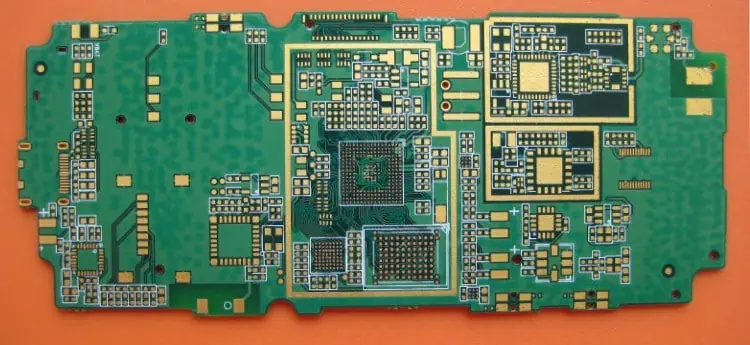
Good PCB silkscreen design makes the assembled product easier to build, inspect, connect and service. It places readable information where a person needs it, preserves clearance to functional surfaces and stays consistent with the engineering documentation. A dense collection of tiny references is not automatically more useful than a smaller set of clearly placed labels.
This page owns layout decisions: hierarchy, placement, orientation, polarity, connector labels and final checks. The Silkscreen PCB page explains printing routes, inks and manufacturing quality. Separating design placement from printing technology helps you solve the right problem before changing fonts or asking for a different ink.
Design for the assembled view
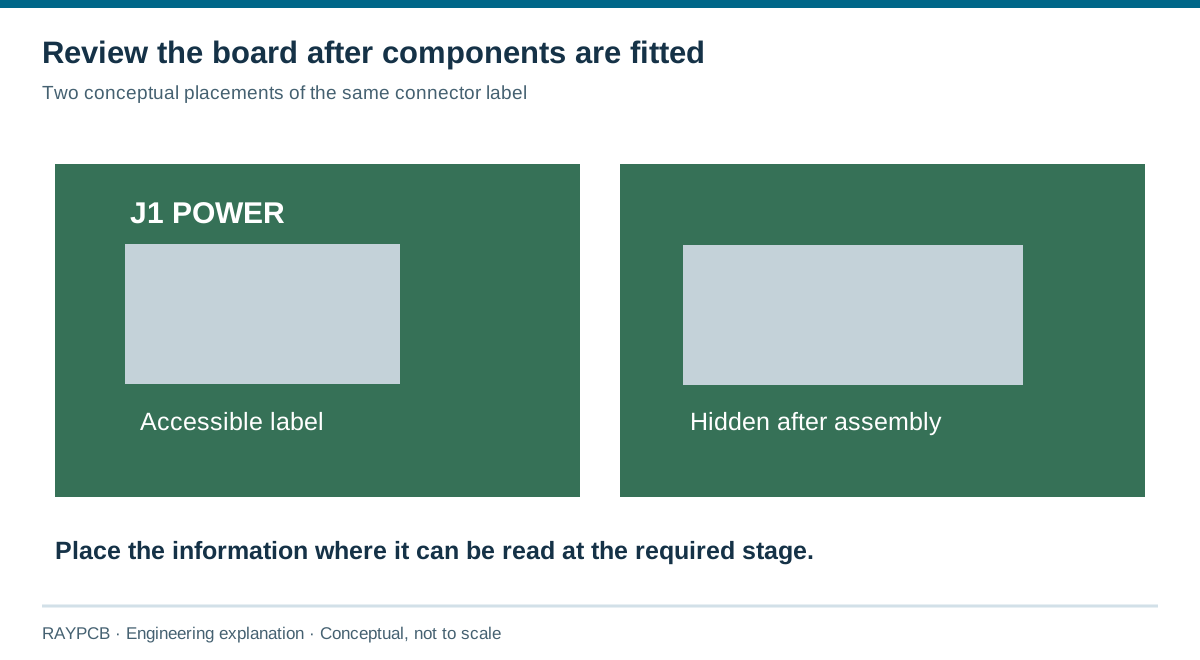
Begin with the component bodies, connectors, shields, heat sinks and enclosure features that will cover the bare board. A reference clearly visible in an empty-board render may disappear after assembly. Review the top and bottom sides from the directions in which a technician or user will actually see them. The physical task should determine the placement.
Reserve space early for polarity, connector functions and revision information. These marks can be more important than decorative text or a logo. If critical labels are left until routing is finished, the available areas may force poor choices. A small planning reservation near a connector can avoid a confusing label squeezed between unrelated components later.
Use a consistent orientation where practical, but do not force every label into one reading direction if it makes a connector ambiguous. A label should clearly belong to the feature it describes. Leaders or grouped labels can help in dense areas when their destination is unmistakable and they do not cross functional surfaces.
Give the most consequential information the clearest space
| Information | Why it matters | Placement priority |
|---|---|---|
| Polarity and orientation | Helps prevent an incorrect installation | Adjacent to the relevant part, visible at the needed stage |
| Connector identity and function | Guides wiring, testing and service | Readable from the connection or service direction |
| Revision and board identity | Associates hardware with documentation | A stable location that remains accessible |
| Component references | Supports inspection, rework and troubleshooting | Near the correct component without ambiguity |
| Test or service labels | Helps a person find the intended point | Visible under the actual service condition |
| Decorative or secondary text | Supports branding or convenience | After the functional information is resolved |
This hierarchy is a design aid, not a requirement to omit every secondary mark. The objective is to avoid sacrificing a meaningful polarity or connector label to preserve a less useful block of text. Review the result with the people who assemble and service the product, because they can identify ambiguity that is easy to miss in a CAD-only review.
Make orientation explicit rather than implied
Use a marking convention that matches the component documentation and assembly drawing. A plus sign, pin-one indicator, chamfer or outline cue can have different meanings in different contexts. Do not assume that any small symbol near a part will be interpreted correctly. The component's orientation requirement should be unambiguous in the released documentation.
Check whether the marking remains visible when it is needed. During placement, an outline or polarity cue may help before the component covers it. During service, a different visible reference may be necessary. If both tasks matter, the layout and assembly documentation should support both rather than relying on a single hidden mark.
Avoid placing an orientation mark where normal legend clipping could remove it. If a required sign sits too close to a mask opening, move the mark or revise the layout. A larger symbol is not helpful if half of it is removed during manufacturing. The clearance worksheet below makes the relevant allowances explicit.
Label the function from the user's side
A connector reference such as J1 helps identify the part in documentation. A functional label such as POWER or a clearly defined signal name can help installation and service. Decide which information belongs on the board and whether the viewing direction is obvious. Be particularly careful with mirrored bottom-side artwork and connectors accessed from an edge or opposite side.
Keep pin numbering and function labels consistent with the schematic, connector drawing and harness documentation. A visually attractive label can still be wrong if it is read from the wrong side. Where a connection is safety- or function-critical, the system documentation must establish the correct wiring; the PCB legend is one supporting interface, not the entire instruction set.
The design for assembly guide provides related guidance on component access and assembly review. For a broader product program, the electronic contract manufacturing page connects the board documentation with recurring build requirements.
Use the actual font geometry
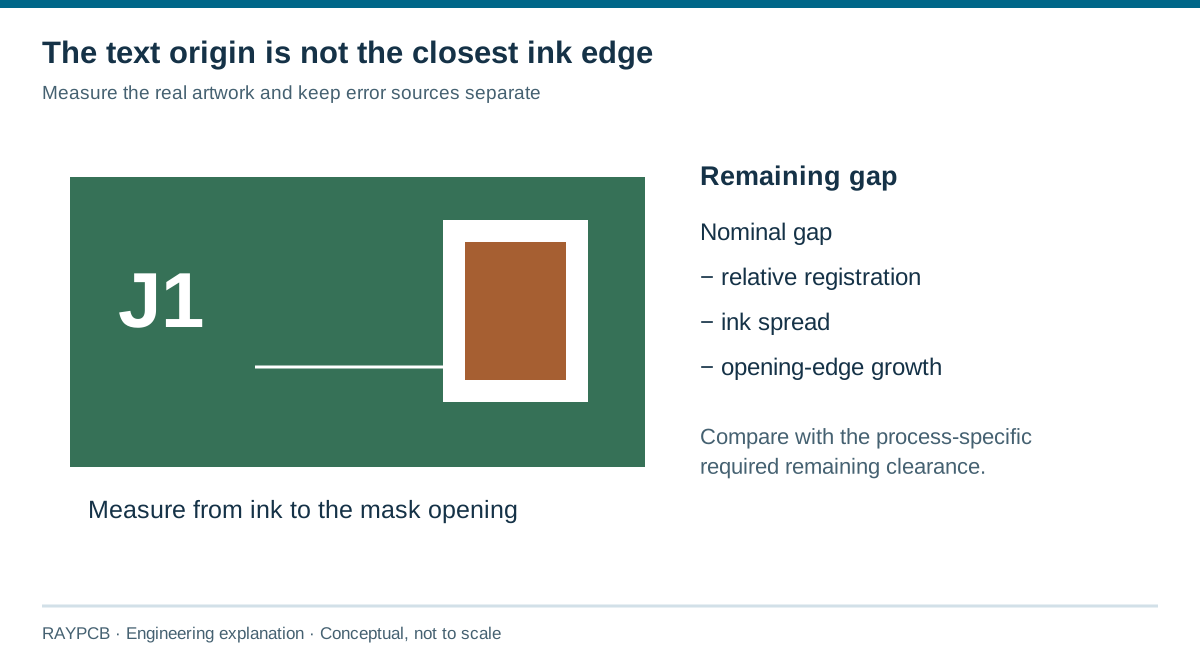
Character height, stroke width, spacing and font style work together. A text origin or nominal bounding box may not show the closest printed stroke to a nearby opening. Review the actual outlines in the exported data, especially for rotated text, punctuation, leaders and symbols. The nearest ink edge is the relevant geometry for clearance.
Do not solve every space problem by reducing font size. Shorten redundant wording, relocate the label or group related information before shrinking a critical identifier. Keep the assembly and service task readable. The text-zone planner on the Silkscreen PCB page helps screen a simple fixed-advance label envelope without claiming to simulate the font.
KiCad's PCB Editor documentation is an official reference for board text, rules and manufacturing outputs. Library guidance or software defaults can be useful starting points, but they are not universal fabrication acceptance limits. Review the chosen process guidance and the actual exported result.
Check the gap from ink to a mask opening
Measure the nominal distance from the actual ink outline to the nearest solder-mask opening. Enter the relative registration allowance, expected ink spread, opening-edge growth and the remaining gap required for your process. The tool subtracts these independent worst-case allowances and shows the margin to your requirement.
RAYPCB ENGINEERING
Manufacturing ProcessSilkscreen clearance budget
Loading Silkscreen clearance budget…
For an illustrative 0.25 mm nominal gap, allowances of 0.08 mm registration, 0.03 mm ink spread and 0.04 mm opening-edge growth leave 0.10 mm. If the entered required gap is 0.12 mm, the budget is short by 0.02 mm. This does not prescribe a universal minimum; it shows why a nominally clear CAD layout can still require discussion.
Use the correct reference edge. If the mask opening extends beyond the copper pad, measuring to copper can overstate the space available for legend. The solder-mask page explains those independent layers. The worksheet does not read Gerber files, locate the closest point automatically or predict actual ink behavior.
Check the exported layers, not only the editing view
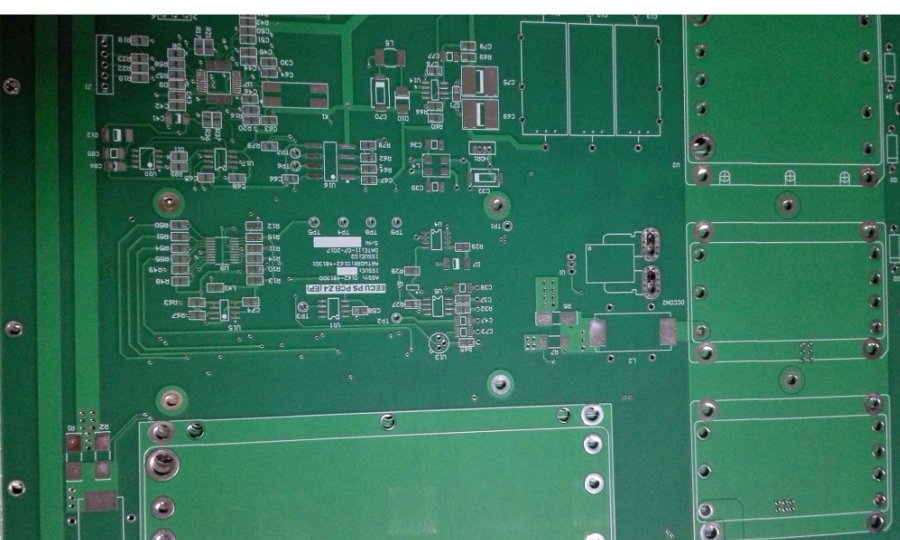
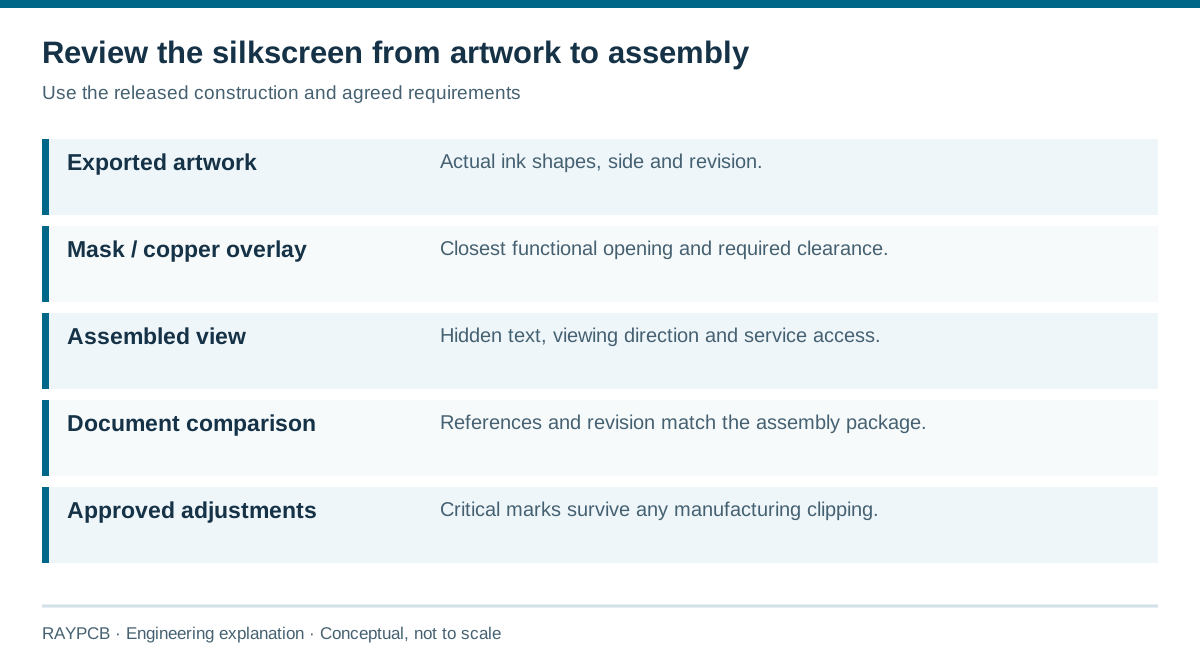
Review the final legend with the copper, mask and outline data for the same revision. Check that the correct side is present, text orientation is intentional and critical markings are not clipped. Confirm that reference changes made during annotation or schematic updates reached the final exported layers. A screenshot from an earlier layout stage is not sufficient evidence.
Inspect regions around fine-pitch parts, fiducials, test pads, edge contacts and mounting interfaces. Some surfaces need to remain clear for soldering, probing, optical recognition or mechanical contact. Identify the actual functional exclusion rather than applying one indiscriminate clearance everywhere. Where the manufacturer proposes clipping or moving artwork, review the effect on meaning as well as geometry.
The PCB files format guide helps organize the handoff. Ucamco's Gerber resources provide the authoritative format reference. The important workflow is a controlled export that describes the intended printed shapes and their layer functions without relying on a receiving engineer to reconstruct the design from a picture.
Three practical layout decisions
For a dense resistor network, individual references may fit only if they are scattered into unrelated spaces. A grouped labeling approach or a clear assembly drawing may be more useful than a crowded legend. Preserve an unambiguous association between the physical locations and the documentation. Do not leave a reference closer to the wrong component merely because that was the available empty space.
For a power connector, the reference and functional identity may need to remain visible after the mating cable is installed. A label directly beneath the connector body cannot serve that purpose. Move the relevant information to an accessible location and verify the reading direction. Retain the complete pin-function definition in the controlled documentation.
For a board with several revisions sharing the same outline, a stable and readable board-identity location can help avoid confusion during inspection and service. Define whether the marking is static artwork or variable production data. A placeholder serial number is not a traceability system, and a manually edited label needs an agreed control process.
Coordinate fabrication, assembly and service information
The board legend, bill of materials, placement data and assembly drawing should describe the same reference set and revision. Check the documents together before release. If a reference is intentionally omitted from the physical board, make sure that omission does not create ambiguity for the assembly or service task.
The required PCBA files guide explains the assembly handoff. Legend text should support those files, not attempt to replace them with every possible instruction printed on the board. Keep process notes and detailed acceptance requirements in the appropriate controlled documents.
Fix ambiguous artwork before it becomes rework
The main value of a clear legend is often reduced confusion rather than a lower printing price. Late artwork changes can trigger another review or interrupt an otherwise ready release. Missing polarity or mismatched references can complicate inspection and troubleshooting. Resolve critical labels while the layout is still easy to change.
For unusual fonts, colors, variable identifiers or durability requirements, ask for the proposed printing route and scope. Include the critical artwork with the enquiry through PCB Manufacturing. Customers who already have a complete release can submit it directly; the clearance tool is optional.
Silkscreen layout questions
Should I measure clearance to copper or to the mask opening?
Use the feature relevant to the printing exclusion. Where the opening extends beyond the copper, a copper-only measurement can overstate the available space. Review the actual mask opening and the intended exposed surface.
Is a CAD design-rule pass sufficient?
It confirms the checks configured in that tool, not every manufacturing or usability requirement. Review the rule values, exported layers, critical labels and assembled view. Software cannot decide whether a connector label is meaningful to the person using it.
Can I let the factory move every overlapping label?
Agree the permitted adjustments and require review for marks that affect orientation, connector meaning or traceability. Moving text can change its association with a component. The best correction often belongs in the controlled design, not in an undocumented production edit.
What is the most useful final review?
Compare the exported legend with mask openings and the assembled view, then verify references and revision against the assembly documentation. Check the information a person needs for the next task, especially polarity, connectors and board identity.
Discuss your silkscreen layout
Send the drawing revision, construction, quantity and the requirement that needs review. Identify any open material, geometry or acceptance question so the manufacturing response can address it.
Attach a downloaded worksheet manually. Contact does not automatically receive tool inputs. References reviewed September 2026. Schematics explain the engineering; reference photographs do not establish current equipment ownership or project qualification.