
RAYPCB · ENGINEERING & PROCUREMENT
Electronic Product Manufacturing Stages: From Requirements to Released Units
Electronic product manufacturing connects circuit boards with components, firmware, mechanics, testing, labeling and delivery. A populated board is often one intermediate output rather than the finished product. This guide follows the handoffs that an OEM or equipment brand needs to control, helping teams distinguish development decisions from manufacturing operations and identify the evidence needed before units are released.
Your task: Define the product requirements. Use the electronic product handoff map to record the next decision.
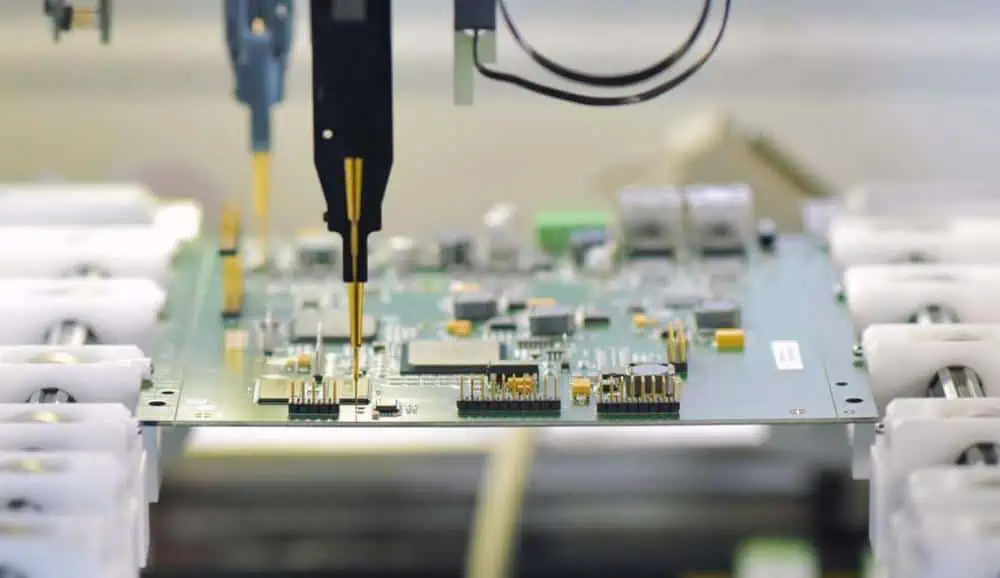
Define what the finished product must do
Start with the intended function, interfaces, environment and use conditions. Identify electrical, mechanical, software and market requirements and assign owners. A factory can build a clear specification; it cannot reliably infer an entire product definition from a photograph or competitor sample.
Decide the purchase boundary. You may need bare boards, assembled boards, an integrated device or a broader ongoing program. State which work remains with your team and which work is being requested.
This page owns the end-to-end stage map. For recurring supply responsibilities, continue to electronic contract manufacturing. For a custom scope that is still being defined, use custom electronics requirements.
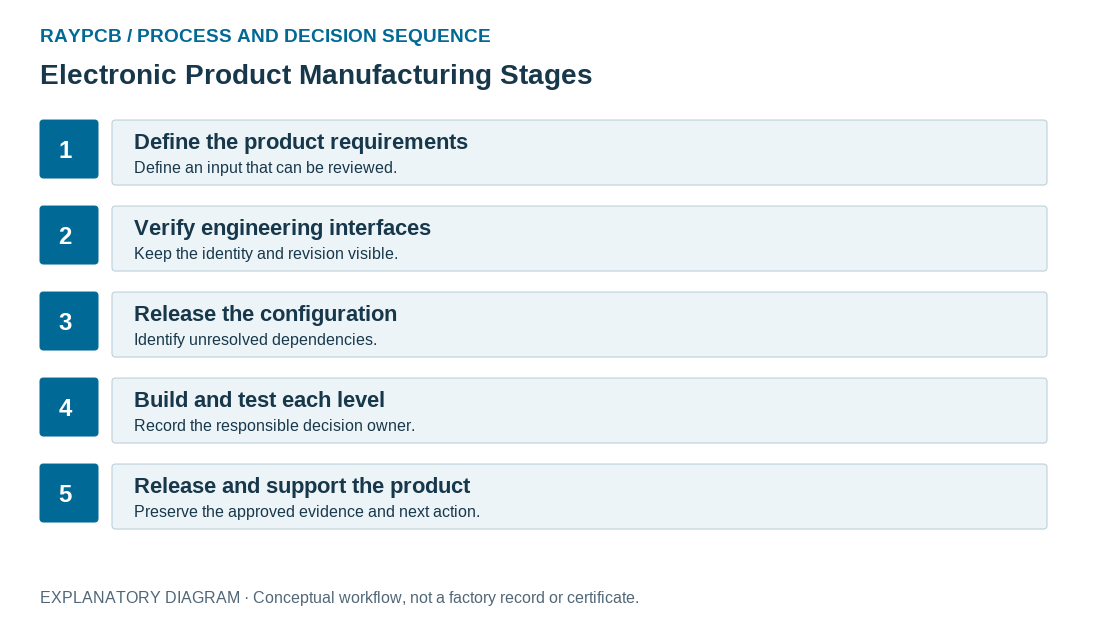
Develop and verify the engineering definition
Circuit design, PCB layout, firmware and mechanics must agree at their interfaces. Connector locations, power, cooling, mounting and programming access are common cross-team decisions. Review them before detailed work makes changes expensive.
Use prototypes to answer defined questions. A functional demonstration can support architecture decisions but may not represent the final construction or production route. Record those differences.
The hardware prototype development guide helps plan evidence-producing builds. A product should progress because its agreed questions are answered, not merely because a calendar milestone has arrived.
Release a coherent manufacturing package
Connect PCB fabrication data, BOM, placement, assembly drawing, mechanical drawings, firmware and test instructions through one configuration record. Identify the authoritative files and product variant.
Purchasing and engineering need to agree alternatives and material commitments. A component availability problem can affect both the board design and the software. Keep approval authority visible when schedule pressure increases.
The required PCBA files guide covers the board-level package. Product integration additionally needs wiring, fastening, labeling, configuration and packaging instructions where applicable.
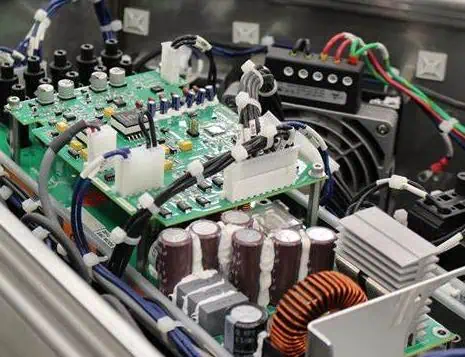
Prepare process and material readiness
Before assembly, confirm accepted materials, tooling, programs, fixtures and inspection instructions. The exact route depends on the design and scope. Specialized processes require their own reviewed requirements rather than being assumed from a generic service description.
Treat test development as a readiness task. Boards can finish assembly and still wait for software, a fixture or approved limits. Include those dependencies in the schedule.
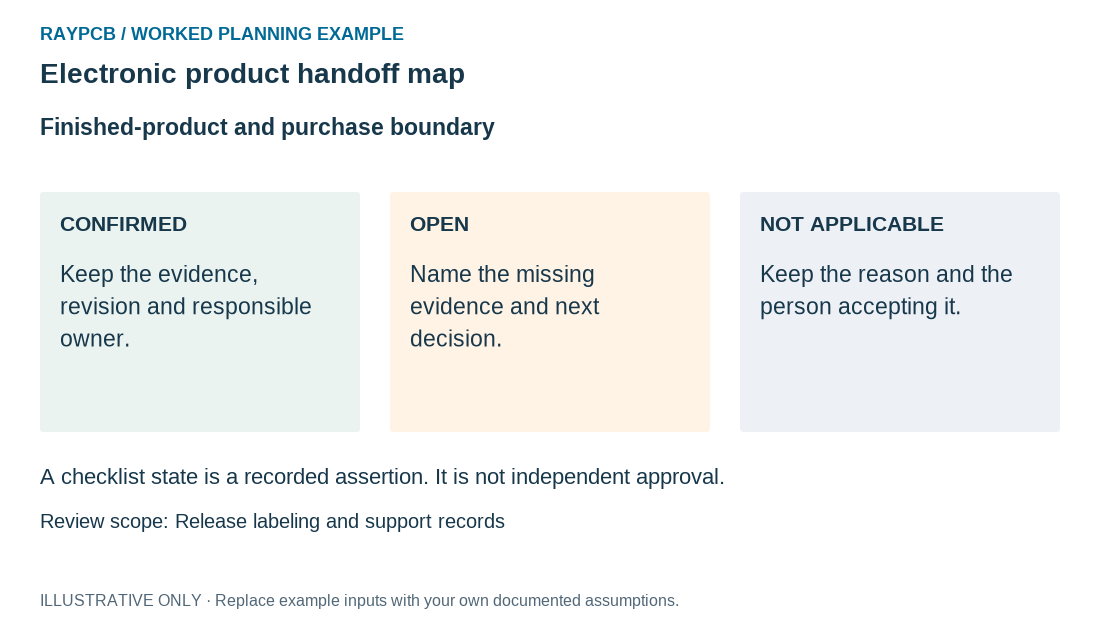
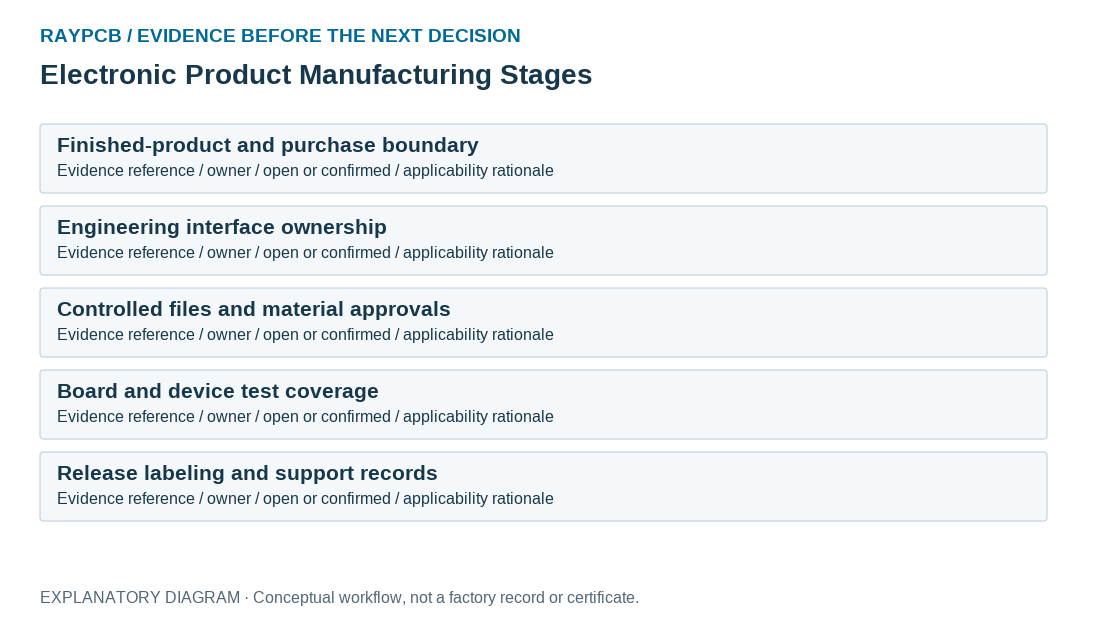
The handoff map below records stage ownership and missing evidence. It does not authorize production or predict manufacturing yield.
Electronic product handoff map
Electronic product handoff map
How to use and interpret this worksheet
Choose a narrow review boundary before filling in the worksheet. Use one product revision, one proposed build or one supplier decision. If several configurations differ, keep separate records or explain precisely which evidence applies to each. A short reference is enough; the tool does not need drawings, customer names, confidential part lists or passwords.
For every item, distinguish confirmed evidence from an unresolved assumption. Confirmed means that the responsible person has reviewed the relevant information, not merely that a document exists somewhere. Open means the decision or evidence is still missing. Not applicable requires a rationale because it is an applicability decision, not a shortcut to completion.
Record a concrete next action with an owner and a target decision point. For example, replace ask engineering with obtain the approved revision from the design owner before material release. The useful output is an actionable handoff, not a readiness percentage. No weighted score is used, because the consequence of one mandatory gap may exceed that of several completed items.
Load example only to learn the controls. Example mode remains clearly labeled even if you edit its values. Clear the form before entering your own review. Changing an input invalidates the old result and disables its download until you generate a new record. Download the current text if it helps your discussion; it is not automatically added to an enquiry.
Keep supporting approvals and measured results in the controlled project system. This worksheet stores nothing between visits and does not verify files, supplier statements or legal applicability. A completed record can support a review meeting, but the authorized team remains responsible for the release decision.
Use the output to identify the next decision, then keep actual approvals in the controlled project record.
Keep a decision record with the review
Use this record to connect the discussion to supporting information. Record the source, revision and reviewer for each item. Confirmed means the responsible person has reviewed the evidence; it does not mean this website has verified it. Keep confidential documents in your approved project system.
| Review topic | Record to retain | When it remains open |
|---|---|---|
| Finished-product and purchase boundary | Identify the controlled scope and the person authorized to approve it. Keep the current reference together with the intended decision. | Clarify the boundary before treating the review as a release instruction. |
| Engineering interface ownership | Reference the actual file, data source or agreed requirement, including its revision or date and the person who reviewed it. | Request the missing evidence and identify which downstream decision depends on it. |
| Controlled files and material approvals | Record the conditions and assumptions that make the evidence applicable. Separate a proposed value from an approved requirement. | Keep the assumption visible and define whether the next activity may proceed under a bounded exception. |
| Board and device test coverage | Identify responsibility for the next operation and the evidence expected afterward. Distinguish preparation from a completed result. | Assign a named role and an agreed decision point; do not turn an unanswered question into an approval. |
| Release labeling and support records | Record the final disposition, affected quantity or revision and the authority accepting it. Preserve the reason for any exception. | Retain the item in the action list and review its consequence before committing work or materials. |
Review the record again when the product, supplier proposal or supporting data changes. A result from an earlier revision is historical evidence, not automatic approval for the current one. If an item is not applicable, retain the reason and the person who made that decision.
Build, inspect and test at the appropriate levels
Bare-board fabrication, component assembly and device integration introduce different risks and require different checks. Inspection can identify workmanship conditions; electrical and functional tests address other aspects of behavior. Define coverage rather than relying on one broad tested label.
Programming should connect the approved software image and configuration to the correct hardware. Final device tests may depend on enclosure, harnesses, sensors or loads that are not present during board-level testing.
A hypothetical gateway can pass a PCB functional test yet fail a final radio check after enclosure assembly. The lesson is to test at the level where the relevant requirement exists. This is an illustrative scenario, not a RAYPCB performance claim.
Control system integration and release
Assembly instructions should define wiring, fasteners, thermal interfaces, labels and configuration as applicable. Approved drawings and procedures establish the requirements; an operator should not have to infer them from a sample alone.
Record final acceptance and disposition of nonconforming units. Distinguish first-pass results, rework, retest and final release so the evidence remains useful for improvement.
Use electronic device assembly for integration details. The quality assurance page connects inspection and test topics. Neither page substitutes for product-specific safety or regulatory work.
Plan logistics and the next revision
Packaging, labeling, destination requirements and accompanying records can affect shipment readiness. Agree them before the lot is complete. Identify serial or lot information needed for support and later investigations.
After release, manage engineering changes and component lifecycle information against the controlled baseline. A successful first shipment does not eliminate the need to review subsequent changes.
The NPI manufacturing guide describes progression into repeat production. For applicable process and acceptance documents, consult the IPC standards framework and assign a qualified owner for product-specific obligations.
Questions about an end-to-end manufacturing request
Does PCB assembly include a finished device? Only when enclosure integration, firmware, test, labeling and other required operations are explicitly included.
Can manufacturing begin before all design decisions are complete? Some bounded activities may proceed under an agreed plan, but unresolved decisions and material commitments need explicit control.
What should RAYPCB receive? Describe the finished output, current development stage, available files, quantities and responsibilities you want quoted. PCB manufacturing and PCB assembly remain the specific board-level routes. You can ask for scope review directly without filling in the tool.