
RAYPCB · MANUFACTURING DECISIONS
Choose a PCB manufacturer against the construction you need
Evaluate manufacturing fit, inspection records, material traceability and quotation scope. Build an evidence request for RAYPCB without relying on unrelated capability maxima.
Bring a drawing or an open engineering question. Tool use is optional.
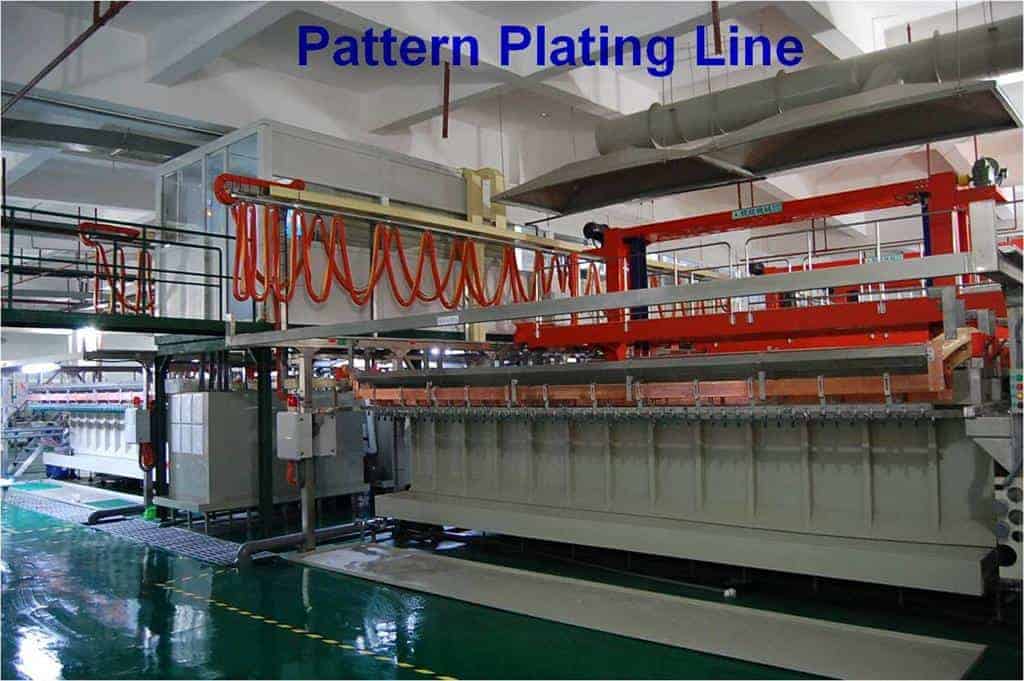
How do you choose a PCB manufacturer?
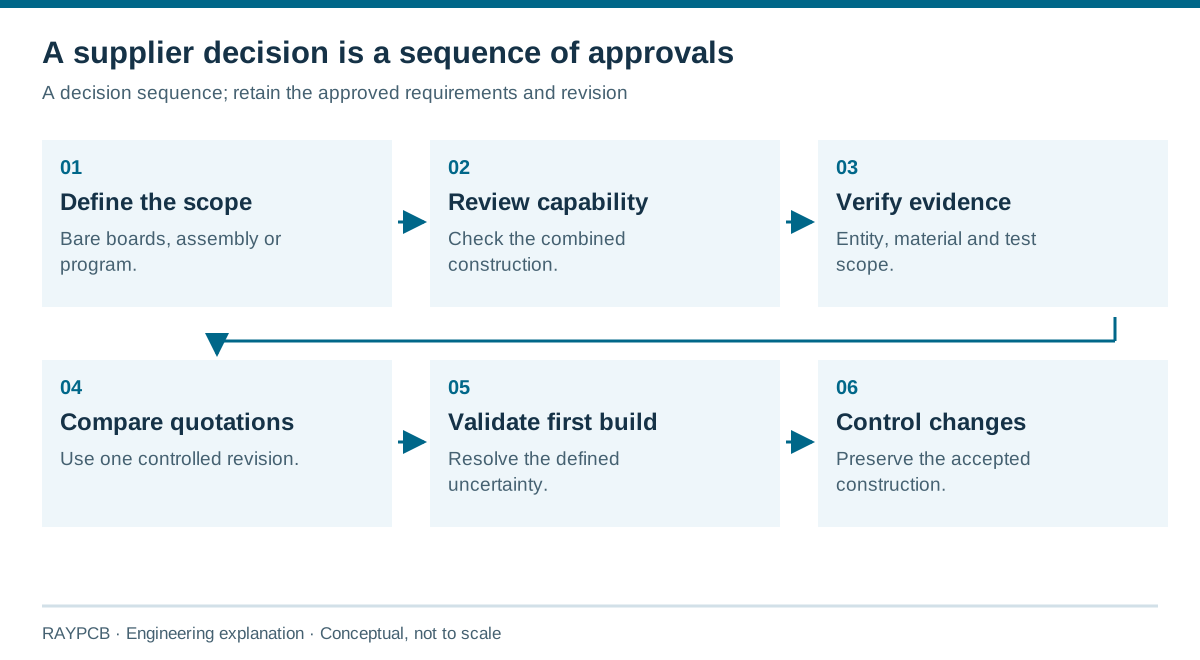
A PCB manufacturer should be evaluated against the board you need to build, the evidence you need to receive and the way the supplier handles changes. A capability table, certificate or attractive unit price can help start the discussion, but none describes the whole manufacturing relationship. The useful question is whether the proposed site and process can deliver your released construction with an agreed acceptance scope and repeatable documentation.
This page is a buyer's evaluation guide. It helps engineers and procurement teams prepare a shortlist, ask comparable questions and review a quotation. The PCB Manufacturing service page covers RAYPCB's fabrication enquiry route, while the PCB manufacturing process guide explains the production sequence. Keeping these tasks separate makes the next step clearer.
Define what you are actually buying
Begin with the deliverable: bare boards, assembled boards or an ongoing product-manufacturing program. These scopes require different evidence and commercial assumptions. A bare-board order may focus on laminate identity, geometry, interconnects and electrical test. An assembly order adds component sourcing, placement, soldering, inspection and potentially firmware or functional test. A continuing OEM program adds change control, supply continuity and recurring reporting.
Use the PCB Assembly hub for board-level component assembly. For a longer-running product program with broader coordination requirements, the electronic contract manufacturing page is the more appropriate service owner. Do not compare a bare-board price with a turnkey assembly proposal as though they quote the same work.
Write a short requirement brief before evaluating suppliers. Include board type, layer structure, critical geometry, material constraints, quantities, delivery need and acceptance requirements. Identify the one or two features most likely to challenge manufacturing. This makes the supplier response much more informative than a broad request for the cheapest PCB.
Ask whether the complete combination is supported
A capability table often lists limits individually. The minimum trace, smallest hole, highest layer count and thickest copper may not be available simultaneously in one construction. Ask the manufacturer to review the actual combination rather than assembling a theoretical board from unrelated best-case limits. The response should identify any required changes or unresolved assumptions.
For a multilayer board, review the proposed stackup, drill spans, copper requirements and material construction together. For flex or rigid-flex, add the region drawing and mechanical task. For ceramic or metal-backed work, identify the circuit-forming route and assembly interface. The relevant PCB material directory helps explain why a brand name alone does not define a construction.
Evidence can include a reviewed drawing response, a proposed stackup, an agreed inspection plan or an appropriate process qualification record. A photograph of a similar-looking board is a useful conversation starter but does not establish the internal construction or acceptance level of your order. Ask what the example actually demonstrates before treating it as proof of a critical capability.
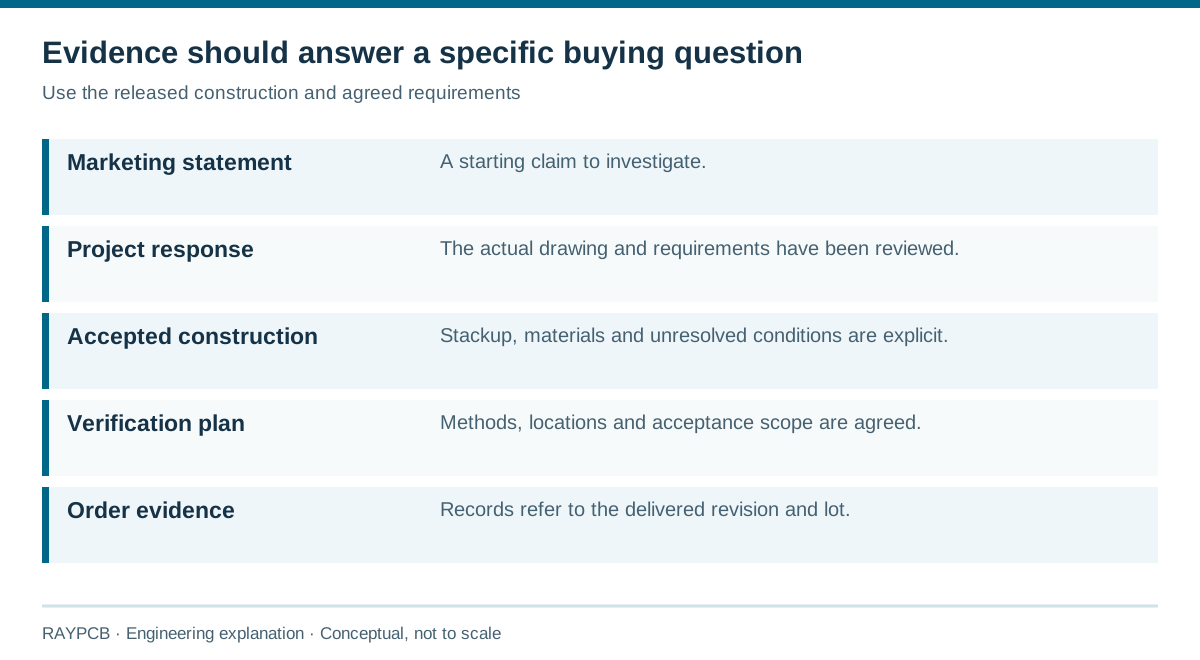
Verify the entity, site and certification scope
Record the legal entity responsible for the order and the production location relevant to the quoted work. If operations are distributed or subcontracted, clarify which organization controls the requirements and change approval. This is not automatically a problem; the important point is that accountability and traceability are clear enough for the program.
When certification is required, obtain the current certificate and check the entity, site, scope, issuing body and validity. A certificate for a different activity or location may not answer your requirement. ISO's certification guidance explains the distinction between standards, certification and accreditation, including routes for verifying accredited certificates. ISO itself does not issue company certificates.
Treat certification and product evidence as related but distinct. A management-system certificate does not substitute for the drawing, inspection results or product-specific qualification needed for your board. Likewise, a successful prototype does not by itself establish a complete quality-management scope. Ask for each kind of evidence only where it serves an actual requirement.
Define what the acceptance plan will prove
Turn critical requirements into an inspection matrix. For each characteristic, record the method, location, coverage or sample plan, acceptance criterion and required record. Examples include finished thickness, critical hole size, conductor geometry, impedance where specified, electrical connectivity and structural interconnect evidence. The exact matrix depends on the construction and order scope.
Ask what is tested on every delivered piece and what is evaluated through representative samples or coupons. A report should make that distinction clear. Electrical continuity, optical inspection, dimensional measurement and destructive section analysis answer different questions. None should be described as a universal test of every property simply because it appears on a certificate of conformity.
For relevant rigid-board work, the IPC-6012 contents identify the document's qualification and performance scope. The purchase requirement must specify the applicable revision and classification where relevant. Avoid a vague “IPC compliant” statement without a defined product scope, and do not impose a class solely as a marketing label.

Build a supplier evidence worklist
The worksheet below tracks whether seven evidence categories have been requested, received and reviewed for this project. It deliberately does not award a supplier score. A document's existence does not prove its validity, and different projects require different depths of review. Use the result to identify the next conversation or document request.
RAYPCB ENGINEERING
Manufacturing ProcessSupplier evidence worklist
Loading Supplier evidence worklist…
For example, a received material declaration may still need comparison with the approved drawing. A requested test plan may not yet define sampling or acceptance. Marking either item as complete too early hides an open decision. The worklist separates those states so the procurement team can see what remains to be resolved before release.
Keep confidential supplier records and project data in your controlled systems. This tool processes selected status labels in the browser and produces a plain-text brief when requested; it does not upload certificates or verify them against an external database. The downloadable summary can be attached manually to an internal review or an enquiry.
Compare quotes against one controlled specification
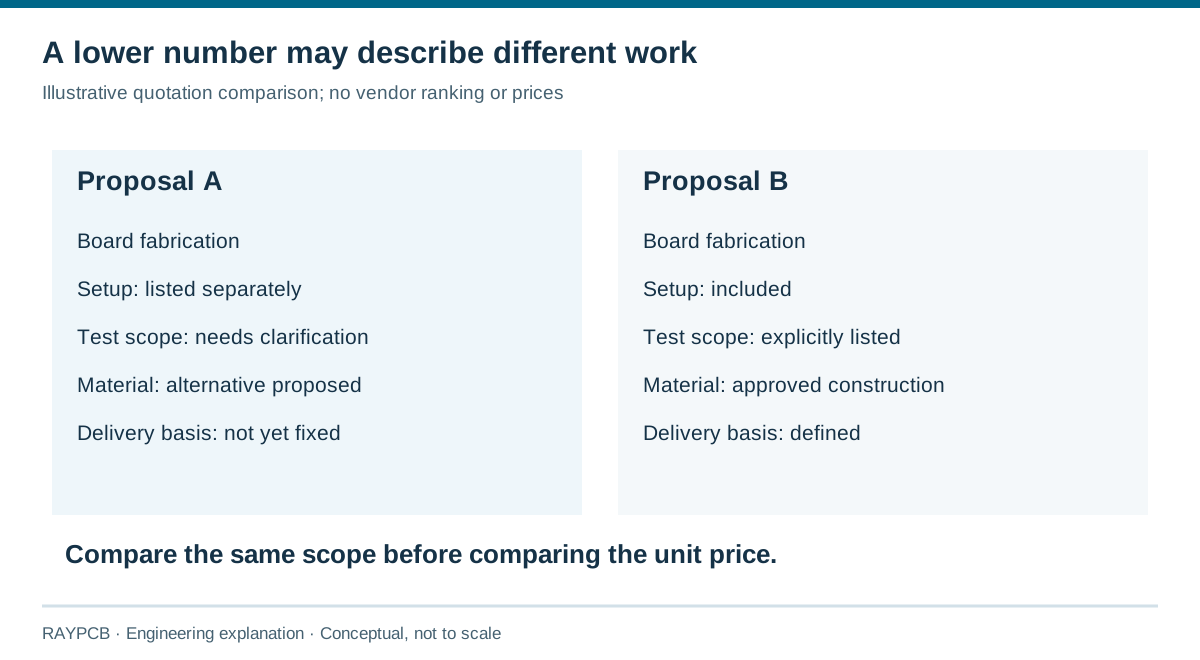
Send the same revision and requirement set to each supplier. Include the layer stack, material and alternative policy, copper by layer, finish, hole requirements, panelization assumptions, quantity breaks and inspection scope. If a supplier proposes a change, identify it as an alternative rather than mixing it into a comparison column without explanation.
Separate unit fabrication cost from setup, tooling, test fixtures, special documentation, shipping and other relevant charges. Clarify the quantity basis: good delivered boards, panel positions or a production lot with an agreed yield basis. An apparently low price can become difficult to compare when the quotation does not state what is included.
Material lead time, manufacturing time and transit time are also different intervals. Ask when the quoted clock starts and which approvals or procurement steps must happen first. A preliminary delivery statement should not be treated as a committed shipment date before the material and technical questions are resolved.
Use the first build to reduce a defined uncertainty
A useful prototype order has a validation purpose. It may test enclosure fit, an impedance construction, a thermal path, a flex installation or an assembly process. Explain that purpose so the supplier can discuss coupons, inspection and documentation that support the decision. Ordering samples without stating what they must demonstrate can produce boards without the evidence needed for release.
The PCB Prototype guide helps prepare a first-build package. Keep the prototype drawing, supplier clarifications and actual delivered construction together. If the build requires a deviation, record it explicitly so later engineering results are not attributed to a construction that was never made.
After evaluation, distinguish design changes from manufacturing corrections. A new pad layout, laminate or finish can affect the next build and may require an updated quote or verification plan. Close the loop with a released revision rather than relying on informal instructions spread across emails and old purchase orders.
Review how repeat orders and changes are controlled
For production, ask how the supplier identifies a lot, associates it with the correct revision and controls relevant material or process changes. The appropriate level of traceability depends on the program. The requirement should be concrete enough to determine what records accompany the order and what can be retrieved later.
Define the alternative-material approval route in advance. A substitute may affect electrical modeling, press behavior, drill preparation, assembly exposure or qualification. Similar catalog numbers do not establish equivalence. The material specification guide helps turn the comparison into a reviewable requirement.
Discuss nonconformance handling before a problem occurs. Identify who communicates the issue, what evidence is supplied, how containment is described and how a proposed disposition is approved. The objective is a clear working process, not a promise that no defect or delay can ever occur. A professional response should make the current situation and next action understandable.
Evaluate the cost of the whole build decision
Unit price is important, but it is not the only cost affected by supplier selection. Unclear requirements can create engineering iterations, repeat tooling, assembly disruption or retesting. A slightly different laminate or panel arrangement can change downstream work. Compare the complete accepted scope and the effort required to make the delivered boards usable.
Avoid universal rankings of manufacturers based on a single published price or minimum feature. The best fit for an uncomplicated prototype may differ from the best fit for a controlled RF, flex or product program. Use the requirement brief and evidence worklist to make the comparison specific to your board and quantity.
If you are ready to discuss RAYPCB as a supplier, send the current drawing package and the critical acceptance requirements through Contact. If the design is preliminary, identify the open questions. A useful response can then focus on the proposed construction, scope and next engineering decision rather than a generic capability claim.
PCB manufacturer selection questions
Is the lowest quoted price the best comparison point?
Only after the quoted scopes match. Confirm revision, material, finished construction, quantity basis, inspection, tooling and delivery terms. A price difference may reflect an omitted requirement or a proposed alternative rather than a simple difference in manufacturing efficiency.
Should I choose a manufacturer from its minimum trace and hole limits?
Use those limits for an initial screen, then request a review of the full design combination. A minimum feature may depend on copper, thickness, material, layer count and process route. The accepted drawing response is more useful than combining independent table limits.
Does a certificate prove the specific PCB is qualified?
No. Check the certificate's actual scope, and separately define the product's construction and required qualification or inspection evidence. Certification and lot acceptance are different parts of supplier evaluation and should not be merged into one claim.
Can I ask for a review before all details are fixed?
Yes. Send the current revision and clearly mark unresolved material, geometry or test requirements. Explain the function behind those questions. Preliminary information can support a useful engineering discussion when its status is explicit.
What should be retained after the first successful order?
Keep the approved files, stackup, material identities, accepted exceptions, inspection scope and relevant results with the order history. For a repeat build, reference that controlled package and identify changes explicitly. This gives procurement and engineering a common basis for the next release.
Discuss your supplier requirements
Send the drawing revision, construction, quantity and the requirement that needs review. Identify any open material, geometry or acceptance question so the manufacturing response can address it.
Attach a downloaded worksheet manually. Contact does not automatically receive tool inputs. References reviewed September 2026. Schematics explain the engineering; reference photographs do not establish current equipment ownership or project qualification.