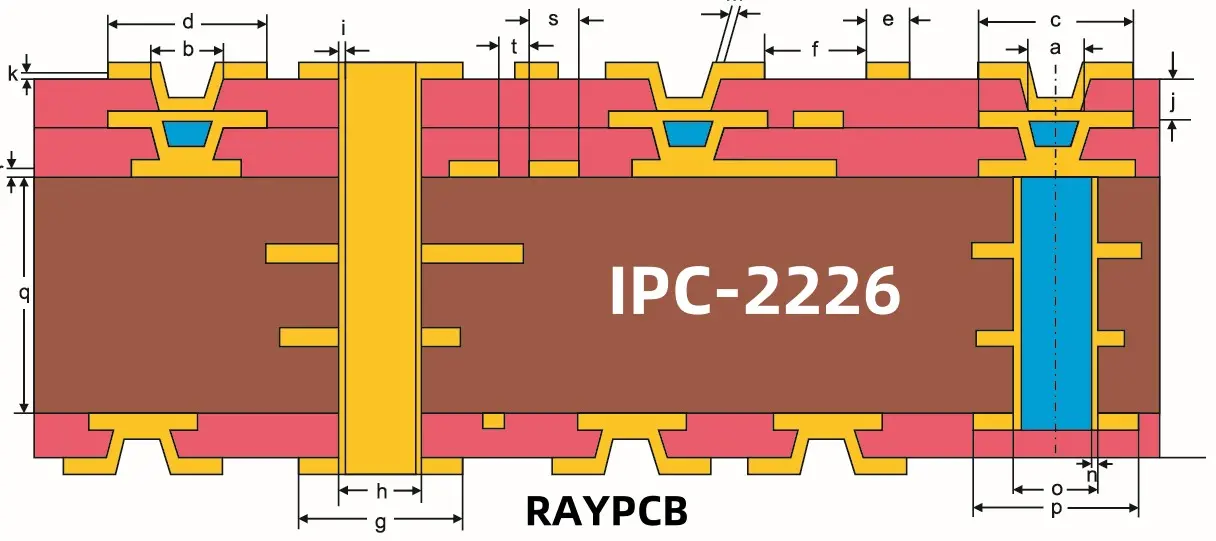
IPC-2226: Sectional Design Standard for High Density Interconnect (HDI) Printed Boards

In the rapidly evolving world of electronics, the demand for smaller, faster, and more complex devices continues to grow. This has led to the widespread adoption of High Density Interconnect (HDI) technology in printed circuit board (PCB) design. To ensure consistency, reliability, and manufacturability in HDI PCBs, the industry relies on standards such as IPC-2226. This comprehensive guide will explore the key aspects of IPC-2226, its importance in HDI PCB design, and how it impacts the electronics manufacturing industry.

What is IPC-2226?

IPC-2226 is a sectional design standard developed by the Institute for Printed Circuits (IPC) specifically for High Density Interconnect (HDI) printed boards. This standard provides guidelines, requirements, and best practices for designing HDI PCBs, which are characterized by their use of microvias, fine lines, and advanced lamination techniques.

Key Objectives of IPC-2226

  1. Establish common terminology for HDI PCB design
  2. Define HDI structures and their characteristics
  3. Provide design guidelines for reliable HDI PCBs
  4. Ensure consistency in HDI PCB manufacturing processes
  5. Promote best practices for HDI PCB design and fabrication

Scope of IPC-2226

IPC-2226 covers various aspects of HDI PCB design, including:

  • Microvia structures and types
  • Layer stack-up designs
  • Material selection considerations
  • Design rules for line width and spacing
  • Pad and land pattern guidelines
  • Testing and reliability requirements

Powered By EmbedPress

The Importance of IPC-2226 in HDI PCB Design
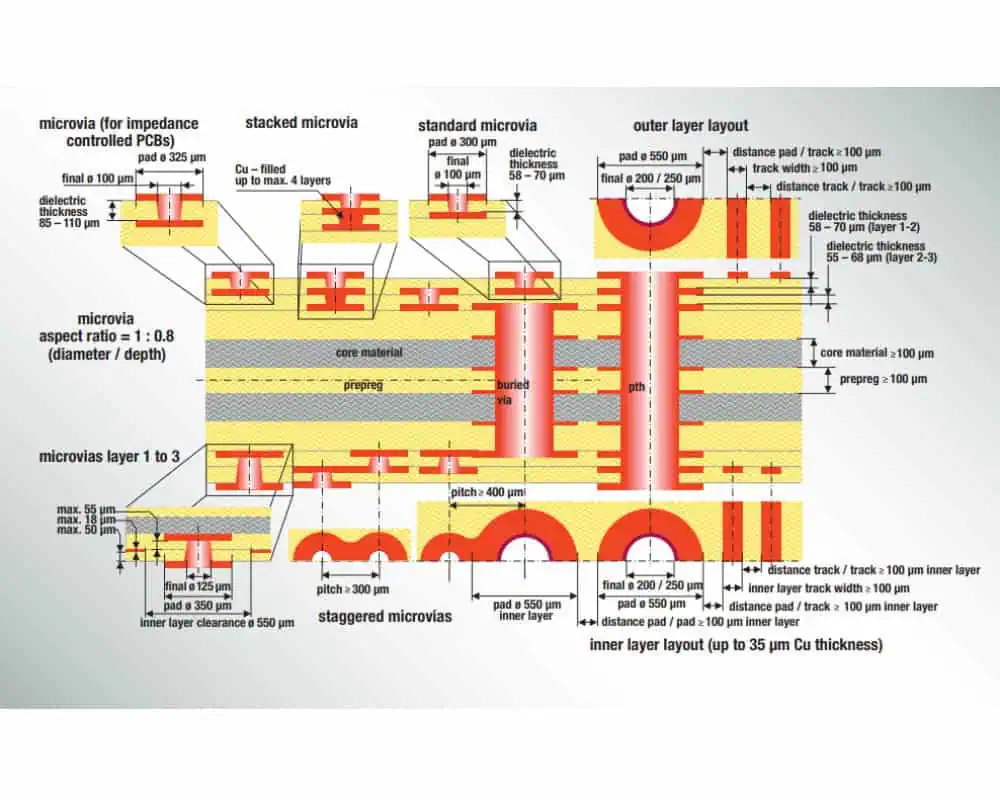
As HDI technology becomes increasingly prevalent in electronics manufacturing, adherence to IPC-2226 offers several crucial benefits:

1. Standardization

IPC-2226 provides a common language and set of guidelines for HDI PCB design, ensuring consistency across different manufacturers and designers.

2. Reliability

By following IPC-2226 guidelines, designers can create HDI PCBs that meet stringent reliability requirements, crucial for applications in industries such as aerospace, medical devices, and telecommunications.

3. Manufacturability

The standard addresses key manufacturability concerns, helping designers create HDI PCBs that can be produced efficiently and cost-effectively.

4. Performance

IPC-2226 guidelines help optimize HDI PCB designs for electrical performance, addressing issues such as signal integrity and impedance control.

5. Innovation

While providing a framework for HDI PCB design, IPC-2226 also allows for innovation and advancement in HDI technology.

Read more about:

Key Components of IPC-2226

Let’s delve into some of the critical components of the IPC-2226 standard:

HDI Structure Types

IPC-2226 defines several types of HDI structures, each with its own characteristics and applications:

Type I HDI

  • Single microvia layer on each side of the core
  • Suitable for moderate density requirements
  • Relatively simple manufacturing process

Type II HDI

  • Multiple microvia layers on each side of the core
  • Higher density than Type I
  • More complex manufacturing process

Type III HDI

  • Microvias that connect three or more layers
  • Highest density option
  • Most complex manufacturing process
  • Subtypes include stacked microvias and staggered microvias

Microvia Definitions and Requirements

IPC-2226 provides detailed specifications for microvias, including:

  • Size definitions (typically โ‰ค150ฮผm in diameter)
  • Aspect ratio guidelines
  • Plating requirements
  • Reliability testing criteria

Layer Stack-Up Design

The standard offers guidelines for designing HDI layer stack-ups, considering factors such as:

  • Number of layers
  • Microvia types and placement
  • Impedance control requirements
  • Signal integrity considerations

Material Selection

IPC-2226 addresses the selection of materials for HDI PCBs, taking into account:

  • Dielectric materials suitable for laser drilling
  • Copper foil types and thicknesses
  • Thermal management considerations
  • Electrical performance requirements

Design Rules

The standard provides specific design rules for HDI PCBs, including:

Implementing IPC-2226 in HDI PCB Design

To effectively implement IPC-2226 in HDI PCB design, consider the following steps:

1. Familiarize Yourself with the Standard

  • Obtain a copy of the IPC-2226 document
  • Study the terminology and definitions used in the standard
  • Understand the different HDI structure types and their applications

2. Assess Your Design Requirements

  • Determine the required circuit density
  • Evaluate signal integrity and impedance control needs
  • Consider thermal management requirements
  • Assess reliability expectations based on the intended application

3. Choose the Appropriate HDI Structure

  • Select the HDI type (I, II, or III) that best meets your design requirements
  • Consider manufacturability and cost implications of different HDI structures

4. Design Your Layer Stack-Up

  • Follow IPC-2226 guidelines for layer stack-up design
  • Consider signal layer pairing and reference planes
  • Optimize for impedance control and signal integrity

5. Apply Design Rules

  • Implement IPC-2226 design rules for line width, spacing, and pad sizes
  • Adhere to microvia design guidelines, including aspect ratios and land patterns

6. Select Appropriate Materials

  • Choose dielectric materials suitable for HDI applications
  • Consider copper foil types and thicknesses recommended by IPC-2226

7. Plan for Manufacturability

  • Consult with your PCB manufacturer to ensure alignment with IPC-2226 requirements
  • Consider design for manufacturing (DFM) guidelines specific to HDI PCBs

8. Implement Reliability Testing

  • Follow IPC-2226 recommendations for reliability testing
  • Consider additional testing based on your specific application requirements

Challenges in Implementing IPC-2226

While IPC-2226 provides valuable guidelines for HDI PCB design, implementing the standard can present some challenges:

1. Complexity

HDI PCB design is inherently complex, and fully understanding and implementing all aspects of IPC-2226 can be challenging, especially for those new to HDI technology.

2. Balancing Requirements

Designers often need to balance various requirements, such as density, performance, reliability, and cost. Strictly adhering to IPC-2226 may sometimes conflict with other design objectives.

3. Rapid Technological Advancements

As HDI technology continues to evolve rapidly, keeping the standard up-to-date with the latest advancements can be challenging.

4. Manufacturing Capabilities

Not all PCB manufacturers may have the capability to produce HDI boards that meet all IPC-2226 requirements, potentially limiting design options.

5. Cost Considerations

Implementing some aspects of IPC-2226 may increase manufacturing costs, which needs to be balanced against performance and reliability requirements.

Future Trends and IPC-2226

As HDI technology continues to advance, we can expect to see ongoing updates and revisions to IPC-2226. Some potential future trends include:

1. Even Higher Density

Future revisions of IPC-2226 may address even higher density HDI structures, potentially defining new types beyond the current Type III.

2. Advanced Materials

As new materials are developed for HDI applications, IPC-2226 may be updated to include guidelines for their use and implementation.

3. Integration with Other Standards

We may see closer integration between IPC-2226 and other related standards, such as those dealing with flex and rigid-flex circuits or embedded components.

4. Additive Manufacturing

As additive manufacturing techniques become more prevalent in PCB production, IPC-2226 may be updated to address design considerations specific to these processes.

5. Artificial Intelligence and Machine Learning

Future versions of IPC-2226 might incorporate guidelines for using AI and ML in HDI PCB design and verification processes.

Conclusion

IPC-2226 plays a crucial role in standardizing and guiding the design of High Density Interconnect (HDI) printed boards. By providing comprehensive guidelines for HDI structures, materials, design rules, and reliability requirements, this standard helps ensure the production of high-quality, reliable HDI PCBs that meet the demands of modern electronic devices.

As the electronics industry continues to push the boundaries of miniaturization and performance, the importance of standards like IPC-2226 will only grow. Designers and manufacturers who familiarize themselves with this standard and implement its guidelines will be well-positioned to create cutting-edge HDI PCBs that meet the evolving needs of the market.

While implementing IPC-2226 can present challenges, the benefits in terms of standardization, reliability, and manufacturability make it an essential tool in the HDI PCB design process. As technology advances, we can expect IPC-2226 to evolve alongside it, continuing to provide valuable guidance for the next generation of HDI PCBs.

By staying informed about updates to IPC-2226 and related standards, PCB designers and manufacturers can ensure they remain at the forefront of HDI technology, creating innovative and reliable electronic products that push the boundaries of what’s possible in modern electronics.
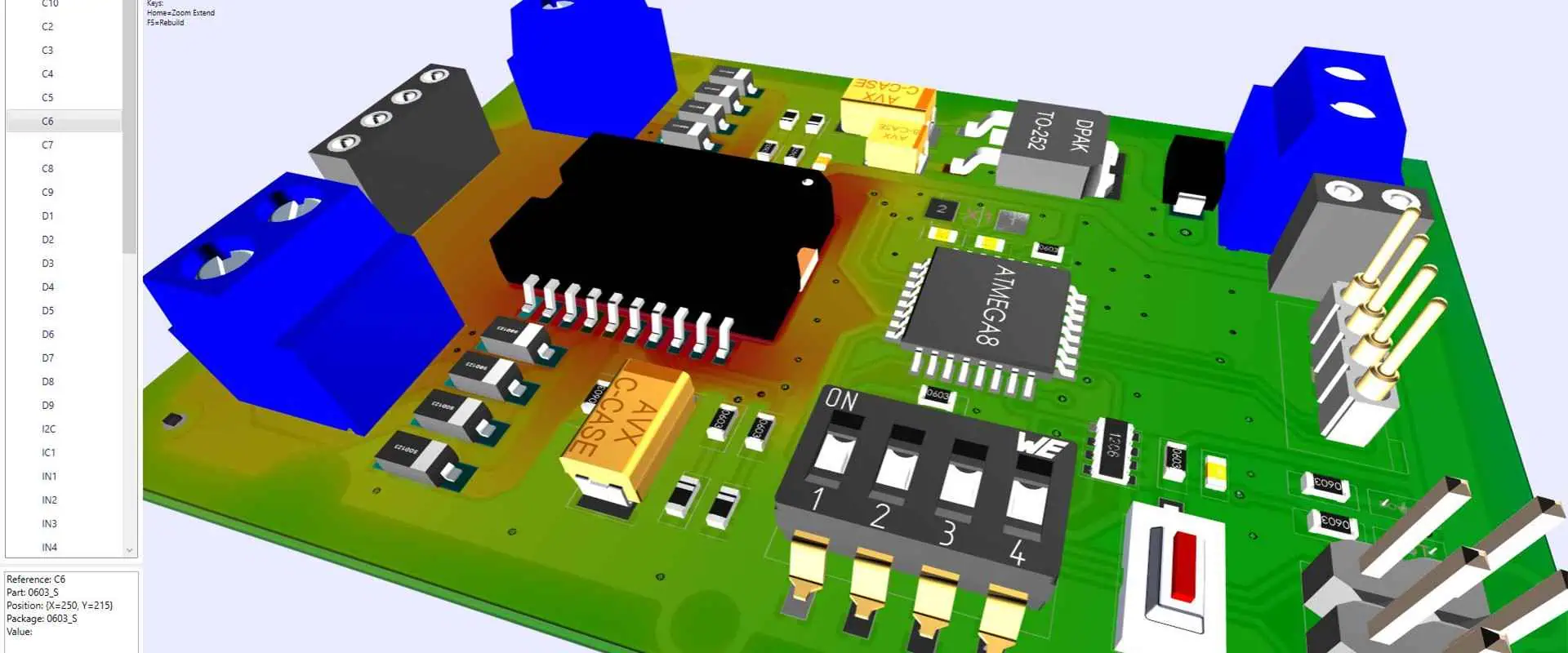
Advanced PCB Thermal Management: Strategies for Heat Dissipation in High-Power Designs

fr4 thermal conductivity

In the rapidly evolving world of electronics, printed circuit boards (PCBs) are becoming increasingly complex and powerful. With this surge in capability comes a significant challenge: managing the heat generated by these sophisticated components. Effective PCB thermal management is crucial for ensuring the reliability, longevity, and performance of electronic devices. This comprehensive guide delves into the intricacies of PCB thermal management, exploring various strategies and techniques for optimal heat dissipation in high-power designs.

YouTube video

What is PCB Thermal Management?

PCB thermal management refers to the process of controlling and dissipating heat generated within a printed circuit board assembly. It encompasses a range of techniques and strategies aimed at maintaining the temperature of electronic components within their specified operating ranges. Effective thermal management is critical for preventing thermal-related failures, ensuring consistent performance, and extending the lifespan of electronic devices.

Key Objectives of PCB Thermal Management:

  1. Maintain component temperatures within safe operating limits
  2. Enhance overall system reliability and performance
  3. Prevent thermal-induced failures and malfunctions
  4. Optimize power efficiency
  5. Extend the lifespan of electronic components and systems

Why is PCB Thermal Management in Some Electronics Difficult?

Thermal Clad PCB
Thermal Clad PCB

Managing heat in PCBs can be challenging for several reasons:

  1. Increasing Power Density: As electronic devices become smaller and more powerful, the amount of heat generated per unit area increases dramatically.
  2. Complex Designs: Modern PCBs often feature multi-layer designs with high component density, making heat dissipation more complicated.
  3. Material Limitations: PCB materials have inherent thermal conductivity limitations, which can impede efficient heat transfer.
  4. Diverse Operating Environments: Electronics may need to function in a wide range of environmental conditions, from extreme cold to high heat and humidity.
  5. Conflicting Design Requirements: Balancing thermal management with other design considerations like signal integrity, EMI shielding, and cost can be challenging.
  6. Miniaturization Trends: The drive towards smaller, thinner devices limits the space available for traditional cooling solutions.

Powered By EmbedPress

Understanding Heat in PCBs: 5 Major Sources of Heat Generation in PCBs

To effectively manage thermal issues in PCBs, it’s crucial to understand the primary sources of heat generation:

1. Integrated Circuits (ICs)

ICs, particularly high-performance processors and graphics chips, are often the most significant heat generators in a PCB.

  • Heat Generation Mechanism: Power consumption due to switching and leakage currents
  • Challenges: High power density, localized hot spots

2. Power Converters

Voltage regulators, DC-DC converters, and other power management ICs can generate substantial heat due to power losses.

  • Heat Generation Mechanism: Inefficiencies in power conversion (switching losses, conduction losses)
  • Challenges: High current handling, thermal management of inductors and capacitors

3. Resistors

While individual resistors may not generate much heat, clusters of resistors or high-power resistors can contribute significantly to overall thermal load.

  • Heat Generation Mechanism: IยฒR losses (Joule heating)
  • Challenges: Proper sizing and placement to avoid localized heating

4. Diodes and Transistors

These components can generate heat due to forward voltage drops and switching losses.

  • Heat Generation Mechanism: Forward voltage drop in diodes, switching losses in transistors
  • Challenges: Managing heat in high-frequency or high-power applications

5. External Sources

In some cases, heat from external sources can affect PCB thermal performance.

  • Heat Generation Mechanism: Ambient temperature, adjacent heat-generating components or systems
  • Challenges: Designing for varying environmental conditions

Read more about:

What are some PCB Design Techniques for Improving Thermal Management?

Effective PCB thermal management begins at the design stage. Here are some key techniques to consider:

  1. Optimal Component Placement: Strategically position heat-generating components to facilitate natural convection and even heat distribution.
  2. Thermal-Aware PCB Stackup: Design the PCB layer stack with thermal considerations in mind, using thermal vias and copper planes for heat spreading.
  3. Copper Pour Optimization: Utilize copper pours effectively to create low-thermal-resistance paths for heat dissipation.
  4. Trace Width and Thickness Considerations: Adjust trace dimensions based on current-carrying capacity and thermal requirements.
  5. Thermal Relief Design: Implement proper thermal relief patterns to balance heat dissipation and solderability.
  6. Material Selection: Choose PCB materials with better thermal properties for critical areas.
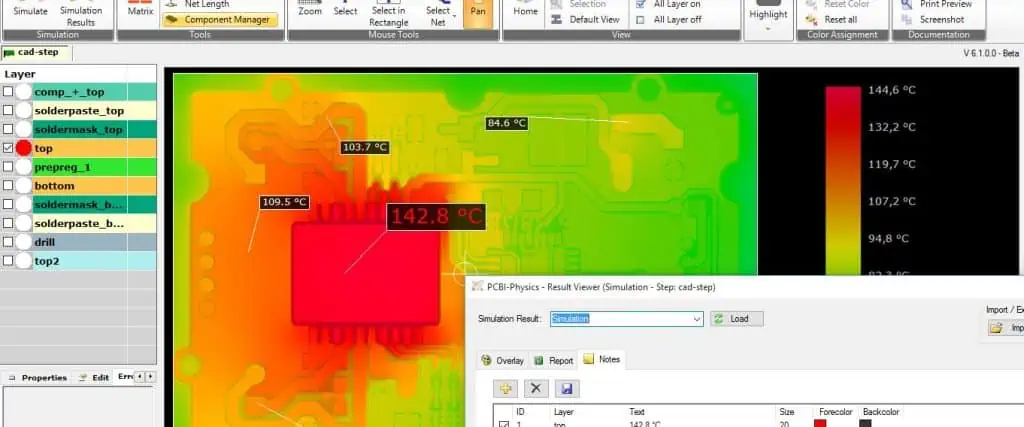
  7. Thermal Simulation and Analysis: Utilize thermal simulation tools during the design phase to identify and address potential hotspots.

Thermal Simulations of PCB

Thermal simulation is a crucial step in modern PCB design, allowing engineers to predict and optimize thermal performance before physical prototyping.

Benefits of Thermal Simulation:

  1. Early Problem Detection: Identify potential thermal issues in the design phase, saving time and resources.
  2. Optimization of Cooling Strategies: Test and refine various cooling techniques virtually.
  3. Component Placement Validation: Ensure optimal placement of heat-generating components.
  4. Material Selection Guidance: Assess the impact of different PCB materials on thermal performance.
  5. Cost Reduction: Minimize the need for physical prototypes and redesigns.

Key Aspects of PCB Thermal Simulation:

  • Steady-State Analysis: Evaluate long-term thermal behavior under constant operating conditions.
  • Transient Analysis: Assess thermal performance during power-up, shutdown, or varying load conditions.
  • Computational Fluid Dynamics (CFD): Model airflow and convection effects for more accurate results.
  • Multi-Physics Simulation: Combine thermal analysis with electrical and mechanical simulations for comprehensive design validation.

12 PCB Thermal Management Techniques to Reduce PCB Heating

1. Identifying Thermal Hotspots and High-Current Traces

  • Use thermal imaging and simulation tools to identify areas of high heat concentration.
  • Pay special attention to high-current traces and components.

Best Practices:

  • Conduct thermal analysis early in the design process.
  • Use thermal cameras during prototype testing to validate simulation results.

2. Copper Thickness and Width of Traces

  • Increase copper thickness (weight) for better heat dissipation.
  • Widen traces carrying high currents to reduce resistance and heat generation.

Design Considerations:

  • Balance trace width with available space and impedance requirements.
  • Consider using thicker copper layers (2 oz or more) for power planes and high-current paths.

3. Pad Design for PCB Thermal Management

  • Optimize pad sizes and shapes for better heat spreading.
  • Implement thermal relief patterns to balance heat dissipation and solderability.

Key Points:

  • Larger pads can act as heat spreaders for surface-mount components.
  • Use spoke-style thermal relief for through-hole components to prevent heat sinking during soldering.

4. Placing of High-Power Components in PCB

  • Strategically position heat-generating components to facilitate natural convection.
  • Avoid clustering high-power components in one area.

Strategies:

  • Place hot components near board edges or in areas with good airflow.
  • Consider the impact of component placement on overall system thermal performance.

5. Thermal Vias for Heat Dissipation in PCBs

Thermal vias are specialized through-holes designed to conduct heat between PCB layers.

Thermal Via Structure

  • Small-diameter plated through-holes, often filled with thermally conductive material.
  • Typically arranged in arrays under heat-generating components.

Placement of Thermal Vias in Circuit Boards

  • Concentrate vias directly under hot components.
  • Create via farms or matrices for maximum heat transfer.

Limitations of Thermal Vias

  • Manufacturing constraints on via size and density.
  • Potential impact on signal integrity in high-speed designs.

Benefits of Thermal Vias in PCBs

  • Efficient heat transfer from surface to internal layers or opposite side of the board.
  • Enables better utilization of internal copper planes for heat spreading.

6. Heat Sinks

  • Attach heat sinks to high-power components or PCB surfaces for enhanced cooling.
  • Select appropriate heat sink size, fin design, and material based on thermal requirements.

Considerations:

  • Ensure proper thermal interface material (TIM) between the heat sink and component.
  • Account for additional weight and mechanical stress when using large heat sinks.

7. Heat Pipe Integration

  • Implement heat pipes for efficient heat transfer over longer distances on the PCB.
  • Useful for channeling heat from internal components to external heat sinks.

Application Notes:

  • Particularly effective in space-constrained designs where traditional heat sinks are impractical.
  • Requires careful integration with PCB layout and mechanical design.

8. Thicker PCB Boards

  • Increase PCB thickness to improve overall thermal mass and heat spreading capability.
  • Useful for high-power applications where space allows for thicker boards.

Trade-offs:

  • Increased material cost and weight.
  • Potential challenges in manufacturing and assembly of thicker boards.

9. Integrated Cooling Methods

  • Incorporate cooling channels or embedded heat spreaders within the PCB structure.
  • Consider advanced technologies like metal-core PCBs for extreme thermal challenges.

Innovative Approaches:

  • Liquid cooling channels embedded in PCB layers.
  • Graphene or carbon nanotube-enhanced thermal layers.

10. Cooling Fans

  • Implement active cooling solutions using fans for forced air convection.
  • Design PCB layout to optimize airflow paths.

Design Tips:

  • Position fans to create effective air paths across hot components.
  • Consider noise and reliability factors when selecting fans.

11. Soldering Concentration

  • Optimize soldering processes to ensure good thermal connections.
  • Proper soldering enhances heat transfer from components to PCB.

Best Practices:

  • Use appropriate solder paste volume and reflow profiles.
  • Ensure good wetting and avoid voids in thermal pad connections.

12. Peltier Heat Pump / Thermoelectric Coolers (TEC)

  • Implement Peltier devices for active, localized cooling of critical components.
  • Useful for precise temperature control in sensitive applications.

Considerations:

  • Requires power management and control circuitry.
  • Consider the heat generated by the TEC itself in overall thermal design.

Applications for PCB Thermal Management

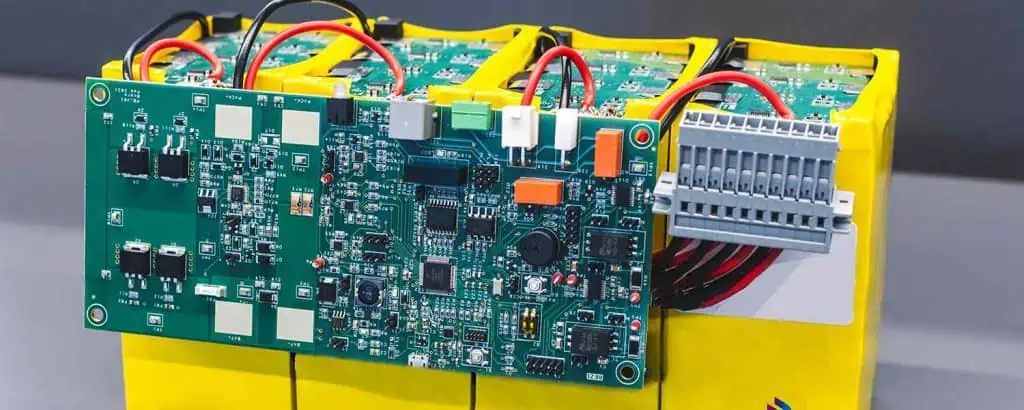
Battery Thermal Management System

Effective thermal management is crucial across a wide range of electronic applications:

1. High-Performance Computing

  • Challenges: Extreme heat generation from powerful processors and GPUs.
  • Solutions: Advanced heat sinks, liquid cooling, thermal vias, and multi-layer thermal management.

2. Power Electronics

  • Challenges: High current handling, power dissipation in converters and regulators.
  • Solutions: Thick copper layers, advanced substrate materials, integrated cooling systems.

3. Automotive Electronics

  • Challenges: Harsh operating environments, reliability requirements.
  • Solutions: Conformal coatings, robust thermal designs, active and passive cooling techniques.

4. Aerospace and Defense

  • Challenges: Extreme temperatures, high reliability demands, size and weight constraints.
  • Solutions: Advanced thermal simulation, specialized materials, innovative cooling techniques.

5. LED Lighting

  • Challenges: High heat flux in small areas, color and output stability.
  • Solutions: Metal-core PCBs, thermal vias, integrated heat sinking.

6. 5G and RF Applications

  • Challenges: High-frequency operation, power amplifier heat dissipation.
  • Solutions: Careful thermal and electrical co-design, advanced materials, active cooling.

7. Industrial Control Systems

  • Challenges: Varied environmental conditions, long-term reliability.
  • Solutions: Robust thermal design, environmental sealing, redundant cooling systems.

8. Medical Devices

  • Challenges: Stringent reliability requirements, patient safety considerations.
  • Solutions: Precision thermal management, biocompatible cooling solutions.

Conclusion: The Future of PCB Thermal Management

As electronic devices continue to evolve, becoming more powerful and compact, the challenges of PCB thermal management will only intensify. However, with ongoing advancements in materials science, simulation technologies, and cooling techniques, the field of thermal management is well-positioned to meet these challenges.

Key trends shaping the future of PCB thermal management include:

  1. Advanced Materials: Development of new substrate materials and thermal interface materials with superior thermal properties.
  2. AI-Driven Design: Integration of artificial intelligence and machine learning in thermal simulation and design optimization.
  3. Nanotechnology: Incorporation of nanomaterials like graphene and carbon nanotubes for enhanced thermal conductivity.
  4. 3D Printing: Additive manufacturing techniques enabling complex, customized cooling solutions.
  5. System-Level Approach: Holistic thermal management strategies considering entire product ecosystems.
  6. Energy Harvesting: Exploring ways to convert waste heat into usable energy, improving overall system efficiency.

By staying abreast of these developments and continuing to refine thermal management techniques, PCB designers and engineers can create more efficient, reliable, and powerful electronic systems. As we push the boundaries of what’s possible in electronic design, effective thermal management will remain a cornerstone of innovation, enabling the next generation of technological advancements.

Remember, successful PCB thermal management is not just about preventing failureโ€”it’s about optimizing performance, extending product lifespan, and enabling groundbreaking technologies. By mastering these techniques and embracing emerging technologies, designers can overcome thermal challenges and create electronic products that are not only powerful but also reliable and efficient.

Understanding IPC-4761: A Comprehensive Guide to Via Protection Types in PCB Design

Via protection is a critical aspect of modern PCB design, enhancing manufacturability and assembly reliability while reducing defects. The IPC-4761 Design Guide for Protection of Printed Board Via Structures outlines multiple via protection methods, which are detailed on pages 5โ€“11 of this document.

YouTube video

What is IPC-4761?

IPC-4761 is a standard developed by the Association Connecting Electronics Industries (IPC) that provides guidelines for the design and manufacturing of vias and plated through holes in PCBs. This standard is essential for ensuring the reliability and functionality of PCBs across various applications.

The Importance of Via Protection

Vias are critical components in PCB design, serving as electrical connections between different layers of a multi-layer board. Protecting these vias is crucial for several reasons:

  1. Preventing contamination
  2. Enhancing electrical performance
  3. Improving mechanical strength
  4. Ensuring long-term reliability

Powered By EmbedPress

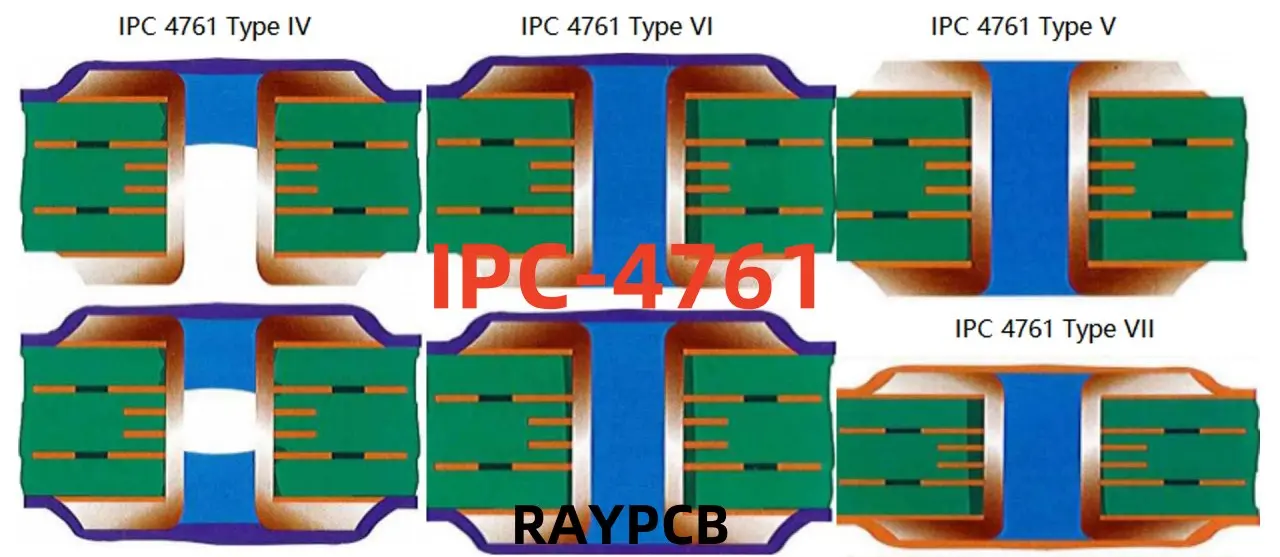
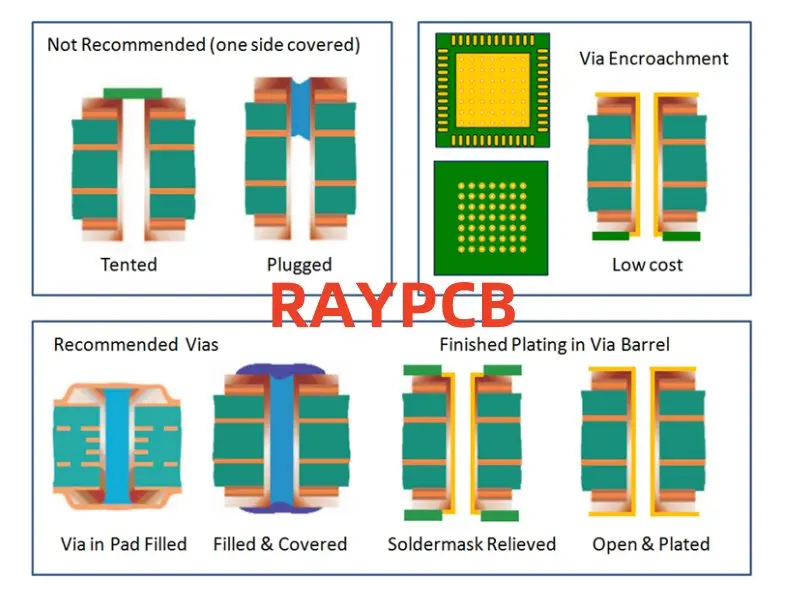
Understanding the Seven Via Protection Types

IPC-4761 defines seven distinct via protection types, each serving specific purposes and offering unique benefits. Let’s explore each type in detail:

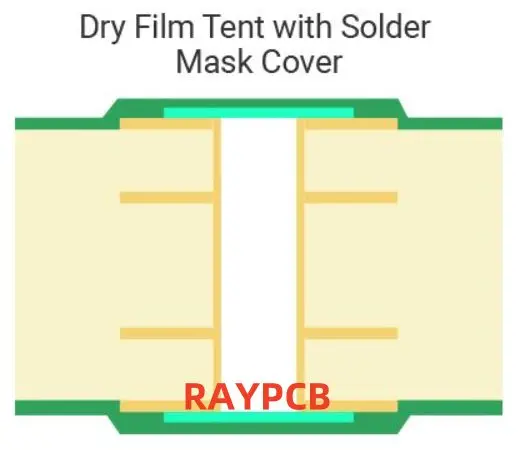
Type I: Tented Via

Tented vias are the most basic form of via protection. They are covered with a layer of solder mask, which provides minimal protection against contamination.

Advantages:

  • Cost-effective
  • Simple manufacturing process

Disadvantages:

  • Limited protection against moisture and contaminants
  • Not suitable for high-reliability applications

Type II: Tented and Covered Via

This type offers an additional layer of protection compared to Type I. A thin layer of copper is placed over the via before applying the solder mask.

Advantages:

  • Improved protection against contamination
  • Better electrical performance

Disadvantages:

  • Slightly more complex manufacturing process
  • May not be suitable for all PCB designs

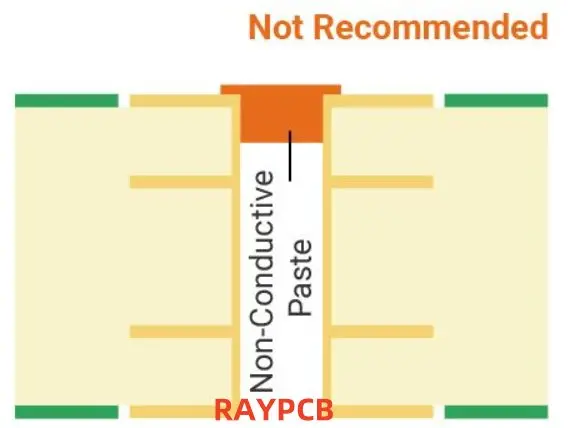
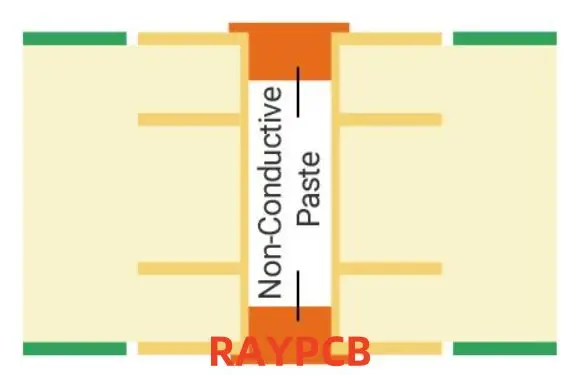
Type III: Plugged Via

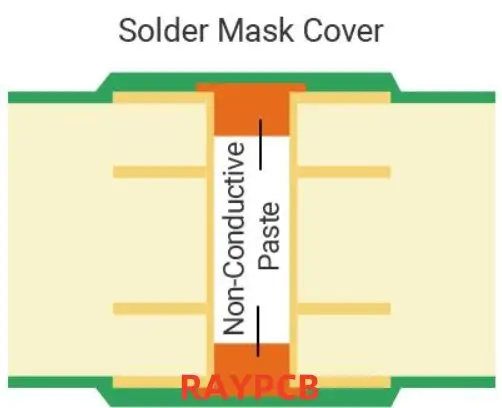
Plugged vias are filled with a non-conductive material, typically epoxy resin, before applying the solder mask.

Advantages:

  • Excellent protection against contamination
  • Improved planarity for component placement

Disadvantages:

  • Higher manufacturing costs
  • Potential for voids in the filling material

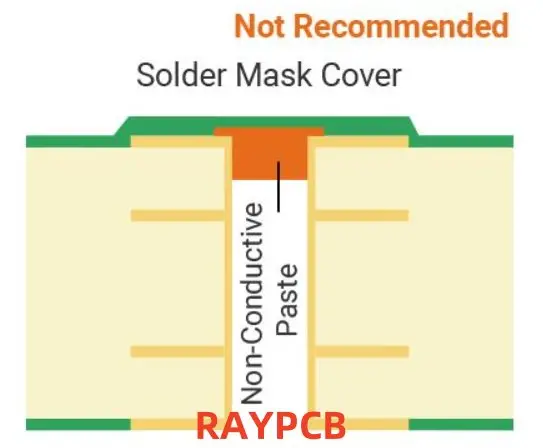
Type IV: Plugged and Covered Via

This type combines the benefits of plugged vias with an additional copper layer for enhanced protection and electrical performance.

Advantages:

Disadvantages:

  • Higher manufacturing costs
  • More complex production process

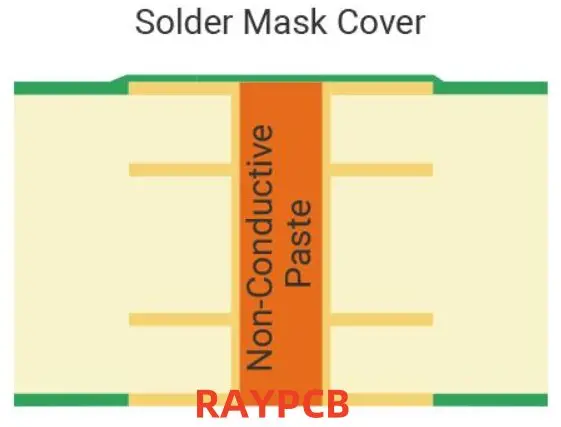
Type V: Filled Via

Filled vias are completely filled with conductive material, typically copper or conductive paste.

Advantages:

  • Excellent thermal management
  • Improved electrical performance
  • Enhanced structural integrity

Disadvantages:

  • Higher production costs
  • Requires specialized equipment

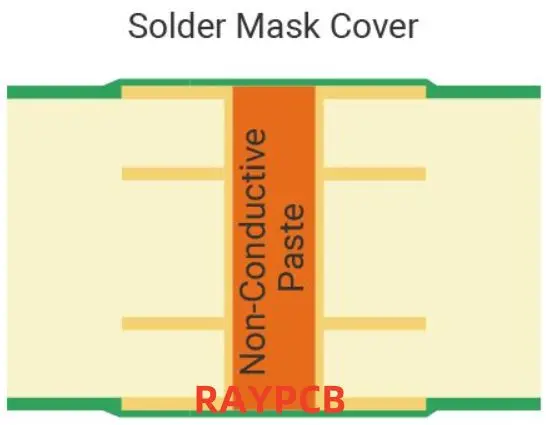
Type VI: Filled and Covered Via

This type builds upon the filled via by adding an additional copper layer over the filled hole.

Advantages:

  • Superior electrical and thermal performance
  • Excellent protection against contamination
  • Ideal for high-reliability applications

Disadvantages:

  • Highest manufacturing costs
  • Most complex production process

Type VII: Filled and Capped Via

IPC-4761 Type VII, also known as filled and capped vias, represents the most advanced form of via protection. This type combines the benefits of filled vias with an additional capping layer for enhanced protection and performance.

Advantages:

  • Ultimate protection against contamination
  • Exceptional electrical and thermal performance
  • Ideal for high-frequency and high-reliability applications

Disadvantages:

  • Highest production costs
  • Requires specialized equipment and expertise

Read more about:

Choosing the Right Via Protection Type

Selecting the appropriate via protection type depends on various factors:

  1. Application requirements
  2. Budget constraints
  3. Manufacturing capabilities
  4. Desired level of reliability

Consider the following when making your decision:

  • Performance needs: High-frequency or high-reliability applications may require more advanced protection types.
  • Environmental conditions: Harsh environments may necessitate better protection against contamination.
  • Cost considerations: Balance the need for protection with budgetary constraints.
  • Manufacturing capabilities: Ensure your PCB manufacturer can produce the chosen via protection type.

IPC-4761 and PCB Design Best Practices

Incorporating IPC-4761 standards into your PCB design process can significantly improve the quality and reliability of your products. Here are some best practices to consider:

  1. Early planning: Consider via protection requirements during the initial design phase.
  2. Consistent documentation: Clearly specify the required via protection types in your design documentation.
  3. Communication with manufacturers: Discuss via protection options with your PCB manufacturer to ensure feasibility.
  4. Regular updates: Stay informed about updates to IPC-4761 and other relevant standards.

The Impact of IPC-4761 on PCB Manufacturing

Implementing IPC-4761 standards can have several positive effects on PCB manufacturing:

  1. Improved quality control: Standardized via protection types enable better quality assurance processes.
  2. Enhanced reliability: Proper via protection leads to more reliable PCBs with longer lifespans.
  3. Streamlined production: Clear guidelines reduce confusion and potential errors during manufacturing.
  4. Global consistency: IPC-4761 promotes consistency across different manufacturers and regions.

Future Trends in Via Protection and IPC-4761

As PCB technology continues to evolve, we can expect to see advancements in via protection methods and updates to IPC-4761. Some potential trends include:

  1. New materials: Development of novel materials for via filling and protection.
  2. Miniaturization: Adapting via protection techniques for increasingly smaller PCB designs.
  3. Integration with other standards: Closer alignment of IPC-4761 with other PCB design and manufacturing standards.
  4. Automation: Increased use of automated processes for via protection application.

Conclusion: The Significance of IPC-4761 in Modern PCB Design

Understanding and implementing IPC-4761 standards is crucial for producing high-quality, reliable PCBs. By selecting the appropriate via protection type and following best practices, designers and manufacturers can ensure their products meet the demanding requirements of today’s electronics industry.

Whether you’re working on a simple consumer device or a complex aerospace application, incorporating IPC-4761 guidelines into your PCB design process will contribute to better performance, longer product life, and improved customer satisfaction.

As the electronics industry continues to advance, staying informed about standards like IPC-4761 will be essential for professionals in PCB design and manufacturing. By embracing these standards and adapting to new developments, we can drive innovation and push the boundaries of what’s possible in electronic design.

Resources for Further Learning

To deepen your understanding of IPC-4761 and via protection types, consider exploring the following resources:

  1. IPC-4761 PDF: The official IPC-4761 document provides detailed information on via protection types and implementation guidelines. While the full document is not freely available, you can purchase it from the IPC website.
  2. IPC-4761 Training: Many organizations offer training courses on IPC standards, including IPC-4761. These courses can provide hands-on experience and in-depth knowledge.
  3. PCB Design Software: Many modern PCB design tools incorporate IPC-4761 standards. Familiarize yourself with these features in your preferred software.
  4. Industry Forums and Communities: Engage with other professionals in PCB design forums to share experiences and learn about real-world applications of IPC-4761.

By continually expanding your knowledge and staying current with industry standards like IPC-4761, you’ll be well-equipped to tackle the challenges of modern PCB design and contribute to the advancement of electronic technology.

Maximizing PCB Density with Buried Vias: Key Parameters and Fabrication Techniques

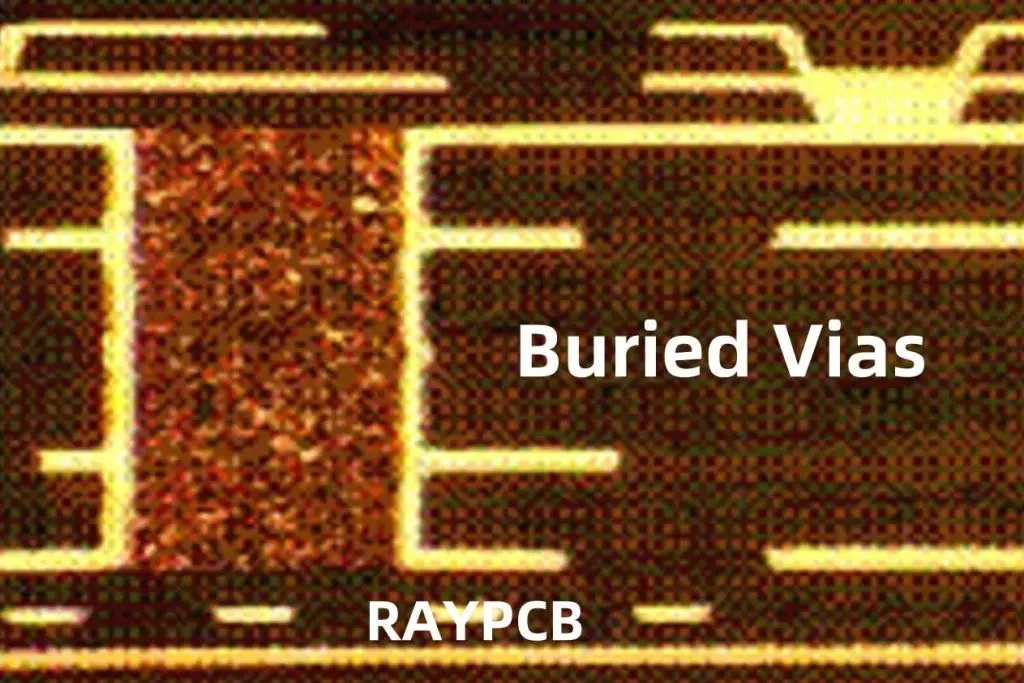
Buried vias are specialized connections that link two or more internal layers within a printed circuit board without extending to the exterior surfaces. Unlike traditional through-holes, buried vias cannot be created by drilling after the board has been fully bonded. Instead, they require a more complex manufacturing process: first partially bonding the inner layers, then applying electroplating treatment, and finally completing the full bonding process.

What are Buried Vias?

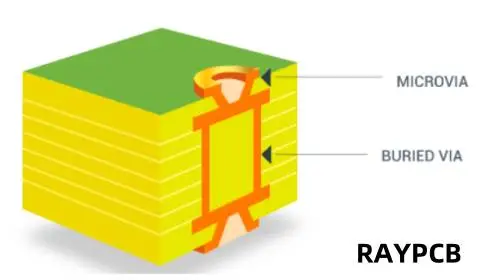
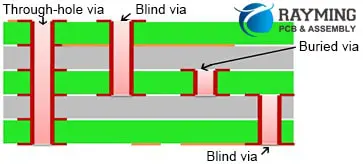
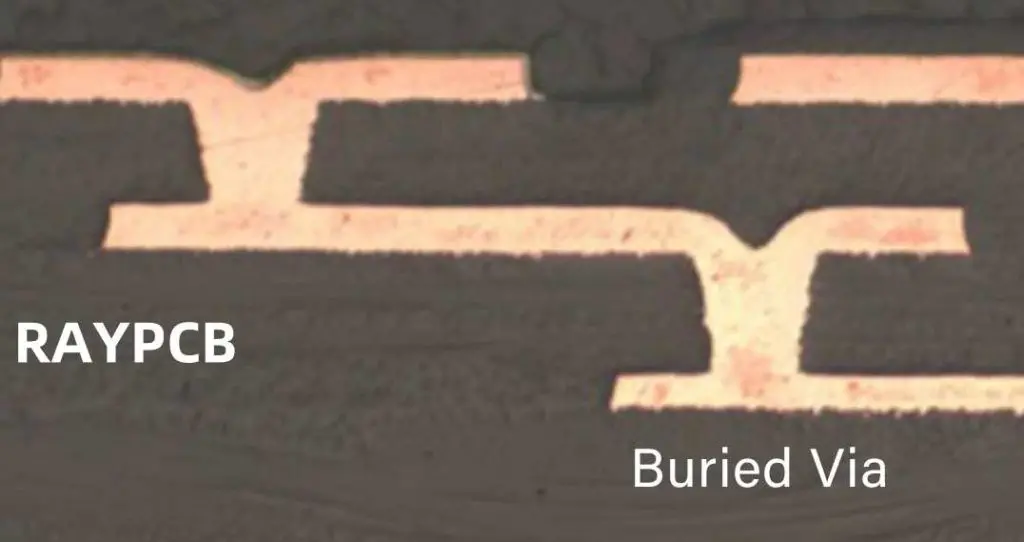
Buried vias are a type of electrical interconnection used in multilayer PCBs. Unlike through-hole vias that extend through the entire board or blind vias that connect an outer layer to one or more inner layers, buried vias are connections between inner layers of a PCB that do not extend to either outer surface. This unique characteristic gives buried vias their name – they are completely enclosed within the PCB structure and not visible from the outside.

YouTube video

Buried vias offer several advantages in PCB design, including:

  1. Increased routing density
  2. Improved signal integrity
  3. Enhanced design flexibility
  4. Reduced overall PCB size

As electronic devices become more compact and complex, buried vias have become an essential tool in the PCB designer’s arsenal, enabling the creation of sophisticated multilayer boards that power many of today’s advanced electronic products.

Read more about:

Key Characteristics of Buried Vias

blind and buried vias

Understanding the key characteristics of buried vias is crucial for effective PCB design and manufacturing. Here are some important features to consider:

1. Location

Buried vias are located entirely within the inner layers of a PCB. They do not extend to either the top or bottom surface of the board.

2. Depth

The depth of a buried via depends on its location within the PCB stack-up. It can span two or more adjacent inner layers.

3. Diameter

The diameter of buried vias can vary depending on the design requirements and manufacturing capabilities. Generally, buried vias can be made with smaller diameters compared to through-hole vias.

4. Aspect Ratio

The aspect ratio (depth to diameter) of buried vias is an important consideration. Lower aspect ratios are generally easier to manufacture reliably.

5. Plating

Buried vias are typically plated with copper to create the electrical connection between layers. The plating process must ensure good coverage and adhesion within the via.

6. Fill

In some cases, buried vias may be filled with conductive or non-conductive materials to enhance their electrical or mechanical properties.

Buried Vias vs. Blind Vias

While both buried and blind vias are used in HDI designs, they have distinct characteristics and applications:

Buried Vias:

  • Connect only inner layers
  • Not visible from the board surface
  • Can be placed under components
  • Typically require sequential lamination

Blind Vias:

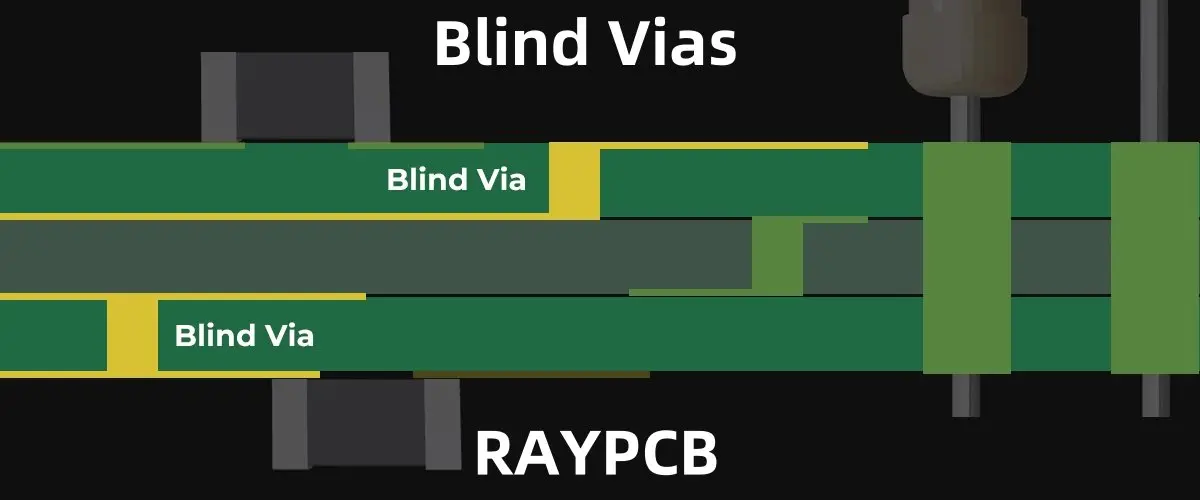
  • Connect an outer layer to one or more inner layers
  • Visible from one side of the board
  • Cannot be placed under components on the side they are visible
  • Can often be manufactured with fewer lamination cycles

The choice between buried and blind vias depends on various factors, including:

  1. Layer count
  2. Routing requirements
  3. Component placement constraints
  4. Manufacturing capabilities and costs

In many advanced PCB designs, a combination of through-hole, blind, and buried vias is used to achieve optimal performance and density.

Advantages of Using Buried Vias in PCB Design

The incorporation of buried vias in PCB design offers several significant advantages:

1. Increased Routing Density

By connecting only inner layers, buried vias free up space on outer and adjacent layers, allowing for more complex routing and higher component density.

2. Improved Signal Integrity

Shorter via lengths result in reduced inductance and capacitance, leading to better signal integrity, especially in high-speed designs.

3. Enhanced Design Flexibility

Buried vias provide designers with more options for layer transitions and routing, enabling more efficient use of PCB real estate.

4. Reduced Board Size

The ability to increase routing density often leads to smaller overall board sizes, crucial for compact electronic devices.

5. Better EMI Performance

By keeping high-speed signals on inner layers, buried vias can help reduce electromagnetic interference (EMI) and improve overall signal quality.

6. Improved Thermal Management

When used in conjunction with thermal vias, buried vias can enhance heat dissipation in specific board areas.

7. Enhanced Reliability

Buried vias are protected from external environmental factors, potentially leading to improved long-term reliability.

Important Guidelines When Designing with Buried Vias

To ensure successful implementation of buried vias in PCB design, consider the following guidelines:

1. Understand Manufacturing Capabilities

Work closely with your PCB manufacturer to understand their capabilities and limitations regarding buried via production. This includes minimum via diameter, maximum depth, and aspect ratio constraints.

2. Optimize Layer Stack-up

Carefully plan your PCB layer stack-up to minimize the number of lamination cycles required. This can help reduce manufacturing costs and improve yield.

3. Consider Signal Integrity Requirements

For high-speed designs, carefully analyze the impact of buried vias on signal integrity. Use simulation tools to verify that the vias do not introduce unacceptable signal degradation.

4. Balance Cost and Performance

While buried vias offer many advantages, they can increase manufacturing costs due to the need for sequential lamination. Carefully evaluate the trade-offs between performance improvements and cost implications.

5. Design for Testability

Ensure that your design allows for adequate testing of buried via connections. This may require careful planning of test points and the use of advanced testing techniques.

6. Adhere to Design Rules

Follow the design rules provided by your PCB manufacturer regarding minimum via size, spacing, and aspect ratio for buried vias.

Buried Vias Manufacturing Considerations

Manufacturing PCBs with buried vias requires specialized processes and equipment. Key considerations include:

1. Sequential Lamination

Buried vias typically require sequential lamination processes, where the PCB is built up in stages. This allows for the creation of buried vias at different depths within the board.

2. Drilling Technology

Select appropriate drilling technology based on via size and board material. Mechanical drilling is common for larger buried vias, while laser drilling may be used for smaller, high-precision vias.

3. Plating Processes

Ensure that plating processes can achieve adequate coverage and thickness within the buried vias. This may require special plating techniques or equipment.

4. Registration Accuracy

Maintain tight registration tolerances to ensure accurate alignment of buried vias with features on adjacent layers.

5. Material Selection

Choose PCB materials that are compatible with the multiple lamination cycles required for buried via manufacturing.

6. Quality Control

Implement rigorous quality control measures, including X-ray inspection, cross-sectioning, and electrical testing to ensure the reliability of buried via connections.

How to Manufacture Buried Vias

The manufacturing process for buried vias typically involves the following steps:

1. Core Preparation

  • Individual core layers are prepared with the required circuitry.
  • Holes for buried vias are drilled in the core layers.

2. Plating and Filling

  • The drilled holes are plated with copper to create electrical connections.
  • If required, the vias may be filled with conductive or non-conductive material.

3. Lamination

  • The prepared core layers are laminated together with prepreg (pre-impregnated bonding layers).

4. Repeat Process

  • Steps 1-3 are repeated for additional sets of buried vias at different depths.

5. Final Lamination

  • Once all buried via layers are complete, the final outer layers are laminated to complete the PCB stack-up.

6. Drilling and Plating of Through-Holes

  • Any required through-holes or blind vias are drilled and plated.

7. Surface Finishing

  • Appropriate surface finishes are applied to the outer layers.

8. Testing and Inspection

  • The completed PCB undergoes electrical testing and visual inspection to ensure quality and reliability.

Conclusion

Buried vias have become an indispensable tool in modern PCB design, enabling the creation of compact, high-performance electronic devices. By understanding the characteristics, advantages, and manufacturing considerations of buried vias, PCB designers can leverage this technology to create more efficient and capable circuit boards.

As electronic devices continue to evolve, demanding ever-higher levels of integration and performance, the role of buried vias in PCB design is likely to grow. Advances in manufacturing technologies and materials science will continue to push the boundaries of what’s possible with buried vias, opening up new possibilities for electronic product design.

Whether you’re designing cutting-edge consumer electronics, high-reliability aerospace systems, or compact medical devices, mastering the use of buried vias can give you a significant advantage in creating innovative, high-performance PCB designs. By carefully considering the guidelines and manufacturing considerations outlined in this article, you can successfully incorporate buried vias into your PCB designs, unlocking new levels of performance and miniaturization.

Blind Vias in PCB Design: Complete Guide for Engineers

As a PCB designer working on high-density boards, I’ve seen blind vias PCB technology transform how we approach complex multilayer designs. If you’re routing signals under fine-pitch BGAs or trying to squeeze more functionality into a compact form factor, understanding blind vias is no longer optionalโ€”it’s essential.

This guide covers everything you need to know about blind vias in PCB design: what they are, when to use them, design rules, manufacturing considerations, and practical tips I’ve learned from years of working with HDI boards.

What Are Blind Vias in PCB?

A blind via is a plated hole that connects an outer layer of a printed circuit board to one or more inner layers without passing through the entire board. Unlike through-hole vias that punch from top to bottom, blind vias are only visible from one side of the PCBโ€”hence the name “blind.”

According to IPC-A-600G standards, blind vias extend from an external surface layer and terminate at an internal layer. They’re drilled partway into the board using either mechanical controlled-depth drilling or laser ablation, then copper-plated to establish electrical connectivity.

The key distinction from other via types:

Via Type Connects Visible From Typical Application
Through-hole via Top to bottom (all layers) Both sides Standard multilayer PCBs
Blind via Outer layer to inner layer(s) One side only HDI PCBs, BGA fan-out
Buried via Inner layer to inner layer Neither side Complex multilayer routing
Microvia Adjacent layers only One side HDI PCBs, fine-pitch components

Why Use Blind Vias PCB Technology?

When I first started working with blind vias, the cost premium seemed hard to justify. But after a few projects where through-hole vias simply couldn’t meet the routing requirements, the benefits became clear.

Space Efficiency and Routing Density

Through-hole vias consume space on every layer they pass through, even layers where you don’t need connections. Blind vias free up that real estate on the layers they don’t penetrate. For a 6-layer board with a signal routed from Layer 1 to Layer 2, a blind via leaves Layers 3-6 completely available for other traces.

Signal Integrity Improvements

Shorter vias mean shorter current paths. In high-speed designs operating above 1 GHz, blind vias can reduce signal propagation delay by 20-30% compared to through-hole alternatives. They also eliminate stub effectsโ€”the unused portion of a through-hole via that acts like an antenna and causes signal reflections at high frequencies.

BGA Fan-Out Solutions

Fine-pitch BGAs with 0.5mm or 0.4mm pitch create routing nightmares. There’s simply no room for through-hole vias between pads. Blind vias allow signals to escape to inner layers without blocking adjacent routing channels.

Overall Cost Reduction

Waitโ€”didn’t I mention blind vias cost more? Yes, the per-via cost is higher. But smart use of blind vias can actually reduce total board cost by eliminating layers. I’ve seen 8-layer designs reduced to 6 layers by strategic blind via placement, saving more on materials and lamination than the via processing adds.

Types of Blind Vias and Manufacturing Methods

Not all blind vias are created equal. The manufacturing method impacts hole diameter, reliability, and cost.

Mechanical Controlled-Depth Blind Vias

These are drilled using standard CNC machines with depth control. The drill stops at a programmed depth rather than passing through.

Specifications:

  • Minimum diameter: 0.15mm (6 mil)
  • Best for: Standard multilayer boards
  • Cost: Most economical blind via option

The challenge is accuracy. Drill bit wear affects depth consistency, and the process requires generous tolerances.

Laser-Drilled Blind Vias (Microvias)

Laser drilling enables much smaller holes with better precision. According to IPC-T-50M, a microvia has a maximum aspect ratio of 1:1 and total depth not exceeding 0.25mm (10 mils).

Specifications:

  • Minimum diameter: 0.075mm (3 mil) or smaller
  • Best for: HDI PCBs, fine-pitch BGAs (0.5mm and below)
  • Cost: Higher than mechanical drilling

CO2 lasers and UV lasers are commonly used. UV lasers provide better precision for copper ablation, while CO2 lasers work faster on dielectric material.

Sequential Lamination Blind Vias

For complex designs requiring blind vias spanning multiple layers, sequential lamination is often necessary. The fabricator builds the board in stagesโ€”drilling and plating pairs of layers before bonding them together.

Specifications:

  • Can span multiple layer pairs
  • Enables stacked and staggered via configurations
  • Cost: Highest due to multiple processing cycles

Comparison of Blind Via Manufacturing Methods

Method Min. Diameter Aspect Ratio Relative Cost Lead Time Impact
Mechanical drilling 0.15mm (6 mil) 1:1 Low +2-3 days
Laser drilling (CO2) 0.10mm (4 mil) 0.75:1 to 1:1 Medium +3-5 days
Laser drilling (UV) 0.075mm (3 mil) 0.75:1 to 1:1 Medium-High +3-5 days
Sequential lamination 0.10mm (4 mil) Varies Highest +5-10 days

Blind Via Design Rules and Guidelines

Getting blind vias right requires attention to specific design rules. These aren’t suggestionsโ€”ignoring them leads to manufacturing failures.

Aspect Ratio Requirements

The aspect ratio (depth-to-diameter) is the most critical parameter for blind via reliability. During copper plating, solution must flow into the hole. Higher aspect ratios make uniform plating difficult.

Recommended aspect ratios:

Aspect Ratio Manufacturability Notes
0.75:1 to 1:1 Ideal Preferred for all blind vias
1:1 to 1.5:1 Acceptable Requires process control
1.5:1 to 2:1 Challenging Higher cost, potential quality issues
Over 2:1 Not recommended Few fabricators can achieve reliably

Calculation example: For a blind via with 0.2mm diameter connecting Layers 1-2 through 0.2mm of dielectric, the aspect ratio is 0.2/0.2 = 1:1โ€”right at the ideal limit.

Pad Size Requirements

Per IPC standards, the blind via pad should have a diameter at least 300ฮผm (12 mil) larger than the via diameter after copper plating. For laser-drilled vias, this can be reduced to 250ฮผm (10 mil).

Pad size formula (IPC-6012 and IPC-2221):

ย 
ย 
Pad Size = Finished Hole Diameter + 2(Minimum Annular Ring) + Fabrication Allowance

For IPC Class 3 designs, maintain minimum annular rings of 2 mil on external layers and 1 mil on internal layers.

Layer Stack-Up Planning

Blind vias must be planned into your layer stack-up from the start. They’re not something you add later. Key rules:

  • Blind vias should always span an even number of copper layers
  • They must start from an outer layer (top or bottom)
  • Avoid overlapping blind and buried via spans (e.g., L1-L3 blind vias simultaneously with L2-L4 buried vias)โ€”this dramatically increases manufacturing complexity

Clearance and Spacing

Maintain adequate spacing between blind vias and other features. A common rule is at least 0.2mm (8 mil) clearance to prevent shorts or manufacturing defects.

For via-in-pad designs under BGA pads, blind vias must be filled with conductive or non-conductive material and plated over to prevent solder wicking during assembly.

Blind Vias PCB Cost Factors

Understanding what drives blind via costs helps you make informed design decisions.

Primary Cost Drivers

Cost Factor Impact Mitigation Strategy
Number of lamination cycles High Minimize blind via layer spans
Laser drilling vs. mechanical Medium Use mechanical where diameter permits
Via filling requirements Medium Only fill vias under pads
Overlapping via spans Very High Design stack-up to avoid this
Tight tolerances Medium Work within standard fabricator capabilities

When Blind Vias Save Money

Despite higher processing costs, blind vias can reduce overall board cost when they:

  • Eliminate one or more layers from the design
  • Reduce board size by enabling denser routing
  • Improve first-pass yield by providing better signal integrity

I’ve worked on designs where adding blind vias reduced layer count from 8 to 6, cutting total fabrication cost by 15% despite the via processing premium.

Applications of Blind Vias in Modern Electronics

Blind vias PCB technology appears across virtually every high-density electronics application.

Consumer Electronics

Smartphones, tablets, and wearables rely heavily on blind vias to achieve their compact form factors. These devices typically use 6-10 layer HDI boards with multiple blind via structures.

Medical Devices

Implantable devices and portable diagnostic equipment require maximum functionality in minimum space. Blind vias enable the dense packaging these applications demand while maintaining the reliability standards required for medical certification.

Aerospace and Automotive

High-reliability applications in aerospace and automotive electronics use blind vias where standard vias can’t meet density or signal integrity requirements. These designs typically follow IPC Class 3 specifications with additional testing protocols.

High-Speed Computing

Servers, network switches, and high-performance computing systems use blind vias extensively for memory interfaces, high-speed serial links, and processor breakout routing.

Common Mistakes and How to Avoid Them

After reviewing hundreds of blind via designs, I see the same mistakes repeatedly.

Mistake 1: Ignoring Aspect Ratio Limits

Problem: Designer specifies 0.15mm blind via through 0.3mm dielectricโ€”a 2:1 aspect ratio that many fabricators can’t reliably plate.

Solution: Check aspect ratio for every blind via. Adjust hole diameter or dielectric thickness to stay within 1:1 whenever possible.

Mistake 2: Late Stack-Up Planning

Problem: Designer finishes routing, then realizes blind vias are needed but stack-up doesn’t support them.

Solution: Define your via strategy and layer stack-up before starting placement. Coordinate with your fabricator early.

Mistake 3: Overlapping Via Spans

Problem: Design has L1-L3 blind vias and L2-L4 buried viasโ€”requiring extra lamination cycles that double the cost.

Solution: Plan via spans to avoid overlap. Use a stack-up visualization tool to verify.

Mistake 4: Forgetting Via Fill Requirements

Problem: Blind vias under BGA pads aren’t specified as filled, causing solder wicking during assembly.

Solution: Call out via fill and cap plating requirements in your fabrication notes for all vias under component pads.

Useful Resources for PCB Engineers

Here are resources I reference regularly when working with blind vias:

IPC Standards:

  • IPC-2221B: Generic Standard on Printed Board Design
  • IPC-6012E: Qualification and Performance Specification for Rigid PCBs
  • IPC-A-600: Acceptability of Printed Boards
  • IPC-T-50M: Terms and Definitions for Interconnecting and Packaging Electronic Circuits

Design Tools Documentation:

  • Altium Designer HDI and Blind/Buried Via Guide
  • Cadence Allegro Via Structure Setup
  • KiCad Multilayer Design Guide

Fabricator Design Guidelines: Most PCB fabricators publish detailed design guides covering their specific blind via capabilities. Request these before starting your designโ€”they’ll save revision cycles.

Frequently Asked Questions

What is the difference between blind vias and buried vias in PCB?

Blind vias connect an outer layer to one or more inner layers and are visible from one side of the board. Buried vias connect only inner layers and are completely hidden within the PCBโ€”invisible from both outer surfaces. Both serve to increase routing density, but blind vias are generally easier to manufacture.

How much do blind vias add to PCB cost?

Blind vias typically add 20-50% to fabrication cost compared to through-hole only designs, depending on complexity. However, if blind vias allow you to reduce layer count or board size, the net cost may actually decrease. A simple blind via structure (one lamination cycle) costs less than complex multi-level structures.

What is the minimum blind via size for PCB manufacturing?

Mechanical drilling supports minimum diameters around 0.15mm (6 mil). Laser drilling enables sizes down to 0.075mm (3 mil) or smaller. Your fabricator’s capabilities determine the actual limitsโ€”always confirm before finalizing your design.

Can blind vias be filled?

Yes, and they often should be. Vias under component pads must be filled with conductive or non-conductive material and cap-plated to prevent solder wicking. Filling also prevents air entrapment during subsequent lamination cycles in complex builds.

When should I use blind vias instead of through-hole vias?

Consider blind vias when: routing under fine-pitch BGAs (0.8mm pitch or finer), through-hole stubs would degrade signal integrity at your operating frequency, you need to reduce layer count, or board size constraints prevent using through-hole vias. If none of these apply, through-hole vias are simpler and cheaper.

Wrapping Up

Blind vias PCB technology has become a standard tool for any engineer working on dense, high-performance designs. The learning curve is realโ€”understanding aspect ratios, stack-up planning, and manufacturing constraints takes time. But once you’ve mastered these concepts, blind vias open up design possibilities that simply aren’t achievable any other way.

Start with simple blind via structures on your next HDI project. Work closely with your fabricator, verify your aspect ratios, and plan your stack-up early. The resultsโ€”more routing density, better signal integrity, and potentially lower overall costsโ€”make the effort worthwhile.

What is Via Covering in PCB? A Guide to Tenting, Plugging, and Filling Vias

1. What is a Via?

Before diving into via covering, it’s essential to understand what a via is in the context of Printed Circuit Board (PCB) design. A via is a plated hole that connects different layers of a multi-layer PCB. Vias serve as conduits for electrical signals and provide thermal paths between layers. They play a crucial role in the functionality and performance of PCBs, especially in complex designs with multiple layers.

YouTube video

2. What is Via Covering?

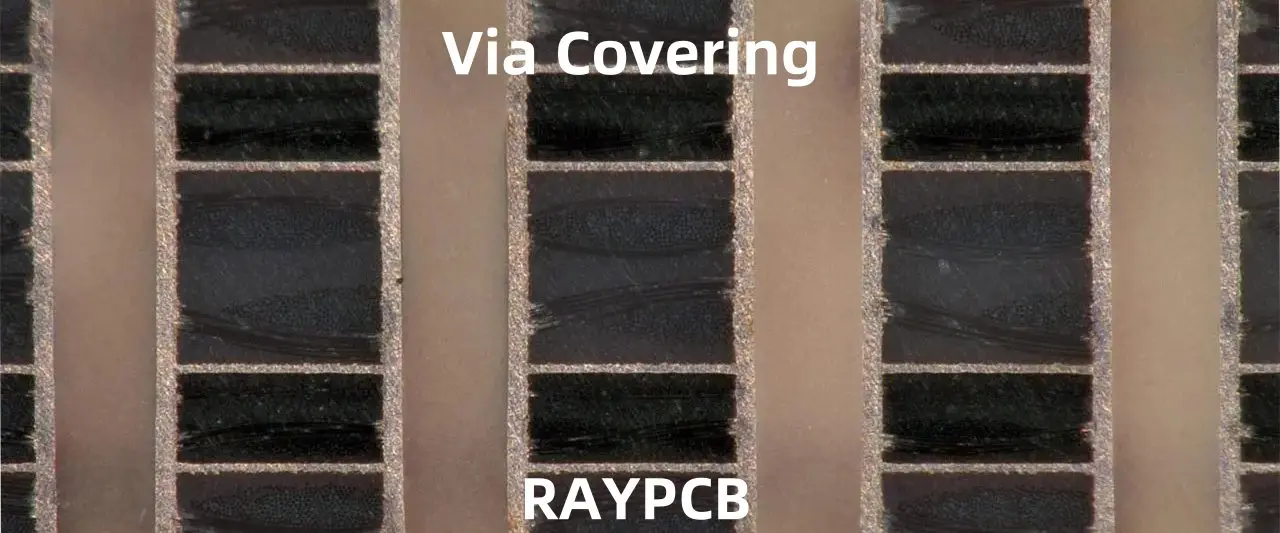
Via covering refers to the process of protecting or sealing vias in a PCB. This can be done using various methods, including tenting, plugging, and filling. The primary purpose of via covering is to protect the via structure from environmental factors, improve the PCB’s reliability, and enhance its performance in specific applications.

Read more about:

3. Why is Via Covering Needed in PCB?

Via covering serves several important purposes in PCB design and manufacturing:

  1. Protection from Contamination: Covered vias are less likely to trap contaminants like moisture, chemicals, or debris that could compromise the board’s functionality.
  2. Improved Reliability: By sealing vias, the risk of short circuits due to conductive particle entrapment is reduced, enhancing the overall reliability of the PCB.
  3. Enhanced Solderability: In surface mount applications, covered vias prevent solder from wicking into the vias during the assembly process, ensuring proper component attachment.
  4. Increased Usable Board Space: Covered vias allow for more efficient use of the PCB surface, as components can be placed over the covered vias in some cases.
  5. Improved Signal Integrity: Certain via covering methods can reduce signal reflections and improve high-frequency performance.
  6. Thermal Management: Some via covering techniques can enhance the thermal properties of the board, improving heat dissipation.
  7. Aesthetics: Covered vias can improve the visual appearance of the PCB, which may be important for certain applications.

4. The Common Types of Via Covering

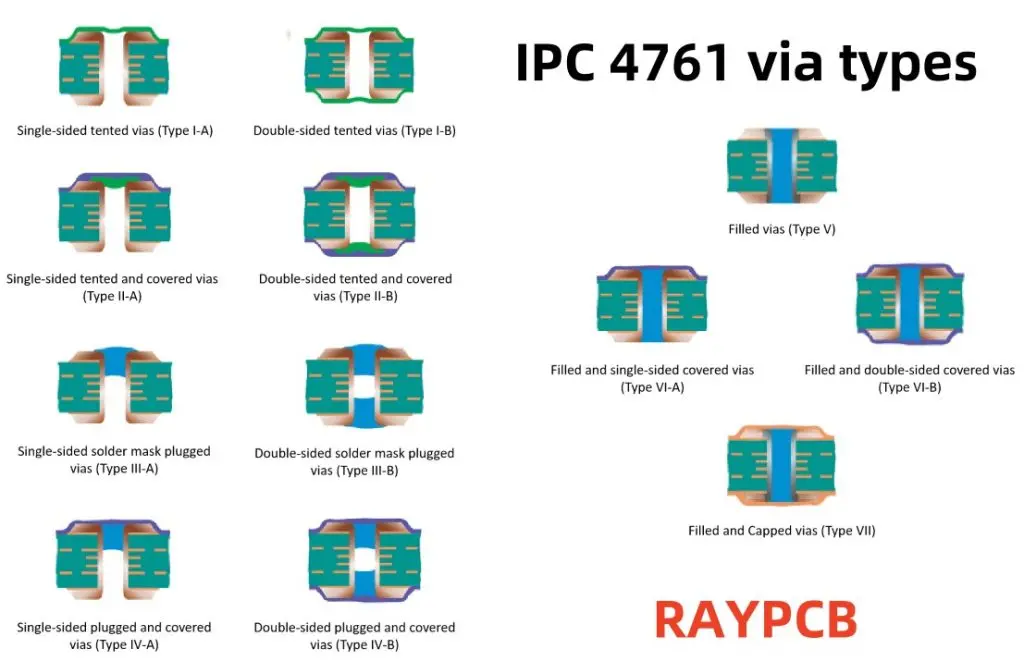
The IPC-4761 “Design Guide for Protection of Printed Board Via Structures” provides a standardized classification for via protection methods. Let’s explore these types in detail:

Type Description Via  Covering Material
I-a Tented  Via (single-sided) Dry film solder mask
I-b Tented Via  (double-sided)
II-a Tented  & Covered Vias (single-sided) Dry film solder mask + LPI[1] solder mask
II-b Tented & Covered  Vias (double-sided)
III-a Plugged  Via (single-sided) Plugging Epoxy (non-conductive paste)
III-b Plugged Via  (double-sided)
IV-a Plugged  & Covered Via (single-sided) Plugging Epoxy + LPI solder mask
IV-b Plugged & Covered  Via (double-sided)
V Filled  Via Plugging  Epoxy (non-conductive paste)
VI-a Filled  & Covered Via (single-sided) Plugging Epoxy + LPI solder mask
VI-b Filled & Covered  Via (double-sided)
VII Filled  & Capped Via Special  Plugging Epoxy + Copper Plating to planarization

4.1 Via Tenting

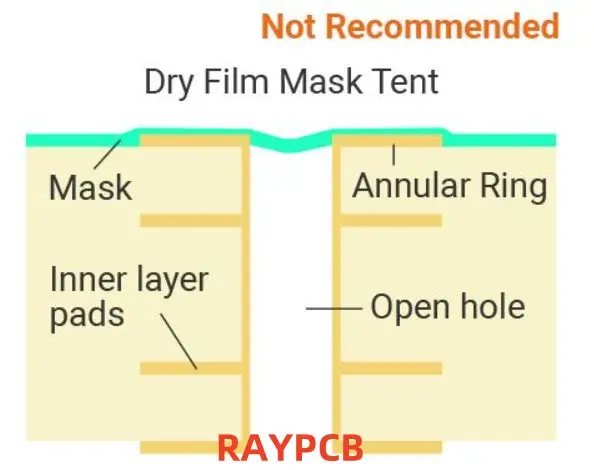
Tenting involves covering the via with the solder mask material, creating a “tent” over the via.

4.1.1 IPC 4761 Type I: Tented Via

  • Single-side: Type I-a This involves tenting the via on one side of the PCB. It provides basic protection and is suitable for less demanding applications.
  • Double-side: Type I-b Here, the via is tented on both sides of the PCB, offering better protection than single-side tenting.

4.1.2 IPC 4761 Type II: Tented and Covered Via

  • Single-side: Type II-a In this method, the via is tented and then covered with an additional coating on one side of the PCB.
  • Double-side: Type II-b This involves tenting and covering the via on both sides of the PCB, providing enhanced protection.

4.2 Via Plugging

Plugging involves filling the via with a material (usually epoxy) to seal it.

4.2.1 IPC 4761 Type III: Plugged Via

  • Single-side: Type III-a The via is plugged from one side of the PCB. This method is often used when protection is needed only on one side.
  • Double-side: Type III-b In this case, the via is plugged from both sides, offering more comprehensive protection.

4.2.2 IPC 4761 Type IV: Plugged and Covered Via

  • Single-side: Type IV-a The via is plugged and then covered with an additional layer on one side of the PCB.
  • Double-side: Type IV-b This method involves plugging the via and covering it on both sides, providing maximum protection.

4.3 Via Filling

Filling involves completely filling the via with a conductive or non-conductive material.

4.3.1 IPC 4761 Type V: Filled Via

In this method, the via is completely filled with a material, typically a non-conductive epoxy. This creates a flat surface and allows for component placement or additional circuitry over the via.

4.3.2 IPC 4761 Type VI: Filled and Covered Via

  • Single-side: Type VI-a The via is filled and then covered with an additional layer on one side of the PCB.
  • Double-side: Type VI-b This involves filling the via and covering it on both sides, offering enhanced protection and a smooth surface on both sides.

4.3.3 IPC 4761 Type VII: Filled and Capped Via

In this method, the via is filled with a conductive material and then capped with a layer of copper. This creates a solid copper structure through the entire via, which can be beneficial for thermal management and high-current applications.

5. Design Tips for Via Covering

When incorporating via covering into your PCB design, consider the following tips:

  1. Choose the Right Method: Select the via covering method based on your specific application requirements. Consider factors such as environmental conditions, electrical performance needs, and manufacturing constraints.
  2. Consider Thermal Management: If heat dissipation is a concern, consider using conductive fill materials or copper-capped vias.
  3. Plan for Manufacturing: Discuss your via covering requirements with your PCB manufacturer early in the design process. Some methods may require specialized equipment or processes.
  4. Balance Cost and Performance: More complex via covering methods generally increase manufacturing costs. Evaluate whether the performance benefits justify the additional expense.
  5. Account for Material Properties: Different fill materials have different electrical and thermal properties. Ensure your chosen material is compatible with your design requirements.
  6. Design for Reliability: In harsh environments or high-reliability applications, consider using more robust via protection methods like double-sided plugging or filling.
  7. Consider Signal Integrity: For high-speed designs, evaluate how different via covering methods might impact signal integrity. Some methods may introduce parasitic capacitance or inductance.
  8. Plan for Testing: If you need to test vias after covering, ensure your chosen method allows for this. Some covering methods may make it difficult to access the via for testing.
  9. Be Mindful of Via Size: The effectiveness of some covering methods can depend on the via size. Very small vias may be challenging to fill completely, while very large vias might require special consideration.
  10. Consider Future Modifications: If you anticipate needing to modify the board in the future, some via covering methods may make this more challenging. Plan accordingly.

Conclusion

Via covering is a crucial aspect of PCB design that can significantly impact the performance, reliability, and manufacturability of your board. By understanding the various methods outlined in the IPC-4761 standard and considering the design tips provided, you can make informed decisions about via protection in your PCB designs.

Remember that the best via covering method for your project will depend on various factors, including the board’s intended use, environmental conditions, manufacturing capabilities, and budget constraints. Always consult with your PCB manufacturer and consider running prototypes to ensure your chosen via covering method meets your specific needs.

As PCB technology continues to advance, new via covering methods and materials may emerge. Stay informed about the latest developments in this field to ensure your designs remain cutting-edge and optimized for performance and reliability.

Cost-Effective PCB Panelization: Balancing Design and Manufacturing Needs

PCB panelization

In the world of electronics manufacturing, efficiency and cost-effectiveness are paramount. One technique that has revolutionized the production of printed circuit boards (PCBs) is panelization. This article delves into the intricacies of PCB panelization, exploring its benefits, challenges, and best practices for optimal results.

YouTube video

What is PCB Panelization?

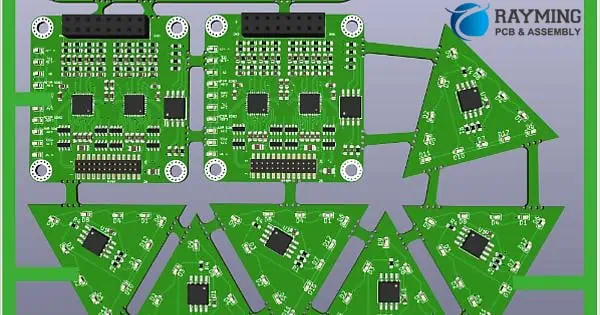
PCB panelization is the process of combining multiple individual PCB designs into a single, larger panel for more efficient manufacturing. This technique allows for the simultaneous production of multiple boards, significantly reducing manufacturing time and costs. Panelization is especially beneficial for high-volume production runs and smaller PCB designs.

By arranging multiple PCB layouts on a single panel, manufacturers can optimize material usage, streamline the production process, and enhance overall efficiency. This approach is particularly advantageous for mass production scenarios, where even small improvements in efficiency can lead to substantial cost savings.

Powered By EmbedPress

Read more about:

How Big is a Board Panel?

The size of a PCB panel can vary depending on several factors, including:

  1. Manufacturing equipment capabilities
  2. Design requirements
  3. Production volume
  4. Material constraints

Typically, PCB panels range from 18″ x 24″ (457mm x 610mm) to 21″ x 24″ (533mm x 610mm). However, some manufacturers may offer custom panel sizes to accommodate specific project needs. It’s crucial to consult with your PCB manufacturer to determine the optimal panel size for your particular requirements.

Tools for PCB Panelization

To effectively implement PCB panelization, designers and manufacturers rely on various specialized tools. These tools help in the planning, execution, and optimization of the panelization process:

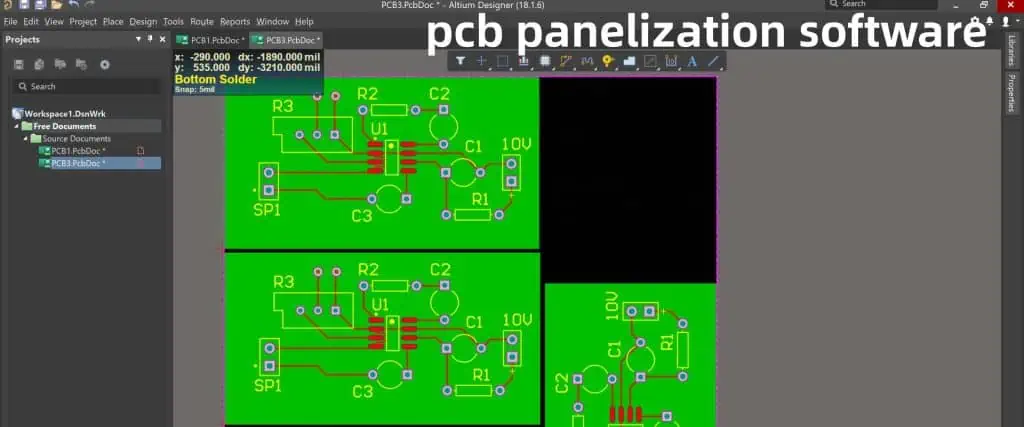
  1. CAD Software: Advanced PCB design software like Altium Designer, Eagle, and KiCad often include panelization features.
  2. Panelization Software: Dedicated tools like PanelizeXT and Wise Panelize focus specifically on creating optimized panel layouts.
  3. Gerber Editors: Software like GerbTool and CAM350 allow for manual adjustments and fine-tuning of panelized designs.
  4. Simulation Tools: Programs that simulate the manufacturing process help identify potential issues before production begins.
  5. Automated Panelization Systems: Some manufacturers use automated systems that optimize panel layouts based on input parameters.

What Types of PCB Panel Designs Are There?

Figure 2,Panelization of two different PCB-designs

PCB panelization offers various design approaches, each suited to different manufacturing requirements and board characteristics. Let’s explore the main types:

1. Order Panelization

Order Panelization
Order Panelization

Order panelization involves arranging identical PCB designs in a grid pattern on the panel. This method is ideal for high-volume production of a single PCB design, maximizing efficiency and minimizing waste.

2. Rotation Angle Panelization

Rotation Angle Panelization

In this approach, PCB designs are rotated at different angles within the panel. This technique can help optimize space utilization, especially for irregularly shaped PCBs. It also allows for more efficient use of panel area, potentially reducing material waste.

3. Double Side Panelization

Double side panelization

Double side panelization involves placing PCB designs on both sides of the panel. This method is particularly useful for double-sided or multi-layer PCBs, allowing for simultaneous production of both sides and potentially reducing manufacturing time.

4. Combination Panelization

Combination Panelization

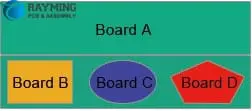
Combination panelization integrates different PCB designs onto a single panel. This approach is beneficial when producing multiple designs in smaller quantities, allowing for efficient use of panel space and reducing overall production costs.

5. Combination Panelization (ABCD)

ABCD panelization is a specific form of combination panelization where four different PCB designs (A, B, C, and D) are arranged on a single panel. This method is ideal for producing small quantities of multiple designs simultaneously, offering flexibility and cost-effectiveness for diverse production needs.

PCB Panelization โ€“ Factors to Consider

Effective PCB panelization requires careful consideration of various factors to ensure optimal results. Let’s examine these crucial aspects:

1. Challenges and Solutions in Panelization

Panelization can present challenges such as:

  • Ensuring uniform board quality across the panel
  • Managing thermal expansion during manufacturing
  • Maintaining consistent electrical properties

Solutions include:

  • Implementing proper spacing between boards
  • Using dummy circuits to balance copper distribution
  • Employing advanced simulation tools to predict and mitigate issues

2. Component Placement

Careful component placement is crucial in panelization. Consider:

  • Edge clearances for components
  • Orientation of sensitive components
  • Balancing component distribution across the panel

3. Trace Routing

Efficient trace routing in panelized designs involves:

  • Minimizing crossovers between boards
  • Ensuring consistent impedance control
  • Optimizing signal integrity across the panel

4. Thermal Management

Thermal considerations in panelization include:

  • Even heat distribution during soldering
  • Managing thermal stress on components
  • Implementing proper thermal relief for large copper areas

5. Manufacturing Tolerances

Account for manufacturing tolerances by:

  • Allowing adequate space between boards
  • Considering tolerance stack-up in panel design
  • Implementing proper fiducial marks for alignment

6. Assembly and Testing

Optimize for assembly and testing by:

  • Incorporating test points accessible in panelized form
  • Designing for compatibility with automated assembly equipment
  • Considering in-circuit and functional testing requirements

7. Cost

Balance cost considerations by:

  • Maximizing panel utilization
  • Optimizing for standard panel sizes
  • Considering material selection and layer count

11 Essential Design Rules for PCB Panelization

panel pcb
panel pcb

To ensure successful PCB panelization, adhere to these essential design rules:

  1. Maintain consistent board orientation for efficient assembly.
  2. Use breakaway tabs or V-scoring for easy depanelization.
  3. Implement proper fiducial marks for accurate component placement.
  4. Ensure adequate clearance between boards and panel edges.
  5. Balance copper distribution across the panel to prevent warping.
  6. Design tooling holes for proper panel alignment during manufacturing.
  7. Consider the direction of manufacturing processes (e.g., etching, plating) in layout.
  8. Implement proper test points accessible in panelized form.
  9. Use panel borders to protect edge components during handling.
  10. Optimize panel utilization to minimize waste.
  11. Ensure compatibility with automated assembly and testing equipment.

How to Depanelize?

Depanelization is the process of separating individual PCBs from the panel after manufacturing. The choice of depanelization method depends on factors such as board design, material properties, and production volume.

Depanelization Methods

Common depanelization techniques include:

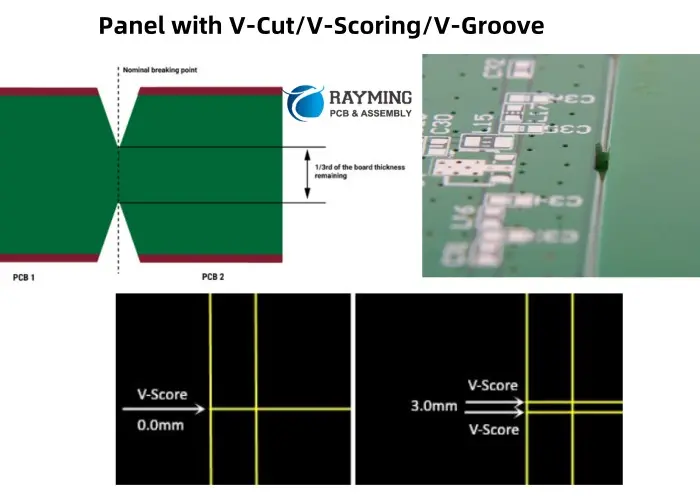
  1. V-Scoring: Creating partially-cut grooves along separation lines.
  2. Tab Routing: Using routed slots with small tabs to hold boards in place.
  3. Perforation: Creating a series of small holes along separation lines.
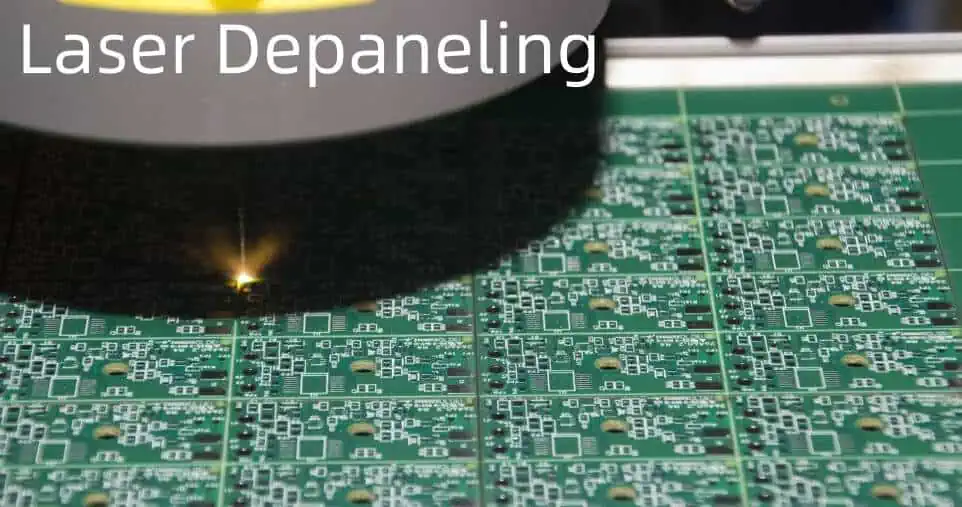
  4. Laser Cutting: Using precision laser technology for clean separation.
  5. Water Jet Cutting: Employing high-pressure water for separation.

V-Scoring

V-scoring is a popular depanelization method that involves:

  • Creating V-shaped grooves on both sides of the panel
  • Allowing for easy manual separation or breakout
  • Providing clean edges with minimal stress on components

Tab Routing

Tab routing offers several advantages:

  • Allows for complex board shapes
  • Provides better support for larger or heavier boards
  • Enables easier separation of densely populated boards

What Factors Affect Panel Prices?

Several factors influence the cost of PCB panels:

1. Usable Area of Working Panel

The efficient utilization of panel space directly impacts cost. Maximizing the usable area reduces waste and lowers per-unit costs.

2. The Cost of Substrates and Films

Material selection significantly affects panel prices. Factors include:

  • Base material (e.g., FR-4, high-frequency materials)
  • Copper weight and type
  • Solder mask and silkscreen materials

3. Drilling Number

The number and complexity of drilled holes impact manufacturing time and cost. Consider:

4. The Number of V-Cutting Lines

V-scoring complexity affects manufacturing costs. Factors include:

  • Total length of V-score lines
  • Complexity of V-score patterns
  • Material thickness and type

5. Test of Electrical Properties

Electrical testing requirements influence overall panel cost:

  • Flying probe vs. bed-of-nails testing
  • Test coverage requirements
  • Specialized testing for high-frequency or high-power designs

6. Expedited Fee

Rush orders or expedited production typically incur additional costs. Consider:

  • Standard vs. expedited turnaround times
  • Impact on manufacturing schedule
  • Balancing urgency with cost-effectiveness

Advantages of PCB Panelization

PCB panelization offers numerous benefits to manufacturers and designers alike:

1. Reduced Costs

Panelization significantly reduces production costs by:

  • Minimizing material waste
  • Lowering per-unit manufacturing costs
  • Optimizing equipment utilization

2. Improved Efficiency

Efficiency gains from panelization include:

  • Faster production times for multiple boards
  • Streamlined assembly and testing processes
  • Reduced handling and transportation requirements

3. Easier Assembly

Panelization facilitates easier assembly by:

  • Enabling batch processing of components
  • Improving compatibility with automated assembly equipment
  • Reducing the risk of damage to individual boards during handling

In conclusion, PCB panelization is a crucial technique in modern electronics manufacturing. By carefully considering design factors, adhering to best practices, and leveraging the advantages of panelization, designers and manufacturers can achieve significant cost savings and efficiency improvements. As the electronics industry continues to evolve, mastering the art of PCB panelization will remain a key factor in staying competitive and meeting the demands of increasingly complex designs.

Precision Protection: Exploring the Role of Dry Film Photoresist in PCB Fabrication

Are you curious about how modern electronics are made? At the heart of many devices lies a crucial component: the printed circuit board (PCB). And at the core of PCB fabrication is an unsung hero – dry film photoresist. In this article, we’ll dive into the world of dry film photoresist and explore its vital role in creating the electronics we use every day.

The Fundamentals of Dry Film Photoresist

Defining Dry Film Photoresist

Dry film photoresist is a photosensitive material central to PCB production. It consists of a photopolymer layer sandwiched between two protective sheets. When exposed to ultraviolet (UV) light, the photoresist undergoes a chemical transformation, enabling precise pattern transfer onto the PCB substrate.

The Journey of Photoresist Technology

The evolution of photoresist technology in PCB manufacturing has been nothing short of remarkable. From the initial use of liquid photoresists to the development of dry film alternatives, this technology has continuously adapted to meet the escalating demands of the electronics industry.

The Liquid Photoresist Era

In the early days of PCB fabrication, liquid photoresists were the primary solution. While effective, they presented challenges in terms of uniformity and handling, particularly for high-volume production scenarios.

YouTube video

The Dry Film Photoresist Revolution

The introduction of dry film photoresist marked a turning point in PCB manufacturing. This innovation addressed many of the shortcomings of liquid photoresists, offering improved consistency, ease of use, and compatibility with automated processes.

Key Benefits of Dry Film Photoresist

Unparalleled Uniformity and Thickness Control

A primary advantage of dry film photoresist is its ability to provide exceptional uniformity across the PCB surface. This consistency is crucial for achieving precise circuit patterns, especially in high-density designs where every micron matters.

Superior Resolution and Edge Definition

Dry film photoresist enables sharper edge definition and higher resolution in circuit patterns. This capability is invaluable as PCBs become increasingly complex and compact, necessitating finer lines and spaces.

Streamlined Handling and Processing

The solid nature of dry film photoresist simplifies handling and application compared to liquid alternatives. It can be easily laminated onto PCB substrates, minimizing the risk of contamination and ensuring more comprehensive coverage.

Eco-friendly and Health-conscious

Dry film photoresist is generally considered more environmentally friendly than its liquid counterparts. It generates less waste and reduces exposure to potentially harmful chemicals during the application process, aligning with modern sustainability goals.

Read more about:

The Dry Film Photoresist Workflow in PCB Production

Dry File Imaging Process of Aluminum PCB Manufactturing

Phase 1: Surface Preparation and Cleaning

Before applying dry film photoresist, the PCB substrate undergoes thorough cleaning to ensure optimal adhesion. This crucial step typically involves mechanical or chemical cleaning processes to eliminate surface contaminants.

Phase 2: Lamination Process

The dry film photoresist is carefully laminated onto the PCB substrate using a combination of heat and pressure. This process ensures uniform coverage and strong adhesion to the board surface, setting the stage for subsequent steps.

Phase 3: UV Exposure

The laminated board is exposed to UV light through a photomask containing the desired circuit pattern. This exposure triggers polymerization in the exposed areas, creating a hardened image of the circuit design.

Phase 4: Development Stage

Following exposure, the board undergoes a development process. This step removes the unexposed photoresist, leaving behind the desired circuit pattern and preparing the board for etching.

Phase 5: Etching Process

With the protective photoresist pattern in place, the board is subjected to an etching process. This step removes the exposed copper, creating the final circuit pattern with precision.

Phase 6: Resist Stripping

Once etching is complete, the remaining photoresist is stripped away, revealing the finished circuit pattern on the PCB and concluding the core fabrication process.

Diverse Applications of Dry Film Photoresist in PCB Manufacturing

High-Density Interconnect (HDI) PCBs

Dry film photoresist plays a pivotal role in the production of HDI PCBs, which demand extremely fine lines and spaces. Its high resolution and excellent edge definition make it ideal for these cutting-edge applications.

Flexible PCB Solutions

The adaptability of dry film photoresist makes it well-suited for manufacturing flexible PCBs. These versatile boards are increasingly used in compact electronic devices and wearable technology, where flexibility is paramount.

Multilayer PCB Fabrication

In the production of multilayer PCBs, dry film photoresist is used to create precise patterns on each layer. Its consistency and reliability are essential for ensuring proper alignment and functionality across all layers of these complex boards.

Rigid-Flex PCB Integration

Rigid-flex PCBs, which combine rigid and flexible board technologies, benefit significantly from the versatility of dry film photoresist. It can be effectively applied to both rigid and flexible substrates, ensuring uniform circuit patterns throughout the hybrid board.

Navigating Challenges in Dry Film Photoresist Usage

Optimal Storage and Handling Practices

Dry film photoresist is sensitive to environmental factors such as light, temperature, and humidity. Implementing proper storage and handling procedures is crucial to maintain its quality and effectiveness throughout its shelf life.

Precision in Equipment and Process Control

Achieving optimal results with dry film photoresist requires precise control over various process parameters, including lamination temperature, exposure time, and development conditions. This level of control demands sophisticated equipment and well-trained operators.

Ensuring Substrate Compatibility

While dry film photoresist is versatile, ensuring compatibility with various PCB substrate materials can be challenging. Different substrates may require specific types of photoresist or modified processing conditions to achieve optimal results.

Application-Specific Optimization

Each PCB application may have unique requirements in terms of resolution, thickness, and other properties. Fine-tuning the dry film photoresist process to meet these specific needs can be complex and time-consuming, requiring expertise and patience.

Innovation Horizons in Dry Film Photoresist Technology

Next-Generation Photoresist Formulations

Ongoing research is focused on developing new photoresist formulations with improved properties, such as higher resolution, better adhesion, and enhanced resistance to harsh manufacturing conditions, pushing the boundaries of what’s possible in PCB fabrication.

Synergy with Additive Manufacturing

As additive manufacturing techniques gain traction in PCB production, dry film photoresist technology is evolving to support these new processes, offering potential for even more precise and efficient circuit creation in the era of 3D-printed electronics.

Eco-Innovation in Photoresist Solutions

The push for more sustainable manufacturing practices is driving the development of eco-friendly dry film photoresist options, with a focus on reducing environmental impact, improving recyclability, and minimizing the carbon footprint of PCB production.

Industry 4.0 Integration

The integration of dry film photoresist processes with advanced automation and Industry 4.0 technologies promises to enhance efficiency, reduce errors, and improve overall PCB manufacturing quality, ushering in a new era of smart manufacturing in the electronics industry.

Conclusion: The Enduring Significance of Dry Film Photoresist

As we’ve explored throughout this article, dry film photoresist stands as a cornerstone technology in the realm of PCB fabrication. Its capacity to deliver precision, consistency, and versatility makes it an indispensable tool in the electronics manufacturing industry.

From enabling the production of high-density interconnect boards to supporting the development of flexible and multilayer PCBs, dry film photoresist continues to push the envelope of possibility in circuit board design and manufacturing. Its ongoing evolution, driven by relentless research and innovation, ensures that it will remain at the forefront of PCB manufacturing technology for years to come.

As electronic devices become increasingly compact, complex, and ubiquitous, the role of dry film photoresist in PCB fabrication is set to grow even more critical. It stands as a testament to the ingenuity and continuous improvement that drives the electronics industry forward, playing a vital role in shaping the electronic landscape of tomorrow.

For PCB designers, manufacturers, and technology enthusiasts alike, understanding the role of dry film photoresist provides valuable insight into the precision and innovation that underpins our modern digital world. As we look to the future, it’s clear that this unassuming yet critical technology will continue to be a key player in the ongoing revolution of electronic design and manufacturing.

Wire Harness Assembly: A Complete Guide to Types, Benefits, Design & Manufacturing

wire harness (also called a cable harness or wiring assembly) is an organized arrangement of wires, cables, and subassemblies designed to transmit electrical power or signals efficiently. While a simple harness may consist of just a few components, more complex versions can incorporate dozensโ€”or even hundredsโ€”of wires, connectors, and passive (or active) elements.

In today’s interconnected world, the importance of efficient and reliable electrical systems cannot be overstated. At the heart of these systems lies a crucial component: the wire harness assembly. Whether you’re in the automotive industry, aerospace, or consumer electronics, understanding wire harness assemblies is essential for creating robust and efficient electrical systems. This comprehensive guide will delve into the world of wire harness assemblies, exploring their types, benefits, design processes, and manufacturing
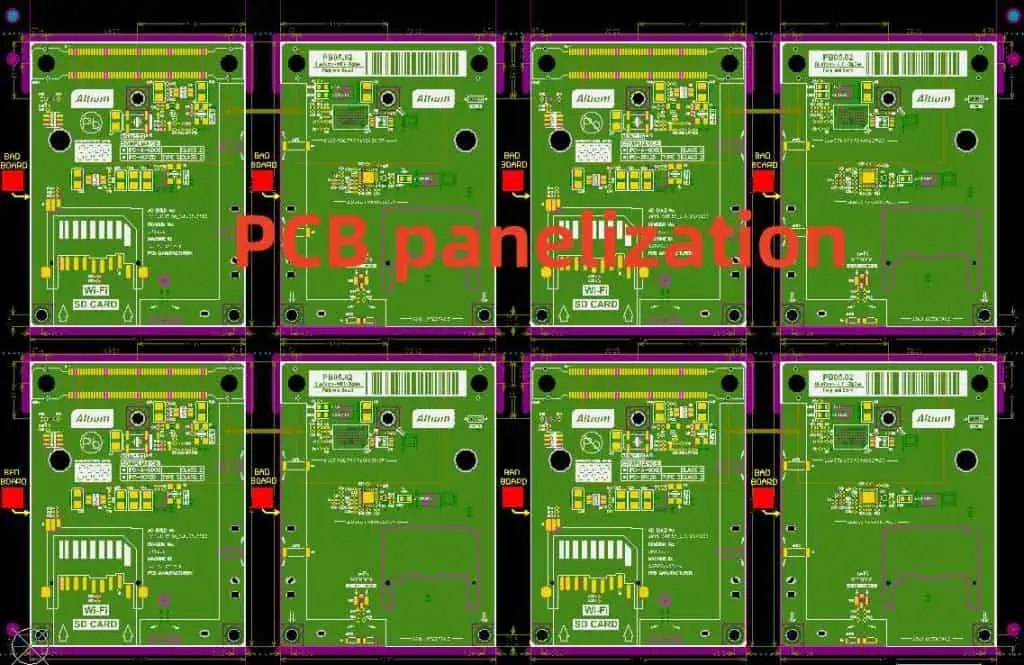
techniques.

YouTube video

What is Wire Harness Assembly?

Wire harness assembly is the process of organizing and bundling individual electrical wires or cables into a single unit. This unified structure, known as a wire harness or wiring assembly, serves as the central nervous system for various electrical devices and systems. By consolidating multiple wires into a single harness, manufacturers can streamline installation, improve organization, and enhance the overall reliability of electrical systems.

Key Components of a Wire Harness

  1. Wires and cables
  2. Connectors
  3. Terminals
  4. Sleeves and sheaths
  5. Clips and fasteners
  6. Labels and identifiers

Wire harness assemblies play a crucial role in transmitting power, data, and signals between different components of a system. They are designed to withstand environmental factors such as heat, vibration, and moisture, ensuring long-term performance and reliability.

Read more about:

Read more about:

Types of Custom Wiring Harnesses

Wire harness assemblies come in various types, each tailored to specific applications and industries. Understanding these types can help you choose the right harness for your project.

1. Automotive Wire Harnesses

Automotive wire harnesses are designed to withstand the harsh conditions found in vehicles. They connect various electrical components, including:

  • Engine control systems
  • Lighting systems
  • Audio and infotainment systems
  • Safety features (airbags, ABS, etc.)

These harnesses must be robust, heat-resistant, and capable of handling high-current applications.

2. Aerospace Wire Harnesses

Aerospace wire harnesses are subject to stringent regulations and must meet high standards for reliability and safety. They are used in:

  • Aircraft control systems
  • Avionics
  • Communication systems
  • Power distribution

These harnesses often use specialized materials to reduce weight and improve performance in extreme conditions.

3. Medical Device Wire Harnesses

Wire harnesses for medical devices require exceptional precision and reliability. They are commonly found in:

  • Diagnostic equipment
  • Patient monitoring systems
  • Surgical devices
  • Imaging machines

Medical wire harnesses often need to be biocompatible and sterilizable.

4. Industrial Wire Harnesses

Industrial wire harnesses are designed for use in manufacturing environments and heavy machinery. Applications include:

  • Robotics and automation systems
  • Control panels
  • Power distribution systems
  • Sensor networks

These harnesses must be durable and able to withstand exposure to chemicals, oils, and extreme temperatures.

5. Consumer Electronics Wire Harnesses

Wire harnesses in consumer electronics are typically smaller and more compact. They are used in devices such as:

  • Computers and laptops
  • Home appliances
  • Gaming consoles
  • Smart home devices

These harnesses often prioritize space-saving designs and efficient signal transmission.

Wire Harness Assembly Benefits

wire harness
wire harness

Implementing wire harness assemblies in your electrical systems offers numerous advantages:

1. Improved Organization and Efficiency

By bundling multiple wires into a single harness, you can:

  • Reduce clutter in electrical systems
  • Simplify installation and maintenance processes
  • Improve airflow and cooling in tight spaces

2. Enhanced Reliability

Wire harnesses provide:

  • Better protection against environmental factors
  • Reduced risk of short circuits and electrical failures
  • Improved stability in high-vibration environments

3. Cost-Effectiveness

While the initial investment in custom wire harnesses may be higher, they offer long-term cost benefits:

  • Reduced installation time and labor costs
  • Lower maintenance and repair expenses
  • Improved product longevity

4. Space Optimization

Wire harnesses help:

  • Maximize available space in compact designs
  • Reduce the overall weight of electrical systems
  • Improve routing options for complex layouts

5. Consistency and Quality Control

Using wire harnesses ensures:

  • Standardized assembly processes
  • Easier quality control and testing
  • Consistent performance across products

6. Customization Options

Wire harnesses can be tailored to specific needs:

  • Custom wire lengths and gauges
  • Specialized connectors and terminals
  • Application-specific insulation and shielding

Wire Harness Design and Pre-Production

The design phase is crucial in creating effective wire harness assemblies. A well-planned design process ensures that the final product meets all specifications and performs optimally.

1. Requirements Gathering

The first step in wire harness design involves:

  • Identifying the specific application and environment
  • Determining power and signal requirements
  • Considering regulatory standards and compliance needs

2. Schematic Design

Creating a detailed schematic involves:

  • Mapping out the electrical connections
  • Specifying wire types, gauges, and colors
  • Identifying connector types and pin assignments

3. 3D Modeling and Routing

Modern wire harness design often utilizes 3D modeling software to:

  • Visualize the harness layout in the final product
  • Optimize wire routing for efficiency and safety
  • Identify potential interference or clearance issues

4. Material Selection

Choosing the right materials is critical for harness performance:

  • Wire types (stranded, solid core, coaxial, etc.)
  • Insulation materials (PVC, PTFE, silicone, etc.)
  • Connector types and plating options

5. Prototyping and Testing

Before full-scale production, prototypes are created to:

  • Verify design accuracy and functionality
  • Conduct performance and durability tests
  • Identify areas for improvement or optimization

6. Documentation and Revision Control

Proper documentation ensures consistency and traceability:

  • Detailed assembly instructions
  • Bill of materials (BOM)
  • Revision history and change management

Wire Harnesses vs. Cable Assemblies

wire harness design
wire harness design

While wire harnesses and cable assemblies serve similar purposes, they have distinct characteristics:

Wire Harnesses:

  • Consist of multiple individual wires bundled together
  • Often use discrete wires for different signals or functions
  • Typically more flexible and adaptable to complex routing
  • Commonly used in applications with multiple connection points

Cable Assemblies:

  • Usually contain multiple conductors within a single outer jacket
  • Often designed for specific signal types (e.g., coaxial, twisted pair)
  • Generally offer better protection against electromagnetic interference
  • Typically used for point-to-point connections or standardized interfaces

Choosing between wire harnesses and cable assemblies depends on factors such as:

  • Application requirements
  • Signal type and frequency
  • Environmental conditions
  • Installation and maintenance considerations

Wire Harness Manufacturing/Assembly Process

The manufacturing process for wire harnesses involves several key steps:

1. Wire Preparation

  • Cutting wires to specified lengths
  • Stripping insulation from wire ends
  • Tinning or crimping terminals onto wire ends

2. Subassembly Creation

  • Grouping wires into sub-bundles
  • Adding intermediate connectors or splices
  • Pre-forming wire groups for easier final assembly

3. Layout and Bundling

  • Arranging wires on an assembly board
  • Securing wires with tape, ties, or clamps
  • Forming the harness into its final shape

4. Connector Assembly

  • Inserting prepared wires into connector housings
  • Securing contacts within connectors
  • Adding seals or backshells as required

5. Protective Covering Application

  • Applying sleeves, conduits, or wraps
  • Heat-shrinking protective tubing
  • Adding abrasion-resistant materials at stress points

6. Labeling and Identification

  • Attaching wire markers or labels
  • Adding identification tags or barcodes
  • Applying color-coding for easy recognition

7. Quality Control and Testing

  • Visual inspections for defects or errors
  • Electrical continuity and insulation resistance tests
  • Environmental and stress testing as required

Wire Harness Covering Options

Protective coverings are essential for enhancing the durability and performance of wire harnesses. Common covering options include:

1. Plastic Tubing

  • PVC tubing for general-purpose applications
  • Polyethylene tubing for improved chemical resistance
  • Nylon tubing for high-temperature environments

2. Braided Sleeving

  • Expandable braided sleeving for flexibility
  • Metallic braided sleeving for EMI shielding
  • Fiberglass sleeving for high-temperature applications

3. Heat-Shrink Tubing

  • Provides a tight, custom fit around wire bundles
  • Available in various materials for different environments
  • Can be used for strain relief and abrasion protection

4. Tape Wrapping

  • Electrical tape for basic insulation and bundling
  • High-temperature tape for automotive and industrial applications
  • EMI shielding tape for sensitive electronic applications

5. Conduits

  • Flexible plastic conduits for general protection
  • Metallic conduits for extreme environments
  • Split conduits for easy installation and maintenance

Wire Harness Testing

Rigorous testing is crucial to ensure the reliability and performance of wire harness assemblies:

1. Continuity Testing

  • Verifies proper connections between points
  • Identifies open circuits or misrouted wires

2. Insulation Resistance Testing

  • Checks for adequate insulation between conductors
  • Identifies potential short circuits or insulation breakdown

3. High-Voltage Testing

  • Ensures insulation can withstand specified voltages
  • Identifies weak points in the harness assembly

4. Environmental Testing

  • Subjects harnesses to temperature extremes, humidity, and vibration
  • Verifies performance under simulated real-world conditions

5. Functional Testing

  • Checks the harness in a simulated or actual application setup
  • Verifies correct operation of all circuits and components

6. X-ray Inspection

  • Non-destructive testing for internal defects
  • Particularly useful for complex or high-reliability harnesses

The Engineering Behind Wire Harnesses

Creating effective wire harness assemblies requires a multidisciplinary approach, combining electrical, mechanical, and materials engineering:

Electrical Engineering Considerations

  • Circuit design and current capacity calculations
  • Signal integrity and EMI/EMC analysis
  • Power distribution optimization

Mechanical Engineering Aspects

  • Stress and strain analysis for harness routing
  • Vibration and shock resistance design
  • Thermal management and heat dissipation

Materials Science Applications

  • Selection of conductor materials (copper, aluminum, alloys)
  • Insulation and jacketing material properties
  • Connector and terminal material compatibility

Manufacturing Engineering

  • Design for manufacturability (DFM) principles
  • Assembly process optimization
  • Quality control and testing methodologies

Systems Integration

  • Interfacing with other electrical and mechanical systems
  • Compliance with industry standards and regulations
  • Lifecycle management and maintainability considerations

Choose RAYMING for Wiring Harnesses and Cable Assemblies

When it comes to high-quality wire harness assemblies and cable solutions, RAYMING stands out as a trusted partner. With years of experience and a commitment to excellence, RAYMING offers:

  1. Custom Design Services: Tailored solutions to meet your specific requirements
  2. Advanced Manufacturing Capabilities: State-of-the-art equipment and processes
  3. Rigorous Quality Control: Comprehensive testing and inspection procedures
  4. Industry Expertise: Experience across automotive, aerospace, medical, and industrial sectors
  5. Competitive Pricing: Cost-effective solutions without compromising on quality
  6. Responsive Customer Support: Dedicated team to assist you throughout the project lifecycle

By choosing RAYMING, you ensure that your wire harness and cable assembly needs are met with precision, reliability, and innovation.

Applications of Wire Harness Assembly

Wire harness assemblies find applications across a wide range of industries and products:

Automotive Industry

  • Engine management systems
  • Infotainment and navigation systems
  • Advanced driver-assistance systems (ADAS)
  • Electric and hybrid vehicle power distribution

Aerospace and Defense

  • Avionics and flight control systems
  • Satellite and space vehicle wiring
  • Military vehicle electrical systems
  • Radar and communication equipment

Medical Devices

  • Diagnostic imaging equipment (MRI, CT scanners)
  • Patient monitoring systems
  • Surgical robots and instruments
  • Portable medical devices

Industrial Automation

Consumer Electronics

  • Computers and laptops
  • Smart home devices
  • Gaming consoles and peripherals
  • Home appliances and white goods

Telecommunications

  • Network routers and switches
  • Cell tower equipment
  • Fiber optic transmission systems
  • Satellite communication ground stations

Energy Sector

  • Solar and wind power systems
  • Power distribution panels
  • Smart grid technologies
  • Electric vehicle charging stations

As technology continues to advance, the importance of reliable and efficient wire harness assemblies will only grow. From enabling the latest innovations in electric vehicles to powering life-saving medical devices, wire harnesses play a crucial role in shaping our modern world.

In conclusion, wire harness assembly is a complex and vital aspect of electrical system design and manufacturing. By understanding the types, benefits, design processes, and applications of wire harnesses, engineers and manufacturers can create more efficient, reliable, and innovative products. Whether you’re developing a new product or optimizing an existing system, partnering with an experienced wire harness manufacturer like RAYMING can help you achieve your goals and stay ahead in today’s competitive market.

TOP 30 Electronic Manufacturing Services Companies in the world (2026 Update)

EMS Electronics Manufacturing Companies

Introduction to Electronic Manufacturing Services

Electronic Manufacturing Services (EMS) play a crucial role in today’s technology-driven world. These companies provide a wide range of services, from design and engineering to manufacturing, testing, distribution, and after-sales support for electronic components and products. As we approach 2026, the EMS industry continues to evolve, adapting to new technologies, market demands, and global challenges.

In this comprehensive guide, we’ll explore the top 30 Electronic Manufacturing Services companies that are shaping the industry in 2026. We’ll delve into their strengths, recent developments, and what sets them apart in this competitive landscape.

Understanding the EMS Industry

electronic design and manufacturing

What are Electronic Manufacturing Services?

Electronic Manufacturing Services encompass a broad range of activities related to the production of electronic components and products. These services typically include:

  1. PCB Assembly
  2. Product Design and Engineering
  3. Prototyping
  4. Testing and Quality Assurance
  5. Supply Chain Management
  6. Distribution and Logistics
  7. After-sales Support and Repair

The Importance of EMS in Modern Technology

As technology continues to advance at a rapid pace, the role of EMS providers becomes increasingly critical. They enable companies to:

  • Focus on core competencies while outsourcing manufacturing
  • Reduce time-to-market for new products
  • Achieve cost efficiencies through economies of scale
  • Access cutting-edge manufacturing technologies
  • Maintain flexibility in production capacity
EMS Calculator & Service Finder – RayPCB

EMS Calculator & Service Finder

RayPCB Engineering Tools

Answer a few questions to find the right EMS services for your project.

โœ…

Recommended: Quick-Turn Prototype

Suggested Services:

Get an instant estimate for your PCB assembly project.

๐Ÿ’ต Assembly Cost Estimate

Unit Price $0.00
Volume Discount 0% OFF
Subtotal (100 units) $0.00
Setup Fee $0
Estimated Total
$0.00

*Estimate only. Final quote may vary based on detailed specifications and BOM review.

Calculate estimated production lead time for your EMS project.

โฑ๏ธ Estimated Lead Time

Total Production Time
0 days
Time Breakdown:
Assembly Production +0 days
PCB Fabrication +0 days
Component Sourcing +0 days
Testing & QC +0 days
โšก
Need it faster?
Expedited service available: ~0 days (additional fees apply)

Compare pricing across different production volumes to optimize your order quantity.

๐Ÿ“Š Volume Pricing Comparison

Quantity Unit Price Total Savings
๐Ÿ’ก
Pro Tip: Ordering 500+ units provides the best balance of unit cost savings vs. inventory investment.

Top 30 Electronic Manufacturing Services Companies in 2026

1. Foxconn (Hon Hai Precision Industry Co., Ltd.)

Headquarters: Taiwan Key Strengths: Massive scale, diverse product portfolio, strong relationships with major tech companies

Foxconn continues to dominate the EMS industry in 2026, leveraging its enormous manufacturing capacity and long-standing partnerships with tech giants like Apple, Amazon, and Microsoft. The company has made significant strides in automation and AI-driven manufacturing processes, further cementing its position as the industry leader.

2. Pegatron Corporation

Headquarters: Taiwan Key Strengths: Strong focus on consumer electronics, growing presence in automotive electronics

Pegatron has maintained its position as a top EMS provider, particularly in the consumer electronics sector. By 2026, the company has expanded its capabilities in emerging technologies such as IoT devices and electric vehicle components, diversifying its client base and revenue streams.

3. Flex Ltd.

Headquarters: Singapore Key Strengths: Global presence, diverse industry expertise, focus on innovation

Flex (formerly Flextronics) has continued to thrive by emphasizing its “Sketch-to-Scale” approach, providing end-to-end solutions for clients across various industries. The company’s investments in Industry 4.0 technologies and sustainable manufacturing practices have paid off, attracting environmentally conscious clients.

4. Jabil Inc.

Headquarters: USA Key Strengths: Advanced manufacturing technologies, strong presence in healthcare and industrial sectors

Jabil has strengthened its position in the EMS market by focusing on high-value sectors such as healthcare, automotive, and industrial equipment. The company’s investments in additive manufacturing and digital supply chain solutions have set it apart from competitors.

5. Sanmina Corporation

Headquarters: USA Key Strengths: High-complexity products, strong presence in defense and aerospace

Sanmina has maintained its focus on high-reliability, complex products for demanding industries such as defense, aerospace, and medical devices. By 2026, the company has expanded its capabilities in cybersecurity and advanced materials, catering to the evolving needs of its specialized client base.

6. Plexus Corp.

Headquarters: USA Key Strengths: Specialized in complex products, strong engineering capabilities

Plexus has continued to excel in serving clients with complex manufacturing requirements. The company’s investments in advanced engineering services and IoT solutions have helped it secure long-term partnerships in growing sectors such as robotics and renewable energy.

7. Benchmark Electronics, Inc.

Headquarters: USA Key Strengths: Focus on high-reliability markets, strong design services

Benchmark Electronics has maintained its position as a key player in the EMS industry by focusing on high-value, complex products for aerospace, defense, and medical markets. The company’s expansion into IoT and edge computing solutions has opened up new growth opportunities.

8. Celestica Inc.

Headquarters: Canada Key Strengths: Strong presence in cloud and communications infrastructure, focus on sustainability

Celestica has successfully pivoted towards high-growth markets such as cloud infrastructure, 5G networks, and renewable energy systems. The company’s commitment to sustainable manufacturing practices has resonated well with environmentally conscious clients.

9. Universal Scientific Industrial Co., Ltd. (USI)

Headquarters: China Key Strengths: Expertise in miniaturization, strong presence in wireless and automotive markets

USI has continued to grow its market share, particularly in the wireless communications and automotive electronics sectors. The company’s advancements in System-in-Package (SiP) technology have made it a preferred partner for clients seeking compact, high-performance solutions.

10. Zollner Elektronik AG

Headquarters: Germany Key Strengths: Mechatronics expertise, strong presence in European markets

Zollner has maintained its position as a leading EMS provider in Europe, leveraging its expertise in mechatronics and Industry 4.0 technologies. The company’s focus on automotive electronics and smart factory solutions has driven its growth in recent years.

11. BYD Electronic

Headquarters: China Key Strengths: Vertical integration, strong presence in mobile devices and automotive electronics

BYD Electronic has continued to expand its EMS offerings, leveraging its parent company’s expertise in battery technology and electric vehicles. The company’s focus on sustainability and green manufacturing has attracted environmentally conscious clients.

12. Enics AG

Headquarters: Switzerland Key Strengths: Specialization in industrial electronics, strong presence in European markets

Enics has maintained its position as a key player in the industrial electronics sector, with a particular focus on automation, energy, and transportation markets. The company’s investments in digital manufacturing and lifecycle services have strengthened its competitive edge.

13. New Kinpo Group

Headquarters: Taiwan Key Strengths: Diverse product portfolio, strong presence in consumer electronics and smart home devices

New Kinpo Group has continued to expand its EMS offerings, particularly in the areas of IoT devices, smart home products, and wearable technology. The company’s focus on vertical integration and design services has helped it secure long-term partnerships with major brands.

14. Sumitronics Corporation

Headquarters: Japan Key Strengths: Strong presence in automotive and industrial markets, expertise in high-reliability products

Sumitronics has maintained its position as a key EMS provider, particularly in the Japanese market. The company’s focus on automotive electronics, industrial automation, and medical devices has driven its growth in recent years.

15. SIIX Corporation

Headquarters: Japan Key Strengths: Global presence, expertise in automotive and consumer electronics

SIIX has continued to expand its global footprint, leveraging its strong presence in both Asian and European markets. The company’s focus on automotive electronics and IoT devices has helped it secure new clients and diversify its revenue streams.

16. Beyonics Technology Limited

Headquarters: Singapore Key Strengths: Expertise in precision engineering, strong presence in medical and automotive markets

Beyonics (formerly BH Electronics) has strengthened its position in the EMS market by focusing on high-precision components for medical devices and automotive applications. The company’s investments in advanced manufacturing technologies have set it apart from competitors.

17. Saline Lectronics, Inc.

Headquarters: USA Key Strengths: Specialization in low-volume, high-mix production, strong presence in medical and defense markets

Saline Lectronics has continued to excel in serving clients with complex, low-volume manufacturing requirements. The company’s focus on advanced testing and quality assurance has made it a preferred partner for clients in highly regulated industries.

18. MC Assembly (Integra Technologies)

Headquarters: USA Key Strengths: Expertise in complex assemblies, strong presence in aerospace and defense markets

MC Assembly, now part of Integra Technologies, has maintained its focus on high-reliability, complex assemblies for aerospace, defense, and medical markets. The company’s investments in advanced manufacturing technologies and cybersecurity have strengthened its competitive position.

19. NOTE AB

Headquarters: Sweden Key Strengths: Strong presence in European markets, expertise in industrial and medtech sectors

NOTE has continued to grow its market share in Europe, particularly in the industrial, medtech, and greentech sectors. The company’s focus on digitalization and sustainability has resonated well with its client base.

20. TT Electronics plc

Headquarters: UK Key Strengths: Expertise in high-reliability markets, strong design and engineering capabilities

TT Electronics has maintained its position as a key player in the EMS industry, focusing on high-reliability markets such as aerospace, defense, and medical devices. The company’s investments in power management and sensor technologies have opened up new growth opportunities.

21. Key Tronic Corporation

Headquarters: USA Key Strengths: Vertically integrated services, strong presence in consumer and industrial markets

Key Tronic has continued to offer a wide range of EMS solutions, from design to manufacturing and distribution. The company’s focus on vertical integration and supply chain optimization has helped it maintain long-term relationships with key clients.

22. Asteelflash Group

Headquarters: France Key Strengths: Global presence, expertise in high-mix, low-volume production

Asteelflash has maintained its position as a leading EMS provider, particularly in Europe and North America. The company’s focus on Industry 4.0 technologies and flexible manufacturing solutions has helped it adapt to changing market demands.

23. VTech EMS

Headquarters: Hong Kong Key Strengths: Expertise in consumer electronics, strong design capabilities

VTech EMS has continued to leverage its parent company’s expertise in consumer electronics, expanding its EMS offerings to include IoT devices, smart home products, and wearable technology. The company’s focus on sustainable manufacturing practices has attracted environmentally conscious clients.

24. Compass Electronics Group

Headquarters: USA Key Strengths: Diverse service offerings, strong presence in industrial and medical markets

Compass Electronics Group has maintained its position as a key player in the EMS industry by offering a wide range of services, from design to manufacturing and lifecycle management. The company’s focus on IoT solutions and digital transformation has driven its growth in recent years.

25. SigmaTron International, Inc.

Headquarters: USA Key Strengths: Flexible manufacturing capabilities, strong presence in consumer and industrial markets

SigmaTron has continued to offer a wide range of EMS solutions, adapting to changing market demands with its flexible manufacturing capabilities. The company’s investments in automation and supply chain optimization have helped it maintain its competitive edge.

26. SMTC Corporation

Headquarters: USA Key Strengths: Expertise in high-reliability markets, strong engineering capabilities

SMTC has maintained its focus on serving clients in high-reliability markets such as aerospace, defense, and medical devices. The company’s investments in advanced manufacturing technologies and design services have strengthened its position in these specialized sectors.

27. Integrated Micro-Electronics, Inc. (IMI)

Headquarters: Philippines Key Strengths: Strong presence in automotive and industrial markets, expertise in power modules

IMI has continued to grow its market share, particularly in the automotive electronics and industrial automation sectors. The company’s focus on power modules and renewable energy solutions has opened up new growth opportunities.

28. Ducommun Incorporated

Headquarters: USA Key Strengths: Expertise in aerospace and defense markets, strong engineering capabilities

Ducommun has maintained its position as a key player in the aerospace and defense sectors, leveraging its expertise in complex electronic and structural systems. The company’s investments in advanced materials and manufacturing technologies have set it apart from competitors.

29. Vexos Inc.

Headquarters: USA Key Strengths: Global presence, expertise in high-mix, low-to-mid volume production

Vexos has continued to offer flexible EMS solutions for clients across various industries, with a particular focus on medical devices, industrial equipment, and communications technology. The company’s investments in supply chain resilience and digital manufacturing have strengthened its competitive position.

30. Creation Technologies

Headquarters: Canada Key Strengths: Expertise in complex, high-reliability products, strong design services

Creation Technologies has maintained its focus on serving clients with complex manufacturing requirements, particularly in the medical, aerospace, and defense sectors. The company’s investments in advanced engineering services and digital transformation have helped it secure long-term partnerships with key clients.

Trends Shaping the EMS Industry in 2026

1. Industry 4.0 and Smart Manufacturing

The adoption of Industry 4.0 technologies, such as IoT, AI, and machine learning, has become widespread among top EMS providers. These technologies enable:

  • Real-time monitoring and optimization of production processes
  • Predictive maintenance to minimize downtime
  • Enhanced quality control through data analytics
  • Improved supply chain visibility and management

2. Sustainability and Green Manufacturing

Environmental concerns have become a top priority for both EMS providers and their clients. Key initiatives include:

  • Adoption of renewable energy sources in manufacturing facilities
  • Implementation of circular economy principles in product design and manufacturing
  • Reduction of carbon footprint through optimized logistics and supply chain management
  • Use of eco-friendly materials and packaging solutions

3. Reshoring and Regional Manufacturing

The global pandemic and geopolitical tensions have accelerated the trend towards reshoring and regional manufacturing. EMS providers are:

  • Establishing or expanding facilities closer to end markets
  • Implementing flexible manufacturing solutions to adapt to changing demand
  • Diversifying supply chains to reduce dependency on single regions or suppliers

4. Specialization and Value-Added Services

Top EMS companies are differentiating themselves by offering specialized services and moving up the value chain:

  • Advanced design and engineering services
  • Prototyping and new product introduction (NPI) support
  • Lifecycle management and aftermarket services
  • Regulatory compliance and certification support

5. Cybersecurity and Data Protection

As manufacturing becomes increasingly digital, cybersecurity has become a critical concern for EMS providers:

  • Implementation of robust cybersecurity measures in manufacturing processes
  • Secure data management and protection of intellectual property
  • Compliance with evolving data protection regulations
  • Offering cybersecurity services as part of product design and manufacturing

Conclusion

The Electronic Manufacturing Services industry continues to evolve rapidly, driven by technological advancements, changing market demands, and global challenges. The top 30 EMS companies in 2026 have demonstrated their ability to adapt to these changes, investing in new technologies, expanding their service offerings, and focusing on sustainability.

As we look towards the future, the most successful EMS providers will be those that can balance global reach with regional responsiveness, leverage advanced technologies to improve efficiency and quality, and offer value-added services that go beyond traditional manufacturing. The industry’s role in bringing innovative products to market quickly and efficiently will only grow in importance as technology continues to shape our world.

For companies seeking EMS partners, this list of top 30 providers offers a starting point for evaluating potential collaborators. However, it’s crucial to consider your specific needs, industry requirements, and long-term goals when selecting an EMS provider. The right partnership can be a key driver of innovation, efficiency, and success in today’s competitive technology landscape.