Understanding No-Clean Flux: Benefits, Applications, and Best Practices

No Clean Flux

In the world of electronics manufacturing and soldering, flux plays a crucial role in ensuring high-quality connections. Among the various types of flux available, no-clean flux has gained significant popularity due to its unique properties and advantages. This article delves into the intricacies of no-clean flux, exploring its benefits, applications, and best practices for use.

What is No-Clean Flux?

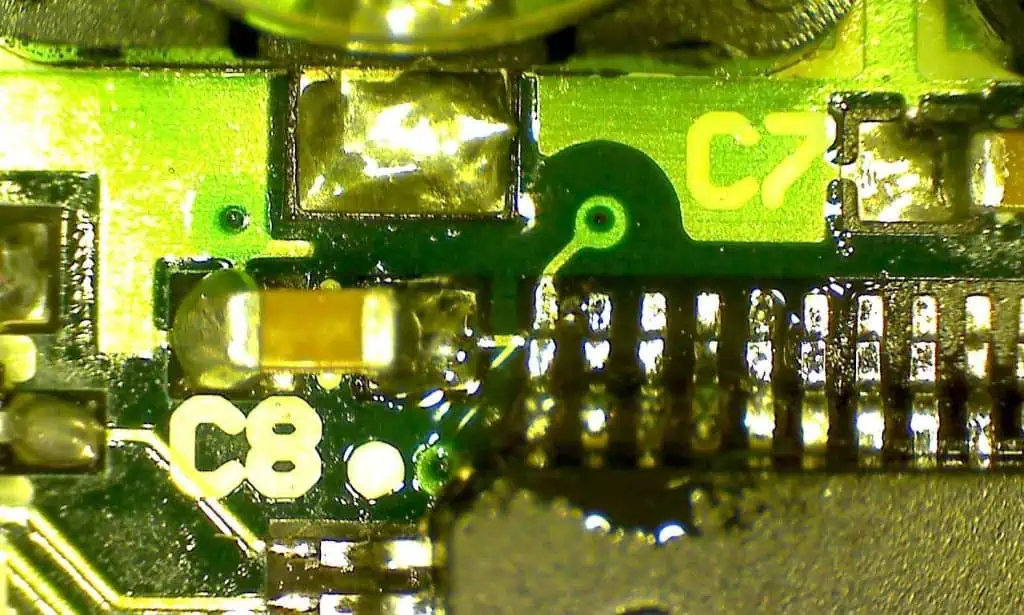
No-clean flux is a type of soldering flux specifically designed to leave minimal residue after the soldering process. Unlike traditional fluxes that require cleaning after use, no-clean flux is formulated to evaporate or decompose during the soldering process, leaving behind only a small amount of non-conductive, non-corrosive residue.

The composition of no-clean flux typically includes:

  1. Activators: Chemicals that remove oxides from metal surfaces
  2. Solvents: Substances that help in the application and spreading of the flux
  3. Resins or Rosins: Materials that provide adhesion and protection

These components work together to facilitate effective soldering while minimizing the need for post-soldering cleaning operations.

YouTube video

Why No-Clean Flux is Used

The use of no-clean flux has become increasingly common in electronics manufacturing for several reasons:

1. Time and Cost Efficiency

By eliminating the need for cleaning after soldering, no-clean flux significantly reduces production time and costs associated with cleaning processes.

2. Environmental Considerations

No-clean flux reduces the use of cleaning solvents, many of which can be harmful to the environment. This aligns with the growing trend towards more environmentally friendly manufacturing processes.

3. Reduced Risk of Component Damage

The cleaning process itself can sometimes damage sensitive electronic components. Using no-clean flux minimizes this risk by eliminating the need for aggressive cleaning methods.

4. Suitable for High-Density Assemblies

As electronic devices become more compact and complex, no-clean flux is particularly useful for high-density assemblies where cleaning might be challenging or impossible.

Why Cleaning Might Still Be Necessary

Despite the name “no-clean,” there are situations where cleaning no-clean flux residues might still be necessary:

1. High-Reliability Applications

In industries such as aerospace, medical devices, or military equipment, where reliability is paramount, even small amounts of flux residue might be unacceptable.

2. Aesthetic Concerns

In some consumer products, visible flux residue might be considered unsightly, necessitating cleaning for cosmetic reasons.

3. Interference with Testing or Conformal Coating

Flux residues can sometimes interfere with electrical testing or the application of conformal coatings, requiring removal in these cases.

4. Excessive Residue

If the soldering process results in more residue than expected (due to overheating or excessive flux application), cleaning may be necessary to ensure product quality.

Read more about:

How to Remove No-Clean Flux Residues

When cleaning is deemed necessary, there are several methods available for removing no-clean flux residues:

1. Benchtop Cleaning

Benchtop cleaning is a manual process suitable for small-scale operations or rework.

Tools and Materials:

  • Isopropyl alcohol (IPA)
  • Lint-free wipes
  • Soft-bristled brushes

Process:

  1. Apply IPA to the area with flux residue
  2. Gently scrub with a soft-bristled brush
  3. Wipe clean with a lint-free wipe
  4. Repeat if necessary

2. Aqueous Cleaning

Aqueous cleaning uses water-based solutions and is often employed in larger-scale operations.

Equipment:

  • Specialized cleaning machines
  • Deionized water
  • Surfactants or detergents

Process:

  1. Load PCBs into the cleaning machine
  2. Apply the cleaning solution at high pressure
  3. Rinse with deionized water
  4. Dry using forced air or heat

3. Vapor Degreasing

Vapor degreasing is an effective method for removing flux residues, especially in hard-to-reach areas.

Equipment:

  • Vapor degreasing machine
  • Specialized solvents (e.g., hydrofluoroethers)

Process:

  1. Place PCBs in the vapor degreasing chamber
  2. Expose PCBs to hot solvent vapors
  3. Allow condensed solvent to wash away residues
  4. Remove PCBs and allow to dry

Cleaning No-Clean Flux โ€“ Selecting the Right Fluid

Choosing the appropriate cleaning fluid is crucial for effectively removing no-clean flux residues without damaging components. Consider the following factors:

1. Compatibility

Ensure the cleaning fluid is compatible with all materials present on the PCB, including components, solder masks, and labels.

2. Effectiveness

The chosen fluid should effectively remove the specific type of no-clean flux used in your process.

3. Environmental and Safety Considerations

Opt for cleaning fluids that are environmentally friendly and safe for operators to use.

4. Drying Time

Consider the drying time of the cleaning fluid, as this can impact production efficiency.

5. Cost

Balance the cost of the cleaning fluid against its effectiveness and the volume required for your operations.

Advantages of No-Clean Flux

No-clean flux offers several advantages that have contributed to its widespread adoption:

1. Increased Productivity

By eliminating the cleaning step, no-clean flux helps streamline the production process, leading to higher throughput.

2. Cost Savings

Reduced cleaning requirements translate to savings in terms of cleaning equipment, solvents, and labor costs.

3. Environmentally Friendly

The minimal use of cleaning solvents makes no-clean flux a more environmentally friendly option compared to traditional fluxes.

4. Suitable for Sensitive Components

No-clean flux is often gentler on sensitive electronic components that might be damaged by aggressive cleaning processes.

5. Improved Reliability

When used correctly, no-clean flux can lead to improved solder joint reliability by minimizing the risk of cleaning-induced damage.

6. Versatility

No-clean flux is suitable for a wide range of soldering applications, from hand soldering to wave soldering and reflow processes.

Challenges of Using No-Clean Flux

While no-clean flux offers many benefits, it’s important to be aware of potential challenges:

1. Process Control

Achieving optimal results with no-clean flux requires careful control of soldering parameters such as temperature and flux quantity.

2. Residue Management

Although minimal, the residue left by no-clean flux must be managed to prevent potential issues in high-reliability applications.

3. Inspection Difficulties

Flux residues can sometimes make visual inspection of solder joints more challenging.

4. Potential for Contamination

If not properly managed, flux residues can potentially lead to contamination issues in some applications.

5. Compatibility Concerns

Not all no-clean fluxes are suitable for all soldering processes or components, requiring careful selection and testing.

6. Operator Training

Proper use of no-clean flux may require additional operator training to ensure optimal results and minimize issues.

Conclusion

No-clean flux has revolutionized the electronics manufacturing industry by offering a more efficient and environmentally friendly soldering solution. Its ability to minimize post-soldering cleaning requirements while maintaining high-quality solder joints has made it a popular choice across various applications.

However, the successful implementation of no-clean flux requires a thorough understanding of its properties, appropriate process control, and awareness of potential challenges. By carefully considering the specific requirements of each application and following best practices, manufacturers can leverage the benefits of no-clean flux to enhance their production processes.

As electronics continue to evolve, becoming more complex and miniaturized, the role of no-clean flux is likely to become even more significant. Staying informed about the latest developments in flux technology and best practices will be crucial for manufacturers aiming to maintain high-quality standards while optimizing their production efficiency.

Why You Should Choose the Best Custom Electronic Design Service

Electronic Design Service

Electronic engineering is one very fast growing field. Why is this so? It is not possible to find a business or an industry that doesnโ€™t benefit in a specific way different from the electronic circuits.

The application of recent innovations to designs is a major key to success. A top electronic design company is creative and innovative. These companies also specialize in the creation of prototypes from the ideas customers present and electronic design and development.

Why you should choose the Best Electronic Design Service for your electronic design services

Latest Technology

When you work with a top company like Rayming PCB, you will enjoy two main benefits. First, is the vast number of years that the engineers have spent in the development of electronic design projects as well as enjoying the benefits of the changing innovations and technologies.

The designers also work with recent trends in the electronic circuit design market. Furthermore, they understand the best practices, which industry experts know.

Experienced Experts in Electronic Design

Rayming PCB & Assembly has improved and refined their solutions and processes to make sure that they provide electronic design services of high standard onto their clients. With this experience, we can clearly say that we are professional electronic designers and will be able to deliver and provide high-quality services. Also, we continue to put in great efforts to get better, like clients seeking innovation.

Rayming also works across different sectors, which includes entertainment, military, telecommunications, commercial, medical, sport, and industrial sectors.

On Scope, On Budget, and On Time

Quick delivery of projects within a specific budget will play a huge role in a businessโ€™ success, most especially for complex and large tasks. Also, top companies offering electronic design services deliver completed products quickly, working with the budget and your specifications.

Furthermore, they offer in-house production and electronic design capabilities that allows users to create appropriate and accurate results for clients. If it is necessary, the company will need to carry out feasibility studies. This is to ensure that the project is viable both financially and practically. These companies will also conduct their work and operations associating closely with their clients. Also, the eventual electronic product will always bear the name of the client, with confidentiality.

Proven Performance

There can be no better proof of a companyโ€™s performance than it having a good client base. Over the years, top companies will have built a large client base. These businesses rely on these companies to deliver their electronic design needs. Their personalized experience, diligence to function and work, as well as efficient outcome are things that keep clients.

What is the Process of Electronic Design?

The circuit design process can cover different embedded systems, including complex electronic systems, and individual transistors having integrated circuits. When we talk of simple circuits, one person can achieve the process of design without the need for a structured or planned design process.

However, for designs that are more complex, electronic designers work with a systematic approach with a computer simulation that is intelligently guided.

A business of today works with some dynamics, which include technology that changes continuously, and at times, it becomes difficult for the companies to remain updated. One major reason is the way each organization is different from the other and complex in nature. For this case, companies will always require manufacturers that can meet their needs rather than building just standard lab equipment.

For integrated circuit design industrial automation, electronic circuit design usually refers to three different steps. These steps include physical design, schematic design, and logic design.

What are the Different Categories Involved In Electronic Design?

The categories here include hardware architecture, embedded software, and electronic design. The company deals with writing low-level firmware in order to interface the hardware directly with readable, highly efficient, and portable practices for electronic design.

Furthermore, the company configures and interacts both the microcontroller and architecture platform. Also, making use of the layout software, the company brings the customerโ€™s electronic circuits into life. The process of PCB design combines the component routing and component placement so as to define the electrical connectivity on a circuit board that is already manufactured.

In addition, a top electronic design company also specializes in EMC testing and Test engineering. The FPGA design is now more common, known as a major technology for building electronic systems. When you integrate the hardcore and soft-core processes, the devices become complete embedded systems on the chip, thereby displacing the general purpose ASICs and processors steadily.

Rayming PCB & Assembly is a professional in FPGA design and is always set to meet the demands of customers in FPGA design that has been set by a customer or client. DSP design is the most and last important technology.

DSP, also called digital signal processing, is using digital processing like by computers, as well as digital signal processors to deliver different operations of signal processing. Analog signal processing as well as DSP (digital signal processing) are different subfields or aspects of signal processing.

Applications of Digital Signal Processing (DSP)

The applications of digital signal processing (DSP) include:

  • Control systems
  • Seismology
  • Digital image processing
  • Spectral density estimation
  • Speech and audio processing
  • Biomedical engineering
  • Telecommunication signal processing
  • Statistical signal processing
  • Radar, sonar, as well as other different sensor array processing

Applying digital computation to the signal processing offers many benefits compared to analog processing in different applications, like error correction and detection in data compression and data transmission. You can apply DSP to stored (static) data and streaming data.

What are the Stages in Electronics Design Services?

Specification of the design requirements

Here, the client will provide details concerning the design requirements or design specifications. At times, the company suggests amendments and improvements to the customerโ€™s design to ensure it comes out better.

At times, some clients may need to sign a non-disclosure agreement. This is to allow them to disclose the design details. In order to prevent wasted efforts, then prospective customers are required to provide some information regarding their requirements, which will allow users to offer a rough and quick cost estimate.

Offering a price quote for your design

When you are done studying the specifications of the design, the company then analyzes the quantity of work necessary, the number of engineers that they should engage, estimated time for completion, and the resources needed, etc.

After considering this, the company comes back with the price quote for their analog electronics design services. Once the client accepts the quote, the company begins the analog electronics design service.

Standard deliverables

Some companies include these standard deliverables for their electronic design services. These include:

  • Schematic diagram including the part values
  • Files of the PCB layout in Gerber format. These include files of the drill information in the Excellon format.
  • The source code in the assembly language or C (well commented) and hex or binary files. This is necessary for the microcontroller in areas where it is used.
  • Executables and source code of the developed PC embedded software as a part of the design, where there is
  • The projectโ€™s complete documentation
  • Completely working prototype and ready for the demonstration

The deliverables are usually enough to start mass design production through the company or through a 3rd party manufacturer.

Final modifications/changes to the design (this happens rarely)

Once you are done examining the prototype, on some rare occasions it may be important to make a few additions or changes to your device before it enters the production phase. For small changes, you can do a firmware upgrade which is usually done without extra costs. However, for changes that are more elaborate, there may be a need to redesign the PCB design or hardware.

Certifications

Customers must understand that to market a specific electronic device in a country, it has to satisfy some requirements in that country. Meeting these requirements isnโ€™t necessary if the client doesnโ€™t intend to sell or market it.

Testing of small quantity production

This is optional. Some companies offering electronic design services can support their customers with testing of small quantity productions. They assist in mass production. This they achieve by managing the whole process of production with the manufacturing companies that they have formed a food understanding with.

Electronic Manufacturing Service in Large Volume

Companies also supplement their circuit design services. This they achieve by offering end-to-end project management of the large volume manufacturing of that designed electronic product. Here, the company manages the procurement of the component, inspection, testing, assembly, and packaging, working with strict procedures for quality control. With this, customers will have a perfect solution from the electronic product concept to the mass production.

Conclusion

Rayming PCB & Assembly is a top company to deliver consumer electronics design services. We have been in the business for over a decade. So, if you wish to discuss how our company will assist you in your PCB design, hardware design, and custom electronics design services, please contact us as soon as possible. Let us know your requirements and be rest assured that we will design as well as manufacture a solution which fits your desires and needs.

The Best Medical Robotics Companies You Should Know

Medical Robotics Companies

The industry of medical robot is, without a doubt growing by the day. It does not matter whether the robots are being utilized in crisis response, target therapy, invasive medical surgeries, prosthetics, etc. The results are almost always the same, perfect. Medical robots are now widely utilized in many different areas, transforming the medical sector worldwide.

As headways of innovation develop persistently, medical surgeries have remained a pretty refined discipline. One fit to treat so many conditions and illnesses. Therefore, as computer hardware and software improves over time, some advances have led to them being utilized in the OR (operating room).

Most medical expert systems are utilized to carry out surgical procedures. Due to this, surgical medical robots have become pretty popular in the medical sector making the robotic surgery empire pretty successful. Everything from gastrointestinal surgeries and organ transplants to urological and spine surgery can be performed using some medical robot.

In the USA, around nine million robot-assisted surgeries were undertaken back in 2018. Moreover, the global surgical robotics market made approximately 4.71 billion dollars in 2018 alone, with the industry’s net worth looking to hit around 15.43 billion dollars by 2029. The robotic surgery market has three different categories, these are surgical systems, surgical services and instruments and accessories.

Due to these successes, many different organizations have emerged, all seeking a piece of the robotics technology pie. But what services can you expect from a medical robot? And how does a medical robotic system operate?

Companies making headways in Healthcare Robotics

Medical Robotics

Here are a couple of companies that have emerged and taken over the healthcare robotics industry:

Intuitive Surgical Company

Back in 2018, Intuitive surgical company was the leading healthcare robotics company in the USA. Their success came when they developed and got FDA approval for the da Vinci system. Since then, intuitive has worked to make this Framework better, yielding a robotic surgery empire that most envy to date.

A bit on the Da Vinci

Da Vinci Surgical System

The da Vinci surgical system is pretty crucial in the robotic surgery market. It provides a clinician with advanced instruments that they can utilize to perform robotic-assisted surgeries. These systems are mainly used to handle minimally invasive procedures.

How does the Da Vinci System work?

The da Vinci system simply translates, in real-time, the hand movements that a clinician makes at a console. The system bends and rotates various instruments during the procedure to carry out a successful surgery.

The da Vinci system has small wristed instruments that imitate a human hand’s motion. The system also provides a highly magnified, three-dimensional definition view of the area being operated. The size of the da Vinci system also helps surgeons carry out complex operations through small incisions on the skinโ€™s surface. It can also fit easily in tight spaces, making it space-efficient.

Components of Da Vinci Healthcare Systems

The Da Vinci System is comprised of the following components:

–          Surgeon console โ€“ The surgeon sits around the console to control the various instruments while at the same time viewing the patientโ€™s anatomy in 3 -dimensions.

–          Patient care โ€“ The patient cart is positioned along the patient’s bed. The cart holds an HD camera and various instruments, which the surgeon controls using the surgeon console.

–          Vision cart โ€“ The Vision cart helps various components of the da Vinci system communicate. It also supports a 3-dimensional HD vision system.

Hansen Medical

The companyโ€™s catheter works by exploring the humanโ€™s peripheral vasculature. It then provides an output utilized to make arrangements for therapeutic devicesโ€”the robotic catheter functions as a Hansenโ€™s Magellan System component. Moreover, the companyโ€™s Sensei X system uses three-dimensional catheters and three-dimensional visualization to let doctors control the systemโ€™s robotically steerable catheter. By steering this catheter, they can collect data on the insides of the heartโ€™s atria.

Diligent Robotic Company

Diligentโ€™s Artificial Intelligence-empowered healthcare robots work with humans to tackle daily occurring scenarios. For example, the company has an autonomous robot, Moxi, which can tackle challenging logistic tasks and run errands in a healthcare facility.

Medrobotics

Medrobotics is the company behind the famous flex robot. They got their FDA approval for this robot back in 2015, which allowed doctors to utilize the robot to access anatomical locations like ears and nose.

CMR Surgical Limited

Established in 2014, CMR is an incredible company that majors in developing robots that carry out minimally invasive surgeries. The goal of this organization is to give humans universal access to minimally invasive procedures at an affordable price.

Stryker

Stryker is a healthcare robotics company that made headlines when it purchased Mako Surgical Corporation in 2013. After buying this corporation, Stryker became the sole owner of the Rio Robotic Arm. An interactive Orthopedic Surgical Platform. This Framework is good to perform total hip and partial knee arthroplasty.

Corindus Vascular Robotics

The corindus vascular company is behind the famous CorPath 200 medical device. These corindus devices are useful in performing percutaneous coronary meditation. The device comes with a surgeon’s cockpit that has radiation therapy shields.

Verb Surgical

Regarding innovation in the healthcare robotics sector, verb surgical takes the lead without much strain. As of now, this company is slowly closing in on the creation of a digital surgical platform that mergers robotic tech, data analytics, progressed instrumentations, and progressed visualization. Moreover, this company fully embraces machine learning expertise and big data from Google hence developing a cost-friendly surgical platform.

Zimmer Biomet Robotics

The Zimmer Biomet Robotics Company, earlier known as Medtech, is an organization famous for producing healthcare robots. Zimmer organization mostly majors in surgical robots that assist in performing central nervous system procedures. Their most successful product is known as ROSA, a robot that helps surgeons undertake negligibly invasive surgeries.

Myomo

MyoPro by Myomo is a robot that helps those who have lost motion or debilitated their arms or hands due to multiple conditions. The medical device studies the humanโ€™s nerve signals and then activates tiny engines which encourage hand and arm movements. Issues That Healthcare Robotics companies encounter

Issues faced by Healthcare Robotics Companies

Medical Robotic Systems, the Distinction

Despite the various semantics in play when dealing with medical expert systems. Surgical robotics manufacturing organizations still have to be pretty careful when manufacturing surgical robots, making their design and development process distinct.

The distinction comes due to two very crucial reasons:

  1. Regulatory strategy โ€“ It can easily change according to the device in use. The change is especially in play when it comes down to the human body autonomy level, team training, and usability validation.
  2. The systems are clinical extensions โ€“ The companies should also understand that the robots are just extensions of the current ability of a clinician. Simply put, the robot facilitates activities that require manual execution. With this in mind, the companies try simplifying the system’s user interface significantly.

Strategic Regulatory

Most robotic systems are based on tech that can facilitate an autonomous procedure easily. Due to these reasons, the efficacy and safety of the robots for FDA approval tend to be pretty cost-prohibitive. There are procedures for medical robotic companies to prove that a medical robot is ready to hit the market and humans can use. Medical robotic companies have to first demonstrate the medical robot safely handling contingencies that might be unpredictable. They then have to carry out validation trials using hundreds or thousands of patients to get the medical design right.

Also, by letting the clinicians control the system, the companies ensure that the results remain in the hands of the human, not the machine. Maintaining clinicians in the system helps further validate the robot’s user interface. As the surgeons utilize the robots, they can judge whether or not the system is functioning correctly. However, you should also note that, during this validation process, only the robot is in trial, not the clinician’s abilities. Due to these reasons, medical robots are pretty complex to make. The maintenance fees of these robots is also pretty high, hence few companies are able to manufacture them.

Minimally Invasive Surgery and why it is crucial to Healthcare Robotic companies

This invasive surgery lets a clinician utilize a technique that significantly limits the number and size of incisions or cuts made during surgeries. These surgeries are typically safer when compared to open surgery. Moreover, patients who undergo this surgeries tend to recover faster and more comfortably.

While performing open surgeries, the surgeon makes a large cut to have a clear view of a patient’s anatomy when operating. On the other hand, in minimally invasive surgeries, the surgeon utilizes tiny cameras, lights, and tools that can easily fit through small incisions made on the patient’s skin. Using this technique, the surgeon can operate on a patient without opening up a lot of muscle and skin.

You can undertake most of these surgeries using robotic technology, allowing precision during the operation.

Surgical Procedures Handled by Surgical Robotics

medical robotics projects

Robotics companies in the robotic surgery market have developed surgical robots that can treat several conditions. As per the 21st century, you can find surgical robots that deal with:

Lungs Operations: In this category, surgical robotics treat tumors, emphysema and cancer.

Heart Operations: Surgical robots are useful to treat heart conditions which include repairing heart valves, treating mitral valve and atrial fibrillation.

Urologic System Operations: In this category, surgeons use surgical robots to treat bladder, prostate, and kidney cancer. They also utilize it to handle kidney transplants, kidney removal, kidney blockage, kidney cysts and kidney stones.

Gynecologic System Operations: Under this category, these robots are useful in treating endometriosis, ovarian cysts and ovarian cancer. Such robots can also remove ovaries and the uterus.

Digestive System Operations: In this category of robotic surgery, doctors or surgeons utilize robots to treat stomach cancer, gallbladder cancer, liver cancer, and rectal or colon cancer. They also use the same technique to remove parts of a colon due to cancer or other diseases.

Other Areas: Other application areas of robotic surgery are in treating gastric bypass, pancreatic cancer, gastroesophageal reflux disease, and gallbladder stones and infections. These robots are also useful in carrying out orthopedic operations. The orthopedic robotics market features surgeries that fix or replace a human hip.

Benefits of Robotic Surgery

While both robotic surgery and laparoscopic surgery are laparoscopic, one main advantage makes robotic surgeries superior. That advantage is that the surgeon gets a three-dimensional view of the operation area while utilizing surgical robots for surgeries. On the other hand, laparoscopic operations only let the surgeon view the operation area in 2 dimensions.

Moreover, surgical robots have motion scaling, an essential software that improves the precision of a surgeon, helping them perform delicate operations.

Advantages of robotic surgery over open surgery include less blood loss during surgery, less damage to muscles, tissues, and skin. The patient’s recovery time is also shortened, and the risk of infection is lower while using robotic surgery. Also, due to the small incisions, the scar that is left is less visible.

What are the Risks of utilizing Robots to Perform Operations?

Certain risks such as infections and anesthesia are possible with all surgeries. What’s more, robotic surgeries tend to take more time when compared to open surgeries. That is because, in robotic surgeries, the surgeon has to first set up the surgical robot and all the instruments needed to operate before the operation. Due to these risks, one must provide prior written permission before the operation. In some cases, the doctor will even opt for open surgery if the risks seem inevitable.

Other categories of Healthcare Robots

Modular Robots

Modular robots simply enhance various systems. One can also configure these systems to undertake multiple functions which include human dexterity functions. In the healthcare industry, these robots include prosthetic robotic legs and arms and a therapeutic wearable exoskeleton.

Therapeutic robots help rehabilitate stroke, paralysis, and traumatic brain injury patients. What’s more, certain companies are working on developing a robotic arm mounted on a wheelchair to help patients living with spinal injuries carry out their daily chores.

Autonomous Mobile Medical Robots

Most health care organizations rely on AMRs to handle tasks such as telepresence, disinfection, and delivering medicine. However, when you equip AMRs with light detection and ranging systems plus mapping capabilities, these systems can handle some tasks autonomously. For example, they can easily navigate the hospital hallways, visiting patients in patient rooms as instructed while the doctor sits at a distance and communicates with the patient via a screen.

Other robots produced to handle medical operations include service robots and the so called social robots.

Service Robots

Service robots handle daily routine logistic tasks, saving health workers a lot of time. Most of these robots work autonomously and then send out reports once they have tackled a task successfully.

Social Robots

Social robots have social intelligence. They interact directly with patients in patient rooms. Medical facilities utilize these robots for monitoring purposes and social interactions. When used perfectly, these robots can encourage patients to stay on track in terms of following treatment regimes.

Conclusion

Robotic medical companies have, without a doubt, impacted the medical industry incredibly. Due to their inventions, surgeons can now handle complex operations with ease and precisions. What’s more, as tech keeps growing every day, we can expect new robotic surgical technologies to emerge with time. The medical device industry is also not left behind with its growth slowly matching that of medical expert systems.

Applying Technologies of Robotics in Farming

Robotics in Farming

As a high-tech revolution continues to sweep the globe, robotics are making their way into farming. With more agribusinesses relying on automated systems to complete tasks, agriculture is undergoing a massive transformation. Many challenges face agribusinesses today, including ensuring sufficient labor is available for harvesting and meeting sustainability standards. Automated farming and other innovative technologies can help address these challenges.

If you are in the agricultural industry, you may be wondering how harvest automation can benefit your business. Robotic harvesters, or robots, help to automate certain processes such as picking, sorting, and packing in an autonomous farm. You can easily program a harvest robot with reliance to rtk satellite navigation and deploy without any major changes to existing infrastructure. Harvest automation can reduce labor costs and increase productivity in the agricultural trade.

Why Are Robots Useful in Farming?

The agricultural field has several applications for robots; some of the most common are in harvesting. Despite its simple nature, picking requires speed and accuracy. Therefore, using robots for picking can boost yields and reduce crop waste.

However, it is difficult to automate the entire process. For example, robots picking sweet peppers face several challenges, including dust, varying light intensity, and temperature changes. In addition, there is need for a specialized computer vision system to locate ripe fruit and deposit it into a bin.

One of the most promising examples of such a robot is TerraSentia, built to work on small farms. It has cameras and is capable of measuring the leaf-area index of plants, and recognizing disease symptoms. The company is also working on a maintenance barn and a second camera for its robot, so farmers can dump the robot in the back of their truck and charge it for future use. In addition, the data it gathers can be uploaded to the cloud and used to improve crop quality.

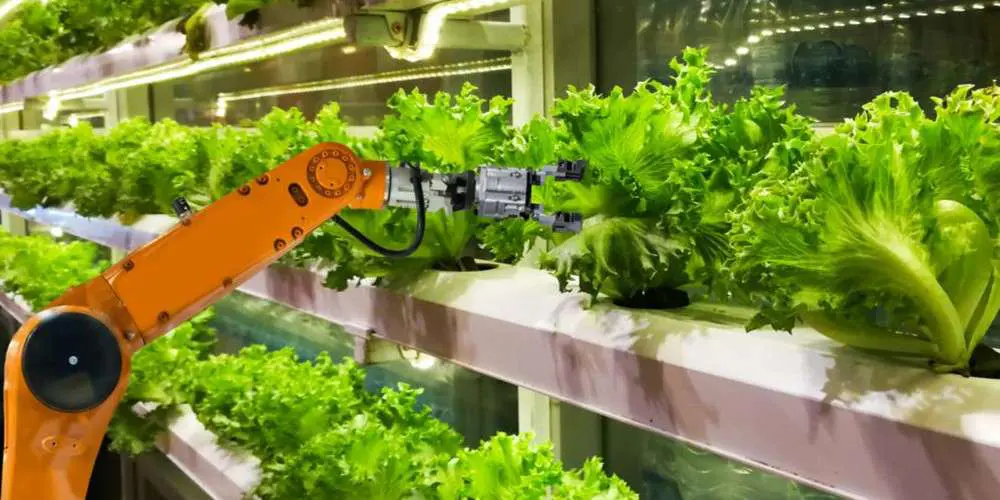
Another example is the “Vegebot,” which uses Artificial Intelligence to determine the ripeness of a tomato plant, and then collect it. Other robotic farming technologies are gaining momentum, with the latest crop harvesting robot already producing the same yields as a single acre of conventional farmland. With rapid improvements in robotic technology, this bodes well for the farming industry. This new expertise will make robotic harvesting easier for farmers, and the benefits will last a lifetime.

Allowing Farmers to Control Weed

We can use agricultural robots in weeding and introducing weed killers. They can work with solar panels, batteries, and diesel fuel. Indoor or vertical farming is an advantage for precision farming and do away with herbicide resistant weeds. LED lights can reduce greenhouse costs by as much as 85%. They use 85% less power than an incandescent bulb. We can also use Artificial Intelligence to control lighting, temperature, carbon dioxide, and moisture levels. With AI, robots can tailor the climate to suit different crops including container crops. They can even grow twenty times more crop per acre, using 90% less water.

The Aspect of Former Employees

Farmers are facing an increasing shortage of human laborers. This is mainly due to aging populations and a multi-year decline in immigration. In addition, robots are performing many agricultural jobs without human workers. And these new robots can operate autonomously and intelligently. They can even plant and spread nutrients. These robotic devices can do the heavy work for farmers, freeing up their former employees. They can also harvest other crops without a human driver.

Developing the right bots for specific tasks is important when considering robot revolution. And while many robotic systems are still a ways off, there are some great advancements in the agricultural field.

Robotics could transform the way farmers work

Farming Robotics

Many large farming companies are championing robotic solutions and becoming strategic investors in techie firms. Several of these companies are conducting trials of next-generation farm machinery. With the increasing power of processors, robotics have become more affordable and practical.

While robots may save farmers time and money, they also pose several safety and health concerns. There are fears that robots can be hacked, compromising human health. As a result, poorer farms cannot afford these items. The development process should happen responsibly, and society should play a key role in deciding their future. For now, robots are not yet ready for widespread adoption.

Currently, farmers make decisions based on the size of their entire paddock, spraying the entire paddock to control pests. With robotic or naio technologies, farmers can target a specific crop or paddock and ensure the highest possible yield. Farmers can also save money and reduce their environmental impact by lowering the cost of pesticides. They’ll also be able to reap a more plentiful harvest.

Universal Platform in the World

As autonomous robotics become more prevalent, governments will need to update data ownership and safety regulations. Some countries have already created codes of practice for using such robots in the crop sector. These codes of practice will spell out who is responsible for worker safety. If farmers adopt them, robots will reduce labor costs by 40 percent. Agricultural robotics could also increase yields by up to 60 percent.

While agricultural robots may seem like futuristic utopias, robotic harvesters are already available for farmers to use. These machines will automatically harvest leafy vegetables and pick strawberries or fruits without human assistance. Instead of human workers, robotic harvesters will rely on data analysis and data gathering. For example, the EarthSense TerraSentia robot can already measure plants’ health and report back to human operators. With such advanced technology, robots could drastically transform the way farmers work.

IoT Combines Robotics

With the help of sensors, automation can help farmers optimize their operations and save on labor costs. For example, farmers can use information from drones to improve crop quality and reduce labor costs. In addition, the IoT (Internet of Things) provides extensive information to help farmers monitor their operations remotely and gather valuable data. As a result, it can lead to better crop management and higher profits.

Robotics replace humans with repetitive tasks

While robotics will never replace people in farming, agricultural robots are making an appearance in greenhouses and fields. While robots cannot entirely replace the human workforce, they can improve working conditions and eliminate repetitive tasks. In the coming years, these machines may replace human employees in various agricultural jobs.

In addition to agricultural work, these machines can also assist in other jobs. These robotic assistants will replace human hands doing repetitive tasks, such as harvesting, packing and sorting produce.

As the growing population worldwide is predicted to reach 9 billion by 2025, countries must find new ways to feed their citizens. New technologies such as robotics may be a solution. Although robotics have already invaded many commercial sectors, the agricultural industry is the next to adopt the technology.

In addition to harvesting, we can also use robots in weeding and pruning. These machines can detect ripe or unripe fruit using computer vision. Because they use computer vision, these robots can also differentiate between different types of berries. A robot can pick an entire bush of strawberries in under eight seconds and move onto the next bush within 1.5 seconds. These robots can do the work of several humans.

The Global Population having a Hand in Emerging Applications

Besides farm labor, farming can also be a meditative experience for farmers. In addition to the benefits of increased productivity and efficiency, agriculture is a highly individualized endeavor and requires careful planning. The sense of embodied knowledge and sensory experience of farmwork is invaluable. Farmers can focus on other aspects of system design by eliminating the need to perform repetitive tasks. The technological advances that are underway will make a tremendous difference.

While robotics are a relatively new technology, they have the potential to revolutionize agriculture. Many agricultural robotics companies are already developing hardware products that incorporate artificial intelligence. Some of these robotic farms already have AI and machine learning vision systems. They also have a high-speed internet connection, meaning they can communicate with humans without any problems. The benefits of farming automation are massive, but there is need for more research before robots are a viable option for all farmers.

The agricultural robot can perform various mundane tasks, like harvesting crops and monitoring fields. It can also handle hazardous tasks, such as bomb defusal, without requiring humans. These robots can even repair themselves in case they sustain a serious injury. This technology will provide much-needed assistance to the agriculture industry as it faces challenges to meet the needs of the world. The challenges of agriculture are so severe, but they are not reliant on more workers and tillable soil analysis.

Applications of robotics in agriculture

robot farmer

The applications of robotics in agriculture are many and varied. Agricultural robots have been in use for decades in both indoor and outdoor industries. While indoor robots are easier to create and maintain, the outdoor ones present more complex challenges. These challenges include weather, safety, and unpredictable circumstances. In the US, for example, labor and rising demands have hampered using robots in agriculture. Moreover, many farmers rely on seasonal and immigrant farmworkers to complete their work.

The Use of Computer Vision

Computer vision application in farm robotics goes far beyond identifying a preset object. This technology is becoming increasingly popular as farming robots gain more autonomy from human operators. For example, computers can distinguish different crops types and tell which ones are good for market. They can also identify the health of livestock, monitor growth and provide information on their progress. With the advancement of autonomous vehicles, computer vision can also guide agricultural robots on varying outdoor conditions.

A midpoint technology between manually operating farm equipment and arming a 5 ton agricultural industrial robot with 150-watt lasers and autonomous brains has been developed. In this technology, a tractor attachment has computer vision cameras and actuators, and analysis software analyzes the data. A human driver still drives the tractor. The advantages of this technology are significant, and they are quickly becoming a reality in many farms today.

Agricultural Robots

As we look to the future, Agricultural Robot Applications could be the future of farming. While this technology has not yet achieved its full potential, its rapid advancements bode well for the future of the agricultural industry. For example, while we still need humans for most farm tasks, such as sorting and packing, robots have proved extremely efficient. In addition, with line tracking technology, robotic devices can work at high speed without breaking.

Another example is the use of sprayers and drones to spray crops. These machines are extremely precise and use ninety percent less chemical solutions than human labor. In addition, a fully autonomous drone can observe crops in any size field. As a result, farmers don’t need to manually check for weeds and pests, as the robot can identify and fix these problems. Additionally, they save much money on labor costs because robots can do the work for them.

Apple Harvesting Robots

While apple and strawberry harvesting robots are still in development, we canโ€™t overstate the benefits of such innovative technology. Despite the enormous labor shortage, these robots will soon be available in large orchards. However, these robots are far too expensive for the average farmer. For now, their use will likely be limited to large orchards.

Crop Harvesting and Autonomous Tractors

Automated farming is not new, but autosteer technology for combines isn’t. Automatic feeding machines have been around for at least 15 years. Autonomous tractors could be the first step toward precision farming. They could increase efficiency, increase yields, and reduce labor costs while addressing environmental impact issues and improving farmers’ lives.

Autonomous tractors can collect data such as crop health and soil conditions. They can also gather data on harvesting crops, leading to new insights. In addition, US farms are facing a labor shortage, and implementing a robotic system could help farmers meet their demands without hiring more employees. Autonomous tractors could replace the need for a human farmhand, allowing them to perform various tasks while remaining off the farm.

Autonomous Robots and Merlin Robot Milker

The agricultural robotics industry is exploding, with new technologies such as autonomous tractors and robotic arms increasing production yields for farmers. The IDTechEx report explores the agricultural advancing robotics market and its key technological factors, offering ten-year market predictions for this exciting new technology. In addition, it highlights the challenges farmers face and discusses how abundant robotics can help them overcome them.

A key benefit of autonomous farming robots is that they can perform many agricultural tasks, including mechanical weed control and fruit picking. This can improve efficiency and precision while reducing the need for human operators. Furthermore, they can be programmed to perform different tasks, reducing pesticide use by up to 80% on farms. In the future, agricultural robots may perform different tasks than human operators, which could lead to new employment opportunities for robot makers and repairmen.

Monitoring crops require high precision

Precision seeding is a common example of precision farming and uses robots to monitor crops. With new sensors, drones can collect data without human intervention. And some robots can even do weeding for farmers. It reduces the need for pesticides, reducing the use of pesticides. These robotic devices have the potential to revolutionize agriculture.

Autonomous harvesting robots can replace laborious manual work. While harvesting is a tedious and repetitive task, it is essential to produce useful food. And today, robotics are taking over many agricultural tasks, including picking strawberries and leafy greens. For example, an automated apple-packing robot developed by Robotics Plus uses suction to pick and pack fruit. The robot also uses smart vision to recognize different types of fruits and analyze their color.

One robot for future farm implementation

Farmer robots are good for repetitive, monotonous tasks. But, some day these robotic machines may be useful for outdoor farming. In the meantime, several tech companies are working to develop robots for this purpose. One of the most prominent agricultural robots in development is the Xaver robot, which is already in the market. It can monitor weeds and scout fields and apply chemical treatments when needed. In addition, vision robotics has developed a robot for thin seedlings. This will improve the growth rate of the crop.

Conclusion

While the agricultural industry has long been a target for the use of robotics, the advent of robotics is making the sector more accessible and affordable. In addition, it can help farmers automate tasks such as milking, feeding, and cleaning manure. There’s no doubt that robotics are the future of agriculture. Whether it’s in the fields of food production or the milking parlor, robotic technology is bringing about an entirely new world.

Understanding the Use of Robots in Industries

Robots in Industries

Are you aware of the impact robots are having on our society? Well, suppose you’ve been listening to or reading any news lately. In that case, you’ll know that the encroachment of artificial intelligence into every aspect of our lives is accelerating at an alarming pace.

You can find robots assisting doctors in operations, acting as carers for elderly patients, and preparing food in restaurants. Some may have you believe that robots are slowly taking over the world, but is this true? The answer to this question depends greatly on whom you ask.

In some industries, robotics are replacing human laborers. These robots can perform certain tasks but also come with ongoing expenses. Some industries may not be ready to replace all their employees with technology. Some of these industries are already embracing cobots. These robots can increase their productivity by as much as 50%. While cobots are not replacements for human workers, they provide a new work experience.

There are many industries where robotics is becoming a commonplace fixture. We will look at each of them to understand their use in these many sectors. What’s in it for the companies involved? How do they use robotics in their processes? And, why is it so important for them?

Robotic Automation and Robot Programming

Robots in Industries

There are many robots out there with utilitarian tasks to perform. For example, you may have had a dishwasher in your home at some point in your life. That dishwashing machine is a form of household robot, but what does it do? Unfortunately, it has only one task for which it was built: cleaning dirty dishes.

We can program robots to carry out many specific tasks and are present in many industries to perform these roles. Moreover, with appropriate sensor technology, several robots can even work together to perform any assigned task or tasks.

This level of teamwork is particularly useful in healthcare, which is why many hospitals are deploying robotic assistants to aid doctors in various roles. For example, you can program surgical robots like the da Vinci to perform certain operations with extreme precision and accuracy.

Delta Robots

Many businesses are experiencing trouble in the COVID-19 economy. For example, in the manufacturing industry, crowded environments can lead to hot spots, virus activity, and poor customer service. Delta robots solve this problem with high-speed pick and place robots. They are also flexible in their programming and can recognize various objects. For example, when used in manufacturing, you can program a delta robot to pick different objects.

The collaborative robots feature a unique programming method. With the Universal UR10, for example, you can program the arm using hand guidance. Programming information is stored and recalled as needed. The more traditional programming methods are also available in delta robots. The most popular method is with teach pendants, although offline programming is also possible.

Cartesian Robots

Some applications call for cartesian robots, such as 3D printing, CNC machines and cutting metal shapes. They are flexible enough to scale up or down, thereby taking up less space than a six-axis robot. IAI offers two-, three-, and six-axis rectangular robots with hundreds of configurations. Cartesian RoboCylinders feature cable chains of various lengths and other options, including high-precision models.

A large transfer robot is a typical example of a cartesian robotic system. Similar concepts apply to de-palletizing and palletizing systems. The most efficient method of packaging automation involves three-stage linear motion. Cartesian robots can operate safely, allowing people to work around them. In many applications, there is the use of these robots for a variety of purposes, including packaging and assembly. In addition, we can position them in an area that requires high-volume production, thereby reducing production costs.

Mobile Robots

Locomotion is a fundamental requirement for these robots. They move in a wide range of environments and can navigate all terrain, including hazardous ones. Mars Pathfinder, Spirit and Opportunity, and Curiosity robots demonstrate this capability. Moreover, sensors are essential for a mobile robot, acting as its windows to the outside world. Without sensors, autonomous driverless cars and drones would not exist.

Cylindrical Robots

A cylindrical robot’s range of motion is essentially cylindrical. A typical cylindrical robot consists of two prismatic joints and one revolute joint. The revolute joint adjusts the position of the links about an axis. The prismatic joints adjust the height and radius of the work envelope. A compact design eliminates the need for a prismatic joint to adjust the radius of an arm. These robots are good for pick and place operations, such as packaging.

Because robots can perform repetitive tasks efficiently, they require very simple programming. Therefore, it is best to use hand-guided programming methods with collaborative robots. Alternatively, you can hire a full-time robot programmer or outsource the programming work to an external company. However, this can be expensive. This article will discuss some of the most common programming issues for cylindrical robots. Hopefully, these tips will help you write a more efficient robotic program.

Scara Robots

The SCARA Robot is a versatile material handling system. It can perform various operations, including moving, picking, assembling, and dispensing. Its rigidity and accuracy make it a good choice for basic assembly processes. Moreover, SCARA robots offer high-quality performance at an affordable cost. The company provides a wide range of SCARA robot models for different applications.

Computer-aided design is the system’s base, enabling engineers to engineer different manufactured objects. The robot’s underlying controller system has a built-in computer program and a system of blueprints for determining the correct motion of individual parts. It allows designers to create detailed three-dimensional drawings of basic figures, and exact sizing of components and satisfies the varying geometric shapes. Then, you can test the resulting robot on simulated models before manufacturing the final product.

Automotive industry

Automotive manufacturing is one of the largest industries in the world. The automotive industry is a leading consumer of robotic technology. The automotive robot market spans several countries and sectors.

Most companies use robots to build cars and maintain and repair them. These robots are especially important for companies that cannot afford to have too many people working on their vehicles at once, because it would make it hard for a human to perform all the tasks that need to be done.

Robots help humans with assembly, testing, and other tasks. Approximately three million industrial robots are in use today. However, there are many benefits of industrial robots. Besides lowering labor costs, they also improve product quality and production speed, increasing profit. Furthermore, robotic systems’ precision leads to less raw materials waste and lower product reject rates. Additionally, human labor is more expensive than industrial robots because of many miscellaneous expenses.

Pharmaceutical industry

Pharmaceutical companies are increasing efficiency and lowering costs using advanced automation technologies and collaborative robots in manufacturing processes. These robots are capable of performing repeatable tasks and lab-specific automation techniques. In some instances, automated labs can perform high-volume online testing and instantaneous microbial detection in air and water. Other technologies can plan and execute infrequent tasks, such as large equipment maintenance.

Pharmaceutical manufacturing has been around for over four centuries and has become increasingly fast-paced and complex. While traditional manufacturing methods involve hours of labor, modern pharmaceutical manufacturing processes rely on automation for increasing productivity. Managing director of TM Robotics, Nigel Smith, explains three major factors to consider when deploying robots in manufacturing. He discusses the advantages of automated systems for pharmaceutical manufacturing, including reducing downtime, enhancing health and safety, improving production flexibility, and lowering operating costs.

The COVID-19 pandemic has increased the awareness of the benefits of automation in the pharmaceutical industry. Automated systems help companies increase production processes without sacrificing quality or safety. In addition to allowing for higher productivity, they can also reduce the costs of product development and testing.

Food industry

Robots are becoming an important part of the food industry, from production to delivery. A robot can handle a particular task depending on how the material is delivered and treated. Other challenges related to using robots in food production include transitioning human employees from the roles robots are replacing. The food industry must decide whether robots are beneficial to the production process and how they will transition human employees from the roles that robots are taking.

Developing robotic end-effectors to automate the pick and place operations requires sophisticated automation technology. Robotic end-effectors must be versatile and have low mechanical parts to avoid falling into food. Robotic systems must also operate at high speeds to ensure proper takt time. They should be cheap and meet strict hygienic standards. A robot is only as good as its design.

Electronics industry

The electronics industries are famous for their dependence on robots. These machines help assemble some of the electronics humans use in their everyday lives. This industry has so trusted them that engineers commonly use them to perform any possible task.

Robots could put together electronics like cell phones and radios, but we now use them to test the quality of manufactured parts.

In this sector, it is common to find a robot that can scan an area and detect the defective parts while they are still in the assembly process. This allows companies to fix everything before leaving their production lines. It also saves them time and money with reduced waste and the elimination of human oversight.

Robotics industry

The robotics industry has grown very quickly in recent years. A large section of the robotics industry is dedicated to making robots that first responders and other professionals can use during dangerous situations. This type of work is usually very hazardous, but the development of these robots has led to a vast improvement in safety.

Industrial robots have several axes of motion, which allow them to perform a task while their base is stationary. This type of robot is the most common and associated with many industrial settings. In addition, they are highly flexible and offer the greatest range of motion. As a result, these robots are particularly useful in environments with tight tolerances, such as clean rooms. They can be programmed to do many different jobs, but the most important aspect of an industrial robot is its flexibility and range of motion.

Another area in which robots are becoming increasingly popular is the inspection of products. A typical inspection job involves a robot positioning a sensor on a work part and determining its quality. As a result, this robot helps industries decrease their overall waste by allowing workers to focus on more important tasks. Unfortunately, this also frees human workers for more complex tasks requiring more precision and care. Automation is a great solution to these problems and can increase productivity by as much as 30 percent.

Manufacturing industry

The effects of robotic adoption in industries vary widely, and felt in jobs with high manual labor. This is especially true of workers in lower and middle-class areas and blue-collar industries. Although this technology impacts industries of all types, adopting robots in manufacturing and non-manufacturing jobs affects humans.

One of the most important sectors in the economy is manufacturing, and this industry relies heavily on robots. The manufacturing industry has been the first to extensively use industrial robots. These machines can perform various tasks, including product assembly and welding. The work envelope of an industrial robot is roughly shaped like a sphere, consisting of at least three joints with varying levels of flexibility. Some articulated robots may even have a fourth joint for rotating the EOAT (end of arm tooling). Although different applications require different work envelopes, some features are universal.

Industrial robots can perform dangerous, dirty and repetitive tasks. They vary greatly in size and design. The most common distinguishing characteristics are the payload capacity, number of axes of travel, and reach distance. Industrial robots can also have multiple peripheral devices in the same system, including end effectors, feeders, conveyor belts, barcode printers, and emergency stop controls. Even robots can work alongside humans and help them complete the task.

The purpose of these robots is to handle a wide variety of tasks that would be very tedious for human workers. We can use them to produce and assemble almost anything, and perform relatively simplistic tasks. By eliminating labor-intensive tasks, these robots become cost effective by reducing manufacturing costs and eliminate the risk of injury and absenteeism. They also allow companies to improve productivity and output without increasing staffing costs.

Agriculture industry

In agribusiness, robots have become extremely useful for many tasks. For example, automated harvesting of crops seems ripe for automation, but the process is more complex in the agricultural industry. The physical labor involved is repetitive and the benefits of automating this task are not yet fully known. Nevertheless, many industries affected by the current robotic revolution include agriculture. Here are some examples of industries that are likely to benefit from automation:

In the agriculture industry, picking crops is a popular robotic application, but it is also one of the most difficult to automate. Harvesting requires precision and speed, and robotic picking systems must identify ripe and unripe fruits and vegetables. Humans do the picking, but automation can help improve yields and decrease waste. But this task is difficult to automate because of many obstacles. For example, the vision system needs to identify the location and ripeness of peppers in extreme conditions, with dust, varying light intensity, and temperature swings.

With the rise of AI-powered tools, farmers can save money and time. These AI-powered robots can identify the optimal recipe for a particular crop, analyzing historical data on growth cycles. The use of agricultural robots in agriculture will grow to $8 billion by 2023. The benefits of using automated weeding robots in agriculture will be many. For example, a farmer can now hire a robot to do the tedious work for them.

Other industries

Education Robots are present in schools around the world helping students learn about science, mathematics, and many other subjects. In addition, they educate children about the importance of technology and how to use it to help solve many different problems.

Emergency Robots are here to save humans from danger, help fight fires, and even put them out. Many types of robots serve the same purpose in this sector, but the main focus is helping people remain safe during times of peril.

Entertainment Robots are one of the most popular forms of entertainment today. They are present in movie theaters and at amusement parks around the world. The robots also appear in television shows and on video games. They perform a variety of different tasks, but their main purpose is to provide entertainment for the masses.

Transportation Robots are one of the most important forms of transportation today. They transport goods and people from one place to another. Many companies are working on large scale driverless vehicles that will operate in the same manner as traditional automobiles.

Military Robots are useful for destruction or to fight. You can program some to kill on command.

The Use of Robots and Machine Tending

Industrial robots lower production costs. They help carry out many tasks, from weed removal to bin picking.

Utilizing Mobile Robots and Machine tending in a manufacturing setting has many benefits. In addition to improving overall equipment effectiveness, these machines can be used for quality control, deburring, gauging, and surface vision inspection. Robots can change grippers quickly, allowing them to perform more than one process simultaneously. Whether the tending job requires deburring, cleaning, or gauging, the robot can perform it without human intervention.

Industrial Robots Lowering Production Costs

According to a recent report by Boston Consulting Group, industrial robotics will reduce labor cost by 16 percent globally by 2025. However, that figure is likely to be higher for the United States and China, the top two industrial robot markets, accounting for more than 25 percent of the global industrial robot market. In the United States, labor cost savings are forecast to exceed 22% by 2025, but the forecast for Japan, Germany, and South Korea is lower.

Although industrial robotics has many benefits, manufacturers should understand their limitations before investing in these devices. Because robots perform repetitive operations, they are a great choice for small to medium-sized operations. However, manufacturers must consider the maintenance cost and extra components before purchasing industrial robots. This is especially true when selecting the equipment, as many require a large initial investment. Industrial robots also have the potential to enhance productivity while lowering production costs.

Weed removal

Weeds are an ongoing problem in the agricultural industry, competing with crops for early growth resources, and manual hoeing is labor-intensive and polluting. To reduce the workload and save time and money, there is a mobile mechanical weed killer, or AMU-Bot, which drives between rows of sapling trees and removes weeds with rotary harrows.

While herbicide-free weed control is still a long way off, companies are focusing on developing and testing methods to become herbicide-free. For example, precision spraying allows for faster, more accurate movement, and a reduced need to hit a “bullseye” each time. As a result, herbicide use is reduced by 90% with this approach. And as the technology improves, farmers can reap the benefits of herbicide-free weed control and improved soil health.

First industrial robot

The Unimate was the first industrial robot to join a production line. It was an automated die-casting robot that released hot auto parts into a cooling liquid, then moved them to workers for final finishing. It was installed in the GM Ewing Township factory in 1961. Since then, other auto manufacturers have employed Unimate robots for machine tending, welding, and other applications. Today, there are several dozen manufacturers of Unimate robots, and hundreds of suppliers of grippers and tool changers.

Robot programming and production costs

Robust robot systems require high levels of programming expertise, and the installation and training of a specialized specialist are expensive. Often, standard text-based programming methods lead to difficult to maintain programs. Editing methods are also difficult, and the time it takes to change a product is often measured in months. We can reduce programming and production costs by utilizing application marketplaces.

The cost of manufacturing and programming a robot is often determined by its capabilities, the cost of raw materials, and the productivity gained. In addition to the hardware and software, a robotic automation system also involves maintenance and spare parts. The cost of personnel and training is another important consideration, as skilled workers may be required to operate and maintain a robot. Automation systems reduce labor costs and save time and money, but they also create a complex environment that requires specialized training.


Everything you need to know about SMT Lines

SMT Lines

SMT technology is becoming pretty popular in the tech industry, and for some good reasons. In the past, the process of manufacturing electronic devices was long and complicated. Manufacturers had to use wires to attach components onto PCB via holes. In case of an error, the repairing procedure was even worse. However, in the modern era, we now have SMT which is a technology that manufacturers utilize to mount components onto PCBs. Mounting various components on PCBs directly eliminates the need for wires which makes gadgets bulky. Hence, thanks to SMT technology, we have compact, efficient devices such as smartphones in the 21st century. Comparing SMT to traditional electronic assembly processes, you will find that SMT has:

  • High density
  • High reliability
  • Low cost
  • Miniaturization
  • Sound field automation

 So yes, the SMT technology is fascinating, but what does the SMT line or SMT production line entail? And which equipment help process PCBs using SMT technology?

What exactly is SMT Line

We can group SMT lines into two classes according to the level of automation; we hence have:

  • Automatic production lines
  • Semi-automatic production lines

We can also group SMT lines according to their size, where we will have:

  • Large production lines
  • Medium production lines
  • Small production lines

Automatic Production Lines

The automatic SMT production line uses production line equipment that are all fully automated. The entire process hence does not require manual handling.

Semi-automatic production Line

The press, in this case, is semi-automatic. That means that the entire process is not fully automatic. You hence might find:

  • Manual printing of PCBs or
  • The Manual loading of PCBs or
  • Manual unloading of PCBs

One major factor to consider in the PCB production process is your clientโ€™s understanding of the entire SMT production process. Your client cannot rate your work without actually understanding what you are doing. Hence here is a basic breakdown of the SMT production line.

SMT Line Process

DFM/DFA check

Once the production team receives a PCB order, they must validate the PCB design. To do so, they must pass the order through a DFM/DFA check. The DFM/DFA check verifies consistency across various design documents, for example:

  • Centroid
  • Gerbers
  • BoM

It also checks on:

  • Part spacing
  • Footprint accuracy
  • Clear orientation marking

The DFM/DFA process tries as much as possible to minimize the probability of there being a design error.

PCB Fabrication

When the DFM/DFA process is complete, the PCB order now moves on to the fabrication stage. In this stage, the operators build a bare PCB board using the following steps:

  • Material lamination
  • Material drilling
  • Copper etching/deposition

These processes have to follow set specifications.

The stencil, which is pretty crucial for screening solder paste, is also generated in this stage. Finally, the production team has to add surface finish and solder mask onto the board before printing silkscreen over the PCB.

Inspection of Material  

The procurement team works hand in hand with the fabrication team to ensure that materials are ready for utilization. Therefore, immediately the bare print circuit board is ready for assembly, there is no delay due to lack of materials. In doing so, the assembly company can speed up production.

However, as these parts come into the PCB assembly facility, they have to go through an incoming quality control team. The IQC team inspects every component thoroughly before warehousing any component or material.

Inspection includes:

  • Sample operation testing
  • Date code verification
  • Entry into software material/component management system

The sophisticated software system in use at this stage utilizes FIFO (first in, first out) rules to check each item. It hence ensures every part in use during the PCB assembly process works in perfect condition.

SMT PCB Loading (done by the PCB Loader)

Here the loading of print circuit boards onto an SMT stencil printer takes place automatically. Operators place the print circuit board inside the magazine and then loads it to the PCB loader. On the other hand, the loader sends the print circuit board onto the Stencil Printer.

Screening of the SMT Solder Paste (by solder paste printer)

After entering this stage, the very first step is to solder up the bare print circuit board. The stencil, which was built in the fabrication stage, is the first component that connects to the print circuit board in this stage. The stencil leaves pads which SMT equipment utilizes to mount components onto the PCB Board.

Component Placement (by the pick and place equipment)

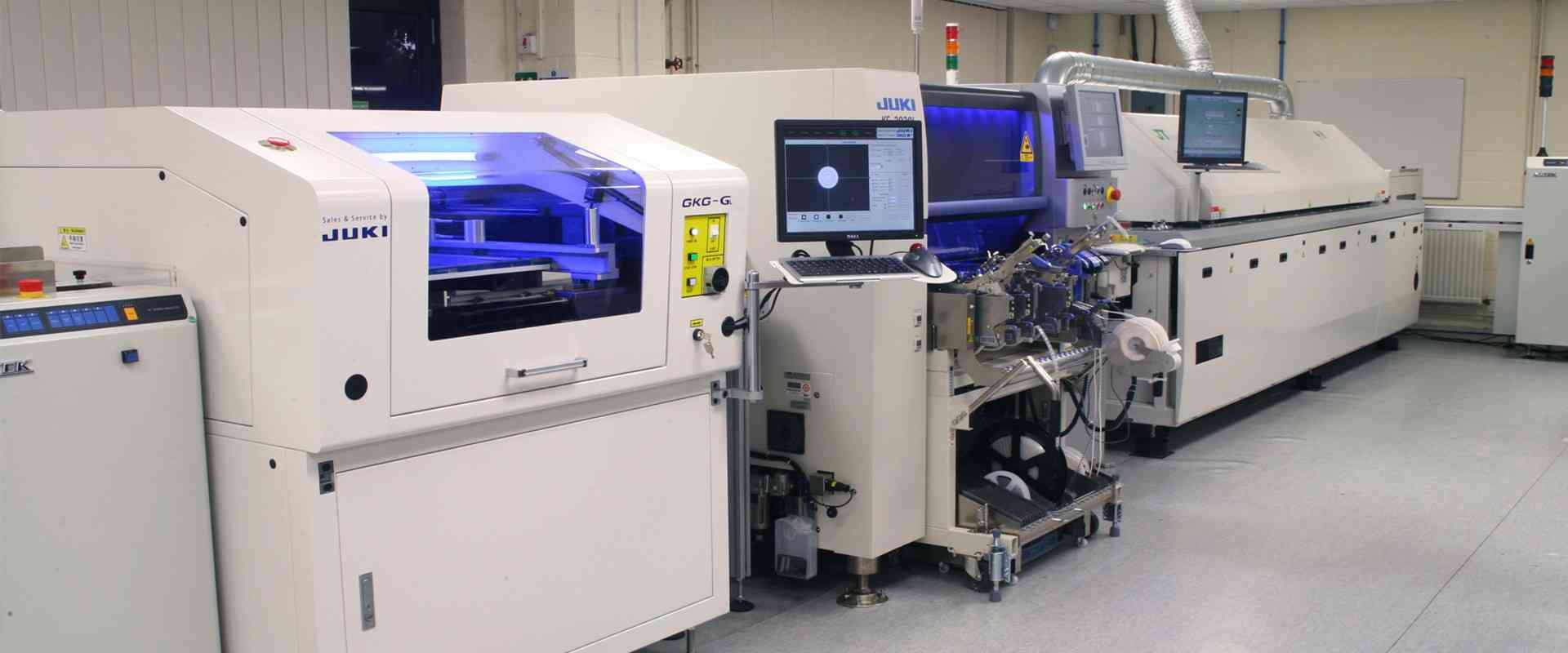
When the soldering process is complete, the print circuits board moves on to the next stage, which is the component placement. Here a pick and place machine picks up components and mounts them onto PCB according to their associated pads. You should note that this process is entirely automatic to reduce errors.

When this stage is over, the PCB moves on to the reflow soldering phase to enhance the components attachment to the PCB.

X-Ray Inspection (done by the SMT X-ray Equipment)

When the reflow cycle is over, any PCB having QFN, BGA, or any other lead-less packages moves on to the X-Ray inspection.

The X-Ray inspection stage helps operators detect any issues in the PCB’s assembly process.

Wave Soldering (done by the wave soldering equipment)

In this stage, the board moves via a conveyer through a molten solder “wave.” The solder, in this case, bonds together any leads and component pads that are not well covered.

Final Inspection

Intermediary inspection cannot confirm the actual quality of the complete electronic device. Hence there must be a final inspection stage to thoroughly inspect the complete PCB.

The final inspection stage involves:

  • Visual inspection
  • Automated optical inspection
  • Functional Circuit Testing
  • In-circuit testing

Summary of main SMT Line Equipment

Here is the main SMT line equipment that sees through the processing of PCBs:

Pick and place machine

These machines mount components accurately onto PCBs

Solder paste Mixer

It mixes solder paste and solder powder evenly to help achieve perfect reflow effects and printing.

Oven

Bakes print circuit boards to remove moisture from the board.

SMT Loader

Places print circuit boards inside the racks of the solder printing machine.

Solder Paste Printing Machine

Prints solder paste onto bare PCBs.

SPI machine

It checks on the volume distribution, area, and thickness of the solder paste that is printed onto the bare PCB surface.

Reflow Machine

The reflow machine melts the solder bond between components and circuits. It then cools the bond to form a firm and conductive electric connection.

AOI

AOI machines detect placement failures

Docking Station

Acts as a station for connection between various machines

SMT Unloader

Receives and then stores PCBs after the reflow soldering stage

Conclusion

SMT has become a cornerstone for innovation in the modern world. In this time and age, most people want slick slim gadgets, and that is what SMT provides. However, to achieve these thin gadgets, many processes have to take place. We hope that this article has given you an insight into the processes that occur during SMT line processing plus the equipment in use.

Getting Started with Features of Achronix FPGA Technology

Achronix FPGA

Achronix is one of the most important Chinese FPGA companies and has made its name by taking on the established giants in high-speed network processing and artificial intelligence. This company has confidence and courage and aims for the emerging FPGA application fields. We wish to see more Chinese FPGA companies taking on these big players. Let us see what makes Achronix different and what its advantages are.

Speedster7t family

The Achronix Speedster7t FPGA family can support demanding data-center, network, and communications workloads. These FPGAs incorporate multiple high-performance clock networks and are capable of complex designs. As a result, the Achronix Speedster7t family of FPGAs is a perfect fit for data-center workloads, control systems, and communications applications.

The Achronix Speedster7t family features high-speed datapaths and large on-chip memory capacities. These capabilities enable Achronix FPGAs to use less space and consume less power, allowing them to fit into smaller systems. The company is a leader in embedded FPGA IP and high-performance computing. In addition to consumer applications, Achronix is also an industry leader in industrial and military applications.

The Achronix Speedster7t FPGA family uses the TSMC 7nm process technology. It delivers industry-leading performance for storage, networking, and compute acceleration. In addition, it can support multiple applications simultaneously, which is key to achieving high-performance computing. The Achronix Speedster7t family is available now and will ship in Q4 2019.

This family features the latest generation of high-performance FPGAs. The Achronix Speedster7t family offers advanced functionality, ASIC-like performance, and improved flexibility, featuring a new, highly optimized architecture. In addition, the Speedster7t family includes PCI Express Gen5 and 400G Ethernet interfaces for high-speed connectivity and enhanced functionality.

Arria 10 GX DSPs

Arria 10 GX/SX FPGAs from Altera feature industry-leading programmable logic, embedded peripherals, high-speed transceivers, hard memory controllers, and protocol IP controllers. They deliver the floating-point performance of up to 1.5 TFLOPS and support Gen3 PCIe x8. In addition, the Arria 10 FPGAs provide up to 1150K LEs. These powerful FPGAs support OpenCL and Altera’s SDK for OpenCL.

Arria 10 GX DSP-based FPGAs provide fast processing and high-quality video. These chips support multiple types of digital signal processing, including AVC and H.264. In addition, Achronix Speedcore eFPGA technology enables designers to implement advanced processing capabilities in a low-power design. As a result, both types of FPGAs can be helpful for various applications.

The Arria 10 GX DSP-based FPGAs are flexible enough to handle various computing tasks. They are best suited for machine vision, data analytics, and embedded control applications. Achronix FPGAs are also renowned for their high-speed processors. So whether you’re building a home entertainment system, mobile phone, or industrial device, Achronix has a solution to handle it.

Besides being versatile, Achronix FPGAs support advanced memory and interconnect technologies. For example, the Achronix Speedster7t device supports Compute Express Link (CE) 2.0, a high-bandwidth interconnect, and PCI Express Gen5 connectivity, delivering ASIC-level performance. In addition to its flexible processing capabilities, Achronix FPGAs also support two-dimensional networking and machine learning.

Seti FPGA processors

If you’re a computer programmer, you’ve probably heard about RISC-V, a processor architecture that is the successor to the ISA. However, what exactly is RISC-V? What’s so special about this technology? The answer, as it turns out, is quite complex. But for those who want to know more, let’s review the basics of this technology.

This processor architecture has two types of ARM Cortex-M cores: SP and DP. Cortex-M is a 32-bit RISC KOL, while ARM Cortex-A53 is a 64-bit RISC-based KOL. These processors can work with achronix FPGA and other programmable logic devices.

The Achronix Speedster FPGA chips are essential for this processor’s features. This processor is capable of six-billion cycles per second, or about two-thirds of the speed of previous competitors. And yet, despite the high speed, it consumes only half of the power of its competitors. That’s a significant difference, and it’s one of the biggest selling points of the Achronix FPGA.

The Achronix Speedster(r)7t FPGA family is built on a new generation of architecture called a 2D High-Speed Network-on-Chip. This innovative FPGA processor is capable of supporting GDDR6 and DDR4/5 memory. And it supports 400G Ethernet streams. With these features, Seti FPGAs are genuinely revolutionary and will allow you to create the fastest systems and applications.

RISC-V is another excellent feature of the Seti FPGA. Its processors can implement RISC-V-style computing, and the underlying architecture depend on RISC-V. As a result, unlike RISC-V, Seti FPGAs are easy to integrate into any existing system. And this is one of the main reasons why Seti FPGA processors are such a success with Rayming PCB & Assembly.

2.6M 6-input LUTs

The new 7nm Speedster7t family of FPGA devices from Achronix features 2.6M 6-input LUTs and 385 Mbits of embedded RAM, 41K Int8 engines, and hardened interfaces. The new FPGAs can accelerate AI/ML applications and offer a range of performance levels and connectivity options.

The Speedster7t family of FPGAs has a dedicated 2D NoC to streamline high-speed data movement. By ensuring that data streams go to the processing engines, this dedicated 2D NoC eliminates performance bottlenecks. With a dedicated 2D NoC, Achronix Speedster7t devices feature a wider range of effective LUTs than comparable traditional FPGAs, which rely on logic lookup table resources and programmable routing. Furthermore, the Speedster7t devices offer a conversion path to an ASIC.

Dedicated 2D NoC

Achronix Semiconductor Corporation, a leading fabless semiconductor company, has introduced its new Dedicated 2-D NoC FPGA. This new chip provides the industry’s highest bandwidth and performance for networking, storage, and compute acceleration applications. Its innovative architectural features and high bandwidth allow it to accelerate high-bandwidth data. The AC7T1500 is a highly flexible, cost-effective solution.

Compared to conventional NOC architectures, the Dedicated 2D NoC of Achonix offers significant performance improvements, including a simplified floorplan and reduced energy consumption. In addition, a large number of bus connections have been absorbed into the NoC, resulting in a minimal number of exposed green clock and logic traces. As a result, this chip offers a wide range of advantages for design and implementation.

Dedicated 2D NoC of Achronix FPGAs offers ultra-high-bandwidth connectivity for 20 Tbps. The high-bandwidth architecture eliminates the complex routing bottlenecks and simplifies the overall design. Dedicated 2D NoCs enable designers to use memory and logic resources more efficiently while reducing their workloads. The Achronix Speedster7t FPGA features two 256-bit data paths and a programmable logic fabric that supports up to 512 Gbps.

The Dedicated 2D NoC of Achronix is a high-performance NoC designed for high-speed digital imaging. Its high-speed memory and wide bandwidth make it ideal for video recording, video editing, and virtual reality applications. This product is also compatible with popular video cameras. So, what are you waiting for? Get the Dedicated 2D NoC of Achronix today!

Dedicated buses

Dedicated buses on the chip are a helpful solution for reducing signal congestion and enhancing high packet throughput. These are a grid between FPGA blocks that can support high clock frequency and high packet throughput. Furthermore, these buses can be hard-wired, further reducing the complexity of routing and scope. In addition, dedicated buses can support high packet throughput, as they have dedicated interfaces for each block.

Dedicated bus technology is becoming increasingly popular in the machine learning and artificial intelligence (AI) industries. The technology has enabled machine learning algorithms to perform up to 300% faster and is now available in many forms. It is a cost-effective alternative to custom AI accelerators and multi-chip solutions. Achronix’s latest technology can handle high-performance applications involving machine learning, artificial intelligence, and other fields.

Dedicated buses are a unique feature of the Achronix FPGA architecture. They enable bus-group routing, which can help reduce congestion and improve timing. In addition to dedicated bus routing, dedicated buses on the Achronix architecture create a giant run-time-configurable switching network on the chip. As a result, this architecture can provide twice as much performance for individual buses and reduces the need for LUTs.

Does Nvidia Use FPGA in Machine Learning?

Nvidia fpga

Does Nvidia use FPGA? This article answers this question by explaining how it is helpful in machine learning workloads. First, you will learn how these chips are energy efficient, and we can customize them for AI and safety requirements. Next, find out why you should use these processors and why they’re better than GPUs. Then, you’ll be able to decide whether these chips are suitable for your workload. Ultimately, you’ll be better off with one of these processors.

Nvidia FPGA for machine learning workloads

Unlike traditional hardware, FPGAs are programmable and can solve any computable problem. The technology has been around for a decade. This new technology enables developers to speed up compute-intensive applications and reduces the complexity of ASIC development. However, the performance of an FPGA will not be close to the performance of a high-end GPU.

Despite the many advantages of GPUs, the cost remains one of the biggest deterrents. While GPUs are superior to FPGAs in some applications, they are not without their disadvantages. Intel, for example, can offer CPUs and FPGAs on the same chip, thereby reducing the cost of a GPU.

The FPGA’s customizable components allow designers to fine-tune the hardware to meet the specific needs of machine learning workloads. For example, INT8 quantization is an efficient way to optimize machine learning frameworks. It can reduce memory usage, bandwidth, and computing requirements when used properly. This also helps meet power efficiency requirements. The new technology is also available through Microsoft‘s Azure cloud service.

As machine learning applications become more common, the need for more efficient hardware for training machine learning models has increased. In recent years, manufacturers have developed new hardware with advanced AI capabilities. While GPUs have many advantages, FPGAs also provide advantages that CPUs do not have. One of these benefits is customizing hardware to match specific deep learning models. Lastly, FPGAs are better at streaming data, which requires pipelined-oriented processing.

Nvidia has been using FPGAs to accelerate AI systems for years and recently expanded support for Arm CPUs. While Arm processors are not as efficient as Intel or AMD, their power requirements are incredibly low, making them attractive to data centers.

They are more energy-efficient than GPUs

Why are FPGAs better than GPUs? Several factors contribute to this conclusion. First, the FPGA has a programmable hardware fabric and is more energy-efficient than a traditional GPU. AMD, for example, has announced plans to release low-power Ryzen Embedded processors. Low-power processors can be found in mobile devices and are more efficient than GPUs. AMD’s Ryzen Embedded processors are among the first processors to include an FPGA.

Another factor determining which is better is power consumption. A GPU consumes around 116.7 Watts per core compared to 50-250 Watts for an FPGA. In contrast, a GPU can run at temperatures as high as 158 ยฐC. In general, though, the better-performing FPGA has more RAM, faster processing, and a lower power bill.

The FPGA also offers designers the ability to fine-tune the hardware. For example, FPGAs can perform machine learning frameworks much faster than a GPU, and we can configure them multiple times to serve multiple purposes throughout their lifecycle. On the other hand, GPUs are better suited for target applications that require high processing power.

Another reason why FPGAs are better is that we can customize them after manufacturing. For example, one FPGA can perform image analysis. A single FPGA implementation can perform 1.2x faster than a GPU, and the same algorithm on both platforms can help create a higher-performance GPU.

As for the latency, a GPU cannot compete with an FPGA. The former is faster at computing integers, while the latter can quickly handle logic and bulk floating-point operations. However, the FPGA is about twice as expensive as a GPU, so its energy efficiency is less critical. But it’s important to consider these two factors when choosing the right hardware for your floating-point workload.

They can work with AI

With the latest generation of FPGAs, developers can fine-tune the hardware to meet the specific needs of AI applications. Nvidia has created a special version of the Stratix 10 NX that supports the newest generation of Tensor Cores and AI Tensor Operations. INT8 quantization is a highly successful technique for boosting machine learning frameworks, and it delivers promising outcomes when it comes to hardware toolchains. It uses 8-bit integers in place of floating-point numbers & effectively meets power efficiency requirements.

Besides developing specialized hardware for AI, Nvidia is also offering customized software development kits, such as DriveWorks. These software tools help developers interpret data from cameras used in self-driving cars. By offering customized solutions, semiconductor companies will enjoy greater developer preference, higher adoption rates, and increased customer loyalty. But before investing in an FPGA, companies should consider the pain points they want to solve with AI and determine whether they need hardware for the edge of the data center.

Unlike their earlier generations, leading-edge FPGAs can be custom programmed for AI. Unfortunately, the complexity of FPGA programming makes them difficult to program. But Rayming PCB & Assembly has overcome this problem with a new platform that makes FPGA programming much simpler. Developers can quickly and easily port their deep learning code onto FPGA hardware with this new platform. And this is a promising move for the future of AI hardware.

They can work with safety requirements

Flexibility. FPGAs are a key element of modern computer architecture. They offer flexibility by allowing developers to integrate more functions than they could in a conventional system. This is important to manufacturers because the same hardware can meet various safety requirements. Further, FPGAs can be tested parallel with the software, saving time during commissioning and testing. For instance, SmartNICs, a type of FPGA device, can allow the changing of the software without affecting the hardware.

Safety-critical systems must be reliable. This means that the system must not fail due to external or internal factors. A failure in these systems could be fatal, as in California’s 2008 Chatsworth train crash, when two oncoming trains collided head-on on a single-track section. Another recent accident involved a car on the road in Arizona, where a technical failure prevented the vehicle from stopping.

The FPGA consists of logical modules connected by routing channels. Each module contains a programmable lookup table to control the elements of each cell. In addition to cascaded adders, FPGAs also contains registers and multiplexers for switching and memory functions. In addition, programmable logic modules are often helpful in creating safety-related components, such as a fingerprint reader.

Flexibility is another crucial aspect of FPGAs. The flexibility of the design allows designers to modify the hardware without redesigning the entire board. As a result, a single hardware solution is suitable for various applications. A good example is FPGAs in medical applications. The flexibility of FPGAs allows designers to create customized hardware that meets their needs while adhering to various safety requirements.

HDL code is helpful for the initial programming of an FPGA. In addition, it is a readable language used for developing programmable logic.

The Positive Impacts of RoHS Circuit Boards in Our Environment

RoHS Circuit Boards

Safety should be an utmost concern when manufacturing a printed circuit board. PCB manufacturing shouldnโ€™t jeopardize the health and safety of people. Therefore, PCB assemblies process need to consider environmental safety. Also, some substances used in manufacturing printed circuit boards are hazardous. Therefore, there should be some restrictions on how these materials are widely used in PCB manufacturing.

The RoHS directive helps to regulate the use of harmful substances in PCBs. All PCB manufacturers need to take responsibility for the products they manufacture. Some circuit boards are specially fabricated without the use of certain harmful substances. The RoHS directive sees to the manufacturing of PCBs without some restricted materials.

What Does RoHS Compliance Mean?

The European Union parliament passed bills that influenced the electronic industry. The Waste Electrical & Electronic Equipment (WEEE) was the first legislation passed. Also, the second one was the Restriction of Hazardous Substances.

RoHS prohibits the use of any restricted materials to manufacture electronic or electrical equipment. This legislation became effective in 2006. Also, the directive aimed to ban the utilization of some harmful materials in producing electronics and circuit boards. Any original equipment manufacturer (OEM) that sells electronic products to European customers must adhere to RoHS compliance.

These materials include:

  • Mercury
  • Cadmium
  • Polybrominated biphenyls (PBB)
  • Lead
  • Polybrominated diphenyl ethers (PBDE)
  • Hexavalent chromium
  • OCta PBDE
  • Phthalates

Any printed circuit boards must not contain any of the materials listed above. Also, the RoHS compliance includes the type of surface finish. The PCB surface finish must not feature any of these materials. Also, RoHS bans the use of lead in manufacturing electronics within countries under the EU.

Traditional solder usually comprise 40% lead and 60% tin. Also, manufacturers used solder in applications within electronics and engineering. This means that a good amount of lead have ended up in landfills. Lead contains a high level of toxicity which is harmful to humans and wildlife. Also, lead is toxic to food sources. Therefore, this prevents the spread of this toxicity, the RoHS directive came into picture.

At first, the industry was resistant to these changes due to the initial lack of a good alternative to lead. Also, there were reports that lead-free solder caused delamination to circuit boards. However, the RoHS go better alternatives to lead. Therefore, various industries now adhere to RoHS compliance.

Factors that Affect the Selection of RoHS Material

PCB manufacturers need to ensure the reliability of a circuit board while choosing a base material.  Also, these key properties help to select the base material of a circuit board

Moisture absorption

The pressure of water becomes higher at lead-free assembly temperature. During thermal cycling, absorbed moisture can be volatile. Also, this can further cause delamination or voiding. PCBs that pass through lead-free assembly testing may have some defects after storing them in an uncontrolled environment. Therefore, when choosing materials for PCBs, manufacturers should consider this property.

Glass transition temperature

This property measures the point at which a material transforms form a glassy, rigid state to a liquid-like state. Also, as glass transition increases, several properties change. For RoHS material, PCB manufacturers should consider this property.

Delamination time

Delamination time relates to the adhesion between material components. Moisture absorption rate and thermal expansion can affect results. It is crucial to treat the internal copper surfaces for multilayer PCBs.

Coefficients of thermal expansion

CTE values above glass transition are much greater than below glass transition. Also, Z-axis expansion triggers stress on plated vias.  The greater lead-free assembly temperatures lead to more expansion for a particular material.

Importance of RoHS PCB Assembly

RoHS compliant PCBs are specifically designed for the safety of our environment. Maintaining the green future is the greatest benefit of these PCBS.

User safety

A RoHS compliant guarantees the safety of users. Most PCB manufacturers adopt RoHS compliance. Therefore, users are guaranteed that the product they utilize contains no mercury or lead. Also, this has tremendously increased the popularity and sales of the products.

Enhanced thermal properties

Lead-free circuit boards feature great thermal properties. Therefore, they perform better than their leaded counterparts. These circuit boards can resist temperatures between -45oC to 150oC. These days, manufacturers are making use of halogen-free materials that have improved thermal stability.

Reduces metal poisoning

Electronic consumers are discarding obsolete electronic devices in landfills. Also, these devices feature hazardous materials which can result in severe poisoning. Despite recycling, these devices feature harmful substance in them. Also, the RoHS has compelled OEMs to minimize the use of hazardous substances. This has reduced the effect of these materials on the environment.

Product reliability

Most popular electronics manufacturers adopt RoHS directive. Also, customers are now guaranteed of the reliability and safety of products. Therefore, this has helped to improve the reputation of brands that produce RoHS compliant circuit boards.

Various improved testing methods

RoHS compliant circuit boards pass through improved testing methods. Also, RoHS PCBs use lead-free solder finish. Chemistry methods and spectroscopy are two common methods used by RoHS. These method determine the concentrations of restricted substances.

Applications of RoHS Compliant PCB

RoHS compliant PCB is widely used in several applications. Environmental safety has become a major concern for most industries. Also, the electronic industry has sought for ways to make electronic devices more environmentally friendly. Therefore, RoHS compliant boards offer a lasting solution to this challenge.

Medical

RoHS compliant PCBs are widely used in the medical industry. Also, medical devices require the use of safe PCBs. The restriction of specific hazardous materials is applicable to medical devices. Also, these circuit boards are useful for producing safety-critical devices. The directive 93/42/EEC is a requirement for medical devices.

Telecommunications

RoHS compliant circuit boards are available in telecommunication devices. These boards have helped to prevent environmental related risks.

Consumer electronics

The RoHS directive stresses the need for the use of RoHS compliant PCB in consumer electronics. Therefore, consumer electronics like televisions and mobile phones feature lead-free PCBs. These lead-free PCBs are safe for the environment.

RoHS Compliant Surface Finishes

Not all PCB surface finishes are RoHS compliant. A RoHS PCB must be completely free from any hazardous materials listed by the RoHS directives. Lead-free finished add to the physical capabilities of PCBs. Some PCB surface finishes are RoHS compliant. These surface finishes include:

Immersion tin

Immersion tin is a lead free PCB surface finish. Therefore it is RoHS compliant. Also, this lead-free surface finish is suitable for fine pitch components. The immersion tin is a deposit if a layer of tin. Therefore, immersion tin serves as a great alternative to lead-based finishes.

Immersion silver

This is another popular lead-free PCB surface finish. Immersion silver offers EMI shielding. Also, immersion silver is ideal for membrane switches and aluminum wire bonding.

OSP

Organic solderability preservatives (OSP) surface finish has gained popularity over the years. This is because of its interest in lead-free processes. Also, OSP produces a thin and protective layer on the copper surface of circuit boards. This layer shields the circuitry from any oxidation during PCB assembly.

ENIG

Electroless nickel immersion gold is another lead-free surface finish. ENIG features two main layers of metallic coating which are electroless nickel and immersion gold. Also, ENIG is RoHS compliant since it features no lead. Therefore, ENIG is a highly preferred surface finish among PCB manufacturers.

Lead free HASL

Lead-free HASL complies with the RoHS directives. Unlike leaded HASL, lead-free HASL comprises no lead. This surface finish option offers excellent solderability and shelf life. Also, it is ideal for lead-free soldering.

ENEPIG

Electroless nickel electroless palladium immersion gold (ENEPIG) is a lead-free PCB surface finish. Also, this surface finish features nickel, palladium, and gold. The palladium layer shields the nickel layer from any corrosion. ENEPIG is more affordable than ENIG since it doesnโ€™t comprise gold.

Impacts of Non-RoHS Compliant PCBs

Non-RoHS compliant PCBs or electronic parts do not only affect the customer, but also affect the supplier. The production of non-compliant PCBs affects both the manufacturer and the customer. Before these electrical and electronic products get to the final consumer, there is a need for shipping and packaging.

Also, the packaging process puts the lives of employees at risk. This is because they come in contact with the harmful substances. Also, before these parts got to these employees, the manufacturer has been already exposed to this toxicity.

However, the final destination of the non-RoHS part isnโ€™t the consumerโ€™s place. After the product has become obsolete or damaged, the product ends in a landfill or recycling center. While the recycling facility might be safer, the landfill isnโ€™t safe. Since it is just a hole in the ground, water can move any amount of the hazardous substances. This will end up polluting the ground as time goes on.

Furthermore, hazardous materials donโ€™t degrade and they may continue to pass through the ground. In the long run, they will end up in underground water or the ocean. Therefore, this will further pollute food sources and wildlife.

Tuna is a good example of such pollution. This long-lived fish consumes hazardous substances in water. Therefore, it comprises trace amounts of lead and mercury. This is a result of dumping hazardous substances in oceans where long-lived fish have time to absorb these substances. One way or the other, hazardous substances will always find a way into our environment.

How to Test Products for RoHS Compliance

You might be wondering how the RoHS directive tests electronic products to ensure compliance. Well, this directive ensures it tests electronic products in a lab. Therefore, this procedure will help to determine the amount of the restricted harmful substances. The RoHS directive conducts these tests:

  • X-ray fluorescence spectroscopy (XRF)  utilizes X-ray to evaluate the levels of alloys and metals within a product. This test is usually used for bromine.
  • Scanning Electron Microscopy (SEM/EDX) identifies lead-free solder in the joints of a product.
  • Atomic Absorbance Spectrophotometry (AAS) determines the amount of mercury and lead in a product.
  • Fourier Transform Infra-Red Spectrophotometer (FTIR) detects polymer in an electrical or electronic product. It identifies bromine found in form or PBDE or PBB.

Frequently Asked Questions

How long does a RoHS certificate stay valid?

A RoHS certification will stay valid for a period of five years. There may be a need for early re-certification if an electronic product goes through significant changes in materials or design.

Is RoHS applicable to plastics?

If an electronic or electrical device comprises a plastic component, the plastic must be RoHS compliant. This is very important because some plastic materials contain toxic substances.

Is RoHS compulsory in Europe?

In all EU countries, all electronic or electrical equipment must be RoHS compliant. However, RoHS is implemented differently in each EU member state. Therefore, electronics manufacturers importing their products must be familiar with the individual measures implemented by each country.

Are there any exemptions from RoHS?

Yes, some products are currently exempted from RoHS compliance. Also, these exceptions cover different types of industrial, medical, and military equipment. Parts of electrical equipment available in the market before July 1, 2006 are exempt from RoHS. However, spare parts of newer electrical or electronic equipment are not.

Are WEE and RoHS related?

Yes, WEE and RoHS directives are related. This is because the two directives focus on the safety of the environment. The WEE focuses on encouraging electronic design with environmentally-safe recovery and recycling. On the other hand, the RoHS focuses on regulating the amount of harmful substances used in electronics manufacturing. Therefore, RoHS regulates the harmful substances in electronic products while WEE focuses on these productsโ€™ disposal.

Conclusion

RoHS compliant PCB assemblies are safe for use in electronic manufacturing. Also, RoHS circuit boards doesnโ€™t compromise the quality of a printed circuit board. Lead-free PCBs can enhance the lifespan of an electronic product. RoHS compliant PCBs comprise the use of lead-free stencils and lead-free surface finish. Also, RoHS is applicable to electrical and electronic components.

Compliance to the RoHS directive helps to assure standard electrical performance in a printed circuit board. PCB assembly processes must involve the use of RoHS compliant materials and procedures.

FPGA Overview: Design, Functionality, and Uses

FPGA

What Is an FPGA?

FPGA stands for Field Programmable Gate Array. It’s a special type of computer chip that can be programmed after it’s manufactured. This makes FPGAs very flexible and useful for many different tasks.

Key features of FPGAs:

  • Can be reprogrammed multiple times
  • Perform many operations at once (parallel processing)
  • Work at high speeds
  • Adapt easily to different tasks
  • Cost-effective for small to medium production runs

Unlike regular computer chips that have fixed functions, FPGAs can change their internal structure to perform different tasks. Think of them as digital Lego blocks that can be rearranged to build various electronic circuits.

YouTube video

How Do FPGAs Work?

FPGAs work by following these steps:

  1. Design: Engineers write a description of what they want the FPGA to do using special computer languages.
  2. Convert: This description is turned into a map of connections and logic blocks.
  3. Configure: The map is loaded into the FPGA, setting up its internal structure.
  4. Operate: The FPGA now works as a custom-designed chip, processing data according to its new configuration.

The magic of FPGAs is that this process can be repeated, allowing the chip to be reconfigured for different tasks as needed.

Read more about:

FPGA Components

FPGAs are made up of several key parts:

1. Configurable Logic Blocks (CLBs)

  • The basic building blocks of an FPGA
  • Can be set up to perform various logical operations
  • Contain lookup tables, flip-flops, and multiplexers

2. Programmable Interconnects

  • The wires that connect different parts of the FPGA
  • Can be configured to create different signal paths

3. Input/Output Blocks (IOBs)

  • Connect the FPGA to the outside world
  • Can be adapted for different voltage levels and signal standards

4. Memory

  • Built-in memory for storing data
  • Helps the FPGA process information quickly

5. Digital Signal Processing (DSP) Blocks

  • Special units for math-heavy operations
  • Useful for tasks like audio or video processing

Types of FPGAs

There are several types of FPGAs, each with its own strengths:

  1. SRAM-based FPGAs
    • Can be reprogrammed many times
    • Lose their configuration when powered off
    • Most common type
  2. Flash-based FPGAs
    • Keep their configuration even when powered off
    • Use less power than SRAM-based FPGAs
  3. Antifuse FPGAs
    • Can only be programmed once
    • Very reliable and resistant to radiation
  4. Hybrid FPGAs
    • Combine features of different FPGA types
    • Offer a balance of performance and flexibility
  5. System-on-Chip (SoC) FPGAs
    • Include both FPGA fabric and a built-in processor
    • Great for complex, all-in-one designs

FPGAs vs. ASICs

FPGAs are often compared to Application-Specific Integrated Circuits (ASICs). Here’s how they stack up:

FeatureFPGAASIC
FlexibilityHigh (can be reprogrammed)Low (fixed design)
Development TimeShorterLonger
Cost for Small RunsLowerHigher
Cost for Large RunsHigherLower
PerformanceGoodExcellent
Power EfficiencyModerateHigh

FPGAs are great for:

  • Prototyping new designs
  • Products that need frequent updates
  • Small to medium production runs

ASICs are better for:

  • High-volume production
  • Products with a fixed, long-term design
  • Applications requiring maximum performance or power efficiency

Why Choose FPGAs?

Developers choose FPGAs for many reasons:

  1. Quick Prototyping: Test ideas fast without waiting for custom chips.
  2. Flexibility: Change the design even after the product is built.
  3. Parallel Processing: Perform many operations at once.
  4. Fast Time-to-Market: Get products out quickly.
  5. Cost-Effective: Cheaper than custom chips for smaller production runs.
  6. Field Updates: Fix bugs or add features to products already in use.
  7. Hardware Acceleration: Speed up specific tasks in a larger system.

Learning FPGA Design

Want to learn FPGA design? Here’s a roadmap:

  1. Start with the Basics:
    • Learn digital logic
    • Understand computer architecture
    • Study basic electronics
  2. Learn a Hardware Description Language:
    • VHDL or Verilog are the most common
    • Practice describing circuits in these languages
  3. Understand FPGA Architecture:
    • Learn about the components inside FPGAs
    • Study different FPGA families and their features
  4. Master the Tools:
    • Get familiar with FPGA design software
    • Learn to use simulation tools to test designs
  5. Practice with Projects:
    • Start small (like building a counter)
    • Gradually tackle more complex designs
  6. Dive Deeper:
    • Explore advanced topics like high-level synthesis
    • Learn about timing analysis and optimization
  7. Keep Learning:
    • Follow FPGA manufacturer tutorials
    • Join online FPGA communities
    • Consider getting certified in FPGA design

Programming an FPGA

Programming an FPGA involves these steps:

  1. Write the Code: Describe your circuit in VHDL or Verilog.
  2. Simulate: Test your design in a virtual environment.
  3. Synthesize: Convert your code into a format the FPGA understands.
  4. Implement: Map your design onto the FPGA’s physical resources.
  5. Generate Bitstream: Create the file that will configure the FPGA.
  6. Program the FPGA: Load the bitstream into the FPGA.
  7. Verify: Test the FPGA to make sure it works as expected.

FPGA Applications

FPGAs are used in many fields:

  1. Telecommunications
    • 5G networks
    • Software-defined radio
  2. Automotive
    • Advanced driver assistance systems
    • Infotainment systems
  3. Aerospace and Defense
    • Radar processing
    • Satellite communications
  4. Medical Devices
    • Medical imaging equipment
    • Patient monitoring systems
  5. Industrial
  6. Consumer Electronics
    • High-definition video processing
    • Smart home devices
  7. Data Centers
    • Network acceleration
    • Cryptography
  8. Artificial Intelligence
    • Machine learning accelerators
    • Edge AI devices
  9. Scientific Research
    • Physics experiments
    • Genomic sequencing
  10. Internet of Things (IoT)
    • Smart sensors
    • Edge computing devices

Conclusion

FPGAs are powerful, flexible chips that bridge the gap between hardware and software. They enable rapid innovation across many industries, from telecommunications to artificial intelligence.

As technology evolves, FPGAs continue to play a crucial role in developing new and exciting applications. Whether you’re a seasoned engineer or a curious student, understanding FPGAs opens up a world of possibilities in digital design.

The journey to mastering FPGA design may be challenging, but it’s also rewarding. It equips you with skills that are increasingly valuable in our technology-driven world. As FPGAs continue to advance, they’ll undoubtedly shape the future of digital systems and create new opportunities for innovation.