ED Copper Vs. RA (Rolled Annealed Copper) in PCB Industry

ED copper Vs. RA copper

ED vs. rolled annealed copper PCB is a common question many electronics engineers have. Both types of copper are commonly ideal for PCB production, but which is better for your application? This article will provide an overview of the main differences between ED and rolled annealed copper. Read on to learn more!

ED copper

The present study demonstrates the influence of various heat treatment methods on the fracture strain of rolled copper. For example, a 10 um thick copper foil subjected to salient heat treatment increased its fracture strain by 0.2 to 15%. Predictive simulations of PCB structure films need consistent information about the effects of different heat treatments on copper films. We can achieve this through the characterization of copper film properties.

In the fabrication process of PCBs, copper foils are rolled from a copper block and then annealed at high temperatures. The resultant copper foils are smooth and have lamellar crystal structures. Therefore, they are suitable for thin consumer applications and are also flexible. However, rolled-annealed copper has poor bending resistance and is not ideal for high-speed dynamic applications.

The cyclic folding/unfolding test of rolled annealed copper yields results in a map of the longitudinal stress component. However, the maximum strain is less than one percent of the maximum force. Thus, the maximum strain of ED copper PCB rolled annealed samples is smaller than the load value to avoid buckling of the sample.

RA Copper has a surface roughness of 0.35 microns RMS, while ED copper has a slightly rougher side. The smooth side of ED copper is slightly rougher than RA Copper. This slight roughness enhances adhesion with the laminate while increasing the insertion loss and resistance. These are essential factors for PCB manufacture. Rayming PCB & Assembly help you determine which type of copper is best suited for your needs.

RA copper

RA copper and ED are both forms of copper foil. ED copper is better for PCB products that don’t require much bending. RA copper is more bendable, but it does cost more. You should compare both types of copper to determine which one is best for your PCB. Here are some differences between the two. First, let’s look at the benefits of ED and RA copper. These materials have varying degrees of electrical conductivity and bendability.

RA copper is used extensively for flex circuits and rigid-flex PCB fabrication. It has a smooth surface, ideal for dynamic, flexible circuitry. It is also a good choice for high-frequency signals, as copper surface roughness affects the insertion loss of RF and microwave signals. RA copper has a smoother surface than ED copper, making it an ideal choice for such applications.

RA copper provides smoother and denser surfaces, making it better for flexible PCBs. Unlike ED copper, RA copper has better thermal and bending properties than ED copper. The disadvantages of RA copper are largely related to its thickness. ED copper is not as flexible as RA copper, but the latter is a more expensive choice for PCBs that require a flexible surface. However, RA copper’s higher conductivity and smoother surface make it better for high-frequency PCBs.

RA copper vs. rolled annealed copper

The flexibility of copper depends on several factors. The thinner a copper is, the more flexible it is. The grain structure of copper also affects its flexibility. Rolled annealed copper has a horizontal grain structure, while Electro Deposited copper is vertical. Both types of copper do not promote flexibility and signal integrity. The following are some of the advantages of rolled annealed copper PCB.

ED copper has higher conductivity and lower manufacturing costs. In addition, its annealing process increases the flexibility of copper and improves its flexibility. As a result, both types of copper are ideal for PCBs. However, there are some essential differences between the two. One of these is the type of copper. ED copper is more brittle, while RA copper is more flexible. As a result, RA copper is better for bendable PCBs, and electrodeposited copper is more expensive.

Which is better?

When comparing ED copper and rolled annealed copper for PCBs, a common question is: Which is better? Of course, both materials have their benefits, but what’s the difference? The two types of copper have some similarities and differences and some crucial differences. Read on to learn more about each. This article aims to answer that question and explain what makes each type superior.

When comparing ED copper and rolled annealed copper for PCBs, the difference between the two types of copper foil is most apparent in the grain structure of the materials. ED copper foils feature fine, medium, and coarse grain structures, allowing designers to choose from the roughest or smoothest surfaces. Likewise, additional treatments can make the copper foil conductive and increase adhesion and compatibility.

While RA copper is softer than ED copper, it is still an excellent choice for flexible boards. Because of its higher conductivity, ED copper is low-cost to PCB manufacturers. However, if you’re designing a PCB that needs to be bent a lot, you’ll want to choose RA copper. But if you’re not sure which is better, read this article to learn more about the differences between the two types of copper.

ED copper is the de facto choice for consumer electronics applications, such as cell phones and digital cameras. The low weight of ED copper means that it requires high cycle rates and careful control of “additive” plating. On the other hand, RA copper is better for more complex, heavier applications that require high current and higher weight. Whether a circuit is dynamic or static, it is essential to consider the underlying material.

Mechanical properties

When considering the differences between ED copper and rolled annealed copper PCBs, it is essential to understand their differences in mechanical properties. ED copper, for example, has superior mechanical properties in applications that experience high thermal stress and mechanical stress. On the other hand, RA copper has excellent thermal cycling resistance, making it a better choice for thermally demanding applications.

When evaluating ED copper vs. rolled annealed copper PCBs, remember that ED copper has a smoother surface than RA copper. ED copper is, therefore, an excellent choice for PCB products where bending is not an issue. This is due to its excellent conductivity, but its tensile strength and elastic elongation are lower. On the other hand, RA copper is ideal for PCB products requiring significant bending and flexing.

On the other hand, RA copper is a popular choice for rigid-flex PCB fabrication and flex circuits manufacturing. Its smooth surface and grain structure make it ideal for dynamic, flexible circuitry. However, while both types of copper have their advantages, RA copper is better suited for high-frequency signals and rigid-flex PCBs. The surface texture of RA copper is slightly smoother than that of ED copper, which is better suitable for applications where the conductivity is critical.

High-Quality Through-Hole Component Assembly for Robust PCBs

Are you looking to create durable and reliable circuit boards? Through hole PCB assembly might be the solution you need. In this comprehensive guide, we’ll explore everything you need to know about this time-tested technique, from its basics to advanced applications.

What is Through Hole PCB Assembly?

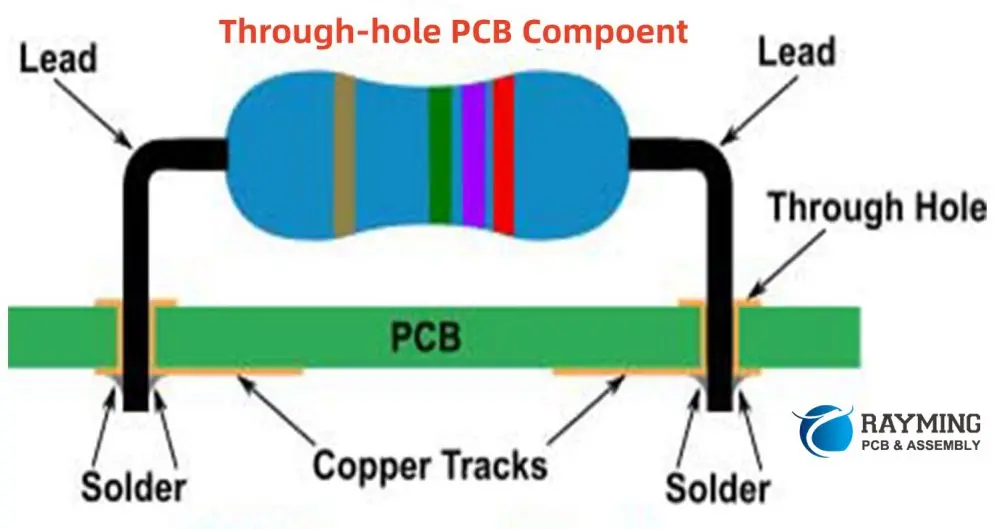
Through hole PCB assembly is a method of mounting electronic components on printed circuit boards (PCBs) by inserting component leads into pre-drilled holes. This technique creates strong mechanical and electrical connections, making it ideal for robust applications.

The Basics of Through Hole Assembly

In through hole assembly:

  1. Holes are drilled in the PCB
  2. Component leads are inserted through these holes
  3. Leads are soldered on the opposite side of the board

This process results in a secure connection that can withstand significant mechanical stress.

Historical Context

Through hole technology emerged in the 1950s, replacing point-to-point construction. Despite the rise of surface-mount technology (SMT), through hole assembly remains crucial for many applications.

YouTube video

Why Choose Through Hole PCB Assembly?

Through hole assembly offers several advantages:

  1. Enhanced mechanical strength
  2. Reliability in high-power applications
  3. Ease of manual rework and prototyping
  4. Availability of specialized components

Let’s explore these benefits in detail.

1. Enhanced Mechanical Strength

Through hole components are physically anchored to the board, making them resistant to:

  • Vibration
  • Shock
  • Thermal stress

This makes through hole assembly ideal for harsh environment applications.

2. Reliability in High-Power Applications

Through hole components can handle higher currents and dissipate heat more effectively than surface-mount components. This makes them perfect for:

3. Ease of Manual Rework and Prototyping

For small-scale production and prototyping, through hole assembly shines. It allows for:

  • Easy component replacement
  • Simple modifications by hand
  • Iterative design processes

4. Availability of Specialized Components

Some components are only available in through hole packages, including:

Learn more about:

Types of Through Hole Components

Understanding different through hole component types is crucial for effective PCB design. Let’s explore the main categories:

1. Axial Components

Axial components have leads extending from both ends. They’re mounted parallel to the PCB surface.

Examples include:

2. Radial Components

Radial components have both leads on one side. They’re mounted perpendicular to the PCB surface.

Examples include:

  • Aluminum electrolytic capacitors
  • Through-hole ceramic capacitors
  • Photoresistors
  • Fuses
  • Light-emitting diodes (LEDs)
  • Field-effect transistors (FETs)

3. DIP Components

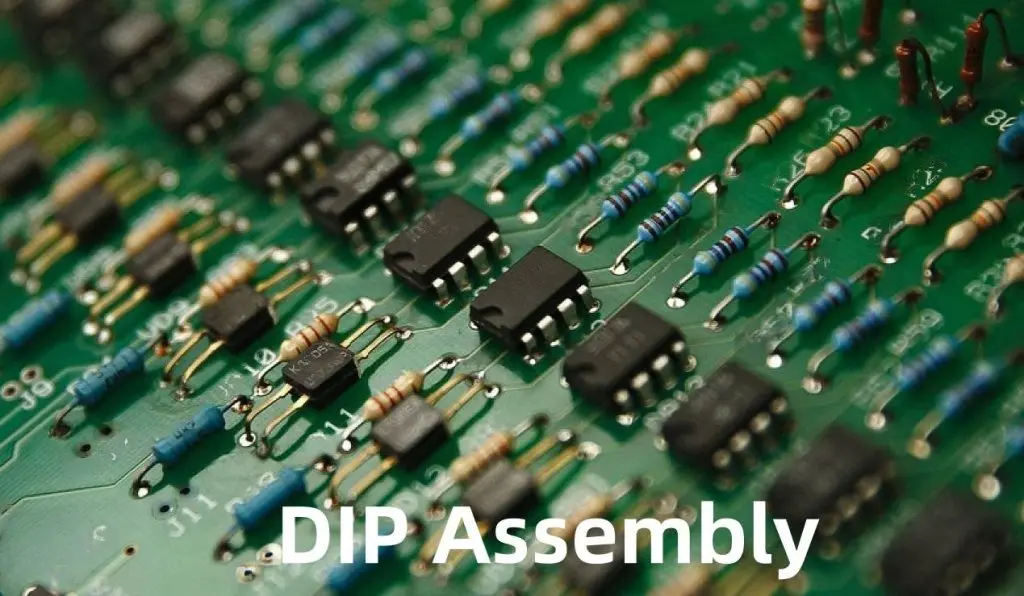
Dual In-line Package (DIP) components are integrated circuits with two rows of pins.

Characteristics include:

  • Rectangular package
  • Easy insertion and removal
  • Various pin counts (typically 4 to 64)

4. Connectors

Through hole connectors provide robust interfaces between PCBs and external devices.

Types include:

  • Pin headers
  • D-sub connectors
  • Terminal blocks
  • IDC sockets
YouTube video

Cost Considerations in Through Hole PCB Assembly

While often more expensive for high-volume production, through hole assembly can offer cost savings in certain scenarios:

  1. Lower initial tooling costs
  2. Reduced rework costs
  3. Longer component lifespan
  4. Simplified inspection process

Features of Through Hole PCB Assembly

Through hole assembly has several distinctive features:

1. High Reliability

Through hole connections can withstand significant mechanical stress, making them:

  • Resistant to vibration and shock
  • Able to withstand thermal cycling
  • Less prone to component detachment

2. Easy Manual Operation

Through hole assembly is ideal for:

  • Prototyping
  • Small-scale production
  • Educational purposes

3. Higher Durability

Through hole connections contribute to overall PCB durability by:

  • Creating stronger mechanical bonds
  • Improving resistance to PCB bending and flexing
  • Enhancing performance in high-stress environments

4. Lower Manufacturing Efficiency

Compared to surface-mount techniques, through hole assembly generally has:

  • More time-consuming component insertion
  • Additional manufacturing steps (hole drilling)
  • Manual insertion requirements for certain components

5. Limited PCB Design

Through hole assembly can impose design limitations, including:

  • Increased board space requirements
  • Restrictions on double-sided component placement
  • Increased routing complexity

Through Hole PCB Assembly Design Considerations

Effective through hole PCB design requires careful consideration of several factors:

  1. Component placement
  2. Hole size and spacing
  3. Thermal management
  4. Signal integrity
  5. Manufacturability

For more detailed information on PCB design, check out this comprehensive PCB design guide.

Through Hole vs. Surface Mount Assembly

Both through hole and surface mount assembly have their strengths. Here’s a quick comparison:

AspectThrough HoleSurface Mount
Mechanical StrengthHigherLower
Power HandlingBetterLimited
Component DensityLowerHigher
Assembly SpeedSlowerFaster
Manual ReworkEasierMore difficult

Choose the method that best suits your project requirements.

Common Defects in Through Hole PCB Assembly

Despite its reliability, through hole assembly can sometimes result in defects:

  1. Solder bridges
  2. Insufficient solder
  3. Component misalignment
  4. Tombstoning
  5. Cold solder joints

Regular inspection and quality control can help identify and prevent these issues.

Through Hole PCB Assembly Process

The through hole assembly process involves several key steps:

  1. Inserting component leads through holes
  2. Wave soldering or selective soldering
  3. Trimming excess lead length
  4. Cleaning and visual inspection
  5. Post-assembly tests and services

Each step is crucial for ensuring a high-quality final product.

Conclusion

Through hole PCB assembly remains a vital technique in electronics manufacturing, offering unparalleled reliability and strength. While surface-mount technology has gained prominence, through hole assembly excels in high-power applications, prototyping, and scenarios requiring robust mechanical connections.

By understanding the nuances of through hole assembly, you can leverage this technique to create durable and high-performance electronic products. Whether you’re designing industrial control systems, high-power amplifiers, or prototyping your next innovation, through hole PCB assembly provides the reliability and flexibility you need.

How to Guarantee SMT Production Quality

PCB prototype assembly suppliers

Introduction

Surface mount technology (SMT) has become the predominant method of electronics assembly and PCB production for its efficiency and miniaturization capabilities. However, the complexity of SMT also introduces risks to product quality if proper control and oversight is not implemented. Defects introduced during SMT assembly can lead to immediate product failures or latent defects that emerge later in the field.

This article provides a comprehensive overview of critical quality assurance practices, testing procedures, metrics, and management strategies to guarantee high yields and reliability throughout the SMT production lifecycle. By instituting disciplined inspection, process controls, standards adherence, and continuous improvement, manufacturers can deliver robust and defect-free SMT assembly.

Design Stage Controls

Consumer Electronics Assembly

Delivering quality SMT production begins in the design stages of product development:

DFA Analysis

Conduct design for assembly (DFA) analysis during board layout to identify any problematic areas for manufacturability and quality. Address issues like:

  • Component spacing and density
  • Placement sequence optimization
  • Accessibility for inspection and rework
  • Test point integration

Early DFA allows optimizing the design for ease of error-free SMT assembly.

Process Capability Assessment

Evaluate process capabilities against all design requirements during engineering prototyping. Verify the selected factory can achieve requirements like:

  • Component sizes and pitches
  • Solder joint sizes
  • Component and board warpage control
  • Placement precision
  • Mixture of through-hole and SMT parts

Supplier Management

Qualify and control critical suppliers:

  • PCB fabricationย – Ensure ready for SMT with proper finishes and soldermask
  • Components – Require statistical controls and incoming inspection testing
  • Solder paste – Validate performance through assembly trials

Controlling component and material quality prevents defects from cascade failures later on.

Quality Planning

Create a quality plan defining all inspection points, SPC metrics, standards, and controls to be implemented based on a design and process risk analysis. This roadmap guides manufacturing quality activities.

Incoming Quality Control

Rigorously controlling the quality of incoming parts and materials prevents defects from entering the production line:

Components

  • Certificates of compliance – Review for acceptability from trusted distributors
  • Sample inspections – Check component markings, lead forms, correctness
  • X-ray inspection – Detect hidden issues like broken wire bonds

Solder Paste

  • Mill/use by date tracking – First in first out (FIFO) usage
  • Thawing/cooling logs – Monitor against specifications
  • Paste viscosity tests – Confirm viscosity within limits

PCBs

  • Netlist testing – Validate against approved data
  • Visual inspection – Check for blemishes, scratches, missing markings
  • AOI verification – Use automated optical inspection to catch board defects

Stencils/Tooling

  • Dimensional checks – Verify to CAD models
  • Microscopic inspection – Check for dents, debris, clogs

This prevents defective materials from reaching production lines and causing quality events.

SMT Production Process Controls

through-hole assembly process

Rigorous process controls and oversight are critical during active SMT production:

Solder Paste Printing

Key controls:

  • Vision alignment – Optically align PCB and stencil for accuracy
  • Print parameter SPC – Monitor print speed, pressure, smear limits
  • Stencil cleaning – Check and clean regularly for clogs
  • Paste inspection – Volume, position checks, SPI monitoring

This achieves consistent, high quality solder paste deposition free of printing defects.

SMT Pick-and-Place

Robust process controls include:

  • Feeder setup validation – Confirm right components in right feeders
  • Nozzle inspection – Hourly checks for debris and wear
  • Lighting and optics – Ensure calibrated and focused on PCBs
  • Placement monitoring – SPC of speed, force, accuracy
  • Component inspection – Regular SPI checks of centered placement

This minimizes misplacement and tombstoning errors during high speed component placement.

Solder Reflow

Key aspects to control:

  • Oven profiling – Monitor temperature zones with thermocouples
  • Conveyor speed – Keep consistent feed rate through oven
  • Solderability validation – Verify parameter settings match solder paste
  • AOI inspection – Automated post-reflow inspection of joints
  • Thermal control – Measure and log profiles for each board

Controlling thermal profiles ensures evenly and properly formed solder joints.

Conformal Coating

For coated boards:

  • Coating validation – Test coverage, cure confirmation
  • Visual checks – Monitor coating quality, drips, unevenness
  • Coating thickness – SPC measurements across boards

This reliably applies protective coatings against humidity and contaminants.

Automated Testing

End-of-line testing should include:

  • ICT fixtures – Confirm test points make contact
  • Continuity/shorts – Detect any open or shorted nets
  • Functional test – Validate board operationally
  • Boundary scan – Increased test coverage of components

Critical for identifying assembly defects before boards leave manufacturing.

First Article Inspections

Conducting comprehensive first article inspections validates process setup and capabilities for new designs:

  • Perform dimensional inspection against CAD – confirm hardware matches plans
  • Conduct visual inspection under magnification – detect any defects
  • Run x-ray inspection – examine internal solder joint and wire bond quality
  • Conduct ICT and functional testing – verify electrical performance
  • Section and analyze solder joint cross-sections – validate process parameters
  • Subject first articles to environmental stress screening – confirm robustness

First article approval establishes a known-good benchmark for judging quality as production ramps up. It also serves as process validation of product designs and CAD models.

In-Process Quality Monitoring

Ongoing inspection and metrics provide critical process feedback:

Statistical Process Control

Collect real-time production data like:

  • Cpk values of print positions
  • Pick-and-place accuracy
  • Solder paste volumes
  • Component rotations
  • Solder joint dimensions
  • Test yields

Chart control limits and monitor for trends or out-of-control points.

Process Audits

Frequently audit:

  • Operator technique
  • Program versions
  • Equipment setup and maintenance
  • Feeder setups
  • Floor layout and material handling

Traceability

  • Link products to production data through serial numbers and time stamps
  • Isolate suspect lots quickly during quality events

SPC, auditing, and traceability provide rapid feedback for detecting issues.

Automated Optical Inspection

Inline automated optical inspection (AOI) is indispensable for catching visual defects:

After Solder Paste Printing

  • Detect missing, skewed, or incomplete print deposits
  • Monitor print registration and offsets

After Component Placement

  • Confirm presence and polarity of components
  • Check for billboarding, tombstones, skew
  • Inspect placement accuracy against CAD

After Solder Reflow

  • Measure joint size, shape, and positioning
  • Detect missing, insufficient, or bridging solder
  • Find lifted leads, skewed parts, positional defects

Automated inspection improves detection rates and provides SPC metrics not achievable manually. Make use of available 2D and 3D AOI tools.

Failure Analysis and Defect Reduction

When defects occur, structured failure analysis and correction techniques are essential:

Defect Reporting

  • Classify every defect by stage of occurrence
  • Note process parameters involved
  • Track by frequency, severity, project

Root Cause Analysis

  • Leverage quality tools like 5 Whys and Fishbone diagrams
  • Relate defects back to process variables with regression techniques
  • Identify root cause patterns โ€“ training, machine wear, materials

Corrective Actions

  • Address root causes โ€“ training, maintenance, materials, settings
  • Standardize solutions into procedures
  • Evaluate implementation and effectiveness

Analyzing defects improves processes for increased quality and reduced costs.

Qualification and Validation Testing

Testing protocols validate manufacturing processes and board quality:

HALT/HASS

Highly accelerated life testing reveals design weaknesses and defect risks. Stresses screening should include:

  • Rapid thermal cycling (-40ยฐC to 100ยฐC)
  • Vibration up to 60Hz across 3 axes
  • Highly accelerated life testing up to 100G

This approximates years of field conditions over weeks to force latent defects.

IPC Validations

Use IPC testing standards like IPC-A-610 to validate quality:

  • Soldering acceptance criteria
  • Lead and terminal integrity
  • Board assembly materials
  • Cleanliness testing
  • Cable and harness assembly

Certified IPC specialists can conduct testing and training.

Customer-Specific Qualification

Many industries have their own testing protocols:

  • Automotive – AEC-Q000 and IPC-A-610 Automotive Addendum
  • Aviation – RTCA DO-160 Environmental Conditions
  • Military – MIL-STD-883 Component Qualification

Align with customer criteria through specific validations.

Qualification testing confirms designs, materials, and processes are ready for full production and field deployment.

Supplier and Subcontractor Management

Extensive supplier quality controls are essential:

  • Maintain approved supplier lists – Block unapproved sources
  • Require certificates of compliance – Mandate for all deliveries
  • Conduct source inspections for high risk suppliers
  • Enforce dock-to-stock quarantines until vetted
  • Audit and score suppliers regularly – Take action on underperformers
  • Provide clear specifications – Remove ambiguities
  • Prevention over inspection – Require process controls from suppliers

Problematic suppliers can cease to exist. Control sources vigilantly.

Continuous Improvement Strategy

Steadily improving quality requires instilling a culture and mindset of continuous improvement.

Data Analysis

  • Collect comprehensive metrics on rework, yield, defects, reliability field failures
  • Analyze for patterns indicating chronic issues
  • Prioritize worst pain points for correction

Idea Generation

  • Empower production teams to suggest improvements
  • Leverage programs like Kaizen and Lean to stimulate ideas
  • Brainstorm solutions to longstanding problems

Implementation

  • Standardize solutions into procedures and training
  • Update documentation like work instructions and drawings
  • Close the feedback loop by measuring impact

Continuous improvement delivers compounded gains over time.

Conclusion

Guaranteeing SMT quality and reliability requires extensive controls implemented in design, supplier management, process monitoring, inspection, testing, analysis, and culture. By rigorously verifying acceptability at each manufacturing stage, resolving defects through root cause analysis, and continuously improving processes, electronics manufacturers can assure their SMT production delivers premium quality and reliability. It takes diligence and buy-in at all levels, but the result is worth the effort for reduced costs and reputational gains.

Frequently Asked Questions

Q: What are the most common SMT defects?

A: Typical SMT defects include open solder joints, tombstoning, missing components, misalignments, bridging, billboarding, skew, solder balls, and insufficient solder. Tracking and analyzing defects points to corrective actions.

Q: How can you assess if PCBs are SMT-ready?

A: PCBs can be verified SMT-ready through netlist testing, inspection of soldermask and surface finish, and dimensional checks. IPC standards like IPC-6012D provide acceptance criteria.

Q: What are key solder paste controls?

A: Monitoring paste life, storage temperatures, stencil condition, and process parameters like print speed and pressure are critical for paste quality. Regular paste testing is also advised.

Q: What type of testing should be performed?

A: Testing should include ICT, boundary scan, functional testing, environmental stress screening, HALT/HASS, vibration, thermal cycling, and any customer specific industry protocols.

Q: How can you monitor hidden solder joint defects?

A: X-ray inspection and cross-section analysis are used to detect hidden voids, cracks, and other internal solder joint anomalies that can lead to field failures.

How to Find Low Cost SMT Production

Do you have a need for SMT production? Are you in the food, electronics, or medical industry? Then, we can custom-design a production line to best suit your needs. Have you witnessed the dynamic changes in the synthesis of PCBs? Why are some PCBs quite different in design and dimensions? Nowadays, SMT has proven to be an efficient mounting style that minimizes the manufacturing cost. In the 1960s, assemblers developed this method, which later spread in the 1980s. Finally, in the 1990s, they used it in the leading assembly companies. SMT production has several advantages over the popular through-hole assembly technique, but at the same time, it has some demerits.

We are a leading provider of components and assemblies for the electronics industry. So whether you’re an OEM in need of bypass solutions or a hospital looking for fluid pump parts–we’ve got you covered! Our capabilities range from non-standard assembly items to prototype development and production.

What is SMT?

Surface mount technology (SMT) is a style we use while producing PCBs. It involves mounting electrical components on a bare board. SMT is a directly opposite process to through-hole mounting format. Assemblers developed it from the hybrid integrated circuit technology. SMT production is the process of synthesizing electronic circuits using plates or boards. In engineering literature, we refer to SMT as an SMT production line. We refer to electronic components prepared using SMT as surface-mounted devices (SMDs).

What are the steps in SMT production?

SMT is a lengthy process that requires a certain level of organization to achieve it. The following are the iterations that we follow in this production:

I. Component Preparation

Before proceeding to any other activity, we must prepare all the components and check for faults. For example, the bare board must have flat solder pads and no holes.

II. Stencil setting

We position the stencil according to the intended solder pad’s position on the PCB.

III. Printing of the solder paste

Solder paste, a mixture of tin and flux, works best in connecting the solder pads and SMC on the PCB.

IV. Placement of the components

The PCB moves on a conveyor belt to the pick-and-place machine, which places all the electronic components in their intended positions.

V. Reflow soldering

This process takes place in five consecutive zones. These are:

  • Soldering oven โ€“ Having applied SMC, the boards continue to the reflow of the soldering oven.
  • Pre-heat zone – This is a high-temperature zone with a temperature rising at one to two degrees Celsius per second until it is between 140ยบC and 160ยบC.
  • Soak zone โ€“ the temperature in this zone is between140ยบC and 160ยบC. The boards spend between 60 and 90 seconds in this zone before proceeding to the reflow zone.
  • Reflow zone โ€“ In this zone, the temperature rise rate is 1 โ€“ 2 degrees Celsius per second to a temperature between 210 ยบC and 230 ยบC. The tin in the paste melts, attaching the lead components to the pads. The surface tension of the molten solder aids in maintaining the position of the components.
  • Cooling zone โ€“ As the board leaves the heating zone, they enter this zone which prevents abrupt cooling of the solder, hence eliminating connection problems.

VI. Cleaning and scanning of the board

Having soldered the board, we now clean them, checking them for any faults. We achieve this with the aid of flying probe testers, magnifying lenses, X-ray machines, and Automated Optical Inspection (AOI).

What factors do we consider when choosing the best SMT production machine?

The nature of the machine determines the quality and quantity of the products. It is therefore important that whenever you go for an SMT production machine, you consider the following factors:

  • Speed

The operating speed of the pick-and-place machine determines how many boards you can assemble within a given period. A machine with a higher speed will pick, inspect, and place more components within a short period. Therefore, it proves to be more effective in the mass production of PCBs.

  • Accuracy

A more accurate machine will perform numerous tasks without making many errors. Therefore, we are sure of high-quality products and maximum product outputs. In addition, the power consumption by the machine will be lesser if it has higher accuracy.

  • Size of the components you intend to handle

If you purchase a surface mount technology machine, the size of the components you wish to mount using the machine is very important. Getting a machine that suits your components will save much of your time, as you do not need to go back to the dealer for machine exchange.

What are the advantages of surface mount technology (SMT) production?

  • PCBs assembled using SMT are more compact and hence have higher circuit speeds.
  • Using SMT, you can place many components closer together on one board. Eventually, you will have a smaller and more compact PCB with lesser weight.
  • We can utilize both sides of the circuit board by applying SMT, allowing for more connections per component and a higher component density.
  • SMT production process is, therefore, faster compared to the through-hole assembly since we do not require drilling holes on the bare board before the placement process. Thus, the preparation cost of the PCB will be lower.
  • PCBs prepared using surface mount technology have lower inductance and resistance. Therefore, they will have higher frequency performance than those prepared with the through-hole assembly technique.
  • Due to low lead inductance and compact package, the PCB will have an easily achievable Electromagnetic Compatibility (EMC).

What are the disadvantages of SMT production?

  • The solder connections may get damaged as the PCB moves through different thermal cycles.
  • Due to the less solder used in this process, the solder joints may not be reliable.
  • Due to the small sizes, you will require expensive tools and a skilled operator to repair faulty PCBs.
  • According to the design of the SMT-produced PCBs, we cannot install sockets that would facilitate the easy replacement of faulty components.
  • SMDs are smaller in size than through-hole components, and therefore, there is no space for labeling the parts and stating component values.
  • Subjecting components to mechanical strain may interfere with their functioning. Therefore, since SMT production involves stressing components to occupy smaller space, we cannot solely use it to manufacture PCBs.

Conclusion

SMT Production can help you take your business to the next level. Although SMT production is a highly specialized job and the demand for skilled SMT technicians will only increase, it is crucial to be on top of your game and have life skills you can use in any job.

We cannot perform SMT production successfully without an SMT production machine. If you want to purchase such a machine, the most suitable machine will depend on three factors. These are the speed, accuracy of the machine, and the size of components you wish to handle with this machine.

Does the Isola I-Speed PCB Material have a High Thermal and Electrical Performance?

Isola I-Tera MT40 PCB

Are you in need of a PCB material that can serve different markets and applications? One that has great thermal stability, high density interconnect, and high speed digital. Then we have you covered because truly not all PCB materials you find out there can offer all these features.

Our simple answer and solution is the Isola I-Speed PCB Material. True, you are not sure with my suggestion, but soon, youโ€™ll understand that this material truly has these great qualities.

In this article, we will be discussing what it is, its benefits or attributes, its applications, as well as its general properties. If this really interests you, why not take your time to read this article, and youโ€™ll be glad you did.

What is the Isola I-Speed PCB Material?

The Isola I-Speed PCB Material is a FR-4 Tg180 Resin system that can serve multilayer applications where thereโ€™s a need for great thermal performance, as well as maximum reliability.

The manufacturing of the I-speed prepreg and laminate products is possible using the multi-functional high performance patentable system of Isola, using electric grade glass fabric.

Furthermore, this system usually delivers an improvement of 15% in the expansion of the Z-axis. Also, it offers an additional 25% of electrical bandwidth. This indicates lower loss compared to the competitive products present in the space.

All these properties, in addition to the better moisture resistance during reflow, leads to a product which bridges a gap from both the electrical and thermal perspective.

Furthermore, the Isola I-Speed PCB Material resin system offers UV blocking and laser fluorescing. This ensures its compatibility with optical systems for positioning, solder mask photo imageable imaging, and AOI systems.

The attributes of the Isola I-Speed PCB Material includes high speed digital, high thermal reliability, and high density interconnect. Also, this PCB material is useful in aerospace and defense, networking and communications, computing, peripherals, and storage, and lastly medical, instrumentation, and industrial.

What are the Applications of the Isola I-Speed PCB Material?

Below are the applications of the Isola I-Speed PCB Material

Computing, storage, and peripherals

The rise in demand for smart and connected devices needs extra bandwidth. This is to aid easy data accessibility and transmission. Also, Isola has been able to engineer its digital materials at high speed, just to support the Internet of Thingsโ€™ foundation. In addition, the Isola I-Speed PCB Material ensures processing ease, thermal reliability, as well as electrical properties that are stable, which includes the dissipation factor (Df) and the dielectric constant (Dk).

Networking and Communication

As bandwidth is becoming a very serious issue when it comes to networking and communication. PCB materials like the Isola I-Speed PCB Material are becoming very important. Engineers that deliver services to these markets use the Isola I-Speed PCB Material.

This is due to its laminatesโ€™ reliability, and high performance, which meets the greatest quality for satellite, voice, and video services, as well as other applications that are data-intensive where bandwidth has become a problem.

Aerospace & Defense

The high speed RF/microwave and digital materials of the Isola I-Speed PCB Material are great for aerospace and military applications. This is because they provide high temperatures of glass transition, as well as low rates of expansion and high decomposition temperature. These above attributes are necessary for demanding aerospace and military applications.

Medical, Industrial and Instrumentation

The portfolio of the Isola I-Speed PCB Material of low loss, high reliability materials supports different medical applications, which includes implantable devices, hybrid devices, imaging and monitoring systems having data and telecom processing capability, as well as other devices.

What are the Attributes of the Isola I-Speed PCB Material?

The following are the attributes of the Isola I-Speed PCB Material.

High Thermal Reliability

The requirement for thermal reliability is in two categories. First, has to do with a PCBโ€™s survival via assembly excluding defects like delamination or blisters. The other category has to do with thermal reliability with respect to the environment for operation all through the lifetime of the product. The two types are critical.

High Speed Digital

The Isola I-Speed PCB Material provides different high-speed digital materials, which delivers superior CAF resistance and superior performance. These materials of low-loss are for applications requiring high signal integrity and reliability. Furthermore, these HSD materials are halogen-free for green electronics.

A high speed digital product that is successful relies on the type of PCB material. Different factors like the data rate, high speed digital channel length, and the processing and thermal considerations must be considered when you are selecting the material.

High Density Interconnect

The attributes of the high density interconnect are designs of PCBs, which use a rise in feature density in order to achieve stack ups that are thinner, layer count that is less and a weight that is lighter.

Isolaโ€™s high performance products like the Isola I-Speed PCB Material offer a thermally robust performance, which is necessary for the lamination cycles for the complex structures.

What is the Thermal and Electrical Performance of the Isola I-Speed PCB Material?

The Isola I-Speed PCB Material has two main values as its thermal performance. First, is the temperature for glass transition which stands at 180 degrees Celsius. This means that, with this temperature, the PCBโ€™s mechanical stability will not fail all through the PCBโ€™s lifetime.

Furthermore, the decomposition temperature (Td) stands at 360 degrees Celsius. This means that you will require a very high temperature before this material can decompose chemically or lose about 5% of its mass weight. This shows that the Isola I-Speed PCB Material is very reliable.

There are two properties that also describe electrical performance. The dielectric constant is 3.64, while the dissipation factor is 0.0060. This means that the Isola I-Speed PCB Material has a high ability to act as an insulator or hold energy.

Conclusion

We hope that you understand all you have read on the Isola I-Speed PCB Material here. The Isola I-Speed PCB Material has great electrical and thermal properties and will function effectively in different applications. If you have any more questions, please reach out to us here.

Where to Manufacture Isola IS410 PCB

multilayer pcb manufacturers

Mostly, there are some questions engineers and designers ask when it comes to this laminate material. This epoxy prepreg has some features that make it a high performance prepreg system. The Isola IS410 PCB material is applicable in various areas.

One of the most asked questions about Isola IS410 is about its compatibility with assembly that is lead free. Also, people inquire about the flexural strength of this laminate material.

With a lot of research, we believe we have answers to these questions. However, these questions are numerous but we shall discuss only a few of them.

What is Isola IS410 PCB Material?

Unarguably, this is the most frequently asked question about Isola IS410. This is a laminate system as well as an epoxy prepreg which has high performance in many applications.

This laminate material is applicable in various areas such as consumer electronics, transportation, medical, aerospace, networking system, communication and automotive. Note that thisย epoxy prepreg is an FR-4 material for circuit boards.

Plus, Isola IS410 aids and enhances reliability level in applications and circuit boards. It uses any solder that is free of lead. Interestingly, its compact design supports high performance through many thermal excursions. This is a CAF resistant laminate that comes with a distinct resin system.

What Copper Foil Does Isola IS410 Use?

Different prepreg systems and laminates use various copper foil. For the Isola IS410 PCB laminate, it can come with HTE grade 3 type of copper foil. Also, engineers employ RTF in this laminate.

Is There Compatibility Between Isola IS410 and Lead-Free Assembly?

No doubt, this is also one frequently asked question about Isola IS410. There are laminates that don’t work with lead free assembly because of their properties. However, this laminate is compatible with assembly that is lead free. This implies that it resists the increasing temperature that comes with fabricating and soldering.

Furthermore, this prepreg system and laminate material meet the demands of assembly that is lead free. It helps to back up some marginal safety in the course of increased temperature of soldering that is lead free. Thereby, it guarantees some thermal resistance. Also, it resists the reflow of system soldering that is lead free.

What Electrical Properties Make Up The Isola IS410 PCB Laminate?

There are electrical properties that are constituent to the Isola IS410 laminate. In addition, designers often consider these electrical properties when using this laminate.

Dissipation Factor

The dissipation factor of this laminate material is vital. Well, it is a considerable element of the electrical properties because it is the measurement of energy lost in this PCB material. With lower DF, then there is little loss of energy or power.

Note that, the DF of this laminate is 0.02, this depends on frequency variance too. Hence, one considers DF during analog signals. This is because of how it determines signal attenuation. Meanwhile, dissipation factor is not necessarily considered during digital circuits.

Surface and Volume Resistivity

This is part of the electrical properties of Isola IS410 one needs to consider. For Isola IS410, the volume resistivity determines how this laminate can withstand electric current. Furthermore, any laminate with low resistivity shows that such allows the flow of electrical current. Therefore, the volume resistivity is withstanding any electric current via the body of the laminate.

Surface resistivity withstands electric current through the surface of this laminate material. Note that the surface resistivity needs to be high in value too.

Electrical Strength

This is another component of the electrical properties of Isola IS410 PCB material. Thus, this has to do with withstanding the electrical neurosis in the Z axis of this laminate. This prepreg material has electrical strength of 1100 voltage per mil.

What is The Flexural Strength of Isola IS410 PCB Material?

The flexural strength of this laminate material matters a lot. Therefore, it is important for designers to find out about it. We measure the flexural strength in the course of flexural testing. The Isola IS410 must be able to withstand any form of deformity and breakage during bending test. In a nutshell, flexural strength is about bending test of the laminate material.

One has to adhere to IPC-6013C regulations for flex, rigid, and rigid-flex laminates. The flexural strength of this laminate is solely tied to its minimal stress as well as its strain during bending test.

Note that, there are basically two flexural testing one can use. The bending test involves 3 points. This deals with accuracy during experimentation. The other is a 4 point. One can do this through two procedures. You carry out these for either large or small deflections.

What are the Kinds of Treatments Isola IS410 Uses?

There are treatments for this kind of laminate material. You can use reduced oxides with oxide alternatives together. This is for the production of multilayer circuit boards.

When using these treatments, make sure that there is the display of dark color based on consistency by these treatments; oxide alternatives and reduced oxides. Note that it is crucial to prevent excessive baking in the course of applying these treatments. There might be resistance to decreased pink ring because of too much baking.

What are The Standard Approvals for Isola IS410 PCB Material?

These standard approvals are the industrial approvals for the Isola IS410. They are the quality standards the prepreg system must follow. Also, it is the standard for this laminate material. Below are the industrial approvals for Isola IS410.

RoHS standards, UL standards, IPC standards, ASTM standards, BSI standards, FCC standards, and CE standards. These are the standards that make the laminate material and prepreg system highly effective.

Conclusion

The Isola IS410 PCB material is one that needs dimensional stability when you are processing the laminate. There are both chemical desmear and plasma desmear for desmearing  this laminate material.

Also, we have been able to provide answers to some of the frequently asked questions about this prepreg system and laminate. You need to figure out the flexural strength during the bending test too.

What is Shengyi SAR10S PCB ?

Isola DE104 PCB

PCB materials play a crucial role in the performance of printed circuit boards. Therefore, it is vital to choose materials with great properties. These materials enhance the functionality of a circuit board. Shengyi is a manufacturer of PCB material. The Shengyi SAR10S is one of the high-quality PCB materials by Shengyi. In this article, we will be discussing Shengyi SAR10S and how it impacts PCB fabrication.

What is Shengyi SAR10S?

Shengyi SAR10S is a halogen-free PCB material. This laminate features great thermal reliability and insulation. Also, Shengyi SAR10S PCB material is ideal for fabricating high-frequency circuit boards. This PCB material features exceptional thermal and mechanical properties. Also, the Shengyi SAR10S PCB material is highly preferred among PCB manufacturer due to its high CTI value.

General Properties of Shengyi SAR10S

Low glass transition temperature (Tg)

Tg measures the temperature at which a PCB material changes from a solid state to a rubber-like state. This property contributes to the thermal performance of a board. The Tg of Shengyi SAR10S PCB material is 140 degrees Celsius.

Low coefficient of thermal expansion

The CTE of Shengyi SAR10S PCB material is 27 ppm/โ„ƒ before Tg. The CTE after Tg is 30 ppm/โ„ƒ. CTE measures the ability of a material to expand in response to heat.  Also, the coefficient of thermal expansion of Shengyi SAR10S is low. This means that this PCB material will hardly expand in size when subjected to high temperature. Therefore, it is an ideal material for high end PCBs.

Excellent thermal conductivity

Thermal conductivity measures the rate of heat transfer in a PCB material. Shengyi SAR10S has a thermal conductivity of 1.1 W/mK. This means that this PCB material can transfer heat effectively. Also, Shengyi SAR10S can easily absorb heat from its environment. Therefore, it is an ideal option for thermal-demanding applications.

High Decomposition temperature (Td)

The Td of Shengyi SAR10S is 410 degrees centigrade at 5% weight loss. Decomposition temperature measures the temperature at which Shengyi SAR10S decomposes chemically. Also, it is more ideal for a pCB material to have a Td above 320 degrees centigrade. PCB materials with high Td feature high glass flow temperature.

High Comparative tracking index (CTI)

CTI measures how an insulating material can withstand unwanted flow of current between traces on the circuit board. The CTI of Shengyi SAR10S PCB material is very high. The CTI of a PCB material is crucial. This is because it helps to determine the overall tracking resistance of a PCB.

Advantages of Shengyi SAR10S PCB Material

Shengyi SAR10S is a high-quality PCB material that enhances the performance of circuit boards. This material is widely used in PCB fabrication due to the benefits it offers. Therefore, we will discuss more of these benefits.

Halogen-free

Shengyi SAR10S is a halogen-free PCB material. Therefore, this PCB material contains no halogen elements. It has no fluorine, chlorine, or bromine. Therefore, it is safe for fabricating printed circuit boards. Also, this material is environmentally friendly.

Great thermal performance

This PCB material features excellent thermal properties that contribute to its thermal performance. For instance, it features high decomposition temperature and low coefficient of thermal expansion. Also, it features excellent thermal conductivity. All of these properties make it thermally reliable.

Applicable in LED devices

Shengyi SAR10S PCB material is applicable in LED TVs and LED lighting. This is as a result of its dielectric properties.

Guidelines for Shengyi SAR10S Processing

  • When operating these laminates, it is important to wear gloves. Otherwise, copper foil collisions can damage the laminate. Also, touching with bare hands can contaminate the copper foil surface. This can cause negative effects.
  • Check for any scratches or pollution during operation. Also, ensure you avoid break in the drilling and cutting processes.
  • Ensure you take pattern fabrication due to the properties of aluminum board
  • Maintain a minimum insulation barrier between the nearest conductor and the circuit boardโ€™s edge. The distance between the line and edge should be at least 2mm. Also, the distance between the hole and line should be at least 3mm.
  • The structure of aluminum laminate is metal. Therefore, you can replace conventionalย baking with a simpleย mechanical method. If there is any warpage, it is advisable to go for mechanical leveling.
  • Also, aluminum laminate requiresย harder cutting tools. Therefore, you will need special milling and a specialย V-CUT blade. In addition, try toย reduce the cutting speed.

The Drilling and Punching Process of Shengyi SAR10S

The drilling of this laminate requires the use of some cutting tools for aluminum materials. Therefore, use single-edge and double-edge cutting tools. These help to remove chips smoothly. The wear of the material will be greater if the thermal conductivity is high.

Punching in Shengyi SAR10S processing is important. This involves using an air gun to eliminate aluminum chips caused by punching. This helps to prevent bad appearance in operation. When punching, work the aluminum surface towards the cutting blade. If not, the solder mask or the dielectric layer may peel off. This can later result in poor quality.

Also, ensure the aluminum surface is placed upwards to the cutting blade. It is advisable to use the 160-200t high tonnage punching machine. Also, adjust the panel edge margin and the punching edge length according to the die sizes. Use the high hardness steel in the cutting blade.

Storage Condition of Shengyi SAR10S

When storing Shengyi SAR10S, it is important to keep it in good condition. Below are guidelines on how to store this laminate.

  • Store sheets in a ventilated and dry environment. Also, ensure you donโ€™t expose this laminate to rain or sunlight. However, it is important to avoid corrosive gas erosion.
  • Reduce shifting to prevent scratching the surface of the laminate.
  • Pack the laminate with original forms. Inappropriate storage can cause sheet deformation. This can cause a negative impact on the PCB material.

Conclusion

Shengyi SAR10S PCB material is a highly reliable and halogen-free material for PCB fabrication. This article has discussed every important detail on Shengyi SAR10S. Also, it has provided guidelines on the processing and storage of this material.

How to Handle and Properly Store the Isola G200 PCB Material

12 layer pcb circuit board

It is very crucial to know how best to handle the Isola G200 PCB material. The lack of proper handling of this laminate material can affect its effectiveness in your circuit boards. Also, there is a need for the proper storage of this prepreg system.

In this article, as an engineer or designer, you shall find out more on how best to store and handle Isola G200 PCB material. This is a well researched writing for you to broaden your understanding in this regard.

What is Isola G200 PCB Material?

To begin with, it is important to discuss what the term “Isola G200” means. If you’re familiar with multilayer circuit boards, then you would agree with us that Isola G200 PCB material is a laminate for holding together the layers. This implies that, Isola G200 is both a prepreg system as well as a laminate.

Therefore, its type of laminate works for multilayer printed circuit boards. Also, it comes with so many processing advantages which accelerate its high performance in various applications. Plus, this laminate works for wide panel size PCBs. Being a prepreg system, it has a resin system included in it.

This laminate can effectively work under high temperatures. Also, no pressure affects its stability and efficiency. One needs to store and handle Isola G200 PCB material in a cool atmosphere.

Furthermore, this helps protect this prepreg system from full polymerization. Hence, it is so because of the inclusion of a resin system. Notably, the Isola G200 PCB material works perfectly for high reliability circuit boards needs.

How Do You Handle Isola G200 PCB Material For High Performance?

In this part of the article, we shall focus on how best to handle Isola G200. This laminate material is a mixture of epoxy resin with Bismaleimide/Triazine.

Please note, the way you handle Isola G200 can make it work positively or have negative effects on it. Some engineers handle it without caution. This type of laminate is different from other laminate materials you expose to unfavorable weather conditions. Although it is highly weather resistant, you still need to keep it in the right place.

If you handle it properly, it can enhance its lifespan. Thus, it becomes durable. In a nutshell, the way you handle this prepreg system determines how long it would last. It uses some measurable polymerized resin and as such needs proper care. This fiberglass fabric has a resin system which is non-tacky. However, the resin system is moderately friable.

When there is any kind of reduction in resin from its fabric, this mostly leads to lamination challenges. Improper handling of this prepreg system can cause glass damage on it. This implies that any careless handling of Isola G200 PCB material causes lamination problems. These are the reasons you need to handle it with care.

Notably, Isola G200 prepreg thickness comes from the kind of fabric used for it. There is an increase in resin the fabric holds when there is reduction in the thickness of the fabric.

Proper ways to handle Isola G200 PCB material are as follows. It is paramount to use only the correct and sharp tool during paneling of this laminate material. This prepreg system cutting needs an accurate instrument.

How Do You Store Isola G200 PCB Material?

This PCB material needs the right storage the same way it requires proper handling. To store it, please there are recommendations below. Meanwhile, it is delicate and needs a cool atmosphere.

To store Isola G200 prepreg and PCB laminate material, you need a restricted area. You need a space where you can exercise some control. This implies, you store it in some controlled area.

This laminate can absorb moisture if it is wrongly handled and stored. In handling it, you should store it right. This implies that you can’t neglect handling it with caution without proper storage. If it absorbs moisture, then it causes cure. Thereby, the glass transition temperature becomes totally abnormal causing its depression. Definitely, the prepreg system’s flow becomes tampered with.

One needs this laminate storage to be lower than 21 degrees while the humidity should be below 45 percent. Don’t open if it doesn’t equilibrise to factors of the layup package. If not, it can result in moisture condensation on Isola G200 PCB material.

It is not recommended to retain this prepreg for too long , above 3 months at alloted conditions for storage.

It is crucial one tests this laminate material and prepreg before making use of it. You should completely avoid prolonged storage. Such requires functionality testing if there is longer storage.

Once the package is unsealed, immediately make use of Isola G200. Therefore, one needs to reseal prepreg that remains when applying new desiccant.

Moreover, so importantly, ensure that the atmosphere is cool for storage. You need to avoid harsh, toxic, and catalytic environmental conditions. Also, avoid high radiation as well as harsh ultraviolet light.

What is The Stabilization Period for Isola G200 PCB Material?

The stabilization time for this kind of prepreg solely depends on temperature for storage. Note that the stabilization time requires that one keeps this prepreg in its sealed form. This is if your storage temperature is lower than the layup room degrees of temperature.

Importantly, if you stick to this during stabilization time, it helps to prevent moisture condensation on the prepreg system.

Conclusion

It is safer to handle Isola G200 PCB material the right way. Above all, it is crucial to store the laminate and prepreg in a cool atmosphere. The stabilization time needs some degree of temperature for storage. Also, no need for a prolonged period for vacuum storage. Peradventure there is extended storage, and a different location that has considerable environmental control.

Also, every kind of Isola G200 PCB laminate needs clean gloves to handle them. You must only wear neat gloves when touching or handling this prepreg. Note that it is a delicate type of prepreg system. Moreover, an engineer needs to be cautious when handling a high resin prepreg system or Isola G200 PCB material.

What You Should Know About the Shengyi Synamic 6B(F) PCB Material

40 Layer PCB

The Shengyi Synamic 6B(F) PCB laminate is a very reliable PCB material because of its exceptional resin flow characteristic. It is one PCB material that is applicable in many areas including telemetry.

Each laminate material has features that make them unique. One uniqueness with this PCB material is that it doesn’t necessarily need high temperature before it functions well.

This article focuses on frequently asked questions about Shengyi Synamic 6B(F) PCB material and areas of its application. Also, it discusses its features. At the end of reading this article, you shall have more understanding of what it entails.

What Are The Characteristics of Shengyi Synamic 6B(F) PCB Material?

This PCB material has some characteristics that make it potent enough to be applicable in some areas. Also, these characteristics help it withstand harsh environmental conditions.

Exceptional Resin Flow

When it comes to laminate with excellent resin flow, the Shengyi Synamic 6B(F) PCB laminate is one to opt for. The flowability of resin is what makes this laminate material strong and bond different layers in the circuit board of cell base antennas.

High Glass Transition Temperature

This is one of the characteristics of Shengyi Synamic 6B(F) PCB material. It has the ability to get up to high degrees of temperature. Although, it doesn’t need high temperatures to work effectively.

UV Resistance

In addition, this laminate material is resistant to rays of light. Unlike some PCB materials, Shengyi Synamic 6B(F) resists the hard effect of UV radiation. Your circuit board needs protection against UV rays which may damage it. So, this is one advantage with this laminate material.

High Decomposition Temperature

This PCB material has a tendency for high td. The high decomposition temperature is the volume of temperature in which your circuit board can decompose resulting from chemical properties.

Notably, this decomposition temperature representation is in degrees Celsius for its unit. Therefore, this td is in high temperature for this kind of laminate material.

What are the Areas of Applications of Shengyi Synamic 6B(F) PCB Laminate Material?

When we talk about the areas of application of Shengyi Synamic 6B(F) laminate, this means applications where it functions effectively. To explain further, we mean every laminate material where you can apply them. Some PCB materials work for power amplifiers, power dividers, routers, switches, and high performance computers. Therefore, it is crucial as an engineer or designer you notably observe where each laminate works.

Telemetry

This is one of the functional areas of application of Shengyi Synamic 6B(F) PCB material. This RF multilayer PCB material makes the bonding of telemetry faster and better. Hence, it makes the possibility of communicating readings in appliances work.

The Shengyi Synamic 6B(F) laminate makes transmitting of any measurements via telephone lines or radio waves possible. Thus, one can then record these recordings. This laminate material makes the communication process easier and high performance is notable.

Telemetry makes the transmitting of data plausible to a shore station. Also, this laminate material makes tracking of recordings applicable in monitoring stations via remote source.

Cell Site

This is another area where Shengyi Synamic 6B(F) works. For all cellular base stations, this laminate material works for the circuit board. It works perfectly for the antennas because it helps transmit electrical circuits faster than other PCB laminates.

When information is sent to large numbers of people, this laminate material makes that work. You find it in any wireless network system. It helps the transmitting of signals (both from the receiver to the sender) work.

This laminate material works for each antenna in cellular sites. It creates some wave radiation which makes the transferring of information possible in cellular phones. Meanwhile, these antennas are structured in such places like towers or radio masts.

Feed Network

The Shengyi Synamic 6B(F) is present in feed networks. Thus, it is a very important aspect of the array antenna. The feed network makes the array antenna work well because of the application of Shengyi Synamic 6B(F) PCB material in its board.

Frequently Asked Questions About Shengyi Synamic 6B(F) PCB Material

There are some underlying questions engineers and designers ask before choosing this laminate material. Let us consider some of them among numerous questions.

Is Shengyi Synamic 6B(F) Weather Resistant?

One of the properties of this laminate material is the ability to withstand any kind of weather. No doubt, a very good PCB material should resist any poor environmental conditions. So, this material can maintain its potency irrespective of the weather conditions of an area. No thunderstorm, rain or ray of light can affect it.

How Flammable is The Shengyi Synamic 6B(F) PCB Material?

One important thing to do while constructing this laminate material is to test it. During testing, you should consider if it is flammable. Hence, it is very bad if a laminate material can easily catch fire. However, when it comes to flammability of this laminate material, it can withstand fire. It is not the type of PCB material that catches fire or is affected by heat or flames.

Is Shengyi Synamic 6B(F) Effective in Circuit Board?

This is one of the concerns of most engineers. Truly, this laminate is highly effective for circuit boards. That is why it is applicable in many areas. It enhances speed and performance in any application. It is very potent and lastsย long without any barrier. Also, it doesn’t become weak from environmental toxicity.

Are There Various Surface Finishes for Shengyi Synamic 6B(F) PCB Material?

Yes, this is one of the PCB materials with varieties of surface finishes that one can choose from. These surface finishes always enhance the general performance of your circuit boards. Therefore, the Shengyi Synamic 6B(F) PCB material has different surface finishes.

Conclusion

Shengyi Synamic 6B(F) PCB material is one that you can boast of. This is because of the various characteristics, properties, and areas of its application. Also, it is durable because of its ability to resist any kind of weather. It has different surface finishes too. Hence, it is very effective as it enhances speed in applications.

What Does the Shengyi Synamic 6GX PCB Material Offer?

24-layer-pcb-design

Synamic 6GX is another PCB material produced by Shengyi. For a while now, Shengyi has been offering several high-quality PCB materials. PCB fabrication requires the use of high-quality materials. This is because the properties of a material will determine its functionality. While choosing a PCB material, manufacturers try to choose materials that meet the requirements of the intended applications.

However, it is important that manufacturers know more about Shengyi Synamic 6GX before opting for it. This article seeks to shed light on Synamic 6GX and what it offers.

What is Shengyi Synamic 6GX PCB Material?

Synamic 6GX PCB material is a low loss and high reliability PCB material. Also, it is a halogen-free material. This means that Shengyi Synamic 6GX features no halogen constituents. This material is very safe for PCB fabrication. Also, it contains no toxic substances. Halogen is a harmful substance with negative impact on human lives and the environment. Therefore, PCB manufacturers prefer using halogen-free materials for fabricating their PCBs.

Also, Shengyi Synamic 6GX is a high Tg material. This low loss material has stable dielectric constant and dissipation factor. With its low z-axis CTE, this material provides better performance. Also, this highly reliable material has a high decomposition temperature at 405 degrees Celsius. It is important to note that Synamic 6GX adheres to the UL 94 flammability ratings. Also, Synamic 6GX is an efficient and functional material for high frequency applications.

General Properties of Shengyi Synamic 6GX PCB Material

Low Z-axis CTE

The coefficient of thermal expansion before 31 ppm/ยฐC before Tg. Also, the CTE on the Z-axis after Tg is 205 ppm/โ„ƒ. Materials with low CTE are ideal for PCB fabrication. Also, the low CTE value indicates that Synamic 6GX can withstand heat without expanding. The CTE of this material is at a minimum value. Hence, it is ideal for high performance applications.

High glass transition temperature (Tg)

The glass transition temperature of Synamic 6GX is 172 degrees Celsius. This value is very high. Synamic 6GX features high Tg which impacts its thermal performance. Generally, Tg measures how a material softens when subjected to temperatures beyond its threshold. Also, Synamic 6GX PCB material will soften when it operates beyond 172 degrees Celsius.

High decomposition temperature (Td)

The Td value of Synamic 6GX PCB material is 405 degrees Celsius. Decomposition temperature measures the temperature at which Synamic 6GX decomposed chemically. Therefore, Synamic 6GX will decomposes chemically at 405 degrees Celsius. Also, this value is high. Materials with high Tg can withstand thermal stress without breaking down easily.

Low and stable dielectric constant

The dielectric constant of Shengyi Synamic 6GX is 3.73. This value is very low. Therefore, Synamic 6GX features a low dielectric constant. Also, this electrical property contributes to signal integrity and impedance. The dielectric constant of a material depends on frequency. A material with low and stable dielectric constant is safe for use in high frequency applications.

Low water absorption

The water absorption rate of Shengyi Synamic 6GX is 0.08. Therefore, Synamic 6GX has a low water absorption rate. This means that this material can withstand a humid environment. Also, it is ideal for use in humid operational environments.

Advantages of Shengyi Synamic 6GX PCB Material

Synamic 6GX features a lot of benefits. Therefore, it is highly preferred among PCB manufacturers. In this section, we will discuss the advantages of this PCB laminate.

High heat resistance

Heat resistance and heat management are two important factors to consider when choosing a PCB material. Shengyi Synamic 6GX PCB material features a high heat resistance. This means that this material can withstand high temperatures. Therefore, it is a great option for applications exposed to high temperatures. For Shengyi Synamic 6GX, the T300 is beyond 60 min.

Environmentally safe

This is another advantage of using this PCB material. It is environmentally-friendly. Also, it features no halogen. This PCB material strictly adheres to the PCB fabrication standards. Halogen constituents are strictly prohibited for use in PCB fabrication. Also, this is because of the harm these constituents pose to the environment.

Low loss

Shengyi Synamic 6GX is a low loss material. Also, this material features low dielectric loss. Therefore, this material doesnโ€™t heat in the RF field. A low loss material helps to reduce signal loss and enhance signal integrity.

Cost effective

This material is a cost-effective option for fabricating circuit boards. Also, Shengyi Synamic 6GX PCB material offers great value for its price.

Great performance

Shengyi Synamic 6GX offers great performance. This PCB is highly reliable as it features exceptional electrical, thermal, and mechanical properties. For instance, its low dissipation factor makes it a better insulating system. Also, its high Tg value contributes to its thermal performance.

Applications of Shengyi Synamic 6GX PCB Material

Synamic 6GX is a reliable and highly efficient PCB material. Also, it is a cost-effective and environmentally friendly option for PCB fabrication. Synamic 6GX PCB material is suitable for use in the following applications:

High speed network equipment

Synamic 6GX PCB material plays a crucial role in high speed networking. Also, this material offers great signal integrity. Signal integrity is crucial for high speed networking.  High speed network equipment combines or splits information along a telecommunications network. It includes routers, switches, and more. This equipment greatly relies on Synamic 6GX PCB material.

High performance computing

Shengyi Synamic 6GX PCB material is commonly used in high performance computing. This application helps engineers and researchers to solve complex problems in less time. Synamic 6GX features properties that make it ideal for use in this application.

Telecommunication system

Synamic 6GX enhances signal integrity in PCBs. Due to these benefits, it is widely used in telecommunications.  For instance, a server is a device that offers service to another computer program. A server receives and stores information. Synamic 6GX PCB material plays a crucial role in the telecommunication system.

Conclusion

Shengyi keeps designing raw PCB material that meets the demand of the PCB industry. The Synamic 6GX is another PCB material. We have discussed this material and what it offers in this article. Also, we have looked at its impacts in some applications.

What Does the Shengyi SAR30 PCB Material Offer?

Isola FR406 PCB

The printed circuit board industry is one that keeps searching for great materials that will improve the reliability of printed circuit boards. One such material is the Shengyi SAR30 PCB material.

This may be new to you, but you have nothing to worry about, because this is why we are here. Therefore, all you need to do to gain vast knowledge in this topic is to take your time and read the article.

This article covers what the Shengyi SAR30 PCB material is, its properties, and characteristics. Also, we will be revealing to you what benefits it offers when used in printed circuit boards.

Please keep reading this informative article, as we enlighten you more on the topic.

What is Shengyi SAR30 PCB Material?

The Shengyi SAR30 PCB material is a high-quality material for printed circuit boards. This is so due to its great characteristics, that includes a high PeelStrength, great insulation and thermal reliability, high comparative tracking index (CTI), halogen-free, and a thermal conductivity of 3.0 W/(mยทK).

The Shengyi SAR30 PCB material is also useful in applications like automobile lighting, power supply board, and LED lighting.

What are the Properties of the Shengyi SAR30 PCB Material?

Below are some of the properties of the Shengyi SAR30 PCB material

Thermal Conductivity

The Shengyi SAR30 PCB material has a thermal conductivity value of 3.0. This value signifies the rate at which the heat source transfers to a cooler region on the printed circuit board.

Thermal Resistance

Also, the thermal resistance value of the Shengyi SAR30 PCB material is 0.34 Kยทcm2/W. This property is mainly determined by your substrates material properties, as well as the copper elementsโ€™ arrangement in your circuit board. At this value, it defines the heat transfer rate between the cold and hot regions of your Shengyi SAR30 PCB material.

Temperature of glass Transition

The Shengyi SAR30 PCB material has a temperature for glass transition at 140 degrees centigrade. This temperature is classified under the standard Tg. At Tg140, you can expect the Shengyi SAR30 PCB material to have great performance, good mechanical and chemical resistance to heat and moisture effects.

Also, you can expect it to have low thermal expansion rates, and good resistance to temperatures that are higher. Lastly, their delamination periods last longer.

Decomposition Temperature (Td)

The decomposition temperature of the Shengyi SAR30 PCB material stands at 395 degrees centigrade, which is that temperature when the substance can decompose chemically.

The Coefficient of Thermal Expansion (Z-axis)

In addition to other features, the Shengyi SAR30 PCB material has a lower coefficient of thermal expansion at the Z-axis. The CTE for the Z-axis at 50 to 260 degrees centigrade stands at 0.48%.

After Tg, the CTE stands at 31 ppm per degrees centigrade, while before Tg, it stands at 20 ppm per degrees centigrade. This shows how much the Z axis of the Shengyi Q160 PCB will contract or expand when cooled or heated.

Volume and Surface Resistivity

The Shengyi SAR30 PCB material has the same value for the volume and surface resistivity. This value stands at 108 Mฮฉ.cm and 108 Mฮฉ respectively. Volume resistivity indicates a materialโ€™s electrical resistance or insulation. This material has a high volume resistivity, which means that the circuit will have less movement of electric charge.

Surface Resistivity on the other hand, has to do with the measure of the insulation or electrical resistance of the Shengyi SAR30 PCB materialโ€™s surface.

Dielectric Breakdown

The Shengyi SAR30 PCB material has a dielectric breakdown of 5.0 kV. This also means dielectric strength, which is the failure of the material to prevent current flow under the application of electric stress. Therefore at 5.0 kV dielectric breakdown, this material experiences this failure and will no more be electrically insulating.

Flammability Rating

The Shengyi SAR30 PCB material has a flammability rating V-0.  This means the burning halts in just ten seconds for vertical spectrums.

Other properties of the Shengyi SAR30 PCB material include Hi-pot test value of 3000V, peel strength of 1.1 N/mm, MOT of 130 degrees centigrade, and a CTI of PLC 0.

What are the Benefits of Shengyi SAR30 PCB Material?

Thermal Expansion is Lower

At Tg140, the Shengyi SAR30 PCB materialโ€™s thermal expansion will be low. This is what explains how it behaves during high temperatures.

What we mean is that, despite its increase in the temperature for operation, you will see very low thermal expansion rates.

High PeelStrength

What this means is that the Shengyi SAR30 PCB material has a high ability to resist any force, which can peel or pull it apart. This occurs at a specific and predetermined rate and angle.

Halogen free

Another quality of the Shengyi SAR30 PCB material is its halogen-free nature. This means that this material doesnโ€™t contain any halogen element including fluorine, bromine, and chlorine, above a specified threshold.

Halogen releases some toxic substances which may be harmful to your board. Therefore, the halogen-free nature of this material ensures its quality.

Applications of the Shengyi SAR30 PCB Material

There are many areas where the Shengyi SAR30 PCB material is applicable. These includes

  • Power Supply Board
  • Hi-power LED lighting
  • Automobile Lighting

Power Supply Board

The Shengyi SAR30 PCB material is applicable in power supply boards. This board is an important interface that helps in the supply, as well as the regulation of power to the components that are connected.

Hi-Power LED lighting

The Shengyi SAR30 PCB material is very important in hi-power LEDs because these LEDs consume more electricity and require more current compared to the conventional LEDs.

Automobile Lighting

Another important area where the Shengyi SAR30 PCB material plays a huge role is automobile lighting. It forms an important material for a vehicleโ€™s lighting system. This includes its signaling and lighting devices, which are integrated or mounted at the sides, rear, front, etc.

Conclusion

We hope you now have a full understanding of the Shengyi SAR30 PCB material. We have discussed what it is, the properties, the benefits, applications, and more. If you have any more questions, feel free to contact us.