Can Isola DE104 PCB material resist exposure to flame or fire? Or can its components withstand pressure from fire? The Isola DE104 has the capacity to withstand fire. It is a fire resistant laminate. It is the type of laminate that doesn’t catch fire easily.
Therefore, there are interesting things to learn about this CAF resistant prepreg system. This article focuses on its flammability, areas of application, and other fascinating information about this laminate. Kindly read through carefully and enjoy this well researched write-up.
What is the Isola DE104 PCB Material?
Have you used this laminate and prepreg material before? What was the experience like for you? There is no doubt that this prepreg material is one of the best you could ever use for your multilayer applications.
The Isola DE104 is a laminate material that has the capacity to hold multiple layers in applications and several circuit boards. This PCB laminate material has an exceptional thermal resistance which is one of the features it possesses.
Hence, it has low CTE in its Z-axis. This is a durable prepreg system that has some unique resin system. Also, its dissipation factor of electrical performance is about 0.022 and has 4.37 as its dielectric constant.
In addition, this laminate material operates on 135 degrees Celsius for its glass transition temperature. Interestingly, this prepreg material has a decomposition temperature of about 315 degree Celsius.
So, it has FR-4 processing and is compatible with any lead free material. However, its processing must comply with standard approvals. This laminate meets the demand of IPC-4101. Both the laminate and prepreg appear in panel form.
Also, the prepreg appears in roll form while the laminate appears in a complete size sheet. It comes with Reverse Treat Foil as the kind of copper foil used in production. Plus, there is heavier copper as well as thinner copper for its type of copper weight.
This prepreg material has E-glass fabric. As well, it is available in spread glass fabric and weave glass fabric. The former (spread glass) is mechanical while the latter (weave glass) is square. Isola DE104 can block any ultraviolet radiation. Thus, this is one of its processing advantages.
Flammability of Isola DE104 PCB Material
Every laminate and prepreg system has a level of how flammable it could be. Meanwhile, there are different variations for various laminate materials. There are some prepreg systems that don’t retain their bonding strength when they come in contact with fire. They loosen up and the stability reduces. Thereby, it catches fire easily. However, Isola DE104 has a tendency to perform exceptionally without modification when exposed to fire.
So, during flammability testing, one needs to measure the propensity to which this laminate can catch fire. How difficult or easy can it be? Therefore, flammability testing is vital during soldering process. You consider the level or degrees of temperature that one exerts on this laminate during exposure to heat, flame or fire.
Note that, during flammability testing, observation is key. You need to know conditions that could trigger Isola DE104 to get ignition. One of such factors could be related to the degrees of temperature in such an atmosphere. Doing this enables you to know the maximal limit that one could get to that leads to the laminate catching fire.
Therefore, designers must always consider the ambient temperature at which they are testing flammability. The rate at which this laminate burns is also worthy of consideration. For instance, if it catches fire, how does it burn? Is it such a combustible laminate material? Ordinarily, this type of laminate doesn’t catch fire easily. Although flammability testing is vital for every class of prepreg system and laminate material.
This prepreg and laminate material can be applicable in several ways. Thus, it is a type of laminate that designers use for different applications in many industries. Let us consider some of these areas where you can apply Isola DE104 PCB material.
This is one of the major areas where you apply this prepreg system. For automobiles, laminate material helps to enhance their performance. It is useful for the transportation industry because this laminate is applicable for the movement of automobiles.
Also, Isola DE104 protects features of the automobile against any form of harm. Therefore, one can’t neglect the importance of this laminate in the automotive industry.
When it comes to consumer electronics, this laminate works effectively for it. Accordingly, for many electronic devices, Isola DE104 PCB material is applicable. Hardly does any consumer electronics function without this laminate.
You find this laminate material in computers, television, radio, smartphones, and different devices individuals make use of in their respective homes. This laminate makes these appliances work without any barrier. Moreover, it aids transmission of signals in these devices. Furthermore, you find this PCB laminate in headphones, tablets, VR devices, game consoles, and digital cameras.
Instrumentation Engineering
This is one other significant area of Isola DE104. It is useful in recording and measuring instruments. This helps in the installation of devices for automation. Furthermore, it enables these instruments to enhance performance as well as sound insulation.
Medical and Industrial
This laminate material is useful for several medical applications. Also, it enhances speed and high performance in industrial machines. For implantation devices, this laminate material helps to improve the strength of it.
Isola DE104 is CAF resistant as it helps to avoid any electromechanical corrosion in devices. This helps the applications to be reliable and flexible. As a result of its CAF resistance, this laminate becomes durable and retains its high performance.
Lead Free Compatibility
This laminate has lead free assembly compatibility which makes it a different laminate from several others. It is also compatible with FR-4 processing.
Low Water Absorption
Interestingly, this laminate doesn’t allow the flow of water through its component parts. Also, it has low moisture absorption as moisture is never something to worry about when using it.
Conclusion
Isola DE104 PCB material is one that can last long. It is not highly flammable and can withstand heat. Thus, it makes it easier to be applicable in various ways. Also, this prepreg system is CAF resistant and has low water absorption as parts of its features. It is available in both thinner and heavier copper foil.
Have you been searching for a reliable PCB material that offers great performance for even very demanding high layer and thermal applications? Then search no more, because the answer is right here.
This answer is the Arlon 85HP PCB Material. You may doubt my recommendation now, but with this article, you will come to understand why the Arlon 85HP PCB Material is a top-quality one for your PCB needs.
Please read on, as we explain better.
What is the Arlon 85HP PCB Material?
The Arlon 85HP PCB Material is categorized among the best polyimide resin systems with a high temperature for glass transition at 250 degrees Celsius. This unique polyimide resin blend leads to a great performance for even very demanding high layer and thermal applications.
In contrast to the conventional polyimide systems, the Arlon 85HP PCB Material features a low coefficient of thermal expansion at the Z-axis. Furthermore, it has two ties the value of the thermal conductivity of the traditional resin systems.
Also, the Arlon 85HP PCB Material has shown to reduce wicking and cracking in thick copper, high density, high layer designs, which challenge the traditional resin systems.
Furthermore, the Arlon 85HP PCB Material is useful in applications such as mission critical printed wiring boards for space, aerospace, oil and gas downhole drilling, military, as well as other applications of high reliability.
What are the Processing Conditions of the Arlon 85HP PCB Material?
The following are the processing conditions of the Arlon 85P PCB Material.
Before you laminate, the prepreg should be vacuum desiccated for about eight to twelve hours.
Also, process the inner layers via etch, strip, and develop, making use of the standard practices of the industry.
Make use of brown oxide or the alternatives on the inner layers
Furthermore, adjust the dwell time of the oxide bath. This is to make sure that there is uniform coating.
Also using a rack, bake the inner layers for an hour at a temperature range of 107 degrees Celsius and 121 degrees Celsius immediately before lay-up.
What is the Lamination Cycle of the Arlon 85HP PCB Material?
The lamination cycle for the Arlon 85HP PCB Material is as follows.
Pre-vacuum for about thirty to forty-five minutes
Then, control the rise in heat to 4.5 degrees Celsius to 6.5 degrees Celsius every minute between 100 degrees Celsius and 150 degrees Celsius. It is preferable to use vacuum lamination
Also, set the cure temperature to stand at 218 degrees Celsius. Furthermore, the cure time for this temperature is 2 hours. In addition, cool down at a pressure of 5 degrees Celsius per minute maximum.
In addition, drill between 350 and 400 SFM. You should use undercut bits for vias 0.0 and smaller.
Using plasma or alkaline permanganate, desmear with settings, which are great for polyimide. To get a positive etchback, plasma is preferable.
You may use standard parameters for profiling
Bake for about one to two hours at a temperature of 121 degrees Celsius before solder.
Compatible with processing techniques that are lead-free
Where can you Apply the Arlon 85HP PCB Material?
This unique polyimide resin blend leads to a great performance for even very demanding high layer and thermal applications. This is why the Arlon 85HP PCB Material is useful in pcb fabrications. These are applications, where you can use this PCB material.
In this article, we have fully discussed the properties and processing conditions of the Arlon 85HP PCB Material. We also included more information, which includes the features, benefits, and more. However, if you have any questions, please drop a message. We will be ready to listen to you and provide answers.
For each PCB laminate material, there are applicable areas they perfectly fit in. Although for some of these laminates, they are applicable in similar areas. For Shengyi mmWave77 PCB material, it can be applied in numerous areas. This laminate helps connect layers on the circuit board.
Also, if you want to know those fields where this laminate is useful, kindly read through this interesting article. This will help you to widen your understanding about it. Also, you get to find answers to some mostly asked questions about Shengyi mmWave77 PCB material.
There are some features this laminate material has. Let us briefly discuss some of them
Low Water Absorption
For this kind of laminate, there is low moisture absorption which is an important characteristic. What low water absorption means is that this laminate material doesn’t allow the flow of water through it. Also, moisture or dampness can’t cause any change in the physical components of this laminate.
Peel Strength
This laminate has exceptional peel strength. Therefore, the bond strength is strong and as such makes the circuit board durable.
Shengyi mmWave77 can withstand any form of force that makes laminate material peel easily. Also, it has a high rate of peel strength when in comparison with other laminates.
The electric conductivity of this laminate is in proportion to high stability. Furthermore, it has the capacity to retain energy in a stable form. This has to do with the ratio of its electric conductivity to its electric free space. However, the dielectric constant is mostly infinite.
Let us begin this article by discussing the major areas you can apply this laminate material. No doubt, there are numerous ways to apply it. However, other laminates may also be applicable in some areas. Therefore, we shall discuss only five applicable areas of this laminate material.
Automobile Radar Operation
No doubt, the Shengyi mmWave77 PCB material is good for automobile radar applications. Shengyi mmWave77 PCB material helps to accelerate the speed of the automotive radars. Also, this laminate helps to connect the layers of the transmitter with the receiver. For the possibility of radio waves getting out, the laminate material helps with the speed processing.
Shengyi mmWave77 PCB material is useful for automobiles. Furthermore, for the radar applications, it easily helps to detect frequency wave modification. Also, it aids signal transmission for automotive radars.
Meter Readers
Note that, there is no better laminate that works effectively for the meter readers like Shengyi mmWave77 PCB material. It aids the processing, gathering, and recording of data. Therefore, Shengyi mmWave77 PCB material is very useful for this kind of application.
It always helps the communication device for the sending out of meter information. Also, the Shengyi mmWave77 PCB material is an important feature of the remote meter reading application.
Direct Broadcast Satellites
Shengyi mmWave77 PCB material makes it easier to send signal transmission in DBS. It helps the connection of the microwave frequencies.
Furthermore, this laminate material has the capacity for signal transmission of television and radio waves frequency. Viewers in their respective homes can always receive signals at their end. This is because the direct broadcast satellites make it possible. Plus, the connection between the layers of the circuit board works with Shengyi mmWave77 PCB laminate.
Cellular Network
For every telecommunications system, the Shengyi mmWave77 PCB material is applicable. Hence, the cellular network becomes active to get signal when this laminate is used in it.
Meanwhile, the cellular telecommunications system makes it possible for mobile phones to work. There’s signal reception as well as transmission through this laminate material. That is why you can’t neglect it as an important feature of cellular networks.
The transmitter that works for each individual cell is connected via the Shengyi mmWave77 PCB material for fast connection. It bridges the frequency wave and connection between the four components of the cellular communication system.
Wireless Communication
For every wireless network, this laminate works efficiently for it. That is why the use of the patch antenna is plausible. When you mount this patch antenna, the communication process becomes faster and more accurate.
Therefore, Shengyi mmWave77 PCB material is applicable in this area. The patch antenna is not like the conventional antennas you see. For its fabrication to be easier, the Shengyi mmWave77 PCB material is used.
What Stages are Involved in the Application of Shengyi mmWave77 PCB Material on the PCB board?
Before you can apply this laminate material on the PCB board, there are few stages involved. This maybe similar to other laminates procedures too.
Preparation Stage
This is the first step for the application of Shengyi mmWave77 PCB material. You need to get materials required for lamination. For this type of laminate, a multilayer PCB is applicable. Also, the lamination machine is useful with Shengyi mmWave77 PCB material.
Placing the Laminate
This is very crucial to the procedure you follow when applying Shengyi mmWave77. At this stage, one begins to arrange each material correctly. Therefore, you need to be very patient at this point. You place this laminate in the layers of your PCB board.
Lamination Stage
Now, you need to put your multilayer PCB right into your lamination machine. This machine needs increasing temperature. This helps with the bonding strength of your laminate material. Dry up your laminate material under this increasing temperature.
Cooling Stage
One can refer to the cooling stage as the final stage of application of Shengyi mmWave77 PCB material. This comes up after you might have dried up your laminate.
You gently cool the PCB board. At this point, one allows some pressure to go off slowly.
Conclusion
It is vital one follows the right procedures when applying the Shengyi mmWave77 PCB material. It enables your laminate material to work effectively. This implies that you get every material you need for the application.
Shengyi mmWave77 PCB material is also applicable in many areas. One of the application areas is the automobile radar operation. It has numerous features which include low water absorption.
LED strips have become incredibly popular in recent years for lighting applications. Among the most common types of LED strips are those based on the WS2812B and WS2813 integrated circuits. Both of these LED driver chips allow for individually addressable RGB LEDs that can be digitally controlled.
While the WS2813 and WS2812B are very similar, there are some key differences between the two that impact performance, wiring, and control. Understanding these differences is helpful when selecting which LED strips to use for a particular lighting project.
This article will examine WS2812B and WS2813 LED strips in detail, compare their specifications and characteristics, and highlight the pros and cons of each to help guide the appropriate selection.
Overview of WS2812B LED Strips
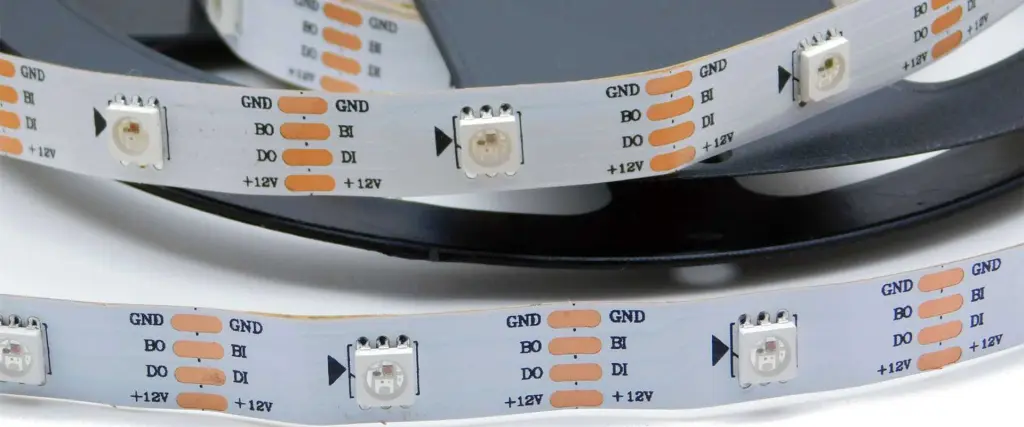
WS2812B LED strips consist of a flexible printed circuit board onto which surface mount RGB LEDs and WS2812B control ICs are soldered. The WS2812B is a smart LED driver chip that enables independent control of each RGB LED module on the strip.
Some key features of WS2812B LED strips:
Integrated control circuit, LED driver and RGB chip in each LED module
Individually addressable – each LED controllable separately
PWM (pulse width modulation) dimming capability
Dense packaging – 30 to 144 LEDs per meter
Flexible form factor – can bend to desired shapes
Simple digital interface using one data line
5V DC operation with data signal levels of 0.35V LOW / 0.7V HIGH
Built-in constant current regulators for uniform brightness
Fast data transmission – 2Mbps protocol speed
Chaining capability – connect strips together into longer runs
WS2812B strips are available in different LED quantity densities to suit lighting needs. Common options are 30, 60, and 144 LEDs per meter. Longer strip lengths can be created by connecting strips using soldering or connectors.
WS2812B strips work well in LED matrix displays, wearable lighting, RGB light shows, and anywhere addressable color changing illumination is desired.
Overview of WS2813 LED Strips
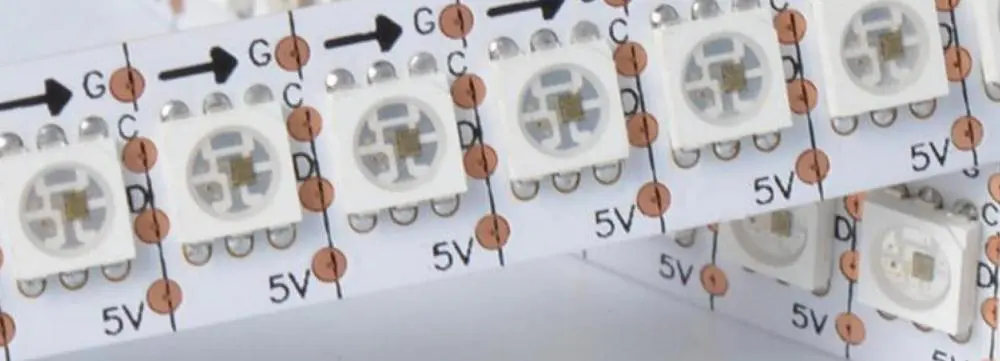
The WS2813 is another integrated LED driver chip that enables individual pixel control. WS2813 LED strips share the same basic architecture as WS2812B strips with the LED driver, chip, and RGB module in each LED.
Key characteristics of WS2813 LED strips include:
Integrates control circuit, LED driver and RGB chip per LED
Individually addressable pixels
Similar data transmission protocol to WS2812B
PWM dimming capability
Built-in constant current output per LED
5V DC power input
Data signal voltage levels of 0-0.4V LOW / 2.5-5V HIGH
Densities from 30 to 240 LEDs per meter
Flexible form factor for bending into shapes
Chaining capability – connect strips together
The WS2813 builds on the capabilities of the WS2812B while enhancing some performance and reliability aspects. We will delve into the differences in more detail later in this article.
Applications of WS2813 LED Strips
The applications of WS2813 LED strips largely overlap with WS2812B uses since their architectures are quite similar. Typical uses include:
While the WS2812B and WS2813 are comparable in many respects, there are some noteworthy differences that impact the performance, control, and reliability of the LED strips:
1. Transmission Reliability
The WS2813 incorporates enhancements that greatly improve the transmission reliability and signal integrity. This allows for longer run lengths of LED strips on a single data link with fewer issues. WS2812B data signals are more prone to degradation and errors over long distances or strips with many LEDs.
2. Refresh Rate
The WS2813 doubles the LED refresh rate to 2-4 kHz versus 1.2 kHz for the WS2812B. The faster rate reduces flicker and improves the perceived dynamic lighting performance.
3. ESD Protection
Built-in ESD (electrostatic discharge) protection is stronger on the WS2813. This makes it more robust against static electricity spikes and events. The WS2812B has basic ESD protection.
4. LED Density
WS2813 strips can have up to 240 LEDs per meter versus 144 with WS2812B. The higher density provides options for tighter lighting effects. But density above 144 can present signal transmission challenges.
5. Control Logic Levels
The signal level logic interfaces differ slightly. WS2813 uses 2.5-5V for HIGH versus 0.7V for the WS2812B. And 0-0.4V for LOW versus 0.35V with WS2812B. This allows for better noise immunity.
6. UL Approval
The WS2813 has undergone UL testing and certification while the WS2812B is not UL certified. This is required for use in some lighting fixtures.
7. Operating Temperature
WS2813 specifies a slightly wider operating temperature range from -30°C to 60°C compared to -25°C to 60°C for the WS2812B.
Control Interface Comparison
Both WS2812B and WS2813 provide a simple single-wire interface for LED control but there are some subtle differences:
WS2812B Interface
Single data line for control signal (DATA)
5V DC power input (VCC)
Ground connection (GND)
WS2813 Interface
Single data line (CI)
5V DC power (VCC)
Ground connection (GND)
Optional CLOCK signal can be used but is usually left disconnected
So while pinouts are essentially the same, the WS2813 can support a CLOCK signal for timing whereas the WS2812B uses a self-clocking data method. The clock can help improve synchronization but is not required.
In both cases, the data line connects from the LED driver to the data input pin on the first LED. The data output then damps to the next LED input down the strip. This daisy-chain method allows the LED driver to address each LED through its serial data transmission.
LED Strip Lighting Control Options
There are several options for controlling WS2812B and WS2813 LED strips to digitally set the color, effects, and animation:
LED Controller
Dedicated LED controller modules provide control interfaces like buttons, knobs, touchscreens, or mobile apps to set lighting patterns, colors, motion and effects. Can control multiple strips over long distances.
Microcontroller
Small programmable devices like Arduino or Raspberry Pi can be programmed to autonomously control the LEDs. Requires coding skills.
Lighting Software
PC lighting control software like MADRIX can send the LED control data signal through USB output devices. Enables synchronized lighting shows and effects.
DMX Lighting Control
Using a DMX512 converter allows professional lighting consoles to control the LEDs through standard DMX protocol. Integrates with stage lighting systems.
Smart Home Systems
LED strips can be incorporated into smart home automation systems and voice assistants for app and voice-controlled lighting. Requires compatible LED controllers.
So there are possibilities ranging from stand-alone manual control to fully customizable color changing lighting shows and integration with other smart systems.
Power Supply Considerations
When working with addressable LED strips, the power supply is an important consideration. A sufficiently rated, quality power supply is recommended to operate WS2812B or W2813 strips.
Some guidance on selecting LED strip power supplies:
Strips require a 5V DC supply. Avoid AC power which could damage them.
Power supply wattage must meet the load. Calculate load as:Number of LEDs x 60mA x 5V
For longer strips, inject power at intervals to avoid voltage drop.
Build in a 20% buffer above calculated load wattage.
Use switched mode power supplies, not linear transformers.
Select power supplies with overcurrent, short circuit and over temperature protection.
Mean Well, HLG, or trusted brands recommended. Avoid cheap, generic power supplies.
Proper power supply selection and connection helps ensure reliable, long-life operation of the LEDs. Undervoltage or overcurrent can reduce LED life span or cause failures.
Comparing WS2812B vs WS2813 for LED Projects
When choosing between using WS2812B and WS2813 LED strips, here are some factors to consider:
Lighting Effects
If limited lighting effects are needed like simple color changes, WS2812B may suffice. For more complex effects and longer runs, WS2813 is preferable.
Run Length
For short strip runs like 1-2 meters, either will work well. For longer runs or many LEDs, WS2813 has advantages.
Environment
For outdoor or wet locations, the WS2813’s improved transmission reliability helps. WS2812B best for indoor and dry areas.
Price
WS2812B strips tend to cost slightly less than comparable WS2813 strips.
Controller Interface
If the controller provides clock synchronization, WS2813 can leverage this. If not, either will function.
Certifications
For UL certified installations, WS2813 is likely required. WS2812B only has basic CE and RoHS certification.
Let’s examine the relative pros and cons of WS2812B and WS2813 LED strips:
WS2812B Pros
Widely available and cost effective
Proven reliability in most indoor uses
Simple data only interface
Flexible and great for hobbyist projects
WS2812B Cons
Limited transmission reliability over long distances
Noisy data signal degrades quality over long runs
Lower refresh rate leads to some visible flicker
Lacks UL certification for fixture integration
WS2813 Pros
Enhanced data transmission reliability
Higher refresh rate reduces flicker
Integrated clock line option for better synchronization
UL certified for commercial and fixture use
WS2813 Cons
Slightly more expensive than WS2812B
High LED density can worsen signal transmission
Overkill for simple, short-length uses
Conclusion
In summary, while WS2812B and WS2813 LED strips are based on very similar integrated LED driver technology, the WS2813 builds on the foundation capabilities to provide better lighting performance, transmission reliability, noise immunity and certifications.
For many simple LED projects, the lower cost WS2812B is likely sufficient. But for professional installations or more demanding lighting effects, the WS2813 represents a worthwhile upgrade. When planning any addressable LED strip lighting project, carefully consider the length, environment, effects needed, regulations, and available control interfaces to select the appropriate option between quality WS2812B and WS2813 LED strips.
FAQ
1. What are some typical densities and lengths available for WS2812B and WS2813 LED strips?
Typical LED strip options:
Densities: 30, 60, 144 LEDs per meter
WS2813 also available in 240 LEDs/m
Lengths: 5 meters, 10 meters spools
Can be cut and connected to desired length
2. What gauge wire is recommended for connecting power to WS2812B or WS2813 LED strips?
Recommended wiring gauge for power connections:
5 meters or less – 20 AWG
5-10 meters – 18 AWG
10-15 meters – 16 AWG
A thicker gauge helps avoid voltage drops over long cable runs. Separate power injection at intervals may also be needed.
3. What types of controllers can be used to control WS2812B and WS2813 LED strips?
Compatible control options:
Dedicated LED controllers with digital output
Microcontrollers like Arduino, Raspberry Pi
PC lighting software and DMX controllers
Smart home automation controllers
Bluetooth or Wifi controllers with app interface
4. What technical skills are needed to work with addressable LED strips?
If you’re looking for the best high-speed and low-loss PCBs, look no further than Nelco. They offer a diverse range of high-performance fiber optic connectivity solutions available to all industries. In addition, they are tough enough to handle anything from harsh chemical environments to extreme thermal conditions. Let’s explore how this product can help you with your business in more detail.
In theory, the only “low loss” products you should be choosing are those constructed with a “low-loss” plastic material comprised of an Inorganic Polymer or a Low Loss Plastic. However, these exotic materials also come at a high price. If you can get by with something less expensive, you need to know there is nothing wrong with choosing a product made from standard clear plastic. It’s still the best choice for fiber optic applications.
Nelco’s “low-loss” plastic has an Inorganic Polymer core that gives it the characteristics of both a low loss and high-speed plastic. It is also highly durable and completely transparent, with the same bend radius required for fiber optic applications. So, your end product will look great, and you can be confident knowing it will perform in any environment you put it into.
Nelco N4000-12 High Speed/Low Loss Laminated Cables Review
The Nelco N4000-12PCB has an outer plastic shell machined from a solid block of high-quality polycarbonate. These are the characteristics that make it an Inorganic Polymer product. This plastic is the same as the stock plastic used in fiber optic LED systems from a transparent perspective. Compared to other plastics, such as ABS, PP, and PC, these materials have similar optical properties.
Clear polycarbonate (PC) is a thermoplastic that is highly impact-resistant, scratch-resistant, and optically clear. Although the most common use of polycarbonate is in bulletproof glass, it has many other uses. These include enclosures for computers, cell phones, and TVs; bottles for sports drinks; medical testing tubes; pens and light bulbs. Polycarbonate can also be injection molded into almost any shape you can imagine.
Nelco N4000-12PCB High Speed/Low Loss PCB is a standard product, ideal for fiber optic applications. This is because it offers the same qualities as many of the fiber optic connectors on the market today and is available at an economical price.
The Nelco N4000-12PCB comes in various sizes and offers numerous combinations of core diameters and outer diameters. These are fully compatible with industry standards, and all the necessary products are available to provide you with everything you need for a successful installation.
The Nelco N4000-12PCB can endure harsh chemical environments and extreme thermal conditions. As a result, we can use it in fiber optic modules, fiber optic light sources, fiber optic power supplies, and fiber optic test systems. This makes it ideal for Rayming PCB & Assembly services that require quick delivery times and rugged handling of delicate products.
The Nelco N4000-12 High Speed / Low Loss Laminates have excellent mechanical and electrical properties. They provide excellent thermal stability and excellent signal speed. They are ideal for RF and digital applications. The laminates are chemically desmear compatible, which reduces the chances of corrosion. A comprehensive review of its features and benefits will help you decide on the best material for your needs.
The Nelco N4000-12 High Speed /Low Loss Laminated Cables enable your engineers to create more reliable and durable designs. With excellent mechanical properties, the Nelco N4000-12 is an excellent choice for various PCB assembly projects. These laminates also feature a low CAF, excellent thermal stability, and excellent signal speed.
The Nelco N4000-12 High Speed /Low Loss Cables have a unique epoxy resin system that provides outstanding mechanical properties. This laminate is suitable for PCB applications requiring high signal and low loss. They also provide excellent signal speed and reliability. In addition, they are ideal for the manufacturing of PCB assemblies.
The electrical and thermal properties
The properties of the Nelco N4000-12 Laminate are among the most important considerations for the materials. These materials exhibit excellent CAF resistance, and the Z-CTE is lower. They are also compatible with a wide range of RF and digital applications. Lastly, Nelco N4000-12 laminates exhibit high electrical performance.
The N4000-12 high-speed/low-loss laminates consist of epoxy resin systems. They offer excellent thermal and CAF resistance. High-speed and low-loss applications characterize them. Moreover, they have high-speed/low-loss characteristics and are suitable for any multilayer printed circuit board.
The thickness of Nelco N4000-12 laminates varies. Therefore, it can be customized but must conform to the range allowed by the manufacturer. This PCB is a multilayer high-reliability material with excellent thermal and mechanical performance. The Nelco N4000-12 is a flexible, low-loss laminate with a glass transition temperature of 240 degrees centigrade.
N4000-12 laminates can withstand high-reflow temperatures and reflow temperatures. As a result, they are helpful in various high-reliability electronic components, including power supplies and telephony. If you’re planning to use this high-speed/low-loss laminate, specify its surface finish.
Among the advantages of Nelco N4000-12, High-Speed Low Loss PCBs are highly durable and can withstand varying temperatures. Moreover, these laminates are suitable for harsh environments. In addition, they have high signal speed and high thermal stability, and we can customize them with specific information and details. This is a unique feature that sets these products apart from other PCBs.
Among the benefits of the Nelco N4000-12, High-Speed Low Loss PCBs are the high thermal stability, wide bandwidth, and ruggedness. They are suitable for use in assemblies with high reflow temperatures while providing superior reliability. They are also highly customizable, and we can use them for various high-speed applications.
The Nelco N4000-12 High-Speed Low Loss PCBs are suitable for high-speed, low-loss applications. The material is excellent for various PCB materials and is CAF resistant. Compared to other PCB materials, this material offers excellent versatility and performance. The advantages of this laminate will make it a preferred choice for many manufacturers.
Tips for Selecting a Material
If you are designing a board that operates at a higher frequency, you must select materials that withstand high temperatures. For high-frequency applications, high-performance epoxies are a necessity. However, these materials have drawbacks, such as limited processability and poor thermomechanical properties. The following tips will help you select material for your board.
As with all PCB materials, high-speed/low-loss PCBs require various materials. The N4000-12 series is an enhanced epoxy resin material. It is excellent for communications, automotive, and other industries. The high-speed/low-loss PCBA has a high-reliability dielectric constant. In addition, the heat-resistant, CAF-resistant, and lead-free characteristics make it an excellent option for PCB applications.
Choose the proper material for your PCB. The best material is compatible with your PCB. For example, if you build a high-speed, low-loss PCB, you can use the Nelco N4000-12 high-speed/low-loss multilayer. Regardless of the type of PCB, it is possible to choose a suitable material for your application.
A printed circuit board uses a battery as its main power source. Capacitors store electrical charges. By choosing a Nelco N4000-12 High-Speed/Low-Loss material, you will avoid the need to worry about lead. In addition, this PCB material will last longer and resist heat.
Printed circuit boards consist of multiple layers. To get the best performance, you must choose a material with the best dielectric constants. Depending on the type of PCB, you can also choose different types of materials. The best way to choose the right material for your project is to know your requirements. So, first, you should know what the materials you need are.
Conclusion
The Nelco N4000-12PCB is perfect for making high-speed and low-loss boards to meet your optical networking needs. In addition to these attributes, it is also transparent and has the same bend radius as fiber optic cable. This means you can place it into any fiber optic or copper PCB without worrying about damaging the surface.
There are some specifications an engineer must consider when using Isola A11 PCB material. These specifications have to do with the properties of this prepreg material. Well, Isola A11 is a class of prepreg with low flow. This is a prepreg system one can apply to a cavity board.
So, in this article our area of concentration deals with properties of Isola A11 a designer should focus on when choosing a no-flow material like this. Also, note that this material has exceptional bonding strength on different surfaces. This material is great for industrial applications.
What Properties Should You Check Out For When Choosing Isola A11 PCB Material?
It is proper to check out for some properties when using this prepreg material. Below are important one’s to consider.
Electrical Properties
This is no child’s play when choosing this prepreg material. It is one of the safest things to do at all times. When considering its electrical properties, you are examining how best this material always reacts to the electric field. By this, you get to know if it is safe to expose it or not to the electric field.
Chemical Properties
In addition, this is another factor to consider at all times. Every laminate material has reactions to chemical elements. Basically, one thing you check out for here is change modification that may occur from exposure to chemical elements. Incase of any chemical reaction, some features of this material are probably going to change.
Thermal Properties
So, you can’t avoid this specification when choosing Isola A11 PCB material. The thermal property involves how this prepreg material reacts to varying degrees of temperature ranges. Therefore, you should observe features that are liable to modify after exposure to temperature ranges.
Physical Properties
Meanwhile, the physical properties are as important as other properties of Isola A11. This is a considerable property because designers must know both intensive and extensive components that measure with no necessary modification or alteration of chemical identity.
Mechanical Properties
Sometimes, some engineers ignore the mechanical components of Isola A11. This is a specification that studies features that change as a result of force application on this material. Note that some physical properties tend to change when one applies force on this material. The modification is after the force exertion on this prepreg system.
What Possible Challenges Can You Face When Choosing Isola A11 PCB Material?
Similarly, like other PCB material, it is no exception that Isola A11 comes with some challenges. In a way, these challenges affect how designers, fabricators, and engineers may have access to this resin system.
Cost
There is no doubt that this prepreg system may be expensive. Although there are different price ranges for each PCB material. However, the better quality you want, the more the cost.
The reason for the high cost of this material is because of how hard it is seeming to produce it. A lot goes into manufacturing this prepreg material with standard laminate surfaces. Although one may likely purchase Isola A11 material at varying prices.
Another determinant of how costly this material may be is the quantity. If one wants many quantities, it definitely affects the cost of production. With quantity and quality in consideration, the cost will be higher.
Availability
This is one of the limitations to how you get the supply of Isola A11. It is not an easy ride to get this PCB material. This is so because of how hard it is to manufacture. Although one can have access to it but depends on how much effort you are ready to put into production.
Difficulty in Production
This is one of the challenges an engineer may experience whilst trying to fabricate this material. Just with other PCB materials, one can experience difficulties producing them. However, the designs of Isola A11 may be simple and this prepreg has versatile functionality.
Is Isola A11 PCB Material Environmentally Friendly?
This is one issue with some prepreg systems. Some could be toxic to the environment because of the nature of materials used in the manufacturing process.
However, this material is environmentally friendly. This is so because of the non-toxic processing and materials used for production. It is a guarantee that when you use this kind of material, there is no pollution it emits into the environment. Therefore, the Isola A11 has healthy material for production.
Thus, that is why this prepreg is compatible with any lead free material. In other words, the kind of material it uses is lead free.
Apart from being environmentally friendly, this is a material that withstands harsh environmental factors. Note that it doesn’t emit toxic chemicals but it can resist harsh weather.
So, this is why many designers always prefer using this material. Isola A11 high performance is not affected by moisture, increased temperature, heat, UV radiation, and rain.
Isola A11 PCB material is also the type that is waterproof. This implies that it has just low water absorption. This is a good feature because it doesn’t allow water to be a barrier to its high performance. Therefore, Isola A11 PCB material is the type that is waterproof and weather resistant.
What are the Advantages of Choosing Isola A11 PCB Material?
No doubt, there are benefits engineers enjoy when using this kind of Isola material. Let us consider some of these benefits.
Optimal Performance
This is a prepreg system that works optimally in multilayer applications. As such, they are rigid-flex prepreg materials. They help rapid processing mode in various applications.
Durability
This is so because of the kind of materials used in production. Every material can make a prepreg system last long or not. However, this lead free Isola A11 PCB material uses materials that make it durable.
Customization
Interestingly, you can customize this material to your taste. This is one advantage with using Isola A11. There are different designs one can choose from and each is unique.
Conclusion
Isola A11 is a very strong PCB material that is weather resistant, durable, and waterproof. It has some properties one must check out for when choosing it. Note that these properties work together. You must check all these specifications together. Furthermore, the mechanical properties can affect the functionality of other properties. That is why you don’t ignore any of the properties.
Taconic commits to supplying best-in-class materials. They will ensure the success of your next board design. To optimize your design, review the general processing guidelines for NF-30L. They have lower costs and ease of processing in high-volume automated manufacturing equipment.
NF-30L is a high-purity FR4 material. It has a high dielectric constant (k) of 3.1 and good resistance to excessive moisture and oxide. Its higher conductivity also lowers the board manufacturing cost. We reduce the number of plated through holes (HT), reducing the final unit cost. In addition, NF-30L conducts electricity between the metallization and the traces. These characteristics reduce the likelihood of shorts and opening during board validation.
NF-30L has a plated metal finish that is resistant to moisture and oxidization. The resistance to oxidation and moisture helps to reduce solder mask breakdown. However, it can compromise adhesion between the metal and your board.
NF-30L is RoHS compliant. It meets the specifications of the European Union’s Restriction of Hazardous Substances directive. It does not contain any restricted substances. Taconic encourages you to use safer materials for your next board design. Low Hazardous Substances NF-30L has a low greatest density of 1%. So, it meets the European Union’s Restriction of Hazardous Substances directive (RoHS). That directive came to play in 2003 to replace the more complex and hazardous RoHS. RoHS aims to reduce the use of hazardous substances in consumer products.
2. High Surface-Area
NF-30L has a higher surface area than most other plastic materials. This key feature of the material enables excellent etch and dry shave performance. It also yields significant savings in board manufacturing costs. You do this by reducing the number of plated through holes (HT).
3. Good Conductivity
NF-30L is a better conductor than most other plastic materials. It has an electrical conductivity of over 1000 S/m. This improves board manufacturing costs. So, it does this by lowering the number of plated through holes (HT) and reducing the solder required.
4. Excellent Solderability & Connectivity
NF-30L has high thermal conductivity. It is an excellent solderable material with excellent wetting properties. This means we can solder it. It allows for solder mask and stencil functionality without an interlayer dielectric. In turn, it improves thermal performance.
NF-30L is available in 50 kg and 100 kg nominal containers. Additionally, it has a 90% metal finish and a dielectric constant of 3.1.
5. Low-Temperature Processing
NF-30L does not have the typical low-temperature processing requirements for metal trace plating. Therefore, we often process it at room temperature. This allows NF-30L to be more cost-effective. It lowers material costs per metallization level. It also reduces heat-related onsite environmental contamination risks.
6. Heat Resistance
NF-30L has high thermal and electrical conductivity. Its high dielectric constant enables it to maintain consistent performance. It happens when exposed to heat. So, we can process NF-30L at temperatures as low as 50 degrees Celsius. It reduces material costs and onsite processing time. The feature is especially beneficial in processing tools. Such is a situation where immersion coolants achieve lower temperatures rather than air cooling.
7. Acid Resistance
NF-30L has excellent corrosion resistance to acids, such as phosphoric and hydrofluoric acid. This property ensures a lack of corrosion in the electronics industry. It is due to companies’ use of films on printed circuit boards. These companies manufacture semiconductors, microprocessors, memory, and other electronic products.
8. Thickness & Weight Reduction
NF-30L is one of the thinnest FR4 materials available. Its thicknesses are down to 0.1 mm while maintaining good strength and high resistivity. This feature is beneficial to companies that use automated PCB manufacturing equipment. It makes NF-30L compatible with most automated synthesis systems.
9. Environmentally Friendly
NF-30L is a used environmentally friendly material. It has a low environmental impact. We can manufacture it without using dangerous metal. They include metal alloys, polymers, solvents, or other toxic chemicals. NF-30L features an average density of 0.91 and a maximum density of 1%, which is much lower than other materials.
10. Cost-Effective
NF-30L features a high dielectric constant (k) and low thermal expansion coefficient. It can save you valuable time, labor, energy, and costs for your product. As a result, these lower costs may enable you to develop new products. It helps to meet the demands of particular markets or end-users.
Taconic has two product lines. One for surface mount and one for through-hole metallization. Taconic’s plastics are available in both extruded and injection molded formats.
Taconic has been developing several new materials since its foundation in 1960. RayMing PCB and Assembly are designing these materials to meet the demands of new markets. They also use it for new applications and technologies. These include:
1. UL94-HB:
It is a polymer material resistant to abrasion, impact, and chemicals. It has a large tensile strength (18 MPa) and exceptional chemical resistance. UL94-HB has a dielectric constant of 3.5 at 300 °C.
2. LLDPE:
This high-performance polyethylene is linear low-density polyethylene (LLDPE). LLDPE has high surge performance, good impact resistance, and good heat sealability. It also retains flexibility after heat treatment and aging.
3. ETFE:
This material has high chemical resistance and excellent electrical, mechanical, and thermal properties. This product is best suited for semiconductor electronics, LED displays, and semiconductor packaging.
4. Acrylic:
We mold or extrude a family of transparent plastics with good impact strength. They also have a high light transmission combined with low processing costs. Acrylic meets the demand for acrylic sheets (PC sheets). We use it in automotive applications and protective films for various devices. They include LCDs, inkjet printers, and other devices.
5. UL94-VO:
This material replaces PVC due to its superior fire-retardant properties and lower emissions. It also has a low density and excellent thermal conductivity. UL94-VO meets the European and North American environmental standards for electronic applications.
6. Cross-Linked Polyolefin (XLPO):
It is nylon-like material with high physical strength, dimensional stability, and dielectric properties. It is suitable for a wide range of applications. They range from wire & cable insulation to hoses and harnesses. XLPO has a high heat distortion temperature (140 °C), and aging, light, and temperature does not affect it.
The processing temperature of Taconic NF-30L PCB is generally lower than other materials. So, it can be mass-transferred during the process, and the temperature is not high. Do not press hard on the product to avoid damaging the components. Instead, put it down on a flat surface to transfer or pick up. Taconic NF30L is a high-performance resin. It poses no human health risk when handled following good industrial hygiene practices. You should follow applicable governmental regulations. However, Taconic NF-30L can generate high levels of dust. They mostly come during cutting, milling, drilling, or sanding.
Prevent contaminant deposits on the material or copper:
Do not handle Taconic NF-30L PCB during the cutting, milling, or drilling operation.
If a contaminant deposit forms on Taconic NF-30L PCB during ordinary use, start by wiping it away with a clean cloth. Then wear proper personal protective equipment. Finally, disinfect the area with appropriate chemical or mechanical means.
Avoid processing Taconic NF-30L PCB while wearing clothing with dark or non-white colors.
Avoid contaminating Taconic NF-30L PCB by touching other items or materials. Also, be sure to avoid those made from a different material.
When processing Taconic NF-30L PCB, use a vacuum cleaner to clean up dust and contaminate. It is dust that may become airborne in application. Also, ensure sanitization during transportation, storage, and handling operations.
Do not stack panels on top of each other:
Avoid stacking Taconic NF-30L PCB on top of each other for storage or transportation.
Use a wooden pallet board or similar device to stabilize. Protect Taconic NF-30L PCB during handling, stack, and storage.
Do not expose to heat:
We use Taconic NF-30L PCB in the semiconductor industry. It requires operating temperatures well above room temperature.
Do not pick up a panel by one edge:
To avoid damage to the PCB, do not pick up a panel by one edge.
Instead, use a clean cloth to pick up the panel and carry it to the work area for processing.
Avoid mechanical scrubbing:
Do not use a scrubbing brush or sharp instrument to clean Taconic NF-30L PCB.
Avoid mechanical scrubbing of Taconic NF-30L PCB, damaging its surface.
Scrub the PCB using soft cloths and warm water, or use soapy water to wash it.
Dry the panel’s surface completely before processing it or re-use it in other work areas.
Taconic materials are helpful in various industrial applications. Some examples include consumer electronics, automotive, and Telecom. We also use them in the semiconductor manufacturing industry. They assemble liquid crystal displays. We often use them as repair materials or parts of machines or equipment that need special care.
Aerospace Components:
The aerospace industry uses PCBs made with Taconic’s high-performance materials. They are famous for their excellent electrical and mechanical properties. Taconic’s PCB materials are valuable for the electronics industry. They are helpful in several avionic applications. They include plane navigation systems, control systems, and flight deck instruments.
Toxicological Testing:
Taconic’s end-user toxicity testing program utilizes several PCBs and related chemicals produced. Manufacturers design the testing to meet international standards.
Edible Food Packaging:
Taconic is an OEM supplier to companies. It produces packaging for food products such as fruit juices and sports drinks. Taconic also supplies trays, pots, blister packs, and other packaging for food products.
Automotive Radar Sensors:
One of Taconic’s known customers manufactures automotive radar sensors. They integrate Taconic’s plastic materials into the product. The application is helpful in automobiles to detect impending collisions. It is one of the first applications of this type of technology.
Conclusion
NF-30L is a high-purity FR4 material. It has a high dielectric constant (k) of 3.1 and good resistance to excessive moisture and oxide. Its higher conductivity also lowers the board manufacturing cost. It does this by reducing the number of plated through holes (HT). This reduces the final cost per unit or other materials available at Taconic.
Are you looking for a company that provides solutions to your PCB assembly needs? We are an organization that specializes in PCB assembly. With us, you will get a quality product at the best price. We meet all your requirements, including timely delivery and excellent customer care. When it comes to acme PCB Assembly, we are the best place for you to get your product in a timely manner.
We provide a wide range of services to meet all your needs. We have been in the industry for many years, and we always deliver excellent services when it comes to PCB assembly. You will get the best quality product on time when you place an order with us. Our PCB assembly is cheap and affordable. We have a team of well-trained individuals who are ready to meet your need at any time.
What is the Production Process?
Before starting the production, we check all the requirements to meet your needs. Our qualified and experienced personnel can always help you design new graphics or boards for your company. We will tailor a custom PCB assembly according to your specification. The product is well-designed, making it easy to integrate with other components.
We are always ready to take on any challenge regarding PCB assembly in your company. As a result, you will get good quality electric and electronic products at affordable prices. We have a team of well-trained personnel ready to meet all your demands. They are always ready to help you with the product. Our PCB assembly is reliable and always offers you high-quality sound and design.
Our service goes beyond just providing our standard PCB assembly. We also provide special services, which will make your product distinctive. The product will have the latest and advanced technology when you buy our products. In addition, our products are well made and come with attractive designs, which makes them attractive to the public.
The acme PCB assembly is a process that aims to produce electronic circuits. This process involves using assembled circuit boards and electronic components to make a complete circuit.
The acme assembly process starts with an engineer or designer coming up with design and layout of the circuit board. After this phase, the expert will send it to a manufacturing company like Rayming PCB & Assembly for fabrication. The manufacturing company will then send an electronic schematic to the engineer or designer with all the components identified for placement on the board.
The next step is routing, which involves connecting all these components on the board using copper wire solder points, metal edge connectors, and metal posts. When this stage is complete, it creates a physical map for how to achieve the placement of the components on the board.
After this, the next step is to solder all of these components to their final destination and then test to ensure that all connections are correct. Once this is done successfully, it will cause the board and the finished circuit to work. The step that follows in this process is quality control testing, which ensures that all connections have been successfully soldered without any defects and can withstand large amounts of heat without harming any of the internal electronic parts.
Finally, we come to the packaging of the acme PCB assembly. This means putting everything into a nice casing to protect it. This step enhances the aesthetics and quality of your product to appeal to as many customers as possible. Next, one must label the board with all necessary information, such as the brand, model number, and part number.
High-Quality PCB Assembly
PCB Assembly is a subproject in the Electronic device. It is a process that includes making sure the correct usage of right components and appropriately place them on a circuit board. The “Right components” are the ones that are most appropriate for the application, and they must be made according to the drawing or specifications provided. PCB Assembly provides PCBs with proper design and placement, which increases the reliability of finished products of electronic devices. Therefore, PCB Assembly is an important process in developing electronic devices.
In the past years, PCB Assembly has been the core of many electronic products. The main idea of PCB Assembly is to ensure that you properly make all circuit connections, and there are no loose or missing components. Moreover, if there are any human-caused defects, such as broken circuits or missing components, we correct them before passing down the assembly line.
BGA is an acronym for Ball Grid Array. It is a type of interconnection technology. BGA assembly is a method of making electrical connections between the components on a printed circuit board that uses resizable balls. It places the components together in order of their size and wire latches to hold them in place while they undergo the soldering process. You can easily change BGA parts since the holes they pass through are soldered and reflowed into place. BGA parts are usually present on the motherboard of personal computers.
Another type of PCBA assembly is the socketed assembly we apply in some systems such as handheld computers and game consoles to plug non-standard ICs into. In this case, the socket is not a part of the finished PCB assembly.
PCBA is good for customizing components and boards because it allows for easy replacement of parts or modifications. This can be useful when one needs to install different types of memory or other electronic parts. It is also a common way to incorporate certain features into a device. For example, in the case of a computer, the motherboard may include an audio card that allows the motherboard to have Windows Media Player or another audio program installed.
Conclusion
The best way to ensure that you are getting a good acme PCB assembly is to use a company with years of experience in this field. Nothing can stand in your way of success when you have the right products and services at your disposal. This way, your product will be unique and have the edge over competing products in the market.
Semiconductors have been nothing but a blessing for every electronic circuit. They have taken electronics to a whole new level, and acme PCB assembly is one of the best ways to take advantage of this technology. So whether it is for your home or business, you will get a quality product when you buy from us. Since we have a team of well-trained specialists, we can help you make any changes necessary for your product.
We have been in this industry for many years and can offer you excellent customized services according to your needs. Our services are always reliable, and customers get the best solutions to their needs. We take pride in our products because we ensure our customers will only receive the best quality PCB assembly. The acme PCB Assembly is very competitive in pricing and is worth every penny.
Arlon has successfully taken over the PCB material industry. This company keeps providing high-quality and high-performance PCB materials. This article focuses on providing more information about Arlon 84N PCB material.
What is Arlon 84N PCB Material?
Arlon 84N PCB Material is a ceramic-filled polyimideprepreg. This PCB material is designed based on Arlon 85N. Therefore, PCB manufacturers use it to fill etched area in multilayers with thick copper layers. Also, Arlon 84N is ideal for filling clearance holes in metal cores. This polyimide compound minimizes shrinkage. Also, it reduces cracking during through-hole drilling in already filled clearance areas.
In addition, this polyimide prepreg meets IPC-4101/40 and /41 requirements. Arlon 84N is a pure polyimide and prepreg system that is free of halogen components. This PCB material offers exceptional thermal stability for applications with high temperatures. Also, it is compatible with lead-free soldering applications. Arlon 84N PCB material features no epoxy.
The peel strength of this material is 7.1 (1.2) ib/in (N/mm) after thermal stress. However, this value still remains the same after process solutions and at increased temperatures.
The dielectric constant of Arlon 84N is 4.2 at 1MHz. At 1 GHz, this value is 4.0.
The electrical strength of this material is 1451 (57.1) volts/mil (kV/mm).
The dissipation factor of Arlon 84N at 1 MHz is 0.01. This value is very low. Therefore, Arlon 84N PCB material is a good insulator system.
The surface resistivity is 1.6 x 10⁸ at C96/35/90. This value is 1.6 x 10⁸ when it is at E24/125.
Thermal property
Arlon 84N PCB material features a very high Tg. The glass transition temperature is above 250 degrees Celsius.
The decomposition temperature of this material is 387 degrees Celsius. However, at 5% weight loss, the Td value is 407 degrees Celsius.
The Z-axis CTE is 48 ppmo/C before Tg. This value increases to 150 ppmo/C after Tg. Also, the Z-axis expansion between 50 to 260 degrees Celsius is 1.0%.
Arlon 84N PCB material is ideal for filling etched areas in clearance holes and copper layers. Therefore, the high flow of resin flows into the holes. Also, the exact pressed thickness of the glass and resin left after flow into the holes vary. This varies based on the holes density you need to fill. Also, it ensures great effectiveness. You can use two piles of Arlon 84N on each side of the material you need to fill.
The pressed thickness of 84N varies based on the thickness and amount of inner copper layers. Also, the Ho value is always the theoretical thickness when there is no fill or flow of inner layer copper. Arlon 84N PCB material minimizes resin content to offer a low pressed thickness.
For the lamination cycle, the pre-vacuum should last for 30-45 minutes.
Also regulate the heat to 4.5 – 6.5 degrees Celsius per minute between 100 and 150 degrees Celsius. Therefore, vacuum lamination is advisable.
The cure temperature settings should be at 218 degrees Celsius. Also begin the cure time when the temperature of the product is above 213 degrees Celsius.
The temperature cure time should be 120 minutes.
Use alkaline permanganate for desmearing. Also, you can use plasma desmear with settings ideal for polyimide. However, plasma is highly recommended to achieve positive etchback. Also, 84N is highly compatible with conventional plating processes.
Arlon 84N PCB material has several benefits. Also, the best prepreg system is one that performs efficiently in PCB fabrication. This material is one of the best prepreg systems for filling etched areas in multilayer boards.
Industry recognition
Arlon 84N PCB material meets the specification and description of some industry standards. For instance, this PCB material meets IPC 4101/40 and 4101/41 requirements. Also, Arlon 84N meets WEEE/RoHS standards.
Halogen-free chemistry
This material doesn’t have any halogen components. Also, it is completely free of toxic substances. Therefore, it is highly recommended for use in PCB fabrication.
Exceptional thermal properties
This material features great thermal properties that contribute to its functionality. The high Td value and Tg value contribute to its thermal resistance. Also, it has got exceptional heat resistance.
Low Z-axis expansion
The Z-axis expansion of Arlon 84N is very low. Therefore, this reduces PTH defects risks that result from solder reflow.
Exceptional performance
Arlon 84N PCB material doesn’t only feature best-in-class thermal characteristics. Also, this material features exceptional electrical and mechanical properties. For instance, Arlon 84N features a low dissipation factor. The peel strength of this material is also very high. All of these properties are responsible for Arlon 84N’s performance.
Lead-free processing compatibility
This is another benefit you get to enjoy when you integrate Arlon 84N in your PCB. Arlon 84N PCB material is very compatible with lead-free processing.
Resin fracturing resistance
Arlon 84N PCB material resists resin fracturing due to the toughened chemistry. Therefore, this helps to strengthen the resin.
The automotive and transportation industries use this PCB material. For instance, Arlon 84 is available in under-hood automotive controls.
Aerospace and defense
The devices used in these industries are most times exposed to long term high temperatures. For instance, Arlon 84N is ideal for use in designing aircraft engine instrumentation. Also, this PCB material offers great thermal performance. Therefore, this makes it a reliable option in these industries.
Industrial system
Arlon 84N PCB material is widely used in designing devices used in industries. For instance, you will find this material in industrial sensors. Also, this material is safe for industrial devices since it features no halogen.
Conclusion
This article has been able to provide vital information about Arlon 84N PCB material. Also, it discusses how this material impacts the PCB industry.
Every PCB engineer and manufacturer wants to use the best PCB materials and polyimide prepregs to meet their PCB needs.
In this article we will be discussing the Arlon 84HP PCB Material. This is very similar to the Arlon 85HP PCB Material. However, we will be discussing the properties of the Arlon 84HP, as well as the features of this high-performance material.
Please continue reading to learn more.
What is the Arlon 84HP PCB Material?
The Arlon 84HP PCB Material is a ceramic-filled high-performance temperature for glass transition of 250 degrees Celsius based on the polyimide system of the Arlon 84N PCB material. This is designed to be useful in filling areas that are etched in the polyimide multilayers, which are made up of copper layers (thick). These are useful in filling the clearance areas present in the metal cores.
Furthermore, the ceramic filler, which is present in the resin reduces shrinkage, as well as inhibits any crack formulation all through the through-hole drilling present in the clearance areas.
The manufacturing of the Arlon 84HP PCB Material takes place on 106 E-glass which is 50 inches wide. Also, the Arlon 84HP PCB Material’s grain direction also matches that of the 85HP. Furthermore, the Arlon 84HP PCB Material obeys the IPC-4101/40/41 requirements, which is validated into IPC-4101/43.
The Arlon 84HP PCB Material has the following mechanical properties.
Its Poisson’s Ratio is 0.15
Also, its young’s modulus for CD/MD is 3.0
Its peel strength with respect to copper is 1.11 N/mm after thermal stress. Then at elevated temperatures, it stands at 92 N/mm, while after process solutions, the value is 93 N/mm
Tensile strength is 241 Mpa
What are the Features of the Arlon 84HP PCB Material?
Just like other Arlon PCB materials, the Arlon 84HP PCB Material has different properties. This is due to the materials that fall under its categories of epoxy products, low-flow products, Arlon Polyimide, as well as SMT product materials. Below are the features of this PCB material.
High temperature of glass transition (Tg)
The Arlon 84HP PCB Material has a high temperature for glass transition of 250 degrees Celsius. This Tg value denotes the reversible and steady change of this material to be changed from its brittle glassy and tough state to a viscous or rubber state.
Low loss
The Arlon 84HP PCB Material possesses low loss. This means that during high radio frequency situations, they heat up slowly.
Polyimide
This material exists as Arlon polymers, which comprises imide monomers that are categorized under high-performance plastics.
With this property, relating to resistance of high heat, this material is useful in different applications, which requires organic constituents that are rugged. Also, due to this, it is also deployed in military applications, fuel cells, high-temperature displays etc.
RoHS/WEEE Compliant
This means that the Arlon 84HP PCB Material has undergone tests for ten banned substances. This is usually conducted by any independent authority. These tests have to confirm the levels of these substances.
Reduces wicking and cracking
The Arlon 84HP PCB Material helps in reducing wicking and cracking. This is another feature that shows that this PCB material is a very reliable option for your engineering needs.
What are the Applications of the Arlon 84HP PCB Material?
The following are areas where you can apply the Arlon 84HP PCB Material.
High assembly or process temperatures
Designs having high MLB complexity and layer counts
Equipment that are exposed to harsh and extreme temperatures. These include satellites and space, sensor systems, petroleum exploration i.e. down hole drilling, under-hood automotive, instrumentation of aircraft engines, semiconductor testing, and defense systems.
Benefits of the Arlon 84HP PCB Material
Because the Arlon 84HP PCB Material comes with great features, below are the benefits of using it.
Lower immigration due to the different fiber reinforcement
Not too sensitive to drilling and routing variations
It is an environmentally friendly PCB material
Also, it is possible to manufacture high-quality through holes
Easy repair possible even under harsh conditions
Supports a productive SMT attachment
It is easy to process it
Product shrinkage is low
Great for applications operating at an elevated temperature
Also, it is compatible with processing techniques that are lead-free
Conclusion
We hope we have been able to explain the properties and general features of the Arlon 84HP PCB Material. The versatility of this material is also seen, as it is useful in different PCB applications.