Professional Nelco PCB Manufacturer

nelco pcb materia
nelco pcb materia
nelco pcb materia

Nelco PCB ( Any Nelco PCB Enquiry Pls send mail to Sales@raypcb.com )

Nelco PCB Laminate often choose by our Europes customer, so we have prepared a sufficient conventional Nelco PCB laminate stock,that can on time delivery to your Nelco PCB.

Nelco Circuit board materials that provide superior thermal and mechanical performance. All Nelco materials are RoHS compliant and many provide high thermal reliability and CAF resistance for lead-free assembly compatibility. Nelco is a reliable source with 50+ years of global materials experience. There are many material types available including FR-4, High-Tg and high speed epoxy materials and advanced materials such as BT, polyimide and cyanate ester.

Nelco PCB materials are designed for high layer count PCB and high speed digital applications such as leadโ€“free assemblies, high speed / low loss and fine-line multilayers, backplanes, communications and networking services, wireless handsets and infrastructure, automotive and diverse mounting and packaging.

Nelcote7 Advanced Composites

Nelco circuit board
Nelco PCB Calculator
RayPCB Engineering Tools
N4000-13 Properties
Dissipation Factor (Df)
0.020
Tg (Glass Transition)
180ยฐC
Td (Decomposition)
340ยฐC
CTI (Tracking Index)
โ‰ฅ600V
Flammability
UL 94 V-0
Best Applications:
General purpose multilayer PCBs, industrial control, consumer electronics, telecommunications equipment.
Quick Material Comparison
Material Dk Df Tg Application
N4000-13 4.5 0.020 180ยฐC General Purpose
N4000-13 SI 4.2 0.013 175ยฐC Signal Integrity
N4000-29 3.9 0.010 200ยฐC High-Speed Digital
N4350-13 RF 3.5 0.008 280ยฐC RF/Microwave
N7000-2 HT 4.3 0.014 260ยฐC High Temperature
ยฉ 2024 RayPCB Engineering Tools | Learn more about Nelco PCB

F-529
E-765
E-761
E-752
E-746

Nelcote7 Digital Electronic Materials

N4000-13
N4000-13 EP
N4000-29
N4000-7 EF

Nelcote7 RF / Microwave Materials

N4350-13 RF
N4380-13 RF
N9000-13 RF

If you want to produce Nelco prototype PCB ,Pls contact use , even high volume is welcome for Nelco material .

Fundamental Facts You Must Know about Nelco PCB
Nelco N4000-7 EF Halogen-Free Epoxy

You must have understood the significance of printed circuit boards, especially if you find electronics an intriguing subject. But you, like many other people, can get caught in the intricate and often confusing web of circuit boards. It may seem like fresh concepts keep popping up every other day. So is Nelco PCB among them? Well, do not worry; this article will cover every fundamental aspect of the Nelco printed circuit board.

Nelco Printed Circuit Board

Nelco PCB implies a printed circuit board built using Nelco materials. Such a printed circuit board provides an outstanding thermal and mechanical performance. It is appropriate for multi-layer and high-speed digital printed circuit board applications. However, it is important to note that Nelco produces both printed circuit boards and RF/microwave industry materials. So what constitutes the materials from Nelco?

The PCB materials from Nelco include Prepreg materials, Nelco laminates, among other fundamental components of the PCB, and RF/microwave.  Such materials offer excellent and high thermal reliability and CAF resistance. Additionally, the materials are compliant with RoHS regulations besides proving compatible with lead-free assembly.

Therefore, if you want to obtain high-quality Nelco PCB products, it is prudent to contract us- RayMing PCB and Assembly for your manufacturing and assembly service needs. You will not only get the Nelco materials, including the Nelco laminates, for producing your Nelco PCB prototype or high-volume production but get them affordably. Consequently, it will reduce the cost of production and make your Nelco PCBs competitive post-production and delivery.

Whatโ€™s more, the company offers excellent and quality printed circuit board production owing to over fifteen years of industry experience, skilled workforce, and latest technologies and equipment. We can deliver quality Meteorwave 1000, Meteorwave 8300, Meteorwave 8350, Meterorwave 8000, and N4000-29NF.       

Nelco PCB also comes with different printed circuit board surface finishes. Therefore, it becomes vital to detail in your submitted Gerber file the specific Nelco PCB surface finish you want.

Designing Your Nelco PCB

The design of the Nelco PCB you come up with will act as the reference upon which the contract manufacturer will prototype, manufacture, and assemble your printed circuit board. Because of this, it helps to consider defining and detailing specific aspects of the PCB design before sending your order to your preferred contract manufacturer.    

Crucial aspects you must consider for your Nelco PCB design include the PCB stack-up, the board materials (including the Nelco PCB surface finish), copper traces, via types, picking PCB parts, rules of design, besides power and signal integrity.     

Nelco PCB Stack-Up: Factors that Determine the Layer Number in the Design

The PCB stack-up design impacts the general performance of the Nelco printed circuit board. It plays a more prominent role, especially in high-performance structures involving transceiver technology. So what is it all about? It implies the substrate and its outlay order upon which you must assemble the PCB components.

The stack-up design quality influences key aspects of the Nelco PCB, such as electrical capability relating to signal transmission, manufacturability, long-term dependability of the PCB product, besides power delivery. Therefore, it becomes prudent to master the printed circuit board fabrication besides factors influencing cost and material choice.

However, this section will focus on the factors that determine the layer number in the Nelco PCB stack-up design. Nelco PCBs possess numerous alternating layers of Prepreg, copper foil, and core materials that all get bound through heat-pressing.  

Factors that influence the layer number include the following.

  • The total signal nets that you need to shoot off the BGA device
  • Packages type for the components and component density
  • The total sum of power planes or pours

Please remember that the aggregate layer number in such a design gets defined by the circuit board intricacy.

Important Characteristics of the Different Types of Nelco PCB Materials

As already alluded, diverse Nelco PCB materials exist, with each material having numerous distinctive features. Therefore, whenever you have to pick a specific Nelco material in your Nelco PCB design, you must consider the attributes vis-ร -vis your PCB application area. Below, a section of some of the Nelco printed circuit board materials and their respective attributes.

High-performance category:

  • Meteorwave 1000 NF. It is a low loss, high reliability, no flow Nelco PCB material. It is a leadless and compatible PCB with a glass transition temperature of 240 degrees centigrade with diverse dielectric constants depending on the capacity of the Nelco PCB material.
  • Meteorwave 8000. It possesses an extremely low loss, very high reliability. The material also possesses a high temperature and lead-free assembly besides proving compatible. It is CAF resistant with a glass transition temperature of 185 degrees Celsius.  It has a dielectric 3.28 and a dissipation factor of 0.0016.
  •  Meteorwave 8350. The Nelco PCB material contains an extremely low loss, very high reliability, and a controlled dielectric constant. It is compatible with high-temperature and lead-free assembly. Additionally, it proves CAF resistant with a glass transition temperature of 185 degrees centigrade.

It is important to note that plenty of other materials exist under this classification of Nelco PCB materials.

FR-4 substrate category:

  • A representative of the category entails the N4000-29NF. The Nelco material features a lead-free, high glass transition temperature multifunctional epoxy. It is amenable to high temperature, lead-free assembly besides proving CAF resistant. It also has a dielectric constant of 4.5 with a dissipation factor of 0.018.   

However, other Nelco materials under this category include N400-6, N400-7, N400-6F, and N4007SI.

Remember, aspects such as the glass transition temperature, dielectric constant, and dissipation factor comprise vital aspects that a circuit board designer must consider regarding their PCB material to ensure a seamless functionality of the PCB under its targeted application.   

The Diverse Printed Circuit Board Surface Finishes for Nelco PCBs

The design phase of your Nelco PCB becomes as important as the prototyping, testing, and production phases. Therefore, you have to become as specific and detailed as possible, including specifying the kind of Nelco PCB surface finish that you want. To understand this better, consider the following PCB surface finishes in Nelco printed circuit boards.

  • Electroless Nickel Immersion Gold (ENIG). It is a typical alternative deployed in Nelco PCB. It provides a gold (thin) solderable film that safeguards the copper traces through a nickel barrier to separate them from the copper. As a lead-free alternative, it forms a perfect long-lasting finish.  
  • Hot Air Solder Levelling (HASL). For HASL, the Nelco printed circuit board gets clasped vertically by clamps before getting immersed in a flux bath. It then gets dipped in a hot and melted solder vat before the finish. The finish consists of tin or lead before getting flattened out by hot-air knives. Such a treatment ensures that the thickness of the entire board becomes uniform. Currently, the application of HASL finishes on PCB primarily focuses on the military and aerospace industries.
  • Lead-free HSLI. The finishes and application of HASLI have similarities to HASL, though the alloy lacks lead. Instead, it possesses nickel and tin or copper and tin, nickel, germanium, copper, and tin alloy. It is, however, crucial to note that this type of PCB finish is not common.
  • Immersion Tin. The finish deploys a thin tin coating over the copper surface via a chemical process. It helps with preventing the oxidation of the copper contained underneath. Such a finish typically gets applied on a high-speed Telco printed circuit board.    
  • Hard Gold. It represents another Nelco PCB finish, primarily deployed in mechanical contact applications such as buttons and keyboards. The hard gold finish is applied on nickel and attaches perfectly to other PCB finishes that disintegrate fast.
  • Entek or Organic Solderability Perseverative. Entek represents a thin organic material coat that gets deposited over copper to shield it before getting soldered. It is water-based though it comes as a non-typical finish currently.
  • Immersion Silver. The finish lacks nickel and gets deployed in high-speed signal application areas. It, however, becomes crucial to note that the finish requires special storage to prevent oxidation and subsequent discoloration.
  • ENEPIG- Electroless Nickel Electroless Palladium Immersion Gold. It is a three-layer finish composed of metal that gets applied on printed circuit boards and wire connections. The electroless nickel protects the copper and prevents it from contacting other metal parts. On the other hand, the electroless palladium provides an extra anti-oxidation coat that limits nickel corrosion. The gold coat incorporated offers an extra layer to limit oxidation besides covering the printed circuit board wholly.
  • Soft Bondable Bond. It possesses a similar bonding technique as ENEPIG. It, however, possesses little space for landing wires because of the crowned surface pad.             

How to Control the Quality of Nelco Printed Circuit Boards

Many manufacturing companies have diverse ways of controlling the quality of Nelco PCB during the fabrication and assembly processes. However, there are a few universal methods of quality control that all PCB companies have to ensure regarding Nelco PCBs. Therefore, typical quality-control tests include the following.

  • Differential scanning calorimetry (DSC)
  • It represents one of the thermos-analytical methods used to access a number of physical and chemical properties of laminates and prepregs. DSC measures the heat flow variation across a specific resin system as compared to that of aluminum reference.
  • Thermos-gravimetric analysis. It determines the loss of weight as a function of temperature when a Nelco material gets heated. Heating happens through a regulated isothermal or heat-up ramp mode.
  • Thermos-mechanical analysis. It determines the dimensional variation of a printed circuit board material when it heats up (from the room temperature to the determined temperature.
  • Infrared spectrophotometry. Inferred to as IR, infrared spectrophotometry determines a PCB's chemical fingerprint regarding its characteristic absorption and transmission of infrared frequencies.

Further, the Nelco PCB quality standard gets regulated by UL, CE, ASTM, RoHS, and ISO quality standards. Therefore, whenever you are looking for a Nelco PCB contract manufacturer or PCB product, it helps to use these quality indicators to know the PCB or PCB manufacturing company's quality regarding quality management systems and standards.

The Importance of Panelization in the Size Determination of Nelco PCBs

Nelcote V-376 PCB

The miniaturization of electronic products demands a similar diminishment of circuit board sizes. Consequently, you have to panelize your Nelco board when determining the initial size, especially if you do not want to interfere with its intended functionality and performance. It not only helps with the maximization of the board yield for every PCB panel but also helps in reducing the board cost for each PCB.

Board panelization becomes crucial as you define the usable surface of the board where you can easily route the circuit board (place components and draw copper traces). For instance, a typical PCB board will have a panel size of 12x18 inches and 18x24 inches. However, since the usable surface often proves less across the board with an inch on either side, the usable surface becomes 10x16 inches and 16x22 inches. Additionally, the panelization of a multi-layer board requires a minimum spacing of 100 mils.   

Hybrid Construction of Nelco PCB

The hybrid construction of Nelco printed circuit boards often represents an intriguing area. It is a powerful construction technique in controlling expenses, especially in high-speed printed circuit board designs. Only the layer that requires high-performance signals uses a higher cost, albeit with laminate core material of low loss. Consequently, other remaining PCB layers can use a lower-cost FR-4 core derivative material.

However, it becomes essential to maintain an even Prepreg throughout the printed circuit board to stick the PCB core layers together. Further, you need to avoid blending the Prepreg to avoid issues when laminating, as a proper bonding of the Prepreg may require different temperature regimes.

Material Loss and Vital Strategies of Mitigating the Loss in Nelco PCBs

Diverse fundamental aspects regarding material loss become key when designing a Nelco PCB. Therefore, you have to select Nelco PCB materials by considering these factors. It includes the loss tangent, skin effect, fiberglass weave composition, and relative dielectric constant.

The considerations become crucial because of the impedance mismatches, dielectric losses, and conductor losses, which play a role in causing signal loss, especially at lower data rates in Nelco PCBs.  While many people can argue that the impedance mismatch can get addressed through controlling separation, traceroutes, and geometrics during the PCB layout design, it cannot cover the other material loss factors.

Additionally, it is important to address and mitigate all these issues in the design phase of your Nelco printed circuit board.

Final Thoughts

Nelco PCB is a vital type of printed circuit board for application in its niche industries. However, to design and produce a useful Nelco PCB, you have to understand the various aspects of the PCB and how such aspects affect the performance of your Nelco PCB.               
Teflon PCB Manufacturer

teflon pcb manufacturer

Rayming provide Teflon PCB Manufacturing services, Pls send PCB files with requirement to Sales@raypcb.com, We will quote you very soon !

teflon pcb manufacturer
Teflon PCB manufacturer

PTFE Teflon PCB to meet the demand for faster communications. Please refer Teflon PCB Applications.  Teflon materials are valued for their suitability in high-frequency electronic applications. At Microwave RF PCBFR-4 Material (approx. 4.5) dielectric constant o is often too high, its significant signal loss during transmission across the printed circuit board. Luckly, Teflon materials boast dielectric constant values as low as 3.5 or less, it is ideal material for overcoming the high-speed limitations of FR-4. The most common of these Teflon PCB materials were developed by Rogers. In addition to a reduction in dielectric constant, these materials also offer very impressive thermal characteristics for High Temperature PCB applications, reaching Tg values as high as 280ยฐC. A datasheet comparison is shown below for two different PTFE teflon pcb materials, RO4003C and RO4350B.  

Teflon PCB Calculator
RayPCB Engineering Tools
Microstrip Impedance Calculator for Teflon PCB
Stripline Impedance Calculator
Teflon/PTFE Material Comparison Chart
Material Dk @10GHz Df @10GHz Frequency Cost Level Application
Rogers RT/duroid 5880 2.20 0.0009 Up to 77 GHz High Aerospace, Radar
Rogers RT/duroid 5870 2.33 0.0012 Up to 40 GHz High Microwave, Satellite
Rogers RO3003 3.00 0.0010 Up to 40 GHz Medium-High Automotive Radar
Rogers RO4003C 3.55 0.0027 Up to 20 GHz Medium 5G, Base Stations
Taconic TLY-5 2.17 0.0009 Up to 60 GHz High Military, Space
Taconic RF-35 3.50 0.0018 Up to 15 GHz Medium Wireless, IoT
Arlon DiClad 880 2.17 0.0009 Up to 40 GHz High Antenna, Radar
Isola Astra MT77 3.00 0.0017 Up to 30 GHz Medium 5G mmWave
Material Selection Guide
Teflon PCB Manufacturing Cost Estimator
ร—
Teflon PCB Stackup Configuration
Select stackup type to view configuration
Hybrid Stackup Benefits
Cost Optimization: Use Teflon only for RF layers and FR4 for power/ground planes to reduce material costs by 30-50%.
Signal Integrity: Teflon layers provide low loss for high-frequency signals while FR4 offers mechanical stability.
Manufacturing: Hybrid stackups require careful bonding process – use appropriate prepreg materials.
Teflon PCB Design Guidelines
1. Material Storage: Store Teflon laminates in a controlled environment (20-25ยฐC, <50% RH). PTFE materials can absorb moisture affecting Dk values.
2. Drilling Considerations: Use carbide drills with 130ยฐ point angle. Reduce feed rate by 30-50% compared to FR4. Consider controlled-depth drilling for blind vias.
3. Surface Preparation: Plasma treatment or sodium etch is required for proper adhesion. ENIG finish is recommended for consistent impedance and solderability.
4. Trace Design: Maintain consistent trace width. Use smooth transitions for impedance changes. Avoid sharp corners – use 45ยฐ or curved traces for RF paths.
5. Via Design: Use back-drilled or blind vias to minimize stub effects at high frequencies. Keep via-to-trace transitions short.
6. Ground Plane: Use solid ground planes without splits under RF traces. Place ground vias around RF traces for isolation (via stitching).
7. Thermal Management: PTFE has lower thermal conductivity than FR4. Use thermal vias and consider copper coin inserts for heat dissipation.
8. Layer Alignment: Account for CTE differences in hybrid stackups. Use proper registration marks for multi-layer alignment.
Common Mistakes to Avoid
โœ— Using standard FR4 design rules without accounting for Teflon properties
โœ— Ignoring via stubs in high-frequency designs (>10 GHz)
โœ— Insufficient ground via stitching near RF traces
โœ— Not specifying impedance tolerance in fabrication notes
โœ— Using incompatible prepreg for hybrid stackups
Frequency vs. Material Selection Quick Reference
Frequency Range Recommended Materials Key Consideration
< 6 GHz RO4003C, RF-35, Standard PTFE Cost-effective solutions work well
6 – 20 GHz RO3003, RT/duroid 5870 Balance Dk stability and loss
20 – 40 GHz RT/duroid 5880, TLY-5 Ultra-low loss critical
> 40 GHz RT/duroid 5880, Specialized PTFE Lowest Df, tight Dk tolerance

PTFE teflon pcb  

PropertyTypical ValueDirectionUnitsConditionTest Method
RO4003CRO4350B
Dielectric Constant, sf Process3.38 ยฑ 0.053.48 ยฑ 0.05Zโ€”10 GHz/23ยฐCIPC-TM-650 2.5.5.5 Clamped Stripline
(1> Dielectric Constant, s Design3.553.66Zโ€”8 to 40 GHzDifferential Phase Length Method
Dissipation Factor tan, 80.0027 0.00210.0037 0.0031zโ€”10 GHz/23ยฐC 2.5 GHz/23ยฐCIPC-TM-650 2.5.5.5
Thermal Coefficient of zt+40+50zppm/ยฐC-50ยฐC to 150ยฐCIPC-TM-650 2.5.5.5
Volume Resistivity1.7 X 10101.2 X 1010 MQใƒปcmCOND AIPC-TM-650 2.5.17.1
Surface Resistivity4.2 X 10ยฐ5.7 X 10ยฐ MQCOND AIPC-TM-650 2.5.17.1
Electrical Strength31.2 (780)31.2 (780)zKV/mm (V/mil)0.51mm (0.020M)IPC-TM-650 2.5.6.2
Tensile Modulus19,650 (2,850) 19,450 (2,821)16,767 (2,432) 14,153,(2,053)X YMPa (ksi)RTASTM D638
Tensile Strength139 (20.2) 100 (14.5)203 (29.5) 130 (18.9)X YMPa (ksi)RTASTM D638
Flexural Strength276 (40)255 (37) MPa (kpsi) IPC-TM-650 2.4.4
Dimensional Stability<0.3<0.5X,Ymm/m (mils/inch)after etch +E2/150ยฐCIPC-TM-650 2.4.39A
Coefficient of Thermal Expansion11 14 4610 12 32X Y Zppm/ยฐC-55 to 288ยฐCIPC-TM-650 2.4.41

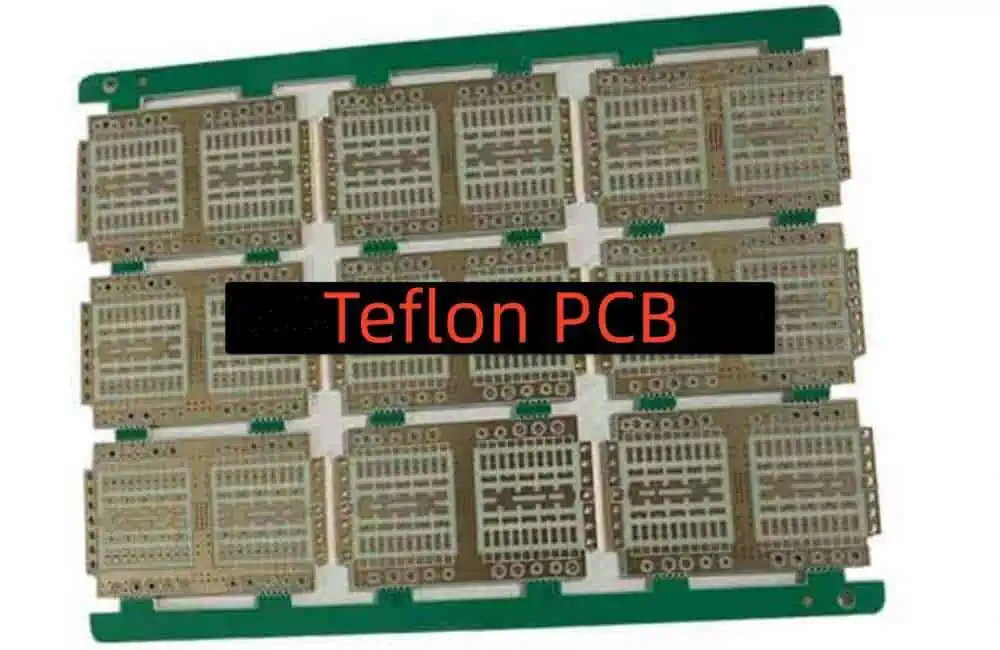
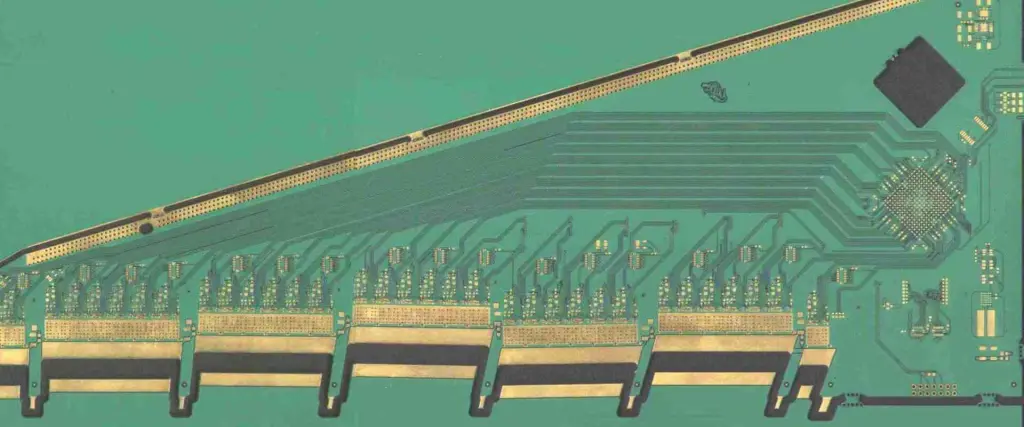
RAYPCB specialise in PTFE (Teflon) PCB Manufacturing, PTFE material is widely used in high frequency PCB , We accept teflon PCB Prototype order with quick turn delivery, All Prototype PCB at industry standard quality of course.

RayMing is experienced in production of various high-frequency circuit boards. For most of RF PCB materials (such as: Ceramic PCB, Teflon PCB, Rogers PCB, Taconic PCB, Arlon Pcb), we have sufficient inventory to ensure fast delivery.

For the past years, different PCB substrates have become popular in the market. This is due to the benefits and features offered by these materials. Polytetrafluoroethylene, also known as Teflon, is one such material.

Teflon is a non-sticky material that features an inert molecular structure. Polytetrafluoroethylene (PTFE) plays a vital role in the production of complex electronics. This material offers great mechanical and electrical properties.

Although this Teflon PCB is machined in a similar way as other laminates, it is important to understand some things about this material.  In this article, we will be discussing important things you need to know about Teflon PCB

What is Teflon PCB?

PTFE teflon pcb

Teflon is a brand name for Polytetrafluoroethylene. PTFE is known for its nonstick and non-reactive surface. Teflon is a well-known material used in the manufacturing of several products. Teflon PCB is an electric circuit that is equipped with better capacities and enhanced connections.

Teflon PCB is a synthetic resin material utilized in non-sticky applications. This material is manufactured by polymerizing tetrafluoroethylene. Teflon PCB material can resist high temperatures. Due to this, it is commonly used for high-frequency PCB.

It features properties like low dissipation factor, cold resistance, low coefficient of thermal expansion, chemical resistance, and high heat.  Teflon PCB manufacturers design this PCB to offer outstanding advantages to users.

Polytetrafluoroethylene is a material known for its resistance to moisture, grease, chemicals, and oil. PTFE PCB features high lubrication, no adhesion, weather resistance, and high insulation. This material is used in the production of PCB ideal for electronic appliances.

Properties of Teflon PCB

A Teflon PCB board has great mechanical, thermal, and electrical properties. This board is used in applications demanding high frequency and high temperature.  Below are some of the properties of this printed circuit board;

Great chemical resistance: This material has the ability to withstand chemicals. When exposed to chemicals, oils, and grease, its original properties donโ€™t alter. PTFE boards can be used in a chemical reagent environment.

Low temperature resistance: Teflon PCB material features great mechanical toughness. Even in cases where the temperature reduces to -196 degrees Celsius, it can still maintain 5 percent elongation.

Weather resistance: This is one of the best properties of this material. Teflon PCB can withstand any weather condition. This makes them durable and reliable.

Low dissipation factor: Teflon PCB board offers a low dissipation factor which makes it a good insulator system. This material is ideal for high-performance and high-quality electronic systems. It is ideal in applications like radar systems and radio frequency.

Non-stick: This material is non-adhesive and non-stick. PTFE is a combination of carbon atoms with fluorine atoms attached to every carbon atom. These strong bonds make this material to be unreactive.

Low water absorption:  PTFE PCBs can be used in humid environments since they feature low water absorption. This means that this board can withstand moisture.  

Exceptional electrical properties: PCB Teflon features low dielectric loss and dielectric constant over a high frequency. This material offers volume resistivity and high breakdown voltage. Its dielectric constant is measured at 2.0.

Teflon PCB Manufacturing

For the production of Teflon circuit boards, extreme attention and carefulness are required. Teflon PCB manufacturers understand that this material is different from FR4 PCB material. For the production of Teflon boards, the following should be considered;

Surface preparation: A substrateโ€™s surface is always prepared for layer formation, marking, and metallization. The manufacturer needs to pay attention to the type of equipment utilized for the preparation of the surface.

 For example, things like bristles, scrubbers, and composite brushes should be avoided during the preparation of the surface. These things can disturb the soft laminate. Sodium etchants or plasma gas recycling is used for the preparation of the PTFE surface.

Copper plating: Special care is needed when copper plating ceramic with high dielectric materials. Pure PTFE materials have a high Z-axis coefficient of thermal expansion. Therefore, it is important to utilize plated copper on through-hole walls.

This plated copper must feature high tensile strength. This helps to minimize the chances of pad lifts and barrel cracks.

Solder mask: You must apply the solder mask within 12 hours of etching the material. A Teflon PCB manufacturer must ensure it processes the etched surface via a standard PTFE cycle. You can also clean residual moisture by baking the PTFE laminates before applying a solder mask.

Drilling: This is a new procedure ideal for drilling PTFE substrates covered with copper. Drilling must be utilized with a high chip load. This removes fibers and PTFE tailing. In most cases, PCB fabricators prefer ceramic-filled laminates since they can drill them easily.

Handling and storage: PTFE laminates need extra care since they are soft.  This makes them vulnerable to tearing or gouging. It is advisable they are stored at room temperature. They shouldnโ€™t be exposed to sunlight to avoid surface oxidation and contamination.

Lamination: Teflon substrates donโ€™t require oxide pretreatment. PCB fabricators laminate PTFE and copper films at high pressures without bonding films or pre-pegs. Sometimes, PTFE PCB manufacturers use bonding films or prepreg of a very low melting point to minimize the processing temperatures. PTFE-FR4 laminates are ideal in some applications, but they need oxide pretreatment.

Advantages of Teflon PCB

PTFE is a useful material for the fabrication of PCB. Teflon PCBs have their unique advantages.

Temperature resistance: Teflon printed circuit board can survive extreme cold and heat. This is a major reason it is used in military and aerospace applications. This board can work from -454 to 600ยฐF and -270 to 315ยฐF. Its ability to withstand any temperature prevents it from cracking.

Great dielectric strength: Due to the high dielectric strength of this board, it is non-conductive. It works perfectly as an insulator. The insulating capability of this material protects equipment from electrical breakdowns.

Durability: PTFE PCB is an ideal option to consider since it is very durable. It can withstand oxidation, ultraviolet rays, embrittlement, or discoloration. It is a cost-effective option because of its long-lasting nature.

Mechanically rigid: Teflon PCB is mechanically stable. This makes it ideal for use in applications that are exposed to high levels of mechanical stability. The thermal conductivity of Teflon PCB is great.

Applications of PTFE PCB

PTFE PCBs are utilized in different military, industrial, aerospace, and commercial applications.

Industrial applications: PTFE boards are commonly used in industrial applications. These boards are used in the production of various electronic components in several manufacturing industries. Exposure of boards to different chemicals and harsh temperatures is common in settings like this. Due to their ability to withstand chemicals and varying temperature, Teflon PCBs are an ideal option.

Radar systems: In radar systems, Teflon PCBs are a great choice. These boards are important in aviation. Teflon boards are used in phased array radar systems. The phased array radar system is important in the aviation and marine industries.

Medical applications: Several medical devices are produced with the use of Teflon PCB. Medical devices such as medical imaging, monitoring devices, etc use Teflon PCB. Teflon is a material approved by the FDA for the production of medical devices. Medical device manufacturers utilize Teflon PCBs since they offer several benefits.

Aerospace industry: Teflon PCBs are an ideal option in the aerospace industry. These boards can withstand high temperatures and harsh chemicals. Most electronic devices used for aerospace applications are subjected to varying conditions.

Teflon PCBs are used in the production of devices such as;

Steps in the Production of Teflon PCB Prototype

The manufacturing of the Teflon PCB prototype requires care and attention. They are certain steps that need to be followed.

Material selection: This is the first step in producing the Teflon PCB prototype. Plastic is commonly used for flexible PCB prototype fabrication.

Rapid design: The design needs to be carried out on a stencil. This helps to identify where connective components and traces are located.

Design testing: This step requires you to examine the functionality of the PTFE PCB. You have to confirm the connections and position of PCB components.

Rectification of Bug: Rectification of bugs is important when there are errors in the design. You have to retrace to modify the performance of the quick PCB prototype.

Rapid prototyping: In this step, you fabricate the prototype. You place the stencil on a plastic board and mount the PCB components. This procedure can be carried out via CAD software.

Functionality testing: After the Teflon PCB prototype has been fabricated, this board goes through a functionality test to access its functions as expected.

Frequently Asked Questions

Why is copper plating important in Teflon PCB boards? The Teflon PCB board features Z-axis CTE and as such, copper PTH is necessary. The copper must have high tensile strength.

What factors should I consider when choosing the right PTFE PCB manufacturer? Several factors like technical capabilities, experience, customization options, and industry-specific certification should be considered when opting for the right PTFE PCB manufacturer.

Conclusion

Teflon PCB is one of the most commonly used PCBs in the electronics industry. This type of PCB has great mechanical and electrical properties. This board is used in several applications due to the benefits they offer.