
RAYPCB · Material selection & fabrication
Tg150 PCB: Mid-Tg Materials, Design & Quote
Specify a mid-Tg board with an identifiable laminate and a clear assembly profile. Compare exact Tg150 data with nearby supplier grades before approving a material or an alternative.
Send files for a material & fabrication quotePreliminary files welcome. Identify the grade, test method and unresolved requirements.

What does Tg150 PCB mean?
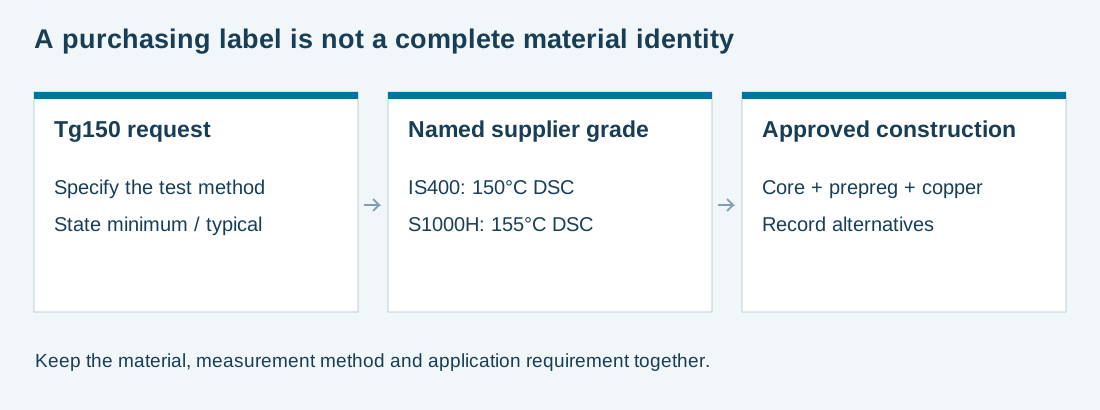
A Tg150 PCB generally refers to a laminate with a glass transition temperature near 150°C. The test method and named grade determine what that label means; a soldering peak above 150°C is a different type of exposure.
Mid-Tg selection is often a practical procurement discussion between standard FR-4 and a higher-Tg system. It should be based on the specified thermal process, board construction and supply options. Do not infer a universal cost saving, reflow count or operating limit from the category.
For the complete grade map and temperature-test definitions, use the High Tg PCB material selection guide.
Reflow peak and service temperature need different evidence
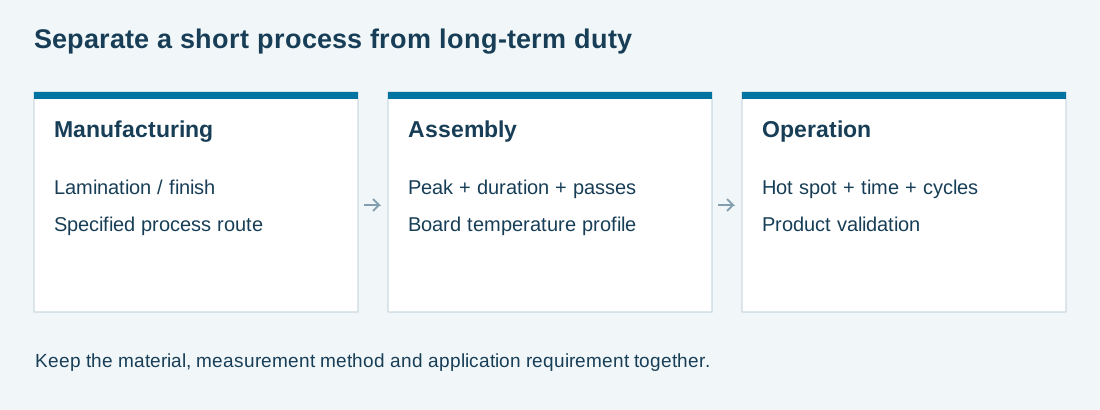
An oven setpoint or solder alloy melting point is not the laminate’s glass transition. A board passes through a brief soldering profile; it may spend years in its operating environment. Assess the measured board temperature and time history for each case.
For double-sided assembly or rework, include all relevant heating operations. Component limits, solder joints, finish, moisture exposure and the laminate system all affect the process. A simple “maximum temperature + 25°C” calculation cannot qualify it. Coordinate the actual profile with PCB assembly process planning.
Use a supplier grade, not an approximate label
Isola IS400 lists 150°C by DSC. Shengyi S1000H is commonly encountered in mid-Tg discussions, but its cited manufacturer datasheet lists 155°C by DSC. The latter should not be presented as an exact Tg150 measurement. If the drawing allows a range or an approved alternate, document that decision.
| If your drawing says… | Clarify before release |
|---|---|
| “FR-4, Tg150” | Which test method, minimum or typical requirement, and approved grade? |
| “S1000H” | Complete grade and datasheet revision, core/prepreg construction and acceptance scope. |
| “Tg ≥150°C” | Method, permitted resin systems and other mandatory electrical/thermal properties. |
| “Lead-free compatible” | Measured board profile, moisture handling, pass count and rework allowance. |
The Tg135 selection page covers the standard-material comparison. Use Tg170 material review when the design calls for a different thermal/mechanical envelope.
| Candidate / RAYPCB guide | Tg and method | Td, 5% mass loss | Z expansion, 50–260°C | Evidence |
|---|---|---|---|---|
| Isola IS400 | 150°C · DSC | 330°C | 3.3% | Supplier data |
| Shengyi S1000H | 155°C · DSC (160°C DMA) | 348°C | 2.8% | Supplier data |
| Isola 370HR | 180°C · DSC | 340°C | 2.8% | Supplier data |
Typical published data, not purchase minima or a stock list. Methods, specimen construction and conditioning may differ. Confirm the supplier revision and the exact supplied construction. A missing entry is not zero.
Prepare a Tg150 PCB fabrication enquiry
Enter the requested construction and material. The chosen grade remains a request until it is agreed for your build. You may skip the planner and send files directly. Material changes clear previously entered cost allowances.
RAYPCB ENGINEERING
High Tg MaterialsTG150 Quotation Planner
Loading TG150 Quotation Planner…
Resolve the engineering question before choosing a grade
RAYPCB ENGINEERING
High Tg MaterialsTG150 Engineering Workbench
Loading TG150 Engineering Workbench…
What changes the design and cost discussion?
Thicker boards, smaller through holes and uneven copper distribution can make expansion and stress considerations more important. Use the complete multilayer stackup when comparing materials, including core and prepreg thicknesses. A nominal layer count by itself is insufficient.
The quote should identify stock alternatives, whether a material change requires impedance or process review, and which thermal or electrical records are included. Compare a standard construction with the exact-grade request if procurement flexibility matters. The budget tool uses user-entered allowances for that construction and does not claim that mid-Tg is a fixed percentage cheaper.
Release requirements and evidence
Keep the approved laminate, compatible prepreg, supplier revision and permitted alternatives with the fabrication drawing. Add the finished stackup, copper, holes, finish, quantity and any assembly thermal profile. Specify the applicable bare-board standard/class/revision, electrical and construction checks, and additional thermal tests when required.
Review the quality and acceptance requirements and rigid manufacturing capability table for the actual construction. Supplier datasheet values are not a RAYPCB test report or a substitute for agreed inspection evidence. For populated samples, coordinate prototype assembly and validation with the same approved material.
Tg150 PCB questions
Is S1000H exactly Tg150?
The cited Shengyi datasheet lists Tg155°C by DSC. It can be discussed as a mid-Tg candidate, but its reported value and method should be retained in the specification.
Can Tg150 replace Tg170?
Only if an engineering review approves the full material and construction requirements. A lower price or a similar product description is not sufficient evidence.
Why can soldering temperatures exceed Tg?
Tg describes a resin transition, while soldering is a short thermal exposure. Thermal endurance and the qualified process profile determine whether that exposure is acceptable.
Is Tg150 a continuous temperature rating?
No. Review actual board temperature, duration, cycling and applicable long-term material and product requirements.
Can I request a mid-Tg quote before selecting a grade?
Yes. Identify the unresolved grade and provide the stackup, copper, holes, assembly conditions and acceptance requirements so candidates can be reviewed.
What should stay fixed in a cost comparison?
Board size, thickness, copper, layer stack, holes, finish, quantity and test scope. List material alternatives explicitly so their process and electrical implications can be compared.
Technical references
Manufacturer sources reviewed on 17 September 2026. Preserve the stated method and revision; confirm current data and supply before approving the build.
Send the material requirement with the board files
Attach fabrication/drill data, outline and stackup. State the thermal exposure, quantity, tests and required delivery date. If the grade or method is unresolved, mark it for engineering review. Downloaded tool notes must be attached manually.
Request a Tg150 PCB review