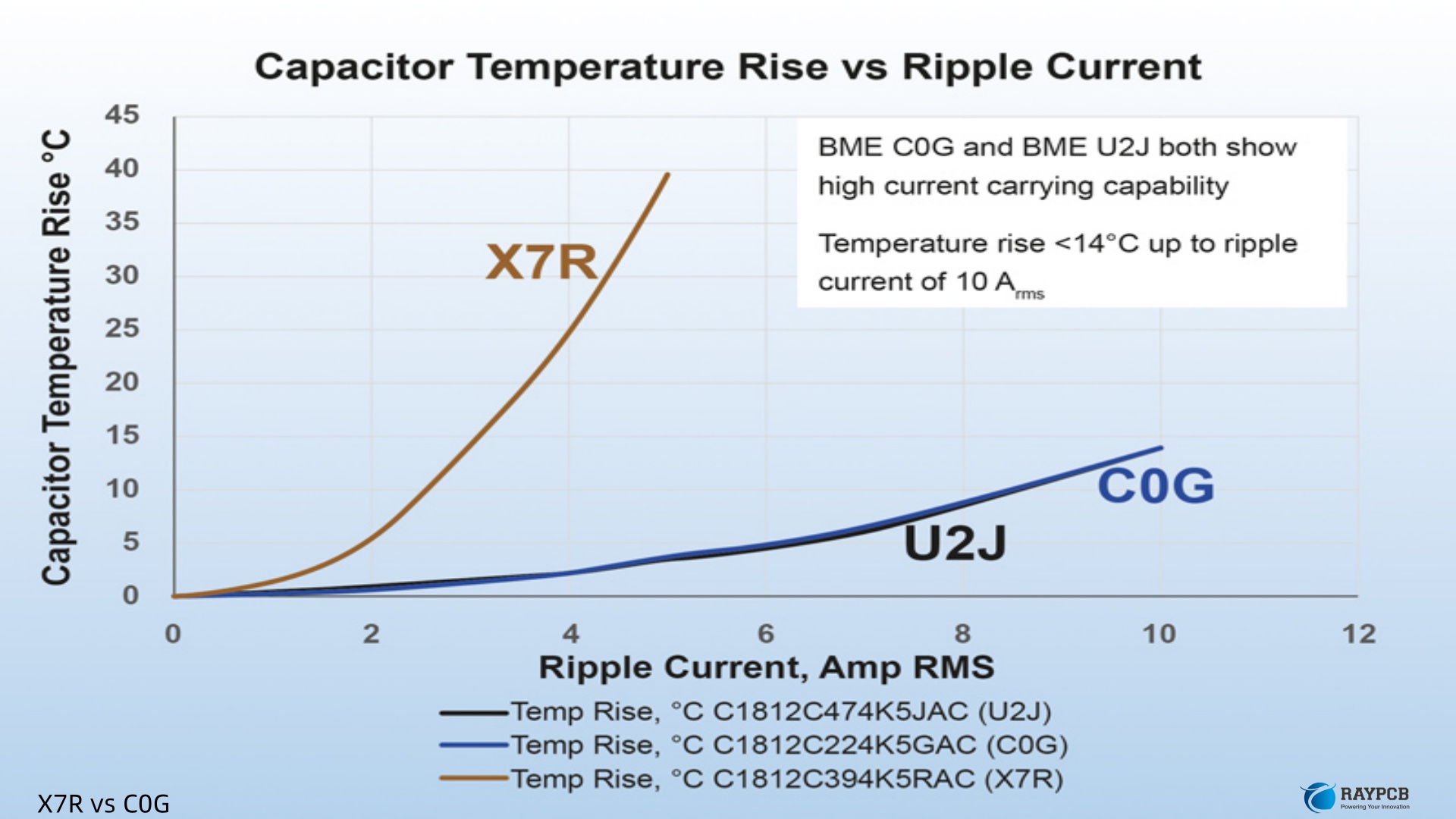
X7R vs C0G Ceramic Capacitor: When to Use Each

X7R vs C0G ceramic capacitors โ€” learn the real electrical differences, DC bias derating risks, and exactly which dielectric to use for your PCB application.

If you’ve spent any time selecting capacitors for a PCB design, you’ve almost certainly stared at a datasheet wondering whether to grab an X7R or a C0G. They’re both ceramic capacitors, they look identical on the reel, and a junior engineer swapping one for the other can silently break a design without a single error message. This guide walks through the real-world differences from a PCB design perspective โ€” what these codes actually mean, where each dielectric shines, and where it will let you down.

What Do X7R and C0G Actually Mean?

Before diving into the comparison, it helps to understand the naming system. Both X7R and C0G follow the EIA RS-198 standard for ceramic capacitor dielectrics.

Decoding the C0G Code

C0G is a Class 1 dielectric. The code breaks down like this:

  • Cย = significant figure of temperature coefficient: 0 (zero)
  • 0ย = multiplier: ร—1 (so 0 ร— 1 = 0 ppm/ยฐC)
  • Gย = tolerance on the temperature coefficient: ยฑ30 ppm/ยฐC

The result: a capacitor whose capacitance shifts by 0 ยฑ30 ppm/ยฐC across temperature. Over the full -55ยฐC to +125ยฐC range, that’s less than ยฑ0.3% change in capacitance. C0G is also called NP0 (Negative-Positive-Zero) in military and European standards โ€” same component, different label. Both the “0” in C0G and the “0” in NP0 are the numeral zero, not the letter O.

Decoding the X7R Code

X7R is a Class 2 dielectric. The code breaks down differently:

  • Xย = lower operating temperature: -55ยฐC
  • 7ย = upper operating temperature: +125ยฐC
  • Rย = maximum capacitance change: ยฑ15%

So across -55ยฐC to +125ยฐC, an X7R capacitor can drift up to ยฑ15% from its nominal value. That sounds manageable, but there’s more to the story โ€” temperature is only one of the variables you have to worry about.

X7R vs C0G: Side-by-Side Comparison

PropertyC0G (NP0)X7R
Dielectric ClassClass 1Class 2
Temperature Range-55ยฐC to +125ยฐC-55ยฐC to +125ยฐC
Capacitance Change vs. Temp0 ยฑ30 ppm/ยฐC (< ยฑ0.3%)ยฑ15% max
DC Bias EffectNoneSignificant โ€” can lose 50โ€“80%
AgingNegligible~1% per decade
Piezoelectric EffectNoneYes (microphonics)
Typical Max Capacitance~10 nF to 100 nF (per case size)Up to 47 ยตF
Typical Toleranceยฑ1%, ยฑ2%, ยฑ5%ยฑ10%, ยฑ20%
Relative CostHigherLower
Package Size for Same ValueLargerSmaller
Dielectric Absorption< 0.6%Higher
Q Factor>1000Lower
Best ForPrecision, RF, timingDecoupling, bulk bypass

The Hidden X7R Problem: DC Bias Derating

This is the one that catches engineers off guard, especially those coming from simulation backgrounds. Class 2 capacitors lose capacitance as you apply DC voltage. This is not a small effect.

A 10 ยตF X7R capacitor rated at 16V can behave like a 2 ยตF capacitor when 12V is applied across it. The ferroelectric dielectric in X7R responds to the electric field, and its effective permittivity drops โ€” taking your capacitance with it. Some manufacturers’ datasheets show derating curves that drop 70% or more at rated voltage.

The practical takeaway: if you’re using an X7R capacitor in a power rail decoupling application, always check the manufacturer’s DC bias derating curve and derate accordingly. A rule of thumb many engineers use is to select a voltage rating at least twice the actual operating voltage to stay in the flat portion of the derating curve. C0G capacitors have no measurable DC bias effect โ€” what you see on the datasheet is what you get in the circuit.

Capacitance Stability: Where C0G Has No Competition

For any application where the capacitor value must stay predictable, C0G is the clear choice. Here’s why the ยฑ30 ppm/ยฐC number is genuinely impressive:

Over the full -55ยฐC to +125ยฐC range (a 180ยฐC swing), the capacitance changes by just ยฑ0.54%. Capacitance drift and hysteresis are below ยฑ0.05%. Dielectric absorption is less than 0.6% โ€” comparable to mica capacitors, which have been the gold standard for precision applications for decades. The Q factor for C0G routinely exceeds 1000, making it ideal at RF frequencies.

X7R capacitance, by contrast, follows a nonlinear curve with temperature, shifts with applied voltage, and ages over time โ€” losing roughly 1% per decade, or about 5% over 10 years. None of these effects are disqualifying for the right application. But in precision timing, filtering, or RF circuits, they add up fast.

When to Use C0G: Application Checklist

C0G is the right call when the capacitor value directly affects circuit performance.

Timing and Oscillator Circuits

Any RC timing network, crystal oscillator load capacitor, or ceramic resonator application needs a stable C value. A ยฑ15% drift in an X7R timing capacitor means your oscillator frequency shifts with temperature. Use C0G.

RF Tuning and Matching Networks

At radio frequencies, capacitor Q and stability are critical. C0G’s high Q (>1000) and predictable temperature behavior make it the standard for RF tuning, impedance matching, and tank circuits in LNA and VCO designs.

Active Filters with Precision Frequency Response

Sallen-Key, multiple feedback, and other active filter topologies rely on accurate capacitor ratios to set pole frequency and Q. X7R will shift your cutoff frequency across temperature. C0G holds the filter response tight.

High-Impedance Analog Nodes

Precision ADC input networks, sample-and-hold circuits, and op-amp feedback networks benefit from C0G’s negligible dielectric absorption. High dielectric absorption causes charge retention errors that show up as settling time issues in high-resolution converters.

Low-Noise Sensitive Circuits

X7R capacitors exhibit piezoelectric behavior โ€” mechanical vibration causes voltage noise. In audio circuits, precision instrumentation, and low-noise analog front ends, this “microphonics” effect can inject ยตV-level noise. C0G is not piezoelectric and is immune to this.

When to Use X7R: Application Checklist

X7R is not a second-choice dielectric โ€” it’s the right tool for high-value bypass and decoupling applications.

Power Supply Decoupling

The bulk of MLCC decoupling on a modern PCB is X7R. You need large capacitance values in small packages, and X7R delivers. Just derate the voltage rating properly and check the DC bias curve.

Bypass Capacitors on Digital ICs

Digital logic doesn’t care whether its bypass cap is exactly 100 nF or 88 nF. The ยฑ15% temperature drift of X7R has no meaningful effect on the performance of a digital power pin. Use X7R here โ€” it’s smaller, cheaper, and fits the job.

Bulk Input/Output Filtering

Buck converter input capacitors, LDO output capacitors, and EMI filter capacitors all benefit from X7R’s high capacitance density. Use multiple X7R capacitors in parallel and derate their voltage ratings.

Coupling Capacitors (Non-Critical)

Interstage coupling where the exact capacitance value is not critical to gain or frequency response is a perfectly reasonable X7R application. If the coupling cap just needs to block DC and you have bandwidth to spare, X7R works fine.

X7R vs C0G: Application Decision Table

ApplicationRecommended DielectricReason
Crystal oscillator load capsC0GFrequency stability
RF tank / tuning circuitsC0GHigh Q, stable
Active filter (precision)C0GStable pole frequency
Sample and holdC0GLow dielectric absorption
Low-noise analog (microphonics concern)C0GNon-piezoelectric
Power supply bypass (bulk)X7RHigh capacitance density
Digital IC decouplingX7RCost/size efficient
Buck converter input capX7R (derated)High bulk capacitance
LDO output capX7RHigh value in small package
Non-critical AC couplingX7RAdequate stability
High-temperature (>150ยฐC)C0G (special grade)X7R degrades severely

Package Size Realities

One practical constraint engineers run into is that C0G capacitors top out at much lower capacitance values for a given package size. If you search a distributor for a 0.1 ยตF 0805 ceramic capacitor, you’ll find hundreds of X7R results and virtually zero C0G options. For 100 nF and above, X7R is often the only practical MLCC option in standard package sizes.

This is a materials limitation: the high-permittivity ferroelectric dielectric in X7R can pack far more capacitance into the same volume. C0G is fundamentally limited by its lower dielectric constant (below 150 for TiO2-based formulations), while X7R dielectric constants can exceed 2000.

For low-value capacitors โ€” anything from 1 pF to a few nanofarads โ€” C0G is readily available in standard 0402 and 0603 packages and is the preferred choice whenever stability matters.

A Note on Identifying Them in the Field

This comes up in manufacturing and rework. Both C0G and X7R MLCCs can look physically identical once they’re off the tape. A common industry observation is that C0G caps tend to have a grey color while X7R parts are more brown โ€” but this is manufacturer-dependent and should never be relied upon for positive identification. Always cross-reference the part number against the manufacturer datasheet. Swapping an X7R for a C0G may work fine, but swapping a C0G for an X7R in a precision circuit can introduce subtle failures that are very hard to debug.

Frequently Asked Questions

Q1: Can I substitute C0G for X7R in a decoupling application?

Yes, in most cases. C0G will perform at least as well as X7R for bypass and decoupling. The only practical issue is that you may not find C0G options in the large capacitance values (1 ยตF and above) needed for bulk decoupling, and C0G parts cost more. For small-value bypass caps, C0G is a perfectly fine substitute.

Q2: Can I substitute X7R for C0G in a timing or filter circuit?

Generally no, and this is where designs get into trouble. The ยฑ15% capacitance variation with temperature, plus DC bias derating and aging, can shift timing and filter frequencies enough to cause circuit failures. Unless you’ve verified the tolerance is acceptable for your design, stick with C0G for precision applications.

Q3: Why does an X7R capacitor measure much lower than rated capacitance on my bench LCR meter?

Your LCR meter may be applying a test voltage, and X7R capacitance drops significantly under DC bias. Also, X7R capacitance changes with the AC measurement signal frequency and amplitude. Measure at the actual operating conditions when possible, or consult the manufacturer’s derating curves.

Q4: What is the difference between C0G and NP0?

They are the same capacitor specified under two different standards. C0G is the EIA designation (used predominantly in North America). NP0 (Negative-Positive-Zero) is used in military standards and commonly seen in European documentation. The “0” in both designations is the numeral zero, though it is frequently written as the letter O, especially as “NPO.”

Q5: Do X7R capacitors really make noise in audio circuits?

Yes. X7R and other Class 2 ceramics are ferroelectric and exhibit piezoelectric behavior. Board vibrations (from fans, motors, or speakers) can physically flex the capacitor, generating a small voltage. In sensitive audio circuits, this appears as audible noise or hum. C0G is not piezoelectric, which is one reason it’s preferred in precision analog and audio reference circuits.

Useful Resources

ResourceDescriptionLink
Murata SimSurfingSimulate capacitor behavior under DC bias, frequency, and temperaturemurata.com
KEMET KSIMKEMET’s capacitor simulation tool with derating curvesksim3.kemet.com
TDK Product SelectorSearch TDK MLCC by dielectric, capacitance, voltageproduct.tdk.com
AVX (Kyocera) Parametric SearchFilter by C0G or X7R, size, voltageavx.com
Digi-Key MLCC FilterDistributor search with dielectric filterdigikey.com
EIA RS-198 Standard SummaryBackground on EIA ceramic capacitor classificationAvailable via IHS Markit
TI Precision Hub โ€” Microphonics SeriesDetailed explanation of piezoelectric noise in MLCCse2e.ti.com

Summary

The X7R vs C0G decision comes down to one question: does the capacitor value matter to your circuit’s performance?

If you need stability โ€” for timing, filtering, RF tuning, or precision analog โ€” C0G is the answer. Its temperature stability (0 ยฑ30 ppm/ยฐC), zero DC bias effect, high Q, non-piezoelectric behavior, and negligible aging make it the reference-grade dielectric for work where accuracy matters. The trade-off is cost and limited availability at high capacitance values.

If you need bulk capacitance in a tight space for power decoupling, bypass, or non-critical coupling โ€” X7R is the right tool. It’s cost-effective, widely available in values up to 47 ยตF, and entirely adequate when the exact capacitor value is not critical to the function. Just derate the voltage rating and check the DC bias curve before committing to a value.

Most PCBs need both. Use C0G at precision analog nodes, oscillator pins, and RF sections. Use X7R everywhere else.
The Advantage of Nearly Isotropic Dielectric Constant of RT/duroid 5870-5880 Glass Microfiber PTFE

Rogers TC600 PCB

Introduction

In the realm of high-frequency electronic applications, material properties play a crucial role in determining performance, reliability, and manufacturing feasibility. Among the key parameters for substrate materials, the dielectric constant (ฮตr) stands as one of the most critical considerations. RT/duroid 5870-5880 Glass Microfiber PTFE composites, manufactured by Rogers Corporation, have gained significant attention in the industry due to their nearly isotropic dielectric properties. This characteristic offers substantial advantages across various applications, from aerospace and defense systems to commercial telecommunications and emerging millimeter-wave technologies.

Understanding Dielectric Isotropy

Before delving into the specific advantages of RT/duroid 5870-5880, it’s essential to understand what a nearly isotropic dielectric constant means in practical terms. Isotropy refers to uniformity in all directions, and when applied to dielectric materials, it indicates that the electrical properties remain consistent regardless of the direction of the electromagnetic field propagation through the material.

Most composite materials exhibit some degree of anisotropy, meaning their electrical properties vary depending on the direction of measurement. This anisotropy often stems from the manufacturing process, where reinforcement fibers or fillers tend to align in specific directions, creating directional variations in properties. In contrast, RT/duroid 5870-5880 materials are engineered with randomly oriented microfibers that minimize this directional dependency, resulting in nearly isotropic behavior.

Powered By EmbedPress

Composition and Structure

RT/duroid 5870-5880 substrates are composite materials consisting of polytetrafluoroethylene (PTFE) resin reinforced with glass microfibers. Unlike traditional woven glass reinforced PTFE composites, which inherently create a structured and directional reinforcement pattern, the microfiber reinforcement in RT/duroid is dispersed randomly throughout the PTFE matrix. This random orientation is key to achieving the nearly isotropic dielectric constant.

The 5870 variant typically has a dielectric constant of approximately 2.33, while the 5880 variant sits at around 2.20 at 10 GHz. Both materials maintain this dielectric constant with minimal variation across different directions, making them ideal for applications where consistent electrical performance is paramount.

Read more about๏ผš

Key Advantages of Nearly Isotropic Dielectric Constant

1. Predictable High-Frequency Performance

Perhaps the most significant advantage of nearly isotropic dielectric properties is the predictable nature of signal propagation. In high-frequency circuits, especially those operating at microwave and millimeter-wave frequencies, signal integrity depends heavily on the consistency of the substrate’s dielectric constant. When the dielectric constant varies with direction, it can lead to:

  • Phase velocity variations
  • Unpredictable propagation delays
  • Signal distortion and dispersion
  • Degraded circuit performance

With RT/duroid 5870-5880’s nearly isotropic properties, designers can accurately predict how signals will propagate through the substrate, enabling more precise timing calculations and impedance matching. This predictability is invaluable for complex, high-speed digital circuits and RF applications where signal integrity is paramount.

2. Enhanced Design Flexibility

The nearly isotropic nature of RT/duroid 5870-5880 grants circuit designers exceptional freedom. Unlike anisotropic materials that might constrain designers to account for directional variations, these materials allow components and transmission lines to be oriented in any direction on the substrate without significantly affecting electrical performance.

This flexibility is particularly beneficial in:

  • Complex layout designs where optimal component placement may require various orientations
  • Curved or non-rectilinear transmission lines
  • Circular polarized antenna designs
  • Space-constrained applications requiring creative routing solutions

Designers can focus on optimizing circuit performance and layout efficiency without the additional constraint of accounting for directional variations in the substrate’s electrical properties.

3. Improved Manufacturing Consistency

Manufacturing consistency is another critical advantage stemming from the nearly isotropic dielectric constant. With anisotropic materials, manufacturing processes must carefully control the orientation of the substrate during fabrication to ensure consistent performance. Any rotational variation during processing could significantly affect the final circuit’s performance.

RT/duroid 5870-5880 materials mitigate this concern, offering:

  • Reduced sensitivity to material orientation during manufacturing
  • Consistent performance across different production batches
  • Lower rejection rates due to property variations
  • Simplified quality control procedures

This manufacturing consistency translates to more reliable production processes, reduced costs, and higher yields, particularly for high-volume or mission-critical applications.

4. Superior Performance in Complex 3D Structures

As electronic devices continue to evolve toward more compact and integrated forms, three-dimensional circuit structures are becoming increasingly common. In such configurations, electromagnetic signals must propagate through the substrate in multiple directions, making isotropic dielectric properties especially valuable.

RT/duroid 5870-5880’s nearly isotropic characteristics enable:

  • Reliable performance in multilayer circuit boards
  • Consistent behavior in through-substrate vias
  • Uniform coupling in complex 3D antenna structures
  • Predictable performance in cavity resonators and filters

This uniform behavior across all dimensions is particularly advantageous for advanced applications like 3D integrated circuits, stacked-patch antennas, and complex filter designs.

5. Temperature Stability and Environmental Resilience

Beyond the advantages directly related to isotropy, RT/duroid 5870-5880 materials exhibit excellent temperature stability. The dielectric constant remains consistent across a wide temperature range, maintaining its isotropic characteristics even under thermal stress. This stability is crucial for applications exposed to variable environmental conditions, such as:

  • Aerospace systems operating through extreme temperature cycles
  • Outdoor telecommunications equipment
  • Automotive radar systems
  • Military and defense electronics

The material’s low moisture absorption further enhances its environmental resilience, preventing performance degradation in humid conditions that could otherwise compromise the dielectric properties.

Applications Benefiting from Nearly Isotropic Dielectric Properties

Several cutting-edge applications particularly benefit from the nearly isotropic dielectric constant of RT/duroid 5870-5880:

  1. Phased Array Antennas: These complex antenna systems require consistent phase relationships between multiple radiating elements, making predictable and uniform signal propagation essential.
  2. Millimeter-Wave Systems: As frequencies push into the millimeter-wave spectrum (30-300 GHz) for applications like 5G, automotive radar, and imaging systems, even minor variations in dielectric properties can significantly impact performance.
  3. High-Precision Timing Circuits: Applications requiring precise timing, such as high-speed digital systems and synchronization circuits, benefit from the consistent propagation delays enabled by isotropic materials.
  4. Satellite Communications: Space-based systems operate in extreme environments and require highly reliable, consistent performance across temperature ranges.
  5. Test and Measurement Equipment: Precision instruments demand substrate materials with predictable, consistent properties to ensure measurement accuracy.

Conclusion

The nearly isotropic dielectric constant of RT/duroid 5870-5880 Glass Microfiber PTFE composites represents a significant advancement in substrate technology for high-frequency applications. This characteristic provides numerous advantages, from predictable electrical performance and design flexibility to manufacturing consistency and environmental resilience.

As electronic systems continue to advance toward higher frequencies, greater integration, and more demanding performance requirements, the value of nearly isotropic substrate materials like RT/duroid 5870-5880 will likely increase. Engineers and designers working on cutting-edge RF, microwave, and millimeter-wave applications would do well to consider these materials when consistent, reliable performance is essential.

The combination of low dielectric constant, minimal dielectric loss, and nearly isotropic properties positions RT/duroid 5870-5880 as an optimal choice for applications where signal integrity, design flexibility, and manufacturing consistency cannot be compromised.

Design Equations for Broadside and Edgewise Stripline

Rogers TMM 10i Laminate

Introduction

Stripline couplers are essential components in RF and microwave circuits that allow designers to split RF power between two lines at desired proportions. These four-port devices operate on the principle of electromagnetic coupling and are widely used in signal routing, power division, and signal sampling applications across various frequency ranges. This article explores the design equations and principles for two common types of stripline couplers: broadside and edgewise configurations.

Powered By EmbedPress

Basic Principles of Stripline Couplers

A stripline coupler typically consists of two parallel transmission lines with equal widths positioned at equal distances from ground planes. The coupling region spans a quarter-wavelength at the design frequency, creating a predictable power division between the output ports. In a standard four-port coupler, ports 1 and 2 are located on the driven line, while ports 3 and 4 are on the coupled line. Port 3 is adjacent to port 2, and port 4 is adjacent to port 1.

The coupling coefficient, measured in decibels (dB), expresses the power ratio between port 4 and port 1. A lower positive dB value indicates stronger coupling. For instance, a 3 dB coupling coefficient represents an approximately equal power split between ports 2 and 4, while a 10 dB coefficient indicates a 9:1 power division ratio.

Broadside vs. Edgewise Configurations

Broadside Stripline Couplers

Broadside couplers are typically constructed using three circuit boards forming two signal layers between ground planes. This configuration is preferred for applications requiring high coupling coefficients (lower dB values) due to its ability to achieve tight coupling between the lines.

The broadside configuration places the coupled lines directly above and below each other, separated by a dielectric material. This arrangement maximizes the coupling area between the lines, allowing for coupling coefficients as low as 1-3 dB to be achieved relatively easily.

Edgewise Stripline Couplers

Edgewise couplers, on the other hand, require only two boards with a single signal layer. In this configuration, the coupled lines are positioned side by side on the same plane. This arrangement is typically used for applications requiring lower coupling (higher dB values), commonly in the range of 8-20 dB.

The edgewise configuration simplifies the manufacturing process compared to broadside couplers but limits the achievable coupling coefficient due to the reduced coupling area between the lines.

Read more about:

Design Equations and Parameters

Both broadside and edgewise couplers share certain fundamental relationships between their design parameters. The key parameters include:

  • D: Coupling coefficient in dB
  • Zโ‚€: Overall characteristic impedance in ohms
  • V: Voltage ratio (V = e^(D/-8.68589))
  • Zโ‚€,even and Zโ‚€,odd: Even and odd mode impedances

Common relationships include:

  • Zโ‚€ = โˆš(Zโ‚€,even ร— Zโ‚€,odd)
  • D = -8.68589 ร— logโ‚โ‚‘โ‚Ž((Zโ‚€,even – Zโ‚€,odd)/(Zโ‚€,even + Zโ‚€,odd))
  • Zโ‚€,even/Zโ‚€,odd = (1 + V)/(1 – V)

Broadside Coupler Design Equations

For broadside couplers, the design parameters are expressed as ratios of line spacing and width to the total ground plane spacing:

  • s: Ratio of line spacing to ground plane spacing
  • w: Ratio of line width to ground plane spacing
  • ฮตแตฃ: Relative permittivity of the dielectric material

Key equations include:

  • Zโ‚€,odd = 296.1s/(ฮตแตฃ ร— tanhโปยน(k))
  • Zโ‚€,even = 188.3 ร— K(k’)/[ฮตแตฃ ร— K(k)]
  • w = (ฯ€/2) ร— [tanhโปยน(R) – s ร— tanhโปยน(R/k)]

Where:

  • k’ = 1 – kยฒ
  • R = (k – s)/(1 – sร—k)
  • K(k) represents the elliptic integral of the first kind with modulus k

Edgewise Coupler Design Equations

For edgewise couplers, the design parameters are expressed as absolute dimensional values:

  • w: Width of the lines
  • s: Spacing between the lines
  • b: Ground plane spacing

Key equations include:

  • kโ‚‘แตฅโ‚‘โ‚™ = tanh((ฯ€ร—w)/(2ร—b)) ร— tanh((ฯ€ร—(w+s))/(2ร—b))
  • k’โ‚‘แตฅโ‚‘โ‚™ = 1 – kยฒโ‚‘แตฅโ‚‘โ‚™
  • kโ‚’โ‚โ‚ = tanh((ฯ€ร—w)/(2ร—b)) ร— coth((ฯ€ร—(w+s))/(2ร—b))
  • k’โ‚’โ‚โ‚ = 1 – kยฒโ‚’โ‚โ‚
  • Zโ‚€,even = (30ฯ€/โˆšฮตแตฃ) ร— [K(k’โ‚‘แตฅโ‚‘โ‚™)/K(kโ‚‘แตฅโ‚‘โ‚™)]
  • Zโ‚€,odd = (30ฯ€/โˆšฮตแตฃ) ร— [K(k’โ‚’โ‚โ‚)/K(kโ‚’โ‚โ‚)]

Where:

  • tanh(i) is the hyperbolic tangent of i
  • coth(i) is the hyperbolic cotangent of i (1/tanh(i))

Design Considerations and Assumptions

When designing stripline couplers using these equations, several assumptions are made:

  1. The thickness of the conductors is considered negligible
  2. The coupled lines have equal width
  3. Distance to ground planes on either side of the coupled lines is equal
  4. Dielectric material completely fills the space between ground planes not occupied by conductor
  5. All layers of dielectric material have the same relative permittivity (ฮตแตฃ)

Practical Examples

Broadside Coupler Examples

For a broadside coupler using RT/duroid 5880 substrate:

  • Outer board thickness: 0.031 inches
  • Center board thickness: 0.005 inches
  • Line width: 0.200 inches
  • Resulting coupling coefficient: 1.47 dB
  • Characteristic impedance: 9.83 ohms

For a broadside coupler using TMM-10 substrate:

  • Outer board thickness: 0.050 inches
  • Center board thickness: 0.015 inches
  • Line width: 0.175 inches
  • Resulting coupling coefficient: 2.82 dB
  • Characteristic impedance: 10.68 ohms

Edgewise Coupler Examples

For an edgewise coupler using RT/duroid 5880 substrate:

  • Board thickness: 0.031 inches
  • Line spacing: 0.005 inches
  • Line width: 0.025 inches
  • Resulting coupling coefficient: 9.74 dB
  • Characteristic impedance: 68.53 ohms

For an edgewise coupler using TMM-10 substrate:

  • Board thickness: 0.025 inches
  • Line spacing: 0.005 inches
  • Line width: 0.010 inches
  • Resulting coupling coefficient: 8.89 dB
  • Characteristic impedance: 46.10 ohms

Applications and Selection Criteria

The choice between broadside and edgewise couplers depends on several factors:

  1. Required Coupling Coefficient: Broadside couplers are preferred for tight coupling (1-6 dB), while edgewise couplers are suitable for looser coupling (7-20 dB).
  2. Manufacturing Complexity: Edgewise couplers are generally simpler to manufacture as they require only a single signal layer.
  3. Space Constraints: Edgewise couplers typically require more lateral space but less vertical space compared to broadside couplers.
  4. Frequency Range: Both types can operate across a wide frequency range, but the bandwidth characteristics may differ.
  5. Impedance Requirements: The desired system impedance (typically 50 or 75 ohms) will influence the selection of line width, spacing, and substrate material.

Conclusion

Stripline couplers in both broadside and edgewise configurations offer designers flexible solutions for power division and signal sampling in RF and microwave circuits. The design equations provided in this article allow for accurate prediction of coupling coefficients and impedance matching, enabling optimized performance for specific applications.

While broadside couplers excel in achieving tight coupling with values as low as 1-3 dB, edgewise couplers offer simpler construction and are ideal for applications requiring coupling in the range of 8-20 dB. The choice between these configurations depends on the specific requirements of the application, including coupling strength, manufacturing complexity, space constraints, and operating frequency range.

By understanding the fundamental principles and design equations presented here, engineers can effectively design stripline couplers tailored to their specific system requirements.

Temperature Rise Estimations in Rogers High Frequency Circuit Boards Carrying Direct or RF Current (PDF Download)

Introduction

High-frequency circuit boards are essential components in modern electronic systems, particularly in telecommunications, aerospace, and defense applications. Rogers Corporation is a leading manufacturer of high-performance circuit materials specifically designed for these demanding applications. When current flows through these circuit boardsโ€”whether direct current (DC) or radio frequency (RF) currentโ€”heat is generated due to various loss mechanisms. Understanding and accurately estimating the resulting temperature rise is crucial for ensuring reliable operation and preventing premature failure of electronic systems.

Powered By EmbedPress

Theoretical Background of Heat Generation

The temperature rise in circuit boards is primarily caused by resistive losses (IยฒR losses) when current flows through conductive traces. For DC currents, the heat generation is relatively straightforward, governed by Joule’s heating law. However, for RF currents, additional loss mechanisms come into play, making temperature estimation more complex.

When RF current flows through a circuit board, losses occur due to:

  1. Conductor losses – Resistive losses in the copper traces
  2. Dielectric losses – Energy dissipated within the substrate material
  3. Radiation losses – Energy converted to electromagnetic radiation

Rogers high-frequency materials are specifically engineered to minimize these losses, particularly at microwave and millimeter-wave frequencies. Materials such as RO4000ยฎ series, RT/duroidยฎ, and CLTEโ„ข offer low dielectric losses (characterized by low dissipation factor or tanฮด) and stable electrical properties across frequency and temperature ranges.

DC Current Temperature Rise Estimation

For direct current applications, the temperature rise can be estimated using thermal resistance models. The key equation is:

ฮ”T = P ร— Rth

Where:

  • ฮ”T is the temperature rise above ambient (ยฐC)
  • P is the power dissipated (watts)
  • Rth is the thermal resistance (ยฐC/W)

The power dissipated is calculated using P = IยฒR, where I is the current and R is the resistance of the trace. The resistance depends on the trace dimensions (width, thickness) and the resistivity of copper, which may vary slightly with temperature.

The thermal resistance depends on multiple factors:

  • Circuit board substrate thermal conductivity
  • Copper thickness and width
  • Presence of thermal vias
  • Proximity to ground planes
  • Board thickness
  • Air circulation around the board

Rogers materials typically have thermal conductivities ranging from 0.2 to 0.7 W/mยทK, which is relatively low compared to ceramic substrates but higher than many conventional FR-4 materials.

RF Current Temperature Rise Estimation

For RF currents, the situation becomes more complex due to frequency-dependent effects. The estimation process requires consideration of:

  1. Skin effect – At high frequencies, current flows primarily near the surface of conductors, effectively increasing resistance
  2. Dielectric loss factor – Energy dissipated in the substrate material
  3. Impedance matching – Mismatches can create standing waves, concentrating power at specific locations

The power dissipation for RF signals can be calculated using:

P = Pin ร— (1-|S21|ยฒ-|S11|ยฒ)

Where:

  • Pin is the input power
  • S21 is the transmission coefficient (power delivered to load)
  • S11 is the reflection coefficient (power reflected back to source)

This calculation accounts for both the power transmitted through the circuit and the power reflected due to impedance mismatches.

Read more about:

Empirical Methods for Temperature Estimation

While theoretical calculations provide a foundation, empirical methods often yield more accurate temperature rise estimations for specific board configurations:

  1. Reference designs – Using documented temperature rises from similar designs
  2. Thermal modeling software – Finite element analysis (FEA) tools that account for material properties and boundary conditions
  3. Infrared thermal imaging – Direct measurement of operating temperatures under various load conditions

Rogers Corporation provides thermal data sheets and application notes for their materials, which can serve as valuable references for temperature rise estimation.

Critical Factors Affecting Temperature Rise

Several key factors significantly impact temperature rise in Rogers high-frequency circuit boards:

Substrate Material Properties

Different Rogers materials exhibit varying thermal characteristics:

  • RT/duroidยฎ 5880 has a thermal conductivity of approximately 0.20 W/mยทK
  • RO4350Bโ„ข offers improved thermal conductivity around 0.62 W/mยทK
  • TC350โ„ข is specifically designed for thermal management with conductivity up to 1.0 W/mยทK

Copper Thickness and Trace Width

Wider traces and thicker copper layers provide lower resistance paths for current flow, reducing power dissipation. Standard copper thicknesses range from 1/2 oz (17.5 ฮผm) to 2 oz (70 ฮผm) for Rogers materials, with custom thicknesses available for high-current applications.

Thermal Management Techniques

Several techniques can be employed to mitigate temperature rise:

  • Thermal vias – Connecting to internal ground planes or heat sinks
  • Copper pours – Increasing the effective copper area for heat spreading
  • Thermally conductive adhesives – Improving heat transfer to enclosures or heat sinks
  • Forced air cooling – Enhancing convection cooling around the board

Practical Estimation Approach

A systematic approach to estimating temperature rise includes:

  1. Calculate the DC resistance of the trace using dimensions and material properties
  2. For RF applications, calculate the effective resistance accounting for skin effect
  3. Determine power dissipation using appropriate equations for DC or RF current
  4. Estimate thermal resistance based on board construction and cooling methods
  5. Calculate temperature rise using ฮ”T = P ร— Rth
  6. Apply safety factors to account for uncertainties

Case Studies

Example 1: DC Power Distribution Trace

Consider a 50 mil (1.27 mm) wide, 1 oz copper trace on RO4350B carrying 2 amperes of DC current. The trace resistance is approximately 0.02 ohms per inch. For a 3-inch trace:

  • Total resistance = 0.06 ohms
  • Power dissipation = (2 A)ยฒ ร— 0.06 ฮฉ = 0.24 watts
  • With a thermal resistance of approximately 30ยฐC/W for this configuration
  • Temperature rise = 0.24 W ร— 30ยฐC/W = 7.2ยฐC above ambient

Example 2: RF Power Amplifier Output Line

For a 50-ohm microstrip line on RT/duroid 6010 carrying 5 watts of RF power at 10 GHz:

  • Insertion loss โ‰ˆ 0.2 dB/inch (primarily from conductor and dielectric losses)
  • For a 2-inch line, total loss โ‰ˆ 0.4 dB or approximately 9% of power
  • Power dissipation = 5 W ร— 0.09 = 0.45 watts
  • With a thermal resistance of approximately 25ยฐC/W for this configuration
  • Temperature rise = 0.45 W ร— 25ยฐC/W = 11.25ยฐC above ambient

Verification Methods

Temperature rise estimations should always be verified using:

  1. Thermal imaging cameras to identify hot spots
  2. Thermocouples or RTDs placed at critical locations
  3. Temperature-sensitive paint or labels for visual indication
  4. Load testing under worst-case operating conditions

Conclusion

Accurate estimation of temperature rise in Rogers high-frequency circuit boards requires understanding both the electrical and thermal properties of the materials involved. While DC current temperature rise calculations are relatively straightforward, RF applications demand consideration of additional frequency-dependent effects. By using a combination of theoretical calculations, empirical data, and verification measurements, engineers can ensure that their high-frequency designs maintain acceptable operating temperatures.

As operating frequencies continue to increase and electronic packaging becomes more compact, thermal management will remain a critical aspect of high-frequency circuit design. Rogers Corporation continues to develop materials with improved thermal properties while maintaining excellent electrical characteristics, enabling the next generation of high-performance RF and microwave systems.

Line Widths for Various Characteristic Impedances of Centered Stripline Devices in a Variety of RT/duroid High Frequency Laminates (PDF Download)

Rogers AD300D pcb

Introduction

In the realm of high-frequency circuit design, the precise control of transmission line characteristics is crucial for optimal performance. Centered stripline devices, a popular choice in many RF and microwave applications, require careful consideration of line widths to achieve desired characteristic impedances. This article delves into the intricacies of line width determination for centered stripline devices using Rogers Corporation’s RT/duroid high frequency laminates, a family of materials renowned for their excellent electrical and mechanical properties.

Powered By EmbedPress

Understanding Centered Stripline Technology

Centered stripline is a type of planar transmission line where a flat conductor is sandwiched between two ground planes, with dielectric material filling the spaces. This configuration offers several advantages, including:

  1. Reduced radiation losses
  2. Better isolation from external electromagnetic interference
  3. Lower dispersion, allowing for wider bandwidth operation
  4. Improved predictability of electrical characteristics

The key parameters that influence the characteristic impedance of a centered stripline include:

  • Line width (W)
  • Dielectric thickness (b)
  • Dielectric constant (ฮตr) of the substrate material
  • Conductor thickness (t)

RT/duroid High Frequency Laminates

Rogers Corporation‘s RT/duroid laminates are widely used in the RF and microwave industry due to their excellent electrical and mechanical properties. These materials offer:

  • Low dielectric loss
  • Tight control of dielectric constant
  • Low moisture absorption
  • Excellent dimensional stability

Common RT/duroid materials include:

  1. RT/duroid 5870
  2. RT/duroid 5880
  3. RT/duroid 6002
  4. RT/duroid 6006
  5. RT/duroid 6010LM

Each of these materials has unique characteristics that make them suitable for different applications and frequency ranges.

Read more about:

Calculating Line Widths for Specific Impedances

The calculation of line widths for centered stripline devices involves complex electromagnetic equations. However, several approximations and design tools are available to simplify this process. One commonly used approximation for the characteristic impedance (Z0) of a centered stripline is:

Z0 = (60 / โˆšฮตr) * ln(4b / (0.67ฯ€(0.8w + t)))

Where:

  • Z0 is the characteristic impedance in ohms
  • ฮตr is the dielectric constant of the substrate
  • b is half the thickness between ground planes
  • w is the width of the conductor
  • t is the thickness of the conductor

To determine the line width for a given impedance, this equation must be solved iteratively or through the use of specialized design software.

Line Width Variations Across RT/duroid Materials

Let’s examine how line widths vary for different characteristic impedances across various RT/duroid materials. We’ll consider a standard 50ฮฉ impedance as well as 25ฮฉ and 75ฮฉ for comparison.

RT/duroid 5870 (ฮตr = 2.33)

  1. 50ฮฉ line: Approximately 1.37 mm wide
  2. 25ฮฉ line: Approximately 3.56 mm wide
  3. 75ฮฉ line: Approximately 0.76 mm wide

RT/duroid 5880 (ฮตr = 2.20)

  1. 50ฮฉ line: Approximately 1.42 mm wide
  2. 25ฮฉ line: Approximately 3.68 mm wide
  3. 75ฮฉ line: Approximately 0.79 mm wide

RT/duroid 6002 (ฮตr = 2.94)

  1. 50ฮฉ line: Approximately 1.15 mm wide
  2. 25ฮฉ line: Approximately 3.00 mm wide
  3. 75ฮฉ line: Approximately 0.64 mm wide

RT/duroid 6006 (ฮตr = 6.15)

  1. 50ฮฉ line: Approximately 0.72 mm wide
  2. 25ฮฉ line: Approximately 1.87 mm wide
  3. 75ฮฉ line: Approximately 0.40 mm wide

RT/duroid 6010LM (ฮตr = 10.2)

  1. 50ฮฉ line: Approximately 0.52 mm wide
  2. 25ฮฉ line: Approximately 1.35 mm wide
  3. 75ฮฉ line: Approximately 0.29 mm wide

Note: These values are approximate and assume a standard dielectric thickness and conductor thickness. Actual values may vary based on specific design parameters and manufacturing tolerances.

Factors Affecting Line Width Calculations

Several factors can influence the accuracy of line width calculations and the resulting impedance:

  1. Frequency dependence: At higher frequencies, the effective dielectric constant may change, affecting the required line width.
  2. Manufacturing tolerances: Variations in dielectric thickness, conductor width, and conductor thickness can all impact the final impedance.
  3. Surface roughness: The roughness of the conductor surface can affect the effective conductor thickness and, consequently, the impedance.
  4. Temperature effects: Changes in temperature can alter the dielectric constant and dimensions of the materials, affecting impedance.
  5. Proximity effects: The presence of nearby conductors or ground planes can influence the effective impedance of the line.
  6. Edge coupling: In closely spaced parallel lines, edge coupling can affect the characteristic impedance.

Design Considerations for Centered Stripline Devices

When designing centered stripline devices using RT/duroid laminates, consider the following:

  1. Impedance matching: Ensure proper impedance matching throughout the circuit to minimize reflections and maximize power transfer.
  2. Tolerance analysis: Account for manufacturing tolerances in your design to ensure that the final product meets specifications.
  3. Thermal management: Consider the thermal properties of the chosen RT/duroid material and design appropriate heat dissipation methods if necessary.
  4. Mechanical stability: Evaluate the mechanical properties of the laminate to ensure it can withstand the intended operating conditions.
  5. Cost considerations: Balance performance requirements with cost constraints when selecting materials and designing the layout.
  6. Manufacturability: Design with manufacturability in mind, considering factors such as minimum line widths and spacing that can be reliably produced.

Advanced Techniques for Precise Impedance Control

To achieve more precise control over impedance in centered stripline devices, consider these advanced techniques:

  1. Electromagnetic field simulation: Use advanced EM simulation software to model the entire structure and optimize line widths for target impedances.
  2. Compensated line structures: Implement compensated line structures to account for manufacturing variations and achieve tighter impedance control.
  3. Laser trimming: Use laser trimming techniques to fine-tune line widths and achieve extremely precise impedances post-manufacture.
  4. Multi-layer designs: Explore multi-layer stripline designs to achieve more complex impedance profiles and routing options.
  5. Impedance-controlled fabrication: Work with PCB manufacturers that specialize in impedance-controlled fabrication to ensure tight tolerances.

Conclusion

The determination of line widths for various characteristic impedances in centered stripline devices using RT/duroid high frequency laminates is a critical aspect of RF and microwave circuit design. By understanding the relationships between material properties, line geometries, and impedance, designers can create high-performance circuits that meet stringent electrical requirements.

The choice of RT/duroid material significantly impacts the required line widths for a given impedance, with higher dielectric constant materials generally requiring narrower lines. This relationship allows designers to balance factors such as circuit size, performance, and manufacturability when selecting materials and designing layouts.

As the demand for high-frequency applications continues to grow, the ability to precisely control impedance in transmission lines becomes increasingly important. By leveraging the excellent properties of RT/duroid laminates and employing advanced design and manufacturing techniques, engineers can push the boundaries of what’s possible in RF and microwave circuit design.

Ultimately, successful implementation of centered stripline devices in RT/duroid laminates requires a holistic approach that considers electrical, mechanical, thermal, and manufacturing aspects. By carefully balancing these factors and utilizing the techniques and considerations outlined in this article, designers can create robust, high-performance circuits that meet the demanding requirements of modern RF and microwave applications.

After Etch Stress Relief in RT/duroid Microwave Laminates

What are RT/duroid Microwave Laminates?

RT/duroid microwave laminates are special materials used in making high-frequency circuit boards. They’re made by Rogers Corporation and are popular for their excellent properties:

  • Low dielectric constant
  • Low loss tangent
  • Good dimensional stability
  • Effective heat conduction
  • Minimal moisture absorption

These features make them ideal for things like antenna systems, satellite communications, and radar technology.

Powered By EmbedPress

The Etching Process: Where Stress Begins

Etching is a key step in making circuit boards. It removes unwanted copper from the laminate surface to create circuit patterns. However, this process can stress the material in several ways:

  1. Chemical reactions: Etching chemicals can cause localized heating and material changes.
  2. Temperature changes: The process often involves heating and cooling, which can stress the material.
  3. Physical forces: Removing copper can upset the material’s structure.

These stresses aren’t visible right away but can cause problems later.

What is After Etch Stress Relief?

After etch stress relief happens when the stresses from etching slowly release over time. This can happen through:

  1. Viscoelastic relaxation: The material slowly deforms in response to stress.
  2. Temperature cycling: Normal temperature changes cause repeated expansion and contraction.
  3. Moisture absorption: Even small amounts of moisture can cause slight changes.
  4. Copper grain changes: The remaining copper can undergo tiny structural changes.

Read more about:

Why Should We Care About Stress Relief?

Stress relief can cause several issues:

  1. Size changes: The board might slightly shrink or expand.
  2. Warping: The board may not stay flat.
  3. Layer separation: In worst cases, copper layers might peel away from the board.
  4. Tiny cracks: Stress relief can cause small cracks in the material.
  5. Electrical changes: The board’s electrical properties might alter slightly.

These problems can be especially troublesome for high-frequency applications that need precise layouts.

How Can We Reduce Stress Relief Problems?

Here are some strategies to minimize stress relief issues:

  1. Improve etching: Better control of chemicals, temperature, and timing during etching.
  2. Heat treatment: Controlled heating and cooling after etching to relieve stress.
  3. Balanced design: Spread copper more evenly across the board.
  4. Careful handling: Store and handle boards properly to avoid extra stress.
  5. Choose the right material: Some RT/duroid grades handle stress better than others.
  6. Use special finishes: Certain surface treatments can help distribute stress.

Advanced Techniques for Managing Stress

As technology advances, new methods are being developed:

  1. Computer modeling: Using software to predict and minimize stress.
  2. New materials: Scientists are creating materials that resist stress better.
  3. Smart etching machines: Systems that adjust automatically to reduce stress.
  4. Stress-aware design software: Programs that help create layouts with less stress.

Wrapping Up

After etch stress relief is a tricky problem when working with RT/duroid microwave laminates. It’s crucial to understand and manage this issue to make high-quality, reliable circuit boards for demanding applications.

By using the right materials, optimizing manufacturing processes, and employing smart design strategies, we can minimize stress-related problems. As research continues, we’ll likely see even better solutions in the future, allowing us to push the boundaries of high-frequency circuit design even further.

Fabrication Guidelines RT/duroid 5870-5880 High Frequency Circuit Materials (PDF Download)

1. Introduction

RT/duroid 5870 and 5880 are high-frequency circuit materials manufactured by Rogers Corporation. These materials are widely used in the aerospace and defense industries, as well as in commercial high-frequency circuit applications. Their unique properties make them ideal for microwave and RF applications, but they also require specific fabrication guidelines to ensure optimal performance.

Powered By EmbedPress

2. Material Properties

Before diving into the fabrication guidelines, it’s essential to understand the properties of RT/duroid 5870 and 5880:

  • Composition: PTFE (Polytetrafluoroethylene) composite reinforced with glass microfibers
  • Dielectric Constant (ฮตr): 2.33 ยฑ0.02 (5870) and 2.20 ยฑ0.02 (5880)
  • Dissipation Factor: 0.0005 to 0.0012 (10 GHz)
  • Temperature Range: -55ยฐC to +150ยฐC
  • Copper Cladding: Available in various weights (1/4 oz to 2 oz)
  • Thickness: Available in various thicknesses (0.005″ to 0.125″)

These properties contribute to the materials’ excellent electrical and mechanical stability across a wide range of frequencies and environmental conditions.

3. Handling and Storage

3.1. Cleanliness

  • Keep the material clean and free from contamination.
  • Handle with lint-free gloves to prevent oil and dirt transfer.
  • Store in a clean, dry environment.

3.2. Temperature and Humidity

  • Store at room temperature (20-25ยฐC) and moderate humidity (30-60% RH).
  • Avoid extreme temperature fluctuations to prevent warping.

3.3. Packaging

  • Keep materials in their original packaging until ready for use.
  • Use interleaving materials between stacked sheets to prevent scratching.

4. Cutting and Machining

rt duroid 5880
rt duroid 5880

4.1. Cutting Methods

  • Shearing: Use sharp, clean blades and support the material to prevent delamination.
  • Sawing: Use a sharp, fine-toothed saw (carbide-tipped blades recommended).
  • Routing: Use carbide-tipped router bits with high spindle speeds and slow feed rates.

4.2. Drilling

  • Use sharp, clean drill bits (preferably carbide-tipped).
  • Recommended drill speeds: 200-500 rpm for small holes, 50-100 rpm for larger holes.
  • Use a backing material to prevent exit burrs.
  • Clean holes thoroughly after drilling to remove debris.

4.3. Milling

  • Use end mills with 30-45ยฐ helix angles.
  • Recommended spindle speeds: 200-300 sfm (surface feet per minute).
  • Slow feed rates to prevent delamination and ensure clean edges.

5. Copper Etching

5.1. Etching Methods

  • Chemical etching is the preferred method for RT/duroid materials.
  • Common etchants: Ferric Chloride, Ammonium Persulfate, Cupric Chloride.

5.2. Etching Considerations

  • Use fresh etchant solutions for consistent results.
  • Maintain proper temperature and agitation during etching.
  • Rinse thoroughly with deionized water after etching.

5.3. Etch Factor

  • Account for the etch factor when designing circuit features.
  • Typical etch factors: 1.5-2.0 for 1 oz copper, 2.0-2.5 for 2 oz copper.

6. Plating

6.1. Surface Preparation

  • Thoroughly clean and desmear the surface before plating.
  • Use chemical or plasma etching to improve adhesion.

6.2. Plating Methods

  • Electroless copper plating followed by electrolytic copper plating is common.
  • Other finishes (e.g., ENIG, immersion tin) can be applied as needed.

6.3. Plating Considerations

  • Monitor plating bath chemistry and temperature for consistent results.
  • Ensure proper adhesion between the plating and the substrate.

Read more about:

7. Multilayer Fabrication

7.1. Layer Registration

  • Use tooling holes or fiducial marks for accurate layer alignment.
  • Consider using a pinning system for improved registration.

7.2. Bonding

  • Use appropriate bonding films compatible with RT/duroid materials.
  • Follow recommended lamination cycles for temperature, pressure, and time.

7.3. Z-axis Expansion

  • Account for the material’s low Z-axis expansion when designing plated through-holes.
  • Use appropriate via design and plating techniques to ensure reliability.

8. Circuit Patterning

8.1. Photoresist Application

  • Use either dry film or liquid photoresist.
  • Ensure proper adhesion and uniform thickness of the photoresist layer.

8.2. Exposure and Development

  • Use collimated UV light for exposure to achieve sharp feature definition.
  • Develop using recommended chemistry and parameters.

8.3. Fine Line Resolution

  • RT/duroid materials can achieve fine line resolution (down to 2-3 mil lines/spaces).
  • Use appropriate imaging and etching techniques for best results.

9. Surface Finishing

9.1. Solder Mask

  • Use solder masks compatible with high-frequency applications.
  • Apply and cure according to the manufacturer’s recommendations.

9.2. Surface Finishes

  • Common finishes include HASL, ENIG, Immersion Tin, and OSP.
  • Choose a finish compatible with the intended application and assembly process.

10. Assembly Considerations

10.1. Component Attachment

  • Use appropriate soldering techniques (e.g., reflow, wave soldering).
  • Follow recommended temperature profiles to avoid damaging the substrate.

10.2. Thermal Management

11. Testing and Quality Control

11.1. Electrical Testing

  • Perform impedance testing to ensure proper transmission line characteristics.
  • Use time-domain reflectometry (TDR) for high-frequency circuit verification.

11.2. Mechanical Testing

  • Check for proper layer adhesion in multilayer constructions.
  • Perform peel strength tests on copper foil as needed.

11.3. Environmental Testing

  • Conduct thermal cycling tests to verify thermal stability.
  • Perform humidity and salt spray tests for applications requiring environmental resistance.

12. Safety Considerations

12.1. Material Handling

  • Use appropriate personal protective equipment (PPE) when handling and fabricating RT/duroid materials.
  • Follow proper ventilation guidelines, especially during machining or high-temperature processes.

12.2. Chemical Safety

  • Handle etchants, plating solutions, and other chemicals according to safety data sheets (SDS).
  • Dispose of chemicals and waste materials in accordance with local regulations.

13. Conclusion

Fabricating high-frequency circuits using RT/duroid 5870 and 5880 materials requires attention to detail and adherence to specific guidelines. By following these fabrication best practices, manufacturers can ensure optimal performance and reliability of their high-frequency circuits. Always consult the latest technical data sheets and processing guides provided by Rogers Corporation for the most up-to-date information and recommendations.

RT/duroid 5870 – 5880 Data Sheet ( PDF Download)

Introduction

RT/duroid 5870 and 5880 are high-frequency laminates manufactured by Rogers Corporation, widely used in the electronics industry for microwave and RF applications. These materials are known for their excellent electrical and mechanical properties, making them ideal for high-performance circuit boards, antennas, and other RF components. This comprehensive analysis of the RT/duroid 5870 – 5880 Data Sheet will delve into the material properties, applications, and key considerations for engineers and designers working with these laminates.

Powered By EmbedPress

Material Composition and Properties

Chemical Composition

RT/duroid 5870 and 5880 are composed of a unique blend of polytetrafluoroethylene (PTFE) composite reinforced with glass microfibers. This composition results in a material with exceptional electrical and mechanical characteristics:

  1. Low dielectric constant
  2. Low loss tangent
  3. Excellent dimensional stability
  4. Consistent electrical properties over a wide frequency range

Dielectric Properties

One of the most critical aspects of RT/duroid 5870 and 5880 is their dielectric properties:

  • Dielectric Constant (ฮตr):
    • RT/duroid 5870: 2.33 ยฑ 0.02 (10 GHz)
    • RT/duroid 5880: 2.20 ยฑ 0.02 (10 GHz)
  • Dissipation Factor (tan ฮด):
    • Both materials: 0.0005 to 0.0009 (10 GHz)

These low dielectric constants and dissipation factors contribute to:

  • Reduced signal losses
  • Improved signal integrity
  • Enhanced overall system performance in high-frequency applications

Thermal Properties

RT/duroid 5870 and 5880 exhibit excellent thermal stability:

  • Coefficient of Thermal Expansion (CTE):
    • X-axis: 31 ppm/ยฐC
    • Y-axis: 48 ppm/ยฐC
    • Z-axis: 237 ppm/ยฐC
  • Thermal Conductivity: 0.22 W/m/K

These properties ensure dimensional stability across a wide temperature range, crucial for maintaining consistent electrical performance in varying environmental conditions.

Mechanical Properties

The mechanical robustness of RT/duroid 5870 and 5880 is noteworthy:

  • Tensile Strength:
    • X-axis: 450 psi (3.1 MPa)
    • Y-axis: 317 psi (2.2 MPa)
  • Compressive Modulus: 86,000 psi (593 MPa)
  • Flexural Strength:
    • X-axis: 13,900 psi (95.8 MPa)
    • Y-axis: 11,500 psi (79.3 MPa)

These mechanical properties contribute to the material’s durability and reliability in various applications.

Applications

RT/duroid 5870 and 5880 find extensive use in numerous high-frequency applications:

  1. Microstrip and Stripline Circuits: The low dielectric constant allows for wider lines, reducing conductor losses in microstrip and stripline configurations.
  2. Antennas: Ideal for patch antennas, phased array antennas, and other antenna designs requiring low loss and consistent performance.
  3. Aerospace and Defense: Used in radar systems, satellite communications, and military electronics due to their reliability and performance in harsh environments.
  4. Test and Measurement Equipment: Employed in high-precision RF and microwave test fixtures and calibration standards.
  5. Medical Devices: Utilized in medical imaging equipment and diagnostic tools operating at high frequencies.
  6. 5G and mmWave Applications: Suitable for next-generation wireless communication systems operating at millimeter-wave frequencies.

Fabrication and Processing

Working with RT/duroid 5870 and 5880 requires specific considerations during fabrication and processing:

Machining and Drilling

  • Use sharp, carbide-tipped tools to minimize burring and ensure clean edges.
  • Maintain high spindle speeds and slow feed rates to prevent material delamination.
  • Cooling fluids are generally not required but can be used if needed.

Metallization

  • Both materials can be plated using standard electroless copper or direct metallization processes.
  • Careful surface preparation is crucial for ensuring good adhesion of the metallic layers.

Bonding and Lamination

  • RT/duroid 5870 and 5880 can be bonded to themselves or other materials using specialized adhesive systems.
  • Thermoplastic films or thermoset prepregs are commonly used for multilayer constructions.

Etching

  • Standard etchants used for copper can be employed.
  • Plasma etching techniques can be used for fine-line geometries and improved edge definition.

Read more about:

Environmental Considerations

RT/duroid 5870 and 5880 exhibit excellent resistance to various environmental factors:

  • Chemical Resistance: Highly resistant to a wide range of chemicals, solvents, and corrosive agents.
  • Moisture Absorption: < 0.02%, ensuring stable electrical properties in humid environments.
  • Fungus Resistance: Non-nutrient to fungal growth, ideal for tropical and high-humidity applications.
  • Outgassing: Low outgassing characteristics, suitable for space and vacuum applications.

Comparison: RT/duroid 5870 vs. 5880

While RT/duroid 5870 and 5880 share many similarities, there are some key differences:

  1. Dielectric Constant:
    • RT/duroid 5870: 2.33 ยฑ 0.02
    • RT/duroid 5880: 2.20 ยฑ 0.02
  2. Glass Microfiber Density:
    • RT/duroid 5870: Higher density
    • RT/duroid 5880: Lower density
  3. Mechanical Strength:
    • RT/duroid 5870: Slightly higher mechanical strength
    • RT/duroid 5880: More isotropic properties
  4. Typical Applications:
    • RT/duroid 5870: Often preferred for antenna applications
    • RT/duroid 5880: Commonly used in mmWave and high-frequency circuits

Design Considerations

When working with RT/duroid 5870 and 5880, designers should consider the following:

  1. Impedance Control: The low dielectric constant allows for wider traces, which can be advantageous for power handling but may require careful impedance matching.
  2. Thermal Management: While these materials have low thermal conductivity, proper heat dissipation strategies should be implemented for high-power applications.
  3. Dimensional Stability: Account for the CTE in designs that may experience significant temperature variations.
  4. Copper Foil Selection: Choose appropriate copper foil type and weight based on the specific application requirements and frequency of operation.
  5. Multilayer Designs: When creating multilayer structures, consider the potential for misalignment due to the material’s low dielectric constant and plan accordingly.

Conclusion

RT/duroid 5870 and 5880 are premium high-frequency laminates that offer exceptional electrical and mechanical properties for demanding RF and microwave applications. Their low dielectric constants, low loss tangents, and excellent dimensional stability make them ideal choices for high-performance circuits, antennas, and other critical components in the electronics industry.

Understanding the unique characteristics and processing requirements of these materials is essential for engineers and designers to fully leverage their capabilities. As the demand for high-frequency and high-speed applications continues to grow, RT/duroid 5870 and 5880 remain at the forefront of material solutions, enabling innovation in telecommunications, aerospace, defense, and beyond.

By carefully considering the properties and applications outlined in this analysis of the RT/duroid 5870 – 5880 Data Sheet, designers can make informed decisions to optimize their high-frequency designs and push the boundaries of RF and microwave technology.

Low Outgassing Characteristics of Rogers Laminates Approved for Spacecraft Applications

12 Layer Rogers+FR4 PCB circuit board

Introduction

In the demanding field of spacecraft design and construction, every component must meet exacting standards to ensure reliability and longevity in the harsh environment of space. One critical aspect of materials selection for space applications is the control of outgassing – the release of trapped gases from materials when exposed to the vacuum of space. Rogers Corporation, a leader in engineered materials solutions, has developed a range of laminates specifically designed to meet the stringent outgassing requirements for spacecraft applications. This article explores the low outgassing characteristics of Rogers laminates and their importance in space technology.

Powered By EmbedPress

Understanding Outgassing in Space Applications

What is Outgassing?

Outgassing is the release of gas that was dissolved, trapped, frozen, or absorbed in some material. In the context of spacecraft, outgassing occurs when materials are exposed to the vacuum of space, causing them to release trapped gases, moisture, and other volatile compounds.

Why is Low Outgassing Important?

  1. Equipment Functionality: Released gases can condense on sensitive surfaces like optical lenses, solar cells, and thermal control surfaces, degrading their performance.
  2. Contamination: Outgassed materials can contaminate other spacecraft components or scientific instruments, potentially compromising mission objectives.
  3. Structural Integrity: Excessive outgassing can lead to material degradation and dimensional changes, affecting the structural integrity of spacecraft components.
  4. Thermal Control: Outgassing can alter the thermal properties of materials, impacting the spacecraft’s thermal management systems.

Rogers Laminates: Engineered for Low Outgassing

Rogers Corporation has developed a range of high-performance laminates specifically designed to meet the stringent outgassing requirements for spacecraft applications. These laminates are engineered to minimize the release of volatile materials in vacuum environments.

Key Features of Rogers Low Outgassing Laminates

  1. Material Composition: Rogers uses carefully selected raw materials and proprietary formulations to ensure minimal volatile content.
  2. Manufacturing Process: The laminates undergo specialized manufacturing processes designed to reduce trapped gases and moisture.
  3. Quality Control: Rigorous testing and quality control measures are implemented to ensure consistency in low outgassing performance.
  4. Versatility: Rogers offers a range of laminates with low outgassing properties, suitable for various spacecraft applications.

Specific Rogers Laminates for Space Applications

Rogers AD255C PCB

RT/duroidยฎ 6002

RT/duroid 6002 is a high-frequency laminate that offers excellent electrical and mechanical properties combined with low outgassing characteristics.

  • Composition: PTFE composite with reinforcing glass microfibers
  • Dielectric Constant: 2.94 ยฑ 0.04 (10 GHz)
  • Outgassing Performance: Meets NASA outgassing specifications
  • Applications: Antenna systems, phased array antennas, beam-forming networks

AD1000โ„ข

AD1000 is a thermoset, ceramic-filled laminate designed for high reliability in space applications.

  • Composition: Ceramic-filled, non-PTFE thermoset resin system
  • Dielectric Constant: 10.0 ยฑ 0.3 (10 GHz)
  • Outgassing Performance: Exceptionally low outgassing
  • Applications: GPS and communication satellite antennas, high-frequency circuit elements

RO3000ยฎ Series

The RO3000 series laminates offer a range of dielectric constants with excellent electrical and mechanical stability.

  • Composition: Ceramic-filled PTFE composite
  • Dielectric Constant: Various options (3.0, 3.38, 3.55, 6.15, 10.2)
  • Outgassing Performance: Meets NASA outgassing specifications
  • Applications: Satellite communication systems, radar systems, high-frequency circuit elements

Read more about:

Outgassing Testing and Certification

To ensure compliance with spacecraft requirements, Rogers laminates undergo rigorous outgassing testing according to established standards.

ASTM E595 Test Method

The ASTM E595 test is the industry standard for evaluating outgassing properties of materials for spacecraft use. The test involves:

  1. Sample Preparation: Precise cutting and cleaning of laminate samples.
  2. Conditioning: Samples are conditioned at 50% relative humidity and 23ยฐC for 24 hours.
  3. Vacuum Exposure: Samples are exposed to high vacuum (โ‰ค5 x 10^-5 Torr) at 125ยฐC for 24 hours.
  4. Measurement: Total Mass Loss (TML) and Collected Volatile Condensable Materials (CVCM) are measured.

NASA Outgassing Specifications

NASA has established the following criteria for low outgassing materials:

  • Total Mass Loss (TML) โ‰ค 1.0%
  • Collected Volatile Condensable Materials (CVCM) โ‰ค 0.1%

Rogers laminates approved for spacecraft applications meet or exceed these stringent requirements.

Benefits of Rogers Low Outgassing Laminates in Spacecraft Design

1. Reliability in Extreme Environments

Rogers laminates maintain their electrical and mechanical properties in the harsh space environment, ensuring long-term reliability of spacecraft systems.

2. Minimal Contamination Risk

The low outgassing characteristics significantly reduce the risk of contamination to sensitive spacecraft components and instruments.

3. Dimensional Stability

With minimal outgassing, Rogers laminates maintain excellent dimensional stability, crucial for precise antenna and circuit designs.

4. Versatility in Applications

The range of available laminates allows designers to select the optimal material for specific spacecraft applications, from high-frequency antennas to power distribution systems.

5. Compliance with Space Agency Standards

Rogers laminates meet the stringent outgassing requirements set by NASA and other space agencies, simplifying the material approval process for spacecraft designers.

Case Studies: Rogers Laminates in Space

Satellite Communication Systems

Rogers RT/duroid 6002 has been successfully used in the construction of high-gain antennas for communication satellites, providing excellent performance and reliability over extended missions.

Mars Rover Components

Certain Rogers laminates have been utilized in the construction of circuit boards for Mars rover missions, where the extreme temperature variations and harsh environment demand materials with exceptional stability and low outgassing.

International Space Station (ISS) Applications

Rogers materials have found applications in various systems aboard the ISS, where long-term reliability and minimal contamination are paramount.

Future Developments in Low Outgassing Laminates

Rogers Corporation continues to invest in research and development to further improve the outgassing characteristics and overall performance of their laminates for space applications. Some areas of focus include:

  1. Advanced Material Formulations: Developing new resin systems and fillers to achieve even lower outgassing levels while maintaining or improving electrical properties.
  2. Enhanced Manufacturing Processes: Refining production techniques to further reduce trapped gases and volatile compounds in the laminates.
  3. Expanded Testing Capabilities: Investing in state-of-the-art testing equipment and methodologies to provide more comprehensive outgassing data and analysis.
  4. Customization for Specific Space Applications: Working closely with spacecraft designers to develop tailored laminate solutions for unique mission requirements.

Conclusion

The low outgassing characteristics of Rogers laminates make them an essential component in the design and construction of reliable spacecraft systems. By meeting stringent outgassing requirements while offering excellent electrical and mechanical properties, these materials enable engineers to create high-performance, long-lasting spacecraft components. As space exploration continues to advance, the importance of low outgassing materials like Rogers laminates will only grow, supporting the development of more sophisticated and capable spacecraft for future missions.

Copper Foils for High Frequency Circuit Materials

Rogers RO4534

Introduction

In the world of high-frequency circuit design, every component plays a crucial role in determining the overall performance of the system. Among these components, copper foils stand out as a critical element in the fabrication of printed circuit boards (PCBs) for high-frequency applications. Rogers Corporation, a global leader in engineered materials solutions, offers a range of specialized copper foils designed to meet the exacting demands of high-frequency circuit materials. This article delves into the significance of copper foils in high-frequency applications and explores Rogers’ innovative offerings in this domain.

Powered By EmbedPress

The Importance of Copper Foils in High-Frequency Circuits

Role in Signal Transmission

Copper foils serve as the primary medium for signal transmission in PCBs. In high-frequency applications, the quality and characteristics of the copper foil directly impact:

  1. Signal integrity
  2. Insertion loss
  3. Return loss
  4. Electromagnetic interference (EMI)

As frequencies increase, the behavior of signals traveling through copper traces becomes more complex, making the selection of appropriate copper foils crucial for optimal performance.

Impact on PCB Performance

The choice of copper foil can significantly affect several key performance metrics of high-frequency PCBs:

  1. Skin Effect: At high frequencies, current tends to flow near the surface of the conductor. The surface roughness of the copper foil influences this effect.
  2. Signal Loss: Smoother copper surfaces generally result in lower signal losses, especially at higher frequencies.
  3. Impedance Control: The thickness and consistency of the copper foil play a role in maintaining consistent impedance across the board.
  4. Thermal Management: Copper foils contribute to heat dissipation in high-power applications.

Rogers’ Copper Foil Offerings

Rogers Corporation provides a variety of copper foils tailored for high-frequency circuit materials. These offerings are designed to address the specific needs of different applications and frequency ranges.

Standard Copper Foils

Rogers offers traditional electrodeposited (ED) copper foils in various weights, typically ranging from 1/4 oz to 2 oz per square foot. These foils are suitable for a wide range of applications and provide a good balance of performance and cost.

Low-Profile Copper Foils

For applications requiring improved signal integrity and reduced losses, Rogers provides low-profile copper foils. These foils feature a smoother surface finish, which helps to mitigate skin effect losses at high frequencies.

Key benefits of low-profile copper foils include:

  1. Reduced insertion loss
  2. Improved signal integrity
  3. Better consistency in impedance control

Reverse-Treated Copper Foils

Rogers offers reverse-treated copper foils, which are designed to enhance the bond between the copper and the dielectric material. This treatment helps to:

  1. Improve peel strength
  2. Enhance reliability in harsh environments
  3. Reduce the risk of delamination during thermal cycling

Ultra-Thin Copper Foils

For applications requiring extremely thin copper layers, Rogers provides ultra-thin copper foils. These foils are particularly useful in:

  1. High-density interconnect (HDI) designs
  2. Flex and rigid-flex circuits
  3. Applications requiring precise impedance control

Read more about:

Tailoring Copper Foils for Specific High-Frequency Materials

Rogers Corporation takes a holistic approach to high-frequency circuit materials, ensuring that their copper foils are optimized for use with specific substrate materials. This tailored approach results in several product lines designed for optimal performance in different applications.

RO3000ยฎ Series Compatible Foils

For use with Rogers’ RO3000ยฎ series laminates, which are popular in high-frequency, low-loss applications, Rogers offers copper foils specifically designed to:

  1. Maintain the low-loss characteristics of the substrate
  2. Provide excellent adhesion to the RO3000ยฎ materials
  3. Support the thermal stability requirements of these high-performance laminates

RO4000ยฎ Series Optimized Foils

The RO4000ยฎ series laminates, known for their excellent high-frequency performance and processability, are paired with copper foils that:

  1. Complement the electrical properties of the substrate
  2. Enhance the overall PCB fabrication process
  3. Support the cost-effective nature of the RO4000ยฎ series

RT/duroidยฎ Compatible Foils

For the high-performance RT/duroidยฎ laminates, Rogers provides copper foils that:

  1. Maintain the exceptional electrical properties of the substrate
  2. Offer superior adhesion to PTFE-based materials
  3. Support the extreme low-loss requirements of millimeter-wave applications

Advanced Technologies in Rogers’ Copper Foils

Rogers Corporation continually invests in research and development to enhance the performance of their copper foils for high-frequency applications. Some of the advanced technologies incorporated into their copper foil offerings include:

Micro-Roughening Techniques

Rogers employs sophisticated micro-roughening techniques to optimize the surface profile of their copper foils. This process aims to:

  1. Improve adhesion to the substrate
  2. Minimize signal losses at high frequencies
  3. Enhance the overall reliability of the PCB

Barrier Layers

For certain high-performance applications, Rogers incorporates barrier layers into their copper foils. These layers serve to:

  1. Prevent copper migration into the dielectric
  2. Improve long-term reliability
  3. Enhance performance in harsh environmental conditions

Customized Surface Treatments

Rogers offers a range of surface treatments for their copper foils, allowing customers to select the optimal finish for their specific application. These treatments can:

  1. Improve solderability
  2. Enhance resistance to oxidation
  3. Optimize adhesion to different types of dielectric materials

Selecting the Right Copper Foil for High-Frequency Applications

Choosing the appropriate copper foil for a high-frequency application involves considering several factors:

  1. Frequency Range: Higher frequencies generally benefit from smoother, low-profile copper foils.
  2. Loss Requirements: Applications with stringent loss budgets may require specialized low-loss copper foils.
  3. Power Handling: High-power applications may need thicker copper foils for improved thermal management.
  4. Fabrication Process: Consider the compatibility of the copper foil with your PCB fabrication process, including etching and plating requirements.
  5. Environmental Conditions: For harsh environments, consider copper foils with enhanced adhesion and resistance to thermal cycling.
  6. Cost Considerations: Balance the performance requirements with budget constraints when selecting copper foils.

Conclusion

Copper foils play a critical role in the performance of high-frequency circuit materials, influencing everything from signal integrity to thermal management. Rogers Corporation’s range of specialized copper foils for high-frequency applications demonstrates their commitment to advancing PCB technology and meeting the evolving needs of the electronics industry.

By offering tailored solutions for different substrate materials and application requirements, Rogers enables engineers to optimize their high-frequency designs for peak performance. As the demand for higher frequencies and more challenging applications continues to grow, the importance of selecting the right copper foil becomes increasingly critical.

Whether you’re designing next-generation 5G infrastructure, advanced radar systems, or high-speed digital circuits, Rogers’ copper foil offerings provide the foundation for pushing the boundaries of high-frequency PCB performance. By leveraging these advanced materials, engineers can create more efficient, reliable, and high-performing electronic systems that drive innovation across a wide range of industries.

As technology continues to evolve, Rogers Corporation remains at the forefront of materials science, continuously refining and expanding their copper foil offerings to meet the challenges of tomorrow’s high-frequency applications. By choosing Rogers copper foils for high-frequency circuit materials, designers and engineers can ensure they have the best possible foundation for their cutting-edge electronic designs.