
RAYPCB · ENGINEERING GUIDE
CEM-1 PCB Material: Construction, Tradeoffs and Quotation
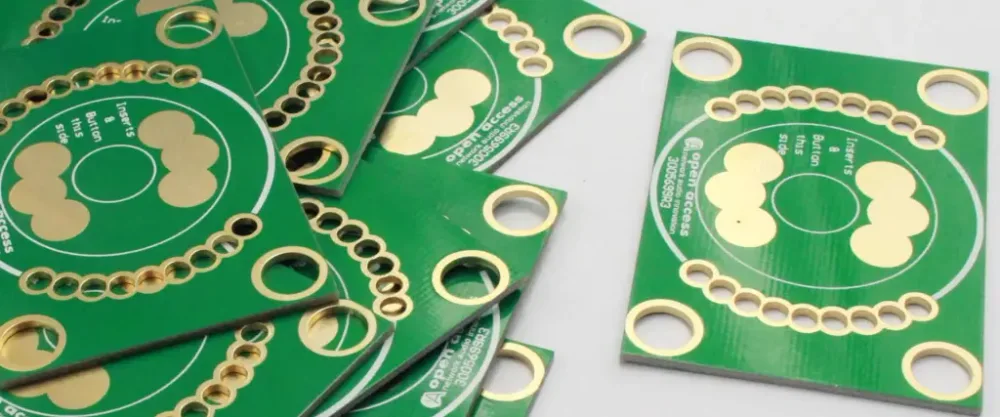
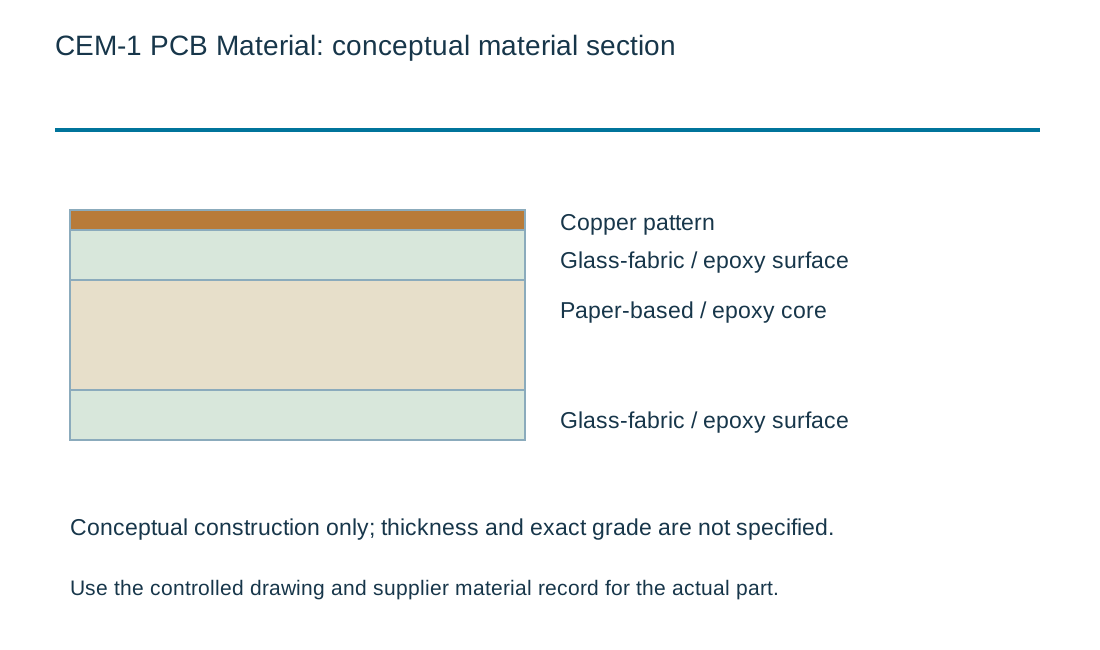
CEM-1 PCB material combines a paper-based core with glass-fabric surface reinforcement in an epoxy composite. That construction gives it a different position from both paper-phenolic materials and all-glass FR-4 laminates. Selection should follow the board's electrical, mechanical, fabrication and assembly requirements rather than a generic claim that one material is always best.
This page explains the construction and quotation questions. Its mass worksheet accepts your declared composite density and copper coverage, while the optional allowance tool keeps tooling and recurring cost separate. Example inputs are assumptions and are not certified CEM-1 properties.
Understand the composite section
The reinforcement arrangement is part of the material identity. Glass at the surfaces and a paper-based interior do not form the same composite as a laminate reinforced throughout with woven glass. The resin system, reinforcement proportions and supplied grade also influence the final behavior.
Use the original supplier material information when specifying a grade. The Eternal Materials product-family information provides context for CEM-1 construction, but a family description does not fix every processing or performance value. Keep the exact product document, supplied thickness and copper with the purchase record.
CEM-1 comparison questions
| Record | Meaning | Avoid this shortcut |
|---|---|---|
| Reinforcement | Paper core and glass surface construction | Not all-glass FR-4 |
| Density | Exact grade or labeled assumption | Not an inherited FR-4 constant |
| Cost comparison | Same outline, quantity and acceptance | Not raw sheet price alone |
Choose the construction from the board task
State the circuit function, hole requirements, mechanical mounting and intended assembly process. A board with relatively simple routing can still have demanding environmental or insulation requirements. Do not infer suitability from component count or the low complexity of a schematic.
Ask the fabricator to review the proposed material and features together. If the design needs a different interconnect structure or a more demanding process, an alternative may be appropriate. The decision should explain which requirement controls the choice instead of describing CEM-1 as a universal middle point between two other materials.
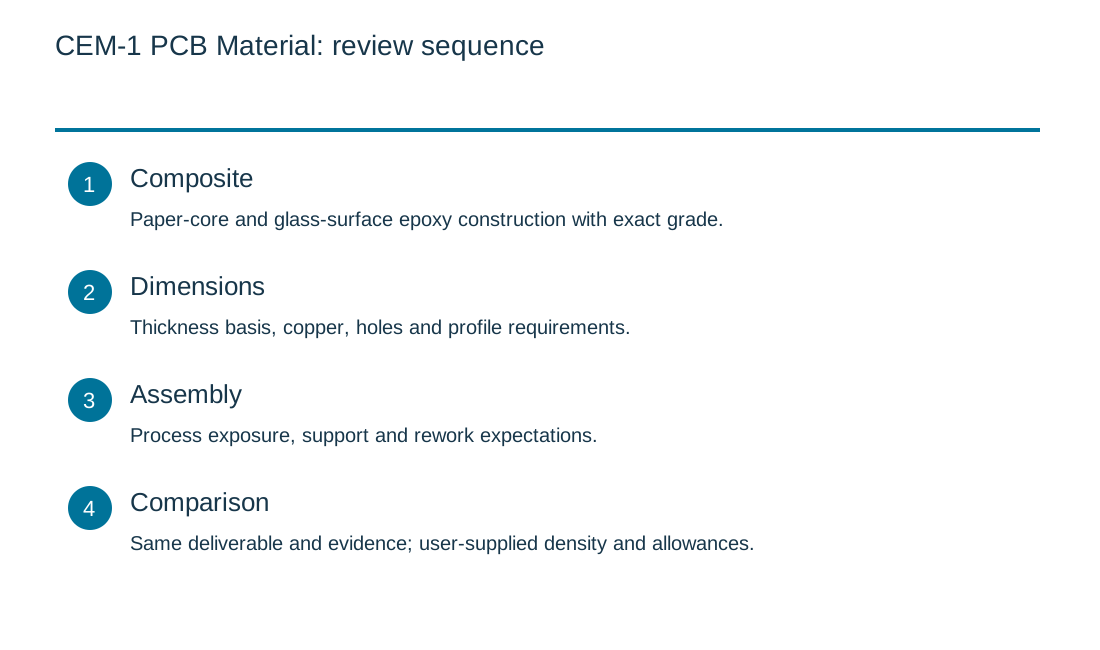
| Review item | What to establish |
|---|---|
| Composite | Paper-core and glass-surface epoxy construction with exact grade. |
| Dimensions | Thickness basis, copper, holes and profile requirements. |
| Assembly | Process exposure, support and rework expectations. |
| Comparison | Same deliverable and evidence; user-supplied density and allowances. |
Specify copper, thickness and profile clearly
Keep the dielectric thickness basis separate from copper cladding. Identify the outline method, holes, slots and critical mechanical dimensions. Tooling and profile requirements can materially influence the production route and economics.
For the thickness convention, use the PCB core guide. The same arithmetic distinction applies even when the composite reinforcement differs. A nominal sheet thickness without a measurement basis can create an avoidable disagreement between the stackup, purchase order and finished-board expectation.
Laminate and retained-copper mass estimate
Laminate and retained-copper mass estimate
Use the current inputs and keep the assumptions
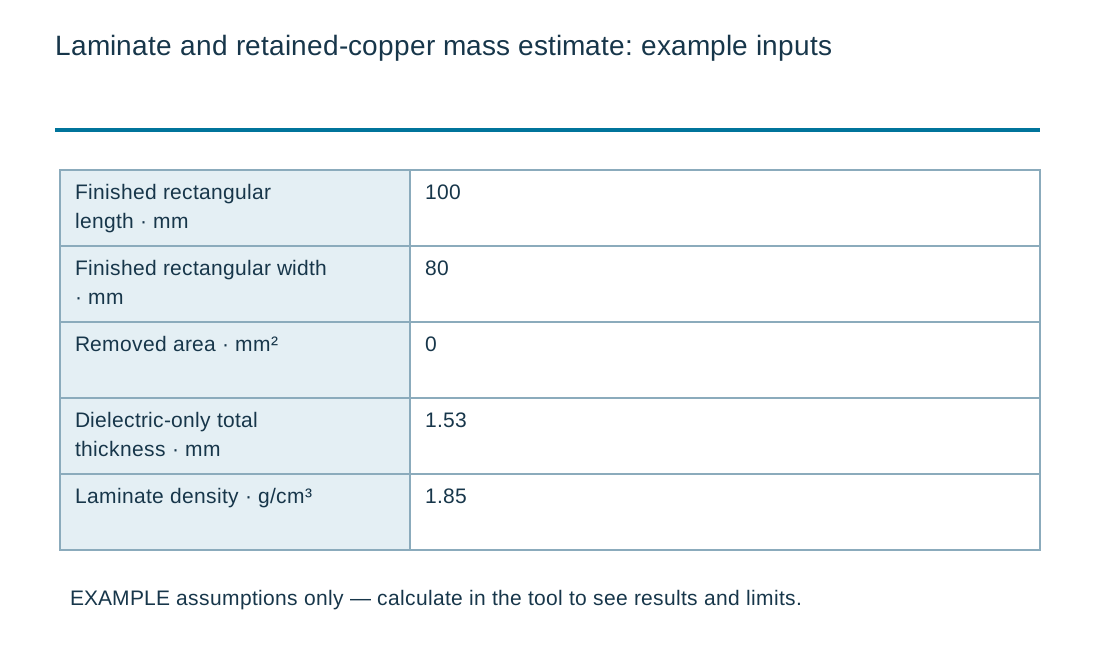
Start with the example only to inspect the units and the calculation boundary. Replace every assumption with a value tied to your own document or measurement. An empty numeric field is not zero. The review-reference field is a local label; avoid entering customer names, confidential part numbers or other private information into a public worksheet.
After calculating, read the notes alongside the numerical result. Changing any input invalidates the displayed result and disables its download until you calculate again. For a comparison, keep the units, geometry, material condition and measurement boundary consistent. A long decimal result does not imply equally precise input data. The downloadable record stays on your device and can be attached manually to an inquiry. It is not automatically transferred into the Contact form.
If an input is unknown, identify the person or document needed to resolve it. Do not fill a gap with a favorable generic value simply to obtain a result. You can request a material or fabrication review without using the tool. The arithmetic illustrates a relationship; it does not accept a construction, certify a material, establish current pricing or replace a supplier process specification.
| Input | What to establish before using it |
|---|---|
| Review reference | Nonconfidential revision label. |
| Finished rectangular length · mm | Bounding rectangle; cutouts are entered separately. |
| Finished rectangular width · mm | Use the same physical boundary for every layer. |
| Removed area · mm² | Through cutouts excluded from both substrate and copper in this simple model. |
| Dielectric-only total thickness · mm | Exclude all copper to avoid double counting. |
| Laminate density · g/cm³ | Project assumption or exact grade data; this example is not universal FR-4 density. |
| Sum of copper thicknesses over layers · µm | Final copper thickness sum; each layer assumed to have the same entered coverage. |
| Mean copper coverage · % | Area-weighted coverage when thicknesses are equal; otherwise use thickness-weighted coverage. |
Optional cost comparison from your own allowances
Use a quotation or a clearly labeled internal assumption for each input. Keep the quantity, construction and inspection scope the same when comparing alternatives. This uncalibrated planning model adds entered values; it contains no current market rates and does not issue a RAYPCB quotation. You can contact the team without completing it.
Optional project allowance comparison
Estimate mass without inventing a density
The mass tool is deliberately input-driven. Enter the exact grade's density or a clearly labeled planning assumption, dielectric-only thickness, copper-thickness sum and coverage. Do not copy the FR-4 example density simply because the calculator can accept it.
If a reliable density is not available, request supplier data or use a representative measurement with a declared boundary. The result should identify what is included and excluded. Coatings, plated features and components can make the finished assembly differ from a dielectric-and-copper subtotal.
Worked comparison: changing more than the sheet price
Consider a hypothetical single-sided board being reviewed in paper-phenolic, CEM-1 and FR-4 constructions. Hold the outline, copper, quantity and acceptance scope constant initially, then record any design or process changes required by each candidate. A lower sheet allowance is only one part of that comparison.
The FR-1 panel guide and FR-2 replacement guide address related but separate decisions. Use them when those constructions are genuine alternatives. Avoid creating a comparison table of unsupported universal temperature or strength values; request comparable data for the actual candidate grades.
Review assembly support and thermal exposure
Record the intended soldering process, number of thermal exposures, handling and rework expectations. Keep the board supported appropriately for the actual manufacturing route. A material description alone does not approve every assembly profile or every component-loading arrangement.
If a change is proposed for cost reasons, ask whether existing process evidence remains applicable. Mechanical and thermal behavior can affect handling and acceptance even when the circuit is unchanged. Preserve any qualification or first-build review as a defined task rather than assuming all alternatives can use the old process unchanged.
Make cost inputs comparable
Separate one-time tooling and setup from recurring fabrication and test allowances. Record panel assumptions, quantity, scope and price validity outside the calculator. The tool adds the values supplied by the user and does not predict yield or issue a live quote.
For a meaningful decision, include any additional inspection, documentation or assembly support. Compare the delivered board under the same acceptance requirements. If one proposal changes the material or outline process, identify that change explicitly instead of presenting the two unit prices as though they represent identical work.
Prepare the material and fabrication review
Send the controlled artwork, drill and profile data, thickness and copper requirements, quantity, intended assembly process and environmental conditions. State whether CEM-1 is fixed or an alternative may be considered. Include the property or cost question that motivates the review.
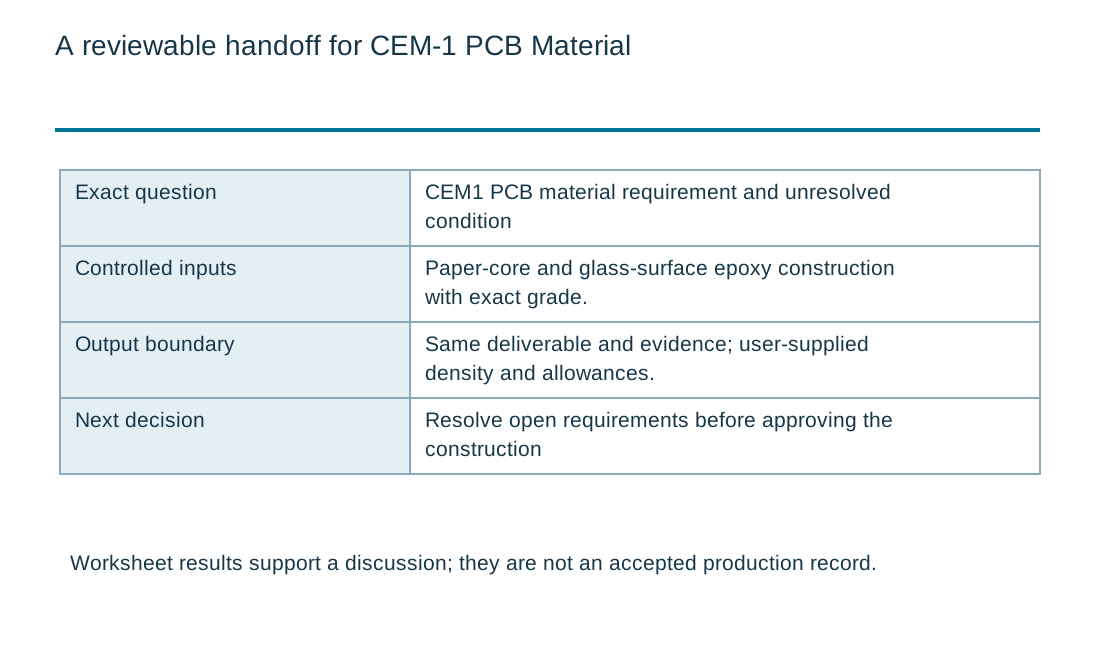
A useful response should identify the proposed exact material, process scope, required evidence and open exceptions. The worksheet output may be attached manually if it clarifies assumptions, but the drawing and acceptance requirements remain the basis for the quotation and manufacturing agreement.
Specify the construction behind the material label
The finished board combines a dielectric, copper patterns, holes, surface coatings and a manufacturing history. Its behavior cannot be inferred from a family name alone. State the supplied grade, reinforcement, thickness, copper and processing conditions that matter to the intended application.
Keep handling and assembly requirements with the fabrication drawing. A thin panel, punched outline or unusual support condition can change the production route even when the electrical circuit is simple. Ask the fabricator to review the actual features and panel format rather than assuming a dimensional example represents a production capability.
For cost comparison, hold the drawing, quantity, test scope and acceptance requirements constant. Record one-time tooling separately from recurring work, and distinguish raw material utilization from accepted-board yield. Any calculator on this page uses supplied assumptions; an actual quotation requires the files and an agreed scope.
Standards, source context and limits
Use the edition, amendment and material-document revision named in the purchase agreement. A standards title, marketing label or supplier product family does not establish that a particular lot meets a requirement. Public summaries are useful for scope; the controlled specification and applicable test method govern acceptance.
The examples on this page are illustrative engineering scenarios. They are not RAYPCB production records or guaranteed material values. Source links identify the organizations responsible for the referenced information. Confirm applicability to the exact grade, construction and test condition before carrying a number into a drawing or qualification report.
For fabrication scope and the agreed construction requirements, see PCB manufacturing.