Ever heard of an aluminum electrolytic capacitor? Sure, you have heard about capacitors being one of the power-driving components in electronics but when it comes to what an aluminum electrolytic capacitor does – it can be confusing right?
Well, in this article, we are going to reveal just what this type of capacitor is and the role it plays in enhancing the performance of consumer electronics.
What is an Aluminum Electrolytic Capacitor?
Wikipedia, the free Encyclopedia, defines it as a “polarized electrolytic capacitor whose anode electrode (+) is made of a pure aluminum foil with an etched surface.”
But just what does it do? The primary use is to smoothen or buffer the rectified DC voltages in many consumer electronics.
Digi-Key breaks it down further by highlighting that the electrolyte in the capacitor serves a major purpose of acting as a cathode. On the other hand, the thin insulating layer of aluminum oxide acts as the dielectric for the capacitor.
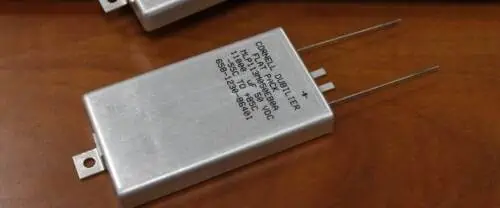
Having known this, what exactly is the function of MLP113M050EB0A? As per the information in the datasheet, it is an aluminum electrolytic capacitor that has a higher impedance ratio, a high temperature range and ultra long life.
MLP113M050EB0A is subject to two (2) major life tests – the endurance life test and the shelf-life test.
Both tests proved that MLP113M050EB0A is worthy of lasting for many years. For example, the shelf-life test returned a DCL and an ESR of 100% of limit each. It also returned a 100% of limit for the capacitance.
On the other hand, the endurance life test returned an ESR of 200% of limit; a DCL of 100% limit and a capacitance of ±10%.
High-Energy Storage
The capacity to store energy is one important factor to consider when choosing an aluminum electrolytic capacitor. Thankfully, MLP113M050EB0A has enough provisions for that.
It drives a high-energy storage via the Type MLP’s design that also provides for a box-shape model. With these two in place, it is now possible to use MLP113M050EB0A to implement both filtering and voltage holdup in computer cards, military SEM-E modules and telecommunication circuit packs.
Ripple Current Doubling
MLP113M050EB0A also enables a ripple-current doubling and with this in place, it would be possible to double this capacity to the maximum.
But first, let us understand what the ripple current is all about. It is a mechanism in place to help ensure or assure that the case or package for the MLP113M050EB0A doesn’t exceed or go above the recommended 0.5-inch height.
For the capacity to be doubled, the core setting of using the maximum permissible internal core temperature of 88˚C would be needed.
These capacitors are said to be “polarized” because of what is known as the anodization principle. It is a working principle that helps detail how the capacitors are to function.
These are some of the important facts about the principle:
2. DC Voltage Operation
One fact about the anodization principle is that it makes the MLP113M050EB0A to work with a DC voltage operation. In this instance, the DC voltage is to be applied with the correct polarity.
Otherwise, making an inappropriate addition of the polarity could cause the component to have a short circuit. If left unattended, it is possible to lead to component damage or malfunction.
3. Understand the Typical Applications
Aluminum electrolytic capacitors like MLP113M050EB0A are mainly used with DC-to-DC converters and power supply-centric applications. There are more of these applications.
The capacitors can also work well with industrial power supplies, the converters used in wind power plants and with switched-mode power supplies.
These capacitors can also be used with specific applications, such as the frequency converters. In this case, they are to be used with the likes of:
For these capacitors to work efficiency, there have to be certain materials that boost the function. Examples of these materials are:
4. The Separator
The separator in an aluminum electrolytic capacitor is the material that demarcates or separates one component from the other.
The separator’s characteristics include an absorbent paper with high-purity. The paper helps to protect the two metal foils from having a direct contact.
Without the separator, it is possible for these foils to not just have a direct contact, but also cause the device to have short-circuit problems.
5. Anode
This is the capacitor’s basic material. It is made to aid an increase in the capacitor’s electrode surface. The increase is needed to smoothen the capacitor’s surface.
Worthy of mentioning is that the anode paves the way for the formation of aluminum oxide. Upon formation, the aluminum oxide helps to protect the metallic aluminum against the harsh or aggressive chemicals that come from the electrolyte.
6. Cathode
At a point, it becomes imperative for the aluminum electrolytic capacitor’s components to make a contact. It is the duty of the cathode to make this happen.
The cathode is a dedicated aluminum foil used to establish an electrical contact between the electrolyte and the capacitor.
In addition to being etched to enlarge the capacitor’s surface, the cathode is particular about how the connection is made. That is why it mostly uses alloyed metals like titanium, copper and silicon. These metals are used to increase the impossibility of oxide to form during the discharge process.
The cathode also regulates the capacitor’s susceptibility to be resistance to the electrical contact made to the electrolyte by alloying the foil with the aforementioned metals – copper, titanium and silicon.
Final Words
MLP113M050EB0A creates a polarized aluminum foil that forms an insulating layer, delivers up to 20 joules of energy storage and acts as the dielectric of the aluminum electrolytic capacitor
We are in a world where a lot of exciting innovations are being made. The Internet of Things (IoT) has brought about a connected world of information exchange. IoT has contributed to a lot of development in the world as a whole. However, the IoT experienced some drawbacks. One of the major drawbacks was the massive economic nightmare posed by batteries.
The installment, replacement, and maintenance of batteries is not a lasting solution. Batteries won’t be able to power several sensors that will be used in the future. Therefore, scientists and engineers have come up with an everlasting solution. This solution is energy harvesting. Also, energy harvesting offers a long-lasting solution to this energy problem. Read more to have a detailed knowledge about what energy harvesting is all about and how it works.
Humanity has been able to achieve a great feat as regards technology and civilization. All of these achievements can be fundamentally attributed to the ability to produce energy and deploy energy. We utilize nearly 607 quintillion joules of energy every year across the globe. The rapid population growth is contributing to energy consumption and needs.
According to estimates, energy expenditure across the globe will be about 777 quintillion joules. These figures are huge. This is one of the reasons energy shortage issues is usually featured in global policymaking. Also, there is a global panic about the environmental impact of depleting fossil fuel reserves. In spite of concerns about decreasing fossil fuel reserves, it is evident that meeting our energy demands will be a mammoth challenge.
However, innovation has continued to bring hope for humanity. This hope is simply based on the fact that innovation can provide a solution to energy shortage.
Energy harvesting, which is also called ambient power or energy scavenging has to do with the process involved in capturing energy and converting it from its surroundings into electricity. This energy could be used at once or kept for use in the future.
Energy harvesting functions through the harnessing of small quantities of ambient energy that is wasted or dissipated in form of light, vibration, heat, etc. As a technology, energy harvesting is in its nascent stage. This in no way is an answer to all the woes related to our energy today. However, it holds a great promise regarding the powering of low power electronics. Furthermore, with the quick expansion of the IoT market, this means a huge potential for the technology.
Therefore, in RayMing’s application that run from any battery type means that you add a boost or step-down circuit with that regulator’ added cost. Also, one might have chosen one of the few microcontrollers, which can run from a single cell or lithium cell alkaline battery. Whichever way, a huge premium is included to your bill of materials as a result of the extra components or from the sourcing of the premium priced microcontroller.
What does Ambient Energy mean?
At any specific time, you can find energy all over us, which will go to waste. For example, as a result of the predominance of mobile devices and electronics, we are bathed constantly in oceans of WiFi signals and radio waves. Usually, our surroundings are clouded with usable energy, which could help in powering our electronics when stored and harnessed.
At times, a new app, which is launched by Richard Vijgen (Dutch designer), referred to as Architecture of Radio, helps in visualizing the invisible and massive energy field around us, all the time.
Also, these signals only represent an ambient energy form. Also, ambient energy could be energy coming in form of vibration or sound, heat, or light. For example, majority of power stations globally employs turbines that convert heat into mechanical energy. This is now converted into electricity.
Furthermore, this process is an inefficient one, with more than two-thirds of its energy input lost to our surrounding as heat. Also, just one third of the converted input serves as usable electricity. Potentially, you can harvest energy from all these sources. Although for now, not all are feasible technologically.
The technologies of energy harvesting come in different types. This is based on the energy source. Moreover, all systems for energy harvesting, in the simplest form, is made up of three major components, coupled with the energy source.
Harvester/Transducer: The harvester or transducer is a part of the energy harvesting system, which helps in the conversion of ambient energy from its source to electrical energy.
Load: This forms a part of the energy harvesting system that could include either electronic devices, which consume any harvested energy like sensors, actuators, circuits, chips, etc, or the energy storage components like super capacitors, capacitors, etc.
Interface Circuit: As for the interface circuit, it helps in extracting the highest possible energy from its transducer and then ensures that the energy is useful through conditioning it in a great form for desired applications. This is through voltage regulation, voltage rectification, etc.
Types of Energy Harvesting
There are various sources of ambient energy which include:
Kinetic energy
RF energy
Light energy
Thermal energy
Solar energy harvest
Photovoltaic cells are commonly used to harvest solar energy. These cells transform light energy into electricity with the help of “photovoltaic effect.” Also, the photovoltaic effect is a principle that involves a process in which photons transform electrons into a greater energy state and as such causing the generation of electric current. PV cells are in four different categories which are:
Emerging PV technologies
Thin-film cells
Single and multi-junction cells
Emerging PV technologies
Since PV cells are quite expensive, one can use photodiodes to harness energy and supply energy for low-power devices like IoT edge-devices. Also, LEDs are less expensive compared to photodiodes. However, photodiodes are better as they provide more energy. Therefore, photodiodes is an ideal optio for harnessing and providing energy.
Piezoelectric transducers are commonly used in harvesting kinetic energy. Also, Piezoelectric transducers generate electricity from kinetic energy using movements or sounds. The transducer transforms the kinetic energy to an AC current. The AC current is the stored in a super-capacitor or a thin-film battery.
Below are examples of Piezoelectric harvesting:
Batteryless remote control units
In this remote control unit, piezoelectric transducers transform the force of the buttons pressed in the energy that provides power to the IR signal of the remote.
Pressure sensors on car tires
The inside of car tires features piezoelectric energy-harvesting sensors. Also, these sensors regulate the air pressure in the tires and transmit the information to the dashboard.
Piezoelectric floor tiles
Some pavements feature piezoelectric floor tiles. These floor tiles transform the kinetic energy from pedestrians’ steps into electrical energy. Also, this electrical energy is further used to power applications such as ticketing systems and displays.
Thermal energy harvest
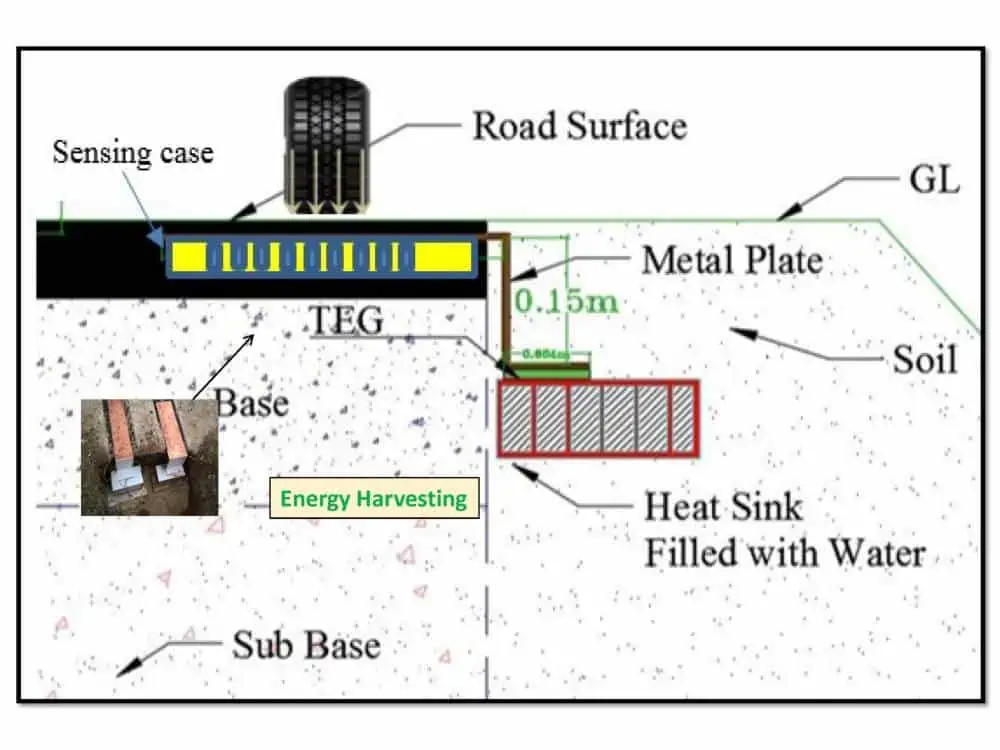
The majority of electrical systems produce heat. Therefore, this accounts for the proportion of dissipated energy. The harvesting of thermoelectric energy is simply based on the Seebeck Effect principle. This principle describes a situation where a difference in temperature between two conductors junction results in increasing voltage.
Also, a thermoelectric harvesting system comprises a thermoelectric generator. This generator comprises various thermocouples linked in series to a heat source. Also, this heat source could be solar panel or engine. The amount of generated energy is proportional to the variation in temperature and also the TEG size.
Furthermore, thermoelectric harvesting helps to power wireless sensor nodes in high-temperature environments and industrial settings. It is ideal for use where there is a huge loss of heat.
RF is almost everywhere around us. Also, RF waves are usually broadcasted in the environment through mobile phones and other telecommunication devices. Some electronic devices also transmit RF waves in our environment.
The technology behind RF harvesting holds a large amount of promise. The reason behind this huge appeal is simple. RF waves is just like a “free energy” that is yet to be tapped into. According to a research, the number of mobile phones subscription was estimated to have exceeded 5 billion.
We can estimate how much energy around us when we add the number of subscription of other devices like microwave ovens, Wifi routers, and laptops among others. This energy is in the form of RF waves. The most reliable RF harvesting technology we have today is Wireless Energy Harvesting (WEH). Also, this harvesting technology is reliable due to its ease of use and simplicity. Radiofrequency waves pick up via an antenna which causes a possible difference across its length.
Therefore, this possible difference makes charge carriers to move along the antenna’s length. With the RF-DC integrated circuits, energy can now be converted from the movement into a DC current that is stable. This is then stored in a capacitor. It could be also used to power sensors.
RF harvesting has a wide range of applications. Also, you can use RF energy in low-power devices like wearable battery-free medical sensors. Furthermore, RF energy can help to wirelessly charge simple consumer electronics. At a wider range, there are other application areas of RF harvesting which include industrial control, automation building, and structural monitoring.
As energy harvesting becomes more popular, there is also an increase in the challenges they have to overcome. Usually, the power got from this energy harvesting is unstable and weak. Furthermore, the device’s power can also stop completely. This is why there is a need to consider measures against unexpected shutdowns.
Furthermore, if manufacturing and installing the devices used comes expensive, then the capacity of the energy harvesting has to be large so as to cover up for the cost. To achieve widespread application of this energy harvesting, then there is a need for low cost, high output, and high-efficiency harvesting equipment. Power consumption reduction of these devices will be important as well.
Furthermore, energy harvesting serves as a very important technology for the creation of networks for M2M and IoT devices. In order to realize future smart factories, smart homes, and smart cities that requires different data, then the development of advanced technologies for energy harvesting will continue.
Reasons why Energy Harvesting is Important
The Internet of Things (IoT) market can explode in a huge way. In a few years, the IoT sensors will have to number in high billions. Furthermore, the main aim of the Industrial Internet of Things is to automate the processes that ensure their efficiency.
Moreover, if the powering of billions of edge-devices and sensors which have to be deployed is done with batteries, then this could cause some other problems. You can deploy these sensors in areas that are difficult to reach.
This is one reason it could be a very difficult and stressful task when replacing its batteries. Furthermore, the replacement of the batteries indicates a cost in the long-term, which will be perceived as a massive pain and absolutely limiting by the adopters.
Furthermore, energy harvesting seeks to find answers to this bottleneck, most especially in very remote place, and areas lacking a power source close by. Also, it helps in negating the need to have man power based management. In addition, it promises more environmental sustainability and helps in reducing the carbon footprint.
Rayming offers a great solution for all IoT devices through the elimination of needing batteries. When there are no batteries, then there will be smaller designs, reduced BOM cost, and no maintenance. This is what Rayming PCB & Assembly has been able to achieve.
Furthermore, Rayming also offers PCB manufacturing, which is useful and applicable in different industries.
Conclusion
IoT (Internet of Things) is altering our daily lives’ landscape dramatically. In addition, these IoT devices are beginning to change our lives in so many ways. It may be the way we workout, shop, or drive, these IoT devices have successfully impacted our lives in different ways.
The Energy harvesting technologies have shown a great promise for the powering of this IoT explosion. Furthermore, with the deployment of more IoT devices in extremely hard-to-reach and remote locations, these batteries do not represent a solution that is very efficient for the powering of edge devices. However, making use of batteries isn’t too ecologically sustainable. Some technologies such as RF harvesting create new doors or opportunities for our quest to achieve the powering or our sensors and MCUs.
With the growing popularity of electronics, companies must find ways to keep up with the demand. They need to sell their products quickly and efficiently. This means they should produce and distribute them in a cost-effective manner.
As such, they will have to look for ways to reduce costs and increase delivery speed. One way of doing this is using stores that provide military electronics at affordable prices.
The biggest challenge facing these companies is that they are unaware which stores offer the best deals on military electronic products. As such, they waste time and money trying out different sites hoping for discounts on their purchases. Unfortunately, this can lead them down a rabbit hole where they spend more money than necessary to buy cheap electronic components from an unknown company without guaranteeing that their purchase will be delivered at the promised time or even arrive at all!
If you’re building military-grade electronics, you need a PCB manufacturer with experience producing this kind of board. The design and manufacturing process for these products must meet strict standards. A military-grade PCB manufacturer should have experience in various layouts and materials and be fully accredited and certified. And this is where Rayming Technology comes in as the PCB manufacturer to supply military electronics.
In recent years, there have been a lot of changes in the military market. The military uses many different types of electronic devices. Some for communication, and others for defense.
Military electronics are electronic systems that serve various purposes for the military. Teams of engineers design these systems and require high-performance electrical components. They must be durable and withstand high temperatures, harsh chemicals, vibration, and transient electrical noise. In addition, you must shield military electronics from sand and moisture. Finally, these electronics require engineering expertise and large-scale integrated circuits.
Only a company with experience and a proven reputation should manufacture military electronics. Additionally, these manufacturers must be code-compliant. This means that they have excellent standards and strict quality measures in production. As military needs continue to grow, these companies constantly advance and reinvest in their technology.
Military electronics use highly specialized materials. These materials include high-grade PCBs, military-grade capacitors, and aluminum. These electronics require a PCB with military-grade materials, and these components are made by companies that service the military industry.
Defense Electronics manufacturers are available in a vertical portal, allowing customers to find a reliable manufacturer to meet their unique needs. These manufacturers provide various services, including testing, inspection, PCB modification, prototyping, and more.
Military-grade PCBs require high-quality military-grade material. There is common use of high-temperature laminates and aluminum. Anodized aluminum is also common due to its oxidation resistance. PCB manufacturing for military systems requires lengthy development cycles and experienced PCB manufacturers.
Defence-grade PCBs must withstand extreme temperatures and harsh environments during the design process. Therefore, high-quality materials are essential to support the PCB under adverse conditions. Anodized aluminum and copper substrates minimize the risk of heat-induced oxidation and ensure durability.
We make military PCBs from high-quality materials specifically designed for the military market. They must meet all the electrical and thermal requirements of the military, as well as any applicable rigid-flex standards. Good materials for military PCBs include aluminum, copper, and high-temperature laminates. We anodize copper and aluminum to resist oxidation. High-quality military PCBs also use high-quality acrylic as a finishing material.
The PCB fabrication process includes selecting the right material and assembling the PCB. The process involves both surface-mount and through-hole techniques. A military PCB must meet specific criteria and have a complex design. In addition, you must test the final product to ensure its reliability and performance. This includes testing the assembly for electrical and thermal compliance and the board’s surface.
A Defence PCB manufacturer must have proper tools and expertise to complete the task. They should provide engineering support to their customers. In addition to having the right equipment and training to complete the PCB fabrication process, they should have a testing facility to ensure the final product is functional. Properly package Military PCBs for protection. Military PCBs are extremely sensitive to static, so pack them in antistatic bags to prevent corrosion and accidental damage.
The design of military PCBs must follow certain design rules, which include component placement, DFM, layer allocation, and cross-talk budgets. Military circuit boards also require a high-speed routing process. The right design software will allow manufacturers to place boards quickly and accurately. The rules for military PCB fabrication are unique and complex.
We can also use military PCBs in robotic systems, uncrewed vehicles, defense navigation systems, communications systems, and even security equipment. These devices require Defence PCBs because they must remain functional for an extended period.
Military-grade circuit boards are designed to be extremely durable and reliable. This is because they operate in extremely harsh environments and must last for years. Typically, military-grade PCBs are more expensive than commercial ones and require a higher quality and design. Additionally, military-grade PCBs should handle a higher current load and withstand harsh environments.
The manufacturing process starts with prebonding the copper layers on the PCB substrate. The application of photoresist follows this process. This is a type of film that hardens when exposed to ultraviolet light. However, the copper underneath is still soft. Therefore, after the photoresist has hardened, you remove from the military-grade PCB substrate, revealing the copper.
It’s important to find a supplier with a wide range of military PCB capabilities, including handling special orders and tight tolerances. You can also consider finding a Defence PCB manufacturer that offers engineering support and quick delivery capabilities. Making a military-grade PCB to meet your specifications will ensure the best quality and best performance.
The manufacture of high-quality military PCBs intends to meet high standards for thermal, electrical, and mechanical properties. The materials used in manufacturing military PCBs include high-temperature aluminum, copper, and laminates. Copper and aluminum can create high-temperature laminates to withstand high temperatures and humidity. High-quality military PCBs also feature thermal compounds and anodized aluminum.
Design guidelines for military PCBs
If you need to create a PCB for military use, there are a few design guidelines you must adhere to. First, you must adhere to the correct MIL (Military Indium Level) spacing. The spacing should be at least 0.005″ between traces and pads.
Another important guideline is to select the proper materials. Military-grade PCBs require materials that can withstand high operating temperatures. You can achieve this by using thermal compounds and high-temperature laminates. You must also ensure that the PCB meets industry standards and is tested for its intended application.
After selecting the right material, you should design the military PCB. Then, you should follow the guidelines for proper routing. The right material is essential to build a Defence PCB that lasts five years. A good design should also consider heat dissipation and component isolation.
Military-grade PCBs must be manufactured according to the strictest standards. They must withstand extreme conditions and must function faultlessly. The manufacturing process of these PCBs involves tight tolerances and parameters, so it’s important to work with qualified manufacturers. The guidelines in this category include MIL-PRF-31032 and MIL-PRF-55110.
The design guidelines for military PCBs differ greatly from those for civilian PCBs. Military-grade PCBs require additional features and materials. Among them, they must withstand high current levels. In addition to limiting the thickness, military-grade PCBs must also be manufactured with increased clearances between components.
Military PCBs should be reliable and durable, with minimal maintenance. In addition, they should meet IPC-A-610E Class 3 standards, the most stringent for military-grade electronic products. As such, they require special fabrication and assembly processes. Therefore, finding a manufacturer with the right experience and expertise is important to help you develop your Defence-grade PCB.
PCB manufacturers must ensure their products meet the specific requirements of military electronics. For example, PCBs used for military applications should be made of materials that can resist extreme temperatures. To meet these requirements, manufacturers should incorporate operating temperature margins in their designs. For example, high-temperature laminates using copper or aluminum are ideal for military applications. In addition, manufacturers should consider thermal compounding to prevent heat transfer between PCB layers.
Unlike PCB design for consumer products, Defence PCBs must meet stringent specifications. For example, military PCB designers must validate the quality of components to meet performance criteria and pass testing regimens. They must also select a contract manufacturer that can meet these strict requirements. In addition, they should choose a company with experience in designing PCBs for military electronics.
Military PCB designs must be free of high-frequency components, such as RF. High-frequency components can interfere with signals and create unnecessary noise. As such, they should be shielded to avoid interference. Additionally, a Defence PCB must conform to strict standards, including MIL-PRF-50884 and MIL-PRF-31032.
Military PCBs should be built to withstand the highest load currents and thermal conditions. They should also be designed to suppress ESD and meet important EMC standards. Power consumption is also important in military PCBs, especially for mobile electronic devices. Using the right PCB design software can help designers meet these requirements.
Military PCBs are critical in equipment that powers military systems. For example, RF PCBs in communication circuits and military radars. In addition to the above, military PCBs are vital in emergency response devices. These PCBs have to withstand high electrical amperage and high power supply fluctuations.
Manufacturers should choose high-quality materials to meet these needs when designing military PCBs. For example, the materials used for military PCB manufacturing should withstand extreme temperatures and humidity.
Considering the harsh operating conditions, chemicals, and contaminants that military electronics are subject to, PCBs must withstand these conditions. This requires careful consideration during PCB design, fabrication, and assembly processes. In addition, using materials that can withstand extreme temperatures and low oxidation is also essential.
How Computer-aided manufacturing is changing the military
The computer-aided manufacturing (CAM) market is expected to grow at a CAGR of 7.8% during the forecast period. Its growing demand is attributed to its benefits, such as reducing waste and energy. Additionally, it helps manufacturers in achieving high-speed production and better tooling accuracy. Further, the proliferation of advanced technologies in the manufacturing industry is driving this market.
The future battlefield will be highly complex, with an array of integrated systems and mechanisms. With high-bandwidth, multi-sensor integration and a unified information and command environment, a soldier can be a force multiplier. As a result, we require modernized supply chains and prepared optoelectronics manufacturers to meet these new demands.
However, the pace of technological progress on the commercial side is much faster than on the Defence. As a result, the DOD does not have access to the latest technologies. This means that its electronics have a longer lifespan than their commercial counterparts. As a result, it is constantly searching for specialized vendors to produce legacy microelectronics. Such devices are often unavailable on the commercial market and are made only through special agreements with the defense establishment.
Military electronics have different requirements than commercial electronics and often need to be more rugged. In addition, their design and production processes must adhere to international standards, and it can take much longer to make typical military electronics.
The Intended Standards Targeting Defence Devices
Printed circuit boards, or PCBs, are a vital part of many industries, from consumer electronics to the military. As a result, they must operate faultlessly under extreme conditions and meet strict standards. These standards are designed to ensure the integrity of these circuit boards, and require a high degree of precision and strict adherence to quality management.
Military electronics are often exposed to harsh environmental conditions, including high temperatures. As a result, it is vital to use high-quality materials that can withstand harsh conditions. Among these materials are high-temperature aluminum substrates, copper, and thermally-compounds. These materials can withstand extreme temperatures and can be designed to minimize heat transfer.
The requirements for military PCBs are often based on IPC-A-610E Class 3 standards. These standards describe the performance of high-performance electronics in harsh environments. Military and aerospace PCBs require special design, fabrication, and assembly practices. Moreover, these circuit boards are usually part of embedded systems that incorporate custom firmware, volatile memory, and communications capabilities. As such, they must be supplied by vendors who meet these requirements.
Printed circuit boards for the military must meet stricter standards and have a longer product life cycle than consumer products. In addition, they must withstand higher temperatures, greater use cases, and higher amounts of chemical and other contaminants. Military-grade circuit boards must also have a high-reliability level, which is necessary to support sensitive Defence electronics.
The Necessary Certifications for perfect execution
military and aerospace electronics
When a PCB manufacturer is involved in developing a military electronic product, they need certain certifications. The military uses IPC standards as a guideline for manufacturers. These standards are internationally recognized and are used to ensure high-quality products and services. They also provide certification for a wide variety of PCB manufacturers.
Generally, military PCBs must have strict tolerances. They also must pass rigorous test procedures. These specifications may differ depending on the industry and the PCB manufacturer. Therefore, it is best to check the website of prospective PCB manufacturers to determine whether they meet these requirements. For example, Rayming Technology, a leading industrial PCB manufacturer in China, is ISO certified and produces rigid and flexible PCBs.
The military relies on electronic components to operate. Because of this, the military has long been concerned about the quality of these components. This problem became more acute as the market for consumer electronics grew. Although various safeguards were introduced to prevent fake components in Defence systems, it is still difficult to secure the supply chain.
PCBs used in military electronics must be made of materials with good properties. For example, they need to withstand harsh chemicals, high temperatures, and humidity. They also need to be robust and reliable. These properties are crucial for the production of military electronics.
Pre-layout simulations for optimization
Military printed circuit boards undergo rigorous testing. These tests include signal noise sensitivity, power levels, and signal generation. In addition, the circuit board prototypes must pass a Design Rule Check (DRC) during the design phase. After the prototypes pass these tests, we send them to the fabrication stage.
These simulations help manufacturers to optimize the design by assessing design trade-offs. For example, these simulations can identify potential signal quality, timing, and manufacturing tolerances. They can also determine potential design changes. In addition, we can use pre-layout simulations to evaluate if certain changes are necessary.
When designing a PCB for a military electronics application, it is important to understand how it performs in different environments. In addition to meeting the specifications of military electronics, designers must be aware of the materials in use. High-quality heat-resistant materials, such as Pyralux AP, are crucial. When considering a material, it is also important to consider the temperature of the surrounding components.
In addition to a design for the testing phase, PCB manufacturers can simulate their designs before production begins. This helps them detect any defects or design violations before production. They also help prevent expensive rework during the production stage. Furthermore, this step helps them ensure quality PCBs for military applications.
A PCB’s surface coating significantly impacts its shelf life, reliability, and solderability. Several different surface coatings are available, and the best one depends on your needs. For example, you need a coating that is resistant to moisture and solvents and easy to rework.
The best surface coating for your PCB is a conformal coating, which is a thin film of polymer you apply to the entire surface of a PCB. It protects electronics from corrosion and moisture and ensures reliable operations in harsh environments. This type of coating is especially useful for aerospace and marine electronics, where the spacecraft must perform with a high level of reliability.
There are two main types of PCB surface coatings. We refer to the first one as a wet film thickness gauge, which comprises a series of notches and teeth inserted into the wet film. Then, we multiply this measurement by the percent-solids content of the coating, which gives you the dry coating thickness. You can also calculate the standard deviation between measurements to determine the uniformity of the coating.
Surface coatings on PCBs are important for Defence electronics because they protect the electronic components and the board surface from harsh environments. In addition, the coating prevents corrosion of components and solder joints, which reduces the likelihood of short circuits. It also increases the durability of the printed circuit board.
Functional testing to determine the precision
PCB manufacturers perform functional testing to ensure that the finished product will perform as intended. These tests involve testing the PCB and its components in simulated environments. We connect the boards to the same systems as the finished product, allowing engineers to test component values and monitor the failure modes. These tests also help the PCB manufacturer prevent costly replacements.
A PCB must pass several tests, including solderability, resistance to solvents, and moisture. It must also pass a micro-sectioning analysis to ensure no defects. The PCB must also pass an ionic contamination test, which checks for corrosion or ionic residue. Another test, the TDR impedance test, verifies the proper function of a signal. The test also looks for the presence of defects and other issues.
PCB manufacturers must follow a specific strategy to test their circuit boards. The test approach should fit the product’s manufacturing volume and end-user market. The strategy should include several factors, including the cost of PCB manufacturing. The goal is to maximize fault coverage without compromising reliability. To accomplish this, the PCB manufacturer should first understand the types of faults that may occur in the electronic components. Then, it will select the appropriate test combination.
While most PCB manufacturers do not have complicated equipment to perform functional testing, they can still perform other types of PCB functional tests. Some of these methods involve building a fixture, which may prolong the manufacturing process. Another type of PCB functional testing is bed-of-nails, which involves aligning multiple pins with probes. Usually, we perform this type of testing during production.
Defence PCB design requires a higher level of quality and reliability. Military PCB suppliers should be familiar with the military’s standards and meet AS9100 quality management standards. The company should also be willing to provide an engineering support team to help you with your project. The company should also provide a reasonable lead time.
The first step in the fabrication process is choosing the material for the military PCB. You can use several materials, including copper, FR4, iron, and metal core PCB. After selecting the material, a design engineer checks the design for errors and prints it out on film or laminate. After this step, fabrication begins.
Military PCBs are specialized boards for connecting electrical components. Their design ensures they withstand harsh environments, such as high humidity and harsh chemicals. Therefore, the final product must withstand these conditions and be as durable as possible. A good military PCB is also highly resistant to heat, so it may require thermal compounds, additional traces, or high-temperature laminates. However, no matter how tough and rugged the military PCB is, it must pass rigorous testing to prove that it performs as intended.
Military PCBs must adhere to specific IPC standards. Therefore, the manufacturing process must be as precise as possible. They take a lot of time, energy, and money to create. Unlike civilian PCBs, military-grade PCBs should be durable and last five to fifteen years.
Due to their high-temperature requirements, testing of the PCBs happens in a controlled environment to ensure they are compatible with the temperature. In addition, high-frequency components may cause issues, and it is best to separate them in a separate layers. You can use spacers to protect the board surface and components.
If you’re putting together a new product, it’s important to have a solid PCB design. The layout should indicate which components are likely to fail and should identify the circuit blocks by name. You should also include your logo to add style and branding. You’ll also want to have a third-party engineer review the layout to check for errors. For example, check that all blocks are similar and that no components are placed at weird angles.
After completing your design, you should have it checked by Rayming PCB. Ensure you check the PCB for continuity, electrical, and design rules. This will help eliminate any design errors and improve the board’s functionality. If the PCB is free of errors, you’ll move components and see if they fit properly.
If your device requires a lot of pins, you’ll want to make sure that it’s breakoutable. You accomplish this by routing traces that run along the perimeter of the device. If you need to make multiple traces, use multiple vias. This will reduce the impedance of the signal tracks.
PCB designers face numerous challenges in their work. For example, with the size of electronic items shrinking, they have to determine the best placement for components while still meeting item specifications. Using time-proven constraint templates can help designers meet these challenges. In addition, they can help shape a new PCB design or upgrade a current one.
After completing your PCB design, you’ll need to test it to ensure it’s compatible and meets all requirements. There are many variables to consider, including bare board constraints and the location of the components. Once you’ve completed these steps, the manufacturer can start the process of Defence PCB manufacturing.
The history of aircraft electronics is fascinating and full of remarkable developments since electronics is a dynamic field. It may be challenging to stay up to date with the newest advancements in technology and applications. In addition, over the last few decades, aviation electronics have become more advanced. They’re crucial today in aircraft design, development, in-flight control, and navigation. Pilots can fly safely and effectively in any weather with aviation electronics. Notably, aviation electronics have progressed from radio and radar to modern systems. Engineers have incorporated electronic communication and navigation systems in early flight. For instance, the jet engine’s increased speed and altitude have presented new obstacles for aviators. Now they must require electronic equipment to fly faster and higher while communicating and navigating. The following information talks more about aviation electronics.
Aviation electronics have a long and fascinating history. It is jam-packed with several firsts and incredible advancements.
The radio was the first electronic gadget used in flying. It transformed how aircraft could communicate with one another and the ground in the early 1900s. That of the radar swiftly followed the development of the radio. It, therefore, revolutionized aviation by making it possible to locate and track aircraft even during inclement weather.
Other electronic breakthroughs, like the creation of the autopilot and the first electronic flight instrumentation, came after the invention of the radar. These tools, which are still in use today, significantly improved flying safety and ease.
The invention of the GPS was the next big breakthrough in aviation electronics. The technique made navigation simpler and allowed for highly accurate aircraft tracking. The creation of the electronic flight control system came after the GPS. This method, which is still in use today, increased the safety of flying.
What Are Aviation Electronics?
The term “aviation electronics” encompasses many aviation-related electronic devices and systems. Furthermore, these systems range from modest electronic devices used for navigation and communications to more complicated systems utilized for aircraft control and flight management. We can classify these electronics into the following two major categories:
Flight control systems
Avionics
Flight Control Systems
Flight control systems are electronic systems that regulate an airplane’s flying path. They include the autopilot, flight management, and flight control unit.
Aircraft employ autopilots to enable pilotless flight. Various automated systems, such as those that steer, throttle, and land a vehicle, are available. Aircraft with installed autopilot systems can fly autonomously with the system without the pilot’s input. By integrating auto-throttle technology into an airplane, pilots can automatically control their engine’s throttle (s). In addition, with the use of Autoland technologies, we can quickly achieve automatic Aircraft landings.
To help pilots with flight planning and navigation, airplanes employ flight management systems. Technologies such as GPS, GIS, and flight planning systems are among these systems. Planning your flight with precision is now easy using a flight planning system. In addition, aircraft rely on navigation systems to get from point one point to another. Furthermore, analyzing an aircraft’s performance requires using aircraft performance analysis systems.
Aircraft rely on flight control systems to steer them safely through the air. A few examples are air traffic control systems, ground control systems, and the systems used to direct the movements of aircraft in flight. In addition, airplanes rely on flight control systems to guide their flights. The regulation of air traffic also requires employing air traffic control systems. However, we can quickly achieve aircraft ground control by using ground control systems.
Avionics
Navigating and communicating with other planes is impossible without avionics. Examples of these systems are in-flight radios, nav systems, and communication devices. Satellite radios, data radios, and regular voice radios are examples of these avionics. For example, aircraft and ground control communicate using voice radios. In addition, pilots and ground control personnel can exchange data using data radios. Moreover, airplanes and satellites can talk to one another via satellite radios.
Aircraft rely on navigation systems to get from point to point. Among these are satellite navigation systems, those that operate in the air, and those that run on the ground. Aircraft on the ground rely on ground-based navigation systems, whereas air-based navigation systems assist in in-flight navigation.
Developed communication technology facilitates information exchange between the aircraft and ground stations. Examples are the telephone network, the internet, and satellite television. Voice communication devices allow pilots and ground crew to talk to one another while in the air. In addition, aircraft and ground stations can exchange data using data communication devices.
Both military and commercial aircraft utilize a range of aviation electronics. We can broadly categorize them into four groups:
1. Navigation and communication: These systems assist pilots in maintaining radio contact with air traffic control and navigating their aircraft. Radios, transponders, and GPS receivers are common examples.
2. Flight control and guiding systems help pilots fly and steer the aircraft. Autopilots, flight directors, and electronic flight instruments are a few examples.
3. Identification and surveillance systems: These systems enable pilots to distinguish between friendly and hostile aircraft and prevent collisions with other aircraft. Radar, TCAS, and ADS-B are among these instances.
4. On-board management systems: These systems support the monitoring and managing of the aircraft’s many systems. They could be controllers for cabin pressurization, fuel management systems, and engine monitoring systems.
Characteristics Of Aviation Electronics
The following are the features of aviation electronics:
Aviation electronics must function dependably in an airplane’s challenging and frequently hostile environment, which is one of its primary requirements. As a result, they must comprise materials that can survive pressure, vibration, severe temperature fluctuations, and altitude.
Aviation electronics must also be able to communicate with other systems on the aircraft, which is another essential feature. The aircraft’s light control or navigation system may fall under this category. The user interfaces must be intuitive and straightforward, even in a demanding flight environment.
There are presently many “fail-safe” aircraft electrical systems on the market. Consequently, the other system components can continue to work even if one part fails. This crucial safety element lessens the possibility of an aircraft’s destruction by a single malfunction.
Present-day electronics are essential to the commercial aviation industry. Whether it’s the flight management system that directs the plane’s navigation or the in-flight entertainment system that keeps passengers occupied, designers have equipped today’s commercial airplanes with cutting-edge technological technology.
Electronics in aircraft play many roles, such as ensuring that planes can fly without issues. Some of these systems are the flight management system, which keeps the aircraft on track, and the engine management system, which keeps an eye on the engines to ensure they’re working correctly.
Furthermore, aviation electronics not only make flying more secure but also make the process of flying more efficient. For instance, electronic systems can assist cut down on gas usage and pollution. Certain airlines have developed “green” projects using cutting-edge electronic aviation technology to reduce their adverse environmental effects further.
Last but not least, aviation electronics give a lot of data that enhances the efficiency of an airline. Information from the aircraft’s black box, for instance, aids in improving safety measures, while details about in-flight entertainment choices help tailor the experience for individual passengers.
What Are PCB Types Utilized In Aviation Electronics?
PCBs in aircraft electronics range from simple single-sided boards to intricate multi-layer boards. The type of PCB utilized relies on the circuit’s intricacy and the application’s needs.
Simple circuits may need a single-sided, the most fundamental PCB. A single-sided PCB contains all components and wires on a single side. Single-sided PCBs are the cheapest and easiest to build but have a limited number of elements to utilize, and the circuit needs to be more intricate.
Complex circuits may necessitate a double-sided PCB with conductors on both sides. The production of double-sided PCBs is more expensive, but they allow for more components and a more intricate circuit.
The most complex circuits may necessitate a PCB with numerous layers of conductors and components. Multilayer PCBs are the most expensive to produce yet enable the most sophisticated circuitry.
Similarities Between Aviation Electronics and Other Electronic Types
Aviation electronics and other sorts of electronics have a lot of commonalities. For instance, comparable materials, like semiconductors, are in both aircraft and other electronics to make their products. Furthermore, both electronics use photolithography and other similar manufacturing techniques to produce their goods. Additionally, comparable test and measuring tools apply in aviation and other electronics to guarantee the quality of their output.
The applications of aircraft and other electronics are another significant commonality. For instance, electronics in aviation and other fields find applications in data processing, communications, and navigation. Aerospace, automotive, and telecommunications are just a few of the sectors that employ both aviation and other kinds of electronics.
Their control style is another commonality between aircraft and other electronics. For example, regulations from the Federal Aviation Administration (FAA) and the European Union apply to aviation and different devices (EU). Additionally, international standards like those from the International Electrotechnical Commission (IEC) apply to aircraft and other electronic forms.
Differences Between Aviation Electronics and Other Electronic Types
The following are ways through which aviation electronics differ from other electronic kinds:
The Federal Aviation Administration (FAA) has established high performance and safety requirements for aviation electronics. Unlike other electronics, they must be vibration- and shock-resistant and able to function in various temperatures and altitudes.
Due to the strict criteria they must adhere to, aviation electronics are often more costly than other electronics. However, they provide years of dependable service in the worst conditions.
The cost of consumer electronics is often lower than that of aircraft electronics since they are mainly for indoor use. However, they are less robust and do not have to fulfill the same safety and performance requirements as aviation electronics.
Manufacturing and other industrial uses require industrial electronics. They must be durable but do not require to fulfill the same performance and safety requirements as aviation electronics.
The aviation industry cannot function without aviation electronics. The electronics resist the severe circumstances prevalent in airplanes and intend to fulfill high safety and performance criteria. Aviation electronics are more costly than other electronics but last for many years with little maintenance.
Top 6 Aviation Electronics Manufacturers
Rayming Technology
Rayming Technology is a prominent producer of aviation electronics, serving the aviation sector with an extensive selection of high-quality equipment.
The company places a significant emphasis on research & development and constantly innovates to bring new and better goods to market. Furthermore, the firm employs highly trained engineers who love aviation and electronics, continually pushing the limits of what is possible.
The products of Rayming find application in various aircraft, ranging from tiny private planes to huge commercial jets. The company’s products are famous for their dependability and performance, and they have worked excellently in some of the most challenging conditions.
Notably, Rayming has a long history of supplying the aviation sector with high-quality goods and services and has earned a solid reputation. The firm is devoted to providing its clients with the highest quality goods and services and exceeding their requirements and expectations.
Rayming’s products bear support from a team of knowledgeable customer care and technical support personnel who are always available to assist. Additionally, the organization has an extensive website that offers clients various information and tools.
Rayming is a widely esteemed brand in the aviation business and a reliable provider of high-quality goods and services. The organization is devoted to providing its clients with the finest solutions and exceeding their requirements and expectations.
Garmin
Garmin is a global leader in designing and producing navigation, aviation, and communication equipment.
Garmin’s headquarters are in Olathe, Kansas. The company is dedicated to quality, innovation, and customer satisfaction and has more than 12,000 workers.
Over 100 countries use Garmin’s aviation devices for civilian aviation, air transport, and military purposes. Furthermore, the company offers an extensive selection of integrated avionics, transponders, GPS navigation, and communication systems.
Integrated avionics solutions from Garmin give pilots exceptional situational awareness and cockpit safety. More than 17,000 systems are functional on more than 24,000 aircraft, making the G1000 and G3000 glass cockpits the most popular in the general aviation market.
Moreover, Garmin’s aviation transponders are the industry standard for aircraft identification and tracking. Mode S transponders are necessary equipment for all aircraft operating in controlled airspace in Europe and many other regions.
Garmin’s aviation GPS navigation systems work excellently in over 80,000 aircraft, making them the most popular worldwide. Furthermore, the company’s GNS 430W and GNS 530W GPS navigators are the industry standard for precise navigation and are suitable for all phases of flight.
Pilots worldwide utilize Garmin’s aviation communication systems for voice and data communication. Moreover, over 8,000 aircraft have the company’s GTS 800 and GTS 850 systems, making them the most popular in the general aviation market.
Garmin’s aviation products have support from an international network of authorized dealers and service locations. Additionally, the company’s website contains abundant materials for pilots, including product manuals, software updates, and customer assistance.
Rockwell Collins is the industry leader in aviation electronics worldwide. They design, fabricate, and provide support for communications and aircraft electronics for commercial and military clients worldwide. Moreover, their goods are helpful throughout the entire flight process, from the cockpit to the cabin to the ground.
Rockwell Collins equips the cockpit with avionics and information management systems that promote safety, efficiency, and adaptability. Their inventory includes integrated flight decks, head-up displays, electronic flight bags, and collision avoidance systems. Moreover, in-cabin entertainment and connectivity options keep passengers engaged and connected during the flight. And on the ground, they provide airports and airlines with air traffic control systems and solutions that enhance operational efficiency.
Rockwell Collins has a long history of developing innovative technologies and solutions that have made air travel safer and more efficient. Created in 1933, they have consistently innovated to satisfy the aviation industry’s ever-changing demands for the past 89 years. In addition, Rockwell Collins designed the first airborne collision avoidance system, the first electronic flight bag, the first integrated flight deck, and some other unique products.
Rockwell Collins is a global leader in providing avionics and information management solutions to commercial and military clients. They prioritize safety, quality, and client pleasure. And they continue to invest in R&D to bring breakthrough products and services to market.
Toulouse
Since the early 20th century, Toulouse in southwest France has played a significant role as a hub of the European aircraft industry. In addition, for over 50 years, the business has been a top provider of avionics and other electronic equipment for commercial and military aircraft. As a result, its products are useful on a broad range of aircraft from tiny, private planes to giant airliners.
Toulouse has a long history of invention in the aerospace sector. It created the first digital flight control system for jet aircraft in the 1960s. The safety and effectiveness of air travel considerably improved due to this technology, which is now a standard feature on most commercial jetliners.
It was the first firm to provide in-flight entertainment systems on commercial aircraft, and the company has also been a pioneer in developing these systems. Today, almost all long-haul flights employ their in-flight entertainment systems.
Toulouse has recently added a wide variety of avionics to its product line. Moreover, small private planes and the most powerful corporate jets also utilize its equipment.
Toulouse is a multinational aviation electronics producer with clients in more than 100 nations. Moreover, it maintains a significant presence in Fort Worth, Texas, USA, where its manufacturing plant is.
With more than 4,000 workers, the enterprise is a significant employer in the Toulouse area. Moreover, with an annual economic effect of more than €1 billion, it also substantially contributes to the regional economy.
Raytheon
Raytheon, a significant American aerospace and defense contractor, provides goods and services to the country’s armed forces, government, and private clients. The business specializes in avionics, missile defense, radar, sonar, and other sensor systems, as well as communication and information systems.
Laurence K. Marshall and Vannevar Bush established Raytheon in 1922. When it was first known as the American Appliance Company, it sold Radios and other consumer electronics. The business later changed its name to Raytheon Manufacturing Company in 1925 to honor the newly invented vacuum tube known as the klystron, which was helpful in radar systems.
Raytheon then concentrated on creating radar equipment for the military during World War II. The company created the first shipboard radar system and mounted it aboard the USS Leary in 1942. In addition, Raytheon began the first airborne radar system in 1943 and climbed aboard Allied aircraft.
Raytheon continued to create new radar systems for military and non-military uses after the war, including air traffic control and weather monitoring. Additionally, the business expanded into new markets, including avionics, communication, information systems, and missile defense.
Raytheon is a top provider of avionics, communication and information systems, missile defense, radar, sonar, and other sensor systems. The military, governments, and commercial clients utilize the company’s goods all around the globe.
Boeing is a top aviation electronics producer, providing commercial and military aircraft with various electronic systems and equipment. Since the early days of radio communication and navigation, Boeing has been a leader in aviation electronics innovation.
Boeing, a pioneer in developing airplane radio communication systems, was the first company to provide a full range of aviation radios. Several notable flights, including Charles Lindbergh’s first solo transatlantic flight in 1927, used Boeing radios.
Additionally, Boeing created the first aircraft radar system and mounted it aboard a US Navy plane in 1935. During World War II, this technology helped to monitor enemy aircraft.
Boeing is still a market leader in aviation electronics today, providing components for various aircraft, from tiny general aviation aircraft to huge commercial jets. In addition, Boeing produces radar systems, flight management systems, GPS navigation systems, and other items.
Boeing is a significant provider of electronic equipment for military aircraft. A broad range of military aviation employs Boeing goods, including fighters, bombers, transport aircraft, and helicopters. Some of the military goods that Boeing produces are avionics, electronic warfare systems, and communications systems.
Boeing is a prominent provider of various electronic equipment and systems for commercial and military aircraft and has a long history of innovation in the field.
Conclusion
Everywhere technology develops as time goes on. Engineers create new electronic systems and equipment in aviation to improve safety and efficiency. Modern commercial airplanes depend heavily on aviation electronics for their safe and efficient operation. They improve safety and efficiency and provide vital data that can help enhance an airline’s overall operation. Furthermore, with the creation and development of new technologies, aviation electronics are continually changing. Therefore, aircraft electronics specialists must stay updated with industry advancements. Aviation electronics, including in-cockpit displays and automated landing systems, continue to advance pilot safety and efficiency in the air. Current aviation electronics are already reasonably excellent, but there is always room for development.
Artificial intelligence can be simply described as the simulation of the processes of human intelligence by machines, most importantly, computer systems. Important applications of AI are speech recognition, expert systems, machine vision, and natural language processing. This term is also applicable to machines exhibiting traits that are associated with the mind of humans like problem-solving and learning.
The main feature of artificial intelligence is its ability of rationalizing as well as taking actions which have a very good possibility of achieving a goal. Machine learning, denoted as ML, forms a part of artificial intelligence. This explains that computer programs have the ability of learning from and adapting to new data form automatically without human assistance. The automatic learning is enabled by deep learning techniques via the absorption of large unstructured data amounts like video, images, or text.
Since the acceleration of the hype surrounding AI, vendors have been seeking ways of promoting the way their services and products make use of AI. Most times, what they call AI is actually just one of the components of AI like machine learning.
In addition, AI needs specialized software and hardware for the training and writing of the algorithms of machine learning. No programming language is similar to AI. However, a few like Java, R, and Python are well-known.
Generally, AI functions through the ingestion of large training data, and then analyzes the data for patterns and correlations. Finally, it makes use of these patterns in making predictions regarding future states. This way, chatbots can produce some lifelike discussions with people. Also, a tool for image recognition could learn how to identify, as well as describe objects present in images through the review of many examples.
Furthermore, AI programming usually focuses on three main cognitive skills. These include self-correction, reasoning, and learning.
Self correction processes: the design of this AI programming aspect is to fine-tune the algorithms continually and also make sure that they offer very accurate results.
Reasoning Processes: This AI programming aspect is focused on selecting the appropriate algorithm to achieve a specific outcome.
Learning Processes: Also, this AI programming aspect is focused on data acquisition and rules creation for ways of transforming data into actionable information. These rules, referred to as algorithms, help in providing these computing devices with instructions on how a task should be completed.
AI is significant because it has the ability to give insights to enterprises into how they should operate, which they had no idea about. Also, at times, Artificial intelligence can handle tasks much better than human beings.
Importantly, when we talk of detail-oriented and repetitive tasks such as analyzing many legal documents to make sure relevant fields are properly filled in, AI tools usually finish jobs faster and with few errors.
With this, there has been a huge rise in efficiency, which has created ways to new opportunities for business for some huge enterprises. Before this present AI wave, it could have been difficult to think that making use of computer softwares in connecting riders to taxis is possible. However, as of today, Uber is now one of the biggest companies globally doing just this.
Furthermore, it makes use of complex algorithms of machine learning in predicting the time at which people will need to order a ride in some areas. This helps in getting drivers proactively on the road even before their services are needed.
In addition, another example is Google, which is now a great player for different online services by making use of machine learning in understanding the way people make use of their services and also improving them. Sundar Pichai, the CEO of the company, announced in 2017 that the company will be operating as “AI first” company. The most successful and largest enterprises of today have utilized AI in improving their operations. They have also been able to get better than their competitors.
What are the Benefits and Pitfalls of Artificial Intelligence?
Deep learning AI technologies and artificial neural networks are evolving very quickly. This is due to the fact that Artificial Intelligence can process large data very quickly, and also make some predictions much more appropriately then it is possible when humans handle the task.
While the creation of large data volume every day could bury human researchers, the AI applications using machine learning could take this data and transform it quickly to actionable information. Presently, the main disadvantage of making use of Artificial Intelligence is that processing large data amounts which is required by AI programming is expensive.
Benefits
Handles detail-oriented jobs perfectly
Delivers results that are consistently
Reduces time for any data-heavy task
Virtual agents that are AI powered are usually available
Disadvantages
It is expensive
Great technical expertise required
The qualified workers required to build different AI tools are in short supply
It can only known what it is shown
Lacks the ability to generalize between different tasks
Categories of Artificial Intelligence: Strong AI vs Weak AI
You can categorize artificial intelligence as either strong or weak
Weak artificial intelligence, which is also called narrow AI, can be described as an AI system, which is trained and designed to finish a task. Virtual assistants and industrial robots like Siri of Apple make use of weak AI.
Strong AI, which is called AGI (Artificial general intelligence), describes programming, which has the ability to replicate the human brain’s cognitive abilities. When a strange task is presented, the strong artificial intelligence system has the ability to use fuzzy logic in applying knowledge between different domains and then get a solution. Theoretically speaking, strong AI programs must pass both a Chinese room test and Turing test.
In 2016, Arend Hintze, who is an assistant professor at the Michigan University, explained that artificial intelligence can be grouped into four main types. Below are the categories.
Type 1: The Reactive Machines
These are task specific AI systems, with no memory. Deep Blue is an example, which is an IBM chess program. This Deep Blue has the ability to identify some pieces present on the chessboard, and then make some predictions. However, because there is no memory present, it can’t make use of past experiences in a bit to inform the future ones.
Type 2: The Limited Memory
These Artificial Intelligence systems have a memory. Therefore they make use of past experiences in informing future decisions. Consider some of the self-driving cars’ decision making functions to be designed like this
Type 3: The theory of mind
Theory of mind is a well-known psychology term. Whenever you apply it to artificial intelligence, it means the system will have the required social intelligence to comprehend emotions. Furthermore, this AI type can predict human behavior and infer the intentions of humans. This skill is necessary for the AI systems to be transformed into integral human team members.
Type 4: Self-awareness
For this category, the artificial intelligence system has this unique sense of self. This is what gives them their consciousness. In addition, self-awareness machines comprehend their present state. However, this AI type is yet to exist.
Examples of Artificial Intelligence (AI) Technology and How to Use them Today
Artificial intelligence can be integrated in different technologies. Below are six major examples where they can be useful.
Automation
Anytime it is combined with AI technologies, the automation tools have the ability to expand the types and volumes of tasks that have been performed. One example is the RPA – Robotic process automation. This is a software, which automates rules-based and repetitive data processing jobs, which were initially handled by human beings.
Furthermore, when you combine it with emerging AI tools and machine learning, RPA has the ability to automate larger enterprise job portions. This enables the tactical bots of the RPA to pass intelligence from the AI and then respond to the process changes.
Machine learning
Machine learning is the science involved in getting your computer to function without any programming. In addition, deep learning forms a part of machine learning which can be considered as predictive analysis automation. Three algorithms of machine learning exist here.
Unsupervised learning: Here, the data sets are not labeled. They are grouped with respect to their differences and similarities.
Reinforcement learning: Here data sets are not labeled. However, after performing several actions or just one action, the AI system gets feedback.
Supervised learning: For supervised learning, the data sets will be labeled. This ensures the detection of patterns and then used in labeling the newly created data sets
Machine Vision
Machine vision gives the machine the seeing ability. Also, machine vision has the ability to capture and analyze any visual information by making use of a camera, digital signal processing, and analog to digital conversion. Usually, this is compared to the eyesight of humans, however, machine vision is not biology bound. This is why you can program it to see the inside of walls, for instance.
It is useful in different applications. These include analysis of medical images to signature identification. Furthermore, computer vision, which is usually focused on image processing (machine-based), is usually combined with machine vision.
This involves human language processing with the help of a computer program. Spam detection is one of the best-known and older examples of the NLP. This considers an email’s text and the subject line in deciding if it is junk. Present approaches to natural language processing have to do with machine learning. Also, some NLP tasks are speech recognition, sentiment analysis, and text translation.
Self-driving cars
Also, autonomous vehicles make use of a blend of deep learning, image recognition, and computer vision in building automated skill in piloting the vehicle when it stays in a specific lane and also avoid some unexpected obstructions like pedestrians.
Robotics
This engineering field deals with the manufacturing and designing of robots. Usually, robots are useful for performing tasks which are very difficult for human beings to handle or handle consistently. Robots are useful for car production assembly lines or NASA in moving large objects present in space. In addition, researchers are making use of machine learning in building robots which can have interactions in different social settings.
Applications of Artificial Intelligence (AI)
AI has been able to get into different markets. Here are some applications of artificial intelligence.
Healthcare
One of the biggest bets is to reduce costs as well as improve patient outcomes. Today, companies are now making use of machine learning in making faster and better diagnosis compared to humans. IBM Watson is one of the well known healthcare technologies. It comprehends natural language and can give answers to any questions it is asked.
Furthermore, this system is useful in the mining of patient data as well as other available sources of data to form hypotheses. This eventually presents a scoring schema. In addition, other applications of Artificial intelligence are making use of virtual health chatbots and assistants in assisting healthcare customers and patients in finding some medical information, understanding billing processes, scheduling appointments and then finalizing administrative processes. A combination of AI technologies is also useful in predicting, fighting, and understanding pandemics like COVID-19.
Business
Algorithms for machine learning are being incorporated into customer relationship management and analytics platforms. This helps in uncovering information on ways of serving customers better. In addition, these Chatbots have become integrated in websites to offer services immediately to customers.
Automating job positions have now become an important point of discussion among IT analysts and academics.
Artificial intelligence has the ability to automate grading, which will give the educators some more time. Furthermore, it has the ability to assess students as well as adapt to students’ needs. This is just to ensure they are on track. In addition, this could change how and where students learn; could even replace some teachers
Finance
Artificial intelligence in personal finance applications like TurboTax or Intuit Mint is disrupting different financial institutions. Also, applications like these help in collecting personal data coupled with offering financial advice. Programs like IBM Watson are now applied to home buying processes. As of today, software for artificial intelligence helps in performing most trading conducted on Wall Street.
Law
The process of discovery, sifting into documents in law could be overwhelming. Making use of artificial intelligence in automating the labor-intensive processes of the legal industry is improving the client service and saving time. Furthermore, law firms are now making use of machine learning in describing data as well as predicting outcomes. They also make use of computer vision in classifying and extracting information from different documents.
Manufacturing
When it comes to integrating robots in the workflow, manufacturing takes the forefront. For instance, industrial robots, which were initially programmed to help handle single tasks as well as separated from the human workers, function increasingly as cobots. Cobots are multitasking and smaller robots which partner with humans and handle the responsibility for most parts of the task in workspaces, factory floors, and warehouses.
Banking
As of today, banks now successfully employ chatbots in letting their customers know about their offerings and services in handling transactions, which doesn’t need human intervention. Artificial Intelligence virtual assistants are also useful in improving and cutting the cost of complying with the banking regulations.
Furthermore, banking organizations also make use of AI in improving their decision making to give out loans. They also identify possible investment opportunities and set credit limits using AI.
Aside from the fundamental role of artificial intelligence in the operation of autonomous vehicles, they are also useful in transportation in order to manage the traffic, ensure ocean shipping is more efficient and safer, and predict possible flight delays.
Security
Machine learning and AI are among the top buzzword lists which security vendors make use of today in differentiating their offerings. Furthermore, these terms also stand for viable technologies. Also, organizations make use of machine learning for event management and security information software as well as other related areas in detecting anomalies, as well as identifying any suspicious activities which could indicate threats.
Through data analysis, as well as making use of logic in identifying similarities that are called malicious code, artificial intelligence could give alerts to emerging and new attacks earlier than earlier technology iterations and human employees. This maturing technology helps in playing a major role in assisting organizations to fight against any cyber attacks.
Comparing Augmented Intelligence and Artificial Intelligence: What’s the Difference?
There are some experts in the industry that believe that there is a close link between artificial intelligence and popular culture. This has now led the public to have some expectations regarding ways in which artificial intelligence will alter life generally and the workplace.
Augmented Intelligence
There are marketers and researchers who hope that the augmented intelligence that features extra neutral connotation, will assist people in comprehending the best AI implementation and will simply improve services and products.
Artificial Intelligence
It is a fact that artificial general intelligence or True AI is closely linked with the technological singularity concept. This is a future that has been ruled by artificial superintelligence, which surpasses the ability of the human brain to comprehend it or the way it shapes our reality. This stays within the science fiction realm, although there are developers working on this issue
Although AI tools can present different functionalities for businesses, using artificial intelligence raises ethical questions. This is because, either worse or better, the AI system usually reinforces what it has learned already.
This could become a problem because the algorithms of machine learning that underpins the majority of AI tools that are most advanced, are just as smart like data given to them during training. Due to the fact that humans choose the data used in training an AI program, which is a potential for the bias of machine learning must be closely monitored and is inherent.
Anyone seeking to make use of machine learning in the real world, there is a need for an in-production system to be able to factor the ethics in the processes of AI training and to prevent bias. Also, this holds true when making use of inherently unexplainable AI algorithms in generative adversarial network and deep learning applications.
Another possible stumbling block to the use of artificial intelligence in industries operating under strict compliance requirements is explainability. For instance, the financial institutions present in the U.S. function under regulations requiring that they explain their decisions for credit issuance.
Also, when AI programming makes a decision to refuse the credit, it could become difficult to clarify how they got to this decision. This is because AI tools that help in making these decisions function by teasing the subtle correlations out between so many variables. When it becomes difficult to explain the decision making process, this program can be called black box AI.
Will Crafting Laws for the Regulation of Artificial Intelligence Work?
Crafting laws for the regulation of artificial intelligence won’t be easy. This is partly because AI is made up of different technologies, which companies make use of for many different ends. Another part is due to the fact that regulations can affect the development and progress of artificial intelligence.
Another issue regarding the formation of a meaningful regulation of artificial intelligence is the quick evolution of the AI technologies. Also, technology as well as novel applications could make already existing laws obsolete.
For instance, the existing laws that regulate the privacy of recorded conversations and conversations don’t cover challenges posed by some voice assistants such as Siri of Apple and Alexa of Amazon which gather conversation, but doesn’t distribute it.
They only distribute it to the technology teams of the companies that utilize it in improving the algorithms of machine learning. Sure, crafted laws by the government in regulating AI don’t stop criminals from utilizing a technology with malicious intent.
Conclusion
Artificial Intelligence is very useful in our world today. In summary, it involves the simulation of the processes of human intelligence by machines, most importantly, computer systems. It is also useful in different applications.
Electronic devices play crucial roles in medical procedures. The advancement in technology has led to the increase in the demand for advanced medical devices. Medical electronics are crucial for carrying out treatments, diagnosing health problems, and performing surgeries. Medicine is one of the best growing fields in today’s world where people prefer the best health service.
Medical electronics contribute to the successful operations of the medical industry. Also, they are the pieces of equipment without which surgeons or doctors are helpless. Medical electronics are specially designed to detect health-related problems and solve them. Furthermore, artificial devices are examples of medical electronics. Medical electronics are suitable for use in different medical procedures and imaging systems like MRI (magnetic resonance insulin).
Medical electronics are a core part of health systems. They are electronics specifically designed to serve medical purposes. These electronic devices help health practitioners to diagnose medical issues and treat patients. Also, medical electronics help in improving quality of life. They help to prevent, diagnose, and treat health issues.
According to the US Food and Drug Administration (FDA), medical electronics are reviewed based on the risk to patients. High risk products demand for more clinical proof than lower risk medical products. Also, the FDA only permits products that have met its requirements to be available on the US market.
Medical electronic devices also include in vitro diagnostic devices. Also, these devices help to carry out test samples like blood, tissue, and bodily fluids taken from the body. Examples of medical electronic devices are defibrillators, hearing aids, and diagnostic equipment for monitoring, recording, and measuring body functions like brain waves and heartbeat.
Medical electronics require high reliability and high performance printed circuit boards to function. Also, it is crucial to integrate high quality board in the manufacturing of medical electronics since these devices are mainly used for life saving purpose. Therefore, there is much emphasis on the quality and functionality of the circuit boards used for these electronics.
Types of Medical Electronic Devices
There are different types of medical electronic devices. These devices help to treat health conditions within the human body.
Monitoring devices
Medical monitoring devices are widely used in various diagnostic and treatment procedures. Furthermore, they help to ensure these procedures are carefully and successfully carried out. Examples of medical monitoring devices include heart monitors, blood pressure monitors, EMG activity systems, flew rate and dispensing systems, X-ray computed tomography, and body temperature monitors.
Medical diagnostic devices
These medical electronics are widely used in displaying, detecting, and acquiring medical images. Also, they provide vital information as regards the human body. Examples of medical diagnostic devices include magnetic resonance imaging (MRI), CT scanner, and ultrasound equipment. A CT scanner utilizes X-rays, special lenses, and computer algorithms to create images of the internal body parts of a patient.
Ultrasound equipment generates sound waves that bounce off the human body. Also, this machine displays the picture of a structure and transforms it into an image.
Implantable medical devices
Implantable devices help to replace defective organs in the human body. Also, they are directly implanted in the body of a patient. They serve as a substitute to any defective organ. Heart pacemakers, cochlear, and artificial kidneys are the most common implantable devices. Medical PCBs are a core part of these devices.
Medical electronics are majorly classified into three classes based on risks. Most industry-leading medical device manufacturers now integrate electronic quality management systems instead of paper-based systems. Also, it is important to understand the three risk based classifications for medical electronics.
Class I
Class 1 medical devices are not designed for sustaining or supporting life. According to the Food and Drug Administration, these devices may not have unreasonable injury risk. More than 47% of medical devices available on the market are Class I. Also, Class I devices are subject to few restrictions and regulatory requirements. However, these devices need to adhere to some general regulations like branding, adulteration, and device registration.
Class II
This category of medical devices has a higher risk than Class I. According to the FDA, general controls for class II devices aren’t enough to offer reasonable guarantee for the effectiveness and safety of the device. Also, controls differ based on the device when it comes to class II devices. However, post-market surveillance, special labeling requirements, and device performance are examples of common controls.
Most times, the 510(k) process or premarket notification approves class II devices. Also, the 510(k) verifies that a device is effective and safe for use.
Class III
Class III devices are medical devices that support or sustain life. Also, they are usually implanted and have possible unreasonable risk of injury or illness. Break implants and heart pacemakers are examples of Class II devices. About 10% of medical electronic devices belong to class III.
Therefore, these devices are highly regulated. Class III devices are usually reserved for cutting edge medical purposes. Also, Class III devices have the highest risk.
Printed circuit board (PCB) is an integral part of medical electronics. This board is responsible for the performance of medical devices. Also, PCB is very critical in the healthcare and medicine field. With recent advancement in technology, diagnostic, research, and treatment strategies are also becoming automated. Therefore, PCBs have a great role in the production of medical electronics.
Implantable devices, diagnostic devices , and monitoring devices comprise printed circuit boards. Medical PCBs are the ideal circuit board for manufacturing printed circuit boards. Also, these PCBs are primarily designed to offer accuracy, precision, and quality. This is because these devices save lives and as such, they are very critical
A medical PCB integrates electronic components. Also, this PCB offers electrical connection and mechanical support to electronic components in medical devices. This PCB encompasses the electronic components and as such, these medical devices are safe for humans.
Medical equipment should offer a good level of durability. However, they may require replacement due to wear and tear or obsolescence. The increasing demand for new medical equipment has resulted in more dependency on more recent technologies like rigid-flex PCBs.
Furthermore, medical PCBs play crucial roles in the medical industry. These boards are majorly designed to function in varying temperatures from -40oC to 140oC. Also, the medical use of PCBs keeps growing as electronics advance to be better and more efficient.
Consideration for Medical Electronics Manufacturing
Medical electronic manufacturing requires carefulness, precision, accuracy, and quality. Also, medical device manufacturers must put quality and precision in mind when producing these devices. These devices are specially developed to save lives. Therefore, there are considerations for medical device manufacturing.
Safety
This is very important. It is the number one factor a medical device manufacturer must put into consideration. Medical devices need to be safe for use. Also, they should be safe for both humans and their environment. Furthermore, manufacturers must design these devices to prevent any form of shock. For instance, medical implantable devices need a high level of accuracy.
Compliance
Medical device manufacturing should comply with certain standards. Also, medical device should meet strict standards. There are specific standards specially set for medical devices. These standards evaluate the quality and precision of medical devices.
Precision
Precision is very important when it comes to medical electronic manufacturing. Medical device manufacturers need to determine the level of accuracy of their devices. Also, precision is of high importance since medical devices are primarily designed to save lives. Furthermore, these devices should be able to withstand dangerous environments.
Lifespan
When manufacturing medical devices, it is crucial to consider their lifespan. One of the factors that determine the lifespan of medical devices is medical PCB. The lifetime of medial electronic devices is crucial in ensuring durability and quality.
Marginal cases
Medical device manufacturers need to consider the marginal cases of a medical device’s application environment. You should know the temperature at which the device will optimally perform.
Challenges in Medical Electronic Device Manufacturing
The manufacturing of medical electronics can be a complex process. The medical electronics industry is a complicated one. Also, these technologies are always in high demand. Therefore, this gives a positive outlook for the future. However, medical device manufacturers face some challenges in the industry. Manufacturers need to overcome these challenges to achieve success and improve public health.
Below are major challenges the medical manufacturing industry face today.
High healthcare costs
High healthcare costs are a challenge in the medical industry. A good number of people across the world can’t afford quality care. Medical device manufacturers are being pressurized to reduce the cost of their products. As a result of this, manufacturers are opting for disposable products instead of long-lasting products.
Counterfeit
As the demand for medical electronic devices increases, counterfeits products will become more in the market. Fake medical products can cause revenue diversion for legal device manufacturers. Also, they could cause harm to patients who utilize them. The best way to eliminate counterfeits is to integrate a system to confirm the authenticity of their products.
Slow, expensive research and development
Through research and development is critical in medical device manufacturing. However, carrying out necessary clinical trials is expensive. Also, this process could be very slow and as such, delaying time to market. This could hinder profitability in the long run. One solution to this challenge is integrating technology such as clod and robotic process automation.
There were more challenges in the medical device manufacturing industry during the COVID-19 pandemic. During the pandemic, different countries adopted various lockdown restrictions. This caused disruption in supply chains. Also, this further caused delay in deliveries and increasing cost of materials. Integrating IoT technologies in medical supply chain can solve this.
Electronic devices make it easy for healthcare providers to connect and communicate with their patients. Medical electronics have become a core part of the health industry as health providers look for ways to improve patient’s health. There are several applications of electronics in medical field which include:
Brain wave machine
Brain wave machine is a crucial medical electronics used in recording the scalp’s electrical activity. It works by discharging neurons within the brain. Also, this machine processes the data acquired from the electrodes which are then positioned on the scalp. The brain wave machine has a screen in which it displays results. Also, this machine helps in treating brain disorders like brain death, mental unhealthiness, and sleeping disorder. Furthermore, it is useful in emergency units.
Defibrillator
Defibrillator is very crucial in emergency situations. It is mostly used in emergency conditions such as heart attack. Also, this medical electronic device affects the heat rhythm like pulseless ventricular tachycardia, ventricular fibrillation, and cardiac arrhythmia. The defibrillator works by delivering electric shock to the heart. This then causes the heart muscles to depolarize and reproduces normal conduction of the heat’s electrical pulse.
Magnetic resonance imaging (MRI)
The MRI machine reviews the inner elements of the human body. This machine is widely used in radiology. Also, MRI machine work by using a strong magnetic field to create images of the body. MRI machines are diagnostic devices which have effect on identifying and treating several specialties. Also, MRI doesn’t integrate radiation. Therefore, it is highly preferred to CT scanner.
Blood gas analyzer
The blood gas analyzer is the best application of electronics in the medical industry. It calculates the pressure of chemical substances like oxygen and carbon monoxide in blood. Health care providers can detect any disorder in blood by analyzing results. This machine has a chemical device strip in which it collects blood. The chemical device strip features particle selective electrodes.
Electronic cardiac monitor
This medical electronic device helps to display the cardiac system’s pressure waveforms. Health care providers insert specific electrodes on the body to obtain ECG of the cardiac system. Also, this monitor checks for any irregular activity in the cardiac system. It is widely used in medical treatment, especially during surgery.
Sphygmomanometer
Sphygmomanometer measures blood pressure. It is an inflatable cuff that regulates the flow of blood. Also, this medical device has mercury used to measure the pressure of blood.
This stage involves identifying a user need in the market. To develop a successful product, one must reduce the gap between the needs of the user and the perception of the designer. What is the function of the device? When is it ideal for use? How will the device be used?
At the ideation and conceptualization stage, medical device manufacturers should lay the groundwork for the design, development, and manufacturing process. This includes calculating possible revenue, assessing risk, and coming up with timelines for the project.
Regulation and compliance
This stage of medical device manufacturing is critical in ensuring the safest products are available in the market. All medical devices must adhere to international and regional compliance standards. This helps to ensure the usability of these devices. For instance, the IEC standard 60601-1 establishes general requirements for medical devices and guidelines to maintain safety.
A medical device might be compliant with the ISO and IEC standards, but that doesn’t mean the FDA will approve it. Food and Drug Administration (FDA) has its requirements for compliance gotten from international and regional standards. Also, medical device manufacturers need to consider the FDA regulations for design control. Design controls refer to the parameters used by an engineer to prove the safety and effectiveness of their products.
Product development and design
Design is crucial in medical device manufacturing. A poorly designed device won’t deliver the required functionality. Also, design inputs refer to physical characteristics that serve as the fundamental of a device’s design. On the other hand, design outputs are manufacturing instructions and specifications of the device.
Engineers need to keep the copies of design outputs and inputs. Also, they should have a copy of a design plan. This describes all development activities of the project and who is in charge of these activities. The technical performance of the device would show up in laboratory settings. Once engineers get the result, they can start developing the device’s form.
Testing
This stage involves verifying and validating the product. Verification evaluates if the device meets certain requirements and verifies if design outputs meet inputs. On the other hand, validation evaluates if the device offers its required benefits. It is an internal-external process.
Medical electronic devices enable remote monitoring of chronic health conditions like high blood pressure and diabetes. Also, these devices can transfer data from the home of a patient to care givers. Also, medical electronics make it easy for healthcare providers to communicate and connect with patients.
Improve health quality
This is one of the ways medical electronics is changing lives and the world at large. Also, medical devices monitor, diagnose, and treat illnesses in humans. Therefore, these devices are usually considered as a core aspect of health systems. They improve health quality by preventing, diagnosing, and treating diseases and illness in a safe way.
Cost savings
Medical devices reduce healthcare costs in various ways. For instance, the integration of electronic health records has helped to keep a check on healthcare cost. Also, medical devices can reduce healthcare costs when healthcare providers have access to quickly and accurately diagnose illnesses.
Time savings
Medical devices can help to save the time spent on diagnosing and treating illnesses. Most time, these devices provide results quickly. Also, medical devices enable healthcare providers to focus more on important things. Furthermore, these devices streamline workflow in hospitals. Medical devices enhance timely intervention and as well improve outcomes.
Contribute to sustainable healthcare
Medical electronics improve health and save lives. Also, these electronics contribute to sustainable healthcare. The medical industry can deliver value to patients and the healthcare systems at large. Accurate diagnostic information helps health practitioners to make good clinical decisions.
Regulation and Standards for Medical Electronics
There are certain standards that regulate the manufacturing, design, and development of medical electronics. Quality management standards are usually established to prevent product failures and enhance efficiencies. Many countries rely on the International Organization for Standardization (ISO) and Food and Drug Administration in regulating medical devices.
Does the ISO have standards for medical devices? What is the role of FDA in medical device compliance and regulation? We have answers to these questions.
What is FDA?
FDA simply stands for Food and Drug Administration. It is a U.S government organization in charge of protecting public health. This organization ensures the safety, security, and efficiency of medical devices and as well as food supply for humans and animals. Also, this organization is the regulatory body for the production of medical devices.
The FDA requires that medical device manufacturers follow quality management systems to ensure medical products meet certain specifications and requirements.
ISO stands for International Organization for Standardization. About 162 national standard bodies are members of this non-governmental international organization. Also, this organization sets guidelines and specifications for services and products to ensure safety. Examples of ISO standards in the medical industry include:
ISO 9001
The ISO 9001is widely integrated by companies that produce, manufacture, label, and deliver medical devices. Also, medical device manufacturers should comply with this ISO standard. A good number of medical device manufacturers have the ISO 9001 certification.
ISO 13485
This ISO standard is specially designed for organizations that design, produce, install, and service medical devices. Also, the ISO 13485 doesn’t meet the requirements of ISO 9001. The ISO reviews its standards every five years. Therefore, the ISO 13845:2016 is the most recent version. Revision helps to keep the ISO standards current and relevant.
Conclusion
Medical electronics play a crucial role in the medical industry. Also, these electronics have contributed to the development of the medical industry. Designing and producing medical devices isn’t a straightforward process. One major concern is reducing time-to-market. Also, medical electronics are specifically designed for life-saving purposes. Therefore manufacturers should pay attention to important details during medical device design and production.
DGP20E24T5/15 is a DGP20 series of DC DC Converters from the stable of Bel Power Solutions. The manufacturer made it into an isolated module; a module that further enhances the converter’s performance.
In this article, we will share with you, some of the important attributes of this DC DC Converter.
What is a DC DC Converter?
First, let us start with an understanding of how a DC DC Converter works. A DC DC Converter is a type of device used to change the direct current voltage input level of an Integrated Circuit (IC) into another that has a direct current voltage output level.
By making this change, it enables the converter to optimize the performance of the target applications or devices, as per the required levels (output or input).
DGP20E24T5/15 is based on the DGP20 series of DC DC Converters manufactured by Bel Power Solutions.
The DC DC Converters in this series are known for the following:
1. Extended Input Voltage
The DGP20 DC DC Converter series use an extended input voltage, with a ratio of 2:1. This allows for the extended or improved operations of the converter to interface with multiple resources. These varieties of resources can be anywhere between 9 and 72 volts.
2. The Tri-Output Design
DGP20E24T5/15’s architecture is based on a triple output model; a model that allows for the converter’s improved functions via the high-performance 20-watt triple output.
Considerations for the Performance
Although DGP20E24T5/15 is rated a high-performance DC DC Converter, it does rely on certain parameters to get to that level.
By default, it doesn’t necessarily need an external capacitance, but you want to consider that under a special circumstance.
If you are looking at getting the most maximum performance possible, it is worth it to use a capacitor with the DGP20E24T5/15. That way, you would be able to derive sufficient ripple current capacity, which is typically connected across the converter’s input pins.
Likewise, DGP20E24T5/15 doesn’t necessarily need an external output capacitance. However, considerations for this are to be made if there is a need to further reduce the system noise.
System Flexibility
DGP20E24T5/15 is one of the most flexible DC DC Converters you can come across. The system’s flexibility is derivable from the up to 11 watts of cubic inch for the power densities.
DGP20E24T5/15 supports noise reduction during operation. However, there is also a chance to further the reduction, especially along the lines of filtration.
To do that, an additional output capacitance is to be added to work alongside the existing 10µF of tantalum and up to 0.1µF of ceramic capacitance.
To that end, it is possible to add up to 400µF of additional tantalum, just to filter the noise further.
DGP20E24T5/15 has Remote Operation
DGP20E24T5/15 is a DC DC Converter with remote operation, especially for supporting the On and the Off operations.
The Remote ON/OFF operation is one of the key mechanisms in the converter’s low-power operation, as it can be used to switch the voltages. For example, the Remote ON/OFF operation/pin can be pulled down to the -INPUT to activate the low-power drain state.
While making the switch, make sure that the pin doesn’t have more than +8 volts or be above 0.3 volts below the -INPUT.
Technical Properties
Here are some of the technical properties or attributes of this DC DC Converter, as represented in a table:
An Isolated Module, according to DigiKey, helps in regulating the electrical separation of input and output voltages – which is what the DGP20E24T5/15 DC DC Converter does.
By creating the isolation, the isolated module helps to prevent the presence of a direct conduction path of metallic property between the two circuit parts (input and output).
Thus, if you are not sure of the relevance to the DGP20E24T5/15 DC DC Converter, here are some of the benefits:
3. Noise Segmentation
Although DGP20E24T5/15 uses an external output capacitance for noise filtration and reduction, it does have some other ways of getting around it.
The isolated module plays an important role in this regard, through the breaking up of the ground loops. This activity leads to the separation of the circuit parts that are more susceptible to noise.
4. DGP20E24T5/15’s Isolated Module Offers Different Levels of Isolation
The isolation of the input and the output voltages is the basic process. The isolated module also extends the isolation to the application’s protection, whereby it prevents the isolated circuit parts from posing danger.
For example, it has what is called the Reinforced Insulation. This type of insulation offers double protection for the isolated circuit parts.
There is the Operational or Functional Insulation; an isolated module that doesn’t offer shock protection, but makes up for that by offering operational security.
The Basic and Supplementary Insulation methods are also on the list. The former works by offering a single layer of insulation, which also offers shock protection. The latter, supplementary insulation, is ideal for adding more redundancy to the basic insulation model.
However, using the isolated module may come with some trade-offs, especially size-wise. The size of the module is higher than the other variant (the non-isolated module). Thus, it tends to take up more spaces in the target applications or circuit boards.
Conclusion
DGP20E24T5/15’s combination of the extended input voltage range and the high-performance, 20-watt triple output combine to give the converter a higher operating voltage.
Now that you know about some of the properties, make sure that the application or use case is either for telecom consumer electronics or battery-powered applications. That is because those two are the major use cases for the DGP20E24T5/15 DC DC Converter.
Wearable technology is a hot topic in the tech world. These wearable devices are becoming more popular every day. There are many types of wearable technologies like smartwatches and glasses, which we can use for various purposes such as fitness tracking, communication, and data storage. These devices are also attached to our clothes and can be used for various activities like work, having a conversation, or even playing games. I have never met anyone who does not wear some type of smart device these days.
Many companies make smartwatches and other wearable technologies. Some people use them in their work while others do not have any reason why they should wear them unless they want to see the time on the watch or something like that. I am sure you will find out what you like. If you have a watch and do not need to see time, it is better to go for the chronograph watch as it will provide you with the best form of fashion in your life.
Wearable devices can provide many benefits to our lives, from improving our health to enhancing our safety and security. The technology behind these products has been around for many years and is increasingly progressing from simple consumer accessories to practical applications. For example, microchip implants in the United States replace passwords and keys and are implanted into fingertips via radio frequency identification (RFID). The technology also offers many practical uses, and RFID chips are under investigation for use in tracking the movement of US army troops throughout the world. In addition, specially designed wearable devices are under development by organizations like Rayming Technology for environmental monitoring, and Cyrcadia Health is developing an app to detect early signs of breast cancer.
A wearable device is any technology designed to be worn. Examples include smartwatches and smart glasses. This type of technology is a useful addition to our lives. For example, it helps us stay in touch with friends and family, keep track of our activity, and help us manage our health and weight.
We can use these devices to measure various health metrics, including your heart rate and blood glucose levels. Some of them don’t even require skin contact. They are extremely convenient and useful, but they also pose several risks. There is a risk of electro-sensitivity and EMF exposure from wearing devices that connect to the internet. Some people may experience ringing in the ears, unexplained hives, or chronic headaches. Other possible side effects include body pain and excessive fatigue. Wearable technologies can also be made of different materials that can cause allergies or other health problems. Another risk is an electrical shock if there is constant contact with the device. Faulty circuitry can be the cause.
Medical wearables are also becoming increasingly useful. In addition to letting people know how much exercise they’re doing, these devices can track biometrics in real-time. The technology is constantly evolving, and some companies are already working on diagnostic and treatment regimen wearables. Some devices can even be embedded into the skin. Others monitor vital signs, track prescription drugs, and test blood oxygen levels.
Wearable technology is a new trend that is growing in popularity every day. It has the potential to revolutionize how we work and live. Wearable devices are increasingly becoming a part of our daily lives. They have become more affordable and more convenient to use. They can be useful for a variety of purposes, such as:
Personal fitness tracker
Activity monitor
Sports watch
Smartwatch
Smart glasses
Fitness tracker with GPS and heart rate monitor, etc.
In a world where smartphones have taken over, wearable devices are changing our lives. There are many health segments in which wearable devices can help you achieve your fitness goals. This includes walking, running, cycling and swimming. They were also very useful in making fitness plans in previous times as well. The latest version of Fitbit has been launched to provide a range of new features to users and make it reach more people interested in wearing these devices on their wrists or around their necks to stay fit.
We can even use them as a replacement for smartphones in some cases because they provide us with much more functionality in the same price range (less than $100). The best part is that they are also very easy to use and can be used by anyone regardless of their technical knowledge or expertise in this specific area. In addition, they are not complicated to set up or learn how to use, so you don’t need any kind of special training or experience just to start using them immediately. You can buy these devices from many different online retailers, like Amazon, Walmart, Best Buy, etc.
Growth of the Wearable Industry
The wearable technology industry has various applications, from consumer electronics to professional sports. It is becoming increasingly more sophisticated and capable of incorporating human-machine interaction into everyday activities. Several notable use cases include fitness trackers, smart watches, smart clothing, and navigation systems. These innovations are also useful in professional sports and healthcare.
In sports, wearables can monitor a range of vitals, from heart rate to calorie intake. Some are even designed to track training regimens. Moreover, recent health concerns, including the COVID-19 pandemic, have led to increased use of wearable technology. They can also help monitor the spread of infection and improve personal hygiene.
The development of wearable technology has a long history. Its earliest forms date back to the invention of glasses, developed more than 800 years ago. Another early wearable technology was the wristwatch, which evolved from large clocks. The modern-day wearable industry began in the 1950s, but the original devices were not at all what they are today.
These devices are becoming more sophisticated and can now detect complex human physiology data. These wearables can even detect the effects of stress, which is a major cause of many health problems.
Wearable technology has also made a huge impact on the business world. Today, 79 percent of employees are wearing smart devices in the workplace, and 82 percent of them report using the device to enhance their work. The technology can improve communication, track employee activity, and improve job site safety. It can also improve an employee’s quality of life and increase retention and productivity.
Wearable technology has several different uses. Some are medical; others are entertainment and gaming. It can encourage healthier lifestyles and enhance physical performance. Many industries have welcomed this, including healthcare, sports, and insurance. For example, the healthcare industry has seen many benefits from wearable technology.
Similarly, manufacturers of sports equipment have embraced the technology. In the late nineteenth century, the wristwatch became popular as a wearable version of the pocket watch. In the twenty-first century, smartwatches and smartphones have evolved from pocket-sized devices to being worn on the wrist.
Sports and Fitness
Wearable technology has the potential to improve sporting performances in many ways. For example, it can monitor various parameters, such as heart rate, blood pressure, and oxygen enrichment, and alert medical personnel to possible injuries. These devices are already being used to monitor the performance of athletes and track their progress throughout the game.
Although these technologies are powerful tools for health and fitness, they are not without limitations. These limitations are largely related to reliability and validity. While the rapid development of wearable devices may lead users to believe that their accuracy is unquestionable, published research suggests that such devices are valid only in a limited number of circumstances. Further, they are best in the context of the low-intensity activity or when the user does not use a lot of energy.
The popularity of wearable technology in sports and fitness is growing. The technology is being marketed to the general public and elite athletes. This new technology has the potential to have a significant impact on cardiovascular health, physical activity, and mortality risk. It is also a great way to keep track of your sleep patterns and overall physical activity.
Military
As the world continues to face asymmetric warfare, wearable technology is finding new applications for the military. With the help of technology, soldiers can wear medical equipment, keep track of their fitness levels, and even monitor the environment around them. This technology will be beneficial to both soldiers and combat arms.
Military wearables will improve the performance of soldiers and help prevent injuries. They will also help to optimize the combat capabilities of a joint force. These technologies will be customized for each soldier, ensuring they get the most out of them. In addition, these devices will provide real-time recovery predictions and secure data transfer methods.
Building a robust network infrastructure along the border will be critical in bringing wearable technology to the battlefield. Reliable backbone fiber connectivity is a must. In addition, you can terminate wireless networks on fiber networks for last-mile connectivity. Another important step is combining implantable sensor technology and the Internet of Battlefield Things. This can make battlefield management entirely digital.
Wearable technology is a hot topic these days, with many different applications. One example is smart wear. These garments use thermal energy to recharge a smartphone or a tablet. Another is augmented reality. This technology lets people explore landmarks with a few clicks of their wrists.
This type of wearable technology is also useful for health-conscious people. A wearable device can improve the balance of physical activity, nutrition, and well-being. We can apply such in serious gaming. For example, a wearable device that monitors your heart rate can be a motivational tool.
Medical and Health Monitoring
Wearable technology is changing the way healthcare providers monitor patients. Using sensors embedded in clothing, eyeglasses, gloves, and other wearables, healthcare providers can monitor patient health data and adjust treatment plans when necessary. This can be very helpful for patients with certain conditions and reduce staff workload.
Wearable devices record biometric data and can help diagnose illnesses early. They can detect symptoms and measure blood pressure or heart rate. Using light-based sensors, they generate biometrics, which can be useful for determining health problems and detecting abnormalities. Wearable devices also provide insight into physiological systems, which can lead to improved treatment options. Approximately 85% of healthcare costs are related to chronic illnesses, so this technology can be a great ambulatory solution for monitoring physiological parameters.
Wearable technology is also helpful for preventing diseases. The use of health monitors helps detect symptoms early and encourages healthier lifestyles. In addition, these devices help patients compare their results to goals, and they can track progress against those goals. With the help of modern technology, healthcare providers can monitor patients around the clock, identifying early signs of serious illnesses and offering preventive care.
Fashion and smart clothing uses of wearable technology are emerging, and consumers have a mixed reactions. The rejection of smart clothing is often due to a lack of consumer understanding or an unwillingness to invest in new products. However, it does not necessarily mean that consumers will not adopt new products if the design is not appealing. This study used a preliminary interview to gather data on consumer perceptions of smart clothing and then conducted in-depth interviews with 30 consumers from different demographics. The research focused on consumer attitudes, preferences, and opinions about smart clothing and whether or not they would purchase the product.
The development of smart clothing is a complex process. First, designers must ensure the clothing is practical and attractive and should consider the characteristics of consumers. For example, color choice must take into account the age group of the target consumer. Older consumers will want to wear conservative, muted colors, while the young prefer vibrant ones. In addition, children’s clothing should be designed to focus on novelty and fun. While wearing smart clothing, however, designers must consider the concealment of electronic components.
Although most developments of smart clothing are still taking place in research labs, there are several examples of the integration of wearable technology into clothing. For example, Levis recently introduced a denim trucker jacket with Google software. This jacket allows users to read messages, respond to notifications, and play music. These devices target urban cyclists, but smart clothing can be useful for various purposes.
Performance monitoring and navigation tracking
Wearable technologies provide information about human performance by collecting various metrics. These metrics can be based on running speed, the inclination of the terrain, and heart rate. Some wearable devices are capable of estimating the workload based on these metrics. These devices are suitable for both ambulatory and clinical settings.
Wearable technologies can be worn on the body or embedded within clothing or other semi-rigid structures. These devices can communicate through the human body using appropriate transmission mediums, such as BLE, Wi-Fi, and cellular data. You can store the collected data from wearable devices for long-term analysis. The devices may not process the data locally but instead, send it to a remote computer equipped with powerful processing capabilities.
Wearable technology is gaining popularity in both elite and general populations. Its widespread use in the health and fitness industry has led to significant growth in the market. A recent study examined the effectiveness of five wrist-worn devices against a respiratory gas analysis method. The authors found that most of these devices had a mean absolute percentage error greater than 10% and often underestimated the amount of oxygen a person is breathing. Nevertheless, this study highlighted the potential benefits of wearable technology for health and fitness.
PCB manufacturing and assembly services
The PCB manufacturing and assembly services for wearable technologies require extreme precision and close attention to detail. In addition, this technology requires circuits that can function in extreme temperatures and environments. For example, a wearable device may be necessary to function properly in a harsh winter in Moscow or a sweltering summer in Mesa, Arizona.
PCBs are present in many medical devices, including implantable defibrillators and cochlear implants, which help the deaf process sounds. Implanted defibrillators help protect people at risk of cardiac problems. And wearable technology includes devices like the responsive neurostimulator, which monitors brain activity around the clock.
PCB manufacturing and assembly services for wearable tech require that you submit your design files to a contract manufacturer. The contract manufacturer will provide the SMT stencil, PCB boards, and other components needed for assembly. PCB assembly companies can provide parts sourced from their established relationships with suppliers and can save assembly costs by purchasing parts in assembly-friendly packages.
The PCBs used in wearable technology are typically smaller in size than the average PCB. However, the smaller PCBs require a lot of precision. As a result, EMS providers should be ready for this new level of complexity.
Wearable tech can take many forms, from jewelry and accessories to medical devices and clothing. This technology is designed to use electronic components worn on the body and has processing and communications capabilities. Some of the most advanced wearable techs include artificial intelligence hearing aids and holographic computers in VR headsets. Others include fitness trackers that record steps taken and play music through a cellphone app.
The military uses wearables to monitor soldiers’ vital signs and performance. Similarly, sports wearables are embedded in athletic apparel and equipment, relaying real-time data to coaches and players. They also use Bluetooth technology to track player health and performance metrics. Wearable tech is also useful for people in remote locations without internet access.
Wearable tech has many applications and is becoming a functional part of our everyday lives. This technology allows us to be hands-free when performing routine tasks, including tracking emergency response teams. It can also collect data for digital management. Smart glasses and watches are two common examples of wearable tech.
While many wearables attach to clothing, some are completely separate. For example, smart glasses and smart clothes allow people to monitor their health and activities. Smart jewelry is another form of wearable tech. It allows people to answer calls through the sleeve without the need for a phone.
Wearable technology is becoming more popular, especially in the gaming world. Many types of wearable technology are available, but one of the most exciting is VR headsets. There are also many different types of fitness devices and smart clothing available. All of these devices are just the tip of the iceberg.
Even though there are many innovations in wearable tech, many people still fear being tracked and hacked by malicious devices.
The Importance of Good Electronic Contract Manufacturers in the Wearable Industry
eye glasses wearable devices
The current market environment is one of the most competitive in the industry. A company can compete with its competitors by providing the right product.
We should not consider these electronic contract manufacturers as replacements for human manufacturers. Instead, they just assist their clients by ensuring that their products are delivered on time, on budget, and at a reasonable cost.
There are a lot of manufacturers that produce electronic contracts. But there are also a lot of companies that manufacture electronic contract software. And there are also a lot of companies that specialize in manufacturing physical contract hardware such as smartwatches, fitness trackers, and other wearable devices.
And this is where Rayming PCB & Assembly Company comes in. Rayming Technology Company is an ISO 9001:2008 certified manufacturing company offering custom-made PCB designs, assembly, and testing. It can provide a 24-hour turn-around service by providing the design from CAD layout to the completed board. Independent third-party certifications have validated the company’s components for quality and safety. Their products have a 100% lifetime warranty against all defects in construction and materials. The company offers professional services such as design development, quality control, materials selection & testing, installation, transportation, and delivery. They use high-quality materials to achieve exceptional results. These tools can effectively protect your investment in quality timepieces for generations to come.
PCB manufacturing and assembly services
A PCB assembly service can provide the required parts for your wearable device while you focus on developing the wearable device. Full turnkey PCB assembly services will require you to send your design files to the contract manufacturer, who will then provide the PCB boards, SMT stencil, and parts required on the bill of materials (BOM). These PCB assembly services will include procurement and assembly, and most contract manufacturers have excellent relationships with their parts suppliers. As a result, the parts are purchased in packages that are assembly friendly, saving you money and time during the assembly process.
PCB assembly services can also address safety concerns, such as maintaining cleanliness. A PCB manufacturer that specializes in medical devices will be able to design the PCB for the device following the required standards and will address any concerns you have about the device’s performance. Additionally, medical PCB assembly services can make sure that your device is designed to be quick and precise.
A PCB that meets the needs of wearable devices is typically very small, requiring careful component selection. In addition, because wearable devices have different requirements than other devices, PCB manufacturers need to ensure that they are ready for the new demands. Hiring a qualified EMS provider will help you increase the chances of a successful PCB assembly.
Medical PCB assembly services are essential for several medical devices. From wearable devices to personal health monitors, PCB assembly services help manufacture the devices that help save and enhance patients’ lives. For example, PCBs are crucial in the design of cochlear implants, which help the deafened heartbeat of patients. Also, implanted defibrillators are critical for people at risk of cardiac problems. Finally, a PCB for a responsive neurostimulator can monitor brain activity around the clock.
The PCB manufacturing and assembly services for wearable electronics require extra care and attention to detail, especially with small components. In addition, these PCBs must operate reliably in extreme environments, be it winter in Moscow or summer in Mesa, Arizona. These new requirements for wearable electronics require new skills and technologies, and the right EMS provider can help you meet these challenges.
The PCB assembly process is critical for the manufacturing of many medical devices. Today, PCBs are useful in various applications, from hearing aids for the deaf and hard-of-hearing, to implanted defibrillators that protect people at risk of cardiac failure. PCBs can also be used to make a responsive neurostimulator, which monitors brain activity around the clock.
Wearable PCBs are often made using flex PCB technology, a type of flexible PCB used in many medical devices. These PCBs have a low ripple effect that reduces system noise and are compact. These PCBs also enable clean signal transmission. However, one of the biggest challenges in the PCB manufacturing process for wearable devices is dielectric constant tolerance. Many devices require a +2% tolerance, but some require a higher one.
PCB manufacturing services for wearable devices are becoming increasingly important as technology improves. These devices are becoming compact, fast, and stylish and should follow strict standards during manufacture.
Wearable devices and PCB manufacturers
Wearable PCB manufacturers face numerous challenges in designing the electronics that go into such devices. The primary constraints are the reduced footprints and low-profile packages. The circuit boards used in these products must be moisture-proof, and the materials used should be durable and reliable. PCBs manufactured for wearable devices must comply with safety and quality standards.
Wearable PCBs can range in structure from two to eight layers, with two to four being the most popular. However, when creating a PCB for a wearable device, it is crucial to use a multilayer structure to minimize electromagnetic interference and crosstalk. Additionally, wearable PCBs can include a ground plane between power and signal planes. This prevents crosstalk and enhances electromagnetic compatibility.
The manufacture of PCBs for wearable devices should use advanced technologies that can handle the high-performance demands of these devices. The materials used should have a minimum solution thickness and exhibit low laminate loss. Wearable PCBs are typically small-sized and can be as small as the size of a penny.
An electronic contract manufacturer is a manufacturer that produces electronic devices for a variety of markets. These companies may specialize in certain fields, such as medical devices, or they may have a wide range of capabilities. Choosing the right manufacturer is important because it will allow you to reduce production costs while receiving the highest quality products possible.
In addition to quality, you’ll want to look for speed and cost. Strong contractors will have quality assurance measures and documentation to prove their capabilities. You’ll also want to find out how well they know the materials and equipment that they use. In addition to that, ask about their turnaround time and value-added services, such as sourcing raw materials.
To be successful in this market, an EMS company must be able to meet the needs of OEMs. As a result, it must be flexible enough to provide solutions for niche products. For example, wearable devices and app-based devices have very specific requirements. In addition, engineers are increasingly using flex circuits. However, not all MDM designers understand how to properly design these circuits.
How to Choose the Right Wearable Device For The Job & Beyond
Wearables are becoming a very important part of our lives. They can help us to do things like communicate with others, manage our health and fitness, and even perform tasks that weren’t possible before. They can be good for everything from sports to medicine and even entertainment purposes. So it’s natural that you want to ensure that your device is the best. The best part about wearing a wearable is its simplicity. You don’t need any special training or knowledge to use it. Simply put on the fitness band, start exercising, and then check your stats afterward to see how well you did compared to others.
You should consider:
The amount your willing to pay
The purpose for the wearable. Is it for notifications, tracking activity or answering emails/texts
Wearable devices and circuit boards are the bellwethers of what the rest of the electronics industry is producing. They are rapidly transforming our lives, especially through medical devices. So now more than ever, manufacturing companies need a specialist in the field who can provide reliable information when developing these technologies.
Rayming Technology will help you be successful in this market. Their consultants can help you decide which will work best for your company, especially as more wearable electronic devices become available on the market. As an EMS provider, they provide a range of solutions for these products.
Contact them today to learn more about their services. They can help you select the right technology for your wearable devices.
Wireless charging has been existing since the late 1800’s. Around this time, Nikola Tesla, an electricity pioneer explained what magnetic resonant coupling was all about. Magnetic resonant coupling refers to the capability to transfer electricity through air by building a magnetic field between a transmitter and a receiver.
However, for about 10 decades, this technology didn’t really have practical applications. It only worked for a few electric toothbrush models. Things are now better these days. Also, there are now various wireless charging technologies being used today. The major aim here is to cut cables from every appliance like smartphones, laptops, and even vehicles.
Wireless charging is becoming popular across several industries like manufacturing, automotive, and medical. This is because it promises to provide enhanced mobility and development that could enable Internet of Things (IoT) devices to receive power several feet away.
A wireless charging device is a piece of tech gear you can have. Furthermore it is very convenient and easy to use. Regardless of where you keep a wireless charger, you can charge your devices effortlessly. Whether it is on your desk or attached to your car’s vent, this charger can make charging very convenient. People even take it for granted since it is very easy.
You may not fully understand what wireless charging does and how it functions. Also, you might use a wireless charger everyday but you are yet to understand its full capability. It is crucial to understand how wireless charging works and other capabilities they offer.
In this article, we will be explaining how wireless charging functions. Also, we will provide some reliable wireless charging phone accessories you can use.
What is Wireless Charging?
APPLE Wireless Charging
Wireless charging is available in a wide selection of phone accessories. A wireless charger is a free station or pad with no messy cables. Also, using this charger entails placing a matching wireless charging device on it. Smartphones like Androids and iPhones can use wireless chargers. These devices can work with wireless charging if there are internal components and tech to help them accomplish such.
As an effective way of charging devices, wireless charging has become popular in recent years. Many people are beginning to know more about wireless charging and how they can use them daily.
The Basics of Wireless Charging
When you hear of wireless charging, it seems like one of those modern developments of 21st century. This is not the case as the basic principle behind wireless charging has been existing before the 21st century.
The science of wireless charging is similar to the resonant inductive coupling process of Nikola Tesla. This scientist used this process to light up his laboratory in the late 19th century. Also, Nikola’s inductive charging created a magnetic field between a receiver and a transmitter. Electricity transmission occurred via the airwaves.
Fortunately, Tesla was able to create the Tesla coil tower that transmitted electricity across a space. He hoped this invention could help to build a wireless power grid one day. This could help him integrated his inductive charging. Although, he couldn’t achieve this before he died, but we are very close to achieving this in our modern world. What he planned to achieve is close to how we use wireless chargers for our phones today.
In our world today, a wireless charging device features an electromagnetic coil. This electromagnetic coil is an induction coil in a charging base that builds a magnetic field which transmits energy to your device.
The question here is how does your phone receive electromagnetic energy? Well, there is an electromagnetic coil in your phone. This coil gets the energy discharged by the induction coil and then transmits that energy back to the battery of your phone. This is exactly how wireless charging works when you place a device on the wireless charger.
There are two standards of wireless charging. These standards are the PMA standard and Qi standard. It is important to know how these standard works and the differences between them. Although the two wireless charging standards integrate the same inductive charging, they use different amount if wavelength.
Qi wireless charging
The Wireless Power Consortium (WPC) created the Qi wireless charging standard. This charging standard is more common than PMA wireless charging. Also, the Qi wireless charging method is widely integrated inside wireless charging devices. It is highly preferred among electronic device and phone manufacturers. This charging standard features a 100-205 KHz band.
PMA wireless charging
PMA simply refers to Power Matters Alliance. It is a wireless charging standard that utilizes wavelengths between the range of 277 to 357 KHz band.
What is Qi Charging?
In this section, we will discuss how Qi charging works. Qi charging is simply an optimized inductive charging. This charging method enables wireless charging. Also, it can only charge the batteries of compatible devices by integrating induction transfer. Furthermore, there are no separate cables, adapters, or chargers. Your device must be compatible with the wireless pad. All you just need to do is to place your compatible device on the wireless pad.
Qi is known as the standard for wireless charging. Qi is a Chinese word which means “air energy flow.” This word is usually pronounced as “chee.” The Wireless Power Consortium (WPC) developed Qi in 2008. Also, this standard was primarily developed to transmit inductive electrical power over about 1.6 inches.
In 2009, the WPC published the Qi low-power specification. The WPC worked on expanding the specification of the medium power.
The base station has a transmitter which features a power conversion unit. The power conversion unit helps in converting electrical power to wireless power. The receiver in phones has a power pick-up unit that helps to convert back wireless power signal to electrical power.
Base station
This comprises a power transmitter that has a transmitting coil. The transmitting coil produces an oscillating magnetic field. Also, the base stations comprise flat surfaces where you can place multiple devices.
Communication
The control and communication units are in power receivers and there is a technique known as modulation. Also, the receiver in the device switches the modulation capacitor or modulation resistor to modulate the load. Furthermore, the transmitter present in the base station senses primary coil voltage or primary coil current to demodulate reflected load.
Mobile devices
Mobile devices consume inductive power. Also, these devices can be tablets or smartphones. They have a receiver coil that features a power receiver. However, the receiver in the devices provides the battery power. Control and communication units are available in power receivers.
How does it work?
An electromagnetic field transmits energy between two objects. This is similar to the magnetic induction technology in physics. This same method is what inductive charging integrates. As it was earlier discussed, two coils are available. There is one coil in the receiver and the other coil in the transmitter. In the transmitter coil, you can generate a magnetic field with an alternating current. Also, this magnetic field helps to induce voltage.
In reality, the receiver in the phone gets power from the electromagnetic field and then transforms it into electrical current. This will help to charge the battery. There are some mobile device manufacturers that are integrating this standard. These manufacturers include Nokia, Sony, LG Electronics, Asus, and Motorola Mobility among others. All devices having the Qi logo are compatible with wireless chargers.
There are two ways to align the receiving and transmitting coil to ensure power transfer.
Free positioning
This method requires mobile devices shouldn’t be placed on a particular position on the surface of the base station. Also, you don’t need to align the coil directly. However, this method allows the integration of several transmitting coils at the location of the receiving coils. Therefore, it can produce a magnetic field and charge batteries inductively.
Guided positioning
You have to place the mobile device on a particular position on the base station’s surface. Also, this is because the receiver coil is in the mobile device while the transmitter coil is in the base station.
Modes of Wireless Charging
There are two modes of charging Qi receivers. These are resonant mode and inductive mode. Also, the transmitter determines the operation mode.
Inductive mode
This mode considers tightly-coupled systems for inductive charging. To achieve the best outcome, the transmitter should function at a frequency that differs slightly from the resonant frequency. Also, this mode limits the distance between receiver and transmitter to a few millimeters. Furthermore, you can achieve high power efficiency with these tightly-coupled systems.
The coils are tightly coupled when the coils have similar size and their distance is less than their diameters.
Resonant mode
Charging occurs in resonant mode when the system features loosely-coupled coils. Also, there is a decrease in the magnetic coupling between coils when the distance between the receiver and the transmitter coils is more than their coil diameters.
Which is better: resonant mode or inductive mode?
Tightly-coupled system is ideal for heat-sensitive applications since it has low heat production and high power transfer. Therefore, heat-sensitive devices like smartphones will benefit from this system. However, the downside of tightly coupled coils is that they are very sensitive to misalignment.
On the loosely-coupled system transfers power efficiently. Such type of system is ideal for applications that feature electromotive force or tight electromagnetic induction. Above all, your needs determine the type of mode to choose.
Qi wireless charging can deliver about 5 watts at the receiver output. On the other hand, with medium power, Qi charging can deliver about 120 watts. Furthermore, the relationship between the receiver and transmitter should occur during charging. Also, without interoperable communication, the charging process won’t commence.
When compared to traditional charging, you will realize wireless charging is slower. However, wireless charging is harmless to humans since it doesn’t emit non-ionizing radiation. Also, this makes it environmentally friendly.
Drawbacks of Wireless Charging
Above all, wireless charging provides a convenient way to charge your phone and other devices. Also, this charging method gives you a free cable environment. You don’t need to worry about cables or wires in your space.
Also, wireless charging offers several benefits. Due to these benefits, there are several phone accessories compatible with wireless charging around us. Also, wireless charging is becoming more popular across industries and in our world in general.
Despite the benefits of wireless charging, there is only one major drawback. The major drawback of wireless chargers is that they don’t perform efficiently like wired chargers. Also, these chargers tend to be slower than fast-charging cable. Although there are ways to prevent inefficiency in wireless charging if you take certain measures.
Distance is a crucial factor too in terms of efficiency and speed. When the receiver of your device is far away from the transmitter of the wireless charger, the charging rate will be very slow. In this scenario, the magnetic field will have to struggle to transfer power to the device. Also, the device has to be directly on the wireless charger for fast power transmission. If it stays at a few millimeters, the charging process may slow down.
This major drawback can easily be prevented. Since you now understand the basic principle behind wireless charging, then you should build a larger transmitter. Also, this may not be as simple as that. If you would be creating a bigger transmitter, this means your phone’s wireless charging receiver must be very large. With a large wireless charging receiver and a bigger transmitter, the charging rate will be faster.
If the wireless charging isn’t as fast as when you plug a device directly in the cable, then how fast is wireless charging? Also, what are the things you should expect from the wireless charging device, and is there a way you can make the charging process faster?
First, there is a need to consider that the device’s maximum charging speed is about 10 watts. The average is 10 watts, although you can find some chargers of 15 watts and stronger. Fast chargers are usually something else. Normally, fast chargers can offer10 to 65 watts making use of the Qi standard and Quick Charge Technology.
However, for wireless charging, it finds it difficult keeping up with this speed level. Rather, working with a wireless charger will give some challenges. For example, the materials and physical design, which prevents efficient and proper charging.
Otherwise, its inner transmitting coil will work effectively without any issue. Consider it like this. There was a time when a wireless charger will not work using a phone case. However, these days, this is not a problem. Therefore, as wireless charging continues to gain wide recognition, the efficiency and speed of the wireless charger will keep getting better, regardless of the aligned coils
As of today, you can get different fast chargers that help you charge your device quickly and in no time. Though it isn’t as fast as the direct cable, there are companies that offer wireless and fast chargers, which can reach 15 watts.
What You Should Expect With Phone Cases and Wireless Chargers
Will wireless chargers work with a phone case? Of course, an accessory for wireless charging can also work with phone cases. Moreover, there are caveats and considerations that you must take note of before you buy a phone case.
Bulky cases have become better
For the beginners, the bulky cases may work against you with respect to wireless charging. This doesn’t happen for all thick cases. At times, it becomes difficult for the thicker case materials to come in contact with the inductor of the wireless charger. Moreover, many brands have considered this and have designed thicker phone cases in a special way that ensures they are compatible with the wireless chargers.
Go for Plastics Rather than Aluminum Cases
Metal and Aluminum-backed phone cases could hinder your device from getting the required boost. Although they are robust and durable, the aluminum cases could disrupt the charging. Take note that one of the Iphone models discontinued its aluminum casing or shell to go for a glass backing. This allowed it to conduct a specific charge on the recent wiring charging accessories and devices.
For those who love the wireless charging abilities of a phone, the MagSafe phone cases provide an advantage. What exactly does the MagSafe phone case do? The compatible devices of MagSafe, whether a battery pack or phone case all have different magnets, which helps to snap to the internal coil of a phone for wireless charging.
Due to the fact that MagSafe magnets are usually designed to help snap in place, this makes sure that the phone doesn’t slide off or stray from your wireless charging disc, platform, or whatever stand for wireless charging is provided. In addition, whenever a MagSafe phone case is paired with the wireless charger that is Qi-enabled, you will be able to achieve faster charge.
Unfortunately, just a few phones presently available offer the MagSafe internal coil. These include the Iphone 13 and Iphone 12 series. Let us hope that with time, MagSafe becomes the norm for Android and Apple phones. However, for now, these devices offer unique snapping. Until these, if any of these devices are in your possession, then check out the MagSafe phone cases.
Collection of Wireless Chargers
If you wish to have a wireless connection that is good, then there is a need to consider two accessories. These include a phone case that has been outlined already and a wireless charging accessory. There are companies that offer high-quality phone cases that are designed for connecting the wireless charging device easily to the wireless charger.
Moreover, it ensures a compatible and well-made wireless charger that helps in keeping the internal transmitter coil of your phone on target. You don’t need to worry about your device going off by some millimeters or to fidget with it so as to position it the right way. This is just exactly what a very good wireless charger offers. Below is a wireless charger collection. Let’s consider each of them in detail.
Power Discs
The power disks provide a round and flat pad which rests on a countertop, deskspace, and tabletop. You can place it wherever you please. With other designs, you will be able to add a colorful and beautiful touch and look to your space. Also, you will find the Twinkle design in this Power Disc collection showcasing your phone, as well as a fabric design that is grey in color for a minimal look.
Furthermore, operating the power discs is easy. All you need to do is to drop the device on the pad and then allow it to charge. Regarding charging speed, expect Samsungs and Apple devices to have a value of 10W and 7.5W respectively. This convenient light indicator let’s you know that your device has been properly placed on the pad and it its charging.
FUEL Battery Pack
This FUEL Battery Pack provides a snap and go kind of wireless charging. There’s no need for a tabletop or desk! In addition, with an in-built and strong magnets which helps it work properly with the MagSafe phone cases, this FUEL battery pack can offer fast charging of about 10W and is also Qi-compatible. Moreover, it can offer direct charges and is useful as a power bank featuring a USB-C port as well as lightning cables included.
The FUEL Power Station
The FUEL Power Station is very useful when you want to charge two or more devices. With the presence of three wireless charging pads, then you will be able to boost your Apple Watch, AirPods, iPhone, at once. In addition, it provides a USB-C port for other devices that you might have or the Android device of a family or friend.
Furthermore, an Apple Watch stand has a magnetic layer that helps in positioning the watch and ensuring that it charges effectively. In addition, every area of wireless charging is Qi-compatible and provides quick charging that can reach 15W.
Wired Charging vs Wireless Charging: Which Is Better?
Wireless Charging pcb BOARD
For some years now, people have been using wireless charging and every day, it keeps gaining more popularity. However, have you ever wondered why wireless charging has become so popular? Is it going to take the place of the traditional wired charging method? Let’s consider why wireless charging will most likely substitute wired charging.
Reasons why Wireless Charging may Substitute Wired Charging
Explaining in a simple way, wireless charging indicates that your handset device can be dropped on your charging dock. It then charges without having to plug it in your phone. The process we just explained is much easier compared to wired charging. Let’s consider the benefits that wireless charging have over wired charging.
You won’t have to handle cables compared to the wired charging
Just imagine this situation. You don’t have to plug and unplug any cable whenever there is a need to charge your device. All you need to do is to drop your device on your charging pad, and then it begins to charge without you doing anything else. Furthermore, everything will look neat and elegant. Sure, you don’t have to be worried about the location of your charger or cable. However, not all wires will be gone. The charging base will need a wire to connect to the power supply.
Reduces wear and tear on devices
As we have mentioned before, you don’t need cables for wireless charging. USB ports are not needed either. This means no strain will be placed on the charging port of the phone, charging plug, and cable. In addition, completely dustproof and waterproof cables are possible.
It makes the simultaneous charging of multiple smartphones possible rather than taking different kinds of cables along with you
For people owning different phones, they need to carry different chargers and cables when traveling. However, if these devices can feature wireless charging, then the charging pad will become an option that fits all. In general, the wireless chargers and cell phones from different manufacturers usually comply with the standard of Qi wireless charging. Therefore, just one wireless charger will be able to charge all the Qi-enabled devices.
Transferring Power to your device is safer. This avoids you putting your data and safety at risk
In contrast to plugging a device in, the wireless charging method helps in transmitting power without touching the electrical connectors that are exposed. What this means is that it reduces the possibility of electric shocks and connection failure.
Lots of deaths and injuries are caused by not using Cellphones or cables properly while charging. This sounds scary, but it actually happens. However, wireless charging could be much safer because one you pick it up, it stops charging.
Also, there is a lesser risk linked with plugging inside public USB chargers. One issue with this is that these public hubs for charging could collect some personal data when you aren’t aware. This is one good reason why you should use wireless charging.
Wireless Charging is very neat
Just a few wires can cause your table to become very messy. This also includes the risks of someone tripping over the cables. However, with wireless charging, you have everything arranged in order.
Why is Wireless Charging Not Yet Everywhere
Wireless charging is usually less efficient and slower compared to wired charging
It was discovered that Samsung Galaxy S6 has the ability to charge full within 1.48 hours if plugged and charged over a specific wired connection. However, wireless charging can take 3.01 hours, which is twice the time it takes for wired charging to complete the task.
Also, it was discovered that wireless charging can take additional time to top your phone up and it takes additional power to be able to charge your device completely too.
Wireless charging can cause overheating for your phone, which can bring harm to your battery
Lots of discussions exist regarding the heat of a wireless charger bringing harm to your battery among those who have begun wireless charging of their phones. It has been revealed that wireless charging generates some waste heat. It could even cause overheating for your phone battery in contrast to the traditional cable charging.
A part of this wasted power then transforms into heat and the additional heat will result in more tear and wear on your battery. This causes the battery’s aging to speed up each time you expose the phone battery to very high temperatures.
The wireless charger is a bit expensive compared to the common cables
Visit Amazon, and check the prices for wireless chargers and cables. You will discover that the majority of cables are below $10. Wireless chargers on the other hand cost an additional $20 or less. This difference is quite large.
By now, you know how wireless charging works. You also know its benefits and drawbacks. Each passing day we see more people adopting this new charging method, and only time will tell if the corded method of charging will be completely abolished for this new method. Also, if working with the wireless charging method, make sure that your device is well fitted with the MagSafe magnetic component and also search for some compatible accessories as well.
Rayming is a top company that offers top support for wireless charging PCB control board manufacturing. This top PCB manufacturer will handle the entire wireless charging PCB processing. The Company’s wireless PCBs are useful in different applications. These include computing devices, wireless earphones, automotive, wireless medical devices, and more.
Conclusion
Wireless charging has gradually gained popularity across several industries like manufacturing, automotive, and medical. Also, wireless charging is harmless to humans since it doesn’t emit non-ionizing radiation. Individuals and companies are beginning to know more about wireless charging and how they can use them daily.
With much being discussed, we can boldly say that wireless charging will change a lot in the electronics industry. It will change how people perceive technology. Also, it intends to make things easier for people and the world at large.
Integrated Circuits (ICs) come in different forms and usually have one role to play – to improve the overall functions of the applications or devices. Today, these ICs have been modeled into different forms, with each of these variants offering unique attributes to the target applications.
One of such models is the digital isolator, of which the ADM3252EABCZ is one them. In this article, you will learn how this digital isolator works.
According to Digi-Key, a digital isolator is an electrically-separating Integrated Circuit (IC), which helps in transferring digital signals among the separated circuits.
You want to rely on ADM3252EABCZ to separate signals coming to the circuits, while maintaining the status quo of improving the workings of the target applications.
The Isolation in Force
Is there any need to isolate the electronic signals? Yes, it helps in keeping each of the circuits fully functional and independent.
For this to work effectively, ADM3252EABCZ has been optimized with a series of isolation technologies, one of which is the isoPower integrated technology. The highpoint of this technology is the support for Digital-to-Digital (dc-to-dc) conversion.
This is imperative, seeing that at the core of the isoPower technology is the separation or isolation of the circuits. Thus, it may be impossible for an analog circuit to interface with a digital circuit and vice-versa. Therefore, the dc-to-dc isolated converter is a welcome development.
ADM3252EABCZ uses a variety of logics, one of which is the 3.3-V logic receiver. But before delving into this, we want to mention that this circuit isolator has a dedicated transmitter driver that converts the 3.3-volts logic input levels into the corresponding RS-232 output levels.
For the 3.3-volts logic receiver, it is tied to the EIA/TIA-232E specifications. As such, it provides for the acceptance of the RS-232 input levels via its dedicated inverting level shifter. This inverting level shifter is responsible for the translation or conversion of the RS-232 input levels into the corresponding 3.3-volts output levels.
ADM3252EABCZ’s 3.3-volts logic receiver also works well with the noise impedance, irrespective of the density. For example, its logic receiver uses the Schmitt trigger input with a hysteresis level of 0.1-volt to keep the noisy input and the slow transition input free from errors.
Overvoltage or an excessive supply of current could potentially reduce the potentials of a circuit. That is why the ADM3252EABCZ’s pull-down resistor measured at 5 kΩ is in place. It helps to protect the logic receiver against overvoltage, especially if it measures above ±30 V.
The speed of transferring data to, from and across the circuits is an important consideration when choosing a digital isolator. ADM3252EABCZ has an estimated data rate of 460 kilobytes per second. This is in conformation to the EIA/TIA-232E and the ITU-T V.28 specifications.
Although this is the maximum data rate, as per the datasheet, it is tied to one factor. For the data rate to clock up to that figure, it is expected that the higher data rates of 460 kbps are feasible, only when the ADM3252EABCZ is running at a reduced RS-232 capacitive load levels.
Below is a list of the additional technical specifications of this ADM3252EABCZ, represented in a table:
Technical Specifications
Description
Type of Channel
Unidirectional
Technology Used
Magnetic Coupling Technology
Common Mode Transient Immunity (minimum)
25kV/µ
Typical Rise and Fall Time
Maximum of 2.5 nanoseconds (ns)
Number of Channels Used
4
Power Isolation
Yes
Operating Temperature (minimum to maximum)
Between 40˚C and 85˚C
Voltage (isolation)
2500Vrms
Types of Packages
44-LBGA and CSPBGA
Voltage Supply (minimum to maximum)
3 volts to 5.5 volts
ADM3252EABCZ’s Power Transfer Process
Since ADM3252EABCZ uses the digital isolator framework and combines it with the magnetic coupling technology, how then does it transfer power?
The power, voltage or current transmission process is enabled by the isoPower technology. It uses a set of high-frequency switching elements to transfer, move or return power to the different “isolated” circuits. All these are done via the dedicated transformer.
Even though the separated circuits get power transmitted to and from them with ease, ADM3252EABCZ still maintains the isolation capabilities. To keep this running, it uses the chip-scale iCoupler technology to enable a total isolation solution. This isolation involves the separation or isolation of the dedicated dc-to-dc converter from the logic signals.
The highpoint of the protection is the fine-tuning of the target device’s security framework in line with the IEC 61000-4-2 system-level testing specifications for ESD devices. The specifications highlight the subjection of the device to a system-level test to confirm the viability to survive normal operations.
To that end, both the Contact Discharge and the Air Gap Discharge have been designed to shore up these specifications.
ADM3252EABCZ uses these two discharge options to meet the ESD system-level testing specifications.
The Air Gap Discharge, according to Maxim Integrated, is a “method of testing ESD-protection structures in which the ESD generator is discharged through an air gap.”
Typically, the discharge takes place between the Device Under Test (DUT), which, in this case, is the ADM3252EABCZ; and the generator. Therefore, the DUT is to be placed close to the ESD test gun to confirm a discharge.
On the other hand, the Contact Discharge has to do with the ESD system-level testing that involves the discharge of the Electrostatic Discharge (ESD) pulse from the ESD test gun. The pulse is discharged directly to the Device Under Test (DUT).
By default, the ESD system-level testing process specifies the equivalenting of these discharge processes. For that purpose, the Level standard is used to make a Contact Discharge of 8 kV to be equivalent to the 15 kV Air Discharge.
That is exactly the ESD protection rating on ADM3252EABCZ. The Contact Discharge is pegged at ±8 kV, while the Air Discharge is pegged at ±15 kV.
Conclusion
ADM3252EABCZ isolates or separates circuits (electrically) to help them function independently, while using a total of 4 channels to switch the signals unidirectionally.