
Introduction
The Xilinx XC6SLX45-2FGG484i is a low-cost Spartan-6 series FPGA (Field Programmable Gate Array) suitable for high volume, cost-sensitive embedded applications. This article provides an overview of the XC6SLX45 FPGA architecture, characteristics, development tools and typical applications that can leverage this device.
FPGA Overview
FPGAs contain programmable logic blocks and interconnects that can be configured to implement custom hardware functions. Key features include:
- Configurable logic blocks (CLBs) to realize logic
- Flexible routing to connect logic blocks
- High-speed I/O for interfacing
- SRAM cells to define programmable functionality
- In-field reconfigurability
FPGAs provide much more flexibility compared to application-specific integrated circuits (ASICs). The programmability enables design revisions and derivative products.
XC6SLX45-2FGG484i Overview

The Xilinx XC6SLX45-2FGG484i provides the following features:
- Part of the cost-optimized Spartan-6 mid-range FPGA series
- Manufactured using a 45nm process technology
- 484 pin FineLine BGA (FGG484) package
- 43,661 logic cells based on 6-input LUTs
- 226 18Kb block RAMs
- 232 DSP48A1 slices with 25 x 18 multipliers
- 8 clock management tiles (CMTs)
- Multi-voltage support from 0.9V to 1.2V VCCINT/VCCAUX
- Maximum I/O interface speed up to 550 Mbps
- -2 speed grade
With this combination of capacity, low power and miniature package, the XC6SLX45 suits compact embedded systems with medium logic requirements.
Internal Architecture
The XC6SLX45 FPGA contains the following key components:
XC6SLX45 simplified block diagram (Image credit: Stack Overflow)
Configurable Logic Blocks
The core of the FPGA consists of an array of CLBs which contain 4-input LUTs and flip-flops for implementing logic and registering results.
Block RAM
The FPGA fabric is augmented with 226 blocks of 18Kb RAM for local storage and buffering needs.
DSP Slices
232 dedicated DSP slices allow arithmetic operations like multiply-accumulate to be performed without consuming general logic resources.
Clock Management
Eight clock management tiles distribute and manipulate clock signals throughout the FPGA for clock domain control and reduced skew.
I/O Blocks
Periphery I/O blocks contain the serial transceivers and parallel I/O logic with support for common standards like LVCMOS, LVDS etc.
Development Tools and Kits
Xilinx offers the following software tools and hardware platforms for the XC6SLX45:
Design Software
- ISE Design Suite – For synthesis, place and route, timing analysis, constraints
- Xilinx Platform Studio – Graphical environment for constraints, debug
- ChipScope – Integrated logic analyzer for live I/O monitoring
- EDK – For designing Microblaze soft processors
Evaluation Kits
- SP601 – Basic evaluation board featuring the XC6SLX45 FPGA
- SP605 – More expansive board with multiple interfaces
- KC705 – Higher capability Kintex-7 board usable for Spartan-6
These enable rapid development and debugging with the XC6SLX45 FPGA.
Applications of XC6SLX45
Some common applications suited for the XC6SLX45 FPGA include:
Industrial Networking – Programming the FPGA fabric allows replacing multiple ASSPs used for interfaces like Ethernet, USB, CAN in industrial equipment.
Motor Drives – The combination of logic density and DSP slices make the XC6SLX45 suitable for controlling variable frequency drives.
Video Processing – Low cost vision systems for machine vision in automation and inspection systems.
Automotive – Driver assistance systems, vision processing, vehicle networks. Low cost fits automotive mass production.
IoT and Edge Computing – Hardware acceleration for analytics at the edge with lower cost than high end FPGAs.
Aerospace – Replacing obsolete ASICs used in flight systems with reprogrammable XC6SLX45 devices.
Instrumentation – Digital acquisition and analysis for measurement systems.
The logic capacity, block RAM and multiply-accumulate ability make the XC6SLX45 a flexible solution for these embedded applications.
Comparison with Other FPGAs
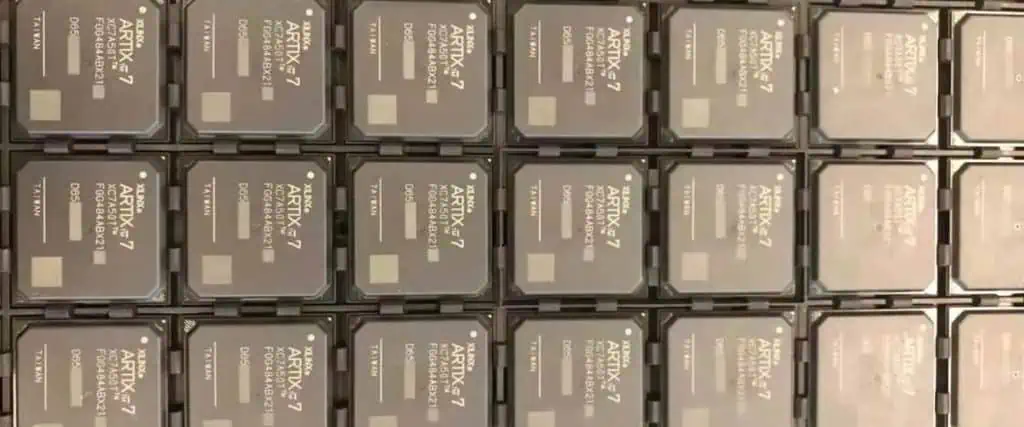
The XC6SLX45 is one of the smaller density parts within Xilinx’s cost-optimized Spartan-6 family. Key comparisons:
| FPGA | Key Characteristics |
|---|---|
| Xilinx Spartan-7 | Higher capacity successor to Spartan-6 with 28HP process |
| Xilinx Artix-7 | Larger mid-range FPGA family with higher performance |
| Intel Max 10 | Competitor low-cost FPGA family from Intel/Altera |
| Lattice ECP5 | Comparable lower cost FPGA with smaller form factors |
So the XC6SLX45 balances low cost with capacity suited for simple to mid complexity designs.
Conclusion
The Xilinx XC6SLX45-2FGG484i FPGA offers an optimal combination of low cost, logic density and low power consumption required in space-constrained embedded systems. The Spartan-6 architecture provides essential embedded peripherals like block RAM and DSP slices while minimizing cost and device footprint. For OEMs building high volume products like industrial controllers, motor drives automation equipment and vehicle systems, the XC6SLX45 FPGA enables an affordable programmable logic solution. When complemented with Xilinx development tools and boards, the device offers fast time-to-market for cost-sensitive applications requiring a low-cost FPGA.
FAQs
How does the XC6SLX45 FPGA differ from the XC6SLX9?
The XC6SLX45 offers higher density with 43K logic cells vs 9K in XC6SLX9. It also provides more block RAM, DSP slices, transceivers and max I/O pin count for more complex designs.
What printed circuit board packages are available for the XC6SLX45?
The XC6SLX45 is manufactured in FGG484, CSG324, FTG256, CSG225 and other BGA packages with ball pitches ranging from 1.0mm to 1.27mm.
What embedded peripherals are integrated within the XC6SLX45 FPGA?
Embedded blocks in the XC6SLX45 include 18Kb block RAMs, DSP48A1 slices, clock management tiles, SPI/I2C blocks, PLLs, LVDS I/O among other dedicated hardware peripherals.
How does the XC6SLX45 differ from the Artix-7 generation?
The Artix-7 family provides higher capacity, performance and features compared to the Spartan-6 generation. Key enhancements include 28HP process, 15 Gbps transceivers, and PCIe integration.
What are some alternatives to the XC6SLX45 FPGA?
Alternatives include higher density Artix/Kintex FPGAs for more complex designs or CPLDs from Xilinx or Lattice for simpler logic implementation. The MicroBlaze soft-core could be used instead of FPGA fabric.
Buy Xilinx XC6SLX45-2FGG484i FPGA
The Xilinx XC6SLX45-2FGG484i is a device that is providing leading capabilities of system integration with lower costs for a higher volume of different applications. This device family is delivering expanded densities that range from 3840 to 147,443 logic cells. The best feature is its less power consumption when compared to previous families. This device has comprehensive and faster connectivity too. The device is manufactured based on the technology of a 45nm lower power copper process that is capable of delivering optimum balance when it comes to performance, power, and cost. This device is offering a novel, dual register lookup of six inputs table along with a vast selection for its built-in blocks on its system level. Such blocks are comprising of 18KB of block RAM with DSP48A1 slices of the second generation, memory controllers (SDRAM), efficient clock management blocks with mixed mode, blocks for higher speed enabled transceiver that is power-optimized, modes for advanced system-level power, options for auto-detected configurations, and efficient IP security along with device DNA and AES protection. Such features are providing a lower cost programmable alternative for custom ASIC products having ease of use. This device is offering an optimum solution for higher volume logic designs, embedded applications that are cost-sensitive, and DSP designs that are consumer-friendly.
Features of Xilinx XC6SLX45-2FGG484i

The device has a lot of features such as logic optimization, higher-speed connectivity in serial mode, lower cost, and availability of various integrated blocks. This device has augmented selection for its input/output standards with staggered pads, packages with higher volume plastic wire, lower dynamic and static power, a mode for hibernating power down for zero power management. The suspended mode is maintaining the configuration and its state along with multi-pin wakeup control enhancements. The higher performance of the device is with 1.2V core voltage in its -2, -3, and -3N grades. The device has interface banks with multi-standards and multi-voltage. It can transfer data up to 1080 Mb/s at its differential input/output. It has a selectable output drive up to 24mA per pin.
The device has hot-swapped compliance with adjustable input/output slew rates for improvement in the integrity of signals. It has memory control blocks such as LPDDR, DDR3, DDR2, and DDR. The supported data rate is up to 800 Megabits per second. It has abundant logic resources and has enhanced logic capability with distributed support of RAM and a discretionary shift register. The block RAM is with a big range of granularity. The Xilinx XC6SLX45-2FGG484i has a feature of fast block RAM with the enabled byte write, clock management tile, flexible clocking, lower noise, digital clock managers for the elimination of clock skew along with distortion of duty cycle. It has lower jitter because of its phase-locked loops. Furthermore, it has pin auto-detection enabled configuration along with efficient security for its protection of design.
Readback
The Xilinx XC6SLX45-2FGG484i has an option for its configuration data to be read without any disruption in the operation of the system.
Management of Clock
The Xilinx XC6SLX45-2FGG484i has a total of 6 clock management tiles. Every clock management tile is having one phase lock loop and two digital clock managers that are to be used collectively or individually.
Digital Clock Manager
The digital clock manager is providing 4 phases for the input frequency that are shifted at 900 apart. This is also offering double frequency CLK2X and its CLKDV is offering a slight clock frequency that is aligned to CLK0. There is the possibility of dividing CLKIN by two. There are zero delays in the DCM whenever the signal of the clock is driving CLKIN and the CLK0 output is being fed back to that of input of CLKFB.
Phased Lock Loop
The Xilinx XC6SLX45-2FGG484i has a phased lock loop that serves as a synthesizer of frequency for broad frequency range and in form of a filter for jitter for incoming clocks. There is a voltage-controlled oscillator in PLL which is known as its heart having a range of frequency in between 400MHz to 1080MHz spanning over an octave. 3 sets of programmable frequency dividers can adapt to VCO for any required application. The pre-divider configuration is reducing the input frequency and is feeding input to a traditional PLL comparator for phases. Feedback divider configuration is acting as a multiplier as it is the diving output frequency of VCO earlier than any other input through phase comparator. The outputs of the VCO are equally dispersed by an angle of 45o.
Blocked Random Access Memory
Each Xilinx XC6SLX45-2FGG484i is having around 12 to 268 dual-port blocked RAMs. Every dual port of blocked RAM is having two independent ports that are capable of sharing data storage.
Digital Signal Processing 48A1 Slice
The applications of DSP are using several binary accumulators and multipliers which are implemented in the best possible way through dedicated DSP slices. Xilinx XC6SLX45-2FGG484i has numerous low-powered, fully customized, dedicated DSP slices. Each slice is consisting of an 18×18 bit multiplier of two’s complement along with an accumulator of 48 bits. Both multiplier and accumulator are capable of operating in a range of 390MHz. Furthermore, the DSP slice is offering an extensive speed increment and pipelining capabilities for enhancing efficiency in numerous applications such as input/output register files with memory-mapped, wide bus multiplexers, and dynamic bus shifters.
Electrical Characteristics
Manu of the Xilinx XC6SLX45-2FGG484i single-ended outputs are using traditional CMOS push/pull structure at the output that is driving higher towards VCCO and lower towards GND. It may either be considered in a higher Z-state. There are numerous features of the system available for the designer to invoke the input/output in design like differential termination resistors and weak pull-down and pull-up resistors at the internal side.
The transceiver of Xilinx XC6SLX45-2FGG484i
There is a requirement for an ultra-fast transmission of information among ICs through long or short distances. Therefore, it requires a dedicated circuitry on-chip with differential input/output capability of dealing with the integrity of signals at higher data rates. The Xilinx XC6SLX45-2FGG484i device is having a 2 to the 8-gigabit circuit as a transceiver. Every gigabit transceiver port is combined along with receiver and transmitter with capability in operation at different data rates till 3.2 gigabits per second. Both receiver and transmitter are separate circuits utilizing distinct PLLs for multiplication of input frequency given as input through certain numbers among 2 and 25 for becoming bit-serial data clock.
SMT Solder Xilinx XC6SLX45-2FGG484i Fpga board

