
What is a Guard Ring?
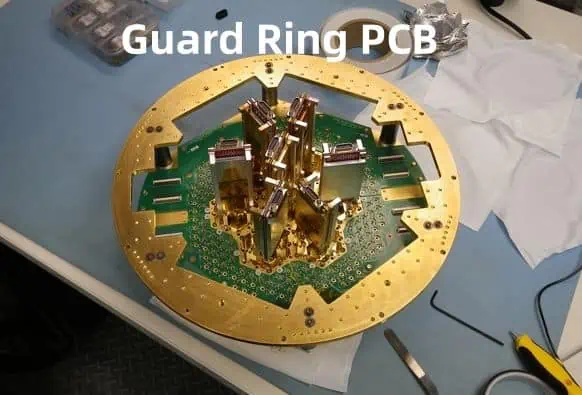
A guard ring refers to a ring of traces routed around the perimeter of sensitive circuits on a printed circuit board. Guard rings act as a physical barrier to protect sensitive nodes against external interference or leakage currents.
Well-designed guard traces divert stray signals away from critical nodes, enhance electromagnetic compatibility, improve measurement accuracy, and prevent errant coupling into internal circuitry. Implementing effective guard rings is crucial when dealing with low-current sensing, high impedance, RF components, or circuits measuring small analog signals.
This article provides a comprehensive guide to implementing proper PCB guard rings, covering:
- Guard Ring Principles and Layout
- Connections and Routing
- Optimizing Trace Widths
- Guard Islands
- Minimizing Leakage
- Examples and Applications
Follow these best practices outlined below to add guard rings that reliably improve circuit performance in your next board design.
Guard Ring Design Principles

Before detailing guard ring implementation, we should review the key principles that make them work:
Electrostatic Protection
- Guard traces form a Faraday cage, blocking electric field interference from coupling onto sensitive traces.
Shunting Stray Current
- Any stray leakage gets shunted by the low impedance guard traces to ground.
Smaller Potentials
- The guarded signal sees much less potential difference from the guard than external interference sources.
Keeping these mechanisms in mind will inform optimum guard layout and routing decisions when protecting critical nodes.
Layout Considerations
The first step in adding a guard ring is planning the trace layout around the protected component or circuit region.
Enclosing Sensitive Nodes
The guard trace should completely enclose the sensitive traces in a contiguous ring around the guarded circuit. Any gaps in coverage create openings for external signals to penetrate.
Following Component Contours
For guarding a specific IC or connector footprint, the ring should closely follow the outline of the component on all sides:
This ensures no exposed areas for leakage or coupling under the component.
Minimizing Openings
For board regions with dense routing, make the guard ring trace spacing and width match adjacent trace spacing to avoid openings between signals:
This helps divert stray signals across to ground better.
By thoughtfully arranging guard rings around components and signals, you can provide robust protection.
Guard Ring Routing
In addition to layout, connecting guard rings properly is also key for performance.
Single Point Grounding
The guard trace should only connect to ground at one location. Having multiple ground points allows currents to flow through the guard itself, reducing its effectiveness.
Dedicated Guard Layer
When possible, route guard traces on their own internal board layer. This prevents coupling between guard and sensitive traces.
Encircling Traces
Route guard traces to fully encircle protected signals on their layer. Sandwiching in plane layers provides further shielding.
Wide Traces
Make guard traces as wide as space allows. Increased area and lower resistance shunts more of any stray leakage through the guard.
Avoid Gaps or Branches
Guard traces should be continuous rectangles with no gaps or branches. This prevents leakage currents from jumping past the guard.
By incorporating these routing practices, your guard rings keep noise out of critical nodes.
Optimizing Guard Trace Widths
Determining the ideal guard trace width is an important consideration during layout. Wider traces enhance guarding performance but consume more space.
As a general rule of thumb, size guard trace widths equal to:
2-3x the width of the protected trace
So for safeguarding a 0.2mm analog signal:
- Guard trace width = 0.4mm to 0.6mm
This provides good current shunting capability without oversizing.
For lower impedance guarding, the 5W:1G rule sets the width ratio between:
- W = Protected signal trace width
- G = Guard trace width
So surrounding a 0.2mm signal requires a 1.0mm guard trace. This provides more robust shielding for critical high-speed or RF traces.
Determine what level guarding your application needs and set widths appropriately. Dense boards may require balancing protection versus routing space.
Adding Guard Ring Islands

When laying out guard rings for circuits with multiple sensitive nodes, it helps to connect independent guard traces together into a larger guard island.
This offers several advantages:
Larger Shunt Area
- Island combines area of all guards
- Diverts more stray current
Simplifies Routing
- Easier connecting one island than multiple rings
Robustness
- Eliminates gaps that weaker lines can penetrate
Here is an example guard island safeguarding multiple op amps and ADC channels:
Note how the island surrounds all sensitive components and fills open areas in the layout.
Islands just need a single connection point to ground to avoid circulating currents.
Minimizing Guard Leakage
In precision measurement applications, even tiny leakage currents (picoamps) through the guard can impact accuracy.
Several techniques help reduce guard leakage:
Maximize Distance
- Increase spacing between guard and sensed signals
- Reduces capacitive coupling
Layer Separation
- Sandwich guard trace between plane layers
- Prevents traces from leaking
Independent Grounds
- Use separate ground returns for guard and protected circuit
- Avoids return path currents
Low Resistance
- Ensure robust grounding and supply power to guards
- Minimizes potential differences
With careful layout considerations, guard rings add minimal loading to precision circuits guarded.
Example Applications
Guard rings provide vital protection for:
Analog Sensing
- Guards stop power supply noise from coupling into microvolt sensors
Radio Circuits
- Prevent signals leaking between mixer/VCO stages
Voltage References
- Shield 1.2V bandgap voltage from other supplies
High Impedance Nodes
- Keep GΩ input impedances isolated
EMI Sensitive Traces
- Reduce emissions/susceptibility
And many more use cases – guard rings universally enhance circuit stability and precision.
FAQ
Here are some frequently asked questions on guard ring design and implementation:
Q: Does the quality of grounding impact guard ring effectiveness?
Yes. Any noise or shifting on the ground carries through to the guard ring since traces all connect eventually at a ground node. Properly designed low-noise ground planes ensure stable guard grounds.
Q: Can more than one guard ring enclose a signal?
Stacking multiple guard rings (on different layers) surrounding a trace enhances protection. However, each interconnected ring needs just one ground point to prevent circulation currents. Too many guards waste board space.
Q: Do components like resistors/caps placed inside guard rings get shielded too?
Unfortunately no. The guard ring effectively “hides” the protected traces electromagnetically. But placed components don’t experience the same shielding since they physically and electrically connect outside the guard boundary.
Q: Can guard rings be added around boards and board sections too?
Definitely. You will often see a row of ground vias routed around the very edge of boards acting as an outer guard boundary to contain EM fields inside. The same principle applies to shielding functional blocks by routing grounded copper regions between circuits across the board.
Q: What are acceptable breaks in guard rings around cutouts?
For necessary cutouts (connectors/holes etc.) the guard ring should continue symmetrically on all sides. Allowing small 5-10 mil gaps for drilling tolerances won’t severely degrade performance. But avoid routing signals through gaps if possible.
Conclusion
Implementing well-designed PCB guard rings enables robust, interference-free performance for sensitive circuits and precision boards. Following guard ring best practices for layout, routing, grounding and dimensions allows you to effectively shield critical signals from external noise sources and internal leakage. Give your low-level analog sensing, RF, and high-impedance circuits the isolation they deserve by guarding them with a ring of protection.

