
Introduction
The Xilinx XC6SLX75T-3FGG484i is a low cost Spartan-6 series FPGA suitable for high volume embedded applications requiring serial connectivity. This article provides an overview of the XC6SLX75T architecture, characteristics, design tools and example applications leveraging this device.
FPGA Overview
FPGAs contain programmable logic blocks and interconnects that can be configured to implement custom hardware functions. Key characteristics include:
- Configurable logic blocks (CLBs) to realize digital logic
- Flexible routing resources to connect logic blocks
- High-speed I/O blocks for interfacing to electronics
- SRAM cells define programmable functionality
- In-field reconfigurability
FPGAs provide more flexibility compared to application-specific integrated circuits (ASICs) by allowing functionality changes through reprogramming.
XC6SLX75T-3FGG484i Overview
The Xilinx XC6SLX75T-3FGG484i provides the following features:
- Part of the low cost Spartan-6 mid-range FPGA series
- Manufactured on a 45nm process technology
- FineLine BGA (FGG) package with 484 pins
- 75,900 logic cells based on 6-input LUTs
- 416 Kb distributed block RAM
- 416 DSP48A1 slices with 25 x 18 bit multipliers
- Integrated PCI express endpoint blocks
- Eight mixed-mode clock managers (MMCM) with PLLs
- Six 3.2Gbps GTP transceivers
- Multi-voltage support from 0.9V to 1.2V VCCINT/VCCAUX
- -3 speed grade
With these characteristics, the XC6SLX75T suits compact embedded systems requiring serial connectivity.
Internal Architecture
The XC6SLX75T FPGA contains the following key components:
XC6SLX75 simplified block diagram (Image credit: Xilinx)
Configurable Logic Blocks
The core FPGA fabric consists of an array of logic blocks containing LUTs, flip-flops and carry logic for implementing combinatorial and sequential logic functions.
Block RAM
416 blocks of 18Kb RAM distributed through the device provide on-chip memory for data storage.
DSP Slices
416 dedicated DSP slices allow arithmetic operations like multiply-accumulate to be implemented without consuming general logic.
Clock Management
Eight MMCM blocks provide clock synthesis, jitter filtering, and clock timing management across multiple domains.
Transceivers
Six 3.2Gbps serial GTP transceivers support high-speed protocols like PCIe, Serial RapidIO, Gigabit Ethernet.
Endpoint Blocks
Four integrated PCIe endpoint blocks enable PCI Express connectivity with minimal FPGA logic resources consumed.
Development Tools and Kits
Xilinx offers the following development tools and platforms for the XC6SLX75T:
Design Software
- ISE Design Suite – For synthesis, place and route, timing analysis, constraints
- Xilinx Platform Studio – For developing Microblaze soft processors
- ChipScope – Integrated logic analyzer for monitoring real-time logic operation
- EDK – For building Microblaze embedded soft processors
Evaluation Boards
- SP601 – Basic evaluation board featuring the XC6SLX75T FPGA
- SP605 – More expansive board with a multitude of interfaces
- KC705 – Higher performance Kintex-7 board also usable for Spartan-6
These enable rapid prototyping and debugging with the XC6SLX75T FPGA.
Applications of the XC6SLX75T
Some example application areas suitable for the XC6SLX75T FPGA include:
Communications – Software defined radio, channel coding, baseband processing algorithms.
Data Centers – Network interface cards, server storage expanders.
Industrial Automation – Integrating multiple interfaces like PCIe, Ethernet, USB, SATA in automation equipment.
Medical – Low cost ultrasound, imaging systems leveraging the FPGA for algorithms.
Automotive – ADAS systems, vision processing, infotainment.
Defense – Secure communications, radar and imaging applications.
The integrated transceivers, block RAM and DSP48A1 slices make the XC6SLX75T a flexible solution for connectivity-oriented embedded systems.
Comparison with Other FPGAs
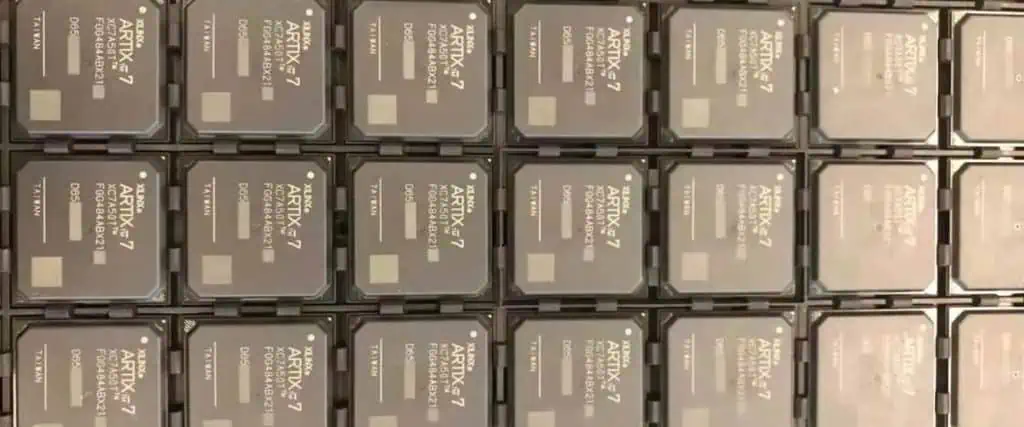
The XC6SLX75T is among the higher density devices in the low-cost Spartan-6 family. Comparisons to other FPGA families include:
| FPGA | Key Characteristics |
|---|---|
| Xilinx Spartan-7 | Higher capacity successor to Spartan-6 based on 28HP process |
| Xilinx Artix-7 | Larger mid-range FPGAs with more logic, faster transceivers |
| Intel Max 10 | Competitor low-cost FPGA from Intel/Altera |
| Lattice ECP5 | Lower cost FPGA family, smaller form factors |
So the XC6SLX75T balances cost and connectivity requirements for medium complexity applications.
Conclusion
The Xilinx XC6SLX75T-3FGG484i FPGA provides an optimal combination of low cost, logic capacity and integrated transceivers required in space-constrained embedded systems. The Spartan-6 architecture balances features like DSP slices, block RAM, and serial I/O in a cost-effective design. For OEMs building high volume products like industrial controllers, test equipment, medical devices, aerospace systems etc., the XC6SLX75T enables an affordable connectivity-enhanced programmable logic solution. When matched with Xilinx development boards and software tools, the device offers fast time-to-market for cost-sensitive embedded applications requiring serial interfacing capabilities.
FAQs
How does the XC6SLX75T differ from the XC6SLX45 FPGA?
The XC6SLX75T provides 75K logic cells compared to 43K in XC6SLX45. It also incorporates PCIe, Gigabit Ethernet blocks and GTP transceivers making it more suitable for connectivity.
What printed circuit board packages are available for the XC6SLX75T?
The XC6SLX75T is manufactured in 484 pin FGG and 324 pin FG packages with 1.0mm ball pitch. Pb-free, green, industrial and commercial grade devices are offered.
What kind of clock management capabilities does the XC6SLX75T have?
The FPGA integrates 8 mixed-mode clock managers (MMCM) which support frequency synthesis, jitter filtering, and clock phase alignment across multiple clock domains.
How can the XC6SLX75T be programmed?
The FPGA can be programmed via JTAG using Xilinx tools like iMPACT. It supports both full and partial reconfiguration. OTP fuse and AES encryption provide programming security.
What are some alternatives to using the XC6SLX75T FPGA?
Alternatives include CPLDs from Xilinx or Lattice for simpler designs. For higher bandwidths, Artix-7 or Kintex-7 FPGAs would be suitable. Soft IP processor cores can replace FPGA fabric where flexibility is not needed.
Searching Xilinx XC6SLX75T-3FGG484i Chip
The Xilinx XC6SLX75T-3FGG484i is one of the best available devices delivering leading capabilities of system integration. The device is inexpensive and can be used for several applications. The device is consuming less power when compared to its previous competitor ICs. The densities are ranging from 3840 to 147,443 logic cells. This device is super fast and has wide-ranging connectivity. This device is grounded on lower power copper processing technology with 45nm delivering optimum balance among performance, costs, and power. This device has to offer a novel and efficient lookup table of six input dual registers and also offers a rich selection for built-in blocks on the system level. This is also comprising of 18Kb of blocked RAM along with 2nd generation DSP slices, controllers for memory, clock management blocks, high-speed receiver and transmitter blocks, advanced power modes. All of the mentioned features of this device are offering a lower-cost alternative for customized ASIC products with ease of use. This IC is offering a compatible solution for logic designs of higher volume, DSP design of consumer choice, and cheap embedded applications.
Configuration of Xilinx XC6SLX75T-3FGG484i

The device is capable of storing custom data of configuration in its internal latches of SRAM type. The configuration bits number is between 3MB to 33MB which is depending on the size of the device and implementation options of user design. However, the storage of configuration is volatile and is to be reloaded whenever the device is given power. The reloading of data is also possible at the time when pin PROGRAM_B is made low. Several methods can be used for loading data of configuration. The configurations of bit-serial can be in master serial mode in which Xilinx XC6SLX75T-3FGG484i is generating signals of configuration clock or can also be used in the mode of slave serial that generates a source of external data configurations in form of clock. The pins JTAG are utilizing protocols for boundary scanning to load data configuration in bit-serial mode.
ISE tool is utilized by Xilinx XC6SLX75T-3FGG484i to bitstream the information regarding configuration through bitgen. The process of configuration is typically executing sequence such that detection of power-up whenever PROGRAM_B is in low mode. Clearing the memory from the entire configuration data. The mode pins are sampled for determining the mode of configuration in either slave or master and parallel or serial. The tool is also loading data of configuration starting from the width of bus detecting pattern which is then followed through synchronization word checking the appropriate code of the device and is ending through cyclic redundancy check. Furthermore, this is starting sequence of user-defined events that release the internal reset of flipflops and waiting for the PLL or DCM to be locked after activation of output drivers and DONE pin is made high after the transition. There are two common techniques used for configuring Xilinx XC6SLX75T-3FGG484i i.e., master byte-wide peripheral interface and master serial peripheral interface.
Configurable Logic Blocks
Every of configurable logic block is consisting of two slices that are arranged adjacently in the form of vertical columns. Three different kinds of configurable logic blocs are available in Xilinx XC6SLX75T-3FGG484i architecture namely, SLICEX, SLICEL, and SLICEM. Every slice has 4 lookup tables and 8 flip-flops. These lookup tables are for general purpose sequential and combinational support.
SLICEX
Almost 50 percent of the slices of Xilinx XC6SLX75T-3FGG484i are SLICEX. These have a similar structure to SLICEL but these are having an arithmetic carry option and are considered as broad multiplexers.
SLICEL
Almost 25 percent of the slices of Xilinx XC6SLX75T-3FGG484i are SLICEL. These are having almost all the features that SLICEM has but are not having any shift or memory registers.
SLICEM
These are also 25 percent of the slices of Xilinx XC6SLX75T-3FGG484i. The 4 lookup tables of SLICEM could be configured in the form of 6 inputs and single output or in the form of lookup tables with 5 equal inputs having the same 5-bit addresses and two distinct outputs. These lookup tables may also be utilized in the form of 64-bit RAM in distributed form along 64 bits single or two 32-bit in each lookup table.
Frequency Synthesis
The outputs of the frequency synthesis CLKFX180 and CLKFX could be programmed for the generation of output frequency independent of the functionality of DCM. It implies that the frequency of DCM is multiplied by a digit M and simultaneously divided by digit D. Here, M is an integer ranging from 2 till 32 and D is an integer ranging from 1 till 32.
Phase Shifting
When CLK0 is in connection with CLKFB, entire outputs i.e., CLKFX180, CLKFX, CLKDV, CLK2X180, CLK2X, CLK270, CLK180, CLK90, and CLK0 could be shifted through a common number that may be defined as multiple of an integer having a fixed delay.
Synchronized Operation
In Xilinx XC6SLX75T-3FGG484i every memory access either write or read is clock-controlled. All of the input writes and clock enables, addresses, and data are registered. The output data is latched and data is retained till the next operation. There is an optional pipeline register that is allowing higher rates for the clock at cost of additional cycle latency.
Memory Control Block
There is are dedicated memory control block in Xilinx XC6SLX75T-3FGG484i. Each of these blocks has a target for single-chip DRAM and supports the access rates of up to 800 megabits per second. This block has devoted routing for predefining the input/outputs. In case when the block is not in use then these input/outputs are accessible for general purpose input/outputs. The block is offering a profound multi-port arbitrated interface for inside logic. The commands and data could be pushed and pulled from the FIFO through traditional control signals. This is a multi-port controller able to be configured through different methods. There is an internal 32, 64, and 128-bit interface for data delivering a simple and outstanding interface for memory controller block. Furthermore, the memory control block can also be connected through 4, 8, or 16-bit DRAM externally. But, the memory controller block functionality is not supported by -3N speed grade applications.

