
RAYPCB · ENGINEERING GUIDE
Shengyi Synamic 8G PCB: High-Speed Material and Loss Budget
Shengyi Synamic 8G is a high-speed laminate designation that should remain distinct from similarly named variants such as 8GN. A useful selection process connects the exact material construction to a channel loss budget and then asks how much route length that budget can support.
This page focuses on that planning step. It does not turn a laminate name into a guaranteed data rate. The Shengyi material overview provides the family context, while the worksheet helps make a particular routing constraint explicit.

Start with exact identity and source method
The cited official 8G product page presents headline Dk/Df of 3.66/0.0032 at 10 GHz and Tg of 200°C by DMA. Obtain the controlled technical sheet and construction-specific method context before carrying those values into a released design model.
A DMA Tg must not be compared as though it were the same measurement as a DSC value. Likewise, a headline loss tangent is not complete insertion loss. Preserve the supplier revision, glass/resin construction and copper choice rather than assuming every 8G stackup has the same electrical behavior.
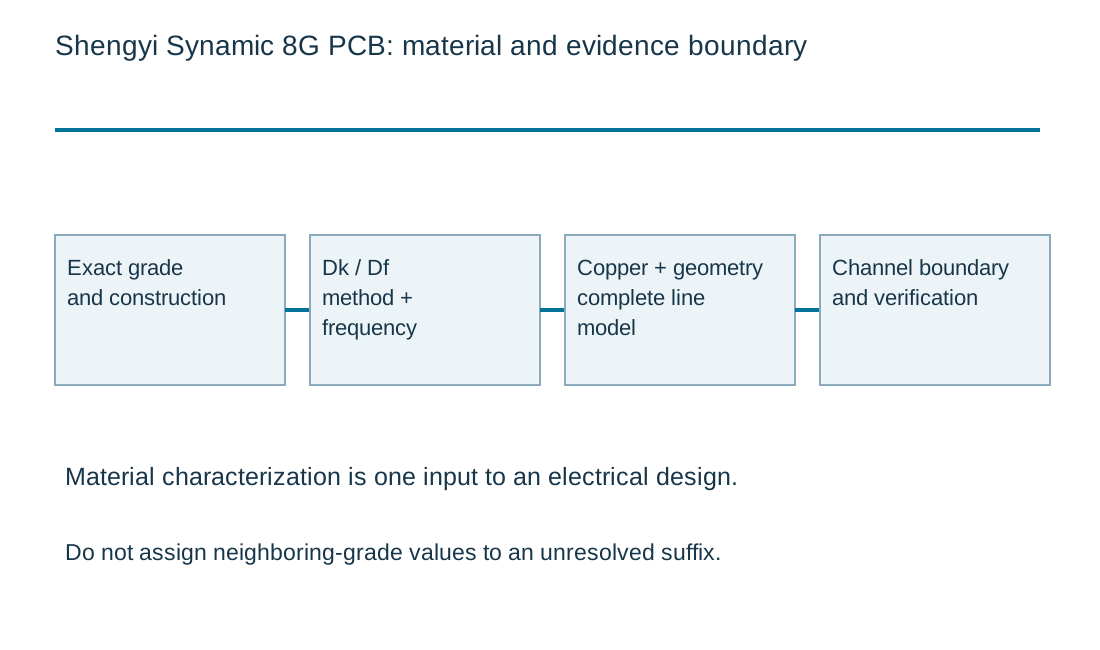
Source-qualified material review
| Item | Published information or evidence status | Design implication |
|---|---|---|
| Product | Synamic 8G | Do not silently change to 8GN. |
| Published headline | Dk 3.66 / Df 0.0032 at 10 GHz | Confirm method and construction in the controlled TDS. |
| Tg headline | 200°C by DMA | Do not compare numerically with DSC without context. |
| Budget tool | Complete routing attenuation entered by the user | Does not convert a material label into a supported data rate. |
Allocate the losses that do not scale with route length
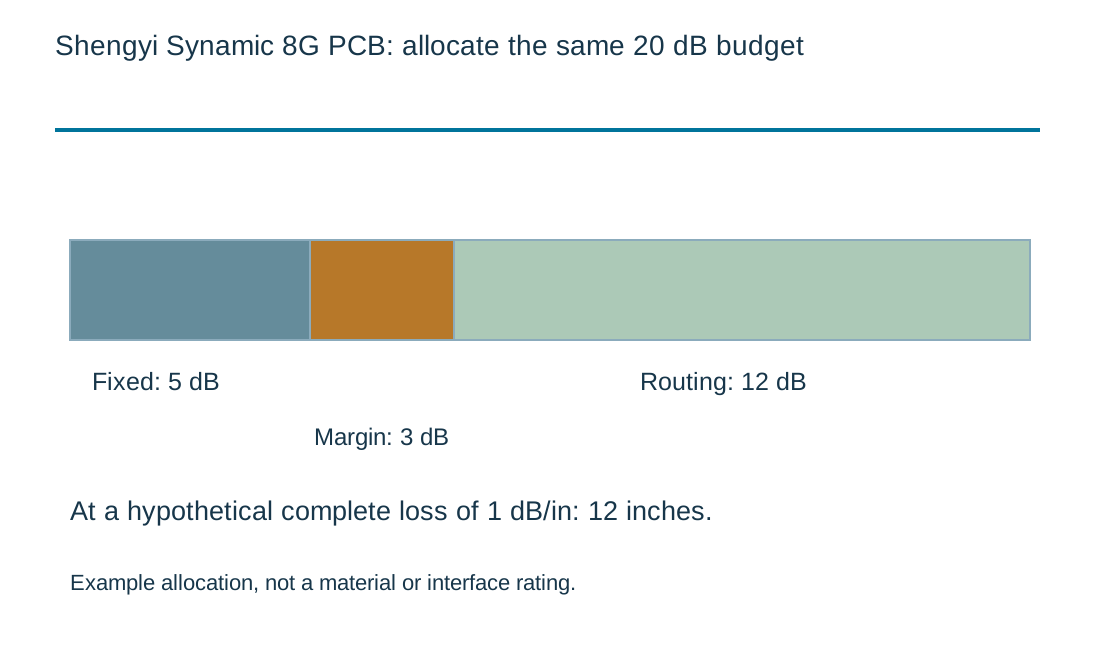
Connectors, vias, packages and other transitions consume part of a channel budget. Their treatment depends on where the reference planes are placed. A planning model should not count a package twice or omit a connector merely because it appears outside the PCB outline.
Reserve any engineering margin explicitly. Do not hide it inside an unexplained routing-loss rate. This makes it possible to see whether a design problem is driven by the route, a transition or the chosen uncertainty allowance.
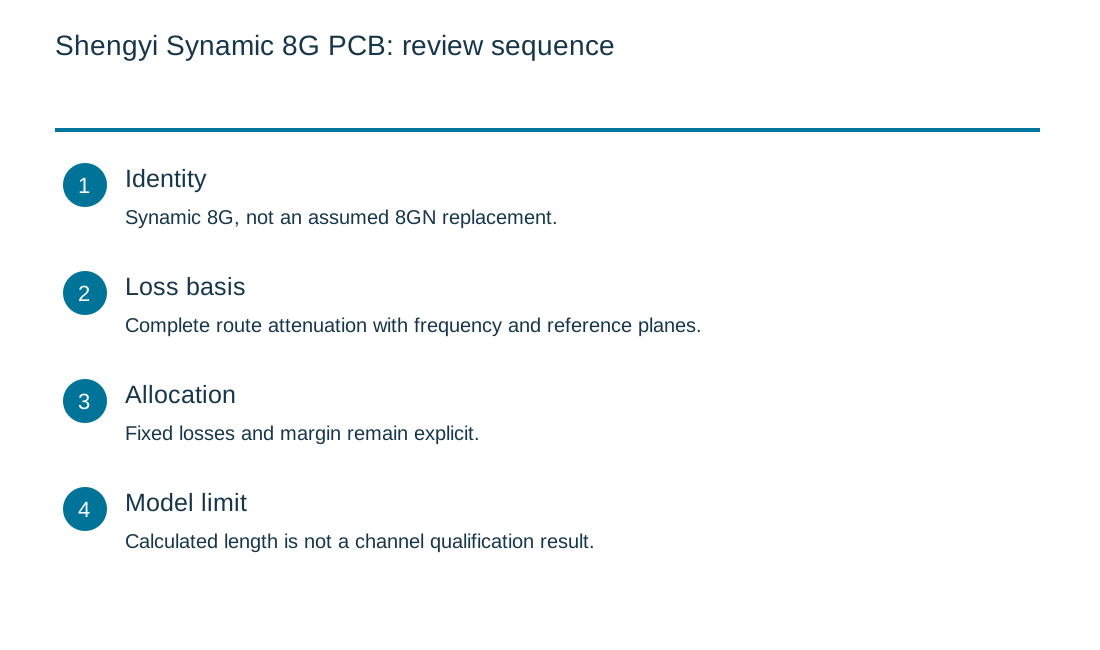
| Review item | What to establish |
|---|---|
| Identity | Synamic 8G, not an assumed 8GN replacement. |
| Loss basis | Complete route attenuation with frequency and reference planes. |
| Allocation | Fixed losses and margin remain explicit. |
| Model limit | Calculated length is not a channel qualification result. |
Calculate the remaining uniform routing length
The worksheet subtracts fixed losses and margin from the allowed total, then divides the remainder by the entered complete routing attenuation. With 20 dB total, 5 dB fixed, 3 dB margin and 1 dB/in, the arithmetic length limit is 12 inches. This is a hypothetical example, not an 8G material rating.
If the remaining allocation is negative, changing route length cannot solve that particular budget. Revisit the fixed allocation, interface assumptions or architecture. A zero routing-loss input is rejected because it would produce an undefined or misleading length result.

Keep a route budget separate from channel qualification
The scalar calculation is an early planning aid. Real channels have frequency-dependent insertion and return loss, crosstalk and signal-processing assumptions. A route shorter than the calculated limit can still fail another requirement.
Use simulation and appropriate measurements for the released construction. Keep the source of the complete attenuation rate visible: measured coupon, validated model or a labeled preliminary assumption. A Df number alone does not supply that rate.
Compare neighboring materials without losing construction control
The Synamic 6N guide explains method-dependent material data, and the 6GX channel worksheet evaluates a budget at a specified route length. These are useful adjacent tasks, but neither authorizes replacing 8G without a reviewed comparison.
If an RF laminate such as the one discussed in the S7136 process guide is proposed, reassess electrical and manufacturing compatibility. Keep foil, dielectric thickness, thermal exposures and qualification requirements in the comparison instead of ranking materials by a single loss-class label.
Routing length from remaining loss allocation
Routing length from remaining loss allocation
Use the current inputs and keep the assumptions
Start with the example only to inspect the units and the calculation boundary. Replace every assumption with a value tied to your own document or measurement. An empty numeric field is not zero. The review-reference field is a local label; avoid entering customer names, confidential part numbers or other private information into a public worksheet.
After calculating, read the notes alongside the numerical result. Changing any input invalidates the displayed result and disables its download until you calculate again. For a comparison, keep the units, geometry, material condition and measurement boundary consistent. A long decimal result does not imply equally precise input data. The downloadable record stays on your device and can be attached manually to an inquiry. It is not automatically transferred into the Contact form.
If an input is unknown, identify the person or document needed to resolve it. Do not fill a gap with a favorable generic value simply to obtain a result. You can request a material or fabrication review without using the tool. The arithmetic illustrates a relationship; it does not accept a construction, certify a material, establish current pricing or replace a supplier process specification.
| Input | What to establish before using it |
|---|---|
| Review reference | Nonconfidential revision label. |
| Allowed loss · dB | Same frequency, reference planes and channel definition throughout. |
| Fixed discontinuity allocation · dB | Connector, package and via contributions included only as entered. |
| Reserved margin · dB | Engineering choice, not a mandated allowance. |
| Complete routing loss · dB/in | Measured or validated model for the chosen copper and stackup. |
Optional cost comparison from your own allowances
Use a quotation or a clearly labeled internal assumption for each input. Keep the quantity, construction and inspection scope the same when comparing alternatives. This uncalibrated planning model adds entered values; it contains no current market rates and does not issue a RAYPCB quotation. You can contact the team without completing it.
Optional project allowance comparison
Build the RFQ around the limiting requirement
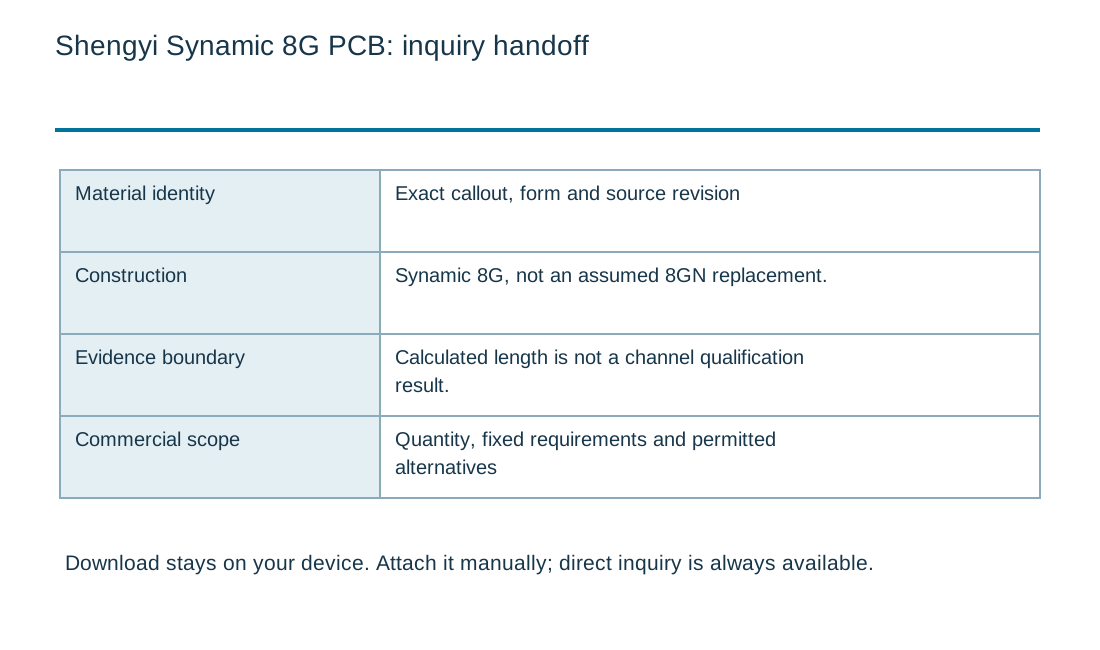
Send the exact 8G callout, proposed stackup, routing constraints, impedance targets, relevant frequency range, quantity and board dimensions. State whether the material is mandatory or an alternative can be assessed. Include the requested evidence and the approval owner for changes.
The cost worksheet uses only the allowances supplied by the visitor. Compare the same quantity, test scope and construction when evaluating proposals. The final manufacturing response should identify open electrical assumptions and the proposed verification route, rather than promising a data rate from the material name.
Tie the exact grade to an electrical construction
State the channel reference planes, frequency range, routing length, copper construction, transitions and interface assumptions together. A laminate loss-tangent value is one input to that system. It is not a complete insertion-loss measurement or a guarantee that a data rate will work.
Use comparable measurement or modeling conditions when screening alternatives. Material changes can require geometry changes to preserve impedance, and copper roughness can alter the result independently of the resin system. Keep the proposed stackup and the channel analysis synchronized through fabrication review.
For procurement, identify the properties that are fixed and the alternatives that can be evaluated. Request evidence at the relevant construction and frequency rather than a broad low-loss label. Compare total delivered scope and validation effort alongside material price. A shorter or better-routed channel may change the tradeoff more than replacing a material name alone.
A useful design-data record retains both the material value and the reason it was selected. State whether the value is supplier characterization, a construction-specific design input, a measured coupon extraction or an early assumption. These sources are not interchangeable. Keep frequency, method and specimen information visible when a comparison uses more than one document.
The tool on this page starts empty because a plausible default can otherwise be mistaken for a verified grade profile. Use the example to understand the units, then replace it with project inputs. A result with many decimal places does not imply that the material or routing-loss input is known to that precision.
For a high-speed design, plan how the model will be checked. Reference planes, coupon geometry, fixtures and the acceptance boundary determine what a measurement means. A coupon that characterizes one line construction does not automatically qualify every route or transition on the board.
Keep the commercial comparison aligned with the engineering one. Quantity, copper, layer structure, test deliverables and qualification effort should be comparable. A lower material allowance can be irrelevant if the proposed construction cannot meet the channel requirement, while a premium grade may be unnecessary if the actual route already has sufficient validated margin.
Standards, source context and limits
Use the edition, amendment and material-document revision named in the purchase agreement. A standards title, marketing label or supplier product family does not establish that a particular lot meets a requirement. Public summaries are useful for scope; the controlled specification and applicable test method govern acceptance.
The examples on this page are illustrative engineering scenarios. They are not RAYPCB production records or guaranteed material values. Source links identify the organizations responsible for the referenced information. Confirm applicability to the exact grade, construction and test condition before carrying a number into a drawing or qualification report. Sources were reviewed on 3 October 2026. A public catalog search is not proof that an unlisted product never existed. Where the exact designation or current technical sheet could not be verified, this page provides a clarification workflow rather than an invented material specification. Current supply, construction availability and qualification remain separate questions.
For fabrication scope and the agreed construction requirements, see PCB manufacturing.