
Technology keeps on advancing in a consistent manner. In the communication sector, strides in communication infrastructure have moved on to a new version known as 5G or fifth-generation communication infrastructure. 5G is pretty efficient, enabling fast transmission of information with minimal lag. Moreover, 5G is generally a more comprehensive, functional technology that everybody can access using various gadgets. 5G can be utilized with MC (mission critical) communications, mobile broadband telecommunication, and the Internet of things.
However, though 5G is pretty efficient, it still faces one major issue, EMI or electromagnetic interference. But what exactly is electromagnetic interference? And how can you shield 5G from electromagnetic interference?
5G wavelengths and Frequencies
Just recently, the FCC granted 280 megahertz from 3.70 gigahertz to 3.98 gigahertz, for now, the popular MF (mid-frequency) fifth-gen band. This mid-frequency fifth gen band is famous for two main reasons which are:
– Increased speed as per data deliverability when compared to 4G
– Increased levels of connectivity in various building
4G or fourth-generation technology relies on low-frequency bands or at least lower FB when compared to 5G. However, these low-frequency bands are crowded with communication, and radio uses, to the point that now technicians are thinking about sharing or reframing. But this option of sharing or reframing tends to be pretty expensive and difficult to achieve. On the other hand, fifth-generation technology functions at high frequencies, which are mmWaves or millimeter waves.
Millimeter waves have short frequency wavelengths. Therefore, engineers must consider this factor when generating 5G networks, particularly in EMF attenuation areas. For EM shielding purposes, 3.98 gigahertz frequencies have a wavelength of about 2.97 inches. Therefore, for common commercial EM shielding levels of approximately 40 db, the max aperture at this particular frequency level will have to be more than 1.49 x 0.02 inches. Due to this, attenuation efforts surrounding 5G are pretty different as per exterior EMI and internal interference.
5G Electromagnetic Interference EMI Shielding in a Nutshell
The fifth-generation tech allows you to carry out complex tasks faster and with ease compared to 4G. Take, for instance, a pretty simple tasks such as the following:
– A mother wants to access her house remotely to check on her refrigerator, which is connected with sensors for autonomous operation. She then orders groceries remotely while receiving manufactured nut allergy alerts in real time.
So is this a simple task? The fifth-gen tech allows this task to occur in a manner that is more complex and efficient. Every single thing must function flawlessly and in a connected manner, from the mother’s smartphone to her refrigerator bearing IoT sensors and so on. One tiny glitch or shielding oversight and the entire task comes crumbling down.
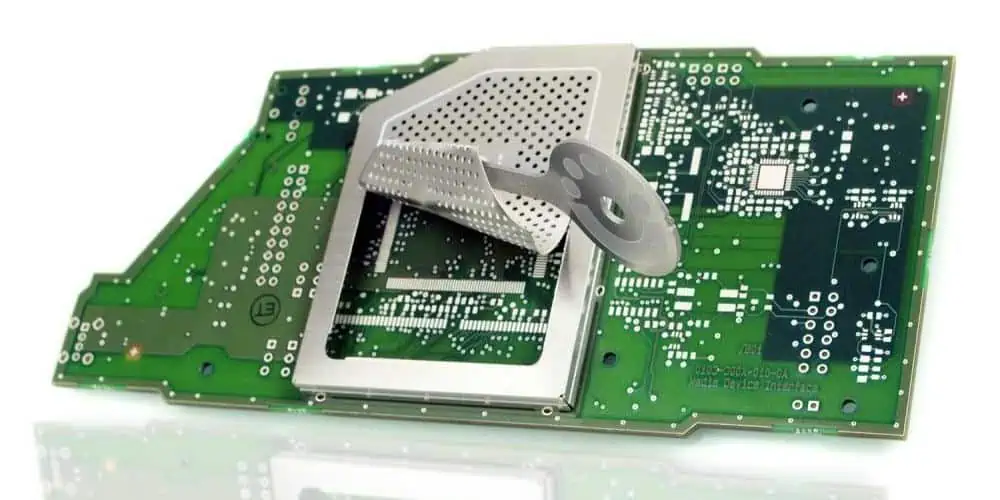
Non-conductive or open aperture areas significantly reduce the EMI shielding ability of various electronic enclosures by letting RFI and EMI either enter or escape an electronic system or product. If such a case occurs, then this might lead to your electronic product malfunctioning or ultimately failing.
Examples of EMI-shielded electronic enclosures which are open apertures, non-conductive areas, or susceptible are:
– Airflow vents meant for air-conditioning and heating
– Signal and power access panels
– Cable entry
You can also choose to utilize conductive fabric gaskets for 5G EMI shielding.
Military 5G Attenuation and Use cases

The United States military is using fifth gen tech by separating control and command into segments which ultimately makes networking aspects:
– Faster
– Transportable
– And more flexible
5G can make all this possible via connecting everything to everyone (which includes soldiers and command operation personnel). Another excellent example of the fifth-gen is the enhanced VR (virtual reality) training for soldiers. The military is utilizing 5G technology for VR training due to a couple of reasons which include:
– Its impeccable data speeds
– Lower Latency
– Improved system connectivity
Moreover, for the military-grade enclosure that has to pass 80db, 60db, Mil-STD-461, or higher, you must apply certain attenuation levels to achieve compliance as per electromagnetic compatibility. At these EM shielding attenuation levels, non-conductive or open aperture areas can’t be large to meet EMI shielding standards.
5G Application in the Medical Industry
The medical sector is integrating fifth gen infrastructure and electronic devices for a couple of reasons which include:
– Gadget profile priority
– Low latency
– Fast download/upload speeds
– Security
Using 5G, for example, helps surgeons safely operate on a patient remotely using comp-controlled robotic gadgets to undertake surgical operations.
5G EMI Shielding materials
Two main properties are pretty essential when building EMI wave absorbing devices:
– Magnetic permeability
– Electrical conductivity
Here are some common materials that encompass these properties:
Metals
Metals should be your first option if you are looking to generate an electromagnetic protection shield since they are simple and cheap. Moreover, these components contain impeccable properties such as:
– Ductility
– Strength
– Magnetic permeability
– Electrical conductivity
These properties make metal shielding devices great for generating EMI shields.
The most utilized metal to generate EMI shields is silver since it has impeccable corrosion resistance and excellent electrical conductivity. All these features make this metal an efficient attenuator of electric fields. However, silver has one downside: it is pretty expensive compared to other options. Due to this downside, most technicians utilize this component as a surface coating or an alloy component.
Carbon Allotropes
The second EMI shielding materials are carbon allotropes which encompass all types of carbon, which include:
– Carbon nanotubes
– Carbon fibers
– Grapheme
– Graphite
These components are utilized as filler components for electromagnetic interference composites. Carbon allotropes make impeccable filler components because of their excellent conductivity and intrinsic strength. Additionally, carbon allotropes mainly function via the multiple reflection shielding mechanism.
The most popular carbon allotrope utilized for External electromagnetic waves shielding is exfoliated graphite because of its flowing ability and flexibility. Moreover, this component has a pretty high porous structure which promotes electromagnetic interference absorption. On the other hand, carbon nanotubes, carbon fibers, and grapheme are utilized as filler components because of their impeccable aspect ratio.
Intrinsically Conducting Polymers
Intrinsically conducting polymers or ICPs are unique polymers that have the ability to effectively conduct their own radiated electromagnetic waves tructure without needing additional conducting components. Moreover, these components are mostly desired because of their processability and because they are lightweight.
ICPs can effectively conduct electricity between atoms because of their conjugated bonds, which allow the delocalization of loose electrons, which now become mobile charges. The electronic conductivity of ICPs can be altered via de-doping and doping. The most popular ICP utilized for EMI shielding include:
– Polypyrrole
– Polyaniline
Conclusion
Fifth-generation technology has, without a doubt, shaken up the tech industry. However, it faces one issue which lowers its performance, electromagnetic interference. However, to handle this issue efficiently, you can utilize EMI shielding or conductive fabric gaskets which shields 5G from electromagnetic interference. We hope that this article has given you all the answers that you were looking for regarding 5G Electromagnetic interference shielding.

