
RAYPCB · ENGINEERING GUIDE
Sheldahl Flex Materials: Define the Film and Bonding Construction
Sheldahl flex materials should be specified by exact product role and grade. A specialty film, adhesive or laminate description is not a complete circuit construction. The relevant decision includes the mating surfaces, permanent layers, processing, environment and evidence required for the finished part.
This page is a materials-integration guide. It does not imply that all supplier products are available from RAYPCB, that a vendor certification applies to the resulting assembly or that a brand name establishes material equivalence.

Identify the supplied product and its role
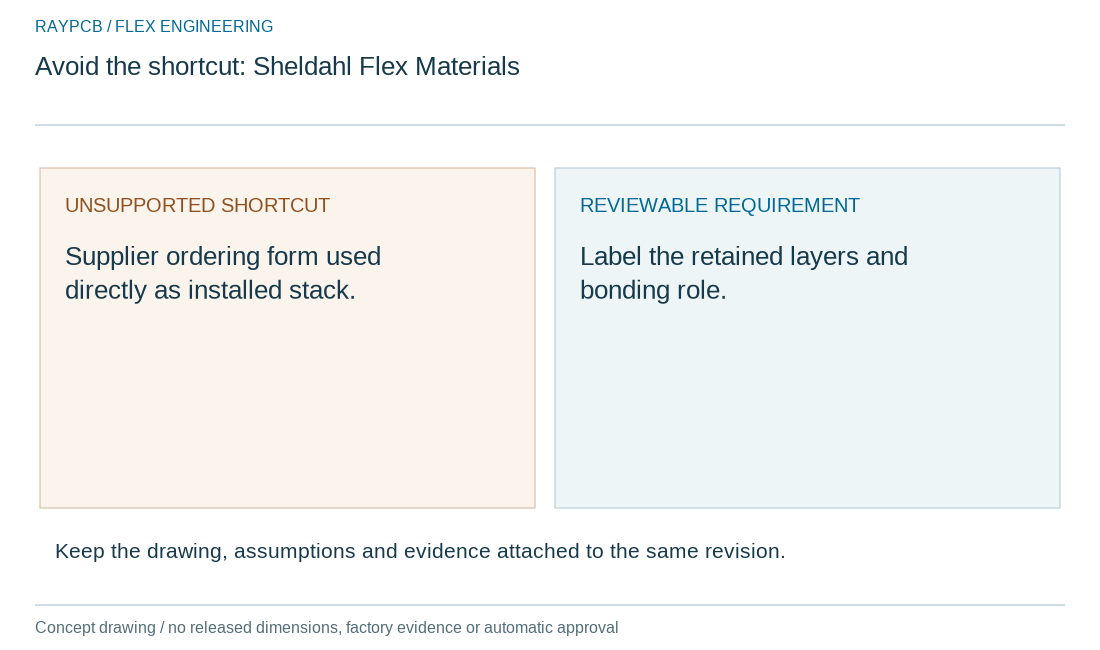
State whether the item is a free-film adhesive, a dielectric film, a laminate or another specifically documented material. Keep the supplier ordering description separate from the installed layer inventory. Some supplied forms include release films that are removed during processing.
Sheldahl's official free-film adhesive information describes material options for particular bonding roles. Use that category information to locate the appropriate documentation, then request current grade-specific data rather than assigning family-wide values.
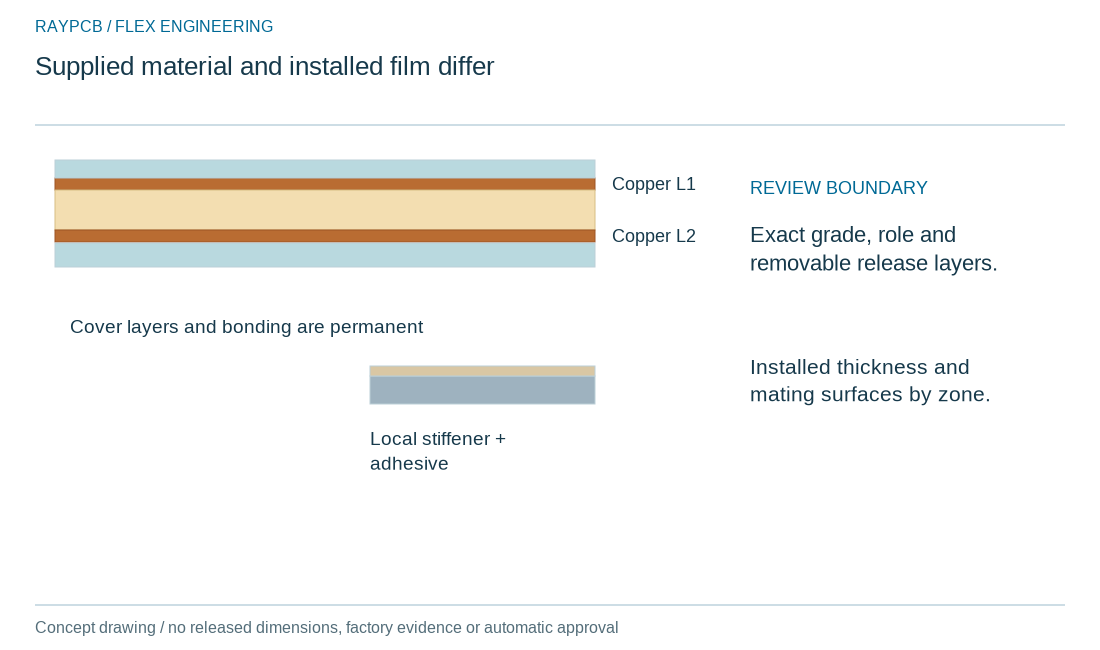
Draw the permanent construction
List the film, adhesive, copper and reinforcement at each relevant zone. Distinguish incoming nominal values from finished dimensions and identify removable layers. A material purchase description may be correct while still being insufficient for a connector-tail thickness requirement.
Use FPC lamination materials for layer bookkeeping and flex stiffener adhesives for reinforced regions. The installed stack must be coherent with the manufacturing bill and the mechanical drawing.
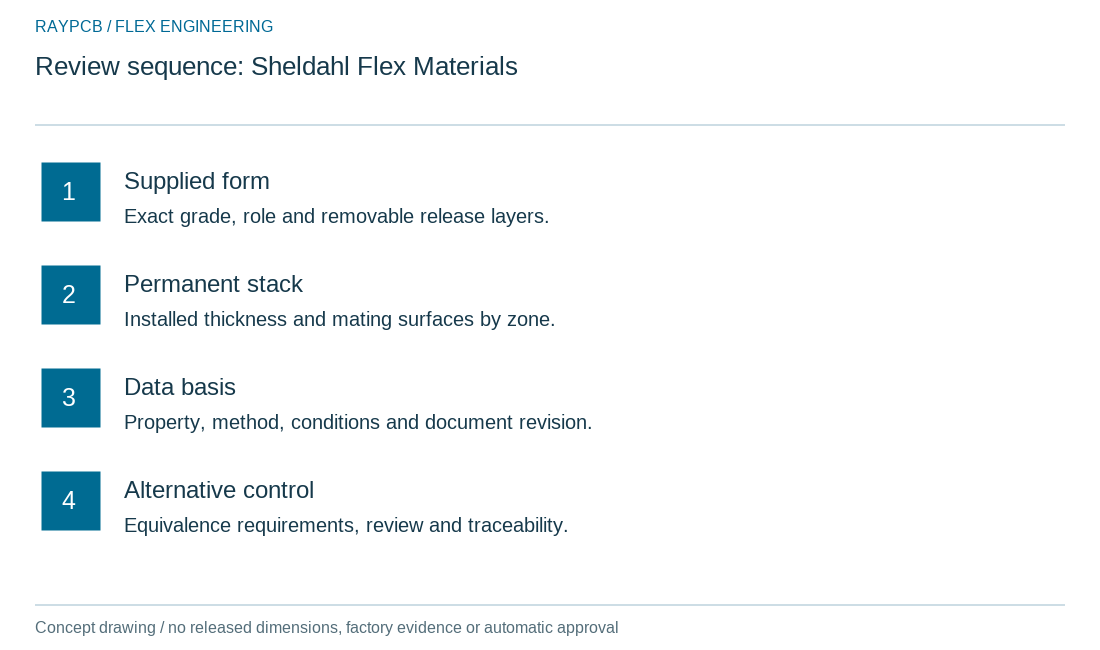
| Review item | What to establish |
|---|---|
| Supplied form | Exact grade, role and removable release layers. |
| Permanent stack | Installed thickness and mating surfaces by zone. |
| Data basis | Property, method, conditions and document revision. |
| Alternative control | Equivalence requirements, review and traceability. |
Match bonding to the actual interfaces
Identify the surfaces, preparation requirements and process route. Include subsequent soldering, cleaning and service exposure. A bond property measured under a supplier's test conditions is not automatically a lifetime rating for another substrate or load direction.
Do not copy a general temperature, pressure or dwell from a different product. Resolve the selected material's guidance and the manufacturer's qualified process before releasing the construction.
Compare electrical and environmental properties by method
Select data relevant to the intended function: insulation, dielectric behavior, adhesion or environmental compatibility. Retain the method, conditions and document revision. Similar numerical values obtained under different conditions may not support a direct substitution.
The flexible substrate selection guide separates material-family screening from complete-construction qualification. A good comparison names both the property and the engineering decision it supports.
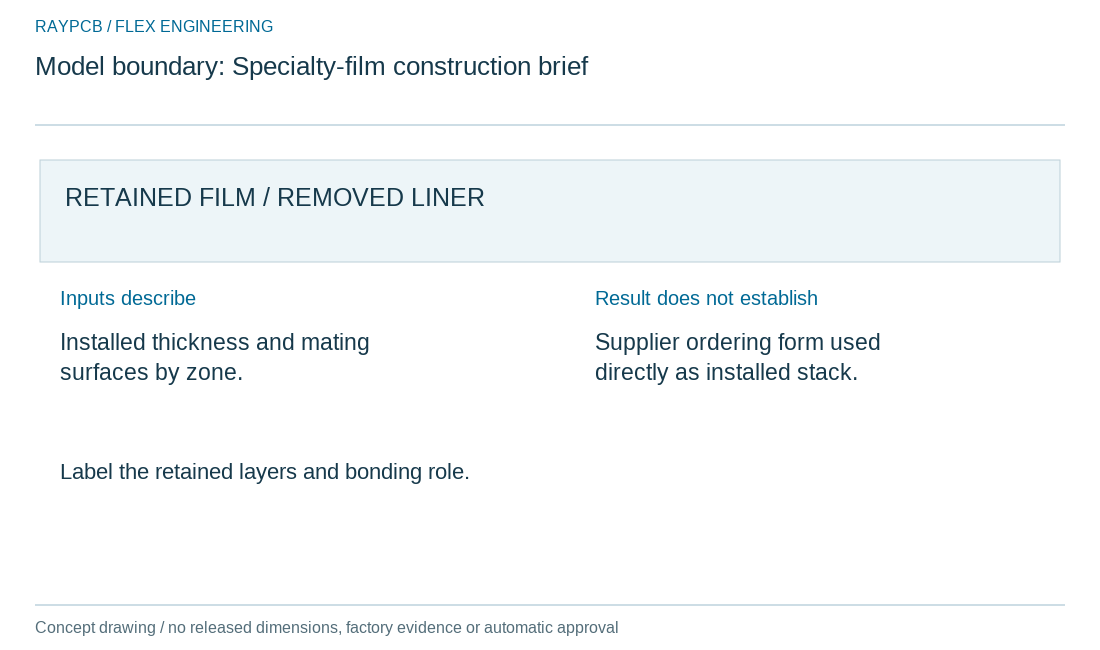
Specialty-film construction brief
Specialty-film construction brief
Use the current inputs and keep the assumptions
Choose the engineering question before entering data. Every field begins blank. Load example provides teaching values so you can inspect the calculation or workflow; it is not a recommendation for dimensions, materials, operating conditions or prices. The example label remains visible after editing. Reset the worksheet before preparing a record based entirely on your own project inputs.
Keep the units and measurement boundaries consistent. A finished thickness is different from an incoming film thickness; a complete current loop is different from one conductor; a bulk dielectric constant is different from effective permittivity. Identify the source and conditions of the values you enter. If information is missing, record it as an engineering question instead of selecting an attractive assumption.
Read the result together with its limitations. A positive geometric margin addresses only the dimensions entered. An evidence checklist records your statements without checking the underlying documents. A cost scenario adds your allowances without supplying current market prices. None of these tools approves a material substitution, predicts service life or issues a manufacturing quotation.
Editing an input invalidates the current result and disables its download until you run the worksheet again. The text download contains the inputs, results and stated limitations. Processing stays in this browser; the tool does not read CAD, upload project files or send your inputs to analytics. No parameters are automatically passed to Contact. Download and attach the record manually if useful, or contact RAYPCB directly without using the tool.
| Input | What to establish before using it |
|---|---|
| Review reference | Use a nonconfidential revision or scope reference. |
| Exact supplier grade / revision / role | Self-reported documentation; keep the supporting record or N/A rationale. |
| Permanent film versus removable liner | Self-reported documentation; keep the supporting record or N/A rationale. |
| Mating surfaces and bonding process | Self-reported documentation; keep the supporting record or N/A rationale. |
| Exposure and electrical requirements | Self-reported documentation; keep the supporting record or N/A rationale. |
| Supplier traceability and construction validation | Self-reported documentation; keep the supporting record or N/A rationale. |
| Next action / record reference | Nonconfidential reference only; the tool does not verify evidence. |
Optional cost comparison from your own allowances
Use a quotation or a clearly labeled internal assumption for each input. Keep the quantity, construction and inspection scope the same when comparing alternatives. This uncalibrated planning model adds entered values; it contains no current market rates and does not issue a RAYPCB quotation. You can contact the team without completing it.
Entered construction budget
Define acceptable alternatives without creating ambiguity
If substitutions are allowed, state which functions, dimensions and verification must remain equivalent. Require review of changed interfaces and processing, not merely another material with a similar trade name. Preserve supplier and lot traceability as required by the order.
Availability and commercial scope should be confirmed during quotation. This page supplies no stock claim, exclusive sourcing claim or current price for an unspecified Sheldahl grade.
Example: a release liner mistaken for insulation
An illustrative stack drawing includes a supplied film's liner as though it remained in the circuit. The purchasing item may be identified correctly, yet the electrical and mechanical model describes a layer that will be removed.
Correct the retained-versus-removed inventory and revisit thickness and insulation assumptions. Keep the supplier's delivery form documented separately so the correction does not accidentally change the material ordered.
Prepare a material-integration enquiry
Provide the exact grade and revision where known, intended role, mating surfaces, stack drawing, process exposures, installed environment and quantity. State which properties require evidence and whether alternatives can be proposed.
The optional entered-cost budget covers the defined construction and verification scope without supplying market rates. Continue to flexible PCB manufacturing for the circuit build review, with unresolved material questions clearly marked.
A grade-specific material review workflow
Describe the engineering requirement before selecting a material family. Identify the relevant thermal history, electrical function, environmental exposure, bonding surfaces and motion. These conditions help distinguish mandatory properties from preferences and prevent an appealing catalog number from becoming the entire specification.
Create a material-role table for the finished circuit. Separate base film, copper, adhesive, coverlay, reinforcement and shielding. Preserve exact grades and supplier document revisions where known. If a material has not been selected, state the required function and the information needed to evaluate a proposal instead of inventing a grade or a universal property value.
Compare data obtained on a compatible basis. Test method, temperature, frequency, specimen construction and conditioning can change the meaning of a reported number. Typical values describe samples or product information under stated conditions; they are not automatically guaranteed limits for a different circuit or process.
Review interfaces as carefully as bulk properties. A strong dielectric may still require a suitable bonding system, and a useful adhesive may interact with the finish, surface preparation or assembly history. The final construction can fail at an interface that a table of isolated material properties never describes.
Keep supplied form and installed structure separate. Liners, release films, carriers and packaging can be essential to procurement or processing while absent from the finished circuit. Conversely, a thin permanent adhesive can be easy to omit from an electrical or mechanical model. Label these distinctions in both the purchase description and the stack drawing.
Control substitutions through function and evidence. Define which requirements and dimensions must remain equivalent and which trials or reviews are needed when a grade changes. Brand familiarity, matching color or a similar family name is not a substitute for that comparison. Confirm actual supply scope and availability during quotation.
At release, retain the selected material schedule with the circuit revision and the agreed verification. Supplier certificates, incoming checks, finished-part measurements and product-level trials answer different questions. Request the records relevant to the order without attributing a supplier's certifications or laboratory results to a different organization or to an untested assembly.
Standards, source context and limits
Use references within their stated scope. Official material documentation applies to the identified grade, conditions and revision. A supplier specimen test is not a guaranteed result for a different finished circuit. Connector drawings govern the specified parts; public category descriptions do not replace them.
Agree the applicable controlled standards, revisions, construction requirements and acceptance criteria for the order. IPC-2223 concerns flexible-board design; IPC-6013 concerns qualification and performance of flexible and rigid-flex printed boards. Assembly workmanship and product-level electrical or safety requirements are separate. A standards reference does not establish a RAYPCB certification or prove that a particular test is included.
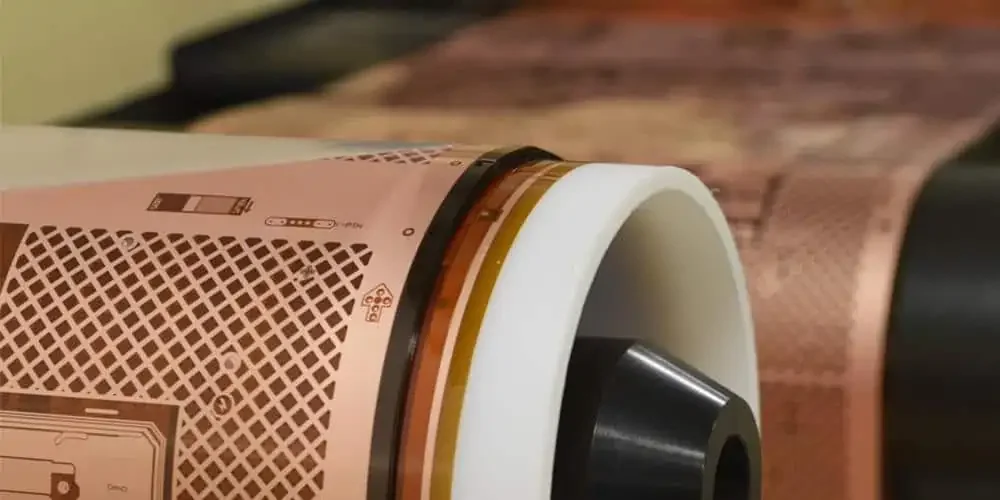
Archive photographs provide visual context from the existing website. They do not establish the precise material grade, present equipment ownership or results of your project. Original diagrams are explanatory construction and review illustrations, not released fabrication drawings or inspection evidence.
For fabrication scope and the agreed construction requirements, see PCB manufacturing.