
RAYPCB · ENGINEERING & PROCUREMENT
High Volume PCB Manufacturing: Build a Controlled Production Baseline
High volume PCB manufacturing depends on repeatable construction, stable release data and controlled changes. Larger quantities spread some setup costs, but they also increase the consequences of an incorrect material, drill definition or acceptance requirement. This page helps procurement and engineering teams prepare a production baseline, compare lot evidence and discuss capacity without confusing an advertised monthly output with a commitment for a particular board.
Your task: Define releases and forecast. Use the production lot and yield arithmetic to record the next decision.
Open production lot and yield arithmetic · Discuss the project

Define volume as a delivery program
Give the quantity per release, expected cadence, forecast horizon and required shipment windows. An annual forecast of many boards can mean one large lot or frequent smaller releases. Those patterns place different demands on material purchasing, work in progress, storage and configuration control.
Separate forecast from commitment. Specify when quantities become firm and how changes affect material already purchased or boards already in process. If a program uses multiple revisions, identify the permitted overlap and how shipments will distinguish them.
High volume is not a substitute for technical detail. Provide dimensions, construction, copper, finish, holes, tolerances, inspection requirements and packing expectations. The manufacturer must assess the actual route, not just the total number of pieces.
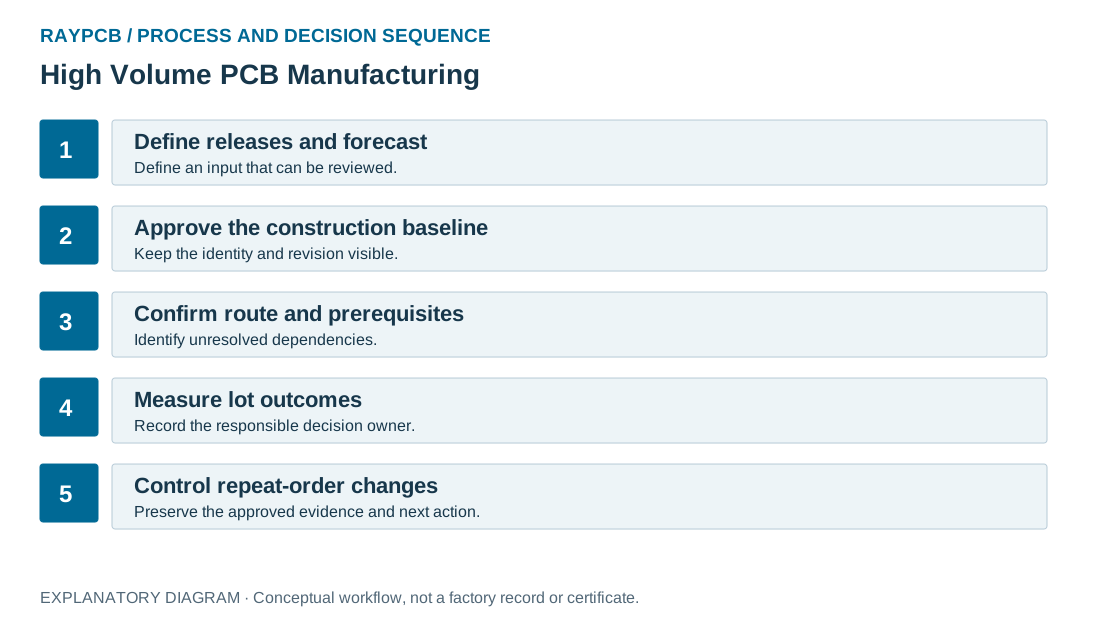
Freeze the construction that was actually reviewed
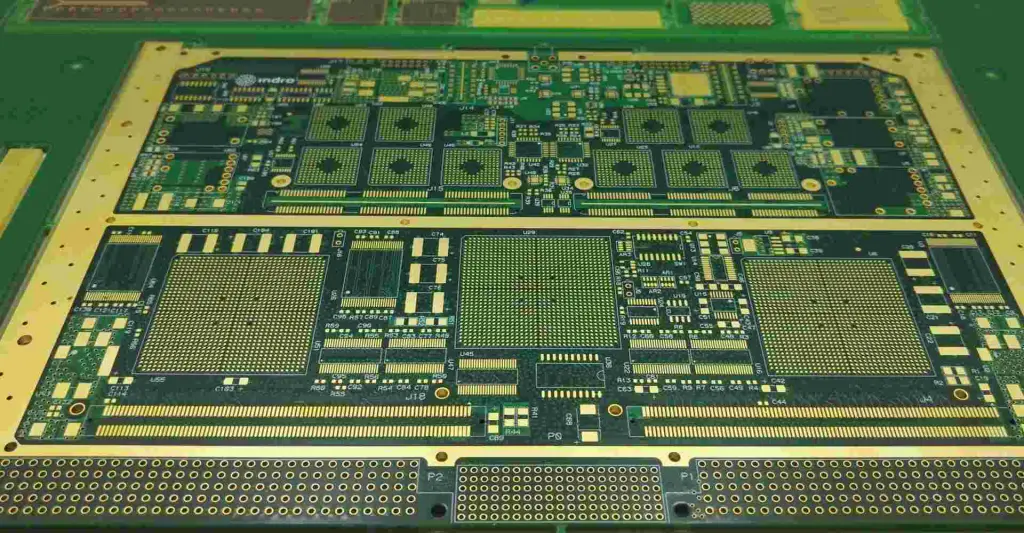
Keep the approved stackup, laminate requirements and allowed substitution process with the released manufacturing data. A repeated order should not silently change dielectric construction, foil or material grade just because the electrical drawing did not repeat every detail.
Identify which properties are functional requirements and which are supplier proposals. Controlled impedance may need agreed geometry, material inputs, measurement method and coupon design. Mechanical interfaces may depend on finished thickness and tolerances. Separate these requirements from ordinary nominal values.
For special constructions, agree the evidence needed before scaling. An acceptable visual sample does not establish internal reliability. Ask for the qualification and lot acceptance scope appropriate to the product, with sampling and reporting agreed in advance.
Plan capacity around the route and the bottleneck
Capacity depends on the processes used by your board, the production mix, maintenance, yield and other commitments. A factory area or total monthly output does not directly tell you how many complex boards can ship in your required window.
Discuss the operations that constrain your design: repeated lamination, specialized drilling, plating, electrical testing or documentation may dominate. Identify material readiness and engineering approval as prerequisites. Ask when capacity is reserved and what assumptions can change the schedule.
Avoid treating a prototype lead time as a production promise. A production release may require different panel planning, purchasing and process evidence. PCB manufacturing lead-time risk planning helps map these dependencies.
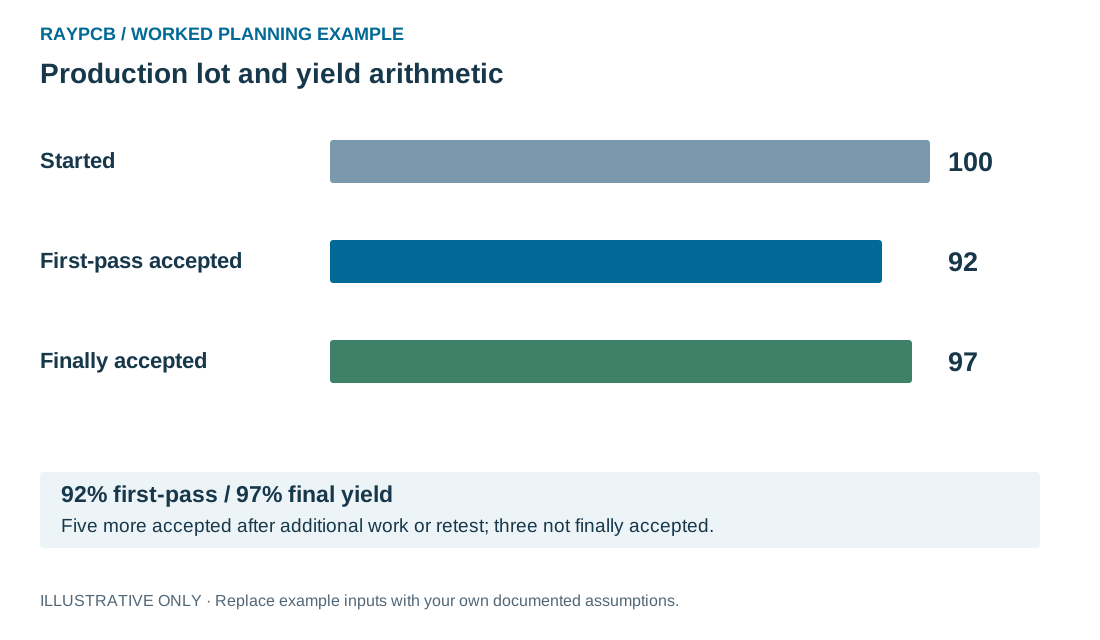
Read yield data with its denominator visible
Distinguish started pieces, accepted pieces, scrap, rework and retest. First-pass yield and final accepted yield answer different questions. Define whether the denominator is panels, individual boards or assemblies and keep it consistent between periods.
The calculator below performs transparent arithmetic on your entered counts. It does not infer capability from one lot or turn yield into a guaranteed future result. Changes in product complexity, inspection coverage or sampling can make two percentages incomparable.
Production lot and yield arithmetic
Production lot and yield arithmetic
How to use and interpret this worksheet
Use counts from one defined lot and a consistent inspection or test scope. Enter started units, units accepted on the first pass and units finally accepted after any permitted additional work or retest. Counts must satisfy first-pass accepted no greater than final accepted, and final accepted no greater than started.
First-pass yield is first-pass accepted divided by started units. Final accepted yield is final accepted divided by started units. The difference in accepted counts indicates units accepted only after additional work or retest; it does not identify the cause. The remaining count is not finally accepted under the recorded scope.
Keep panels and individual boards separate. Do not compare a panel-based rate with a unit-based rate or combine changing inspection coverage without explanation. A high percentage from a small sample does not establish process capability or future reliability.
Retain defect categories, rework instructions, test-system changes and relevant configuration information alongside the summary. Otherwise an apparent improvement could come from changed limits or reduced coverage rather than a better process.
Use the example to check the arithmetic, then clear the form for actual lot counts. Input changes invalidate old output. Download the current record if it helps the review, but keep controlled production records elsewhere. This worksheet does not create a test report, infer a failure mechanism, approve a lot or transmit manufacturing data.
Use the result to ask better questions. A falling first-pass yield with stable final yield may indicate additional rework. A stable yield with weaker inspection can be misleading. Preserve defect categories and process context alongside summary values.
Keep a decision record with the review
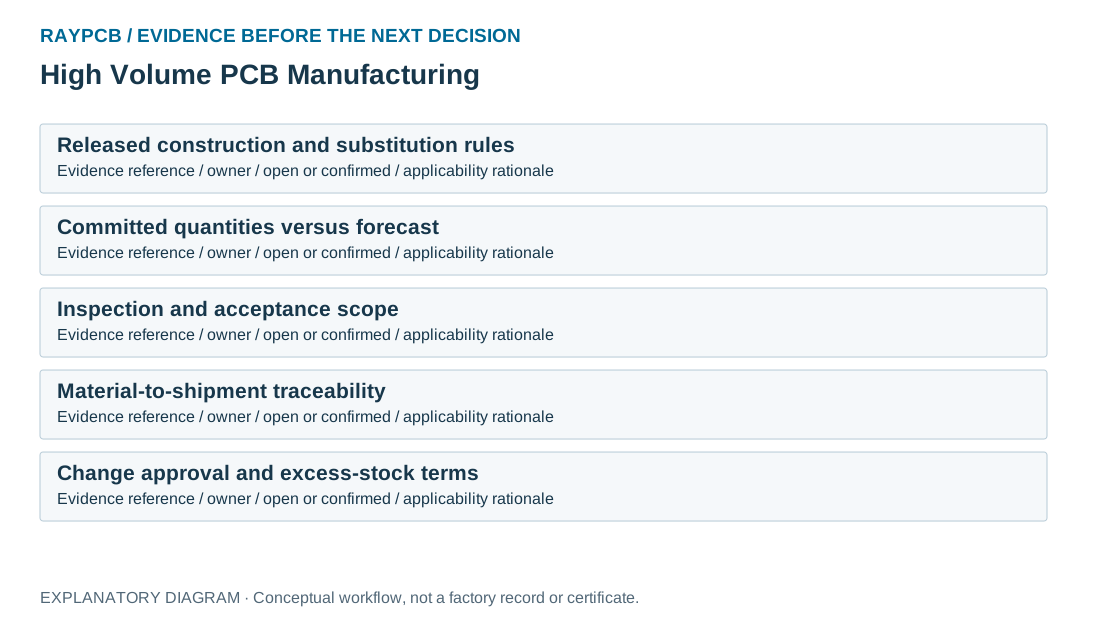
Use this record to connect the discussion to supporting information. Record the source, revision and reviewer for each item. Confirmed means the responsible person has reviewed the evidence; it does not mean this website has verified it. Keep confidential documents in your approved project system.
| Review topic | Record to retain | When it remains open |
|---|---|---|
| Released construction and substitution rules | Identify the controlled scope and the person authorized to approve it. Keep the current reference together with the intended decision. | Clarify the boundary before treating the review as a release instruction. |
| Committed quantities versus forecast | Reference the actual file, data source or agreed requirement, including its revision or date and the person who reviewed it. | Request the missing evidence and identify which downstream decision depends on it. |
| Inspection and acceptance scope | Record the conditions and assumptions that make the evidence applicable. Separate a proposed value from an approved requirement. | Keep the assumption visible and define whether the next activity may proceed under a bounded exception. |
| Material-to-shipment traceability | Identify responsibility for the next operation and the evidence expected afterward. Distinguish preparation from a completed result. | Assign a named role and an agreed decision point; do not turn an unanswered question into an approval. |
| Change approval and excess-stock terms | Record the final disposition, affected quantity or revision and the authority accepting it. Preserve the reason for any exception. | Retain the item in the action list and review its consequence before committing work or materials. |
Review the record again when the product, supplier proposal or supporting data changes. A result from an earlier revision is historical evidence, not automatic approval for the current one. If an item is not applicable, retain the reason and the person who made that decision.
Make acceptance and traceability specific
Agree the standards, revisions, class, drawings and customer requirements that define acceptance. IPC-A-600 addresses printed-board acceptability, while qualification and performance requirements depend on the applicable board specification, such as IPC-6012 for rigid boards. Confirm the contractually required documents rather than assuming one phrase covers everything.
Traceability should support the investigations your product may need. Define links between material lots, production lots and shipments, and decide which records accompany delivery. Retention and retrieval arrangements should be agreed before the first large release.
A quality system certificate is relevant evidence about a defined scope, but it is not a test report for the delivered board. Use quality assurance to discuss the evidence needed for your order, and consult the IPC standards framework for document scope.
Compare the economics of quantity without hiding inventory
Ask for price breaks against the same construction and inspection scope. Separate one-time tooling, recurring board cost, special testing, documentation, packaging and freight. Do not assume every cost falls proportionally with quantity.
Larger lots can improve setup allocation yet increase inventory exposure. If the product changes, the economic cost includes unusable stock and any committed material. Discuss release schedules or staged purchasing where appropriate, with the commercial terms made explicit.
A hypothetical program forecasting several releases may benefit from a stable material plan while retaining separate finished-board deliveries. Whether this is practical depends on the supplier agreement; the webpage does not offer consignment or stocking terms by default.
Treat change control as part of production
A repeat order should identify whether it is identical to the previous approved baseline. If not, list the changed files and affected characteristics. Changes to materials, construction or test requirements may require renewed engineering review and price or schedule confirmation.
Do not use an informal note such as same as last time when several revisions have been quoted. Reference a specific approved package and purchase order. Keep superseded data available for traceability but clearly excluded from current production.
When assemblies are also required, coordinate board revision changes with the BOM, placement, firmware and test package. The PCB assembly order checklist covers that release boundary. Bare-board acceptance and assembled-product acceptance remain separate.
Questions for a production enquiry
Does a successful small lot prove high-volume readiness? It is useful evidence, but the production route, material supply, inspection and change controls must also be reviewed.
Can we obtain a firm annual price immediately? A price needs defined construction, quantities, release pattern, validity and commercial assumptions. Forecasts and material availability can change.
What should RAYPCB receive? Send the released fabrication package, order quantities, forecast, required dates and acceptance evidence. Start through PCB manufacturing; use supplier evaluation when you need to compare evidence before selecting a partner.