
RAYPCB · Manufacturing decisions
PCB quote comparison: align the scope before the price
Compare two quotations using one quantity and currency. Keep technical differences, missing information and order-level fees visible.
Share your current requirements and open questions. Tool use is optional.

What makes a PCB quote comparison valid?
A valid PCB quote comparison starts with the same released product, delivered quantity, acceptance requirements and commercial boundary. Only then does comparing prices answer a useful purchasing question. Two suppliers can produce accurate quotations for different interpretations of an RFQ; the numerical difference does not by itself establish which quotation delivers the product you need.
Start by identifying the controlling fabrication archive and drawing. Record approved alternatives, required tests, delivery format and the milestone used for lead time. Then separate recurring board price from fixed preparation, freight and other agreed charges. The worksheet on this page keeps those amounts visible alongside unresolved scope; it does not create a supplier score or treat missing information as a free inclusion.
For a new RAYPCB enquiry, you can go directly to Contact with the available files and questions. Completing a competitor comparison is optional. The purpose of this guide is to improve the quality of a purchasing decision and the clarity of the resulting order, rather than to force every visitor through a price-ranking exercise.
Establish one comparison basis
Use a short RFQ summary that travels with the fabrication package. The summary should identify what is fixed, which alternatives may be quoted and who can approve a change. If one supplier proposes a different laminate or finish, label it as an alternative offer instead of placing it silently beside the baseline. Technical approval and commercial selection can then be reviewed separately.
| Comparison category | Information to align | A difference that needs clarification |
|---|---|---|
| Product identity | Drawing, data revision, quantity and board/panel unit | Different revisions or counts of arrays versus circuits |
| Construction | Stackup, material, copper, holes, finish and outline | Unapproved substitute or omitted special feature |
| Verification | Tests, acceptance basis, coupons and records | A generic “tested” statement without agreed coverage |
| Delivery | Start condition, endpoint, destination and packaging | Dispatch compared with arrival or unpriced freight |
| Commercial scope | Currency, fixed fees, validity and included charges | Setup included in one total but added separately in another |
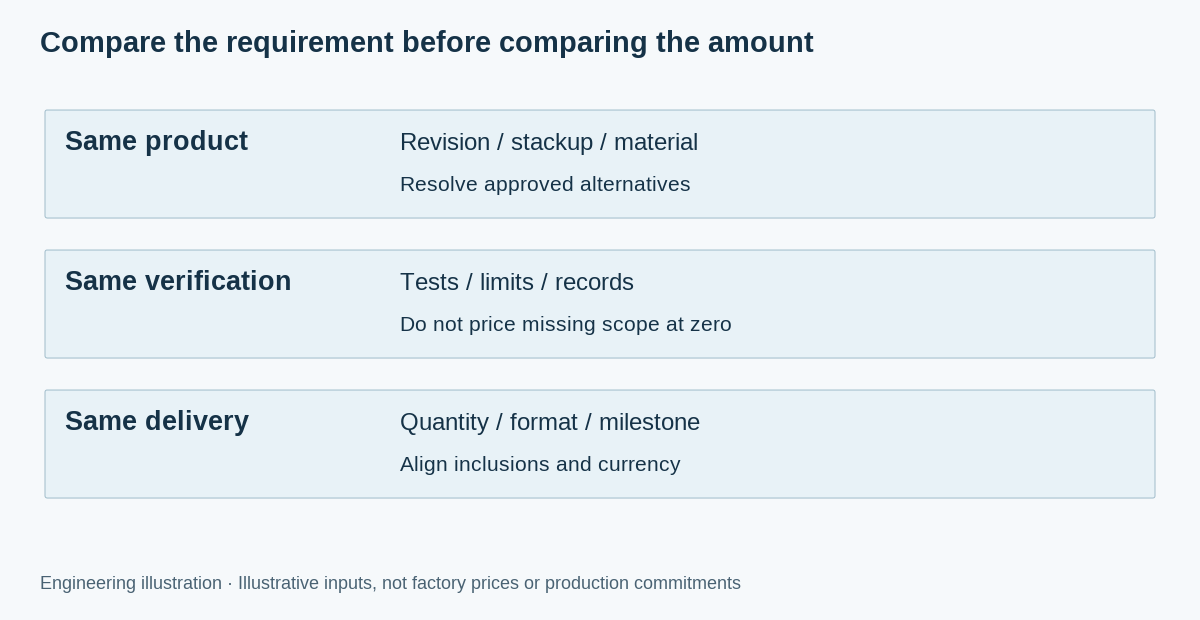
This is a comparison checklist, not evidence that either supplier has met the requirement. Keep the source quotation, clarification response and responsible reviewer with the worksheet. An unresolved item and a confirmed difference require different actions: the former needs information, while the latter needs a change, an accepted alternative or a decision to exclude that offer from the baseline comparison.
Compare amounts without hiding scope gaps
Enter one delivered quantity and one currency. For each quotation, enter a unit price, fixed charges, freight and any other nonduplicated adjustment. Then mark the five scope categories as matched, different or unresolved. The numerical subtotals remain visible when a category is open, but the result will not describe the scope as aligned.
RAYPCB ENGINEERING
Fabrication BuyingPCB quote comparison Planner
Loading PCB quote comparison Planner…
The arithmetic is quantity × unit price + fixed charges + freight + other adjustments for each quotation. Enter a documented credit as a negative other adjustment only if it has not already been deducted from the unit price; a subtotal cannot be negative. The tool reports the difference as B minus A. It does not apply exchange rates, customs duties, tax rules or a probability of supplier failure. Convert and document currencies outside the tool using your agreed procurement basis before entering a same-currency comparison.
Example: unit-price order can reverse
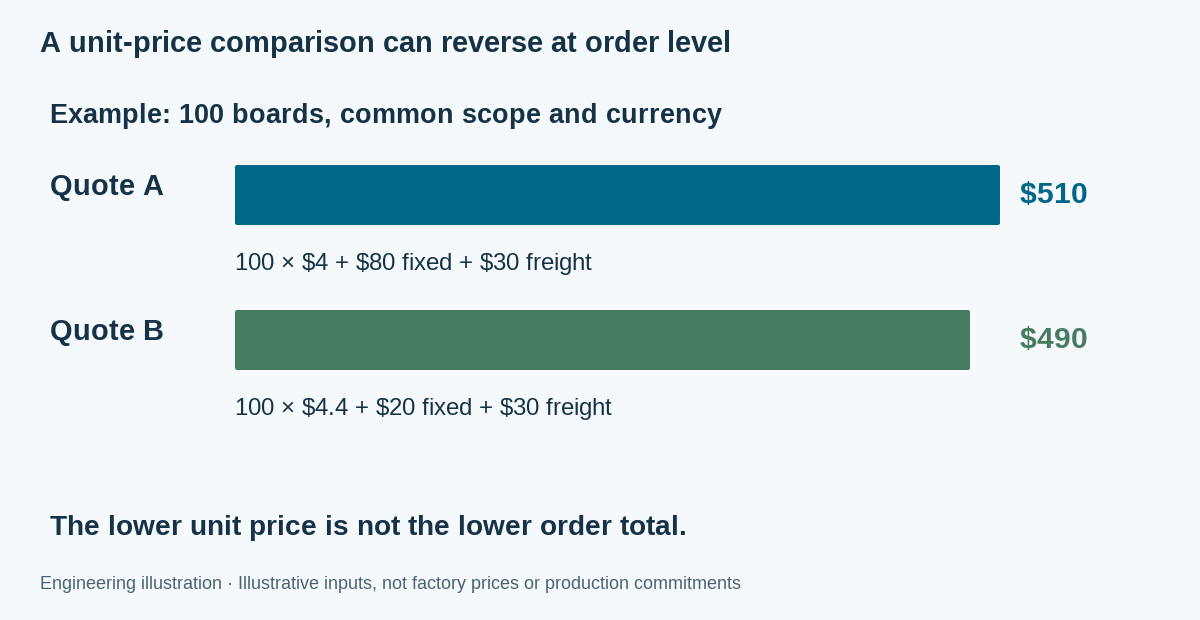
Assume both offers cover 100 identical finished boards and the same verified scope. Quote A has an illustrative unit price of USD 4, fixed charges of USD 80 and freight of USD 30, giving USD 510. Quote B has USD 4.40 per board, fixed charges of USD 20 and the same USD 30 freight, giving USD 490. Other adjustments are explicitly zero in this example.
Quote A has the lower unit price, while Quote B has the lower total for this specific order. That does not make B the preferred supplier in every situation. A repeat order may use a different fixed-fee arrangement, a larger quantity may have a different rate and either offer might contain a technical exception. These values are invented to demonstrate the comparison, not quotations from RAYPCB or another manufacturer.
Avoid combining a unit price from one quantity tier with the setup treatment from a different order. Compare complete offers at each requested break. If the supplier provides a single total, ask which fees it includes before dividing it into input fields. Adding an already-included engineering fee again creates a misleading comparison even though the calculator itself works correctly.
Read exceptions before discounts
Pay attention to the notes below the price table. They may contain proposed changes to material, thickness, copper, hole size, finish, tolerances or panel format. An approved change may be reasonable, but it should remain visible and traceable to the affected drawing. A verbal statement that the boards are “equivalent” is not a substitute for the design owner deciding which requirements matter.
For controlled impedance, clarify the target, tolerance, stackup and measurement evidence. For special vias or sequential structures, confirm which interconnect construction has been quoted. The PCB DFM guide addresses review of those manufacturing details. A low quotation based on conventional through holes is not a like-for-like offer for a board that requires filled and capped structures.
Where a supplier identifies a genuine cost driver, use the design trade-off review to evaluate a controlled alternative. The right response is not always to preserve every initial specification, but the required product behavior must survive the change. Keep the baseline quote and approved alternative separate until engineering review is complete.
Compare the evidence being purchased
“Electrical test,” “inspection” and “quality report” are not interchangeable descriptions. Specify the relevant method, extent, acceptance basis and record. A report may document measured results, confirm a procedure or summarize conformity; ask what it actually contains and how it relates to the shipped lot. Do not infer complete functional verification from a bare-board continuity test.

The PCB quality-control guide explains how a fabrication requirement connects to a control and a record. Identify the applicable IPC documents and editions through the official revision table, then agree the order-specific requirements. A standards name in a quotation does not settle every tolerance or create a universal inspection package.
Special evidence can require planning before production. Coupons, retained samples, dimensional reporting and additional traceability may affect panel allocation or record preparation. Ask for those requirements in the RFQ, not after selecting the lowest amount. Otherwise the eventual order can accumulate charges that were absent from the comparison because the original scope was incomplete.
Normalize what “lead time” ends with
Record whether the quoted interval begins at file receipt, approved release, payment or another agreed event. Confirm whether it ends at production completion, dispatch or delivery. Identify the calendar and cutoff assumptions. A shorter fabrication promise may not produce an earlier received board when material confirmation, engineering questions or transport remain outside that interval.
Use Quick Turn PCB to examine those dependencies. It separates ready-to-start conditions from the later manufacturing and logistics path. A quoted date should identify what the customer must provide and when, as well as how a subsequent design change affects the commitment. A planning worksheet cannot reserve a factory slot or guarantee carrier performance.
Packaging and delivery format also belong in the scope. Individual circuits, assembly arrays and special protective packaging affect what the receiving operation can do next. Confirm destination details, shipment documents and any split-delivery request. Record commercial delivery terms explicitly rather than assuming that an identical shipping label means identical allocation of costs and responsibilities.
Clarify one-time and repeat-order treatment
Ask whether preparation, tooling, special tests and reports are charged once per design, once per revision or once per order. Confirm whether a repeat release must use the same material and quantity to retain the quoted treatment. A stored tool may still need review or replacement when the design or process changes. Do not spread a one-time price benefit over uncommitted future demand as if that demand were certain.
For recurring small lots, the low-volume fabrication guide helps decide what should actually be ordered after usable stock and reserve are reconciled. For an area-based quotation, PCB cost per square inch explains the denominator. These are useful supporting decisions, but neither substitutes for reading each offer’s inclusion and exception notes.
Keep quotation validity and the assumptions behind a price in the comparison record. An old quote may no longer describe available material, capacity or freight. If an RFQ changes, request updated offers rather than editing only one line in the old worksheet. That practice prevents an apparently precise comparison from joining amounts that were never offered together.
Turn the chosen offer into a controlled order
Before ordering, reconcile the selected quote with the final fabrication release and written clarifications. Identify the accepted alternatives, required records, price basis, quantities and milestones. Close unresolved technical differences with the appropriate authority. A purchasing approval should not silently substitute for engineering approval of a material or construction change.
Keep the comparison, source quotes and agreed exceptions together. The official Ucamco Gerber resources describe fabrication data exchange, while the local PCB file-format guide helps organize a clear release package. Good data identification supports both accurate quoting and later investigation if the delivered product does not match the expected revision.
For RAYPCB review, send the available data and clearly state which requirement needs clarification. You do not need to disclose other suppliers’ confidential commercial details to request an engineering explanation or a revised scope. A concise set of questions about inclusions is often more useful than forwarding an unexplained total and asking the next supplier to beat it.
PCB quotation questions
Can the tool choose the best PCB supplier? No. It compares entered amounts and reported scope categories. It cannot verify manufacturing performance, commercial reliability or the adequacy of engineering evidence.
Should an unknown charge be entered as zero? No. Ask whether it is included, excluded or still to be priced. An explicit zero is appropriate only when that treatment is confirmed for the comparison.
Can I compare PCB and PCBA prices in the same worksheet? Use a consistent deliverable. Component purchase, assembly and programming need their own scope; a populated-board price is not directly comparable with a bare-board price.
Does a lower total justify accepting a changed material? Only the responsible design authority can approve that change against the product requirements. Keep its technical approval separate from the numerical price comparison.
Clarify your PCB quotation scope
Send the fabrication revision, quantities, construction, required verification and delivery milestone. Include the available files and identify unresolved scope so the engineering team can review a useful quotation.
Attach a downloaded tool brief manually. Contact does not automatically receive these inputs. References reviewed September 2026. Illustrations use planning examples; photographs do not establish prices, delivery times or project-specific acceptance.
Prepare each quote before comparing suppliers
First check the line items and missing amounts in a single PCB quote. If a number is still a configuration estimate, review what an instant quote needs before engineering approval before treating it as equivalent to a reviewed offer.