
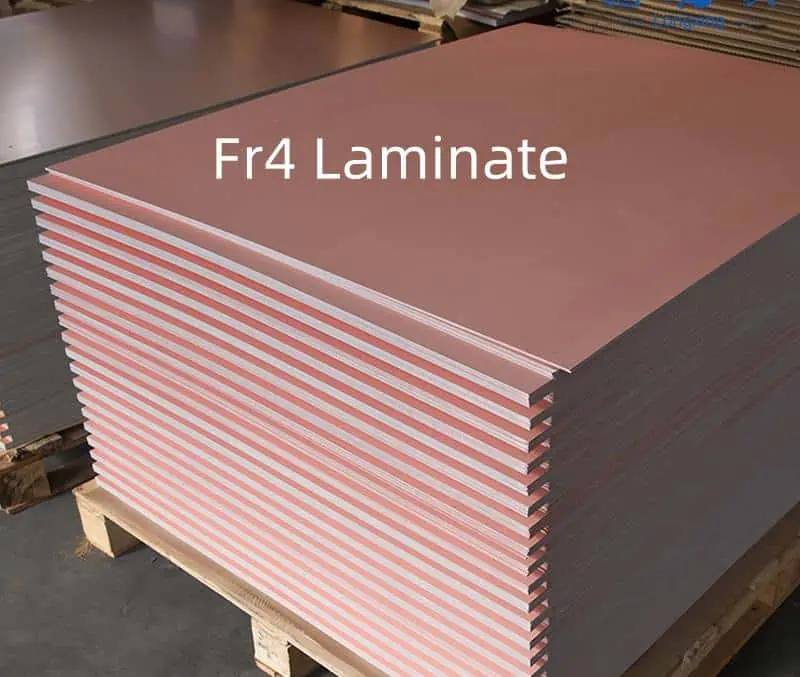
A PCB laminate is a non-conductive substrate, or the base material used for the production of Printed Circuit Boards (PCBs).
It is important to mention that this is usually the basis of the board and serves a definite purpose – to bolster the speed of producing the circuits.
Hence, you can understand the workings of a base laminate PCB by taking note of the following:
- It is also called the Copper-Clad Laminate PCB, mainly because of the alignment of sheets of copper foil on either side of the prepreg.
- The laminate is made of a composite material, which is made up of layers of fiberglass cloth. This layer is typically impregnated with an epoxy resin.
- The fiberglass layers are stacked atop each other and are used to create a solid sheet of material. This is, of course, after the layers have been pressed together with both pressure and heat.
How are PCB Laminates Produced?
The development of circuit board laminates takes a defined process – via the curing under pressure and temperatures of cloth. This is also done using thermoset resin for the creation of the final piece of PCB laminate thickness.
The Copper-Clad Laminates (CCLD) comprising of sheets of prepreg are laminated with pressure and heat. The sheets of copper foil are aligned to either side and upon the hardening of the resin, the laminates will take the form of a plastic composite.
The Layers of a Circuit Board
A Printed Circuit Board (PCB) typically has four (4) layers. These include:
- Substrate
- Copper
- Silkscreen and;
- Soldermask
A major concentration is placed on the substrate, and this is where we find the laminate PCB. There are two (2) major types of substrates:
- Organic and;
- Inorganic
On the one hand, the organic substrates are the ones comprising reinforced materials, examples being glass fiber, which is impregnated with resin binders, and which is dried and covered with a copper foil. It would then be developed by high pressure and high temperature.
Another name for the aforementioned substrate is Copper-Clad Laminates (CCLD).
On the other hand, there is the inorganic substrates, which comprise enamel-coated steel substrates and ceramic plates.
The Types of PCB Laminates
Different kinds of laminates or non-conductive substrates can be used in the production of circuit boards.
These are also called the Printed Circuit Board (PCB) materials. In this section, we talk about some of the popular laminate materials.
1. FR-4
When mention is made of PCB laminate materials, the FR-4 readily comes to mind. The reason why it is common can be attributed to different factors, most especially, the excellent performance, across all characteristics.
You might be wondering what the full meaning of the acronym is. It stands for Flame Retardant 4 (FR-4). This type of PCB laminate is noted for these attributes:
- It is a glass-reinforced epoxy material.
- The FR-4 circuit board material is commonly used in the production of different kinds of PCBs.
- The material is designed as per the standards of the NEMA LI 1-1998.
- Good strength-to-weight ratio.
- Good thermal conductivity
- Excellent mechanical strength.
- The FR-4 material helps to maintain an effective balance of the following: production capacity, cost, performance, reliability and durability.
- The material is not just strong and rigid. It also resists cracking and warping of the PCB.
a. Flame Properties
FR-4 laminate is so-called because of the ability to retard flames. Hence, the flame-retardant properties are the reason for the reliability in a wide range of electronic devices.
b. Typical Application
Although the popular opinion is that the FR-4 PCB laminate materials are used “across circuit boards,” the fact is that the options are sometimes limited.
For example, these materials are mainly developed for use with PCBs that require a maximum of 14 layers.
Even at that, you can still use the FR-4 laminate materials for the double-layered circuit boards.
However, you must avoid using this laminate material to produce circuit boards optimized for high-temperature applications or uses.
Excellent Thermal Properties
The thermal capabilities of this laminate material are also a unique feature. These include excellent thermal stability, low dielectric constant and loss, enhanced UL flame ratings, power specifications and high insulation resistance.
c. High-Performance FR-4
You can consider this to be the higher version of the FR-4 laminate material, in terms of the performance. However, there is more to that.
The high-performance FR-4 PCB laminate material refers to the type of laminate material that does not just offer improved mechanical and electrical properties, but also makes the usability extendable beyond the double-layer PCBs. You can also use these materials with the multilayered Printed Circuit Boards (PCBs).
The following are some of the attributes:
- Better dimensional stability and a higher strength are realized because the material is made using a higher grade of epoxy resin, as well as a finer weave of glass fiber reinforcement.
- High-performance FR-4 PCB materials offer improved mechanical strength, better thermal conductivity, and a lower dielectric loss, especially, when this is compared to the traditional FR-4 material.
Due to the increased Tg for better reliability and the decreased dielectric properties, this material is commonly deployed for use in the key industries where performance and reliability is required:
- Telecommunication
- Defense and;
- Aerospace
d. Copper-Clad Laminate (CCL)
This is another common type of circuit board laminate. The Copper-Clad Laminate (CCL) serves as the base material that comprises a layer of copper that is bonded to either one or both sides of the board.
The features of the CCL laminate material include:
- It is relied on to meet the distinct needs of different electronic devices, thanks to the availability in several copper weights and thicknesses.
e. Polyimide
This is a type of PCB laminate material noted for the higher temperature resistance, a property that makes it ideal for the electronic applications often exposed to harsh environments.
Other types of PCB laminate materials are:
- Teflon
- High Tg Epoxy
- BT Epoxy
Conclusion
Circuit board laminates are used to provide electrical insulation between the copper traces, provide the needed mechanical strength for holding the electronic components in place, as well as providing consistent dielectric properties for ensuring ideal transmission of electrical currents through the non-attenuated copper traces.
Always consult a professional laminate PCB manufacturer to guidance before using these materials in your circuit boards.

