
If you’ve ever had a circuit fail during thermal cycling or watched signal integrity fall apart above 10 GHz, you know that material selection isn’t just a checkbox on your BOM — it’s the foundation of your entire design. After working with RF and high-temperature PCB designs for years, I’ve learned that when standard FR-4 can’t cut it anymore, Arlon PCB materials consistently deliver where it matters most.
This guide walks you through everything you need to know about selecting the right Arlon material for your project. Whether you’re designing phased array antennas, automotive radar modules, or aerospace control systems, you’ll find practical insights here that go beyond basic datasheets.
What is Arlon PCB Material?
Arlon PCB refers to circuit boards manufactured using high-performance laminates and prepregs from Arlon Electronic Materials Division (EMD). Founded in 1969 as a veteran-owned business, Arlon has built over 50 years of expertise in PTFE-based microwave laminates and more than 30 years in polyimide systems.
What sets Arlon apart from standard FR-4? The key difference lies in the resin systems. While FR-4 uses a basic epoxy-glass construction, Arlon materials incorporate advanced thermoset technologies including:
- Polyimide resins with glass transition temperatures exceeding 250°C
- PTFE (Teflon) composites for ultra-low dielectric loss
- Ceramic-filled systems for enhanced thermal conductivity
- High-Tg multifunctional epoxies for lead-free assembly compatibility
These specialized formulations deliver electrical, thermal, and mechanical performance that standard materials simply cannot match. When your design demands stable dielectric properties at 40 GHz, reliable operation at 200°C, or plated through-hole integrity through 500+ thermal cycles, Arlon materials become essential rather than optional.
Arlon PCB Calculator
RayPCB Engineering Tools
Arlon Material Selection Guide
AD Series (AD255C, AD260A, AD300A, AD350A)RF/Microwave
Woven fiberglass reinforced PTFE composites. Ideal for high-frequency applications requiring excellent electrical properties and dimensional stability.
CLTE Series (CLTE-XT, CLTE-AT)Thermal Management
Controlled Low Thermal Expansion materials with ceramic-filled PTFE. Excellent for applications requiring matched CTE with components.
DiClad Series (DiClad 527, DiClad 880)Cost-Effective RF
Non-woven PTFE/fiberglass composites offering excellent price-performance ratio for moderate frequency applications.
CuClad Series (CuClad 217, CuClad 250GT)High-Speed Digital
PTFE/woven glass laminates with excellent signal integrity for high-speed digital and mixed-signal applications.
TC Series (TC350, TC600)High Thermal Conductivity
Ceramic-filled PTFE with enhanced thermal conductivity for power amplifiers and LED applications.
Microstrip Impedance Calculator
Calculated Results
50.0 Ω
Effective Dk
2.12
Wavelength (λ)
20.6 mm
Propagation Delay
4.86 ps/mm
Conductor Loss
0.12 dB/in
PCB Stack-up Designer
Stack-up Summary
Total Thickness
32.6 mils
Arlon Core Layers
2
Prepreg Layers
1
Manufacturing Cost Estimator
Estimated Total Cost
$485.00
Material Cost
$280.00
Fabrication
$155.00
Per Unit
$48.50
Arlon PCB Design Best Practices
📐 Material Selection for Frequency
For applications below 6 GHz, DiClad series offers excellent cost-performance. For 6-20 GHz, use AD series. Above 20 GHz, consider CLTE or CuClad series for lowest loss. Always verify Dk tolerance with manufacturer specs.
🔥 Thermal Management Considerations
PTFE materials have lower thermal conductivity than FR4. Use thermal vias (0.3mm diameter, 1mm pitch) under power components. TC series materials provide 3-5x better thermal conductivity for high-power applications.
⚡ Impedance Control Guidelines
Arlon materials have tighter Dk tolerance (±0.04) vs FR4 (±0.2). Design for nominal Dk value. Request impedance testing on production lots. Allow ±5% impedance tolerance in your design margins.
🔧 Drilling & Via Recommendations
PTFE materials require specialized drill bits with lower feed rates. Minimum via diameter: 8 mils. Maintain aspect ratio below 8:1. Plasma desmear is recommended over chemical processes for PTFE.
📏 Trace Width Compensation
PTFE has higher CTE than copper. Add +0.5 mil to trace width specifications to compensate for etching variations. Use trapezoidal trace models for accurate impedance calculations above 10 GHz.
🔗 Hybrid Stack-up Design
Combine Arlon RF cores with FR4 prepreg for cost optimization. Place high-frequency signals on Arlon layers. Use FR4 bonding films compatible with PTFE (e.g., FEP or low-flow prepreg).
✨ Surface Finish Selection
ENIG provides best solderability for fine-pitch components on PTFE. For RF applications, immersion silver or OSP minimize conductor loss. Avoid HASL on thin PTFE cores (<10 mil).
📦 Storage & Handling
Store Arlon laminates at <30°C and <50% RH. PTFE materials absorb minimal moisture but cleanliness is critical. Handle with gloves to prevent contamination affecting solder mask adhesion.
Arlon Material Comparison Chart
| Material | Dk @ 10GHz | Df @ 10GHz | Tg (°C) | CTE Z-axis | Best For |
|---|---|---|---|---|---|
| AD255C | 2.55 ± 0.04 | 0.0018 | >280 | 280 ppm/°C | General RF |
| AD260A | 2.60 ± 0.04 | 0.0017 | >280 | 265 ppm/°C | Antennas |
| AD300A | 3.00 ± 0.04 | 0.0020 | >280 | 250 ppm/°C | Size reduction |
| AD350A | 3.50 ± 0.05 | 0.0035 | >280 | 230 ppm/°C | Compact RF |
| CLTE-XT | 2.94 ± 0.04 | 0.0012 | 288 | 12 ppm/°C | CTE matching |
| DiClad 527 | 2.50 ± 0.04 | 0.0018 | N/A | 170 ppm/°C | Cost-effective |
| DiClad 880 | 2.55 ± 0.04 | 0.0022 | N/A | 170 ppm/°C | Multi-layer |
| CuClad 217 | 2.17 ± 0.02 | 0.0009 | N/A | 24 ppm/°C | Low loss |
| CuClad 250GT | 2.50 ± 0.04 | 0.0018 | N/A | 24 ppm/°C | High-speed |
| TC350 | 3.50 ± 0.05 | 0.0020 | N/A | 24 ppm/°C | Thermal mgmt |
| TC600 | 6.15 ± 0.15 | 0.0025 | N/A | 20 ppm/°C | High Dk apps |
Why Choose Arlon PCB Over Standard Materials?
The decision to specify Arlon typically comes down to three scenarios where FR-4 limitations become design constraints:
High-Frequency Performance Requirements
FR-4’s dielectric constant (Dk) fluctuates significantly with frequency and temperature, causing impedance mismatches and signal degradation above 1-2 GHz. Arlon materials maintain stable Dk values from DC through millimeter-wave frequencies, with loss tangents as low as 0.0009 — compared to FR-4’s 0.02 or higher.
Thermal Management Challenges
Standard epoxy-glass laminates begin softening around their 130-140°C glass transition temperature. Arlon polyimides remain dimensionally stable at 250°C+, while PTFE-based materials maintain electrical performance across extreme temperature ranges from -55°C to +260°C.
Reliability in Harsh Environments
Military, aerospace, and automotive applications demand materials that survive thermal shock, vibration, and moisture exposure. Arlon’s low moisture absorption (typically under 0.3%) and matched coefficient of thermal expansion (CTE) prevent the delamination and via failures that plague FR-4 in demanding conditions.
Arlon PCB Material Categories and Product Families
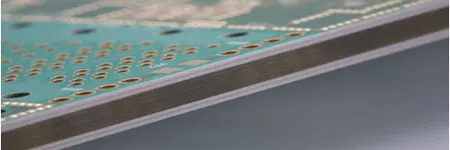
Understanding Arlon’s product families helps you narrow down options quickly. The materials fall into two main divisions: Electronic Substrates (for high-reliability multilayer applications) and Microwave Materials (for RF/high-frequency circuits).
Polyimide Products
Arlon’s polyimide family delivers the highest thermal performance for applications where temperature is the primary constraint. These materials feature:
| Product | Tg (°C) | Td (°C) | Key Applications |
|---|---|---|---|
| Arlon 33N | 250 | 389 | Flame-retardant commercial avionics (UL94-V0) |
| Arlon 35N | 250 | 407 | Military, aerospace, down-hole drilling |
| Arlon 85N | 250 | 407 | High-layer count MLBs, space applications |
| Arlon 85HP | 250+ | 430 | Mission-critical aerospace, extended thermal life |
The 85N series deserves special attention. As a pure, unmodified polyimide without flame retardants, it offers superior long-term thermal stability compared to halogenated alternatives. I’ve seen 85N boards survive qualification testing that destroyed competing materials.
Epoxy Products
When you need better-than-FR-4 performance without the cost of polyimide, Arlon’s epoxy products fill the gap:
| Product | Tg (°C) | Td (°C) | Best For |
|---|---|---|---|
| Arlon 44N | 170 | 300+ | Hole filling in metal core PCBs |
| Arlon 45N | 175 | 300+ | High-layer count MLB, general high-reliability |
These materials process like standard FR-4 but deliver significantly better thermal performance, making them practical upgrades for existing manufacturing lines.
Low-Flow Products
Rigid-flex designs and heat sink bonding require precise resin flow control. Arlon’s low-flow prepregs address this:
| Product | Tg (°C) | Application Focus |
|---|---|---|
| Arlon 37N | 200 | Rigid-flex bonding, heat sink attachment |
| Arlon 38N | 200 | Enhanced adhesion to polyimide films |
| Arlon 47N | 175 | Multilayer rigid-flex epoxy systems |
| Arlon 49N | 170 | High-layer count rigid-flex, lead-free compatible |
| Arlon 51N | 170 | Lead-free rigid-flex, RoHS compliant |
The 51N is particularly important for modern designs — it’s specifically formulated for lead-free assembly compatibility, addressing the higher reflow temperatures required by RoHS-compliant soldering.
Controlled Thermal Expansion (SMT) Products
Surface mount reliability depends on matching the PCB’s thermal expansion to ceramic components. Arlon’s SMT materials use aramid reinforcement instead of glass to achieve this:
| Product | Tg (°C) | CTE (X-Y) | Key Benefit |
|---|---|---|---|
| Arlon 45NK | 170 | Low | LCCC compatibility, woven aramid/epoxy |
| Arlon 55NT | 170 | 7-9 ppm/°C | Lightweight aerospace, non-woven aramid |
| Arlon 85NT | 250 | 7-9 ppm/°C | Space applications, polyimide/aramid |
The 55NT is worth noting for weight-sensitive designs — the aramid reinforcement provides excellent dimensional stability at roughly half the weight of glass-reinforced alternatives.
Microwave Products (PTFE-Based)
For RF and microwave circuits, Arlon offers an extensive range of PTFE composites:
| Product Family | Dk Range | Df (typical) | Best Application |
|---|---|---|---|
| AD Series (AD255C, AD260A, AD300A, AD350A) | 2.55-3.50 | 0.0018-0.0035 | General RF, woven glass reinforced |
| CLTE Series (CLTE-XT, CLTE-AT) | 2.94-3.00 | 0.0012-0.0013 | CTE-matched, phase-critical systems |
| DiClad Series (DiClad 527, DiClad 880) | 2.50-2.55 | 0.0018-0.0022 | Cost-effective RF, non-woven PTFE |
| CuClad Series (CuClad 217, CuClad 250GT) | 2.17-2.50 | 0.0009-0.0018 | Lowest loss, high-speed digital |
| TC Series (TC350, TC600) | 3.50-6.15 | 0.002-0.0025 | Thermal management, power amplifiers |
CLTE-XT stands out as one of the most impressive materials in this family. With the lowest loss tangent in its class (0.0012), lowest thermal expansion (8-12 ppm/°C), and excellent phase stability versus temperature, it’s become the go-to choice for phased array antennas and satellite communication systems. I’ve seen designs use CLTE series materials in 64-layer boards for global communication satellites.
TC350 addresses a different challenge — thermal management. Its ceramic-filled PTFE construction provides best-in-class thermal conductivity (0.72 W/m·K) while maintaining low dielectric loss. For power amplifier boards where heat removal determines reliability, TC350 significantly outperforms standard PTFE materials.
Key Properties and Specifications
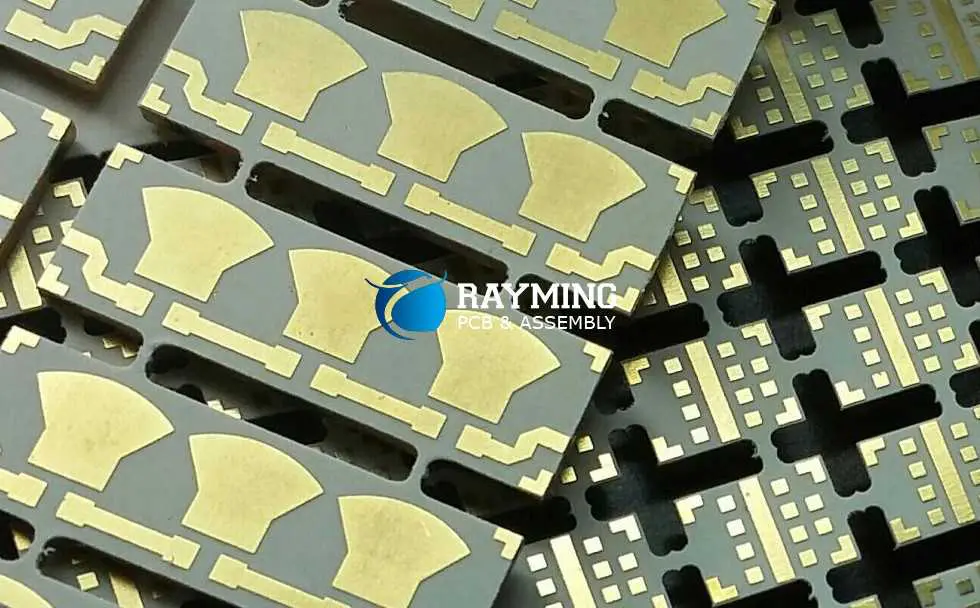
When comparing Arlon materials, focus on these critical parameters:
Electrical Properties
| Property | What It Affects | Typical Range |
|---|---|---|
| Dielectric Constant (Dk) | Signal speed, impedance, trace width | 2.17-6.15 |
| Loss Tangent (Df) | Signal attenuation, heat generation | 0.0009-0.0035 |
| Dk Tolerance | Impedance control accuracy | ±0.02 to ±0.05 |
| Dk vs. Temperature | Phase stability | Material dependent |
For high-frequency designs, Dk tolerance matters as much as the nominal value. Arlon microwave materials typically hold ±0.04, compared to ±0.2 for standard FR-4 — a critical difference for precision impedance control.
Thermal Properties
| Property | Significance | Range |
|---|---|---|
| Glass Transition (Tg) | Maximum continuous operating temp | 170-250°C |
| Decomposition (Td) | Thermal destruction point | 300-430°C |
| CTE (Z-axis) | PTH reliability, via integrity | 20-280 ppm/°C |
| CTE (X-Y) | Component attachment reliability | 7-24 ppm/°C |
| Thermal Conductivity | Heat dissipation capability | 0.2-1.1 W/m·K |
The Z-axis CTE deserves special attention for multilayer boards. High Z-axis expansion stresses plated through-holes during thermal cycling. Arlon polyimides with their 50 ppm/°C Z-axis CTE dramatically outperform FR-4’s typical 250+ ppm/°C.
Mechanical Properties
| Property | Impact | Consideration |
|---|---|---|
| Peel Strength | Copper adhesion | Critical for fine lines |
| Flexural Strength | Handling, vibration resistance | Important for rigid-flex |
| Moisture Absorption | Long-term reliability | Lower is better |
Arlon PCB vs. Rogers vs. FR-4: When to Use What

One of the most common questions I get: “When should I use Arlon instead of Rogers or FR-4?” Here’s my practical framework:
Use FR-4 When:
- Operating frequency stays below 1-2 GHz
- Temperature requirements are standard (peak 150°C)
- Cost is the primary driver
- Reliability requirements are commercial-grade
Use Arlon When:
- You need better-than-FR-4 but with easier processing than pure PTFE
- High-temperature operation is required (polyimide products)
- Rigid-flex designs demand precise resin flow control
- Cost-to-performance balance matters
- You want FR-4-like processing with enhanced properties
Use Rogers When:
- Absolute lowest RF loss is non-negotiable
- Ultra-high frequencies (40+ GHz) require the best Dk stability
- You specifically need PTFE properties that only Rogers formulations provide
The Hybrid Approach
For many designs, I use a hybrid stackup — Arlon or Rogers for RF-critical layers, standard FR-4 for digital and power routing. This balances performance and cost effectively.
| Material Comparison | Dk @10GHz | Df @10GHz | Tg (°C) | Relative Cost |
|---|---|---|---|---|
| Standard FR-4 | 4.3-4.5 | 0.02 | 130-140 | 1x |
| Arlon 45N (Epoxy) | 4.2 | 0.015 | 175 | 2-3x |
| Arlon 85N (Polyimide) | 3.4 | 0.004 | 250 | 3-5x |
| Arlon AD255C (PTFE) | 2.55 | 0.0018 | N/A | 5-8x |
| Arlon CLTE-XT | 2.94 | 0.0012 | 288 | 8-10x |
| Rogers RO4003C | 3.38 | 0.0027 | 280 | 6-8x |
| Rogers RT5880 | 2.20 | 0.0009 | N/A | 10-15x |
Industry Applications for Arlon PCB
Aerospace and Defense
This sector demands the highest reliability and performance. Typical applications include:
- Avionics systems: Control systems requiring long service life at elevated temperatures (85N, 85HP)
- Radar systems: Phased array antennas needing stable Dk across temperature ranges (CLTE-XT)
- Satellite communications: Multilayer microwave boards up to 64 layers (CLTE series)
- Missile guidance: High-G survival and thermal cycling resistance (polyimide products)
The 85N series meets IPC-4101/41 specifications and is commonly used in MIL-PRF-31032 qualified boards. For flame-retardant requirements, 33N provides UL94-V0 certification.
Telecommunications and 5G
The push to higher frequencies drives stringent material requirements:
- Base station antennas: Low loss at operating frequencies (CLTE, TC350)
- Power amplifier boards: Thermal management and signal integrity (TC350)
- mmWave 5G: Performance at 28 GHz and beyond (AD1000, CLTE-XT)
- Tower-mounted amplifiers: Outdoor reliability and thermal cycling (TC350)
5G infrastructure particularly benefits from Arlon’s low-loss materials. At 28 GHz, even small differences in Df translate to significant range and efficiency improvements.
Automotive Electronics
Modern vehicles contain dozens of electronic control units operating in harsh conditions:
- 77 GHz automotive radar: Stable Dk for accurate distance measurement (AD series, CLTE-XT)
- Engine compartment electronics: High-temperature survival (polyimide products)
- ADAS systems: Reliability under thermal cycling and vibration (85N, TC350)
- EV power electronics: Thermal management for high-current designs (TC series)
Medical Devices
Medical applications demand both performance and regulatory compliance:
- Imaging systems: Signal integrity for MRI and CT equipment
- Implantable devices: Long-term reliability, biocompatibility considerations
- Diagnostic equipment: Precision analog circuits requiring stable electrical properties
Industrial and Oil/Gas
Extreme environment applications benefit from Arlon’s thermal capabilities:
- Down-hole drilling sensors: Operation at 200°C+ (35N, 85N)
- Industrial automation: Long-term reliability in harsh factory environments
- Power conversion: High-temperature operation in enclosed enclosures
Design and Manufacturing Considerations

Stackup Design Tips
When designing with Arlon materials, consider these practical guidelines:
Hybrid stackups work well. Place Arlon materials on signal-critical layers and use FR-4 compatible prepregs for bonding layers where possible. This optimizes cost while maintaining performance where it matters.
Match CTE across the stackup. Mixing materials with dramatically different CTEs causes warpage and stress during thermal cycling. Arlon’s prepregs are formulated to work with their corresponding laminates — don’t mix product families without consulting your fabricator.
Account for Dk differences. When transitioning between material types in a hybrid stackup, impedance will change. Adjust trace widths accordingly at layer transitions.
Processing Recommendations
Arlon materials generally process more easily than pure PTFE alternatives, but some considerations apply:
| Process Step | Consideration |
|---|---|
| Storage | Climate-controlled, <30°C, <50% RH |
| Drilling | PTFE materials need lower feed rates, carbide bits |
| Desmear | Plasma preferred for PTFE; standard chemical for epoxy/polyimide |
| Lamination | Follow material-specific temperature profiles |
| Surface Finish | ENIG provides best solderability on PTFE; OSP acceptable for most applications |
For PTFE materials specifically:
- Use specialized drill bits with lower feed rates
- Plasma desmear outperforms chemical processes
- Maintain 8:1 or better aspect ratio for reliable plating
- Add +0.5 mil to trace widths to compensate for etching variations
Lead-Free Compatibility
Modern RoHS requirements demand lead-free soldering with peak temperatures around 260°C. Arlon polyimides (33N, 35N, 85N) with their 250°C Tg and 380-430°C Td handle this easily. For epoxy-based products, ensure Tg exceeds 170°C — materials like 45N and 49N are specifically designed for lead-free compatibility.
Useful Resources and Datasheet Downloads
When specifying Arlon materials, these resources help ensure accurate design:
Official Sources
- Arlon EMD Website: www.arlonemd.com — Product datasheets, technical support
- Rogers Corporation (acquired Arlon circuit materials): www.rogerscorp.com — CLTE, TC series datasheets
Material Databases
- PCB Directory Material Database: Searchable comparison tool for laminate properties
- IPC-4101 Specification: Industry standard for laminate qualification
- Microwaves101 Laminate Comparison Chart: Side-by-side RF material comparison
Distributor Technical Support
- Insulectro: www.insulectro.com — Major Arlon distributor with technical support
- AGC (authorized distributor in certain regions): Regional Arlon support
Design Tools
- Impedance calculators: Most EDA tools include material libraries; verify Dk values match your specific Arlon grade
- Stackup planners: Work with your fabricator to validate hybrid stackup compatibility
Frequently Asked Questions
What’s the difference between Arlon 33N and 85N?
Both are polyimide materials with 250°C Tg, but they serve different purposes. Arlon 33N is flame-retardant (UL94 V-0 rated) for applications requiring fire safety certification — think commercial avionics or automotive. Arlon 85N is a pure, unmodified polyimide without flame retardants, giving it better long-term thermal stability. If you need UL certification, go with 33N. If maximum thermal performance for aerospace or military is the priority, choose 85N.
How much more does Arlon PCB cost compared to FR-4?
Arlon materials typically cost 2-5x more than FR-4 for electronic substrates (epoxy, polyimide) and 5-10x more for microwave materials (PTFE-based). The exact premium depends on the specific product and order volume. However, consider total cost: for high-reliability applications, the cost of field failures, rework, or warranty claims often far exceeds the material premium. Many engineers use a hybrid approach — Arlon for performance-critical layers, FR-4 for standard routing — to optimize cost-performance balance.
Can Arlon materials handle lead-free soldering?
Yes, but choose carefully. Lead-free soldering peaks around 260°C. Arlon polyimides (33N, 35N, 85N) with their 250°C Tg and 380-430°C Td handle this easily. For epoxy-based products, verify the Tg exceeds 170°C. Materials like 45N, 49N, and 51N are specifically designed for lead-free compatibility. The 51N was developed explicitly for lead-free rigid-flex applications.
Is Arlon better than Rogers for RF applications?
It depends on your specific requirements. For most applications up to 40 GHz, Arlon microwave materials perform comparably to Rogers at potentially lower cost and with easier processing (more FR-4-like handling). Rogers PTFE materials like RT5880 achieve the absolute lowest loss tangent — essential for the most demanding RF applications. Arlon’s CLTE and TC350 series offer comparable electrical performance with advantages in processability and thermal management. For 77 GHz automotive radar or 5G mmWave, both brands offer suitable options — evaluate based on your specific Dk, Df, and thermal requirements.
What certifications do Arlon materials meet?
Arlon materials comply with major industry standards. Their electronic substrate products meet relevant IPC-4101 specifications (like /40, /41 for polyimides). They comply with RoHS and REACH environmental regulations. Many products have UL certification for flammability (V-0, V-1, or HB ratings). For aerospace applications, Arlon supports AS9100 certified supply chains. Specific MIL-spec qualifications depend on the material — 85N, for instance, is commonly used in MIL-PRF-31032 qualified boards.
Quick Material Selection Guide
To help you get started quickly, here’s a decision tree based on your primary design constraint:
If your main challenge is HIGH TEMPERATURE:
- Standard high-temp needs → Arlon 45N (175°C Tg, epoxy-based, easy processing)
- Extreme temperature requirements → Arlon 85N (250°C Tg, polyimide)
- Need flame retardancy → Arlon 33N (250°C Tg, UL94 V-0)
If your main challenge is HIGH FREQUENCY:
- General RF up to 20 GHz → AD255C or DiClad series (cost-effective)
- Precision phase control → CLTE-XT (lowest loss, best stability)
- Power amplifiers with thermal needs → TC350 (high thermal conductivity)
If your main challenge is RIGID-FLEX:
- Epoxy-based, lead-free → Arlon 51N
- Polyimide-based, high reliability → Arlon 37N or 38N
- Heat sink bonding → Arlon 47N
If your main challenge is WEIGHT:
- Aramid-reinforced for aerospace → Arlon 55NT or 85NT
This simplified guide points you toward the right product family. From there, consult the detailed datasheets and your fabricator to finalize the specification.
Conclusion
Selecting the right Arlon PCB material comes down to matching properties to your specific application requirements. For high-temperature reliability, polyimide products like 85N deliver unmatched thermal performance. For RF and microwave circuits, the CLTE and AD series provide the signal integrity your designs demand. For rigid-flex and thermal management challenges, specialized products address each need.
The key is not over-specifying (and overpaying) while ensuring you don’t underestimate what your design actually requires. When standard FR-4 limitations become design constraints, Arlon materials offer a proven path to meeting performance requirements without the processing difficulties of exotic alternatives.
For your next high-performance PCB project, take time to evaluate whether Arlon materials can help you achieve better thermal management, improved signal integrity, or enhanced reliability. The material datasheets and your fabricator’s engineering team are your best resources for making the final selection.
Related posts:
- Why the Arlon 49N PCB Material Is Useful In High Temperature or High Performance Applications
- Arlon 33N PCB Material – The Fundamental Material for High Performance PCB
- Temperature Rise Estimations in Rogers High Frequency Circuit Boards Carrying Direct or RF Current (PDF Download)
- Arlon 84HP PCB Material: The High Performance Polyimide

