
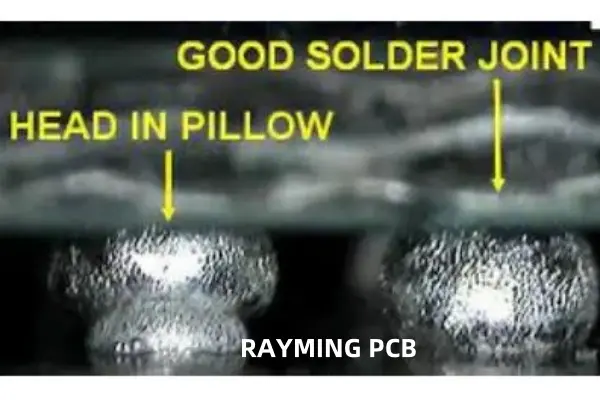
Do you involve in electronic PCB board production has probably encountered the phenomenon of “head-in-pillow” defects when soldering BGAs. Here is an interesting technical article describing this type of defect and an effective method to prevent it.
A Proposed Mechanism and Remedy for Ball-in-Socket and Foot-in-Mud Soldering Defects on Ball Grid Array and Quad Flat Pack Components
The miniaturization of electronic components has driven the widespread adoption of advanced packaging technologies such as Ball Grid Array (BGA) and Quad Flat Pack (QFP) components. While these packages offer superior electrical performance and higher pin density, they also introduce unique soldering challenges that can compromise assembly reliability. Among the most concerning defects are the “ball-in-socket” phenomenon affecting BGA components and the “foot-in-mud” defect commonly observed in QFP assemblies. Understanding the underlying mechanisms behind these defects and implementing effective remediation strategies is crucial for maintaining high-quality electronic assemblies.
Understanding Ball-in-Socket Defects in BGA Components
The ball-in-socket defect represents one of the most subtle yet problematic soldering issues in BGA assembly. This defect occurs when the solder ball from the BGA component fails to fully coalesce with the solder paste deposited on the PCB pad, resulting in a hollow cavity or “socket” formation around the solder ball. From external inspection, these joints may appear acceptable, making this defect particularly insidious as it often escapes visual detection while significantly compromising joint reliability.
The formation mechanism of ball-in-socket defects involves several interconnected factors. During the reflow process, the solder paste on the PCB pad begins to melt and wet the surface. Simultaneously, the solder ball attached to the BGA component also reaches its melting point. Under ideal conditions, these two molten solder masses should merge completely, forming a homogeneous joint upon cooling. However, when process parameters are suboptimal, incomplete coalescence occurs.
The primary contributing factors include insufficient reflow temperature profiles that fail to achieve complete solder melting, inadequate dwell time at peak temperature preventing full metallurgical bonding, contamination or oxidation on either the solder ball or PCB pad surface that inhibits proper wetting, and mismatched solder alloy compositions between the ball and paste that create different melting characteristics.
Additionally, the presence of flux residues or volatile compounds that fail to escape during reflow can create gas pockets that prevent complete solder fusion. The surface tension forces between the partially molten solder masses can also contribute to maintaining separation rather than promoting coalescence.
Foot-in-Mud Defects in QFP Components
The foot-in-mud defect affects QFP components and manifests as excessive solder buildup around the component leads, creating an appearance reminiscent of feet stuck in thick mud. This defect is characterized by irregular solder joint geometry with excessive fillet formation that can bridge adjacent pins or create stress concentrations that compromise long-term reliability.
The mechanism behind foot-in-mud formation typically involves excessive solder paste deposition combined with poor solder flow characteristics during reflow. When too much solder paste is applied to the PCB pads, the excess material must flow somewhere during the melting process. In QFP assemblies, this excess solder tends to accumulate around the component leads, particularly in the heel and toe regions of the joint.
Several factors contribute to this defect, including over-application of solder paste due to incorrect stencil design or printing parameters, inadequate component placement force that fails to displace excess paste, improper reflow profile that promotes solder spreading rather than controlled wetting, and flux formulations that provide insufficient surface tension control during the molten phase.
The component’s gull-wing lead design, while beneficial for visual inspection and rework, can exacerbate foot-in-mud formation by creating natural collection points for excess solder. The capillary action between the lead and PCB surface can draw additional molten solder into the joint area, further contributing to the defect formation.
Proposed Remediation Strategies
Addressing these soldering defects requires a comprehensive approach that encompasses process optimization, material selection, and quality control measures. For ball-in-socket defects in BGA assemblies, the primary focus should be on reflow profile optimization. The temperature profile must ensure complete melting of both the solder balls and paste while providing sufficient time above liquidus temperature for complete coalescence.
Implementing a gradual ramp rate during the preheat phase helps minimize thermal shock while ensuring uniform temperature distribution across the assembly. The peak temperature should exceed the solder alloy liquidus point by an appropriate margin, typically 20-30°C for SAC alloys, while maintaining this temperature for 60-90 seconds to ensure complete metallurgical bonding.
Surface preparation plays a crucial role in preventing ball-in-socket formation. Both the BGA component and PCB pads must be free from oxidation, contamination, and flux residues that could inhibit proper wetting. Implementing controlled atmosphere reflow using nitrogen can significantly reduce oxidation and improve solder flow characteristics.
For foot-in-mud defects in QFP assemblies, stencil design optimization is paramount. The aperture size and shape must be carefully calculated to deposit the correct volume of solder paste for each pad size. Implementing area ratio calculations and considering the paste release characteristics can help achieve optimal paste deposition. Typically, maintaining an area ratio between 0.6 and 1.5 provides good paste release while preventing over-deposition.
Component placement parameters also require attention. The placement force should be sufficient to displace excess paste without damaging the component or creating placement accuracy issues. Implementing force feedback during placement can help ensure consistent results across different component types and sizes.
Process Control and Quality Assurance
Effective prevention of these soldering defects requires robust process control and monitoring systems. Statistical process control should be implemented for critical parameters including paste printing thickness and registration, component placement accuracy and force, and reflow temperature profile consistency across the conveyor width.
Advanced inspection techniques such as X-ray imaging can detect ball-in-socket defects that escape visual inspection. Automated X-ray systems can be programmed to identify the characteristic void patterns associated with incomplete solder coalescence, enabling early detection and process correction.
For foot-in-mud defects, automated optical inspection systems can be configured to detect excessive solder buildup and joint geometry irregularities. Implementing measurement algorithms that assess fillet height and width can provide quantitative feedback for process optimization.
Conclusion
Ball-in-socket and foot-in-mud soldering defects represent significant challenges in modern electronic assembly, requiring careful attention to process parameters, material properties, and quality control measures. By understanding the underlying formation mechanisms and implementing comprehensive remediation strategies, manufacturers can achieve reliable, high-quality solder joints that meet the demanding requirements of today’s electronic products. Continuous monitoring and process optimization remain essential for maintaining consistent assembly quality and preventing these subtle but critical defects from compromising product reliability.

