RO4003C and RO4350B are high-performance laminates from Rogers Corporation’s RO4000 series. These materials offer excellent electrical properties for RF and microwave applications. The data sheet PDF provides detailed specifications, including dielectric constant and loss tangent. Pricing varies based on thickness and quantity, typically ranging from $100 to $300 per sheet. These laminates balance cost-effectiveness with superior performance for antenna arrays and high-speed digital designs.
Download RO4000 Laminates RO4003C and RO4350B Data Sheet:
Introduction to Rogers RO4000 Series
Overview of Rogers Corporation
Rogers Corporation is a global leader in engineered materials solutions, specializing in advanced laminate materials for high-frequency circuit applications. With a rich history dating back to 1832, Rogers has established itself as a pioneer in developing innovative materials for the electronics industry.
The RO4000 Series: A Game-Changer in PCB Materials
The RO4000 series represents a significant advancement in PCB (Printed Circuit Board) laminate technology. These materials bridge the gap between traditional FR4 materials and high-performance PTFE-based laminates, offering a unique combination of performance, reliability, and cost-effectiveness.
RO4003C: High-Performance Laminate
Key Features of RO4003C
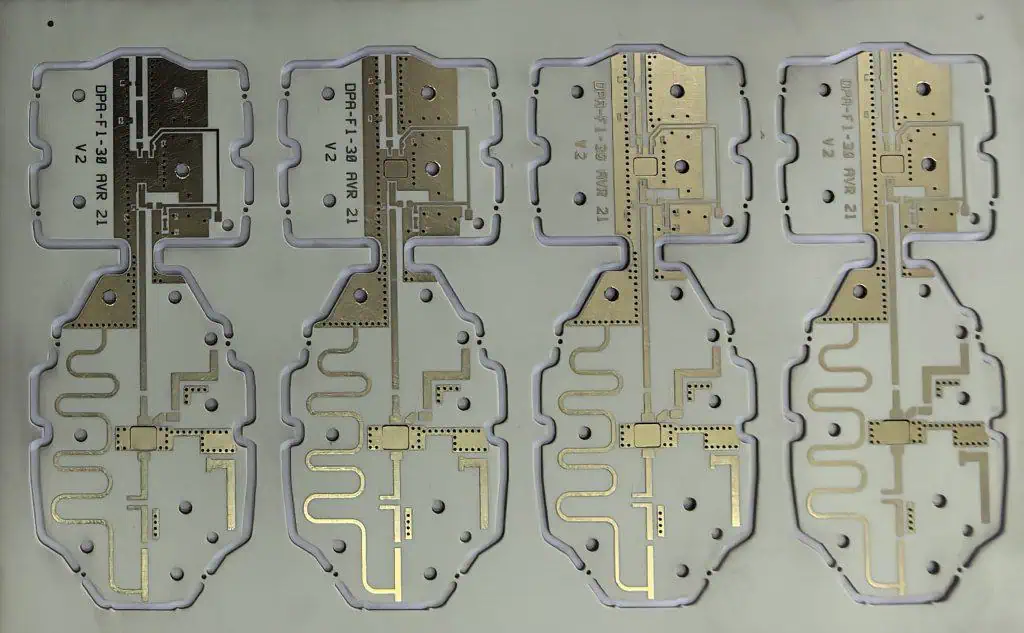
RO4003C is a glass-reinforced hydrocarbon/ceramic laminate designed for high-frequency applications. Its key features include:
- Low dielectric constant (Dk) of 3.38 ± 0.05 at 10 GHz
- Low loss tangent of 0.0027 at 10 GHz
- Excellent thermal stability
- Compatible with standard FR4 manufacturing processes
Applications of RO4003C
RO4003C finds widespread use in various high-frequency applications, including:
- Antenna arrays
- Power amplifiers
- LNAs (Low Noise Amplifiers)
- Filters and couplers
- Base station infrastructure
RO4003C Data Sheet Highlights
The RO4003C data sheet provides comprehensive information about the material’s properties. Key highlights include:
- Electrical properties across various frequencies
- Thermal and mechanical characteristics
- Dimensional stability data
- Processing guidelines
To access the full RO4003C data sheet PDF, visit the official Rogers Corporation website or contact their sales representatives.
RO4350B: High-Performance Alternative
Key Features of RO4350B
RO4350B is another member of the RO4000 series, offering slightly different properties compared to RO4003C:
- Higher dielectric constant (Dk) of 3.48 ± 0.05 at 10 GHz
- Low loss tangent of 0.0037 at 10 GHz
- Excellent thermal stability
- Compatible with standard FR4 manufacturing processes
Applications of RO4350B
RO4350B is suitable for various high-frequency applications, including:
- Power amplifiers
- Phased array antennas
- Satellite communications systems
- High-speed digital boards
- RF/microwave circuits
RO4350B Data Sheet Highlights
The RO4350B data sheet provides detailed information about the material’s properties. Key highlights include:
- Electrical properties across various frequencies
- Thermal and mechanical characteristics
- Dimensional stability data
- Processing guidelines
To access the full RO4350B data sheet PDF, visit the official Rogers Corporation website or contact their sales representatives.
Read more about:
Comparing RO4003C and RO4350B
Dielectric Constant and Loss Tangent
One of the primary differences between RO4003C and RO4350B lies in their dielectric constants:
- RO4003C: Dk = 3.38 ± 0.05 at 10 GHz
- RO4350B: Dk = 3.48 ± 0.05 at 10 GHz
The loss tangent also differs slightly:
- RO4003C: 0.0027 at 10 GHz
- RO4350B: 0.0037 at 10 GHz
These differences make each material suitable for specific applications and design requirements.
Thermal and Mechanical Properties
Both RO4003C and RO4350B offer excellent thermal stability and mechanical properties:
- Coefficient of Thermal Expansion (CTE):
- RO4003C: X-axis: 11 ppm/°C, Y-axis: 14 ppm/°C, Z-axis: 46 ppm/°C
- RO4350B: X-axis: 10 ppm/°C, Y-axis: 12 ppm/°C, Z-axis: 32 ppm/°C
- Thermal Conductivity:
- RO4003C: 0.64 W/m/K
- RO4350B: 0.62 W/m/K
- Flexural Strength:
- RO4003C: 241 MPa
- RO4350B: 255 MPa
These properties ensure reliable performance across a wide range of operating conditions.
Choosing Between RO4003C and RO4350B
When deciding between RO4003C and RO4350B, consider the following factors:
- Frequency range of your application
- Required dielectric constant for impedance matching
- Thermal management requirements
- Mechanical stress expectations
- Cost considerations
Consulting with Rogers Corporation representatives can help in making the best choice for your specific project needs.
Manufacturing Processes for RO4000 Series
PCB Fabrication Compatibility
One of the significant advantages of the RO4000 series is its compatibility with standard FR4 manufacturing processes. This compatibility offers several benefits:
- Reduced fabrication costs compared to PTFE-based materials
- Familiar processing techniques for PCB manufacturers
- Shorter lead times for prototyping and production
Special Considerations in Manufacturing
While RO4000 series materials are compatible with standard processes, some special considerations include:
- Drill bit selection and speed optimization
- Copper foil treatment and adhesion
- Lamination pressure and temperature control
- Proper handling to prevent contamination
Following Rogers Corporation’s recommended processing guidelines ensures optimal performance and reliability of the finished PCBs.
Pricing Information for RO4000 Series Laminates
Factors Affecting Price
The cost of RO4000 series laminates can vary based on several factors:
- Material thickness
- Copper foil weight
- Panel size
- Order quantity
- Market demand and raw material costs
Pricing Ranges
While exact pricing can vary, general price ranges for RO4000 series laminates are as follows:
- RO4003C: Typically ranges from 50to50to150 per square foot
- RO4350B: Generally priced slightly higher, ranging from 60to60to180 per square foot
These prices are approximate and can fluctuate based on market conditions and specific requirements. For accurate pricing, it’s best to contact Rogers Corporation or authorized distributors directly.
Cost Comparison with Other Materials
When comparing costs, consider the following:
- RO4000 series vs. FR4: Generally more expensive than FR4, but offers superior high-frequency performance
- RO4000 series vs. PTFE-based materials: Usually more cost-effective while maintaining good high-frequency characteristics
- Total system cost: Consider potential savings in processing and improved yield when calculating overall project costs
Obtaining RO4000 Series Data Sheets and Samples
Accessing Data Sheet PDFs
To obtain the latest data sheet PDFs for RO4003C and RO4350B:
- Visit the official Rogers Corporation website (www.rogerscorp.com)
- Navigate to the “Products” section and select “Advanced Connectivity Solutions”
- Find the RO4000 series page
- Download the respective data sheet PDFs
Alternatively, you can contact Rogers Corporation’s customer service or sales representatives for direct access to these documents.
Requesting Material Samples
For engineers and designers interested in evaluating RO4000 series materials:
- Contact Rogers Corporation’s sales team or local distributors
- Provide details about your project and specific requirements
- Request sample materials for testing and prototyping
Many suppliers offer sample programs to help customers make informed decisions before large-scale purchases.
Design Considerations for RO4000 Series Laminates
Impedance Control
Achieving precise impedance control is crucial in high-frequency circuit design. When using RO4000 series laminates:
- Use accurate Dk values provided in the data sheets
- Consider frequency-dependent Dk variations
- Account for copper foil roughness in impedance calculations
- Utilize impedance calculation software for complex structures
Signal Integrity Optimization
To maximize signal integrity in your designs:
- Minimize transmission line discontinuities
- Use proper via design and placement
- Implement effective grounding techniques
- Consider stripline configurations for critical signals
Thermal Management Strategies
For high-power applications, consider the following thermal management approaches:
- Utilize the material’s inherent thermal conductivity
- Implement proper copper plane design for heat spreading
- Consider embedded heat sinks or coin attachment for localized cooling
- Use thermal vias in multilayer designs to improve heat dissipation
Case Studies: Successful Applications of RO4000 Series
5G Infrastructure
The RO4000 series has been widely adopted in 5G infrastructure development:
- Base station antennas utilizing RO4003C for its low loss characteristics
- Power amplifiers benefiting from the thermal stability of RO4350B
- Reduced size and weight of equipment due to the materials’ electrical properties
Satellite Communication Systems
RO4000 series laminates have proven invaluable in satellite communication applications:
- Low orbital satellites using RO4003C for lightweight antenna arrays
- Ground station equipment leveraging RO4350B for high-power transmitters
- Improved reliability in harsh space environments due to the materials’ stability
Automotive Radar Systems
The automotive industry has embraced RO4000 series materials for radar applications:
- 77 GHz automotive radar using RO4003C for its consistent performance
- ADAS (Advanced Driver Assistance Systems) benefiting from the materials’ reliability
- Cost-effective solution compared to traditional PTFE-based materials
Future Trends and Developments
Evolving Material Science
Rogers Corporation continues to invest in research and development:
- Exploring new formulations to further improve electrical performance
- Investigating environmentally friendly manufacturing processes
- Developing materials optimized for emerging technologies like 6G and beyond
Integration with Advanced Manufacturing Techniques
The future of RO4000 series may include:
- Compatibility with 3D printing technologies for rapid prototyping
- Advanced lamination processes for ultra-thin, high-layer count PCBs
- Integration with flexible and stretchable electronics
Conclusion
The Rogers RO4000 series, particularly RO4003C and RO4350B laminates, represents a significant advancement in high-frequency PCB materials. By offering a balance of performance, reliability, and cost-effectiveness, these materials have become indispensable in various cutting-edge applications.
As the demand for high-frequency and high-speed circuits continues to grow, the importance of choosing the right laminate material becomes increasingly critical. The RO4000 series provides engineers and designers with versatile options to meet the challenges of modern electronic systems.
By understanding the properties, applications, and manufacturing considerations of RO4003C and RO4350B, professionals in the electronics industry can make informed decisions to optimize their designs and stay ahead in a rapidly evolving technological landscape.
For those looking to push the boundaries of high-frequency circuit design, the Rogers RO4000 series offers a solid foundation for innovation and excellence.