
Printed Circuit Boards (PCBs) are the backbone of modern electronics, serving as the foundation for countless devices we use daily. Ensuring the quality of these intricate components is crucial for the reliability and performance of electronic products. This article delves into the comprehensive process of implementing quality inspection for PCBs, covering various stages of inspection, advanced technologies, and best practices in the industry.
Understanding PCB Quality Inspection
Importance of PCB Quality Inspection
Quality inspection of PCBs is critical for several reasons:
- Ensuring product reliability
- Minimizing field failures and recalls
- Maintaining brand reputation
- Complying with industry standards and regulations
- Optimizing production processes
Types of PCB Defects
PCB defects can be categorized into several types:
| Defect Category | Examples | Potential Causes |
| Manufacturing Defects | Open circuits, short circuits, wrong components | Process issues, human error |
| Design Defects | Signal integrity problems, thermal issues | Poor PCB layout, inadequate thermal management |
| Material Defects | Delamination, copper separation | Substandard materials, improper handling |
| Assembly Defects | Solder bridges, misaligned components | Incorrect assembly proce |
Implementing a Comprehensive PCB Inspection Process

Incoming Material Inspection
Raw Material Verification
- Base material inspection
- Check for correct material type (e.g., FR-4, high-frequency materials)
- Verify thickness and dielectric properties
- Copper foil inspection
- Examine copper thickness and purity
- Check for surface defects or contamination
- Solder mask and silkscreen material verification
- Ensure correct color and type
- Verify compatibility with PCB design requirements
Component Inspection
- Visual inspection
- Check for physical damage or discoloration
- Verify correct package types and markings
- Electrical parameter verification
- Sample testing of critical components
- Verification of key electrical parameters (e.g., resistance, capacitance)
- Documentation review
- Check component datasheets and certificates of conformance
- Verify compliance with RoHS and other relevant standards
Bare Board Inspection
Visual Inspection
- Surface examination
- Check for scratches, dents, or other physical damage
- Inspect solder mask and silkscreen quality
- Hole quality assessment
- Examine drill hole size and position accuracy
- Check for burrs or copper remnants in holes
- Copper pattern inspection
- Verify trace width and spacing
- Check for copper shorts or opens
Dimensional Inspection
- Board outline verification
- Measure overall board dimensions
- Check for correct profiling and edge quality
- Hole positioning
- Verify hole locations against design specifications
- Check critical hole-to-hole distances
- Layer alignment
- Inspect registration between layers in multi-layer PCBs
- Check for misalignment issues in plated through-holes
Electrical Testing
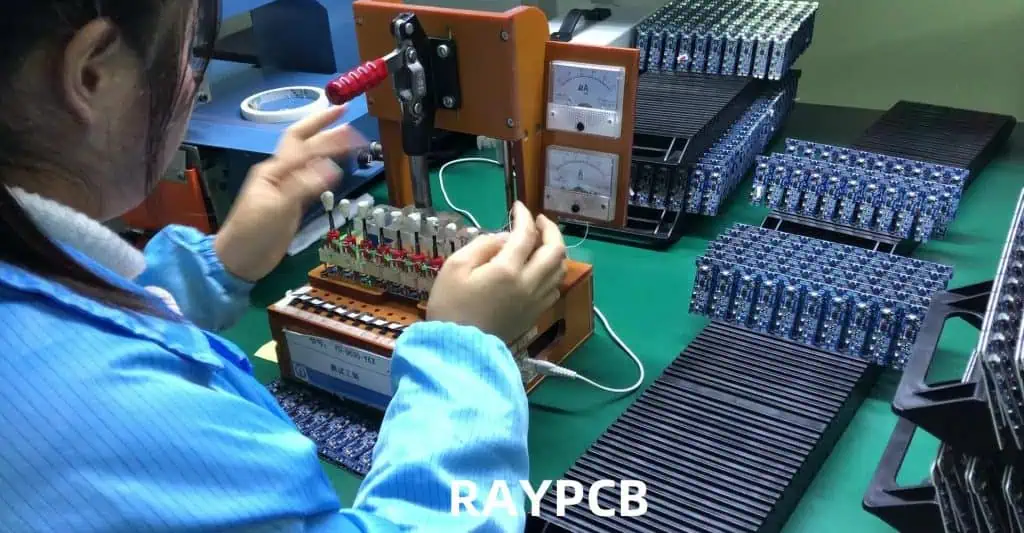
- Continuity and isolation testing
- Perform automated testing to check for shorts and opens
- Verify correct connections between pads and vias
- Impedance testing
- Measure controlled impedance traces
- Verify compliance with design specifications
- High-potential (Hi-Pot) testing
- Test for dielectric strength between layers
- Identify potential breakdown or insulation issues
PCB Assembly Inspection
Pre-Reflow Inspection
- Solder paste inspection (SPI)
- Check solder paste volume and alignment
- Identify insufficient or excessive solder paste deposits
- Component placement inspection
- Verify correct component placement and orientation
- Check for missing or misaligned components
Post-Reflow Inspection
- Automated Optical Inspection (AOI)
- Inspect solder joint quality
- Check for solder bridges, insufficient solder, or component misalignment
- X-ray Inspection
- Examine hidden solder joints (e.g., BGA, QFN packages)
- Detect voids or defects in solder connections
- Manual Visual Inspection
- Perform detailed visual checks for any defects missed by automated systems
- Inspect overall board quality and cleanliness
Functional Testing
- In-Circuit Testing (ICT)
- Test individual components on the assembled PCB
- Verify correct component values and basic functionality
- Boundary Scan Testing (JTAG)
- Test interconnections between components
- Verify functionality of complex ICs and programmable devices
- Functional Circuit Testing
- Simulate real-world operating conditions
- Verify overall PCB functionality and performance
Environmental and Reliability Testing
- Thermal Cycling
- Subject PCBs to extreme temperature variations
- Identify potential issues with solder joints or component connections
- Vibration Testing
- Simulate transportation and operational vibrations
- Verify mechanical integrity of the PCB assembly
- Humidity Testing
- Expose PCBs to high humidity conditions
- Check for potential corrosion or delamination issues
Advanced Inspection Technologies
Automated Optical Inspection (AOI)
Working Principle
AOI systems use high-resolution cameras and sophisticated image processing algorithms to inspect PCBs for defects. They compare the captured images against a “golden” reference or CAD data to identify anomalies.
Key Features
- High-speed inspection capabilities
- Detection of surface mount and through-hole defects
- Color analysis for solder joint quality assessment
- 3D measurement capabilities for component co-planarity
Inspection Parameters
| Parameter | Description | Typical Tolerance |
| Component Presence | Verifies if all components are present | 100% detection |
| Component Orientation | Checks correct rotational alignment | ±5 degrees |
| Solder Joint Quality | Assesses solder fillet shape and size | ±10% of ideal |
| Solder Bridges | Detects unwanted solder connections | 100% detection |
| Component Placement | Measures X, Y, and theta positioning | ±0.1mm, ±0.5 degrees |
X-ray Inspection
Working Principle

X-ray inspection uses high-energy radiation to penetrate through the PCB and components, creating images of internal structures. This allows for inspection of hidden solder joints and internal PCB layers.
Key Applications
- Inspection of Ball Grid Array (BGA) solder joints
- Detection of voids in solder connections
- Examination of internal PCB layers for defects
- Verification of through-hole component soldering
Inspection Capabilities
| Feature | Description | Typical Resolution |
| 2D X-ray | Provides top-down view of PCB | 5-10 µm |
| 3D X-ray (Computed Tomography) | Creates 3D model of PCB internals | 5-20 µm |
| Void Detection | Identifies and measures solder voids | Down to 2% void ratio |
| BGA Ball Analysis | Measures ball size, shape, and position | ±1 µm accuracy |
Laser-Based Inspection
Working Principle
Laser-based inspection systems use laser triangulation to create high-resolution 3D profiles of PCB surfaces. This allows for precise measurement of solder paste deposits, component heights, and coplanarity.
Key Features
- High-precision 3D measurements
- Non-contact inspection method
- Capability to inspect transparent or reflective surfaces
- Solder paste volume calculation
Inspection Parameters
| Parameter | Description | Typical Accuracy |
| Solder Paste Height | Measures height of solder paste deposits | ±1 µm |
| Solder Paste Volume | Calculates volume of solder paste | ±3% |
| Component Coplanarity | Measures lead/ball heights for flatness | ±2 µm |
| Board Warpage | Assesses overall PCB flatness | ±5 µm |
Implementing an Effective PCB Inspection Strategy
Developing Inspection Criteria
- Review industry standards
- IPC-A-610 for acceptability of electronic assemblies
- IPC-6012 for rigid PCB qualification and performance specifications
- Analyze critical factors
- Identify critical components and connections
- Determine key performance parameters
- Establish acceptance criteria
- Define acceptable ranges for measured parameters
- Set pass/fail criteria for visual and functional tests
Creating Inspection Procedures
- Define inspection points
- Identify key stages in the production process for inspection
- Determine appropriate inspection methods for each stage
- Develop detailed work instructions
- Create step-by-step procedures for each inspection task
- Include visual aids and reference images
- Implement data collection and reporting systems
- Define data to be collected during inspections
- Establish reporting formats and frequency
Training and Certification
- Operator training
- Provide comprehensive training on inspection equipment and procedures
- Conduct regular refresher courses
- Certification programs
- Implement internal certification processes for inspectors
- Encourage external certifications (e.g., IPC Certification)
- Continuous improvement
- Regularly assess inspector performance
- Update training materials based on new technologies and processes
Data Analysis and Process Improvement
- Statistical Process Control (SPC)
- Implement SPC techniques to monitor inspection results
- Identify trends and potential process issues
- Root Cause Analysis
- Conduct thorough investigations of recurring defects
- Implement corrective and preventive actions
- Continuous process optimization
- Use inspection data to drive process improvements
- Regularly review and update inspection criteria and procedures
Challenges and Considerations
Balancing Inspection Thoroughness and Production Efficiency
- Risk-based inspection
- Focus more rigorous inspection on critical areas or high-risk products
- Implement sampling plans based on historical data and product criticality
- Inline vs. offline inspection
- Determine optimal placement of inspection steps within the production line
- Balance the need for 100% inspection with production speed requirements
- Automation vs. manual inspection
- Evaluate the cost-effectiveness of automated inspection systems
- Identify areas where human inspection adds significant value
Keeping Up with Technological Advancements
- Regular technology assessments
- Stay informed about new inspection technologies and methodologies
- Evaluate potential benefits of upgrading inspection systems
- Collaboration with equipment suppliers
- Engage with suppliers for training and support
- Participate in beta testing of new inspection technologies
- Industry networking
- Attend conferences and trade shows focused on PCB inspection
- Participate in industry working groups and standards committees
Managing Inspection Data
- Data storage and retrieval
- Implement robust systems for storing inspection data
- Ensure easy accessibility for analysis and traceability
- Data security
- Protect sensitive inspection data and intellectual property
- Comply with data protection regulations
- Integration with MES and ERP systems
- Connect inspection data with broader manufacturing and business systems
- Enable real-time decision making based on inspection results
Future Trends in PCB Inspection
Artificial Intelligence and Machine Learning
- Defect classification and prediction
- Use AI algorithms to improve defect detection accuracy
- Implement predictive maintenance for inspection equipment
- Adaptive inspection
- Develop systems that can adjust inspection parameters based on historical data
- Implement self-learning algorithms for continual improvement
Industry 4.0 Integration
- IoT-enabled inspection equipment
- Connect inspection systems to the broader factory network
- Enable real-time monitoring and control of inspection processes
- Digital twin technology
- Create virtual models of PCBs for enhanced defect analysis
- Simulate inspection processes for optimization
Advanced Imaging Technologies
- Terahertz imaging
- Explore non-destructive testing methods for internal PCB structures
- Improve detection of hidden defects in multi-layer PCBs
- Hyperspectral imaging
- Enhance material analysis capabilities
- Improve detection of contamination and material defects
Conclusion
Implementing a comprehensive quality inspection process for PCBs is crucial for ensuring the reliability and performance of electronic products. By combining visual, automated, and functional inspection methods, manufacturers can detect a wide range of defects and maintain high-quality standards. As technology continues to advance, staying up-to-date with the latest inspection techniques and equipment will be essential for remaining competitive in the PCB manufacturing industry.
Effective PCB inspection requires a holistic approach, integrating advanced technologies with well-defined procedures, trained personnel, and continuous improvement processes. By focusing on these elements and adapting to new challenges and technologies, PCB manufacturers can ensure the highest levels of quality and reliability in their products.
Frequently Asked Questions (FAQ)
- Q: What is the most critical stage of PCB inspection? A: While all stages are important, the post-reflow inspection is often considered the most critical. This stage, which typically includes AOI and X-ray inspection, can detect a wide range of assembly defects such as solder joint issues, component misalignment, and hidden defects in BGA packages.
- Q: How does automated inspection compare to manual inspection? A: Automated inspection systems like AOI and AXI offer high-speed, consistent, and objective inspection capabilities, making them ideal for high-volume production. Manual inspection, while slower, can be more flexible and better at detecting certain types of defects that require human judgment. A combination of both methods is often the most effective approach.
- Q: What are the key factors to consider when choosing PCB inspection equipment? A: Key factors include the types of PCBs being produced (e.g., complexity, size), production volume, required inspection speed, types of defects to be detected, integration with existing systems, and overall cost-effectiveness. It’s also important to consider the equipment’s ease of use, reliability, and the availability of technical support.
- Q: How often should inspection criteria and procedures be updated? A: Inspection criteria and procedures should be reviewed and updated regularly, typically at least annually or whenever there are significant changes in product design, manufacturing processes, or industry standards. Additionally, they should be reviewed after any major quality issues or customer complaints to ensure continuous improvement.
- Q: What role does data analysis play in PCB inspection? A: Data analysis is crucial in PCB inspection for several reasons:
- Identifying trends and patterns in defects
- Optimizing inspection processes and parameters
- Driving continuous improvement in manufacturing processes
- Enabling predictive maintenance of inspection equipment
- Supporting traceability and compliance requirements By effectively analyzing inspection data, manufacturers can proactively address quality issues and improve overall production efficiency.

