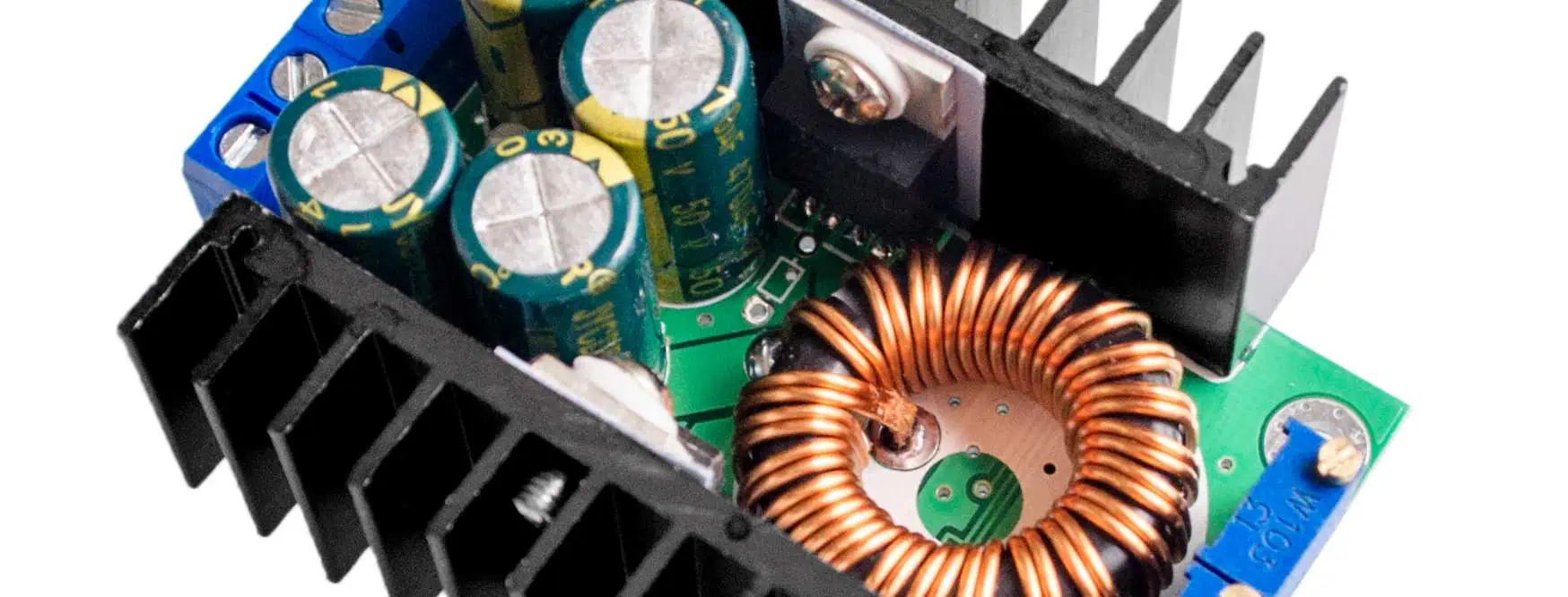
Can I use Buck converter as LED driver?

Schematic diagram of a small, low-cost and relatively constant current capacitor buck LED driver.

The working principle of the LED driver is to limit the maximum operating current by using the capacitive reactance generated by the capacitor at a certain AC signal frequency. Therefore, the working principle of the capacitor step-down is not complicated.

At 50Hz, the capacitance generated by a 1uF capacitor is about 3180 ฮฉ.

When the AC voltage of 220V is added to both ends of the capacitor, the maximum current flowing through the capacitor is approximately 70mA.Although the current flowing through the capacitor is 70mA, but does not produce power consumption on the capacitor, if the capacitor is an ideal capacitor, then the current flowing through the capacitor is a virtual current, and its work is reactive power.

The use of capacitive buck schematic diagram is a common small current power supply diagram , with small volume,low cost and current is relatively constant and other advantages, and is also commonly used in the driving diagram of the LED.

The following figure shows an actual LED driver diagram with capacitor step-down: Most of the application diagram do not have a varistor or transient voltage suppression transistor. It is recommended that the connection, due to varistor or transient voltage suppression transistor can effectively discharge the mutation current in the moment of voltage mutation (such as led lightning, large power equipment start, etc.), effectively bleed the abrupt current to protect the diode and other transistors, and their response time is generally in the order of micro milliseconds.

The pressure resistance of the filter capacitor C2,C3 depends on the load voltage, which is generally 1.2 times times the load voltage, and its capacitance capacity depends on the size of the load current.

Capacitor Buck LED Driver Schematic Diagram

Introduction

Buck converters are DC-DC step down regulators that can provide an efficient and flexible means of driving LED lighting. By converting a higher DC input voltage to a lower adjustable output voltage, buck converters allow controlling the current through and brightness of LEDs.

However, LED loads present some specific design considerations for buck converter circuits regarding dimming methods, startup currents, and topology selections. With careful component selection and circuit configuration, buck regulators can form the basis of robust LED drivers that are compact, efficient, and inexpensive.

Buck Converter Basics

YouTube video

Here is a basic non-isolated buck converter circuit:

The key operating principles:

  • An inductor and capacitor connected in series smooths the switched input into a lower DC output voltage
  • Output voltage is a function of duty cycle D = Vout / Vin
  • Fast switching with pulse width modulation (PWM) maintains voltage regulation
  • Diode prevents reverse inductor current flow when switch opened
  • Inductor limits inrush current when switch closes

Buck regulators provide efficient DC-DC conversion at high switching frequencies with minimal components. Output can be adjusted or dimmed by varying the duty cycle.

Using Bucks for LED Drivers

The buck converter’s flexible and efficient output makes it well suited as an LED driver with some design considerations:

Lower Voltage Requirements

  • LEDs typically operate at 1.5V to 3.5V, much lower than most buck input sources. Large step-down ratio required.
  • May need wider duty cycle range or two-stage conversion for large input-output differentials.

Constant Current Control

  • LEDs require current limiting for stable operation. Bucks require output current control rather than just voltage.
  • Current sense resistor with feedback allows adjusting PWM to maintain constant current through LEDs.

Dimming Ability

  • Varying LED brightness requires dimming capability. PWM dimming integrates well with buck converter PWM control.
  • Lower duty cycle reduces average current providing dimming control.

Startup Behaviors

  • Inrush current control needed for LEDs. Cycle-by-cycle and soft-start techniques used.
  • Preload may be required to avoid output voltage overshoot on startup.

With good engineering, bucks make excellent LED drivers. But the unique electrical characteristics require special consideration.

LED Driver Topology Comparison

Several buck-based topologies can be used for LED lighting drivers:

TopologyDescription
Basic BuckSimplest option. Requires current sense resistor which wastes power.
Buck with Current SensingReplaces sense resistor with low-side current sensing for greater efficiency.
Hysteretic BuckUses constant on-time with hysteretic current control. Fast transient response but some ripple.
\Buck-BoostAllows continued operation as input voltage approaches LED voltage. Prevents dropout.
\SEPICSingle inductor converter provides input-output isolation and prevents dropout.
CukProvides input-output isolation. High efficiency but higher part count.

Selecting the optimal buck implementation depends on factors like required dimming method, isolation needs, and available input voltage range.

LED Driver Design Considerations

Here are some key design factors when developing a buck LED driver:

Integrated vs Discreet Implementation

  • Integrated circuits simplify design with complete regulator solutions. Fewer external components needed.
  • Discreet designs allow greater customization of performance and form factor. More complex circuit analysis required.

Input Voltage Range

  • Determine minimum to maximum input voltage. Allows proper selection of power switch rating and duty cycle range.
  • Account for dimming impacts on input current when sizing inductors, caps, and switches.

Output Voltage and Current

  • Output requirements dictate power stage design. Higher currents necessitate lower loss components.
  • Ensure adequate headroom between LED voltage and input for regulation.

Efficiency Targets

  • LEDs benefit from high efficiency to minimize heating and power waste.
  • Discreet design allows optimization but integrated ICs often offer 80%+ efficiency.

Size/Footprint Limits

  • Component selection and topology affect overall driver size.
  • Consider needs of target application when minimizing footprint.

Thermal Management

  • LED drivers generate heat that must be dissipated to maximize lifetime.
  • Use oversized components, thermal vias/planes, and forced air cooling as needed.

Careful balancing of size, cost, complexity, and performance goals leads to an optimized LED driver design.

Dimming Methods

Controlling LED brightness is key. Buck converters provide dimming flexibility:

Analog PWM Dimming

  • Vary duty cycle of buck controller to adjust average LED current directly.
  • 0-100% dimming range possible. Can cause color shifts at low currents in some LEDs.

Digital PWM

  • Use a digital PWM signal to control analog PWM dimming circuit. Allows digital control.

DC Voltage Dimming

  • Adjust reference voltage to regulator to set output current level. Allows simple interface.

Analog Dimming

  • Control output current amplitude directly rather than adjusting duty cycle.
  • Requires more complex circuitry to implement.

The preferred method depends on external controls, required dimming resolution, and component complexity constraints.

Component Selection Guidelines

Proper component selection helps optimize LED driver buck converters:

Inductors

  • Low core and copper losses at operating frequencies and currents
  • Tight tolerance to ensure consistent current control
  • Sufficient saturation current rating for inrush tolerance

Capacitors

  • Quality ceramics for main filter caps to reduce ESR
  • Meet ripple current ratings at full load
  • Provide sufficient capacitance for line and load regulation

Power Switches

  • MOSFETs or IGBTs selected based on Vin, Iout, and frequency
  • Logic-level FETs avoid need for driver ICs
  • Match Rds(on) to efficiency targets

Current Sense

  • Precision sense resistors or current sense amplifier ICs
  • Provide sufficient bandwidth for current loop stability

Control ICs

  • Integrated controllers offer protection features and design ease
  • Discreet controllers allow greater customization

Component selection balancing cost, size constraints, and performance goals is necessary to produce an optimized LED driving solution.

Design Process Steps

The overall buck LED driver design process involves:

  1. Define target application and requirements
  2. Select topology based on needs like dimming, isolation, etc.
  3. Model power stage and simulate in software for feasibility
  4. Choose controller approach – discreet, integrated IC
  5. Select components meeting operating parameters and design goals
  6. Develop prototype on PCB for testing
  7. Analyze losses, efficiency, thermal performance
  8. Evaluate dimming performance, flicker, and output ripple
  9. Iterate on design to refine and improve as needed
  10. Confirm robustness and lifetime through validation testing

Careful simulation, prototyping, and testing leads to a buck converter LED driver implementation meeting performance goals, cost targets, size constraints, and application requirements.

Summary

  • Buck converters can provide an efficient LED driving solution but require adaptations.
  • Key design considerations for LED loads include dimming approaches, current regulation, and startup behaviors.
  • Performance goals, size constraints, and external controls determine best topology like basic buck, hysteretic, or \SEPIC.
  • Following robust design practices ensures an LED driver that meets efficiency, reliability, and functional targets.
  • Buck converters, properly engineered for LED loads, enable high performance and flexible solid state lighting solutions.

FAQ

What are the main disadvantages of using a buck converter for an LED driver?

Higher input voltages require a wide duty cycle range. May need lower frequency for light loads. Most buck ICs lack explicit current regulation. Added components or control loops help overcome these limitations.

What causes output voltage overshoot when a buck LED driver starts up?

At startup, the output cap is fully discharged causing a large inrush until regulation is established. Adding a preload, improving control loop speed, and slow soft-start help mitigate overshoot.

How does a buck LED driver provide constant current?

A current sense resistor or amplifier provides feedback to the regulator which adjusts the duty cycle to maintain a constant peak inductor current. This provides controlled average output current.

Why is inductor selection important for buck LED drivers?

The inductor impacts conversion efficiency, transient response time, and ripple currents. A low loss inductor with saturation current headroom prevents tripping protections during surges.

What dimming architectures can be used with buck LED drivers?

Analog PWM, digital PWM, and DC voltage dimming integrate well with buck converters. PWM options avoid color shift at low brightness. Analog dimming requires wider control loops but avoids flicker.
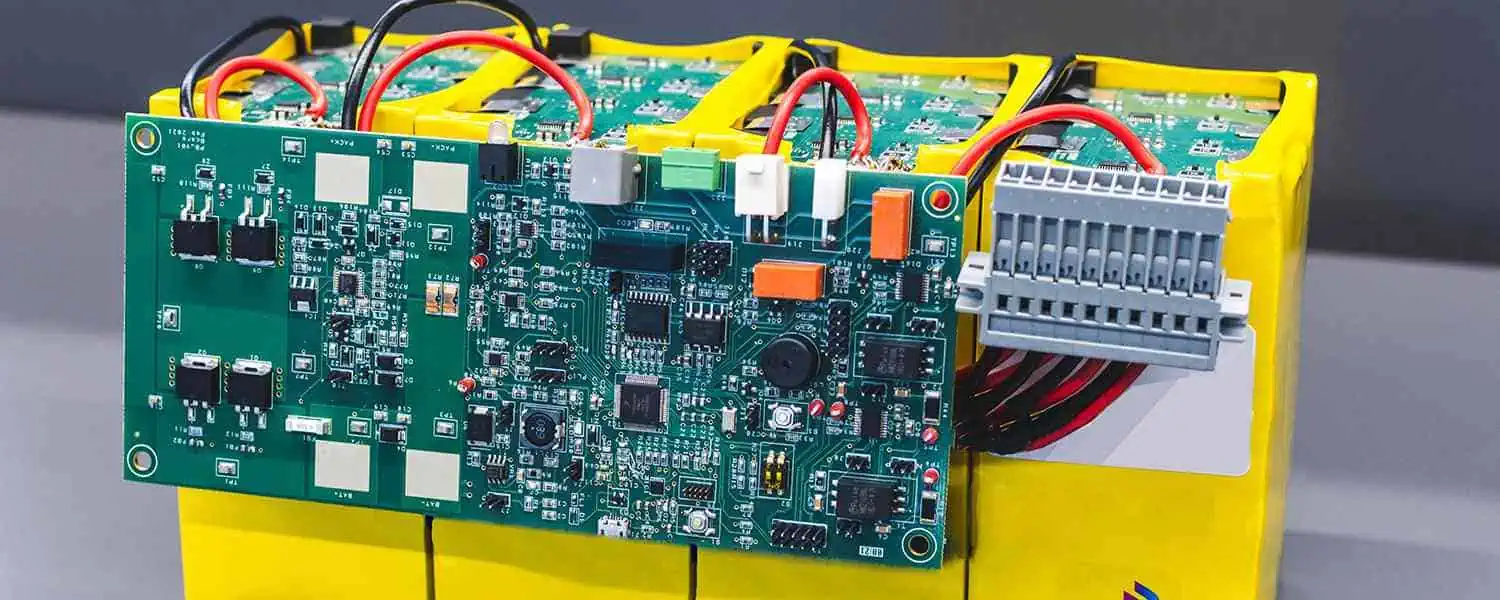
Is a battery temperature sensor necessary?

Battery Thermal Management System

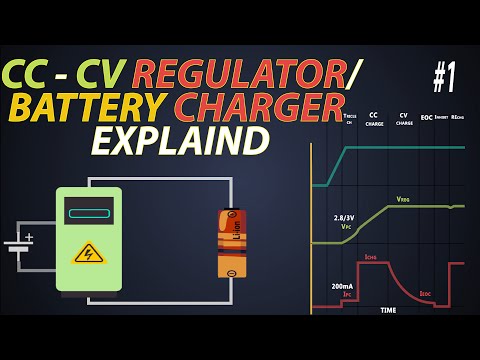
There are many types of battery chargers on the market: rechargeable alkaline battery chargers, nickel-metal hydride battery chargers, and nickel-cadmium battery chargers. When buying a battery charger, I suggest you buy a multi-function battery charger which can reduce some expenses.

YouTube video

Here is a circuit schematic diagram of the battery charger probe that can be tested by using the probe to prevent battery damage, whether the charger starts charging or improperly connected.

Battery Charger Probe Schematic Diagram to Prevent Battery Damage

This battery charger probe prevents damage to the battery or allows you to test it yourself, whether the charger starts charging or improperly connected. By using the probe, the cable clamp is connected to the battery positive level for the first time, then the test board touches the negative pole of the battery.

Introduction

Battery temperature sensors play an important role in battery management systems by providing temperature monitoring and protection. The measurement of cell, module, and pack temperatures allows the system to optimize charging conditions, prevent damage from overheating, and estimate battery capacity.

This article explores the impacts of temperature on battery performance and lifetime, the consequences of exceeding safe temperature limits, how and where temperature sensors are implemented, and alternatives when temperature sensing may not be required.

Effects of Temperature on Batteries

Battery cell chemistry determines optimal temperature ranges. In general, temperature extremes degrade batteries through the following effects:

High Temperatures

  • Accelerated ageing and shorter cycle lifetimes
  • Loss of active materials and internal structural changes
  • Increased self-discharge rates
  • Degradation of internal resistance and power capability
  • Thermal runaway risk in some lithium-ion types

Low Temperatures

  • Temporary loss of capacity and lower discharge rates
  • Increased internal resistance causes voltage drop
  • Reduced current and power discharge ability
  • Slower charging rates may be required
  • Risk of lithium plating in lithium-ion cells
  • Higher risk of metal corrosion in some chemistries

Keep batteries within a safe operating range improves performance, lifetime, and safety. Temperature monitoring provides feedback to manage these effects.

Consequences of Exceeding Temperature Limits

Without temperature monitoring and control, the following failure modes can occur when battery temperatures go out of safe limits:

High Temperature Effects

  • Pouch cell swelling leading to fire/explosion
  • Internal short circuits due to separator damage
  • Venting of electrolytes
  • Thermal runaway causing cascading cell failures

Low Temperature Impacts

  • Permanent capacity loss or premature failure
  • Internal battery damage from lithium plating
  • Voltage clipping and inability to deliver rated power

These potential risks demonstrate the need for temperature sensing as part of a battery management system.

Implementing Battery Temperature Sensors

To monitor temperature, sensor placement is important:

Cell Surface Mounting

Attaching sensors directly to cell surfaces provides most accurate measurements but increases pack complexity. Higher quantity of sensors required. Useful for validating cell models.

Module/Pack Mounting

Sensor mounted externally on module or pack enclosure is simpler. Provides general temperature for control but may not detect localized hot spots.

Within Pack

Sensors inserted internally between cells provide intermediate monitoring without direct cell contact. Compromise between complexity and localized readings.

Air Intake/Outflow

Measuring inlet cooling air and outlet heat exhaust temperatures provides indirect pack temperature estimates for basic control. Simplest approach.

Thermal Imaging

Infrared cameras used periodically provide non-contact temperature map of pack to identify hotspots not apparent from discrete sensors.

In most cases, a combination of pack surface sensors and selective internal placement provides sufficient temperature monitoring for control and protection.

Temperature Sensor Selection

A variety of sensor options exist for battery temperature monitoring:

  • Thermistors – Inexpensive, accurate. Linear and nonlinear types available.
  • RTDs – Very linear over wide temperature range. Accurate and precise but higher cost.
  • Thermocouples – Low cost sensors. Require compensation circuitry.
  • IC Temperature Sensors – On-chip amplification, linearization, and output. Application specific variants.
  • Infrared Sensors – Non-contact temperature measurement. Lower accuracy and higher cost than thermistors/RTDs.
  • Fiber Optic Sensors – Electrically passive for high voltage isolation. Expensive.

Robustness, cost, accuracy, and measurement range considerations will determine optimal sensor selection for the battery application and environment.

Temperature Sensor Circuit Design

Proper circuit design improves measurement accuracy and noise rejection:

  • Linearization – Adding resistive or digital linearization for sensors like thermistors improves temperature correlation.
  • Amplification – Sensor signals require buffering and amplification for noise immunity and signal conditioning.
  • Filtering – Low pass RC filters reduce noise pickup in long sensor leads in electromagnetically noisy environments.
  • Isolation – Fiber optic transmitters or galvanic isolators prevent false ground errors.
  • Compensation – Correct for errors like thermal junction effects in thermocouples.
  • Calibration – Normalize each sensor output at defined temperatures to maximize absolute accuracy.

Careful circuit design ensures the temperature sensor subsystem provides the battery management system with precision temperature data across the operating range.

Alternatives to Temperature Sensors

While temperature sensors are generally recommended, some alternatives exist for low cost or simpler battery packs:

Model Estimation

Use a thermal model of the battery to estimate temperature based on charge/discharge current, voltage response, and ambient temperature. Lower cost but less accurate.

Current Limiting

Conservatively derate maximum current to prevent heating rather than directly sensing temperature rise. Simple but reduces available capacity.

Periodic IR Scanning

Use a handheld thermal camera to periodically scan pack and check for hot spots instead of continuous monitoring. Only detects issues as they arise.

Exterior Thermal Feedback

Rely on skin temperature sensation, temperature labels, or surface mounted thermochromics to indicate unsafe externals temperatures manually. Provides warning but no control.

While workable for very basic systems, the lack of reliable temperature feedback with these alternatives prevents optimization and reduces safety margins compared to proper thermal sensing and control.

Advanced Temperature Monitoring

More advanced battery systems maximize safety and performance using improved thermal monitoring:

  • Multiple internal distributed sensors provide temperature maps to the BMS. Detects local hotspots.
  • Fiber optic distributed sensing embeds thousands of measuring points within modules to improve resolution.
  • Thermal runaway detection monitors rate of temperature increase as an early warning.
  • Cell surface insulators with embedded thermistors improve response time and accuracy.
  • Actively cooled and heated packs maintain uniform stable temperature regardless of conditions.

With sufficient temperature data, battery thermal models can be further refined to simulate thermal behaviors for different use cases and optimize thermal management strategies.

Thermal Management Integration

Incorporating temperature data into thermal management enables:

  • Reducing charge rate when temperature nears limit to avoid overheating rather than simple fixed current charging.
  • Proactively cooling the pack when approaching upper limits well before reaching critical temperatures.
  • Preventing operation in extremely cold environments by temperature dependent output derating or pack heating.
  • Optimizing cooling system controls based on inlet air and internal temperatures.
  • Estimating impedances and available capacity based on temperature.
  • Triggering safe shutdown and isolation when dangerous temperatures are detected.

Integrating temperature monitoring as part of the overall thermal management and battery management systems is key to maintaining safe, efficient, and optimal battery operation.

Summary

  • Battery temperature heavily impacts performance, lifetime, and safety parameters. Exceeding limits degrades batteries.
  • Direct temperature monitoring allows optimizing operation as well as preventing failures from overheating or freezing.
  • Sensor selection, placement, and circuit design ensure robust and noise-free measurements for the battery management system.
  • Alternatives exist for simple batteries but lack protections of active sensing and control. Advanced techniques provide greater resolution.
  • Temperature feedback coupled with thermal management strategies maximizes battery efficiency, utilization, and safety.

FAQ

How many temperature sensors are needed in battery pack?

Depends on pack size but a minimum of 3-5 sensors placed at end/middle of pack helps detect basic thermal gradients for control and protection. Larger packs may use 10 or more sensors distributed throughout the modules.

What temperature range do Li-Ion batteries operate in?

Charge: 0ยฐC to 45ยฐC, Discharge: -20ยฐC to 60ยฐC. Wider operating range possible with thermal controls. Lower and upper cutoff limits are used for protection.

What communications bus is used for battery temperature sensors?

A controller area network bus (CAN Bus) is typical for connecting multiple sensors over a common serial data bus. Other options include SPI, ISO-BUS, and I2C. Wireless sensors are also an emerging option.

How often should battery temperature be monitored?

Continuous monitoring provides best results for optimizing charging and prevent over-temperature conditions. For simple packs, occasional sampling may suffice but lacks robust protections.

Why are multiple temperature sensors needed in large battery packs?

A single external measurement cannot detect internal hot spots. Distributed sensors allow finding cells with higher localized heating to properly control charge rates and cooling across large packs.

What is a watt-hour meter?

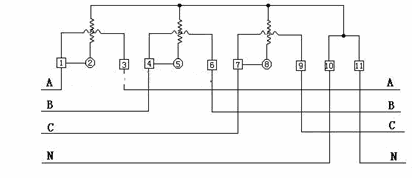
Three-phase watt-hour meter is used to measure the power output (or load consumption) of three-phase ac circuit. Its working principle is exactly the same as that of single-phase watt-hour meter, except that it adopts the way of multiple driving parts and aluminum plates fixed on the rotating shaft in structure to realize the measurement of three-phase electric energy.

Three-phase three-circuit active watt-hour meter uses two sets of driving parts to act on two aluminum plates (or one aluminum plate) mounted on the same shaft, and the principle is exactly the same as that of single-phase watt-hour meter.

The three-phase watt-hour meter fully meets the technical requirements of single-phase 1 or 2-stage in DL/ T645 -1997 and GB/ T17215-1998.With good reliability, small size, light weight, beautiful appearance, advanced technology, 35mm DIN standard installation and other characteristics;And has a good anti โ€“ electromagnetic interference, low self โ€“ consumption power saving, high precision, high overload, high stability, anti โ€“ electric leakage,Long Service life.

Three-phase Watt-hour Meter Schematic Diagram

Introduction

A watt-hour meter, also known as a kilowatt-hour meter, is an electrical meter that measures the total energy consumed by a residence, business, or an electrical load in kilowatt-hours. It allows power utilities to determine power consumption over a period of time for billing purposes and customers to monitor their electrical energy usage.

This article provides an overview of watt-hour meter operating principles, design types including electromechanical and electronic meters, key components, installation considerations, calibration and accuracy, and trends in smart metering technology.

What is a Watt-Hour and Why Measure It?

A watt-hour is a unit of electrical energy equivalent to a power consumption of one watt sustained for one hour. For example, a 100 watt light bulb powered for 10 hours would consume 1000 watt-hours of energy (100 x 10 = 1000 watt-hr).

By measuring watt-hours, the total work performed or energy consumed by an electrical load can be determined. The utility company uses this information to properly bill customers based on energy use rather than simple power (watts) draw. Customers can also monitor watt-hour usage over time to identify high consumption loads or changes in energy usage profiles.

Some key reasons to measure watt-hours:

  • Allows fair utility billing based on total energy consumed rather than peak power demand
  • Enables analyzing usage patterns over days, weeks, months to minimize waste
  • Identifies high consumption equipment for possible efficiency improvements
  • Verifies conservation efforts are achieving savings
  • Provides data to size backup power systems and generators

Operating Principle

Watt-hour meters operate on the principle of counting revolutions of an aluminum disc mounted on a shaft. The disc rotates at a speed proportional to the power flowing through the meter. Counting the revolutions over time therefore provides a measurement of the energy consumed.

The aluminum disc spins between two electromagnets. One creates a magnetic flux proportional to the voltage applied. The other uses current flowing through the meter to generate a magnetic field. The interaction of these two perpendicular magnetic fields produces a torque that rotates the disc at a speed proportional to power (volt-amps).

Gears connect the disc to dials which record the cumulative energy consumption. This method allows the meter to register the total watt-hours used over months or years.

Electromechanical Watt-Hour Meter Operation (Image Credit: BidyutJyoti/Wikimedia)

Types of Watt Hour Meters

There are two primary types of watthour meters in use:

Electromechanical

The traditional electromechanical induction meter uses the rotating aluminum disc as described above. Gears drive mechanical dials to display the watt-hours used.

They provide reliable measurement but are bulky and require manual reading. Electromechanical meters are still in use but being phased out in favor of electronic meters.

Electronic

Newer electronic watt-hour meters replace the physical disc and gears with electronic sensing and measurement of voltage and current. This allows features like:

  • LCD/LED numerical display of usage rather than dials
  • Ability to network multiple meters with remote reading
  • Programmable time-based tariff schedules
  • Instantaneous power usage readout
  • Two-way communication for meter configuration
  • Load control capabilities

Electronic meters are cheaper to produce and enable automated meter reading and advanced smart grid functionality.

Watt Hour Meter Components

The key components found in a watt-hour meter are:

  • Voltage coils – Apply magnetic flux to aluminum disc proportional to line voltage
  • Current coils – Generate magnetic field proportional to current flow through meter
  • Rotating disc assembly – Spins at speed proportional to power consumption
  • Damping magnet – Stabilizes disc rotation speed to prevent overspinning
  • Gears – Provide mechanical coupling to dials/display
  • Dials or display – Cumulatively show watt-hours consumed
  • Test block – Allows magnetic calibration and accuracy testing
  • Registers – Record cumulative energy usage over time

Major Components in an Electromechanical Watt-Hour Meter (Image Credit: BidyutJyoti/Wikimedia)

Watt Hour Meter Installation

Proper installation of watt-hour meters is important for accurate measurement:

  • Mount securely on non-flammable surface away from easily combustible materials
  • Locate outdoors in protective housing if required by standards
  • Position the meter so display is easily visible without obstructions
  • Verify meter socket wiring matches meter terminal design and rated voltages
  • Use weatherproof conduit fittings aligned properly with enclosure
  • Leave sufficient wire slack to prevent stresses on connections
  • Seal openings and knockouts according to local electrical code
  • Check disc rotation direction and multiplier connections
  • Verify calibration and seals following installation

Careful mechanical and electrical installation protects the meter and ensures correct energy accounting right from the start.

Calibration and Accuracy

Watt-hour meters are factory calibrated to standards specifying allowed tolerances on errors. Typical accuracy metrics:

  • Full load – 0.5% to 1% error at nominal current rating
  • Light load – 1% to 2.5% error at 10% of nominal current
  • Power factor – 1% to 3% error over 0.5 lagging to 0.8 leading

Various factors impact accuracy:

  • Magnet strength weakening over time
  • Bearing wear allowing disc wobble
  • Dust buildup on critical components
  • Voltage imbalance between phases

Field calibration and testing procedures help maintain accuracy:

  • Calibration check at full, light, and zero load
  • Verify disc rotation speed using timing marks
  • Current reversal test detects loose or tilted discs
  • Optional calibration magnets can correct minor errors

Adhering to recommended recalibration intervals ensures minimal watt-hour reading errors.

Trends in Smart Metering

Traditional electromechanical watt-hour meters are increasingly being replaced by sophisticated electronic smart meters that provide additional capabilities:

  • Two-way digital communication for automatic meter readings
  • Real-time power usage monitoring
  • Load limiting and load shedding abilities
  • Remote reconfiguration and setting of tariff schedules
  • Power quality metrics like voltage, frequencies, power factor
  • Tamper and theft detection alerts
  • Outage reporting and power restoration logging

When networked together into the advanced metering infrastructure (AMI), smart meters allow:

  • Automated billing and reduction in overhead
  • Remote insight into demand and grid health
  • New time-based electricity pricing models
  • Ability to collect and analyze energy usage data

The transition to smart meters and AMI is a crucial step in modernizing power grids and enabling greater efficiency and reliability through information availability.

Summary

  • Watt-hour meters measure the total electrical energy used by a load, residence, or facility. This enables utility billing based on consumption.
  • Traditional electromechanical types used eddy currents and an aluminum disc but are being replaced by electronic meters.
  • Accurate voltage and current sensing allows determining power usage. Disc rotation per time indicates energy usage.
  • Careful mechanical and electrical installation is needed for reliable operation. Meters must be periodically calibrated.
  • Evolution to smart meters provides automation, telemetry, grid analytics, and usage visibility through networked communication.

FAQ

How does a watt-hour meter work electrically?

It works by sensing the voltage and current to derive real power. Two coils generate magnetic fields proportional to the voltage and current. Their interaction causes a disc to rotate at a speed proportional to power. Counting revolutions over time provides energy usage.

What was the main limitation of electromechanical watt-hour meters?

The primary limitation was the need to manually read and record the dial indications to determine electrical energy usage. This was labor intensive and prevented real-time telemetry of consumption data. Modern electronic meters overcome this through digital outputs and networking.

What quantities can smart meters measure beyond watt-hours?

Smart meters contain additional electronics to measure parameters like power factor, voltage, current, frequency, waveform quality, instantaneous usage, and outage information. This provides greater grid and usage insight.

How frequently are utility watt-hour meters calibrated?

Electromechanical meters are typically recalibrated every 5-10 years. Electronic smart meters are solid-state with no moving parts and generally do not need recalibration for 15-20 years assuming acceptable power conditions.

How does meter tampering impact watt-hour accuracy?

Any unauthorized physical alteration like forcing discs to under-record usage, applying external magnets, or electrical tampering will greatly reduce meter accuracy. Smart meters often include tamper detection capabilities to detect and report such activities.

Blinking LED Circuit with Schematics and Explanation

Light-emitting diode is known simply as โ€œthe LEDโ€.

The Schematic Diagram of Flashing LED Application

The diode made of a compound of gallium, arsenic and phosphorus, that can emit visible light when electrons are combined with holes. So it can be used to make LED.

YouTube video

LED is used as an indicator light in circuits and instruments, It can also be displayed in text or number.

Gallium arsenide phosphide diodes emit red light;

Gallium phosphide diodes emit green light;

Silicon carbide diodes emit yellow light.

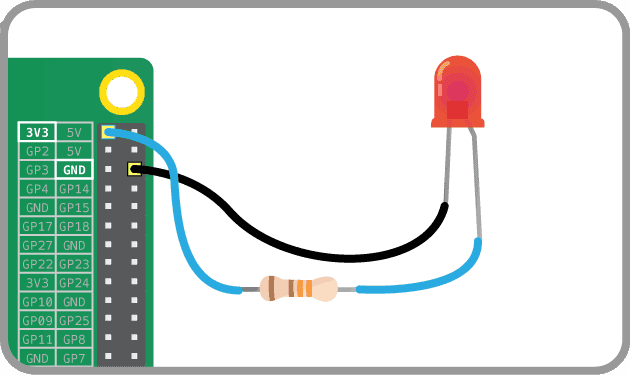
As shown in the figure, It is the circuit diagram of flashing single LED application.

The flashing LED operates at a low hertz frequency, it is easy to attract peopleโ€™s attention. So it can be widely used in various alarm circuits, such as temperature, liquid level, and voltage limit alarm circuits.

It is a type of semiconductor diode that can convert electrical energy into light energy;

Both Led and ordinary diode, consists of a PN junction with unidirectional conductivity.

The Schematic Diagram of Flashing LED Application

Introduction

Blinking LED circuits are used in a wide range of simple electronic projects to demonstrate digital logic and timing fundamentals. By automatically turning an LED on and off repeatedly, useful visual indications, alerts, and effects can be created.

This article provides schematic diagrams and explanations of common blinking LED circuit implementations using 555 timers, microcontrollers, and discrete transistor designs. Both astable oscillators for continuous blinking and monostable time delay configurations are covered.

555 Timer Astable Blinking LED

The 555 timer integrated circuit configured as an astable multivibrator provides a simple method for generating a blinking LED:

How it Works

  • 555 setup as astable oscillator charging/discharging between C1/R1 and C2/R2.
  • Output square wave drives transistor which switches LED on/off.
  • Flashing rate determined by R1, R2, C1, C2 values per 555 astable equations.
  • Output duty cycle depends on ratio of R1/R2. Equal values provide 50% duty cycle.
  • LED current limited by R3. R4 pulls down transistor base when off.

This basic circuit using just a 555 timer and few components provides continuous LED blinking. Frequency and duty cycle can be adjusted via resistor and capacitor values.

555 Monostable Blinking LED

A 555 timer monostable configuration generates timed pulses to blink an LED:

How it Works

  • Pushbutton trigger generates a defined one-shot pulse from 555 monostable on each press.
  • Output pulseturns on transistor, lighting LED for duration of pulse.
  • Timing components R1, R2 and C1 determine pulse width.
  • Subsequent button presses restart timing cycle blinking LED again.
  • Optional biasing components (dotted) keep transistor OFF in idle state.

This creates a manually triggered blinker that illuminates the LED for a timed duration with each activation. Can produce attention getting flashes.

Microcontroller Blinking LED

Microcontrollers provide fully software controllable blinking LED capabilities:

How it Works

  • LED connected to GPIO pin of microcontroller.
  • Software loops to toggle I/O pin HIGH/LOW at desired blink frequency.
  • Timer peripheral used to control ON and OFF duration.
  • Duty cycle easily adjusted in software to provide desired blink pattern.
  • Current limiting resistor protects I/O pin from excessive current draw.

Microcontroller blinkers are fully customizable in software and avoid any external components beyond the LED itself. Timing, duty cycles, and patterns can be reconfigured on the fly.

Transistor Astable Blinker

Discrete transistors can also implement an astable multivibrator blinking circuit:

Show Image

How it Works

  • Cross-coupled transistor pair switches each other on/off repeatedly.
  • Powered by collector supply Vcc.
  • R1/R2 bias transistors just below turn-on threshold when other transistor is ON.
  • C1/C2 timing capacitors charge through collectors controlling blink rate.
  • Q1 collector output drives external LED.
  • R5 limits LED current. R3/R4 provide DC bias.

This all-transistor astable circuit provides high current drive capacity for multiple LEDs if needed. Timings easily adjustable through R and C values.

JFET Relaxation Oscillator Blinker

JFET transistors can implement simple relaxation oscillator blinker circuits:

How it Works

  • Capacitor C1 charges through R1 when JFET is OFF.
  • When voltage across C1 reaches JFET gate threshold, it turns ON rapidly discharging capacitor and lighting LED.
  • JFET turning ON forces its own gate low via R2 turning device back OFF.
  • Circuit repeats charging C1 and blinking LED.
  • R4 limits LED current. R3 provides bias.

This self-blinking circuit uses only a JFET transistor and passive components. Frequency controlled through R1/C1 time constant.

Summary

  • Blinking LED circuits provide visual alerts and indications using electronic oscillators and digital timing.
  • 555 timers as astable or monostable oscillators offer simple blinker circuits.
  • Transistor multivibrator and JFET relaxation oscillator designs enable discrete component LED blinkers.
  • Microcontrollers allow fully software controlled blinking for maximum flexibility.
  • Combine blinking visual outputs with other circuit functions like sensing for integrated systems.

Blinking LEDs find countless applications in electronic projects to visually indicate states and activities in an energy efficient manner.

FAQ

What are some application examples of blinking LED circuits?

Some common applications are visual indicators on electronic devices, heartbeat or measures indicators, flashing alerts when events occur, lighting effects, toy and sculpture lighting, timing games, and visual metronome or speed displays.

How do you calculate the blink frequency for 555 timer circuits?

The formulas for a 555 astable oscillator provide the blink frequency based on resistor and capacitor values. Duty cycle is controlled by the ratio of RA to RB. Refer to 555 datasheets for exact equations.

How fast can an LED be blinked by a microcontroller?

Microcontrollers can easily blink most LEDs well into the hundreds of Hertz. Using timer hardware peripherals and interrupts allows blinking at kilohertz frequencies for most LED types.

What determines the blink intensity of an LED?

Blink intensity is controlled by the LED drive current. Higher current causes greater light intensity. Series current limiting resistors can adjust intensity by changing the voltage across the LED.

How do you make an LED blink slower?

For 555 timers, use larger timing capacitor values and/or smaller resistor values to increase the RC time constant. For microcontrollers, increase the software delay timing. For transistor circuits, increase capacitance and/or resistance to extend timing.

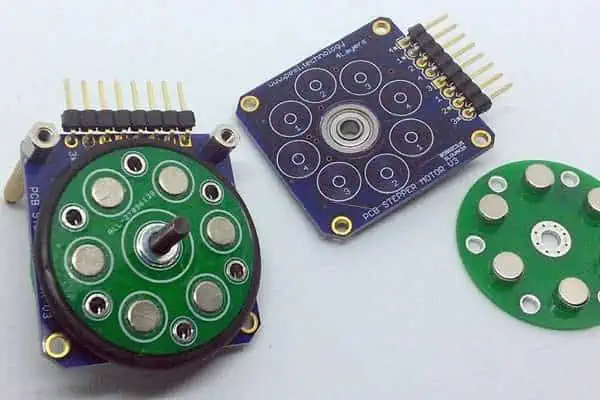
Stepper Motors Basics: Types, Uses, and Drive Schematic Diagram

A stepped motor which could convert an electric pulse signal into an angular displacement or linear displacement and its driver circuit diagram.

A stepping motor is an open-loop control element stepping motor that converts an electrical pulse signal into an angular displacement or a linear displacement. In the case of non-overload, the speed and stop position of the motor only depend on the frequency of the pulse signal and the number of pulses, and are not affected by the load changes. When the stepper driver receives a pulse signal, it drives the stepper motor to rotate a fixed angle in the set direction, called โ€œstep angleโ€, and its rotation is performed step by step at a fixed angle.

It is one of the most commonly used control electronic components in industrial control and instrumentation. It has the characteristics that the input pulse is proportional to the motor shaft. It is widely used in intelligent robots, floppy disk drives and data machine tools. The most suitable system for microcomputer-controlled stepper motors is the 20BY-0 stepper motor. It uses a +5V DC power supply with a step angle of 18 degrees and the motor coil consists of four phases.

Stepper Motor and Drive Schematic Diagram

Introduction

YouTube video

Stepper motors are brushless DC electric motors that move in discrete angular steps in response to digital pulse signals. They are precisely controllable and can be used in open loop position control systems without the need for feedback sensors.

Stepper motors are used extensively in industrial automation, robotics, 3D printers, CNC machines, and many other applications requiring precise positioning and speed control. They provide excellent low speed torque and response to digital inputs.

This comprehensive guide covers the operating principle of stepper motors, drive methods, common types and configurations, typical applications, and drive circuit schematic implementations.

How Stepper Motors Work

Stepper motors consist of a rotor containing permanent magnets and a stator containing electromagnets (windings). Applying current pulses to the windings generates magnetic fields which interact with the rotor magnets, causing rotational movement one step at a time.

Stepper Motor Rotation (Image Credit: Bakon/Wikimedia)

Some key operating characteristics of stepper motors:

  • Motion occurs in discrete steps measured in degrees (Most common is 1.8ยฐ/step or 0.9ยฐ/step)
  • Accurate positioning and repeatability – errors less than 5% of per step angle
  • Open loop control – No feedback sensors required
  • Driven by digital pulse trains from controllers
  • Torque optimized for low speed high precision applications
  • High holding torque when not moving resists external forces
  • Can be miniaturized down to tiny step angles enabling precision micro-positioning

Understanding the stepping sequence and drive methods allows proper control of stepper motors.

Drive Methods

Stepper motors are commutated by energizing the phase windings in a sequential pattern to rotate the shaft. Two primary drive methods are used:

Wave Drive (1 Phase ON)

Only one winding is energized at any time. Rotor magnet aligns with magnetic field produced by active winding before next step occurs.

Provides greater torque at lower speeds. Resonances can occur at higher speeds.

Wave Drive Sequence (Image Credit: Festo Didactic)

Full Step Drive (2 Phase ON)

Two windings are energized simultaneously to produce stronger torque. Minimizes resonances.

Cannot achieve very low speeds. Provides higher torque across operating range.

Full Step Drive Sequence (Image Credit: Festo Didactic)

Proper selection of drive mode depends on required speed and torque. Controllers allow selecting different drive modes.

Stepper Motor Types

Stepper motors are classified based on their internal construction:

Variable Reluctance

Contain salient pole stator with concentrated windings. Multi-toothed rotor provides varying magnetic reluctance as it rotates. Simple and inexpensive construction.

Permanent Magnet

Have magnetized rotor with defined poles. Stator has distributed windings. Provides good torque and low resonance issues. Most common type.

Hybrid

Combine permanent magnet rotor with salient pole stator. Provides high torque, low resonance, good speed range. Most advanced and powerful type.

The number of stator teeth determine the step angle. More teeth provide finer resolution but require more switching.

Stepper Motor Configurations

Beyond the internal construction, stepper motors are also classified by their physical size, shaft type, and operating voltages:

Size and Frame

  • Very small steppers < 28 mm used in precision instruments. 0.9ยฐ step angle.
  • Small steppers between NEMA 8 – 17 sizes used in automation. 1.8ยฐ step angle.
  • Large NEMA 23-34 frame steppers used in high torque applications. 1.8ยฐ step angle.
  • Pancake or slim profile steppers optimized for tight spaces.

Shaft Type

  • Standard round shaft – most common
  • D-shaped shafts prevent slipping of couplings
  • Geared – have integrated gearheads to increase torque
  • Hollow shaft – for applications like driving lead screws

Voltage Rating

  • Low voltage steppers – 12 or 24V types common. Higher currents.
  • Medium voltage – 36 or 48V rated. Used in automation.
  • High voltage – for precision or high power steppers. Up to 300V.

Combine winding configuration, drive mode, frame size, shaft and voltage rating to select optimal stepper.

Stepper Motor Performance Specs

Key specifications to evaluate stepper motor performance:

  • Steps per Revolution – Typically range from 24 to 400 steps/revolution. More steps enables greater positioning precision.
  • Step Angle – Angle moved per step. Common values are 0.9ยฐ, 1.8ยฐ, 7.5ยฐ and 15ยฐ. Smaller step angle provides higher resolution.
  • Torque – Rated holding and pull-out torque values. Higher torque allows faster accelerations under load.
  • Voltage – Rated voltage and input current determines power input needs.
  • Inductance – Higher is better for drivability at higher speeds but reduces torque. Values from 1mH to 50mH typical.
  • Resistance – Lower resistance enables higher torque output. Range is typically 1-5ฮฉ per phase.
  • Inertia – Lower rotor inertia allows faster acceleration and response.
  • Accuracy – Deviation from intended step angle measured in arcminutes. Sub-arcminute accuracy is achievable.

Review rated specifications against the application’s resolution, torque, speed, and accuracy requirements when selecting an optimal stepper motor.

Stepper Motor Drives

Stepper motors require properly designed drive circuits to energize their phases in coordination with input step and direction signals. Here are the key functions stepper motor drivers perform:

Power Amplification

Increase current and voltage levels of control signals to adequately drive motor windings. Typically chopper or linear drives used.

Stepping Sequence Generation

Translate step and direction inputs into a sequence for energizing the phase windings. Microstepping capability is desirable.

Current Control

Vary winding currents to optimize torque output. Lower current at high speeds to overcome inductive impedance.

Protection Circuits

Detect error conditions like missed steps or overtemperature and respond appropriately to prevent damage.

Feedback Interfaces

Provide connections to external encoders or sensors when closed loop operation is needed.

Command Inputs

Step and direction signal inputs dictate motor motion. Additional control inputs like enables may be included.

Properly designed drives ensure smooth and reliable stepper motor operation and protect against malfunctions.

Basic Unipolar Driver

Here is a basic unipolar driver for a variable reluctance stepper:

  • ULN2003 Darlington transistor array provides 500mA current rating per channel. 8 channels total.
  • Diodes protect against back EMF when winding currents are switched.
  • Resistors limit current through windings. Can alter values to change maximum current levels.
  • Inputs must be energized in proper sequence to step motor.
  • Only one winding active at any time. Limited torque capability.

Low component count makes this a simple and inexpensive drive choice but performance is limited.

Basic Bipolar Driver

A basic bipolar driver energizes two windings simultaneously:

Show Image

  • Dual H-Bridge (L298N) allows 4 quadrant operation of windings.
  • Allows current in both directions through windings enabling bipolar drive.
  • Higher performance but increased component count over unipolar design.
  • Provides up to 2A per winding. Higher than unipolar drives.
  • Fast switching time < 100ns.

Bipolar drive with H-bridges provides good performance for small to mid-sized steppers.

Microstep Driver

Microstepping divides steps into smaller increments. Typical microstep resolutions are 1/8, 1/16, 1/32, 1/64 step:

  • Sinusoidal microstepping currents smooth motor operation and provide position interpolation.
  • Microstep table maps control input state to sine wave DAC value.
  • On-chip DAC and PWM generate sinusoidal current profiles in windings.
  • Chopper circuits allow microstepping and current control capability.
  • External potentiometer sets maximum current level.

Microstepping allows very fine resolution motion and smoothing with stepper motors.

Integrated Stepper Controller

Integrated stepper controllers contain drive electronics, sequencing logic, and microcontroller:

  • Microcontroller generates control signals and sequences drive waveform based on incoming step and direction inputs.
  • Integrated motor drivers with current control. May include thermal shutdown.
  • Onboard supply generates motor voltages from main DC input.
  • Status indicators and I/O allow monitoring and interfacing.
  • Parameters and drive modes configurable through communication interfaces.

All-in-one integrated controllers simplify implementation with advanced features and protection.

Stepper Motor Applications

Stepper motors provide many advantages for precise positioning in automation, robotics, instruments, and other applications:

  • CNC Machines – For precisely controlling cutting tools and workpiece position.
  • 3D Printers – High precision positioning of print heads over multiple axes.
  • Scanners & Plotters – Provide linear motion and positioning for optics.
  • Robots – Allow precise joint control and position feedbackless operation.
  • Pick-and-Place – X-Y positioning for PCB assembly and packaging machines.
  • Laser Cutters – For accurate motion and focusing of optics.
  • Textiles – Provide incremental stitching motion in sewing machines.
  • Displays – Used in meter movements, gauge mechanisms, advertising displays.
  • Valves – Precise control over fluid flow without complex feedback.

Stepper’s excellent response to digital inputs makes them ideal for computer controlled automation tasks requiring high precision.

Summary

  • Stepper motors provide precise digital control of rotational position without feedback sensors.
  • Operation based on magnetic field interactions between stator windings and rotor magnets.
  • Driven by pulse train inputs that sequence the winding energization to step the motor.
  • Major types include variable reluctance, permanent magnet, and hybrid steppers.
  • Driver circuits amplify signals and provide sequencing and protection. Microstepping enables fine increments.
  • Widely used in automation, robotics, CNC machines, 3D printers and other applications requiring high precision motion under digital control.

FAQ

What are the typical step angles for stepper motors?

Common step angles include 0.9ยฐ, 1.8ยฐ, 7.5ยฐ, 15ยฐ, and 30ยฐ. Smaller step angles allow higher precision but require more switching. 0.9ยฐ and 1.8ยฐ are most common for fine control.

What is the difference between unipolar and bipolar stepper motors?

Unipolar steppers only have current flowing in one direction through their coils, while bipolar motors reverse current direction providing higher torque. Bipolar motors require full H-bridge drivers.

Can stepper motors be used in closed loop systems?

Yes, stepper motors can incorporate rotary encoders or resolvers to provide position feedback. The controllers can use PID control in a servo loop to achieve even better precision and compensation.

Why are stepper motors operated at lower speeds?

The construction of stepper motors makes them best suited for operation below 1000 RPM. At higher speeds, resonances, switching delays, and inductance effects impair torque and control.

What causes lost steps in a stepper motor?

Exceeding torque limits, accelerating too quickly, too high a speed, or electrical noise can all cause missed steps and loss of synchronism. Proper drive design and torque margins prevent lost steps in most cases.

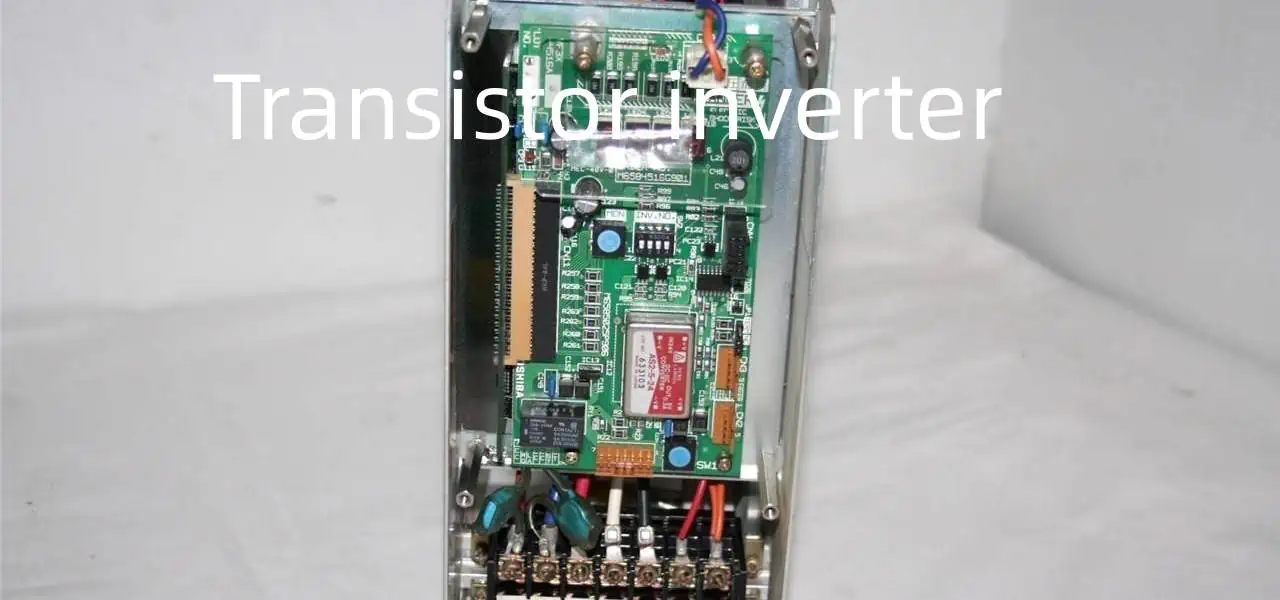
What is transistor inverter circuit?

In remote villages, there is often  power outages. Some universities will also have power outages at night, and those who like to stay up late will not have electricity. But thatโ€™s okay, you can solve this problem.

This is very easy to make an inverter that can turn the 12V supply voltage to be 220V. The circuit is driven by a multivibrator consisting of BG2 and BG3, and then driven by BG1 and BG2 to control BG6 and BG7 operation.

The oscillating circuit is powered by the regulated power supply of the BG5 and DW groups, which makes the output frequency relatively stable. At the time of production, we can choose the  commonly used AC transformers with dual 12V output. A 12V battery can be selected as needed.

This schematic diagram can also be used for small generator for home use.

The Schematic Diagram of Dual 12v Output Transistor Inverter

Introduction

A transistor inverter circuit converts a digital input signal to its opposite logic level at the output. For example, when the input is HIGH the output will be LOW and vice versa. Inverters play a key role in digital logic systems by providing signal inversion, buffering, logic level shifting, clock generation and other functions.

Inverters form the fundamental building block for more complex digital logic gates and functions. This article provides an overview of transistor-based inverter circuits, their operation, key parameters, types and applications.

Inverter Basics

An inverter uses an amplifying device like a transistor connected in a switching configuration to generate the inverted output:

  • When the input is LOW, the amplifying device turns ON pulling the output HIGH.
  • When the input is HIGH, the device is OFF and the output is pulled LOW through the load resistor.

This functionally inverts the logic level between input and output. The amplifying element provides gain to ensure solid logic HIGH and LOW voltage levels.

Basic Inverter Functional Diagram

Some key characteristics of inverters:

  • Gain should be higher than 1 for unambiguous logic levels
  • Provide high input impedance and low output impedance
  • Capable of high speed operation with fast switching
  • Output inverted copy of input waveform
  • Support fan-out to drive multiple gate inputs

Properly designed inverters are critical building blocks for reliable digital systems.

BJT Inverter

Here is a simple inverter circuit using a bipolar junction transistor:

When the input is LOW (< 0.7V), the transistor is OFF. Output is pulled HIGH through Rc.

When input is HIGH (>0.7V), transistor turns ON and pulls output LOW via collector-emitter path.

Resistor RB provides biasing to keep transistor OFF when input is LOW. Capacitor CE helps speed up switching by providing current bursts.

Key characteristics:

  • Slow compared to MOSFET circuits due to minority carrier charge storage
  • Input HIGH level must exceed 0.7V (base-emitter diode drop)
  • Output swing typically 0.2V to (Vcc – 0.2V)
  • Low input impedance, moderate output impedance

Simple and inexpensive but performance limited. Better for lower speed applications.

MOSFET Inverter

Here is an inverter using a MOSFET transistor:

When input is LOW (<threshold voltage), MOSFET is OFF, output pulled HIGH.

When input is HIGH (>threshold voltage), MOSFET turns ON discharging output to ground.

No biasing network needed compared to BJT version.

Key characteristics:

  • Very high speed since no minority carrier storage
  • Low input threshold voltage (~1-2V)
  • Rail-to-rail output swing potential
  • High input impedance, low output impedance
  • Draws no current when OFF

Much faster switching speeds than possible with BJTs. Widely used for high performance digital logic.

CMOS Inverter

CMOS inverters use complementary NMOS and PMOS transistors:

When input is LOW, PMOS is ON pulling output HIGH. NMOS is OFF.

When input is HIGH, NMOS turns ON and discharges output LOW. PMOS is OFF.

No current flows from supply to ground when in static state. Very low quiescent power.

Provides excellent noise immunity and high gain. Standard for modern digital ICs.

Key Inverter Characteristics

Some key performance parameters for inverters:

  • Propagation Delay: Time taken to switch output state after input change. Need very low (ns range) for high speed operation.
  • Rise/Fall Time: Time taken for output voltage to transition between logic levels. Lower is better for high speed.
  • Gain: Ratio of output to input voltage. Should exceed one for robust noise margin.
  • Fan-out: Number of standard input gates that can be reliably driven by the output. Higher is better.
  • Power Consumption: Quiescent and dynamic power. CMOS is most efficient topology.
  • Noise Immunity: Ability to reject noise coupling and avoid false triggering. VIL and VIH levels determine immunity.

Optimizing these parameters through careful transistor sizing and biasing is key to designing robust high performance inverters.

Types of Inverters

Some common types of inverters used in digital systems include:

  • Buffer Inverters – Provide isolation between circuits while inverting logic level. Used to prevent loading effects.
  • Logic Level Shifters – Convert between voltage levels like TTL and CMOS. Provides compatibility.
  • Clock Inverters – Special fast inverters designed to provide inverted clock signals with precision timing.
  • Schmitt Trigger Inverters – Provides hysteresis for noisy inputs. Cleans up waveforms.
  • Rail-to-Rail Output Inverters – Swings output from supply rail to ground. Improves high/low logic levels.
  • Open Drain Output Inverters – Used when wired-AND logic is needed. Pulls output low but does not drive high.

Selecting the right inverter type enhances performance for the target application.

Inverter Circuits Examples

Here are some example inverter circuit implementations:

Buffer Inverter

Isolates loading on upstream gate/source. Boosts current drive for higher fan-out.

Level Shifter

Converts 1.8V CMOS logic to 5V TTL input requirements. Provides inter-logic family translation.

Schmitt Trigger Inverter

Provides hysteresis for noisy waveforms. Cleans up slow rise/fall times.

Inverter Applications

Inverters play a vital role in many digital logic systems:

  • Oscillator and clock generation circuits
  • Driving logic signals across long PCB traces
  • Interfacing logic families with incompatible voltages
  • Buffering high fan-out signals to prevent overloading
  • Inversion of control and timing signals
  • Waveform shaping of noisy digital signals
  • Logic level translation between circuits

Any design needing signal inversion, buffering, gating, or logic level shifting will require inverters as fundamental building blocks.

Summary

  • Inverters use transistor amplifiers to invert the logic level between input and output.
  • BJT, MOSFET and CMOS are common transistor types used to build inverters.
  • Key performance factors include propagation delay, speed, gain, fan-out, noise immunity.
  • Many circuit variations exist optimized for functions like buffering, level shifting, noise reduction.
  • Inverters are core components in digital logic, timing generation, signal conditioning, and translation applications.

Understanding inverter circuits provides the foundation for designing more complex digital logic functions.

FAQ

What is the difference between inverter and NOT gate?

Inverters and NOT gates perform the same logic function of inverting the input signal. Inverter tends to refer to transistor circuit implementations while NOT gate can be used when discussing abstract boolean logic functions.

Why use an inverter vs direct connection?

Inverters provide gain, isolation, and logic level shifting. This prevents distortion of the original signal. A direct connection can load down source circuits and potentially cause malfunction.

What is the basic structure of all inverter circuits?

A switching element (transistor) with load configured to invert input to output. BJT, JFET, MOSFET switching devices with resistors as loads are common. The active device provides amplification.

How does an inverter provide logic level shifting?

The inverter can operate between higher and lower supply voltages. The input threshold and output swing adapt to the inverter’s own supply levels allowing translation.

Why use Schmitt Trigger inverters?

Schmitt Trigger inverters incorporate positive feedback to provide hysteresis in the switching thresholds. This makes them less sensitive to noisy input signals and improves waveform shaping.

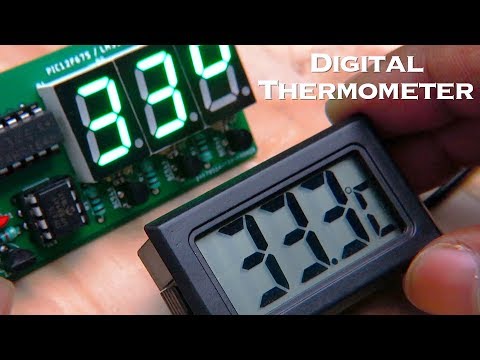
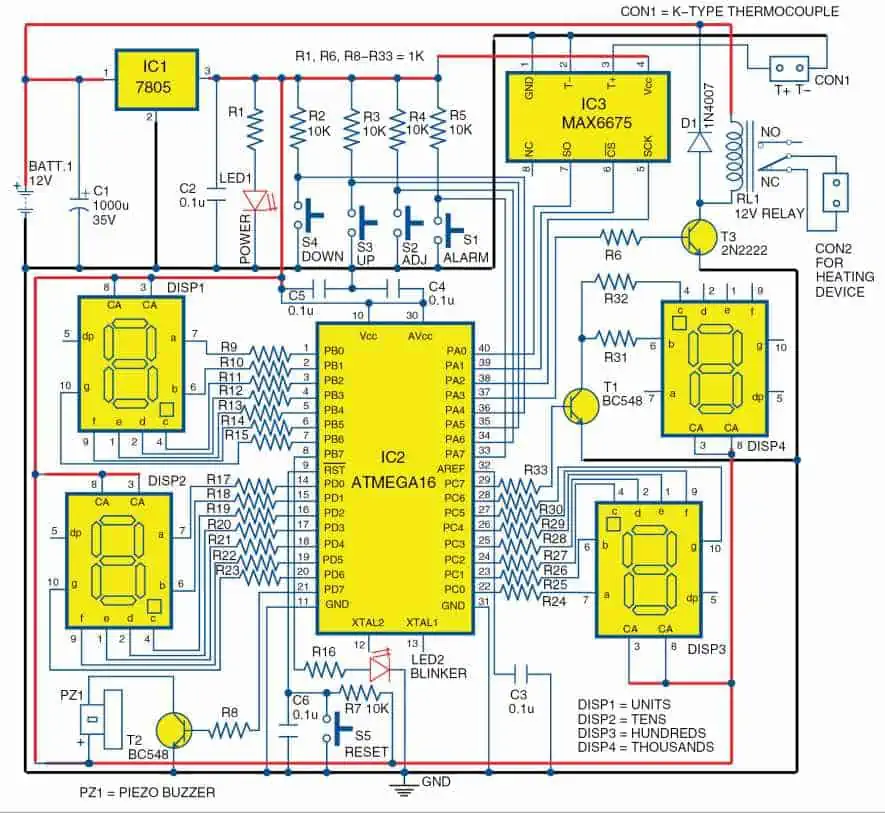
What is Digital Thermometer Circuit Diagram ?

An electronic thermometer circuit diagram with high measurement accuracy, memory and beep tips for human body temperature.

The electronic thermometer consists of a temperature sensor, an LCD monitor, a button battery, a special integrated circuit and other electronic components.

Compared with the traditional mercury glass thermometer,electronic thermometer can measure the body temperature quickly and accurately,has the advantages of convenient reading, short measurement time, high measurement accuracy, energy memory and buzzing cues. The circuit of the electronic thermometer is shown as below, thermal power RT stares and R1, R2, R3 and RP1.When the temperature is 20 โ„ƒ, select R1, R3 and adjust the RPL to make the bridge a balance.

Electronic Thermometer Diagram

Introduction

A digital thermometer circuit diagram illustrates the electronic components and connections required to construct a thermometer that provides temperature readings in numeric format. Unlike analog thermometers that use a mercury column, bimetallic coil, or other mechanical sensor, digital thermometers convert temperature into an electrical signal that is digitized using analog-to-digital conversion and displayed.

Understanding the circuitry allows constructing simple to more complex digital thermometers. The key components include temperature sensors, analog signal conditioning, microcontrollers or display drivers, displays, and power supplies. Common sensing elements used include thermistors, RTDs, and thermocouples.

This article will provide an overview of several typical digital thermometer circuit implementations and their diagrams.

How Digital Thermometers Work

Here are the key steps in how a digital thermometer functions:

  • A temperature sensor converts the ambient temperature into an analog electrical signal that varies based on temperature.
  • The analog signal is conditioned and amplified through circuitry. This improves the signal quality.
  • The amplified signal is fed into an analog-to-digital converter (ADC) to digitize the temperature value.
  • A microcontroller or display driver chip reads the digitized temperature from the ADC.
  • The chip outputs the numeric temperature reading on a digital display like an LCD.
  • Power supply circuitry provides regulated voltage to the components.

By understanding this sequence, we can now examine some sample digital thermometer circuit diagrams.

Simple Thermistor Thermometer

Here is a basic digital thermometer circuit using a thermistor as the temperature sensing element:

This circuit uses just a few low cost components:

  • Thermistor – Temperature dependent resistor. Resistance drops non-linearly as temperature rises. Provides analog temperature signal.
  • Comparator – Produces a digital output by comparing thermistor voltage against known reference voltage.
  • 555 Timer – Configured in astable mode to produce clock pulses for the counter. Clock frequency varies based on thermistor resistance.
  • Counter – Counts clock pulses from 555 timer. Higher temperature causes higher clock frequency and thus higher counter value.
  • Decoder & Display – Translates counter output to drive the 7-segment LED display. Shows 2-digit temperature reading.
  • Reference Voltage – Provides stable voltage threshold for comparator. Set based on thermistor specs.

This simple circuit can measure over a narrow range of ~50ยฐC with 1-2ยฐC accuracy. Wider range thermometers require additional components.

LM35 Based Thermometer

YouTube video

The LM35 linear temperature sensor makes an excellent choice for more accurate digital thermometers:

  • LM35 Sensor – Integrated analog temperature sensor with linear +10mV/ยฐF output. High accuracy and low self heating.
  • Op-Amp – Configured as amplifier to boost LM35 output to readable voltage levels. Gain sets resolution.
  • ADC – Built-in analog-to-digital converter transforms amplified signal into digital values.
  • Microcontroller – Reads digitized temperature from the ADC channel and calculates temperature based on ADC reference voltage.
  • LCD – Microcontroller outputs temperature reading directly to LCD display. Can add ยฐF or ยฐC symbol.

This circuit allows much wider range and better than 1ยฐC accuracy with proper calibration. The LM35 enables a very linear and stable thermometer.

Multi-Sensor Thermometer

Here is a circuit for a versatile thermometer using multiple sensor types:

  • Instrumentation Amp – Differential amplifier subtracts voltage across RTD sensor to produce amplified temperature signal. High common mode noise rejection.
  • Thermocouple Amp – Amplifies small thermocouple voltage. Cold junction compensation circuit removes reference junction error.
  • Thermistor network – Voltage divider circuit produces thermistor signal readable by ADC.
  • ADC – Digitizes signals from all three sensors using input multiplexer and single ADC.
  • Microcontroller – Manages ADC measurements. Applies linearization and conversion algorithms specific to each sensor type.
  • Display – Shows current reading. Can display temperature from selected sensor.

This flexible design supports thermocouples, RTDs, and thermistors. The microcontroller software provides cold junction compensation and linearization for accurate readings from multiple sensor types.

Isolated Thermocouple Thermometer

For very high temperature measurements with thermocouples, an isolated circuit is required for safety and noise rejection:

  • Thermocouple – Acts as the temperature transducer based on differential voltage produced by dissimilar metal junctions.
  • Isolation Amplifier – Provides electrical isolation and protects low voltage circuitry from high common mode voltages. Also removes noise.
  • Cold Junction Compensator – Specialized integrated circuit measures reference junction temperature and compensates voltage to eliminate reference errors.
  • ADC – Digitizes the compensated thermocouple voltage for the microcontroller. High resolution ADC improves accuracy.
  • Microcontroller – Applies linearization algorithms specific to the thermocouple type. Calculates and displays temperature.
  • LCD Display – Shows current temperature reading up to 3-4 digit precision.

The combination of isolation amplifier and cold junction compensation allows this circuit to accurately measure very high temperatures in industrial environments.

Summary

  • Digital thermometers convert temperature into an electrical signal and then digitize it to display a numeric temperature reading.
  • Key components include temperature sensors, amplifiers, ADCs, microcontrollers, displays, and power supplies.
  • Popular sensors used include thermistors, RTDs, thermocouples, and integrated sensors like the LM35.
  • Circuit techniques like isolation, linearization, and cold junction compensation help improve measurement accuracy.
  • A microcontroller running sensor-specific code allows a single circuit to support multiple sensor types.
  • Digital thermometer circuits can be very simple or highly complex depending on the required measurement range and precision.

FAQ

What are the main components of digital thermometer?

The core components are the temperature sensor, signal conditioning circuitry, analog-to-digital converter, microcontroller/display driver, display, and power supply. Additional components improve linearity, isolation, accuracy, etc.

What temperature sensor is most accurate?

Platinum RTD sensors provide the highest accuracy and stability. However integrated sensors like the LM35 also offer excellent linearity and precision. Thermocouples are highly versatile for wide temperature range but need compensation.

What communication protocols are used in digital thermometers?

Many industrial digital thermometers use HART, Profibus, or Modbus for digital communication overtwisted pair wires or RS-485 links. This allows remote temperature monitoring and digitization.

How does software improve digital thermometer accuracy?

Linearization algorithms running on the microcontroller improve sensor accuracy by correcting non-linearities inherent in devices like thermistors and thermocouples over their operating range.

How does isolation improve digital thermocouple thermometers?

Isolation amplifiers prevent ground loops, reject common mode noise, and protect internal low voltage circuitry from the high voltages that can be produced by thermocouples monitoring very high temperatures in industrial processes.

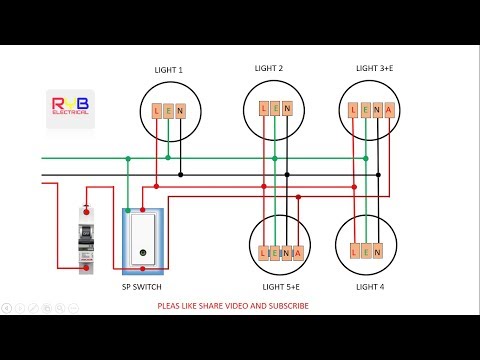
What is Emergency Lighting Circuit Diagram ?

Emergency lighting is a type of lights that can effectively illuminate and display exit passageway or can continue to work without interruption when the normal lighting power supply fails,  Widely used in public places where can lighting without intermittent . The emergency lighting fixture is composed of a light source, a light source driver, a rectifier, an inverter, a battery pack, a logo lamp housing something like that.

Here is a circuit diagram of an emergency lighting made with LES.

The circuit operation of the device is shown in Figure 1. Power outages are a recurring thing, but in some cases power outages are not allowed (such as ongoing surgery). The circuit designed with LSE is simple and fully automated. When there is 220V AC power, the illumination lamp H1 is lit, and the โ‘ฃ pin of the LSE output with high level output, the Transistor VT is turned off, and the relay J is in a release state, so the DC lamp H2 is not lit. Once power cut, H1 goes out, and the LSEโ€™s โ‘ฃpin outputs a low level. At this time, the Transistor VT is conduction, the relay J is pulled in, the power of the illumination lamp H2 is connect, the H2 is automatically lit, and the transition between the two lamps is almost no break Intermittent.

Emergency lighting is still an important product required in against fire safety measures. In the event of an emergency, such as an earthquake, fire or circuit failure, the power supply is suddenly interrupted and all light sources have ceased to operate. At this point, it must provide reliable illumination immediately and indicate the direction of evacuation and the location of the emergency exit, in order to ensure the people who are in dark can evacuate

An Emergency Lighting Circuit Diagram

Introduction

An emergency lighting circuit diagram depicts the electrical connections and components of a system that provides backup illumination during power outages. Emergency lighting is essential for building safety by providing low level lighting to aid in emergency egress when normal lighting fails.

The emergency lighting circuit includes batteries, chargers, indicators, controls, and the specialized light fixtures needed to provide emergency lighting in buildings and public spaces as required by electrical and fire safety codes. Understanding emergency lighting circuits through their circuit diagrams is important for installation, inspection, and maintenance.

This article provides an overview of the key components and typical wiring diagrams used in emergency lighting installations.

Purpose of Emergency Lighting

Emergency lighting serves a vital safety function in buildings:

  • Illuminates exit paths to allow occupants to evacuate safely during emergencies or power loss.
  • Provides minimum illumination for critical areas like stairwells, aisles, corridors, ramps, and passageways.
  • Allows emergency responders to access and navigate a building in blackout conditions.
  • Reduces panic by providing some lighting during sudden power failures.
  • Serves as a backup to normal lighting system in case of electrical failure.
  • Mandated by national and local electrical, building, and fire codes for most public buildings. Exceptions sometimes made for small residential spaces.

Proper emergency lighting installation is crucial. The circuitry must be reliable and wire correctly to fixtures intended for emergency use.

Key Components of Emergency Lighting Circuits

YouTube video

A typical emergency lighting system consists of the following major components:

Backup power source – Usually rechargeable sealed lead acid batteries. May have 30 minute to 3 hour runtime.

Battery charger – Maintains batteries in a fully charged state for immediate use when needed. Connects to line voltage.

Control unit – Senses loss of external power and automatically switches to batteries to power emergency lighting.

Status indicators – LEDs or audible alarms indicate external power loss, battery state, faults.

Emergency lighting fixtures – Illuminate when normal power fails. Contain backup ballasts and lamps.

Wiring and conduit – Transports external line power and connects fixtures to control units. May include junction boxes.

Understanding the function of each component is key to properly interpreting emergency lighting circuit diagrams.

Typical Emergency Lighting Wiring Diagram

Here is a typical wiring diagram for a basic emergency lighting installation:

This diagram shows 3 key elements of the circuit:

1. Line Input

External 120/277V AC supply powers the charger and some controls. Ground connection required. Line input may have overcurrent protection via circuit breaker.

2. Battery and Charger

Batteries connect to charger module. Charger keeps batteries in ready state by providing regulated DC float voltage charge. Charger taps line input power.

3. Emergency Lighting Fixtures

Fixtures contain internal backup batteries or lamp heads designated for emergency use. Connected to central control unit via switched circuit for detecting loss of external power.

Let’s look at the key components and connections in more detail.

Chargers and Batteries

  • Chargers maintain emergency light batteries in a fully charged state and prevent overcharging. Accept universal line voltage input.
  • Batteries used are typically sealed lead acid. Sizing depends on fixture runtime and load requirements.
  • Switchover to battery when line voltage drops below ~80-90% occurs in milliseconds to avoid any lighting interruption.
  • Batteries generally have a 3-5 year lifespan and must be replaced periodically. Chargers may also need replacement over time.
  • Battery voltage is usually 6V, 12V, or 24V DC to operate lamp heads and internal circuitry.

Proper battery maintenance and testing is crucial to ensure emergency lighting system activates reliably when needed.

Control Units and Status Indicators

  • Control units manage switching between external line power and internal DC battery power. Auto-sensing line loss.
  • Audible alarms and LED indicators show system status – AC/battery mode, faults, charger issues, etc.
  • Optional self-testing feature runs periodic discharge tests to validate battery charge and switchover functioning.
  • Detailed diagnostics for troubleshooting available from some microcontroller-based units.
  • Status indicators must be suitably placed for easy inspection by facility maintenance personnel.

Controls and alarms provide confidence in system operation and help catch issues before an emergency occurs.

Emergency Lighting Fixtures

There are 2 main types of emergency lighting fixtures:

Unit Equipment – Complete self-contained emergency lighting solution with integrated battery, charger, and lamps or LED arrays. Available for both interior and exterior fixture applications. Designed for easy installation and maintenance.

Remote Fixtures – Lamps heads or LED arrays are connected by wiring to a centralized control unit and battery supply. Allows using normal lighting fixtures for emergency use to save cost. Requires compatible fixture compatibility.

Proper aiming, placement, and spacing of emergency lighting fixtures following lighting codes is necessary to adequately illuminate emergency egress paths.

Emergency Lighting Wiring

  • Line voltage wiring feeds AC supply to chargers and control units. Follows national and local electrical codes.
  • Class 1 rated wiring used between central batteries/controls and remote lamp heads.
  • Low voltage DC wiring used internally within self-contained emergency lighting units.
  • Neutral line connects chargers, controls, and any status indicators.
  • Grounding via connection to earth ground and metal conduit improves safety and noise rejection.
  • Separate conduit recommended for emergency lighting wiring. Do not mix with other building wiring.

Properly installed and segregated wiring with suitable conductors enables reliable operation during emergencies.

Additional Emergency Lighting Features

Some additional features sometimes incorporated into emergency lighting circuits include:

  • Dedicated transformers to provide line isolation and optimal voltage to the charging system.
  • Backup generators as a secondary source when battery capacity is exceeded by long outages.
  • Remote trouble indication panels to centrally monitor system status.
  • Integration with building management systems for centralized control and monitoring.
  • Zone wiring to group fixtures in different areas on separate circuits. Improves survivability.
  • Emergency lighting incorporated into exit signs to provide egress path illumination.

While not required in simple systems, these features improve robustness, monitoring, control, and survivability.

Typical Emergency Lighting Specifications

To size and specify an emergency lighting system properly, some key specifications need to be defined:

  • Illumination level provided – Usually 10-20% of normal lighting levels. Needs to meet codes for environment.
  • Runtime on battery – 30 minutes, 1 hour, 2 hours etc. Dictates battery capacity needed.
  • Battery type – Sealed lead acid common. Nickel cadmium for cold environments. Lithium for extended runtimes.
  • AC supply voltage – 120V or 277V are typical, but many chargers support both.
  • Charger amperage rating – Determines how long batteries take to recharge after outage.
  • Operating temperature range – Most systems work from 0ยฐC to 40ยฐC. Special batteries needed for extreme cold/hot.
  • Status indicators and diagnostics included
  • Certifications – UL 924, NFPA 101 Life Safety Code, local codes.

Properly sizing and specifying the emergency lighting system based on these parameters ensures that the installation meets all necessary performance, runtime, and code compliance requirements.

Inspecting and Testing

Regular inspection and testing of emergency lighting systems is vital to validate proper performance. Some recommended actions include:

  • Monthly visual checks of status indicators to verify system health.
  • Annual discharge test by disconnecting line voltage and operating fully on battery for programmed runtime.
  • Testing indication alarms and alerts when faults are simulated.
  • Checking charger voltage and current settings are properly calibrated.
  • Validating batteries not nearing end of useful life. Replacement as needed every 3-5 years.
  • Inspecting electrical connections are tight and free of corrosion.

Documenting and timestamping inspection results provides records for regulators. Issues uncovered during testing can then be corrected proactively.

Summary

  • Emergency lighting provides essential illumination during power failures to aid in safe building evacuation.
  • Key components include batteries, chargers, controls, status indicators, and emergency lighting fixtures.
  • Wiring diagrams depict connections between line input, charging system, control units, and fixtures.
  • Estimating illumination levels and runtimes allows proper sizing and selection of the system.
  • Regular inspection testing validates that the emergency lighting system functions reliably when needed.

Following good emergency lighting design, installation, and maintenance practices ensures building occupant safety when normal lighting fails.

FAQ

What battery backup time is required by code for emergency lighting?

Most building codes require a minimum of 90 minutes of runtime for emergency lighting on battery backup. Healthcare and high-rise buildings may mandate up to 3 hours of backup capacity.

Where should emergency lighting fixtures be located?

Fixtures must be located along exit pathways and stairwells to illuminate egress routes. Spacing and placement should follow lighting level requirements in local codes.

How often should emergency lighting systems be tested?

Monthly visual inspections and annual discharge tests for full runtime are recommended. Testing should validate that status indicators function and designed lighting levels are achieved.

What wiring should be used for emergency lighting circuits?

Line voltage wiring should follow normal electrical code requirements. Low voltage wiring between controls and remote fixtures should use Class 1 rated conductors. Separate conduit is recommended.

What are common emergency lighting failure points?

Batteries failing to hold charge and aging chargers are common failure causes over time. Wiring faults, uncalibrated controls, and improper maintenance also lead to malfunctions. Testing identifies issues before an emergency.