
Ever heard of UWB antennas? Well, you might have, but still, UWB’s different aspects remain hidden from you. What does UWB antenna mean, and what it’s purpose? UWB antennas mean Ultra-wideband, which is a crucial part of telecommunication and can be anything that has more bandwidth than 500MHz. The UWB antennas never work with smaller bandwidths, and you can use them easily for the processing of complex and huge data. There are many industries around us that are relying on UWBs for IoT applications; computing machines and even wireless systems are using UWBs for fast, precise, and broad data transmission purposes. Tracking, placement, and location identification are much easier when you are using UWBs. We are going to shed light on major aspects of the UWB antennas for you in detail!
UWB Antenna Communication
People had no idea that UWB antennas existed until they got to know their use cases, like UWB communication. The UWBs are reliable for changing redundant technology, supporting the low-power communication system and frequency bands are all possible due to UWBs. You already know that when we talk about UWB wireless communication, we mean higher data rates and high frequency. Mishaps can happen when we are dealing with things on a large and complex scale. But UWBs save us from all the complications due to low-powered signals. Now its time to see why you should consider UWB technology:
- Better for short-range and wireless communication
- High data processing rate
- Less fading due to multipath
- Affordability
- Power efficient nature
Major Advantages of UWB Antenna
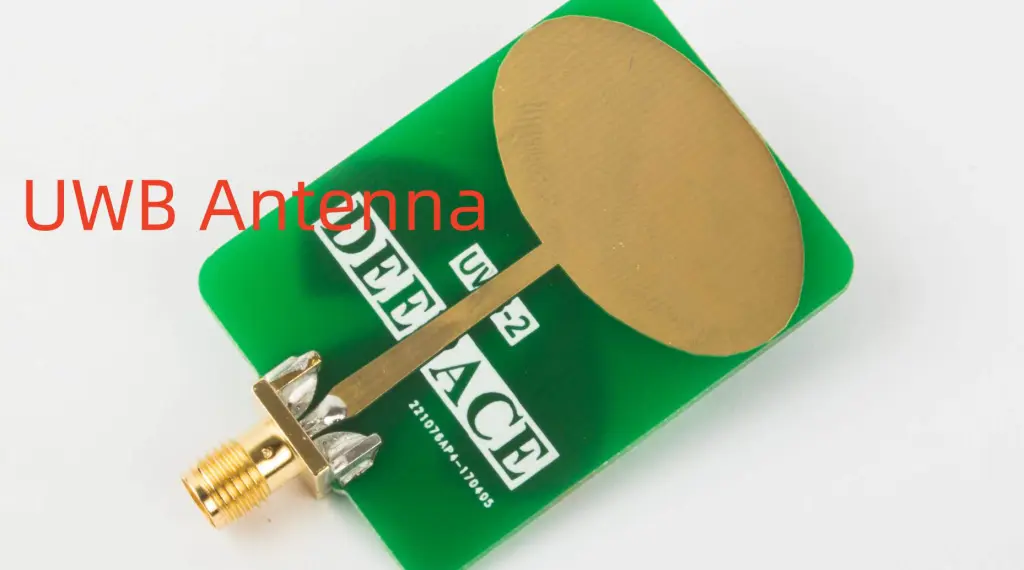
UWBs have integral applications around us, meaning we might not be able to witness wireless communication, internet browsing, or video-calling with our friends at all without UWBs antennas. Not just this, UWBs are important for portable and smart devices that you mainly use at home and office. Experts believe that the world will witness impressive upgrades in UWBs with the passage of time. So that the users can draw out more desired results from UWBs for consumer electronics. Now, why are UWBs so acceptable among their users? Let’s see below:
- These work on high data rates.
- These are affordable.
- These consume less power.
- These are more reliable for sustaining broader bandwidth.
- These omit the use of multi-narrow antennas.
- If you use a single UWB antenna, it will handle the frequency, data transmission, and band operation impressively.
- UWBs are reliable for controlling the multi-antenna interface and also consume less space.
Design of UWB Antenna
UWBs cannot work without an efficient design which means their body and structure matter a lot in their performance. There are some factors that create an impact on the function of UWBs, like the radiation pattern of major telecommunication devices, and due to this, you get two types of UWBs:
- Directional Radiation Pattern: In this type, there are individual directions and paths followed by transmission and reception terminals. When the interface is low, it will enhance the performance of UWBs due to the radiation pattern. A fine example is the Vivaldi antennas which is a coplanar UWB.
- Omni-Directional Radiation Pattern: These are reliable for fine performance and maintain the connection between the receivers and transmitters and support all directions. The omnidirectional radiation pattern is useful for home devices and portable consumer electronics.
Other types of UWB Antenna :
- Biconical antennas
- Log periodic antennas
- Spiral antennas
- Monoconical antennas
UWB Antennas – Major Types
We are going to see the abovementioned types below:
· Dipole
It is the most common and basic type of antenna – the dipole antenna. If you use longer and bigger components in a dipole, it will boost its gain, and there will be a visible difference in the gain as compared to before.
· Vivaldi
It is another typical UWB antenna type. These also go by the name of exponential antennas. These feature two sides, and the antennas consist of a metallic dielectric plate present on each side. It works similarly to a transmission line antenna. It works on low current, offers impressive bandwidth, and has a moderate range of gain as well. You can use PCBs to develop such antennas. Using PCBs for these antennas won’t cost much.
· Log Periodic
Log periodic antennas contain an arrangement of multiple dipole antennas. Now this arrangement is responsible for the resonation of the signals that develop an intense pulse. The periodic log antennas are available in smaller versions and work on frequencies up to 11.
· Scimitar
The scimitar antenna has a talon-like shape and mostly resembles a scimitar sword. The dimensions and radius of both the curves of this antenna are different. The inner curve works with a high frequency, and the external curve has a low frequency. It works on 1500Hz in total and has an impedance of 20 ohms as well which comes in handy for its functioning.
· Fractal
Fractal antennas are responsible for extending the receiving end of any antenna. So it can receive more signals with precision. A triangular fractal antenna is a common example. These consume less space and are reliable when you want efficient multiband performance as well. These are supportive of maximum current in congested areas as well.
Operating of UWB Antenna
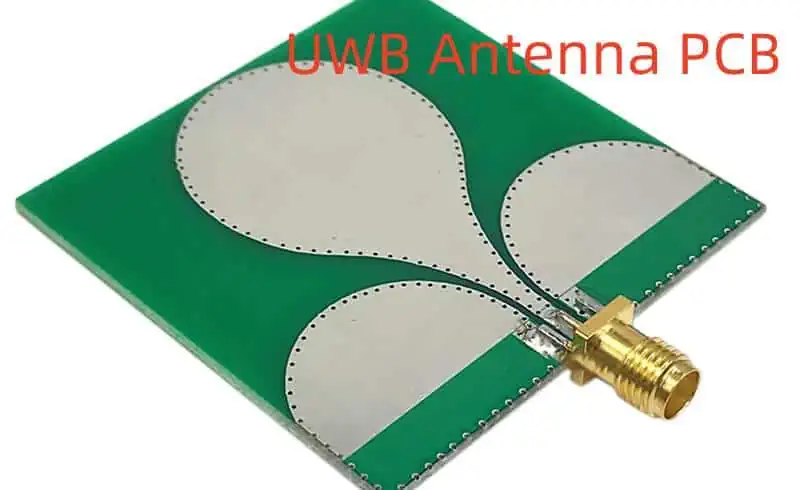
Ultra-wideband (UWB) has a special phenomenon that is important to consider to fully understand how these antennas work:
- Such antennas catch the radio waves followed by a large bandwidth, mainly for those electronics that work on short range.
- These antennas act as a bridge between the transmitter and receiver and sustain the radio frequencies.
- UWBs work on the intense pulses and maintain them as they move back and forth between the two terminals and then later process their data.
- UWBs are good with distance, and these don’t require interference and carrier waves as well.
- These are also noise-resistant, which means they are crucial for the majority of consumer electronics.
Top Applications of UWB Antenna
Automotive
- UWBs are also important for the automotive industries, and giants of this domain are now relying on UWBs for their features.
- You can insert them in the automated cars as well for accurate distance measurement in which UWBs work on proximity.
- UWBs also offer protection and security of the system since no one can catch their radio signals at all.
- Therefore, experts believe that UWBs are more secure to use instead of other forms of digital keys.
Smartphone devices
- Portable devices like smartphones also use UWBs in their assembly and structure.
- These enhance the accuracy and locating features in the mobiles.
- You can locate short-range devices through your smartphone with the help of UWB antennas.
- Short-range data transfer also becomes feasible when you are using UWBs.
Medical
- The medical industry is benefiting from UWBs because they are precise and power-efficient.
- UWB radars are effective and much safer when it comes to using X-ray machines on patients to detect diseased organs and tissues.
- Wearable portable devices can also use UWBs for precise data and health statistics of patients. 24/7.

