
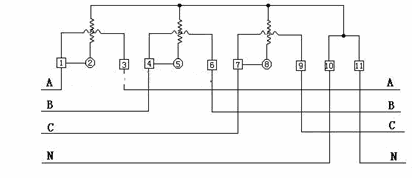
Three-phase watt-hour meter is used to measure the power output (or load consumption) of three-phase ac circuit. Its working principle is exactly the same as that of single-phase watt-hour meter, except that it adopts the way of multiple driving parts and aluminum plates fixed on the rotating shaft in structure to realize the measurement of three-phase electric energy.
Three-phase three-circuit active watt-hour meter uses two sets of driving parts to act on two aluminum plates (or one aluminum plate) mounted on the same shaft, and the principle is exactly the same as that of single-phase watt-hour meter.
The three-phase watt-hour meter fully meets the technical requirements of single-phase 1 or 2-stage in DL/ T645 -1997 and GB/ T17215-1998.With good reliability, small size, light weight, beautiful appearance, advanced technology, 35mm DIN standard installation and other characteristics;And has a good anti – electromagnetic interference, low self – consumption power saving, high precision, high overload, high stability, anti – electric leakage,Long Service life.
Introduction
A watt-hour meter, also known as a kilowatt-hour meter, is an electrical meter that measures the total energy consumed by a residence, business, or an electrical load in kilowatt-hours. It allows power utilities to determine power consumption over a period of time for billing purposes and customers to monitor their electrical energy usage.
This article provides an overview of watt-hour meter operating principles, design types including electromechanical and electronic meters, key components, installation considerations, calibration and accuracy, and trends in smart metering technology.
What is a Watt-Hour and Why Measure It?
A watt-hour is a unit of electrical energy equivalent to a power consumption of one watt sustained for one hour. For example, a 100 watt light bulb powered for 10 hours would consume 1000 watt-hours of energy (100 x 10 = 1000 watt-hr).
By measuring watt-hours, the total work performed or energy consumed by an electrical load can be determined. The utility company uses this information to properly bill customers based on energy use rather than simple power (watts) draw. Customers can also monitor watt-hour usage over time to identify high consumption loads or changes in energy usage profiles.
Some key reasons to measure watt-hours:
- Allows fair utility billing based on total energy consumed rather than peak power demand
- Enables analyzing usage patterns over days, weeks, months to minimize waste
- Identifies high consumption equipment for possible efficiency improvements
- Verifies conservation efforts are achieving savings
- Provides data to size backup power systems and generators
Operating Principle
Watt-hour meters operate on the principle of counting revolutions of an aluminum disc mounted on a shaft. The disc rotates at a speed proportional to the power flowing through the meter. Counting the revolutions over time therefore provides a measurement of the energy consumed.
The aluminum disc spins between two electromagnets. One creates a magnetic flux proportional to the voltage applied. The other uses current flowing through the meter to generate a magnetic field. The interaction of these two perpendicular magnetic fields produces a torque that rotates the disc at a speed proportional to power (volt-amps).
Gears connect the disc to dials which record the cumulative energy consumption. This method allows the meter to register the total watt-hours used over months or years.
Electromechanical Watt-Hour Meter Operation (Image Credit: BidyutJyoti/Wikimedia)
Types of Watt Hour Meters
There are two primary types of watthour meters in use:
Electromechanical
The traditional electromechanical induction meter uses the rotating aluminum disc as described above. Gears drive mechanical dials to display the watt-hours used.
They provide reliable measurement but are bulky and require manual reading. Electromechanical meters are still in use but being phased out in favor of electronic meters.
Electronic
Newer electronic watt-hour meters replace the physical disc and gears with electronic sensing and measurement of voltage and current. This allows features like:
- LCD/LED numerical display of usage rather than dials
- Ability to network multiple meters with remote reading
- Programmable time-based tariff schedules
- Instantaneous power usage readout
- Two-way communication for meter configuration
- Load control capabilities
Electronic meters are cheaper to produce and enable automated meter reading and advanced smart grid functionality.
Watt Hour Meter Components
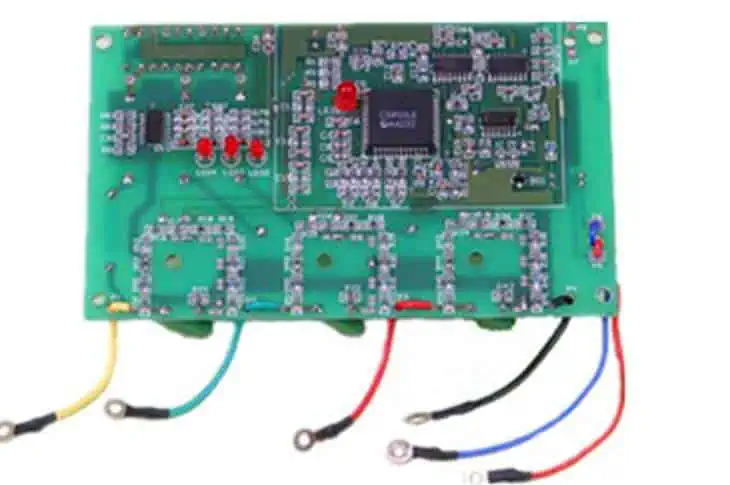
The key components found in a watt-hour meter are:
- Voltage coils – Apply magnetic flux to aluminum disc proportional to line voltage
- Current coils – Generate magnetic field proportional to current flow through meter
- Rotating disc assembly – Spins at speed proportional to power consumption
- Damping magnet – Stabilizes disc rotation speed to prevent overspinning
- Gears – Provide mechanical coupling to dials/display
- Dials or display – Cumulatively show watt-hours consumed
- Test block – Allows magnetic calibration and accuracy testing
- Registers – Record cumulative energy usage over time
Major Components in an Electromechanical Watt-Hour Meter (Image Credit: BidyutJyoti/Wikimedia)
Watt Hour Meter Installation
Proper installation of watt-hour meters is important for accurate measurement:
- Mount securely on non-flammable surface away from easily combustible materials
- Locate outdoors in protective housing if required by standards
- Position the meter so display is easily visible without obstructions
- Verify meter socket wiring matches meter terminal design and rated voltages
- Use weatherproof conduit fittings aligned properly with enclosure
- Leave sufficient wire slack to prevent stresses on connections
- Seal openings and knockouts according to local electrical code
- Check disc rotation direction and multiplier connections
- Verify calibration and seals following installation
Careful mechanical and electrical installation protects the meter and ensures correct energy accounting right from the start.
Calibration and Accuracy
Watt-hour meters are factory calibrated to standards specifying allowed tolerances on errors. Typical accuracy metrics:
- Full load – 0.5% to 1% error at nominal current rating
- Light load – 1% to 2.5% error at 10% of nominal current
- Power factor – 1% to 3% error over 0.5 lagging to 0.8 leading
Various factors impact accuracy:
- Magnet strength weakening over time
- Bearing wear allowing disc wobble
- Dust buildup on critical components
- Voltage imbalance between phases
Field calibration and testing procedures help maintain accuracy:
- Calibration check at full, light, and zero load
- Verify disc rotation speed using timing marks
- Current reversal test detects loose or tilted discs
- Optional calibration magnets can correct minor errors
Adhering to recommended recalibration intervals ensures minimal watt-hour reading errors.
Trends in Smart Metering
Traditional electromechanical watt-hour meters are increasingly being replaced by sophisticated electronic smart meters that provide additional capabilities:
- Two-way digital communication for automatic meter readings
- Real-time power usage monitoring
- Load limiting and load shedding abilities
- Remote reconfiguration and setting of tariff schedules
- Power quality metrics like voltage, frequencies, power factor
- Tamper and theft detection alerts
- Outage reporting and power restoration logging
When networked together into the advanced metering infrastructure (AMI), smart meters allow:
- Automated billing and reduction in overhead
- Remote insight into demand and grid health
- New time-based electricity pricing models
- Ability to collect and analyze energy usage data
The transition to smart meters and AMI is a crucial step in modernizing power grids and enabling greater efficiency and reliability through information availability.
Summary
- Watt-hour meters measure the total electrical energy used by a load, residence, or facility. This enables utility billing based on consumption.
- Traditional electromechanical types used eddy currents and an aluminum disc but are being replaced by electronic meters.
- Accurate voltage and current sensing allows determining power usage. Disc rotation per time indicates energy usage.
- Careful mechanical and electrical installation is needed for reliable operation. Meters must be periodically calibrated.
- Evolution to smart meters provides automation, telemetry, grid analytics, and usage visibility through networked communication.
FAQ
How does a watt-hour meter work electrically?
It works by sensing the voltage and current to derive real power. Two coils generate magnetic fields proportional to the voltage and current. Their interaction causes a disc to rotate at a speed proportional to power. Counting revolutions over time provides energy usage.
What was the main limitation of electromechanical watt-hour meters?
The primary limitation was the need to manually read and record the dial indications to determine electrical energy usage. This was labor intensive and prevented real-time telemetry of consumption data. Modern electronic meters overcome this through digital outputs and networking.
What quantities can smart meters measure beyond watt-hours?
Smart meters contain additional electronics to measure parameters like power factor, voltage, current, frequency, waveform quality, instantaneous usage, and outage information. This provides greater grid and usage insight.
How frequently are utility watt-hour meters calibrated?
Electromechanical meters are typically recalibrated every 5-10 years. Electronic smart meters are solid-state with no moving parts and generally do not need recalibration for 15-20 years assuming acceptable power conditions.
How does meter tampering impact watt-hour accuracy?
Any unauthorized physical alteration like forcing discs to under-record usage, applying external magnets, or electrical tampering will greatly reduce meter accuracy. Smart meters often include tamper detection capabilities to detect and report such activities.

