
RAYPCB · ENGINEERING GUIDE
Bare Copper PCB: Oxidation, Handling and the Solderability Decision
A bare copper PCB leaves copper without a specified solderability-protection finish in the relevant region. It is not the same as a finished board that simply has exposed solder pads. Those pads may carry OSP, immersion silver, tin, ENIG or another treatment that is difficult to identify from a photograph alone.
This page helps decide when bare copper is an intentional choice and how to manage the resulting handling and assembly questions. It does not promise a universal safe storage time or recommend an uncontrolled cleaning recipe.
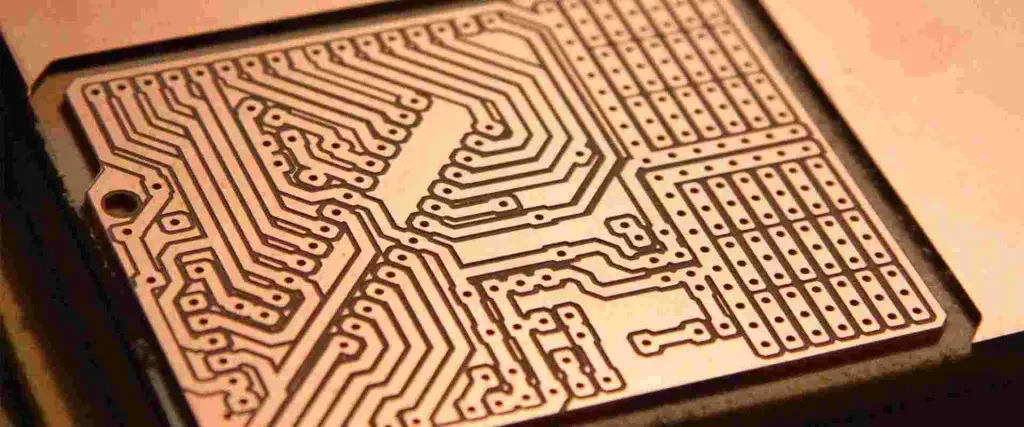
Clarify what bare means in the drawing
Identify whether the entire board, selected copper regions or a temporary process state is being described. A copper-clad laminate before patterning and an etched circuit ready for assembly are different products. The required deliverable should be explicit in the order.
Do not rely on color to distinguish untreated copper from every protective finish. Ask for the specified construction and process record. If a designer intentionally needs an uncoated region for bonding, contact or another experiment, name that region and function rather than changing the finish of unrelated solder lands.
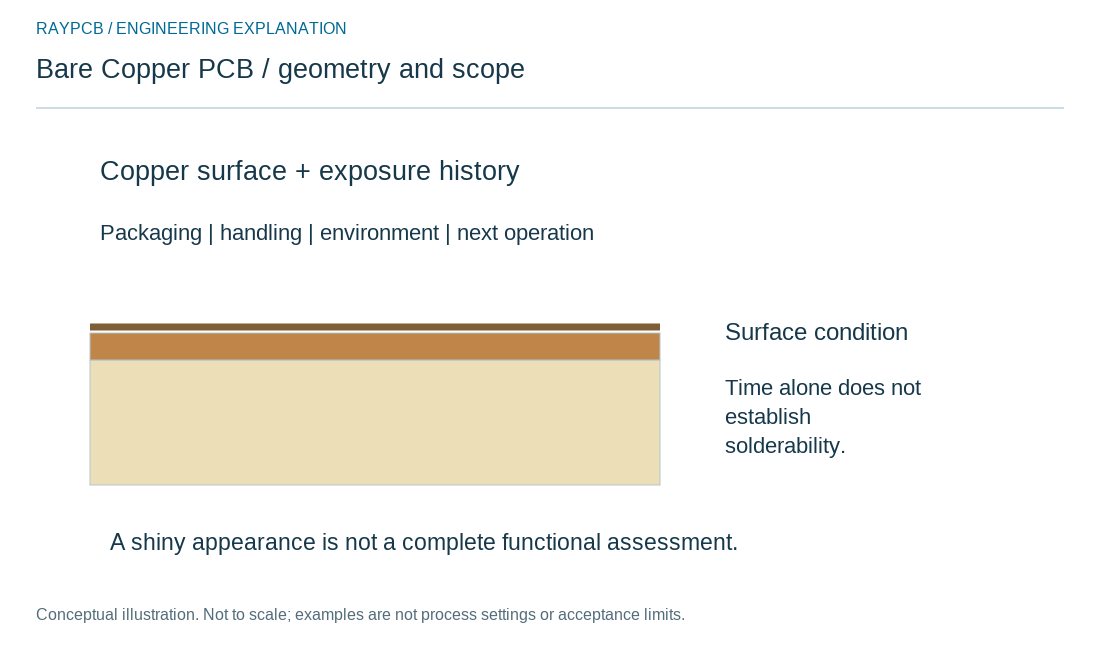
Understand why oxidation becomes a practical issue
Copper surface condition changes with exposure and handling. Oxidation and contamination can affect later joining or contact behavior, but a visual shade is not a complete measure of solderability. The relevant evidence depends on the intended operation and the accepted process.
Keep the time and conditions between surface preparation, storage and use under control. A short delay in one environment is not equivalent to the same delay under different humidity, contaminants or handling. This is why a fixed number of days from a generic webpage is a poor substitute for a defined material-management procedure.
| Review item | What to establish |
|---|---|
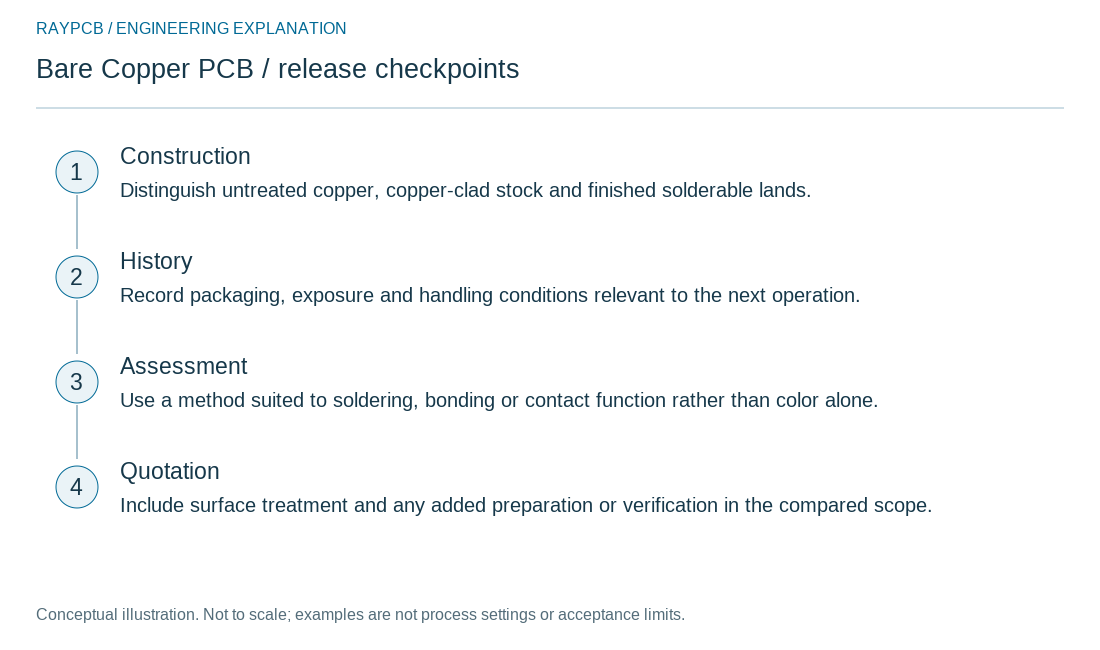
| Construction | Distinguish untreated copper, copper-clad stock and finished solderable lands. |
| History | Record packaging, exposure and handling conditions relevant to the next operation. |
| Assessment | Use a method suited to soldering, bonding or contact function rather than color alone. |
| Quotation | Include surface treatment and any added preparation or verification in the compared scope. |
Compare protected finish options by the next operation
If the board will be assembled later, discuss a finish suitable for that route instead of assuming that untreated copper is always the least-cost choice. The finish can influence storage, handling, soldering and inspection requirements. Compare total build scope, including any added preparation or verification.
The immersion-silver and immersion-tin pages cover two specific routes. Neither should be selected solely because its visible color resembles the desired board. Use the complete construction and assembly requirements to choose the appropriate option.
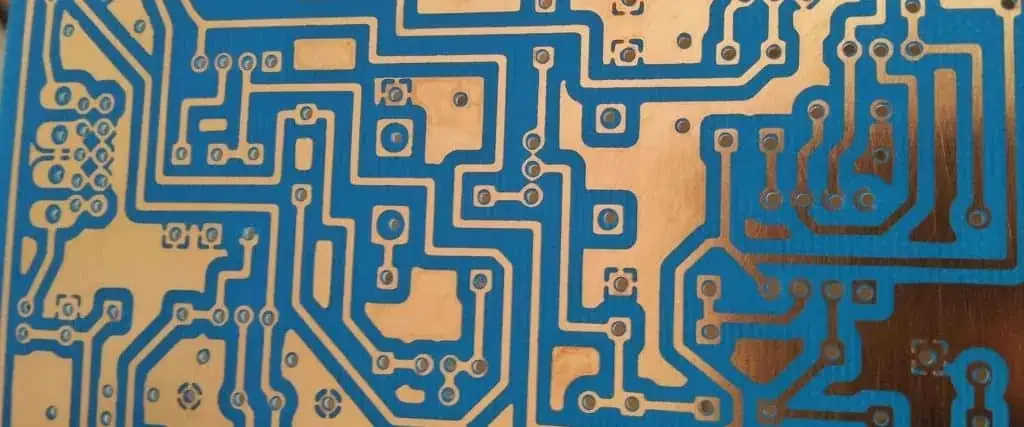
Record exposure rather than inventing shelf life
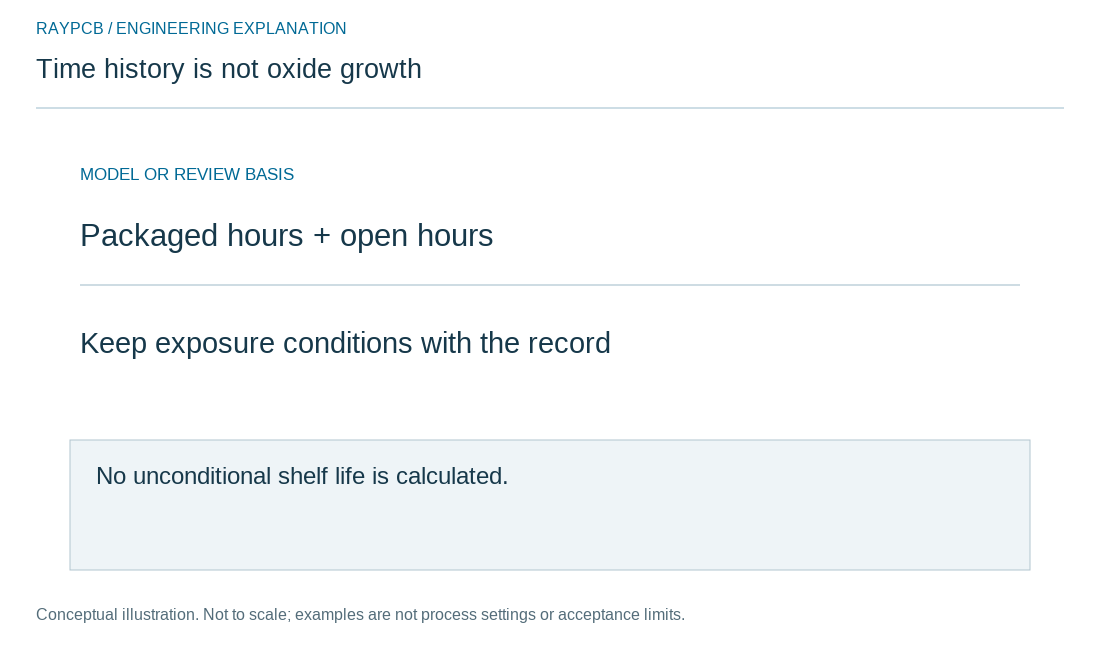
The worksheet adds entered hours in two exposure states and reports the total. The labels distinguish packaged and open handling time, but the tool does not assign equal damage to each hour or predict oxide growth. Temperature, atmosphere and packaging effectiveness remain outside the arithmetic.
Use the record to identify missing history or compare how two handling routes are organized. Do not turn a lower total into an automatic approval. A board with an unknown surface condition needs an appropriate assessment even when the recorded elapsed time is short.
Copper exposure-history total
Copper exposure-history total
Use the current inputs and keep the assumptions
Start with the feature or process question you actually need to resolve. Fields are blank until you enter values or deliberately load an illustrative example. Example mode remains labeled after editing, so a sample is not silently presented as verified project data. Clear the example before preparing a project-specific record.
Use the units printed beside each input. Keep the drawing revision, measurement basis and source of any allowance in your controlled project records. A field that asks for a limit expects your agreed requirement; the example is not an IPC threshold or a statement of RAYPCB capability. A numerical result should lead to a focused review, not replace it.
Changing any input invalidates the displayed result and disables its download until you calculate again. The text download contains the current inputs, results and assumptions. Nothing is uploaded, stored in analytics or automatically transferred into the Contact form. You may attach the file manually if it helps explain your enquiry; completing the worksheet is optional.
| Input | What to establish before using it |
|---|---|
| Review reference | Use a nonconfidential reference to connect this worksheet to the correct design or process revision. |
| Recorded packaged interval · hours | Time record only; packaging effectiveness and environment are not modeled. |
| Recorded open-handling interval · hours | No oxide-growth, damage equivalence or shelf-life approval is calculated. |
Avoid ad hoc surface restoration
If the surface condition is unsuitable for the intended operation, the response should follow a controlled process with verified compatibility. Abrasion or chemical treatment can alter copper geometry, leave residue or affect adjacent materials. A shiny appearance after intervention is not by itself proof of a satisfactory result.
For valuable or populated assemblies, clarify whether rework is justified and what verification is required. If only coating removal or repair is involved, use the dedicated removal and repair guides. Those tasks should not be confused with restoring a solderable copper surface.
Keep experiments distinct from production supply
Bare copper can be part of a deliberate laboratory or process-development task. Document the experimental objective and what will be learned from the sample. Do not automatically carry that construction into recurring production without reviewing storage, assembly and acceptance needs.
For repeat orders, preserve the approved surface condition and handling requirements with the drawing. A purchasing description that alternates between bare copper and finished PCB can create unintended substitutions. The supplier needs to know whether protection is prohibited, optional or required in each region.
Request the right quotation scope
Send the intended function, material and copper construction, quantity and timing of the next operation. Identify exposed regions and any finish restrictions. If the surface condition is being investigated, include material history and the test or assembly observation that raised the concern.
A useful proposal explains the assumed finish, handling and verification scope. It should not promise that untreated copper remains unchanged indefinitely. This makes the cost comparison honest and helps avoid choosing a superficially simple board that creates additional uncertainty at assembly.
For specification and report interpretation, use the separate IPC-4553A silver evidence guide and IPC-4554 tin evidence guide. These pages own the standards discussion; they do not replace the finish-selection review or supply a universal storage guarantee.
Control the surface through the next manufacturing operation
A surface condition is useful only in relation to what happens next. Identify whether the copper is intended for soldering, bonding, contact, coating or an experimental process. The appropriate protection and verification depend on that task, so a generic request for bare or clean copper leaves too much open to interpretation.
Preserve the material history between fabrication and use. Packaging, opened handling, storage and any intervention can change the condition being evaluated. A time inventory can expose missing information, but it cannot replace an assessment of the actual surface or predict behavior under every environment.
When an alternative finish is proposed, compare the complete build scope. Material and process charges are only part of the decision. Handling, storage, assembly preparation and verification may also change. Keep those consequences visible so a nominally lower fabrication cost does not hide additional work elsewhere.
Do not equate appearance with performance. A shiny surface, a darker region and a uniform color each need interpretation in context. Use the method appropriate to the required function and keep the measurement or test conditions with the result. Uncontrolled cleaning can alter both the surface and the evidence you were trying to assess.
For a recurring product, lock the approved surface condition and permitted alternatives into the drawing and supply record. A prototype experiment can then remain an experiment until its evidence supports a production choice. This helps engineering and purchasing discuss the same deliverable instead of using the phrase bare copper for several different constructions.
Standards, source context and limits
Use the official references for their stated scope and the applicable controlled document for contractual requirements. A public scope page, product description or application note is not a complete acceptance specification. Material-supplier guidance applies to the named material and process; it is not evidence that every option is available for this board.
Agree the document revision, construction, inspection method and any exceptions with the responsible engineering and quality teams. The explanatory drawings and worksheet examples on this page are original planning aids, not factory records, qualification results or compliance certificates.