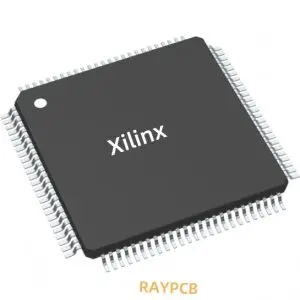
Product Specification
The XA6SLX75T-3FGG484Q is a robust field-programmable gate array (FPGA) from Xilinx’s automotive-grade Spartan-6 family, designed for demanding applications requiring high reliability and performance. This XA6SLX75T-3FGG484Q features 75,000 logic cells with advanced DSP capabilities, making it ideal for automotive, industrial, and aerospace applications.
Key Technical Specifications:
- Logic Cells: 75,000 system gates
- Package Type: 484-pin Fine-Pitch Ball Grid Array (FBGA)
- Speed Grade: -3 (highest performance grade)
- Operating Temperature: -40°C to +125°C (automotive grade)
- I/O Pins: 296 user I/O pins
- Block RAM: 4,824 Kb distributed across multiple blocks
- DSP48A1 Slices: 132 dedicated multiply-accumulate units
- Clock Management: 4 Clock Management Tiles (CMTs)
- Power Supply: 1.2V core, 2.5V/3.3V I/O
The XA6SLX75T-3FGG484Q supports various I/O standards including LVDS, LVTTL, and SSTL, providing exceptional flexibility for interfacing with diverse system components.
Price
The XA6SLX75T-3FGG484Q is positioned as a premium automotive-grade FPGA solution. Pricing varies based on quantity, distributor, and current market conditions. For the most current XA6SLX75T-3FGG484Q pricing information, contact authorized Xilinx distributors or visit official semiconductor marketplaces.
Pricing Factors:
- Quantity breaks available for volume purchases
- Lead times may affect pricing
- Automotive qualification adds premium over commercial variants
- Regional pricing variations may apply
Documents & Media
Essential documentation for the XA6SLX75T-3FGG484Q includes comprehensive datasheets, application notes, and development resources:
Technical Documentation:
- Product datasheet with complete electrical specifications
- Pin configuration and packaging information
- Power consumption and thermal management guidelines
- Automotive qualification documentation (AEC-Q100)
Development Resources:
- Xilinx ISE Design Suite compatibility information
- Reference designs and example projects
- PCB layout guidelines for the 484-pin FBGA package
- Signal integrity considerations for high-speed applications
Application Notes:
- Automotive-specific implementation guidelines
- DSP design optimization techniques
- Clock domain crossing best practices
- Power management strategies
Related Resources
The XA6SLX75T-3FGG484Q ecosystem includes comprehensive development tools and support resources:
Development Platforms:
- Compatible evaluation boards and development kits
- Third-party modules featuring the XA6SLX75T-3FGG484Q
- Prototype and production-ready carrier boards
Software Tools:
- Xilinx ISE Design Suite (legacy support)
- IP core libraries optimized for Spartan-6 architecture
- Simulation and verification tools
- Programming and debugging utilities
Community Resources:
- Xilinx community forums and support
- Application-specific user groups
- Training materials and webinars
- Technical support documentation
Environmental & Export Classifications
The XA6SLX75T-3FGG484Q meets stringent environmental and regulatory requirements for automotive and industrial applications:
Environmental Compliance:
- RoHS compliant lead-free package
- Automotive Electronics Council (AEC-Q100) qualified
- Operating temperature range: -40°C to +125°C
- Storage temperature range: -65°C to +150°C
- Humidity resistance per JEDEC standards
Export Classification:
- Export Control Classification Number (ECCN) applies
- Restricted for certain international destinations
- Compliance with International Traffic in Arms Regulations (ITAR)
- Documentation required for export licensing
Quality Standards:
- ISO/TS 16949 automotive quality management
- Zero-defect manufacturing processes
- Extended product lifecycle support
- Comprehensive traceability documentation
The XA6SLX75T-3FGG484Q represents the pinnacle of automotive-grade FPGA technology, combining high performance, reliability, and comprehensive development support for mission-critical applications. Its robust feature set and automotive qualification make it the preferred choice for engineers developing next-generation automotive, industrial, and aerospace systems.