Product Specification
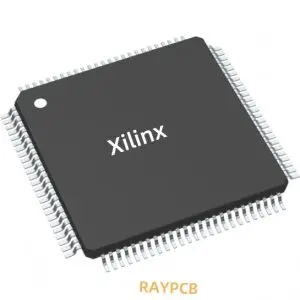
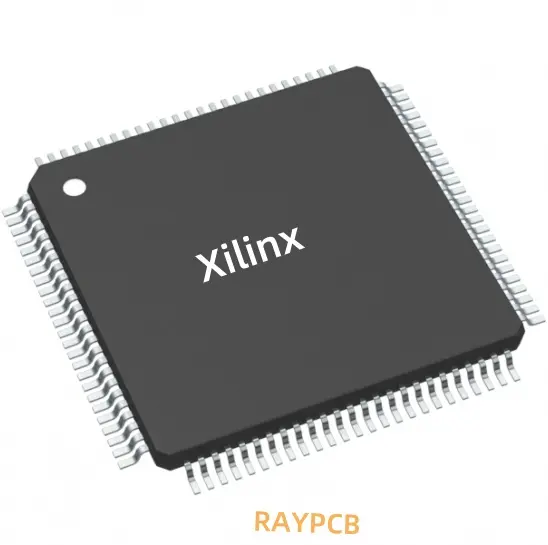
The XC2C384-10TQG144C is a high-performance Complex Programmable Logic Device (CPLD) from Xilinx’s industry-leading CoolRunner-II family. Designed for demanding applications requiring both high speed and low power consumption, this versatile CPLD delivers exceptional performance in a compact package.
Key Technical Specifications:
- Logic Capacity: 9K Gates with 384 Macro Cells
- Logic Blocks: 24 Function Blocks
- Performance: 9.2ns propagation delay
- Maximum Frequency: 125MHz
- Technology: Advanced 0.18um CMOS technology
- Supply Voltage: 1.8V (operating range 1.7V to 1.9V)
- Package: 144-Pin TQFP (Thin Quad Flat Pack)
- I/O Pins: 118 user-configurable I/Os
- Power Consumption: Ultra-low power at just 28.8uW
- Standby Current: Impressively low 16uA
Advanced Features:
- DataGATE Technology: For significant power reduction
- CoolCLOCK Technology: Dynamic power reduction
- Flexible Clocking Options:
- Optional DualEDGE triggered registers
- Clock divider (÷ 2,4,6,8,10,12,14,16)
- Multiple global clocks with phase selection per macrocell
- In-System Programming: For easy updates and field configuration
- JTAG Support: IEEE Standard 1149.1/1532 for testing and programming
- Non-volatile Technology: Instant-on capability
The XC2C384-10TQG144C combines the high speed and ease of use associated with Xilinx’s XC9500/XL/XV CPLD family with the extremely low power attributes of the XPLA3 family, making it suitable for both high-speed data communications/computing systems and portable, low-power applications.
Price
The XC2C384-10TQG144C is available at a competitive price point, with reference pricing around $16.55 per unit. Volume discounts are available for bulk orders, making it a cost-effective solution for production runs.
Important purchasing notes:
- This product is typically marked as Non-Cancellable and Non-Returnable (NCNR)
- Current market availability may affect pricing
- For the most up-to-date pricing and availability, request a quote from authorized distributors
Documents & Media
Comprehensive documentation is available to support your development with the XC2C384-10TQG144C:
- Product Datasheet (DS095): Complete technical specifications, electrical characteristics, and timing information
- CoolRunner-II Family Datasheet (DS090): Overview of the entire CoolRunner-II CPLD family features
- Application Notes: Implementation guides and design best practices
- Pin Diagrams and Packaging Information: Detailed pinout for PCB design
- Timing Models: For accurate simulation and verification
- Migration Guides: Information on upgrading from other CPLD families
All documentation can be accessed through Xilinx’s documentation portal or from authorized distributors’ websites.
Related Resources
Development Tools:
- Xilinx ISE Design Suite: Comprehensive development environment supporting the XC2C384-10TQG144C
- Vivado Design Suite: Modern design environment for newer projects
- WebPACK Tools: Free development tools for smaller designs, supported from ISE 4.1i version
Programming Support:
- In-System Programming: For field updates and configuration
- IEEE Standard 1149.1/1532 Boundary-Scan (JTAG): For programming, prototyping, and testing
- JTAG Command Initiation: For standard FPGA configuration
Compatible Development Boards:
Several development boards are suitable for evaluation and prototyping with this device, including:
- ZedBoard
- Basys 3 board
- TinyFPGA BX
- Nexys4-DDR
- Terasic DE10-Nano
- Digilent Arty S7
Environmental & Export Classifications
Environmental Specifications:
- RoHS Status: RoHS Compliant (lead-free)
- Operating Temperature Range: Commercial grade (0°C to 70°C)
- Moisture Sensitivity Level: Standard handling requirements
- Packaging: ESD-protected packaging
Export Classifications:
- USHTS Code: 8542390001
- CNHTS Code: 8542399000
- TARIC Code: 8542399000
- ECCN: EAR99
The XC2C384-10TQG144C is ideal for a wide range of applications including telecommunications equipment, industrial control systems, high-performance computing, consumer electronics, and portable devices where both performance and power efficiency are critical requirements.