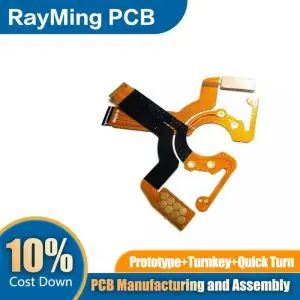
Cover Layer Flex PCBs are advanced flexible printed circuits featuring protective overlay materials that shield the circuit traces while maintaining the board’s inherent flexibility. These specialized flexible circuits combine the bendability of standard flex PCBs with enhanced durability and protection against environmental factors.
Key Features
Enhanced Protection: The cover layer acts as a protective barrier against moisture, dust, chemicals, and mechanical abrasion while preserving circuit integrity during repeated flexing cycles.
Maintained Flexibility: Despite the additional protective layer, these circuits retain their ability to bend, fold, and flex to fit into compact or irregularly shaped electronic assemblies.
Improved Reliability: The protective overlay significantly extends the operational lifespan of the flexible circuit by preventing trace damage from external elements and handling stress.
Design Versatility: Available in various cover layer materials including polyimide films, adhesive overlays, and specialized protective coatings to meet specific application requirements.
Technical Specifications
The cover layer construction typically features a base flexible substrate with copper traces, covered by a protective dielectric material that maintains electrical insulation while providing mechanical protection. Standard configurations support trace widths from 0.1mm to several millimeters, with layer counts ranging from single-sided to complex multilayer designs.
Applications
Cover Layer Flex PCBs excel in demanding environments including medical devices, automotive electronics, aerospace systems, consumer electronics, and industrial automation where circuits must withstand repeated flexing while remaining protected from harsh operating conditions.
Benefits
These protected flexible circuits offer superior performance in applications requiring both mechanical flexibility and environmental resistance, making them ideal for mission-critical systems where circuit failure is not acceptable. The cover layer design ensures consistent electrical performance throughout the product’s operational life while reducing maintenance requirements and improving overall system reliability.