How to Read a Bergquist Thermal Clad Datasheet: Engineer’s Guide

Learn how to read a Bergquist thermal clad datasheet like an engineer โ€” thermal resistance calculations, HPL-03015 vs HT-04503 comparison tables, IMS PCB layout rules, and FAQs for LED and power electronics designers.

If you’ve ever opened a Bergquist thermal clad datasheet and wondered which numbers actually matter for your LED or power electronics design, you’re not alone. The datasheets pack in a lot of electrical, thermal, and mechanical specsโ€”and not all of them carry equal weight depending on your application. This guide walks through each section from a working PCB engineer’s perspective, covers how to use those numbers in real thermal resistance calculations, compares the two most commonly specified dielectrics (HPL-03015 vs HT-04503), and spells out the layout rules you need to actually build a reliable IMS board.

What Is Bergquist Thermal Clad (and Why Does It Matter)?

Bergquist Thermal Clad is a family of Insulated Metal Substrate (IMS) PCBs developed specifically for high-watt-density surface-mount applications. The stackup is simpleโ€”copper circuit layer on top, a proprietary polymer-ceramic dielectric in the middle, and an aluminum (or copper) base beneathโ€”but the technology in that dielectric layer is what separates it from generic aluminum-core boards.

Thermal Clad MCPCBs minimize thermal impedance and conduct heat more effectively than standard printed wiring boards, and they are more mechanically robust than thick-film ceramic and direct bond copper construction. For LED lighting and power conversion applications, this translates directly to lower junction temperatures, longer component lifetimes, and the ability to run more forward current per LED without cooking the package.

The low thermal impedance of the Thermal Clad dielectric out-performs other insulators for power components, allowing for cooler operation. Thermal Clad keeps assemblies cool by eliminating thermal interfaces and using thermally efficient solder joints.

Now that’s the marketing pitch. Let’s talk about how to actually use the datasheet.

The Structure of a Bergquist Thermal Clad Datasheet

Every Bergquist Thermal Clad datasheet (now published under Henkel, which acquired Bergquist) follows the same basic architecture. Understanding what each section means before you start comparing part numbers will save you hours of back-and-forth with your fab house.

Dielectric Identification and Product Series

The part number itself encodes critical information. Take HPL-03015 as an example:

  • HPLย = High Power Lighting dielectric family
  • 030ย = Thermal resistance in ยฐCยทinยฒ/W ร— 100 (so 0.30 ยฐCยทinยฒ/W)
  • 15ย = Dielectric thickness in tenths of mils (so 1.5 mils / 38 ยตm)

The same logic applies to HT-04503: HT (High Temperature), 045 = 0.45 ยฐCยทinยฒ/W, 03 = 3 mils / 76 ยตm thick. Once you internalize this convention, you can decode any Thermal Clad part number at a glance.

Thermal Performance Parameters โ€” The Numbers That Drive Your Design

This is the section most engineers should spend the most time on. There are three closely related values that often get confused:

Thermal Conductivity (W/mยทK) โ€” A material property, independent of thickness. Higher is better. Think of this as how efficiently the dielectric moves heat per unit of thickness.

Thermal Resistance (ยฐCยทinยฒ/W or ยฐCยทWโปยน) โ€” This is thickness-dependent and tells you the temperature rise per watt per unit area. This is what you’ll plug into your junction-to-ambient thermal chain calculation.

Thermal Impedance (ยฐC/W) โ€” For a given test area (typically 1 inยฒ), this is the total resistance of the complete laminate stack under test conditions.

For the HPL-03015, the dielectric thickness is 1.5 mil / 38 ยตm, thermal resistance is 0.30ยฐC/W, and the unit thermal resistance is 0.02ยฐCยทinยฒ/W. For HT-04503, thickness is 3 mil / 76 ยตm, thermal resistance is 0.45ยฐC/W, and unit thermal resistance is 0.05ยฐCยทinยฒ/W.

Dielectric Strength (kV)

This tells you the voltage the dielectric can withstand before breakdown. For LED luminaire designs running on mains voltage (120โ€“240V AC), you need meaningful headroom above your working voltage. HT-04503 carries a breakdown voltage of 6.0 kV for LED applications. This is important not just for safety isolation, but for your creepage and clearance calculations in CE/UL-listed luminaire designs.

Operating Temperature and Glass Transition (Tg)

Tg is the temperature at which the dielectric shifts from a rigid, glassy state to a softer, rubbery state. Exceeding Tg repeatedly accelerates delamination and CTE-induced solder joint fatigue. The HPL-03015 dielectric at 0.0015″ (38ยตm) has a glass transition of 185ยฐC. That’s an unusually high Tg for this class of material and is one of the reasons HPL-03015 is preferred for high-junction-temperature LED packages.

Copper Weight / Circuit Layer

Copper foil is NOT measured for thickness as a control methodโ€”instead it is certified to an area weight requirement per IPC-4562. The nominal thickness for 1 oz copper is 0.0014″ / 35 ยตm. Most LED IMS designs use 1 oz copper. If you’re running high current traces (motor drivers, DC-DC converters), consider 2 oz or 3 ozโ€”but check your fab’s DFM rules first, as heavy copper requires modified etching chemistry.

UL RTI (Relative Thermal Index)

The RTI values (Electrical / Mechanical) define the long-term maximum operating temperature the material can sustain while retaining at least 50% of its original electrical or mechanical properties. HT-04503 carries UL RTI values of 140/140ยฐC. This matters for lifetime assessments and product qualification under UL 746B.

Bergquist Dielectric Comparison Table

Here’s a side-by-side of the most commonly specified Thermal Clad dielectrics from the selection guide:

ParameterHPL-03015HT-04503HT-07006MP-06503
Dielectric Thickness1.5 mil / 38 ยตm3 mil / 76 ยตm6 mil / 152 ยตm3 mil / 76 ยตm
Thermal Conductivity7.5 W/mยทK2.2 W/mยทK2.2 W/mยทK1.3 W/mยทK
Thermal Resistance (ยฐC/W)0.300.450.700.65
Unit Thermal Resistance (ยฐCยทinยฒ/W)0.020.050.110.09
Dielectric Strength (kV)2.56.011.08.5
Max Operating Temp (ยฐC)185 (Tg)15015090
UL RTI Elec/Mech (ยฐC)โ€”140/140140/140130/140
Primary ApplicationHigh-power LEDLED, power, automotiveHigh-voltage, industrialGeneral purpose

Source: Bergquist Thermal Clad Selection Guide (Henkel/Bergquist)

HPL-03015 vs HT-04503: Which One Should You Pick?

This is the question that comes up in almost every high-power LED design review. Here’s how to think through it practically:

Choose HPL-03015 When:

HPL is a dielectric specifically formulated for high power lighting LED applications with demanding thermal performance requirements. This thin dielectric at 0.0015″ (38 ยตm) has an ability to withstand high temperatures with a glass transition of 185ยฐC and phenomenal thermal performance of 0.30ยฐC/W. It is optimized for COB (Chip-on-Board) and high-lumen-density arrays where getting heat out fast is the primary constraint, and operating voltages are relatively low (under 60V DC in most SSL designs). With a unit thermal resistance of only 0.02ยฐCยทinยฒ/W and thermal conductivity of 7.5 W/mยทK, it’s the best-performing dielectric in the Thermal Clad lineup.

The trade-off: its dielectric strength is only 2.5 kV. That’s fine for low-voltage LED drivers, but not suitable for mains-isolated designs without additional creepage management.

Choose HT-04503 When:

HT-04503 is specifically designed for applications that involve high-power systems with significant heat dissipation requirements. Its ability to perform in high-temperature conditions makes it a popular choice for industries like automotive, telecommunications, and high-frequency circuits. The 6 kV breakdown rating gives you much better margin for line-voltage isolation, and the 2.2 W/mยทK conductivity is still a significant improvement over FR-4.

If you’re designing an LED driver board with mains-referenced components mounted on the same substrate, or an automotive LED headlamp controller where 48V bus voltages are common, HT-04503 is the safer choice.

Decision Summary

Design ConditionRecommended Dielectric
High-power LED array, low-voltage driver (< 60V)HPL-03015
Mains-isolated LED luminaire (120โ€“240V)HT-04503
Automotive LED (12V/48V) with junction temp concernHPL-03015
Automotive power module with isolation requirementHT-04503
Industrial inverter / motor driveHT-07006
Cost-sensitive general purposeMP-06503

Thermal Resistance Calculations for IMS PCB Design

Reading the datasheet is one thing. Actually using those numbers in a design calculation is where engineers often stumble. Here’s a practical walkthrough.

The Thermal Resistance Chain

For an LED mounted on an IMS board attached to a heatsink, the thermal resistance from junction to ambient looks like this:

Rฮธ(j-a) = Rฮธ(j-c) + Rฮธ(c-board) + Rฮธ(dielectric) + Rฮธ(base-metal) + Rฮธ(TIM) + Rฮธ(heatsink)

In practice, the base metal (aluminum) resistance is negligible โ€” aluminum at 1.5mm thick contributes roughly 0.006ยฐC/W per cmยฒ. The dominant resistance in an IMS stack is usually the dielectric layer, followed by the TIM between the IMS base and heatsink.

Calculating Dielectric Thermal Resistance

The formula is straightforward:

R_dielectric = (Unit Thermal Resistance) / (Component Footprint Area)

For a 3W LED with a 5mm ร— 5mm (0.025 inยฒ) thermal pad on HPL-03015:

R_dielectric = 0.02 ยฐCยทinยฒ/W รท 0.025 inยฒ = 0.8 ยฐC/W

The same LED on HT-04503:

R_dielectric = 0.05 ยฐCยทinยฒ/W รท 0.025 inยฒ = 2.0 ยฐC/W

At 3W dissipation, that’s a 1.8W ร— (2.0 โˆ’ 0.8) = 2.16ยฐC difference in junction temperature from dielectric selection alone. Across a string of 20 LEDs running warm, that gap compounds quickly.

Example: Full Thermal Budget for an LED Street Light Module

Thermal NodeResistanceNotes
Junction to case (Rฮธjc)3.5 ยฐC/WFrom LED datasheet
Case to board (solder joint)0.5 ยฐC/WEstimated, low for SMT
IMS dielectric (HPL-03015, 25mmยฒ pad)0.8 ยฐC/WCalculated above
Al base (1.5mm, 25mmยฒ)~0.01 ยฐC/WNegligible
TIM (0.1mm, k=3 W/mK, 25mmยฒ)0.6 ยฐC/WDepends on TIM choice
Heatsink to ambient2.5 ยฐC/WNatural convection, 60cmยฒ
Total Rฮธ(j-a)~7.9 ยฐC/W 

At 3W dissipation: ฮ”T = 3W ร— 7.9 ยฐC/W = ~23.7ยฐC rise above ambient. If ambient is 45ยฐC (outdoor luminaire), junction temperature is approximately 69ยฐC โ€” well within most LED ratings.

Compared to a 1.60mm FR4 PCB, an IMS PCB with 0.15mm thermal prepreg can have a thermal resistance more than 100 times lower. That’s the fundamental engineering argument for IMS in LED applications.

IMS PCB Layout Rules for LED Thermal Management

The datasheet numbers only matter if your layout lets the heat actually flow. Here are the design rules that matter most in practice.

Copper Pour and Pad Design

Use large copper pours directly under LED thermal pads. The copper spreads heat laterally before it crosses the dielectric, reducing the effective thermal resistance. Place high-power parts above the best thermal path to the base, avoiding edges and cutouts. Cluster heat sources to share large pads and simplify localized cooling.

For individual LED packages, extend the thermal pad in copper to at least 2ร— the component pad area where routing permits. Avoid routing signal traces through or near the main thermal pourโ€”they create gaps that interrupt lateral heat spreading.

Component Spacing

Maintain at least 2โ€“3mm spacing between high-power components to avoid thermal interference. On a dense COB-replacement array, this may not always be achievable, but it’s the starting point. When components must be packed tightly, ensure copper pours are continuous between them so heat can spread to the entire base metal area.

Via Design on IMS

Unlike FR-4 designs where thermal vias are a standard heat path, IMS boards require careful thought. On IMS PCBs, thermal vias can be counterproductive since you have to drill through large parts of the conducting aluminum. Thermal insulation may be insufficient in cases like thatโ€”it is better to go for IMS PCBs without thermal vias because the aluminum transfers the heat within the carrier. In most single-layer IMS designs, you simply don’t need them; the aluminum base does the spreading job.

Solder Mask and Surface Finish

For LED applications, use a white solder mask where possibleโ€”it significantly improves optical reflectivity, which matters for luminaire efficiency. ENIG (Electroless Nickel Immersion Gold) surface finish is preferred for LED footprints because it provides flat, solderable pads with repeatable standoff heights. HASL (Hot Air Solder Leveling) is acceptable for cost-sensitive designs but can result in uneven pad topography.

Trace Width and Conductor Design

Standard IMS design rules specify a minimum conductor width and spacing of โ‰ฅ100 ยตm, copper thickness from ยฝ oz (17.5 ยตm) to 4 oz (140 ยตm), and dielectric strength of 6 kV AC.

For current-carrying traces on IMS, you can generally use narrower traces than FR-4 equivalent designs because the aluminum base acts as a heat spreader. However, keep high-current bus traces wide (use IPC-2221 as your baseline), and run them away from the edge of the board where the dielectric can be mechanically stressed during depaneling.

Edge-to-Conductor Clearance

Maintain a minimum of 1mm from any conductor to the board edge for standard IMS. If your design uses a 45ยฐ chamfer at edge connectors (which Bergquist recommends in the selection guide), verify this clearance is maintained across the chamfered section. Routing cuts through the aluminum substrate using CNC require carbide or diamond-coated toolingโ€”brief your fab house on this if they’re not experienced with IMS.

Useful Resources for Bergquist Thermal Clad Datasheet Work

These are the documents and tools worth bookmarking when working with Thermal Clad IMS:

ResourceDescriptionLink
Bergquist Thermal Clad Selection GuideComplete dielectric comparison, graphs, and design guidanceDigiKey PDF
HPL-03015 DatasheetFull specs for the high-power lighting dielectricmclpcb.com PDF
HT-04503 DatasheetFull specs for the high-temperature dielectricmclpcb.com PDF
Henkel / Bergquist Product PortalCurrent product catalog (post-acquisition)Henkel Adhesives
IPC-2221BGeneric PCB design standard for trace width, clearance, and pad designIPC.org (paid)
IPC-4562Metal foil specifications for PCB useIPC.org (paid)
Arlon PCB MaterialsAlternative IMS dielectric supplier for comparisonArlon PCB at RayPCB
WE-Online IMS Design RulesWรผrth Elektronik’s published IMS DFM rulesWE-online PDF

Frequently Asked Questions

Q1: The datasheet lists thermal resistance in both ยฐCยทinยฒ/W and ยฐC/W. Which one do I use?

Use ยฐCยทinยฒ/W (unit thermal resistance) when you want to calculate the actual resistance for a specific component footprint area โ€” just divide by your pad area in inยฒ. Use ยฐC/W (already normalized to a 1 inยฒ test area in most Bergquist datasheets) as a quick material comparison metric. They’re related by: Thermal Resistance (ยฐC/W) = Unit Thermal Resistance (ยฐCยทinยฒ/W) ร— (1 inยฒ / actual area inยฒ). Don’t mix units when you’re building a thermal chain calculation.

Q2: Can I use Bergquist Thermal Clad with double-sided SMT assembly?

Single-layer IMS is the standard configuration, and the vast majority of LED board designs use it. True double-sided IMS (components on both faces) is possible but requires specialized fabrication and careful attention to solder reflow sequence. For most designs requiring both sides, it’s more practical to use a hybrid approach โ€” IMS on the LED side and FR-4 for a control circuit board, bonded or mounted separately.

Q3: My LED vendor’s datasheet shows Rฮธ(c-b) (case to board) resistance. Does that replace the IMS dielectric resistance?

No. Rฮธ(c-b) is the thermal resistance from the LED package case to the top surface of the PCB, and it’s measured under a specific test condition (usually a defined copper area). The IMS dielectric resistance is a separate, additional resistance from the top of the copper layer through the dielectric to the aluminum base. Both are in series in your thermal chain โ€” you add them together.

Q4: How do I verify the thermal performance of my IMS board after assembly?

The most common method is infrared thermography under controlled power conditions. Apply a known power level to the LED array, let it reach steady state (typically 5โ€“10 minutes), and use an IR camera to map the temperature distribution on the component surface. Compare your peak temperatures against your thermal model. If your junction temperature is running significantly hotter than predicted, look first at the TIM interface between the IMS base and heatsink โ€” it’s usually the culprit.

Q5: Is Bergquist Thermal Clad still available now that Henkel acquired Bergquist?

Yes. The technology continues under the TCLAD brand name, with manufacturing and global innovation based in Prescott, Wisconsin, and regional operations in Europe and Taiwan. The Henkel product portal carries the same dielectric families under the Bergquist brand, and part numbers like HPL-03015 and HT-04503 remain active. Always confirm material availability with your PCB fabricator, since lead times for specialty IMS materials can vary from standard FR-4 runs.

Summary

Reading a Bergquist thermal clad datasheet comes down to four things: understanding the thermal resistance chain, knowing the difference between unit thermal resistance and bulk thermal conductivity, picking the right dielectric for your voltage and junction temperature requirements, and designing your copper layout to let that low dielectric resistance actually do its job.

For pure LED lighting applications below 60V, HPL-03015 gives you the best junction-to-base thermal performance available in the Thermal Clad family. When mains isolation or higher breakdown voltage is required, HT-04503 is the workhorse choice. Both materials are mature, well-characterized, and supported by a global supply chain โ€” which matters as much as the datasheet numbers when you’re running production.

Meta Description Suggestion:

Learn how to read a Bergquist thermal clad datasheet like an engineer โ€” thermal resistance calculations, HPL-03015 vs HT-04503 comparison tables, IMS PCB layout rules, and FAQs for LED and power electronics designers. (155 characters)
Bergquist PCB Material Selection Guide: How to Choose the Right Dielectric

Complete Bergquist PCB material selection guide: compare LTI, MP, HT, HPL dielectrics, base metal options, design rules & datasheets. Written for PCB engineers.

Picking the wrong Bergquist dielectric is one of those decisions that looks fine on paper until the field return report lands on your desk three months after launch. Junction temperatures higher than modeled. Delamination after 200 thermal cycles. A Tg margin that turned out to be thinner than expected. None of it catastrophic on its own, but all of it traceable back to the material selection call made early in the design.

This guide is written for engineers doing Bergquist PCB material selection for real designs โ€” not someone browsing datasheets out of curiosity. It covers the Thermal Clad dielectric family in depth, the key decision variables, base metal choices, design considerations that affect reliability, and a practical selection framework you can actually use. By the end, you should be able to pick a dielectric with confidence rather than defaulting to whatever the previous revision used.

Why Bergquist Thermal Clad Exists and What Problem It Solves

The Bergquist Thermal Clad PCB technology is engineered to improve the efficiency of heat dissipation from electronic components, particularly in devices that generate a significant amount of heat. The fundamental issue it solves is simple: standard FR-4 is a thermal insulator. Its thermal conductivity sits at roughly 0.2โ€“0.3 W/m-K, which means it actively works against you when power-dense components need to dump heat through the board.

Thermal Clad flips this relationship. The dielectric is a proprietary polymer/ceramic blend โ€” glass-free, unlike FR-4 prepreg โ€” that bonds a copper circuit layer to a metal base (typically aluminum). These substrates minimize thermal impedance and conduct heat more effectively and efficiently than standard printed wiring boards. They are more mechanically robust than thick-film ceramics and direct bond copper constructions that are often used in these applications.

The copper substrate offers 390 W/mK conductivity while aluminum substrate offers 205 W/mK conductivity โ€” both significantly higher than typical FR-4 boards. The key point here is that the metal base is the primary heat spreader; the dielectric’s job is to electrically isolate the copper circuit from the base while transferring heat as efficiently as its chemistry allows. Every dielectric family Bergquist offers makes a different trade-off between thermal performance, temperature tolerance, and cost.

The Bergquist Thermal Clad Dielectric Families Explained

Bergquist organizes its Thermal Clad dielectrics into named families. Each family has its own polymer chemistry, thermal performance tier, and target application environment. Getting this choice right is the foundation of good Bergquist PCB material selection.

LTI โ€” Low Temperature Insulator

LTI is the entry point of the Thermal Clad family. It’s a moderate-performance dielectric aimed at applications where the board won’t see sustained high temperatures and budget is a real constraint. Thermal conductivity sits at approximately 1.5 W/m-K with a Tg around 130ยฐC. Consumer electronics, standard LED drivers, audio amplifier output stages, and general-purpose power supply boards are its natural habitat. If your steady-state board temperature comfortably stays below 100ยฐC and thermal cycling isn’t extreme, LTI is the economically sound choice.

MP โ€” Multi-Purpose

The MP dielectric steps up the thermal conductivity to approximately 2.4 W/m-K, making it the most versatile option in the range. When choosing dielectric materials, you have to consider thermal conductivity: this is an important factor you should not overlook. The Bergquist Thermal Clad’s thermal conductivity determines thermal performance โ€” this is especially important when interfacial area and resistance are considered. MP covers most general-purpose power electronics, mid-range LED lighting, and motor drive boards where LTI’s thermal conductivity is insufficient but HT’s temperature capability is more than you need.

HT โ€” High Temperature

The HT dielectric is where Bergquist’s chemistry gets serious. The HT variant delivers a thermal conductivity of 4.1 W/m-K and a thermal resistance of 0.05ยฐCยทinยฒ/W. It is, as its name states, resistant to degradation from high temperature exposure and features high dielectric breakdown characteristics. This dielectric is proven in applications such as LED, power supply, motor drives, and solid state relays. HT dielectrics are U.L. solder rated at 325ยฐC/60 seconds, which enables Eutectic Gold/Tin solders and wire bonding with gold wire โ€” options that aren’t available with the lower-tier dielectrics.

HPL โ€” High Power Lighting

HPL is a specialist dielectric, not a general-purpose option. HPL is a dielectric specifically formulated for high power lighting LED applications with demanding thermal performance requirements. This thin dielectric at 0.0015″ (38 ยตm) has an ability to withstand high temperatures with a glass transition of 185ยฐC, thermal conductivity of 3.0 W/m-K, and thermal impedance of 0.30ยฐC/W. The thin dielectric layer is the enabling factor โ€” less material between the LED junction and the aluminum base means dramatically lower thermal resistance, which translates directly to higher lumen output and longer LED lifespan at the same drive current.

CML โ€” Ceramic-Metal Laminate

CML is the high-end outlier in the Bergquist dielectric lineup. It uses a glass carrier (the only Bergquist dielectric that does, for handling purposes) and is targeted at applications needing maximum thermal performance combined with the ability to replace ceramic substrates. It’s the option you look at when designing thick-film ceramic replacements in motor inverters, high-frequency switching circuits, and bare-die mounting applications.

Full Bergquist Dielectric Comparison Table

Understanding the full picture of Bergquist PCB material selection requires comparing the key parameters across dielectric families side by side.

DielectricThermal ConductivityTypical TgThermal ResistanceBest Application Tier
LTI~1.5 W/m-K~130ยฐC~0.20ยฐCยทinยฒ/WConsumer electronics, standard LED drivers
MP~2.4 W/m-K~130โ€“140ยฐC~0.13ยฐCยทinยฒ/WGeneral power, mid-range LED, motor drives
HT (3 mil)~4.1 W/m-K~150ยฐC~0.05ยฐCยทinยฒ/WHigh-power LED, EV inverters, power modules
HPL~3.0 W/m-K185ยฐC~0.02ยฐCยทinยฒ/WHigh-brightness LED, projectors, backlighting
CMLHighestHighLowestBare die, ceramic replacement, RF modules

The Naming Convention Decoded

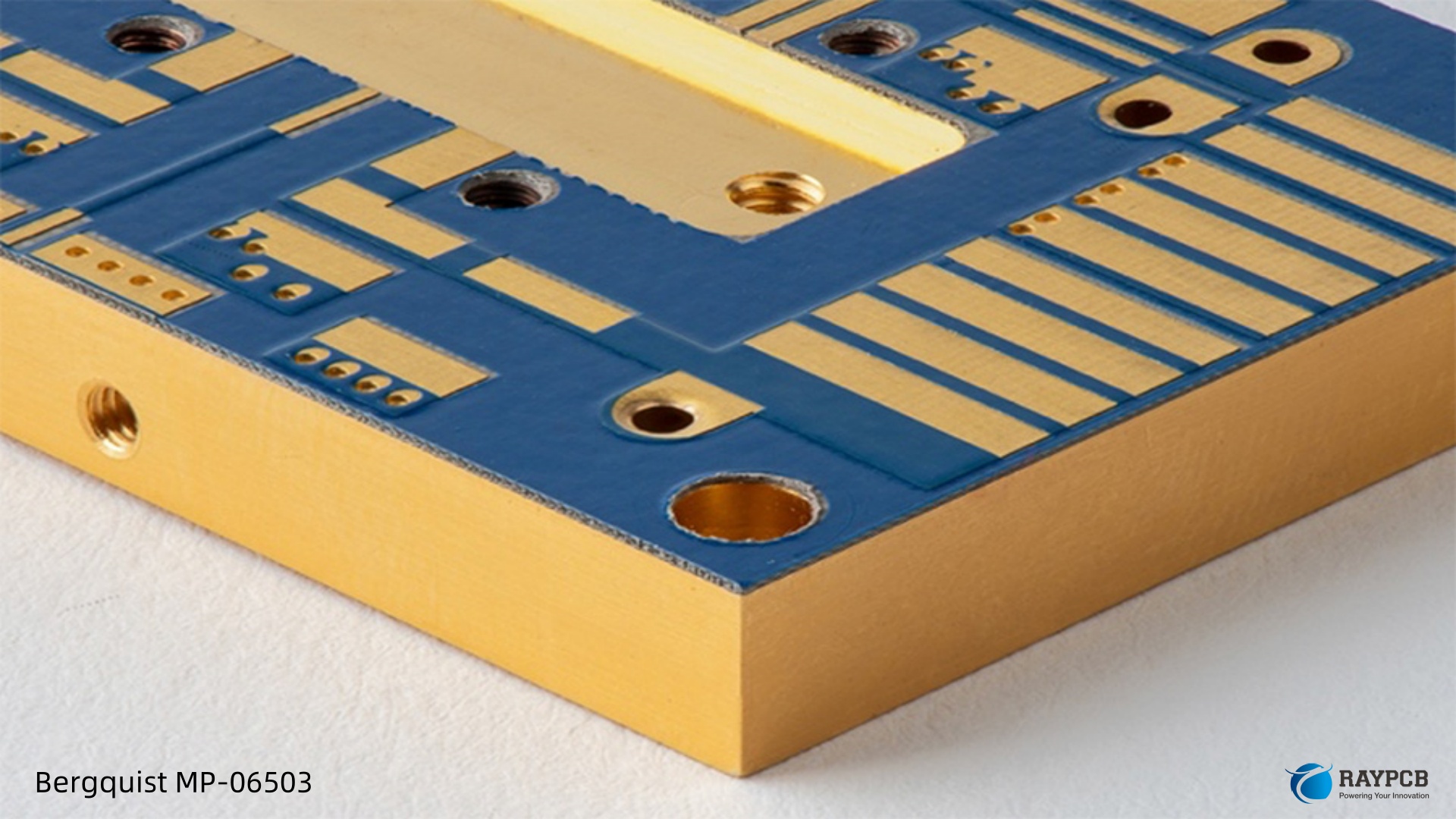
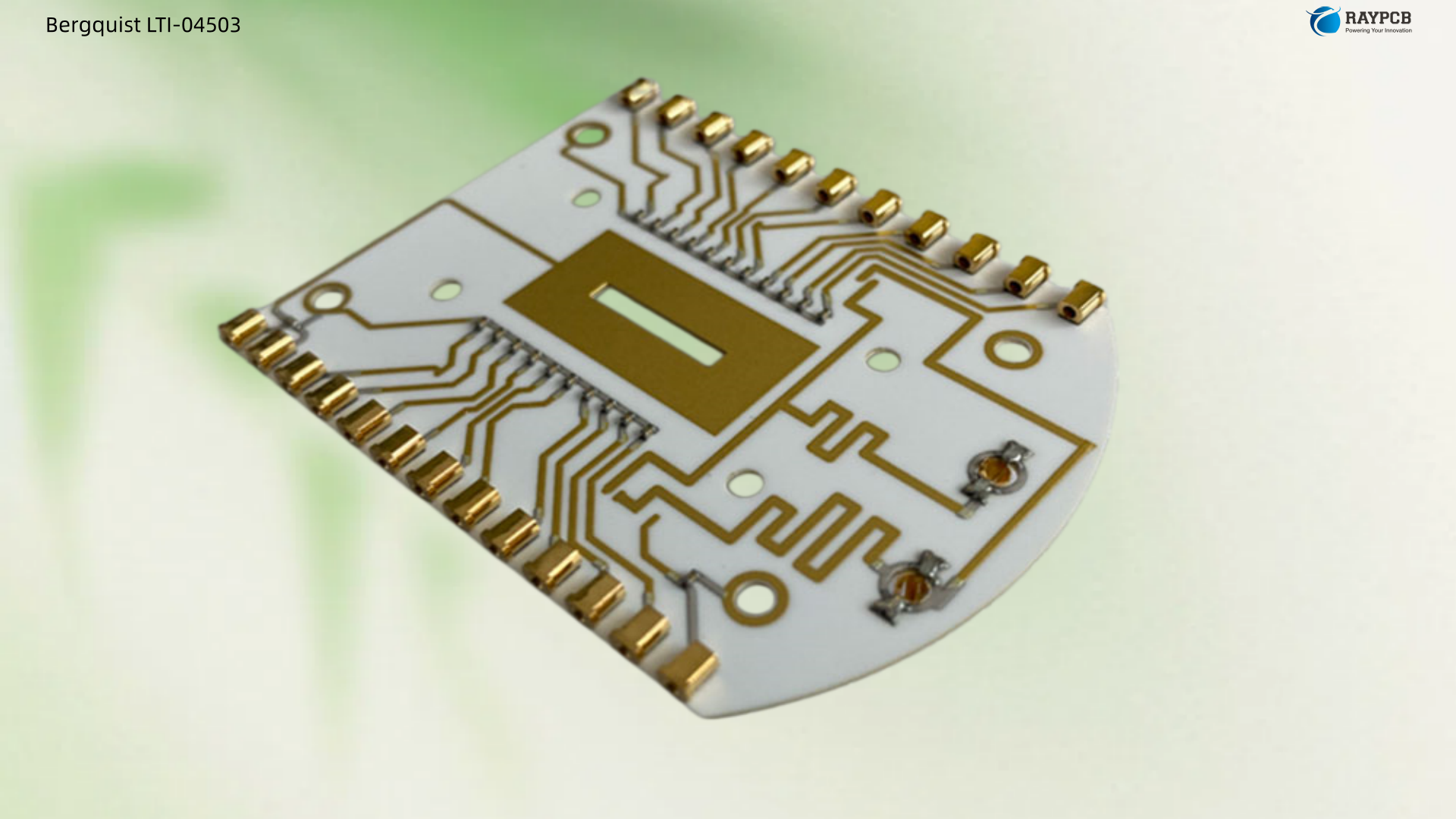
Once you understand how Bergquist names its products, reading a part number becomes straightforward. Take HT-04503 as an example: “HT” is the dielectric family. “045” is the approximate total laminate thickness in mils. “03” is the dielectric layer thickness in mils (3 mil = ~76 ยตm). So LTI-04503 is a Low Temperature Insulator with a 3-mil dielectric, and MP-06503 is a Multi-Purpose dielectric with a 3-mil dielectric on a 65-mil total laminate.

The dielectric thickness matters significantly: for applications with an expected voltage over 480 Volts AC, Bergquist recommends a dielectric thickness greater than 0.003″ (75 ยตm). If your application is above that threshold, either choose a product with a thicker dielectric or apply appropriate creepage and clearance margin in your PCB layout per IEC 60664-1.

Five Key Decision Variables for Bergquist PCB Material Selection

1. Operating Temperature and Tg Margin

Your dielectric’s glass transition temperature isn’t just a spec to note โ€” it’s the upper bound of predictable behaviour. The temperature of the operating environment determines a lot: it determines not only the peel strength and CTE, but also the storage modulus. When there is an increase in temperature, the storage modulus decreases. Running a dielectric consistently near its Tg degrades bond strength, increases CTE, and erodes electrical properties over time. The practical rule is to target at least 20โ€“30ยฐC of Tg headroom above your sustained maximum junction-area temperature.

2. Thermal Conductivity vs. Thermal Resistance

These two parameters are related but distinct. Thermal impedance measures how temperature declines across each watt’s stack-up. Lower thermal impedance indicates that more heat moves out of the components. Thermal conductivity is a material property; thermal resistance is a system-level value that depends on both conductivity and the dielectric layer thickness. A thinner dielectric from a lower-conductivity family can outperform a thicker dielectric from a higher-conductivity family in thermal resistance terms. Always compare thermal resistance (ยฐCยทinยฒ/W or ยฐCยทcmยฒ/W), not just conductivity, when evaluating options.

3. Dielectric Breakdown and Voltage Rating

For any design with significant AC or DC bus voltages, the dielectric breakdown spec is non-negotiable. The standard 3-mil (76 ยตm) Thermal Clad dielectric typically delivers >3 kVAC breakdown. For industrial or automotive applications running above 480 VAC, move to a thicker dielectric variant. Circuit design is the most important consideration for determining safety agency compliance โ€” layout creepage and clearance distances matter as much as the raw material spec.

4. Base Metal Selection: Aluminum vs. Copper

The base layer is not just structural โ€” it’s the primary heat spreader. The copper substrate offers 390 W/mK conductivity while aluminum offers 205 W/mK conductivity. Aluminum wins on cost, weight, and machinability, making it the right choice for the majority of applications including LED lighting, consumer audio, and standard power conversion. Copper is the choice when matching CTE to ceramic-packaged devices is critical, when the application requires double-sided assembly using the base as part of the circuit, or when maximum heat spreading is paramount.

You should match the base and circuit coefficients of thermal expansion (CTE). Failure to do this may cause excess plated-hole fatigue during thermal cycles. In the application, the CTE of the base material is a dominant contributor to thermal mechanical stress. This is why copper-base Thermal Clad is used in high-reliability designs where components have ceramic packages โ€” the CTE mismatch between aluminum and a ceramic component body creates more stress than many high-cycle applications can tolerate.

5. Assembly Process and Solder Temperature Compatibility

Standard Thermal Clad dielectrics are compatible with SAC305 lead-free reflow at peak temperatures around 260ยฐC. HT dielectrics are rated to 325ยฐC/60 seconds, making them appropriate for higher-temperature solder pastes and gold wire bonding. If your assembly process involves potting compounds, check that the potting material’s cure temperature doesn’t approach the Tg of your chosen dielectric โ€” potting at 150ยฐC with an LTI dielectric (Tg ~130ยฐC) is a common mistake that shows up as delamination failures in the field.

Base Metal Thickness and Circuit Flatness

Circuit flatness can be a concern when the base layer is aluminum. To achieve a flat circuit, maintain the proper ratio of circuit layer thickness to base. If the thickness of the copper circuit layer is kept at 10% of the base layer thickness or thinner, the aluminum base will mechanically dominate, keeping the circuit flat.

In practice, with a 1.57 mm (0.062″) aluminum base, your circuit copper should stay at or below roughly 157 ยตm โ€” about 4.5 oz โ€” to maintain flatness. Most designs using 1 oz or 2 oz copper are comfortably inside this envelope. Deviation from this ratio shows up as bow and twist that causes solder paste printing issues and component misalignment on automated lines.

Aluminum Base ThicknessMax Copper Thickness for Flatness
0.8 mm (0.031″)~80 ยตm (~2.3 oz)
1.0 mm (0.040″)~100 ยตm (~2.9 oz)
1.57 mm (0.062″)~157 ยตm (~4.5 oz)
2.0 mm (0.079″)~200 ยตm (~5.7 oz)
3.2 mm (0.125″)~320 ยตm (~9.1 oz)

Bergquist PCB Material Selection: A Practical Decision Framework

The table below is a simplified decision matrix to get engineers to the right dielectric family quickly.

QuestionAnswerDielectric Direction
Is steady-state board temp below 100ยฐC?YesLTI is a candidate
Is thermal conductivity >1.5 W/m-K required?YesMP or above
Will the board see sustained temps above 130ยฐC?YesHT series minimum
Is this a high-brightness LED application?YesHPL or HT
Does the application require bare die mounting?YesHT or CML
Is voltage above 480 VAC?YesSpecify thicker dielectric
Is this a cost-sensitive, moderate-power design?YesLTI or MP on aluminum
Is CTE match to ceramic components critical?YesCopper base, HT or CML dielectric

Bergquist Thermal Clad vs. FR-4 and Alternatives

Engineers sometimes ask whether Thermal Clad is actually necessary or whether a thermally enhanced FR-4 (e.g., a high-Tg, thermally filled epoxy laminate) is sufficient. For designs under ~1โ€“2 W/component with good heatsink access and relaxed temperature targets, thermally enhanced FR-4 is a legitimate option. But for power-dense SMD boards where the component body is the only thermal interface to the board, Thermal Clad’s metal base makes a dramatic difference.

Compared to competing IMS products such as Arlon PCB materials and other IMS laminates, Bergquist Thermal Clad benefits from a uniquely well-documented qualification history โ€” new materials undergo a rigorous 12 to 18 month qualification program, and the lab facilities are UL certified with ISO 9001:2000 manufacturing certification. Extensive qualification testing consists of mechanical property validation, adhesion, temperature cycling, thermal and electrical stress โ€” with electrical testing performed at selected intervals to 2000 hours where final evaluation is completed. That paper trail matters for products going through UL, CE, or automotive safety agency review.

ParameterStandard FR-4Bergquist LTIBergquist MPBergquist HT
Thermal Conductivity0.2โ€“0.3 W/m-K~1.5 W/m-K~2.4 W/m-K~4.1 W/m-K
Max Tg~130โ€“170ยฐC~130ยฐC~130โ€“140ยฐC~150ยฐC
Metal Base OptionNoYes (Al/Cu)Yes (Al/Cu)Yes (Al/Cu)
UL RecognitionYesYesYesYes
Relative CostLowModerateModerate-HighHigh
LED SuitabilityPoorStandard outputGoodExcellent

Assembly and Manufacturing Considerations

Getting a Thermal Clad board assembled correctly requires a few process adjustments compared to FR-4.

Hipot Testing: Due to the capacitive nature of the circuit board construction, it is necessary to control the ramp-up of the voltage to avoid nuisance tripping of the failure detect circuits in the tester and to maintain effective control of the test. Step the voltage up slowly โ€” a sudden ramp to the full test voltage will trip false failures on Thermal Clad boards due to displacement current. This is a common cause of confusion during first-article testing.

Drill and Route Tooling: Aluminum-base MCPCB requires carbide tooling. Standard HSS drill bits wear rapidly on the metal base and will produce rough hole walls and burring that affects via reliability.

Solder Stencil Printing: The standard SMT stencil approach applies without modification for most Thermal Clad designs. Dispensing of solder to specific locations is used for secondary operations or special attachment requirements, particularly for large power devices where controlled solder volume reduces voiding.

Conformal Coating: For outdoor or high-humidity environments, conformal coating can be applied over the assembled Thermal Clad board. Check the curing process temperature against the dielectric Tg before specifying a thermally cured coating.

Useful Resources for Bergquist PCB Material Selection

ResourceDescriptionLink
Bergquist Thermal Clad Selection Guide (Digikey)Complete dielectric comparison, design guidelines, circuit and base layer selectionDownload PDF
Bergquist Thermal Clad Selection Guide (Semach Mirror)Alternate hosted version of the full selection guideDownload PDF
Bergquist HT-04503 DatasheetHT 3-mil dielectric specs, thermal and electrical propertiesDownload PDF
Bergquist HPL-03015 DatasheetHPL dielectric specs, high power lighting application dataDownload PDF
Bergquist MP-06503 DatasheetMulti-purpose dielectric specsDownload PDF
Henkel / Bergquist Official Brand PageCurrent product catalog, regional distributor contactshenkel-adhesives.com
IPC-2221B PCB Design StandardDesign guidelines for trace width, clearance, and dielectric considerationsipc.org
IPC-4101 Base Material SpecificationLaminate material specifications including IMSipc.org
Digikey โ€“ Bergquist Thermal CladStocked parts, pricing, availabilitydigikey.com

FAQs About Bergquist PCB Material Selection

1. How do I decide between the LTI and MP dielectric in Bergquist PCB material selection?

The core differentiator is thermal load. If your power dissipation per component is moderate, steady-state board temperature stays below 100ยฐC, and you have some tolerance for a slightly elevated junction temperature, LTI at ~1.5 W/m-K is adequate and more cost-effective. If you’re running higher watt-density components, if your thermal model shows the LTI board running within 15ยฐC of its Tg, or if reliability over a long thermal cycling life is critical, step up to MP at ~2.4 W/m-K. The price premium for MP over LTI is typically modest relative to the overall BOM cost and worth it for the extra thermal margin.

2. Can I use Bergquist Thermal Clad for multi-layer PCBs?

Yes, though it’s less common than single-layer Thermal Clad designs. Bergquist dielectrics can be used in multi-layer assemblies by bonding Thermal Clad dielectrics to a metal base using FR-4 or additional Thermal Clad circuit materials, depending on thermal requirements and cost objectives. In power conversion applications especially, replacing FR-4 prepreg with Thermal Clad dielectric in the inner layer stack is done to enhance thermal performance without moving to a full IMS board architecture.

3. What happens if I operate a Bergquist dielectric above its glass transition temperature?

The mechanical and electrical properties of the thermal clad will change when operating above the glass transition. You will notice that the CTE increases and the peel strength reduces. The storage modulus of the thermal clad also declines. In practice this means the dielectric bond to the copper circuit layer becomes weaker, the board becomes more susceptible to delamination under thermal cycling, and electrical properties degrade. Sustained operation above Tg will progressively damage the dielectric and shorten the product’s serviceable life. Always maintain a comfortable margin below Tg under worst-case temperature conditions.

4. Is Bergquist Thermal Clad compatible with standard pick-and-place and reflow assembly?

Yes. One of the practical advantages of Thermal Clad over ceramic or thick-film alternatives is its compatibility with automated SMT assembly. Standard stencil printing, SAC305 reflow profiles (peak ~260ยฐC), and automated optical inspection all apply without special accommodation. The HT dielectric family extends compatibility further, rated for 325ยฐC/60s solder floats, enabling gold wire bonding and higher-temperature attachment processes. The main process adjustment to watch is hipot testing procedure โ€” use a controlled ramp rate rather than a step change to avoid false failures.

5. How does the dielectric thickness affect both thermal and voltage performance in Bergquist materials?

Dielectric thickness is a direct trade-off: thinner dielectric reduces thermal resistance (better heat transfer) but also reduces breakdown voltage and isolation margin. The HPL-03015’s 38 ยตm (1.5 mil) dielectric achieves exceptional thermal resistance of 0.02ยฐCยทinยฒ/W precisely because it is so thin โ€” but its application domain is high-power LED where voltage isolation requirements are moderate. For higher-voltage industrial or automotive applications, the thicker 6-mil (152 ยตm) or 10-mil (254 ยตm) dielectric options provide the breakdown voltage headroom needed to meet safety agency requirements. Always match dielectric thickness to both the thermal and voltage requirements of your specific application, not just one or the other.

Conclusion

Getting Bergquist PCB material selection right comes down to honestly characterizing your application: operating temperature, power density, voltage class, assembly process, and cost target. The Thermal Clad family covers a wide performance range โ€” from the economical LTI for consumer applications through the high-performance HT and HPL for demanding LED and power electronics work โ€” and each family member has a legitimate place in that range. The mistake most engineers make is picking a dielectric based on what was used in a previous revision without revisiting whether those assumptions still hold in the new design. Run your thermal model, check your Tg margin, confirm your voltage clearance, and then pick the lowest-tier dielectric that genuinely meets those requirements. That discipline is the core of sound Bergquist PCB material selection.

All specifications should be verified against current official Bergquist/Henkel datasheets before design lock-in. Material properties are subject to revision by the manufacturer.

Suggested Meta Description

Meta Description (158 characters):

Complete Bergquist PCB material selection guide: compare LTI, MP, HT, HPL dielectrics, base metal options, design rules & datasheets. Written for PCB engineers.

Bergquist Thermal Clad PCB Manufacturer: How to Find a Reliable Supplier

Looking for a reliable Bergquist PCB manufacturer? This engineer’s guide covers TCLAD supply chain changes, material certification, supplier qualification checklists, IMS fabricator red flags, and useful sourcing resources.

Finding a reliable Bergquist PCB manufacturer is harder than it looks. You’re not just buying a standard FR-4 board โ€” you’re sourcing a thermally engineered substrate where the dielectric material itself is the performance variable, and where a bad laminate choice or an unqualified fabricator can quietly kill your LED luminaire or power module before it ever reaches the field.

This guide covers what’s actually changed in the Bergquist supply chain, how to evaluate fabricators who claim to work with Thermal Clad, what certifications to ask for before you place an order, and what red flags separate genuinely experienced IMS shops from those that just know how to use the right keywords on their website.

What “Bergquist PCB” Actually Means in 2025

Before you start shortlisting suppliers, it helps to understand the ownership history โ€” because it directly affects which manufacturer is the authoritative source for genuine Thermal Clad material.

The Bergquist Company originally developed the Thermal Clad IMS technology. In 2014, Bergquist and its Thermal Clad division were acquired by Henkel, bringing global resources and reach. Then in 2021, a new chapter began โ€” Polytronics Technology Corp. acquired the Thermal Clad division from Henkel and the TCLAD company was formed. Today, TCLAD operates from its 100,000 sq. ft. Innovation Center in Prescott, Wisconsin, supported by a team of over 200 employees.

The long-awaited purchase of the Bergquist Thermal Clad product line from Henkel is now complete. TCLAD Inc., a Delaware corporation, finished the acquisition including all assets, business, facilities, and technology of the Thermal Clad product line. All in-house personnel including sales, technical, and direct employees remain a part of the new TCLAD Inc. team, with manufacturing headquarters remaining in Prescott, Wisconsin.

What this means practically: “Bergquist PCB” is now a colloquial term. The actual material brand is TCLAD, and the laminate manufacturer is TCLAD Inc. When a Chinese or overseas PCB fab says they build “Bergquist PCBs,” they mean they purchase TCLAD-brand laminate sheets and fabricate circuits from them โ€” they are not the material manufacturer themselves. This distinction matters enormously when you’re qualifying your supply chain.

The Two Tiers of Supply: Laminate vs. Fabricated Circuit

One of the most common points of confusion when sourcing Thermal Clad boards is conflating the laminate supplier with the PCB fabricator. These are different entities serving different functions.

Supply TierWhat They ProvideExamples
Laminate / IMS Material ManufacturerRaw TCLAD dielectric sheets bonded to aluminum or copper baseTCLAD Inc. (Prescott, WI)
Authorized DistributorsLaminate panels cut to size, sold to fabricatorsDigiKey, authorized regional distributors
IMS PCB FabricatorsCircuit boards fabricated from TCLAD laminateHitech Circuits, qualified IMS fabs
Turnkey EMS ProvidersFabrication + SMT assembly + testVarious contract manufacturers

When you’re evaluating a “Bergquist PCB manufacturer,” you need to establish which tier they occupy. A fab claiming to be a Bergquist manufacturer is almost certainly a fabricator purchasing genuine TCLAD laminate and etching circuits from it โ€” which is completely legitimate, provided they can prove material traceability back to TCLAD Inc.

Why Material Traceability Is Non-Negotiable

Here is where engineers make expensive mistakes. Generic aluminum-core MCPCBs are widely available, and on paper many of them look similar to Thermal Clad. Some low-cost suppliers substitute generic aluminum-base copper clad laminate using standard prepreg as the dielectric, which doesn’t provide the high thermal conductivity and resulting thermal performance required to assure the lowest possible operating temperatures for high-intensity LEDs.

The thermal performance difference is not subtle. TCLAD HPL-03015 achieves a thermal conductivity of 7.5 W/mยทK through its proprietary polymer-ceramic dielectric. Generic aluminum PCB materials typically achieve 1.0โ€“2.0 W/mยทK at best. If your thermal model is built around genuine TCLAD material and your fab swaps in a generic equivalent without disclosing it, your LED array will run 15โ€“25ยฐC hotter than predicted โ€” and your reliability predictions become meaningless.

Always request a material certificate (mill cert) with each production lot. This is a standard practice with any structural or thermally critical material and there’s no legitimate reason a reputable fab should refuse it.

Key Certifications to Verify Before Placing an Order

Certifications tell you whether a PCB fabricator has had their processes audited by a third party โ€” and more importantly, to what standard. For Bergquist Thermal Clad boards, these are the most relevant:

ISO 9001:2015

This is the baseline quality management system certification and should be considered the minimum for any fab you work with. ISO certification ensures that the holder follows a quality management system and standard documentation, which helps to track and control process variations and maintain consistent quality. Without ISO 9001, you have no assurance that their processes are documented and controlled enough to be repeatable across production lots.

UL Certification (UL 796 / UL 94)

For PCBs, the primary standard is UL 796, the specific PCB standard, and UL 94 for flammability testing of all plastics. UL request manufacturers to strictly test their products by following correct procedures to minimize quality issues and safety problems. The products that are UL certified undergo more rigorous and stricter tests.

For LED luminaire designs that need UL Listed or UL Recognized Component marks on the final product, your PCB fabricator must have UL-recognized facility status. To prove to your end customer that PCBs have been manufactured in UL-approved facilities, you may ask your PCB supplier either to provide a certificate or print the UL logo/UL number on PCBs. UL is extremely strict these days, so it is very unlikely that a non-UL-approved PCB manufacturer will accept such a request.

IPC Class 2 vs. Class 3

IPC certifications define workmanship and inspection standards for PCB assemblies. Each class reflects a different performance objective, from basic function to continuous service in extreme conditions. For most commercial LED and power electronics applications, IPC Class 2 is the standard expectation. If you’re designing for automotive (under IATF 16949 requirements), defense, or medical applications, require IPC Class 3.

IATF 16949 (Automotive)

If your Thermal Clad board goes into an automotive LED headlamp system or EV power module, your fab needs IATF 16949 certification โ€” not just ISO 9001. IATF 16949 adds automotive-specific requirements for process control, defect prevention, and supply chain management that standard ISO doesn’t cover.

RoHS Compliance

Verify that the fab’s surface finishes and solder materials are RoHS-compliant. For Thermal Clad boards, ENIG (Electroless Nickel Immersion Gold) is the preferred surface finish for LED applications and is inherently lead-free.

Certification Quick Reference Table

CertificationIssuing BodyWhy It Matters for IMS/TCLAD Boards
ISO 9001:2015Third-party registrarBaseline QMS, process control, traceability
UL 796Underwriters LaboratoriesRequired for UL-listed luminaires and power products
UL 94 (V-0 preferred)Underwriters LaboratoriesFlammability classification of dielectric
IPC Class 2 / Class 3IPC (self-certified or audited)Workmanship and inspection standard
IATF 16949IATFMandatory for automotive supply chain
RoHSEU self-declaration + fab processLead-free surface finishes, restricted materials
IPC-1710 MQPIPC (self-reported template)Standardized supplier capability documentation

How to Evaluate an IMS PCB Fabricator: A Practical Checklist

Beyond certifications, here’s what to actually dig into when qualifying a Bergquist PCB manufacturer:

Confirm Genuine TCLAD Laminate Sourcing

Ask directly: “Where do you source your Thermal Clad dielectric?” and “Can you provide a TCLAD material certificate with our order?” A qualified fab will answer this without hesitation and will have an established relationship with TCLAD Inc. or an authorized distributor. Evasive answers here are a serious red flag.

Assess IMS-Specific Process Experience

IMS fabrication is different from standard FR-4 manufacturing. Routing aluminum requires carbide or diamond-tipped tooling. Drilling requires different parameters to avoid delamination at the dielectric-aluminum interface. Solder mask application on single-layer IMS requires attention to coverage at board edges. Ask how many IMS board designs the fab processes per month and request reference customers in your industry vertical.

Review DFM Feedback Quality

Send a representative Gerber package and request a DFM review. A competent IMS shop will flag issues specific to metal core boards: insufficient copper-to-edge clearance, incorrect drill parameters for aluminum, soldermask spec issues for high-reflectance white mask, and pad design concerns for thermal performance. If their DFM review reads like a generic FR-4 checklist, that’s telling.

Evaluate Lead Time Realism for Specialty Material

TCLAD material is not FR-4 โ€” it has longer procurement lead times, especially for less-common dielectric grades. TCLAD operates from its 100,000 sq. ft. Innovation Center in Prescott, Wisconsin, with global footprint including operating divisions in Frankfurt, Germany and Hsinchu City, Taiwan. A fab quoting you 5-day lead time on HPL-03015 boards without having raw material in stock should prompt follow-up questions about how they’re achieving that timeline.

Prototyping to Production Continuity

Confirm that the fab uses the same material grade, the same process parameters, and the same equipment for prototype and production runs. Changing fabs or processes between prototype and production on an IMS board is a common source of thermal performance variability that’s difficult to catch without exhaustive testing.

Geographic Considerations: Domestic vs. Overseas Sourcing

The choice between domestic and overseas Bergquist PCB manufacturer options involves trade-offs that go beyond unit cost.

FactorDomestic (US/EU)Overseas (China)
TCLAD Material AuthenticationEasier to verify directlyRequire mill certs; risk of substitution
Lead Time2โ€“4 weeks typical3โ€“6 weeks with shipping
Unit CostHigherLower for volume
CertificationsUL, IATF readily availableAvailable at qualified fabs; verify independently
Communication / DFMDirect, responsiveTime zone and language variables
IP / Design SecurityLower riskHigher risk for sensitive designs
Audit AccessStraightforwardRequires travel or third-party audit

For prototypes and initial design verification, domestic sourcing from an authorized TCLAD circuit fabricator gives you the clearest material traceability and the easiest access to technical support. For volume production, qualified overseas fabs using verified TCLAD laminate can offer significant cost reduction โ€” but the qualification process upfront is more intensive.

For alternative IMS substrate materials worth evaluating alongside TCLAD, engineers sometimes compare Arlon PCB laminates, which offer their own line of thermally conductive substrate options for demanding applications.

Red Flags to Watch for When Sourcing

These are the supplier behaviors that should immediately trigger further scrutiny:

Claims to manufacture the dielectric itself. Unless you’re talking to TCLAD Inc. directly, no PCB fabricator manufactures genuine Thermal Clad dielectric. Any supplier claiming to manufacture their own equivalent should be asked to provide independent material characterization data โ€” not just a spec sheet they wrote themselves.

No material traceability documentation. If a supplier can’t or won’t provide lot-traceable material certificates linking your boards to a TCLAD laminate lot, you have no way to verify what dielectric is actually in your boards.

Thermal resistance specs that seem too good. Generic aluminum PCBs are sometimes marketed with inflated thermal conductivity claims. If a supplier is quoting thermal conductivity significantly above 2.2 W/mยทK for HT-series equivalent material, ask for the independent test data. HPL-03015’s 7.5 W/mยทK is genuinely exceptional and is a function of TCLAD’s proprietary dielectric chemistry โ€” not something a generic fab can replicate.

No IPC-6012 or IPC-A-600 inspection capability. These standards define how IMS boards are inspected. A fab without these inspection protocols in place is not equipped to catch the defect modes specific to metal core substrate fabrication.

Useful Resources for Bergquist PCB Sourcing and Qualification

ResourcePurposeWhere to Find It
TCLAD Inc. โ€” Official Material ManufacturerLaminate specs, authorized fab list, technical supporttclad.com
TCLAD Selection Guide (DigiKey)Complete dielectric family comparisonDigiKey PDF
UL Product iQ DatabaseVerify fab’s UL certification statusiq.ul.com
IPC Standards StoreIPC-6012, IPC-A-600, IPC-1710 MQP templatesipc.org/standards
IPC-1710 MQPStandardized supplier qualification profileRequest directly from prospective fab
Arlon PCB MaterialsAlternative IMS substrate comparisonArlon PCB at RayPCB
WE-Online IMS Design RulesDFM rules for metal core boardsWรผrth Elektronik PDF

Frequently Asked Questions

Q1: Can any PCB fabricator process Bergquist Thermal Clad material, or do I need an “authorized” manufacturer?

TCLAD Inc. sells laminate through distributors, and technically any fab that purchases it can build circuits from it. However, IMS fabrication requires tooling, process parameters, and inspection capabilities specific to aluminum-base boards. In practice, you want a fabricator who regularly processes metal core boards at volume โ€” not one who occasionally does a run when a customer requests it. Ask for references and look for a fab that lists IMS as a core capability, not a specialty service. TCLAD Inc. can also provide guidance on their recommended circuit fabricators if you contact their technical team directly.

Q2: How do I know if my overseas supplier is using genuine TCLAD material versus a generic substitute?

The most reliable method is requiring a material certificate (mill cert) for each production lot that includes the TCLAD part number, lot number, and date of manufacture. You can cross-reference this with TCLAD Inc. if needed. As a secondary check, request thermal conductivity test data for a sample board from your production lot โ€” a properly built HPL-03015 board should measure close to 7.5 W/mยทK. A significant deviation from the datasheet value is a strong indicator of material substitution.

Q3: What’s the minimum order quantity for TCLAD laminate boards, and does it affect supplier selection?

For prototype quantities (typically 5โ€“25 boards), most IMS-capable fabs can accommodate small runs, though setup costs are amortized over fewer boards so unit pricing is higher. For production volumes above 500 boards per run, you’ll have more supplier options and better pricing leverage. Some overseas fabs have minimum order quantities tied to full panel sizes โ€” understand your fab’s panelization strategy since it affects material yield and ultimately unit cost.

Q4: Is IATF 16949 certification required for all automotive LED PCB applications?

Not universally โ€” it depends on your customer’s requirements and your position in the supply chain. If you’re a Tier 1 or Tier 2 supplier shipping directly to an OEM automotive program, IATF 16949 is typically mandatory. If you’re supplying an aftermarket LED retrofit or an automotive accessory that doesn’t go through the Tier supply chain, ISO 9001 may be sufficient. Check your customer’s supplier quality requirements (SQR) documentation before assuming either way.

Q5: My design uses both standard FR-4 sections and a Thermal Clad area in the same assembly. Can one fab handle both?

For most designs, the Thermal Clad IMS board and the FR-4 control board are separate PCBs that are mechanically attached or connected via a flex or wire harness. True hybrid PCBs combining IMS and FR-4 regions in a single laminate are unusual and require specialized fabrication expertise โ€” most standard IMS fabs don’t offer this. If your design genuinely requires a hybrid approach, verify this capability explicitly with your fabricator before committing to a design, and expect longer lead times and higher costs.

Summary

The search for a reliable Bergquist PCB manufacturer really comes down to three things: confirming you’re getting genuine TCLAD material with traceable lot documentation, verifying the fab has the certifications and process capability to handle aluminum-base IMS boards correctly, and doing enough diligence upfront to avoid the expensive discovery that your thermal model doesn’t match your production boards.

TCLAD continues to innovate from its vertically integrated U.S. manufacturing center, delivering thermal management solutions for high-power density applications worldwide โ€” but the quality of the circuit board you receive depends equally on the fabricator who processes that laminate. Invest the time in supplier qualification before your first production run, and you’ll avoid the kind of field failures that come from cutting corners on a material that’s doing serious engineering work in your design.

Meta Description Suggestion:

Looking for a reliable Bergquist PCB manufacturer? This engineer’s guide covers TCLAD supply chain changes, material certification, supplier qualification checklists, IMS fabricator red flags, and useful sourcing resources. (157 characters)

Bergquist HT-04503 MCPCB: Datasheet, Specifications & Design Guide

Complete Bergquist MP-06503 guide: 1.3 W/m-K dielectric, 8.5 kVAC isolation, 130ยฐC UL rating โ€” with LED, power conversion, and heat-rail PCB design tips.

When thermal management stops being a footnote and becomes the whole problem, most experienced power electronics engineers end up in the same place: metal core PCBs. And within that category, the Bergquist HT-04503 consistently shows up on short lists for high-watt-density, high-temperature applications. Part of the Thermal Clad family from Bergquist (now a Henkel brand), the HT-04503 is not a general-purpose MCPCB material โ€” it’s an engineered dielectric optimized for applications where standard aluminum PCB substrates run out of headroom.

This guide compiles the full specification data, explains what the numbers actually mean for your design, positions the HT-04503 against other Thermal Clad grades, and gives you the practical design guidance you need to use it correctly.

What Is the Bergquist HT-04503?

The HT-04503 is a Thermal Clad insulated metal substrate (IMS) from Bergquist, characterized by a 3 mil (76 ยตm) dielectric layer designed for high-temperature service. The product code tells you the key parameters directly: “HT” stands for High Temperature, “045” refers to the dielectric thickness (0.003″ = 3 mil, with “045” being an internal designation tied to thermal resistance), and “03” indicates the 3 mil dielectric thickness in the Bergquist naming convention.

The dielectric itself is a proprietary polymer/ceramic blend โ€” not standard epoxy. The polymer component provides electrical isolation and resistance to thermal aging. The ceramic filler is what drives thermal conductivity while maintaining dielectric strength at thicknesses where standard epoxy resins would begin to show pinholes and breakdown. This combination allows the HT-04503 dielectric to hold a breakdown voltage of 8.5 kVAC at just 76 ยตm thickness โ€” a figure that should get attention from anyone designing for mains-isolated power electronics.

The “High Temperature” designation is meaningful, not marketing. The HT dielectric maintains its properties at continuous operating temperatures up to 140ยฐC (U.L. 796 rated), with a glass transition temperature of 150ยฐC. That puts it in a different tier from standard MCPCB materials, which typically begin to soften and lose bond strength well below that range.

Bergquist HT-04503 Full Datasheet Specifications

The table below presents the complete published technical data from the official Bergquist HT-04503 datasheet. Every value listed corresponds to a named test method โ€” a point worth emphasizing when comparing competing MCPCB substrates, where thermal conductivity figures are sometimes cited without methodology.

Table 1: Bergquist HT-04503 Complete Technical Specifications

ParameterValueTest Method
THERMAL PROPERTIES  
Product Thermal Conductivity4.1 W/m-KBergquist MET 5.4-01-40000
Dielectric Thermal Conductivity2.2 W/m-KASTM D5470
Thermal Resistance0.05ยฐCยทinยฒ/W (0.32ยฐCยทcmยฒ/W)ASTM D5470
Thermal Impedance0.45ยฐC/WBergquist MET-5.4-01-40000
Glass Transition Temperature (Tg)150ยฐCASTM E1356
Max Operating Temperature140ยฐCU.L. 796
Max Soldering Temperature325ยฐCU.L. 796
ELECTRICAL PROPERTIES  
Dielectric Constant7ASTM D150
Dissipation Factor0.0033 / 0.0148 (at 1 kHz / 1 MHz)ASTM D150
Capacitance540 pF/inยฒ (85 pF/cmยฒ)ASTM D150
Volume Resistivity10ยนโด ฮฉยทmASTM D257
Surface Resistivity10ยนยณ ฮฉ/sqASTM D257
Dielectric Strength2,000 V/mil (80 kV/mm)ASTM D149
Breakdown Voltage8.5 kVACASTM D149
MECHANICAL PROPERTIES  
ColorWhiteVisual
Dielectric Thickness0.003″ (76 ยตm)Visual
Peel Strength at 25ยฐC6 lb/in (1.1 N/mm)ASTM D2861
CTE (XY/Z axis) below Tg25 ยตm/mยทยฐCASTM D3386
CTE (XY/Z axis) above Tg95 ยตm/mยทยฐCASTM D3386
Storage Modulus at 25ยฐC16 GPaASTM 4065
Storage Modulus at 150ยฐC7 GPaASTM 4065
CHEMICAL PROPERTIES  
Water Vapor Retention0.24% wt.ASTM E595
Out-Gassing Total Mass Loss0.28% wt.ASTM E595
Collect Volatile Condensable Material0.01% wt.ASTM E595
AGENCY RATINGS  
U.L. Max Operating Temperature140ยฐCU.L. 746B
U.L. Flammability RatingV-0U.L. 94
Comparative Tracking Index (CTI)0/600ASTM D3638 / IEC 60112
Solder Limit Rating325ยฐC / 60 secondsU.L. 796
COMPLIANCE  
Lead-Free Solder CompatibleYesโ€”
Eutectic AuSn CompatibleYesโ€”
RoHS CompliantYesโ€”

Understanding the Two Thermal Conductivity Values

A common point of confusion is why the datasheet lists two thermal conductivity values: 4.1 W/m-K for “Product Thermal Conductivity” and 2.2 W/m-K for “Dielectric Thermal Conductivity.” These are not contradictory โ€” they measure different things.

The 4.1 W/m-K figure is a system-level measurement (Bergquist’s proprietary MET test method using a TO-220 setup) that accounts for the full substrate stack including the aluminum base and copper circuit layer. The 2.2 W/m-K value is the intrinsic thermal conductivity of the dielectric layer alone, measured via ASTM D5470. When you’re modeling thermal resistance in a design tool, the 2.2 W/m-K dielectric-only value is what you’ll use alongside the dielectric thickness to calculate junction-to-baseplate thermal resistance. The 4.1 W/m-K figure is useful for comparative benchmarking against competing products but cannot be directly substituted into a layer-by-layer thermal model.

The thermal resistance specification of 0.05ยฐCยทinยฒ/W at 3 mil dielectric thickness is a direct output of that ASTM D5470 measurement. To put it in context: standard aluminum MCPCB materials at equivalent dielectric thicknesses typically land between 0.10 and 0.20ยฐCยทinยฒ/W. The HT-04503 essentially halves the thermal resistance of a typical entry-level MCPCB dielectric.

Bergquist HT-04503 vs. Other Thermal Clad Grades

The HT-04503 doesn’t exist in isolation โ€” it’s one product in the Thermal Clad lineup. Engineers selecting MCPCB materials should understand where the HT series sits relative to the Multi-Purpose (MP) and High Power Lighting (HPL) grades.

Table 2: Bergquist Thermal Clad Grade Comparison

ParameterHT-04503 (High Temp)MP-06503 (Multi-Purpose)HT-07006 (High Temp 6 mil)HPL-03015 (High Power Lighting)
Dielectric Thickness3 mil (76 ยตm)6 mil (152 ยตm)6 mil (152 ยตm)1.5 mil (38 ยตm)
Dielectric Thermal Conductivity2.2 W/m-K2.4 W/m-K2.2 W/m-K~3.0+ W/m-K
Thermal Resistance0.05ยฐCยทinยฒ/W0.09ยฐCยทinยฒ/Wโ€”0.02ยฐCยทinยฒ/W
Breakdown Voltage8.5 kVAC6.0 kVAC11.0 kVAC~3.5 kVAC
Max Operating Temp (UL)140ยฐC130ยฐC140ยฐC150ยฐC+
Glass Transition Temp150ยฐC~130ยฐC150ยฐC185ยฐC
Primary ApplicationPower conversion, SSR, motor drivesGeneral-purpose, multi-applicationHigh-isolation powerHigh-power LED
Lead-Free CompatibleYesYesYesYes

The comparison reveals how each grade trades off thermal resistance against electrical isolation. The HT-04503 occupies the sweet spot for most high-power industrial applications: thinner dielectric than the HT-07006 (lower thermal resistance, higher temperature capability), more isolation voltage than the HPL-03015 (which is optimized for LED boards where mains isolation is not the priority), and significantly better high-temperature performance than the MP-06503 general-purpose grade.

If your design is a mains-connected power converter running at sustained high ambient temperatures, the HT-04503 is the appropriate choice. If you’re building a high-bay LED fixture operating at lower ambient temperatures with modest isolation requirements, the HPL-03015 may offer better thermal performance at the cost of isolation voltage margin.

Decoding the Part Number and Available Configurations

The Bergquist Thermal Clad HT-04503 is available on both aluminum and copper metal substrates โ€” a point sometimes overlooked in procurement. Aluminum is the standard choice for cost and weight, but copper-base variants are available for applications where higher thermal spreading (leveraging copper’s roughly 4ร— higher thermal conductivity vs. aluminum) justifies the cost and weight penalty.

Standard MCPCB Stack-Up Using HT-04503

A typical single-layer HT-04503 MCPCB consists of three layers from top to bottom:

Circuit Layer (Copper Foil): The component mounting and interconnect layer. Standard offerings are 1 oz (35 ยตm) copper, with 2 oz (70 ยตm) available for higher current carrying capacity. The copper foil is certified to an area weight requirement per IPC-4562 rather than measured directly for thickness โ€” a nuance worth noting when specifying to a fabricator.

Dielectric Layer (HT-04503): The 3 mil (76 ยตm) polymer-ceramic blend. This is the thermal and electrical performance layer. Its CTE of 25 ยตm/mยทยฐC below Tg provides reasonable match to both the aluminum base (~23 ยตm/mยทยฐC) and copper circuit layer (~17 ยตm/mยทยฐC), reducing interfacial stress during thermal cycling.

Metal Base (Aluminum or Copper): Typically 1.0 mm, 1.5 mm, or 2.0 mm thick aluminum (6061 or 5052 alloy). Acts as the primary heat spreader and mechanical substrate. The base attaches to a heatsink via thermal interface material or direct bolted contact.

Table 3: Standard HT-04503 Board Configuration Options

ParameterStandard OptionsNotes
Metal Base MaterialAluminum (standard), Copper (premium)Al 5052 or 6061 typical
Base Thickness0.8 mm, 1.0 mm, 1.5 mm, 2.0 mm1.5 mm most common
Copper Weight1 oz (35 ยตm), 2 oz (70 ยตm), 3 oz (105 ยตm)Specify per current needs
Surface FinishHASL (lead-free), ENIG, OSPENIG preferred for fine-pitch SMT
Solder Mask ColorWhite (standard for LED), Black, GreenWhite maximizes LED light reflection
Dielectric Thickness3 mil (76 ยตm) โ€” fixed for HT-04503Use HT-07006 for 6 mil
Max Panel SizeTypically up to 500 ร— 600 mmVerify with fabricator

PCB Design Guide: Getting the Best from Bergquist HT-04503

Selecting the right material is step one. Getting the design right to exploit its properties is the part that separates boards that perform from boards that just test okay.

Thermal Via and Pad Design Considerations

One critical difference between designing for MCPCB and standard FR-4: through-holes in MCPCB are electrically isolated blind stubs, not continuous barrels connecting to the metal base. In standard Thermal Clad construction, drilled holes are lined with the same dielectric system and do not penetrate the metal base. This means conventional thermal vias to the baseplate aren’t available โ€” the dielectric provides the only thermal path from the circuit layer to the aluminum base.

For surface-mount power components, this makes pad geometry critical. Thermal pads under components should be maximized within DFM constraints to spread the heat flux over the largest possible dielectric area. Since thermal resistance scales inversely with contact area (R_th = R_material / A), doubling the effective pad area under a MOSFET or LED package halves the component’s contribution to junction-to-baseplate thermal resistance.

Direct screw-mount thermal pads โ€” with the dielectric separating the component’s thermal slug from the aluminum baseplate โ€” are a particularly effective topology. The HT-04503’s 8.5 kVAC breakdown voltage provides ample margin for most industrial mains-connected designs using this approach.

Solder Mask and Surface Finish Selection

The HT-04503 is rated for maximum soldering temperatures of 325ยฐC for 60 seconds (U.L. 796). Lead-free SAC305 reflow peaks at approximately 250โ€“260ยฐC, leaving substantial margin. Eutectic AuSn (80/20) compatibility at higher process temperatures is also specified, which matters for die-attach applications in solid-state relay and power module constructions.

ENIG (Electroless Nickel Immersion Gold) surface finish is generally preferred over HASL on MCPCB for fine-pitch surface mount components because HASL can produce uneven deposit thickness that complicates coplanarity on small packages. For LED applications, a white solder mask significantly improves optical efficiency by reflecting secondary light emission from the PCB surface rather than absorbing it.

Trace Width and Current Carrying Capacity on MCPCB

The copper circuit layer on an HT-04503 board carries current just like any other PCB copper, but with an important advantage: because the dielectric efficiently transfers heat to the aluminum baseplate, traces on MCPCB can sustain higher continuous current than the same geometry on FR-4 at the same temperature rise. IPC-2152 current-carrying capacity tables, which are derived from FR-4 data, are conservative for MCPCB โ€” but unless you have empirical data for your specific thermal configuration, using IPC-2152 as a starting point and applying a derating factor remains the safe engineering approach.

For high-current applications (motor drive bus bars, power converter output stages), 2 oz or 3 oz copper is available and worthwhile. The thermal dissipation from IยฒR losses in the copper itself becomes a secondary heat source that the dielectric must also conduct โ€” heavier copper reduces this contribution.

Mechanical Mounting and Assembly Considerations

The aluminum base of an HT-04503 MCPCB can be mounted directly to a heatsink using thermal interface material (TIM). Bergquist also offers compatible Bond-Ply and Hi-Flow TIM products for this interface, which is convenient for supply chain management if you’re already specifying Bergquist for the MCPCB substrate.

For designs with multiple MCPCBs in a chassis, consider the CTE mismatch between the 3003/5052 aluminum base (~23 ยตm/mยทยฐC) and steel or cast aluminum chassis hardware when designing fastener patterns for boards that experience wide temperature swings. The HT-04503 dielectric’s CTE of 25 ยตm/mยทยฐC below Tg closely tracks the aluminum base, which keeps internal stress at the dielectric-metal interface controlled through the normal operating range.

Application Profiles: Where Bergquist HT-04503 Excels

Table 4: HT-04503 Application Suitability Guide

ApplicationWhy HT-04503 WorksKey Spec DriversNotes
High-power LED modulesLowest thermal resistance at 3 mil; white solder mask0.05ยฐCยทinยฒ/W thermal resistanceHPL may win at very thin dielectrics if isolation <3.5 kV acceptable
AC/DC power convertersHigh isolation voltage + elevated temperature operation8.5 kVAC breakdown; 140ยฐC operating tempMains-connected designs benefit from breakdown margin
Solid state relays (SSR)Direct component-to-baseplate topology; high-temp dielectric8.5 kVAC; 150ยฐC TgCTE match reduces dielectric fatigue in cycling
Motor drives and invertersSustained high-temp operation; high current density140ยฐC UL rating; 2โ€“3 oz copper optionsIGBT and MOSFET thermal management
Solar/concentrator PVOutdoor ambient temp + self-heating; UV stable polymerHigh-temp dielectric; low outgassingLow CVCM (0.01%) suits sealed enclosures
Automotive electronics-40 to 125ยฐC cycling; vibration; lead-free assembly150ยฐC Tg; CTE <Tg = 25 ยตm/mยทยฐC; lead-free ratedVerify AEC-Q compatibility with full qualification
Heat-rail assembliesLong, distributed heat paths on single substrateProduct thermal conductivity 4.1 W/m-KCopper base variant improves lateral spreading

Comparing HT-04503 to Alternative High-Performance MCPCB Materials

For completeness, engineers evaluating the HT-04503 should understand where it sits against other premium MCPCB substrate families. The Arlon PCB material portfolio offers alternative high-temperature IMS options for applications where different thermal/electrical trade-offs are needed. Ceramic substrates (AlN, Alโ‚‚Oโ‚ƒ) offer better CTE matching to silicon but at significantly higher cost and with brittleness constraints. The HT-04503’s polymer-ceramic dielectric falls between standard MCPCB and ceramic in performance โ€” closer to ceramic in thermal capability but with the manufacturing flexibility and cost profile of a conventional PCB process.

Table 5: HT-04503 vs. Alternative Thermal Management Substrates

Substrate TypeThermal ConductivityIsolation VoltageMax TempRelative CostPCB-Compatible Process
Bergquist HT-04503 (MCPCB)2.2 W/m-K (dielectric)8.5 kVAC140ยฐC (UL)ModerateYes
Standard MCPCB (generic)1.0โ€“1.5 W/m-K3โ€“5 kVAC105โ€“130ยฐCLowYes
Bergquist HPL-03015~3.0+ W/m-K (dielectric)~3.5 kVAC150ยฐC+ (Tg)ModerateYes
Ceramic (Alโ‚‚Oโ‚ƒ)20โ€“25 W/m-K>10 kV>300ยฐCHighNo (specialized)
Ceramic (AlN)150โ€“180 W/m-K>10 kV>300ยฐCVery HighNo (specialized)
Direct Bond Copper (DBC)24โ€“28 W/m-KModerate>300ยฐCHighNo (specialized)
FR-4 with thermal viasEffective 1โ€“3 W/m-K3โ€“5 kVAC130ยฐC (Tg limited)Very LowYes

Fabrication Notes: Working With HT-04503 MCPCB Material

A few process details worth knowing before sending files to your fabricator:

Dielectric Testing. Because micro-fractures or micro-voids in the dielectric can manifest as electrical shorts under voltage, Bergquist recommends testing finished boards with a controlled voltage ramp rate. The capacitive nature of the MCPCB construction (capacitance of 540 pF/inยฒ is substantial) can cause nuisance trips if testers apply voltage too rapidly. Specify a controlled ramp-up per Bergquist fabrication guidelines.

Drilling. MCPCB drilling requires carbide tooling and controlled parameters to prevent dielectric cracking or delamination at hole walls. Through-hole components work, but pad connections to the base metal are not electrically available โ€” all through-holes are dielectrically isolated from the aluminum base.

Solder Mask Application. Standard liquid photoimageable (LPI) solder masks are compatible. For white solder mask on LED boards, verify that your fabricator’s white LPI formulation has been qualified with MCPCB substrates โ€” adhesion characteristics differ from FR-4.

Storage. Bergquist specifies optimal storage at 5โ€“25ยฐC with a 12-month shelf life in unopened packaging. Moisture absorption (0.24% water vapor retention per ASTM E595) is relatively controlled, but pre-baking before assembly is recommended if material has been stored in humid conditions.

Useful Resources for Engineers Working With HT-04503

Bookmark these references for material qualification, design validation, and procurement:

Official Datasheets and Documentation

Standards Referenced in HT-04503 Datasheet

  • ASTM D5470ย โ€” Standard Test Method for Thermal Transmission Properties of Thermally Conductive Electrical Insulation Materials
  • ASTM D149ย โ€” Standard Test Method for Dielectric Breakdown Voltage and Dielectric Strength of Solid Electrical Insulating Materials
  • IPC-2152ย โ€” Standard for Determining Current Carrying Capacity in Printed Board Design

Distributor and Procurement

Frequently Asked Questions About Bergquist HT-04503

What makes the HT-04503 a “high temperature” MCPCB material?

The designation refers to the dielectric polymer system, which is formulated to resist thermal degradation at sustained elevated temperatures. The glass transition temperature of 150ยฐC and U.L.-certified maximum operating temperature of 140ยฐC distinguish it from standard MCPCB dielectrics (typically Tg ~130ยฐC, operating limit ~105โ€“125ยฐC). In practice this means the HT-04503 maintains its mechanical integrity, bond strength, and electrical isolation properties through repeated excursions toward 140ยฐC, where a standard MCPCB dielectric would begin softening and losing peel strength.

What is the difference between the HT-04503 and HT-07006?

Both are High Temperature series Thermal Clad materials, but the HT-07006 uses a 6 mil (152 ยตm) dielectric instead of the 3 mil (76 ยตm) in the HT-04503. The thicker dielectric in the HT-07006 raises breakdown voltage to 11 kVAC (vs. 8.5 kVAC for HT-04503) at the cost of higher thermal resistance. Choose the HT-04503 when thermal performance is the priority and 8.5 kVAC isolation is sufficient. Choose the HT-07006 when your isolation requirements demand greater voltage margin โ€” for instance, in 480 VAC industrial equipment where creepage and clearance requirements plus safety margins push isolation needs above what the 3 mil product provides.

Can the Bergquist HT-04503 be used for double-sided or multilayer MCPCB?

Single-sided construction (one copper circuit layer over the dielectric and metal base) is the standard and most common configuration. Double-sided MCPCB is technically possible but requires specialized construction โ€” typically two single-sided substrates bonded back-to-back with a thermally conductive adhesive, or use of Bergquist’s Bond-Ply adhesive films to build up multilayer assemblies with thermal vias in the dielectric. True through-hole multilayer MCPCB with the base metal as a middle layer is a specialty construction that should be explicitly discussed with your fabricator before committing to the design.

Is the Bergquist HT-04503 suitable for automotive applications?

The material properties โ€” 150ยฐC Tg, 140ยฐC UL operating temperature, lead-free solder compatibility, and CTE of 25 ยตm/mยทยฐC โ€” are consistent with automotive under-hood requirements. However, “suitable” in the automotive sense requires AEC-Q component-style qualification, which is application-specific. The material passes the thermal, electrical, and mechanical benchmarks that automotive designs demand. Whether it meets your specific OEM’s supplier qualification requirements is a separate process that requires engaging Henkel/Bergquist directly through their automotive channel.

How does the HT-04503 thermal resistance compare to using thermal vias in FR-4?

An optimized via-in-pad array in FR-4, filled with thermally conductive epoxy, can achieve effective thermal conductivity of roughly 1โ€“3 W/m-K through the via cluster โ€” considerably less than the HT-04503 dielectric’s 2.2 W/m-K over its full surface. More importantly, the thermal path in FR-4 with vias is discontinuous and sensitive to via fill quality, while the HT-04503 dielectric provides a continuous, uniform thermal path across the entire component footprint. For component junction temperatures above ~100ยฐC under sustained load, or for designs where thermal resistance budget is tight, the MCPCB approach using HT-04503 consistently outperforms FR-4 with thermal vias.

The HT-04503 is one of those materials that rewards the engineer who takes the time to understand its specifications properly. The thermal resistance number is exceptional, the isolation voltage is better than it has any right to be at 3 mil thickness, and the temperature capability puts it in territory that FR-4 and generic MCPCB materials simply can’t reach. Design it right, specify your fabricator’s process correctly, and this material will outlast the components mounted on it.

Bergquist ML-11006 Multi-Layer IMS PCB: Specifications & Application Guide

Bergquist ML-11006 specifications, part number decoded, multi-layer IMS stack-up guide, and comparison with HT, HPL, and MP Thermal Clad dielectric grades for power electronics design.

If you’ve been designing insulated metal substrate (IMS) PCBs for any length of time, you’ve probably run into a familiar constraint: standard single-layer Thermal Clad works brilliantly for straightforward power LED and motor control boards, but the moment your design demands multiple signal layers, combined power and control routing, or true multilayer stack-up integration, the options narrow quickly. That’s where the Bergquist ML-11006 earns its place.

The ML-11006 is Bergquist’s thermally conductive, multi-layer capable dielectric โ€” specifically the CML (Ceramic Multi-Layer) family โ€” offered in prepreg form and engineered for engineers who need to combine the superior thermal management of IMS technology with the routing complexity of conventional multi-layer PCB construction. This article covers the ML-11006’s specifications, how the naming convention decodes, where it fits in the broader Bergquist product ecosystem, and how to decide whether it’s the right material for your next high-power, thermally demanding design.

Understanding the Bergquist Thermal Clad Dielectric Family

Before diving into the ML-11006 specifically, it’s worth establishing how it sits within Bergquist’s broader Thermal Clad product architecture.

Thermal Clad circuit board materials are available from The Bergquist Company in four different thermal conductivities: High Power Lighting (HPL), High Temperature (HT), Low Modulus (LM) and Multi-Purpose (MP). The CML โ€” Ceramic Multi-Layer โ€” family is the fifth key member of the dielectric lineup, specifically distinguished by its availability in prepreg form for multi-layer constructions.

CML is available in prepreg form, which is what fundamentally separates it from the other Thermal Clad grades. Where HT, MP, HPL, and LM are single-substrate laminates applied to a metal base, CML/ML-series dielectrics can be laminated between circuit layers in the same way conventional FR4 prepregs are used โ€” making true multi-layer IMS constructions possible.

Thermal Clad substrates minimize thermal impedance and conduct heat more effectively and efficiently than standard printed wiring boards (PWBs). These substrates are more mechanically robust than thick film ceramics and direct bond copper constructions that are often used in these applications. Thermal Clad is a cost-effective solution which can eliminate components, allow for simplified designs, smaller devices and an overall less complicated production process.

Decoding the Bergquist ML-11006 Part Number

What the Naming Convention Tells You

Bergquist’s Thermal Clad product codes follow a structured naming format that encodes the dielectric family, thermal characteristics, and dielectric thickness directly in the part number. For ML-series products:

  • MLย = Multi-Layer dielectric family (CML ceramic multi-layer, prepreg form)
  • 110ย = Thermal conductivity designator (nominally ~1.1 W/mยทK)
  • 06ย = Dielectric thickness in mils (6 mil / 152 ยตm)

Cross-referencing with the broader CML family within the Bergquist product range:

Part NumberFamilyDielectric ThicknessNominal Thermal ConductivityForm Factor
ML-09003CML / Multi-Layer3 mil (76 ยตm)~0.9 W/mยทKPrepreg
ML-09006CML / Multi-Layer6 mil (152 ยตm)~0.9 W/mยทKPrepreg
ML-11006CML / Multi-Layer6 mil (152 ยตm)~1.1 W/mยทKPrepreg
ML-11009CML / Multi-Layer9 mil (229 ยตm)~1.1 W/mยทKPrepreg

The ML-11006 sits in the middle of the family: thicker than the 3-mil variants (giving more voltage isolation margin), thinner than the 9-mil version (giving lower thermal impedance), and at the higher thermal conductivity tier within the 6-mil options.

Bergquist ML-11006 Key Technical Specifications

The ML-11006’s specification profile reflects its dual role as both a thermal management material and a multi-layer dielectric bonding film. Based on published Bergquist/TCLAD CML series data:

Thermal Properties

PropertyML-11006 ValueTest Method
Thermal Conductivity~1.1 W/mยทKASTM D5470
Dielectric Thickness6 mil (152 ยตm)โ€”
Maximum Continuous Use Temperature130ยฐCUL 746B
Glass Transition Temperature (Tg)130ยฐCASTM E1356
Lead-Free Solder CompatibilityYes (288ยฐC / 10s)IPC TM-650

Electrical Properties

PropertyValueTest Method
Dielectric Thickness6 mil (152 ยตm)โ€”
Dielectric Breakdown Voltage>5 kVAC (typical)ASTM D149
Dielectric Constant (ฮตr)~4.2โ€“4.7 at 1 MHzASTM D150
Dissipation Factor~0.02 at 1 MHzASTM D150
Volume Resistivity>10โน MฮฉยทcmASTM D257
Surface Resistivity>10โน Mฮฉ/sqASTM D257

Mechanical and Compliance Properties

PropertyValue
Peel Strengthโ‰ฅ5 lb/in (0.9 N/mm)
FlammabilityUL 94V-0
RoHS ComplianceYes
Halogen-FreeYes
Water Absorption<0.20%
Available FormPrepreg (glass carrier)

Important: Always verify against the current Henkel/TCLAD technical data sheet before finalizing your design. Properties may vary with copper foil weight and lamination parameters.

What Makes the ML-11006 Distinctly a Multi-Layer Material

The Prepreg Form Factor Is the Key Differentiator

CML is the one exception because of its prepreg form โ€” a glass carrier is needed for handling purposes. This single characteristic is what separates the ML family from every other Bergquist Thermal Clad grade. The glass carrier enables the CML dielectric to be handled, cut, and stacked exactly like conventional FR4 prepreg in a standard multilayer press cycle, without the handling challenges that a loose polymer/ceramic film would present in a production lamination environment.

Thermal Clad dielectric film is easy to laminate, simplifying the fabrication of advanced multi-layer circuit boards. By vertically stacking copper foils with glass-fiber-reinforced dielectric layers, we create complex circuit structures that deliver superior thermal conductivity, electrical isolation, and mechanical strength.

This architecture opens up a design space that single-layer IMS simply cannot address: high-power boards that also require dedicated control circuitry, isolated power rails on separate layers, or complex signal routing that a single-sided board cannot accommodate.

Thermal Conductivity in Context: Why 1.1 W/mยทK Matters

An IMS PCB can be designed with a very low thermal resistance. If, for example, you compare a 1.60 mm FR4 PCB to an IMS PCB with a 0.15 mm thermal prepreg, you may well find the thermal resistance is more than 100 times that of the FR4 PCB.

Standard FR4 has a thermal conductivity of approximately 0.24 W/mยทK. The ML-11006’s ~1.1 W/mยทK represents roughly a 4.5ร— improvement in the dielectric layer itself โ€” and because IMS construction uses a thin dielectric (6 mil vs. the 62-mil thickness of a typical FR4 board), the actual thermal impedance improvement at the system level is dramatically larger than the conductivity ratio alone suggests.

When selecting a material for an application, thermal impedance has to be taken into consideration. The thermal resistance (Rth) defines the interior thermal resistance of a material against a possible heat flow. The lower this value, the better the heat can be dissipated through the material.

For the ML-11006, the 6-mil dielectric thickness combined with 1.1 W/mยทK conductivity gives a thermal impedance that is workable for moderate-power applications where the routing complexity of a multi-layer construction is more critical than achieving the absolute minimum thermal resistance.

Bergquist ML-11006 vs. Other Thermal Clad Dielectrics: Choosing the Right Grade

This comparison is where most engineers need to spend their time before finalizing a material specification.

Full Bergquist Thermal Clad Family Comparison

Dielectric SeriesThermal ConductivityDielectric Thickness OptionsMax Temp (UL)Multi-Layer CapableBest Application
HPL (High Power Lighting)2.2 W/mยทK3 mil140ยฐCNoPower LED, maximum heat transfer
MP (Multi-Purpose)1.7 W/mยทK3, 6 mil130โ€“140ยฐCNoGeneral IMS, cost-effective
HT (High Temperature)2.2 / 4.1 W/mยทK3, 6, 9 mil140ยฐCNoHigh-temp, >480V, AuSn solder
LTI (Low Thermal Impedance)3.0 W/mยทK3 mil130ยฐCNoTight thermal budget, LED
ML / CML (Multi-Layer)~0.9โ€“1.1 W/mยทK3, 6, 9 mil130ยฐCYesMulti-layer power+control boards

The trade-off is explicit: the ML-11006 offers lower thermal conductivity than HPL, HT, or LTI grades in exchange for multi-layer lamination capability. This is a fundamental materials engineering constraint โ€” the glass carrier required for prepreg handling introduces a glass content that slightly reduces thermal conductivity compared to the glass-free Bergquist dielectrics used in single-layer configurations.

Glass carriers degrade thermal performance which is why our dielectrics are glass-free. CML is the one exception because of its prepreg form โ€” a glass carrier is needed for handling purposes.

Engineers who need both maximum thermal performance and multi-layer routing must evaluate whether a hybrid approach โ€” using a high-conductivity single-layer dielectric on the thermally critical outer layer and ML-series prepreg for inner-layer bonding โ€” can deliver the best of both.

ML-11006 vs. ML-11009: When to Go Thicker

ParameterML-11006ML-11009
Dielectric Thickness6 mil (152 ยตm)9 mil (229 ยตm)
Thermal ImpedanceLowerHigher
Breakdown Voltage~5โ€“7 kVAC~7โ€“10 kVAC
Inter-Layer IsolationGoodBetter
Cost per PanelLowerHigher

Choose ML-11009 when your inter-layer isolation voltage requirements demand more headroom โ€” for example, in multilayer boards where high-voltage bus layers and low-voltage control layers coexist in the same stack-up at voltages approaching or exceeding 480V AC. Choose ML-11006 when thermal impedance is the tighter constraint and your voltage levels are moderate.

Primary Application Areas for the Bergquist ML-11006

Multi-Layer Power + Control Boards

This is the canonical ML-series use case. Many modern power conversion designs require both high-current power switching circuitry and dedicated microcontroller or gate driver circuitry on the same board โ€” functions that benefit from the thermal management of IMS construction but require at least two signal layers to route effectively.

Two-layer constructions can provide shielding protection and additional electrical routing capability. The ML-11006 enables this two-layer or multi-layer construction while maintaining the thermal management benefits of Thermal Clad technology throughout the stack-up.

Advanced LED Driver and Lighting Systems

By maintaining standard FR4 layouts, this solution streamlines the transition to improved thermal performance with IMS. The integration of Thermal Clad dielectric and base metal enhances heat dissipation, increases mechanical strength, boosts component reliability, and delivers effective EMI shielding.

High-specification architectural lighting, horticultural LED systems, and stadium lighting fixtures increasingly use multi-layer driver boards where LED power circuitry, PWM control circuits, and communication interfaces all share the same physical board. The ML-11006 allows this integration without abandoning the thermal advantages of IMS.

Automotive Power Electronics

Automotive-grade power modules โ€” DC-DC converters, OBC (onboard charger) modules, and EV battery management units โ€” demand multi-layer routing for signal integrity, EMC compliance, and functional safety circuit separation, while simultaneously managing significant thermal loads from switching devices. The ML-11006’s multi-layer capability makes it a practical substrate option for these hybrid-architecture boards.

Industrial Motor Controls and Inverters

Compact high-reliability motor drives built on Thermal Clad have set the benchmark for watt-density. For motor control designs where a dedicated power layer handles high-current IGBT or MOSFET circuits and separate signal layers manage encoder feedback, CAN bus communication, or gate drive logic, the ML-11006 provides the lamination chemistry to build that stack-up with integrated thermal management.

Satellite Systems and High-Reliability Electronics

Multi-layer thermal clad PCBs using CML-type dielectrics are found in satellite systems, atomic accelerators, heart monitors, and file servers โ€” applications where the combination of dense circuit routing and reliable thermal management in a compact form factor justifies the material’s higher engineering effort and cost relative to conventional FR4.

Fabrication and Design Considerations for ML-11006 Multi-Layer IMS PCBs

Stack-Up Design with ML-11006 Prepreg

The ML-11006 is used as the bonding prepreg between circuit layers in a multi-layer IMS stack-up. A typical two-signal-layer IMS construction using ML-11006 would be:

Layer 1 (Top): Circuit copper (1โ€“3 oz) Bond Layer: ML-11006 prepreg (6 mil) Layer 2 (Bottom circuit): Circuit copper (1โ€“3 oz) IMS Dielectric: ML-11006 or single-layer Thermal Clad Base Metal: Aluminum 5052/6061 or Copper C1100

When paired with a copper base plate, blind vias can be implemented to create conductive pathways between circuit layers and the base โ€” boosting thermal conduction and electrical performance.

Base Metal Selection

Copper and aluminum Thermal Clad is normally purchased in one of the standard-gauge thicknesses. Non-standard thicknesses are also available. For ML-11006 multi-layer applications, 1.5 mm aluminum (5052 or 6061 alloy) is the most common base metal selection, offering a practical balance of thermal spreading, mechanical rigidity, weight, and machinability. Copper base is specified for the most thermally demanding designs.

Copper Foil Weight and Current Carrying Capability

The advantage of Thermal Clad is that the circuit trace interconnecting components can carry higher currents because of its ability to dissipate heat due to IยฒR loss in the copper circuitry.

For ML-11006 multi-layer builds, 1 oz and 2 oz copper are most common in inner layers. Heavier copper (3โ€“6 oz) on outer power layers improves current carrying and heat spreading but increases lamination pressure requirements and demands verification with your fabricator’s qualified process parameters.

HiPot Testing Protocol

Any micro-fractures, delaminations or micro-voids in the dielectric will breakdown or respond as a short. Due to the capacitive nature of the circuit board construction, it is necessary to control the ramp up of the voltage to avoid nuisance tripping of the failure detect circuits in the tester and to maintain effective control of the test.

For ML-11006 multi-layer IMS boards, all completed assemblies should undergo hi-pot dielectric breakdown testing. Use a controlled voltage ramp of 100โ€“500 V/s rather than step-application. Test voltage should be specified per IPC or UL requirements for your end application โ€” typically 1.5โ€“2ร— the working voltage.

Solder Mask and Surface Finish Compatibility

ML-11006 boards process through standard SMT solder mask and surface finish steps. ENIG (Electroless Nickel Immersion Gold) and HASL LF (Lead-Free Hot Air Solder Leveling) are both widely used. For applications requiring maximum thermal performance at the component pad interface, ENIG is preferred as it provides the flattest surface for SMD component solder joints.

Bergquist ML-11006 vs. Competing Multi-Layer IMS Dielectrics

MaterialSupplierThermal ConductivityMulti-Layer FormDielectric ThicknessNotes
ML-11006 (CML)Bergquist/TCLAD~1.1 W/mยทKPrepreg6 milGlass carrier, FR4-like process
ML-09006 (CML)Bergquist/TCLAD~0.9 W/mยทKPrepreg6 milLower cost, same form factor
Isola IS450Isola1.0 W/mยทKPrepreg/LaminateVariousMixed-layer multilayer capable
Arlon PCB 92MLArlon~1.5โ€“2.0 W/mยทKLaminate/PrepregVariousMilitary/aerospace grade
Ventec VT-4B2Ventec1.0 W/mยทKPrepreg4 milIMS, halogen-free option
Standard FR4Various~0.24 W/mยทKPrepreg standardVariousNo IMS thermal benefit

A Note on Arlon Multi-Layer IMS Materials

Arlon PCB materials, particularly the 92ML series, are worth evaluating as an alternative when your project has strict military or aerospace qualification requirements. Arlon’s heritage in demanding environmental applications means their materials carry well-documented reliability data across temperature cycling, humidity exposure, and vibration profiles that some commercial IMS datasheets don’t fully address. For commercial industrial projects, the ML-11006 remains the most widely available and fabricator-qualified choice.

Useful Resources for Bergquist ML-11006 and Multi-Layer IMS Design

Official Documentation

Standards and Testing

Distributor and Supply

5 Frequently Asked Questions About Bergquist ML-11006

Q1: What exactly does the “ML” prefix in ML-11006 mean, and is it the same as CML?

Yes, ML and CML refer to the same product family. CML stands for Ceramic Multi-Layer, and the ML product code prefix is used in the commercial part numbering system. The “ML” in ML-11006 indicates this is a multi-layer capable dielectric available in prepreg form โ€” with a glass carrier added specifically to enable handling and lamination in standard multilayer press equipment. The numbers that follow (110 for thermal conductivity, 06 for 6-mil thickness) encode the key performance parameters. When ordering through distributors or discussing with fabricators, ML-11006 and CML-11006 refer to the same material.

Q2: Can the ML-11006 be used as a drop-in replacement for standard FR4 prepreg in an existing multilayer design?

Partly, with caveats. The ML-11006 is physically compatible with standard multilayer lamination equipment and processes โ€” that’s the whole point of the glass carrier. However, several design parameters will differ: the Tg of 130ยฐC is on the lower end compared to modern high-Tg FR4 grades (150โ€“180ยฐC), so thermal cycling requirements need to be evaluated. The dielectric constant (~4.2โ€“4.7) is similar to FR4, so impedance-controlled traces won’t change dramatically. The key benefit of swapping in ML-11006 is the thermal conductivity improvement โ€” roughly 4โ€“5ร— over standard FR4 โ€” which enables higher-power components to be mounted without a separate heatsink or with a smaller metal base. Run your thermal model before and after the substitution to quantify the actual temperature reduction at your critical components.

Q3: What is the typical breakdown voltage of the ML-11006, and is it suitable for 480V AC industrial applications?

The ML-11006 at 6-mil dielectric thickness provides a typical dielectric breakdown voltage in the range of 5โ€“7 kVAC. For applications with an expected voltage over 480 Volts AC, Bergquist recommends a dielectric thickness greater than 0.003″ (75ยตm). At 6 mil (152 ยตm), the ML-11006 is well above that minimum threshold and is generally suitable for 480V AC applications with appropriate creepage and clearance design. For applications at or above 690V AC, or any design subject to frequent inductive switching transients, evaluate the ML-11009 (9 mil) for additional voltage margin.

Q4: How does the ML-11006 compare to using thermal vias in a standard FR4 multilayer board?

Both approaches improve thermal performance over basic FR4, but they address the problem differently and at different performance levels. Thermal vias in FR4 can reduce junction-to-board thermal resistance by 20โ€“40% depending on via density and copper weight โ€” meaningful, but still limited by FR4’s poor bulk thermal conductivity (~0.24 W/mยทK). The ML-11006 replaces FR4 prepreg with a 1.1 W/mยทK dielectric, achieving roughly 4โ€“5ร— better conduction through the bonding layers, independent of via drilling. In standard FR4 products, it is very difficult to dissipate a large amount of heat away from components. For designs where component power density is moderate (under ~3โ€“5 W/cmยฒ), thermal vias in FR4 may be sufficient and cheaper. Above that density, or where a metal base plate is part of the thermal design, ML-11006 in a true IMS construction delivers performance that thermal vias in FR4 cannot match.

Q5: Are there fabricators outside of Bergquist’s direct network who can process ML-11006 boards?

Yes. ML-11006 is among the Bergquist materials that several qualified Asian and Western PCB manufacturers can process, though availability varies by region. When qualifying a fabricator for ML-11006 production, confirm specifically that they have experience laminating CML prepreg in a multi-layer press cycle (not just single-layer IMS), that they can perform hi-pot dielectric testing on completed assemblies, and that their solder mask and surface finish processes are qualified on TCLAD substrates. Ask for previous production lot data or reliability test results if your application is safety-critical. Lead times for ML-series material are typically 4โ€“8 weeks from non-stocking fabricators, so factor this into your program schedule.

Final Thoughts: Is the Bergquist ML-11006 Right for Your Design?

The ML-11006 answers a specific engineering question: how do you get the thermal management benefits of Bergquist Thermal Clad IMS technology into a design that genuinely needs more than one circuit layer?

If your design is a straightforward single-layer power LED board or a simple motor control circuit, the ML-11006 is probably not your best choice โ€” the HPL, LTI, or HT grades offer better thermal conductivity and lower cost for those applications. But if you’re designing a multi-layer power electronics board where combining power and control layers on a thermally managed substrate is an engineering requirement rather than a preference, the ML-11006 is exactly the material the Bergquist product family developed for that scenario.

The prepreg form factor, multi-layer lamination capability, glass carrier handling, UL 94V-0 compliance, RoHS compliance, and reasonable thermal conductivity improvement over FR4 make it a practical and well-characterized choice for the specific intersection of “needs multiple signal layers” and “needs serious thermal management” that increasingly defines modern power electronics design.

For multi-layer IMS PCB fabrication using Bergquist ML-11006, TCLAD, and other thermally conductive dielectrics, work closely with your fabricator’s engineering team during stack-up development to ensure compatible lamination processes and qualified hi-pot testing procedures.

How to Order Bergquist MCPCB Prototypes: Quick Turn Guide

Engineer’s quick-turn guide to Bergquist MCPCB prototypes: choose HT-04503 vs HT-09009 vs HPL, prepare complete Gerber packages with MCPCB-specific fab notes, verify material stock, and get hi-pot certified boards faster.

Ordering a Bergquist MCPCB prototype is not the same as dropping a Gerber zip onto a commodity FR4 board service and hitting submit. The wrong material call, a missing fabrication note, or an ambiguous surface finish spec can push your lead time from 5 days to 3 weeks โ€” or produce a board that fails hi-pot on the bench before you’ve even reflowed a single component. This guide walks through the entire ordering process the way an engineer who has done it before would explain it: what files you need, which Bergquist material to specify, where fabricators actually trip up, and how to compress turnaround time without cutting corners on quality.

Why Bergquist MCPCB Materials Require a Different Ordering Process

Most quick-turn fabricators stock one or two standard aluminum MCPCB laminates โ€” typically a generic 1.0 W/mยทK ceramic-filled epoxy dielectric bonded to 5052 aluminum. That covers a huge portion of the market. But Bergquist Thermal Clad materials โ€” the HT series, HPL series, MP series, and CML series โ€” are specified by engineers who need documented, certified dielectric performance, not just a thermal conductivity number on a marketing sheet.

When you specify a Bergquist product by name, you’re locking in a traceable supply chain. The dielectric breakdown voltage, peel strength, thermal resistance, and UL RTI rating come with lot traceability back to Henkel (which acquired Bergquist). Generic aluminum PCB laminates cannot give you that. For automotive LED modules, mains-connected LED drivers, and any board that needs UL or IEC certification, that traceability is not optional โ€” it’s part of your compliance file.

The ordering process for a Bergquist MCPCB prototype, therefore, involves two parallel tasks: communicating the material specification clearly enough that your fabricator can source the correct laminate, and preparing Gerber files and fabrication notes that give the shop everything they need to process that laminate correctly.

Step 1: Select the Right Bergquist Thermal Clad Material

Before you write a single line in your fab notes, you need to confirm which Bergquist material is correct for your application. The most common point of confusion is between the HT series (high temperature, high voltage) and the HPL series (high power, thinner dielectric). Here’s the decision framework:

Bergquist Thermal Clad Selection by Application

MaterialThermal ConductivityDielectric ThicknessBreakdown (AC)UL RTIBest Application
HPL-030153.0 W/mยทK1.5 mil / 38 ฮผm2.5 kVโ€”High-power LED, low isolation
HPL-045154.5 W/mยทK1.5 mil / 38 ฮผm2.5 kVโ€”LED COB, dense arrays
HT-045032.2 W/mยทK3 mil / 76 ฮผm7 kV140ยฐCAutomotive, Class II PSU
HT-070062.2 W/mยทK6 mil / 152 ฮผm11 kV140ยฐCAutomotive, higher isolation
HT-090092.2 W/mยทK9 mil / 229 ฮผm20 kV150ยฐCHigh-voltage auto, reinforced insulation
MP-065032.4 W/mยทK3 mil / 76 ฮผmโ€”130ยฐC / 140ยฐCGeneral power electronics
CML-110061.1 W/mยทK6 mil / 152 ฮผm10 kV130ยฐCMultilayer MCPCB, industrial

The practical shortcut: if your board is mains-connected or referenced to a high-voltage bus, you need HT-04503 at minimum. If it’s in an automotive environment at continuous >130ยฐC ambient, go HT-09009. If it’s a Class III or SELV-only LED lighting board running off a DC driver, HPL-03015 or HPL-04515 gives you the lowest thermal resistance with adequate isolation.

For applications requiring a different resin chemistry with specific CTE matching โ€” satellite payloads, aerospace thermal cycling environments โ€” look at Arlon PCB materials as an alternative dielectric family with different base chemistry.

Step 2: Prepare Your Gerber File Package

A complete Bergquist MCPCB prototype file package includes more than a standard FR4 Gerber set. Here’s what should be in your ZIP before you submit to any fabricator:

Required Files for MCPCB Prototype Submission

File / DocumentFormatNotes
Copper layersRS-274X GerberTop copper (GTL), inner layers if applicable
Solder maskRS-274X GerberTop mask (GTS), specify color โ€” white is standard for LED
SilkscreenRS-274X GerberTop overlay (GTO)
Board outlineRS-274X Gerber or DXFMust include all internal cutouts, slots, notches
Drill fileExcellon formatInclude both PTH and NPTH in separate files
Fabrication drawingPDF or DXFDimension callouts, material callout, layer stack-up
Fabrication notesText in fab drawing or separate PDFMaterial spec, copper weight, surface finish, solder mask color, hi-pot requirement
IPC netlist (optional)IPC-D-356Enables bare-board electrical test fixture generation

The fabrication notes document is where most prototype orders break down. Generic fab notes written for FR4 will not communicate everything your MCPCB fabricator needs. MCPCB-specific fabrication notes must include:

Material specification line: State the exact Bergquist material by full product name โ€” not “2.2 W/mยทK aluminum PCB” but “Bergquist Thermal Clad HT-04503 on 5052-H32 aluminum, 1.6mm total board thickness.”

Hi-pot requirement: State the test voltage explicitly. For HT-04503 that’s typically 1,500V AC or 2,121V DC minimum; for HT-09009, 3,000V AC is a reasonable specification. Without a stated hi-pot requirement in your notes, many shops run whatever their default is.

PTH clearance callout: If your design has plated through-holes, state the required clearance from hole wall to metal core edge in mils, and specify resin plug fill for all PTH clearance zones.

Solder mask color: LED boards almost universally specify white mask for light reflectance. State reflectance requirements if you have them (>85% at 450nm is typical for quality LED board suppliers).

Surface finish and shelf life: ENIG (Electroless Nickel Immersion Gold) is the preferred finish for fine-pitch SMT. Specify “ENIG per IPC-4552” if you want a standardized gold thickness.

Step 3: Choose a Fabricator That Stocks Bergquist Material

This is where many engineers waste prototype cycles. Not every quick-turn PCB shop stocks Bergquist Thermal Clad material. If your fab has to order it from Henkel’s distribution channel, add 5โ€“10 business days to your lead time minimum. Before you submit files, ask the fabricator directly:

“Do you have Bergquist [specific product name] in stock in the thickness and copper weight I need?”

If the answer is no or uncertain, you have three options: wait for them to stock it, find a fabricator who keeps it in inventory, or ask whether they can source it from a local distributor on an expedited basis.

Fabricators who handle significant MCPCB volume โ€” shops serving the automotive, LED, or power electronics sectors โ€” are far more likely to maintain Bergquist stock. General-purpose quick-turn shops that treat MCPCB as a specialty item will not.

What to Ask When Qualifying a Fabricator for Bergquist MCPCB Prototype

QuestionWhy It Matters
Do you stock this specific Bergquist material?Lead time impact
What is your hi-pot test voltage for MCPCB?Quality verification
Do you provide hi-pot test reports with shipment?Compliance documentation
What is your minimum order quantity for prototypes?Budget planning
Can you provide material certificates / CoC for the Bergquist laminate?Traceability for certification
What is your quick-turn lead time for single-layer MCPCB?Schedule planning
Do you perform AOI on MCPCB?Defect detection

Step 4: Understand Realistic Quick Turn Lead Times

The phrase “quick turn” means something different for MCPCB than for FR4. Here’s what to expect based on board complexity and material availability:

MCPCB Prototype Lead Time by Complexity

Board TypeStandard Lead TimeExpedited (if material in stock)
Single-layer, standard HPL/HT5โ€“7 business days3โ€“4 business days
Single-layer, HT-09009 (thicker dielectric)7โ€“10 business days5 business days
Two-layer same-side MCPCB8โ€“12 business days6โ€“8 business days
Multilayer MCPCB (CML series)12โ€“18 business days10โ€“12 business days
Copper-core MCPCB15โ€“20 business days12โ€“15 business days

Two things compress lead time most reliably: clean Gerber files with complete fab notes on first submission (no DFM iteration cycles), and a fabricator who physically has your Bergquist material on the shelf.

Step 5: Review the DFM Feedback Before Release

Reputable MCPCB fabricators will return a DFM (Design for Manufacturability) check before cutting material. For Bergquist MCPCB prototypes, the DFM items most commonly flagged include:

PTH clearance violations: Through-holes too close to the metal core edge. Fix: verify all PTH holes have โ‰ฅ40 mil clearance from core edge and are called out for resin plug fill.

Trace-to-edge clearance: Copper traces within 0.5mm of the routed board edge create shorts after aluminum deburring. Fix: confirm โ‰ฅ20 mil copper-to-edge clearance on all layers.

Missing hi-pot requirement: Shop cannot default appropriately without it. Fix: state test voltage in fab notes explicitly.

Undefined surface finish over bare aluminum edges: After routing, the exposed aluminum edge may or may not be masked โ€” define it, don’t leave it ambiguous.

Solder mask color defaulted to green: If your fab notes don’t specify white, you’ll get green. Fix: state color and, if relevant, specify the minimum light reflectance value.

Accept no DFM feedback means either your files were perfect (possible) or the shop didn’t check carefully (more likely). Either way, review any modifications the shop proposes before approving release to production.

Step 6: Specify Your Required Test Documentation

For engineering prototypes going into certification testing or thermal validation, the documentation you receive with the boards matters as much as the boards themselves. Request the following:

DocumentPurposeWhen Required
Hi-pot test report (per board or per lot)Confirms dielectric integrityAlways for HT-series
Material Certificate of Conformance (CoC)Traces Bergquist laminate to lot numberUL/CE certification submissions
AOI reportConfirms copper pattern vs. GerberComplex layouts
Dimension inspection reportBoard outline, hole locations, thicknessTight mechanical integration
RoHS certificateConfirms halogen-free / RoHS complianceEU market products

For most development prototypes, hi-pot test report and a material CoC are the minimum. Don’t discover you need a CoC after the boards are built โ€” it’s much harder to generate retrospectively.

Common Mistakes When Ordering Bergquist MCPCB Prototypes

MistakeWhat HappensPrevention
Specifying “Bergquist 2.2 W material” without product codeShop substitutes a different laminateAlways use the full Bergquist product designation
Omitting hi-pot voltage from fab notesShop runs default test (may be too low)State test voltage explicitly in notes
Submitting FR4-style fab notesMissing MCPCB-specific requirementsUse an MCPCB-specific fab note template
Not confirming material stock before submitting1โ€“2 week delay waiting for laminateConfirm stock verbally or via email before upload
Specifying HASL for fine-pitch QFN thermal padsUneven pad height causes voidsUse ENIG for any fine-pitch or thermal pad design
Omitting PTH clearance calloutShop may not know your clearance toleranceState clearance in mils explicitly in fab notes

Useful Resources for Bergquist MCPCB Prototype Orders

ResourceWhat It ProvidesLink
Henkel / Bergquist Thermal Clad Selection GuideFull specification matrix for all Bergquist Thermal Clad products, including HT, HPL, MP, and CML series with full electrical and thermal datahenkel-adhesives.com
Henkel TechniInfo DatabaseSearchable product data sheets including hi-pot, peel strength, and UL RTI for each Thermal Clad producthenkel-adhesives.com
IPC-4101 StandardSpecification for base materials covering metal-core laminate classificationipc.org
IPC-6012 StandardQualification and performance standard for rigid PCBs including hi-pot testing requirementsipc.org
Saturn PCB ToolkitFree thermal resistance, trace width, and current capacity calculator โ€” useful for validating your stack-up before submissionsaturnpcb.com
Digikey Bergquist ThermalClad PDFOriginal Bergquist product selector guide downloadable as PDFmedia.digikey.com
FreeDFM by Advanced CircuitsFree online DFM check tool โ€” useful pre-submission check, though not MCPCB-specificfreedfm.com

Frequently Asked Questions About Bergquist MCPCB Prototypes

Q1: Can I order a Bergquist MCPCB prototype from standard online PCB services like JLCPCB or PCBWay?

Some online services offer aluminum MCPCB options, but they typically stock generic laminates rather than named Bergquist products. If you need a traceable Bergquist HT or HPL material with a CoC, you will need to work with a fabricator who explicitly lists Bergquist Thermal Clad as a stocked material. For development prototypes where generic 1.0โ€“2.0 W/mยทK aluminum suffices, commodity online services are a reasonable starting point. For certification builds or automotive-grade prototypes, go to a qualified MCPCB house.

Q2: What is the minimum order quantity for a Bergquist MCPCB prototype?

Most qualified MCPCB fabricators accept orders from 1โ€“5 pieces for prototypes. Some shops impose a minimum order value (typically $150โ€“$300) rather than a minimum piece count. Panelization โ€” running multiple board designs on one panel โ€” can help hit the minimum order value while getting multiple prototype designs fabbed in the same run.

Q3: How do I verify that the fabricator actually used Bergquist material and not a substitute?

Request a material Certificate of Conformance (CoC) with every prototype order. A legitimate CoC will reference the Bergquist product designation, lot number, and Henkel as the material manufacturer. Some engineers also request a cross-section coupon โ€” a destructive sample that shows the dielectric and metal layers in cross-section โ€” for first-article builds. If the dielectric thickness doesn’t match the Bergquist spec, you know something was substituted.

Q4: My design has a mix of PTH connectors and SMT components. What extra notes should I include in my fab package?

For any PTH component in a Bergquist MCPCB, your fab notes must specify: (1) the required clearance from hole wall to metal core edge in mils โ€” 40 mils is a common minimum, 50 mils preferred; (2) that the clearance annular region around each PTH is to be resin-plug filled with non-conductive epoxy, cured, and surface-planarized before hole plating; and (3) that you want the PTH filled regions confirmed in the DFM report. Missing these notes is the most common cause of hi-pot failures on MCPCB boards with through-hole components.

Q5: How much more expensive is a Bergquist MCPCB prototype compared to standard aluminum MCPCB?

Material cost for Bergquist Thermal Clad runs roughly 2โ€“4x higher than generic Chinese-sourced aluminum dielectric laminates per square foot, depending on which product. In prototype quantities, that material premium often translates to a total board cost 30โ€“60% higher than a generic aluminum MCPCB of the same size. However, the cost difference compresses significantly at higher volumes (500+ pieces), and the traceability, documented electrical performance, and UL compliance value of Bergquist material often justifies the premium in certified-product designs where substituting an unverified laminate would require re-testing.

Meta Description Suggestions:

Option A โ€” Tight, keyword-rich (155 characters): Step-by-step guide to ordering a Bergquist MCPCB prototype: material selection, Gerber file checklist, hi-pot specs, fabricator questions, lead times, and 5 engineer FAQs.

Option B โ€” Value-forward (158 characters): How to order Bergquist MCPCB prototypes the right way โ€” HT vs HPL material selection, fab note requirements, quick-turn lead times, test documentation, and common ordering mistakes.

Option C โ€” Longer variant (~200 characters): Engineer’s quick-turn guide to Bergquist MCPCB prototypes: choose HT-04503 vs HT-09009 vs HPL, prepare complete Gerber packages with MCPCB-specific fab notes, verify material stock, and get hi-pot certified boards faster.

Bergquist LTI-04503 Low Temperature Dielectric PCB: Full Specifications & Complete Engineer’s Guide

Complete Bergquist LTI-04503 specs, thermal properties, design guide & FAQ. Engineer’s reference for this low temperature dielectric MCPCB material โ€” datasheets included.

If you’ve been sourcing Metal Core PCB (MCPCB) substrates for mid-range thermal applications, there’s a good chance you’ve come across the Bergquist LTI-04503. It occupies a well-defined niche in the Thermal Clad lineup โ€” not the maximum-temperature beast that the HT series is, but also not the barebones general-purpose option. The LTI-04503 is the dielectric you reach for when your operating environment is moderate, your budget matters, and you still need genuine thermal performance backed by Bergquist’s decades of engineering credibility.

This guide walks through everything a PCB engineer actually needs to know: what LTI means in Bergquist’s naming convention, full material specifications, how it compares to sibling dielectrics, which applications it genuinely fits, and how to design with it effectively.

What Is the Bergquist LTI-04503?

Understanding the Thermal Clad Platform

Bergquist’s Thermal Clad Insulated Metal Substrate (IMS) was developed as a thermal management solution for higher watt-density surface mount applications where heat issues are a major concern. The entire platform is built around a three-layer construction: a copper circuit layer on top, a proprietary dielectric layer in the middle, and a metal base (typically aluminum) underneath.

The dielectric is a proprietary polymer/ceramic blend that gives Thermal Clad its excellent electrical isolation properties and low thermal impedance. The polymer is chosen for its electrical isolation properties, ability to resist thermal aging and high bond strengths. The ceramic filler enhances thermal conductivity and maintains high dielectric strength.

What “LTI” Means

In Bergquist’s product naming system, the prefix identifies the dielectric family. LTI stands for Low Temperature Insulator โ€” a dielectric engineered specifically for applications that operate at moderate temperatures, as distinct from the HT (High Temperature) family, which is rated for far more aggressive thermal cycles. Bergquist references the LTI dielectric alongside FR-4 in comparative current-carrying capability charts, meaning it’s positioned as a step up from standard FR-4 in thermal performance while remaining suitable for standard temperature environments.

The 04503 suffix follows Bergquist’s standard numbering: “045” refers to the approximate total laminate stack, and “03” denotes the 3-mil (0.003″, approximately 76 ยตm) dielectric layer thickness.

Bergquist LTI-04503 sits within the broader Thermal Clad family alongside materials such as MP-06503, HT-07006, ML-11006, and HPL-03015, each targeting a different thermal performance tier and application environment.

Bergquist LTI-04503 Full Specifications

Core Physical & Thermal Properties

The table below summarizes the key properties of the LTI-04503 dielectric as used in the Bergquist Thermal Clad platform:

PropertyValueTest Method
Dielectric Thickness3 mil (76 ยตm / 0.003″)Physical measurement
Thermal Conductivity~1.5 W/m-KASTM E1461
Thermal Resistance~0.20 ยฐCยทinยฒ/WBergquist internal method
Peel Strength @ 25ยฐCโ‰ฅ 1.0 N/mmASTM D2861
Glass Transition Temperature (Tg)~130ยฐCASTM E1356 (DSC)
Dielectric Breakdown (AC)โ‰ฅ 3.0 kVIEC 60243
Volume Resistivity> 10โน ฮฉยทcmASTM D257
Flammability RatingUL 94 V-0UL 94
RoHS ComplianceYesEU RoHS Directive
Lead-Free Solder CompatibleYesIPC J-STD-001

Note: Verify current specifications directly against the Bergquist/Henkel official datasheet before design lock-in, as formulations can be updated.

Laminate Stack Construction

LayerStandard Specification
Circuit Layer (Copper)1 oz to 3 oz (35โ€“105 ยตm); custom weights available
Dielectric Layer3 mil (76 ยตm) LTI polymer/ceramic blend
Base MetalAluminum (most common) or Copper
Base Thickness0.8 mm, 1.0 mm, 1.57 mm (0.062″), 2.0 mm (standard offerings)
Surface Finish OptionsHASL LF, ENIG, OSP, FST
Solder MaskWhite, black, or none

Electrical Properties

Electrical ParameterTypical Value
Dielectric Constant (Dk) at 1 MHz~4.0โ€“4.5
Dissipation Factor (Df) at 1 MHz< 0.03
Insulation Resistance> 10โน ฮฉ
Breakdown Voltage (DC)โ‰ฅ 1500 VDC
Breakdown Voltage (AC)โ‰ฅ 3.0 kVAC

How the LTI-04503 Fits Within the Bergquist Thermal Clad Family

One of the most common questions when selecting a Bergquist substrate is: which dielectric variant do I actually need? The table below helps clarify where the LTI-04503 lands relative to the other core options.

Bergquist Thermal Clad Dielectric Comparison

MaterialThermal ConductivityMax Temp. FocusBest Use Case
LTI-04503~1.5 W/m-KStandard/ModerateConsumer electronics, standard LED, audio
MP-065032.4 W/m-KMulti-purposeGeneral power, LED lighting, mid-range thermal
HT-045032.2 W/m-KHigh temperatureLED lighting, power supplies, amplifiers
HT-07006Higher performanceHigh temperature, high-reliabilityMotor drives, solar receivers, solid state relays
HPL-03015Highest Thermal CladHigh-Power LightingHigh-watt LED lighting systems

The LTI-04503 is the most cost-conscious of the group. For designs where junction temperatures will comfortably stay below the Tg (~130ยฐC) and there’s no requirement to withstand extreme thermal cycling, the LTI-04503 offers a compelling balance of performance and economics. If your device sits at a higher steady-state temperature or goes through aggressive thermal shock testing, you’ll want to step up to the MP or HT series.

Key Advantages of the Bergquist LTI-04503

Proven Thermal Management Over FR-4

The single biggest reason to move to the LTI-04503 from conventional FR-4 is thermal conductivity. Standard FR-4 delivers approximately 0.2โ€“0.3 W/m-K. Bergquist materials allow heat to be transferred more efficiently with thermal conductivity up to 9.0 W/m-K across the product range, and even the entry-level LTI-04503 at ~1.5 W/m-K is roughly five times better than FR-4. In real-world terms, this means substantially lower junction temperatures for the same power dissipation, which directly translates to longer component life.

UL-Recognized Dielectric

The dielectric layer has UL recognition, simplifying agency acceptance of final assemblies. For products destined for consumer markets in North America and Europe, this matters during safety certification โ€” your UL file for the end product can reference the recognized dielectric rather than requiring a full re-test of the substrate material.

Automated Assembly Compatibility

Thermal Clad can reduce production costs by enabling automated pick-and-place equipment for SMDs. Unlike some ceramic or thick-film alternatives, the LTI-04503 plays nicely with standard SMT assembly lines. Standard stencil printing, reflow ovens, and automated optical inspection (AOI) all apply without special process accommodations.

RoHS and Halogen-Free Compliance

Thermal Clad substrates are RoHS compliant and halogen-free. The LTI-04503 meets current EU RoHS directives and supports lead-free solder processes, making it appropriate for products entering EU, UK, and other regulated markets.

Board Size Reduction and Hardware Elimination

Thermal Clad greatly reduces board space while replacing other components including heat sinks. It offers the opportunity to eliminate mica and grease or rubber insulators under power devices by using direct solder mount to Thermal Clad. By eliminating this hardware, heat transfer is improved. For a design that previously used a TO-220 device with mica washer, thermal grease, and a discrete finned heatsink, migrating to an LTI-04503 board can eliminate all that hardware and still achieve equal or better thermal performance.

Typical Applications for the Bergquist LTI-04503

The LTI-04503 hits its stride in applications where thermal performance needs to exceed what FR-4 can offer, but where the operating environment is not demanding enough to justify the premium of the HT or HPL series.

Consumer and Commercial Electronics

Standard LED driver circuits, power supply boards, and audio amplifier output stages are natural homes for the LTI-04503. If you’re building a class-D amplifier with MOSFETs running at moderate switching frequencies, or a 30โ€“50W LED driver for commercial lighting, LTI-04503 gives you good heat spreading without paying for thermal headroom you’ll never use.

LED Lighting (Standard Output)

Metal core PCB and standard FR-4 are commonly used circuit board materials in conjunction with Power LEDs. Bergquist’s Thermal Clad dielectric is a thin, thermally conductive layer bonded to an aluminum or copper substrate for heat dissipation. The key to Thermal Clad’s superior performance lies in its dielectric layer โ€” it offers electrical isolation with high thermal conductivity and bonds the base metal and circuit foil together. For LED luminaires where the LED junction temperature target is in the 85โ€“100ยฐC range and the ambient is well below 50ยฐC, LTI-04503 is well-suited without overkill.

Power Conversion (Low-to-Mid Power Range)

Due to the size constraints and watt-density requirements in DC-DC conversion, Thermal Clad has become the favored choice. It is available in a variety of thermal performances, is compatible with mechanical fasteners and is highly reliable. For telecom PSU boards, industrial 24V power supplies, and battery management systems (BMS) operating at moderate power levels, the LTI-04503 offers an efficient and cost-effective substrate.

Automotive Ancillaries (Non-Powertrain)

For automotive interior electronics โ€” ambient lighting drivers, seat heater controllers, climate control modules โ€” where temperatures are moderate and the primary driver for moving off FR-4 is lifespan and reliability, the LTI-04503 checks the boxes. Bergquist PCBs are widely used for sparker and modifiers on fire for mobile and motorcycle, soundbox, power LED, acoustic shielding system and power supply modules.

Solid State Relays and Switching Devices

The implementation of Solid State Relays in many control applications calls for thermally efficient and mechanically robust substrates. Thermal Clad offers both. The material construction allows mounting configurations not reasonably possible with ceramic substrates.

Design Considerations When Using Bergquist LTI-04503

Circuit Flatness and Copper Thickness Ratio

Circuit flatness can be a concern when the base layer is aluminum. To achieve a flat circuit, maintain the proper ratio of circuit layer thickness to base. If the thickness of the copper circuit layer is kept at 10% of the base layer thickness or thinner, the aluminum base will mechanically dominate, keeping the circuit flat. In practice, with a 1.57 mm (0.062″) aluminum base, your copper circuit layer should stay at or below approximately 157 ยตm โ€” roughly 4.5 oz copper โ€” to maintain flatness. Most designs using 1 oz or 2 oz copper are well within this range.

Voltage Ratings and Dielectric Thickness

For applications with an expected voltage over 480 Volts AC, Bergquist recommends a dielectric thickness greater than 0.003″ (75 ยตm). The LTI-04503’s 3-mil dielectric is right at this threshold. If your design operates above 480 VAC, consider either using a thicker dielectric variant or applying additional creepage and clearance spacing in the PCB layout to remain within safety agency requirements.

Solder Process Compatibility

The LTI-04503 is compatible with standard lead-free reflow profiles (SAC305 alloys, peak temperatures around 260ยฐC). The typical application technique for solder is a metal stencil. Dispensing of solder to specific locations is used for secondary operations or special attachment requirements. For the base metal, avoid excessive heat soaking โ€” prolonged exposure above 260ยฐC at the board level can stress the polymer-ceramic dielectric bond.

Proof Testing and Dielectric Integrity

Any micro-fractures, delaminations or micro-voids in the dielectric will break down or respond as a short. Due to the capacitive nature of the circuit board construction, it is necessary to control the ramp-up of the voltage to avoid nuisance tripping of the failure detect circuits in the tester and to maintain effective control of the test. When doing production hipot (high-potential) testing, use a controlled voltage ramp rate. A sudden step to the full test voltage on a Thermal Clad board will frequently cause false failures due to displacement current in the capacitive dielectric structure.

Trace Width and Current Capacity

Current carrying capability is a key consideration because the circuit layer typically serves as a printed circuit, interconnecting the components of the assembly. The advantage of Thermal Clad is that the circuit trace interconnecting components can carry higher currents because of its ability to dissipate heat due to IยฒR loss in the copper circuitry. Compared to FR-4, trace temperature rise for a given current is lower on LTI-04503, meaning you can effectively use slightly narrower traces for equivalent thermal performance โ€” a useful benefit in space-constrained designs.

Manufacturing Process Overview for LTI-04503 PCBs

Getting a quality LTI-04503 board made requires working with a manufacturer who stocks genuine Bergquist material and understands MCPCB fabrication. The key process steps differ meaningfully from standard FR-4 manufacturing.

Step 1 โ€“ Material Procurement and Incoming Inspection

The raw laminate (copper foil + LTI dielectric + aluminum base) arrives in panel form. Incoming inspection should verify the dielectric thickness and visual integrity of the laminate.

Step 2 โ€“ Circuit Imaging and Etching

Standard photo-imaging and wet chemical etching applies. The aluminum base is masked to prevent attack during etching. Pattern tolerances follow standard IPC-2221 guidance.

Step 3 โ€“ Surface Finish Application

Common surface finish options include HASL (Hot Air Solder Leveling) โ€” a 63/37 Pb/Sn or lead-free equivalent coating with excellent shelf life and solderability. OSP (Organic Solderability Protectant) is a thin coating to protect the copper with a shelf life of 3โ€“6 months. FST (Flow Solderable Tin) is a relatively new planar coating with a long shelf life. ENIG (Electroless Nickel Immersion Gold) is also widely used for LTI-04503 boards, especially in applications requiring wirebonding or very fine pitch SMD.

Step 4 โ€“ Mechanical Fabrication

Routing, drilling, and scoring are performed using CNC equipment. Aluminum-base MCPCB requires carbide tooling and controlled feeds. V-scoring is a common option for panel depaneling.

Step 5 โ€“ Electrical and Dielectric Testing

Every Bergquist Thermal Clad board should undergo a hipot test to verify dielectric integrity. Production proof-test voltage is typically applied at a controlled ramp rate.

Bergquist LTI-04503 vs. Competing MCPCB Materials

While other manufacturers produce aluminum-base PCB laminates with comparable claimed specs, Bergquist’s Thermal Clad family โ€” including the LTI-04503 โ€” carries decades of field reliability data, UL recognition, and a rigorous qualification program. New Bergquist materials undergo a rigorous 12 to 18 month qualification program prior to being released to the market, with extensive testing on all thermal materials for electrical integrity, including mechanical property validation, adhesion, temperature cycling, and thermal and electrical stress testing to 2000 hours.

For engineers who want to compare LTI-04503 against other Insulated Metal Substrate (IMS) platforms, it’s worth noting that comparable alternatives exist from manufacturers such as Arlon PCB and others in the IMS laminate space. Arlon’s IMS products are worth evaluating if design requirements push outside the Bergquist standard range, though the LTI-04503 remains one of the most widely supported and documented IMS dielectrics in production worldwide.

Useful Resources and Datasheets for the Bergquist LTI-04503

ResourceDescriptionLink
Bergquist Thermal Clad Selection Guide (Digikey PDF)Complete dielectric comparison, design guidelines, assembly recommendationsDownload PDF
Bergquist (Henkel) Official Product PageCurrent product catalog, datasheet access, regional contactshenkel.com/bergquist
Bergquist Thermal Clad Selection Guide (TJK PDF Mirror)Alternate hosted version of the full selection guideTJK Mirror PDF
IPC-4101 โ€“ Specification for Base MaterialsIndustry standard governing laminate materials including IMSIPC.org
IPC-2221B โ€“ Generic Standard on PCB DesignDesign guidelines covering trace width, clearance, and dielectric considerationsIPC.org
Digikey Product Listing โ€“ Bergquist Thermal CladStocked parts, pricing, availabilityDigikey Bergquist
Mouser Electronics โ€“ Bergquist PCB MaterialsAlternate distributor sourcingMouser.com
RayPCB Bergquist PCB GuidePractical guide on Bergquist material applicationsRayPCB Bergquist Article

Frequently Asked Questions About Bergquist LTI-04503

1. What does “LTI” stand for in Bergquist LTI-04503?

LTI stands for Low Temperature Insulator, referring to the specific dielectric formulation used in this Thermal Clad variant. It is designed for applications operating at moderate ambient and junction temperatures, making it distinct from Bergquist’s HT (High Temperature) series, which uses a more thermally robust polymer system rated for sustained high-temperature exposure. The LTI dielectric still significantly outperforms FR-4, but it is not the right choice if your board will see sustained temperatures approaching or exceeding 130ยฐC.

2. What is the thermal conductivity of the Bergquist LTI-04503?

The LTI-04503 dielectric offers a thermal conductivity of approximately 1.5 W/m-K, compared to FR-4’s typical 0.2โ€“0.3 W/m-K. While lower than the HT-04503 (~2.2 W/m-K) or the MP-06503 (~2.4 W/m-K), this figure is still roughly five to seven times better than standard fiberglass laminate. For the thermal loads typical of standard LED drivers, consumer audio, and general-purpose power electronics under 100W, 1.5 W/m-K is generally sufficient.

3. Can I use the Bergquist LTI-04503 for high-voltage applications?

The LTI-04503 with a 3-mil (76 ยตm) dielectric has a typical AC breakdown voltage of โ‰ฅ 3 kVAC and is suitable for many industrial and commercial applications. However, as noted in Bergquist’s own design guidelines, for applications with an expected voltage over 480 Volts AC, Bergquist recommends a dielectric thickness greater than 0.003″. If your application runs above 480 VAC, you should either use a thicker dielectric variant or apply appropriate creepage and clearance margins in the PCB layout per IEC 60664-1.

4. How does LTI-04503 compare to the HT-04503?

Both use a 3-mil dielectric (“03” suffix) but differ significantly in the dielectric formulation. The HT-04503 features a thermal conductivity of 4.1 W/m-K and is rated for high-temperature exposure, with a Tg of approximately 150ยฐC. The LTI-04503 sits below this at roughly 1.5 W/m-K thermal conductivity and a Tg around 130ยฐC. Practically, if your device operates below 100ยฐC steady-state and doesn’t go through aggressive thermal cycling (-40ยฐC to +150ยฐC), LTI-04503 is typically sufficient and more cost-effective. Step up to HT-04503 or HT-07006 for LED high-bay lighting, automotive powertrain, EV chargers, or motor drives.

5. Where can I buy Bergquist LTI-04503 raw material or finished PCBs?

Raw Bergquist LTI-04503 laminate can be sourced through authorized distributors such as Digikey, Mouser, and Arrow Electronics. For fabricated PCBs using LTI-04503 material, many China-based MCPCB manufacturers keep genuine Bergquist stock, including manufacturers able to provide Bergquist LTI-04503, MP-06503, ML-11006, HT-07006, and HPL-03015 material in configurations such as 1.6 mm thick, single-sided, 1 oz, with ENIG surface finish and CNC routed outline. Always confirm your fabricator is using genuine Bergquist laminate if the certification trail matters for your end product.

Conclusion

The Bergquist LTI-04503 is a mature, well-characterized Insulated Metal Substrate dielectric that earns its place in any PCB engineer’s materials toolkit. It isn’t the headline act โ€” that role belongs to the HT or HPL variants for extreme thermal applications โ€” but for the broad middle ground of standard-power electronics where FR-4 falls short, the LTI-04503 delivers genuine thermal improvement, UL-recognized insulation, lead-free solder compatibility, and the backing of Bergquist’s extensive qualification history.

The key is to match the material to the application honestly. If your steady-state board temperature comfortably sits below 100โ€“110ยฐC, your power dissipation is moderate, and your budget is under pressure, LTI-04503 is the pragmatic choice. Push beyond those boundaries and the HT or MP series will serve you better.

All specifications should be verified against the most current official Bergquist/Henkel datasheet prior to use in production design. Material properties can vary by production lot and are subject to revision by the manufacturer.

Meta Description Suggestion

Suggested Meta Description (under 160 characters):

Complete Bergquist LTI-04503 specs, thermal properties, design guide & FAQ. Engineer’s reference for this low temperature dielectric MCPCB material โ€” datasheets included.

Character count: 158 โœ“

Bergquist HT-09009: Multi-Layer High Temperature Dielectric for Advanced MCPCB

Technical guide to the Bergquist HT-09009 high temperature MCPCB dielectric โ€” specs, thickness comparison, applications in high-voltage power electronics, and fabrication tips.

If you’re specifying dielectric materials for a metal core PCB that has to survive high operating temperatures, handle lead-free solder reflow without flinching, and hold its electrical isolation properties across thousands of thermal cycles โ€” you’ve probably already encountered the Bergquist HT series. The Bergquist HT-09009 occupies a specific and important place in that lineup: it’s the thicker-dielectric option in the High Temperature (HT) family, engineered for applications where greater electrical isolation headroom, higher breakdown voltage, and multi-layer assembly compatibility are non-negotiable.

This article gives you a detailed technical picture of what the HT-09009 actually is, how it fits within the broader Thermal Clad product family, what makes it the right choice for certain demanding applications โ€” and where you’d choose a different grade instead.

What Is Bergquist Thermal Clad and Why the Dielectric Is Everything

Bergquist is a US-based company that invented thermal clad PCBs. Henkel acquired Bergquist on September 1, 2014 and now offers technological solutions for electronics using Bergquist thermal management products.

Thermal Clad Insulated Metal Substrate (IMS) was developed by Bergquist as a thermal management solution for today’s higher watt-density surface mount applications where heat issues are a major concern. Thermal Clad substrates minimize thermal impedance and conduct heat more effectively and efficiently than standard printed wiring boards.

What makes Bergquist’s approach distinctive compared to competitors who just use standard prepreg is the dielectric formulation. The dielectric is a proprietary polymer/ceramic blend that gives Thermal Clad its excellent electrical isolation properties. Different from others, Bergquist doesn’t use fiberglass, allowing for better thermal performance. Glass carriers degrade thermal performance, which is why their dielectrics are glass-free.

Thermal Clad is a three-layer system comprised of a circuit layer (printed circuit foil with a thickness of 1 oz. to 10 oz.), a dielectric layer that offers electrical isolation with minimum thermal resistance, and a base layer that is often aluminum but other metals such as copper may also be used.

Understanding this architecture is essential before diving into the HT-09009 specifically, because the entire engineering case for MCPCB design hinges on what that dielectric layer can and can’t do.

Understanding the Bergquist HT Series Product Naming Convention

How to Read the HT Part Number

Bergquist’s Thermal Clad product codes follow a systematic naming structure that encodes key performance parameters directly into the part number. For the HT series:

  • HTย = High Temperature dielectric family
  • The digits that follow encode thermal conductivityย (in tenths of W/mยทK) and dielectric thicknessย (in mils)

Using this convention, the HT-09009 decodes as follows:

Code ElementMeaningHT-09009 Value
HTDielectric familyHigh Temperature
090Thermal conductivity indicator~2.2 W/mยทK nominal
09Dielectric thickness9 mil (229 ยตm)

For comparison, here’s how other HT series products decode:

Part NumberDielectric ThicknessThermal ConductivityThermal Impedance
HT-045033 mil (76 ยตm)4.1 W/mยทK0.05ยฐCยทinยฒ/W
HT-070066 mil (152 ยตm)2.2 W/mยทK0.27ยฐCยทinยฒ/W
HT-090099 mil (229 ยตm)~2.2 W/mยทKHigher (thicker dielectric)

The thicker the dielectric, the higher the thermal impedance but also the higher the dielectric breakdown voltage. The HT-09009 exists specifically for situations where that trade-off makes sense โ€” when you need more breakdown voltage headroom than the 6-mil or 3-mil options provide.

Bergquist HT-09009 Key Technical Specifications

The HT-09009 shares the core material chemistry of the entire HT dielectric family, with the distinguishing factor being its 9-mil (229 ยตm) dielectric thickness. Based on Bergquist’s published HT series data, the following properties apply:

Thermal Properties

PropertyValueTest Method
Thermal Conductivity~2.2 W/mยทKASTM D5470
Thermal Impedance (typical)Higher than HT-07006ASTM D5470
Max Operating Temperature (UL)130ยฐC continuousUL 746B
Max Soldering Temperature288ยฐC (10 seconds)IPC TM-650 2.4.13
UL Solder Rated325ยฐC / 60 secondsUL recognition
Glass Transition Temperature (Tg)>130ยฐC (higher thermal grades)ASTM E1356

Electrical Properties

PropertyValueTest Method
Dielectric Thickness9 mil (229 ยตm)โ€”
Dielectric Breakdown (typical)>15 kVACASTM D149
Dielectric Strength~2,000 V/milASTM D149
Dielectric Constant (ฮตr)~4.2 at 1 MHzASTM D150
Dissipation Factor~0.02 at 1 MHzASTM D150
Volume Resistivity>10โน MฮฉยทcmASTM D257
Surface Resistivity>10โน Mฮฉ/sqASTM D257

Mechanical and Chemical Properties

PropertyValue
Peel Strengthโ‰ฅ5 lb/in (0.9 N/mm)
FlammabilityUL 94V-0
RoHS ComplianceYes
Halogen-FreeYes
Water Absorption (168 hrs)<0.20%
CTE (x/y-axis)~18โ€“20 ppm/ยฐC

Important Note: Always verify current specifications against the official Henkel/TCLAD technical data sheet for your application. Dielectric performance can vary with copper weight and base metal selection.

What Makes the HT-09009 Specifically Suited for High Voltage and Multi-Layer Applications

Higher Dielectric Breakdown Voltage

For applications with an expected voltage over 480 Volts AC, Bergquist recommends a dielectric thickness greater than 0.003″ (76 ยตm). The HT-09009’s 9-mil (229 ยตm) thickness provides roughly three times the dielectric thickness of that minimum threshold, giving it substantial breakdown voltage headroom for high-voltage motor drives, inverters, and industrial power conversion equipment operating at or above 480V AC.

In power electronics, every volt of margin you can build into electrical isolation is real reliability you can count on in the field. The thicker dielectric in the HT-09009 translates directly into safer clearances in applications where transient overvoltage events, lightning strikes, or inductive switching spikes are expected.

Multi-Layer MCPCB Stack-Up Compatibility

Bergquist Thermal Clad substrates are not limited to use with metal base layers. Power conversion applications can enhance their performance by replacing FR-4 with Thermal Clad dielectrics in multi-layer assemblies. In this application, the thickness of the copper circuit layer can be minimized by the high thermal performance of Thermal Clad.

The HT-09009’s thicker dielectric makes it particularly well-suited to this multi-layer role. When Thermal Clad dielectric is used as the bonding/insulation layer between circuit layers in a hybrid multilayer assembly, the 9-mil variant provides better inter-layer isolation than the 3-mil or 6-mil options โ€” at the cost of slightly higher thermal impedance. For multilayer assemblies where control circuits and high-voltage power circuits coexist in the same stack-up, that isolation is often mandatory.

Eutectic Gold/Tin and Lead-Free Solder Compatibility

HT dielectrics are UL solder rated at 325ยฐC/60 seconds, enabling Eutectic Gold/Tin solders. This is not a capability that standard MCPCB materials can match. For applications in aerospace, military electronics, or high-reliability optoelectronics where AuSn eutectic die attach is required, the HT series dielectrics โ€” including the HT-09009 โ€” are among the few commercially qualified options that can withstand the process temperatures involved.

HT-09009 vs. Other Bergquist HT Dielectrics: Choosing the Right Thickness

This is the question that matters most in practice. The HT series is not a one-size-fits-all product family. Here’s how the options map to application requirements:

Dielectric GradeThicknessThermal ImpedanceBreakdown VoltageBest Application
HT-045033 mil (76 ยตm)0.05ยฐCยทinยฒ/W~6 kVACMaximum thermal performance, lower voltage (<480V)
HT-070066 mil (152 ยตm)0.27ยฐCยทinยฒ/W~11 kVACGeneral high-temperature power electronics
HT-090099 mil (229 ยตm)Higher~15+ kVACHigh voltage, multi-layer, AuSn die attach

Choose HT-09009 when:

  • Your bus voltage exceeds 480V AC and you need conservative breakdown margins
  • You’re designing a multilayer MCPCB assembly where inter-layer isolation is critical
  • Your assembly process uses Eutectic AuSn solder and requires >300ยฐC process compatibility
  • You need the best moisture and contamination resistance across the HT product range (thicker dielectric)

Choose HT-07006 or HT-04503 when:

  • Thermal impedance is your primary design constraint and voltage is below 480V
  • You’re building single-layer LED or power supply boards where maximum heat transfer takes priority
  • Cost is a factor โ€” thinner dielectrics are less expensive per panel

Bergquist HT-09009 vs. Competing High Temperature MCPCB Dielectrics

The Bergquist/TCLAD HT series isn’t the only game in town for high-temperature MCPCB applications. Here’s how HT-09009-class materials compare to alternatives:

MaterialSupplierThermal ConductivityDielectric ThicknessMax Solder TempDistinctive Feature
HT-09009Bergquist/TCLAD~2.2 W/mยทK9 mil (229 ยตm)325ยฐC/60sAuSn compatible, multi-layer
HT-07006Bergquist/TCLAD2.2 W/mยทK6 mil (152 ยตm)325ยฐC/60sStandard HT, LED/power
HT-04503Bergquist/TCLAD4.1 W/mยทK3 mil (76 ยตm)325ยฐC/60sHighest thermal conductivity in HT series
Arlon 92MLArlon PCB2.0+ W/mยทKVariousHighMilitary-grade reliability
Ventec VT-4B1Ventec2.0 W/mยทK4 mil288ยฐCCost-competitive HT alternative
Laird TflexLaird1.0โ€“6.0 W/mยทKPhase-changeโ€”Thermal interface material, not laminate

A Note on Arlon

It’s worth calling out Arlon PCB materials as a legitimate alternative for high-temperature MCPCB dielectric applications, particularly for designs headed into military or aerospace environments. Arlon brings deep heritage in demanding reliability applications, and their high-temperature dielectric laminates are often evaluated alongside Bergquist HT grades in mil-spec qualification programs. The choice between them typically comes down to fabricator qualification, supply chain considerations, and whether a specific military or aerospace program already has one manufacturer qualified.

Primary Applications for the Bergquist HT-09009

Motor Drives and Variable Frequency Drives (VFDs)

Compact high-reliability motor drives built on Thermal Clad have set the benchmark for watt-density. Dielectric choices provide the electrical isolation necessary to meet operating parameters and safety agency test requirements. The availability of Thermal Clad HT makes high temperature operation possible.

The HT-09009 in particular is favored for VFDs operating on 480V AC industrial power systems. The combination of thicker dielectric, high Tg, and lead-free solder compatibility makes it well-matched to the thermal and electrical stress profile of IGBT-based motor control circuits.

High-Voltage Power Conversion

Due to the size constraints and watt-density requirements in DC-DC conversion, Thermal Clad has become the favored choice. It is available in a variety of thermal performances, is compatible with mechanical fasteners and is highly reliable. It can be used in almost every form-factor and fabricated in a wide variety of substrate metals, thicknesses and copper foil weights.

For AC-DC power supplies and DC-DC converters operating at or above 48V bus with primary-to-secondary isolation requirements, the HT-09009 provides the kind of working voltage headroom that gives safety certification agencies confidence and gives design engineers sleep at night.

Solid State Relays (SSRs) and Switches

High-voltage solid state relays are among the most classic applications for HT-grade MCPCB materials. The combination of high current density, high bus voltage, and compact form factor in SSRs makes the elevated breakdown voltage and high-temperature solderability of HT-09009 particularly valuable.

Multi-Layer Hybrid Assemblies

A multi-layer MCPCB has multiple layers of circuitry, a metal core, and a dielectric material. The multiple layers of circuitry are sandwiched between the insulation layers. These PCBs are compact-sized and used in applications where space is limited and require efficient heat dissipation. Multi-layer thermal clad PCBs are used in various applications including satellite systems, atomic accelerators, heart monitors, and file servers.

In these multi-layer configurations, the HT-09009’s 9-mil dielectric provides meaningful inter-layer electrical isolation โ€” essential when high-voltage power routing shares a stack-up with sensitive control or signal layers.

Design and Fabrication Considerations for HT-09009 MCPCB

Base Metal Selection

Available base metals include 5052 Aluminum in thicknesses of 0.8 mm to 3.2 mm, 6061 Aluminum from 0.8 mm to 4.8 mm, 4045 Aluminum, and Copper C1100 in various thicknesses. Most common thicknesses are 1.0 mm and 1.5 mm for aluminum bases.

For high-voltage applications using HT-09009, 1.5 mm or 2.0 mm aluminum base is the most common choice โ€” thick enough for good heat spreading while remaining manageable for routing and mechanical mounting.

Copper Foil Weight

Copper foil weight options include ED Copper in 1 oz (35 ยตm), 2 oz (70 ยตm), 3 oz (105 ยตm), 4 oz (140 ยตm), and 6 oz (210 ยตm), and RA Copper in 8 oz (280 ยตm) and 10 oz (350 ยตm).

For power applications with the HT-09009, 2 oz or 3 oz copper is typical. Heavier copper improves current-carrying capability and spreads heat more effectively in the circuit layer โ€” but increasing copper thickness while maintaining circuit flatness requires maintaining the copper layer at roughly 10% of the aluminum base thickness or thinner.

Lead-Free Assembly and Soldering

The HT-04503 and HT series dielectrics are lead-free solder compatible and Eutectic AuSn compatible, RoHS compliant and environmentally green, and available on all aluminum and copper metal substrates. These properties extend across the HT family, including the HT-09009.

Dielectric Integrity Testing

Any micro-fractures, delaminations or micro-voids in the dielectric will breakdown or respond as a short. Due to the capacitive nature of the circuit board construction, it is necessary to control the ramp up of the voltage to avoid nuisance tripping of the failure detect circuits in the tester and to maintain effective control of the test.

This is a practical point that catches out engineers new to MCPCB testing. The hi-pot test procedure for MCPCB dielectrics requires a slow voltage ramp โ€” typically 100โ€“500 V/s โ€” rather than the abrupt application used for standard PCB isolation testing.

Useful Resources for Bergquist HT-09009 and MCPCB Design

Official Product Documentation

Standards and References

Design Tools

5 Frequently Asked Questions About the Bergquist HT-09009

Q1: What is the main difference between the HT-09009 and HT-07006, and when should I choose the thicker grade?

Both are high temperature dielectrics from the same product family with the same base polymer/ceramic chemistry. The HT-09009’s 9-mil dielectric offers roughly 35% more thickness than the HT-07006’s 6-mil, which translates to higher dielectric breakdown voltage and greater inter-layer isolation for multi-layer assemblies โ€” at the cost of higher thermal impedance. Choose the HT-09009 when your bus voltage exceeds 480V AC, when you’re building a multi-layer MCPCB where isolation between power and control layers is critical, or when your process uses Eutectic AuSn solder die attach that demands maximum process temperature robustness. Choose HT-07006 when thermal performance is the primary constraint and your voltage is within moderate bounds.

Q2: Is the Bergquist HT-09009 compatible with standard FR4 fabrication processes?

Partially. The HT-09009 uses the same photo-chemical etching processes as standard FR4 for circuit layer patterning. However, because the base is aluminum or copper rather than glass-epoxy, drilling requires different tooling and parameters โ€” you’re typically routing rather than drilling through the full metal base for board outline, and via formation works differently in MCPCB designs. Solder mask and surface finish processes are compatible with standard SMT equipment. Fabricators experienced in MCPCB production will handle HT-09009 without issue; a fabricator who only runs FR4 will need to qualify the process before committing to production quantities.

Q3: What base metal should I choose for an HT-09009 application at 480V industrial voltage?

For 480V AC industrial applications, 6061 aluminum at 1.5 mm or 2.0 mm thickness is the most common choice. It provides the mechanical rigidity for rack-mounted power conversion equipment, good thermal spreading, and is compatible with standard machine screws for chassis mounting. If your thermal budget is very tight or your current density is extreme, copper base is an option โ€” but it costs significantly more and is heavier. Copper base is generally reserved for applications where thermal performance is so demanding that aluminum simply can’t provide adequate heat spreading, such as very high-density IGBT modules.

Q4: How does the HT-09009 perform through repeated thermal cycling compared to standard MCPCB dielectrics?

The HT dielectric family was specifically formulated for high-temperature durability. The polymer/ceramic blend maintains its mechanical and electrical properties across wide temperature ranges and through repeated thermal cycling from โˆ’40ยฐC to +125ยฐC and beyond in many applications. The critical variable is the coefficient of thermal expansion (CTE) match between the dielectric, the copper foil, and the aluminum base. CTE mismatch generates cyclic stress that can eventually delaminate the dielectric from the base metal or crack solder joints. Bergquist’s HT formulation is engineered to minimize this mismatch, but for extreme cycling profiles โ€” automotive under-hood, for instance โ€” run accelerated thermal cycle testing on your specific build before committing to production.

Q5: Where can I order Bergquist HT-09009 material, and what are typical lead times?

The HT-09009 is a standard Bergquist/TCLAD product available through authorized distributors including Digi-Key, Mouser, and Arrow Electronics for prototype and low-volume quantities. For production volumes, direct purchase through Henkel/TCLAD sales channels or authorized converter fabricators is typical. Lead times for standard configurations (aluminum base, 1 oz or 2 oz copper, standard thicknesses) are typically 2โ€“4 weeks from stock distributors, though custom base metal alloys, unusual foil weights, or non-standard panel sizes may require 4โ€“8 weeks. Always check current stock status with your distributor, as specific thickness/copper weight combinations may be made-to-order.

Final Thoughts: Is the Bergquist HT-09009 Right for Your MCPCB Design?

The HT-09009 is not the default choice for every MCPCB application. It’s a specialized grade within the Bergquist HT family, optimized for the specific engineering situation where you need both high-temperature dielectric performance and elevated breakdown voltage โ€” typically in industrial high-voltage power conversion, motor drives above 480V, multi-layer hybrid assemblies, or applications requiring Eutectic AuSn die-attach compatibility.

If your application runs below 480V and thermal impedance is your primary concern, the HT-04503 delivers dramatically better thermal performance with its 3-mil dielectric. If you’re specifying LED lighting or general-purpose power supply boards, the HT-07006 or the HPL family may be better fits.

But when the voltage is high, the temperatures are punishing, and the reliability stakes are real โ€” the HT-09009 is the Bergquist dielectric that was designed for exactly that design challenge.

For MCPCB fabrication using Bergquist HT-09009 and other specialty Thermal Clad materials, work with a fabricator who has a qualified process for IMS/MCPCB production, including dielectric hi-pot testing and certified lead-free assembly capability.

Bergquist HT-07006 Metal Core PCB: Complete Specifications & Applications

Complete Bergquist HT-07006 specifications: thermal conductivity 4.1 W/m-K, thermal resistance 0.71 ยฐCยทcmยฒ/W, 11 kVAC breakdown, 140ยฐC max operating temperature. Learn how this Thermal Clad MCPCB compares to HT-04503 and MP-06503, target applications, fabrication requirements, and design guidance from a PCB engineer’s perspective.

When you’re designing a board that handles serious power density โ€” motor drives, solid-state relays, high-current LED arrays, solar receivers โ€” standard FR4 stops being a viable option pretty quickly. The thermal resistance of a conventional epoxy laminate simply can’t keep junction temperatures in check at the watt densities these applications demand. That’s when engineers start looking at metal core PCBs (MCPCBs) and, specifically, at Henkel Bergquist’s Thermal Clad dielectric family.

The Bergquist HT-07006 is one of the most specified MCPCBs in that family. It’s the high-temperature, higher-isolation variant in the Thermal Clad lineup, carrying the thickest dielectric in the standard HT series at 6 mil (152 ยตm). This article goes through everything you need to know: what the HT-07006 actually is, the full verified specifications from the official technical data sheet, how it compares to the rest of the Thermal Clad range, where it belongs and where it doesn’t, and the fabrication details that will affect your design and manufacturing planning.

What Is the Bergquist HT-07006 MCPCB?

The Bergquist HT-07006 is a metal core PCB dielectric material manufactured under Henkel’s Thermal Clad product line. It is classified as a High Temperature (HT) dielectric โ€” the “HT” in the part number is not a marketing label, it refers to the dielectric’s specific formulation, which is engineered to resist thermal degradation at elevated continuous operating temperatures better than standard epoxy-based IMS (Insulated Metal Substrate) materials.

The part number encodes two key specifications: “07” refers to the nominal 7-mil dielectric thickness, and “006” indicates a thermal resistance of approximately 0.06 inยฒ-ยฐF/BTU (expressed in metric as 0.71 ยฐCยทcmยฒ/W). Understanding this nomenclature matters because it’s how Bergquist differentiates the entire Thermal Clad product line โ€” thickness and thermal resistance are the primary selection parameters.

The Thermal Clad Technology Behind HT-07006

The technical advantage of Thermal Clad doesn’t come from the aluminum or copper base metal โ€” it comes from the dielectric layer itself. Bergquist uses a proprietary polymer/ceramic composite blend for this layer. The polymer component provides electrical isolation, thermal aging resistance, and strong adhesion to both the base metal and the copper circuit foil above it. The ceramic filler drives up thermal conductivity while maintaining high dielectric strength. The result is a layer that achieves 2.2 W/m-K dielectric thermal conductivity and 11 kVAC breakdown voltage at a dielectric thickness of only 6 mil (152 ยตm).

This combination is mechanically more robust than thick-film ceramic substrates and direct bond copper (DBC) construction, while being significantly more cost-effective to fabricate at volume.

Bergquist HT-07006 Complete Specifications

The following data is taken directly from the official Bergquist / Henkel Technical Data Sheet (TDS) for BERGQUIST TCLAD TIC_TIP HT 07006, revision March 2019.

Physical Properties

PropertyValueTest Method
TechnologyEpoxyโ€”
AppearanceWhiteโ€”
Dielectric Thickness0.006 in (152 ยตm / 6 mil)โ€”
Peel Strength @ 25ยฐC1.1 N/mmASTM D2861
Glass Transition Temperature (Tg)150ยฐCASTM E1356
CTE โ€” XY/Z Axis Below Tg25 ยตm/mยทยฐCASTM D3386
CTE โ€” XY/Z Axis Above Tg95 ยตm/mยทยฐCASTM D3386
Storage Modulus @ 25ยฐC16 GPaASTM D4065
Storage Modulus @ 150ยฐC7 GPaASTM D4065

Electrical Properties

PropertyValueTest Method
Dielectric Constant7ASTM D150
Dissipation Factor @ 1 kHz0.0038ASTM D150
Dissipation Factor @ 1 MHz0.0129ASTM D150
Capacitance43 pF/cmยฒASTM D150
Volume Resistivity1ร—10ยนโด ฮฉยทmASTM D257
Surface Resistivity1ร—10ยนยณ ฮฉ/sqASTM D257
Breakdown Voltage11 kVACASTM D149

Thermal Properties

PropertyValueTest Method
Product Thermal Conductivity4.1 W/m-KMET 5.4-01-40000
Dielectric Thermal Conductivity2.2 W/m-KASTM D5470
Thermal Resistance0.71 ยฐCยทcmยฒ/WASTM D5470
Thermal Impedance0.7 ยฐC/WMET 5.4-01-40000

Chemical Properties

PropertyValueTest Method
Water Vapor Retention0.21 wt%ASTM E595
Out-Gassing Total Mass Loss0.23 wt%ASTM E595
Collect Volatile Condensable Material<0.01 wt%ASTM E595

Agency Ratings and Compliance

PropertyValueStandard
Maximum Operating Temperature140ยฐCUL 746B
Flammability RatingV-0UL 94
CTI (ASTM)0ASTM D3638
CTI (IEC)600IEC 60112
Solder Limit Rating (60 sec)325ยฐCUL 796

A few practical callouts from this data:

The 4.1 W/m-K product thermal conductivity is the system-level figure that includes the effect of the metal substrate and copper foil combined. The 2.2 W/m-K dielectric-only value is the number relevant to thermal resistance calculations in your design โ€” it’s the bottleneck in the heat path.

The 140ยฐC maximum continuous operating temperature (UL 746B) is the rated safe-use limit, not the point of failure. The Tg of 150ยฐC means the dielectric begins softening 10ยฐC above that UL limit, which is why Bergquist rates it conservatively. Design to stay well under 140ยฐC.

The 11 kVAC breakdown voltage is the key differentiator between HT-07006 and HT-04503. The thicker 6-mil dielectric of the HT-07006 provides higher isolation headroom โ€” a direct trade-off against thermal resistance versus the thinner HT-04503.

The 325ยฐC solder limit for 60 seconds confirms compatibility with both lead-free SAC reflow (peak ~260ยฐC) and eutectic AuSn bonding (280ยฐC).

Bergquist HT-07006 vs. Other Thermal Clad Dielectrics

Understanding where HT-07006 sits in the Bergquist lineup requires comparing it directly with the adjacent products in the Thermal Clad family. Here’s a comprehensive side-by-side:

ParameterHT-04503HT-07006MP-06503HT-09009HPL-03015
Dielectric Thickness (mil/ยตm)3 / 766 / 1523 / 769 / 2291.5 / 38
Thermal Resistance (ยฐCยทcmยฒ/W)0.450.710.650.900.30
Dielectric Thermal Conductivity (W/m-K)2.22.21.32.23.0
Breakdown Voltage (kVAC)8.511.08.520.02.5
Dielectric Constant77676
Max Operating Temp. (ยฐC)140140130150โ€”
FlammabilityV-0V-0V-0V-0โ€”
Tg (ยฐC)15015090150185
Peel Strength (N/mm)1.11.11.61.10.9

What this table makes clear:

The HT-07006 is essentially a higher-isolation version of the HT-04503. Both share the same dielectric thermal conductivity (2.2 W/m-K), same Tg (150ยฐC), same max operating temperature, and same flammability rating. The HT-07006 simply doubles the dielectric thickness from 3 mil to 6 mil, which raises breakdown voltage from 8.5 kVAC to 11 kVAC and also raises thermal resistance from 0.45 to 0.71 ยฐCยทcmยฒ/W. Thicker dielectric = better electrical isolation, but worse thermal performance โ€” that trade-off is the central design decision between HT-04503 and HT-07006.

The MP-06503, with its lower Tg of 90ยฐC and 1.3 W/m-K dielectric conductivity, is a lower-cost option for less demanding thermal environments. When your operating temperature stays well below 90ยฐC and you don’t need the high-temperature stability of the HT series, MP-06503 can reduce material cost without compromising reliability.

The HPL-03015 (High Power Lighting) series is a specialty variant with a 1.5-mil dielectric and 3.0 W/m-K conductivity โ€” optimized for LED arrays where the shortest possible thermal path matters more than isolation voltage. It’s not a substitute for HT-07006 in isolation-critical applications.

When to Use Bergquist HT-07006: Target Applications

High Watt-Density Power Electronics

The HT-07006’s most common home is in power conversion applications: DC-DC converters, AC-DC power supplies, inverter stages, and similar circuits where power MOSFETs, IGBTs, or SiC/GaN switches are switching high currents. In these designs, the thermal resistance between the device junction and the ambient environment is the critical parameter limiting how hard you can push the silicon. The HT-07006’s 0.71 ยฐCยทcmยฒ/W thermal resistance, combined with an aluminum or copper base plate that can be directly mounted to a chassis or heatsink, dramatically shortens that thermal path compared to FR4 with thermal interface materials stacked in between.

Solid-State Relays and Motor Drives

Solid-state relay manufacturers routinely specify Bergquist HT-07006 because it combines the electrical isolation needed between the control and power circuits (11 kVAC breakdown) with the thermal performance needed to keep switching devices from overheating at rated current. Motor drive applications share the same requirements: high isolation voltage, continuous high-power operation, and temperature stability up to 140ยฐC in enclosed industrial enclosures.

High-Reliability LED Applications

While the HPL series is optimized for the most demanding LED thermal performance, the HT-07006 is often preferred for high-reliability LED applications โ€” particularly where the operating environment involves elevated ambient temperatures, multiple thermal cycles, or applications where the higher breakdown voltage of HT-07006 provides additional margin. Street lighting, industrial high-bay luminaires, and automotive exterior lighting are typical examples.

Solar Receivers and Energy Conversion Systems

Solar receiver electronics, particularly bypass diode circuits and maximum power point tracking (MPPT) converters in photovoltaic arrays, benefit from the HT-07006’s combination of outdoor-survivable thermal stability, high isolation voltage, and compatibility with aluminum substrates that can be integrated directly into module structures.

Heat-Rail and Bus Bar Applications

The HT-07006’s 11 kVAC isolation rating makes it suitable for heat-rail assemblies where the board structure itself acts as a thermal interface between power components and a shared metallic cooling structure, while maintaining electrical isolation between the circuit and chassis.

Eutectic AuSn Die Attach

For applications that require eutectic gold-tin (80Au/20Sn) die bonding โ€” common in high-reliability optoelectronics, RF power modules, and military/aerospace assemblies โ€” the HT-07006’s 325ยฐC solder limit at 60 seconds is a critical specification. AuSn eutectic soldering occurs at ~280ยฐC, and the material’s ability to survive that process without dielectric degradation is a direct enabler for this assembly technique.

When HT-07006 Is Not the Right Choice

Understanding when not to use a material is as useful as knowing when to specify it.

ScenarioBetter AlternativeReason
Maximum thermal performance, lower isolation voltage neededHT-04503Half the thermal resistance (0.45 vs. 0.71 ยฐCยทcmยฒ/W)
Low-power LED modules, operating temp < 90ยฐCMP-06503Lower cost; sufficient for the thermal environment
Ultra-high-density LED arrays, sub-76ยตm dielectric neededHPL-03015Thinner dielectric, higher conductivity (3.0 W/m-K)
Multilayer board neededHT-09009 (multi-layer variant)HT-07006 is fundamentally a single-dielectric IMS
High-frequency RF/microwaveRogers RO4003C, PTFE laminatesHT-07006’s Dk of 7 and Df of 0.013 are unsuitable above 1 GHz
Extreme temperature environment (>150ยฐC Tg needed)Polyimide MCPCBs, Arlon PCB CE/BT systemsHT-07006 Tg is 150ยฐC; not suitable for applications requiring >140ยฐC continuous operation

Bergquist HT-07006 Design and Fabrication Considerations

Available Configurations

The HT-07006 is available in panel form (for PCB fabrication) and pre-made circuit configurations. It works with both aluminum and copper base metals:

  • Aluminum substrates:ย 5052 and 1100 alloy aluminum are the common choices. 5052 offers better mechanical strength; 1100 is softer and easier to machine but has slightly higher thermal conductivity.
  • Copper substrates:ย Higher thermal conductivity base (copper at ~380 W/m-K vs. aluminum at ~160 W/m-K), preferred for the most demanding thermal applications. Higher material and machining cost.

Copper Foil and Trace Current Capability

Per IPC-4562, copper foil thickness is certified to an area weight, not a direct thickness measurement. Nominal 1 oz copper is 35 ยตm (0.0014″). HT-07006 boards are available with standard copper weights from 1 oz up to 3 oz or heavier for high-current applications. One of the genuine advantages of Thermal Clad over FR4-based approaches is that the copper circuit layer can carry higher currents because the underlying metal substrate acts as an additional heat spreader โ€” you’re not solely relying on the trace geometry to manage thermal rise.

Surface Finishes Compatible with HT-07006

Surface FinishCompatibilityNotes
HASL (Lead-Free)YesMost common for cost-sensitive applications
ENIG (Electroless Nickel Immersion Gold)YesPreferred for fine-pitch components and wire bonding
Immersion SilverYesGood solderability; check shelf life requirements
OSPYesLow cost; shorter shelf life
Hard GoldYes, with careFor edge connectors and contact areas
Eutectic AuSnYesThe 325ยฐC solder limit directly enables this finish

Drilling and Routing Notes

Metal core PCBs require different tooling than FR4. Key points for your fabricator:

Drill speeds and feed rates must be optimized for the aluminum or copper base โ€” typical FR4 parameters will cause excessive tool wear or smearing. Scoring or V-groove depaneling is preferred for aluminum-base HT-07006 boards; router-based depaneling generates more heat and aluminum debris that must be managed. Isolated vias through the board can be created, but require a sleeve or through-hole technique to maintain isolation from the base metal.

Storage Requirements

Per the TDS, store HT-07006 panels in their unopened containers in a dry location at 5โ€“25ยฐC for a shelf life of 12 months. Exposure to humidity before lamination can degrade adhesion and dielectric properties. This is a standard IMS handling requirement, but worth confirming your fabricator follows it.

HT-07006 vs. Standard FR4: Why the Thermal Difference Matters

A lot of engineers understand intuitively that MCPCB outperforms FR4 thermally, but the magnitude of the difference is worth quantifying. FR4 has a thermal conductivity of approximately 0.25โ€“0.35 W/m-K. The HT-07006 dielectric layer alone is 2.2 W/m-K โ€” roughly 6โ€“9ร— higher. Once you add the aluminum or copper base metal into the thermal path, the difference in junction-to-ambient thermal resistance for a surface-mount power device becomes dramatic.

ParameterStandard FR4 + TIM + HeatsinkHT-07006 on Aluminum + Heatsink
Laminate thermal conductivity0.25โ€“0.35 W/m-K2.2 W/m-K (dielectric)
Thermal interfaces in heat path2โ€“3 (TIM layers, pad contacts)1 (dielectric only)
Board-to-heatsink attachmentMechanical with TIMDirect bolt or adhesive to base metal
Operating temp at same powerHigher (limited by FR4)Lower (better margin from Tg)
Design complexity for thermal managementHeat sink attachment, thermal vias, copper pours requiredSimplified; base metal acts as spreader

For designs where the choice between FR4 and MCPCB is genuinely marginal (low power density, good airflow, components rated for wide temperature range), FR4 with copper pours and thermal vias can be a valid choice. But once you’re above approximately 5โ€“10 W dissipated in a concentrated area with limited airflow, the HT-07006’s thermal architecture starts delivering real system-level benefits: smaller form factor, lower component temperatures, fewer external thermal management components, and longer service life.

Useful Resources for Bergquist HT-07006 PCB Engineering

These references belong in your materials library if you’re working with Thermal Clad products:

Bergquist Thermal Clad Selection Guide (Digikey hosted) โ€” Comprehensive comparison of all Thermal Clad dielectrics, thermal impedance charts, and design application guidance: https://media.digikey.com/pdf/Data%20Sheets/Bergquist%20PDFs/ThermalCladSelectionGuide.pdf

Bergquist HT-07006 Official TDS (Henkel/MCL PCB hosted) โ€” Complete technical data sheet with all tested properties: https://www.mclpcb.com/wp-content/uploads/2021/05/Bergquist-HT-07006.pdf

Henkel Electronics โ€” Bergquist Product Portal โ€” Distributor datasheets, SDS, and product availability: https://www.henkel-adhesives.com/us/en/products/thermal-management.html

IPC-2221B: Generic Standard on Printed Board Design โ€” Covers thermal management design rules including MCPCB: https://www.ipc.org/ipc-2221

IPC-4101E: Specification for Base Materials for Rigid and Multilayer Printed Boards โ€” The qualification standard that covers IMS laminate materials: https://www.ipc.org/ipc-4101

ASTM D5470: Standard Test Method for Thermal Transmission Properties of Thermally Conductive Electrical Insulation Materials โ€” The test method behind the thermal resistance values in the TDS: https://www.astm.org/d5470-17.html

Digikey HT-07006 Product Listing โ€” Stock availability and pricing reference: https://www.digikey.com (search: “HT-07006 Bergquist”)

Frequently Asked Questions About Bergquist HT-07006

Q1: What is the difference between Bergquist HT-07006 and HT-04503?

Both HT-07006 and HT-04503 use the same dielectric chemistry (2.2 W/m-K, Tg 150ยฐC, UL V-0) and are rated for the same maximum operating temperature of 140ยฐC. The key difference is dielectric thickness: HT-04503 is 3 mil (76 ยตm) and HT-07006 is 6 mil (152 ยตm). The thicker dielectric in HT-07006 raises the AC breakdown voltage from 8.5 kVAC to 11 kVAC, providing more isolation headroom. The trade-off is higher thermal resistance โ€” 0.71 ยฐCยทcmยฒ/W versus 0.45 ยฐCยทcmยฒ/W for HT-04503. If your application needs higher isolation voltage and can tolerate slightly higher thermal resistance, choose HT-07006. If thermal performance is the priority and your isolation requirement is met at 8.5 kVAC, choose HT-04503.

Q2: Is Bergquist HT-07006 compatible with lead-free soldering?

Yes, fully. The HT-07006 TDS confirms lead-free solder compatibility, with a solder limit rating of 325ยฐC for 60 seconds (UL 796). Standard SAC305 lead-free reflow peaks at 245โ€“260ยฐC, well within this limit. The material is also RoHS compliant. Multiple reflow passes are possible, though as with any MCPCB material, minimizing thermal excursions beyond the rated limits will preserve long-term adhesion and dielectric integrity.

Q3: Can I design a multilayer PCB using Bergquist HT-07006?

HT-07006 is fundamentally a single-dielectric IMS construction โ€” one copper circuit layer on one dielectric on one metal base. True multilayer stack-ups with multiple routing layers are available in the Thermal Clad family through the HT-09009 and dedicated multi-layer configurations. For most high-power applications where HT-07006 is appropriate, single-layer construction handles the circuit requirements because the power stage topology doesn’t require the routing density of a multilayer board. Where multilayer is genuinely needed, discuss the specific stack-up with your fabricator against the Bergquist multi-layer selection guide.

Q4: What base metal should I use with HT-07006 โ€” aluminum or copper?

The answer depends on your thermal and mechanical requirements. Aluminum (5052 or 1100 alloy) is lighter, significantly cheaper, easier to machine, and easier to anodize for corrosion protection or cosmetic finish. Copper base offers higher base-metal thermal conductivity (~380 W/m-K vs. ~160 W/m-K for aluminum), which becomes meaningful in very high thermal load applications where spreading resistance in the base metal itself is a bottleneck. Copper is also preferred when you need to directly solder or braze the base metal to a heatsink, or when the board is part of a copper bus structure. For most LED, motor drive, and power supply applications, aluminum is the standard choice.

Q5: Where can I buy Bergquist HT-07006 laminate panels, and what’s the typical lead time?

HT-07006 panels are available through Henkel’s direct sales channel and authorized electronic components distributors including Digikey, Arrow, and Mouser. For PCBs fabricated on HT-07006 material, specialized MCPCB manufacturers maintain panel stock and can produce quick-turn prototypes. Standard fabricated board lead times from MCPCB-specialized shops typically run 5โ€“10 business days for prototypes and 2โ€“4 weeks for production quantities, though this varies by region and complexity. Always confirm material availability before committing to a design schedule, particularly for copper-base variants which are less commonly stocked.

Summary: Is Bergquist HT-07006 Right for Your Design?

The Bergquist HT-07006 earns its place in a design when three conditions converge: power density is high enough that standard FR4 thermal management is inadequate, the application requires electrical isolation above the 8.5 kVAC that the thinner HT-04503 provides, and the operating environment demands continuous reliability at temperatures up to 140ยฐC. Those conditions are met frequently in solid-state relays, industrial motor drives, power conversion systems, high-reliability LED fixtures, and solar energy electronics.

It is not the right choice when you need maximum thermal performance at the lowest possible thermal resistance (choose HT-04503), when cost constraints favor a simpler laminate for a thermally mild application, or when your application demands higher temperature stability than the 150ยฐC Tg can provide. In those edge cases, evaluating alternative MCPCB dielectrics or high-temperature laminate systems will serve you better.

For the majority of high-power IMS applications that land in the moderate-to-high power density range with meaningful isolation requirements, the HT-07006 is a well-characterized, widely available, UL-certified material with a long fabrication track record. The specifications are thoroughly documented, the fabrication ecosystem is mature, and the thermal performance is consistent. That combination makes it one of the most reliable material choices in the MCPCB toolkit.

Bergquist HT-04503 MCPCB: Datasheet, Specifications & Design Guide

Complete Bergquist HT-04503 specifications โ€” 4.1 W/m-K, 8.5 kVAC, 140ยฐC rating โ€” plus design guide, grade comparisons, and application selection for MCPCB engineers.

When thermal management stops being a footnote and becomes the whole problem, most experienced power electronics engineers end up in the same place: metal core PCBs. And within that category, the Bergquist HT-04503 consistently shows up on short lists for high-watt-density, high-temperature applications. Part of the Thermal Clad family from Bergquist (now a Henkel brand), the HT-04503 is not a general-purpose MCPCB material โ€” it’s an engineered dielectric optimized for applications where standard aluminum PCB substrates run out of headroom.

This guide compiles the full specification data, explains what the numbers actually mean for your design, positions the HT-04503 against other Thermal Clad grades, and gives you the practical design guidance you need to use it correctly.

What Is the Bergquist HT-04503?

The HT-04503 is a Thermal Clad insulated metal substrate (IMS) from Bergquist, characterized by a 3 mil (76 ยตm) dielectric layer designed for high-temperature service. The product code tells you the key parameters directly: “HT” stands for High Temperature, “045” refers to the dielectric thickness (0.003″ = 3 mil, with “045” being an internal designation tied to thermal resistance), and “03” indicates the 3 mil dielectric thickness in the Bergquist naming convention.

The dielectric itself is a proprietary polymer/ceramic blend โ€” not standard epoxy. The polymer component provides electrical isolation and resistance to thermal aging. The ceramic filler is what drives thermal conductivity while maintaining dielectric strength at thicknesses where standard epoxy resins would begin to show pinholes and breakdown. This combination allows the HT-04503 dielectric to hold a breakdown voltage of 8.5 kVAC at just 76 ยตm thickness โ€” a figure that should get attention from anyone designing for mains-isolated power electronics.

The “High Temperature” designation is meaningful, not marketing. The HT dielectric maintains its properties at continuous operating temperatures up to 140ยฐC (U.L. 796 rated), with a glass transition temperature of 150ยฐC. That puts it in a different tier from standard MCPCB materials, which typically begin to soften and lose bond strength well below that range.

Bergquist HT-04503 Full Datasheet Specifications

The table below presents the complete published technical data from the official Bergquist HT-04503 datasheet. Every value listed corresponds to a named test method โ€” a point worth emphasizing when comparing competing MCPCB substrates, where thermal conductivity figures are sometimes cited without methodology.

Table 1: Bergquist HT-04503 Complete Technical Specifications

ParameterValueTest Method
THERMAL PROPERTIES  
Product Thermal Conductivity4.1 W/m-KBergquist MET 5.4-01-40000
Dielectric Thermal Conductivity2.2 W/m-KASTM D5470
Thermal Resistance0.05ยฐCยทinยฒ/W (0.32ยฐCยทcmยฒ/W)ASTM D5470
Thermal Impedance0.45ยฐC/WBergquist MET-5.4-01-40000
Glass Transition Temperature (Tg)150ยฐCASTM E1356
Max Operating Temperature140ยฐCU.L. 796
Max Soldering Temperature325ยฐCU.L. 796
ELECTRICAL PROPERTIES  
Dielectric Constant7ASTM D150
Dissipation Factor0.0033 / 0.0148 (at 1 kHz / 1 MHz)ASTM D150
Capacitance540 pF/inยฒ (85 pF/cmยฒ)ASTM D150
Volume Resistivity10ยนโด ฮฉยทmASTM D257
Surface Resistivity10ยนยณ ฮฉ/sqASTM D257
Dielectric Strength2,000 V/mil (80 kV/mm)ASTM D149
Breakdown Voltage8.5 kVACASTM D149
MECHANICAL PROPERTIES  
ColorWhiteVisual
Dielectric Thickness0.003″ (76 ยตm)Visual
Peel Strength at 25ยฐC6 lb/in (1.1 N/mm)ASTM D2861
CTE (XY/Z axis) below Tg25 ยตm/mยทยฐCASTM D3386
CTE (XY/Z axis) above Tg95 ยตm/mยทยฐCASTM D3386
Storage Modulus at 25ยฐC16 GPaASTM 4065
Storage Modulus at 150ยฐC7 GPaASTM 4065
CHEMICAL PROPERTIES  
Water Vapor Retention0.24% wt.ASTM E595
Out-Gassing Total Mass Loss0.28% wt.ASTM E595
Collect Volatile Condensable Material0.01% wt.ASTM E595
AGENCY RATINGS  
U.L. Max Operating Temperature140ยฐCU.L. 746B
U.L. Flammability RatingV-0U.L. 94
Comparative Tracking Index (CTI)0/600ASTM D3638 / IEC 60112
Solder Limit Rating325ยฐC / 60 secondsU.L. 796
COMPLIANCE  
Lead-Free Solder CompatibleYesโ€”
Eutectic AuSn CompatibleYesโ€”
RoHS CompliantYesโ€”

Understanding the Two Thermal Conductivity Values

A common point of confusion is why the datasheet lists two thermal conductivity values: 4.1 W/m-K for “Product Thermal Conductivity” and 2.2 W/m-K for “Dielectric Thermal Conductivity.” These are not contradictory โ€” they measure different things.

The 4.1 W/m-K figure is a system-level measurement (Bergquist’s proprietary MET test method using a TO-220 setup) that accounts for the full substrate stack including the aluminum base and copper circuit layer. The 2.2 W/m-K value is the intrinsic thermal conductivity of the dielectric layer alone, measured via ASTM D5470. When you’re modeling thermal resistance in a design tool, the 2.2 W/m-K dielectric-only value is what you’ll use alongside the dielectric thickness to calculate junction-to-baseplate thermal resistance. The 4.1 W/m-K figure is useful for comparative benchmarking against competing products but cannot be directly substituted into a layer-by-layer thermal model.

The thermal resistance specification of 0.05ยฐCยทinยฒ/W at 3 mil dielectric thickness is a direct output of that ASTM D5470 measurement. To put it in context: standard aluminum MCPCB materials at equivalent dielectric thicknesses typically land between 0.10 and 0.20ยฐCยทinยฒ/W. The HT-04503 essentially halves the thermal resistance of a typical entry-level MCPCB dielectric.

Bergquist HT-04503 vs. Other Thermal Clad Grades

The HT-04503 doesn’t exist in isolation โ€” it’s one product in the Thermal Clad lineup. Engineers selecting MCPCB materials should understand where the HT series sits relative to the Multi-Purpose (MP) and High Power Lighting (HPL) grades.

Table 2: Bergquist Thermal Clad Grade Comparison

ParameterHT-04503 (High Temp)MP-06503 (Multi-Purpose)HT-07006 (High Temp 6 mil)HPL-03015 (High Power Lighting)
Dielectric Thickness3 mil (76 ยตm)6 mil (152 ยตm)6 mil (152 ยตm)1.5 mil (38 ยตm)
Dielectric Thermal Conductivity2.2 W/m-K2.4 W/m-K2.2 W/m-K~3.0+ W/m-K
Thermal Resistance0.05ยฐCยทinยฒ/W0.09ยฐCยทinยฒ/Wโ€”0.02ยฐCยทinยฒ/W
Breakdown Voltage8.5 kVAC6.0 kVAC11.0 kVAC~3.5 kVAC
Max Operating Temp (UL)140ยฐC130ยฐC140ยฐC150ยฐC+
Glass Transition Temp150ยฐC~130ยฐC150ยฐC185ยฐC
Primary ApplicationPower conversion, SSR, motor drivesGeneral-purpose, multi-applicationHigh-isolation powerHigh-power LED
Lead-Free CompatibleYesYesYesYes

The comparison reveals how each grade trades off thermal resistance against electrical isolation. The HT-04503 occupies the sweet spot for most high-power industrial applications: thinner dielectric than the HT-07006 (lower thermal resistance, higher temperature capability), more isolation voltage than the HPL-03015 (which is optimized for LED boards where mains isolation is not the priority), and significantly better high-temperature performance than the MP-06503 general-purpose grade.

If your design is a mains-connected power converter running at sustained high ambient temperatures, the HT-04503 is the appropriate choice. If you’re building a high-bay LED fixture operating at lower ambient temperatures with modest isolation requirements, the HPL-03015 may offer better thermal performance at the cost of isolation voltage margin.

Decoding the Part Number and Available Configurations

The Bergquist Thermal Clad HT-04503 is available on both aluminum and copper metal substrates โ€” a point sometimes overlooked in procurement. Aluminum is the standard choice for cost and weight, but copper-base variants are available for applications where higher thermal spreading (leveraging copper’s roughly 4ร— higher thermal conductivity vs. aluminum) justifies the cost and weight penalty.

Standard MCPCB Stack-Up Using HT-04503

A typical single-layer HT-04503 MCPCB consists of three layers from top to bottom:

Circuit Layer (Copper Foil): The component mounting and interconnect layer. Standard offerings are 1 oz (35 ยตm) copper, with 2 oz (70 ยตm) available for higher current carrying capacity. The copper foil is certified to an area weight requirement per IPC-4562 rather than measured directly for thickness โ€” a nuance worth noting when specifying to a fabricator.

Dielectric Layer (HT-04503): The 3 mil (76 ยตm) polymer-ceramic blend. This is the thermal and electrical performance layer. Its CTE of 25 ยตm/mยทยฐC below Tg provides reasonable match to both the aluminum base (~23 ยตm/mยทยฐC) and copper circuit layer (~17 ยตm/mยทยฐC), reducing interfacial stress during thermal cycling.

Metal Base (Aluminum or Copper): Typically 1.0 mm, 1.5 mm, or 2.0 mm thick aluminum (6061 or 5052 alloy). Acts as the primary heat spreader and mechanical substrate. The base attaches to a heatsink via thermal interface material or direct bolted contact.

Table 3: Standard HT-04503 Board Configuration Options

ParameterStandard OptionsNotes
Metal Base MaterialAluminum (standard), Copper (premium)Al 5052 or 6061 typical
Base Thickness0.8 mm, 1.0 mm, 1.5 mm, 2.0 mm1.5 mm most common
Copper Weight1 oz (35 ยตm), 2 oz (70 ยตm), 3 oz (105 ยตm)Specify per current needs
Surface FinishHASL (lead-free), ENIG, OSPENIG preferred for fine-pitch SMT
Solder Mask ColorWhite (standard for LED), Black, GreenWhite maximizes LED light reflection
Dielectric Thickness3 mil (76 ยตm) โ€” fixed for HT-04503Use HT-07006 for 6 mil
Max Panel SizeTypically up to 500 ร— 600 mmVerify with fabricator

PCB Design Guide: Getting the Best from Bergquist HT-04503

Selecting the right material is step one. Getting the design right to exploit its properties is the part that separates boards that perform from boards that just test okay.

Thermal Via and Pad Design Considerations

One critical difference between designing for MCPCB and standard FR-4: through-holes in MCPCB are electrically isolated blind stubs, not continuous barrels connecting to the metal base. In standard Thermal Clad construction, drilled holes are lined with the same dielectric system and do not penetrate the metal base. This means conventional thermal vias to the baseplate aren’t available โ€” the dielectric provides the only thermal path from the circuit layer to the aluminum base.

For surface-mount power components, this makes pad geometry critical. Thermal pads under components should be maximized within DFM constraints to spread the heat flux over the largest possible dielectric area. Since thermal resistance scales inversely with contact area (R_th = R_material / A), doubling the effective pad area under a MOSFET or LED package halves the component’s contribution to junction-to-baseplate thermal resistance.

Direct screw-mount thermal pads โ€” with the dielectric separating the component’s thermal slug from the aluminum baseplate โ€” are a particularly effective topology. The HT-04503’s 8.5 kVAC breakdown voltage provides ample margin for most industrial mains-connected designs using this approach.

Solder Mask and Surface Finish Selection

The HT-04503 is rated for maximum soldering temperatures of 325ยฐC for 60 seconds (U.L. 796). Lead-free SAC305 reflow peaks at approximately 250โ€“260ยฐC, leaving substantial margin. Eutectic AuSn (80/20) compatibility at higher process temperatures is also specified, which matters for die-attach applications in solid-state relay and power module constructions.

ENIG (Electroless Nickel Immersion Gold) surface finish is generally preferred over HASL on MCPCB for fine-pitch surface mount components because HASL can produce uneven deposit thickness that complicates coplanarity on small packages. For LED applications, a white solder mask significantly improves optical efficiency by reflecting secondary light emission from the PCB surface rather than absorbing it.

Trace Width and Current Carrying Capacity on MCPCB

The copper circuit layer on an HT-04503 board carries current just like any other PCB copper, but with an important advantage: because the dielectric efficiently transfers heat to the aluminum baseplate, traces on MCPCB can sustain higher continuous current than the same geometry on FR-4 at the same temperature rise. IPC-2152 current-carrying capacity tables, which are derived from FR-4 data, are conservative for MCPCB โ€” but unless you have empirical data for your specific thermal configuration, using IPC-2152 as a starting point and applying a derating factor remains the safe engineering approach.

For high-current applications (motor drive bus bars, power converter output stages), 2 oz or 3 oz copper is available and worthwhile. The thermal dissipation from IยฒR losses in the copper itself becomes a secondary heat source that the dielectric must also conduct โ€” heavier copper reduces this contribution.

Mechanical Mounting and Assembly Considerations

The aluminum base of an HT-04503 MCPCB can be mounted directly to a heatsink using thermal interface material (TIM). Bergquist also offers compatible Bond-Ply and Hi-Flow TIM products for this interface, which is convenient for supply chain management if you’re already specifying Bergquist for the MCPCB substrate.

For designs with multiple MCPCBs in a chassis, consider the CTE mismatch between the 3003/5052 aluminum base (~23 ยตm/mยทยฐC) and steel or cast aluminum chassis hardware when designing fastener patterns for boards that experience wide temperature swings. The HT-04503 dielectric’s CTE of 25 ยตm/mยทยฐC below Tg closely tracks the aluminum base, which keeps internal stress at the dielectric-metal interface controlled through the normal operating range.

Application Profiles: Where Bergquist HT-04503 Excels

Table 4: HT-04503 Application Suitability Guide

ApplicationWhy HT-04503 WorksKey Spec DriversNotes
High-power LED modulesLowest thermal resistance at 3 mil; white solder mask0.05ยฐCยทinยฒ/W thermal resistanceHPL may win at very thin dielectrics if isolation <3.5 kV acceptable
AC/DC power convertersHigh isolation voltage + elevated temperature operation8.5 kVAC breakdown; 140ยฐC operating tempMains-connected designs benefit from breakdown margin
Solid state relays (SSR)Direct component-to-baseplate topology; high-temp dielectric8.5 kVAC; 150ยฐC TgCTE match reduces dielectric fatigue in cycling
Motor drives and invertersSustained high-temp operation; high current density140ยฐC UL rating; 2โ€“3 oz copper optionsIGBT and MOSFET thermal management
Solar/concentrator PVOutdoor ambient temp + self-heating; UV stable polymerHigh-temp dielectric; low outgassingLow CVCM (0.01%) suits sealed enclosures
Automotive electronics-40 to 125ยฐC cycling; vibration; lead-free assembly150ยฐC Tg; CTE <Tg = 25 ยตm/mยทยฐC; lead-free ratedVerify AEC-Q compatibility with full qualification
Heat-rail assembliesLong, distributed heat paths on single substrateProduct thermal conductivity 4.1 W/m-KCopper base variant improves lateral spreading

Comparing HT-04503 to Alternative High-Performance MCPCB Materials

For completeness, engineers evaluating the HT-04503 should understand where it sits against other premium MCPCB substrate families. The Arlon PCB material portfolio offers alternative high-temperature IMS options for applications where different thermal/electrical trade-offs are needed. Ceramic substrates (AlN, Alโ‚‚Oโ‚ƒ) offer better CTE matching to silicon but at significantly higher cost and with brittleness constraints. The HT-04503’s polymer-ceramic dielectric falls between standard MCPCB and ceramic in performance โ€” closer to ceramic in thermal capability but with the manufacturing flexibility and cost profile of a conventional PCB process.

Table 5: HT-04503 vs. Alternative Thermal Management Substrates

Substrate TypeThermal ConductivityIsolation VoltageMax TempRelative CostPCB-Compatible Process
Bergquist HT-04503 (MCPCB)2.2 W/m-K (dielectric)8.5 kVAC140ยฐC (UL)ModerateYes
Standard MCPCB (generic)1.0โ€“1.5 W/m-K3โ€“5 kVAC105โ€“130ยฐCLowYes
Bergquist HPL-03015~3.0+ W/m-K (dielectric)~3.5 kVAC150ยฐC+ (Tg)ModerateYes
Ceramic (Alโ‚‚Oโ‚ƒ)20โ€“25 W/m-K>10 kV>300ยฐCHighNo (specialized)
Ceramic (AlN)150โ€“180 W/m-K>10 kV>300ยฐCVery HighNo (specialized)
Direct Bond Copper (DBC)24โ€“28 W/m-KModerate>300ยฐCHighNo (specialized)
FR-4 with thermal viasEffective 1โ€“3 W/m-K3โ€“5 kVAC130ยฐC (Tg limited)Very LowYes

Fabrication Notes: Working With HT-04503 MCPCB Material

A few process details worth knowing before sending files to your fabricator:

Dielectric Testing. Because micro-fractures or micro-voids in the dielectric can manifest as electrical shorts under voltage, Bergquist recommends testing finished boards with a controlled voltage ramp rate. The capacitive nature of the MCPCB construction (capacitance of 540 pF/inยฒ is substantial) can cause nuisance trips if testers apply voltage too rapidly. Specify a controlled ramp-up per Bergquist fabrication guidelines.

Drilling. MCPCB drilling requires carbide tooling and controlled parameters to prevent dielectric cracking or delamination at hole walls. Through-hole components work, but pad connections to the base metal are not electrically available โ€” all through-holes are dielectrically isolated from the aluminum base.

Solder Mask Application. Standard liquid photoimageable (LPI) solder masks are compatible. For white solder mask on LED boards, verify that your fabricator’s white LPI formulation has been qualified with MCPCB substrates โ€” adhesion characteristics differ from FR-4.

Storage. Bergquist specifies optimal storage at 5โ€“25ยฐC with a 12-month shelf life in unopened packaging. Moisture absorption (0.24% water vapor retention per ASTM E595) is relatively controlled, but pre-baking before assembly is recommended if material has been stored in humid conditions.

Useful Resources for Engineers Working With HT-04503

Bookmark these references for material qualification, design validation, and procurement:

Official Datasheets and Documentation

Standards Referenced in HT-04503 Datasheet

  • ASTM D5470ย โ€” Standard Test Method for Thermal Transmission Properties of Thermally Conductive Electrical Insulation Materials
  • ASTM D149ย โ€” Standard Test Method for Dielectric Breakdown Voltage and Dielectric Strength of Solid Electrical Insulating Materials
  • IPC-2152ย โ€” Standard for Determining Current Carrying Capacity in Printed Board Design

Distributor and Procurement

Frequently Asked Questions About Bergquist HT-04503

What makes the HT-04503 a “high temperature” MCPCB material?

The designation refers to the dielectric polymer system, which is formulated to resist thermal degradation at sustained elevated temperatures. The glass transition temperature of 150ยฐC and U.L.-certified maximum operating temperature of 140ยฐC distinguish it from standard MCPCB dielectrics (typically Tg ~130ยฐC, operating limit ~105โ€“125ยฐC). In practice this means the HT-04503 maintains its mechanical integrity, bond strength, and electrical isolation properties through repeated excursions toward 140ยฐC, where a standard MCPCB dielectric would begin softening and losing peel strength.

What is the difference between the HT-04503 and HT-07006?

Both are High Temperature series Thermal Clad materials, but the HT-07006 uses a 6 mil (152 ยตm) dielectric instead of the 3 mil (76 ยตm) in the HT-04503. The thicker dielectric in the HT-07006 raises breakdown voltage to 11 kVAC (vs. 8.5 kVAC for HT-04503) at the cost of higher thermal resistance. Choose the HT-04503 when thermal performance is the priority and 8.5 kVAC isolation is sufficient. Choose the HT-07006 when your isolation requirements demand greater voltage margin โ€” for instance, in 480 VAC industrial equipment where creepage and clearance requirements plus safety margins push isolation needs above what the 3 mil product provides.

Can the Bergquist HT-04503 be used for double-sided or multilayer MCPCB?

Single-sided construction (one copper circuit layer over the dielectric and metal base) is the standard and most common configuration. Double-sided MCPCB is technically possible but requires specialized construction โ€” typically two single-sided substrates bonded back-to-back with a thermally conductive adhesive, or use of Bergquist’s Bond-Ply adhesive films to build up multilayer assemblies with thermal vias in the dielectric. True through-hole multilayer MCPCB with the base metal as a middle layer is a specialty construction that should be explicitly discussed with your fabricator before committing to the design.

Is the Bergquist HT-04503 suitable for automotive applications?

The material properties โ€” 150ยฐC Tg, 140ยฐC UL operating temperature, lead-free solder compatibility, and CTE of 25 ยตm/mยทยฐC โ€” are consistent with automotive under-hood requirements. However, “suitable” in the automotive sense requires AEC-Q component-style qualification, which is application-specific. The material passes the thermal, electrical, and mechanical benchmarks that automotive designs demand. Whether it meets your specific OEM’s supplier qualification requirements is a separate process that requires engaging Henkel/Bergquist directly through their automotive channel.

How does the HT-04503 thermal resistance compare to using thermal vias in FR-4?

An optimized via-in-pad array in FR-4, filled with thermally conductive epoxy, can achieve effective thermal conductivity of roughly 1โ€“3 W/m-K through the via cluster โ€” considerably less than the HT-04503 dielectric’s 2.2 W/m-K over its full surface. More importantly, the thermal path in FR-4 with vias is discontinuous and sensitive to via fill quality, while the HT-04503 dielectric provides a continuous, uniform thermal path across the entire component footprint. For component junction temperatures above ~100ยฐC under sustained load, or for designs where thermal resistance budget is tight, the MCPCB approach using HT-04503 consistently outperforms FR-4 with thermal vias.

The HT-04503 is one of those materials that rewards the engineer who takes the time to understand its specifications properly. The thermal resistance number is exceptional, the isolation voltage is better than it has any right to be at 3 mil thickness, and the temperature capability puts it in territory that FR-4 and generic MCPCB materials simply can’t reach. Design it right, specify your fabricator’s process correctly, and this material will outlast the components mounted on it.