Complete PP-1080 thin prepreg guide: specs, Dk/Df tables, stack-up examples, and a selection guide for HDI and controlled impedance PCB build-up designs.
If you’ve been designing multilayer PCBs long enough, you already know that prepreg selection isn’t just a material checkbox — it’s a decision that ripples through your entire stack-up. Get it wrong and you’re staring at impedance mismatches, delamination failures, or a board that’s just too thick for the enclosure. Among the available glass fabric styles, PP-1080 thin prepreg consistently shows up as the go-to choice when you’re chasing tight dielectric spacing, controlled thickness, and solid electrical performance without stepping up to exotic laminates.
This guide breaks down everything you need to know about PP-1080 thin prepreg — specifications, comparison tables, stack-up strategies, and practical tips for selecting the right resin content variant for your application.
What Is PP-1080 Prepreg and Why Does the “1080” Matter?
The number “1080” is not a marketing name — it refers directly to the IPC glass fabric style designation. Each style number describes how the fiberglass yarn is woven on the loom: thread count, weave density, and bundle spacing. The 1080 fabric uses a relatively loose weave compared to heavyweight styles like 7628, which translates to a thinner finished sheet and higher resin content by weight.
In practical terms, PP-1080 thin prepreg sits in the lightweight category alongside the 106 style, but offers better mechanical strength than 106 due to its slightly denser weave. This makes it a realistic workhorse for thin PCB build-up where you need dimensional reliability without sacrificing electrical performance.
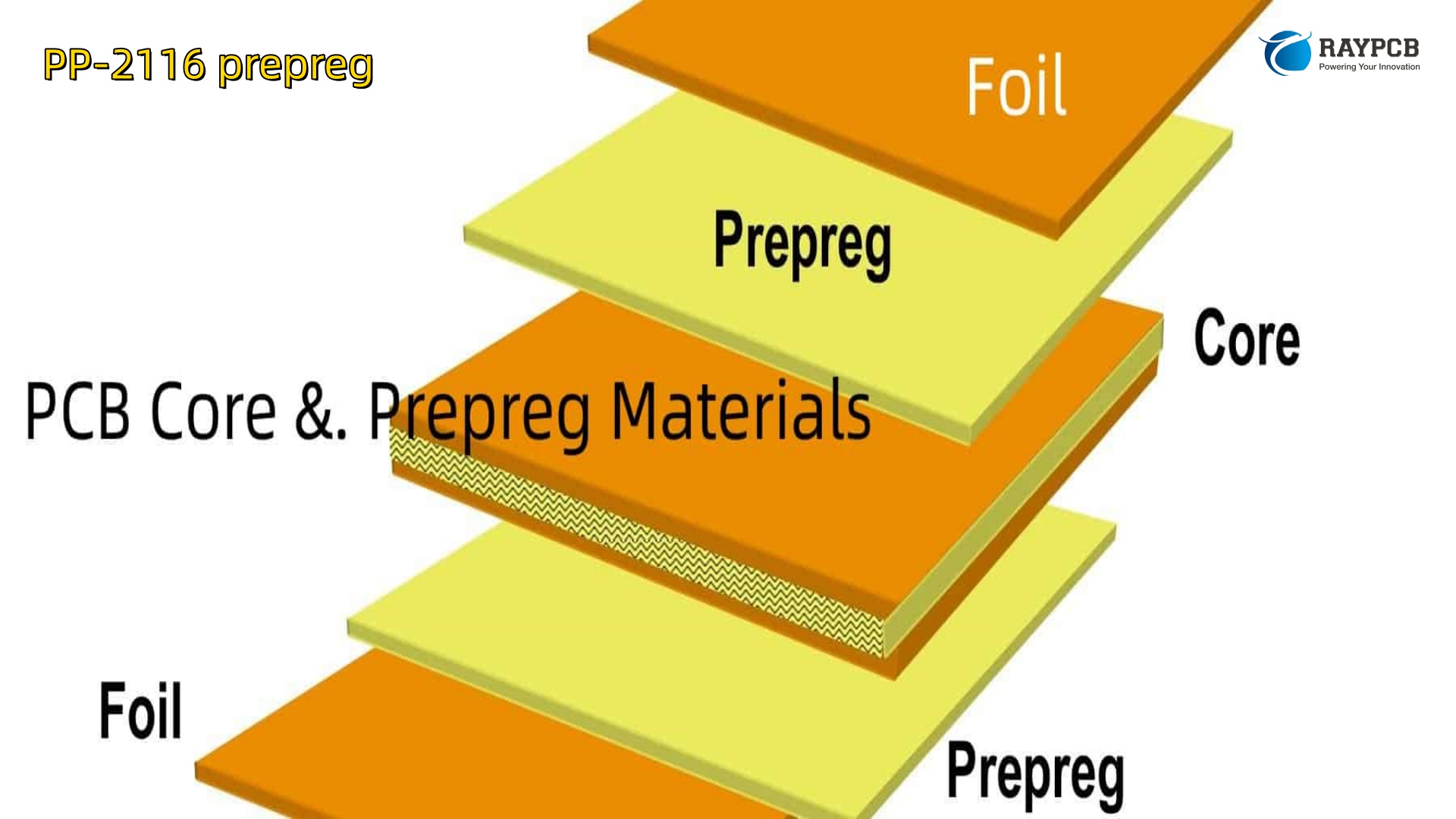
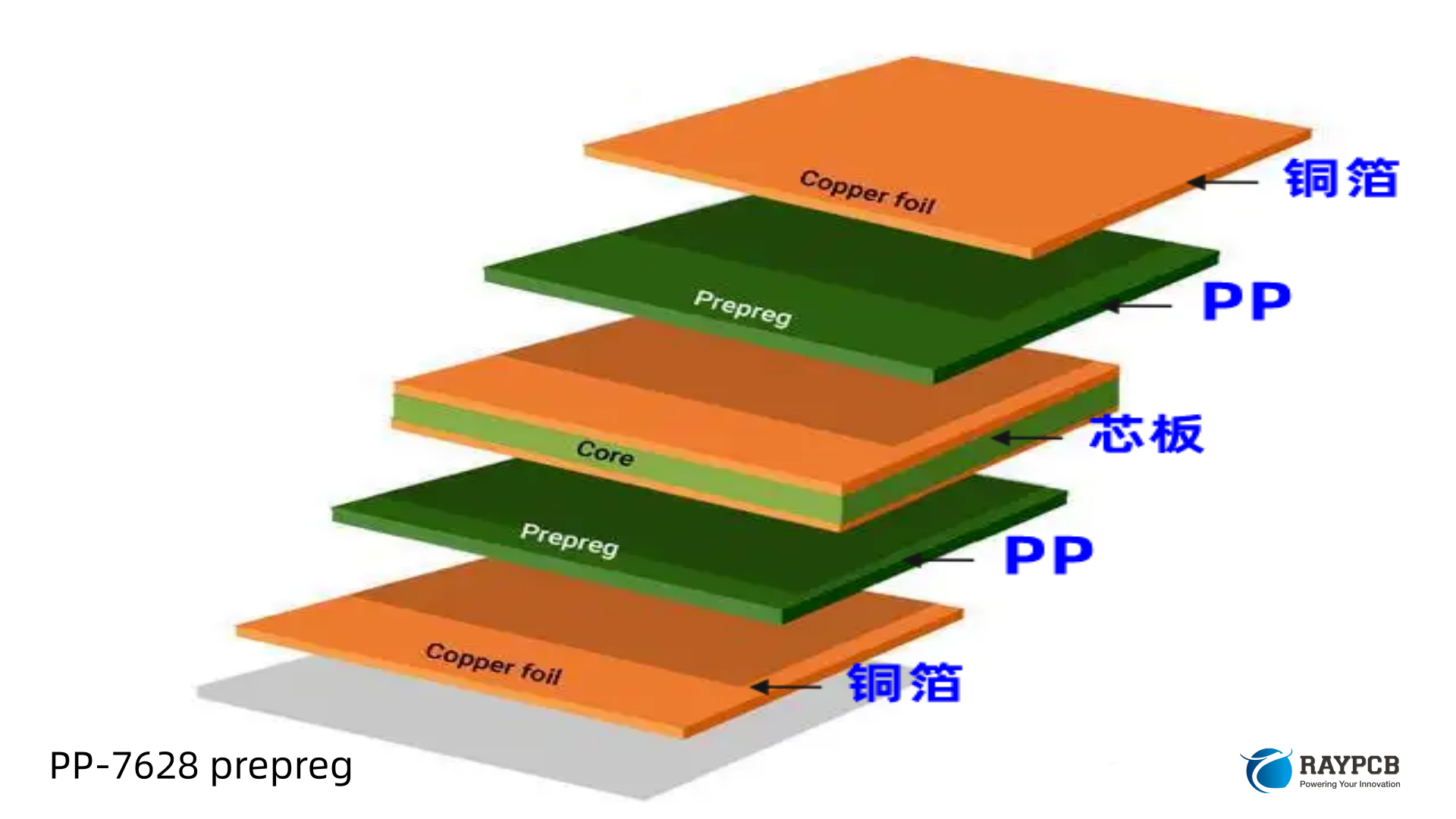
The resin impregnated into the glass fabric is in a semi-cured B-stage state. When heat and pressure are applied during lamination, that resin flows, bonds with adjacent copper layers or cores, then fully crosslinks into a hard dielectric. The entire layer integrity of your multilayer board depends on how well that process goes — and PP-1080 thin prepreg is engineered to make it predictable.
PP-1080 Thin Prepreg: Key Technical Specifications
PP-1080 has a cured thickness range of approximately 60–70 μm and a dielectric constant (Er) of 3.2–3.7, with resin content around 60%. However, these numbers vary across supplier product lines and resin content variants. The table below consolidates typical published values from leading laminate manufacturers:
PP-1080 Prepreg Specification Table
| Parameter | Standard RC (65%) | High RC (68–70%) | Notes |
| Glass Style | IPC 1080 | IPC 1080 | Loose woven fiberglass |
| Cured Thickness | 0.075–0.079 mm (3.0–3.1 mil) | 0.085–0.090 mm (3.3–3.5 mil) | Post-lamination value |
| Resin Content | 64–65% | 68–70% | By weight |
| Dk @ 1 GHz | 3.52–3.55 | 3.45–3.49 | Higher RC = lower Dk |
| Df @ 1 GHz | ~0.0135 | ~0.0138 | Standard FR-4 epoxy system |
| Tg (standard) | 130–150°C | 130–150°C | High-Tg variants available |
| Moisture Absorption | < 0.5% | < 0.5% | Per IPC-TM-650 |
| Shelf Life | 6 months @ ≤23°C | 6 months @ ≤23°C | Dry, UV-protected storage |
Engineer’s Note: For the 1080 glass style at 65% resin content, Dk reads approximately 3.55 at 100 MHz and 3.48 at 10 GHz; at 68% resin content, it drops to about 3.49 at 100 MHz and 3.41 at 10 GHz. Always pull the engineering data sheet from your laminate supplier — not the marketing sheet — when doing impedance calculations.
PP-1080 vs Other Common Prepreg Styles: Comparison Table
Understanding where PP-1080 thin prepreg sits in the ecosystem helps you make stack-up decisions faster. Here’s a side-by-side view:
| Property | PP-106 | PP-1080 | PP-2116 | PP-7628 |
| Glass Style Weight | Ultra-light | Lightweight | Mid-weight | Heavy |
| Cured Thickness | 51–61 μm | 75–90 μm | 100–132 μm | 180–200 μm |
| Typical Resin Content | 72–76% | 64–70% | 52–57% | 40–45% |
| Dk @ 1 GHz (typical) | ~3.32 | ~3.45–3.52 | ~4.40–4.50 | ~4.5–4.6 |
| Mechanical Strength | Low | Moderate | Good | High |
| Resin Flow | Very high | High | Medium | Low |
| Best Application | Thin HDI layers | Thin build-up, HDI | Standard multilayer | Thick structural layers |
| Relative Cost | Moderate | Moderate | Low | Lowest |
Prepreg 1080 is thinner than Prepreg 2116 — measuring around 60 to 90 microns versus 90 to 110 microns — and also carries more resin, around 60–68% by weight compared to about 50% for 2116. This changes how they bond and insulate.
Lightweight styles like 106 and 1080 offer higher resin content relative to glass, resulting in lower Dk values and smoother surfaces. They’re preferred for high-frequency applications where lower Dk improves signal propagation.
Why PP-1080 Thin Prepreg Is the Default for Thin PCB Build-Up
Controlled Dielectric Spacing in HDI Stack-Ups
When you’re building a 6-layer or 8-layer board in a 1.0 mm total thickness target, every micron matters. PP-1080 thin prepreg gives you a repeatable pressed thickness in the 75–90 μm range, which lets you hit tight dielectric spacing between signal layers and reference planes without stacking multiple plies.
Prepreg thickness directly determines the dielectric spacing between signal layers and reference planes. For controlled impedance designs, even a 0.5 mil thickness variation can shift impedance by 3–5 ohms. At those tolerances, using a predictable, well-characterized material like PP-1080 is not optional — it’s essential.
Impedance Control and Signal Integrity
Dk varies from 2.92 at 10 GHz for 1080 glass style to 3.19 at 10 GHz for 2116 glass style when comparing the same laminate system — a Dk variation of roughly 3–6% depending on resin content. For any design running differential pairs or controlled-impedance traces, this delta directly affects trace width calculations. PP-1080’s lower Dk versus 2116 allows for slightly wider traces at equivalent impedance targets, which is friendlier for fabrication yield.
Resin Flow Advantage in Complex Topographies
Inner layers with heavy copper pour create surface topology that thinner prepregs must fill completely to avoid voids. PP-1080’s higher resin content (65–70%) gives it enough flow during lamination to fully encapsulate copper patterns — critical for reliability in thermal cycling environments.
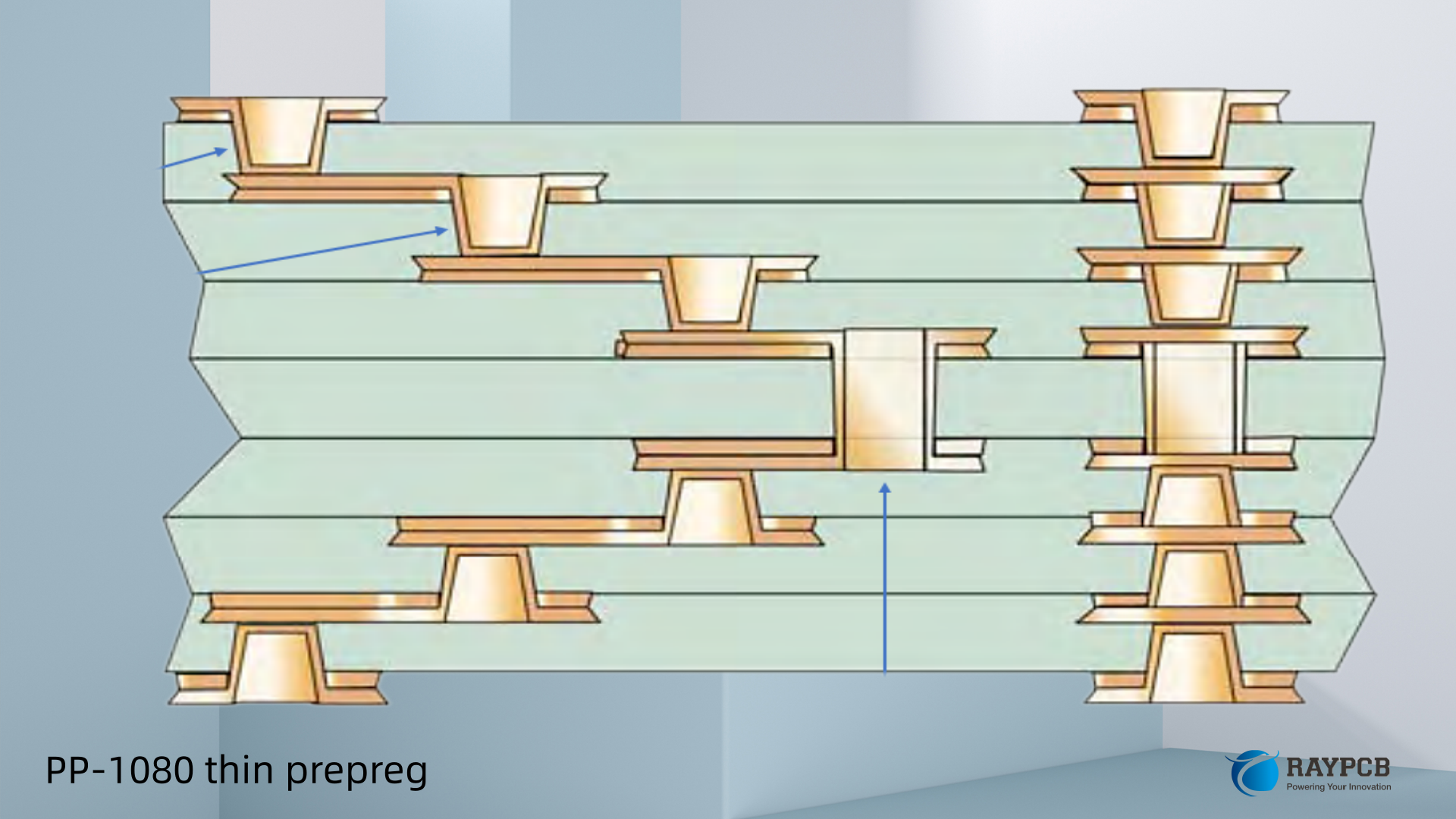
Compatibility with Laser Drilling in HDI
Flat glass cloth with high resin content such as 1035, 1067, and 1086 show excellent heat absorption properties for laser drilling. The same principle applies to PP-1080 — its relatively high resin fraction and uniform weave minimize laser deflection during microvia formation. This makes PP-1080 thin prepreg a solid choice for HDI build-up layers where blind via formation by CO₂ laser is part of the process.
PP-1080 Thin Prepreg in Common PCB Stack-Up Configurations
4-Layer Thin Board (Total ~0.8 mm)
| Layer | Material | Thickness |
| L1 Copper | 1 oz Cu foil | ~35 μm |
| Prepreg | 1× PP-1080 (HR) | ~90 μm |
| Core | FR-4 0.36 mm core | 360 μm |
| Prepreg | 1× PP-1080 (HR) | ~90 μm |
| L4 Copper | 1 oz Cu foil | ~35 μm |
| Solder mask (×2) | LPI | ~25 μm ×2 |
| Total | ~660 μm + plating |
6-Layer Board with Thin Outer Dielectric (Total ~1.0 mm)
| Layer | Material | Thickness |
| L1 | Outer copper | ~35 μm |
| PP | 2× PP-1080 | ~150 μm |
| Core | L2–L3 core | 100 μm |
| PP | 1× PP-1080 | ~80 μm |
| Core | Central core | 360 μm |
| PP | 1× PP-1080 | ~80 μm |
| Core | L4–L5 core | 100 μm |
| PP | 2× PP-1080 | ~150 μm |
| L6 | Outer copper | ~35 μm |
| Total | ~1090 μm approx. |
Adjusting to a single PP-1080 ply for intermediate interfaces and high-RC variants on outer layers gives you the flexibility to tune total board thickness with sub-100 μm precision.
How to Select the Right PP-1080 Variant for Your Application
Not all PP-1080 thin prepregs are the same. Resin content, resin system (standard Tg vs. high Tg vs. halogen-free), and supplier all affect actual performance. Here’s a practical selection framework:
Selection Decision Table
| Design Requirement | Recommended PP-1080 Variant |
| Total board thickness < 0.8 mm | PP-1080 Standard RC (65%), single ply |
| Controlled impedance ±10% | PP-1080 HR (68%), verify Dk from engineering datasheet |
| Lead-free assembly (≥260°C reflow) | PP-1080 High-Tg (Tg ≥ 170°C) |
| Halogen-free / RoHS compliance | PP-1080 HF grade (check supplier availability) |
| HDI with laser vias | PP-1080 MR or HR — higher resin aids laser drilling |
| Mixed-signal or RF (up to 6 GHz) | PP-1080 with published Dk/Df table — confirm at target frequency |
| High-reliability / automotive | PP-1080 High-Tg + phenolic cure system |
Material Supplier Datasheets Worth Bookmarking
Leading laminate manufacturers publish engineering-grade Dk/Df tables for 1080 glass style at multiple resin contents and frequencies. You should always use these rather than the single-number Dk on marketing sheets.
Doosan’s CCL product line — documented at Doosan PCB — includes 1080-compatible prepreg offerings with detailed thermal and electrical characterization data covering standard and high-Tg variants. Their materials are widely used in Korean and Asian PCB fabrication ecosystems where thin build-up tolerances are tightly controlled.
PP-1080 Prepreg Storage and Handling: What Gets Overlooked
A lot of field problems with PP-1080 thin prepreg trace back to storage or handling rather than material defects. The resin is in B-stage — it’s chemically active and absorbs moisture from the air.
Before using prepregs in PCB manufacturing, they should be stored in special conditions: keep wrapped in damp-proof material to prevent moisture absorption that weakens bonding strength, and avoid UV rays and strong light.
Key handling rules for PP-1080 thin prepreg:
Storage temperature should be maintained at or below 23°C with relative humidity under 50%. Shelf life runs approximately 3–6 months from the manufacturing date depending on the resin system. Once a roll is opened, it should be used within the stated out-time window. Any prepreg exposed to moisture shows reduced resin flow during lamination, which causes voids and inconsistent dielectric thickness. Expired prepreg has advanced curing that reduces its ability to flow and bond properly, leading to poor adhesion, voids, delamination, and inconsistent thickness.
Useful Resources for PP-1080 Thin Prepreg Selection
| Resource | Link | What It Contains |
| Isola IS415 Dk/Df Table | isola-group.com | Engineering Dk/Df data for 1080 at multiple RC% and frequencies |
| IPC-4101 Specification | ipc.org | Industry standard for laminate and prepreg classifications |
| Altium Designer Materials Library | altium.com | Stack-up manager with prepreg material properties |
| Signal Integrity Journal — Dk/Df Guide | signalintegrityjournal.com | Deep dive on interpreting laminate data sheets |
| Sierra Circuits HDI Material Guide | protoexpress.com | Practical HDI prepreg selection criteria |
| Doosan PCB Materials | Doosan PCB | Doosan CCL and prepreg product data including 1080-compatible grades |
| PCBSync Prepreg Guide | pcbsync.com | Comprehensive practical prepreg selection guide |
5 Frequently Asked Questions About PP-1080 Thin Prepreg
1. Can I use a single ply of PP-1080 between cores, or do I need two plies?
A single ply of PP-1080 thin prepreg (high-resin variant at ~90 μm pressed) is often sufficient for inner-layer interfaces with moderate copper weight (½ oz to 1 oz). However, on interfaces with heavy copper fill (2 oz or above), two plies are recommended to ensure complete resin fill of copper topology and avoid voids. Always confirm with your fabricator’s design rules — some fabs mandate minimum ply counts between adjacent copper layers.
2. How does PP-1080 perform at frequencies above 5 GHz?
At 10 GHz, the 1080 glass style at 65% resin content shows a Dk of approximately 3.48 and a Df around 0.0143. This is acceptable for many digital high-speed designs but may be marginal for pure RF or mmWave applications. If you’re pushing past 10 GHz, consider low-loss prepreg systems (PTFE-based or hydrocarbon ceramic) with 1080-style glass for mechanical support, rather than standard FR-4 epoxy prepreg.
3. Is PP-1080 thin prepreg compatible with sequential lamination in HDI builds?
Yes — PP-1080 is widely used in 1+N+1 and 2+N+2 HDI build-up constructions. Its high resin content supports good adhesion in the sequential press cycles, and its thickness is compatible with microvia aspect ratios achievable by CO₂ laser drilling. Confirm that your chosen variant’s Tg is appropriate for the cumulative thermal exposure across multiple lamination cycles.
4. What’s the difference between standard RC and high RC variants for thin PCB purposes?
In short: standard RC (around 64–65%) gives you a thinner pressed result (~75–80 μm), while high RC (68–70%) results in a slightly thicker pressed sheet (~85–90 μm) but with lower Dk due to the higher resin fraction. For the thinnest possible build-up, use standard RC. For better impedance control and laser via compatibility, high RC is preferred. Resin content typically ranges 65–75% for 106 and 1080 styles, which are used to bond inner layer cores together in thin build-up constructions.
5. Can I mix PP-1080 and PP-2116 in the same stack-up?
Mixing prepreg types is common — for example, using 1080 prepreg for critical high-speed signal layers and 7628 for non-critical power plane separation. Just ensure CTE compatibility and verify Dk values for each layer in your impedance calculations. The same logic applies to mixing 1080 and 2116. Just be careful: Dk mismatch between layers adds modeling complexity, so always run your impedance tool with layer-specific Dk values rather than a single board-level number.
Summary: When PP-1080 Thin Prepreg Is the Right Call
PP-1080 thin prepreg hits a sweet spot that few other glass styles can match: thin enough for compact build-ups, resin-rich enough for reliable bonding, and electrically well-characterized across the frequency range most PCB engineers work in. Its Dk in the 3.45–3.55 range (depending on resin content) makes impedance calculation straightforward, and its compatibility with laser drilling keeps it relevant in HDI designs.
Use PP-1080 thin prepreg when you’re working with total board thicknesses below 1.6 mm, when you need controlled impedance layers with predictable dielectric spacing, when your design involves HDI microvia build-up, or when lead-free assembly demand a high-Tg variant of the same base fabric style.
Where it’s not the best fit: ultra-high-frequency designs above 10 GHz (consider PTFE or hydrocarbon laminates), or applications where dimensional stability under heavy copper flood is the primary concern (2116 or 7628 may be better).
Pull your supplier’s engineering Dk/Df table, cross-check resin content against your stack-up model, and confirm pressed thickness with your fabricator before locking down the design. That three-step process eliminates most PP-1080 selection mistakes before they reach the production floor.