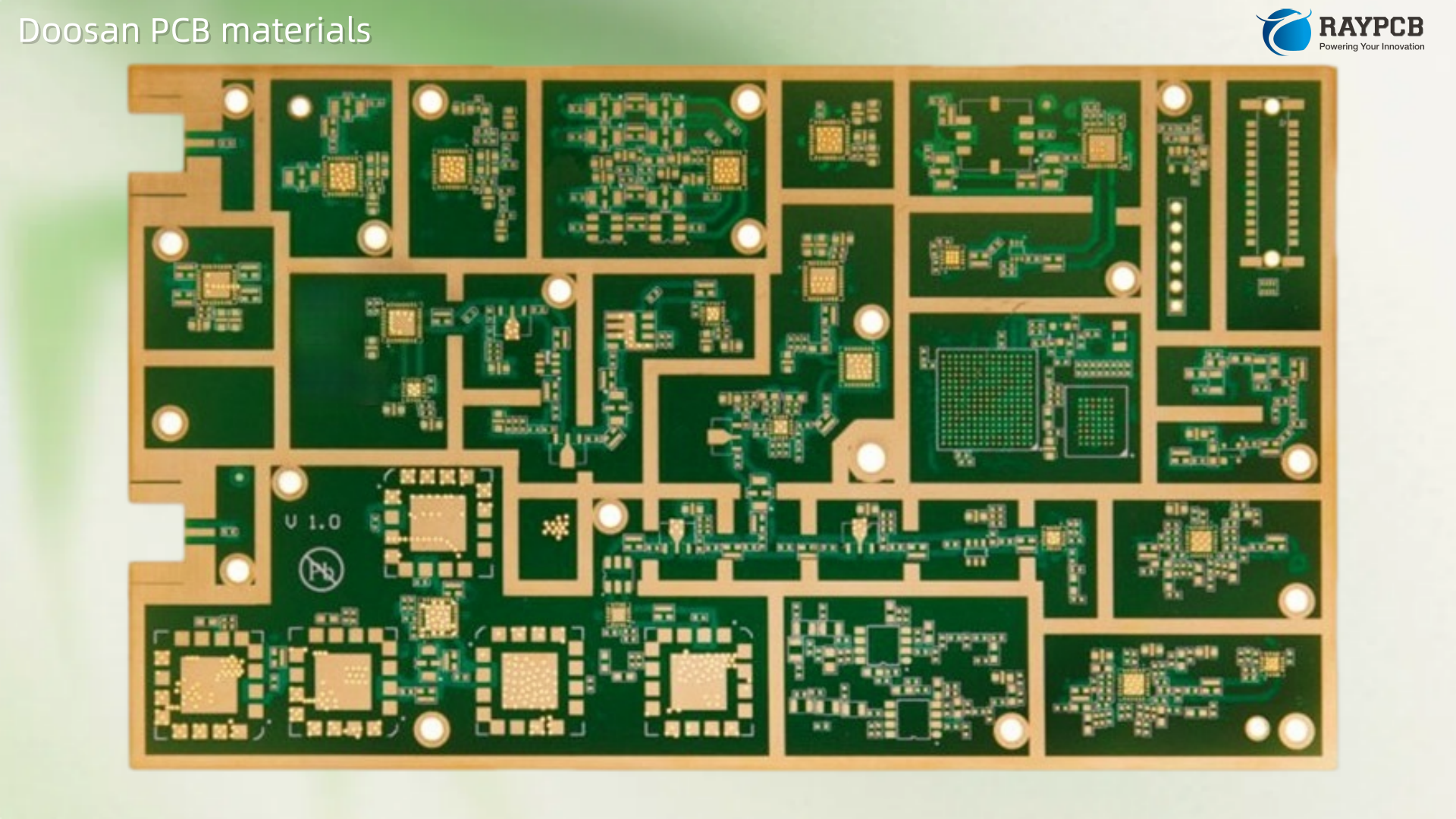
If you’re designing a PCB that needs to survive lead-free assembly, handle real-world operating temperatures, and still comply with RoHS and halogen-free environmental requirements — all without the cost premium of exotic laminates — DS-7402 PCB laminate from Doosan Electro-Materials is one of the more credible options in the middle-Tg halogen-free category. This guide pulls together the full spec picture, application context, and processing considerations that engineers actually need when evaluating this material.
What Is DS-7402 PCB Laminate?
DS-7402 is a middle glass transition temperature (Tg) copper clad laminate (CCL) manufactured by Doosan PCB materials — a South Korean supplier with a well-established presence in the Asian PCB supply chain. The material is built on a modified epoxy resin system reinforced with woven E-glass and is completely free of halogens, antimony, and red phosphorus. That last point matters: many so-called “halogen-free” materials in this Tg class still rely on antimony trioxide as a synergist in their flame retardant system. DS-7402 avoids this.
The defining characteristic of DS-7402 is its combination of a 165°C Tg with a remarkably high decomposition temperature (Td) of 380°C — that’s unusually good for a mid-Tg product and gives significant headroom for lead-free reflow processes. Add in excellent CAF (Conductive Anodic Filament) resistance and tight dimensional control, and you have a material positioned squarely at mobile devices, consumer electronics, automotive ECUs, and high-layer-count HDI boards.
The Td of 380°C is the headline figure for this material. Most mid-Tg halogen-free laminates land in the 330–350°C range — getting 380°C puts DS-7402 closer to high-Tg territory in terms of thermal decomposition stability, even though its Tg sits at 165°C. This is particularly valuable for boards going through multiple lead-free reflow passes.
Electrical Properties
Property
Value
Frequency / Condition
Dielectric Constant (Dk)
3.91
1 GHz
Dissipation Factor (Df)
0.014
1 GHz
Volume Resistivity
≥ 10⁸ MΩ·cm
C-96/35/90
Surface Resistivity
≥ 10⁶ MΩ
C-96/35/90
CTI (Comparative Tracking Index)
≥ 600 V
—
A Dk of 3.91 at 1 GHz is worth noting — it’s notably lower than standard FR-4 which typically runs 4.5–5.0 in the same frequency band. This makes DS-7402 more signal-friendly for DDR memory interfaces, moderate-speed SerDes, and mixed-signal boards that need better impedance control without jumping to a premium low-loss material. The Df of 0.014 is acceptable for digital designs up to a few GHz.
Mechanical Properties
Property
Value
Standard
Flexural Strength
450–550 MPa
IPC-TM-650 2.4.4
Peel Strength (1 oz Cu)
1.15 kgf/cm
IPC-TM-650 2.4.8
Water Absorption
0.26%
D-24/23
Compliance & Certification
Attribute
Status
Halogen-Free
Yes (Cl < 900 ppm, Br < 900 ppm)
Antimony-Free
Yes
Red Phosphorus-Free
Yes
RoHS Compliance
Yes
UL Flammability Rating
94 V-0
CAF Resistance
Yes
DS-7402 Variant Family: Understanding the Suffix System
Doosan offers several variants under the DS-7402 platform, each tuned for slightly different requirements. Knowing the difference prevents you from speccing the wrong grade:
Variant
Key Differentiator
Target Application
DS-7402
Baseline mid-Tg halogen-free
Consumer electronics, mobile, A/V
DS-7402M
Improved moisture resistance, same Td ~370°C
Similar to base, enhanced humidity environments
DS-7402H
Higher Tg (~170°C) version of the 7402 platform
Lead-free automotive, networking
DS-7402LC
Low CTE version, optimized warpage control
SLP smartphones, eSSD, interposer boards
For smartphone SLP (Substrate-Like PCB) applications, DS-7402LC is the correct call — it trades slightly different resin characteristics for superior warpage control in ultra-thin stackups. If you’re just building a 6-layer consumer electronics motherboard, the base DS-7402 is the right starting point.
Where DS-7402 PCB Laminate Gets Specified: Real Use Cases
Mobile Devices and Smart Consumer Electronics
This is the bread-and-butter application for DS-7402. The low Dk relative to standard FR-4 reduces parasitic capacitance at high-speed signal layers. CAF resistance is particularly valuable in high-density smartphone PCBs where via-to-via spacing is extremely tight — CAF failures are a known reliability concern in fine-pitch HDI boards.
Automotive ECU, DCU, and TCU Boards
Doosan explicitly positions DS-7402 for automotive ECU (Engine Control Unit), DCU (Domain Control Unit), and TCU (Transmission Control Unit) applications. The combination of halogen-free compliance with IMDS-traceable chemistry, CAF resistance, and good thermal stability at 165°C Tg makes it viable for under-hood and near-powertrain placements where operating temperatures are moderate but the environment is thermally and electrically hostile.
Notebook Computers and A/V Equipment
High-layer-count notebook motherboards benefit from DS-7402’s good thickness control — critical for maintaining via registration and impedance accuracy in boards with 12 to 20+ layers. A/V devices, set-top boxes, and streaming hardware running continuous duty cycles also fit well here.
Memory Modules and SSD Drives
For this application specifically, DS-7402LC is the preferred sub-variant. Low Z-axis CTE reduces solder joint fatigue during thermal cycling, which is a real failure mode in BGA-heavy memory module and SSD controller board designs.
DS-7402 vs. Competing Mid-Tg Halogen-Free Laminates
Material
Supplier
Tg (°C)
Td (°C)
Dk @ 1 GHz
Halogen-Free
Antimony-Free
DS-7402
Doosan
165
380
3.91
Yes
Yes
S1000-2M
Shengyi
170
≥ 350
4.2
Yes
Yes
TU-862 HF
Taiwan Union
160
≥ 340
4.3
Yes
Yes
IT-158Q
Iteq
160
≥ 360
4.0
Yes
Yes
NP-175F
Nanya
170
≥ 350
4.3
Yes
Yes
DS-7402 stands out primarily for its Td of 380°C — the highest in this comparison group — and its relatively low Dk of 3.91 which gives it an edge in signal-integrity-sensitive designs. The tradeoff is that the baseline Tg of 165°C is slightly lower than S1000-2M or NP-175F. For applications where Tg headroom is the top priority, DS-7402H bumps that up to ~170°C while staying within the Doosan material family.
Processing Notes for Fabricators
Lamination: DS-7402 processes with standard multilayer lamination cycles. The resin system is compatible with conventional press programs. Doosan specifically highlights good thickness control as a product strength — fabricators running tight HDI tolerances should find this consistent batch-to-batch.
Lead-Free Reflow Compatibility: The T-288 > 15 min rating and Td of 380°C mean DS-7402 handles multiple SAC305 reflow passes without issue. For boards going through three or more reflow cycles (both sides plus rework allowance), this thermal margin is genuinely useful.
CAF Prevention: DS-7402’s built-in CAF resistance reduces the risk of electrochemical migration between adjacent vias under DC bias at elevated temperature and humidity. This matters in HDI designs where engineers are pushing drill-to-copper spacing to the limit. That said, laminate CAF resistance should still be combined with proper PCB design rules (minimum via spacing, surface finish selection) rather than relied upon as a single-point fix.
Drill Parameters: Standard carbide drill geometry. No special adjustments needed for the base glass fiber system. Fine-drill work below 0.15 mm should still use appropriate entry material to control hole quality.
Storage: Keep panels in original packaging in a dry, temperature-controlled environment. Bake at 120°C for 2–4 hours before lamination if panels have been exposed to elevated humidity or stored beyond 6 months.
Useful Resources for DS-7402 PCB Laminate
Doosan Electro-Materials Product Page — Official DS-7402 product listing with RoHS and MSDS download links (doosanelectromaterials.com)
IPC-4101E Standard — The governing specification for rigid PCB base materials; DS-7402 aligns with halogen-free FR-4 slash sheets
IPC-TM-650 Test Methods — Defines how Tg, Td, CTE, peel strength, and delamination times are measured and reported
UL Product iQ (iq.ul.com) — Verify current UL 94 V-0 certification status and applicable copper foil weights
MCL PCB DS-7402 Datasheet — Millennium Circuits Limited hosts a PDF datasheet version: mclpcb.com
RayPCB Doosan PCB Materials Guide — Doosan PCB material application guide covering the full DS-7402 product family
IPC-2221B — Generic PCB design standard; useful for matching material class to environmental and performance requirements
5 FAQs About DS-7402 PCB Laminate
Q1: Is DS-7402 a direct replacement for standard FR-4 in existing designs?
For most multilayer consumer electronics designs — yes, with essentially the same processing conditions. Doosan specifically engineered the DS-7402 family to maintain FR-4 compatibility in drilling, lamination, and chemical processing. The real change is moving from a halogenated to a phosphorus/antimony-free flame retardant system, which doesn’t affect fabrication workflow but does require material qualification sign-off in regulated industries like automotive.
Q2: What’s the difference between DS-7402 and DS-7409?
The DS-7409 targets higher Tg applications (Tg ≥ 170°C) and is positioned more toward high-reliability automotive and telecom infrastructure boards where maximum thermal robustness is the priority. DS-7402 sits at 165°C Tg but achieves a higher Td (380°C vs. ~340°C), making it better suited to fine-pitch HDI consumer designs where decomposition resistance and CAF resistance matter more than maximum Tg headroom.
Q3: Can DS-7402 pass REACH and EU environmental regulations?
Yes. Being halogen-free (Cl < 900 ppm, Br < 900 ppm), antimony-free, and red phosphorus-free positions DS-7402 well against REACH SVHC restrictions and the EU’s RoHS Directive. That said, for EU-facing products, always verify with your laminate distributor that the current production batch holds current RoHS certification documentation — regulations update and certificate expiry dates matter.
Q4: What is CAF resistance and why does it matter for DS-7402?
CAF (Conductive Anodic Filament) is an electrochemical failure mode where copper ions migrate along glass fiber–resin interfaces between adjacent vias or conductors under DC voltage and humidity. In high-density HDI boards with tight via spacing, CAF is a known long-term reliability failure mode. DS-7402’s resin system includes improved adhesion at the fiber–resin interface, which blocks the migration path. This is one of the reasons Doosan markets this material specifically for mobile and fine-pitch HDI applications.
Q5: Is there a minimum order quantity, and where can DS-7402 be sourced outside Asia?
DS-7402 is available through Doosan’s authorized distributor network globally, including through fabricators who carry Doosan materials in their approved vendor lists. Availability outside Asia can vary — it’s worth confirming with your PCB fabricator whether they stock this specific laminate or can qualify it into their supply chain. For prototype quantities, fabricators who already carry Doosan materials will often have standard panel sizes available without special minimums.
Final Thoughts
DS-7402 PCB laminate occupies a well-defined space: it’s the halogen-free, mid-Tg workhorse that covers the bulk of consumer electronics, mobile, and moderate-duty automotive PCB applications without the material cost of high-Tg or low-loss grades. Its standout spec — that Td of 380°C combined with CAF resistance — makes it genuinely well-suited to HDI boards running lead-free assembly, where thermal decomposition margin and long-term reliability in fine-pitch via structures are real engineering concerns, not just spec sheet talking points.
If your application sits in the automotive or high-reliability networking space, look at DS-7402H or DS-7409 for higher Tg. If you’re building ultra-thin smartphone or SSD interposer boards with severe warpage requirements, DS-7402LC is the right variant. For everything in between — which covers a large portion of the PCB volume built today — the base DS-7402 is a solid, proven choice.
Doosan vs Shengyi laminate: full spec comparison tables, high-speed material analysis, supply chain trade-offs, and application selection guide for PCB engineers.
The question “Doosan vs Shengyi laminate — which one should I spec?” comes up more than you’d expect, and it’s rarely straightforward. Both manufacturers run genuinely competitive product lines. Both supply real volume into Asia’s PCB fabrication ecosystem, and both show up on approved vendor lists at serious OEM manufacturers worldwide. The honest answer is that “better” depends entirely on what your design actually demands: thermal requirements, signal speed, supply chain geography, and whether you’re building consumer electronics or safety-critical systems.
This guide gives you the engineering-level comparison you need. Not marketing copy from either vendor — a practical breakdown of where each supplier’s materials perform, where they fall short, and how to make the decision without wasting a prototype run.
Who Are Doosan and Shengyi in the PCB Materials Market?
Doosan Electro-Materials: The Korean Vertical Integrator
Doosan Corporation Electro-Materials (DEM) has been producing copper clad laminates since 1974 and has grown into one of the world’s top-tier CCL manufacturers. Their facilities span South Korea, China, and Europe, producing over 15 million square meters of laminate annually. Doosan’s important differentiator is vertical integration — they synthesize their own resin systems rather than sourcing from third-party chemical suppliers. For engineers, this translates to tighter lot-to-lot consistency in dielectric properties and fewer supply chain variables affecting impedance predictability.
Their product portfolio spans standard FR-4 (EM-285 series), high-Tg mid-range (EM-370 series), and high-speed/high-frequency materials (DS-7409 series), plus flexible CCL (DSflex series) and IC package substrates. The DS-7409D series — covering middle-loss, low-loss, ultra-low-loss, and super-low-loss FR-4 variants — has established Doosan as a cost-competitive player in the high-speed PCB material space dominated by Panasonic Megtron and Isola.
For a comprehensive overview of Doosan’s CCL product range, the Doosan PCB reference documents Doosan’s material lineup with technical detail useful for specification work.
Shengyi Technology: The Volume Champion from China
Shengyi Technology Co., Ltd. (SYTECH), headquartered in Dongguan, China, is by most measures one of the largest CCL and prepreg manufacturers in the world. Their production scale gives them significant cost advantage and near-universal availability through Chinese PCB fabricators — roughly 70% of high-speed CCL production is now based in Asia, and Shengyi is a central part of that ecosystem.
Their product line ranges from the entry-level S1141 (Tg 130°C) through standard high-Tg FR-4 (S1000H at Tg 150°C, S1000-2 at Tg 170°C, S1000-2M at Tg 180°C), and into high-speed low-loss materials (S7439, S7439G) as well as RF/microwave substrates (S7136H, SCGA-500 series, mmWave77 for 77GHz automotive radar). Shengyi has invested significantly in matching Western performance benchmarks while maintaining the pricing accessibility that made them the default material at volume Chinese fabricators.
Doosan vs Shengyi Laminate: Head-to-Head Specification Comparison
Standard FR-4 Range
For the workhorse segment — boards below 8 layers, standard reflow, no impedance control requirement — both manufacturers deliver fully capable materials at similar price tiers.
Parameter
Doosan EM-285 Series
Shengyi S1000H
Notes
Tg (DSC)
130–150°C
150°C
Both sufficient for standard reflow
Td
~310°C
325°C
Shengyi slightly higher
CTE Z-axis
~70 ppm/°C
~60 ppm/°C
Below Tg
Dk @ 1 GHz
~4.4–4.5
~4.5
Comparable
Df @ 1 GHz
~0.020
~0.018
Comparable
Water Absorption
~0.15%
~0.15%
Same
UL Flammability
V-0
V-0
Both compliant
Halogen-Free Option
Yes
Yes
Both offer HF grades
Relative Cost
Low–Medium
Low
Shengyi lower cost at volume
For standard applications — industrial controls, consumer electronics, 4–6 layer boards without tight impedance control — Shengyi S1000H and Doosan EM-285 series are functionally interchangeable. Shengyi wins on cost at Chinese fabricators because of domestic supply chain integration. Doosan wins when your Korean or Taiwanese fabricator has Doosan on preferred vendor status, which is common in those markets.
High-Tg FR-4 for Lead-Free Assembly and Multilayer
This is where material selection actually starts to matter for production yield. Lead-free assembly at peak reflow temperatures of 255–260°C creates serious thermal stress on laminate, and Tg margin above assembly temperature directly affects via barrel integrity and delamination risk.
Parameter
Doosan EM-370 Series
Shengyi S1000-2
Shengyi S1000-2M
Notes
Tg (DSC)
170°C
≥ 170°C
180°C
S1000-2M has highest margin
Td
~340°C
~340°C
~345°C
Very comparable
T288 (min)
> 20 min
> 30 min
> 30 min
Shengyi slightly better
CTE Z-axis
~50 ppm/°C
~50 ppm/°C
~48 ppm/°C
All acceptable
Dk @ 1 GHz
~4.3
~4.3
~4.3
Essentially equivalent
Df @ 1 GHz
~0.018
~0.017
~0.016
Very similar
CAF Resistance
Good
Good
Excellent
S1000-2M has documented CAF data
Lead-Free Compatible
Yes
Yes
Yes
Both verified
Application
8–12 layer MLB, automotive
8–16 layer MLB
High-density MLB, medical, auto
The Shengyi S1000-2M is a well-documented performer in high-layer-count applications with excellent CAF (Conductive Anodic Filament) resistance data from multiple OEM qualifications. If your fabricator is Chinese and the design is a 12+ layer MLB for automotive or medical, S1000-2M is a default choice with broad fabricator familiarity. For Korean or globally diversified supply chains, Doosan EM-370 is the equivalent specification-match at comparable performance.
High-Speed Low-Loss Materials: Where the Real Differences Emerge
This is the category where the Doosan vs Shengyi laminate comparison gets genuinely interesting, and where making the wrong call costs you signal integrity performance.
Parameter
Doosan DS-7409DV (Low Loss)
Doosan DS-7409DJN+ (Super Low Loss)
Shengyi S7439
Notes
Tg (DSC)
~170°C
~200°C
200°C
DS-7409DJN+ and S7439 match
Dk @ 10 GHz
~3.55
~3.3–3.4
3.80
Doosan lower Dk
Df @ 10 GHz
~0.009
~0.004–0.005
0.0068
DS-7409DJN+ better; S7439 middle
Copper Options
Standard, VLP
Standard, VLP
VLP (3μm Rz), 2μm Rz available
S7439 default is VLP
E-Glass Option
Standard, spread
Standard, spread
Standard, spread
Both offer weave-reduced options
Frequency Range
Up to 25 GHz
Up to 40 GHz
1–20 GHz (stable)
CAF Resistance
Excellent
Excellent
Excellent (0.7mm pitch tested)
S7439 has documented OEM CAF data
Halogen-Free
Yes (DS-7409DV)
Select variants
Yes (S7439G)
Both HF options exist
Primary Application
Networking, base stations
5G, high-speed computing
Networking, backplane, 56Gbps+
The S7439 series provides stable Dk and Df from 1 GHz to 20 GHz over a temperature range of −40°C to +125°C — an important specification for designs that must characterize signal behavior across a wide operating envelope. For PAM4 signaling at 56Gbps and above, this frequency-stability is a meaningful differentiator.
Doosan’s DS-7409DJN+ goes further in raw Df performance at higher frequencies, making it competitive for applications pushing toward 40 GHz. The DS-7409 series is noted as cost-competitive in the high-speed material category, particularly relative to Panasonic Megtron and Isola products that command higher premiums.
Doosan vs Shengyi Laminate: Side-by-Side Segment Comparison Table
Application Segment
Preferred: Doosan
Preferred: Shengyi
Either Works
Standard 4-layer consumer PCB
✅ Both
8-16 layer MLB, lead-free
✅ Both
Automotive (ECU, DCU)
✅ Strong automotive supply chain
✅ S1000-2M auto-qualified
✅ Both
5G base station / telecom
✅ DS-7409DJN+ ultra-low loss
✅ S7439 stable Dk/Df
Depends on Df target
IC package substrates
✅ Doosan DS-8502SQ series
Flexible PCB (FPC)
✅ DSflex series (full PI range)
Shengyi has flex but narrower PI options
77GHz automotive radar
Doosan EM-888HF competitive
✅ mmWave77 PTFE specialist
High-density HDI (SLP)
✅ DS-7402LC for SLP/smartphone
✅ S1165 for HDI
Cost-first, Chinese supply chain
✅ Default at most CN fabs
Korean/Taiwan supply chain
✅ Preferred vendor at KR/TW fabs
Green/halogen-free required
✅ Halogen-free grades available
✅ S1165, S7439G available
Both offer HF
Supply Chain Considerations: The Factor Engineers Underestimate
Specification matching between Doosan and Shengyi in the standard and high-Tg FR-4 range is close enough that supply chain geography often becomes the deciding factor — not electrical performance.
Shengyi materials are stocked as default at the majority of Chinese PCB fabricators. If you’re ordering production from a Shenzhen or Suzhou fab, the lead time for Shengyi S1000H or S1000-2M is typically zero — it’s on the shelf. Doosan materials are widely available in Korean and Taiwanese fabrication ecosystems, and increasingly available through Doosan’s European distribution network (Ventec and regional partners) for Western OEMs.
Doosan’s manufacturing footprint across South Korea, China, and Europe provides geographic redundancy that pure single-region suppliers cannot match. For supply chain risk management — which became critically important for design teams after the 2020–2022 component shortage period — Doosan’s multi-region production offers options that insulate against single-country supply disruptions.
From a geopolitical standpoint, specifying Shengyi as your sole laminate source creates China-dependency risk for production continuity. Specifying Doosan or maintaining a dual-qualified stack-up with both approved vendors reduces that exposure.
Where Doosan Has a Clear Advantage
IC Package Substrates: Doosan’s DS-8502SQ and DS-7402LC series are specifically engineered for SLP (Substrate-Like PCB) and IC package substrate applications. These materials deliver high elastic modulus, low CTE, and sub-1.0 ppm/°C dimensional stability needed for semiconductor packaging. This is a product category where Shengyi does not have comparable depth.
Flexible CCL Breadth: The DSflex product line covers polyimide thicknesses from 12 μm to 50 μm with selectable PI stiffness grades (low/medium/high) across the same product family. This level of PI engineering customization is not matched in Shengyi’s flexible offerings.
Vertical Resin Integration: Doosan synthesizes its own resin systems. This gives engineering teams working on custom qualification programs a direct technical dialogue with the resin chemist, not just a distributor. For material qualification in automotive (IATF 16949) or aerospace contexts, this traceability depth matters.
Where Shengyi Has a Clear Advantage
Volume Availability and Fabricator Familiarity: At high-volume Chinese fabricators, Shengyi S1000H and S1000-2 are on the production floor in quantity. Lead times, pricing, and process familiarity are optimized for Shengyi at these fabs. Switching to Doosan mid-program at a Chinese fabricator adds procurement friction.
S7439 CAF Performance Data: Shengyi has published CAF resistance data for S7439 down to 0.7mm pitch across multiple OEM test vehicles — a level of public qualification documentation that is useful when justifying material choices to customers running their own supply chain audits.
mmWave77 for Automotive Radar: For 77GHz ADAS radar PCBs, Shengyi’s mmWave77 is purpose-built PTFE material with documented performance at millimeter-wave frequencies. This is a narrow but important segment where Shengyi is ahead of Doosan’s current FR-4-based approach.
Cost at Scale: At Chinese fabricators running multi-thousand panel volumes, Shengyi’s integrated domestic supply chain produces lower landed cost than Doosan for equivalent-spec materials.
Doosan vs Shengyi: Application Selection Decision Table
Design Profile
Recommended Material
Supplier Advantage
Consumer 4L PCB, cost priority
Shengyi S1000H
Shengyi — cost and availability
12L MLB, lead-free, automotive
Shengyi S1000-2M or Doosan EM-370
Either — check fabricator stock
High-speed backplane, 56Gbps
Shengyi S7439
Shengyi — documented 56Gbps PAM4 data
5G base station, high layer count
Doosan DS-7409DJN+
Doosan — lower Df at 10+ GHz
FPC for smartphone flex
Doosan DSflex-600
Doosan — broader PI thickness options
IC package substrate / SLP
Doosan DS-8502SQ
Doosan — purpose-built substrate
77GHz radar (ADAS)
Shengyi mmWave77
Shengyi — dedicated PTFE material
HDI halogen-free compliance
Shengyi S1165 or Doosan HF grade
Either — verify specific HF grade
Korean/Taiwan fabrication chain
Doosan (preferred vendor)
Doosan — supply chain proximity
Chinese fabrication chain
Shengyi (default stock)
Shengyi — default availability
Useful Resources for Doosan vs Shengyi Laminate Evaluation
Industry-standard benchmark for Dk/Df comparison methodology
5 Frequently Asked Questions: Doosan vs Shengyi Laminate
1. Can I substitute Doosan EM-370 for Shengyi S1000-2 mid-program without re-qualification?
Functionally, the electrical and thermal parameters of Doosan EM-370 and Shengyi S1000-2 are very close — both Tg 170°C DSC, similar CTE, comparable Dk/Df. However, “functionally equivalent” is not the same as “qualified equivalent.” If your PCB is going into a product with a UL listing, automotive type approval, or medical device certification that references the specific laminate material, any change requires at minimum a re-test and potentially full re-qualification. For prototype and low-regulation applications, the substitution is low-risk. For regulated applications, work through your PCB fabricator’s change management process and get written confirmation that the substituted material meets your BOM specification.
2. Which supplier has better halogen-free options for a project requiring IEC 61249-2-21 compliance?
Both manufacturers offer halogen-free grades across their product lines. Shengyi’s halogen-free offerings include S1165, the S7439G variant (Tg 180°C, Df 0.0070 @ 10 GHz), and various HF grades across the S1000 series. Doosan’s halogen-free CCL includes HF-designated grades in their standard and high-speed lines, documented with RoHS certificates and MSDS per product. The practical question is which HF grade your fabricator has on their approved material list. At Chinese fabricators, Shengyi HF grades are more commonly pre-qualified in the production process. At Korean and Taiwanese fabs, Doosan HF grades are standard. Specify the IEC 61249-2-21 compliance requirement explicitly on your fab drawing rather than assuming an HF-labeled material automatically meets the standard — confirm with a lot-level certificate of conformance from your fabricator.
3. For a 5G mmWave PCB running at 28 GHz, which material performs better?
At 28 GHz, both Doosan’s DS-7409DJN+ and Shengyi’s S7439 are in the conversation, but with different strengths. The S7439 series is documented for stable Dk/Df from 1 to 20 GHz across the full automotive temperature range (−40°C to +125°C), with the S7439 Df of 0.0068 at 10 GHz. Doosan’s DS-7409DJN+ pushes lower Df (0.004–0.005 range at 10 GHz) but is primarily characterized up to ~40 GHz in high-speed digital applications rather than RF signal integrity at specific frequency bands. Above 40 GHz or for RF designs where loss budget is critical, neither is the first choice — PTFE-based materials like Shengyi mmWave77 or Rogers RO4003C are the appropriate specifications. For 28 GHz designs where FR-4 processability is a priority, Doosan DS-7409DJN+ has a slight Df advantage.
4. Is Doosan or Shengyi better for a Korean tier-1 automotive supplier project?
Both are plausible, but logistics and approved vendor list status will decide it faster than material performance comparisons. Korean tier-1 automotive suppliers (Hyundai Mobis, HL Mando, Samsung Electro-Mechanics supply chain) routinely work with Doosan-qualified laminates because Doosan is a Korean-headquartered supplier with IATF 16949-supporting documentation infrastructure and Korean-language application engineering support. For a project deep in the Korean automotive supply chain, Doosan materials often arrive at the fab already on the approved vendor list, reducing qualification time by weeks. Shengyi S1000-2M is also automotive-qualified and fully capable, but if your fabricator is in Korea, Doosan is the path of least resistance.
5. How do the two suppliers compare on technical support and application engineering?
This is a real differentiator that doesn’t show up in spec tables. Doosan’s vertical resin integration means their application engineering team can engage directly on material chemistry questions — useful for custom qualification programs, impedance modeling adjustments, or CAF risk assessment in novel stack-up configurations. Shengyi, given its scale, has broader distributor coverage (especially in North America through Shengyi Technology USA) but the technical dialogue for custom applications is typically one more step removed from the resin chemist. For standard applications, this difference is irrelevant. For a customer trying to qualify a new laminate into an existing production line with specific process window constraints, Doosan’s vertical integration gives them more tools to answer the “why did this fail under these press conditions” question directly.
Final Verdict: Doosan vs Shengyi Laminate for Your Design
Neither Doosan nor Shengyi is universally better. The practical rule is straightforward: use Shengyi when your fabricator is in China and cost efficiency and supply chain simplicity matter more than supply chain diversity. Use Doosan when you’re in the Korean or Taiwanese fabrication ecosystem, when you need IC package substrates or advanced FPC materials, when ultra-low-loss performance at 10+ GHz is critical, or when a multi-geography supply chain is a hard requirement.
For most standard FR-4 and high-Tg FR-4 applications, you can run both on your approved vendor list simultaneously and let your fabricator tell you which is in stock at better lead time. The Dk/Df numbers are close enough that your impedance model won’t care about the supplier name — only the actual measured dielectric constant of the specific lot of material pressed into your stack-up.
Build your material qualification around the IPC-4101 slash sheet specification, not a brand name. Require lot-level test data from whichever supplier your fabricator uses, and you’ll be in a defensible position regardless of which name is printed on the laminate edge.
Doosan vs Rogers PCB material compared: FR-4 vs high-frequency specs, Dk/Df tables, cost analysis, and when each material wins. Engineer’s guide with real data.
Material selection is one of those decisions that looks straightforward on a spec sheet and gets complicated the moment you’re trying to explain to a product manager why the board costs three times more than the FR-4 version. If you’re comparing Doosan vs Rogers PCB materials, you’re most likely at one of two crossroads: either you’re designing something at or above a few gigahertz and need to know whether Rogers is actually necessary, or you’re evaluating whether Doosan’s advanced laminate series can genuinely replace Rogers in a specific application and save meaningful cost.
Both scenarios are worth working through carefully. The short answer — Rogers wins for pure RF performance above 5–6 GHz, Doosan wins on cost and processability for high-speed digital and sub-6GHz designs — is correct but leaves out most of the engineering nuance that determines which material actually belongs in your stackup.
Understanding the Two Material Families
Before comparing specs, it’s worth understanding what each company actually makes, because “Doosan” and “Rogers” are not single materials — they’re product families with very different coverage.
What Doosan Electro-Materials Produces
Doosan PCB materials come from Doosan Corporation’s Electronics Materials division (Doosan Electro-Materials, or DEM), one of the world’s largest CCL manufacturers by volume, producing over 15 million square meters of laminate annually from facilities in South Korea, China, and Europe. Their vertically integrated model — from resin synthesis through finished laminate — means tighter control over material properties than competitors relying on third-party resin suppliers.
The Doosan portfolio spans the full range from standard FR-4 through advanced high-speed and mmWave materials:
Standard & High-Tg FR-4 Series — The workhorse product line used in consumer electronics, servers, and industrial equipment. High-Tg variants (Tg ≥ 170°C) handle lead-free assembly without issue.
DS-7409D Series (High-Speed FR-4) — The headline product for signal-integrity-critical designs. The DS-7409D family includes multiple sub-grades targeting different loss levels: DS-7409DV (Low Loss), DS-7409DV(N) (Ultra Low Loss), and DS-7409DJN+ (Super Low Loss). Designed for base stations, high-speed computing, 5G infrastructure, and network switching equipment.
DS-9000 / RF-500 Series (mmWave/5G) — Doosan’s push into territory traditionally owned by Rogers. The DS-9000 uses a fluorinated resin system with Dk of 2.6 and Df below 0.001 at 10 GHz — figures that directly challenge Rogers RT/duroid for beyond-5G and 6G applications.
EM-888HF Series — A hybrid material targeting 77 GHz automotive radar with Dk of 3.4 and Df of 0.003 at 10 GHz, while remaining processable on standard FR-4 equipment. This is significant: automotive radar designs that previously required full PTFE processing can run on EM-888HF without the process complexity penalty.
What Rogers Corporation Produces
Rogers Corporation’s Advanced Electronics Solutions division makes the benchmark materials for RF, microwave, and high-reliability PCBs. Their most widely used product families in PCB design are:
RO4000 Series (RO4003C and RO4350B) — Hydrocarbon ceramic laminates reinforced with woven glass. The most commercially relevant Rogers products for most engineers, offering near-PTFE electrical performance with FR-4-compatible processing. RO4350B is the UL 94V-0 flame-rated version; RO4003C is halogen-free but not V-0 rated.
RO3000 Series — PTFE-ceramic composites designed for high-frequency stability from microwave through mmWave. RO3003 offers a Dk of 3.00 ±0.04 with exceptional Dk stability across frequency and temperature — the go-to for automotive radar, satellite, and phased arrays.
RT/duroid Series — The highest-performance PTFE-based laminates for demanding microwave and millimeter-wave applications. RT/duroid 5880 has Dk of 2.20 ±0.02 and Df of 0.0009 — numbers nothing else touches outside ceramics.
RO4835 and RO4730G3 — The oxidation-resistant and ultra-low-profile variants for high-power and antenna applications.
Doosan vs Rogers PCB: Head-to-Head Electrical Specifications
This is where the real engineering decision lives. The table below compares the key electrical and thermal parameters across the most commonly specified grades from each manufacturer:
Material
Dk @ 10 GHz
Df @ 10 GHz
Tg (°C)
Moisture Absorption
Relative Cost
Doosan Standard FR-4
4.5–4.8
0.018–0.025
130–150
0.15–0.20%
1× (Baseline)
Doosan DS-7409DV (Low Loss)
3.7–3.9
0.006–0.009
≥ 175
~0.13%
2–3×
Doosan DS-7409DJN+ (Super Low Loss)
3.4–3.6
0.003–0.005
≥ 175
~0.10%
3–4×
Doosan EM-888HF (mmWave)
3.4
0.003
≥ 175
< 0.10%
4–5×
Doosan DS-9000 (6G/Ultra Low Loss)
2.6
< 0.001
—
Very Low
6–8×
Rogers RO4350B
3.48
0.0037
> 280
0.06%
5–7×
Rogers RO4003C
3.38
0.0027
> 280
0.04%
5–7×
Rogers RO3003
3.00
0.0013
—
0.04%
8–12×
Rogers RT/duroid 5880
2.20
0.0009
—
0.02%
15–20×
A few things stand out immediately. The Doosan DS-7409DJN+ and EM-888HF grades get within striking distance of Rogers RO4350B on Df at 10 GHz. The bigger gap is on moisture absorption (0.10% vs 0.04–0.06%) and Tg — Rogers RO4350B and RO4003C both exceed 280°C Tg, a meaningful advantage for applications with aggressive thermal cycling or multiple assembly passes.
For anything at 77 GHz or beyond, the Rogers RT/duroid and RO3003 series still have a substantial physics advantage that no current Doosan FR-4-based product can match.
FR-4 vs High-Frequency Material: Where the Line Actually Is
A lot of engineers get this wrong. The question is not “FR-4 vs Rogers” in the abstract — it’s “at what frequency and power level does the dielectric loss in my specific trace geometry become unacceptable?” That’s a calculation, not a rule of thumb.
Here’s a practical frequency-based decision framework:
Frequency Range
Material Recommendation
Rationale
DC to 1 GHz
Standard FR-4 (Doosan or any vendor)
Dielectric loss is manageable; cost dominates
1–5 GHz
High-speed FR-4 (Doosan DS-7409DV)
Loss matters for long traces; standard processing
5–10 GHz
Low-loss FR-4 (Doosan DS-7409DJN+) or Rogers RO4350B
Rogers preferred for tight impedance tolerance and lower moisture sensitivity
10–40 GHz
Rogers RO4350B or RO4003C
Doosan EM-888HF is competitive; Rogers preferred for proven supply chain
40–77 GHz (mmWave)
Rogers RO3003 or Doosan DS-9000
Both work; Rogers has more published design data
> 100 GHz (sub-THz)
Rogers RT/duroid 5880 / specialized ceramics
Only PTFE-based or ceramic; no current FR-4 system competes
One important nuance: trace length matters enormously. A 5 GHz signal over a 10mm trace on standard FR-4 will work fine in many applications. The same signal over 200mm of FR-4 will show meaningful insertion loss degradation. Doosan DS-7409D materials are specifically optimized for the long backplane-style routing in server and switch chassis — applications where Rogers would work but is economically unjustifiable.
Processing and Manufacturability: A Critical Practical Difference
One reason Rogers RO4000 series materials gained widespread adoption was that they process like FR-4. No special PTFE handling, no sodium etch treatment for through-holes, no specialized drill parameters. This is a genuine engineering accomplishment that made RF PCB manufacturing accessible to standard FR-4 fabricators.
Doosan DS-7409D series materials share this advantage. Both can be processed using:
Process Step
Doosan DS-7409D
Rogers RO4003C/RO4350B
Drilling
Standard parameters
Standard parameters
Through-hole plating
No special treatment
No special treatment
Lamination temperature
Standard FR-4 cycles
Slightly higher than FR-4
Etching
Standard chemistry
Standard chemistry
Lead-free soldering
Compatible (high Tg)
Compatible (Tg > 280°C)
Hybrid stackup with FR-4
Yes
Yes, but CTE mismatch requires care
Where Rogers RO4350B has a process edge is in lamination temperature tolerance — its Tg above 280°C gives the fabricator more margin on press cycles and downstream assembly. A Doosan DS-7409D board with Tg of 175°C clears lead-free requirements but has less thermal headroom for multiple rework cycles on dense BGA assemblies.
For Rogers RT/duroid and RO3000 series, the processing story changes entirely. PTFE-based materials require sodium etch or plasma treatment before through-hole plating, specialized drilling parameters to prevent fiber pull-out, and careful handling to avoid surface contamination. This adds fabrication cost and limits the supplier pool. Only fabs with specific experience and tooling for PTFE processing should attempt these materials.
Doosan vs Rogers PCB: Cost Analysis for Real Projects
Cost comparison between these material families is context-dependent, but here’s a realistic breakdown for a 6-layer board in production quantities:
Hybrid stackups — using premium material only on the signal layers that need it, with standard FR-4 or Doosan high-speed material on less critical layers — are often the most cost-effective solution for mixed-signal designs. The key constraint is CTE matching at the lamination boundary; Rogers and standard FR-4 have similar z-axis CTE, making hybrid boards manufacturable with care, but it requires fabricator experience.
Doosan’s competitive position is strongest in the 2–10 GHz range where their DS-7409D series offers 60–70% of Rogers’ electrical performance at 40–60% of the Rogers price point. For a 5G base station filter board or a 6 GHz backhaul module, that tradeoff often makes engineering and commercial sense.
Application-Specific Recommendations
5G Infrastructure and Base Stations
Doosan DS-7409DV or DS-7409DJN+ is the standard specification for many Tier-1 telecom equipment vendors in this application. At sub-6 GHz frequencies with controlled trace lengths, Doosan’s loss performance is adequate, and the cost advantage on large panels (server-sized boards at 600mm × 500mm) is very significant. For mmWave 5G (28 GHz, 39 GHz), Rogers RO4350B or Doosan EM-888HF are both valid choices. Rogers carries more published antenna design data.
Automotive Radar (76–77 GHz)
This is a contested space. Rogers RO3003 has been the default for 77 GHz FMCW radar for years. Doosan EM-888HF (Dk 3.4, Df 0.003 @ 10 GHz) is gaining adoption, especially at manufacturers prioritizing cost reduction and standard-process compatibility. Both need verification with your specific antenna simulation at the final fabrication dimensions.
High-Speed Digital (PCIe, DDR, SerDes)
This is Doosan’s strongest territory against Rogers. For PCIe Gen 4/5, 112G SerDes, and 400G+ switching fabric, Doosan DS-7409DJN+ competes directly with Rogers RO4350B on signal integrity performance, at meaningfully lower cost. Rogers is rarely specified for pure digital designs above the component-supplier recommendation level.
Aerospace and Defense
Rogers has the documentation advantage here. MIL-qualified designs, space-grade applications, and programs requiring traceable material certifications lean on Rogers’ established qualification data. Doosan is expanding its qualified materials library but does not yet have the same depth of mil-aero documentation.
Consumer RF (Wi-Fi, Bluetooth, Sub-1 GHz IoT)
Standard Doosan FR-4 or high-Tg FR-4. Rogers is unnecessary and economically unjustifiable for this application category.
Useful Resources for Doosan vs Rogers PCB Material Selection
Rogers Technology Support Hub — full datasheets, Dk/Df vs. frequency plots, and design guides for all Rogers laminates: rogerscorp.com
Doosan Electro-Materials Product Portal — DS-7409D series and advanced material datasheets: doosanelectromaterials.com
IPC-4103 — Specification for Base Materials for High-Speed/High-Frequency Applications; includes slash sheets for Rogers RO4003C (/10) and RO4350B (/11): ipc.org
Z-zero Z-planner — stackup tool with both Doosan and Rogers laminate libraries for impedance modeling: z-zero.com/pcb-materials
Saturn PCB Toolkit — free impedance calculator, supports multiple dielectric material inputs for both Rogers and Doosan grades: saturnpcb.com
IPC-TM-650 Method 2.5.5.5 — test method for Dk and Df measurement (stripline resonator); the standard referenced in both Doosan and Rogers published specs
Isola Material Comparison Tool — useful for benchmarking Doosan and Rogers against a third reference point: isola-group.com
Frequently Asked Questions: Doosan vs Rogers PCB
Q1: Can Doosan DS-7409DJN+ replace Rogers RO4350B in an existing design?
For designs operating below 10 GHz, this substitution is often technically viable, but it requires re-simulation. The Dk values are close — DS-7409DJN+ runs around 3.4–3.6 vs RO4350B’s 3.48 — but the Df advantage still sits with Rogers (0.0037 vs 0.003–0.005 for Doosan). More importantly, the Tg difference is real: Rogers RO4350B at >280°C versus Doosan at ~175°C. If your assembly process includes multiple reflow cycles or elevated-temperature burn-in, verify thermal compatibility before substituting. Always request a first-article impedance coupon measurement from your fabricator when switching materials.
Q2: Is Rogers RO4003C or RO4350B better for most designs?
For most designs, RO4350B is the safer production choice because it carries UL 94V-0 flame rating, which many end-product certifications require. RO4003C is halogen-free and has slightly lower Df (0.0027 vs 0.0037), which benefits very low-loss or phase-sensitive designs. If UL 94V-0 is required, use RO4350B. If your application doesn’t require a flame rating and you want marginal Df improvement, RO4003C works — but the performance delta is small enough that most engineers default to RO4350B for simplicity.
Q3: Why is Rogers PCB material so much more expensive than Doosan?
The premium reflects several factors: Rogers’ ceramic and PTFE-based formulations require more expensive raw materials and tighter manufacturing tolerances; Rogers maintains extensive qualification documentation (MIL, IPC slash sheets, application data) that has real engineering value; and Rogers operates in a market where customers historically paid a premium because the alternative — failed RF circuits — was much more costly than the material upcharge. Doosan’s cost advantage grows as the market for high-speed FR-4 has scaled production volumes and as Doosan has expanded its advanced material portfolio.
Q4: How does the “fiber weave effect” differ between Doosan and Rogers materials?
This is an important high-frequency consideration. Standard FR-4 (including standard Doosan FR-4) uses woven glass fabric that creates periodic dielectric variation along the trace path — the fiber weave effect — which causes differential pair skew and impedance variation. Doosan DS-7409D series mitigates this by using fine-weave glass styles, but doesn’t eliminate it. Rogers RO4003C uses two glass fabric styles (1080 + 1674) that partially reduce the effect. Rogers ceramic-filled materials (RO3003, RT/duroid) have uniform ceramic filler distribution with no fiber weave, essentially eliminating this failure mode. For phased array antennas and any design with tight phase matching requirements, this difference matters at frequencies above ~5 GHz.
Q5: Which material should I specify for a design that mixes RF circuitry and high-speed digital on the same board?
This is increasingly common in 5G radio and radar boards. The standard approach is a hybrid stackup: Rogers RO4350B or Doosan EM-888HF on the RF outer layers where antenna feeds and amplifier matching networks route, with Doosan DS-7409DJN+ or equivalent high-speed FR-4 on inner layers serving the digital circuitry. The key is to keep Rogers material only where the RF performance justifies it, and to verify that the z-axis CTE of the Rogers and FR-4 zones are compatible at your fabricator’s lamination process temperature. Discuss the stackup with your fabricator before tape-out — hybrid material boards are not difficult for experienced fabs, but they need to be explicitly reviewed at DFM stage.
The Doosan vs Rogers PCB material comparison is less about which brand is better and more about where your design actually sits on the frequency-performance-cost curve. For most high-speed digital and sub-6GHz RF work, Doosan’s advanced series delivers genuine performance at substantially lower cost. For serious RF, microwave, and any application where dielectric stability under temperature and humidity is non-negotiable, Rogers has earned its premium. Run the numbers for your specific trace lengths, frequencies, and thermal environment — and let the physics tell you which material belongs in your stackup.
Comparing Doosan vs Isola laminate? Get a full side-by-side specs breakdown covering Tg, Td, Dk, Df, CAF resistance, thermal reliability, and application fit — written from a PCB engineer’s perspective with tables and expert guidance.
Keyword focus: Doosan vs Isola laminate | Word count: ~2,200 | Last updated: 2025
If you’ve spent any time sourcing PCB materials for high-reliability or high-frequency builds, you’ve almost certainly bumped into both Doosan and Isola on your shortlist. The problem isn’t finding data sheets — it’s knowing which numbers actually matter when you’re stacking up these two vendors side by side. This article digs into the real spec differences, the application sweet spots, and the tradeoffs that matter to engineers making board-level decisions.
Why the Doosan vs Isola Laminate Debate Matters in PCB Design
Both Doosan Electro-Materials and Isola Group are tier-one laminate suppliers with broad IPC-qualified product lines. But they come from different market histories. Isola, founded in the US and now headquartered in Arizona, has deep roots in North American EMS supply chains and telecom-grade materials. Doosan, a South Korean conglomerate, has built its electronics materials division into a global player with strong penetration in Asia-Pacific fabs.
For a design engineer or purchasing manager, the core tension is this: both brands publish competitive Tg, Td, CTE, and Dk/Df specs — but the real-world behavior of these materials under manufacturing stress, thermal cycling, and signal loss conditions can diverge in ways that datasheets don’t always reveal.
Overview of Each Brand’s Core Product Lines
Doosan Laminate Families
Doosan PCB laminates come primarily from the DS and DP series, plus their halogen-free and RF-grade materials. Key product families include:
Doosan vs Isola Laminate: Key Electrical Specs Compared
Standard High-Tg FR4-Class Materials
This is where most volume purchasing decisions are made. The table below compares the most-used high-Tg FR4-class grades from each manufacturer.
Property
Doosan DS-7409HF
Isola 370HR
Isola IS410
Test Method
Tg (DSC)
170°C
180°C
180°C
IPC-TM-650 2.4.25
Td (5% weight loss)
340°C
340°C
340°C
TGA
CTE Z-axis (50–260°C)
3.0%
3.0%
3.1%
IPC-TM-650 2.4.24
Dk @ 1 GHz
4.3
4.04
4.40
IPC-TM-650 2.5.5.5
Df @ 1 GHz
0.020
0.0094
0.017
IPC-TM-650 2.5.5.5
T-288 (min)
>30 min
>60 min
>60 min
IPC-TM-650 2.4.24.1
Halogen-free
Yes
Yes
No
IEC 61249-2-21
CAF resistance
Good
Excellent
Good
IPC-TM-650 2.6.25
Engineer note: The Df gap at 1 GHz between DS-7409HF (0.020) and 370HR (0.0094) is significant if you’re running signals above 3–4 GHz. For sub-GHz digital designs, it’s largely irrelevant. Check actual insertion loss simulations before dismissing it.
Low-Loss / High-Frequency Materials
Once you’re designing above 5 GHz — think 5G fronthaul, automotive radar, high-speed backplanes — the comparison shifts to the mid-loss and low-loss tiers.
Property
Doosan DPDM RF
Isola FR408HR
Isola IS680
Isola Astra MT77
Dk @ 10 GHz
~3.0 (PTFE blend)
3.65
3.33
3.00
Df @ 10 GHz
~0.003
0.0091
0.0034
0.0017
Tg
N/A (PTFE)
185°C
185°C
N/A (PTFE)
Primary use case
Antenna, mmWave
Server, backplane
5G, defense
ADAS, radar, phased array
Typical frequency range
DC–77 GHz
DC–15 GHz
DC–20 GHz
DC–100 GHz
Machinability
Moderate
Excellent
Good
Challenging (PTFE)
Cost relative to FR4
High
Moderate
Moderate-High
Very High
Isola’s Astra MT77 has become the go-to for sub-6 GHz and mmWave automotive radar (77 GHz), largely because of its proven Dk/Df consistency across temperature. Doosan’s PTFE RF grades are less widely benchmarked in open literature, which can create qualification headaches for IATF 16949-level programs.
Thermal Reliability: What the Numbers Mean in Practice
Comparing Td and T-288 Values
Td (decomposition temperature) and T-288 (time to delamination at 288°C) are the two most important thermal reliability indicators for lead-free assembly. Both Doosan and Isola’s flagship grades achieve Td ≥ 340°C and T-288 > 30 minutes — which clears the bar for most multi-reflow scenarios.
Where Isola pulls ahead is in published T-288 data. IS410 and 370HR are routinely reported at >60 minutes, giving Tier-1 EMS shops confidence in high-layer-count builds with aggressive thermal profiles. Doosan’s datasheets sometimes report 30–45 minutes for equivalent grades, which is acceptable but leaves less margin.
Z-Axis CTE and Via Reliability
Material
Z-axis CTE (50–260°C)
Via Barrel Fatigue Risk
Doosan DS-7409HF
3.0%
Low-Moderate
Isola 370HR
3.0%
Low
Isola IS410
3.1%
Low
Standard FR4 (reference)
4.5–5.0%
Moderate-High
Both materials perform well versus commodity FR4. For designs with vias > 12:1 aspect ratio, the tighter CTE of either brand is beneficial — but process controls at the fab matter equally as much here.
CAF Resistance and Conductive Anodic Filament Concerns
CAF (Conductive Anodic Filament) failure has become a priority concern as board densities increase and operating voltages remain relatively low — a scenario where tiny leakage currents can cause latent failures.
Isola’s 370HR uses a resin system specifically tuned for CAF resistance, and it has extensive published IPC test data to back it up. This is a recognized advantage in high-reliability industrial and automotive programs.
Doosan has improved CAF performance in newer halogen-free grades, and their DS-7409HF shows good results, but the public dataset is smaller. For programs requiring demonstrated CAF qualification history, Isola’s track record with OEM qualifications gives it an edge.
Processability and Fab Compatibility
Drilling and Lamination
Factor
Doosan
Isola
Drill smear tendency
Low
Low-Moderate (IS410)
Back-drilling cleanness
Good
Good (370HR excellent)
Press cycle sensitivity
Moderate
Low
Resin flow consistency
Consistent (Asian fab-tuned)
Consistent (global fab-tuned)
North American fab experience
Growing
Extensive
Asia-Pacific fab experience
Extensive
Good
One practical note from fab engineers: Doosan materials are extremely well-optimized for Asian HDI facilities that run aggressive lamination cycles. Some North American fabs have had to dial in their press recipes when switching to Doosan after years on Isola. That’s not a material deficiency — it’s a process calibration issue — but factor it into your NPI schedule if you’re switching vendors mid-program.
Surface Finish Compatibility
Both material families are compatible with HASL, ENIG, ENEPIG, and OSP surface finishes. No significant reported issues with either brand across standard surface treatment chemistry.
Qualification and Traceability Standards
Standard
Doosan
Isola
IPC-4101 Slash Sheet
Yes (multiple)
Yes (multiple)
UL 94 V-0
Yes
Yes
RoHS / REACH compliance
Yes
Yes
IATF 16949 supply chain
Emerging
Established
AEC-Q200 relevant grades
Limited public data
IS680, FR408HR widely referenced
MIL-PRF-55110
Limited
Some grades listed
For defense and aerospace programs where MIL-spec traceability is mandatory, Isola’s longer North American history gives it clear advantages. For commercial automotive at ISO/TS level or below, Doosan is increasingly viable.
Cost and Supply Chain Considerations
Raw laminate pricing fluctuates with copper foil and resin markets, so absolute numbers age quickly — but the relative dynamics are worth noting.
Doosan laminates typically come in at a slight cost advantage versus Isola equivalents, particularly for Asian PCB fabricators buying in volume through established distribution. The price gap narrows considerably when you factor in logistics, qualification costs, and the engineering time to re-certify if you switch mid-production.
Supply chain concentration is a real risk factor. Doosan’s laminate production is heavily concentrated in Korea; Isola has manufacturing in North America and Europe. For programs requiring geographic supply chain diversification (especially post-2020 supply shock awareness), Isola offers more regional optionality.
Which One Should You Specify?
The honest answer is: it depends on your fab, your frequency range, and your qualification requirements. Here’s a simplified decision guide:
Use Case
Recommended Choice
Standard FR4 multilayer, Asian fab
Doosan DS-7409HF or DP-1000
High-Tg halogen-free, any region
Isola 370HR (broader qualification history)
5–15 GHz low-loss, cost-sensitive
Isola FR408HR
mmWave / automotive radar (77 GHz)
Isola Astra MT77
HDI with tight CAF spec, North America
Isola 370HR
High-volume commercial electronics, Asia
Doosan (cost and fab compatibility)
Defense / MIL traceability required
Isola
Useful Resources for PCB Laminate Selection
The following databases and documents are valuable for anyone doing a serious Doosan vs Isola laminate evaluation:
IPC-4101D — Base materials specification for rigid and multilayer PCBs (ipc.org)
Isola Materials Data Sheets — Full parametric library at isola-group.com (free download, registration required)
Doosan Electro-Materials Catalog — Available at doosanelectro.com/en
PCB Laminate Selector Tool (NCAB Group) — Practical laminate comparison tool for common fabrication scenarios
IPC-TM-650 Test Methods — The underlying test protocols for Dk, Df, Td, T-288 (ipc.org/test-methods)
Rogers Corporation Dk/Df Reference — Useful benchmark for calibrating Doosan and Isola RF material claims
Frequently Asked Questions
Q1: Is Doosan laminate a direct drop-in replacement for Isola 370HR? Not always. Both are IPC-4101 slash sheet-compliant, but Dk values differ enough (e.g., 4.3 vs 4.04) that impedance-controlled designs will need re-modeling and potentially adjusted trace geometries. Always verify with your fab’s field solver before qualifying the swap.
Q2: Which laminate performs better for back-drilling in high-layer-count boards? Isola 370HR has more published data for back-drilling performance and is widely used in 20+ layer backplane designs. Doosan’s newer halogen-free grades are improving, but if back-drilling is a core requirement, Isola’s qualification evidence is more mature.
Q3: Can I use Doosan laminates for ADAS radar applications? Doosan’s PTFE-based RF series can be used for high-frequency antenna substrates, but Isola’s Astra MT77 has significantly more documented qualification history with Tier-1 automotive suppliers for 77 GHz radar. Unless your fab has specific Doosan RF experience, Astra MT77 is the lower-risk path to IATF-level sign-off.
Q4: Does the Df difference between Doosan FR4-class and Isola 370HR matter for PCIe Gen 5 designs? Yes. PCIe Gen 5 runs at 32 GT/s (approximately 16 GHz Nyquist). At that frequency, Isola 370HR’s lower Df will produce measurably lower insertion loss on long channels. For short traces (<50 mm), the difference may be within your channel budget. For backplane-length channels, it’s likely worth the premium.
Q5: Are Doosan laminates harder to source outside Asia? Historically yes, though global distribution has improved. For North American or European fabs, Doosan may require longer lead times and may have fewer authorized distributors in-region. Isola’s North American manufacturing base provides better regional stock availability for time-sensitive builds.
Summary
The Doosan vs Isola laminate comparison ultimately comes down to program context. Isola carries deeper qualification history in North American and European supply chains, stronger published CAF data, and the most proven low-loss options for high-frequency designs. Doosan offers competitive thermal performance, excellent fab compatibility in Asia-Pacific, and solid cost positioning for commercial volume production.
Neither brand is universally superior — and the best engineering decision is the one that aligns your laminate choice with your fab’s process capability, your signal integrity budget, and your qualification risk tolerance.
Meta Description Suggestion:“Comparing Doosan vs Isola laminate? Get a full side-by-side specs breakdown covering Tg, Td, Dk, Df, CAF resistance, thermal reliability, and application fit — written from a PCB engineer’s perspective with tables and expert guidance.”(~155 characters — fits Yoast SEO green zone)
Is Doosan PCB material RoHS compliant? This engineer-focused guide covers Doosan PCB RoHS compliance across all laminate grades, explains the RoHS vs halogen-free distinction, lists HF-certified grades, and details the documentation you need for a bulletproof compliance file.
If you’re qualifying a Doosan PCB material for a product destined for the EU, UK, or any market with active environmental legislation, the first question that lands on your desk is usually a simple one: is this laminate actually RoHS compliant? The short answer is yes — but the longer answer is the one you need, because RoHS compliance for PCB base materials involves more nuance than a checkbox on a supplier’s website. This article breaks down exactly what Doosan PCB RoHS compliance means in practice, which specific product grades are covered, and what documentation you need to protect your project.
What RoHS Compliance Actually Means for PCB Laminates
RoHS — the EU’s Restriction of Hazardous Substances Directive (2011/65/EU, commonly called RoHS 2) — restricts ten hazardous substances in electrical and electronic equipment placed on the European market. For PCB base materials, the substances that matter most are lead (Pb), hexavalent chromium (Cr VI), polybrominated biphenyls (PBBs), polybrominated diphenyl ethers (PBDEs), and the four phthalates added under the 2015/863 amendment (DEHP, BBP, DBP, DIBP).
Here is the key point that trips up engineers when they first look at laminate datasheets: standard FR-4 can be RoHS compliant even when it contains brominated flame retardants. The specific brominated compounds restricted under RoHS are PBBs and PBDEs — not tetrabromobisphenol A (TBBPA), which is the bromine compound used in conventional FR-4. TBBPA is not currently restricted under RoHS. So a standard brominated FR-4 from Doosan can carry a valid RoHS declaration without being halogen-free. Understanding that distinction early saves a lot of confusion during supplier qualification.
RoHS vs Halogen-Free: Not the Same Thing
This distinction matters enough to state it plainly in its own section because even experienced procurement engineers conflate the two on a regular basis.
Substances of Very High Concern (dynamic candidate list)
0.1% by weight in article
A laminate can be RoHS compliant while still containing significant bromine (as TBBPA). A halogen-free laminate eliminates bromine and chlorine almost entirely. Many high-reliability and automotive applications now require both — RoHS compliance plus halogen-free designation per IEC 61249-2-21. If your customer’s BOM restriction sheet specifies “halogen-free,” a standard RoHS-compliant FR-4 will not satisfy it.
Doosan PCB RoHS Compliance: The Full Picture
Doosan Electro-Materials maintains RoHS compliance across its laminate portfolio. Every product page on the Doosan Electro-Materials website provides both an RoHS download and an MSDS download — and that per-grade documentation structure is actually the right approach for engineers to use when building a compliance file.
Standard and High-Tg Doosan Grades: RoHS Compliant
The core Doosan FR-4 families — including the DS-7409 and DS-7402 series used in multilayer digital and IC substrate applications — carry RoHS compliance declarations. These are brominated FR-4 grades that use TBBPA as the flame retardant system. They are RoHS compliant because TBBPA is not a restricted substance under RoHS, but they are not halogen-free.
For engineers who need to satisfy both RoHS and halogen-free requirements simultaneously, Doosan offers a dedicated halogen-free product line. Doosan’s halogen-free product lines meet IEC 61249-2-21 requirements with bromine content below 900 ppm and chlorine below 900 ppm. These grades use phosphorus-nitrogen-based flame retardant systems in place of TBBPA.
Key halogen-free Doosan grades and their primary application targets:
Grade
Application Focus
Key Features
HF Designation
DS-7409HG (I)
IC Package — NAND Flash
Low CTE, High Tg
Halogen, antimony & red phosphorus free
DS-7409HG (ZL)
IC Package — Mobile DRAM
Low CTE, High Tg, High modulus
Halogen, antimony & red phosphorus free
DS-7409HG (ZS)
FC CSP (AP, Controller, Interposer)
Low CTE, High Tg, High modulus
Halogen, antimony & red phosphorus free
DS-7409HG (KN)
IC Package — 5G AiP
Low Dk/Df
Halogen, antimony & red phosphorus free
DS-7402BS (DF)
Mobile, Consumer Electronics
Dust-free, Thermal resistance
Halogen, antimony & red phosphorus free
DS-7402HD
PC DRAM, Graphic DRAM
Low Dk
Halogen, antimony & red phosphorus free
DS-7409DQN
800G Networks, 5G/6G Base Station
Super ultra low loss
Halogen-free
The DS-7409DQN targets enterprise and carrier routers, switches, and 5G/6G base stations, delivering super ultra low loss performance of -0.87 dB/inch at 26.5 GHz while maintaining a full halogen-free designation. That combination — regulatory compliance with high-frequency electrical performance — is exactly what next-generation telecom infrastructure demands.
REACH Compliance
Beyond RoHS, Doosan products comply with the REACH regulation, and environmental declarations and conflict minerals documentation are available through Doosan’s quality department. REACH’s SVHC candidate list is updated twice yearly by ECHA, so confirming REACH status on specific grades requires checking against the current candidate list at the time of your product’s market placement — not at the time of initial qualification.
What Documentation to Request from Your Supplier
A verbal assurance or a generic “RoHS compliant” stamp on a product page is not sufficient for a serious compliance file. Here is what you should be requesting and keeping on file:
Document
What It Proves
Where to Get It
RoHS Certificate of Conformance (CoC)
Manufacturer’s declaration that the specific grade meets RoHS 2 restricted substance thresholds
Doosan product page per grade, or via your fab
MSDS / SDS
Full material safety data, including chemical composition of the resin system
Doosan product page per grade
IEC 61249-2-21 Declaration
Halogen-free status per the IEC standard (Br ≤ 900 ppm, Cl ≤ 900 ppm)
Request from supplier — only relevant for HF-designated grades
UL Recognition Certificate
UL file number confirming the grade is recognised under UL 796/UL 94
UL Product iQ database — verify the specific grade is listed
REACH SVHC Declaration
Confirmation that no SVHC above 0.1% is present
Doosan quality department on request
Always request documentation tied to the specific laminate grade and lot, not a blanket corporate-level statement. For automotive and medical builds, your customer’s PPAP or supplier qualification process will likely specify exactly which of these documents are required.
How Halogen-Free Laminate Affects Your Manufacturing Process
One thing engineers sometimes learn the hard way after making a halogen-free material switch: the process parameters need checking. Halogen-free laminates are more rigid than traditional FR-4, increasing drill wear and shortening drill life by as much as 25%, driving up fabrication costs and forcing manufacturers to use higher drilling power. These laminates also have lower resistance to alkaline etching solutions, which means soaking times must be reduced to avoid surface defects such as white spots or delamination.
For most fabs working with Doosan’s halogen-free grades, these adjustments are well understood and factored into standard process windows. Most standard Doosan materials process using standard FR-4 equipment and chemistry, and fabricators experienced with major supplier materials typically require minimal process adjustments. The practical takeaway: flag the material change to your fab before your first production run and confirm they have experience with the specific Doosan HF grade you’ve specified.
Useful Resources for Doosan PCB RoHS Compliance Verification
Keep these bookmarked when building your compliance file or responding to a customer’s RHS questionnaire:
Doosan Electro-Materials Official Product Catalogue — doosanelectromaterials.com/en/product — per-grade RoHS and MSDS downloads directly from the manufacturer
EU RoHS Official Text (2011/65/EU + 2015/863 Amendment) — eur-lex.europa.eu — the governing directive text, including the full restricted substances list
ECHA SVHC Candidate List (REACH) — echa.europa.eu/candidate-list-table — updated twice yearly; use this to verify REACH status against the current list at time of product placement
UL Product iQ — iq.ul.com — verify UL recognition status for specific Doosan laminate grades by UL file number
IPC-4101D Base Material Specification — the governing IPC standard for rigid PCB laminates, with slash sheets defining performance classes including halogen-free grades
RoHSGuide.com — rohsguide.com — authoritative independent resource covering RoHS, REACH, WEEE, and material compliance in plain language
5 FAQs on Doosan PCB RoHS Compliance
Q1: Is standard Doosan DS-7409 FR-4 RoHS compliant even though it contains bromine? Yes. Standard FR-4 uses tetrabromobisphenol A (TBBPA) as its flame retardant, and TBBPA is not currently restricted under RoHS. The brominated compounds restricted under RoHS 2 are PBBs and PBDEs — different chemical structures entirely. Doosan DS-7409 carries a valid RoHS declaration. What it does not claim is halogen-free status under IEC 61249-2-21, because TBBPA brings the bromine content well above the 900 ppm halogen-free threshold.
Q2: My customer requires “halogen-free” material on their restriction sheet. Which Doosan grades satisfy this? You need to specify one of Doosan’s HF-designated grades — those explicitly described as halogen, antimony, and red phosphorus free on the product datasheet, such as DS-7409HG (I), DS-7409HG (ZL), DS-7402BS (DF), DS-7402HD, or DS-7409DQN depending on your application. Confirm with your fab that they have the correct grade stocked and that the per-grade IEC 61249-2-21 declaration is available for your compliance file.
Q3: Does RoHS compliance cover the copper foil and prepreg in addition to the core laminate? RoHS applies to the finished homogeneous material, so yes — the copper foil, prepreg, and core must all individually comply. In practice, copper foil from major suppliers has been lead-free and RoHS compliant for many years. Prepreg from the same Doosan grade family as your core laminate will carry matching RoHS documentation. Confirm this explicitly if you are using prepreg from a different supplier than your cores.
Q4: How often does Doosan update its RoHS declarations, and how do I know if mine is current? Compliance requirements vary depending on the date the product is placed on the market, particularly because REACH SVHC updates and any future RoHS annex amendments change what must be declared. Best practice is to pull a fresh CoC from Doosan’s product page or your distributor at the start of each new production batch, and certainly before a major product re-qualification. Don’t rely on documentation that is more than 12–18 months old without re-verifying.
Q5: We’re designing for automotive (IATF 16949 supply chain). Is Doosan’s RoHS documentation sufficient? For automotive-grade products, a supplier with robust certifications like ISO 9001 or IATF 16949 is more likely to have a reliable system for managing their upstream supply chain. Doosan Electro-Materials operates under an ISO 9001 quality management system. For IATF 16949 supply chains, your tier-1 customer will typically specify additional documentation — IMDS material data submission, conflict minerals reporting under Dodd-Frank, and sometimes third-party lab test data rather than a self-declaration. Engage Doosan’s technical sales team early for automotive qualification programmes; they have dedicated support for this documentation pathway.
The Bottom Line on Doosan PCB RoHS Compliance
Doosan PCB materials are RoHS compliant across the product range, and the company provides per-grade RoHS and MSDS documentation directly on its product pages — which is exactly the format you need when building a defensible compliance file. For standard brominated FR-4 grades, that compliance covers the RoHS restricted substance list. For the halogen-free HF-designated grades, it also satisfies IEC 61249-2-21 halogen-free requirements with bromine and chlorine content below 900 ppm each.
The practical action item for engineers is straightforward: match your compliance requirement to the right Doosan grade, pull the per-grade documentation rather than a generic corporate statement, and confirm your fab’s process windows when switching to any halogen-free variant. That workflow handles both regulatory requirements and manufacturing reliability in one pass.
Complete 2026 guide to Doosan PCB materials: part numbers, specs, suffix codes, and selection advice for DS-7402, DS-7409D, DS-8502, FCCL, and thermal CCL series.
Every time I’ve had to spec a PCB laminate for a demanding application — automotive radar, server backplane, 5G base station, fine-pitch smartphone HDI — the shortlist of suppliers that can consistently deliver at volume keeps coming back to a handful of names. Doosan Electronics is almost always on it. They’ve been making copper clad laminates since 1974, and in the past decade the company’s material portfolio has broadened dramatically to cover everything from standard FR-4 through ultra-low-loss high-speed grades, IC package substrates, flexible CCL, and LED thermal management materials.
The challenge is navigating their catalog. The part numbering system isn’t always obvious, the suffix codes communicate important information that’s easy to miss, and the right material choice can look very different depending on whether your constraint is cost, Tg, Df, CTE, or halogen content. This guide covers the full Doosan PCB materials lineup as it stands in 2026: what each series does, what the part numbers mean, and how to select the right grade for your application.
Who Is Doosan Corporation Electro-Materials?
Established in 1974, Doosan Corporation Electro-Materials is a business group of Doosan Corporation, committed to constant innovation in electronic materials. The division — also referred to as Doosan Electro-Materials or DEM — focuses exclusively on CCL (Copper Clad Laminate), FCCL (Flexible CCL), prepreg, copper foil, and advanced substrate materials for PCBs.
Their facilities in South Korea, China, and Europe produce over 15 million square meters of laminate annually. Their vertical integration from resin synthesis to final laminate production gives them tighter control over material properties than many competitors who rely on third-party resin suppliers. For engineers, this translates to more predictable electrical performance and fewer surprises during impedance testing.
At IPC APEX EXPO 2024, Doosan unveiled various advanced CCL products including CCL for memory and system semiconductor packaging, CCL for communications networks, and flexible CCL for smart devices. The company’s product applications now span consumer devices, 5G/6G infrastructure, automotive ADAS, data center hardware, and industrial electronics.
Understanding the full Doosan PCB materials portfolio requires breaking the product line into its functional segments: standard and mid-range FR-4, high-speed and low-loss grades, IC substrate materials, flexible CCL, thermally enhanced products, and the specialty automotive/high-reliability grades. Each segment has its own part number logic.
Understanding Doosan’s CCL Part Number System
Before diving into individual products, it helps to understand how Doosan structures its part numbers. This isn’t documented cleanly in one place — you have to infer it from the product catalog patterns — but once you see the logic, the codes start making sense.
The base part number format is DS-XXXX, where the digits carry rough category meaning. The suffix letters that follow communicate important differentiation: resin system, halogen content, special characteristics, or processing variants. Here’s a summary of the most common suffix codes:
Suffix
Meaning
(no suffix)
Standard resin system, base version
V
Very low loss / low Df variant
N
Ultra-low-loss / halogen-free
JN+
Super low loss, next-generation resin
LC
Low CTE variant
SQ
SQ series (HDI/sequential lamination optimized)
BS
Build-up sheet / prepreg sheet format
DF
Dust-free property for PCB process
DFM
Dust-free + modified resin
DFL
Dust-free, low-loss
H
High Tg variant
HF
High-frequency optimized
(X)
Cross-linked / halogen-free variant
(C)
Customer-specific variant
(T)
Thin dielectric version
(NT)
Non-halogen + Thin
With these codes in hand, a part number like DS-7409DV(N) reads as: DS-series, 7409 product family, D-grade high Tg, V = low loss, N = non-halogen. That tells you quite a lot before you’ve even opened the datasheet.
Standard and Mid-Range FR-4: The DS-7402 Series
DS-7402 — The Workhorse General-Purpose Laminate
The DS-7402 is Doosan’s core general-purpose FR-4. If you’re building industrial controls, consumer electronics, telecom infrastructure at moderate frequencies, or anything where standard FR-4 is the specified material and you want a reliable, well-characterized supplier, DS-7402 is the entry point for the Doosan portfolio.
PCB materials serve as the foundation of PCBs, and when fabricating a PCB it is important to select materials that suit the requirements of the intended application. DS-7402 covers the mainstream middle-Tg segment — a glass transition temperature around 150–170°C depending on specific product variant, which places it comfortably above lead-free assembly peak reflow temperatures with reasonable margin.
Parameter
DS-7402 Typical Value
Tg (DMA)
~150°C
Td
~300°C
CTE Z-axis (below Tg)
~60 ppm/°C
Dk @ 1 GHz
~4.6
Df @ 1 GHz
~0.020
Thermal Conductivity
~0.3 W/m·K
Flammability
UL 94 V-0
DS-7402LC — Low CTE Version for Multilayer Stack-Ups
The DS-7402LC adds controlled low CTE performance to the base DS-7402 material, specifically targeting designs with high via counts or fine-pitch BGAs where Z-axis expansion during thermal cycling would otherwise risk via barrel cracking. This is the variant you’d reach for when the design involves dense multilayer constructions with buried or blind vias and the operating environment involves meaningful temperature swing.
DS-7402BS (DF) and DS-7402BS (DFM) — Build-Up Sheet Variants
The DS-7402BS (DF) targets smart device applications — mobile and consumer electronics — with excellent thermal resistance, excellent dust-free property under PCB process, and halogen/antimony/red phosphorus-free composition. The BS designation indicates a prepreg sheet format optimized for build-up layer applications, while the DF suffix specifically certifies dust-free processing characteristics — important for the clean room environments used in smartphone HDI manufacturing.
The DFM variant includes a modified resin system that provides additional processing improvements for fine-pitch, high-density build-up applications.
DS-7402 Series Quick Reference
Part Number
Key Features
Target Application
DS-7402
Standard FR-4, mid-Tg
Consumer electronics, industrial
DS-7402LC
Low CTE version
Multilayer HDI, BGA-dense boards
DS-7402BS (DF)
Build-up, halogen-free, dust-free
Smartphone HDI, consumer devices
DS-7402BS (DFM)
Modified resin, build-up
Fine-pitch HDI build-up layers
High-Speed and Low-Loss CCL: The DS-7409D Series
This is the product family that has made Doosan’s name in high-speed PCB applications. The DS-7409D series spans a wide performance range — from mid-loss grades for network switches and server boards through ultra-low-loss variants for 5G base stations and high-frequency computing infrastructure.
DS-7409D includes Middle loss FR4 High Speed PCB Material DS-7409D(X), Low loss FR4 High Speed PCB Material DS-7409DV, Ultra low loss FR4 High Speed PCB Material DS-7409DV(N), and Super low loss FR4 High Speed PCB Material DS-7409DJN+.
DS-7409D(X) — Middle Loss High Speed
The base DS-7409D(X) is the entry point for the high-speed series. The (X) denotes halogen-free formulation. This grade delivers meaningfully lower Df than standard FR-4 at high frequencies — useful for network equipment, storage controllers, and computing boards running signals in the 1–10 Gbps range where standard FR-4 losses are problematic but the cost premium of premium low-loss materials isn’t justified.
Parameter
DS-7409D(X)
Tg (DMA)
~180°C
Td
~340°C
Dk @ 10 GHz
~3.7–3.9
Df @ 10 GHz
~0.010–0.013
CTE Z-axis
~3.0–3.5%
Water Absorption
~0.15%
Applications
10G/25G networking, storage, servers
DS-7409DV — Low Loss
The DS-7409DV is where the DS-7409D family gets genuinely competitive with mid-market materials from Isola and Panasonic. The Doosan DS-7409DV has a glass transition temperature (DMA) of 225 degrees Celsius and a decomposition temperature of 400 degrees Celsius. Its T-288 value is greater than 120 minutes. At the X, Y axis, it has a CTE of 16/16 ppm/°C. At the Z axis, the CTE is 45/270 ppm/°C. Its thermal conductivity is 0.4 W/m·K and Z expansion is 2.6%.
The DS-7409DV has a dielectric constant of 3.65, 3.51, 3.49, and 3.48 at 1 GHz, 2 GHz, 5 GHz, and 10 GHz respectively. That flat Dk-versus-frequency response is one of the key indicators of a genuinely good low-loss material — it means your impedance models hold up across the frequency range of your signals rather than drifting as you move into the GHz regime.
The DS-7409DV is halogen-free, free of halogen components, and a great choice for PCB manufacturing that is safe for the environment. This PCB material adheres to UL94 V-0 flammability specifications.
DS-7409DV(N) — Ultra Low Loss
The (N) suffix adds ultra-low-loss resin formulation on top of the base DV performance. This is the grade reaching for PCIe Gen 5, 100G/400G networking, and dense server backplanes where multi-meter differential pair routing requires insertion loss budgets that mid-loss materials can’t support. Dk sits around 3.4–3.5 and Df drops to the 0.005–0.007 range at 10 GHz depending on exact test conditions.
The DS-7409DV(NT) variant adds thin-core processing capability alongside the ultra-low-loss resin, for designs that need thinner dielectric layers in the HDI build-up construction.
DS-7409DV(T) and DS-7409DV(C) — Process-Specific Variants
The (T) denotes a thinner cured prepreg form factor for applications where reduced dielectric thickness is needed in the build-up stack. The (C) variant addresses specific customer requirements — typically a modified press profile, resin content adjustment, or surface texture specification requested by a major OEM or tier-1 board fabricator.
DS-7409DJN+ — Super Low Loss
DS-7409DJN+ is the Super low loss FR4 High Speed PCB Material in the DS-7409D series. This is Doosan’s flagship in the low-loss FR-4 space — targeting 5G mmWave antenna arrays, AI server fabrics, and high-frequency instrumentation where you’re working with signals in the 10–25+ GHz range and insertion loss in a 1-meter trace can be the difference between a working system and a marginal one. Dk at 10 GHz approaches 3.3 and Df drops below 0.004.
DS-7409D Series Comparison
Part Number
Loss Level
Dk @ 10 GHz
Df @ 10 GHz
Primary Application
DS-7409D(X)
Middle
~3.8–4.0
~0.010–0.013
10G/25G network switches
DS-7409DV
Low
~3.48–3.50
~0.007–0.009
100G networking, DDR5 servers
DS-7409DV(N)
Ultra-low
~3.4–3.5
~0.005–0.007
400G infrastructure, PCIe Gen5
DS-7409DJN+
Super low
~3.3–3.4
~0.003–0.005
5G mmWave, AI accelerators
DS-7409D features include: Low Dk & Df for high signal speed and signal integrity; High Tg and Low CTE; Excellent through hole reliability and thermal performance; and suitability for lead-free soldering processes. Applications include base stations, high speed computing, network equipment, high frequency modules, and measuring instruments.
High-Tg and Low-CTE Materials: The DS-8502 Series
While the DS-7409D series is about loss, the DS-8502 series is about thermal reliability and dimensional stability — specifically for applications where warpage control, thermal cycling survival, and extreme temperature resistance are primary requirements.
DS-8502LC — Ultra High Tg, Low CTE, Low Loss
The DS-8502LC targets Smart Device (Mobile), Smart Device (Consumer Electronics), Memory Module & SSD, and Automotive ECU/DCU/TCU applications. Its features include Ultra High Tg & Low CTE for warpage control, High Speed material (Low Dk / Low loss), and Halogen, antimony and red phosphorus free composition.
The Doosan DS-8502LC has a glass transition temperature (DMA) of 260 degrees Celsius. The decomposition temperature of this material is 430 degrees Celsius. Its T-288 value is greater than 120 minutes. At the X, Y axis, it has a CTE of 10/9 ppm/°C. At the Z axis, the CTE is 20/120 ppm/°C. Thermal conductivity is 0.6 W/m·K.
A Tg of 260°C DMA is extraordinarily high for an organic laminate. Most lead-free assembly processes peak around 260°C, meaning DS-8502LC maintains its mechanical properties right through the soldering process — critical for preventing warpage in large, thin substrates like the BGA interposers and SSD controller boards this material targets.
Parameter
DS-8502LC
Tg (DMA)
260°C
Td
430°C
T-288
>120 min
CTE X/Y
10/9 ppm/°C
CTE Z (below Tg)
20 ppm/°C
Thermal Conductivity
0.6 W/m·K
Halogen-free
Yes
DS-8502SQ — Sequential Lamination HDI Grade
The DS-8502SQ targets Smart Device, Consumer Electronics, Memory Module & SSD, and Automotive ECU/DCU/TCU. Its features include Low Dk & Df for high signal speed and signal integrity, High Tg and Low CTE value to reduce warpage, Excellent multi-lamination and thermal performance, and Halogen/antimony/red phosphorus free formulation.
The SQ suffix signals that this material is specifically engineered for sequential lamination HDI manufacturing — the multi-press-cycle fabrication process used for smartphone boards, laptop mainboards, and memory module substrates. The material has to survive repeated press cycles without degrading, which places demands on Td, T-288, and resin flow consistency that not all high-Tg laminates can meet.
Low Dk Materials: The DS-8402H Series
DS-8402H — Halogen-Free Low Dk FR-4
Doosan Low Dk DS-8402H is an FR-4 substrate material with low dielectric constant. This PCB material is halogen-free and features a high glass transition temperature. The Tg value of Doosan Low Dk DS-8402H is 190°C. The decomposition temperature is 380°C. It features 2.8% Z-axis expansion and low water absorption of 0.12%.
This PCB material is a cost-effective option for PCB fabrication. Doosan Low Dk DS-8402H is a flame retardant material that meets the UL-94 V-0 flammability standards. The electrical properties of this material are excellent, featuring a low dissipation factor and a very low dielectric constant, making it functional in high-frequency GHz range electronic applications.
The DS-8402H targets a specific niche: designs that need lower Dk than standard FR-4 (bringing it down toward 3.6–3.8 at 1 GHz) with the Tg needed for lead-free assembly, at a cost point that doesn’t jump into premium low-loss territory. This makes it useful for 5G sub-6 GHz boards, Wi-Fi 6E antenna systems, and radar modules where dielectric constant matters but loss tangent requirements aren’t at the extreme end.
DS-8402H BS (DFL) — Build-Up Sheet, Low Loss Variant
The DS-8402H BS (DFL) is a Copper Clad Laminate product available from Doosan Corporation Electro-Materials. The DFL suffix adds dust-free and low-loss properties to the build-up sheet format, targeting HDI applications where the DS-8402H’s lower Dk is valuable in the build-up dielectric layers alongside the low-loss processing requirements of fine-line fabrication.
DS-8402H Product Variants
Part Number
Format
Key Differentiation
DS-8402H
Core laminate
Low Dk, high-Tg, halogen-free
DS-8402H BS (DFL)
Build-up sheet
Low-loss, dust-free processing, HDI
The DS-7408 and DS-7409 Build-Up Sheet Series
In addition to the DS-7409D core laminate series, Doosan produces prepreg and build-up sheet variants of the 7408 and 7409 families for sequential lamination HDI fabrication.
The DS-7408 BS (DF), DS-7409 BS (DF), and DS-7402 BS (DF) represent the build-up sheet range within the corresponding CCL families. These materials are supplied in prepreg sheet format rather than laminate, formatted for the build-up layer press cycles in smartphone, wearable, and laptop HDI manufacturing.
The distinction from the core laminates is important: build-up sheet (BS) grades are formulated for lower resin flow during pressing (to control dielectric thickness uniformity), dust-free processing, and compatibility with laser microvia formation. If you’re specifying a DS-7409DV in an HDI stackup and the fabricator is using build-up layer construction, you’d likely be specifying DS-7409 BS (DF) for the prepreg portions of the stackup rather than the core laminate form factor.
IC Package Substrate Materials
The IC package substrate is used for high elastic modulus and low CTE to support reliable and thin products with excellent insulation, heat resistance, low permittivity, and stretch stability.
Doosan’s IC substrate materials represent their most technically demanding product category — materials for the interposer and BGA package substrate applications where fine-pitch copper redistribution layers (as fine as 2/2 µm line/space in advanced versions) and extreme dimensional stability requirements push the boundaries of what organic laminate chemistry can deliver.
These materials aren’t typically on an engineer’s shelf-stock shortlist; they’re qualified through a collaboration between Doosan, the OSAT (outsourced semiconductor assembly and test) facility, and the chip vendor. The key properties are elastic modulus (Young’s modulus higher than standard FR-4, to resist substrate warpage), ultra-low CTE (to match silicon and copper’s expansion), and low dielectric loss for signal integrity at package-level frequencies.
Doosan produces IC substrate materials: ultra-thin materials with 25–50 µm core for package substrates supporting fine-pitch flip-chip designs.
Flexible CCL (FCCL): The DSflex Series
FCCL is an abbreviation for flexible copper clad laminate. FCCL is a key material of flexible printed circuit board (FPCB) and is manufactured by laminating copper foil onto polyimide film (PI). FPCB, unlike rigid PCB, makes it possible to realize product design with bending, folding, and sliding features.
Doosan’s DSflex series covers flexible CCL for smartphone, wearable, laptop, and automotive applications where the circuit must flex or fold in the final assembly. The DSflex-900 is the key product in this line.
DSflex-900
The DSflex-900 is a standard polyimide-based flexible CCL targeting smart device applications. Polyimide substrate provides high thermal stability (Tg well above 250°C), good dielectric properties for flex circuit routing, and the mechanical flexibility needed for continuous bending applications in phone hinges, camera modules, and wearable device fold zones.
The FX series supports designs requiring controlled impedance in flexible sections — increasingly important for wearables and medical devices.
Flexible CCL Selection Considerations
When specifying Doosan FCCL for your design, the key parameters to align between material spec and design requirement are: minimum bend radius (cycling vs. static installation), adhesive vs. adhesiveless construction (adhesiveless offers better high-frequency and thermal performance), copper weight and type (electrolytic vs. rolled annealed — RA copper is essential for high-cycle bending), and polyimide film thickness.
LED Lighting and Power Module Substrate Materials
Doosan Electronics develops LED and power module substrate materials for lighting and power module applications, including High Thermal Conductivity, High Reliability, and High Tg & High Thermal Conductivity metal-base copper clad laminates.
This product segment covers metal-base and thermally enhanced laminates for high-power LED lighting, motor drive modules, and power electronics applications where the PCB dielectric must efficiently transfer heat to an aluminum or copper base plate.
Doosan’s Thermally Enhanced Laminates include metal-core and ceramic-filled variants for LED lighting and power module applications where heat dissipation is the primary design constraint.
The standard thermal conductivity range for these materials typically runs 1.0–3.0 W/m·K, with higher thermal conductivity achieved through increased ceramic filler loading. The tradeoff is that heavier filler loading increases Dk and complicates laser drilling, so the specific grade selection depends on whether the design uses through-holes (no laser drilling concern) or microvias.
Automotive and High-Reliability Materials
The automotive sector has driven significant development at Doosan, particularly for ADAS (Advanced Driver Assistance Systems) applications. Their RF-500 and EM-888HF materials see heavy use in 77 GHz radar modules where signal integrity directly impacts safety-critical functions. For powertrain and body electronics, the EM-827 and EM-891 series handle the thermal cycling and vibration requirements specified in AEC-Q100 testing. Several Tier 1 automotive suppliers have standardized on Doosan materials for new platform designs.
Automotive qualification for CCL involves considerably more documentation and lot-to-lot consistency verification than standard commercial PCB material procurement. Doosan maintains the relevant automotive certifications (IATF 16949 quality management system), and their automotive-grade CCL products carry the material traceability documentation that tier-1 suppliers require for both initial qualification and ongoing production audits.
Doosan maintains certifications that include IATF 16949, UL recognition, and halogen-free certifications. These certifications represent audit trails and process controls that reduce risk when designing products for automotive, medical, or aerospace applications.
High-CTI Materials for Power Electronics
Doosan produces High-CTI Materials (EM-CTI Series) with Comparative Tracking Index ratings above 600V for power electronics where creepage distances are tight. High CTI ratings are critical for mains-connected power electronics — motor drives, EV chargers, industrial inverters — where the PCB surface may have high-voltage copper traces at close proximity and the laminate material must resist tracking failures in contaminated or humid environments.
5G and mmWave Communication Materials
The 5G rollout has created demand for low-loss materials that can handle frequencies from sub-6 GHz to mmWave bands. Doosan PCB substrates appear in base station antenna arrays, beamforming networks, and backhaul equipment where insertion loss budgets are tight. The company’s ability to supply consistent material in high volumes has made them a preferred supplier for telecommunications OEMs who can’t afford material shortages during infrastructure buildouts.
Doosan’s 5G/6G communication materials are needed to transfer high volumes of data in the 5G/6G communications setting. High-reliable PCB board allows chipsets and network boards to operate stably at Sub-6, mmWave and even Sub-THz.
For 5G applications, material selection follows frequency range. Sub-6 GHz antenna array PCBs can often use DS-7409DV or DS-7409DV(N) depending on exact insertion loss budget and antenna element count. mmWave beamforming modules at 28 GHz or 39 GHz require the DS-7409DJN+ or dedicated RF-grade materials, where Df at 28 GHz is the critical specification rather than bulk FR-4 low-frequency Dk.
Complete Doosan PCB Materials Part Number Reference Table
This table consolidates the primary CCL product families. For full specifications, always pull the current datasheet from Doosan’s official product page — specs can be updated between product revisions.
Part Number
Series
Tg (DMA)
Dk @ 10 GHz
Df @ 10 GHz
Halogen-Free
Primary Application
DS-7402
Standard FR-4
~150°C
~4.5
~0.020
No
Consumer, industrial
DS-7402LC
Standard FR-4
~150°C
~4.5
~0.020
No
Multilayer HDI, BGA boards
DS-7402BS (DF)
Build-up
~155°C
~4.4
~0.019
Yes
Smartphone HDI layers
DS-7402BS (DFM)
Build-up
~155°C
~4.4
~0.018
Yes
Fine-pitch HDI build-up
DS-7409D(X)
High-speed
~180°C
~3.8–4.0
~0.010–0.013
Yes
10G/25G networking
DS-7409DV
Low loss
~225°C
~3.48–3.50
~0.007–0.009
Yes
100G, DDR5, servers
DS-7409DV(N)
Ultra-low loss
~220°C
~3.4–3.5
~0.005–0.007
Yes
400G, PCIe Gen5
DS-7409DV(T)
Thin, low loss
~220°C
~3.4–3.5
~0.006–0.008
Yes
HDI build-up, thin core
DS-7409DJN+
Super low loss
~210°C
~3.3–3.4
~0.003–0.005
Yes
5G mmWave, AI fabrics
DS-7408 BS (DF)
Build-up sheet
~180°C
~3.8
~0.011
Yes
HDI build-up layers
DS-7409 BS (DF)
Build-up sheet
~220°C
~3.5
~0.008
Yes
Low-loss HDI build-up
DS-8402H
Low Dk FR-4
~190°C
~3.6–3.8
~0.010
Yes
Sub-6 GHz RF, Wi-Fi 6E
DS-8402H BS (DFL)
Build-up sheet
~190°C
~3.6
~0.009
Yes
Low-Dk HDI layers
DS-8502LC
Ultra-high Tg
260°C
~3.5
~0.008
Yes
SLP, SSD, automotive ECU
DS-8502SQ
Sequential HDI
260°C
~3.5
~0.008
Yes
Smartphone, laptop HDI
DSflex-900
Flex CCL
>250°C
~3.4
~0.010
Yes
FPC, wearables, cameras
LED/Power Thermal
Metal-base CCL
>170°C
~4.8–5.5
~0.018
Yes
LED drivers, power modules
Dk/Df values are approximate based on available datasheet data and published characterizations. Always reference the current official Doosan datasheet for your specific variant and test conditions before finalizing impedance calculations.
How to Select the Right Doosan PCB Material for Your Application
Here’s the decision framework that covers most design scenarios:
Step 1: Identify Your Frequency Ceiling
Signal Speed / Frequency
Starting Material
DC to 1 GHz / below 1 Gbps
DS-7402, DS-7402LC
1–10 GHz / 1–25 Gbps
DS-7409D(X) or DS-8402H
10–28 GHz / 25–100 Gbps
DS-7409DV or DS-7409DV(N)
28–40 GHz / 100–400 Gbps
DS-7409DJN+
mmWave above 40 GHz
DS-7409DJN+ or RF-grade variant
Step 2: Evaluate Thermal and Reliability Requirements
Lead-free assembly compatibility requires Tg above 170°C at a minimum (150°C is marginal). For multiple reflow cycles, automotive applications, or Class 3 reliability requirements, target Tg ≥ 200°C and verify T-260 and T-288 values. IC package substrates and SSD boards typically need Tg ≥ 250°C for warpage control during assembly.
Step 3: Check Halogen-Free and Regulatory Status
Almost all modern Doosan CCL products in the high-performance segment are halogen-free (antimony and red phosphorus-free as well). If your product requires IEC 61249-2-21 halogen-free certification, confirm the specific part number carries that certification — not all variants in a product family are automatically halogen-free.
Step 4: Confirm CTE Budget for Your Via Structure
High via aspect ratio designs, HDI with stacked microvias, and large BGA arrays all benefit from low-CTE laminates to minimize Z-axis expansion during thermal cycling. DS-8502LC’s 20 ppm/°C Z-axis CTE (below Tg) is exceptionally low; DS-7409DV’s 45 ppm/°C is good for a standard high-speed FR-4 grade.
Step 5: Discuss Fabrication-Specific Variants With Your Board Shop
Several Doosan materials have customer-specific variants (C suffix) or thin-core versions (T suffix) that may be carried by a specific fabricator under negotiated supply agreements. Your board shop may have access to optimized press profiles and specific material revisions that aren’t listed on the public product page — worth asking.
Doosan PCB Materials vs. Key Competitors
Understanding how Doosan competes with Isola, Panasonic, TUC, and Shengyi helps when you’re making a sourcing decision or looking for a validated substitute.
Doosan Material
Loss Level
Comparable Isola
Comparable Panasonic
Comparable TUC
DS-7402
Standard FR-4
IS410
R-1566W
TU-768
DS-7409D(X)
Middle loss
370HR
R-1577
TU-872 SLK
DS-7409DV
Low loss
IS415
Megtron 4
TU-883
DS-7409DV(N)
Ultra-low loss
FR408HR
Megtron 6
TU-883 SP
DS-7409DJN+
Super low loss
Tachyon 100G
Megtron 7
—
DS-8502LC
Ultra-high Tg, low CTE
IS500
—
TU-862 HF
In the field of high-speed PCB materials, the main manufacturers include ISOLA (370HR, FR408, IS410, IS620), Panasonic of Japan (Megtron4 and Megtron6 are the most classic), TUC of Taiwan (the 893 series are highly competitive), and Doosan of South Korea (DS-7409D series is cost-effective).
The cost-effectiveness note on the DS-7409D series is real and widely acknowledged in the industry. Where Panasonic Megtron 6 commands a significant premium due to brand recognition and long qualification history, the DS-7409DV(N) routinely competes on specification for 100G/400G networking boards at a lower material cost. For volume production where qualification cost is amortized, this is a meaningful difference.
Useful Resources for Engineers Working With Doosan PCB Materials
Resource
Description
Access
Doosan Official Product Catalog
Complete CCL lineup with product search by application and property
doosanelectromaterials.com/en/product
Doosan CCL All Properties PDF
Full Tg, Td, CTE, Dk, Df data across product families
doosanelectromaterials.com/download section
CircuitData Material Database
Open-source material DB with Doosan entries, API access
materials.circuitdata.org
Z-zero Z-planner
Stackup design tool with Doosan laminate library integration
z-zero.com/pcb-materials
IPC-4101 Standard
Base material qualification and slash sheet specifications
Impedance stackup design incorporating Doosan material Dk/Df
altium.com / z-zero.com
MCL PCB Doosan Datasheets
DS-7402 and DS-7409 datasheets in PDF
mclpcb.com/doosan
Frequently Asked Questions About Doosan PCB Materials
Q1: What is the difference between DS-7409DV and DS-7409DV(N)?
Both are low-loss grades in the DS-7409D series, but the (N) suffix indicates a halogen-free resin formulation on top of the DV low-loss base chemistry. The (N) grade typically has Df values 10–20% lower than the base DV, and it meets IEC 61249-2-21 halogen-free requirements. For designs that don’t need halogen-free certification and where the base DV meets the insertion loss budget, DS-7409DV is the more economical choice. For designs requiring halogen-free compliance — most automotive, medical, and consumer electronics sold in the EU — DS-7409DV(N) is the correct specification.
Q2: Can I substitute Doosan DS-7409DV for Panasonic Megtron 4 without re-qualifying the board?
In a strict IPC Class 3 or automotive program, any laminate change requires at least a material qualification review and potentially a full re-qualification depending on the program’s material control plan. However, from a technical specification standpoint, DS-7409DV and Megtron 4 are in the same performance class — similar Dk, similar Df, similar Tg. For Class 2 commercial products, many design teams do a controlled first article build with the substituted material and run it through incoming electrical test and cross-sectional analysis rather than full re-qual. Confirm with your customer or quality plan before switching.
Q3: Does Doosan supply datasheets and process guidelines in English?
Yes. Doosan’s official website at doosanelectromaterials.com has an English-language interface with product pages, RoHS documentation, and MSDS downloads. Full technical datasheets with Tg, Td, CTE, Dk, and Df tables are available via the technical support section or through authorized distributors and board fabricators. For advanced processing guides and press profiles, contact Doosan’s regional technical sales team — these documents are available on request but aren’t always posted publicly.
Q4: Which Doosan material is best for 77 GHz automotive radar PCBs?
At 77 GHz, you’re at the upper limit of what organic FR-4-class laminates can realistically support. Doosan RF-500 and EM-888HF materials see heavy use in 77 GHz radar modules where signal integrity directly impacts safety-critical functions. The DS-7409DJN+ is at the high-performance end of the DS-7409D family but for serious 77 GHz antenna board applications, consult Doosan’s RF-grade or EM-888HF materials specifically. Material loss at 77 GHz for any organic laminate is significantly higher than at 10 GHz — the total board loss budget and antenna element dimensions at that frequency typically require dedicated RF laminate grades rather than enhanced FR-4.
Q5: How should I store Doosan CCL and prepreg to maintain material properties?
Standard industry storage guidelines apply to Doosan materials. Laminate cores and prepreg sheets should be stored sealed in moisture-barrier packaging, at temperatures below 23°C and humidity below 50% RH. Doosan laminates ship vacuum-sealed with moisture indicators. For fine-pitch designs or high humidity environments, standard pre-bake procedures apply before lamination. Prepreg materials have a defined shelf life (typically 3–6 months from manufacture date when stored correctly) — always check the manufacture date on the roll label and confirm remaining shelf life with your board fabricator. Material that has exceeded shelf life should be re-tested for resin flow characteristics before use; expired prepreg can produce voids, delamination, and inconsistent dielectric thickness in the finished board.
Conclusion
Navigating the Doosan PCB materials catalog is a lot more manageable once you understand the product family logic and suffix code system. The DS-7402 series handles standard applications; the DS-7409D family spans a performance range from mid-loss to super-low-loss for high-speed designs; the DS-8502 series delivers ultra-high Tg and CTE control for advanced packaging and automotive; DS-8402H fills the low-Dk FR-4 segment; DSflex covers flexible CCL; and the LED/thermal grades handle power electronics.
For engineers sourcing material for production programs, the most important takeaway is this: Doosan maintains consistent batch-to-batch material properties, supports volume supply at scale, and backs their product line with English-language technical documentation and regional engineering support. For high-volume projects where material availability and traceability matter as much as headline specifications, that combination is what makes Doosan PCB materials a practical choice at every tier from standard FR-4 through advanced low-loss high-speed substrates.
Keep this guide bookmarked and verify current specs against the official Doosan datasheet for any production design — part number variants can evolve, and the specific Tg, Dk, and Df values that matter to your design need to come from the current, released product datasheet rather than a reference table.
Doosan PCB material certifications: UL file numbers, IPC-4101 slash sheets, RoHS and REACH docs — product-by-product breakdown for PCB engineers and compliance teams.
When you’re specifying a laminate for a new design, the material’s electrical properties get most of the attention in the early stages. But by the time you’re writing a BOM, generating compliance documentation, or preparing a qualification package for a tier-one OEM, the certification stack behind that material matters just as much as its Dk and Df numbers. For engineers working with Doosan products, understanding exactly which Doosan PCB material certifications apply — and what each one actually requires — keeps qualification reviews running smoothly and avoids last-minute surprises at the fabricator.
This guide covers the three pillars of Doosan’s certification posture: UL recognition, IPC material qualification, and RoHS/environmental compliance, along with what documentation you should be collecting and where to find it.
Why Doosan PCB Material Certifications Matter Beyond Compliance Boxes
Certifications aren’t just about regulatory gatekeeping. They answer a practical engineering question: has an independent third party verified that this material behaves consistently and safely under the conditions your product will see? By combining IPC standards with UL, RoHS, and ISO systems, electronics manufacturers can build a complete and reliable quality framework that controls every stage of production from raw materials to final delivery.
For Doosan specifically, the certification structure maps tightly to their product families — FR-4 general-purpose, high-speed network, IC package substrate, and PTFE-based RF materials — each of which carries a slightly different certification profile. Knowing which certifications apply to which product saves time when a customer quality audit lands on your desk.
UL Recognition: What UL94 V-0 and UL 796 Mean for Doosan Laminates
UL94 V-0 Flame Rating
UL certification is issued by Underwriters Laboratories, a third-party safety organization founded in Chicago that tests products before market release and sets manufacturing standards. For PCB base materials, the two most relevant UL designations are UL94 V-0 and UL 796.
UL94 V-0 is the flammability rating that every laminate used in a serious production design should carry. It means the material self-extinguishes within 10 seconds after a direct flame is removed, with no dripping of flaming particles. Every Doosan laminate product — from the standard DS-7409 FR-4 variants to the ILD-series PTFE materials — carries UL94 V-0 as a baseline. High Tg FR-4 CCL materials with UL94 V-0 rating are essential for high-temperature FR-4 applications and lead-free assembly processes that expose boards to peak temperatures of 260°C.
UL 796: Printed Wiring Board Safety Standard
UL 796 is the standard specifically for tests and safety of printed wiring boards, covering requirements including withstanding voltage between conducting traces, which is specified at 40V/mil or 1.6 kV/mm. UL recognition under UL 796 is what allows a fabricator to build boards using Doosan materials and claim UL-listed product status. The UL file number associated with a specific Doosan product is the document you need from your fabricator — it links the recognized laminate construction to the finished board.
UL Recognition Files, including UL file numbers and recognized constructions, are available through the UL Product iQ database. If you’re auditing a fabricator’s use of Doosan materials, checking the UL Product iQ database directly against the file number they provide is the fastest way to verify legitimacy.
IPC Standards: How Doosan Laminates Are Classified and Tested
IPC-4101: The Core Laminate Specification
IPC-4101 covers the requirements of substrate selection — laminates and prepregs — and is mainly used for rigid PCBs and multilayer boards, addressing the materials used, their size, and their characteristics. This is the standard that your fabricator’s material engineer, stackup tool, and impedance calculator all reference when working with Doosan materials.
Within IPC-4101, materials are categorized by “slash sheets” — numbered sub-specifications that define minimum property requirements for a particular material class. IPC-4101 defines material requirements for PCB laminate materials and other materials used to build stackups. Doosan’s DS-7409 series products are qualified to specific IPC-4101 slash sheets, and those slash sheet numbers should appear on your fabrication drawing’s material callout.
IPC-4101 Slash Sheet
Material Class
Typical Doosan Product Fit
Key Properties
/21
FR-4, Tg ≥ 130°C
DS-7409 standard grades
Basic epoxy/glass
/24
FR-4, Tg ≥ 150°C
DS-7409 mid-grade
Improved thermal
/26
FR-4, Tg ≥ 170°C
DS-7409DV, DV(N)
High Tg lead-free
/98
Low loss, Tg ≥ 150°C
DS-7409DQN
High-speed network
/129
Halogen-free, Tg ≥ 150°C
DS-7409HG series
IC substrate halogen-free
IPC-TM-650: The Test Method Bible
Every property listed in a Doosan datasheet — Tg, Td, Dk, Df, CTE, peel strength, water absorption — references a specific IPC-TM-650 test method. Key IPC-TM-650 test methods referenced in Doosan datasheets include 2.4.25c for Tg (DSC), 2.4.24c for Tg (TMA), 2.4.41 for CTE, 2.4.40 for decomposition temperature, 2.5.5.9 for dielectric constant and dissipation factor, and 2.4.8 for peel strength. When comparing Doosan specifications against competing laminates, always verify that the same IPC-TM-650 method was used for each measurement — Dk reported at 1 GHz via cavity resonator and at 10 GHz via stripline are not directly comparable numbers.
IPC-4103: For RF and High-Frequency Materials
For Doosan’s ILD PTFE-based materials, IPC-4103 — not IPC-4101 — is the applicable standard for specifying base materials intended for RF and microwave applications. If your design uses ILD-series materials for mmWave or sub-6 GHz RF work, the IPC-4103 slash sheet classification, not the IPC-4101 slash sheet, should appear in your stack-up specification.
RoHS and Environmental Certifications Across the Doosan Product Line
Doosan products comply with RoHS directive requirements and REACH regulation. Their halogen-free product lines meet IEC 61249-2-21 requirements with bromine content below 900 ppm and chlorine below 900 ppm. Every current product page on the Doosan Electro-Materials portal includes a per-product downloadable RoHS certificate and Material Safety Data Sheet (MSDS).
The table below maps Doosan product families to their environmental certification tier and the relevant standards:
Doosan Product Family
UL94
IPC Standard
RoHS
Halogen-Free (IEC 61249-2-21)
REACH
DS-7409DV (Low Loss FR-4)
V-0
IPC-4101/26
✓
✗
✓
DS-7409DV(N) (Ultra Low Loss)
V-0
IPC-4101/98
✓
✗
✓
DS-7409DQN (Super Ultra LL)
V-0
IPC-4101/98
✓
✓
✓
DS-7409HG Series (IC Substrate)
V-0
IPC-4101/129
✓
✓
✓
ILD Series (PTFE RF)
V-0
IPC-4103
✓
✓
✓
Engineers specifying Doosan PCB materials for regulated markets should collect both the RoHS certificate and the REACH SVHC declaration from Doosan’s quality department, as these are separate declarations and auditors typically want both.
Additional Quality Management Certifications
Beyond the three core pillars, Doosan Electro-Materials operates under ISO 9001-aligned quality management systems, consistent with their position as a supplier to tier-one semiconductor, networking, and automotive customers. ISO 9001 and ISO 14001 certifications correspond to quality management and environmental management system certification respectively, providing the manufacturing process controls that underpin the consistency of every electrical property listed in the datasheets.
For automotive and industrial applications, engineers should also request confirmation of IATF 16949 compliance through Doosan’s supply chain, particularly for DS-7409 products entering automotive module and ADAS designs.
Useful Certification Resources for PCB Engineers
UL Product iQ Database — iq.ul.com — Verify Doosan UL file numbers and recognized constructions
IPC Standards Store — ipc.org/standards — Purchase IPC-4101, IPC-4103, and IPC-TM-650
Q1. Where do I find the UL file number for a specific Doosan laminate product?
The UL file number is typically listed on the product datasheet or available from your Doosan distributor. You can then cross-reference it in the UL Product iQ database at iq.ul.com to confirm the exact recognized constructions — layer count, copper weight, and thickness combinations — that fall under that file.
Q2. Which IPC-4101 slash sheet should I call out on my fab drawing for DS-7409DV?
The DS-7409DV is a high-Tg, low-loss FR-4 product most commonly qualified to IPC-4101/26, which specifies FR-4 material with Tg ≥ 170°C. Your fabricator’s material engineer should confirm the exact slash sheet match based on the specific construction. Using the wrong slash sheet creates an audit mismatch even when the material itself is fully qualified.
Q3. Is REACH compliance covered by Doosan’s RoHS certificate?
No — they are separate declarations. Environmental declarations and conflict minerals documentation are available through Doosan’s quality department. Request the SVHC (Substances of Very High Concern) declaration separately alongside your RoHS certificate; auditors from automotive and medical OEMs routinely ask for both.
Q4. Do all Doosan halogen-free products also carry IEC 61249-2-21 certification?
Yes. The DS-7409HG series and DS-7409DQN are specifically positioned as halogen-free and comply with IEC 61249-2-21, with bromine and chlorine each below 900 ppm. The standard-grade DS-7409DV and DV(N) do not carry halogen-free designation — they are RoHS compliant but may contain TBBPA flame retardant, which is currently still permitted under RoHS.
Q5. How do Doosan certifications compare to competing laminates like Isola 370HR or Panasonic Megtron 6?
The certification framework is the same — UL94 V-0, IPC-4101 slash sheet qualification, and RoHS compliance are industry-wide requirements, not Doosan-specific. The differentiation is in which slash sheets each product qualifies for, specific Td and Tg values that determine fit for your assembly process, and the depth of electrical characterization data published. Among high-speed PCB material manufacturers, Doosan’s DS-7409D series is recognized for cost-effectiveness in the network and computing equipment segment.
Building Your Doosan Compliance Documentation Package
When you’re preparing a fabrication and compliance package for a Doosan-based design, the minimum documentation set should include the product-specific RoHS certificate, REACH SVHC declaration, MSDS, UL file number confirmation from the fabricator, and the IPC-4101 or IPC-4103 slash sheet reference on your fabrication drawing. Getting these documents in order before the fab review — not during it — is what keeps qualification timelines on track and keeps procurement from sending the design back to engineering.
Suggested Meta Descriptions
Option A (Keyword-first, 156 chars):
“Doosan PCB material certifications explained: UL94 V-0, UL 796, IPC-4101 slash sheets, and RoHS compliance mapped by product family. With documentation checklist.”
Option B (Question-led, 155 chars):
“Which certifications do Doosan PCB laminates carry? Full engineer’s guide to UL, IPC-4101, RoHS, and REACH compliance across the DS-7409 and ILD product families.”
Option C (Benefit-focused, 158 chars):
“Doosan PCB material certifications: UL file numbers, IPC-4101 slash sheets, RoHS and REACH docs — product-by-product breakdown for PCB engineers and compliance teams.”
Recommended: Option C — it front-loads the primary keyword “Doosan PCB material certifications,” names all three major frameworks (UL, IPC-4101, RoHS/REACH), and signals the content’s practical depth for both engineers and quality/compliance roles — the two key searcher personas for this topic.
Comparing Doosan vs ITEQ high Tg FR-4 laminates? This engineer-focused Doosan ITEQ FR-4 comparison covers DS-7409 vs IT-180A specs, thermal performance tables, CAF resistance, halogen-free options, and practical advice on which material to choose for your next multilayer PCB project.
If you’ve been sourcing laminates for a multilayer backplane, an automotive ECU, or a high-layer-count server board, you’ve almost certainly landed on the same shortlist: Doosan and ITEQ. Both are serious, globally recognised CCL manufacturers. Both offer strong high Tg FR-4 families. And both can make a PCB fabricator’s quoting process surprisingly complicated.
This guide cuts through the datasheet noise and looks at the Doosan vs ITEQ FR-4 comparison from a working engineer’s perspective — what the numbers actually mean at the bench, where each brand earns its keep, and how to avoid the classic mistake of spec’ing the wrong material and only finding out during IST or ISC testing six weeks later.
What “High Tg FR-4” Actually Means in Practice
Standard FR-4 has a glass transition temperature (Tg) sitting somewhere between 130–150°C. The moment your board exceeds that threshold — during lead-free reflow, repeated thermal cycling, or just running hot in a confined enclosure — the epoxy resin shifts from a glassy, rigid state to a softer, rubbery one. Once a board exceeds its Tg, the Z-axis CTE can jump dramatically, creating enormous tensile stress on plated through-holes and causing barrel cracks or corner cracks that show up as intermittent open circuits — notoriously hard to debug.
High Tg FR-4 (Tg ≥ 170°C) delays that transition, giving your vias and copper barrels a far wider thermal safety margin. Besides better heat resistance, high Tg PCBs also tend to show improved moisture and chemical resistance. That combination matters enormously in automotive underhood applications, industrial controls, and anything running lead-free soldering with multiple reflow passes.
Who Are Doosan and ITEQ?
Doosan Electro-Materials is a South Korean company founded in 1974. Its DS-7409D series has earned a reputation as a cost-effective option in the high-speed PCB material space, competing credibly against Panasonic Megtron, Isola 370HR, and TUC’s 893 series. Doosan’s laminate portfolio spans standard FR-4 all the way through halogen-free, low-loss, and ultra-low-loss materials, making it a flexible supplier for most PCB tiers.
ITEQ Corporation is a Taiwanese company founded in 2000. It has positioned itself as a performance-focused laminate supplier with a strong push into halogen-free and high-speed digital materials. Its IT-180A is arguably one of the most widely specified high Tg FR-4 materials in Asia-Pacific fabrication shops, and its IT-170GRA1 series targets the 3S (server/storage/switch) market directly.
For boards built at Doosan PCB fabrication houses, the DS-7409 series is often the default high Tg choice. Understanding how it stacks up against ITEQ’s equivalents will save you revision cycles.
Head-to-Head: Doosan DS-7409 vs ITEQ IT-180A
The most common comparison in the field is between Doosan’s DS-7409 (standard high Tg) and ITEQ’s IT-180A. Here’s how the headline specs shake out:
Key Thermal Properties Comparison
Property
Doosan DS-7409
ITEQ IT-180A
Tg (DSC)
~170°C
≥175°C
Tg (TMA)
~165°C
~170°C
Decomposition Temp (Td)
~350°C
~340–360°C
T260 (thermal resistance)
>30 min
>60 min
T288 (thermal resistance)
>15 min
>20 min
Z-axis CTE (α1)
~41 ppm/°C
~45 ppm/°C
Z-axis CTE (α2)
~210 ppm/°C
~210 ppm/°C
CAF Resistance
Good
Excellent
ITEQ IT-180A achieves a T260 of over 60 minutes and a T288 of over 20 minutes, demonstrating strong lead-free assembly tolerance across multiple reflow passes. In a multilayer board that sees three or four reflow trips plus possible rework, that headroom matters.
Electrical Properties Comparison
Property
Doosan DS-7409
ITEQ IT-180A
Dk @ 1 GHz
~4.3
~4.2–4.4
Df @ 1 GHz
~0.020
~0.018–0.020
Surface Resistance
>10⁹ MΩ
>10¹⁰ MΩ
Volume Resistivity
>10⁸ MΩ·cm
>10⁸ MΩ·cm
Neither material is designed for RF or high-speed digital signal integrity — that’s a different product tier. Both are solid, conventional FR-4 class dielectrics for standard multilayer digital and power applications.
When to Step Up: The DS-7409D and IT-170GRA1 Families
If your design demands more than basic high Tg — you’re routing 10+ Gbps traces, working with a 20+ layer backplane, or specifying halogen-free for European or automotive compliance — both vendors offer upgraded product lines.
Doosan DS-7409D Series (High Speed Tier)
The DS-7409D family includes a middle-loss variant (DS-7409D(X)), a low-loss variant (DS-7409DV), an ultra-low-loss variant (DS-7409DV(N)), and a super-low-loss variant (DS-7409DJN+), covering applications from base stations to high-speed computing and network equipment.
The DS-7409DV achieves a glass transition temperature of 225°C by DMA measurement, a decomposition temperature of 400°C, and a T288 exceeding 120 minutes, with X/Y-axis CTE of 16/16 ppm/°C. Those thermal numbers are genuinely impressive for an FR-4-based material and put it well within automotive and server-grade qualification windows.
ITEQ IT-170GRA1 (Halogen-Free High Tg Tier)
ITEQ IT-170GRA1 is a halogen-free, high Tg (180°C by DSC) material targeting industrial PC and 3S (server/storage/switch) applications, offering low mid-loss, high thermal reliability, low CTE, and CAF resistance. For engineers specifying RoHS-compliant builds destined for European markets or green manufacturing programs, this is a direct alternative to the DS-7409DV halogen-free variant.
IT-170GRA1 maintains T260 and T288 both exceeding 60 minutes, with Z-axis CTE alpha1 of 45 ppm/°C and alpha2 of 210 ppm/°C.
Extended Family Comparison Table
Grade
Doosan Option
ITEQ Option
Key Differentiator
Standard High Tg
DS-7409
IT-180A
General multilayer, cost-focused
High Tg + Low CTE
DS-7409DV
IT-180A (filled)
Via reliability in thick boards
High Tg + Halogen-Free
DS-7409DV
IT-170GRA1
Green/RoHS compliance
High Tg + Low Loss
DS-7409D(X)
IT-170GRA1
Mid-speed digital, <10 Gbps
High Tg + Ultra Low Loss
DS-7409DJN+
IT-988GSE
10–25 Gbps signal integrity
Availability, Cost, and Fabricator Support
This is where a pure datasheet comparison falls short. Talking to PCB engineers who work across Asia and North America, a few practical realities emerge:
Fabricator familiarity: ITEQ IT-180A is extremely well understood in Taiwan-based and mainland China shops. Press cycle parameters, drill tooling compensation, and desmear recipes are dialled in at most volume manufacturers. Doosan DS-7409 is the default choice at many Korean fabricators and is increasingly stocked in Southeast Asia.
Regional pricing: Doosan tends to price competitively against ITEQ and Shengyi equivalents, especially in Korean-affiliated supply chains. ITEQ may carry slight premiums at non-Taiwanese shops due to import logistics, though this varies significantly by region and annual volume.
Lead times: Both materials are generally available with short lead times from established distributors in Asia. For North American or European builds, confirm CCL stocking before finalising your BOM — both brands have grown their Western distribution networks but spot availability can still surprise you.
UL and IPC certification: ITEQ IT-180A carries UL File Number E178114 and is compliant with IPC-4101C /126. Doosan’s DS-7409 family also holds UL recognition. Confirm the specific UL file covers your exact laminate grade before submitting for a UL-marked end product.
Which One Should You Actually Choose?
Here’s the honest engineering answer: for most standard high Tg multilayer projects, the choice is driven more by your fabricator’s supply chain than by any meaningful performance gap between the two. DS-7409 and IT-180A are close enough in thermal and electrical properties that reliability outcomes in production are determined far more by the laminate processing at the fab than by which material’s name is on the datasheet.
That said, there are clear differentiation points:
Choose Doosan DS-7409 (or DS-7409DV) if:
Your fabricator is Korean-affiliated or has a strong Doosan supply relationship
You need the extended DS-7409D series for high-speed/low-loss applications on the same procurement programme
You want strong halogen-free options bundled with the same high Tg performance without changing your stackup design
Choose ITEQ IT-180A (or IT-170GRA1) if:
Your fabricator works predominantly with Taiwanese CCL and has IT-180A press cycles already optimised
You need the highest documented T260/T288 values in the standard high Tg FR-4 class
CAF resistance is a hard qualification requirement — ITEQ’s IT-180A has extensive published CAF test data that can ease the qualification paperwork
Useful Resources for Engineers
Bookmark these when you’re writing your material specification or reviewing your fab’s stackup proposal:
CircuitData Material Database — materials.circuitdata.org — open-source database covering 700+ PCB materials across 90 manufacturers, including full Doosan and ITEQ catalogues
IPC-4101D Specification — the governing standard for base materials for rigid and multilayer PCBs; /126 slash sheet covers high Tg filled epoxy
IPC-TM-650 Test Methods — reference for how Tg, CTE, T260/T288, and CAF are measured; critical when comparing datasheets from different suppliers
5 FAQs from the Bench
Q1: Can I mix Doosan DS-7409 cores with ITEQ IT-180A prepreg in the same stackup? Technically you can mix high Tg materials from different suppliers if their Tg, resin content, and press parameters are closely matched — but most fabs will push back on this, and it can complicate your press cycle and UL traceability. Unless your fab explicitly supports it, stick to a single supplier per build.
Q2: Does higher Tg always mean better board reliability? Not automatically. Tg is the temperature at which the resin softens, but Td (decomposition temperature) is where chemical breakdown begins — both numbers matter for your overall thermal budget, and your operating and processing temperatures must stay well below both. A board running at 90°C continuously doesn’t need a 175°C Tg material; spending that budget on lower Df or better CTE fill might give more real-world value.
Q3: For lead-free assembly with multiple reflow passes, which survives better? ITEQ IT-180A’s published T288 >20 minutes and T260 >60 minutes give it the edge on paper for boards seeing three or more reflow trips. The DS-7409DV’s T288 >120 minutes puts it well ahead of both for demanding applications, if you’re willing to move up the product tier.
Q4: Is ITEQ IT-170GRA1 drop-in compatible with IT-180A in an existing stackup? IT-170GRA1 is compatible with standard high Tg FR-4 processes, so the fabrication transition is usually smooth — but resin content and Dk will shift slightly (IT-170GRA1 targets Dk below 3.9 at 10 GHz), so re-run your impedance calculations before treating it as a direct swap.
Q5: Which material has better availability in North America? Both have grown their US distributor networks, but ITEQ has slightly broader stocking coverage through established North American PCB material distributors. Doosan availability has improved significantly but may require longer lead times for specialty grades outside Korean-affiliated shop networks. Confirm stocking with your fab before committing to a specific grade on a time-sensitive project.
Suggested Meta Description:
Comparing Doosan vs ITEQ high Tg FR-4 laminates? This engineer-focused Doosan ITEQ FR-4 comparison covers DS-7409 vs IT-180A specs, thermal performance tables, CAF resistance, halogen-free options, and practical advice on which material to choose for your next multilayer PCB project.
Doosan DF flexible PCB CCL (DSflex series) specs, PI thickness guide, copper options, application selection table, and processing tips for FPC engineers. Full technical guide.
Flexible printed circuits are not forgiving of mediocre base materials. When a smartphone camera module flexes thousands of times during its service life, or a wearable medical device bends continuously against a wrist, the flexible copper clad laminate (FCCL) underneath is doing real mechanical work — not just providing electrical conductivity. Material selection at the CCL stage determines flex life, impedance consistency, thermal stability under reflow, and ultimately whether a field failure trace ends up at your doorstep or your supplier’s.
Doosan Electro-Materials has been supplying CCL to the PCB industry since 1974, and their Doosan DF flexible PCB material lineup — the DSflex series — is among the more widely used flexible CCL families in Korean, Japanese, and increasingly global FPC supply chains. This guide covers the complete specification picture for the DSflex (Doosan DF) flexible CCL range, explains where each variant fits, and gives you the selection framework to specify it correctly.
What Is the Doosan DF Flexible CCL Series?
The Doosan DF series — commercially catalogued as the DSflex product family — is Doosan’s line of polyimide-based flexible copper clad laminates engineered for FPC and rigid-flex applications. Unlike their rigid FR-4 CCL products, the DSflex materials are built on a polyimide (PI) film substrate rather than woven glass-reinforced epoxy, giving them the flexibility, thermal resistance, and dimensional stability characteristics that FPC designers depend on.
The core construction of all Doosan DF flexible CCL variants follows the standard FCCL architecture: a polyimide base film bonded to copper foil, either with an acrylic adhesive layer (3-layer construction) or in an adhesiveless format where the copper bonds directly to the PI. The distinction between adhesive and adhesiveless construction is one of the most consequential material decisions in FPC design — more on that in the selection section.
Within the DSflex family, Doosan segments by PI thickness, copper type availability, PI stiffness grade, and specific application target (dynamic flex, impedance-controlled, spring-back applications, etc.). Each designation carries meaningful differentiation, not just a marketing suffix.
Doosan DSflex Series: Product Line Overview
Here’s how the main DSflex variants map to application requirements:
Doosan DF Flexible CCL Product Comparison Table
Product
PI Thickness
Copper Options
Key Feature
Primary Application
DSflex-600
12 μm
ED / RA (low-profile, Hi-flex)
Good flex endurance, strong bond to bonding sheet
High-flex smartphone, slim mobile FPC
DSflex-600P
25 μm
RA (low-profile, Hi-flex)
Low/mid/high stiffness PI; good spring-back
Camera flex, foldable display flex
DSflex-600U
25 μm
RA (low-profile, Hi-flex)
PI thickness up to 50 μm; easy impedance control; UL MOT 200°C
RF/high-speed signal flex, wearable
DSflex-600D
50 μm
RA (low-profile, Hi-flex)
Low/mid/high stiffness PI, dimensional stability
Static flex, rigid-flex bonding layers
DSflex-600DI
50 μm
RA (low-profile, Hi-flex)
High-stability PI, multiple lamination
HDI rigid-flex, IC package substrate
DSflex-600UY
25 μm
RA
Specialty PI grade for specific dynamic profiles
High-cycle wearable, IoT flex
DSflex-900
12 μm
ED / RA
Good flex endurance, excellent dimensional stability
General-purpose thin FPC, tablet, PC
Note: All DSflex products are RoHS compliant. Material Safety Data Sheets (MSDS) and RoHS certificates are available for each product through Doosan Electro-Materials. For full product data, visit Doosan PCB where Doosan’s CCL and FPC material range is documented.
Key Technical Specifications for Doosan DF Flexible CCL
For engineers doing stack-up work, here are the critical properties across the DSflex range. Note that Doosan offers PI in low, medium, and high stiffness grades for most variants — stiffness is a selectable parameter, not a fixed spec.
DSflex-600 / DSflex-900: Core Electrical and Mechanical Properties
Property
Typical Value
Test Method
Notes
Dielectric Constant (Dk)
3.4–3.5 @ 1 GHz
IPC-TM-650
PI base film
Dissipation Factor (Df)
0.002–0.004 @ 1 GHz
IPC-TM-650
Excellent for signal layers
Volume Resistivity
≥ 10¹³ Ω·cm
IPC-TM-650
At standard conditions
Surface Resistivity
≥ 10¹² Ω
IPC-TM-650
Dielectric Breakdown Voltage
≥ 100 kV/mm
IPC-TM-650
Peel Strength (as received)
≥ 1.4 N/mm (8 lb/in)
IPC-4204
RA copper, per IPC minimum
Peel Strength (after solder float)
≥ 1.0 N/mm (6 lb/in)
IPC-4204
288°C, 10 sec float
Dimensional Stability (MD)
≤ 0.05%
IPC-TM-650
Post-etch
Dimensional Stability (TD)
≤ 0.05%
IPC-TM-650
Post-etch
Moisture Absorption
≤ 1.5%
IPC-TM-650
24h immersion
UL Flammability
V-0
UL 94
All DSflex variants
Tg (PI base film)
210–260°C
DMA
Inherent to polyimide substrate
Max Operating Temp (UL MOT)
200°C (DSflex-600U)
UL
Higher than standard
PI Thickness Options and Construction Summary
PI Thickness
Common Products
Adhesive Option
Adhesiveless Option
Typical Total Thickness*
12 μm
DSflex-600, DSflex-900
Yes
No
~45–55 μm with ½ oz Cu
25 μm
DSflex-600P, 600U, 600UY
Yes
Yes
~60–80 μm with ½ oz Cu
50 μm
DSflex-600D, 600DI
Yes
Yes
~90–120 μm with ½ oz Cu
*Total thickness depends on copper weight selection and adhesive thickness (typically 12–25 μm per adhesive layer)
Copper Foil Options Available in Doosan DF Flexible CCL
Copper Type
Designation
Surface Profile
Flex Life
Typical Application
Electro-Deposited
ED
Rough (columnar grain)
Lower (static flex)
Cost-sensitive static routing
Rolled Annealed
RA standard
Smooth
Good
General dynamic flex
Rolled Annealed Low-Profile
RA LP
Very smooth
Good + signal integrity
High-speed signal traces
Hi-flex RA
RA Hi-flex
Smooth
Highest
High-cycle dynamic flex, wearables
The rolling process in creating RA copper produces an elongated grain structure that makes it significantly better suited for frequent bending compared to electrodeposited copper. In dynamic applications — camera modules, foldable device hinges, wearable sensor bands — specifying Hi-flex RA copper is not optional if long flex life is a design requirement.
Understanding the Doosan DF Flexible CCL PI Stiffness Grades
One feature that distinguishes Doosan’s DSflex offering from some competitors is the availability of low, middle, and high stiffness polyimide grades within the same product family. This matters more than it sounds at first.
In FPC design, PI stiffness directly affects spring-back behavior — how much the flex circuit returns to its original position after bending. For applications like flip-cover mechanisms, printer head flex, or any design where the circuit needs to maintain its bent position or return reliably to a rest position, stiffness grade is an active design parameter rather than background noise.
The DSflex-600P is specifically called out by Doosan for its “good spring-back property with low modulus PI,” making it the choice when you need low-stiffness PI that accommodates repeated bending without fatigue while also returning predictably to rest position. Higher stiffness grades in the same product line give fabricators the option to stiffen flex zones without adding separate FR-4 stiffeners, reducing layer count in some configurations.
Where Doosan DF Flexible PCB Materials Are Applied
Mobile and Consumer Electronics
The 12 μm PI products (DSflex-600 and DSflex-900) target slim mobile flex applications where total FPC thickness is tightly constrained. Smartphones pack multiple FPC assemblies — display connectors, camera flex, fingerprint sensor cables, battery connector cables — and cumulative thickness at fold zones and connector areas creates real mechanical conflict with industrial designers. Doosan’s 12 μm PI with Hi-flex RA copper directly addresses this by trimming base laminate thickness to the minimum while keeping flex life acceptable for the device’s expected service cycles.
Wearable Electronics and IoT Devices
Wearables present a uniquely demanding mechanical environment. A fitness tracker or smartwatch may flex 10,000+ times per day at the wrist bend zone, at varying temperatures and humidity levels. The DSflex-600U targets this segment specifically, with its emphasis on high flexible endurance combined with dimensional stability and UL MOT of 200°C — the latter giving meaningful headroom against skin-contact heat exposure and rework cycles.
For wearable designs with controlled-impedance requirements (Bluetooth antenna feed lines, ECG sensor traces), the DSflex-600U’s documented support for impedance control via PI thickness up to 50 μm gives engineers enough dielectric depth to achieve 50Ω microstrip without stacking coverlay tricks.
Automotive Electronics
Modern automotive electronics represent one of the highest-reliability FPC application categories. A single camera FPC in an ADAS system sees thermal cycling from −40°C to +125°C across its service life, plus vibration, humidity, and extended soldering exposure during rework. Doosan’s polyimide base films inherently hit Tg values of 210–260°C, which gives ample margin above automotive operating temperatures. High dimensional stability variants (DSflex-600D, 600DI) are suited for static flex routing in ECU and sensor assemblies where registration accuracy through sequential lamination matters.
Rigid-Flex PCB Construction
In rigid-flex boards, the DSflex-600DI and DSflex-600D serve the flexible zone of the stack-up. The higher-PI-thickness (50 μm) variants provide enough mechanical body to survive bonding interface processing between flex and rigid zones without tearing or delaminating, while the available high stiffness PI grade allows the flex region to maintain shape in semi-static configurations without full stiffener addition.
How to Select the Right Doosan DF Flexible CCL Variant
Application-Based Selection Guide
Design Requirement
Recommended DSflex Variant
Reasoning
Ultra-thin FPC < 0.06 mm total
DSflex-600 (12 μm PI, ½ oz RA)
Minimum PI thickness available
High-cycle dynamic flex (>100K bends)
DSflex-600P or 600U (Hi-flex RA)
Hi-flex RA copper + spring-back PI
Impedance-controlled flex trace (50Ω)
DSflex-600U (PI up to 50 μm)
Documented impedance control support
Automotive / high temp (125°C+)
DSflex-600D or 600DI (50 μm PI)
Dimensional stability + thermal margin
Cost-sensitive static routing
DSflex-900 (ED copper option)
ED copper lowers material cost
Rigid-flex bonding layer
DSflex-600DI
Multi-lamination rated
Spring-back / folded flex
DSflex-600P (low modulus PI)
Specific spring-back engineering
Wearable with high UL MOT
DSflex-600U
Rated to 200°C MOT
Adhesive vs. Adhesiveless: The Critical Construction Choice
Adhesiveless FCCL bonds copper directly to polyimide, eliminating the acrylic adhesive layer entirely. This construction offers thinner profiles, improved flexibility, better dimensional stability, and superior high-temperature performance — but at higher material cost. Adhesive-based materials are more likely to absorb moisture but may prove an economical option for less demanding applications.
For Doosan DF flexible PCB designs, the practical rule is straightforward: if your design involves dynamic flex with more than 50,000 bend cycles, or if it will undergo more than two reflow cycles, or if dimensional stability for fine-line etching is critical, specify adhesiveless construction. For static routing and cost-driven consumer applications, adhesive construction reduces material spend by 20–30% without meaningful reliability penalty.
Processing Guidelines for Doosan DF Flexible CCL
Handling polyimide FCCL on the production floor requires different discipline than rigid CCL. A few key parameters:
FCCL should be stored at temperatures below 25°C with relative humidity below 60%, kept in original vacuum packaging, and protected from UV exposure. Thin PI films (12–25 μm) are particularly susceptible to wrinkling from mishandling during roll-to-sheet conversion. Once packaging is opened, material should be processed within 48 hours or resealed.
During lamination, PI’s dimensional response to heat and moisture must be factored into artwork compensation values. Dimensional stability in MD and TD axes runs ≤ 0.05% for Doosan’s DSflex materials, but actual post-etch movement will vary based on your specific etch chemistry, temperature, and rinse parameters. Confirm dimensional compensation factors with your fabricator’s measured data for the specific DSflex grade rather than relying on generic PI figures.
For coverlay lamination, acrylic adhesive coverlays are the standard pairing with DSflex adhesive-type FCCL. Adhesiveless DSflex variants can accept either acrylic coverlay or liquid photoimageable solder mask (LPI), the latter preferred in high-density component areas where fine-pitch solderable pads require tighter solder dam geometry.
Useful Resources for Doosan DF Flexible PCB and FCCL Selection
5 Frequently Asked Questions About Doosan DF Flexible CCL
1. What is the difference between DSflex-600 and DSflex-900 for a standard mobile FPC application?
Both products share the 12 μm PI base thickness and similar available copper options, but DSflex-900 is positioned with emphasis on excellent dimensional stability alongside flex endurance. In practice, DSflex-900 is often preferred for multi-layer FPC and rigid-flex applications where multiple lamination cycles require tighter dimensional control, while DSflex-600 is the workhorse single- and double-sided product for standard smartphone flex assemblies. If your FPC is a simple 1–2 layer camera cable or display flex, DSflex-600 covers most requirements. If you’re building a 4-layer dynamic flex for a rigid-flex assembly, DSflex-900 or DSflex-600DI warrants evaluation.
2. Can Doosan DF flexible CCL be processed on standard rigid PCB production lines?
Partially. The etching chemistry, imaging, and surface finish processes are similar, but the handling and lamination steps require FPC-specific adjustments. PI film moves and stretches differently than FR-4 under heat and tension. Rollers, vacuum tables, and pin registration tooling must be configured for thin film. The coverlay lamination press cycle differs significantly from prepreg pressing. Most PCB houses with an established FPC production line can process DSflex materials without issues, but shops transitioning from pure rigid PCB production should expect a process qualification period before yield stabilizes.
3. What minimum bend radius should I design to when using DSflex Hi-flex RA copper?
Per IPC-2223, dynamic flex applications (repeated bending) require a minimum bend radius of at least 10 times the total board thickness. For a typical single-sided DSflex-600 FPC with 12 μm PI and ½ oz RA copper (total thickness approximately 45–50 μm), that translates to a minimum dynamic bend radius of about 0.5 mm. Static flex zones (bent once during assembly) can use a tighter radius — IPC-2223 specifies a minimum of 6 times total thickness for static applications. Hi-flex RA copper extends fatigue life at a given bend radius relative to standard RA copper, but it does not change the IPC-2223 minimum calculations. Always design to the IPC minimum first, then factor in Hi-flex RA as a reliability margin improvement on top of that.
4. Does Doosan DF flexible CCL come with third-party qualification data for automotive applications?
Doosan Electro-Materials provides RoHS certificates and MSDS documentation for all DSflex products as standard. For automotive qualification under IATF 16949 or AEC-Q200 material qualification, you will need to contact Doosan directly for application-specific qualification data or work with an automotive-tier FPC fabricator who has already run qualification builds using DSflex materials. The DSflex-600D and 600DI variants, with their 50 μm PI and documented dimensional stability specs, are the materials most commonly evaluated for automotive flex applications in Doosan’s product line. Peel strength after thermal cycling and dimensional stability under −40°C to +125°C cycling are the key data points to request.
5. How does Doosan DF flexible CCL compare to DuPont Pyralux and Panasonic Felios for dynamic flex?
All three are established PI-based FCCL families with polyimide Tg values in the 210–260°C range and Hi-flex RA copper options. The practical differences come down to specific PI formulations (which affects Dk, CTE, and moisture absorption), available thickness options, adhesive system compatibility, and regional supply chain accessibility. Doosan DSflex has strong supply chain presence in Korean and Taiwanese FPC ecosystems, making it a natural choice for FPCs manufactured in that region. DuPont Pyralux (particularly the AP and LF series) has broader Western supply chain documentation. For functional electrical performance at standard mobile FPC frequencies (< 5 GHz), the three families perform comparably. Where Doosan DF flexible PCB materials specifically differentiate is in the selectable PI stiffness grades (low/mid/high stiffness options within the same product family), which competing products don’t offer as a single unified product line.
Summary: Specifying Doosan DF Flexible CCL for Your FPC Project
Doosan DF flexible PCB materials — the DSflex product family — cover the full range of standard PI-based FCCL requirements from ultra-thin 12 μm dynamic flex applications to 50 μm thick-PI static and rigid-flex constructions. The combination of selectable PI stiffness grades, low-profile and Hi-flex RA copper options, and adhesive or adhesiveless construction choices gives design engineers more tuning latitude than most competing FCCL families at a similar price tier.
Match your application to the right variant: DSflex-600/900 for slim mobile and thin dynamic applications, DSflex-600P for spring-back and variable-stiffness requirements, DSflex-600U for impedance control and high MOT wearables, and DSflex-600D/DI for automotive, high-reliability, and rigid-flex bonding layers. Pull RoHS certificates per production lot, specify Hi-flex RA copper for any design exceeding 50,000 bend cycles, and confirm dimensional compensation data with your FPC fabricator from the specific roll lot before committing production artwork.
DMBA-2.0 thermal PCB laminate delivers 2.0 W/m·K conductivity for power electronics. Engineer’s guide to specs, stackup design, thermal vias, and applications in EV and motor drives.
If you’ve spent time designing power conversion circuits, inverter stages, or high-current motor drive boards, you know that picking the wrong laminate is one of the fastest ways to create a reliability problem that won’t show up until the board is in a customer’s hands running at full load. Standard FR-4 has a thermal conductivity somewhere between 0.2 and 0.4 W/m·K. That’s basically a thermal insulator. The DMBA-2.0 thermal PCB laminate sits at 2.0 W/m·K — ten times better — and that’s not just a marketing number. It’s the kind of difference that changes how you design, how you size your copper, and whether you need to bolt a separate heatsink to the backside of your assembly.
This article covers what DMBA-2.0 actually is, why the thermal conductivity number matters in practice, where it fits in the landscape of thermal laminate options, and how to design with it effectively for power electronics applications.
What Is DMBA-2.0 Thermal PCB Laminate?
DMBA-2.0 is a high thermal conductivity copper clad laminate engineered specifically for power electronics and thermal management applications. The “2.0” designation refers directly to its rated thermal conductivity of 2.0 W/m·K — the core specification that sets it apart from standard and mid-grade laminates. It achieves this performance through a ceramic-filled epoxy resin system, where thermally conductive fillers (typically aluminum oxide, boron nitride, or a combination) are dispersed through the resin matrix to improve heat transfer without sacrificing the electrical insulation that makes the material useful as a PCB substrate.
The result is a material that sits in a practical sweet spot: high enough thermal conductivity to make a real difference in junction temperature budgets, while still being processable on standard PCB fabrication equipment — unlike ceramic substrates or metal-core PCBs with extreme dielectric requirements.
DMBA-2.0 Key Technical Parameters
Engineers need numbers to work with, not just marketing language. The table below summarizes the typical performance envelope for DMBA-2.0 class laminates. Always pull the specific manufacturer datasheet for the lot you’re ordering, since ceramic filler loading and resin formulations can shift properties slightly between product revisions.
Property
DMBA-2.0 Typical Value
Standard FR-4 (for comparison)
Thermal Conductivity
2.0 W/m·K
0.2–0.4 W/m·K
Glass Transition Temperature (Tg, DMA)
≥170°C
130–140°C (standard)
Decomposition Temperature (Td)
≥340°C
~300°C
Dielectric Constant (Dk) @ 1 GHz
4.8–5.5
4.2–4.8
Dissipation Factor (Df) @ 1 GHz
0.018–0.025
0.018–0.022
CTE X/Y axis
14–16 ppm/°C
14–17 ppm/°C
CTE Z axis (below Tg)
55–70 ppm/°C
50–70 ppm/°C
Dielectric Breakdown Voltage
≥40 kV/mm
~20 kV/mm
Flammability Rating
UL 94 V-0
UL 94 V-0
The elevated Dk relative to standard FR-4 is a natural consequence of the ceramic filler loading. Aluminum oxide and boron nitride both have higher dielectric constants than epoxy resin, so filling the resin with them increases the bulk Dk. For most power electronics applications this doesn’t matter much — you’re not routing multi-GHz differential pairs on a motor drive board. But if your design mixes power stages with communication or control circuitry on the same board, you’ll want to model impedance with the actual Dk values rather than assuming standard FR-4 numbers.
Why DMBA-2.0 Thermal PCB Matters for Power Electronics Design
The Thermal Resistance Problem With FR-4
Here’s the basic heat flow physics: thermal resistance through a material is proportional to thickness divided by thermal conductivity times area. Standard FR-4 acts like a thermal blanket under your power components. A 1.6 mm FR-4 board with a typical 100 mm² power device footprint has a substrate thermal resistance of roughly 40°C/W. If your MOSFET is dissipating 10 W, that’s 400°C of temperature rise just in the board substrate — obviously impossible in reality because you’d have a fire. What actually happens is your thermal path shifts almost entirely to vias and the ambient conduction path through the PCB edge.
DMBA-2.0 changes that equation fundamentally. The same geometry gives you approximately 4°C/W through the substrate — a 10× improvement. Your power device can now meaningfully transfer heat through the board material itself, not just through your via arrays. That opens up design options that simply don’t exist with FR-4.
Where DMBA-2.0 Sits in the Thermal Laminate Landscape
Not all high-thermal-conductivity laminates are the same, and choosing between them involves real tradeoffs. The table below puts DMBA-2.0 in context.
Material Type
Thermal Conductivity
Relative Cost
Key Tradeoff
Standard FR-4
0.2–0.4 W/m·K
1× (baseline)
Good processability, poor thermal
Enhanced FR-4 (high-Tg)
0.3–0.5 W/m·K
1.2–1.5×
Minimal thermal improvement
DMBA-2.0 Thermal Laminate
2.0 W/m·K
3–5×
Good balance of thermal + processability
Metal Core (MCPCB, aluminum base)
1.0–3.0 W/m·K (dielectric only)
2–4×
Single-sided only, no through-hole parts
Ceramic (AlN substrate)
150–180 W/m·K
15–30×
Brittle, specialized processing, expensive
Copper Core PCB
1.0–9.0 W/m·K
4–8×
Layer count limited, heavier
The practical advantage of DMBA-2.0 over metal-core PCBs is multilayer capability. An aluminum-core MCPCB is fundamentally limited to 1–2 layers on a single mounting side. If your power electronics design needs inner layers for gate drive routing, power plane partitioning, or current sensing circuits, MCPCB can’t do the job. DMBA-2.0 supports standard multilayer fabrication processes, so you can have thermal conductivity that actually matters while still using four, six, or more layers.
Core Applications of DMBA-2.0 Thermal PCB
EV and Hybrid Vehicle Power Modules
Automotive power electronics is where DMBA-2.0 class laminates really earn their keep. Traction inverters, on-board chargers, and DC-DC converters in electric vehicles face an unforgiving combination of high continuous power dissipation, wide ambient temperature swings (-40°C to +85°C or higher), and long service life requirements. Junction temperature directly determines both instantaneous performance and long-term reliability. Every 10°C reduction in junction temperature roughly doubles the operational lifetime of a semiconductor device.
In a typical 50 kW traction inverter using SiC MOSFETs, the power module PCB supporting the gate drive and snubber circuitry needs to handle significant localized heat. DMBA-2.0 thermal PCB allows the board itself to participate in heat spreading, reducing hotspot gradients across the assembly.
Industrial Motor Drive and Frequency Converter Boards
Variable frequency drives (VFDs) and servo drives push switching devices at frequencies from a few kHz up to hundreds of kHz. The combination of switching losses and conduction losses in IGBTs or SiC devices can put 20–100 W or more into a compact assembly. For industrial designs targeting IPC Class 3 reliability, DMBA-2.0 gives the designer more thermal headroom to meet temperature rating requirements without forcing an elaborate external cooling architecture.
High-Power LED Driver Boards
LED driver PCBs above a few hundred watts — stadium lighting, horticultural lighting systems, UV curing equipment — require effective thermal management to keep LED junction temperatures below manufacturer limits. DMBA-2.0 provides a practical upgrade from standard high-Tg FR-4 in these applications, particularly in designs where mounting on a heatsink plate makes use of the board’s through-plane thermal conductivity.
Power Supply and DC-DC Converter Designs
Server power supplies, telecom rectifiers, and industrial DC-DC converters all face the challenge of high component density combined with power density that grows year over year as efficiency standards tighten and form factors shrink. DMBA-2.0 thermal PCB is used in these designs to manage heat spreading from transformer primaries, synchronous rectifier FETs, and bulk capacitor arrays.
Renewable Energy Inverters
Solar inverters, wind power converters, and energy storage system (ESS) bidirectional converters spend thousands of hours at or near full load. Thermal cycling is continuous and unavoidable. DMBA-2.0’s combination of high thermal conductivity, controlled CTE, and high-Tg resin makes it a strong candidate for the power stage boards in these applications, where the cost of a field failure is very high.
Designing With DMBA-2.0 Thermal PCB: Practical Engineering Guidance
Thermal Via Strategy and Copper Plane Design
Even with a 2.0 W/m·K substrate, your thermal design still depends heavily on copper plane layout and via strategy. The ceramic-filled resin in DMBA-2.0 provides much better through-plane thermal conductivity than FR-4, but copper still outperforms it by approximately 200×. The right strategy is to use DMBA-2.0 as the thermal backbone while maximizing the copper contribution through design choices.
A well-implemented thermal via array under a power package pad can reduce the effective thermal resistance to the bottom copper layer by 40–70% compared to the substrate alone. Via fill with conductive or non-conductive epoxy is recommended to prevent solder wicking and improve the effective thermal conductance of each via. Typical design guidelines for thermal via arrays on DMBA-2.0:
Design Parameter
Recommended Guideline
Via diameter (thermal)
0.3–0.5 mm
Via wall copper plating
≥25 µm
Via fill
Conductive or non-conductive epoxy fill + cap plate
Via pitch
0.8–1.2 mm (dense array under component pad)
Top copper pour clearance
As per creepage requirements — don’t compromise isolation
Bottom copper solid pour
≥2 oz, full pour preferred for heat spreading
Copper Weight and Current Carrying Capacity
DMBA-2.0 thermal PCB is commonly used with heavier copper weights than standard signal boards, since the same design constraints that drive thermal management also involve high current carrying capacity. The improved thermal dissipation from DMBA-2.0 means trace current carrying capacity is somewhat higher than IPC-2152 tables predict for FR-4, because the trace temperature rise for a given power dissipation is lower.
Application
Recommended Copper Weight
Standard power stage routing
2 oz (70 µm)
High current bus bars
4–6 oz (140–210 µm)
Gate drive signal layers
1 oz (35 µm)
Thermal plane layers
2–3 oz (70–105 µm)
Fabrication Considerations for DMBA-2.0
The ceramic filler content in DMBA-2.0 affects tooling wear during mechanical drilling. Ceramic fillers are abrasive to drill bits, and higher thermal conductivity variants with elevated filler loading will accelerate drill wear compared to standard FR-4. This isn’t a showstopper, but it’s worth confirming with your PCB fabricator that they have experience with thermally enhanced laminates and that they account for increased drill bit replacement frequency. Most tier-1 shops handle this routinely.
Lamination parameters should follow the manufacturer’s recommended press profile. The resin flow characteristics of ceramic-filled laminates differ from standard FR-4, so using generic press programs can result in voids at the copper-dielectric interface.
Creepage and Clearance Design for Power Applications
One specification that’s easy to overlook is comparative tracking index (CTI). Power electronics applications frequently have mains voltages present, and CTI directly determines the minimum creepage distances you must maintain between copper features at different potentials. DMBA-2.0 class materials typically achieve CTI ratings of 250–400V (IEC 60112), which places them in Material Group III or IIIa. For designs with mains voltages above 300V, verify the CTI specification of your specific material grade and cross-reference IEC 60950, IEC 62368, or your applicable product safety standard for the required creepage.
Doosan PCB and High Thermal Conductivity Laminate Solutions
When evaluating thermally enhanced laminate suppliers for serious power electronics work, Doosan is one of the established names worth putting on your shortlist. Their product portfolio spans standard FR-4 through high-Tg, high-speed, and thermally enhanced variants, with the thermal conductivity grades serving LED power substrate, motor drive, and power module applications. Doosan PCB materials are qualified through standard IPC-4101 parameters with full datasheet traceability, and their thermal laminate products support the lead-free assembly processes that current RoHS compliance requirements mandate. For high-reliability designs where material traceability and consistent batch-to-batch properties matter, working with a supplier like Doosan — with a documented quality system — significantly reduces program risk compared to sourcing from generic CCL producers.
Useful Resources for Power Electronics PCB Engineers
The table below lists resources that are directly useful when specifying and designing with DMBA-2.0 thermal PCB or equivalent high-thermal-conductivity laminates.
Resource
What You’ll Find
IPC-4101 (Specification for Base Materials)
Qualification parameters and slash sheet data for thermal laminates
IPC-2152 (Current Carrying Capacity)
Via and trace current capacity vs. temperature rise tables
IPC-9592 (Requirements for Power Conversion Devices)
Design and qualification rules for power converter PCBs
IEC 60112 (CTI Testing)
Test method for comparative tracking index on PCB materials
Comparative high-thermal-conductivity laminate for RF power
Ventec VENTEC VT-4A1 Datasheet
Benchmark thermal laminate in similar 2.0 W/m·K class
IPC-TM-650 Test Methods
Standardized test methods for Tg, Td, CTE, thermal conductivity
JEDEC JESD51-1 / JESD51-7
Thermal measurement standards for PCB/component junction temperature
Frequently Asked Questions About DMBA-2.0 Thermal PCB
Q1: Can DMBA-2.0 completely replace a heatsink in a power electronics design?
Realistically, no — and you probably wouldn’t want it to. DMBA-2.0 thermal PCB dramatically improves heat spreading within the board and reduces the thermal resistance between power devices and any external cooling surface. But for high-power applications dissipating tens of watts or more, you’ll still need an external thermal path: a heatsink, cold plate, or chassis mounting. What DMBA-2.0 changes is how effectively the heat reaches that external cooling surface, and how evenly it spreads before it gets there. The result is lower peak junction temperatures and more uniform temperature distribution across the assembly — both of which improve reliability.
Q2: How does DMBA-2.0 perform during lead-free reflow assembly?
High-Tg DMBA-2.0 variants with Tg ≥170°C are designed for lead-free assembly compatibility. Peak reflow temperatures for SAC alloys are typically 245–260°C, well below the Tg of a properly specified DMBA-2.0 material. The decomposition temperature (Td ≥340°C) provides further margin. However, multiple reflow cycles (rework scenarios, double-sided assembly) should still be reviewed against the material’s T-260 and T-288 specification values. Always get the thermal reliability data from the specific material datasheet rather than assuming all “high-Tg thermal laminates” are equivalent.
Q3: Is DMBA-2.0 suitable for designs with both power stages and sensitive analog or digital control circuitry?
Yes, but with some design discipline. The elevated Dk (~5.0 at 1 GHz) compared to standard FR-4 means impedance calculations for any controlled impedance traces need to use the correct material values. For low-frequency control signals and power routing, this is rarely an issue. For mixed-signal designs with high-speed communication interfaces on the same board as the power stage, consider using stackup isolation between the power and signal layer groups, and model impedance for each relevant trace using DMBA-2.0’s actual Dk/Df values rather than FR-4 defaults.
Q4: What’s the expected cost premium for DMBA-2.0 over standard FR-4?
The material itself typically costs 3–5× more than standard FR-4 laminate at equivalent copper weight and panel size. For the finished PCB, the total cost premium is lower on a percentage basis because fabrication labor, via drilling, surface finish, and testing costs are similar. As a rough figure, a power stage PCB on DMBA-2.0 might cost 40–80% more than the same board on standard high-Tg FR-4. Given that an equivalent improvement in thermal management using external heatsinks, thermal interface materials, and mechanical hardware often costs more and takes up more space, the PCB material upgrade frequently pencils out — especially for high-volume production where field reliability costs matter.
Q5: Does DMBA-2.0 require special storage or handling before lamination?
Like all prepreg-based laminates, DMBA-2.0 materials should be stored in sealed moisture-barrier packaging, away from UV light, at temperatures below 10°C and humidity below 50% RH. Thermally enhanced laminates with ceramic fillers are particularly sensitive to moisture pickup in the prepreg stage, since absorbed moisture can create steam voids during hot press lamination. If material has been out of packaging for more than a few hours in a humid environment, a pre-bake per the manufacturer’s specification (typically 2–4 hours at 80–100°C) before pressing is strongly recommended.
Conclusion
DMBA-2.0 thermal PCB is not a solution you reach for on every design — standard FR-4 or high-Tg variants are still the right call for the vast majority of PCB applications. But when you’re working on power electronics where device junction temperatures, thermal cycling reliability, or the elimination of discrete heatsink hardware are genuine engineering constraints, a 2.0 W/m·K laminate fundamentally changes what’s achievable in the board design itself. Understanding the material’s tradeoffs — slightly higher Dk, ceramic-filler-driven processing considerations, CTI implications for power isolation — is what separates a design that works at room temperature from one that’s still performing reliably after ten years of field service.
For power electronics engineers, getting comfortable with thermally enhanced laminates like DMBA-2.0 is increasingly non-negotiable. As power densities rise and form factors shrink across EV powertrains, industrial drives, and renewable energy converters, the thermal budget conversation has to start at the laminate selection stage — not after layout is complete and junction temperatures are already too high.