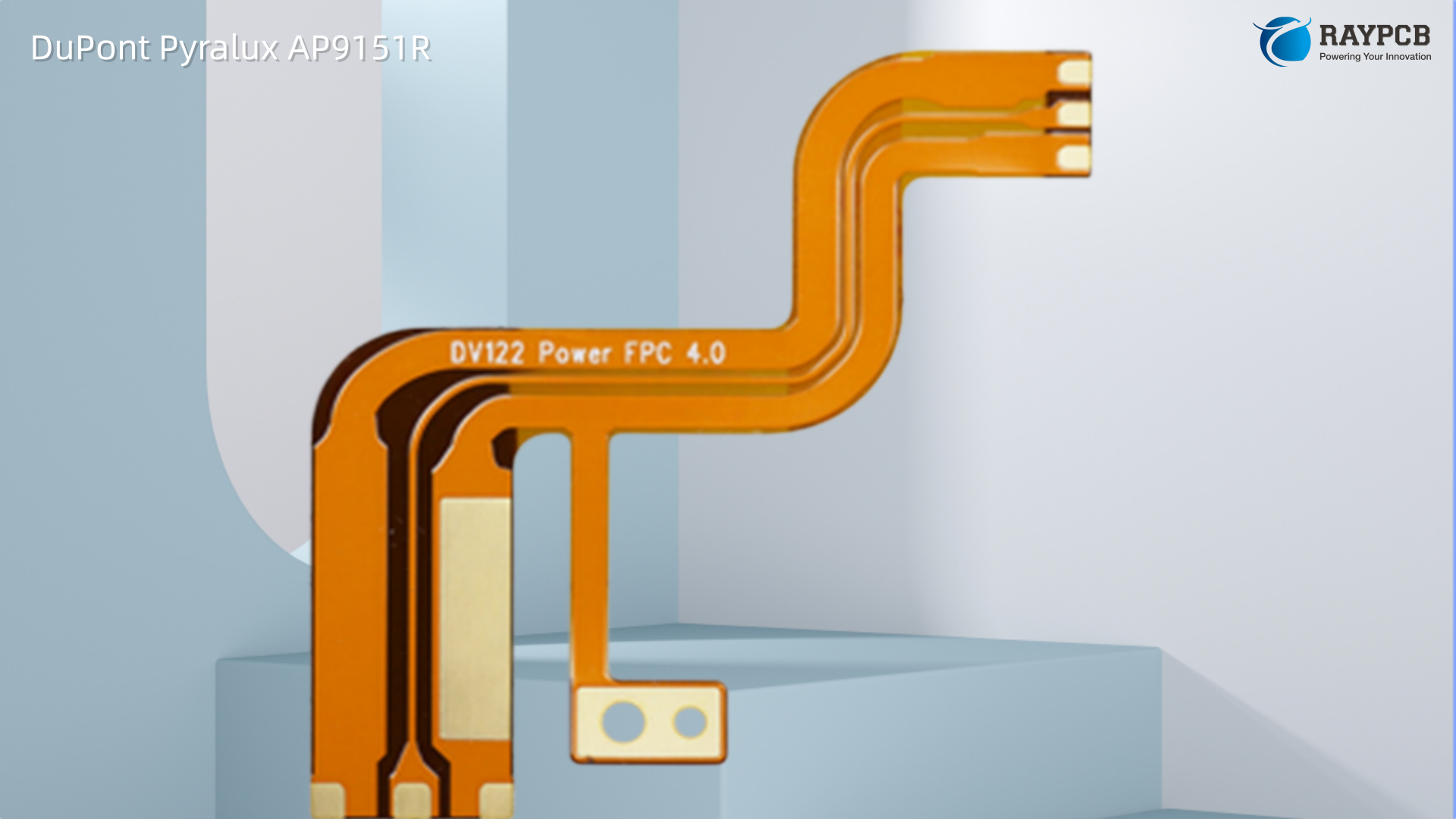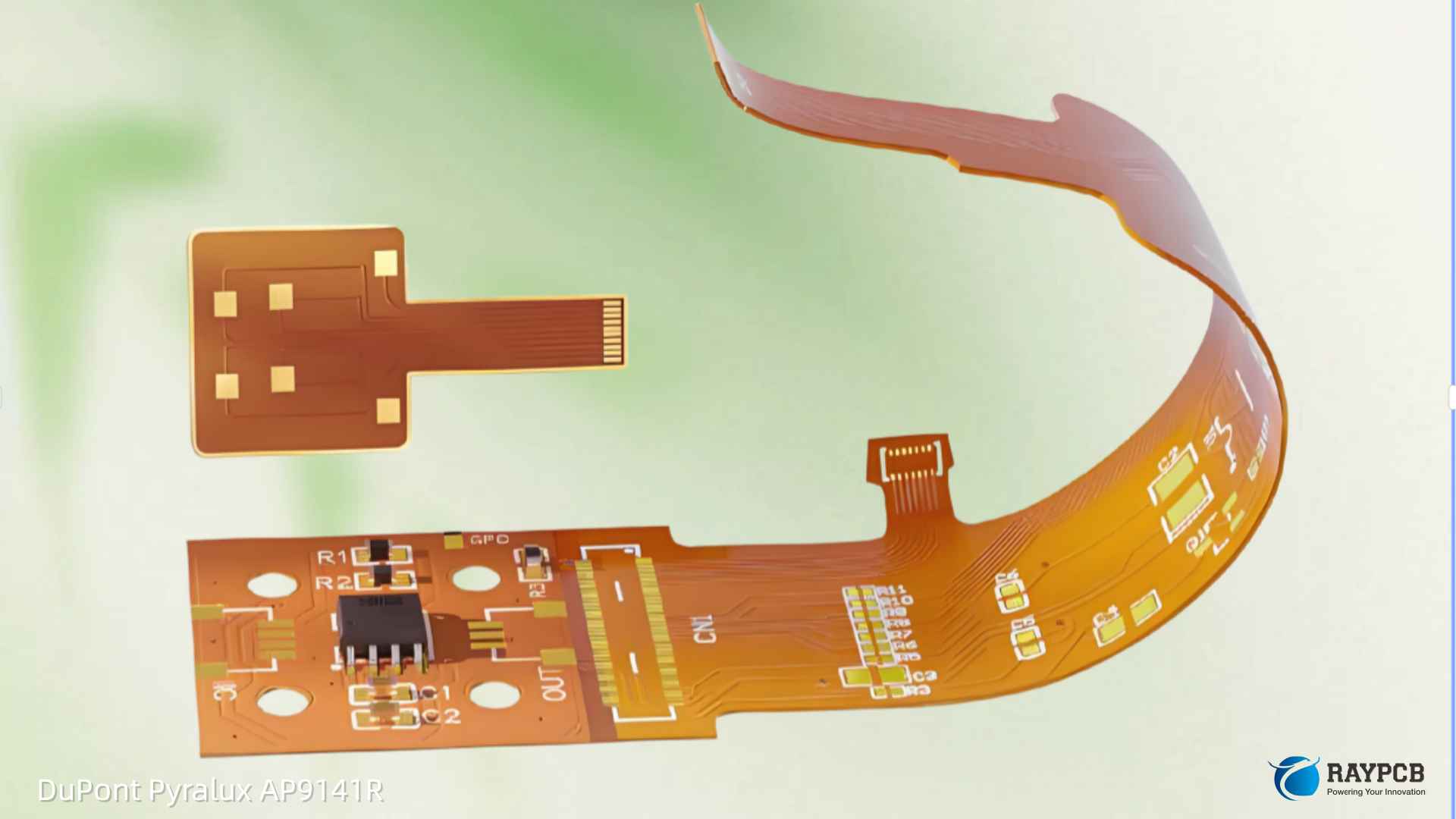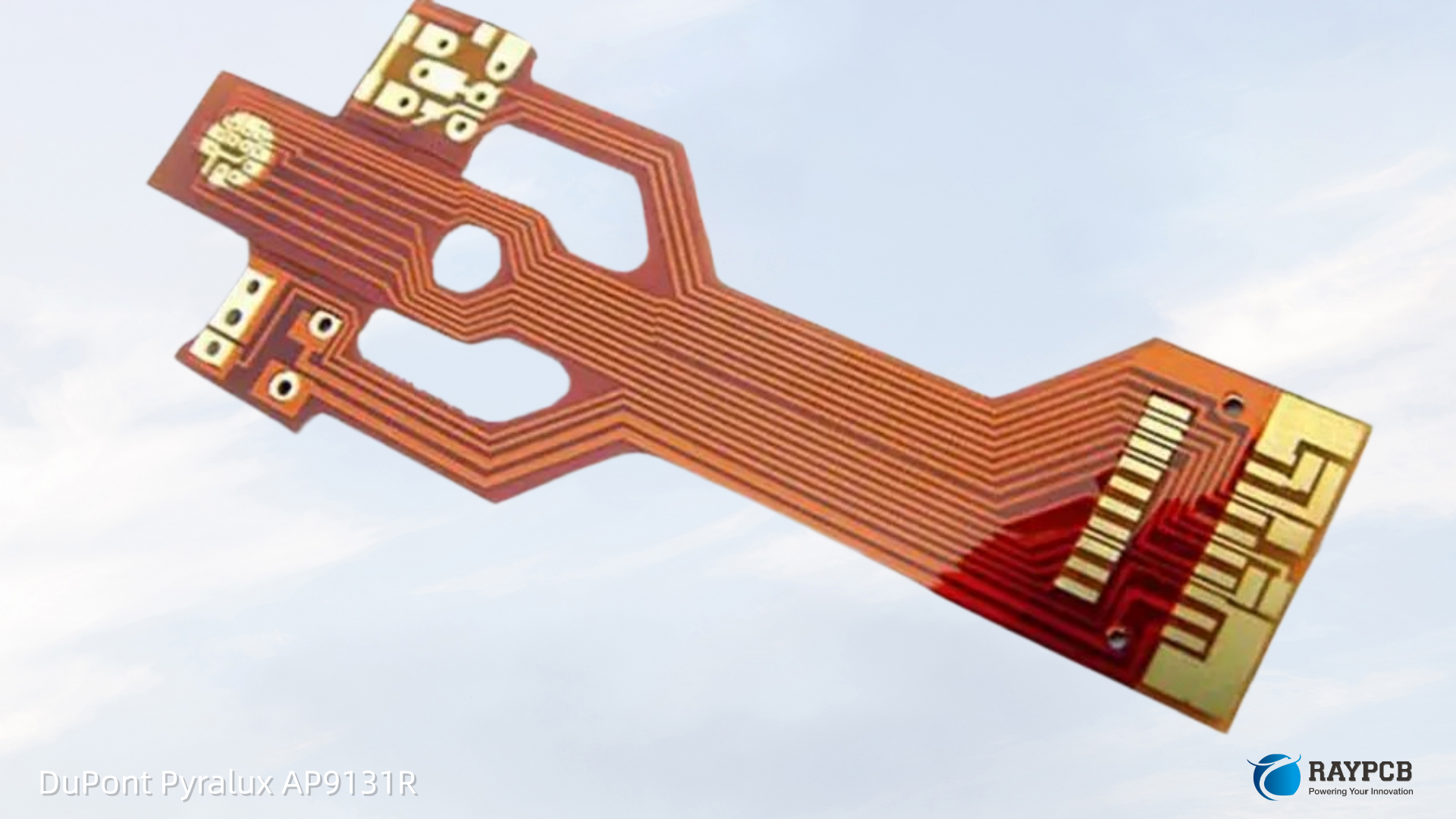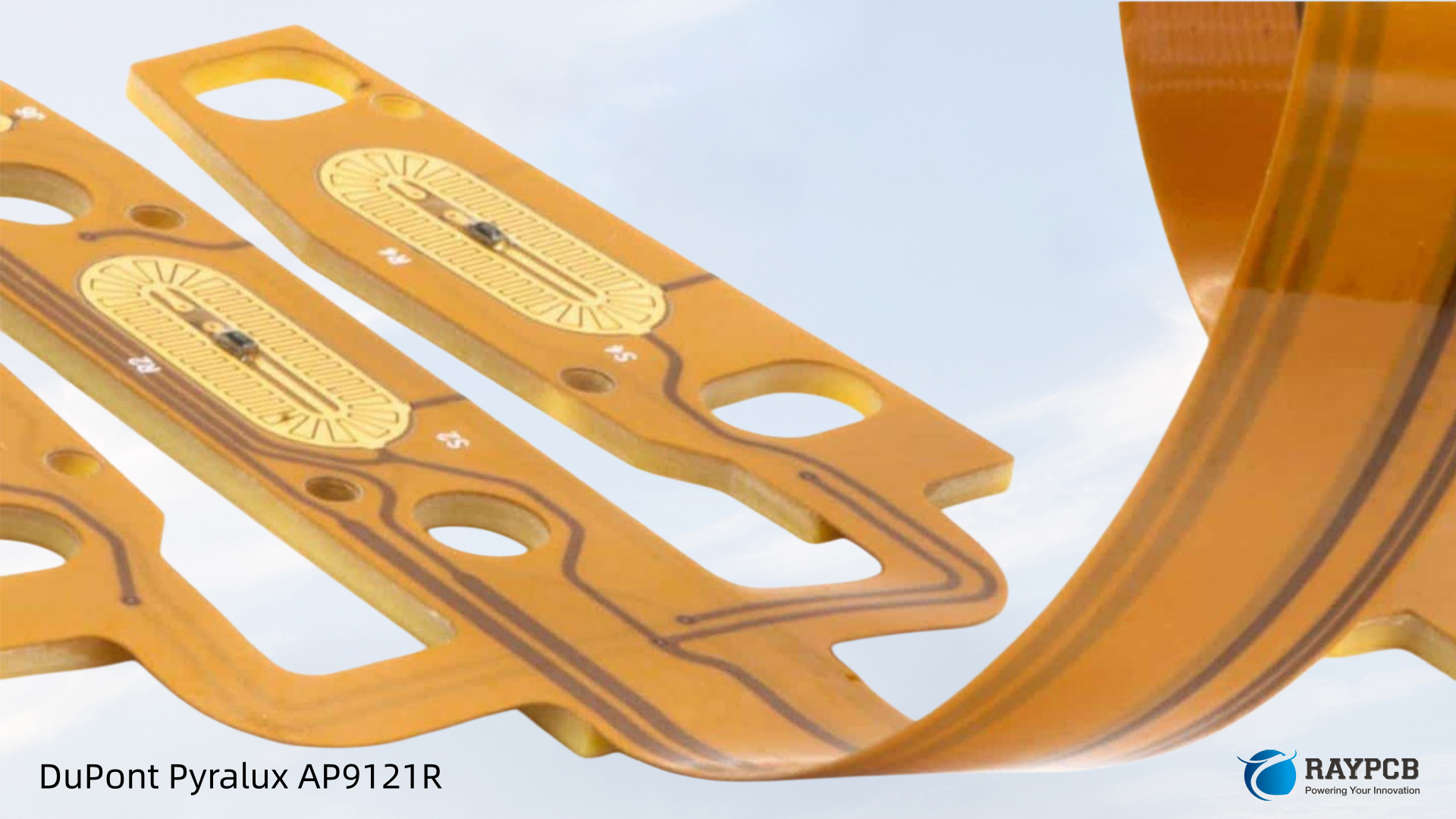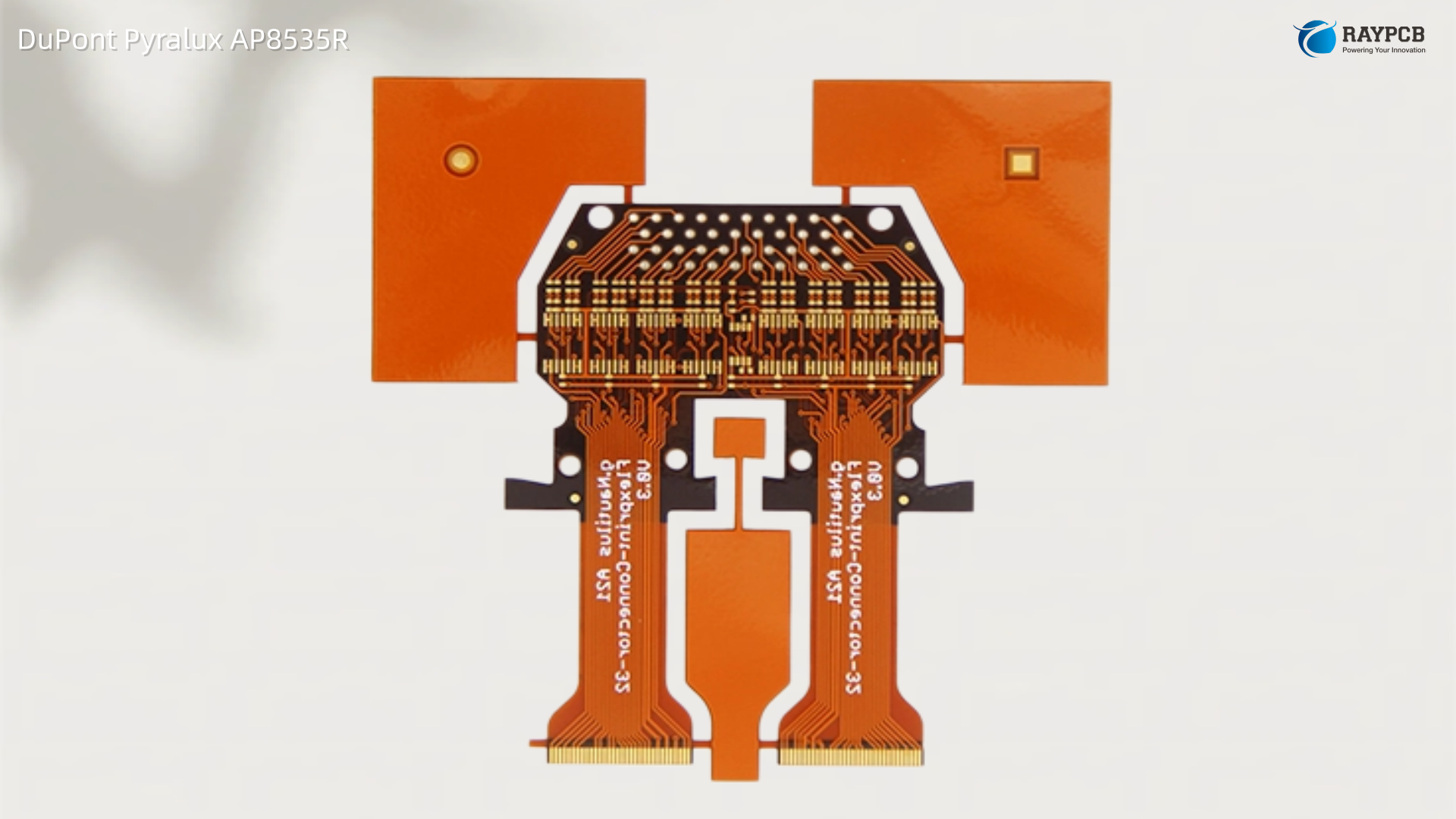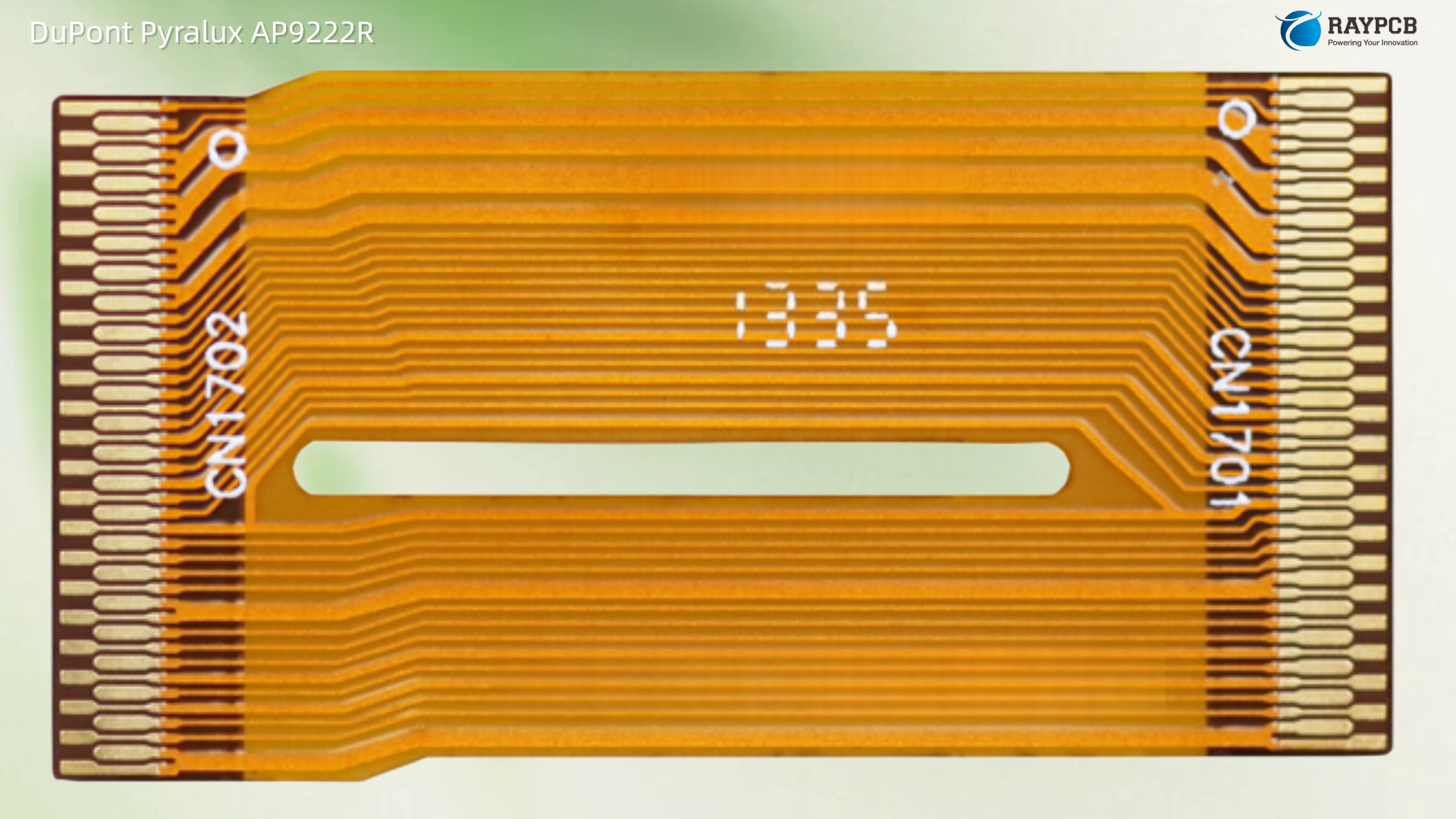
DuPont Pyralux AP9222R specs, design rules, and heavy copper flex circuit guide for PCB engineers. Complete coverage of 2 oz RA copper / 2 mil PI laminate: current capacity, bend radius tables, process notes, and competitor comparison. Essential reference for power flex design.
When most engineers think about flexible circuits, they picture fine-pitch signal traces on thin copper. DuPont Pyralux AP9222R flips that assumption. This laminate pairs 2 oz rolled annealed copper with a 2 mil all-polyimide dielectric — a combination that’s purpose-built for power-carrying flex circuits where thermal management, current capacity, and bend reliability all have to coexist in the same stackup.
If you’re designing a flex circuit that needs to deliver real current — battery interconnects, motor drive flex assemblies, power distribution in satellites, or high-current medical devices — AP9222R deserves a close look. This guide covers everything a working PCB engineer needs: the full spec table, design tradeoffs, stackup rules, process notes, and honest comparisons to alternative materials.
What Is DuPont Pyralux AP9222R?
DuPont Pyralux AP9222R is a single-sided, adhesiveless flexible copper-clad laminate from DuPont’s Pyralux AP (All-Polyimide) product family. It combines 2 oz (70 µm) rolled annealed copper directly bonded to a 2 mil (50 µm) polyimide film — with no acrylic or epoxy adhesive layer in between.
That adhesiveless construction is what puts it in a different class from older acrylic-adhesive flex laminates. Without a third material in the stack, you eliminate the weakest thermal link, the biggest source of Z-axis CTE mismatch, and the most likely layer to delaminate under thermal shock.
Pyralux AP9222R Part Number Decoded
| Code Element | Meaning |
| AP | Adhesiveless Pyralux (all-polyimide) |
| 9 | Single-sided construction |
| 2 | 2 oz copper (70 µm / 2.8 mil) |
| 2 | 2 mil (50 µm) polyimide dielectric |
| 2R | Rolled Annealed (RA) copper, second variant designation |
AP9222R = adhesiveless, single-sided, 2 oz RA copper, 2 mil PI core.
Full Technical Specifications for DuPont Pyralux AP9222R
| Property | Value | Test Standard |
| Copper Weight | 2 oz (70 µm / 2.8 mil) | — |
| Copper Type | Rolled Annealed (RA) | — |
| Dielectric Thickness | 2 mil (50 µm) | IPC-TM-650 2.2.2 |
| Total Laminate Thickness | ~4.8 mil (122 µm nominal) | — |
| Dielectric Material | Polyimide (Kapton®-based) | — |
| Dielectric Constant (Dk) | 3.4 @ 1 MHz | IPC-TM-650 2.5.5.3 |
| Dissipation Factor (Df) | 0.003 @ 1 MHz | IPC-TM-650 2.5.5.3 |
| Volume Resistivity | >10¹⁶ Ω·cm | IPC-TM-650 2.5.17 |
| Surface Resistivity | >10¹³ Ω | IPC-TM-650 2.5.17 |
| Dielectric Strength | >3,000 V/mil | IPC-TM-650 2.5.6 |
| Peel Strength (as received) | ≥ 6 lb/in (1.05 N/mm) | IPC-TM-650 2.4.9 |
| Dimensional Stability (MD/TD) | ≤ 0.10% | IPC-TM-650 2.2.4 |
| UL Flammability Rating | 94 V-0 | UL 796 |
| Operating Temp (continuous) | -65°C to +150°C | — |
| Solder Float (288°C, 10 sec) | Pass | IPC-TM-650 2.4.13 |
| Moisture Absorption | ≤ 2.0% | IPC-TM-650 2.6.2 |
| CTE (X/Y plane) | ~16–18 ppm/°C | — |
| Tg (Polyimide film) | >350°C | — |
| RoHS Compliant | Yes | — |
Why 2 oz Copper on a 2 mil PI Base Is a Unique Design Point
The combination of heavy copper and thin dielectric in AP9222R creates a specific set of tradeoffs that you don’t encounter with thinner copper grades. Understanding these is critical before you commit to this material.
Current Carrying Capacity Advantage
Two ounces of copper carries roughly twice the current of 1 oz copper at the same trace width, following IPC-2152 tables. For a 100 mil (2.54 mm) wide trace in free air with 2 oz copper, you’re looking at roughly 3.5–4.0 A with a 10°C temperature rise — a significant improvement over the ~2.5 A you’d get from the same trace in 1 oz.
This matters in applications like:
- Battery-to-BMS flex interconnects in EVs and portable electronics
- High-current motor control flex assemblies in robotics
- Power bus flex circuits in aerospace and satellite systems
- Implantable and wearable medical devices with tight thermal budgets
The Thin PI Dielectric Consideration
The 2 mil PI base is thinner than the more common 3 mil used in AP9131R. That has two consequences worth thinking through:
Good: Lower total circuit thickness for the same copper weight compared to a 3 mil PI build, which helps with bend radius targets and connector insertion profiles.
Watch out for: With 70 µm of copper sitting on only 50 µm of PI, the copper-to-dielectric thickness ratio is higher than in any other common AP grade. This means wrinkle and cockle management during fabrication requires tighter process control, and the circuit has less dielectric buffer against through-plane stress concentrations.
Heavy Copper Flex Design Rules for AP9222R
Designing with 2 oz copper on a flexible substrate introduces fabrication and reliability constraints that don’t show up in standard flex design guides. Here’s where to focus.
Minimum Trace Width and Spacing
Heavy copper etching requires compensating for increased undercut. In standard production with well-controlled spray etching, expect:
| Copper Weight | Practical Min Line/Space | Recommended Min Line/Space |
| 0.5 oz (18 µm) | 50 µm / 50 µm | 75 µm / 75 µm |
| 1 oz (35 µm) | 75 µm / 75 µm | 100 µm / 100 µm |
| 2 oz (70 µm) | 125 µm / 125 µm | 175 µm / 175 µm |
If your design requires features finer than 125 µm with 2 oz copper, discuss with your fabricator early. Some shops apply a width compensation factor of 0.5–1× the copper thickness to account for lateral etch.
Bend Radius Requirements for 2 oz RA Copper Flex
Heavy copper increases circuit stiffness, which directly drives minimum bend radius requirements. Using IPC-2223C as the baseline and adding practical engineering margin:
| Application Type | Bend Radius Multiplier | Approximate Bend Radius for AP9222R (4.8 mil base + 2 mil coverlay) |
| Static (one-time install) | 6× total thickness | ~0.04 in (1 mm) minimum |
| Dynamic (repeated, <100K cycles) | 15× | ~0.10 in (2.5 mm) |
| High-cycle dynamic (>100K cycles) | 25–30× | ~0.17 in (4.3 mm) |
Note that 2 oz copper makes AP9222R substantially stiffer than 1 oz alternatives. For high-cycle dynamic applications with 2 oz copper, some designers step down to 1 oz in the flex zone and fan out to 2 oz pads in the rigid termination areas — this is worth considering in your stackup before locking geometry.
Conductor Routing in Flex Zones
A few rules that matter more at 2 oz than at 1 oz:
Run traces parallel to the bend axis. At 2 oz, the stiffness of perpendicular conductors creates localized stress risers at the bend radius that accelerate fatigue cracking.
Avoid 90° corners in flex zones. Use curved or 45° transitions. This applies at any copper weight but becomes critical at 2 oz where stress concentration at sharp corners is amplified.
Use teardrop reliefs on all pads in or near the flex zone. The larger copper mass at 2 oz increases the stress discontinuity between pad and trace.
Avoid filled vias in the dynamic bend zone. Via barrels crack before copper traces do in dynamic flex. If you need vias near the flex zone, place them in a strain-relief transition region, not in the active bend area.
Processing AP9222R: What Your Fab Shop Needs to Know
Working with DuPont PCB adhesiveless laminates like AP9222R requires process adjustments compared to acrylic-adhesive flex or standard FR-4. Here are the key ones to communicate to your fabricator.
Pre-Bake Before Imaging
Polyimide is hygroscopic. Before laminating dry film resist, bake AP9222R at 120°C for 30–60 minutes to drive off absorbed moisture. Skipping this step leads to poor dry-film adhesion, pinholes, and etch bridging — especially problematic with 2 oz copper where the resist is carrying more lateral etch load.
Etch Compensation
At 2 oz copper, etch factor (ratio of vertical to lateral etch depth) drops compared to lighter copper weights. Plan to add 0.5–0.7× the copper thickness as width bias to your photo tools. Work with your fab to confirm their specific etch compensation factor before releasing artwork.
Coverlay Bonding Conditions
All-polyimide AP9222R pairs best with PI-based coverlay film (DuPont Pyralux PC or LF series). Typical lamination conditions for PI coverlay over AP9222R: 175°C at 300–400 PSI for 60–90 minutes in a hydraulic press. The 2 oz copper’s surface topography requires higher pressure than 1 oz builds to achieve full void-free coverlay adhesion.
Thermal Relief on Heavy Copper Pads
At 2 oz, large copper pads act as significant heat sinks during soldering. Add thermal relief spokes on any through-hole pad in rigid termination areas. For surface-mount pads on heavy copper, verify your reflow profile can sustain peak temperature long enough to reflow paste against the thermal mass.
DuPont Pyralux AP9222R vs. Competing Heavy Copper Flex Laminates
| Material | Supplier | Cu Weight | PI Thickness | Adhesive-Free | Key Differentiator |
| AP9222R | DuPont | 2 oz | 2 mil | Yes | Broad market availability, UL 94 V-0 |
| AP9231R | DuPont | 2 oz | 3 mil | Yes | Thicker PI for better dimensional stability |
| Espanex M-Series (2 oz) | Nippon Steel | 2 oz | 2–3 mil | Yes | Strong position in Asian supply chain |
| UPILEX-S Laminate | Ube/Mitsui | 2 oz | 2 mil | Yes | Extremely low CTE PI film |
| Panasonic FELIOS (2 oz) | Panasonic | 2 oz | 2–3 mil | Yes | Fine-pitch optimized surface |
| Shengyi SH260 flex | Shengyi | 2 oz | 2 mil | No (acrylic) | Lower cost, reduced thermal performance |
The choice between AP9222R (2 mil PI) and AP9231R (3 mil PI at 2 oz) often comes down to total thickness budget versus dimensional stability. The extra mil of PI in AP9231R adds stiffness, which can actually help with registration accuracy on fine-pitch builds — but adds ~25 µm to your total circuit thickness.
Thermal Management Advantages of All-Polyimide Heavy Copper Flex
The adhesiveless construction of AP9222R pays dividends specifically in thermal applications. Acrylic adhesive layers in conventional flex laminates have thermal conductivity around 0.15–0.20 W/m·K — a meaningful bottleneck when you’re trying to conduct heat through the laminate stack.
PI film thermal conductivity is in a similar range (~0.12 W/m·K), but eliminating the adhesive layer removes an interface resistance and reduces total dielectric thickness in the thermal path. Combined with 2 oz copper’s excellent in-plane thermal spreading (~385 W/m·K for copper), AP9222R can function as both a current carrier and a lateral heat spreader — a useful dual function in constrained assemblies.
Useful Resources and Datasheet Links
| Resource | What It Covers | Where to Find It |
| DuPont Pyralux AP Product Family Page | Full AP series overview, ordering info | dupont.com/pyralux-ap |
| DuPont Pyralux AP9222R Datasheet | Detailed specs with test method references | DuPont Product Finder |
| IPC-2223C Sectional Design Standard | Flex and rigid-flex PCB design rules | IPC.org |
| IPC-2152 Current Capacity Standard | Updated current-carrying capacity tables | IPC.org |
| IPC-6013 Qualification & Performance | Reliability and acceptance criteria for flex | IPC.org |
| IPC-TM-650 Test Methods Manual | All referenced laminate test methods | IPC.org/TM |
| UL Product iQ (UL 796) | Verify V-0 flammability listing | iq.ul.com |
Frequently Asked Questions About DuPont Pyralux AP9222R
Q1: Is AP9222R suitable for dynamic flex applications, or is 2 oz copper too stiff?
It depends on your bend geometry. Two oz RA copper does reduce flex endurance versus 1 oz at the same bend radius. However, RA copper’s grain structure still gives it significantly better fatigue life than ED copper of the same weight. For moderate-cycle dynamic applications (tens of thousands of cycles) with a generous bend radius — at least 15× total circuit thickness — AP9222R works. For millions of cycles with tight bend radii, consider stepping down to 1 oz copper in the active flex zone and using 2 oz only in the stiffened termination areas.
Q2: Can AP9222R be used for RF/microwave flex circuits?
The Dk of 3.4 and Df of 0.003 at 1 MHz are reasonable but not optimized for high-frequency RF applications. At microwave frequencies (>5 GHz), loss tangent rises and the all-PI construction — while better than acrylic-adhesive laminates — is not in the same class as PTFE-based flex substrates like Rogers ULTRALAM or DuPont’s own Pyralux TK series. Use AP9222R for power distribution and low-frequency signal routing; use RF-optimized substrates for transmission line structures above ~1 GHz.
Q3: What surface finishes work best with AP9222R for heavy copper flex?
ENIG (Electroless Nickel Immersion Gold) is the most common choice. The flat, solderable surface is critical for coverlay bonding registration and fine-pitch soldering. Immersion silver works well for cost-sensitive programs but has a shorter shelf life. Avoid HASL on heavy copper flex — the uneven surface topography on 2 oz pads causes coverlay adhesion voids and creates solder bridging risks on fine-pitch patterns. OSP is acceptable for single-reflow processes but check compatibility with your assembly thermal profile.
Q4: How does moisture absorption affect AP9222R during PCB fabrication?
Polyimide absorbs moisture from ambient air, and 2 oz copper makes the problem more consequential because absorbed moisture trapped under the copper during press lamination or soldering can cause blistering or delamination. Store AP9222R rolls in sealed packaging at <60% RH. After opening, process within 24 hours or re-bake at 120°C for 60 minutes before use. This is non-negotiable for high-reliability builds.
Q5: Does AP9222R qualify for aerospace and military programs?
Yes, AP9222R meets the material requirements referenced in IPC-6013 Class 3 (highest reliability tier) and is used across aerospace, defense, and satellite programs. For MIL-spec programs, verify that AP9222R appears on the applicable QPL or your prime contractor’s Approved Materials List. Some programs require lot traceability documentation from DuPont, which is available through authorized distributors. Always verify the specific procurement specification for your program rather than assuming broad aerospace approval.
Meta Description Suggestion:
DuPont Pyralux AP9222R specs, design rules, and heavy copper flex circuit guide for PCB engineers. Complete coverage of 2 oz RA copper / 2 mil PI laminate: current capacity, bend radius tables, process notes, and competitor comparison. Essential reference for power flex design.
Word count: ~1,550 words | Primary keyword: DuPont Pyralux AP9222R | Secondary keywords: heavy copper flex laminate, 2 oz RA copper flex, adhesiveless polyimide laminate, Pyralux AP series, power flex circuit design