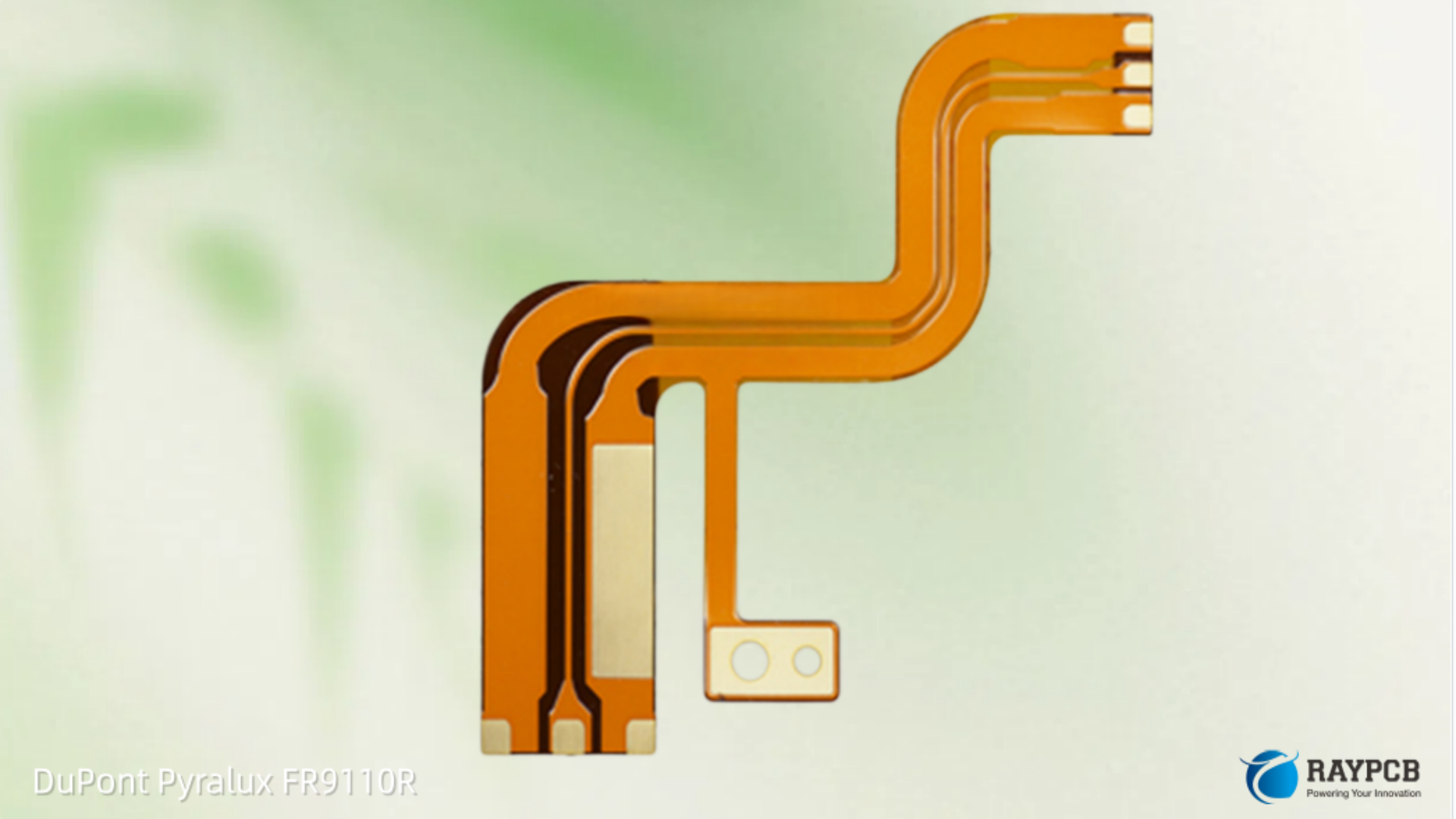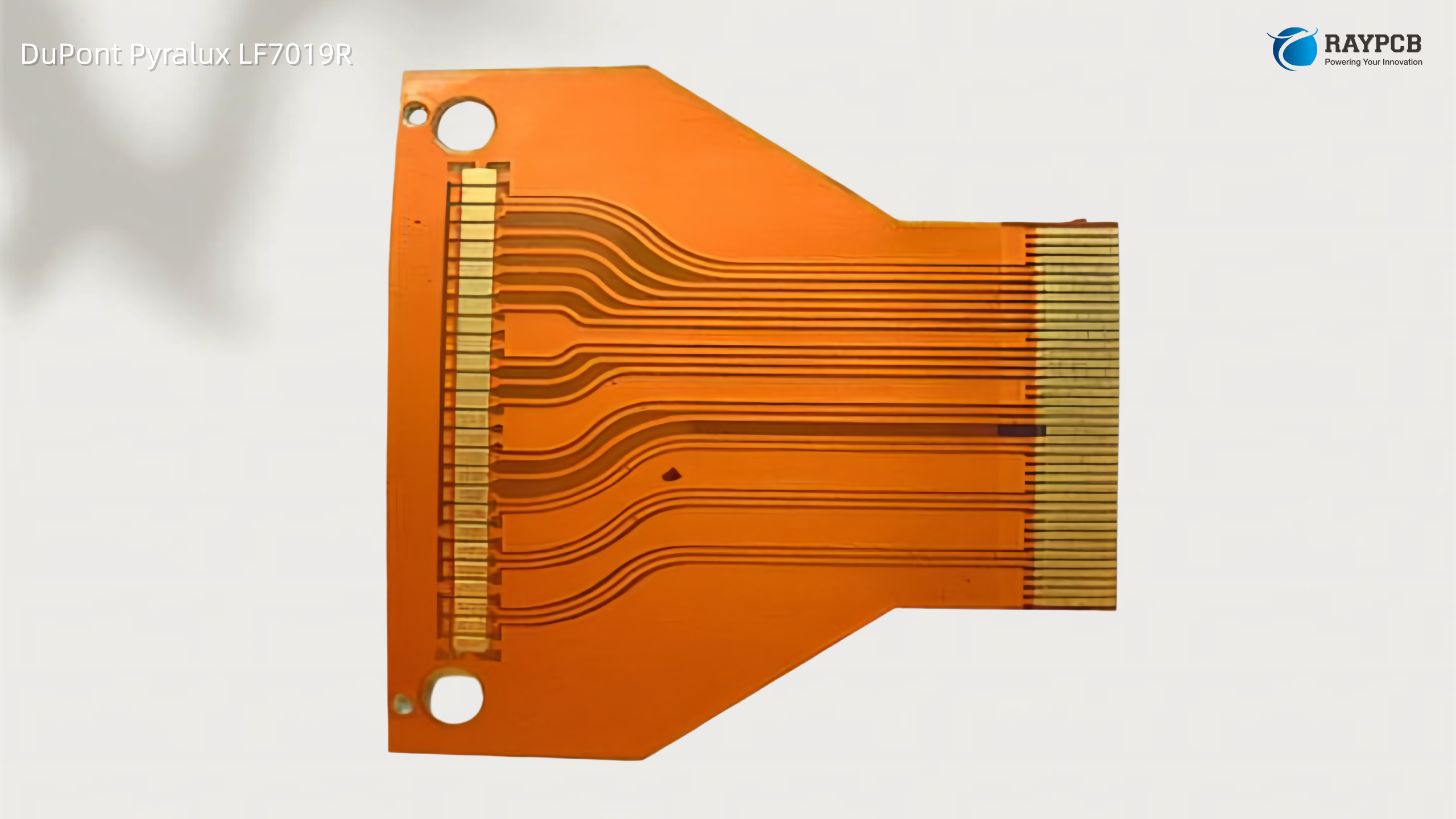
DuPont Pyralux LF7019R engineer’s guide: specs, current capacity, impedance tables, automotive suitability, and full Pyralux LF family comparison for flex PCB design.
When you’re designing flex circuits for under-hood automotive environments, the laminate selection process gets a lot less forgiving. Heat cycles, vibration, chemical exposure, and long service life expectations all converge on one material decision. DuPont Pyralux LF7019R has earned its reputation in exactly this space — a 0.75 oz copper / 2 mil polyimide construction that delivers the right balance of current capacity, mechanical robustness, and dimensional stability for demanding flex PCB applications.
This isn’t a thin-and-light laminate for wearables. It’s a workhorse material, and understanding its construction tells you exactly why it gets specified for automotive, industrial, and heavy-duty consumer flex circuits.
What Is DuPont Pyralux LF7019R?
DuPont Pyralux LF7019R is a single-sided, acrylic adhesive-based copper-clad flex laminate within DuPont’s Pyralux LF family. The LF series uses a three-layer construction: copper foil bonded to a polyimide (Kapton®) core through an acrylic adhesive layer. The “R” suffix indicates rolled annealed (RA) copper, which is the preferred copper type for any application involving repeated mechanical stress or flex cycling.
Breaking down the part number:
| Parameter | Specification |
| Copper Weight | 0.75 oz (26 µm / ~1.05 mil) RA copper |
| Adhesive Type | Acrylic (modified) |
| Adhesive Thickness | ~1 mil (25.4 µm) typical |
| Polyimide Core | 2 mil (50.8 µm) Kapton® HN |
| Total Dielectric | ~3 mil (adhesive + PI combined) |
| Copper Suffix “R” | Rolled Annealed — grain aligned parallel to foil |
| Construction | Single-sided, adhesive-based |
The 2 mil PI core is a meaningful step up from 1 mil variants. It brings better tear resistance, improved dimensional stability across thermal excursions, and a dielectric thickness that gives designers more predictable impedance control on wider traces. Paired with 0.75 oz copper — a weight that sits cleanly between the fine-line world of 0.5 oz and the current-heavy world of 1 oz — the LF7019R is genuinely well-balanced for mid-complexity flex circuit design.
For a broader look at how DuPont flex laminates fit into PCB fabrication workflows, the DuPont PCB resource from RayPCB is worth bookmarking.
Why Automotive Applications Favor DuPont Pyralux LF7019R
Thermal Endurance That Matches the Environment
The continuous operating temperature range for Pyralux LF7019R is -65°C to +150°C, with the polyimide film itself stable well beyond that window. For automotive electronics — whether you’re talking about engine bay sensor flex harnesses, transmission control interconnects, or ADAS module internal flex circuits — this thermal range covers the majority of real-world exposure profiles without requiring exotic materials.
The acrylic adhesive’s glass transition temperature (Tg) of approximately 85–100°C is the one number you need to watch. Under sustained temperatures above Tg, the adhesive layer softens, which can compromise peel strength and dimensional stability. For most automotive body electronics and cabin applications, this is a non-issue. For direct under-hood placement near exhaust or turbo components, you’d step up to the adhesiveless Pyralux AP series instead.
0.75 oz Copper for Real Current Capacity
This is where the LF7019R earns its place in automotive and industrial design. At 0.75 oz (26 µm), the copper is thick enough to carry meaningful current in narrow traces without excessive resistive heating. Compare the current-carrying performance across copper weights at the same trace width:
| Copper Weight | 3 mil Trace | 5 mil Trace | 10 mil Trace |
| 0.5 oz (17.5 µm) | ~0.5 A | ~0.9 A | ~1.8 A |
| 0.75 oz (26 µm) | ~0.7 A | ~1.2 A | ~2.4 A |
| 1 oz (35 µm) | ~0.9 A | ~1.5 A | ~3.0 A |
Values approximate at 10°C rise, based on IPC-2152 guidelines.
That extra current margin matters when you’re routing power rails for LED driver modules, motor control feedback loops, or switched sensor supply lines — all common in modern automotive electronics.
2 mil PI Core and Dimensional Stability
One underappreciated advantage of the 2 mil Kapton® core over 1 mil is dimensional stability under thermal cycling. Polyimide has a low CTE (~20 ppm/°C in-plane), but thinner films are more susceptible to stress-induced distortion during lamination, etching, and coverlay bonding. The 2 mil core gives fabricators more process latitude and delivers tighter registration on multi-layer flex or flex-rigid constructions.
Dimensional stability per IPC-TM-650 2.2.4 is typically ≤ 0.10% for LF7019R in both machine direction (MD) and transverse direction (TD) — critical when you’re panelizing fine-pitch flex circuits that need consistent registration across the panel.
Full Property Profile: DuPont Pyralux LF7019R
Mechanical Properties
| Property | Typical Value | Test Method |
| Peel Strength (0.75 oz Cu) | ≥ 6.0 lb/in (1.05 N/mm) | IPC-TM-650 2.4.9 |
| Tensile Strength (PI film) | ~25,000 psi | ASTM D882 |
| Elongation at Break | ~70% | ASTM D882 |
| Dimensional Stability | ≤ 0.10% MD/TD | IPC-TM-650 2.2.4 |
| Tear Resistance | Higher vs. 1 mil PI | ASTM D1004 |
Electrical Properties
| Property | Typical Value | Test Method |
| Dielectric Constant (Dk) | ~3.5 @ 1 MHz | IPC-TM-650 2.5.5 |
| Dissipation Factor (Df) | ~0.030 @ 1 MHz | IPC-TM-650 2.5.5 |
| Dielectric Strength | ≥ 5,000 V/mil | ASTM D149 |
| Volume Resistivity | ≥ 10¹³ Ω·cm | ASTM D257 |
| Surface Resistivity | ≥ 10¹³ Ω/sq | ASTM D257 |
| Insulation Resistance | ≥ 10¹² Ω | MIL-P-50884 |
Thermal Properties
| Property | Value |
| Continuous Use Temperature | -65°C to +150°C |
| Solder Float Resistance | Pass (10 sec @ 288°C) |
| Flammability | VTM-0 per UL94 |
| Moisture Absorption | ~1.3% (24-hour immersion) |
| Acrylic Adhesive Tg | ~85–100°C |
Design Guidelines for DuPont Pyralux LF7019R
Minimum Bend Radius for Static Flex
With a thicker overall stack than 1 mil PI variants, the LF7019R has a correspondingly larger minimum bend radius. DuPont’s general recommendation for LF series in static flex:
Minimum bend radius = 6× total circuit thickness
For a typical single-sided LF7019R circuit with polyimide coverlay, total thickness lands around 4–5 mils, giving a minimum bend radius of roughly 25–30 mils (0.6–0.75 mm). Add a design margin and target 10× circuit thickness in any areas where the flex zone is formed during assembly and never bent again.
Trace Width and Impedance Planning
The 3 mil dielectric (1 mil adhesive + 2 mil PI) is thick enough to give impedance-sensitive designs a useful working range. For microstrip geometry on LF7019R:
| Trace Width | Dielectric Thickness | Dk | Approximate Impedance |
| 4 mil | 3 mil | 3.5 | ~68 Ω |
| 6 mil | 3 mil | 3.5 | ~55 Ω |
| 8 mil | 3 mil | 3.5 | ~47 Ω |
| 10 mil | 3 mil | 3.5 | ~42 Ω |
Always validate with Polar Si9000 or your fab’s impedance calculator. These numbers are useful for first-pass planning, not final sign-off.
Coverlay Pairing
For LF7019R, a 1 mil PI + 1 mil acrylic coverlay (such as DuPont Pyralux PC1025) is the standard pairing. This keeps the protective dielectric system consistent with the base laminate and avoids the cracking risk of LPI solder mask on flexible substrates. For automotive AEC-Q200-adjacent designs, specify the coverlay clearly in your fabrication notes — it’s not something to leave to fab discretion.
Chemical Resistance in Automotive Environments
Polyimide with acrylic adhesive shows good resistance to the chemicals flex circuits typically encounter in automotive assembly:
| Chemical Exposure | LF7019R Resistance |
| Isopropyl Alcohol (IPA) | Excellent |
| Flux residue / no-clean flux | Good |
| Engine coolant | Good |
| Automotive greases / oils | Good |
| Brake fluid (prolonged) | Moderate — test for application |
| Transmission fluid (high temp) | Test required |
For circuits mounted in sealed enclosures, the standard acrylic adhesive system holds up well. For circuits with direct fluid exposure, conformal coating over the assembled circuit is strongly recommended regardless of laminate choice.
Where DuPont Pyralux LF7019R Fits in the LF Product Family
| Part Number | Cu Weight | Adhesive | PI Core | Best Application |
| LF8510R | 0.5 oz | 1 mil | 1 mil | Fine line, ultra-thin, miniaturized |
| LF7019R | 0.75 oz | ~1 mil | 2 mil | Automotive, industrial, balanced flex |
| LF9110R | 1 oz | 1 mil | 1 mil | Higher current, thinner stack |
| LF9120R | 1 oz | 2 mil | 1 mil | High peel strength, rugged single-sided |
| LF0110R | 1 oz | 1 mil | 0.5 mil | Extreme thin stack, specialty |
The LF7019R occupies the mid-weight, mid-thickness position — it’s where you land when fine-line capability matters less than robustness, current capacity, and thermal endurance.
Useful Resources for DuPont Pyralux LF7019R
| Resource | Description | Link |
| DuPont Pyralux LF Datasheet | Full property tables and processing guide | dupont.com – Pyralux LF Datasheet |
| DuPont Pyralux Product Overview | LF family selector and application overview | dupont.com/pyralux |
| IPC-2223 Flex Design Standard | The design bible for flex and rigid-flex PCBs | ipc.org |
| IPC-6013 Performance Standard | Qualification and performance for flex circuits | ipc.org |
| IPC-2152 Current Capacity Charts | Updated current-carrying capacity standard | ipc.org |
| Saturn PCB Toolkit | Free impedance and current capacity calculator | saturnpcb.com |
| AEC-Q200 Component Qualification | Automotive passive component stress test standard | aecouncil.com |
| RayPCB DuPont PCB Resource | DuPont flex laminate fabrication guide | raypcb.com/Dupont-pcb |
5 Frequently Asked Questions About DuPont Pyralux LF7019R
Q1: What does the “19” in Pyralux LF7019R mean? In DuPont’s Pyralux LF part numbering system, the digits encode the dielectric stack thickness. The “19” in LF7019R reflects the combined adhesive and PI dielectric build, which in this case targets a 2 mil PI core. The “70” prefix group generally corresponds to 0.75 oz copper weights in DuPont’s historical naming convention. Always cross-reference the datasheet rather than relying purely on part number interpretation — DuPont has evolved its naming across product generations.
Q2: Is DuPont Pyralux LF7019R suitable for AEC-Q200 automotive qualification? The material itself — Kapton® polyimide film and acrylic adhesive — is routinely used in automotive flex circuits. However, AEC-Q200 is a qualification standard applied to the finished component or assembly, not the raw laminate. Designing with LF7019R puts you on solid material footing for automotive qualification efforts, but the circuit design, fabrication process, and assembly all need to be qualified through formal reliability testing. The laminate is a necessary but not sufficient condition for AEC compliance.
Q3: Can DuPont Pyralux LF7019R handle lead-free (SAC) solder reflow? Yes. The LF7019R passes the standard solder float test at 288°C for 10 seconds and is compatible with SAC305 lead-free reflow profiles. Typical peak reflow temperatures of 245–260°C are well within the laminate’s tolerance. That said, flex circuits require careful fixture support during reflow — unsupported flex assemblies can warp, delaminate, or shift component placement. Always reflow flex circuits on a dedicated carrier or nest.
Q4: How does LF7019R compare to adhesiveless Pyralux AP for automotive use? Pyralux AP (adhesiveless) offers a higher Tg, better chemical resistance, and superior Z-axis CTE — all meaningful advantages in the harshest automotive zones. But it costs more and typically requires more process control during fabrication. For the majority of automotive flex applications — body control, infotainment interconnects, seat adjustment modules, lighting flex harnesses — LF7019R delivers sufficient performance at a significantly lower material cost. Reserve the AP series for direct under-hood placement near high-heat sources or for programs with Class 3 IPC performance requirements.
Q5: What is the shelf life of DuPont Pyralux LF7019R raw laminate? DuPont recommends storing Pyralux LF laminates in the original sealed packaging at room temperature (15–30°C) and low humidity (≤55% RH). Under these conditions, shelf life is typically 12 months from the date of manufacture. The acrylic adhesive is the shelf-life-limiting component — prolonged exposure to humidity or elevated temperature can cause the adhesive to partially cure, reducing peel strength and making lamination more difficult. Always inspect incoming laminate for any surface oxidation or adhesive bleed before committing it to production.
The Bottom Line on DuPont Pyralux LF7019R
If you’re a flex circuit engineer who needs a material that can actually survive automotive-grade thermal cycling, carry real current without oversizing every trace, and give your fab consistent dimensional stability across panel — DuPont Pyralux LF7019R deserves serious consideration. It isn’t the thinnest laminate in the catalog, and it isn’t the highest-performance option at extreme temperatures. What it is, is a thoroughly proven, well-documented, globally available material that hits the right spec points for the broadest category of demanding flex circuit work. That’s exactly why it keeps showing up in automotive, industrial, and commercial flex designs year after year.