Motor Start & Motor Run Capacitor: What’s the Difference?

Learn the key differences between a motor start capacitor and a motor run capacitor โ€” including specs, sizing formulas, replacement rules, testing methods, and failure symptoms โ€” with comparison tables and a full FAQ.

If you’ve ever replaced a capacitor on an HVAC compressor, a pool pump motor, or an industrial fan โ€” and stared at two physically similar cans wondering which is which โ€” this guide is for you. A motor start capacitor and a motor run capacitor look alike from the outside. They’re both cylindrical, both measured in microfarads (ยตF), and both connected to motor windings. But they do completely different jobs, operate under completely different electrical conditions, and swapping one for the other is a guaranteed way to kill your motor fast.

This article breaks down everything you actually need to know โ€” the physics behind each type, the specifications that matter, how to size a replacement, how to test one under load, and what failure looks like before it takes the motor with it.

Why Single-Phase Motors Need Capacitors at All

Before getting into the differences, it helps to understand why capacitors are in the circuit in the first place. Three-phase motors generate a naturally rotating magnetic field because three voltage phases arrive at 120ยฐ intervals. Single-phase AC motors don’t have that luxury โ€” they only have one voltage waveform, which means the magnetic field it creates simply pulsates back and forth. Left alone, a single-phase induction motor will hum and vibrate in place but won’t self-start. Give it a physical spin in the right direction and it will run, but it can’t generate starting torque on its own.

The engineering fix is to add a second winding โ€” the auxiliary or start winding โ€” and to feed it with a phase-shifted current. A capacitor creates that phase shift by leading or lagging the current relative to the main winding. The result is two magnetic fields that peak at different times, effectively simulating the rotating field of a three-phase motor long enough to get the rotor spinning. Once spinning, the rotor can sustain itself on the main winding’s alternating field through induction.

That one sentence โ€” long enough to get the rotor spinning โ€” is where motor start and motor run capacitors diverge fundamentally.

What Is a Motor Start Capacitor?

A motor start capacitor is an electrolytic capacitor designed to provide a large burst of capacitance for a very short duration โ€” typically only a few seconds โ€” to generate the high starting torque required to bring the motor up to speed from a dead stop.

How a Motor Start Capacitor Works

When power is applied, the start capacitor is in series with the auxiliary winding. The high capacitance value creates a large phase shift โ€” ideally approaching 90ยฐ between main and auxiliary winding currents โ€” which produces the maximum possible starting torque. Some motor designs achieve starting torques as high as 300% of full-load running torque.

Once the motor reaches approximately 75% of its rated full speed, a centrifugal switch mounted on the motor shaft opens and disconnects the start capacitor from the circuit. At that point the motor is running fast enough for the rotor’s induction to sustain rotation without it.

The centrifugal switch is critical. If the switch fails in the open position, the start capacitor never enters the circuit and the motor won’t start. If it fails closed, the start capacitor stays energized continuously โ€” and because it’s built for intermittent duty only, it will overheat and fail catastrophically, often blowing its top off entirely.

Motor Start Capacitor Specifications

SpecificationTypical RangeNotes
Capacitance70 ยตF โ€“ 1,200 ยตFAlways above 70 ยตF; given as a range (e.g., 88โ€“108 ยตF)
Voltage ratings125 V, 165 V, 250 V, 330 VACMatch or exceed original rating
ConstructionAluminum electrolyticNon-polarized; handles short duty only
Duty cycleIntermittent (seconds)Will fail if energized continuously
CaseBlack plastic, roundTypically 50โ€“60 Hz rated
Toleranceยฑ10%Wider tolerance acceptable for starting

One key identifier: start capacitor values are always expressed as a range (e.g., 88โ€“108 ยตF at 250 VAC), because the starting torque requirement is forgiving within that window. A run capacitor, by contrast, is always a fixed single value.

What Is a Motor Run Capacitor?

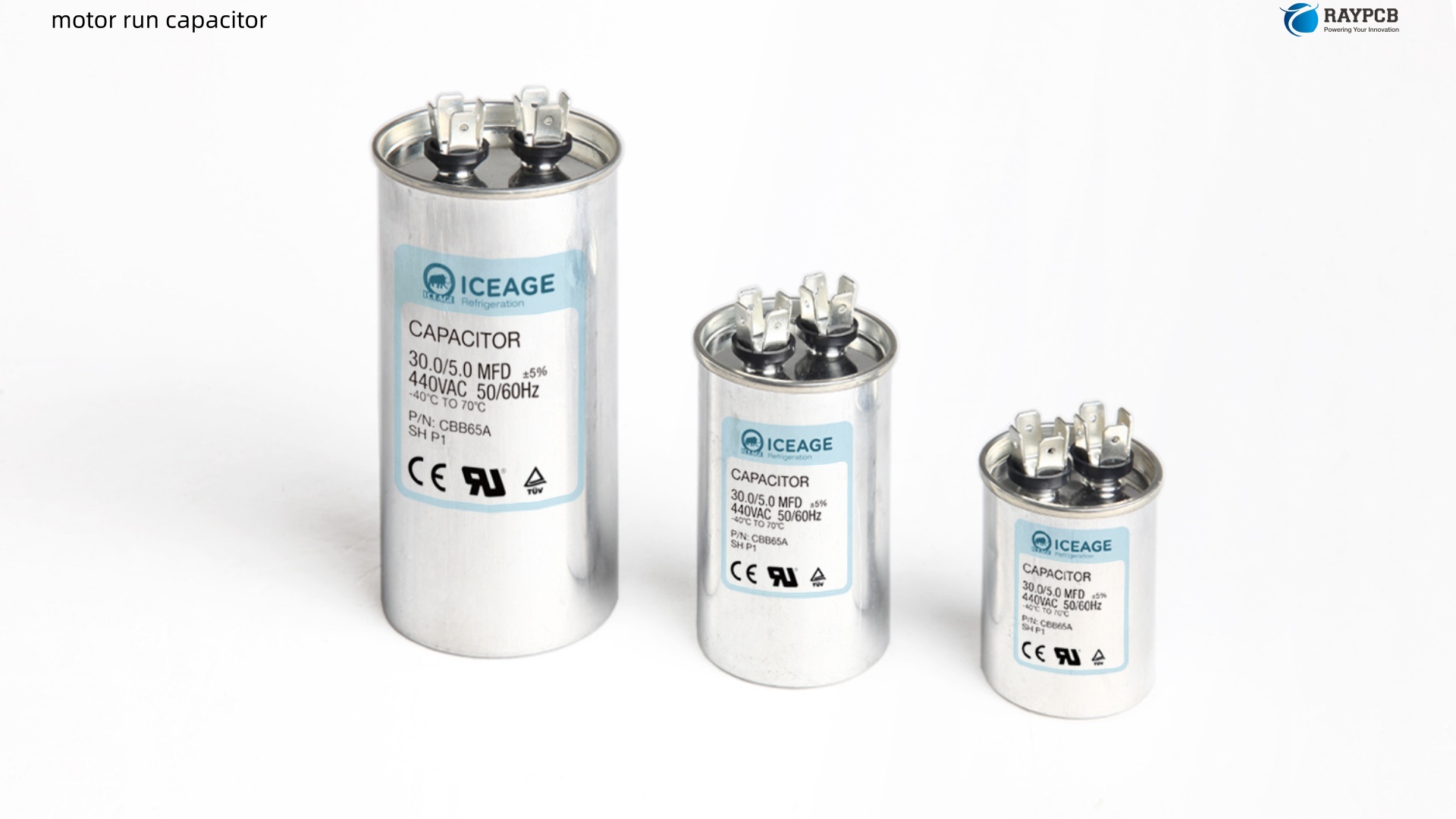
A motor run capacitor is a film capacitor โ€” almost always polypropylene โ€” that remains permanently energized in the circuit the entire time the motor is running. Its job is not to provide maximum starting torque but to maintain a continuous phase shift between main and auxiliary windings, improving running efficiency, power factor, and torque stability under load.

Understanding how run capacitors are constructed, selected, and integrated into PCB-level motor control designs is well covered in resources on PCB capacitors, particularly regarding dielectric selection and voltage derating principles that apply equally to motor and circuit-board capacitor applications.

How a Motor Run Capacitor Works

Where a start capacitor dumps its charge in seconds and gets disconnected, the motor run capacitor handles continuous AC current at line voltage for the entire operating life of the motor. This demands fundamentally different construction. Electrolytic capacitors โ€” fine for the start capacitor’s momentary duty โ€” would overheat and fail within minutes under continuous AC stress. Instead, run capacitors use metallized polypropylene film (or historically, oil-impregnated paper) which provides:

  • Very low dissipation factor (low heat generation under continuous AC)
  • Self-healing properties when metallized film types experience minor dielectric breakdown
  • Long service life: quality run capacitors are rated for 30,000โ€“60,000 operating hours
  • Stable capacitance value over temperature and service life

The run capacitor keeps the auxiliary winding energized and phase-shifted, which maintains a more symmetrical rotating magnetic field around the rotor. Without it, the motor would run on only the main winding โ€” possible, but inefficient, noisy, and hard on the windings.

Motor Run Capacitor Specifications

SpecificationTypical RangeNotes
Capacitance1.5 ยตF โ€“ 100 ยตFFixed single value on label
Voltage ratings250 V, 370 V, 440 VACUse same or higher voltage rating only
ConstructionPolypropylene film (MPP)Wet-fill or dry-fill versions available
Duty cycleContinuousDesigned to run as long as motor runs
CaseMetal cylinder or oval canisterRound most common; oval also available
Toleranceยฑ5% to ยฑ10%Must match spec within 5โ€“10%

Motor Start Capacitor vs Motor Run Capacitor: Head-to-Head Comparison

FeatureMotor Start CapacitorMotor Run Capacitor
Primary functionBoost starting torqueMaintain running efficiency
Time in circuitSeconds (until ~75% speed)Continuously while motor runs
Capacitance value70โ€“1,200 ยตF (range)1.5โ€“100 ยตF (fixed)
ConstructionAluminum electrolyticPolypropylene film
Voltage ratings125 V, 165 V, 250 V, 330 VAC250 V, 370 V, 440 VAC
Duty ratingIntermittentContinuous
DisconnectionVia centrifugal switchAlways in circuit
Case colorTypically black plasticTypically metal, silver/gray
Value markingRange (e.g., 88โ€“108 ยตF)Single value (e.g., 35 ยตF)
Can it replace the other?Never โ€” fails under continuous dutyOnly in unusual circumstances; values too low
Failure modeCatastrophic (blows top)Gradual capacitance drop; sometimes bulge

The Dual Run Capacitor: One Can, Two Jobs

In many HVAC systems โ€” particularly air conditioner condensing units โ€” you’ll find a dual run capacitor. This is simply two run capacitors sharing a single cylindrical can. The three terminals are labeled:

  • Cย โ€” Common
  • HERMย โ€” Hermetically sealed compressor motor
  • FANย โ€” Condenser fan motor

A common example would be a 40+5 ยตF at 440 VAC dual capacitor: the 40 ยตF section serves the compressor, and the 5 ยตF section serves the fan motor. These are electrically independent inside the can; the only shared element is the common terminal and the physical housing. When one section fails, the entire dual capacitor is typically replaced, though it’s technically possible to replace a failed section with a separate run capacitor wired to match.

A 440 V rated capacitor can always substitute for a 370 V application, but never the reverse โ€” voltage ratings must match or exceed the original.

Capacitor-Start vs Capacitor-Run Motor Types

The application tells you which capacitor arrangement is in use:

Capacitor-Start Motor (CS)

Uses only a start capacitor and runs on the main winding alone after the centrifugal switch opens. Delivers high starting torque but less efficient running performance. Common in compressors, pumps, and any application needing heavy load starts.

Capacitor-Run / Permanent Split Capacitor (PSC) Motor

Uses only a run capacitor, permanently connected. No centrifugal switch required. Lower starting torque but quieter, more efficient running. Common in direct-drive fans, small pumps, HVAC blower motors.

Capacitor-Start Capacitor-Run (CSCR) Motor

Uses both. The start capacitor delivers high starting torque; the centrifugal switch disconnects it once the motor reaches speed; the run capacitor remains in the circuit for efficient continuous operation. Most expensive and mechanically complex, but the best all-around performance. Used for demanding applications where both high starting torque and efficient continuous running are required.

Motor Type and Capacitor Configuration Summary

Motor TypeStart CapRun CapStarting TorqueRunning Efficiency
Capacitor-Start (CS)YesNoHighModerate
Permanent Split Cap (PSC)NoYesLow-ModerateHigh
Cap-Start Cap-Run (CSCR)YesYesVery HighHigh
Split-Phase (resistance start)NoNoModerateLow

How to Size a Replacement Motor Run Capacitor

Getting the replacement wrong โ€” even slightly โ€” causes the rotor’s magnetic field to become uneven. The rotor hesitates at those uneven spots during each rotation, creating noise, increased power consumption, reduced output torque, and accelerated winding wear. Here’s the correct sizing process:

Step 1: Read the Motor Nameplate

Always start with the motor’s data tag or nameplate, not the old capacitor. The motor manufacturer tested specific capacitor values for that exact motor design. The nameplate may specify the run capacitor value directly. If not, check the motor manufacturer’s documentation.

Step 2: Match the Capacitance Value Exactly

For motor run capacitors, exact replacement is mandatory. The acceptable tolerance is ยฑ5% to ยฑ10%. Do not substitute a higher or lower value thinking it will “work close enough.” A wrong value disrupts the balance between main and auxiliary winding currents, causing hesitation and overheating.

Step 3: Match or Exceed Voltage Rating

Never install a lower voltage rating than the original. The common run capacitor voltage classes are 250 VAC, 370 VAC, and 440 VAC. A 440 V capacitor can replace a 370 V application but not vice versa. The voltage rating must meet or exceed the line voltage the motor will see.

Step 4: Verify with the Load Test Formula

If the original rating is unknown, you can calculate the correct ยตF value from live measurements:

ยตF = (Start Winding Amps ร— 2,652) รท Capacitor Voltage

Measure the amperage on the wire running from the capacitor to the start winding, and the voltage between the capacitor’s relevant terminals (HERM to C, or FAN to C for a dual cap). Plug those values in and compare to the installed capacitor’s rating. If it’s outside the ยฑ10% range, replacement is warranted.

Motor Run Capacitor Sizing Reference Table

Motor HPVoltageTypical Run Capacitor Value
1/6 HP115 V3โ€“5 ยตF
1/4 HP115 V5โ€“7.5 ยตF
1/3 HP115 V7.5โ€“10 ยตF
1/2 HP230 V10โ€“15 ยตF
3/4 HP230 V15โ€“20 ยตF
1 HP230 V25โ€“35 ยตF
2 HP230 V35โ€“50 ยตF

These are general guidelines. Always verify against the motor’s nameplate or manufacturer documentation first.

How to Test a Motor Run Capacitor

Visual Inspection First

A failed or failing run capacitor often shows physical signs:

  • Bulging or swollen sides/endsย โ€” internal pressure buildup; replace immediately
  • Leaking oilย (wet-fill types) โ€” dielectric fluid escaping; replace immediately
  • Blown pressure reliefย โ€” safety interrupter has tripped; replace immediately

If the capacitor looks intact, proceed to electrical testing.

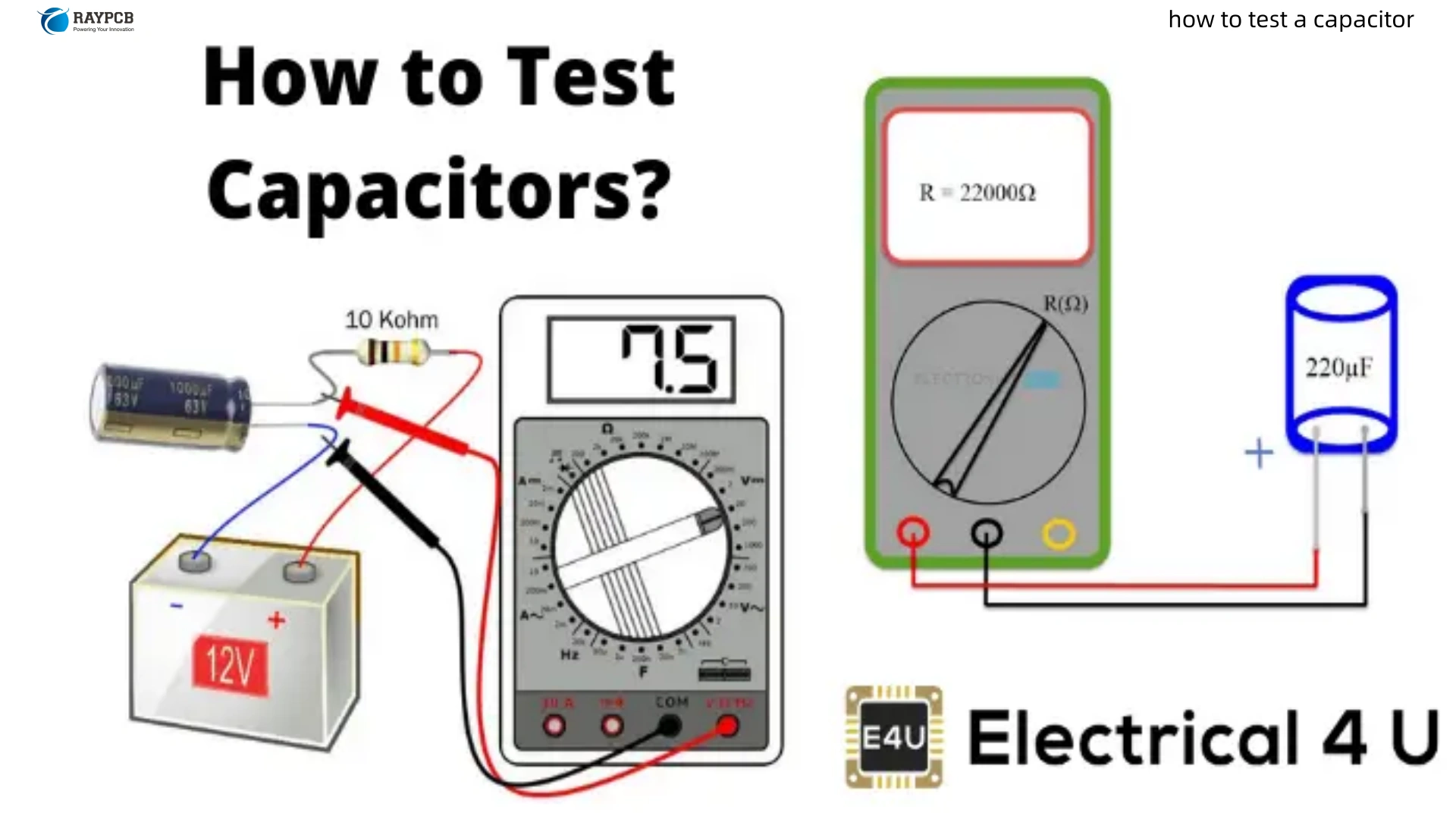
Testing with a Multimeter (Capacitance Mode)

  1. De-energize and discharge the capacitorย โ€” bridge the terminals briefly with a resistor (10โ€“20 kฮฉ, 2W) or use a discharge tool. Never short directly.
  2. Set the multimeter to capacitance (ยตF) mode.
  3. Connect test leads to the capacitor terminals.
  4. Compare the reading to the rated value on the label.
  5. If the measured value is outside the specified ยฑ5โ€“10% tolerance, replace the capacitor.

Testing Under Load (More Accurate)

The load test using the formula above (amps ร— 2,652 รท voltage) gives a more realistic reading because it measures the capacitor’s actual behavior under operating conditions rather than just static capacitance. A capacitor can pass a static test but still underperform under load, particularly in aging units.

Signs of a Failing Motor Run Capacitor

Pay attention to these symptoms โ€” they often show up well before complete failure:

SymptomLikely Cause
Motor hums but won’t startStart cap failed or run cap too weak to assist
Motor runs but draws high currentRun cap value dropped; magnetic field unbalanced
Motor runs hotInefficient field from weak cap; windings overcompensating
Noisy operation (vibration, buzzing)Rotor hesitating at uneven magnetic field spots
Motor turns off unexpectedlyOverload protection tripping from excess current
Slow acceleration to full speedWeak or failed start cap

Motor Run Capacitor Lifespan and Failure Causes

A quality run capacitor has a design life of 30,000 to 60,000 operating hours. Factory-installed capacitors in highly cost-competitive products sometimes have design lives as short as 1,000 hours. Three factors dramatically shorten run capacitor life:

Heat is the primary killer. Every 10ยฐC rise above the capacitor’s rated operating temperature roughly halves its service life. Motors running in hot environments, poorly ventilated enclosures, or next to heat-generating components will eat through run capacitors far faster than expected.

Overvoltage has an exponential effect. Running a 370 V capacitor on a line that regularly spikes to 420 V will degrade the dielectric far faster than normal aging predicts. Always use the 440 V class capacitor when line voltage stability is uncertain.

Motor faults upstream can overload the capacitor. If motor windings are beginning to fail, current through the capacitor rises above its rated value, accelerating thermal aging. A string of run capacitor failures in a motor that otherwise seems fine is a warning sign to check the motor windings closely.

Useful Resources for Motor Capacitor Selection and Design

ResourceTypeLink
Capacitor Industries โ€“ Run vs Start Capacitor GuideTechnical PDFcapacitorindustries.com PDF
TemcoIndustrial โ€“ Motor Capacitor FAQTechnical Guidetemcoindustrial.com
TemcoIndustrial โ€“ Run Capacitor Selection GuideSelection Guidetemcoindustrial.com
HVAC School โ€“ Testing Run Capacitors Under LoadPractical Guidehvacrschool.com
Wikipedia โ€“ Motor CapacitorReference Overviewen.wikipedia.org
InspectApedia โ€“ Motor Capacitor Selection GuideDiagnostic Guideinspectapedia.com
DigiKey TechForum โ€“ Start vs Run CapacitorsForum/Technical Referenceforum.digikey.com
IC-Online โ€“ Capacitor Sizing Chart GuideSizing Referenceic-online.com

Frequently Asked Questions About Motor Run Capacitors

Q1: Can I use a motor start capacitor as a motor run capacitor in an emergency?

No. A start capacitor is built for intermittent duty โ€” seconds at a time. Leaving it energized continuously will cause it to overheat and fail catastrophically, often destroying the motor winding in the process. The direction is one-way only: a run capacitor can theoretically substitute for a start capacitor in unusual circumstances if the capacitance and voltage ratings match, but a start capacitor can never substitute for a run capacitor under continuous operation.

Q2: What happens if I install the wrong ยตF value motor run capacitor?

The motor’s magnetic field becomes unbalanced. The rotor will hesitate at uneven spots during each rotation, causing audible noise, elevated current draw, reduced output torque, and overheated windings. The motor will still run, but it will run poorly and its lifespan will be shortened. Both over-sized and under-sized capacitors cause problems. The correct value is the one specified by the motor manufacturer โ€” not the nearest available standard value.

Q3: Can I use a 440 V run capacitor to replace a 370 V run capacitor?

Yes, in terms of voltage rating, a 440 V capacitor is a safe substitute for a 370 V application. The higher voltage rating simply means the dielectric can withstand more stress, which never hurts. The reverse โ€” using a 370 V capacitor in a 440 V application โ€” is not acceptable and will shorten the capacitor’s life and risk failure. The capacitance value (ยตF) must still match the motor specification exactly regardless of which voltage class you use.

Q4: My motor run capacitor reads within tolerance on a multimeter but the motor is still running hot. Could the capacitor still be the problem?

Yes. A static capacitance test measures the capacitor at low voltage with no AC stress. A capacitor that reads correctly off-circuit can still have elevated ESR (equivalent series resistance) or poor high-frequency characteristics that cause it to underperform under operating conditions. The load test formula โ€” amps ร— 2,652 รท capacitor voltage = ยตF โ€” gives a much more accurate picture of actual performance under load. If the under-load value diverges significantly from the static test, the capacitor is degraded and should be replaced even if the static reading looks fine.

Q5: How often should a motor run capacitor be replaced as preventive maintenance?

There’s no universal interval because operating conditions vary so much. In a climate-controlled indoor environment with a well-ventilated motor, a quality run capacitor may last a decade or more. In a hot outdoor HVAC condensing unit running most of the summer, life can be considerably shorter. A practical approach is to test run capacitors annually with a calibrated multimeter. If the value has dropped more than 5โ€“10% below the rated value, replace it before it causes a motor fault. After the sixth or seventh season of service in a demanding HVAC application, proactive replacement is cheaper than an emergency service call.

The Bottom Line

The motor start capacitor and the motor run capacitor share a body style and a unit of measurement. That’s roughly where the similarity ends. The start capacitor is a short-burst electrolytic that lives in the circuit for seconds, gets switched out by a centrifugal switch, and must never be left energized. The motor run capacitor is a polypropylene film component that runs continuously at line voltage for the entire service life of the motor, keeping the auxiliary winding phase-shifted and the magnetic field balanced.

Getting replacement right means matching the ยตF value exactly for run capacitors, matching or exceeding voltage ratings for both, never substituting a start cap for a run cap, and testing under load rather than relying only on a static multimeter reading. Do those things and motor capacitor failures become predictable, diagnosable, and cheap to fix โ€” instead of surprises that take the motor with them.
MLCC DC Bias Effect: Why Your 10ยตF Cap Is Really 2ยตF

The MLCC DC biasย effect can shrink your 10ยตF cap to 2ยตF in circuit. Learn why it happens, which dielectrics suffer most, and how to select and derate correctly.

You pulled up the BOM, confirmed 10ยตF on the decoupling cap, soldered the board, powered it up โ€” and then spent two days debugging a switching regulator that oscillates at the wrong frequency. The schematic is correct. The layout looks clean. The part number matches. What went wrong?

Almost certainly, it was MLCC DC bias. That 10ยตF ceramic cap you placed on the 5V rail may be delivering 2โ€“3ยตF under actual operating conditions. And the datasheet never lied to you โ€” it just measured the capacitance at 0V. You’re running at 5V.

This is one of the most commonly missed phenomena in PCB design, and it bites experienced engineers as often as it catches beginners. This guide explains exactly what MLCC DC bias is, why it happens at the physics level, how badly it affects each dielectric type, and โ€” most importantly โ€” what you can do about it.

What Is MLCC DC Bias and Why Does It Matter?

MLCC DC bias refers to the drop in effective capacitance that occurs when a DC voltage is applied across a Class II multilayer ceramic capacitor. The capacitance value printed on the part โ€” and measured in the datasheet โ€” is tested at essentially zero DC bias, typically using a tiny AC signal of around 0.5โ€“1V RMS at 1 kHz with no DC offset. The moment you put that capacitor into a circuit with a real voltage across it, the actual capacitance begins to fall.

The effect is not subtle. A 4.7ยตF 25V X5R 0603 MLCC from Murata โ€” the kind of part you’d reasonably use as an output capacitor on a small switching converter โ€” can deliver only about 1.3ยตF at 10V bias, less than half the rated voltage. At rated voltage, things are worse: a 4.7ยตF 25V 0805 X5R capacitor operating at its full 25V rating delivers only about 15% of its rated value โ€” around 0.7ยตF.

For general decoupling on low-voltage rails (3.3V or below), the effect is manageable but still real. For output filters on buck converters, charge pump circuits, RC timing networks, and precision analog applications, ignoring MLCC DC bias is a design error that will cost you at board bring-up or, worse, in the field.

The Physics Behind MLCC DC Bias: Ferroelectric Dipoles

To understand why this happens, you need to look at what’s inside a Class II MLCC.

Class I vs Class II Dielectrics

Class I MLCCs use titanium dioxide (TiOโ‚‚) as the dielectric material. Class II MLCCs use barium titanate (BaTiOโ‚ƒ) along with additives. Class I types are more stable but are limited to lower capacitance values. Class II capacitors have higher volumetric efficiency โ€” and that’s where the DC bias problem lives.

The EIA coding tells you which class you’re dealing with. If the temperature characteristic code starts with C, H, or P (like C0G or NP0), it’s Class I and has no meaningful DC bias effect. If it starts with X, Y, or Z (X5R, X7R, Y5V, Z5U), it’s Class II and DC bias is a real concern.

Why Ferroelectric Materials Lose Capacitance Under Voltage

Barium titanate has a tetragonal crystal structure below its Curie temperature of approximately 125ยฐC. This structure generates electrical dipoles โ€” one side of each crystal axis is more positive and the other more negative. Without any applied DC voltage, these dipoles arrange themselves randomly throughout the crystal structure, resulting in high dielectric constant and high capacitance.

When a DC voltage is applied, the resulting electric field begins to align the dipoles parallel to the field. Some dipoles align at low voltages; more align as voltage increases. The progressive alignment of dipoles reduces the dielectric constant, and capacitance falls continuously as voltage rises. At the full rated voltage, capacitance can drop by 50% or more from the zero-bias nominal value.

The problem has gotten significantly worse in modern high-density MLCCs. To achieve higher capacitance in a given package size, manufacturers either increase the dielectric constant of the ceramic material or increase the number of dielectric layers by making each layer thinner. Both approaches amplify the DC bias effect. Thinner dielectric layers mean a given terminal voltage creates a stronger electric field per unit thickness across the dielectric, increasing the bias-induced dipole alignment.

The Hysteresis Problem

There is an additional subtlety that complicates the picture: the DC bias effect can exhibit hysteresis, because the ferroelectric material has a hysteretic polarization-electric field curve. In practical terms, this means the effective capacitance at a given voltage can differ depending on whether you’re sweeping voltage up or down, and it can also vary with the history of voltage stress applied to the part. Lab measurements and manufacturer simulation tools show this behavior, and it means the real capacitance in a circuit with dynamic voltage swings is even harder to predict than a static DC bias curve suggests.

How Bad Is It? Real-World Capacitance Loss Data

The numbers, once you look at them carefully, are genuinely alarming for anyone who has been selecting ceramic capacitors purely by the nominal value.

Worked Example: The 10ยตF That Became 2ยตF

Consider an X5R 0805 10ยตF 6.3V capacitor used as a 5V coupling capacitor in an operational amplifier application. The combined capacitance loss factors include: approximately 60% loss of capacitance from the 5V DC bias (close to the 6.3V rated voltage), about 15% additional loss from the AC voltage component, 10% loss due to operating temperature, and 5% per decade of time from aging. The total actual capacitance is the product of all these individual loss factors โ€” not their sum. The expected actual capacitance in this operating condition is approximately 2.9ยตF, and in worst-case scenarios for different part numbers and manufacturers, the real capacitance can be as low as 10% of the rated value.

That’s the headline: a labeled 10ยตF capacitor providing somewhere between 1ยตF and 3ยตF in a real circuit. Every factor multiplies against the others.

Capacitance Loss by Dielectric Type: A Comparison

The severity of MLCC DC bias varies significantly by dielectric class. This table summarizes typical worst-case capacitance retention at various percentages of rated voltage:

DielectricAt 25% Rated VoltageAt 50% Rated VoltageAt 80% Rated VoltageAt 100% Rated Voltage
C0G (NP0) โ€“ Class I~100%~100%~100%~100%
X7R โ€“ Class II~85โ€“90%~60โ€“75%~40โ€“55%~30โ€“50%
X5R โ€“ Class II~80โ€“85%~50โ€“70%~30โ€“40%~15โ€“30%
Y5V โ€“ Class II~70%~30โ€“50%~10โ€“20%<10%

Note: Values are representative ranges based on published manufacturer data. Actual loss is part-number specific โ€” always check the DC bias curve for your specific component.

The DC bias effect can shrink capacitance anywhere from 10% to 90% at rated voltage for ferroelectric MLCCs. Y5V dielectrics are effectively unsuitable for any application where stable capacitance matters.

How Package Size Affects DC Bias

Capacitance loss due to DC bias can be reduced by using a physically larger case size, because a larger case reduces the electric field strength (V/mm) across the dielectric material. A 10ยตF 6.3V X5R capacitor in an 0805 package shows significantly less capacitance loss at a given voltage than the same nominal value in an 0603 package.

Since the DC bias effect is directly related to the size of the dielectric, the smaller the capacitor footprint, the worse it performs. This has a counterintuitive implication: the trend toward smaller passive components directly worsens DC bias-induced capacitance loss for any given nominal capacitance value.

For a 1ยตF capacitor featuring a nominal voltage of 25V, the capacitance at 10V only decreases by about 2%, because the dielectric layers are thicker at higher nominal voltages. Thicker dielectric means a weaker electric field per layer, affecting fewer dipoles.

DC Bias Plus Aging: The Compounding Effect

MLCC DC bias does not operate in isolation. It compounds with two other degradation mechanisms that every PCB engineer should understand: thermal capacitance change and dielectric aging.

MLCC Aging (Time-Related Capacitance Drift)

All Class II ceramic capacitors lose capacitance over time even at room temperature, even at zero voltage, because the ferroelectric grains slowly transition to more energetically stable crystal domain configurations. This process is called aging. The standard model for aging is roughly 5% capacitance loss per decade of time (per decade of hours: after 10 hours, after 100 hours, after 1000 hours, etc.).

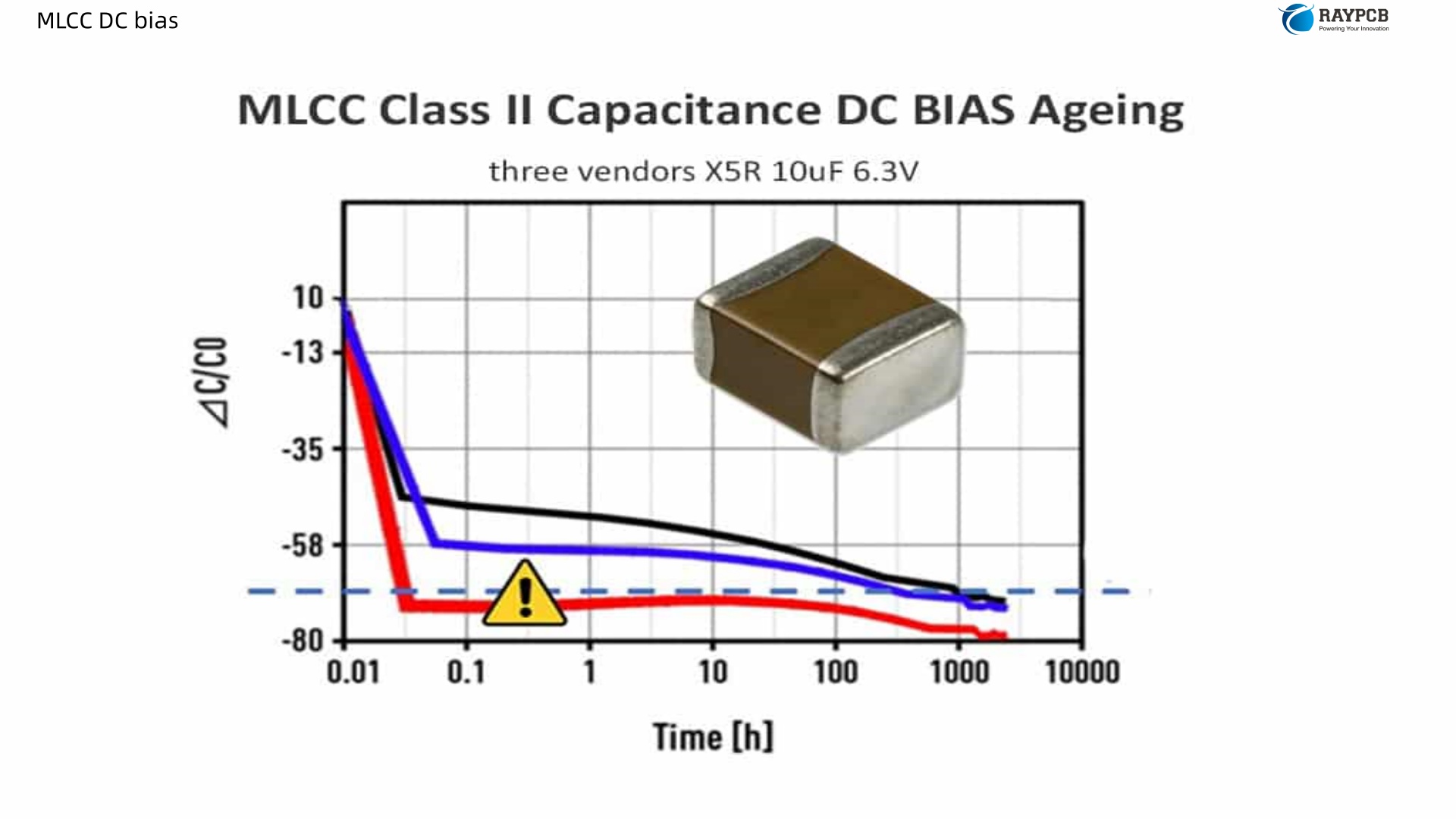
Recent research has found that prolonged exposure of X7R capacitors to a DC bias voltage leads to capacitance decrease much stronger than the natural aging drift alone. In competitive testing of multiple vendor X7R parts, all competing capacitors showed greater-than-specified rates of capacitance loss over time under bias conditions. After 1000 hours of bias exposure, all competing MLCCs tested lost more than 20% of their capacitance beyond the initial DC bias effect.

This DC bias aging effect was not widely recognized until automotive manufacturers began reporting failures in critical systems. The capacitance loss from DC bias aging is not simply additive with the instantaneous DC bias effect โ€” the two compound multiplicatively.

Temperature and DC Bias Together

The temperature coefficient of capacitance for X7R is specified as ยฑ15% over the rated temperature range, and X5R is similar within its narrower range. When thermal reduction and DC bias reduction occur simultaneously, the combined loss is again multiplicative, not additive.

For X5R operating at 50% of rated voltage and 85ยฐC, assume only 40โ€“50% of rated capacitance will actually be available. Combined with aging and DC bias, an X5R “10ยตF” capacitor might deliver only 3ยตF under worst-case conditions.

Which Circuits Are Most Affected by MLCC DC Bias?

Switching Regulator Output Filters

The entire control loop for a buck or boost converter depends on a certain amount of capacitance. If the design is based on nominal capacitance values, DC bias can cause stability problems or EMC issues. This is especially pronounced on the input of a buck converter and the output of a boost converter, where voltages are highest. Many IC datasheets for switching regulators do not explicitly state whether the required capacitance is nominal or effective, leaving the designer to discover the discrepancy through board-level testing.

Charge Pump Circuits

Charge pumps place DC voltages across their capacitors โ€” including the flying capacitor used to transfer charge and the input and output capacitors. All of these are directly affected by DC bias. The real capacitance directly impacts charge pump performance, and a significant reduction in effective capacitance translates directly to reduced output current capability.

RC Timing Circuits

An engineer designing an RC time delay circuit using a large ceramic capacitor in series with a large resistor will find that the actual time constant is not simply R ร— C_nominal. Because capacitance decreases with bias voltage during the charging cycle, the RC time constant is effectively some smaller and voltage-dependent value. The actual time delay requires integrating the DC bias-capacitance curve, not simply multiplying the nominal values.

Precision Analog and Audio Circuits

For analog signal paths using large ceramic capacitors as DC blocking or coupling capacitors, MLCC DC bias creates a voltage-dependent capacitance that can introduce nonlinearity and distortion. In audio circuits, this nonlinearity is audible. Additionally, Class II ceramics exhibit piezoelectric behavior โ€” physical vibration induces voltage and vice versa โ€” causing acoustic noise in power circuits and susceptibility to microphonics in sensitive analog paths.

How to Fix MLCC DC Bias: Practical Solutions for PCB Engineers

Solution 1: Use the Manufacturer’s DC Bias Simulation Tools

Before you finalize any MLCC selection where DC bias matters, check the actual effective capacitance at your operating voltage using manufacturer tools. This is not optional for switching converter filters, charge pumps, or RC timing applications.

The key tools are listed in the resources section below. Murata SimSurfing is the most widely recommended โ€” it lets you enter operating voltage, temperature, and frequency to get the actual effective capacitance curve, not just the nominal value.

Solution 2: Select a Higher Voltage Rating

Using capacitors with a higher voltage rating than strictly required can offset the DC bias capacitance reduction. A capacitor operating at a lower percentage of its rated voltage retains more of its nominal capacitance. For a 1ยตF capacitor rated at 25V, the capacitance at 10V only decreases by about 2% โ€” because higher voltage ratings use thicker dielectric layers, which produce a weaker electric field per layer at the same terminal voltage.

As a practical rule, select an MLCC with a voltage rating at least 2ร— your operating voltage for X7R parts and 3ร— for X5R parts if you need reasonably stable effective capacitance.

Solution 3: Use a Larger Physical Package

A physically larger case size design reduces the V/mm electrical field exposed to the dielectric. A 10ยตF X5R in an 0805 package shows significantly better DC bias behavior than the same value in a 0603 package. If board space allows, stepping up a package size is often the lowest-cost fix.

Solution 4: Upgrade the Dielectric Grade

Moving from X5R to X7R, from X7R to X8R, or to tighter tolerance grades such as X7P reduces DC bias sensitivity. The higher-grade dielectrics use ceramic formulations with less ferroelectric character, trading some volumetric efficiency for better stability.

Solution 5: Parallel Multiple Smaller Capacitors

Two capacitors connected in parallel with lower individual capacitance values โ€” each with thicker dielectric layers โ€” can achieve the same total nominal capacitance with better DC bias behavior than a single higher-value part in the same package. For example, two 4.7ยตF parts may outperform a single 10ยตF part in effective capacitance under bias, because the lower capacitance value requires thicker dielectric layers.

Solution 6: Switch Capacitor Technology

For applications where MLCC DC bias is genuinely unacceptable โ€” precision timing, stable analog filtering, high-reliability industrial or automotive designs โ€” consider switching away from Class II ceramics entirely for those specific positions.

Capacitor TypeDC Bias EffectBest Use Case
C0G / NP0 MLCCNoneTuned circuits, RF, precision timing, oscillators
X7R MLCCModerate (better than X5R)General decoupling, low-to-mid voltage rails
X5R MLCCSignificantHigh-capacitance density, low-voltage rails only
Polymer TantalumNegligibleStable bulk capacitance, medium voltage
Aluminum ElectrolyticNegligible (but polarized)Bulk filtering, high capacitance values
Film (Polypropylene)NoneAC filtering, precision analog, high voltage

Polymer tantalum and aluminum hybrid capacitors can be good alternatives when DC bias stability is required but board space does not allow larger MLCC packages.

Comparing Dielectrics: DC Bias Performance at a Glance

This table summarizes the key trade-offs between the most common MLCC dielectric types relevant to the DC bias decision:

ParameterC0G (NP0)X7RX5RY5V
EIA ClassIIIIIII
Dielectric materialTiOโ‚‚BaTiOโ‚ƒ + additivesBaTiOโ‚ƒ + additivesBaTiOโ‚ƒ (high-K)
DC bias effectEssentially noneModerateSignificantSevere
Temp coefficientยฑ30 ppm/ยฐCยฑ15% (โˆ’55 to +125ยฐC)ยฑ15% (โˆ’55 to +85ยฐC)+22%/โˆ’82%
Max capacitance per packageLowMediumHighVery high
AgingNegligible~1โ€“5%/decade~1โ€“5%/decade>5%/decade
Recommended for DC voltage circuitsYesYes (check DC bias curves)With cautionAvoid

Vendor Differences: Not All X7R Parts Are Equal

One aspect of MLCC DC bias that catches engineers off guard when qualifying alternative sources: the same part number from a different manufacturer can have meaningfully different DC bias behavior. Qualifying a new vendor using a part at different application conditions without background knowledge of the DC bias data can lead to catastrophic system failures. In one documented case, three different manufacturers’ versions of the same 10ยตF 6.3V X5R MLCC showed very different capacitance drop curves over time under bias, with a substitute vendor added during a shortage situation resulting in field failures.

Measured vendor data and simulated vendor data can differ significantly. In comparative testing across multiple vendors, some manufacturers’ simulation tools underestimated the actual capacitance loss, meaning real-world performance was worse than the tool predicted.

The practical implication: whenever you qualify a new MLCC source, re-verify the DC bias performance against your actual operating conditions, not just the nominal capacitance specification.

Step-by-Step: How to Select an MLCC Accounting for DC Bias

Here is a practical workflow for any application where DC bias could matter:

StepActionTool/Reference
1Identify the DC operating voltage across the capacitorCircuit schematic, simulation
2Identify operating temperature rangeSystem thermal analysis
3Look up the DC bias derating curve for the candidate partManufacturer simulation tool (SimSurfing, K-SIM, etc.)
4Determine effective capacitance at operating V and TRead from the curve at your operating point
5Check if effective capacitance meets circuit requirementsCompare to required value
6If not, select higher voltage rating, larger package, or better dielectricIterate
7Re-verify effective capacitance for the new candidate partRepeat step 3โ€“4
8Include aging margin (5โ€“10% additional derating) for long-life designsApply to final selection

For capacitors used in switching regulator output filters, confirm with the IC manufacturer whether the required capacitance in the datasheet refers to nominal or effective capacitance. Many power management IC datasheets specify effective capacitance โ€” if the MLCC selection is based on nominal value alone, the actual loop bandwidth and stability margin will be different from what was designed.

Useful Resources for MLCC DC Bias Research

These tools and documents are directly applicable to real design decisions:

ResourceTypeWhy It’s Useful
Murata SimSurfingOnline simulation toolThe industry standard โ€” enter voltage, temperature, frequency to get effective capacitance curve for any Murata MLCC
TDK Product AdvisorComponent databaseDC bias curves and temperature characteristics for TDK MLCCs
Kemet K-SIMSPICE simulationFull MLCC SPICE models including DC bias behavior
Samsung Electro-Mechanics SPECComponent databaseDC bias and aging data for SEMCO MLCCs including X7S parts
EPCI Article: High CV MLCC DC Bias and Ageing ExplainedTechnical articleComprehensive treatment of DC bias + aging interaction with real data
Vishay DC Bias Aging Study (PDF)Technical paperComparative data on X7R DC bias aging across multiple vendors
OS Engineering DC Bias Measurement Study (PDF)Technical paperIndependent measured DC bias data including hysteresis effects
KYOCERA AVX DC Bias App Note (PDF)Application notePhysics explanation and selection guidance from an MLCC manufacturer
Manufacturer datasheetsPrimary sourceAlways check the voltage vs. capacitance curve for your specific part number

FAQs: MLCC DC Bias

Q1: Does the ยฑ10% or ยฑ20% tolerance marking on an MLCC capacitor include the DC bias effect?

No, and this is one of the most common misconceptions. The temperature rating code (like X7R with ยฑ15% tolerance) covers variation due to temperature change only. It tells us absolutely nothing about the DC bias effects. The tolerance marking reflects capacitance variation from the nominal measured at zero bias and rated temperature. The DC bias-induced capacitance loss is entirely separate and is not captured in the standard tolerance specification.

Q2: Does MLCC DC bias affect C0G (NP0) capacitors?

No. C0G is a Class I dielectric using titanium dioxide, which is not ferroelectric. It does not exhibit voltage-dependent polarization and has essentially zero DC bias effect. The trade-off is that C0G ceramics have much lower dielectric constants, which limits the available capacitance per package size. C0G parts are typically available up to a few ยตF in larger packages, making them suitable for precision applications but impractical for bulk decoupling requiring tens of ยตF.

Q3: If I use a 10V MLCC on a 3.3V rail, is the DC bias effect negligible?

Better than using a 6.3V part, but not negligible โ€” especially for X5R. At 33% of rated voltage (3.3V on a 10V part), an X5R capacitor might still lose 20โ€“30% of its nominal capacitance. An X7R at the same operating point would lose perhaps 10โ€“20%. For general decoupling this is often acceptable. For precision applications, RC timing, or converter output filters, always verify using the manufacturer’s simulation tool. Using a 16V or 25V rated part on a 3.3V rail gives significantly better effective capacitance retention.

Q4: My switching regulator is unstable โ€” could MLCC DC bias be the cause?

Yes, and it’s more common than most engineers expect. The DC bias issue with buck and boost regulators is particularly serious because many IC datasheets for these devices do not clearly state whether the required output capacitance is nominal or effective. The distinction can lead to an 80% difference in actual capacitance, which directly affects control loop crossover frequency and phase margin. If your regulator oscillates or has poor transient response, verify the effective capacitance of your output filter MLCCs at the output voltage using SimSurfing or K-SIM, and compare it to what the IC datasheet actually requires.

Q5: I need to replace an MLCC with an alternative source โ€” do I need to re-test DC bias performance?

Yes, always. The DC bias effect is dependent on various parameters that are internal to the specific part number and manufacturer design โ€” it is not guaranteed to be identical across different manufacturers even for nominally equivalent parts. MLCC DC bias behavior is not covered by standard part-equivalency assumptions. When qualifying an alternative source for any position where effective capacitance under bias is critical โ€” switching converter filters, timing circuits, charge pumps โ€” re-verify the DC bias curve against your operating conditions before approving the substitution.

Summary: What Every PCB Engineer Should Remember About MLCC DC Bias

MLCC DC bias is not an obscure corner case โ€” it’s a fundamental characteristic of every Class II ceramic capacitor, and it affects every circuit where those capacitors see a significant DC voltage. The nominal capacitance is measured at zero voltage and is essentially a marketing number for real power circuits.

The practical rules to take away from this: always pull the DC bias derating curve from the manufacturer’s simulation tool before finalizing an MLCC selection for any voltage-sensitive application; select voltage ratings at least 2ร— the operating voltage to retain meaningful capacitance; prefer X7R over X5R where board space allows a higher-voltage or larger-package part; use C0G for anything where stable capacitance is genuinely critical; and treat aging plus DC bias as compounding, multiplicative effects โ€” not additive ones.

Every one of these decisions costs pennies at the component level. Ignoring them can cost days of debug time, board respins, or field failures that trace back to a labeled 10ยตF capacitor that was actually running at 2ยตF.

How to Test a Capacitor: Multimeter & ESR Meter Methods

Step-by-step guide on how to test a capacitor with a multimeter and ESR meter. Includes visual inspection, resistance mode, capacitance testing, in-circuit ESR methods, reference tables, and FAQs for electrolytics, tantalums, and ceramics.

A dead capacitor is responsible for more field failures than most engineers want to admit. Bulging tops, dried electrolyte, excessive ESR โ€” bad caps quietly take down power supplies, motor controllers, audio amplifiers, and mainboards every day. Knowing how to test a capacitor properly, both on the bench and in-circuit, is one of the most practical diagnostic skills you can develop.

This guide covers every method that actually works: multimeter resistance and capacitance testing, ESR meter testing, visual inspection, and in-circuit vs. out-of-circuit considerations. We’ll also talk about when each method is appropriate and what the results actually mean.

Why Testing Capacitors Matters

Capacitors degrade. Aluminum electrolytic capacitors in particular have a finite lifetime tied to temperature, ripple current, and the slow evaporation of their liquid electrolyte. A capacitor that measures within 20% of its rated capacitance can still be functionally useless if its equivalent series resistance (ESR) has climbed high enough to destabilize a voltage regulator or generate excessive heat.

This is why “does it still hold charge?” is not sufficient. A thorough capacitor test checks capacitance, leakage, and ESR โ€” three independent failure modes that require different tools and methods.

Before You Test: Safety and Discharge First

This step is non-negotiable. A charged capacitor โ€” especially a large bulk electrolytic in a power supply โ€” stores enough energy to cause a serious shock or damage your test equipment.

Discharge procedure:

  1. Unplug or de-energize the circuit
  2. Wait at least 30 seconds for small capacitors, several minutes for large ones
  3. Use a discharge resistor (a 1kฮฉ to 10kฮฉ resistor rated for the voltage) connected across the terminals โ€” never short directly with a wire or screwdriver
  4. Confirm voltage with a multimeter before touching terminals

Large capacitors (above 1000ยตF or above 100V rating) deserve particular respect. Treat discharge as a procedure, not an afterthought.

Visual Inspection: The First Test You Should Always Do

Before you connect any test equipment, look at the capacitor. Visual inspection catches maybe 60โ€“70% of failed aluminum electrolytics without any tools at all.

H3: Signs of a Failed Capacitor

Visual SignWhat It Indicates
Bulging or domed topInternal pressure from gas buildup โ€” capacitor has failed
Vent residue / brown crust on topElectrolyte has vented โ€” capacitor is dead
Cracked or split caseMechanical or thermal overstress
Leaking electrolyte on PCBFailed seal โ€” capacitor and nearby PCB traces may be damaged
Burn marks or discolorationThermal event โ€” check surrounding components too
Lifted or corroded baseLong-term electrolyte leakage

If you see any of the above, stop testing and replace the component. A bulging capacitor that still “measures okay” on a capacitance meter is not okay. The structural failure means it will fail again under load, possibly violently.

For SMD ceramic capacitors, look for cracks along the body โ€” these are often caused by board flexure and produce intermittent failures that are notoriously hard to find.

How to Test a Capacitor with a Multimeter

A standard digital multimeter gives you two useful testing modes for capacitors: resistance/continuity mode for a basic sanity check, and capacitance mode for a more quantitative measurement. Neither replaces an ESR meter for electrolytic testing, but together they cover most situations.

H3: Multimeter Resistance Mode Test (Basic Go/No-Go)

This method works on polarized capacitors (electrolytics, tantalums) and gives you a quick pass/fail result. It won’t give you ESR or an accurate capacitance value, but it tells you whether the capacitor is shorted, open, or behaving like a capacitor.

Steps:

  1. Remove the capacitor from the circuit (in-circuit resistance testing gives false readings due to parallel paths)
  2. Discharge the capacitor fully
  3. Set the multimeter to resistance mode โ€” use the highest range (2Mฮฉ or higher) for large caps, mid-range (200kฮฉ) for small ones
  4. For a polarized capacitor, connect red probe to the positive lead, black to negative
  5. Observe the reading

What to expect from a good capacitor:

PhaseReadingExplanation
InitialLow resistance (near 0ฮฉ)Capacitor is charging through the meter’s internal battery
RisingResistance climbs steadilyCap is charging โ€” resistance appears to increase
FinalHigh resistance (Mฮฉ range) or OLFully charged โ€” no more current flowing

A good capacitor shows this charging arc. The larger the capacitor, the longer it takes to reach steady state.

Failed capacitor readings:

ReadingVerdict
Stays at 0ฮฉ / near zero permanentlyShorted capacitor โ€” replace immediately
OL immediately with no charging arcOpen capacitor โ€” replace
Unstable, fluctuating readingLeaky capacitor โ€” likely failed

H3: Multimeter Capacitance Mode Test

Most mid-range and higher digital multimeters include a capacitance (F) function. This is more useful than resistance mode because it gives you an actual capacitance value to compare against the component’s rated value.

Steps:

  1. Discharge the capacitor completely before connecting to the meter
  2. Remove from circuit โ€” in-circuit measurements are unreliable
  3. Set meter to capacitance mode (usually marked with a capacitor symbol or “F”)
  4. Insert leads into the correct meter ports (some meters have dedicated capacitance terminals)
  5. For polarized caps, observe polarity โ€” red probe to positive lead
  6. Wait for the reading to stabilize

Acceptable tolerance ranges:

Capacitor TypeTypical ToleranceAcceptable Range
Aluminum Electrolyticยฑ20%80%โ€“120% of rated value
Tantalumยฑ10โ€“20%80%โ€“120% of rated value
Ceramic (Class II, X5R/X7R)ยฑ10โ€“20%May read lower due to DC bias effect
Filmยฑ1โ€“5%Very tight โ€” deviation flags a problem
Ceramic (Class I, C0G/NP0)ยฑ1โ€“5%Stable โ€” close reading expected

Important caveat on ceramics: High-capacitance ceramic capacitors (X5R, X7R types above 1ยตF) show significant capacitance reduction under DC bias. A 10ยตF X5R cap measured out-of-circuit on a bench meter may read 8โ€“9ยตF and be perfectly fine. In-circuit under operating voltage it may only deliver 4โ€“5ยตF. This is normal Class II ceramic behavior, not a fault.

H3: Multimeter Diode Mode for Leakage Check

Some engineers use diode mode as an alternative leakage test, particularly for tantalum capacitors. Place the red probe on the positive lead. A good cap shows a brief deflection then returns to OL. Any persistent low reading in diode mode suggests leakage and the capacitor should be replaced.

How to Test a Capacitor with an ESR Meter

This is where serious capacitor diagnostics begins. For electrolytic and tantalum capacitors used in switch-mode power supplies, voltage regulators, and audio circuits, ESR (Equivalent Series Resistance) is the critical parameter โ€” not just capacitance.

H3: What Is ESR and Why Does It Matter?

ESR is the resistive component in series with the ideal capacitance inside a real capacitor. It comes from the resistance of the leads, the foil plates, and critically โ€” the electrolyte itself. As an electrolytic capacitor ages and its electrolyte dries out, ESR rises. A capacitor with doubled ESR is borderline. A cap with 10ร— its rated ESR is functionally useless in most power supply applications, even if it still shows near-correct capacitance.

High ESR causes:

  • Ripple voltage increase on power rails
  • Heat buildup inside the capacitor under ripple current
  • Voltage regulator instability and oscillation
  • Audio distortion in amplifier stages
ESR ConditionEffect on Circuit
Normal (manufacturer spec)Correct filtering, stable regulation
2โ€“5ร— spec ESRIncreased ripple, marginal performance
10ร—+ spec ESRCircuit malfunction, excess heat
Open internal connectionComplete loss of capacitance

H3: In-Circuit ESR Testing

The major advantage of a dedicated ESR meter is that many designs allow in-circuit testing without desoldering the component. ESR meters inject a low-voltage, high-frequency AC signal (typically 100kHz) that is too small to forward-bias semiconductor junctions in parallel circuit paths, giving a reading that closely represents the capacitor’s ESR alone.

Steps for in-circuit ESR testing:

  1. Power off and discharge the circuit
  2. Zero the meter with probes shorted together (lead resistance compensation)
  3. Touch probes directly to the capacitor leads or pads โ€” polarity doesn’t matter for ESR meters
  4. Read the ESR value and compare to reference tables

In-circuit results can read slightly higher than true ESR due to parallel resistance paths. If a cap reads borderline high, remove it and test out-of-circuit to confirm.

H3: ESR Reference Values by Capacitance and Voltage

ESR specifications vary by manufacturer, capacitance, voltage rating, and temperature. These are general reference values:

CapacitanceVoltage RatingGood ESRSuspect ESRFailed ESR
10ยตF16โ€“50V< 2ฮฉ2โ€“10ฮฉ> 10ฮฉ
100ยตF16โ€“50V< 1ฮฉ1โ€“5ฮฉ> 5ฮฉ
470ยตF16โ€“50V< 0.5ฮฉ0.5โ€“2ฮฉ> 2ฮฉ
1000ยตF16โ€“50V< 0.3ฮฉ0.3โ€“1ฮฉ> 1ฮฉ
3300ยตF10โ€“25V< 0.15ฮฉ0.15โ€“0.5ฮฉ> 0.5ฮฉ

Always cross-reference against the specific datasheet. Low-ESR capacitors designed for switching supply applications will have tighter specs than standard electrolytics.

H3: Recommended ESR Meter Options

MeterTypeNotes
MESR-100Dedicated ESR meterAffordable, in-circuit capable, auto-ranging
Atlas ESR70Dedicated ESR + capacitanceExcellent accuracy, used by many professionals
Peak ESR60+Compact ESR meterFast, reliable, good for field work
LCR-T4 / LCR-T7Component testerMeasures ESR, capacitance, and identifies component type
Fluke 87VPremium DMMCapacitance only โ€” no ESR function

How to Test a Capacitor In-Circuit vs. Out-of-Circuit

This question comes up constantly and the answer depends on what you’re testing for.

Test TypeIn-CircuitOut-of-Circuit
Visual inspectionโœ… Yesโœ… Yes
Resistance / charging testโŒ Not reliableโœ… Best method
Capacitance measurementโŒ Parallel paths cause errorsโœ… Accurate
ESR meter testโœ… Usually acceptableโœ… Most accurate
Leakage testโŒ Not reliableโœ… Yes

The general rule: for a definitive pass/fail, desolder and test out-of-circuit. For a fast screening pass during board-level fault isolation, an ESR meter in-circuit is your best tool.

Testing Ceramic Capacitors (MLCCs)

Ceramic capacitors fail differently from electrolytics. They don’t bulge or vent โ€” they crack. A cracked MLCC typically presents as an intermittent short or leakage path that appears only under mechanical stress or thermal cycling.

Testing MLCCs:

  • Resistance mode: a good ceramic should read OL immediately. Any finite resistance reading in the Mฮฉ range or lower indicates leakage or cracking.
  • Capacitance mode: useful for confirming value in out-of-circuit testing
  • Flexure test: gently flex the PCB near the suspect component while monitoring with a multimeter in resistance mode โ€” an intermittent crack will show up as a momentary resistance drop

Capacitors in high-stress locations on a PCB โ€” near board edges, near large connectors, or in areas subject to thermal cycling โ€” are prime candidates for flexure-induced cracking.

Testing Film and Mica Capacitors

Film and mica capacitors are the most reliable capacitor types in common use. They rarely fail unless subjected to overvoltage or physical damage. Testing is straightforward:

  • Resistance mode:ย Should read OL immediately with no charging arc (values too small to show charging on most meters)
  • Capacitance mode:ย Should read within 1โ€“5% of rated value for quality film caps
  • Diode/continuity mode:ย Any beep or low resistance reading indicates a failed cap

Common Capacitor Test Mistakes to Avoid

Not discharging before testing. Beyond the safety risk, a charged cap will give a false high reading on capacitance mode and damage your meter if the voltage is high enough.

Testing electrolytics in-circuit with a standard DMM. Parallel circuit paths around the capacitor corrupt the reading. What looks like a 100ยตF cap might be the parallel combination of your cap and a 120ฮฉ resistor.

Judging electrolytics by capacitance alone. A cap at 95% of rated capacitance with 8ร— its rated ESR will cause the same power supply instability as a completely open cap in many circuits.

Missing ceramic cracks. Ceramics look fine visually when cracked. Add a flexure check to your process when chasing intermittent faults on dense SMD boards.

Trusting a single OL reading on a large cap. A very large capacitor (thousands of ยตF) takes time to charge through a multimeter’s internal source. Give it several seconds before concluding it’s open.

Useful Resources for Capacitor Testing

  • Nichicon Capacitor Application Guideย โ€” nichicon.co.jpย โ€” Life expectancy, ESR data, and derating guidelines for aluminum electrolytics
  • KEMET Capacitor Finder & Datasheetsย โ€” kemet.comย โ€” Parametric search including ESR specs for tantalum and ceramic types
  • Murata SimSurfing Design Toolย โ€” product.murata.comย โ€” Simulate MLCC capacitance vs. DC bias and temperature
  • Capacitor ESR Reference Chart (EEVblog)ย โ€” Community-maintained ESR reference values for common electrolytic series
  • Digi-Key Capacitor Parametric Searchย โ€” digikey.comย โ€” Filter by ESR, capacitance, voltage, and temperature rating
  • IPC-A-610 Acceptability of Electronic Assembliesย โ€” Industry standard covering inspection criteria including capacitor installation
  • Atlas ESR70 Component Databaseย โ€” Included with Atlas ESR meter โ€” manufacturer ESR specs for thousands of capacitor part numbers

FAQs: How to Test a Capacitor

Q1: Can I test a capacitor without removing it from the board? For ESR testing, yes โ€” a dedicated ESR meter works reliably in-circuit on most boards. For capacitance testing, in-circuit measurement is unreliable due to parallel component paths. For a definitive capacitance reading, desolder and test out-of-circuit. Visual inspection is always done in-circuit first.

Q2: My multimeter shows the correct capacitance but the circuit still doesn’t work โ€” why? Almost certainly ESR. A capacitor can retain near-nominal capacitance while its ESR has climbed to unusable levels. This is the most common scenario in aging switch-mode power supplies. Get an ESR meter and check the actual series resistance before replacing other components.

Q3: How do I test an SMD capacitor that’s already on the board? For SMD electrolytics: an ESR meter with fine-tipped probes touches directly to the solder pads. For MLCCs: use resistance mode (should read OL) or capacitance mode out-of-circuit after hot-air removal. For in-circuit MLCC crack detection, the board flexure method while monitoring resistance is the most effective approach.

Q4: What’s the difference between testing a tantalum vs. an aluminum electrolytic capacitor? The testing methods are identical but the failure modes differ. Tantalums fail more often as shorts (catastrophic, sometimes with fire) where electrolytics tend to fail as opens or high-ESR degradation. A tantalum reading near-zero resistance in any mode should be treated as a serious fault โ€” tantalum shorts can cause PCB trace damage. Also note: tantalum stripe marking indicates positive (opposite to electrolytic convention).

Q5: How do I know if my multimeter is accurate enough to test capacitors? For a basic go/no-go test (shorted or open), any functional DMM works. For capacitance measurement within ยฑ5% accuracy, you need a meter with a specified capacitance accuracy โ€” most mid-range meters (Uni-T UT61, Fluke 115 and above, Brymen 867) are adequate. For ESR measurement, you need a dedicated ESR meter or LCR meter โ€” a standard DMM cannot measure ESR regardless of price.

Wrapping Up

Knowing how to test a capacitor is less about memorizing steps and more about understanding what each test actually tells you. Visual inspection first, resistance mode for a quick sanity check, capacitance measurement for value verification, and ESR testing for the failure mode that actually kills circuits in the field. Use the right tool for each question, and don’t stop at capacitance alone when you’re hunting down a failing power supply.

The bench time you spend learning these methods pays back the first time you diagnose a failed switching regulator in fifteen minutes instead of three hours.

How to Read Capacitor Codes: 3-Digit, EIA & Color Codes Explained

Learn how to read capacitor codes โ€” 3-digit EIA, tolerance letters, voltage codes, color bands, and SMD markings โ€” with tables and worked examples for every type.

If you’ve ever picked up a ceramic disc capacitor and stared at the tiny “104” stamped on its face wondering what it actually means, you’re not alone. Knowing how to read capacitor codes is one of those fundamental skills that every PCB engineer, repair technician, and serious hobbyist needs to have locked in. It’s not difficult once the logic clicks โ€” but the sheer variety of marking systems across different capacitor types and eras makes it easy to get confused.

This guide covers every major system you’ll encounter: the 3-digit EIA code used on most ceramic and film capacitors, the EIA-198 alphanumeric system on precision parts, the legacy color code still showing up on vintage boards, electrolytic and tantalum markings, and the tricky world of SMD capacitors that sometimes have no markings at all. With complete reference tables and worked examples throughout, this is the only capacitor code reference you’ll need bookmarked.

Why Learning How to Read Capacitor Codes Actually Matters

It might seem like a small thing, but misreading a capacitor code has real consequences. A 100nF decoupling cap misread as 100pF will let gigahertz-range noise sail straight through your supply rail. A 25V capacitor mistaken for a 250V part will fail silently under normal operating conditions. In repair work, pulling a part without correctly recording the value from the old component leads to sourcing the wrong replacement โ€” and a circuit that fails in the same place all over again.

Understanding the coding also helps you read a BOM correctly, catch component substitution errors during board bring-up, and avoid the classic “this small SMD cap looks identical to that other small SMD cap” confusion during rework.

Understanding Capacitor Units First

Before decoding any marking, you need to be solid on capacitance units. All capacitor codes resolve to a value in picofarads (pF) as the base unit, because pF is the lowest common denominator across the range of components you’ll find in a typical design.

UnitSymbolEquivalent in pFCommon Usage
MicrofaradยตF (or uF)1,000,000 pFElectrolytics, large ceramics, film caps
NanofaradnF1,000 pFFilm caps, mid-range ceramics
PicofaradpF1 pFSmall ceramics, RF/timing circuits

The conversions you’ll use constantly: 0.1ยตF = 100nF = 100,000pF. 10nF = 0.01ยตF = 10,000pF. Getting comfortable with these three representations means any code you decode will make intuitive sense straight away.

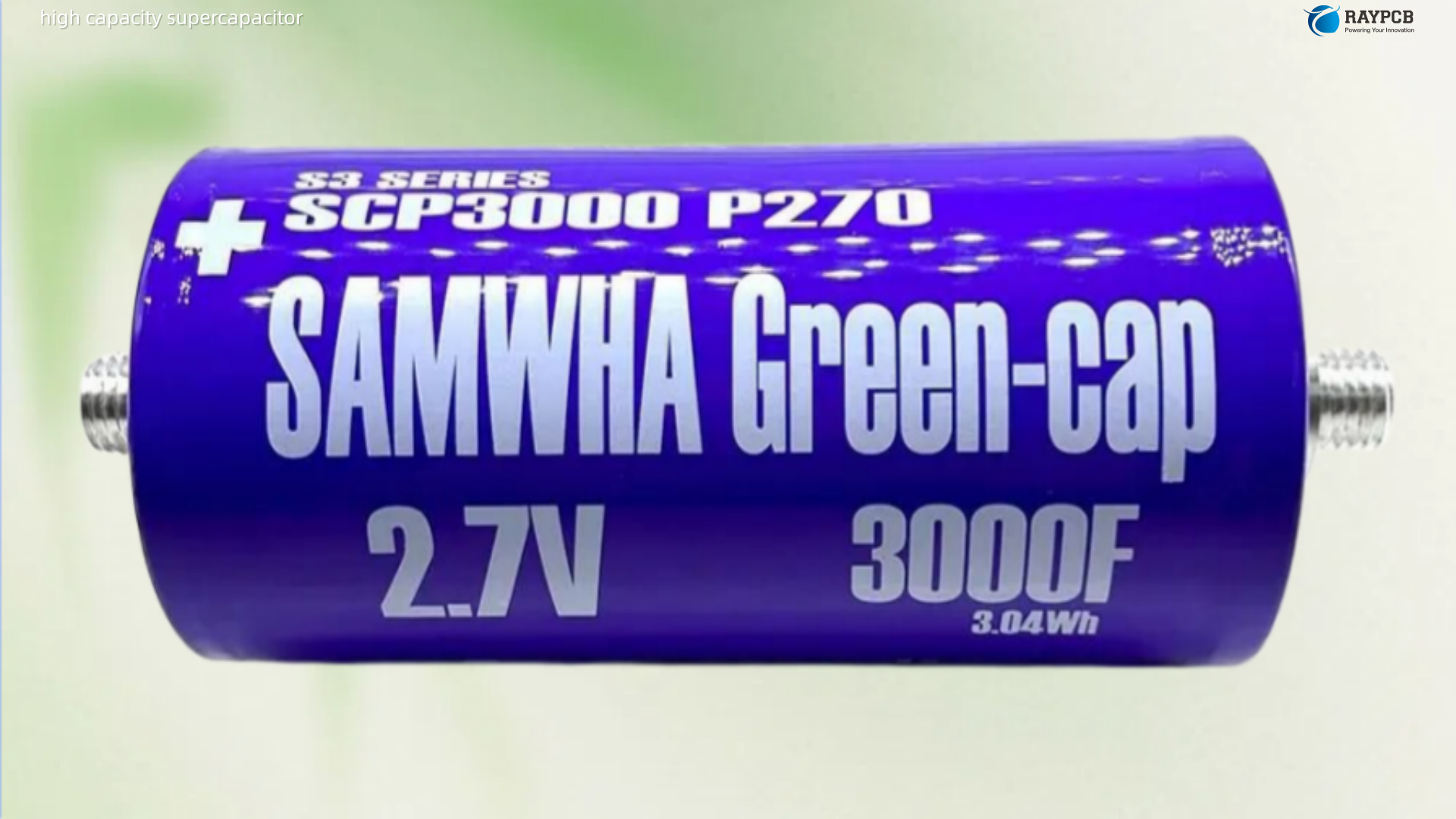
Note: on older or larger electrolytic capacitors you may see the abbreviation MFD printed on the case. This stands for microfarad (ยตF), not megafarad โ€” a legacy notation that’s increasingly misleading now that supercapacitors extend into the actual farad range.

How to Read the 3-Digit Capacitor Code (The Most Common System)

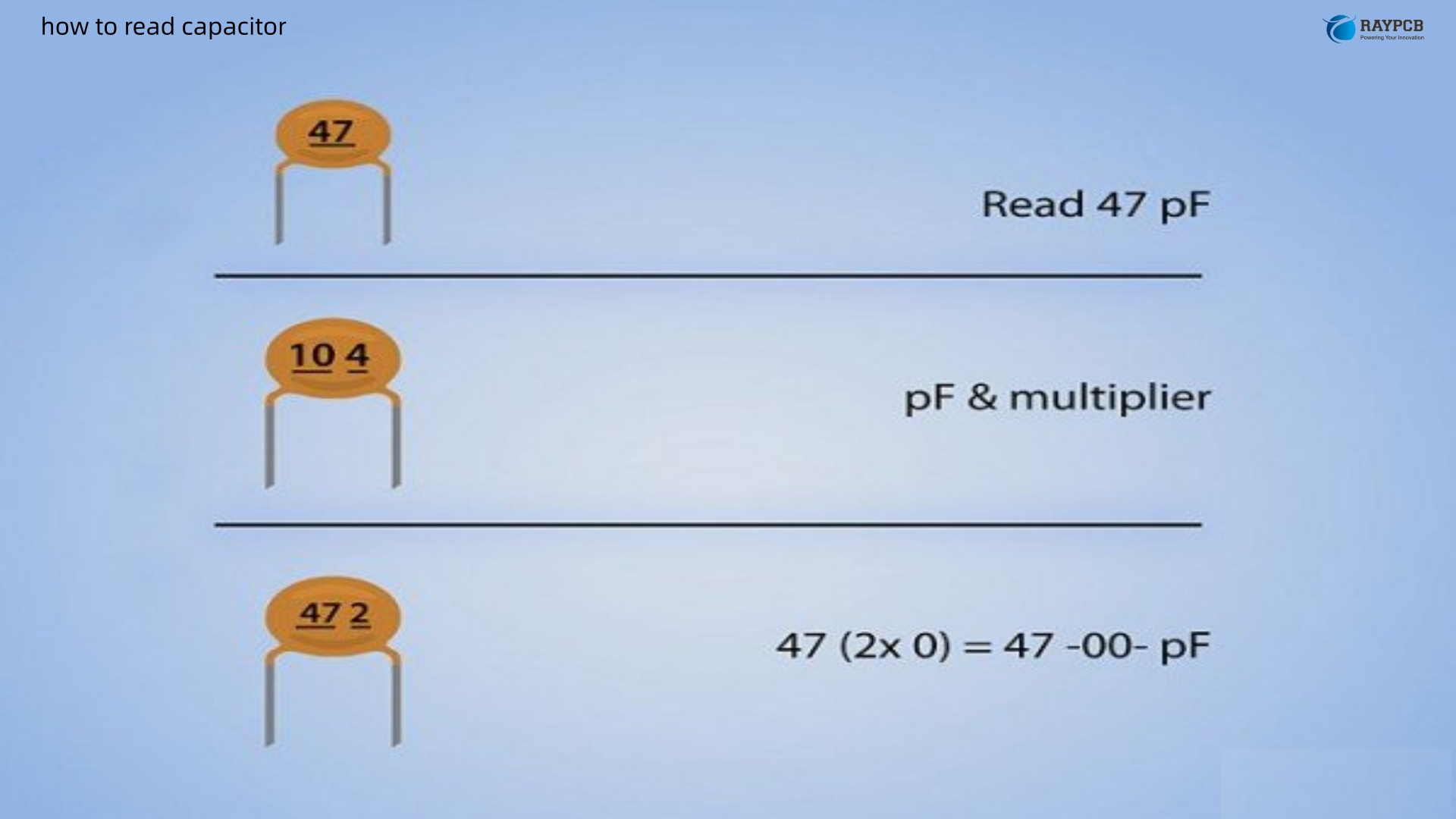
The 3-digit code is the one you’ll use most. It appears on ceramic disc capacitors, small polyester film caps, and most SMD ceramics that are large enough to carry markings. The logic is nearly identical to reading a resistor code.

The rule: The first two digits are the significant figures. The third digit is the multiplier โ€” specifically, the number of zeros to add after the first two digits. The result is always in picofarads (pF).

3-Digit Code Worked Examples

Code on CapFirst Two DigitsMultiplier (3rd digit)Result in pFConverted Value
104104 zeros100,000 pF0.1 ยตF
473473 zeros47,000 pF47 nF
102102 zeros1,000 pF1 nF
221221 zero220 pF220 pF
470470 zeros47 pF47 pF
682682 zeros6,800 pF6.8 nF
331331 zero330 pF330 pF

The most common mistake engineers make when first learning how to read capacitor codes is treating the third digit as a literal digit rather than a multiplier. A capacitor marked 104 is not 104 pF โ€” it’s 10 followed by four zeros, which is 100,000 pF or 0.1ยตF. This single confusion causes more incorrect component orders than anything else.

Special Multiplier Values: 8 and 9

The EIA RS-198 standard includes two special-case multipliers that you’ll rarely see but should know about:

3rd DigitMultiplierExampleResult
8ร— 0.0147847 ร— 0.01 = 0.47 pF
9ร— 0.147947 ร— 0.1 = 4.7 pF

These appear on very low-value capacitors where the normal code would produce a meaninglessly small number.

When You See Just Two Digits

If a capacitor has only a two-digit marking โ€” say, 47 or 22 โ€” read that number directly as picofarads. 47 = 47 pF. 22 = 22 pF. No multiplier involved.

The “R” Decimal Point Notation

For values below 10 pF where a decimal point is needed, the letter R substitutes for the decimal point. This follows the same convention used for resistors.

CodeMeaning
3R93.9 pF
1R51.5 pF
R470.47 pF
4R74.7 pF

If you see an R in a capacitor code, you’re dealing with a sub-10 pF value โ€” typical in RF matching networks, oscillator load circuits, and antenna tuning.

How to Read Capacitor Tolerance Codes

The tolerance letter typically appears immediately after the 3-digit capacitance code. So a capacitor marked 104K is 0.1ยตF with 10% tolerance โ€” not a 1040-something value.

EIA Tolerance Letter Codes

LetterToleranceTypical Application
Bยฑ0.1 pFPrecision NP0/C0G
Cยฑ0.25 pFPrecision NP0/C0G
Dยฑ0.5%Precision timing
Fยฑ1%Precision timing/RF
Gยฑ2%Standard precision
Jยฑ5%General-purpose ceramic
Kยฑ10%Standard bypass/decoupling
Mยฑ20%Power supply filtering
Z+80% / โˆ’20%Bulk storage, supercaps

In practice, the two codes you’ll see most often on a production PCB are J (ยฑ5%) and K (ยฑ10%). The tighter tolerances (D, F, G) almost always appear on C0G/NP0 dielectric parts used in oscillators, filters, and timing circuits. The M and Z tolerances are typical on large electrolytic values where absolute accuracy is less critical than bulk capacitance.

How to Read EIA Voltage Codes on Capacitors

Voltage rating is critical โ€” and it’s often the marking that gets skipped during a quick bench check. On larger capacitors it’s printed plainly in volts (e.g., 50V, 100V). On smaller ceramic and film types, a two-character voltage code may be used instead.

EIA DC Voltage Code Table

CodeVoltage Rating (DC)
1A10V
1C16V
1E25V
1H50V
1J63V
2A100V
2C160V
2E250V
2W450V
2H500V
3A1000V

A capacitor marked 2A474J should therefore be decoded as: 2A = 100V rating, 474 = 470,000 pF = 0.47ยตF, J = ยฑ5% tolerance.

How to Read MLCC Dielectric Codes: C0G, X7R, X5R and More

On ceramic capacitors, you’ll frequently see a three-character dielectric code alongside or instead of a voltage code. This tells you how stable the capacitance is over temperature โ€” which is often more important than the nominal value for precision or timing applications.

Class I Dielectric Codes (EIA RS-198)

The three-character code works as: [significant figure of temperature coefficient] + [multiplier] + [tolerance in ppm/ยฐC]

The most important Class I dielectric is C0G (also written NP0). C0G means a temperature coefficient of 0 ยฑ30 ppm/ยฐC across โˆ’55ยฐC to +125ยฐC. It is the gold standard for stable, predictable performance in filters, oscillators, and precision analog circuits.

Class II Dielectric Codes (EIA RS-198)

CodeTemperature RangeMax Capacitance ChangeTypical Use
X7Rโˆ’55ยฐC to +125ยฐCยฑ15%General purpose, decoupling
X5Rโˆ’55ยฐC to +85ยฐCยฑ15%Consumer electronics
Y5Vโˆ’30ยฐC to +85ยฐC+22% / โˆ’82%Bulk bypass only
Z5U+10ยฐC to +85ยฐC+22% / โˆ’56%Bulk bypass only

The X7R and X5R codes are the most commonly specified Class II dielectrics in modern PCB design. Y5V and Z5U have extremely wide capacitance variation over temperature and are unsuitable for any application where the capacitor value needs to stay predictable โ€” but they allow very high capacitance in small packages, which is why they show up in low-cost consumer goods.

How to Read the EIA-198 Two-Character Code (Letter + Number)

This system is used on precision SMD capacitors and is less common than the 3-digit code, but you’ll encounter it on tight-tolerance parts. A letter represents the significant figures of the capacitance, and a number represents the multiplier (power of 10).

EIA-198 Letter-to-Value Table (Selected Values)

LetterpF ValueLetterpF Value
A1.0a2.5
B1.1b3.5
C1.2c4.0
D1.3d4.5
E1.5e5.0
F1.6f6.0
G1.8g7.0
H2.0h8.0
J2.2j9.0
K2.4โ€”โ€”

Example: A5 = 1.0 ร— 10โต = 100,000 pF = 0.1ยตF. The number after the letter is the exponent (power of 10), not a multiplier in the sense of “add this many zeros.” So the number 5 means ร—100,000.

This system is explicitly used on the DigiKey SMD Capacitor Code Calculator and on precision component datasheets from manufacturers like Murata and TDK for their tightly-toleranced C0G parts.

How to Read Capacitor Color Codes (Legacy Systems)

Color codes on capacitors are largely obsolete โ€” you’ll find them on components from the 1960s through the mid-1980s, particularly on polyester film, mica, and some polystyrene types. If you’re repairing vintage audio gear, old radio equipment, or industrial equipment from that era, knowing how to read capacitor color codes is genuinely useful.

Standard Capacitor Color Code Table

ColorDigit ValueMultiplierToleranceVoltage (certain types)
Black0ร—1ยฑ20%โ€”
Brown1ร—10ยฑ1%100V
Red2ร—100ยฑ2%250V
Orange3ร—1,000ยฑ3%โ€”
Yellow4ร—10,000ยฑ4%400V
Green5ร—100,000ยฑ5%16V
Blue6ร—1,000,000ยฑ6%63V
Violet7โ€”ยฑ12.5%โ€”
Grey8ร—0.01ยฑ30%25V
White9ร—0.1ยฑ10%โ€”
Goldโ€”ร—0.1ยฑ5%โ€”
Silverโ€”ร—0.01ยฑ10%โ€”

Reading order for a 5-band capacitor: Band 1 and 2 are the significant digits. Band 3 is the multiplier. Band 4 is tolerance. Band 5 is working voltage. Always start reading from the end that has bands closer together, or from the end with a wider first band.

Color code example: Brown, Black, Orange, Gold = 10 ร— 1,000 = 10,000 pF = 10nF, ยฑ5% tolerance.

Mica Capacitor Dot Codes

Mica capacitors used a dot matrix system rather than bands. A black first dot identifies the component as mica. Dots 2, 3, and 4 give the capacitance value in pF using the same digit-digit-multiplier logic. Dot 5 is tolerance and dot 6 is voltage class. The dot numbering goes left-to-right on the top row and right-to-left on the bottom row โ€” a peculiar scheme that trips up first-time readers.

How to Read Electrolytic Capacitor Markings

Electrolytic capacitors are generally large enough to print values directly โ€” 470ยตF 35V, for example. There’s no code to decode. The key information to check on an electrolytic:

MarkingWhat to Check
Capacitance value (ยตF)Confirm the value matches the BOM
Voltage rating (V)Must exceed the maximum circuit voltage with margin
Temperature rating (ยฐC)85ยฐC vs. 105ยฐC matters for service life
Polarity stripeThe stripe or negative marking indicates the cathode (โˆ’) lead

The negative lead on a through-hole electrolytic is indicated by a stripe running down the body. On radial electrolytics the negative lead is also shorter. When in doubt, measure both leads with a DMM โ€” the positive lead will show a higher forward diode-like reading when the positive probe is on it.

How to Read SMD Tantalum Capacitor Codes

SMD tantalum capacitors use a positive polarity indicator rather than negative โ€” and this is one of the most common “gotcha” differences for engineers transitioning from through-hole work. The bar, stripe, or bevel on the tantalum package marks the positive (anode) terminal. This is the reverse convention from through-hole electrolytics, where the stripe marks negative.

Larger SMD tantalums often print value and voltage directly: 107 / 6.3V = 100ยตF at 6.3V (using 3-digit pF code: 10 ร— 10โท = 100,000,000 pF = 100ยตF). Smaller tantalums may use the EIA voltage letter code described above.

SMD Ceramic Capacitors: When There Are No Markings

This is the reality of modern PCB work. Surface-mount ceramic capacitors in 0402, 0201, and smaller packages frequently carry no markings whatsoever. The chips are too small to print legibly, and in automated assembly there’s no need since the pick-and-place machine reads the reel tape, not the component body. This means:

  • The BOM and assembly drawing are your primary reference
  • The component reel label carries the part number and value
  • A good LCR meter or capacitance meter is essential for identifying unmarked parts during debug or rework
  • Never measure a capacitor in-circuit for a definitive value โ€” always measure it out-of-circuit

For 0603 and larger, markings may be present in the 3-digit or EIA-198 format described above. For anything smaller, check your BOM and datasheet first.

Complete Quick-Reference Decoding Guide

Use this as a one-page cheat sheet:

What You SeeSystemHow to Decode
Three digits only (e.g., 104)EIA 3-digitFirst two = significant digits, third = add that many zeros, result in pF
Three digits + letter (e.g., 104K)EIA 3-digit + toleranceDecode capacitance first, then letter = tolerance
Letter-digit prefix + 3-digit (e.g., 2A104J)EIA with voltage codeFirst two chars = voltage, next three = capacitance, final letter = tolerance
Letter + number (e.g., A5)EIA-198Letter = significant figure value (from table), number = power of 10
R in code (e.g., 3R9)Decimal notationR = decimal point, result in pF
5 color bandsLegacy color codeBand 1+2 = digits, Band 3 = multiplier, Band 4 = tolerance, Band 5 = voltage
Value + V directly printedNon-codedRead directly โ€” typical on electrolytics and large film caps
No markingsUnmarked SMDCheck BOM, measure with LCR meter out-of-circuit

Useful Resources for Reading Capacitor Codes

These tools and references will accelerate your work with unfamiliar markings:

Frequently Asked Questions About How to Read Capacitor Codes

Q1: A capacitor on my board is marked “104” โ€” is that 104 picofarads?

No, this is the most common misreading. The code 104 means: take 10, add 4 zeros = 100,000 pF = 0.1ยตF = 100nF. To read any 3-digit code correctly, treat the third digit as the number of zeros to append to the first two, not as a third significant digit. Only a two-digit marking with no multiplier would be read as a direct pF value โ€” so “47” = 47 pF, but “470” = 47 pF (four zeros would make it 470,000 pF, but the multiplier here is 0, meaning no zeros added, giving 47pF).

Q2: What does the letter after the capacitor code mean โ€” for example, “104K”?

The letter is the tolerance code. K = ยฑ10%, J = ยฑ5%, M = ยฑ20%, F = ยฑ1%, and so on. The tolerance letter always follows the capacitance code and never modifies the value. So 104K is 0.1ยตF ยฑ10%, not 104K-something pF. This tolerance table follows the EIA standard and is shared with the resistor tolerance system.

Q3: I see “2A474J” on a capacitor. How do I read this?

This is a full EIA code with a voltage prefix. Break it down: 2A = 100V (from the EIA DC voltage code table). 474 = 47 ร— 10,000 = 470,000 pF = 0.47ยตF. J = ยฑ5% tolerance. So this is a 0.47ยตF, 100V, ยฑ5% ceramic capacitor.

Q4: What’s the difference between C0G and NP0 on a capacitor?

They are the same dielectric specification. C0G is the EIA code under RS-198, and NP0 (Negative-Positive-Zero) is the informal industry name for the same material that has been in use for decades. Both denote a Class I ceramic dielectric with a temperature coefficient of 0 ยฑ30 ppm/ยฐC. If your design calls for one, the other is a valid substitute as long as capacitance, voltage, and case size match.

Q5: How do I identify a capacitor with no markings at all?

First, check your BOM and assembly drawing against the board reference designator โ€” that should be your primary source of truth. If you genuinely don’t know what component was there (repair work on an unknown board, for instance), remove the capacitor from the board and measure it with an LCR meter or a DMM with capacitance function. In-circuit measurements are unreliable because parallel paths affect the reading. Cross-reference the measured capacitance, voltage tolerance (check from context), and package size against supplier databases like DigiKey, Mouser, or the manufacturer’s datasheet library. For 0402 and smaller packages, physically checking the component reel or bag label is the fastest resolution.

Once you’ve internalized the 3-digit EIA system, the rest of the capacitor code landscape falls into place naturally. The tolerance letter, the voltage prefix, the EIA-198 two-character system โ€” they all follow the same underlying logic: compress the maximum amount of information into the minimum number of characters on the smallest possible component body. Understanding that logic is the real key to reading any capacitor code you’ll ever encounter on a real PCB.

High-Capacity Supercapacitors (500Fโ€“3000F): EV, Grid & Industrial Uses โ€” The Complete Engineer’s Guide

Focus keyword high capacity supercapacitorย leads, targets EV/grid/rail engineers actively specifying or integrating these systems, matches all three major search intent clusters for this topic.

There’s a moment in power electronics design when you realize a battery simply cannot do what you need it to do. It’s not an energy problem โ€” it’s a power problem. The load demands hundreds of amps for a fraction of a second: a traction motor accelerating from rest, a grid inverter absorbing a braking energy pulse, a crane lowering a heavy load while the hydraulics recover kinetic energy. Batteries are slow electrochemically. They weren’t built for this. That’s the precise moment when a high capacity supercapacitor module โ€” a bank of 500F, 1000F, or 3000F cells stacked to achieve the bus voltage you need โ€” becomes the right engineering answer.

This guide is written from the perspective of an engineer who needs to actually specify, size, and integrate these devices โ€” not just understand that they exist. It covers what separates a 500F cell from a 3000F cell, how to build a module from individual 2.7V cells to reach 48V, 160V, or 300V system voltage, where these devices are solving real problems in EV drivetrains, railway traction, grid stabilization, and industrial machinery, and what the critical engineering pitfalls look like before you hit them.

What Makes a Supercapacitor “High Capacity”?

In the supercapacitor world, “high capacity” means individual cell capacitance values from approximately 500 Farads up to 3000 Farads and beyond โ€” cells physically large enough to require bolt-type terminals, cylindrical aluminum cans in the 35mm ร— 60mm to 60mm ร— 138mm range, and energy storage in the 1โ€“11 Wh range per cell. These are not the coin-cell-sized backup power components used in RTC circuits. These are serious energy storage devices that weigh 500g to 1kg per cell and handle peak currents of hundreds of amps.

High Capacity Supercapacitor: Key Technical Parameters

ParameterTypical Range (500Fโ€“3000F cells)Why It Matters
Capacitance500F โ€“ 3000F per cellDetermines stored energy at a given voltage
Cell Voltage2.7V โ€“ 3.0VMaximum per-cell operating voltage
Module Voltage16V โ€“ 300V+ (series stacks)Must match system bus voltage
ESR (per cell)0.15mฮฉ โ€“ 2mฮฉGoverns peak power delivery and internal heating
Max Continuous Current50A โ€“ 600AMust not be exceeded during charge or discharge
Peak Current (1s pulse)200A โ€“ 2000ARelevant for starting, acceleration, braking pulses
Operating Tempโˆ’40ยฐC to +65ยฐC (standard)โˆ’40ยฐC performance critical for cold-climate transport
Cycle Life500,000โ€“1,000,000 cyclesEffectively unlimited in most applications
Energy Density4โ€“8 Wh/kgLow vs. batteries โ€” accept this, optimize for power
Power Density5,000โ€“15,000 W/kgThis is the value proposition

The power density figure deserves emphasis. Supercapacitors provide power density of approximately 10,000 W/kg while achieving high-power output and excellent cycle durability. That’s 10โ€“100ร— higher than lithium-ion batteries. When the application requires peak power delivery โ€” not sustained energy storage โ€” the supercapacitor wins this comparison comprehensively.

The EDLC Physics Behind High-Capacity Cells

High-capacity supercapacitors are Electric Double-Layer Capacitors (EDLCs). They store energy electrostatically at the interface between activated carbon electrodes and an organic electrolyte. The massive surface area of activated carbon โ€” up to 2,000 mยฒ/g โ€” is what produces capacitance values impossible to achieve with conventional dielectric capacitor construction. A 3000F cell contains several hundred grams of activated carbon electrode material, carefully wound with separator and current collectors into a tight cylindrical jelly-roll construction inside an aluminum can.

The organic electrolyte used in 2.7V-rated cells (typically acetonitrile-based or propylene carbonate-based) allows a higher voltage window per cell than aqueous electrolytes, which enables the energy density improvements of recent generations. The voltage window determines stored energy through E = ยฝ ร— C ร— Vยฒ. Increasing per-cell voltage from 2.5V to 2.7V increases stored energy by approximately 17% for the same capacitance โ€” which is why the 2.7V cell rating has become the dominant standard and 3.0V cells are now entering production.

Building High-Voltage Modules from 2.7V Cells

Individual high capacity supercapacitor cells operate at 2.7V maximum. Real-world applications need 12V, 16V, 48V, 160V, or even 300V bus voltages. The solution is series stacking โ€” placing cells in series to add their voltages, just as you build a battery pack. A 16V module uses six 2.7V cells in series (16.2V maximum). A 48V module uses eighteen cells. A 160V module requires sixty cells. Commercial modules from Maxwell Technologies (now Vishay), Eaton, Skeleton Technologies, and Vinatech are pre-built at these common voltage levels.

Common High-Capacity Supercapacitor Module Configurations

Module VoltageCell Count (2.7V cells)Typical CapacitanceTypical Application
16V6 cells58F โ€“ 500FAutomotive starting, light industrial
48V18 cells16F โ€“ 165FIndustrial machinery, light rail buffer
160V60 cells5F โ€“ 50FGrid stabilization, heavy rail
300V~112 cells2F โ€“ 20FEV drivetrain, grid storage modules

The critical engineering challenge in series-stacked modules is cell voltage balancing. No two cells have exactly the same capacitance or leakage current. In a series string, voltage distributes according to the inverse of individual cell capacitances โ€” a cell with lower capacitance charges to a higher voltage fraction. If uncorrected, the weakest cell in the string may be driven above its rated 2.7V, accelerating aging, increasing leakage, and eventually causing it to fail while the rest of the string is still within ratings. This imbalance worsens over the life of the module as individual cells age at different rates.

Cell Voltage Balancing Methods Compared

Balancing MethodComplexityPower LossCostBest For
Passive resistor (bleeder)Very lowContinuous bleed lossVery lowShort-duration backup, cost-critical
Zener clamp (per cell)LowOnly at overvoltageLowSimple modules, low cycle rate
Active switched balancingHighNear-zeroHighHigh-cycle industrial/EV applications
Dedicated BMS ICMediumLowMediumPre-packaged modules with monitoring

In high-cycle applications like EV regenerative braking or rail traction systems, active balancing is worth the cost. The alternative โ€” passive bleeder resistors across each cell โ€” continuously dissipates power and wastes the energy efficiency advantage that makes supercapacitors attractive in the first place.

High-Capacity Supercapacitors in Electric Vehicle Applications

Regenerative Braking: Where Supercapacitors Solve a Real Problem

The core challenge in EV regenerative braking is not energy volume โ€” it’s power rate. When a vehicle decelerates hard from 100 km/h, the regenerative braking system needs to absorb kinetic energy quickly. The power generated during hard braking can exceed 100kW in a passenger vehicle and 500kW in a commercial vehicle or rail car. Lithium-ion batteries cannot absorb this rate of charge without damage โ€” high charge rates accelerate lithium plating, degrade the SEI layer, and reduce cell cycle life.

Advanced regenerative braking systems can capture up to 92.5% of kinetic energy during deceleration, directing it first to supercapacitors for rapid storage, then gradually transferring it to the primary battery. This two-stage strategy resolves the power rate conflict: the supercapacitor absorbs the high-power braking pulse (milliseconds to seconds), then the stored energy is transferred to the battery at a rate the battery chemistry can handle (seconds to minutes). The result is both higher energy recovery and reduced battery stress.

In EV hybrid energy storage system (HESS) designs, a typical configuration applies a 48V DC link incorporating a 500F ultracapacitor module at 16V alongside a 60Ah battery. The ultracapacitor offers rapid energy release for high power demands, while the battery provides the long-lasting energy supply.

Protecting Battery Longevity Through Supercapacitor Buffering

Battery degradation in EVs is not uniform โ€” it’s accelerated by high C-rate charge and discharge events, which are exactly what stop-and-go urban driving produces constantly. Every hard acceleration draws multi-C current from the battery; every hard braking demands multi-C charge acceptance. Supercapacitor HESS design directly addresses this. The integration of supercapacitors as buffers during motor transients reduces electrochemical strain on batteries, with studies showing this configuration can enhance battery longevity by mitigating peak current demands.

EV Drivetrain System Architecture with High-Capacity Supercapacitors

In a HESS for BLDC motor-driven EVs, the battery pack is directly connected to the DC-link at a lower voltage, while a higher-voltage supercapacitor module connects through a unidirectional DC/DC converter. In normal conditions, the battery alone supplies the motor. During peak power events โ€” acceleration or hill climbing โ€” the supercapacitor assists through the DC/DC converter.

The bidirectional DC/DC converter between the supercapacitor bank and the main DC bus is a key system component. It needs to handle the high peak currents and fast transient response that make supercapacitors valuable โ€” a poorly designed converter with slow control loop bandwidth throws away the supercapacitor’s speed advantage. Typical converter switching frequencies for this application run from 20kHz to 100kHz, with control loop bandwidths of several kHz to respond quickly enough to capture sub-100ms braking pulses.

High-Capacity Supercapacitors in Grid and Railway Applications

Grid Frequency Regulation and Peak Shaving

Power grids face a fundamental challenge: generation and consumption must balance in real time. Traditional inertia from rotating generators provided this balance inherently โ€” synchronous machines physically resist frequency changes through their rotational inertia. As grids incorporate more renewable generation from inverter-coupled sources (solar, wind), this physical inertia disappears. Frequency deviations that once recovered over seconds now happen in milliseconds.

High-capacity supercapacitor banks connected to grid-tied inverters provide synthetic inertia โ€” injecting or absorbing power within milliseconds when frequency deviates from 50Hz or 60Hz. A 1MW supercapacitor array might store only a few minutes of energy at rated power, but that’s sufficient for frequency regulation events, which last seconds to minutes and repeat frequently across a 24-hour period. The supercapacitor’s cycle life advantage over batteries is decisive here: grid frequency regulation involves thousands of charge-discharge cycles per year, a rate that degrades lithium-ion batteries rapidly but has negligible effect on EDLCs.

Railway Traction: Recovering Regenerative Braking Energy at Substations

Railway systems present a particularly compelling use case for high capacity supercapacitor installations at DC traction substations. When a train brakes on a 3kV DC railway system, the regenerative energy returns to the overhead wire and must be absorbed by something. If another train is accelerating nearby, it absorbs that energy. But if no train is in the right position, the energy is dumped as heat through braking resistors โ€” wasted entirely.

Research on 3kV DC railway hybrid energy storage systems shows that peak power can be reduced by approximately 1MW with a payback period around 10 years for battery module installation, while energy consumption can be decreased by 1.9 MWh per 24-hour period with a payback period of approximately 7.5 years for the supercapacitor module.

The supercapacitor portion of the system handles the high-power, short-duration regenerative braking pulses, while a battery handles longer-duration peak power shaving. The supercapacitor module is mainly dedicated to regenerative energy utilization, while the Li-ion battery aims for peak power reduction. Sizing each component for its actual role rather than designing a single storage technology to handle both requirements dramatically improves economics and system life.

Industrial Crane and Port Equipment Applications

Rubber-tired gantry cranes, reach stackers, and automated guided vehicles in ports and manufacturing facilities represent another high-value supercapacitor application. Every time a crane lowers a container, the descending load generates power through the hoist motor operating in regeneration. Without energy recovery, this power is burned as heat in braking resistors โ€” visibly wasteful and thermally demanding. A high-capacity supercapacitor bank recovers this energy and returns it during the next lift cycle.

The cycle rate in port crane applications can reach 10โ€“30 complete lift-and-lower cycles per hour across a 24-hour operating day โ€” over 200,000 cycles per year. No battery chemistry handles this gracefully. Supercapacitors do, with cycle life specifications from major manufacturers running to 500,000 cycles or more under these conditions, translating to 15+ years of continuous port operation without cell replacement.

Specifying High-Capacity Supercapacitors: The Parameters That Actually Govern Performance

Energy Sizing: Starting From Application Requirements

The fundamental sizing equation for a supercapacitor module is:

E = ยฝ ร— C ร— (V_maxยฒ โˆ’ V_minยฒ)

Where V_max is the fully charged voltage and V_min is the minimum useful discharge voltage. You cannot use 100% of the stored energy because as voltage drops, available power drops proportionally โ€” a supercapacitor bank at 50% voltage delivers only 25% of its full-power capability. Practical designs typically use 50โ€“75% of the voltage window as the usable range, leaving 25% or more at the bottom as unusable reserve.

Example sizing for a 300kJ peak energy requirement with a 48V bus:

C_required = 2 ร— E / (V_maxยฒ โˆ’ V_minยฒ) = 2 ร— 300,000 / (48ยฒ โˆ’ 24ยฒ) = 2 ร— 300,000 / (2304 โˆ’ 576) = 347F

So a 48V module with approximately 350F of capacitance provides the required energy while using the voltage window from 48V down to 24V.

Power Sizing: ESR Is the Critical Parameter

The maximum instantaneous power deliverable by a supercapacitor module is governed by ESR, not capacitance:

P_max = Vยฒ_rated / (4 ร— ESR_total)

For a 48V module with total ESR of 2mฮฉ: P_max = 48ยฒ / (4 ร— 0.002) = 2304 / 0.008 = 288kW peak power. This is why manufacturers of premium high-power supercapacitors โ€” Skeleton Technologies in particular โ€” focus intensely on reducing ESR through curved graphene electrode structures rather than simply maximizing capacitance. Lower ESR directly extends peak power capability.

Thermal Management at High Current

High peak currents flowing through ESR generate heat inside the cell: P_heat = Iยฒ_peak ร— ESR. For a 500A peak current through a cell with 0.5mฮฉ ESR: P_heat = 500ยฒ ร— 0.0005 = 125W per cell. In a module of 18 cells in series, total internal heat generation at this current is 2.25kW โ€” sufficient to require active cooling in a confined module enclosure. Most high-power supercapacitor modules above 100kW continuous power rating require liquid cooling or forced-air cooling to maintain cell temperature within the operating range.

Temperature directly affects both performance and life. Cell capacitance decreases at low temperatures โ€” a cell rated at 3000F at 25ยฐC may deliver only 2200โ€“2500F at โˆ’30ยฐC. ESR increases at low temperatures, sometimes by 3โ€“5ร— for wet EDLC cells. Cold-climate applications must account for reduced power capability and increased internal heating in their sizing calculations.

Comparing High-Capacity Supercapacitor Manufacturers and Cell Series

These are the established manufacturers producing 500Fโ€“3000F cells with traceable technical documentation and supply chain stability โ€” the starting list for any serious procurement process:

High-Capacity Supercapacitor Cell Series Comparison

ManufacturerKey SeriesMax CapacitanceESR RangeNotable Strength
Vishay (Maxwell heritage)K2, DuraBlue3000F0.22mฮฉโ€“0.29mฮฉMost widely specified, extensive datasheet history
EatonHS series3000F0.2mฮฉโ€“0.5mฮฉStrong module ecosystem, wide temp range
Skeleton TechnologiesSkelCap5000FSub-0.2mฮฉCurved graphene electrode, lowest ESR commercial cells
SAMWHA CapacitorGreen-Cap P2703000F0.25mฮฉโ€“0.35mฮฉCost-competitive, automotive AEC-Q200 versions
LS Mtron (Korea)LSUM series3000F0.2mฮฉโ€“0.3mฮฉStrong in rail and industrial markets
WIMA (Germany)SuperCap500F โ€“ 1200F0.3mฮฉโ€“1mฮฉEuropean rail-qualified, high reliability focus

The Maxwell K2 series โ€” now produced under Vishay following the 2019 acquisition โ€” has the deepest body of real-world deployment data of any supercapacitor product, having been in production since the early 2000s. When specification engineers at Tier 1 automotive suppliers or rail OEMs need a part with 15 years of failure-mode history in the field, the K2 series is the default starting point. Skeleton’s curved graphene approach genuinely delivers lower ESR than activated carbon-based cells, but at a cost premium and without the same field history depth at this writing.

Compliance, Safety Standards, and Certifications

High capacity supercapacitor modules for transport and grid applications must meet specific standards depending on the application sector:

Key Standards for High-Capacity Supercapacitor Applications

StandardScopeRequired For
IEC 62391-1Fixed electric double-layer capacitors, generalGeneral industrial/grid use
IEC 62391-2Double-layer capacitors for power applicationsHigh-power industrial and transport
IEC 62576-2018EDLCs for electric vehiclesEV drivetrain supercapacitor systems
AEC-Q200Passive components for automotiveAny automotive-rated cell specification
UN/DOT 38.3Transport testing for energy storageShipping and logistics compliance
ISO 9001Manufacturing quality managementGeneral quality assurance baseline
CE / RoHSEuropean market requirementsEU system integration

For automotive applications, AEC-Q200 qualification is non-negotiable โ€” it defines accelerated stress tests, thermal cycling, vibration, humidity, and electrical overstress requirements specifically for automotive passive components. Not all supercapacitor manufacturers maintain AEC-Q200 qualification; confirm this before designing a cell into a vehicle application.

Practical Integration Considerations: What Engineers Get Wrong

Underestimating Inrush Current at Power-Up

A discharged supercapacitor module looks like a short circuit to the power source at the instant of connection. A 500F module at 48V bus voltage, with 2mฮฉ total ESR, draws an initial current of 48 / 0.002 = 24,000A โ€” a current spike that destroys contactors, fuses, and DC/DC converter input stages within milliseconds if not managed. Every supercapacitor module integration requires a pre-charge circuit: a resistor and relay combination (or a dedicated pre-charge controller) that limits inrush current to a safe level during power-up, then bypasses the limiting resistor once the module is charged near bus voltage.

This seems obvious in hindsight, but pre-charge circuit failures are one of the most common causes of first-article power-up failures in supercapacitor system integration. Calculate the time constant of your pre-charge resistor and module capacitance, specify the resistor power rating correctly for the energy it must absorb during pre-charge (E = ยฝ ร— C ร— Vยฒ every power-up cycle), and check that the resistor can handle the thermal cycling of repeated pre-charge events in the intended duty cycle.

PCB and Bus Bar Design for High Pulse Currents

At the module level, current paths to the supercapacitor terminals must handle peak currents that dwarf the continuous current rating. Copper bus bars, not PCB traces, are the correct medium for main current paths in high-capacity supercapacitor applications. The inductance of the connection between the supercapacitor module and the load is also worth managing โ€” a long, narrow bus bar loop creates inductance that limits the speed of current rise during fast transient events, partially defeating the supercapacitor’s response speed advantage. For layout guidance on how capacitors interface with PCB power distribution and bus design, reviewing PCB-level design principles before specifying the physical integration is worth doing even when the supercapacitor itself mounts off-board.

Self-Discharge and System Standby Planning

Large supercapacitor modules will self-discharge to approximately 50% of their initial voltage within days to a few weeks when disconnected from a charge source, and to near-zero over a longer period. Unlike a battery, a supercapacitor left connected to a powered-off system does not maintain charge indefinitely. Systems designed for long standby periods must either include a trickle-charge circuit to maintain the module at operating voltage, or their sizing must account for the cap starting from a partially discharged state when the system powers up after extended idle time.

Useful Engineering Resources for High-Capacity Supercapacitor Design

These are the primary technical references worth bookmarking for any serious high-capacity supercapacitor design:

Vishay / Maxwell K2 Series Datasheets and Application Notes โ€” vishay.com/capacitors/ultracapacitors: Full K2 series datasheets including ESR vs. temperature curves, pulse power models, and the Maxwell ultracapacitor sizing calculator.

Eaton Supercapacitor Module Technical Resources โ€” eaton.com/en-us/catalog/capacitors/supercapacitor-modules.html: Application notes for transportation, grid, and UPS supercapacitor modules, including cell balancing design guides.

Skeleton Technologies Application Engineering โ€” skeletontech.com/resources: Detailed technical papers on curved graphene electrode EDLCs including ESR comparison data versus activated carbon cells, and hybrid HESS architecture white papers.

IEC 62391-2 Standard Overview (IEC Website) โ€” iec.ch/publication/6163: The primary international standard for power-application EDLCs โ€” essential reading for any grid or transport integration requiring certification.

ScienceDirect: Battery-Supercapacitor HESS Review โ€” sciencedirect.com/science/article/pii/S2590123024018413: Comprehensive academic review of HESS design, sizing methodologies, energy management strategies, and effects on EV performance characteristics.

Digikey Supercapacitor Parametric Search โ€” digikey.com/en/products/filter/supercapacitors-ultracapacitors-edlcs/572: Cross-reference 500Fโ€“3000F cells by voltage rating, ESR, temperature range, and manufacturer simultaneously.

KEMET Supercapacitor Design Guide โ€” kemet.com/en/us/capacitors/supercapacitors.html: Design guide covering module assembly, cell balancing circuit design, thermal analysis, and life prediction for KEMET supercapacitor series.

5 Frequently Asked Questions About High-Capacity Supercapacitors

Q1: Can a bank of 500Fโ€“3000F supercapacitors replace a battery entirely in an EV?

Not with current technology โ€” and not because supercapacitors aren’t good enough, but because they’re solving the wrong problem for full vehicle energy storage. Supercapacitors have lower energy density of around 1โ€“10 Wh/kg, while batteries provide high energy density and long-lasting energy supply. A battery pack might deliver 250Wh/kg; a supercapacitor delivers 5โ€“8Wh/kg. To store the same energy as a 60kWh EV battery pack using supercapacitors alone would require roughly 8,000โ€“12,000 kg of supercapacitor cells โ€” the entire weight budget of a heavy truck, not a passenger car. Supercapacitors work as power buffers alongside batteries, not as replacements for them.

Q2: How do you calculate how much energy a 3000F 2.7V supercapacitor stores?

Using E = ยฝ ร— C ร— Vยฒ: E = 0.5 ร— 3000 ร— 2.7ยฒ = 0.5 ร— 3000 ร— 7.29 = 10,935 joules = approximately 3.04 watt-hours. That’s the total energy at full charge. Usable energy depends on your minimum discharge voltage โ€” if the load requires at least 1.5V, usable energy is ยฝ ร— 3000 ร— (2.7ยฒ โˆ’ 1.5ยฒ) = ยฝ ร— 3000 ร— (7.29 โˆ’ 2.25) = 7,560 joules = about 2.1 watt-hours per cell. For a 16V module of six cells, multiply by six: approximately 12.6 usable watt-hours in the 16Vโ€“9V discharge window โ€” meaningful pulse energy for automotive starting or industrial peak demand applications.

Q3: Why is ESR so much more important in high-capacity supercapacitors than in small supercapacitors?

In a 0.1F backup supercapacitor powering an RTC at 3ยตA, ESR of 10โ€“100ฮฉ barely matters โ€” the voltage drop is in the microvolt range. In a 3000F supercapacitor delivering 500A of peak braking current, a 0.5mฮฉ ESR difference between cell models produces 250mV of additional voltage drop โ€” and 125W of additional internal heating per cell. Multiply that across 60 cells in a high-voltage module and you have 7.5kW of extra internal heat generated during a braking event. ESR in high-power applications is not a secondary spec โ€” it determines system efficiency, thermal management requirements, and peak power capability more directly than capacitance value does.

Q4: What happens if one cell in a series string fails?

A single cell failure in a series-connected supercapacitor module typically causes the entire module to fail โ€” either because the failed cell is short-circuit (causing the module to lose one cell’s voltage contribution) or open-circuit (breaking the series current path entirely). Short-circuit failure is more common in EDLCs, where the cell self-discharges through an internal short and the remaining cells in the string see slightly higher voltage, potentially cascading. This is why quality module manufacturers include per-cell voltage monitoring (the supercapacitor management system, SMS), protective disconnect relays, and active balancing. Designing a high-capacity supercapacitor module without cell-level monitoring is an engineering risk that should only be accepted with full awareness of the consequences.

Q5: How should high-capacity supercapacitor modules be safely decommissioned or disposed of?

A fully charged 3000F 2.7V cell stores approximately 3 watt-hours of energy at a very low internal impedance โ€” it can deliver thousands of amps through a short circuit. Before handling, disposal, or shipping a supercapacitor module, the cells must be fully discharged through a resistive load to below 0.1V per cell. Never short-circuit cells to discharge them โ€” the current spike will weld terminals and cause uncontrolled heating. A discharge resistor should be calculated to keep discharge current below the cell’s continuous current rating: for a 48V module at 5A discharge current, use a 9.6ฮฉ resistor. The module should be fully discharged before any mechanical disassembly, terminal removal, or contact with conductive materials. Environmental disposal follows standard e-waste regulations โ€” activated carbon electrodes and aluminum construction have no specific hazardous material designations, but local recycling regulations for electronic components apply.

Summary

High-capacity supercapacitors in the 500F to 3000F range are not a future technology waiting for adoption โ€” they are working components in production EVs, operating railway systems, live grid stabilization installations, and active industrial machinery right now. The value proposition is consistent across all these applications: unlimited cycle life, instantaneous power delivery, and the ability to absorb and release energy at power rates that damage or destroy battery technology. The engineering challenges โ€” cell voltage balancing, inrush current management, thermal management at high peak currents, and the pre-charge circuit requirement โ€” are all well-understood problems with established solutions. Get the sizing math right, choose the right cell series for your application environment, and build a proper management system around the module, and the high-capacity supercapacitor delivers operational lifetime measured in decades, not years.

Technical specifications cited reflect typical manufacturer data at time of writing. Always verify against current datasheets from your chosen supplier before finalizing a design.

EMI Filter Capacitor: X Cap & Y Cap Selection Guide

X cap and Y cap selection made clear: differential vs common mode noise, X1/X2/Y1/Y2 classifications, certification requirements, and PCB layout guidance for EMI filters.

Every AC-connected product ships with an EMI filter on its mains input. Most engineers have placed X capacitors and Y capacitors on a schematic without giving them much thought beyond copying a reference design. That approach worksโ€”right up until the first pre-compliance EMI scan comes back with a problem, or the certification lab flags a safety concern, or the product fails in the field because an unsuitable part was substituted during a BOM revision.

The EMI filter capacitor is not a generic bypass component. The X cap and Y cap classifications exist because these components are connected directly to AC mains voltage and their failure modes are safety-critical. Understanding the classification system, the physics behind how each type suppresses noise, and the selection rules that govern them is essential knowledge for any engineer working on a mains-powered product.

This guide covers the complete picture: how X and Y caps work, the IEC safety classification system, value selection logic, PCB layout practices, and the compliance obligations that make these components different from every other capacitor on the board.

What Is an EMI Filter Capacitor?

An EMI filter capacitor is a safety-rated capacitor connected directly to AC power lines with the specific purpose of suppressing conducted electromagnetic interference. Conducted EMI travels along the mains cables in two distinct modes, and the EMI filter network needs to address both:

Differential mode (DM) noise flows in opposite directions on the Live and Neutral conductorsโ€”it is essentially noise current that takes the normal circuit current path but at frequencies far above mains frequency. X capacitors suppress differential mode noise by connecting across Live and Neutral (Lโ€“N), providing a low-impedance shunt path for high-frequency DM current.

Common mode (CM) noise flows in the same direction on both Live and Neutral conductors and returns via the protective earth (ground). It is caused by parasitic capacitance between switching nodes and the chassis or earth, and it is the harder noise mode to suppressโ€”and the more likely cause of radiated emissions failures. Y capacitors suppress common mode noise by connecting between Live and Earth (Lโ€“E) and between Neutral and Earth (Nโ€“E), providing a shunt path for CM noise current to return to its source without traveling back through the mains cable.

This fundamental difference in noise typeโ€”and in connection topologyโ€”is why X and Y capacitors are separate components with separate safety classifications, separate failure mode requirements, and separate regulatory constraints.

Why EMI Filter Capacitors Are Safety Components

The fact that both X and Y capacitors connect to AC mains lines means their failure modes directly determine whether a product can shock or electrocute a user.

Class X capacitors should fail short to trigger upstream protection such as a fuse or breaker. Class Y capacitors must fail open to avoid shock hazards. This is the foundational safety requirement that defines everything about how these components are constructed, tested, and certified.

An X capacitor failing short is safe: it blows the mains fuse, the product stops working, and the user is not at risk. An X capacitor failing open is also safe: the filter becomes less effective but no hazard is created.

A Y capacitor failing short is catastrophic: it creates a direct connection between the live mains conductor and the equipment chassis. If the chassis is touchableโ€”and on most products it isโ€”the user faces a lethal shock hazard. This is why Y capacitors must be manufactured to fail open under fault conditions, and why their construction, dielectric integrity, and certification requirements are far more stringent than X capacitors.

The “safety” designation on these capacitors refers not to the dielectric material but to the component having passed specific safety certification tests. In terms of material, safety capacitors are mainly CBB (metallized polypropylene film) capacitors and ceramic capacitors. The certification, not the chemistry, is what makes a component a safety capacitor.

X Capacitor and Y Capacitor Classifications Explained

Both Class-X and Class-Y capacitors have subclasses: subclass X1, X2, and X3, and subclass Y1, Y2, Y3, and Y4. Subclass X2 and Y2 are the most common type of subclass for applications that use 120VAC (USA) or 220/240VAC (Europe).

X Capacitor Subclasses

ClassPeak Impulse VoltageSafety LevelTypical Application
X1>2.5 kV, โ‰ค4.0 kVIIIIndustrial 3-phase mains, lighting ballasts
X2โ‰ค2.5 kVIIConsumer electronics, household appliances (most common)
X3โ‰ค1.2 kVNo specific classLow-energy equipment (rarely used)

Whereas X2 and Y2 caps are appropriate for household applications, X1 and Y1 safety capacitors are used in industrial settings. For most consumer product designsโ€”SMPS adapters, white goods, industrial controls connected to single-phase 230 V mainsโ€”X2 is the correct specification. For equipment connected to 3-phase industrial supplies where surge voltages can be significantly higher, X1 is required.

Y Capacitor Subclasses

ClassInsulation TypeTest VoltageMax CapacitanceTypical Application
Y1Double/reinforced8 kV peak4.7 nF (typically)Industrial, medical across reinforced insulation
Y2Basic/supplementary5 kV peak4.7 nFConsumer electronics, general mains products
Y3Basic/supplementaryโ€”โ€”Not widely used in practice
Y4Functional insulation<150 Vโ€”Telecom, low-voltage applications

The difference between Y1 and Y2 capacitors is the maximum isolation voltage of the component. Y2 capacitors can be used for barriers with up to 1500VAC test voltage; Y1 rated capacitors can be used for barriers up to 3000VAC test voltage.

For medical equipment, the Y classification maps directly onto patient safety requirements: Y2 rated capacitors will provide sufficient protection to an operator in a 2ร—MOOP isolation barrier, while Y1 capacitors are required where 2 MOPP (Means of Patient Protection) is needed.

Can You Substitute X2 for Y2 or Vice Versa?

A Y2 capacitor can safely be used in place of an X2 capacitor, but an X2 capacitor should not be used in place of a Y2 capacitor. This is because, although an X2-type capacitor would work and filter noise sufficiently, it would not meet the line-to-ground safety standards. In plain terms: always use the correct class for the connection topology. Never place an X-rated capacitor in a Y position.

Certification Standards: What the Labels Mean

Every safety capacitor should carry visible certification marks on its body. Understanding what you’re looking at matters for both compliance and BOM management.

StandardRegionScope
IEC 60384-14InternationalPrimary global standard for X and Y safety capacitors
EN 60384-14Europe (CENELEC)Identical to IEC 60384-14
UL 1414USAAcross-the-line (X cap) applications
UL 1283USAEMI filter assemblies
CAN/CSA C22.2 No.1CanadaCanadian safety requirements
GB/T 14472ChinaChinese national standard
AEC-Q200AutomotiveQualification standard for automotive-grade safety caps

The certification marks on a compliant safety capacitor body typically include VDE, ENEC, UL, CUL, CQC, or KC (Korea). A part carrying IEC/ENEC certification is recognized across all CENELEC member countries without repeat testing. For North American markets, UL certification is required separately. Dual-certified parts (carrying both European and North American marks) simplify BOM management for products sold in multiple regions.

When reviewing a BOM or approving a substitute component, verify that the replacement part carries the same certification marks as the original. A physically identical-looking capacitor without the correct certifications is not an acceptable substitute in a safety-capacitor positionโ€”regardless of what the basic electrical datasheet says.

EMI Filter Capacitor Values: How to Select the Right Capacitance

Value selection for X and Y capacitors is governed by two competing requirements: filtering effectiveness (which increases with capacitance) and regulatory limits (which constrain maximum capacitance, particularly for Y caps).

X Capacitor Value Selection

X capacitors suppress differential mode noise. Higher capacitance provides more attenuation at a given frequency, and X capacitors are not limited by leakage current concerns in the way Y capacitors are. Common X2 capacitor values range from 33 nF to 2.2 ยตF.

The X capacitor, together with the differential mode inductance of the common mode choke, forms a low-pass filter for DM noise. The cutoff frequency is:

f_cutoff = 1 / (2ฯ€ ร— โˆš(L_DM ร— C_X))

For a 1 mH differential mode inductance and a 470 nF X2 capacitor: f_cutoff = 1 / (2ฯ€ ร— โˆš(0.001 ร— 0.00000047)) โ‰ˆ 7,300 Hz

This gives strong attenuation above roughly 7 kHzโ€”useful for a 100 kHz SMPS switching frequency with its harmonics. For higher switching frequencies, smaller X capacitor values are often sufficient, and using too large a value wastes board space and cost.

One critical practical requirement: standards require that the voltage across the X-capacitor decay with a maximum time constant of one second. Typically, this is achieved by including a resistor as a discharge element in parallel with the X-capacitor (sometimes called a “bleeder resistor”). This prevents the mains plug pins from remaining at dangerous voltage after the plug is removed. The resistor must be sized to discharge the capacitor within 1 second per IEC 60950/IEC 60335 requirements.

At 230 VAC, assuming the discharge resistor meets the time-constant requirement, that resistor results in a dissipation of 5.3 milliwatts for every 100 nF of X-capacitance. This ongoing power loss matters for energy efficiency ratings (ErP standby power directives in Europe limit standby consumption to under 0.5 W), which is why X-capacitor discharge ICs have become popular in designs with large X-cap values.

Y Capacitor Value Selection

Y capacitors are far more tightly constrained than X caps. Because Y capacitors connect between the mains line and the protective earth (chassis), any current flowing through them appears as chassis leakage currentโ€”the same current that flows through a person touching the chassis if the earth connection is broken. Regulatory limits on leakage current are set to safe levels, and those limits directly cap the maximum Y capacitor value.

Restrictions of the leakage current limit the capacitance value of Y1 capacitors to 4.7 nF, but there are applications that require higher capacitance values. In these applications, two or more capacitors can be used in parallel.

Product CategoryMax Leakage CurrentTypical Max Y Cap (per phase, 230 V, 50 Hz)
IT equipment (IEC 60950)3.5 mA~47 nF
Household appliances (IEC 60335)0.75 mA~10 nF
Industrial equipment (IEC 61010)5.0 mA (portable), 3.5 mA (handheld)~68 nF
Medical equipment class B (IEC 60601)0.5 mA~6.8 nF
Medical equipment class BF/CF0.1 mA~1.5 nF

The leakage current at 50 Hz through a Y capacitor is simply I = 2ฯ€ ร— f ร— C ร— V_rms. For a 4.7 nF Y cap on 230 V, 50 Hz mains: I = 2ฯ€ ร— 50 ร— 4.7ร—10โปโน ร— 230 โ‰ˆ 0.34 mA. Well within the 0.75 mA household appliance limit.

Because the maximum Y cap value is tightly constrained, common mode choke impedance carries the primary burden of common mode attenuation. Y capacitors handle the remaining high-frequency CM noise that the choke doesn’t adequately attenuate.

Complete EMI Filter Capacitor Selection Guide

ParameterX CapacitorY Capacitor
ConnectionLine to Neutral (Lโ€“N)Line to Earth (Lโ€“E), Neutral to Earth (Nโ€“E)
Noise type suppressedDifferential mode (DM)Common mode (CM)
Typical values33 nF โ€“ 2.2 ยตF470 pF โ€“ 10 nF
Required failure modeFail short (safe to blow fuse)Fail open (prevent shock)
Self-healingYes (metallized film)Yes (metallized film)
Most common classX2 (consumer/industrial)Y2 (consumer)
Voltage rating (consumer 230 V)305 VAC or 310 VAC250 VAC or 300 VAC
Discharge resistor needed?Yes (bleeder required)No
Leakage current limited?NoYes (product-category dependent)
Dominant dielectric materialMetallized polypropylene (MKP)Metallized polypropylene or ceramic

Choosing Between Film and Ceramic for Y Capacitors

Both metallized polypropylene film and ceramic are used for Y capacitors. Each has a distinct niche.

ParameterFilm Y CapacitorCeramic Y Capacitor
Capacitance range1 nF โ€“ 47 nF (film)10 pF โ€“ 10 nF
Self-healingYesNo
PackageTHT, leaded radialSMD (0805, 1206, 1812)
Suitable for SMT reflow?No (most film types)Yes
Temperature coefficientLowModerate
Surge capabilityHighModerate
Typical use caseBulk Y cap in mains filterHigh-frequency bypass, SMD designs

For compact designs using SMD assembly and needing Y capacitors at very small values (33 pF to 4.7 nF), MLCC Y2 capacitors in 1808โ€“2220 packages at 250 VAC are an effective SMD option for compact or SMT designs, while MKP film capacitors are used for higher capacitance.

The self-healing property of metallized film Y capacitors is a significant safety advantage: if a minor dielectric fault occurs, the arc vaporizes the local metallization and the capacitor continues to function in open-circuit at the fault site. Ceramic Y capacitors do not self-healโ€”a fault propagates. This is why film construction is preferred in higher-stress Y capacitor positions, particularly in industrial environments.

How the Role of the Capacitor Fits Into the Full EMI Filter Network

An EMI filter is not just X and Y capacitorsโ€”it is a network that combines inductive and capacitive elements to create attenuation across a wide frequency range. Understanding where the capacitor fits in this network explains why selecting value and placement both matter enormously.

A typical single-stage LC EMI filter consists of: a common mode choke (provides CM impedance), X capacitors (shunt DM noise), and Y capacitors (shunt CM noise). The combination works as a low-pass filter for both DM and CM paths simultaneously. More demanding applications use two-stage filtersโ€”an additional LC stageโ€”which roughly doubles the attenuation slope from โ€“20 dB/decade to โ€“40 dB/decade per noise mode.

The order in which these components are arranged on the PCB matters significantly. PCB layout is critical. Incorrect placement of Y capacitors or poor grounding can reduce attenuation by tens of decibels. The standard arrangement places the X and Y capacitors at the mains input, before the common mode choke, and then a second set of Y capacitors at the choke output before the rectifier. This two-stage arrangement handles both the mains-conducted noise coming into the equipment (immunity) and the internally generated switching noise going out onto the mains (emissions).

PCB Layout Rules for EMI Filter Capacitors

Layout errors are the most common reason a well-specified EMI filter fails to perform on the measurement bench. A capacitor that looks correct on the schematic but is routed with long traces and shared ground paths can lose 20โ€“30 dB of attenuation at high frequency compared to a well-implemented layout.

Keep the filter loop area small. The effectiveness of a Y capacitor is determined by the inductance of the path from the noisy conductor, through the capacitor, and back to the chassis/earth return. Minimizing that loop area minimizes the parasitic inductance that degrades high-frequency performance.

Connect Y capacitor earth terminals directly to the chassis ground pour. A shared via or a long trace between the Y cap ground pad and the chassis earth plane adds series inductance that reduces attenuation above a few MHz. For Y capacitors in particular, multiple vias in parallel directly to a copper pour connected to the chassis earth are the correct approach.

Separate the noisy and clean sides of the filter. The input side of the EMI filter (the mains side) carries conducted noise. The output side (the converter side) should be physically separated to prevent coupling. Running traces from both sides in parallel on adjacent layers or in close proximity on the same layer partially defeats the filter by coupling noise capacitively around the filter network.

Place X capacitors close to the mains entry point. The goal is to intercept differential mode noise before it can propagate across the board. X capacitors located well away from the mains entry point allow DM noise to radiate from the long interconnecting traces before the capacitor has a chance to shunt it.

Application-Specific Selection Table

ApplicationRecommended X CapRecommended Y CapNotes
Consumer SMPS adapter (230 V)X2, 100โ€“470 nF, 305 VACY2, 2.2โ€“4.7 nF, 250 VACUL+ENEC dual certification for global product
Industrial drive, single-phaseX1, 470 nFโ€“1 ยตF, 305 VACY1, 2.2โ€“4.7 nF, 300 VACHigher surge immunity, X1/Y1 class
Industrial drive, 3-phaseX1, 470 nFโ€“2.2 ยตF, 305 VACY1 (per phase), 4.7 nFLeakage budget shared across three phases
Medical Class B equipmentX2, 100โ€“470 nFY2, โ‰ค1 nF (strict leakage budget)IEC 60601-1; max 0.5 mA touch current
Medical Class BF/CF equipmentX2Y1, โ‰ค470 pF2 MOPP required; use two Y1 caps in series
Automotive (12 V/48 V systems)X2, AEC-Q200 ratedY2, AEC-Q200 ratedMust meet AEC-Q200 qualification standard
LED driver (mains dimmable)X2, 100โ€“220 nFY2, 1โ€“2.2 nFY cap value limited by dimmer compatibility
Telecom/server PSUX2, 470 nFโ€“1 ยตFY2, 4.7 nFMeet ATIS/Telcordia discharge requirements

Useful Resources for EMI Filter Capacitor Selection

These are the authoritative references that engineers working on mains-connected products should bookmark:

IEC 60384-14 Standard โ€“ iec.ch โ€” The primary international standard governing fixed capacitors for EMI suppression connected to mains. Essential for understanding classification, test conditions, and certification requirements.

Vishay Safety Capacitor Series (X1/Y1, X2/Y2) โ€“ vishay.com/safety-capacitors โ€” Comprehensive product range with IEC, UL, VDE, CQC certifications; includes F340 series technical documentation.

KEMET EMI Safety Capacitor Selector โ€“ kemet.com/safety โ€” Parametric search covering X1/Y1 and X1/Y2 combination types with full compliance documentation.

Knowles Precision Devices โ€“ EMI Safety Capacitor Guide โ€“ knowlescapacitors.com โ€” Strong technical resources including the Engineer’s Guide to Safety Capacitors (downloadable eBook).

Wรผrth Elektronik Safety Capacitor Portfolio โ€“ we-online.com/safety-caps โ€” WCAP-FTXH (X2 film) and WCAP-CSSA (Y2 MLCC) series with application notes.

Power Electronic Tips โ€“ FAQ on X and Y Capacitors โ€“ powerelectronictips.com โ€” Clear, concise FAQ format covering safety classification, certification, and discharge requirements.

Digi-Key Safety Capacitor Parametric Search โ€“ digikey.com/safety-capacitors โ€” Real-time stock and pricing with certification filter options; essential for verifying availability of certified parts.

CISPR 22 / EN 55032 โ€“ The conducted EMI limits standard for information technology equipmentโ€”defines the test methodology and limit lines that X and Y capacitor networks must help meet.

Frequently Asked Questions About EMI Filter Capacitors

What is the difference between an X capacitor and a Y capacitor?

An X capacitor connects across the AC mains linesโ€”between Live and Neutral. Its job is to suppress differential mode (DM) noise by shorting high-frequency noise current between the two mains conductors. If it fails, it must fail short to blow the mains fuse. A Y capacitor connects from a mains conductor to earth/ground. Its job is to suppress common mode (CM) noise by shunting high-frequency noise current to ground. Because a Y capacitor failure to short would place mains voltage on a touchable chassis, Y capacitors must be built and certified to fail open under fault conditions. The two types have fundamentally different failure mode requirements, different certification standards, and must never be interchanged.

Can I use any capacitor rated for 250 VAC as a Y capacitor?

No. A standard 250 VAC-rated film or ceramic capacitor is not equivalent to a Y2 safety capacitor, even if the voltage rating matches. Safety capacitor certification (IEC 60384-14) requires the component to pass specific surge withstand tests, humidity and temperature endurance tests, andโ€”criticallyโ€”to demonstrate the correct open-circuit failure mode under fault conditions. A standard capacitor has not been tested or characterized for these requirements. Using an uncertified capacitor in a Y position will fail EMC certification testing and creates a genuine electric shock hazard.

How many Y capacitors should I use in a typical EMI filter?

A typical single-phase mains EMI filter uses two Y capacitors: one between Live and Earth, and one between Neutral and Earth. Both are needed because common mode noise exists on both mains conductors relative to earth. Some designs use a single Y capacitor from the midpoint of two X capacitors to earthโ€”this is a CY arrangement that uses the midpoint of the X cap voltage divider. More demanding designs use a two-stage filter with four Y capacitors totalโ€”one pair at the mains entry and one pair at the converter side of the common mode choke.

Why is there a maximum value limit for Y capacitors?

Y capacitors connect between mains conductors and the protective earth. At mains frequency (50 or 60 Hz), even a small capacitor allows a continuous AC current to flow to earthโ€”this is the chassis leakage current. International safety standards set a maximum allowable leakage current based on the risk of electric shock if a person touches the chassis while the earth connection is broken. For household appliances (IEC 60335), the limit is 0.75 mA; for IT equipment it is 3.5 mA; for medical equipment it can be as low as 0.1 mA. These current limits, at 230 V and 50 Hz, directly translate into a maximum permissible Y capacitor value. The limit is not about circuit performanceโ€”it is purely a safety constraint.

What certifications should I check when selecting a safety capacitor?

At minimum, verify that the capacitor carries certification marks from the recognized bodies for your target markets. For Europe, look for VDE or ENEC marks confirming IEC 60384-14 compliance. For the USA, UL 1414 (X caps) or UL 1283 (EMI filter assemblies) certification. For Canada, CUL or CSA marks. For China, CQC certification to GB/T 14472. For automotive applications, AEC-Q200 qualification. Also verify the specific sub-classification (X1 vs X2, Y1 vs Y2) matches your application’s surge voltage and insulation requirements. The certification marks should be visibly printed on the component bodyโ€”not just claimed in a distributor’s datasheet field.

Summary

The EMI filter capacitor is one of the few components on a PCB where getting the specification wrong can simultaneously cause a product to fail regulatory compliance testing and create a genuine safety hazard. X capacitors and Y capacitors are not interchangeable with each other, not replaceable with uncertified general-purpose film capacitors, and not simply a higher-voltage-rating version of a standard bypass cap.

The selection logic is straightforward once you understand the architecture: X caps go across the line for differential mode noise, Y caps go line-to-earth for common mode noise, both must carry the correct IEC safety certification for their position and the target market, and Y cap values are capped by leakage current limits that vary by product category. PCB layoutโ€”particularly low-inductance Y cap connections directly to chassis earthโ€”determines whether a correctly specified filter actually performs at the frequencies the design needs.

Getting this right at the first schematic review prevents the expensive cycle of pre-compliance failures, layout revisions, and re-certification that comes from treating safety capacitors as an afterthought.

Electrolytic vs Film Capacitor: Choosing the Right One for Your PCB Design

whether to use an electrolytic or film capacitor? Compare ESR, capacitance, lifespan, cost, and AC capability with real-world PCB application guidance.

If you’ve spent any time laying out a power supply board or debugging an audio circuit that keeps oscillating, you already know that picking the wrong capacitor type can quietly ruin an otherwise solid design. The debate between electrolytic vs film capacitor comes up constantly in PCB engineeringโ€”and for good reason. These two capacitor families sit at opposite ends of a performance trade-off, and knowing exactly where each one belongs will save you rework cycles, BOM cost headaches, and field failures.

This guide cuts through the theory and gets into the practical decision-making engineers actually use on the bench and in schematic reviews.

What Is an Electrolytic Capacitor?

An electrolytic capacitor uses a thin layer of metal oxide as its dielectric, formed electrochemically on the surface of an aluminum (or tantalum) anode foil. The “liquid cathode”โ€”the conductive electrolyteโ€”contacts the entire roughened anode surface, which is what gives this technology its defining characteristic: massive capacitance per unit volume.

The aluminum oxide layer is extraordinarily thin, measured in nanometers, which is what drives capacitance so high compared to other dielectric types. That same structure, however, demands polarity. Connect an electrolytic backwards and the oxide layer breaks down, the electrolyte heats up, and you get a venting cap at best, a small explosion at worst.

Key Construction Points

The wound cell inside a typical aluminum electrolytic consists of anode foil, separator paper, cathode foil, and liquid electrolyteโ€”all rolled into a cylinder and sealed in an aluminum can. The electrolyte is the component’s weakest link over time: it slowly evaporates, especially under heat, which causes ESR to rise and capacitance to fall until the part eventually fails.

What Is a Film Capacitor?

A film capacitor is built from completely dry materials. Thin plastic filmโ€”most commonly polypropylene (PP) or polyester (PET/Mylar)โ€”acts as the dielectric. Metal electrodes are either a separate foil layer or are vacuum-deposited directly onto the film surface (the metallized variant). The assembly is wound or stacked, then potted in resin or encased in a plastic housing.

Because there’s no liquid or polarized oxide involved, film capacitors are non-polarized and operate happily in AC circuits. Their dry construction means there’s nothing to evaporate or degrade over time the same way electrolyte doesโ€”a well-made polypropylene film cap can outlast the product it’s built into by years.

Common Film Dielectric Materials

DielectricCodeDissipation FactorTemp RangeTypical Use
Polypropylene (PP)MKP / CBB<0.2%โ€“55ยฐC to +105ยฐCSnubbers, DC-link, audio, HF filters
Polyester (PET)MKT / CL<1.2%โ€“55ยฐC to +125ยฐCGeneral purpose, coupling, bypass
Polyphenylene Sulfide (PPS)โ€”Very lowโ€“55ยฐC to +150ยฐCPrecision, SMD applications
PTFEโ€”Extremely lowโ€“55ยฐC to +200ยฐCAerospace, military, microwave

Polypropylene holds about 50% of the film capacitor market share, with polyester taking another 40%. For most switching-power-supply snubbers and DC-link applications, MKP is the go-to. For budget-conscious general-purpose decoupling where precision doesn’t matter, MKT works fine.

Electrolytic vs Film Capacitor: Head-to-Head Comparison

This is the section most PCB engineers actually want. Let’s put these two types against each other across the parameters that matter on a real board.

Capacitance Range and Energy Density

Electrolytic capacitors win this round decisively. You can buy a 10,000 ยตF, 450 V aluminum electrolytic in a 35 mm ร— 55 mm can. To store the same energy with a film capacitor would require a part roughly three times larger and three times more expensive. The specific energy density of aluminum electrolytics is approximately three times higher than polypropylene film at the same voltage rating.

Film capacitors typically start around 100 pF and extend to a few hundred microfarads in large power formats. For the bulk energy storage that a PFC stage or UPS needs, electrolytics are simply the practical choice.

ESR, ESL, and High-Frequency Performance

Film capacitors win this round just as decisively. Polypropylene film has inherently low dielectric losses, giving film caps ESR values orders of magnitude lower than electrolytics at high frequency. Electrolytics become increasingly lossy above a few hundred kilohertz; their ESR rises as frequency increases. Film caps maintain very low impedance well into the megahertz range.

For snubbers across IGBT/MOSFET switches, EMI suppression X and Y capacitors, output filters on brushless motor drives, and RF bypass, film is the correct choice. Slapping an electrolytic into a snubber position is a recipe for premature failure from ripple heating.

Voltage Handling and Overvoltage Tolerance

ParameterElectrolyticFilm (Polypropylene)
Max rated voltage (common)Up to ~500 VUp to 1500 V DC
Overvoltage tolerance~120% of rated voltage~200% for short transients
Self-healingNoYes (metallized types)
PolarityPolarized (DC only)Non-polarized (AC/DC)

Film capacitors’ self-healing property is a significant real-world reliability advantage. When a metallized film cap experiences a local breakdown, a plasma arc vaporizes the thin metallization around the fault, electrically isolating it and restoring operation. The capacitor loses a tiny amount of capacitance but keeps working. An electrolytic has no such mechanismโ€”overvoltage typically causes progressive or catastrophic failure.

In wind turbine inverters, for instance, the DC bus can spike significantly when wind speed suddenly drops. This is exactly why large-scale wind installations have been moving from electrolytic DC-link capacitors to film types: the overvoltage tolerance and maintenance-free operation justify the higher initial cost.

Lifetime and Reliability

This is the area where the gap is most significant for long-life industrial and renewable energy applications.

ParameterElectrolyticFilm
Typical endurance (at rated temp)2,000โ€“20,000 hours100,000+ hours
Primary aging mechanismElectrolyte evaporationNegligible (dry construction)
Temperature sensitivityHigh (every 10ยฐC halves life)Moderate
Failure modeGradual (ESR rise, C drift)Usually open (self-healing)

The Arrhenius rule applies hard to electrolytics: operating at 85ยฐC instead of 105ยฐC roughly doubles the lifespan. Running them cool with good airflow and derating voltage to 80% of rated value are the most effective ways to extend field life. Film caps, by contrast, are limited mainly by dielectric degradation at sustained high temperaturesโ€”their practical lifespan often reaches 2โ€“3 times that of equivalent electrolytics.

Cost

Electrolytics are the budget choice, full stop. Cost per unit of stored energy (ยตF or joule) is roughly three times lower than polypropylene film. That cost advantage compresses when you account for the fact that electrolytics may need series voltage dividers, protection resistors, and water-cooling in demanding power applicationsโ€”costs that film caps largely avoid.

For high-volume consumer electronics where BOM cost is scrutinized to the cent, electrolytics remain dominant in bulk storage positions. For industrial, renewable energy, and automotive power electronics where reliability over 10โ€“20 years matters more than upfront cost, film capacitors are increasingly the preferred solution.

Physical Size and PCB Footprint

Electrolytics are smaller for a given capacitance value, which is why they still dominate in space-constrained consumer products like power adapters and LED driver boards. Film capacitors are bulkierโ€”a 10 ยตF polypropylene film cap is considerably larger than a 10 ยตF electrolytic of the same voltage rating.

For surface-mount designs, electrolytics (particularly SMD aluminum electrolytics) are widely available. SMD film capacitors exist but are limited in size and capacitance range, largely because polypropylene can’t handle the reflow soldering temperatures that SMD processes require.

Full Comparison Table: Electrolytic vs Film Capacitor

ParameterAluminum ElectrolyticFilm (PP/PET)
Capacitance range0.1 ยตF โ€“ 100,000 ยตF100 pF โ€“ 300 ยตF (typical)
Voltage rating4 V โ€“ 550 V50 V โ€“ 1500 V
PolarityPolarizedNon-polarized
ESRMediumโ€“HighVery Low
ESLMediumLow
Self-healingNoYes (metallized)
Operating temp (max)85ยฐC / 105ยฐC / 125ยฐC85ยฐC โ€“ 125ยฐC (PP to PET)
Lifetime2,000โ€“20,000 h100,000+ h
Overvoltage tolerance~120% rated~200% rated (transient)
AC-capableNoYes
Cost per ยตFLowHigh
Physical size per ยตFSmallLarge
Best applicationBulk storage, filteringHF, snubbers, AC, precision

When to Use an Electrolytic Capacitor

Electrolytics make sense when you need bulk capacitance on a DC rail at reasonable cost and the electrolyte temperature will stay manageable. Specific scenarios:

Power supply input/output filtering. The main bulk capacitor on a rectified AC inputโ€”that classic 470 ยตF, 450 V cylindrical canโ€”is an electrolytic because nothing else delivers that capacitance in that voltage range at that cost. Understanding the role of the capacitor in this context is fundamental to power supply design.

DC motor drive DC-link (cost-sensitive). In single-phase drives under a few kilowatts, where periodic maintenance is acceptable, electrolytics remain common. Just derate them properly, keep ambient temperature in check, and plan for replacement.

Audio coupling at large values (where size allows). A 100 ยตF or larger coupling cap that sees only DC bias is a natural electrolytic application, provided polarity is correctly managed.

SMPS decoupling on secondary rails. Output filter caps on a 5 V or 12 V rail, where frequency is moderate and temperature is well-controlled, are often electrolyticโ€”especially in consumer power supplies where cost dominates.

When to Use a Film Capacitor

Film capacitors are the correct choice whenever the application involves AC, high frequency, long life requirements, or overvoltage exposure:

Snubber circuits. Across IGBT, MOSFET, or diode switches, the snubber capacitor sees extremely fast voltage transients and high peak currents. Only film (typically polypropylene) can handle the dV/dt, low ESR, and high peak current simultaneously. An electrolytic here will fail quickly.

EMI/RFI suppression (X and Y capacitors). Safety-rated X and Y capacitors on AC mains lines are always filmโ€”typically metallized polypropyleneโ€”because they must withstand AC voltage, handle transients safely, and self-heal after transient breakdowns.

DC-link in renewable energy and industrial drives. Large inverters for solar, wind, and EV charging increasingly use film capacitors for their combination of high voltage rating, overvoltage tolerance, and long maintenance-free life.

Audio crossovers and signal coupling (precision). Film caps have significantly lower distortion than electrolytics at low frequencies. In a speaker crossover or tube amplifier output stage, polypropylene film caps are the audiophile standard.

Output filter on AC motor drive. The output filter on a VFD (variable frequency drive) carries AC current, so a non-polarized capacitor is requiredโ€”electrolytic is simply off the table.

Application Decision Guide

ApplicationRecommended TypeNotes
Mains rectifier bulk storageElectrolyticDerate to 80% V, keep cool
SMPS output filter (5 Vโ€“48 V)ElectrolyticLow-ESR type preferred
IGBT / MOSFET snubberFilm (PP)MKP or equivalent
DC-link >100 kW inverterFilm (PP)Self-healing, long life critical
X/Y safety capacitorFilm (PP, safety-rated)UL/IEC certified type required
Audio coupling, small valueFilm (PET or PP)Better distortion than electrolytic
Audio coupling, large value (>10 ยตF)Electrolytic (NP)Use non-polar (NP) type
AC power factor correctionFilm (PP, AC-rated)AC voltage, must be non-polarized
General decoupling, low-frequencyElectrolyticCost-effective
High-precision timing/resonant circuitFilm (PP)Stable C vs. temperature
EMI filter, common/differential modeFilm (PP, X2/Y2)Safety rating mandatory

Replacing Electrolytic Capacitors with Film: What to Watch For

Some engineers ask whether they can simply swap electrolytics for film caps to get better reliability. The answer is: sometimes yes, but watch for a few traps.

Capacitance is rarely equal. To get the same low-frequency filtering performance with a film cap, you’d typically need a larger capacitance value because film caps have lower ESRโ€”which paradoxically means the resonant behavior of the LC circuit changes. This can cause instability in regulators designed around a certain ESR minimum.

Size mismatch. A 1000 ยตF film cap is physically enormous. This substitution only works when capacitance requirements are modestโ€”say, under 10โ€“22 ยตF.

Self-healing caveat. Self-healing in metallized film caps works for minor faults. Sustained overvoltage or very large dielectric breakdown events can still cause open-circuit or destructive failure, especially if the film carbonizes.

Cost impact on BOM. Film caps at equivalent value and voltage often cost 3โ€“5ร— more. Justify the switch with a lifetime or reliability cost model, not just component cost.

Useful Resources for Capacitor Selection

Here are authoritative resources PCB engineers should bookmark:

Vishay Film Capacitor Technical Guide โ€“ vishay.com/docs/26033/gentechinfofilm.pdf โ€” Detailed technical parameters, derating curves, and construction explanations.

TDK-EPCOS Capacitor Product Selector โ€“ product.tdk.com โ€” Parametric search across aluminum electrolytic and film product families.

Murata SimSurfing โ€“ ds.murata.com/simsurfing โ€” Impedance simulation tool, useful even when cross-referencing film cap behavior.

Nichicon Technical Notes โ€“ nichicon.co.jp/english/technotes โ€” Deep technical application guides for aluminum electrolytics including lifetime calculation methodology.

PSMA Capacitor Forum White Paper โ€“ psma.com โ€” Detailed comparison of film vs. electrolytic for power bus applications.

IEC 60384 Standard Series โ€“ The governing IEC standards for fixed capacitors in electronic equipment, covering both aluminum electrolytic (IEC 60384-4) and film (IEC 60384-13/14/16) types.

Digi-Key Parametric Capacitor Search โ€“ digikey.com/capacitors โ€” Real-time availability, pricing, and datasheet access for rapid component selection.

Frequently Asked Questions

Can I use a film capacitor to replace an electrolytic capacitor?

In some cases, yes. For small capacitance values (under ~10โ€“22 ยตF), swapping in a polypropylene film cap improves ESR, lifetime, and high-frequency performance. However, for large bulk storage caps (hundreds of ยตF), the film equivalent would be physically impractical and far too expensive. Also check that the replacement’s ESR isn’t so low that it destabilizes LDO or switching regulator feedback loops designed around a higher minimum ESR.

Why do film capacitors last longer than electrolytic capacitors?

The core reason is dry vs. liquid construction. Electrolytic capacitors contain a liquid electrolyte that slowly evaporates over time, especially at elevated temperatures. As electrolyte depletes, ESR rises and capacitance drops, eventually causing the cap to fall out of spec. Film capacitors use solid, dry plastic film as the dielectricโ€”there’s nothing to evaporate or chemically degrade in the same way, giving them dramatically longer service life.

What is the self-healing property of film capacitors?

Self-healing is the ability of a metallized film capacitor to recover from minor internal dielectric breakdowns. When a tiny fault occurs in the dielectric, the resulting arc vaporizes the thin metal electrode around the fault point, electrically isolating it and preventing a short circuit. The capacitor loses a small amount of capacitance but continues to function. This mechanism makes film caps much more tolerant of transient overvoltages than electrolytics, which have no equivalent recovery mechanism.

Which capacitor has lower ESRโ€”electrolytic or film?

Film capacitors have significantly lower ESR, especially at high frequencies. Polypropylene film caps have a dissipation factor below 0.2%, while aluminum electrolytics can have dissipation factors that are an order of magnitude higher and that worsen as frequency rises. This is why film caps are used in snubbers and high-frequency filter positions where heating from ESR losses would quickly degrade an electrolytic.

Are electrolytic capacitors suitable for AC circuits?

Standard aluminum electrolytic capacitors are polarized and designed for DC circuits only. Connecting them to AC voltage will cause reverse polarity during each negative half-cycle, degrading the oxide dielectric and eventually destroying the cap. For AC applications, use non-polarized film capacitors (or bipolar/non-polar electrolytic types designed specifically for AC, such as motor run capacitors). Safety-rated X and Y capacitors for mains EMI filtering are always film type.

For more information on how capacitors integrate into PCB design, see RayPCB’s in-depth guide at https://www.raypcb.com/pcb-capacitor/.

Summary

The electrolytic vs film capacitor decision doesn’t need to be complicated once you understand what each technology is optimized for. Electrolytics deliver unmatched capacitance density and cost-efficiency for bulk energy storage on DC railsโ€”that’s their lane, and they own it. Film capacitors deliver low ESR, AC compatibility, self-healing, overvoltage robustness, and decade-long service life for filtering, snubbing, and precision applications where electrolytics simply can’t keep up.

Most real power electronics boards use both. The electrolytic handles the bulk DC-link energy. Film caps handle the snubbers, the EMI filters, the output AC caps on motor drives. Knowing which tool belongs where is what separates a design that survives field deployment from one that generates return-to-factory calls three years in.

Decoupling Capacitor Guide: Placement, Value & Best Practices

Master decoupling capacitor placement, value selection, and PCB layout best practices โ€” with real engineering formulas, ESR/ESL explained, and a practical placement checklist.

Walk into any PCB bring-up session and watch what the first power-on oscilloscope probe checks. Nine times out of ten, it’s the power rail. Unstable voltage, mystery resets, ADC readings that drift for no apparent reason, microcontrollers stuck in brownout โ€” these symptoms are frequently traced back to a missing, misplaced, or incorrectly valued decoupling capacitor. This guide covers every aspect of decoupling capacitors that matters for real-world PCB design: what they actually do at the physics level, how to pick the right values, where to put them in layout, and the placement rules that actually hold up under scrutiny versus the myths that keep getting repeated in forums.

What Is a Decoupling Capacitor and Why Does Every IC Need One?

A decoupling capacitor โ€” also called a bypass capacitor in many contexts โ€” is a capacitor placed between an IC’s power supply pin and ground, physically close to the component it serves. Its primary job is to act as a local energy reservoir, storing charge and releasing it rapidly when the IC demands a sudden burst of current during a switching event.

Here is the core problem it solves. When a digital IC switches logic states, it draws a fast transient current spike from the power supply. The PCB traces, vias, and power planes connecting that IC to the main power supply all have inductance. Inductance resists sudden changes in current. So when the IC pulls a spike, the inductance of the supply path creates a temporary voltage dip at the IC’s power pin โ€” a voltage rail sag. If that dip exceeds the IC’s noise margin, you get logic glitches, register corruption, or a full processor reset. Placing a decoupling capacitor directly at the power pin means the capacitor โ€” not the distant power supply โ€” provides that transient current spike. The capacitor’s stored charge bridges the gap while the main supply catches up.

The secondary role of a decoupling capacitor is filtering high-frequency noise already present on the power rail. Every switching power supply produces ripple and high-frequency spectral content. Every digital bus creates simultaneous switching output (SSO) noise. A well-placed decoupling capacitor provides a low-impedance path for this noise to circulate locally rather than coupling into sensitive analog circuits, radiating as EMI, or propagating through the power distribution network (PDN).

Decoupling Capacitor vs. Bypass Capacitor: Is There a Difference?

These terms are often used interchangeably, and in most practical contexts that is fine. Technically, “bypass capacitor” refers to a capacitor that shunts high-frequency noise from an IC’s power pin to ground, while “decoupling capacitor” more precisely refers to a capacitor placed across the power and ground planes to prevent low-frequency rail noise from propagating between sections of the board. In practice, a well-placed 100 nF MLCC near a logic IC serves both functions simultaneously. This guide uses the terms interchangeably, as the industry broadly does.

How a Decoupling Capacitor Works: The Physics Behind It

A real capacitor is not an ideal component. It is an RLC network: a capacitor (C) in series with equivalent series resistance (ESR) and equivalent series inductance (ESL). These parasitics fundamentally determine how useful a decoupling capacitor is at any given frequency.

Self-Resonant Frequency (SRF)

Every decoupling capacitor has a self-resonant frequency (SRF) โ€” the frequency at which the capacitive reactance and the inductive reactance (from ESL) cancel each other out. At the SRF, the capacitor’s impedance reaches its minimum value, which is set by the ESR alone. This is the frequency where the decoupling capacitor is most effective.

Below the SRF: the component behaves as a capacitor โ€” impedance falls as frequency rises. Above the SRF: the ESL dominates โ€” impedance rises as frequency rises, and the component starts behaving like an inductor.

This is why a 100 ยตF electrolytic capacitor does not help suppress 100 MHz noise. Its SRF might be around 1โ€“2 MHz. At 100 MHz it is already inductive and contributing nothing useful. The correct tool for 100 MHz noise is a small MLCC (e.g., 100 nF or 10 nF in a 0402 package) whose SRF falls in the tens to hundreds of MHz range.

ESR and ESL: What the Datasheet Numbers Actually Mean

ESR (equivalent series resistance) sets the floor for how low the capacitor’s impedance can get at resonance. Lower ESR means lower minimum impedance, which means more effective noise suppression. MLCCs have ESR in the single-digit milliohm range. Aluminum electrolytic capacitors can have ESR of hundreds of milliohms, which is why they are poor choices for high-frequency decoupling despite their large capacitance values.

ESL (equivalent series inductance) determines where the SRF sits and how fast the impedance rises above it. Typical ESL for an 0402 MLCC is around 0.5โ€“1 nH. A through-hole electrolytic can be 10โ€“20 nH. Every millimeter of PCB trace between the capacitor and the IC power pin adds approximately 1 nH of additional mounting inductance on top of the component’s own ESL. A standard via adds another 0.5โ€“1.5 nH depending on board thickness. This is the reason placement matters as much as component selection.

Capacitor TypeTypical ESRTypical ESLSRF RangeBest Decoupling Frequency
MLCC 100 nF (0402)5โ€“30 mฮฉ0.5โ€“1 nH30โ€“150 MHz10โ€“200 MHz
MLCC 1 ยตF (0402)5โ€“30 mฮฉ0.5โ€“1 nH10โ€“50 MHz5โ€“100 MHz
MLCC 10 ยตF (0805)5โ€“50 mฮฉ1โ€“2 nH3โ€“15 MHz1โ€“30 MHz
Tantalum 10 ยตF100โ€“500 mฮฉ2โ€“5 nH1โ€“5 MHz100 kHzโ€“5 MHz
Al Electrolytic 100 ยตF50โ€“300 mฮฉ10โ€“20 nH100โ€“500 kHz1 kHzโ€“1 MHz
Al Polymer 100 ยตF5โ€“30 mฮฉ5โ€“10 nH300 kHzโ€“2 MHz10 kHzโ€“5 MHz

Decoupling Capacitor Values: What to Use and Why

The Classic Three-Tier Decoupling Strategy

Effective decoupling across a wide frequency range requires multiple capacitor values because no single component covers all frequencies well. The industry-standard approach uses three tiers of capacitance placed at different locations in the power distribution hierarchy.

Tier 1 โ€” Bulk Capacitance (10 ยตF to 100 ยตF): Large electrolytic, tantalum, or polymer capacitors placed near the power supply entry point on the board or near voltage regulators. These handle low-frequency load transients and provide a charge reservoir for the entire board. They compensate for the slow response time of the main power supply.

Tier 2 โ€” Mid-Range Decoupling (1 ยตF to 10 ยตF): MLCC capacitors (X7R dielectric, 0603 or 0805 package) placed near ICs that have moderate switching currents. These bridge the impedance gap between the bulk caps and the local high-frequency decoupling caps.

Tier 3 โ€” Local High-Frequency Decoupling (100 nF to 10 nF): Small MLCCs (0402 or 0201 package, X7R dielectric) placed directly at each IC power pin. These handle fast switching transients and high-frequency noise at the component level. The 100 nF (0.1 ยตF) value is the most universal starting point in digital design and is the standard recommendation from virtually every MCU and FPGA manufacturer.

How Many Decoupling Capacitors Per IC?

The standard rule is one 100 nF MLCC per VDD/VCC power pin, supplemented by one shared mid-range capacitor (1โ€“10 ยตF) per IC. For simple microcontrollers with two or three power pins, this means three to four capacitors per IC. For large FPGAs with dozens of power pins across multiple supply domains, a full decoupling plan following the manufacturer’s application notes is required โ€” these documents usually specify values, quantities, and placement constraints precisely.

An important nuance: if space prevents one capacitor per pin, use a minimum of one 100 nF cap per IC, placed at the power pin cluster that drives the highest-speed internal logic. Shared capacitors are a compromise but are better than no local decoupling.

Calculating Decoupling Capacitance from First Principles

For engineers who need to go beyond rules of thumb, the minimum required capacitance can be estimated from the transient current demand:

C = I ร— ฮ”t / ฮ”V

Where:

  • Iย = the transient current demand of the IC (from the datasheet or simulation)
  • ฮ”tย = the rise/fall time of the switching transient
  • ฮ”Vย = the maximum acceptable voltage droop at the power pin (typically 5% of VDD)

Example: A microcontroller draws a 100 mA transient spike with a 10 ns rise time, and the supply is 3.3 V with a maximum 5% droop (165 mV allowed).

C = 0.1 A ร— 10 ร— 10โปโน s / 0.165 V โ‰ˆ 6 nF

Two parallel 100 nF capacitors significantly exceeds this requirement and also provides lower effective ESL than a single larger cap โ€” good margin for most MCU applications.

Decoupling Capacitor Value Selection by Application

ApplicationRecommended Local DecouplingSupplemental Bulk Cap
3.3V / 5V Logic MCU100 nF X7R MLCC per VDD pin10 ยตF X7R or polymer
FPGA Core Voltage100 nF + 10 nF per power pin clusterPer vendor app note
High-Speed SerDes / DDR100 nF + 1 nF per power pin100 ยตF polymer near rail
Op-Amp Supply Pin100 nF C0G + 10 ยตF tantalumโ€”
RF IC Supply100 pF + 10 nF + 100 nF cascaded10 ยตF near LDO output
Motor Driver VCC100 nF MLCC + 100 ยตF electrolytic220โ€“470 ยตF bulk near driver
Audio DAC/ADC AVDD100 nF C0G (low noise)10 ยตF low-ESR tantalum

Decoupling Capacitor Placement: The Rules That Actually Matter

Placement is where theory meets the reality of a physical PCB, and it is where more designs fall short than in value selection. Correct component selection with poor placement delivers worse results than decent component selection with excellent placement.

The First Law of Decoupling: Minimize Loop Inductance

The single most important placement objective is minimizing the inductance of the current loop formed by the IC power pin, the capacitor, and the return path back through ground. Every element in that loop adds inductance: trace length, via height, trace width, the gap between power and ground vias. Every nanohenry of loop inductance reduces the frequency range over which the capacitor is effective.

A practical trace inductance rule: approximately 1 nH per millimeter of trace length on a typical PCB. This means a decoupling capacitor placed 5 mm away from the IC power pin, with traces routing to reach it, has already added 5 nH of mounting inductance before the capacitor’s own ESL is even counted. At 100 MHz, 5 nH of inductance presents an impedance of over 3 ฮฉ โ€” completely defeating any benefit from the capacitor.

The target: place decoupling capacitors within 1โ€“2 mm of the IC power pin they serve, with the shortest possible trace routing to both power and ground connections.

Placement Strategy by PCB Stack-Up

The effectiveness and optimal placement strategy for decoupling capacitors changes depending on the PCB layer arrangement.

PCBs with tightly coupled power and ground planes (โ‰ค 4 mil / 0.1 mm separation): The interplane capacitance of closely spaced copper planes is significant โ€” approximately 16 pF/cmยฒ for FR-4 at 10 mil spacing, increasing as planes get closer. On a board with tight plane spacing, the planes themselves provide high-frequency decoupling and the exact X/Y position of the discrete capacitors becomes less critical. The parasitic inductance of the plane structure is inherently low and uniformly distributed. This is how dense server motherboards manage to use relatively few bypass capacitors while supporting GHz-class processors.

Typical 4-layer PCBs with standard stack-up (40โ€“60 mil plane separation): The wide interplane gap makes plane capacitance negligible. Discrete capacitor placement is critical. One capacitor per power pin, placed as close as physically possible, is required for reliable operation at high clock speeds.

Two-layer PCBs (no dedicated power planes): Decoupling capacitor placement is critical and the ground return path must be deliberately routed. Use the shortest possible traces, keep the capacitor and IC power pin on the same layer, and route a direct wide trace to the capacitor ground pad and back to the main ground reference. A solid ground pour beneath the decoupling network helps significantly.

Via Placement: The Often-Overlooked Detail

Many engineers get the capacitor placement correct but then add unnecessary inductance through careless via routing. The best practice for connecting a decoupling capacitor to buried power and ground planes:

  • Place the power via and the ground via adjacent to the capacitor padsย โ€” not at the end of a trace stub running from the pad
  • Keep the power and ground vias as close together as possibleย โ€” the distance between them determines the loop area of the current return path through the planes
  • For BGA packages and dense high-speed designs, consider via-in-padย technology to eliminate trace stubs entirely and connect directly to the power ball through the pad
  • Avoid routing any traces between the capacitor pad and the via โ€” the via should be at the edge of the pad or immediately next to it
  • Use multiple viasย per capacitor pad in high-current or high-frequency applications to reduce via inductance in parallel

The Back-Side Placement Technique for BGAs

For BGA packages on multilayer PCBs, placing the decoupling capacitor on the opposite (bottom) side of the PCB directly beneath the BGA can achieve lower loop inductance than placing the capacitor on the top side next to the BGA. The current path from a BGA power ball on the top layer, down through a short via to the bottom-side capacitor, and back through a ground via is often shorter than routing across the top surface to a nearby capacitor. This technique requires via-in-pad or very short stubs on the top side ball pads and is standard practice in high-speed processor board design.

Component Placement Order: Capacitors Before Traces

This sounds obvious but it gets ignored in real design schedules. Place decoupling capacitors before routing any signal traces. Decoupling capacitors should be treated as extensions of the IC package โ€” they belong physically next to the power pins with guaranteed clear routing space. When signal traces are routed first and capacitors are fitted into leftover space, the result is always a layout compromise. The decoupling capacitors end up further away than optimal, connected through convoluted trace paths, and their effectiveness degrades accordingly.

Multiple Capacitors in Parallel: Value Ordering

When using multiple decoupling capacitors of different values on the same power pin โ€” for example, a 100 nF and a 10 nF in parallel โ€” a common question is which capacitor should be closest to the IC. The answer: place the smallest-value capacitor closest to the power pin. The smaller capacitor has a higher SRF and handles the fastest transient currents. It needs the lowest mounting inductance to do its job effectively. The larger capacitor can be slightly further away because it handles slower, lower-frequency transients where a few extra millimeters of trace inductance matters much less.

A caution on anti-resonance: placing two different-value capacitors in parallel creates an anti-resonance peak (impedance spike) at a frequency between the SRFs of the two capacitors. If this peak falls at a critical frequency in your design โ€” such as a major clock harmonic โ€” the parallel combination can actually increase PDN impedance at that frequency. In sensitive designs, use simulation tools to check the parallel impedance profile before committing to the layout.

Common Decoupling Mistakes PCB Engineers Make

Using Electrolytics for High-Frequency Decoupling

An aluminum electrolytic capacitor with 10 nH ESL and a SRF below 500 kHz contributes almost nothing to decoupling at 50 MHz or above. It is the correct choice for bulk energy storage on a power rail, but it should always be supplemented by ceramic MLCCs for local high-frequency bypass. Using only electrolytics near a high-speed IC is one of the most common mistakes in beginner PCB designs.

Putting Decoupling Capacitors on the Wrong Side of Ferrite Beads

If a ferrite bead separates the noisy digital supply from a clean analog supply, the decoupling capacitors for the analog section must be placed after the ferrite bead โ€” on the clean side. Placing them before the ferrite bead means they decouple the noisy digital rail. The whole point of the ferrite bead filter is undermined if the downstream decoupling is missing.

Daisy-Chaining Power Connections Through Capacitor Pads

Some designers route the main power trace through the capacitor pad โ€” the trace runs from the power source, to one pad of the capacitor, continues to the next capacitor pad, and then finally reaches the IC power pin. This series routing means the decoupling capacitor is connected in series with the power path rather than in shunt (parallel) between power and ground. A shunt bypass capacitor must connect from the power node to ground โ€” not in line between the source and the load.

Ignoring the IC Manufacturer’s Application Note

Every IC manufacturer publishes reference designs and application notes for their products. For high-speed processors, FPGAs, and RF ICs, these documents specify not just capacitor values but exact placement constraints, recommended via structures, and bill of materials. Following these recommendations is free high-quality design guidance. Ignoring them in favor of general rules of thumb โ€” when the manufacturer has done the measurements โ€” is a source of unnecessary risk.

Single Decoupling Cap for Multiple Power Pins

Some MCUs have three VDD pins and three GND pins for a reason โ€” each pin supplies a different internal circuit block. Sharing a single 100 nF capacitor across all three VDD pins, placed somewhere between them, compromises the decoupling for all three. Each power pin deserves its own capacitor, placed directly at that pin.

Decoupling Capacitors for Specific Circuit Types

Analog and Mixed-Signal ICs

Analog circuits โ€” op-amps, ADCs, DACs, voltage references โ€” are sensitive to power supply noise in ways that digital logic is not. For analog power pins, use C0G/NP0 dielectric MLCCs rather than X7R for the local high-frequency bypass capacitor. C0G’s lower dielectric absorption, non-piezoelectric behavior, and stable capacitance under bias make it superior for keeping precision analog supply pins clean.

A low-noise LDO before the analog supply rail, followed by a 10 ยตF low-ESR tantalum and a 100 nF C0G at each analog power pin, is a solid baseline for precision measurement circuits.

FPGA and High-Speed Processor Decoupling

FPGAs require decoupling across a wide frequency range because internal logic switches simultaneously across millions of flip-flops. Core voltage decoupling for a mid-size FPGA can require dozens of capacitors โ€” 100 nF and 10 nF in combination per power pin cluster. Always start with the official power delivery application note from the FPGA vendor (Xilinx/AMD, Intel/Altera, Lattice). These documents are detailed and board-specific.

RF and Microwave Circuits

RF supply decoupling uses a cascaded approach: a large bulk cap (10 ยตF tantalum or polymer) at the regulator output, followed by progressively smaller ceramics (1 ยตF โ†’ 100 nF โ†’ 10 nF โ†’ 100 pF) as you approach the RF IC power pin. The 100 pF value has an SRF in the low GHz range and handles GHz-frequency supply noise directly at the IC. The cascade creates overlapping low-impedance bands that together cover from kHz to multi-GHz frequencies.

Decoupling Capacitor Best Practices: Quick Reference

Design StepBest Practice
Value selection100 nF X7R MLCC per digital IC power pin; supplement with 1โ€“10 ยตF per IC
Package sizeUse 0402 or 0201 for lowest ESL; avoid 0805 or larger for local bypass
Dielectric (analog)Use C0G/NP0 for precision analog and audio supply pins
PlacementWithin 1โ€“2 mm of IC power pin; on back side of PCB for BGAs
Via placementPower and ground vias directly adjacent to capacitor pads
Trace routingShortest possible traces; wide and direct; no stubs
OrderingSmallest value cap closest to power pin when stacking multiple values
Stack-upTighter plane spacing reduces placement sensitivity for high-freq decoupling
Manufacturer guidanceAlways check and follow the IC vendor’s decoupling application note
SimulationUse PDN simulation for FPGA/high-speed designs to verify impedance profile
Placement timingPlace decoupling caps before routing signal traces
Ferrite beadsPlace decoupling capacitors on the clean side of EMI filters

Frequently Asked Questions

Q1: Can I place my decoupling capacitor far from the IC as long as I use large traces?

No. Trace inductance is dominated by trace length, not trace width, once the width is reasonably wide (above 10 mils for most PCBs). A trace that is twice as wide has roughly half the inductance per unit length โ€” but a trace that is twice as long has twice the inductance regardless of width. The only way to reduce mounting inductance is to shorten the distance between the capacitor and the IC power pin. Wide traces help marginally; short traces help fundamentally.

Q2: Do I need decoupling capacitors if I have a solid, continuous ground plane?

Yes. A good ground plane improves the return path and reduces the loop inductance of the current path, making your decoupling capacitors more effective. But the ground plane does not replace the need for discrete decoupling capacitors. The plane does not store charge in the way a capacitor does, and it cannot supply the instantaneous transient current spikes that digital ICs demand. Both are needed โ€” the ground plane and the discrete capacitors work together.

Q3: My schematic shows 100 nF next to every IC. Does the value matter, or is it just symbolic?

The value matters for frequency coverage. 100 nF has a practical SRF in the range of 30โ€“100 MHz in a typical 0402 package, making it effective for the switching frequencies of most digital logic. For very high-speed circuits (>100 MHz clock domains, GHz SerDes), supplement with a 10 nF or 1 nF capacitor at those specific power pins. For slower MCUs below 50 MHz, 100 nF is usually sufficient as the local bypass without the additional smaller value.

Q4: Why do some IC application notes call for 10 nF and 100 nF in parallel rather than a single 110 nF capacitor?

Because two capacitors with different values have different SRFs and therefore cover different frequency ranges. A 100 nF has its SRF at a lower frequency than a 10 nF. Placing them in parallel creates two impedance minima โ€” one around the SRF of each capacitor โ€” giving broader frequency coverage than a single 110 nF. A single 110 nF capacitor only has one SRF, somewhere between the two, and covers neither frequency band as effectively. The parallel combination also reduces total ESL (two sets of vias in parallel).

Q5: My board has reset problems under high CPU load. Could it be a decoupling issue?

Very likely. Classic symptoms of inadequate power decoupling include: microcontroller resets or hangs under heavy processing load, ADC readings that shift when digital activity increases, oscilloscope measurements showing rail voltage drooping or spiking in time with processor activity, and EMC test failures in the radiated emissions band. Start by probing the IC’s VDD pin directly with a 10:1 probe tip soldered as close to the pin as possible (not through a clip lead). If you see voltage excursions exceeding 5% of VDD correlated with the resets, insufficient or improperly placed decoupling is the likely cause. Add 100 nF MLCCs directly at the VDD pins and retest.

Useful Resources for Decoupling Capacitor Design

ResourceDescriptionLink
Murata SimSurfingSimulate MLCC capacitance, ESR, ESL vs. frequency, temperature, and DC biasds.murata.co.jp/simsurfing
KEMET KSIMModel capacitor impedance with real parasitics under operating conditionsksim3.kemet.com
TDK MLCC SelectorFilter MLCC by capacitance, voltage, case size, dielectric, ESRproduct.tdk.com
AVX (Kyocera) SpiCapDownload SPICE models for AVX MLCCs for PDN simulationavx.com
Digi-Key MLCC FilterFull parametric search including ESR, ESL, SRF fieldsdigikey.com
Altium PDN AnalyzerIntegrated PDN simulation and impedance profiling within Altium Designeraltium.com
Cadence Sigrity PowerSIIndustry-standard PDN analysis and decoupling optimization toolcadence.com
Wรผrth Elektronik RedexpertInteractive MLCC impedance and frequency response tool with real component datawe-online.com/redexpert
Speeding Edge (Lee Ritchey)Technical papers on PDN design, plane capacitance, and decoupling strategyspeedingedge.com
IPC-2141AStandard for high-speed board design including power distribution guidelinesAvailable via IPC.org

Summary

The decoupling capacitor is one of the most consequential passive components in any digital or mixed-signal PCB design, and also one of the most frequently mishandled. The guiding principles:

Every IC power pin needs a local 100 nF X7R MLCC placed as close as physically possible to the pin. Supplement with a 1โ€“10 ยตF mid-range capacitor per IC and a 100 ยตF bulk capacitor near the power entry or voltage regulator. Use additional small-value capacitors (10 nF, 1 nF) at high-speed power pins where clock frequencies exceed 100 MHz.

Placement matters as much as value selection. Every millimeter of trace between the capacitor and the IC power pin adds ~1 nH of mounting inductance, which directly degrades high-frequency decoupling effectiveness. Place capacitors before routing signal traces. Put vias directly at capacitor pads. Use the back side of the PCB for BGA packages.

Always check the IC manufacturer’s application note for specific decoupling recommendations. For FPGAs, high-speed processors, and RF ICs, the vendor’s power delivery guide is the most accurate source of capacitor values, quantities, and placement rules โ€” more reliable than any generic rule of thumb.

Get the decoupling right, and your first power-on oscilloscope measurement will show clean, stable rails. Get it wrong, and the same measurement will explain a lot of debugging sessions you thought were software problems.

Ceramic vs Electrolytic Capacitor: Which Should You Use?

Ceramic vs electrolytic capacitor โ€” a PCB engineer’s guide to ESR, dielectric types, DC bias effects, and exactly which cap to use in every circuit scenario.

If you’ve spent any time routing a PCB or debugging a noisy power rail, you already know that picking the wrong capacitor can cost you days of troubleshooting. The ceramic vs electrolytic capacitor decision comes up in virtually every design โ€” from a simple Arduino power supply to a high-frequency RF front-end. Both capacitor types have earned their place in electronics, but they are fundamentally different animals, and blindly swapping one for the other is a fast track to circuit headaches.

This guide cuts through the noise and gives you a practical, engineer-level breakdown of when to reach for a ceramic, when to stick with an electrolytic, and what to watch out for in both cases.

What Is a Ceramic Capacitor?

A ceramic capacitor uses a ceramic material as its dielectric โ€” the insulating layer sandwiched between two metal electrodes. The most widely used form today is the Multilayer Ceramic Capacitor (MLCC), which stacks hundreds of ceramic and electrode layers to achieve useful capacitance in an extremely small package. A typical 0603 MLCC can pack several microfarads into a footprint smaller than a grain of rice.

Ceramic caps are non-polarized, meaning you can drop them in either direction โ€” no band, no stripe, no risk of explosive failure if you get the orientation wrong.

Ceramic Dielectric Classes: C0G vs X7R vs Y5V

One thing that trips up less experienced engineers: “ceramic capacitor” is not a single spec. The dielectric class dramatically changes how the cap behaves in your circuit.

Class I โ€” C0G / NP0: Paraelectric dielectrics, extremely stable. Temperature coefficient of 0 ยฑ30 ppm/ยฐC across โˆ’55ยฐC to +125ยฐC. Capacitance doesn’t drift with voltage, doesn’t age meaningfully, and dissipation factor stays below 0.15%. These are your precision parts โ€” oscillators, timing circuits, RF matching networks. The tradeoff is lower capacitance density; you won’t find a C0G in anything much above 10 nF in a small package.

Class II โ€” X7R / X5R: Ferroelectric dielectrics based on barium titanate (BaTiOโ‚ƒ). Dielectric constant around 3,000, so you get dramatically more capacitance per unit volume. X7R covers โˆ’55ยฐC to +125ยฐC with ยฑ15% capacitance tolerance over that range. This is the workhorse for decoupling, bypassing, and general filtering. The gotchas: capacitance drops significantly under DC bias (sometimes 40โ€“60% at rated voltage), and there’s measurable aging โ€” X7R loses roughly 1โ€“2% capacitance per time decade.

Class III โ€” Y5V / Z5U: Very high dielectric constant, huge capacitance in a tiny package, but terrible stability. Capacitance can swing ยฑ80% over temperature. Avoid these unless you truly don’t care about the actual capacitance value.

What Is an Electrolytic Capacitor?

An electrolytic capacitor uses an oxide layer (typically aluminum oxide, Alโ‚‚Oโ‚ƒ) as the dielectric, grown electrochemically on an aluminum foil anode. A liquid or solid electrolyte acts as the effective cathode. Rolling this structure into a cylinder gives you the classic can-shaped component you see dominating power supply boards.

The physics of this construction enables very high capacitance in a relatively small body. Electrolytic caps routinely span from 1 ยตF all the way into the thousands of microfarads โ€” territory that ceramics simply can’t match cost-effectively.

The critical catch: electrolytic capacitors are polarized. Connect them backwards and you’re asking for trouble โ€” at best a dead cap, at worst a component that vents or ruptures. The shorter lead (and the stripe on the body) marks the negative terminal. This is non-negotiable.

Ceramic vs Electrolytic Capacitor: Head-to-Head Comparison

ParameterCeramic (MLCC)Electrolytic (Aluminum)
Capacitance Range1 pF โ€“ ~100 ยตF1 ยตF โ€“ 100,000 ยตF+
Voltage RatingUp to several kVTypically 6.3 V โ€“ 500 V
PolarityNon-polarizedPolarized (must observe +/โˆ’)
ESRVery low (mฮฉ range)Higher (can be ฮฉ range)
ESLVery lowHigher
High-Frequency PerformanceExcellentPoor (degrades above ~100 kHz)
Temperature StabilityExcellent (C0G) to moderate (X7R)Moderate; electrolyte degrades at extremes
LifespanDecades (no liquid to dry out)5โ€“20 years typical
PackageSMD (0201 to 2220) or through-hole discThrough-hole can or SMD polymer
Cost (for same value)Higher at large ยตF valuesVery economical for bulk capacitance
Piezoelectric EffectYes (Class II โ€” audible noise possible)No
AC CapableYesNo (DC only, unless non-polarized type)
DC Bias EffectSignificant for X7R/X5R (up to โˆ’60%)Minimal

Key Technical Differences Explained

ESR and High-Frequency Performance

For a PCB designer, ESR (Equivalent Series Resistance) is often the deciding parameter. Ceramic capacitors have extremely low ESR โ€” typically in the single-digit milliohm range. This means they can source and sink high-frequency transient currents with minimal resistive loss.

Electrolytic capacitors carry significantly higher ESR, especially as frequency climbs. Above roughly 100 kHz, the impedance of a standard aluminum electrolytic rises instead of falling, making it nearly useless for high-frequency noise suppression. This is exactly why you see a 100 nF ceramic placed physically next to an IC’s VCC pin even when there’s already a 100 ยตF electrolytic on the board โ€” the ceramic handles the fast transients that the electrolytic can’t touch.

Capacitance vs Voltage (DC Bias Effect)

This is one of the most under-appreciated traps in ceramic cap selection. Class II MLCCs (X7R, X5R) exhibit a strong DC voltage dependence. A 10 ยตF, 10 V X7R MLCC in an 0805 package might only deliver 4โ€“5 ยตF of effective capacitance when biased at 5 V. At 10 V it could be even lower. Electrolytic capacitors don’t suffer from this โ€” their capacitance is far more stable under DC bias.

The practical fix for MLCCs: always derate voltage generously. A common rule of thumb is to use parts rated at 2ร— your operating voltage minimum.

Aging

Class II ceramic caps lose capacitance over time in a predictable logarithmic fashion โ€” typically 1โ€“2% per decade hour for X7R. An electrolytic ages differently; its electrolyte gradually dries out or degrades, which raises ESR and reduces capacitance โ€” but on a longer timescale measured in years. C0G ceramics don’t age meaningfully at all.

Polarity and Orientation Risk

This is operational, not electrical, but it matters on the production floor. Electrolytic capacitors require correct placement orientation every time. A reversed electrolytic in a power supply can fail violently. Ceramics are orientation-agnostic, simplifying PCB assembly and eliminating one category of placement defect entirely.

Mechanical Sensitivity (Ceramic)

Ceramic MLCCs, especially larger case sizes (1206, 1210 and above), are brittle. They can crack under PCB flexure, soldering thermal stress, or board depanelization. A cracked MLCC often presents as an intermittent short โ€” one of the nastier faults to debug. Electrolytics are physically far more robust.

Ceramic Capacitor Dielectric Quick-Reference

Dielectric TypeTemp RangeCapacitance Tolerance (Temp)Best Use Case
C0G / NP0โˆ’55ยฐC to +125ยฐCยฑ30 ppm/ยฐCOscillators, RF, timing, precision filters
X7Rโˆ’55ยฐC to +125ยฐCยฑ15%General decoupling, bypass, filtering
X5Rโˆ’55ยฐC to +85ยฐCยฑ15%Consumer decoupling (lower temp range)
Y5Vโˆ’30ยฐC to +85ยฐC+22% / โˆ’82%Non-critical bypass (unstable)

When to Use a Ceramic Capacitor

Reach for a ceramic when:

Decoupling and Bypass: Every IC power pin should have a ceramic cap โ€” typically 100 nF X7R in 0402 or 0603 โ€” placed as close to the pin as physically possible. The low ESR and low ESL of ceramics make them the right choice for killing high-frequency switching noise before it reaches your IC. For a more in-depth look at how capacitors function on a PCB, including placement strategies and common design pitfalls, it’s worth reviewing the fundamentals before laying out your board.

RF and High-Frequency Circuits: Matching networks, RF coupling, antenna circuits โ€” these always use C0G/NP0 ceramics for their extremely stable impedance and low loss characteristics.

Precision Timing and Oscillators: RC timing circuits and crystal oscillator load capacitors depend on stable capacitance values. X7R’s voltage dependence and aging disqualify it here; C0G is the right call.

Space-Constrained Designs: The volumetric efficiency of MLCCs is unmatched in the sub-10 ยตF range. Wearables, hearing aids, IoT sensors โ€” anywhere board area is precious, ceramics win.

AC Coupling and Signal Path: Non-polarized ceramics work cleanly in AC coupling applications. Electrolytic caps are not suitable for AC signals.

High-Temperature Environments: With the right dielectric (X7R or C0G), ceramics operate reliably at 125ยฐC and beyond. Electrolytic electrolytics degrade faster at elevated temperatures.

When to Use an Electrolytic Capacitor

Reach for an electrolytic when:

Bulk Energy Storage on Power Rails: Linear regulators and switching power supplies need large reservoir capacitors on their output rails. A 470 ยตF or 1000 ยตF electrolytic does this job economically. Replicating this with ceramics would require impractical numbers of MLCCs at much higher cost.

Input Filtering on Power Supplies: Large input capacitance absorbs line ripple and holds up voltage during transient loads. Electrolytics are the standard choice here, typically placed in parallel with a smaller ceramic for high-frequency bypass.

Audio Coupling (Large Signal Path Coupling): Coupling capacitors in audio circuits often need to be in the tens to hundreds of microfarads range to maintain flat frequency response at low frequencies. Electrolytic audio-grade caps (or non-polarized electrolytic types) are the traditional choice.

Low-Frequency Filtering: Below a few kilohertz, the higher ESR of electrolytics is much less of a concern, and the high capacitance values they offer at low cost are hard to beat.

Cost-Sensitive High-Capacitance Designs: If you need 1000 ยตF on a $5 IoT power supply board, an electrolytic is the practical answer. The equivalent ceramic solution would be expensive and physically impractical.

Common Circuit Applications and Recommended Capacitor Type

ApplicationRecommended TypeTypical Value
IC VCC decouplingCeramic X7R100 nF
MCU bulk bypassCeramic X7R or Polymer1โ€“10 ยตF
Power supply output filterElectrolytic (+ parallel ceramic)100โ€“2200 ยตF + 100 nF
RF matching networkCeramic C0G1โ€“100 pF
Crystal oscillator load capsCeramic C0G12โ€“22 pF
Audio signal couplingElectrolytic (non-polarized)10โ€“100 ยตF
Switching regulator input capElectrolytic + Ceramic100 ยตF + 100 nF
EMI filter (Class Y safety cap)Ceramic (Y-rated)1โ€“100 nF
Timing / RC circuitCeramic C0G100 pF โ€“ 10 nF
Motor drive bulk storageElectrolytic1000 ยตF+

Can You Replace an Electrolytic with a Ceramic?

Yes, sometimes โ€” and modern MLCCs have made this increasingly viable at lower capacitance values. Modern high-density X7R MLCCs can now reach 47โ€“100 ยตF in a 1206 package, genuinely competitive with small electrolytic caps. In switched-mode power supplies (SMPS) operating above a few hundred kilohertz, replacing a 47 ยตF electrolytic output cap with several 10 ยตF MLCCs in parallel can dramatically reduce output ripple due to the lower ESR.

However, a direct 1-for-1 substitution requires caution:

  1. Account for DC bias derating โ€” the nominal value printed on the ceramic cap is not what you get at operating voltage.
  2. Check the voltage rating. An 0805 10 ยตF 6.3 V X7R is not a drop-in replacement for a 10 ยตF 25 V electrolytic.
  3. Replacing large bulk electrolytics (100 ยตF+) with ceramics remains expensive and physically impractical for most designs.
  4. The reverse โ€” replacing a ceramic with an electrolytic โ€” almost never works for decoupling or high-frequency roles due to ESR and self-resonance limitations.

A Practical PCB Engineer’s Decision Checklist

Before choosing between a ceramic and electrolytic capacitor, work through these questions:

1. What capacitance value do you need? Under 10 ยตF โ€” ceramic is viable. Over 100 ยตF โ€” electrolytic is likely the practical answer.

2. What is the operating frequency? Above 100 kHz, use ceramics. Below a few kHz, electrolytics are fine.

3. Does polarity matter? In AC circuits, or anywhere orientation errors could occur in production, non-polarized ceramics have an advantage.

4. What are the temperature requirements? For automotive or industrial (โˆ’40ยฐC to 125ยฐC), use X7R ceramics or specifically rated electrolytics.

5. How critical is the actual capacitance value? For precision timing, oscillators, or filters โ€” use C0G. For bulk bypass โ€” value tolerance matters little.

6. What is the board space constraint? Tight SMD layout favors MLCCs. Through-hole electrolytics need clearance for their tall cylindrical bodies.

7. Is noise/EMI a concern? Ceramics near each switching node, electrolytic for bulk.

Useful Resources and Reference Databases

Here are the key references and datasheets databases that any engineer working through the ceramic vs electrolytic capacitor decision should bookmark:

Manufacturer Parametric Search Tools

Standards and Technical References

  • IEC 60384-1ย โ€” Fixed capacitors for use in electronic equipment
  • EIA-198 Standardย โ€” Ceramic capacitor dielectric classification coding
  • MIL-PRF-55681ย โ€” Military spec for ceramic chip capacitors

Learning and Application Notes


Frequently Asked Questions (FAQ)

Q1: Can I use a ceramic capacitor in place of an electrolytic for power supply filtering?

For low-capacitance applications (under ~47 ยตF) in a modern SMPS, modern MLCCs can work well and may actually improve high-frequency ripple performance due to their lower ESR. However, you must account for DC bias derating โ€” a 10 ยตF X7R at its rated voltage may only deliver 4โ€“6 ยตF of effective capacitance. For large bulk filtering (100 ยตF and above), electrolytics remain the practical and cost-effective choice.

Q2: Why does my ceramic capacitor read a much lower value than its label on my LCR meter?

Almost certainly a DC bias effect. If you are measuring an X7R or X5R MLCC with a DC bias applied (which many LCR meters do by default), the ferroelectric dielectric is suppressing effective capacitance. Measure at zero DC bias, or better yet, use a meter that can simulate the operating bias voltage. A 10 ยตF cap measuring as 4 ยตF in circuit is not faulty โ€” it’s physics.

Q3: What causes electrolytic capacitors to bulge or explode?

Three common causes: reverse polarity (the electrochemical reaction accelerates destructively), over-voltage (the oxide dielectric breaks down), and excessive ripple current generating internal heat that dries the electrolyte and builds internal pressure. Always verify polarity, observe voltage derating (typically 80% of rated), and check ripple current specs against your application.

Q4: What is the piezoelectric effect in ceramic capacitors and does it matter?

Class II MLCCs (X7R, X5R, Y5V) use ferroelectric ceramics that are also piezoelectric โ€” they physically deform under applied voltage. In switching power supplies, this can generate audible buzzing (the cap acts like a tiny speaker). In audio circuits, it can introduce noise into the signal path. Solutions: use C0G/NP0 in sensitive audio paths, physically underfill or conformal-coat the board, or select MLCCs with an anti-vibration structure from manufacturers like Murata or TDK.

Q5: How do I choose between an aluminum electrolytic and a polymer electrolytic capacitor?

Polymer electrolytic capacitors use a solid conductive polymer as the electrolyte instead of a liquid. This gives them dramatically lower ESR (approaching MLCCs), better high-frequency performance, and longer lifespan since there’s no liquid to dry out. They’re an excellent middle-ground choice for SMPS output filtering where you need bulk capacitance with better transient response than a standard aluminum electrolytic. The tradeoff is cost โ€” polymer caps are noticeably more expensive than standard aluminum electrolytics of the same capacitance.

Summary: Ceramic vs Electrolytic Capacitor

Neither capacitor type is universally superior โ€” they are complementary tools. In most real-world PCB designs, you’ll use both. The established pattern is: electrolytic capacitors for bulk energy storage and low-frequency filtering on power rails, ceramic capacitors for high-frequency decoupling, precision circuits, RF, and everything where low ESR and stability matter.

When you’re next choosing between ceramic and electrolytic, the fastest decision framework is:

  • Need bulk capacitance (>10 ยตF) at low cost?ย โ†’ Electrolytic
  • Need high-frequency performance, low ESR, small footprint?ย โ†’ Ceramic (X7R)
  • Need precision, stability, RF?ย โ†’ Ceramic (C0G)
  • Need both bulk and transient response?ย โ†’ Electrolytic in parallel with a ceramic

Get that combination right and your power rails will be clean, your ICs will stay happy, and your production line will thank you for the polarity-safe ceramics.

Last updated: 2025 | Written from a PCB engineering perspective for designers working on real-world circuit design challenges.

Capacitor in Series vs Parallel: Formulas & Practical Guide

Learn how capacitors in series and parallel work โ€” formulas, voltage distribution, worked examples, and practical PCB applications. Includes comparison tables and FAQs.

Walk through any PCB schematic and you’ll find capacitors stacked in parallel on every power rail and occasionally chained in series across high-voltage nodes. Both configurations are everywhere, but a surprising number of engineers apply them by habit rather than by calculation. Understanding capacitors in series and in parallel โ€” the formulas, the trade-offs, and the real-world reasons for choosing one over the other โ€” is foundational knowledge that pays dividends every time you sit down to design or debug a board.

This guide covers the math, the physical reasoning behind it, worked examples, and the practical scenarios where each configuration actually makes sense.

Why Capacitor Configuration Matters on a Real PCB

Before diving into formulas, it’s worth framing why this matters beyond textbook theory. When you place capacitors on a PCB, you’re making deliberate choices about total capacitance, voltage handling, energy storage, and impedance behavior across frequency. Getting the configuration wrong doesn’t just mean slightly off filtering โ€” it can mean a regulator that oscillates, a high-voltage rail that destroys components, or decoupling that works at DC but fails completely at the switching frequency where it’s needed most.

Capacitors in Parallel: Formula, Behavior, and When to Use It

H3: The Parallel Capacitance Formula

When capacitors are connected in parallel โ€” all positive terminals tied together, all negative terminals tied together โ€” the total capacitance is simply the sum of each individual capacitance:

C_total = Cโ‚ + Cโ‚‚ + Cโ‚ƒ + … + Cโ‚™

This is the intuitive one. Parallel capacitors add together the same way parallel resistors do not. The reason is physical: placing capacitors in parallel effectively increases the total plate area while keeping the plate separation constant. More plate area means more charge storage โ€” more capacitance.

Worked Example:

Three capacitors in parallel: 100ยตF, 47ยตF, and 10ยตF.

C_total = 100 + 47 + 10 = 157ยตF

That’s it. No reciprocals, no complex algebra.

H3: Voltage Rating in a Parallel Configuration

This is where engineers sometimes get complacent. When capacitors are in parallel, the voltage across every capacitor is identical โ€” it equals the supply voltage. This means:

  • Each capacitor must individually be rated for the full supply voltage
  • The parallel configuration does NOT increase the voltage rating
  • Using a 16V capacitor in parallel with a 50V capacitor on a 24V rail will destroy the 16V cap

The total charge storage increases, and the total energy stored increases, but the voltage limit is set by the weakest component in the group.

ParameterParallel Configuration
Total CapacitanceCโ‚ + Cโ‚‚ + Cโ‚ƒ
Voltage RatingEquals the lowest-rated individual cap
Total ChargeQ_total = Qโ‚ + Qโ‚‚ + Qโ‚ƒ
Total EnergyE = ยฝ ร— C_total ร— Vยฒ
Impedance at frequencyLower (capacitors in parallel reduce ESR too)

H3: Why Engineers Put Capacitors in Parallel

The most common reason is to hit a target capacitance when a single large capacitor isn’t available, isn’t cost-effective, or doesn’t fit the footprint. But there are more nuanced reasons:

Broadband decoupling: Different capacitor types have different self-resonant frequencies (SRF). A 100ยตF bulk electrolytic has good low-frequency impedance but poor high-frequency performance. A 100nF MLCC has a high SRF and handles high-frequency noise. Place them in parallel and the combination handles both frequency ranges. This is why you see a large electrolytic and several small ceramics on every power rail in a well-designed board.

ESR reduction: Parallel capacitors combine their ESR in parallel, reducing the total series resistance. If you need very low ESR for a high-ripple-current application, paralleling multiple standard electrolytics is often cheaper than buying a single premium low-ESR unit.

Reliability / redundancy: In high-reliability designs, spreading capacitance across multiple smaller units reduces the impact of any single component failure.

Capacitors in Series: Formula, Behavior, and When to Use It

H3: The Series Capacitance Formula

Capacitors in series follow the reciprocal sum formula โ€” the same structure as parallel resistors:

1/C_total = 1/Cโ‚ + 1/Cโ‚‚ + 1/Cโ‚ƒ + … + 1/Cโ‚™

Or in the simplified two-capacitor case:

C_total = (Cโ‚ ร— Cโ‚‚) / (Cโ‚ + Cโ‚‚)

The total capacitance of capacitors in series is always less than the smallest individual capacitor. This seems counterintuitive until you understand the physics: series capacitors effectively increase the total plate separation while keeping the plate area constant. Greater separation means lower capacitance.

Worked Example 1 โ€” Two equal capacitors in series:

Cโ‚ = Cโ‚‚ = 100ยตF

C_total = (100 ร— 100) / (100 + 100) = 10000 / 200 = 50ยตF

Two equal capacitors in series always give exactly half the individual capacitance.

Worked Example 2 โ€” Two unequal capacitors in series:

Cโ‚ = 100ยตF, Cโ‚‚ = 22ยตF

C_total = (100 ร— 22) / (100 + 22) = 2200 / 122 = 18.03ยตF

Notice how the result is dominated by the smaller capacitor. In series configurations, the smallest capacitor has the most influence on the total โ€” the opposite of a chain of parallel capacitors.

Worked Example 3 โ€” Three capacitors in series:

Cโ‚ = 10ยตF, Cโ‚‚ = 47ยตF, Cโ‚ƒ = 100ยตF

1/C_total = 1/10 + 1/47 + 1/100 = 0.1 + 0.02128 + 0.01 = 0.13128

C_total = 1 / 0.13128 = 7.62ยตF

H3: Voltage Distribution in Series Capacitors

This is the critical behavior that makes series configurations useful. When capacitors are connected in series, the supply voltage divides across the capacitors in inverse proportion to their capacitance:

Vโ‚ = V_total ร— (C_total / Cโ‚)

Or equivalently, since charge is equal on all series capacitors:

Vโ‚ / Vโ‚‚ = Cโ‚‚ / Cโ‚

A smaller capacitor takes a larger share of the voltage. A larger capacitor takes a smaller share.

Voltage distribution example:

Two capacitors in series across a 100V supply: Cโ‚ = 100ยตF, Cโ‚‚ = 100ยตF

Vโ‚ = Vโ‚‚ = 50V each โ€” equal split for equal capacitances.

Now with Cโ‚ = 100ยตF, Cโ‚‚ = 10ยตF:

C_total = (100 ร— 10) / 110 = 9.09ยตF Vโ‚ = 100 ร— (9.09 / 100) = 9.09V across the 100ยตF cap Vโ‚‚ = 100 ร— (9.09 / 10) = 90.9V across the 10ยตF cap

The smaller capacitor takes the majority of the voltage. This is why unmatched capacitors in series without voltage-balancing resistors are dangerous.

ParameterSeries Configuration
Total CapacitanceLess than smallest individual cap
Voltage RatingSum of individual voltage ratings (with caveats)
Voltage DistributionInversely proportional to capacitance
ChargeEqual on all capacitors (Q = C_total ร— V_total)
Primary Use CaseVoltage rating extension, AC coupling, charge pumps

H3: Voltage Balancing Resistors in Series Capacitor Strings

If you’re putting electrolytic capacitors in series to handle a higher voltage than a single unit supports, you must add balancing resistors in parallel with each capacitor. Without them, manufacturing tolerances and leakage current differences will cause the voltage to distribute unevenly, potentially over-stressing one capacitor in the string.

The balancing resistor value is typically chosen so that the bleed current (V/R) is roughly 3โ€“5ร— the maximum expected capacitor leakage current. A common starting point is 100kฮฉ for capacitors rated below 100V, but always verify against the specific capacitor’s leakage spec in the datasheet.

Series vs Parallel: Direct Comparison

PropertyCapacitors in SeriesCapacitors in Parallel
Total CapacitanceLess than smallest capSum of all caps
Voltage HandlingHigher (sum of ratings*)Same as individual rating
Formula1/C_t = 1/Cโ‚ + 1/Cโ‚‚…C_t = Cโ‚ + Cโ‚‚ + Cโ‚ƒ…
Charge StoredSame on each capDivides among caps
ESRAdds (higher total ESR)Reduces (lower total ESR)
Main ApplicationVoltage extension, AC couplingIncreased capacitance, broadband filtering
Risk FactorUnequal voltage sharingIndividual cap voltage ratings

*Only achievable reliably with matched capacitors or balancing resistors.


Practical PCB Applications: When to Use Series or Parallel

H3: Parallel Capacitors for Power Supply Decoupling

The textbook example: on a 3.3V rail, you’ll commonly see a 10ยตF X5R MLCC in parallel with a 100nF C0G MLCC. The 10ยตF handles mid-frequency bulk charge storage, the 100nF handles high-frequency transient decoupling near its self-resonant frequency. The combination gives flat, low-impedance coverage across a decade or more of frequency.

This is not just parallel capacitance addition โ€” it’s strategic impedance engineering across frequency. When you’re laying out the board, the 100nF decoupling cap should be as close as physically possible to the IC power pin, with the 10ยตF cap slightly further out toward the power plane. The placement reinforces the frequency-domain division of labor between the two.

H3: Parallel Capacitors to Meet Bulk Capacitance Targets

On a 12V input switching converter that calls for 470ยตF of input capacitance, you have choices: one large 470ยตF/25V unit, two 220ยตF/25V units in parallel, or four 100ยตF/25V units in parallel. In high-ripple-current designs, the multiple-unit approach distributes thermal load and can be mechanically more reliable. The total ESR of four paralleled caps is one-quarter the individual ESR, which matters when you’re calculating power dissipation in the capacitor bank.

H3: Series Capacitors for Voltage Rating Extension

A common scenario in industrial or automotive electronics: you need 200ยตF at 100V, but your approved component list only has 63V-rated electrolytics in the right footprint. Two 470ยตF/63V caps in series give you approximately 235ยตF at an effective 126V rating (with balancing resistors). This is a real solution used in production hardware when lead times or cost constraints make single high-voltage units impractical.

H3: Series Capacitors for AC Coupling

AC coupling capacitors โ€” used to block DC while passing AC signals โ€” are almost always single capacitors, but the principle of series capacitance applies when you need a specific coupling capacitance in an unusual value. More relevantly, the series capacitor in an AC coupling application must be chosen with regard to the RC time constant it forms with the load resistance, which defines the low-frequency cutoff of the coupling network.

H3: Series-Parallel Combinations for Custom Requirements

Real designs sometimes call for series-parallel combinations. For example, a 4-capacitor array might be arranged as two parallel groups of two series capacitors each. The calculation proceeds in stages: resolve the series groups first to get their equivalent capacitance, then sum the parallel results.

Example:

Group A: 100ยตF and 100ยตF in series โ†’ 50ยตF Group B: 100ยตF and 100ยตF in series โ†’ 50ยตF Group A in parallel with Group B โ†’ 100ยตF at 2ร— the individual voltage rating

This configuration doubles the voltage handling compared to all four in parallel, while maintaining 100ยตF total capacitance โ€” a useful trade-off when board space is fixed but voltage headroom is needed.

Capacitance, Energy, and Charge: The Supporting Equations

For completeness, here are the core capacitor equations that apply in both configurations:

FormulaDescription
Q = C ร— VCharge stored (Coulombs)
E = ยฝ ร— C ร— VยฒEnergy stored (Joules)
I = C ร— (dV/dt)Current in response to voltage change
X_C = 1 / (2ฯ€ ร— f ร— C)Capacitive reactance at frequency f
f_SRF = 1 / (2ฯ€ ร— โˆš(LC))Self-resonant frequency (L = parasitic inductance)

The reactance formula is particularly important for decoupling design. A 100nF capacitor has a reactance of about 1.6ฮฉ at 1MHz and 0.16ฮฉ at 10MHz. Doubling the capacitance (two in parallel) halves the reactance โ€” directly reducing AC impedance at every frequency.

Common Mistakes When Combining Capacitors

Using mismatched caps in series without balancing resistors. Manufacturing tolerance alone can cause significant voltage imbalance. In a 100V system, a 20% capacitance mismatch could result in one capacitor seeing 60V while the other sees 40V โ€” fine if both are rated for 100V, catastrophic if you chose 50V-rated parts.

Assuming series capacitors double the voltage rating. They can, but only with proper balancing. Unbalanced series capacitors in a real circuit will not split voltage evenly, and the component with lower capacitance (which takes more voltage due to Q = CV) may exceed its rating.

Ignoring ESR when paralleling capacitors. Two capacitors in parallel have lower combined ESR only if they’re of similar types. Paralleling a low-ESR MLCC with a high-ESR general-purpose electrolytic creates a complex interaction at resonance. At certain frequencies the circuit can actually exhibit higher impedance than either component alone โ€” a phenomenon called anti-resonance. Simulation in SPICE before layout is good practice on sensitive rails.

Over-decoupling with too many parallel ceramics. More parallel capacitance isn’t always better. Dense MLCC arrays on high-speed power rails can create low-impedance paths that cause instability in some voltage regulator topologies. Check the regulator’s stability requirements and output impedance specifications before stacking caps indiscriminately.

Useful Resources

  • Murata SimSurfingย โ€” product.murata.comย โ€” Simulate capacitance vs. DC bias, temperature, and frequency for Murata MLCCs; essential for parallel decoupling design
  • KEMET SPICE Modelsย โ€” kemet.comย โ€” Downloadable SPICE models including parasitic inductance and ESR for accurate series/parallel simulation
  • TDK Capacitor Selection Toolย โ€” product.tdk.comย โ€” Filter by capacitance, voltage, ESR, and temperature coefficient
  • Texas Instruments Power Supply Decoupling Application Note SLVA630ย โ€” Practical guidance on parallel capacitor selection for IC power pins
  • Digi-Key Capacitor Parametric Searchย โ€” digikey.comย โ€” Filter and compare by series, value, voltage, and ESR
  • EEVblog Capacitor Seriesย โ€” YouTube โ€” David Jones’ practical video series covering capacitor behavior in real circuits
  • All About Circuits โ€” Capacitors Chapterย โ€” allaboutcircuits.comย โ€” Free textbook-quality reference with worked examples

FAQs: Capacitors in Series and Parallel

Q1: Do capacitors in series increase or decrease total capacitance? They decrease it. The total capacitance of capacitors in series is always less than the smallest individual capacitor in the string. The formula is 1/C_total = 1/Cโ‚ + 1/Cโ‚‚ + 1/Cโ‚ƒ. This is the opposite behavior from resistors โ€” series capacitors behave like parallel resistors mathematically.

Q2: Can I simply put two capacitors in series to double the voltage rating? In theory, yes โ€” if both capacitors are identical and matched. In practice, manufacturing tolerances mean the voltage will not split exactly equally, and the capacitor with slightly lower capacitance will carry a higher voltage. For any serious high-voltage application, always add balancing resistors in parallel with each capacitor in the series string to enforce equal voltage sharing.

Q3: Why do PCB designers put a small ceramic capacitor in parallel with a large electrolytic? It’s not just for extra capacitance โ€” it’s for broadband impedance control. A large electrolytic has good low-frequency capacitance but poor high-frequency performance due to its internal inductance and ESR. A small MLCC has a high self-resonant frequency and handles GHz-range noise. Together, the parallel combination gives low impedance across a much wider frequency range than either could achieve alone.

Q4: What happens to the voltage across capacitors when they are connected in parallel? All capacitors in parallel share the same voltage โ€” the voltage across the parallel combination. Each capacitor must be individually rated to handle that full voltage. Connecting a lower-voltage capacitor in parallel with a higher-rated one on a rail that exceeds the lower rating will damage or destroy the underrated component.

Q5: How do I calculate total capacitance for a mixed series-parallel network? Work from the inside out. Resolve any series groups to their equivalent single capacitance using the reciprocal formula. Then treat those equivalent values as single components and resolve the parallel combinations by addition. Repeat until you have a single equivalent capacitance. Drawing the circuit as a simplified schematic at each stage helps avoid errors in complex networks.

Final Thoughts

Whether you’re designing a decoupling network, extending voltage headroom, or just trying to hit a target capacitance from stock components, knowing the series and parallel capacitor formulas cold is non-negotiable. The math for capacitors in series is exactly where engineers expect the opposite โ€” less capacitance, higher voltage handling โ€” while parallel combinations give you the intuitive result of summed capacitance with shared voltage stress.

The formulas are just the entry point. The real engineering judgment is knowing when each configuration serves the circuit, how ESR and self-resonance interact in parallel arrays, and when a series string needs balancing resistors to stay safe. Get those right, and your capacitor selection choices will hold up from simulation through production.