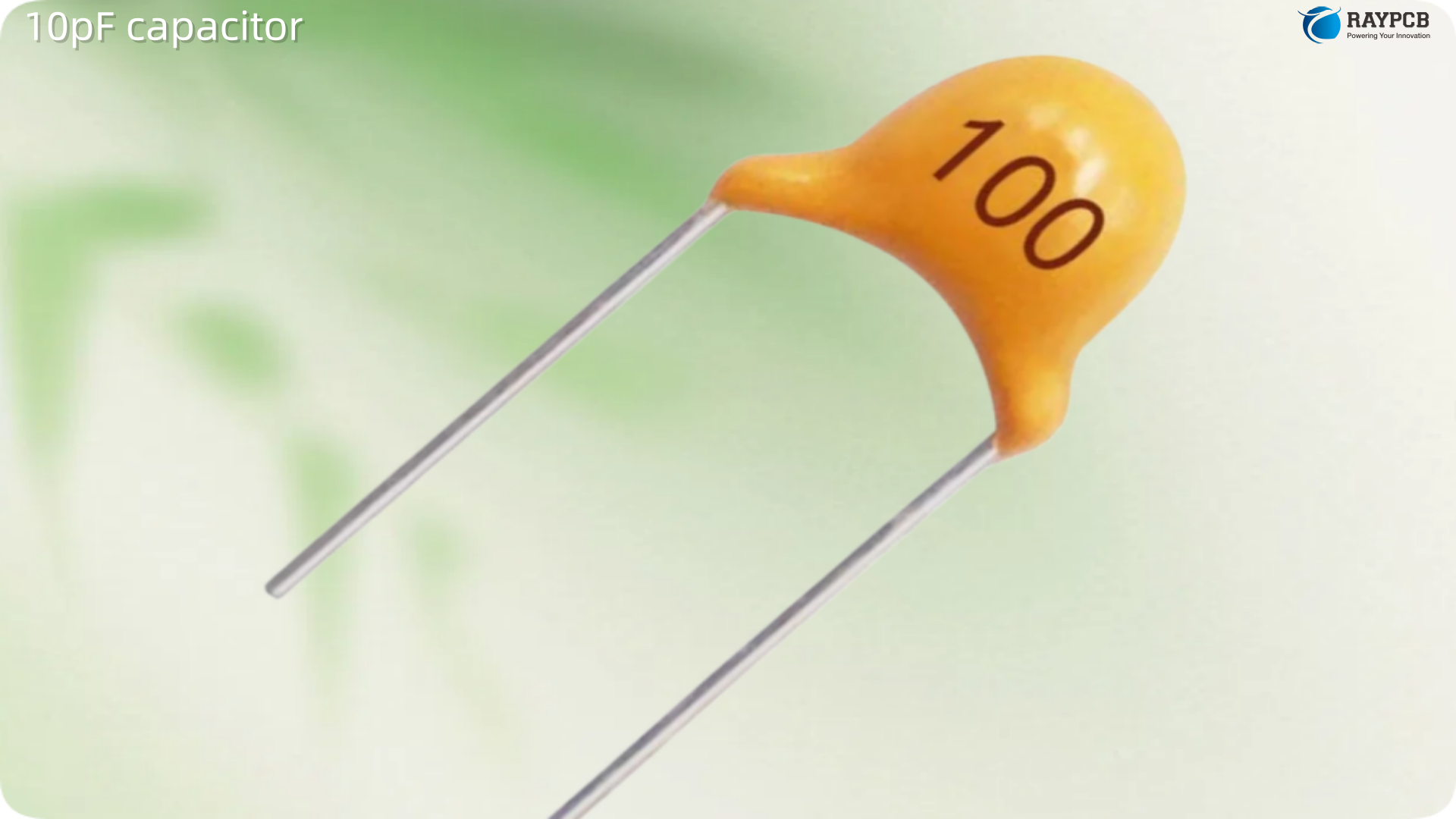
10 pF Capacitor: Crystal Load, RF Filtering & Circuit Uses

Scroll through any microcontroller reference schematic and you’ll find a pair of identical capacitors flanking a quartz crystal โ€” both labeled 10 pF. Look at the RF section of a Bluetooth or Wi-Fi module and you’ll spot 10 pF appearing again, this time sitting between a supply pin and ground. The 10 pF capacitor is not glamorous, but it is everywhere, and getting it wrong quietly breaks things: oscillators that drift in the cold, RF supplies that radiate spurious emissions, impedance matching networks that deliver mediocre insertion loss. This guide covers every place the 10 pF capacitor shows up, why it works there, how to calculate it correctly, and how to avoid the PCB-level mistakes that undermine it.

What Is a 10 pF Capacitor?

A 10 pF capacitor stores 10 picofarads of charge โ€” 10 ร— 10โปยนยฒ farads. In unit terms that is 0.01 nF or 0.00001 ยตF. Those equivalences matter because component values are listed differently depending on the distributor or schematic tool, and mistaking 10 pF for 10 nF (a factor of 1,000) is a real-world mistake that shows up in production failures more often than engineers like to admit.

At low frequencies the capacitive reactance of a 10 pF capacitor is enormous โ€” tens of thousands of ohms โ€” making it essentially invisible to the circuit. As frequency rises into the tens and hundreds of MHz, that reactance drops into a usable range, which is precisely why 10 pF is one of the most common picofarad values in RF and timing circuits.

Capacitive reactance of 10 pF at common frequencies:

FrequencyApplicationXc of 10 pF
1 MHzLow-frequency RF~15,900 ฮฉ
10 MHzCrystal oscillator (high-speed MCU)~1,592 ฮฉ
100 MHzFM band, basic RF~159 ฮฉ
433 MHzIoT, LoRa~37 ฮฉ
900 MHzGSM, NB-IoT~18 ฮฉ
2.4 GHzWi-Fi, Bluetooth, Zigbee~6.6 ฮฉ
5 GHzWi-Fi 5/6~3.2 ฮฉ

At 900 MHz the reactance is around 18 ฮฉ โ€” squarely within matching network territory. At 10 MHz it sits at over 1.5 kฮฉ, which is why it works as a carefully sized load capacitor for crystal timing circuits without loading the oscillator output heavily.

The 10 pF Capacitor in Crystal Oscillator Circuits

How a Pierce Oscillator Uses Load Capacitors

Almost every microcontroller’s onboard oscillator uses a Pierce topology. In a Pierce oscillator, the crystal connects between two IC pins (typically XTAL_IN and XTAL_OUT), with a load capacitor from each pin to ground โ€” labeled CL1 and CL2. These two capacitors, along with the crystal itself and the stray PCB capacitance, determine the total load capacitance (CL) seen by the crystal.

The crystal manufacturer specifies the CL value at which the crystal oscillates at its nominal frequency. Get CL wrong and the crystal runs off-frequency โ€” sometimes by tens of ppm, which in a Bluetooth or Zigbee device translates directly to channel center frequency error and failed regulatory compliance.

The Load Capacitance Formula

The total effective load capacitance is calculated as:

CL = (CL1 ร— CL2) / (CL1 + CL2) + Cstray

Where CL1 = CL2 (you should use matched values) and Cstray is the combined capacitance of the IC pins and PCB traces. Stray capacitance in a Pierce oscillator circuit usually ranges from 3 pF to 7 pF. On a two-layer board with short traces it may be as low as 2 pF; on a dense four-layer board closer to 5 pF.

Solving for CL1 and CL2 When CL = 10 pF

Many modern RF-enabled MCUs (STM32 families, TI CC26xx, nRF52 series) use crystals with a specified load capacitance of 6โ€“10 pF. The “10 pF CL” crystal is a common, well-stocked value. Here is how to solve for the external capacitors:

CL1 = CL2 = 2 ร— (CL โˆ’ Cstray)

Using CL = 10 pF and assuming Cstray = 4 pF (typical for a modern 4-layer board):

CL1 = CL2 = 2 ร— (10 โˆ’ 4) = 12 pF

If your actual Cstray is higher than estimated, the external capacitors should be reduced. If the measured oscillator frequency is consistently too low, effective CL is too high โ€” reduce the external capacitors. If the frequency is consistently high, increase them. The 10 pF value commonly appears as the final calculated value for CL1/CL2 when the target crystal CL is higher (e.g., 12โ€“15 pF) and stray capacitance consumes some of the budget.

Common Crystal Load Capacitor Scenarios

Crystal CLAssumed CstrayRequired CL1 = CL2
6 pF3 pF6 pF
8 pF3 pF10 pF โ† common 10 pF case
10 pF4 pF12 pF
12 pF4 pF16 pF
18 pF5 pF26 pF

The “10 pF external capacitor for crystal loading” scenario appears whenever the crystal’s CL is around 8 pF and stray capacitance is moderate โ€” a common combination in compact IoT and Bluetooth designs.

10 pF as an RF Decoupling and Bypass Capacitor

Why 10 pF and 33 pF Are Classic RF Supply Bypass Values

In RF engineering, power supply pins of LNAs, PAs, mixers, and VCOs must be bypassed to ground to prevent RF energy from coupling back into the supply rails โ€” which causes instability, spurious outputs, and unwanted oscillation. The bypass capacitor must look like a very low impedance at the RF operating frequency.

The 10 pF and 33 pF capacitors achieved classic status in this role for a specific reason: in C0G/NP0 dielectric and 0603 packaging, their self-resonant frequency (SRF) lands close to important RF bands. At SRF, the capacitor’s impedance is at its lowest โ€” essentially only its ESR remains. This “free filtering” effect at the SRF is deliberately exploited in RF circuit design.

For the 10 pF value in a 0402 package with approximately 0.5 nH of ESL:

SRF โ‰ˆ 1 / (2ฯ€ ร— โˆš(0.5ร—10โปโน ร— 10ร—10โปยนยฒ)) โ‰ˆ 2.25 GHz

That puts the SRF right in the 2.4 GHz ISM band โ€” one reason 10 pF appears so often as a bypass element in Wi-Fi and Bluetooth power supply networks.

RF Bypass Capacitor Strategy

In practice, a single capacitor value never covers the full frequency range of noise on a supply pin. A multi-cap strategy using a 10 pF (for high-frequency bypassing) alongside a 100 nF (mid-frequency) and a 10 ยตF bulk cap provides broadband impedance suppression across decades of frequency. The 10 pF handles the GHz range; the other values handle lower frequencies.

10 pF in RF Matching and Filter Networks

Reactance in Matching Networks at Sub-1 GHz

At 433 MHz, 10 pF delivers about 37 ฮฉ of reactance. That value slots neatly into L-network calculations for antenna matching networks in LoRa, ISM-band, and RFID circuits. Many reference designs for 433/868/915 MHz front-ends include a 10 pF shunt or series element in the output matching network between the PA and the antenna port.

LC Filter Elements

In a Chebyshev or Butterworth bandpass filter for a 900 MHz front-end, the component values that fall out of the design equations commonly land in the 10โ€“47 pF range for the capacitor elements. The 10 pF is a natural fit for narrow-band filters where tighter selectivity is needed. It also appears in SAW filter input/output matching networks and LNA interstage networks.

Dielectric and Package Selection for 10 pF

Always Use C0G/NP0 in Timing and RF Circuits

The choice of dielectric is not optional for a 10 pF in crystal load or RF matching service. Class II dielectrics like X7R have significant capacitance variation with temperature and DC bias voltage. For a 10 pF crystal load capacitor, a 5% capacitance shift with temperature moves the crystal frequency by several ppm โ€” unacceptable in timing-critical or RF-compliant designs. C0G (NP0) provides ยฑ30 ppm/ยฐC temperature stability, Q factor exceeding 1,000, and effectively zero voltage dependence.

DielectricTemp StabilityVoltage DependenceQ Factor10 pF Crystal Load?10 pF RF Bypass?
C0G / NP0ยฑ30 ppm/ยฐCNone>1000โœ… Requiredโœ… Preferred
X7Rยฑ15% over rangeModerate100โ€“500โŒ Not suitableโš ๏ธ Only if SRF-targeted
X5Rยฑ15% over rangeHigh<300โŒ Not suitableโŒ Avoid

Package Size and SRF Implications

PackageTypical ESLApproximate SRF for 10 pF
0201 (0603M)~0.3 nH~9 GHz
0402 (1005M)~0.5 nH~7.1 GHz
0603 (1608M)~0.8 nH~5.6 GHz
0805 (2012M)~1.0 nH~5.0 GHz

For 2.4 GHz applications, any of these packages provides adequate SRF margin. For 5 GHz Wi-Fi designs, 0402 or 0201 is recommended to keep SRF comfortably above the operating frequency.

PCB Layout Tips for 10 pF Applications

Getting the component right and then ruining it with bad layout is the most common failure mode when working with picofarad-range capacitors.

Crystal load capacitors: Place CL1 and CL2 as close to the crystal pins as possible โ€” ideally within 1 mm. Trace lengths to the crystal should be short and equal. Keep the crystal circuit away from high-speed digital signals and switching regulators. A ground plane under the crystal area is generally not recommended by many MCU manufacturers because it adds stray capacitance and can destabilize the oscillator.

RF bypass capacitors: The ground via for a shunt bypass capacitor must be as close as possible to the component pad โ€” not routed through a long trace to a distant via. A typical via adds 0.4โ€“0.8 nH of inductance, which at 2.4 GHz is measurable. For demanding RF designs, use a via-in-pad approach or place the via immediately adjacent to the ground pad.

Pad sizing: Oversized pads add extra capacitance to ground. For a 10 pF component, even 0.5โ€“1 pF of additional pad capacitance shifts the value by 5โ€“10%. Use the component manufacturer’s recommended land pattern and do not arbitrarily enlarge pads for “better soldering.”

Trace stubs: Any trace between a 10 pF capacitor and the next RF node acts as a stub. At 2.4 GHz even 1 mm of trace introduces a few tenths of a nanohenry of inductance. Keep connections as direct as possible and simulate with layout parasitics included.

10 pF Capacitor Specification Checklist

ParameterRecommended Specification
Capacitance10 pF
Toleranceยฑ0.5 pF for crystal load; ยฑ1 pF acceptable for RF bypass
DielectricC0G / NP0
Voltage ratingโ‰ฅ10 V (typically 25 V or 50 V for MLCC)
Package0402 for most designs; 0201 for 5 GHz+
Operating temperatureโˆ’55ยฐC to +125ยฐC
SRFVerify it exceeds operating frequency by โ‰ฅ2ร—
ESR<0.3 ฮฉ at operating frequency
QualificationAEC-Q200 for automotive; standard EIA-198 otherwise

Useful Resources for 10 pF Capacitor Selection and Crystal Design

ResourceTypeLink
ECS Inc. Crystal Load Capacitance CalculatorOnline toolecsxtal.com
ECS Inc. โ€“ Impact of Load Capacitance on Crystal DesignsWhitepaperecsxtal.com
Texas Instruments AN โ€“ Crystal & Oscillator Selection (CC13xx/CC26xx)App noteti.com
AllAboutCircuits โ€“ Load Capacitance on Quartz CrystalsTechnical articleallaboutcircuits.com
Johanson Technology โ€“ SRF/PRF for RF CapacitorsApplication notejohansontechnology.com
KYOCERA AVX โ€“ C0G/NP0 Dielectric OverviewProduct referencekyocera-avx.com
Murata SimSurfing โ€“ S-parameter search toolComponent databaseds.murata.co.jp/simsurfing
RayPCB โ€“ Capacitors in PCB DesignPCB design guideraypcb.com/pcb-capacitor

Frequently Asked Questions

1. Can I use an X7R 10 pF capacitor for crystal load capacitors?

In general, no. X7R capacitance varies with temperature โ€” typically ยฑ15% over the operating range. A 10% shift in a 10 pF load capacitor will pull the crystal frequency by several ppm, which exceeds the tolerance of any serious timing application. For a microcontroller clock where the Bluetooth stack tolerates ยฑ20โ€“40 ppm total, using X7R for the load capacitors is a real design risk. Always specify C0G/NP0 for crystal load applications.

2. My crystal datasheet says CL = 10 pF. Does that mean I use 10 pF capacitors for CL1 and CL2?

No โ€” this is one of the most common misconceptions. The crystal CL is the total capacitive load the crystal must see from the circuit. CL1 and CL2 are in series (from the crystal’s perspective through ground), so two equal external capacitors of value C produce a series combination of C/2. You also need to subtract the stray capacitance of the PCB and IC pins. Using the formula CL1 = CL2 = 2 ร— (CL โˆ’ Cstray), with CL = 10 pF and Cstray โ‰ˆ 3โ€“4 pF, you end up with approximately 12โ€“14 pF for each external capacitor โ€” not 10 pF.

3. Why do 10 pF and 33 pF appear so often in RF supply bypass circuits?

These values became widely adopted because, in older 0603 packages, their self-resonant frequencies (SRFs) landed near the 900 MHz and 2.4 GHz ISM bands respectively โ€” providing a very low impedance “for free” at important wireless frequencies. Although modern 0402 and 0201 packages have shifted SRFs upward, the habit of reaching for 10 pF or 33 pF for RF supply bypassing has stuck because they still produce useful low impedance in the GHz range with appropriate package selection.

4. How do I know if my 10 pF capacitor is causing a crystal oscillator failure?

The most reliable diagnostic is to measure the actual oscillation frequency using the MCU’s clock output pin (MCO or similar) with a frequency counter while varying temperature. If the frequency drifts outside the crystal’s specified tolerance window as temperature changes, first suspect the load capacitor dielectric (check for X7R) and pad layout stray capacitance. If the oscillator fails to start reliably at cold temperatures, check oscillator gain margin โ€” the crystal’s equivalent series resistance (ESR) rises at low temperature, and if combined with excessive load capacitance, the gain margin falls below unity.

5. Does PCB layer count significantly affect the 10 pF crystal load capacitor value I should use?

Yes, noticeably. Stray capacitance Cstray varies with PCB design: a two-layer board with short traces may contribute only 1โ€“2 pF of stray capacitance, while a dense four-layer board with longer crystal trace routing and more copper nearby may contribute 4โ€“6 pF. If you calculated CL1/CL2 assuming Cstray = 3 pF but your board actually has 6 pF of stray, you’ll end up overloading the crystal and running slightly below the nominal frequency. Always verify oscillator frequency on the first prototype and adjust the capacitor values accordingly before committing to production.

Conclusion

The 10 pF capacitor is deceptively ordinary in appearance but technically demanding in application. Whether it’s sitting in a Pierce oscillator circuit setting the load capacitance of a 10 MHz crystal reference, bypassing the supply of a 2.4 GHz PA, or forming part of a narrowband antenna matching network, the rules are the same: use C0G/NP0 dielectric without exception, choose the right package for your operating frequency and SRF requirements, get the tolerances tight, and treat the PCB layout around it with the same discipline you’d apply to any other RF element. A few extra minutes of correct calculation and careful placement avoids the kind of production-line frequency drift or RF spurious issue that takes days to debug on a scope.
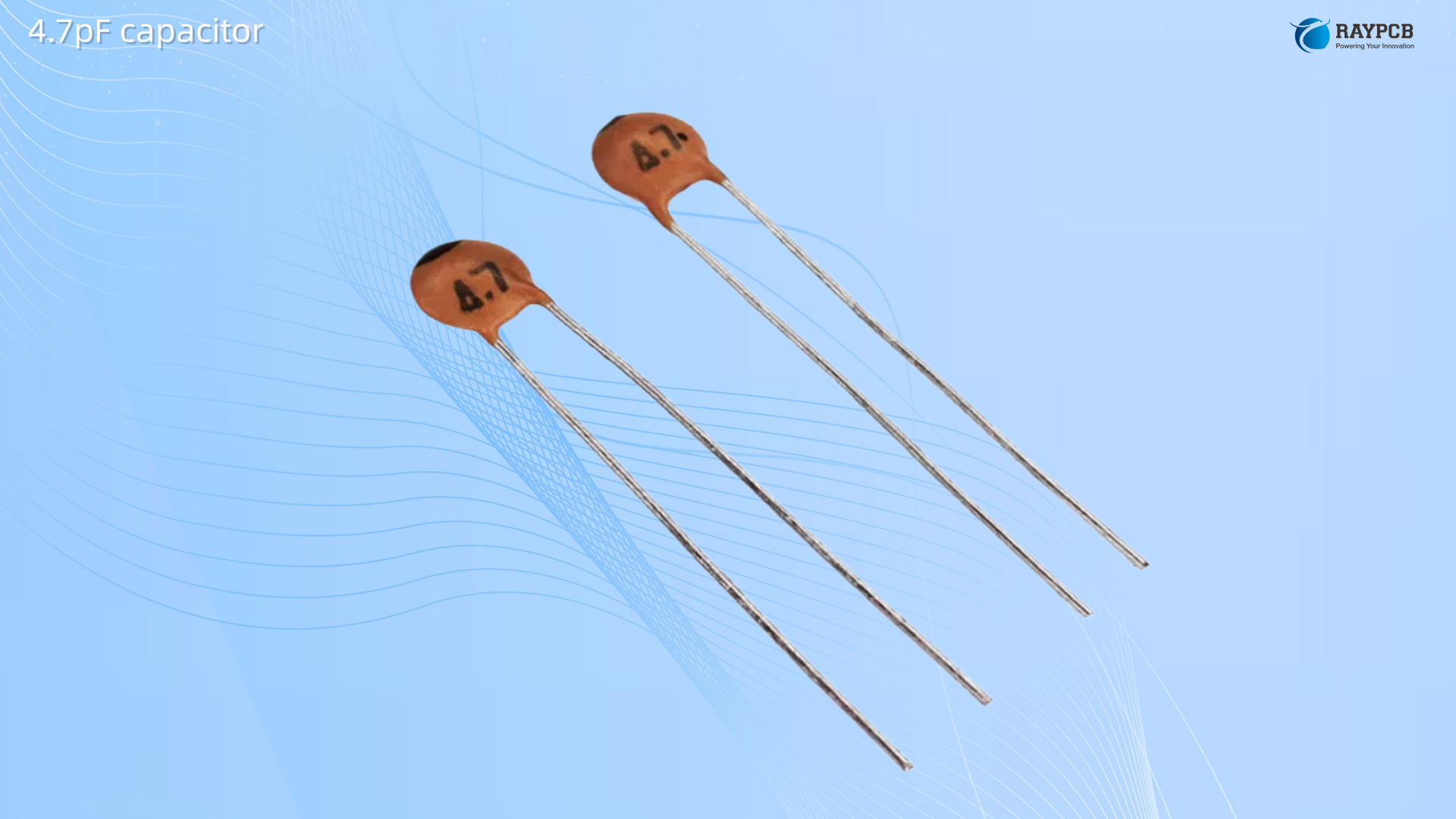
4.7 pF Capacitor: Applications in RF, Oscillators & Load Matching

Everything you need to know about the 4.7pF capacitor: RF matching, crystal oscillator load capacitance, C0G vs X7R dielectric, 0402 vs 0201 package selection, real part numbers, and PCB layout tips for GHz-range designs.

If you’ve spent time designing RF front-ends, crystal oscillator circuits, or high-frequency filters, you’ve almost certainly landed on a 4.7 pF capacitor at some point. It’s one of the most useful values in the sub-10 pF range โ€” large enough to be relatively forgiving in terms of parasitic effects compared to 1 pF, yet small enough to be useful in matching networks and load capacitance tuning well above 1 GHz.

The challenge with a 4.7pF capacitor is that most engineers treat it like any other bypass cap โ€” slap down an X7R MLCC and call it done. That approach works fine at low frequencies, but at RF frequencies it can silently ruin your circuit performance without any obvious component failure. This guide covers the real applications, the specs that actually matter, how to pick the right package, and where to source parts that will perform as expected.

What Is a 4.7 pF Capacitor?

A 4.7 pF capacitor stores 4.7 picofarads of charge โ€” that’s 4.7ร—10โปยนยฒ farads. In the standard E12 capacitor series, 4.7 pF falls between 3.9 pF and 5.6 pF. In the E24 series, it sits between 4.3 pF and 5.1 pF. The value is widely stocked in ceramic chip form across multiple package sizes.

At this capacitance level, the reactance (Xc = 1 / 2ฯ€fC) at common RF frequencies is:

FrequencyReactance of 4.7 pF
100 MHz338 ฮฉ
433 MHz78 ฮฉ
915 MHz37 ฮฉ
2.4 GHz14 ฮฉ
5.8 GHz5.8 ฮฉ

This reactance range maps directly onto why 4.7 pF shows up in so many RF impedance matching and filter applications between 400 MHz and 3 GHz. At sub-GHz frequencies, it presents a high enough impedance to be useful as a series element; at 2.4 GHz and above, it’s useful as a shunt element in matching networks.

Like all small-value ceramics, a 4.7pF capacitor performs very differently depending on dielectric type, package size, and PCB layout. Understanding those differences is what separates a design that hits spec from one that needs three board respins.

Key Applications of the 4.7 pF Capacitor

RF Impedance Matching Networks

This is the most demanding application for a 4.7pF capacitor. In L-network, pi-network, and T-network matching topologies used to interface antennas, LNAs, PAs, and mixers to a 50 ฮฉ system, the component values are calculated from the source and load impedances and the target center frequency. For frequencies between 400 MHz and 2.4 GHz, calculated capacitance values regularly land in the 2โ€“10 pF range, making 4.7 pF one of the most frequently specified values.

The reactance tolerance matters here. A ยฑ5% tolerance on 4.7 pF means the actual value could be anywhere from 4.47 pF to 4.94 pF. At 2.4 GHz, that’s a reactance variation of roughly ยฑ0.7 ฮฉ โ€” potentially significant in a narrow-band matching network. For production-intent designs, specify ยฑ0.25 pF or ยฑ0.1 pF absolute tolerance.

Crystal Oscillator Load Capacitance

The most common application many digital engineers encounter for a 4.7pF capacitor is in crystal oscillator circuits. A Pierce oscillator (used in virtually all microcontroller crystal circuits) requires two capacitors โ€” one from each oscillator pin to ground โ€” to present the correct load capacitance to the crystal.

For a crystal with a specified load capacitance C_L, the two external caps are ideally:

C_ext = 2 ร— (C_L โˆ’ C_stray)

where C_stray accounts for PCB trace capacitance and the MCU pin capacitance (typically 2โ€“5 pF total). For crystals with C_L = 12 pF, C_ext often works out to 12โ€“18 pF per leg after accounting for series parasitic capacitance. But for lower-load-capacitance crystals (C_L = 6โ€“9 pF, increasingly common in low-power and high-frequency crystals), the external capacitors can drop to 4.7 pF or below.

Using the wrong load capacitance shifts the crystal’s operating frequency. For a 32 MHz crystal with a frequency pulling sensitivity of 20 ppm/pF, a 1 pF error in load capacitance causes a 20 ppm frequency error โ€” enough to fail USB timing requirements or cause Bluetooth channel spacing issues.

Antenna Tuning and Matching

Chip antennas for 2.4 GHz (WiFi, BT, Zigbee) and sub-GHz ISM bands almost always require an external matching network to tune the antenna impedance to 50 ฮฉ at the RF IC port. Most chip antenna manufacturers provide a reference matching network in their datasheet, and 4.7 pF is a very common shunt or series element in those networks.

When a PCB is slightly different from the reference design โ€” different board size, different ground plane geometry, different substrate โ€” the antenna impedance shifts and the matching network needs retuning. Having a 4.7 pF cap (or neighboring values like 3.9 pF and 5.6 pF) in your retuning toolkit is standard practice.

RF Filter Design

In discrete LC bandpass, low-pass, and high-pass filters for RF systems, 4.7 pF appears frequently as a shunt or series capacitor in designs for 433 MHz, 868 MHz, 915 MHz, and 2.4 GHz. It’s particularly common in harmonic filters placed after power amplifiers to meet regulatory spurious emission limits.

The Q factor of the capacitor directly affects the filter’s insertion loss and shape factor. A low-Q cap (high ESR) in a filter will add passband insertion loss and round off the filter skirts. For filter applications, specify caps with Q > 200 at the operating frequency.

VCO Tank Circuit Trimming

In voltage-controlled oscillators, the tank circuit capacitance sets the center frequency. A fixed capacitor placed in parallel with the varactor diode (or as part of the tank capacitance) sets the baseline around which the varactor tunes. At 433โ€“915 MHz, these fixed tank caps are often in the 4โ€“10 pF range, making 4.7 pF a natural fit.

High-Speed PCB AC Coupling

In some high-speed differential or RF signal chains, AC coupling capacitors are chosen small enough to maintain a flat response through the operating band while blocking DC. At 2.4 GHz and above, a 4.7 pF coupling cap presents about 14 ฮฉ โ€” low enough to pass the signal with minimal insertion loss while blocking DC offset.

Choosing the Right Package for a 4.7 pF Capacitor

Package selection affects parasitic inductance, parasitic capacitance, self-resonant frequency (SRF), and Q factor. For RF applications, smaller is generally better โ€” up to the point where assembly yield becomes a concern.

PackageSize (mm)Typical SRF (4.7 pF)Pad Parasitic CBest For
0603 (1608M)1.6 ร— 0.8~3โ€“5 GHz~0.3 pFGeneral purpose, easy to solder
0402 (1005M)1.0 ร— 0.5~5โ€“8 GHz~0.15 pFRF up to 3 GHz, standard RF production
0201 (0603M)0.6 ร— 0.3~8โ€“12 GHz~0.07 pF5 GHz and above, lower parasitics
01005 (0402M)0.4 ร— 0.2>12 GHz<0.05 pFmmWave, specialized assembly only

For most RF work at 433 MHz to 3 GHz, 0402 is the right choice. It balances low parasitics with practical assembly requirements. Move to 0201 if you’re designing above 3 GHz or if you’re doing a comparative placement trial to measure layout parasitics.

Dielectric Selection: Why C0G Is Non-Negotiable for RF

This is one of the most common specification errors on RF PCBs. There are three main MLCC dielectric classes you’ll encounter:

DielectricCapacitance Stability vs TempCapacitance vs VoltageUse in RF Circuits
C0G (NP0)ยฑ30 ppm/ยฐC (excellent)No changeYes โ€” always preferred
X7Rยฑ15% over โˆ’55 to +125ยฐCDegrades with DC biasAvoid for RF/oscillator use
Y5V+22% / โˆ’82% over temp rangeSeverely degrades with biasNever use in RF circuits

For a 4.7pF capacitor in a matching network or oscillator circuit, C0G (NP0) is the only acceptable dielectric. X7R capacitance drifts by up to 15% over temperature โ€” for a 4.7 pF cap, that’s a swing of nearly 0.7 pF, which will detune your matching network and pull your oscillator frequency. C0G caps cost a bit more, but the difference is negligible in any RF design where performance matters.

Recommended 4.7 pF Capacitor Part Numbers

ManufacturerPart NumberPackageDielectricToleranceVoltage
MurataGRM1555C1H4R7BA01D0402C0Gยฑ0.1 pF50 V
TDKC1005C0G1H4R7C050BA0402C0Gยฑ0.25 pF50 V
KemetC0402C479C5GACTU0402C0Gยฑ0.25 pF50 V
VishayVJ0402A4R7CXACW1BC0402C0Gยฑ0.1 pF50 V
Wรผrth Elektronik8850120050170402C0Gยฑ0.1 pF50 V
AVX/Kyocera04025A4R7BAT2A0402C0Gยฑ0.1 pF50 V
ATC100B4R7BW500XTATC 100BC0Gยฑ0.1 pF500 V

The ATC 100B series is worth calling out specifically for high-power RF applications (PA harmonic filters, antenna switches) where a standard MLCC would fail under RF current stress. The capacitor construction in these high-Q RF chip caps is fundamentally different from standard MLCCs.

PCB Layout Guidelines for 4.7 pF Capacitors in RF Circuits

Use the manufacturer’s recommended land pattern. Pad dimensions directly affect parasitic capacitance. An oversized 0402 pad pattern can add 0.1โ€“0.3 pF of stray capacitance โ€” up to 6% of your intended 4.7 pF value.

Consider a ground plane void beneath series capacitors. For caps placed in a series RF signal path, a small copper void (clearance cutout) in the ground plane beneath the cap reduces parasitic shunt capacitance to ground. This is especially important at 2.4 GHz and above.

Keep matching network components close together and close to the antenna or RF port. Trace length between matching elements adds inductance and changes the network’s effective topology. Route matching caps with the shortest possible traces directly to the pad.

Run EM simulation before fabrication. At 2.4 GHz and above, even the shape of your pad and the trace routing around a 4.7 pF cap can shift the effective capacitance enough to detune a matching network. Sonnet Lite (free), Ansys HFSS, or Cadence AWR can extract parasitic effects from your layout before committing to fab.

Separate matching network ground vias from digital return currents. A single via shared between the matching network ground and a switching regulator return path can inject noise into the RF circuit. Keep RF ground returns isolated and stitched directly to the RF ground plane.

Where to Buy 4.7 pF Capacitors

DistributorWebsiteNotes
Digi-Keydigikey.comBest parametric search, huge stock depth
Mousermouser.comStrong authorized stock for Murata, TDK, KEMET
LCSClcsc.comCost-effective for prototyping quantities
Arrowarrow.comGood for production volumes with traceability
Farnell/Element14farnell.comEU/UK preferred distributor for authorized stock

For production runs, always buy through authorized distributors with full traceability. Counterfeit small-value ceramics are more common than most engineers expect, and the failure mode is insidious โ€” the fake caps often measure close to spec on an LCR meter but perform poorly at RF frequencies due to inferior dielectric or electrode materials.

Useful Resources and Design Tools

  • Murata SimSurfingย โ€“ Free online tool to view impedance, ESR, and S-parameters vs. frequency for Murata capacitors: ds.murata.com/simsurfing
  • Kemet KSIMย โ€“ Capacitor simulation with impedance and insertion loss curves: ksim.kemet.com
  • TDK Product Finder with S-parameter Downloadsย โ€“ Full parametric search with downloadable SPICE/S-param models: product.tdk.com
  • ATC RF Capacitor Datasheet Libraryย โ€“ High-Q RF chip caps with full S-parameter data for microwave design: atceramics.com
  • Sonnet Lite (Free EM Simulator)ย โ€“ Layout-level EM simulation for RF circuits: sonnetsoftware.com
  • Texas Instruments Crystal Oscillator Design Reference (AN-2447)ย โ€“ Detailed guide on load capacitance calculation for Pierce oscillators
  • Wรผrth Elektronik ANP008ย โ€“ Application note on three-terminal caps, RF filtering, and parasitic effects: we-online.com
  • Mini-Circuits RF Calculatorsย โ€“ L-network and pi-network matching calculators: minicircuits.com

Frequently Asked Questions About 4.7 pF Capacitors

Can I substitute a 4.7 pF capacitor with 4.3 pF or 5.1 pF in a matching network?

Often yes โ€” with simulation and measurement. In an RF matching network, the center frequency and impedance transformation depend on the exact component values. Swapping 4.7 pF for 4.3 pF or 5.1 pF will shift the network’s response, but depending on the bandwidth of the network, the change may be tolerable. Always re-simulate with the new value and verify on hardware with a VNA before committing to the change in production.

Why does my 4.7 pF capacitor measure differently on my LCR meter than its spec?

Low-value capacitors are sensitive to measurement frequency, lead placement, and stray capacitance in the test fixture. Most LCR meters measure at 1 kHz or 1 MHz by default, which may not match the frequency at which the cap was characterized in its datasheet. Also, probe leads and the PCB itself contribute parasitic capacitance that can add 0.5โ€“1 pF or more to the reading. Open-compensation and short-compensation in the LCR meter’s fixture calibration helps, but some residual error is unavoidable at 4.7 pF.

What happens if I use X7R instead of C0G for a 4.7 pF cap in an oscillator circuit?

You’ll likely see oscillator frequency drift with temperature that exceeds the crystal’s own temperature coefficient. X7R capacitance can change by ยฑ15% over the operating temperature range. For a 4.7 pF cap, that’s up to ยฑ0.7 pF variation. In a crystal load capacitance context, a 1 pF change in total load capacitance can pull the oscillator frequency by 10โ€“30 ppm depending on the crystal’s motional parameters โ€” enough to cause real problems in wireless or USB clock applications. Use C0G.

How do I account for PCB parasitic capacitance when placing a 4.7 pF cap?

Start by estimating the parasitic contribution from your layout: typical 0402 pad pair adds ~0.1โ€“0.2 pF, a short trace to a via adds ~0.1โ€“0.3 pF/mm, and a via itself adds ~0.3โ€“0.8 pF depending on board stackup and aspect ratio. Sum these up and subtract from your target capacitance to get the component value you actually need to specify. If the parasitics are comparable to your intended 4.7 pF, use EM simulation to get a more accurate parasitic estimate before ordering parts.

Is a 4.7 pF capacitor suitable for power supply decoupling?

Technically yes, but it’s generally too small to be useful as a standalone decoupling cap in any power supply context. At 100 MHz, a 4.7 pF cap presents about 338 ฮฉ โ€” far too high for effective high-frequency decoupling. You’d use 100 nF or 10 nF for bulk and high-frequency decoupling, and possibly a 1โ€“10 pF cap only as a supplementary high-frequency bypass in very specific RF power supply situations. In standard digital or analog power supply design, a 4.7 pF cap has no practical decoupling role.

Working with a 4.7pF capacitor well comes down to three things: specifying C0G dielectric every single time, choosing the right package for your frequency range, and respecting the role that PCB layout plays at values this small. Get those right and a 4.7 pF cap in a matching network or oscillator circuit will hit your targets. Get them wrong and you’ll spend debugging time on a problem that was never really a circuit topology issue in the first place.

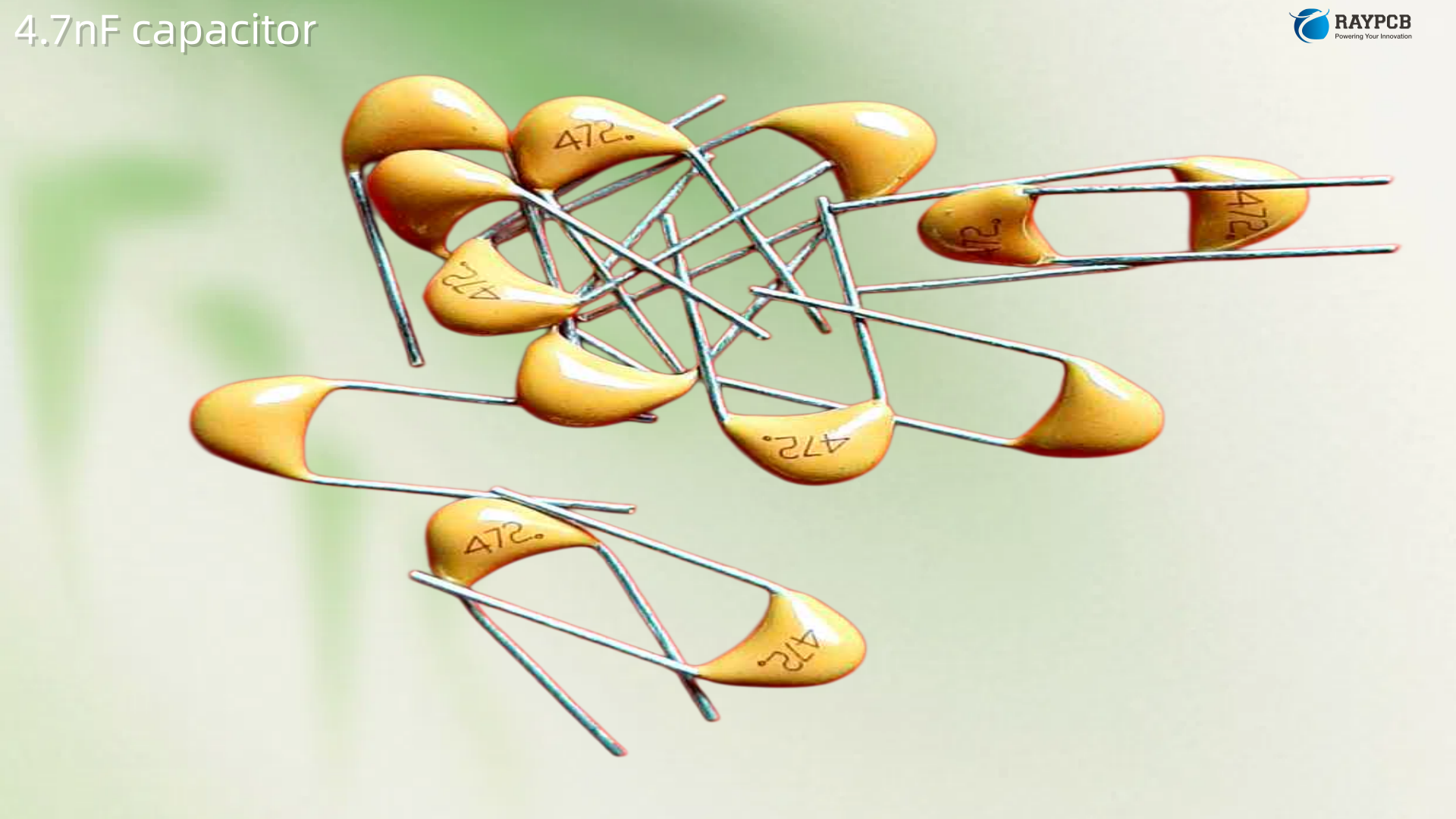
4.7nF Capacitor (Code 472): RC Filter Design, Dielectric Selection & PCB Layout Guide

Decode capacitor code 472, select C0G vs X7R dielectric, and calculate RC filter cutoffs for the 4.7nF capacitor โ€” practical guide from a PCB engineer’s perspective.

The 4.7nF capacitor is one of those parts that sits in the E12/E24 standard value series and gets pulled into designs constantly โ€” from ADC anti-aliasing filters and RF snubbers to debounce networks and CFL ballasts. Yet when a junior engineer looks at the body of a ceramic disc and sees 472, confusion often follows. What does it mean, and what can this capacitor actually do for your circuit?

This guide answers both questions from the ground up. By the end, you’ll know how to decode the marking, select the right dielectric, calculate RC filter cutoff frequencies, and lay the part out correctly on your PCB.

Decoding Capacitor Code 472: What Does It Mean?

The EIA three-digit marking system is straightforward once you know the rule: the first two digits are significant figures, and the third digit is the power-of-ten multiplier in picofarads.

DigitValueMeaning
1st4First significant figure
2nd7Second significant figure
3rd (multiplier)2ร— 10ยฒ = ร— 100
Result4700 pF = 4.7 nF = 0.0047 ยตFAll equivalent

So 47 ร— 100 = 4700 pF = 4.7 nF. Simple as that. You’ll see this part listed under all three unit conventions depending on the distributor. They are identical โ€” 4.7 nF, 4700 pF, and 0.0047 ยตF are the same capacitance.

One trap to watch for: 473 is not the same as 472. The 473 decodes to 47 ร— 1000 = 47,000 pF = 47 nF โ€” a full ten times larger. Getting these mixed up on a BOM is a real design risk, especially when similar-looking parts sit next to each other in a reel drawer.

A tolerance letter suffix usually follows the three digits. J = ยฑ5%, K = ยฑ10%, M = ยฑ20%. The voltage rating may also appear as a prefix letter-number pair (e.g., 2A = 100 VDC per EIA standard), though on smaller disc ceramics this is often absent โ€” check the datasheet or reel label.

4.7nF Capacitor Full Specifications

ParameterTypical Values
Capacitance4.7 nF (4700 pF / 0.0047 ยตF)
EIA Marking Code472
Common DielectricsC0G/NP0, X7R, Y5V
Voltage Ratings16V, 25V, 50V, 100V, 250V, 400V, 1000V+
Toleranceยฑ5% (J), ยฑ10% (K), ยฑ20% (M)
SMD Packages0402, 0603, 0805, 1206
Through-Hole PackagesRadial disc, film (5mm, 10mm pitch)
ESRLow โ€” suitable for RF and high-frequency circuits
Polarised?No โ€” non-polarised in all types

Choosing the Right Dielectric for Your 4.7nF Capacitor

This is where component selection either goes right or quietly causes you a re-spin six months down the road. The dielectric you choose defines how the 4.7nF capacitor will actually behave in your circuit โ€” not just at room temperature on the bench, but across its entire operating range.

C0G / NP0 โ€” The Precision Choice

C0G (also called NP0) is a Class 1 dielectric with a temperature coefficient typically within ยฑ30 ppm/ยฐC. In practice this means negligible capacitance change over โˆ’55ยฐC to +125ยฐC, no measurable aging, and no voltage-dependent capacitance shift. The dissipation factor is also extremely low (maximum 0.15%), which translates to minimal signal loss at high frequencies.

For any 4.7nF capacitor that sits in a timing circuit, oscillator feedback network, precision analog filter, or RF tuning stage, C0G is the correct choice. Yes, it’s slightly larger for a given capacitance-voltage combination compared to X7R, but in the nF range this is rarely a problem. You can fit a C0G 4.7nF in an 0603 package at 50V without issue.

X7R โ€” Workhorses for General-Purpose Filtering

X7R allows ยฑ15% capacitance variation over โˆ’55ยฐC to +125ยฐC, and it ages logarithmically โ€” roughly 1โ€“2% capacitance loss per decade-hour. For non-critical decoupling, power supply bypass, or filtering stages where the exact โˆ’3dB point doesn’t need to be tightly controlled, X7R is cost-effective and compact.

However, be conscious of DC bias derating. An X7R 4.7nF capacitor rated at 50V can lose a significant portion of its nominal capacitance when operated at a high fraction of its rated voltage. Always check the manufacturer’s DC bias curve in the datasheet, not just the nominal value.

Y5V / Z5U โ€” Avoid for Signal Work

Capacitance can vary by as much as โˆ’82% across the operating temperature range. Not appropriate for filters, timing, or any circuit where the RC time constant must be predictable. Reserve these for bulk energy storage where capacitance tolerance is irrelevant to function.

Dielectric Selection Summary

DielectricTemp StabilityAgingDC Bias EffectBest For
C0G / NP0ยฑ30 ppm/ยฐCNegligibleNoneFilters, timing, RF, oscillators
X7Rยฑ15% over range~1โ€“2%/decadeModerateGeneral decoupling, bypass
Y5V+22% / โˆ’82%HighSignificantBulk storage only

RC Filter Design with a 4.7nF Capacitor

The core formula for an RC filter cutoff frequency is:

fc = 1 / (2ฯ€ ร— R ร— C)

With C = 4.7 nF, this gives the following โˆ’3 dB cutoff frequencies across standard resistor values:

Resistor (R)Cutoff Frequency (fc)Suggested Application
33 ฮฉ~1.02 MHzHF RF snubber, EMI suppression
100 ฮฉ~338 kHzHigh-speed signal line filtering
1 kฮฉ~33.8 kHzADC input conditioning
3.38 kฮฉ~10 kHzAudio band low-pass
10 kฮฉ~3.38 kHzMid-frequency signal filtering
33.8 kฮฉ~1 kHzLow-frequency anti-aliasing
100 kฮฉ~338 HzAudio high-pass, DC blocking

At the cutoff frequency, output voltage is at 70.7% (โˆ’3 dB) of input. Below that for a low-pass filter, the signal passes through with minimal attenuation. Above it, roll-off occurs at โˆ’20 dB per decade for a single-pole stage.

How to Reverse-Calculate the Resistor for a Target Cutoff

Rearranging the formula: R = 1 / (2ฯ€ ร— fc ร— C)

Example: You need a 5 kHz low-pass filter with your 4.7nF capacitor:

R = 1 / (2ฯ€ ร— 5000 ร— 4.7ร—10โปโน) = 6.76 kฮฉ

The nearest E24 standard value is 6.8 kฮฉ, which gives a cutoff of approximately 4.98 kHz โ€” effectively spot on.

RC Time Constant for Timing Circuits

For timing applications, the time constant ฯ„ = R ร— C determines how quickly the capacitor charges to ~63.2% of supply voltage:

Resistor (R)Time Constant (ฯ„)Typical Use Case
1 kฮฉ4.7 ยตsHigh-speed pulse timing
10 kฮฉ47 ยตsMid-range timing, debounce
47 kฮฉ220.9 ยตsOscillator RC networks
100 kฮฉ470 ยตsTimer stages, 555 astable
470 kฮฉ2.209 msSlow timing intervals

A complete charge cycle is conventionally taken at 5ฯ„ (~99.3%). If you’re using the 4.7nF with a 555 timer, pairing it with a 47 kฮฉ resistor puts your oscillation frequency in the tens of kilohertz range โ€” a common sweet spot for tone generators and basic PWM.

Where the 4.7nF Capacitor Gets Used on Real PCBs

The 4.7nF capacitor covers a distinctive frequency territory that makes it a regular fixture in several circuit categories:

ADC anti-aliasing filters are one of the most common placements. High-speed ADCs typically require a low-pass RC filter at the input to prevent frequency aliasing. The 4.7nF paired with a resistor in the 1โ€“10 kฮฉ range covers the audio-to-RF boundary well.

RF and microwave snubbers use the 4.7nF to suppress switching transients on gate drive lines and MOSFET drain nodes. At these frequencies, low ESR is critical โ€” use C0G ceramic in 0402 or 0603.

IยฒC and SPI bus filtering in noisy industrial environments often benefits from a small capacitor to ground on each signal line. The 4.7nF is a common choice here because it provides good HF suppression without visibly slowing down the signal edges at standard bus speeds.

**CFL ballast networks

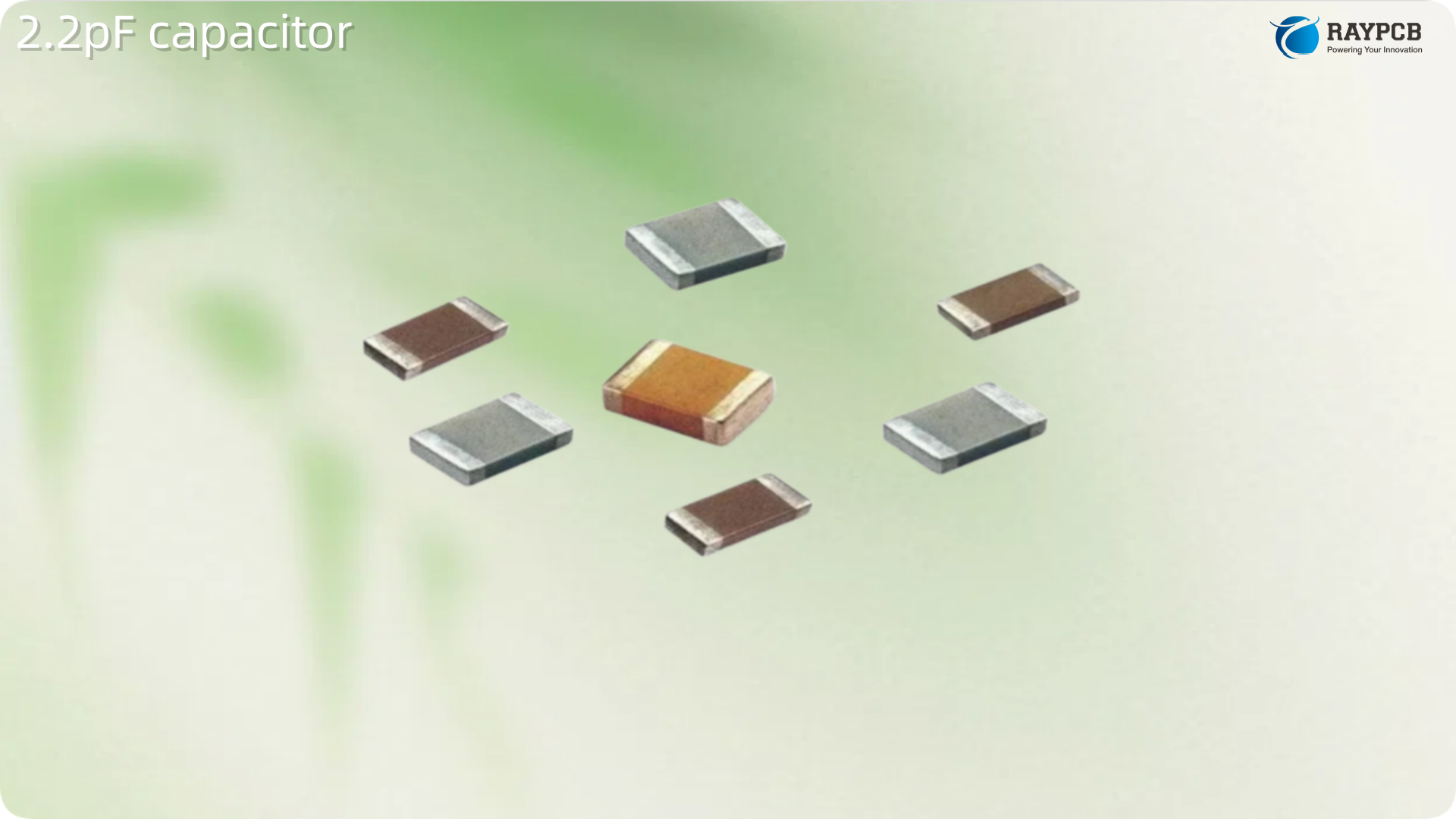
2.2 pF Capacitor: Tiny Value, Big Role in RF Matching

2.2 pF capacitor delivers ~30 ฮฉ reactance at 2.4 GHz โ€” making it essential for RF matching. Learn dielectric selection, PCB layout tips, and spec guidance.

Pick up a 0402-size 2.2 pF capacitor and you can barely see it. Under a microscope it looks unremarkable โ€” a beige ceramic chip with two silver terminations. But drop it into an RF matching network at 5 GHz and that single component can mean the difference between a clean โˆ’30 dB return loss and a system that reflects half its power back into the amplifier. If you’ve spent any time laying out antenna matching networks, power amplifier output stages, or LNA input circuits, you already know the pF-range capacitor range is where precision engineering actually lives.

This article covers everything you need to get the most out of the 2.2 pF capacitor: what makes it behave the way it does at GHz frequencies, where it belongs in a circuit, which dielectric to choose, how PCB layout can ruin it even after you’ve specified it correctly, and how to buy the right part from the right manufacturer.

What Is a 2.2 pF Capacitor and Why Does That Value Matter?

A 2.2 pF capacitor stores 2.2 picofarads of charge โ€” 0.0000000000022 farads. In a DC or low-frequency context, that’s essentially nothing. But capacitive reactance follows the formula:

Xc = 1 / (2ฯ€ ร— f ร— C)

At RF and microwave frequencies, that tiny capacitance translates into impedance levels that sit squarely in the range of typical RF circuit impedances (typically 50 ฮฉ, sometimes 75 ฮฉ). Here’s why it matters โ€” look at what 2.2 pF produces at common wireless frequencies:

FrequencyApplicationXc of 2.2 pF
100 MHzFM radio, basic RF~723 ฮฉ
433 MHzIoT, LoRa~168 ฮฉ
900 MHzGSM, LPWAN~80 ฮฉ
1.575 GHzGPS L1~46 ฮฉ
2.4 GHzWi-Fi, Bluetooth, Zigbee~30 ฮฉ
5 GHzWi-Fi 5/6, 5G Sub-6~14.5 ฮฉ
24 GHzAutomotive radar, mmWave~3 ฮฉ

Notice the pattern: as frequency climbs into the GHz range, 2.2 pF moves from a high-impedance blocking element toward an impedance value that fits neatly into matching network calculations. At 2.4 GHz it produces roughly 30 ฮฉ of reactance โ€” directly useful for transforming a 50 ฮฉ system into a complex antenna impedance. This is exactly why 2.2 pF shows up constantly in reference designs for Bluetooth modules, Wi-Fi front ends, and GPS LNA input stages.

The value also follows the standard E12 series (1.0, 1.2, 1.5, 1.8, 2.2, 2.7, 3.3โ€ฆ), meaning it’s widely stocked by every major distributor. You’re not paying a premium for an exotic value.

Why Small Capacitors Dominate RF Matching Networks

The Impedance Mismatch Problem in RF Systems

In RF circuits, mismatches in impedance cause standing waves, signal distortion, and power loss. If a power amplifier with a 50 ฮฉ output drives an antenna presenting 20 โˆ’ j15 ฮฉ, a significant chunk of the available power reflects back. Over repeated cycles in a transmitter that can mean heating the PA output stage, degraded efficiency, and reduced range.

L-networks, pi-networks, and T-networks solve this by introducing reactive elements that cancel the imaginary part and transform the real part. For applications above 1 GHz, the capacitor values that fall out of the matching equations commonly land in the 1โ€“10 pF range. The 2.2 pF is a natural answer to many of those calculations.

Where 2.2 pF Fits in an L-Network

An L-network uses a single inductor and a single capacitor to transform one impedance to another. For a shunt capacitor topology transforming a lower impedance to 50 ฮฉ, the required capacitance calculates directly from:

C = 1 / (2ฯ€ ร— f ร— Xc)

For Xc = 30 ฮฉ at 2.4 GHz: C โ‰ˆ 2.21 pF. That’s not a coincidence โ€” 2.2 pF is a standard value precisely because these calculations land there repeatedly in the 2.4 GHz band.

The same logic applies in pi-networks on PA outputs, where a shunt element to ground at the output is commonly a few picofarads, and in T-networks used in balun designs for differential antenna feeds.

Dielectric Selection: Why You Must Use C0G/NP0 at These Values

This is where engineers sometimes get into trouble. The 2.2 pF value is too small for X7R to behave reliably in an RF matching application. Here’s why.

C0G (NP0): The Only Choice for Sub-10 pF RF Work

C0G (also called NP0) is an EIA Class I ceramic dielectric with a temperature coefficient of 0 ยฑ30 ppm/ยฐC. Capacitance change with temperature is less than ยฑ0.3% from โˆ’55ยฐC to +125ยฐC, and the dielectric exhibits negligible capacitance drift over time and applied voltage. C0G typically achieves a Q factor exceeding 1,000, which means very low ESR and minimal loss โ€” exactly what you need in a matching network that must preserve power.

X7R: Not Appropriate for Sub-5 pF Matching

X7R is a ferroelectric Class II dielectric. It achieves higher capacitance density, but its properties are nonlinear โ€” capacitance varies with temperature, DC bias voltage, and AC signal amplitude. For a 100 nF bulk bypass capacitor these variations are tolerable. For a 2.2 pF matching element where 0.3 pF of drift shifts your resonant frequency by hundreds of MHz at 5 GHz, X7R is a reliability risk, not just a performance compromise.

DielectricTemp StabilityVoltage DependenceQ FactorUse in 2.2 pF RF Matching?
C0G / NP0ยฑ30 ppm/ยฐCNone>1000โœ… Yes โ€” preferred
X7Rยฑ15% over tempSignificant100โ€“500โŒ No โ€” too unstable
X5Rยฑ15% over tempHigh<200โŒ No
Y5V+22/โˆ’82% over tempVery high<100โŒ Absolutely not

Package Selection: Smaller Is Better at GHz Frequencies

For a 2.2 pF RF capacitor, the package size directly affects parasitic inductance (ESL), which in turn determines the self-resonant frequency (SRF). Above the SRF, a capacitor no longer behaves capacitively โ€” it becomes inductive, and your carefully calculated matching network stops working.

PackageESL TypicalBest For
0201 (0603M)~0.3โ€“0.5 nH5 GHz, 24 GHz, mmWave
0402 (1005M)~0.5โ€“0.7 nH2.4 GHz, GPS, 900 MHz
0603 (1608M)~0.8โ€“1.0 nHBelow 1 GHz (larger bodies add inductance)

For a 2.2 pF capacitor with 0.5 nH of ESL, the SRF is approximately:

SRF = 1 / (2ฯ€ ร— โˆš(LC)) = 1 / (2ฯ€ ร— โˆš(0.5ร—10โปโน ร— 2.2ร—10โปยนยฒ)) โ‰ˆ 4.8 GHz

That means a 0402-size 2.2 pF C0G will start to look inductive above roughly 4.8 GHz. If you’re designing at 5 GHz or above, move to 0201 and potentially verify the actual SRF from the manufacturer’s S-parameter data. Johanson Technology, Murata, and KYOCERA AVX all publish measured S-parameters for their RF MLCCs, which is far more reliable than calculating from nominal ESL.

Real-World Applications of the 2.2 pF Capacitor

Antenna Matching in Bluetooth and Wi-Fi Modules

In compact wireless modules (ESP32, nRF52840, RTL8720, and similar), the antenna matching network between the IC’s RF output and the PCB trace antenna or connector is typically two to three components. The shunt capacitor to ground in that pi-network or L-network is almost always in the 1โ€“4 pF range. Reference designs frequently show 2.2 pF or 1.8 pF at this position. Getting this value right is what moves the S11 marker to the center of the Smith chart at 2.4 GHz.

GPS LNA Input Matching

GPS L1 receivers operate at 1.575 GHz, and the LNA input matching network must transform the antenna impedance to the LNA’s optimal noise figure impedance (not necessarily 50 ฮฉ). The capacitive element in that input match is often 2.2 pF or 1.5 pF. Drift in this component shifts the noise figure directly, so C0G tolerance and stability are mandatory.

PA Output Harmonic Filter

In a simple 2.4 GHz power amplifier output stage, a low-pass or bandpass filter attenuates harmonics before the antenna. The series capacitors in a Chebyshev or Butterworth filter can include 2.2 pF elements. These must maintain their value under the PA’s output power level (which can swing several volts of RF amplitude) โ€” yet another reason to avoid X7R.

RF Oscillator Tank Circuits

In VCXO and LC oscillator designs, the tank capacitor network sometimes includes picofarad-range capacitors to trim the oscillation frequency. A 2.2 pF in parallel with a larger trimmer provides a fine frequency shift without heavy pulling.

PCB Layout: Where the 2.2 pF Capacitor Gets Destroyed

Specifying the right part is only half the battle. Even a perfect C0G 0402 in the right position fails to perform if the PCB layout adds parasitic inductance and capacitance around it.

Minimize pad size. Oversized pads add extra capacitance to ground and shift the effective capacitance value. For a 2.2 pF component, even 0.1 pF of pad capacitance is a 4.5% error.

Avoid stub traces. Any trace between the capacitor’s pad and the via or the next component acts as a short transmission line stub. At 5 GHz, even 0.5 mm of 0.3 mm-wide microstrip adds measurable inductance and reflection.

Keep the ground via close. For a shunt matching capacitor, the via connecting the capacitor’s ground pad to the RF ground plane needs to be as close as the design rules allow. A typical PCB via contributes 0.4โ€“0.8 nH of inductance, which at 5 GHz is not negligible.

Model the pads in simulation. When you run EM simulation in tools like AWR Microwave Office, Keysight ADS, or ANSYS HFSS, include the pad geometry. Johanson and Murata both provide S-parameter files and Modelithics simulation models that include the pad parasitics, which gives you significantly more accurate simulation results than using the ideal capacitor model.

Key Specifications Checklist for a 2.2 pF RF Capacitor

SpecificationRecommended Value / Note
Capacitance2.2 pF
Toleranceยฑ0.1 pF (code “B”) or ยฑ0.25 pF (code “C”) โ€” not ยฑ5%
DielectricC0G / NP0
Voltage ratingโ‰ฅ10 V (typically 25 V or 50 V for MLCC)
Package0402 for โ‰ค2.4 GHz; 0201 for 5 GHz+
SRFMust exceed operating frequency by โ‰ฅ50%
Operating temperatureโˆ’55ยฐC to +125ยฐC minimum
ESR<0.5 ฮฉ at operating frequency
QualificationAEC-Q200 for automotive; MIL-PRF-55681 for defense

Useful Resources for RF Capacitor Selection

ResourceTypeLink
Johanson Technology SRF/PRF Technical NoteApplication notejohansontechnology.com
Johanson Understanding Chip Capacitors GuideApplication notejohansontechnology.com
Murata SimSurfing (S-parameter & model search)Component simulation databaseds.murata.co.jp/simsurfing
KYOCERA AVX SpiMLCC Simulation ToolOnline SPICE modelkyocera-avx.com
Modelithics MLCC ModelsAdvanced simulation librarymodelithics.com
Cadence PCB Resources โ€“ RF Capacitor SelectionDesign guideresources.pcb.cadence.com
RayPCB โ€“ Capacitors in PCB DesignPCB design overviewraypcb.com/pcb-capacitor
Newark โ€“ 2 pF RF Capacitor SearchDistributor databasenewark.com

Frequently Asked Questions

1. Can I use a 2.2 pF X7R capacitor instead of C0G in an RF matching circuit?

Not if you want the network to work reliably. X7R exhibits significant capacitance change with temperature and voltage bias. For a 2.2 pF matching element, even a 5% drift shifts the component’s reactance by more than 1 ฮฉ at 2.4 GHz, which measurably degrades return loss. Always use C0G/NP0 for matching components below 10 pF.

2. What tolerance should I specify for a 2.2 pF capacitor in an RF design?

Use ยฑ0.1 pF (EIA tolerance code “B”) if your network is narrow-band or operating above 3 GHz. For less sensitive broadband designs at 2.4 GHz, ยฑ0.25 pF (“C” tolerance) is often acceptable. Avoid percent-based tolerances (like ยฑ5%) for sub-5 pF values โ€” ยฑ5% of 2.2 pF is only ยฑ0.11 pF, but some distributors will list ยฑ5% tolerance parts that at these tiny values become ยฑ1% specifications you didn’t ask for. Read the actual tolerance column in the datasheet.

3. How do I verify whether a 2.2 pF capacitor is performing correctly in my RF circuit?

Use a vector network analyzer (VNA) and measure S11 at the design frequency. If you have access to a component fixture (e.g., an 0402 test board), you can measure the actual component S-parameters and compare them to the manufacturer’s data. In-circuit, tune the matching network while monitoring return loss on the VNA โ€” if the 2.2 pF is off-value or the wrong dielectric, you’ll find that the minimum S11 doesn’t land at the right frequency.

4. Why does moving to a smaller package (0201 vs. 0402) improve RF performance at 5 GHz?

Smaller packages have lower parasitic inductance (ESL). For a 2.2 pF value with lower ESL, the self-resonant frequency is higher, meaning the component behaves like a true capacitor over a broader frequency range. At 5 GHz an 0402 with 0.6 nH of ESL is already quite close to its SRF, while an 0201 with 0.3 nH SRF sits around 6.8 GHz โ€” giving you meaningful margin.

5. Can PCB pad size really shift the effective capacitance of a 2.2 pF component?

Yes, and this surprises engineers who are used to working with larger values. Pad capacitance on a typical 0402 RF footprint on FR-4 can add 0.05โ€“0.15 pF to the effective capacitance. That’s up to 7% of the nominal 2.2 pF value โ€” easily enough to detune a narrowband antenna match. Reduce pad area to the minimum required by your manufacturer’s assembly guidelines, and use a ground plane cutout directly under the RF trace and pads if your board stack allows it.

Conclusion

The 2.2 pF capacitor is a small component with outsized consequences in RF design. Its reactance sits in the useful 15โ€“80 ฮฉ range through the 1โ€“5 GHz band that covers most modern wireless protocols, making it one of the most frequently reached-for values in antenna matching, LNA biasing, PA harmonic filtering, and oscillator tuning. Getting it right means specifying C0G/NP0 dielectric without compromise, choosing the correct package for your operating frequency, keeping tolerances tight (ยฑ0.1 pF or ยฑ0.25 pF), and treating PCB layout with the same rigor you’d give any other RF transmission-line element. Treat a 2.2 pF like a generic bypass cap, and your carefully calculated matching network will drift with temperature, age, and assembly variation. Treat it as the precision RF element it is, and it will reward you with stable, repeatable performance across every production unit.

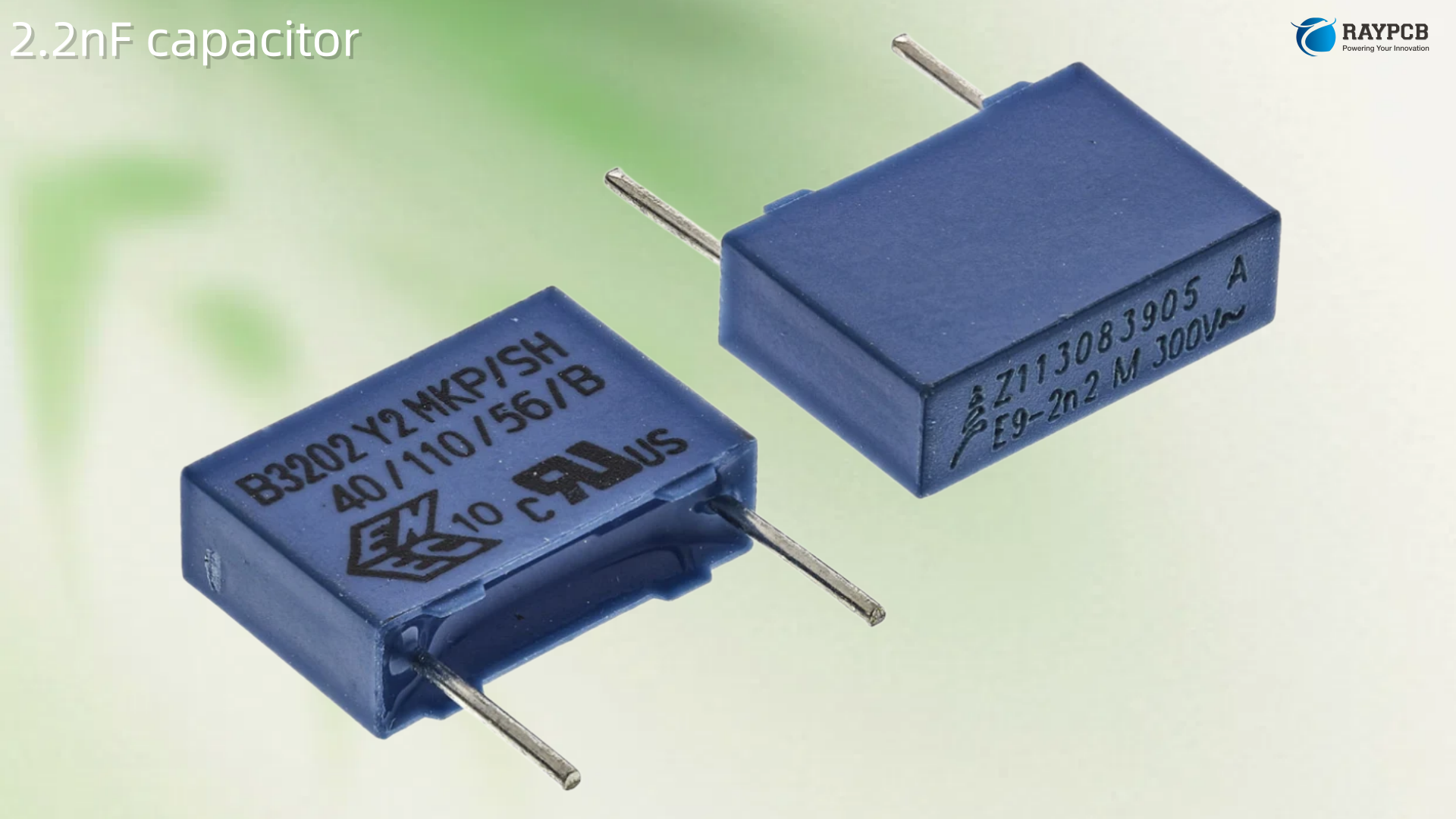
2.2nF Capacitor (Code 222): The PCB Engineer’s Complete Guide to Timing & Filter Applications

The 2.2nF capacitor (code 222) explained: decode the marking, choose the right dielectric, calculate RC filter cutoffs, and master PCB layout โ€” engineer’s guide.

If you’ve ever squinted at a tiny ceramic disc stamped with 222 and asked yourself what it means, you’re in good company. The 2.2nF capacitor โ€” marked with the three-digit EIA code 222 โ€” is one of those unassuming components that shows up everywhere: RF snubbers, RC timing loops, ADC anti-aliasing filters, and decoupling rails. It’s not glamorous, but pick the wrong value or the wrong dielectric and your design will tell you loud and clear.

This guide breaks down everything a working PCB engineer needs to know about the 2.2nF capacitor โ€” from reading the code off the body to calculating real cutoff frequencies and integrating the part cleanly into your next layout.

What Does Capacitor Code 222 Mean?

The 2.2nF capacitor carries the EIA three-digit marking 222, decoded as follows:

Digit PositionValueMeaning
1st digit2First significant digit
2nd digit2Second significant digit
3rd digit (multiplier)2ร— 10ยฒ = ร— 100
Result2200 pF = 2.2 nF = 0.0022 ยตFAll equivalent values

So the math is: 22 ร— 100 = 2200 pF = 2.2 nF. You’ll sometimes see this part listed as 2200pF in distributor catalogs โ€” same component, different unit preference. If there’s a letter suffix like J (ยฑ5%) or K (ยฑ10%), that’s the tolerance code. The voltage rating, if encoded, usually appears as a separate prefix (e.g., 2A = 100 VDC per EIA standard).

Worth noting: a 222 and a 223 are not the same thing. The 223 decodes to 22 ร— 1000 = 22,000 pF = 22 nF โ€” a full 10ร— larger. Confusing these two on a BOM has caused more than one engineering headache.

2.2nF Capacitor Key Specifications at a Glance

ParameterTypical Values
Capacitance2.2 nF (2200 pF / 0.0022 ยตF)
EIA Code222
Common DielectricsC0G/NP0, X7R, Y5V
Voltage Rating16V, 50V, 100V, 250V, 400V (type-dependent)
Toleranceยฑ5% (J), ยฑ10% (K), ยฑ20% (M)
Package (SMD)0402, 0603, 0805, 1206
Package (TH)Radial disc, 5mm / 10mm pitch
ESRVery low (suitable for RF and HF circuits)
MountingPolarised? No โ€” fully non-polarised

Dielectric Matters: Choosing the Right 2.2nF Capacitor Type

This is where a lot of engineers get burned. Ceramic capacitors are divided into two broad application classes, and a 2.2nF part comes in both:

C0G / NP0 (Class 1) โ€” Your Best Bet for Precision Work

C0G dielectric has near-zero temperature coefficient and almost no capacitance drift with voltage or age. If your 2.2nF capacitor sits in a timing circuit, an oscillator feedback loop, or any precision analog path, C0G is the non-negotiable choice. It gives you high stability, low loss (high Q), and predictable behaviour across temperature โ€” exactly what resonant circuits and filter poles demand.

X7R (Class 2) โ€” Good for General-Purpose Filtering

X7R offers a ยฑ15% capacitance variation over โˆ’55ยฐC to +125ยฐC. It’s far more compact and cheaper than C0G at equivalent values. For bypass, decoupling, and non-precision filter stages where the cutoff frequency doesn’t need to be tight, X7R works fine. Just be aware of DC bias derating โ€” at high DC bias, effective capacitance can drop noticeably.

Y5V / Z5U โ€” Generally Avoid for Signal Paths

High volumetric efficiency, but capacitance can vary by as much as โˆ’82% over temperature and voltage. You wouldn’t use this in a filter or timer where predictability matters.

2.2nF Capacitor in RC Timing Circuits

The RC time constant is the foundational equation for any timing application:

ฯ„ = R ร— C

With a 2.2nF capacitor, the time constants you can achieve across standard resistor values look like this:

Resistor (R)Time Constant (ฯ„ = R ร— C)Typical Use Case
1 kฮฉ2.2 ยตsHigh-frequency pulse timing
10 kฮฉ22 ยตsMid-range timing, debounce circuits
47 kฮฉ103 ยตsOscillator RC networks
100 kฮฉ220 ยตsLow-power timer stages
470 kฮฉ1.034 msLonger interval timing

In a 555 timer charging circuit, the 2.2nF capacitor is commonly paired with resistors in the tens-of-kilohm range to set oscillation frequencies in the tens-of-kilohertz โ€” a sweet spot for tone generation, PWM generation, and clock references in simple microcontroller circuits.

One thing to watch: the time constant defines when the capacitor charges to ~63.2% of supply voltage. Full “charged” is conventionally taken at 5ฯ„ (99.3%). For timing accuracy, always use a C0G dielectric and a tight-tolerance resistor (1% metal film minimum).

2.2nF Capacitor in Filter Applications

Low-Pass and High-Pass RC Filter Design

The cutoff frequency formula for an RC filter is:

fc = 1 / (2ฯ€ ร— R ร— C)

With a 2.2nF capacitor, here are the cutoff frequencies you get across common resistor values:

Resistor (R)Cutoff Frequency (fc)Filter Application
100 ฮฉ~723 kHzRF pre-filter, HF bypass
1 kฮฉ~72.3 kHzAudio anti-aliasing (high end)
7.23 kฮฉ~10 kHzAudio band filter
10 kฮฉ~7.23 kHzADC input conditioning
72.3 kฮฉ~1 kHzLow-frequency signal separation

At the cutoff frequency, the output signal drops to 70.7% of the input (โˆ’3 dB). Below fc for a low-pass, the signal passes through largely unaffected. Above fc, it rolls off at โˆ’20 dB per decade for a single-pole stage.

The 2.2nF value places this capacitor solidly in the RF and high-frequency analog domain for typical resistor values. That’s why you’ll find it in:

  • ADC anti-aliasing filtersย ahead of high-speed converters
  • RF snubber networksย to suppress switching transients
  • Op-amp feedback networksย for bandwidth limiting
  • EMI/RFI suppressionย in power supply outputs
  • IยฒC and SPI line filteringย in noisy industrial environments

High-Pass Configuration

Swap the resistor and capacitor positions and you have a high-pass filter with the same cutoff frequency formula. A 2.2nF cap paired with a 7.23 kฮฉ resistor gives a 10 kHz high-pass โ€” useful for AC coupling stages where you want to block DC and low-frequency noise but pass the signal band above 10 kHz.

PCB Layout Tips for 2.2nF Capacitors

When placing a capacitor on a PCB in this value range, layout discipline has a measurable impact on performance:

Keep placement close to the load. For decoupling duty, place the 2.2nF cap as close as physically possible to the VCC pin of the IC it’s serving. Trace inductance is the enemy โ€” every millimetre adds parasitic inductance that raises the impedance at frequency.

Use a short, direct return path. The via to ground and the ground pour directly under the cap are as important as the cap placement itself. On a 4-layer board, dedicate an inner layer as a ground reference and stitch the cap’s GND pad to it with a via as close to the pad as your DRC allows.

Mind the solder mask clearance on 0402 and 0603 SMD. At this capacitance value and high frequency, parasitic inductance from long pads or tombstoning from asymmetric reflow can shift the effective resonant frequency enough to matter.

For filter circuits, match component placement to signal flow. Place the series resistor first (upstream), then the shunt capacitor to ground. This maintains a clean signal path and avoids routing loops that could couple noise.

Common 2.2nF Capacitor Part Numbers & Where to Find Them

ManufacturerPart NumberDielectricPackageVoltage
MurataGCM1885C1H222JA16DC0G060350V
TDKC1608C0G1H222J080AAC0G060350V
SamsungCL10C222JB8NNNCC0G060350V
VishayVJ0603D222JXPAJC0G0603200V
KemetC0603C222J5GACTUC0G060350V
YageoCC0603JRNPO9BN222NP0060350V

Useful Resources for Engineers

Frequently Asked Questions About the 2.2nF Capacitor

Q1: Is a 2.2nF capacitor the same as a 2200pF or 0.0022ยตF capacitor? Yes, exactly. All three notations describe the same capacitance value. Distributors and datasheets use different unit conventions depending on context, but 2.2 nF = 2200 pF = 0.0022 ยตF. The code 222 on the body always refers to this value regardless of which unit is shown in the catalog.

Q2: Can I substitute a 2.2nF capacitor with a 2.2nF film capacitor instead of ceramic? In many applications, yes. Film capacitors (polyester, polypropylene) offer excellent stability and low ESR, similar to C0G ceramic. The trade-off is physical size โ€” a film cap at 2.2nF is considerably larger than an equivalent MLCC. In tight PCB layouts or high-frequency RF applications above a few megahertz, the ceramic MLCC is usually the better choice due to its lower parasitic inductance.

Q3: What resistor do I need to set a 10 kHz low-pass filter with a 2.2nF capacitor? Using fc = 1 / (2ฯ€ ร— R ร— C), rearranged: R = 1 / (2ฯ€ ร— fc ร— C) = 1 / (2ฯ€ ร— 10,000 ร— 2.2ร—10โปโน) โ‰ˆ 7.23 kฮฉ. The nearest standard E24 value is 7.5 kฮฉ, which gives you a cutoff of approximately 9.65 kHz โ€” close enough for most applications.

Q4: Why does my 2.2nF X7R capacitor behave differently at different temperatures? X7R dielectric has a capacitance variation of ยฑ15% over โˆ’55ยฐC to +125ยฐC, plus additional drift under DC bias. If your circuit requires a stable, predictable time constant or filter corner, switch to a C0G/NP0 dielectric 2.2nF capacitor, which has negligible temperature and voltage dependence.

Q5: Is the 2.2nF capacitor polarised? No. Ceramic capacitors, including the 2.2nF 222-coded type, are non-polarised. You can install them in either orientation on the PCB without affecting performance. This contrasts with electrolytic and tantalum capacitors, which must be placed with correct polarity.

Final Thoughts

The 2.2nF capacitor might be one of the smallest line items on your BOM, but in RF, precision analog, and timing circuits it deserves the same level of specification discipline as any active device. Know your dielectric, understand how the RC time constant and cutoff frequency shift with your resistor values, and keep your PCB layout tight. Those three habits alone will save you more re-spins than almost any other single practice in analog and mixed-signal design.

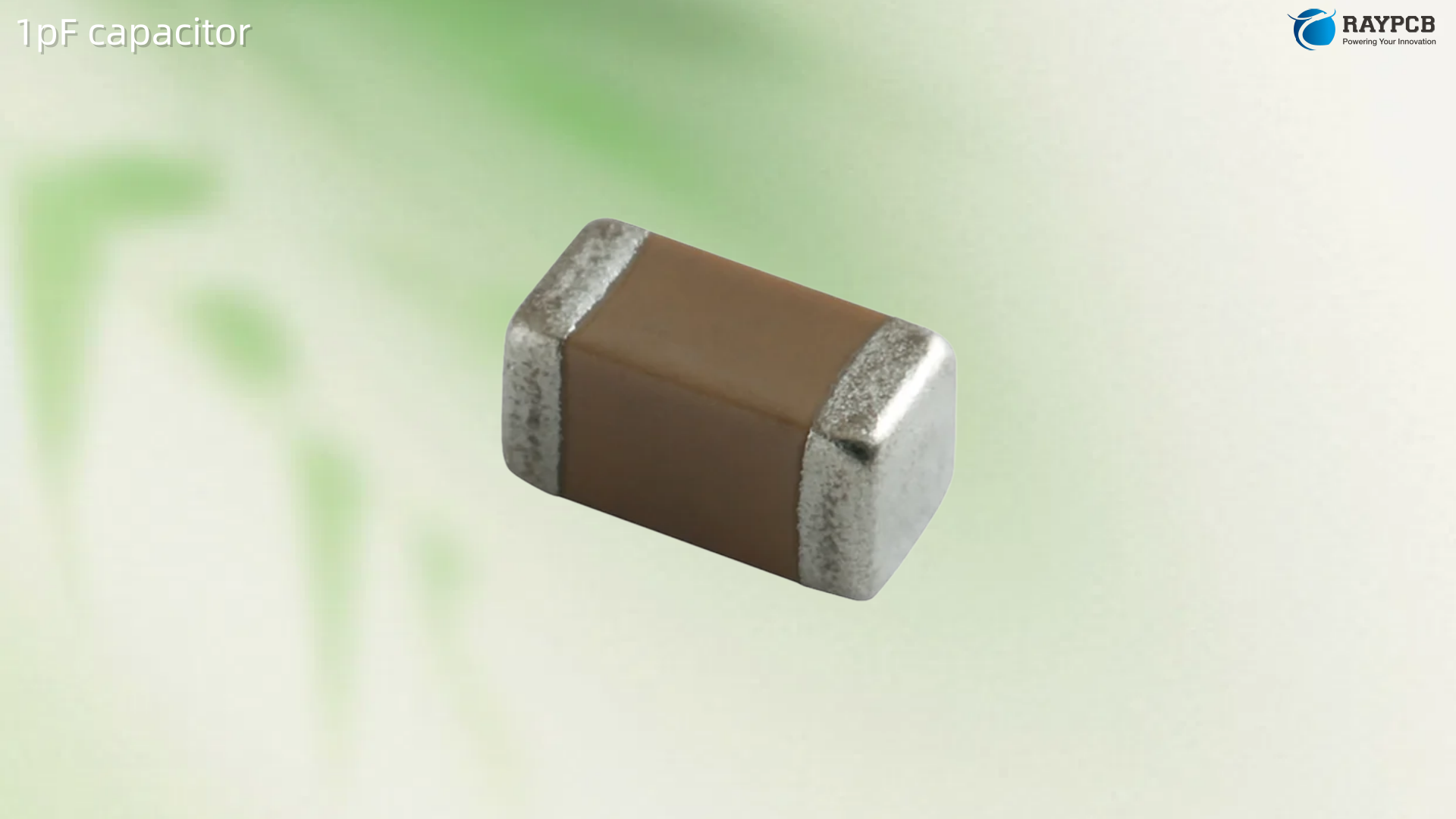
1 pF Capacitor: Uses, Packages & Where to Find It

A practical guide to the 1pF capacitor: where it’s used in RF matching networks and oscillators, which package to choose, key specs like C0G dielectric and ยฑ0.1 pF tolerance, and where to buy from major distributors.

A 1 pF capacitor is one of the smallest capacitance values you’ll encounter in electronics, and yet it shows up in some surprisingly demanding applications. If you’ve never had to deal with a 1 pF cap before, you might wonder whether something that small even matters. Once you’ve worked on RF circuits, antenna matching networks, or high-speed oscillators, you’ll know the answer is absolutely yes โ€” and you’ll also know how easy it is to ruin your design by getting the footprint, dielectric, or parasitics wrong on a component this tiny.

This guide breaks down everything a PCB engineer needs to know about the 1pF capacitor: what it’s used for, which packages make sense, how to read the specs, and where to actually source them.

What Is a 1 pF Capacitor?

A 1 pF capacitor (one picofarad, or 1ร—10โปยนยฒ farads) is an extremely small-value capacitor used primarily in high-frequency analog and RF circuits. For context, a typical decoupling capacitor on a digital power rail is 100 nF โ€” that’s 100,000 times larger than a 1 pF cap.

At this scale, the capacitance of the component is often comparable to โ€” or smaller than โ€” the parasitic capacitance of the PCB traces, solder pads, and even the IC pins themselves. That’s what makes working with 1 pF caps both powerful and tricky. The circuit topology and the physical layout matter just as much as the component value.

The value is sometimes written as 1p, 1pF, or in EIA code as 1R0 (though manufacturers vary on notation for sub-10 pF values โ€” always check the datasheet).

Where Is a 1 pF Capacitor Used?

Most of the applications for 1 pF capacitors fall into a few well-defined categories. If you’re seeing this value in a BOM and wondering why it’s there, one of these is almost certainly the reason.

RF Impedance Matching Networks

This is the most common home for 1 pF caps. In L-network, pi-network, and T-network matching topologies, component values are calculated based on the source and load impedances and the target frequency. At frequencies above 1 GHz, even small impedance mismatches cause significant reflection loss, and the calculated capacitance often lands in the 0.5โ€“5 pF range. A 1 pF cap in a matching network is doing real work.

Crystal Oscillator Load Capacitance

Quartz crystals have a specified load capacitance โ€” typically 12 pF or 18 pF โ€” that must be presented by the circuit for the crystal to oscillate at its marked frequency. The two capacitors in a standard Pierce oscillator circuit (one from each oscillator pin to ground) are chosen to present this load. In some high-frequency crystals or when parasitic capacitance is already significant, the external cap values can drop to 1โ€“2 pF.

VCO Frequency Trimming

Voltage-controlled oscillators use a varactor diode whose capacitance shifts with applied voltage to tune the output frequency. Fixed capacitors placed in parallel with the varactor set the baseline capacitance of the tank circuit. At microwave frequencies, those trim caps can be as small as 1 pF.

Antenna Tuning and Filter Design

In small loop antennas and ceramic chip antennas, impedance matching at 2.4 GHz, 5 GHz, or cellular bands often requires very small shunt or series capacitors. The same applies to bandpass filter design using coupled resonators โ€” 1 pF shows up frequently in filter topologies above 1 GHz.

High-Speed PCB Signal Coupling and Bypass

In some RF and mmWave designs, a 1 pF cap is used as an AC coupling element where higher capacitance would create too much low-frequency loading, or as a very high-frequency bypass where larger caps would resonate below the frequency of interest.

1 pF Capacitor Packages and Physical Dimensions

Package selection for a 1 pF cap matters more than it does for larger values. At 1 pF, the self-resonant frequency (SRF) is extremely high, but parasitic capacitance from the PCB land pattern can meaningfully alter the effective circuit capacitance. Smaller packages have lower parasitics.

PackageL ร— W (mm)Typical Voltage RatingNotes
0402 (1005M)1.0 ร— 0.525โ€“50 VMost common for general RF use
0201 (0603M)0.6 ร— 0.310โ€“25 VLower parasitics, harder to place
01005 (0402M)0.4 ร— 0.210 VMinimal parasitics, reflow-only
0603 (1608M)1.6 ร— 0.850โ€“100 VLower SRF, usually overkill for 1 pF
ATC 100B seriesVariousUp to 500 VRF/microwave high-Q chip caps

For most RF work in the 1โ€“6 GHz range, 0402 is the practical sweet spot โ€” small enough that pad parasitics don’t swamp the 1 pF value, but large enough that assembly houses can handle it without special placement requirements. If you’re working at 10 GHz and above, 0201 or 01005 starts making sense.

Key Electrical Specs to Check on the Datasheet

A 1 pF capacitor datasheet has fewer obvious numbers than a bulk decoupling cap, but the parameters that matter are critical.

ParameterWhat to CheckWhy It Matters
Capacitance toleranceยฑ0.1 pF or ยฑ0.25 pF (not %)At 1 pF, a ยฑ5% tolerance is meaningless โ€” get absolute tolerance in pF
Dielectric typeC0G (NP0)Only C0G is stable enough for RF; X7R drifts too much
Q factor / ESRQ > 100 at target freqLow Q degrades filter insertion loss and oscillator phase noise
Self-resonant frequencyShould be >> operating frequencyTypically >10 GHz for 0402 C0G at 1 pF
Voltage rating25 V or higherUsually not a concern at signal levels, but verify in high-power RF
Temperature coefficientยฑ30 ppm/ยฐC or betterCritical in frequency-determining circuits

Always use C0G (NP0) dielectric for 1 pF capacitors. X7R and Y5V dielectrics have poor capacitance stability, especially at low values where the permittivity variation is a larger percentage of the total capacitance. Most reputable RF-grade 1 pF caps are C0G by default, but double-check before ordering.

Capacitance Tolerance: Why ยฑ0.1 pF vs. ยฑ5% Matters

This is a point that trips up engineers new to RF design. Standard capacitor tolerances are given in percentage (ยฑ5%, ยฑ10%). But at 1 pF, ยฑ5% means ยฑ0.05 pF โ€” which sounds fine until you realize that the parasitic capacitance of your PCB via might be 0.1โ€“0.3 pF, making the component tolerance the least of your problems.

More practically: if you’re using a 1 pF cap in a matching network or filter and you specify ยฑ5%, you might get a part that’s actually 0.95 pF or 1.05 pF. At 2.4 GHz, that 5% shift changes the reactance from ~66 ฮฉ to ~63 or ~70 ฮฉ โ€” which in an impedance matching application can mean a measurable return loss difference.

For production designs, specify ยฑ0.1 pF or ยฑ0.25 pF absolute tolerance. The cost difference from standard tolerance is minimal.

Popular 1 pF Capacitor Part Numbers

Here are specific parts from major manufacturers that are well-characterized and widely stocked:

ManufacturerPart NumberPackageDielectricToleranceVoltage
MurataGRM1555C1HR10BA01D0402C0Gยฑ0.1 pF50 V
TDKC1005C0G1H010C050BA0402C0Gยฑ0.1 pF50 V
VishayVJ0402A1R0CXACW1BC0402C0Gยฑ0.1 pF50 V
KemetC0402C109C5GACTU0402C0Gยฑ0.1 pF50 V
Wรผrth Elektronik8850120050090402C0Gยฑ0.1 pF50 V
AVX/Kyocera04025A1R0BAT2A0402C0Gยฑ0.1 pF50 V
ATC100B1R0BW500XTATC 100BC0Gยฑ0.1 pF500 V

The ATC 100B series is worth knowing about if you’re doing power RF work โ€” it’s a high-Q RF chip capacitor designed specifically for demanding microwave applications and has tighter RF performance specs than standard MLCC products.

PCB Layout Tips for 1 pF Capacitors

Getting the layout right is arguably more important than the component selection for a value this small.

Keep land patterns minimal. Oversized pads add capacitance to ground. Use the manufacturer’s recommended land pattern, not a generic one from your CAD library footprint database. A slightly too-large 0402 land pattern can add 0.05โ€“0.2 pF of parasitic capacitance โ€” that’s 5โ€“20% of your intended 1 pF.

Avoid ground planes directly under the component. For capacitors in series signal paths, having a ground plane immediately beneath the cap adds shunt capacitance. Use a copper void (also called a moat or clearance) under the component footprint if the parasitic capacitance is a concern at your operating frequency.

Route traces to pads, not through them. Trace routing that loops around or extends past the cap pads adds inductance and capacitance. Come straight in to each pad with the minimum necessary trace width.

Minimize via use near 1 pF caps. A standard PCB via adds roughly 0.3โ€“1 pF of capacitance depending on board stackup. One via placed too close to a 1 pF matching cap can completely detune your network.

Simulate with parasitic extraction before committing to a layout. Most RF-capable EDA tools (Cadence AWR, Keysight ADS, or even Sonnet Lite for free) allow you to extract parasitic capacitance from your layout. Run this before sending to fab if your design is frequency-sensitive.

Where to Buy a 1 pF Capacitor

These parts are widely stocked at major distributors. Use the parametric search filters to narrow by capacitance, dielectric, tolerance, and package.

DistributorSearch/Filter LinkNotes
Digi-Keydigikey.comLargest stock, good parametric filters
Mousermouser.comStrong on Murata, TDK, AVX
LCSClcsc.comBudget-friendly, good for prototyping
Arrowarrow.comAuthorized for most major brands
Farnell/Element14farnell.comUK/EU stocking, authorized distributor

For production quantities, going direct to the manufacturer (Murata, TDK, AVX) through their authorized distribution channels ensures traceability and avoids counterfeit risk โ€” something that matters more than most engineers admit until they’ve been burned by fake passives.

Useful Resources and Datasheets

  • Murata SimSurfingย โ€“ Online simulation tool for Murata capacitors, shows S-parameters and impedance vs. frequency: ds.murata.com/simsurfing
  • TDK Product Finderย โ€“ Parametric search with downloadable SPICE and S-parameter models: product.tdk.com
  • Kemet KSIMย โ€“ Online capacitor simulation tool with ESR, ESL, impedance curves: ksim.kemet.com
  • AVX SpiCapย โ€“ S-parameter and SPICE model generator for AVX capacitors: avx.com/products/spicap
  • ATC Microwave Capacitors Datasheet Libraryย โ€“ High-Q RF chip caps with full S-parameter data: atceramics.com
  • IPC-7351Bย โ€“ Land pattern standard for SMD components, including small passives
  • Coilcraft RF Inductor/Capacitor Design Toolsย โ€“ Useful for LC filter and matching network calculations: coilcraft.com/tools

Frequently Asked Questions About 1 pF Capacitors

Why would I use a 1 pF capacitor instead of a larger value?

In RF and microwave circuits, the required component values are determined by the operating frequency and the impedances involved. At 2.4 GHz or higher, the reactance of even a few picofarads can be significant. In an impedance matching network or RF filter, using too large a capacitor would present too low an impedance and short-circuit the signal path at the operating frequency. The 1 pF value is specifically chosen to provide the right reactance at the target frequency.

Can I replace a 1 pF capacitor with two 2 pF caps in series?

In theory, two 2 pF capacitors in series give 1 pF. In practice, this is almost never a good idea in RF circuits. You’re adding extra solder joints, more parasitic inductance, and more footprint area โ€” all of which degrade performance at high frequency. If 1 pF isn’t available, it’s better to choose the closest available standard value (0.8 pF or 1.2 pF) and verify your circuit still works, rather than building a series combination.

What tolerance should I specify for a 1 pF capacitor in a matching network?

Use ยฑ0.1 pF absolute tolerance. Percentage tolerances are meaningless at this capacitance value. ยฑ0.25 pF is acceptable for less critical applications, but for anything where impedance accuracy matters โ€” antenna matching, RF filter, oscillator load โ€” stick to ยฑ0.1 pF. The price difference between ยฑ0.1 pF and looser tolerances is negligible in small quantities.

Does the PCB substrate matter when using 1 pF capacitors?

Yes, significantly. On standard FR4, the relatively high loss tangent (tanฮด โ‰ˆ 0.02) and the dimensional variation of the substrate affect parasitic capacitance and insertion loss. High-frequency designs using 1 pF caps are often built on Rogers RO4350B or similar low-loss RF laminates where the electrical properties are tighter and the loss tangent is lower (tanฮด โ‰ˆ 0.004). If you’re building on FR4 and seeing unexpected performance, parasitic effects from the substrate could be contributing.

Why does my 1 pF capacitor simulation not match measured results?

The most common cause is that your simulation doesn’t include PCB parasitics. A schematic-level SPICE simulation with an ideal 1 pF cap won’t account for the land pattern capacitance, trace inductance, or the capacitance of nearby vias. Use S-parameter models from the manufacturer (available from Murata SimSurfing, TDK, or Kemet KSIM) and consider running an EM simulation of the layout before relying on simulated results.

Working with 1 pF capacitors is one of those skills that separates RF engineers from general PCB designers. The component is simple โ€” a small ceramic chip with two terminals โ€” but getting it right requires understanding parasitics, dielectric selection, tolerance impact, and layout discipline. Get those right, and a 1 pF cap can make the difference between a matched antenna system and one that wastes half your transmit power in reflected losses.