Polystyrene Capacitor: High Precision, Low Noise, Obsolete but Useful

Complete guide to polystyrene capacitors: key specs, why they excelled in precision audio and timing circuits, why they’re obsolete, and the best modern replacements.

There is a certain irony in the story of the polystyrene capacitor. Electrically, it is one of the finest capacitor dielectrics ever put into production: extraordinarily low dielectric absorption, negligible distortion, near-zero voltage coefficient, and capacitance stability over temperature that rivals silver mica. In precision analog circuits, audio signal paths, and sample-and-hold networks, polystyrene capacitors were โ€” and in many legacy designs, still are โ€” the benchmark component. And yet, you cannot design one into a new product. The film stopped being made. The world moved on.

If you are servicing legacy gear, working with precision analog instrumentation from the 1970sโ€“1990s, or trying to understand why engineers of that era reached for these particular parts so consistently, this guide covers everything you need to know. It also explains what has replaced the polystyrene capacitor in modern designs โ€” and why some of those replacements are still not quite as good.

What Is a Polystyrene Capacitor?

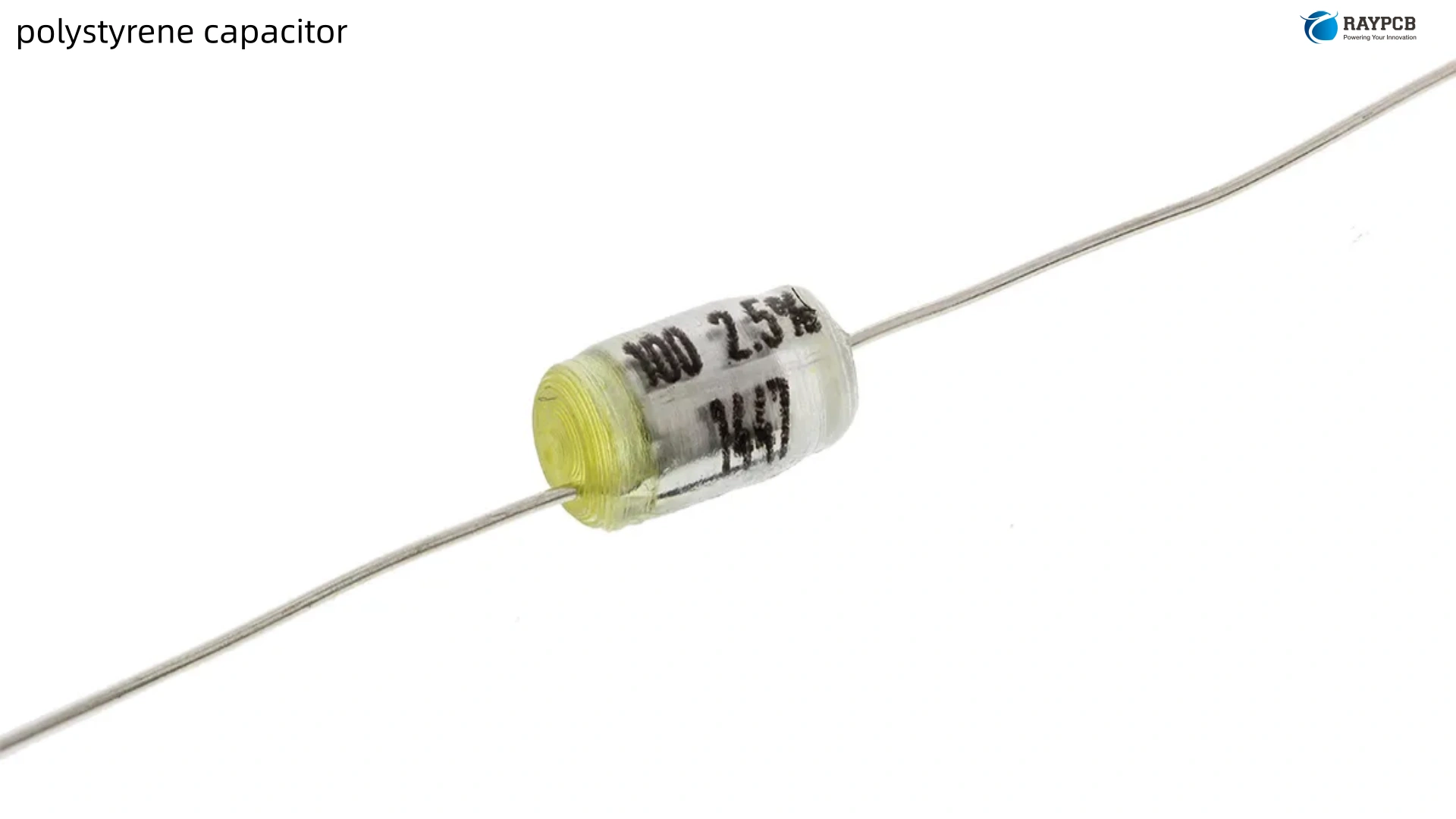
A polystyrene capacitor is a film and foil capacitor that uses polystyrene (PS) film as its dielectric material. The construction is straightforward: two strips of aluminum foil electrodes are interleaved with two layers of polystyrene film, then wound into a cylindrical roll and encased in a plastic or lacquered tube. Sometimes referred to as “Styroflex” in European literature โ€” a brand name from the former Siemens/WIMA era โ€” these capacitors were introduced into production around 1949 and remained a preferred precision component for decades.

The wound cylindrical construction is worth noting from a circuit behavior standpoint: because the foil strips are rolled up like a coil, the polystyrene capacitor has a small but measurable self-inductance. This makes it unsuitable for high-frequency applications above a few megahertz, where the inductive reactance begins to dominate. Below that frequency limit, however, its electrical behavior is essentially ideal.

Key Specifications at a Glance

ParameterPolystyrene Capacitor
Dielectric materialPolystyrene (non-polar)
Capacitance range10 pF to ~47 nF
Typical toleranceยฑ5% to ยฑ10%; precision types ยฑ1% to ยฑ2%
Temperature coefficientโˆ’125 to โˆ’150 ppm/ยฐC (linear, negative)
Operating temperature rangeโˆ’40ยฐC to +85ยฐC (max +70ยฐC for value stability)
Rated voltage30 V to 630 V DC
Dissipation factor (DF)< 0.01% at 1 kHz, 25ยฐC
Dielectric absorption~0.02%
Insulation resistanceVery high (RC time constant > 100,000 s)
Frequency suitabilityUp to ~1 MHz (wound coil structure limits HF)
ConstructionFilm and foil only (no metallized version possible)
Physical formatThrough-hole only (axial or radial lead)
SMD availabilityNone โ€” cannot survive reflow soldering temperatures

Why the Polystyrene Capacitor Was So Highly Regarded

To understand why engineers still discuss polystyrene capacitors with something approaching reverence, you need to understand what makes a capacitor “good” for precision applications. It is not just about tight initial tolerance โ€” it is about how the capacitor behaves after manufacture, under bias, across temperature, and over time.

Dielectric Absorption: The Hidden Accuracy Killer

Dielectric absorption (DA) is the phenomenon where a capacitor, after being discharged, partially “recharges” itself from residual charge trapped in the dielectric. Think of it as a sponge that stays slightly wet even after wringing. In a sample-and-hold circuit, DA causes the output voltage to creep upward after the hold switch opens โ€” directly limiting the accuracy of the measurement. In a precision integrator, DA causes output errors proportional to the input signal history. In audio circuits, some engineers argue DA introduces a subtle smearing of transient response.

Polystyrene capacitors have a dielectric absorption of approximately 0.02% โ€” one of the lowest figures of any practical dielectric, comparable only to Teflon (PTFE). Polyester (Mylar) capacitors by comparison show 0.2% to 0.5% DA, which is 10 to 25 times worse. For sample-and-hold circuits in precision ADC front ends and for precision integrators in instrumentation, the polystyrene capacitor’s DA performance was genuinely class-leading.

Temperature Stability: Predictable and Linear

The temperature coefficient of a polystyrene capacitor is typically โˆ’125 to โˆ’150 ppm/ยฐC. This sounds significant, but the critical word is linear. Unlike Class 2 ceramic capacitors (X7R, X5R) whose capacitance changes non-linearly and unpredictably with temperature, polystyrene’s negative TC is consistent, repeatable, and predictable. Across the 0ยฐC to +50ยฐC range โ€” the operating window of most commercial electronics โ€” it delivers near-zero drift. The linearity also made polystyrene capacitors useful for deliberate temperature compensation in oscillator circuits, where their predictable โˆ’TC could offset the positive TC of other components.

Dissipation Factor: Nearly Lossless

The dissipation factor of a polystyrene capacitor is less than 0.01% at 1 kHz and room temperature. This means the polystyrene capacitor dissipates virtually no energy. In audio circuits, high dissipation factor is associated with audible coloration and loss of dynamics. In precision filters and timing circuits, high DF introduces phase errors and detuning. A dissipation factor below 0.01% means the capacitor is behaving as close to an ideal passive element as any practical component can achieve.

No Voltage Coefficient

Polystyrene capacitors show essentially no capacitance change with applied voltage. This is one of the chief advantages over Class 2 ceramic capacitors, which lose significant capacitance under DC bias โ€” sometimes 50โ€“80% of their rated value. In a precision filter or timing circuit, a capacitor that holds its value regardless of the signal voltage across it produces far more predictable and stable performance.

Long-Term Stability and Aging

Polystyrene capacitors do not undergo aging. The capacitance value measured the day they were manufactured is essentially the same decades later, provided they have never been overheated. Engineers servicing vintage test equipment from the 1960s and 1970s routinely find polystyrene capacitors still measuring within their original tolerance specification โ€” a longevity record that is genuinely remarkable for an analog passive component.

Why Polystyrene Capacitors Became Obsolete

The story of the polystyrene capacitor’s disappearance is partly technical and partly industrial. The glass transition temperature of polystyrene is around 95ยฐC, and the practical maximum operating temperature is +85ยฐC, with permanent, irreversible value change occurring at around +70ยฐC. This last point is critical: unlike most capacitors that recover after a brief thermal excursion, a polystyrene capacitor that sees excessive heat is permanently damaged. Its value simply shifts, and it does not return to the original specification on cooling.

This thermal sensitivity had two consequences. First, the polystyrene film could never be made in a metallized construction โ€” the process of vacuum-depositing metal onto the film requires temperatures the polystyrene cannot tolerate. Metallized film construction is what allowed other film capacitors to be made much smaller at the same capacitance. Second, polystyrene capacitors were incompatible with wave soldering and completely incompatible with reflow soldering. In the era when through-hole assembly was standard, this was manageable. As PCB manufacturing transitioned to automated SMT and reflow, polystyrene’s inability to survive the process made it a dead end for new product design.

The supply chain collapse was equally decisive. The demise of polystyrene capacitors began around 1990 when the suppliers of capacitor-grade polystyrene film decided the volume was not worth the manufacturing effort. Their primary business was making Styrofoam products, and the thin precision film required for capacitors was a small, difficult-to-justify part of their output. Capacitor manufacturers placed large one-time bulk orders to stock the film, but once those reserves were depleted, production effectively ended. By approximately 2012, polystyrene film capacitors were largely gone from the market as active production items, with remaining stock continuing to trickle out of distributor warehouses.

Where Polystyrene Capacitors Were โ€” and Still Are โ€” Used

Despite the supply situation, it is worth knowing precisely where polystyrene capacitors were deployed, because it tells you where to look when servicing legacy equipment and informs the selection criteria for replacement parts.

Precision Application Areas

ApplicationWhy Polystyrene Was the Right Choice
Sample-and-hold circuits (ADC front ends)Minimal DA prevents voltage creep after hold command
Precision active filters (Sallen-Key, state-variable)Stable capacitance, no voltage coefficient, low DF
Audio signal path coupling and equalizationNo distortion, no piezoelectric effect, no DA-induced smearing
Tuned IF filter networksPredictable linear TC allows deliberate temperature compensation
Precision RC timing circuitsStable value over temperature, no aging, predictable TC
Voltage-controlled filters (VCF) and oscillators (VCO)Capacitance independent of applied voltage, essential for linearity
Precision integratorsNear-zero DA is essential for accurate integration
High-end audio preamplifiers and equalization stagesLow distortion, highly regarded by audiophile designers
Legacy test and measurement instrumentsLong-term value stability keeps calibration valid for decades

The Heat Damage Problem: A Critical Handling Warning

This deserves emphasis for anyone working with existing polystyrene capacitors or sourcing NOS (new old stock) parts. A polystyrene capacitor exposed to temperatures above approximately 70ยฐC will undergo a permanent, irreversible shift in capacitance value. It does not recover on cooling. This means:

During manual soldering: Use a heat sink clip on the component lead between the capacitor body and the solder joint. Keep the iron time at the pad as brief as possible. This is not optional for precision applications.

In circuit: Keep polystyrene capacitors physically distant from heat-generating components โ€” power resistors, regulators, transistors. If the ambient PCB temperature in the intended mounting location exceeds 70ยฐC, polystyrene is the wrong component regardless of its electrical advantages.

For NOS stock: Verify values with a precision LCR meter before using stored polystyrene capacitors. Stock that has been exposed to heat or poor storage conditions may have shifted value permanently.

Modern Replacements for Polystyrene Capacitors

When the polystyrene capacitor cannot be sourced โ€” which is the situation for any new design today โ€” the question becomes which modern alternatives come closest to matching the characteristics that made polystyrene valuable.

Film Capacitor Dielectric Comparison for Precision Applications

DielectricDADF @ 1kHzTemp CoefficientMax TempSMD AvailableVoltage Coeff
Polystyrene (PS)0.02%< 0.01%โˆ’125 to โˆ’150 ppm/ยฐC+85ยฐCNoNone
Polypropylene (PP)0.02%< 0.05%โˆ’150 to โˆ’250 ppm/ยฐC+105ยฐCLimitedNone
PTFE (Teflon)~0.02%< 0.02%โˆ’200 ppm/ยฐC+200ยฐCNoNone
Polyphenylene Sulfide (PPS)~0.05%< 0.05%~โˆ’120 ppm/ยฐC+125ยฐCYesVery low
Polycarbonate (PC)~0.08%~0.05%~0 ppm/ยฐC+125ยฐCNoVery low
Polyester (PET/Mylar)0.2โ€“0.5%0.3โ€“1%Non-linear+125ยฐCYesLow
C0G / NP0 Ceramic< 0.06%< 0.01%0 ยฑ30 ppm/ยฐC+125ยฐCYesNone

Polypropylene film capacitors are the most commonly recommended replacement for polystyrene in precision and audio applications. The dielectric absorption is essentially identical at 0.02%, the dissipation factor is nearly as good, and the maximum operating temperature is higher at +105ยฐC. The key difference is a temperature coefficient of โˆ’150 to โˆ’250 ppm/ยฐC โ€” more negative than polystyrene, and not zero. This means polypropylene is more temperature-sensitive across a wide range, though for many applications within a narrow temperature window it performs similarly. Polypropylene cannot be made in exactly the same physical sizes as polystyrene, and for SMD designs only very limited options exist.

C0G / NP0 ceramic capacitors deserve serious consideration as a polystyrene replacement in precision digital and instrumentation circuits, particularly for values below 1 nF. C0G ceramics have near-zero temperature coefficient (ยฑ30 ppm/ยฐC), no voltage coefficient, no aging, and are available in SMD packages with excellent tolerances. Dielectric absorption is slightly higher than polystyrene but still very low at around 0.06%. For engineers comfortable with selecting and placing capacitors in PCB layouts, C0G ceramics in 0402 to 0805 packages are often the practical choice in modern designs where polystyrene values would have appeared in legacy schematics.

Polyphenylene sulfide (PPS) capacitors are an interesting middle ground โ€” available in SMD construction (unlike polypropylene film), with good temperature stability and better dissipation factor than polyester. For precision filter and timing applications that need SMD packaging and better stability than a standard ceramic, PPS is worth evaluating.

PTFE (Teflon) capacitors match polystyrene’s electrical performance and exceed it in temperature range, but are expensive, difficult to source in common values, and not available in SMD construction. They remain the choice for aerospace and military precision circuits where cost is secondary to performance.

Identifying Polystyrene Capacitors in Vintage Equipment

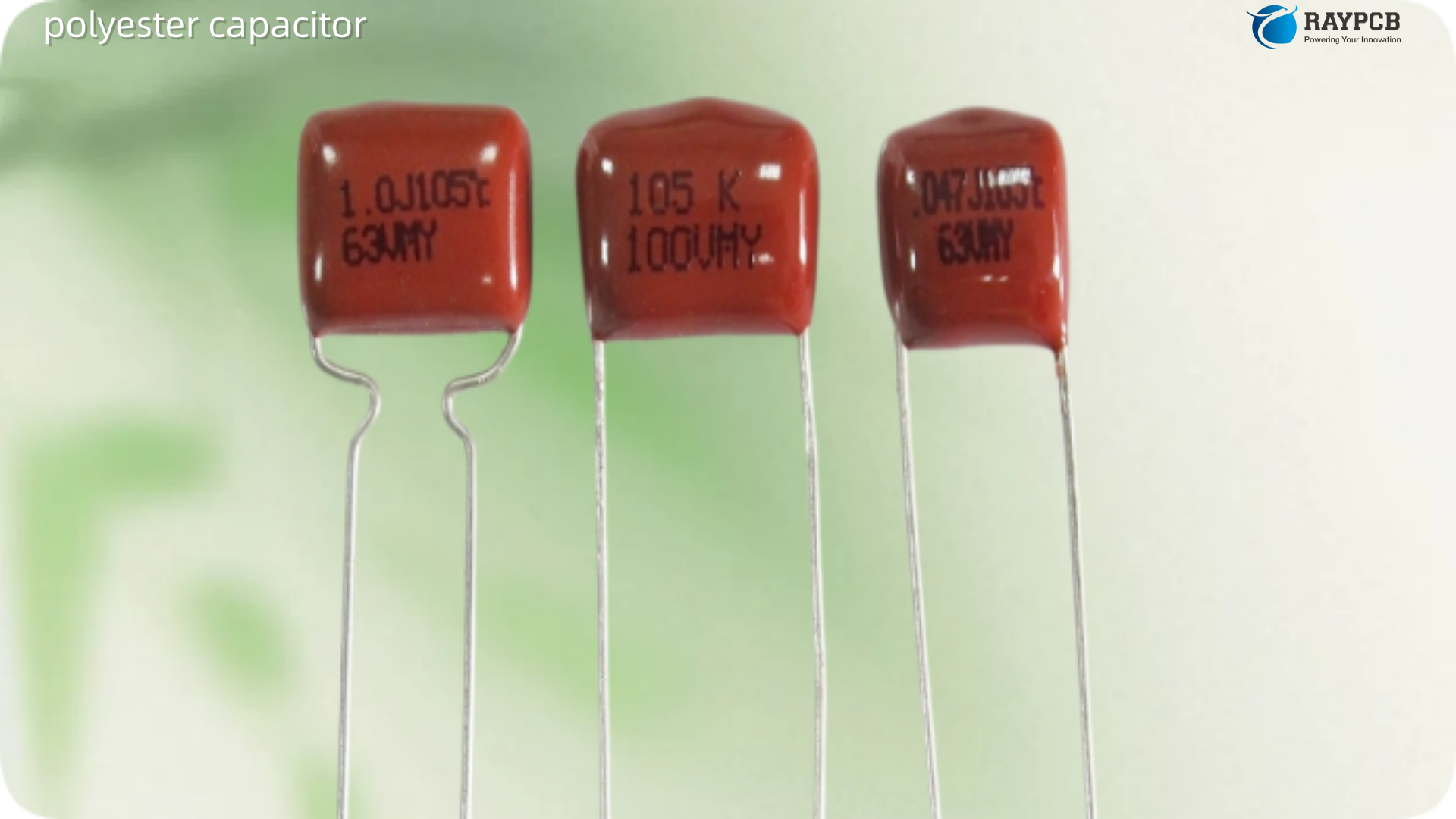
When servicing gear that may contain polystyrene capacitors, knowing what to look for matters. They typically appear as small cylindrical components, usually with a clear, pale yellow or pale blue outer body โ€” the rolled film construction is sometimes visible as a slightly transparent or translucent case. In European equipment, the Siemens/WIMA “KS” designation was common; in the U.S., manufacturers including Mallory, Cornell Dubilier, and Centralab produced variants. The capacitors are through-hole only, in either axial or radial lead configuration, and the axial style was far more common.

Values are typically in the range of 10 pF to 47 nF, marking them as the small-signal precision parts in a design rather than the bulk or bypass capacitors. If you find a small, unusually precise-looking leaded film capacitor in the feedback network of an op-amp, in a filter stage, or in the input path of a precision ADC, there is a reasonable chance it is polystyrene.

Useful Resources for Polystyrene Capacitors and Their Replacements

ResourceWhat It ProvidesLink
Electrocube White Paper: Polystyrene AlternativesDetailed discussion of supply collapse and modern substitute optionselectrocube.com
Electronics Notes: Polystyrene CapacitorsTechnical overview of properties and applicationselectronics-notes.com
RF Cafe: Capacitor Dielectric Comparison TableSide-by-side comparison of all film and ceramic dielectric typesrfcafe.com
Doeeet: PS and PPS Film CapacitorsDetailed engineering specifications for PS and PPS dielectricsdoeeet.com
WIMA Film CapacitorsOne of few remaining suppliers with NOS polystyrene stock; also produces polypropylene replacementswima.com
Vishay Film CapacitorsPolypropylene and PPS film capacitors as modern precision alternativesvishay.com/capacitors/film
DigiKey Film Capacitor SearchFilter by dielectric (polypropylene, PPS, PTFE) for sourcing replacement typesdigikey.com
KEMET Film Capacitor SeriesPHE and R series polypropylene; good reference specs for precision replacement selectionkemet.com

Frequently Asked Questions About Polystyrene Capacitors

1. Can I still buy polystyrene capacitors today?

You can find NOS (new old stock) polystyrene capacitors from specialist suppliers, vintage component stockists, and some audiophile component retailers. WIMA and a few other European manufacturers still have quantities of polystyrene film stocked from historical bulk orders. The supply is finite and depleting โ€” values in common precision ranges (100 pF to 4.7 nF) may still be found, but you cannot design a new product around the assumption of ongoing supply. For legacy repairs, check specialist suppliers like Michael Percy Audio, Hificollective, or Tedss.com for remaining stock.

2. What is the best replacement for a polystyrene capacitor in a vintage audio repair?

For audio signal path applications at values below 10 nF, polypropylene film capacitors (WIMA MKP or MKS2 series, Vishay MKP series, Panasonic ECQ series) are the closest direct replacement in terms of electrical performance. The DA and distortion characteristics are essentially identical to polystyrene. The temperature coefficient is slightly more negative (โˆ’150 to โˆ’250 ppm/ยฐC versus โˆ’125 ppm/ยฐC for polystyrene), but for audio applications operating in a narrow ambient temperature range, this difference is not audible or measurable in practice. For values below 1 nF where a surface-mount option is needed, a quality C0G ceramic from a reputable manufacturer (Murata, TDK, KEMET) is an excellent modern alternative.

3. Why can polystyrene capacitors not be made in SMD form?

Because polystyrene melts and permanently deforms at temperatures around 95ยฐC, well below the peak temperatures of both wave soldering and reflow soldering (typically 245โ€“260ยฐC peak for SAC305 solder). The dielectric would be destroyed during the assembly process. Additionally, attempts to create a metallized polystyrene film โ€” which would allow smaller physical sizes โ€” failed for the same reason: the metallization process damages the film thermally. The wound coil construction of the standard polystyrene film capacitor also does not translate easily to the flat chip format of SMD components.

4. What happens to a polystyrene capacitor if it gets too hot?

The damage is permanent and silent. If the capacitor body reaches temperatures above approximately 70โ€“75ยฐC during use or soldering, the polystyrene film physically deforms slightly, causing a permanent change in the effective plate area and separation. The capacitance shifts, and it does not recover when the component cools. This is unlike most other capacitor failures which are abrupt or detectable by inspection. A thermally damaged polystyrene capacitor may appear completely normal visually and may even continue to function, just with a shifted value that throws off precision circuits in ways that are difficult to trace. If you suspect heat damage, measure with a precision LCR meter.

5. Is a polypropylene capacitor electrically equivalent to polystyrene?

Very nearly, but not identically. The dielectric absorption and low-distortion behavior are essentially the same at approximately 0.02%. The dissipation factor of polypropylene is slightly higher at 0.02โ€“0.05% versus polystyrene’s < 0.01%, but both are far superior to polyester. The main practical difference is the temperature coefficient: polypropylene’s โˆ’150 to โˆ’250 ppm/ยฐC is more negative and slightly less linear than polystyrene’s, which matters in circuits designed to exploit polystyrene’s near-zero TC over a specific temperature range, particularly oscillator compensating networks. For most audio and general precision applications, polypropylene is the correct and recommended substitute. The higher maximum temperature of polypropylene (+105ยฐC) is also a genuine advantage โ€” you do not need to worry about accidental heat damage during assembly the way you do with polystyrene.

Summary

The polystyrene capacitor occupies a unique position in the history of electronics: a component that reached near-ideal electrical performance in its specific area of application, only to be killed by a supply chain problem rather than superseded by anything clearly superior. Its dielectric absorption of 0.02%, dissipation factor below 0.01%, near-zero voltage coefficient, and decades of proven stability made it the preferred choice for precision timing, audio signal paths, sample-and-hold circuits, and precision filters across a 40-year production run.

For new designs, it is no longer an option. Polypropylene film capacitors are the functional replacement for most analog precision applications, with C0G ceramics covering the small-value SMD territory. For servicing legacy equipment, treating polystyrene capacitors with appropriate care โ€” avoiding heat above 70ยฐC, verifying value with a precision meter, and knowing where to source remaining stock โ€” remains essential knowledge for any engineer working with precision analog hardware from the 1960s through the early 2000s.
Polypropylene Capacitor: Why Engineers Love It for Audio & RF

Polypropylene capacitors offer near-zero dielectric absorption, flat voltage coefficient, and ultra-low dissipation factor โ€” here’s why PCB engineers choose them for audio, RF, and power electronics, with full spec comparisons and application examples.

Ask any experienced PCB engineer which film capacitor they’d spec into a precision analog signal path or a high-frequency resonant circuit, and the answer is almost always the same: a polypropylene capacitor. Not because it’s the cheapest option โ€” it isn’t โ€” but because it solves problems that no other affordable capacitor type handles as cleanly. Low dielectric absorption, stable capacitance across temperature and voltage, and a dissipation factor so close to zero it barely registers. This guide breaks down exactly what makes polypropylene capacitors the go-to choice for audio and RF engineers, how to read the specs that actually matter, and when they’re genuinely worth the premium.

What Is a Polypropylene Capacitor?

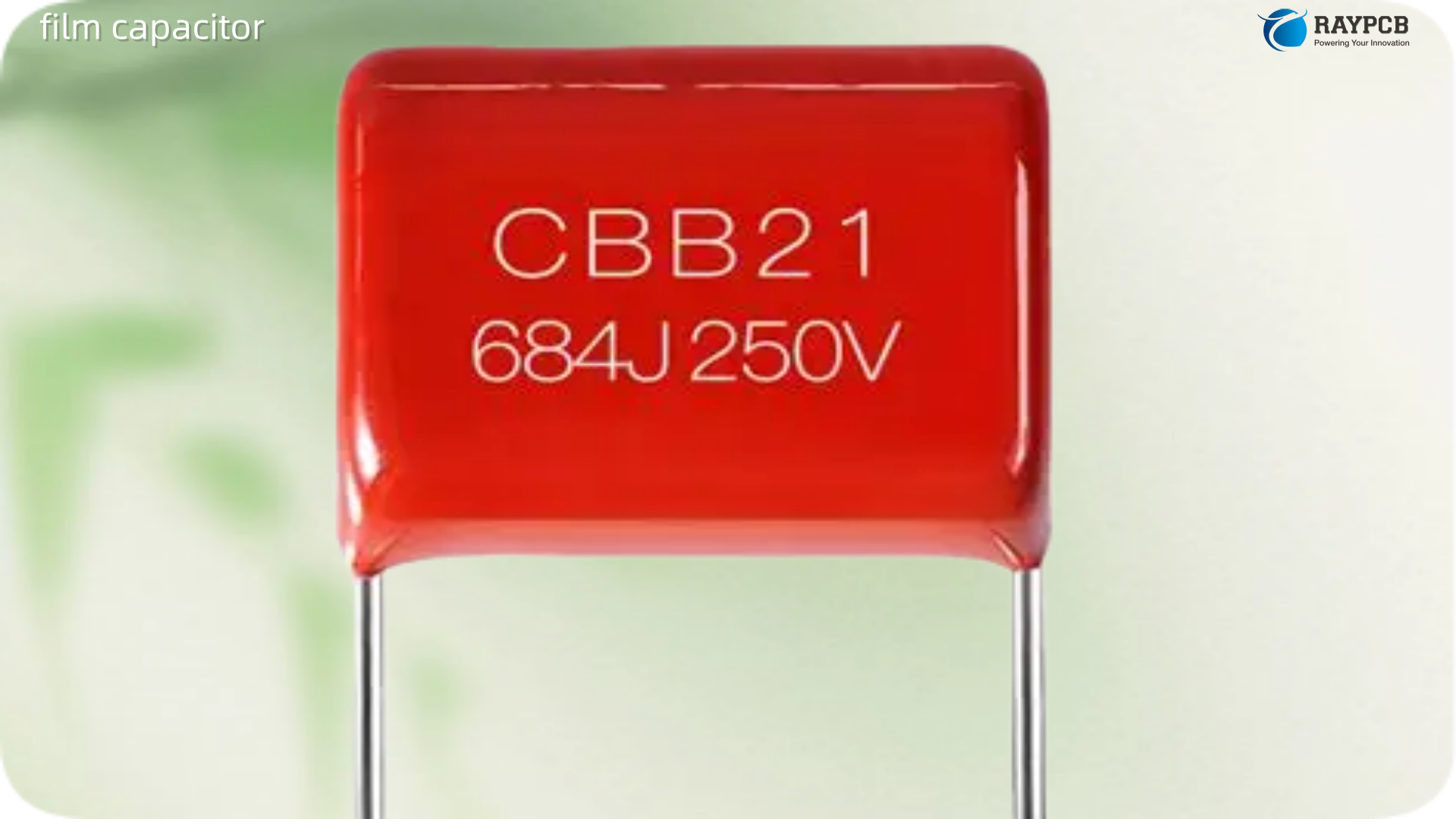
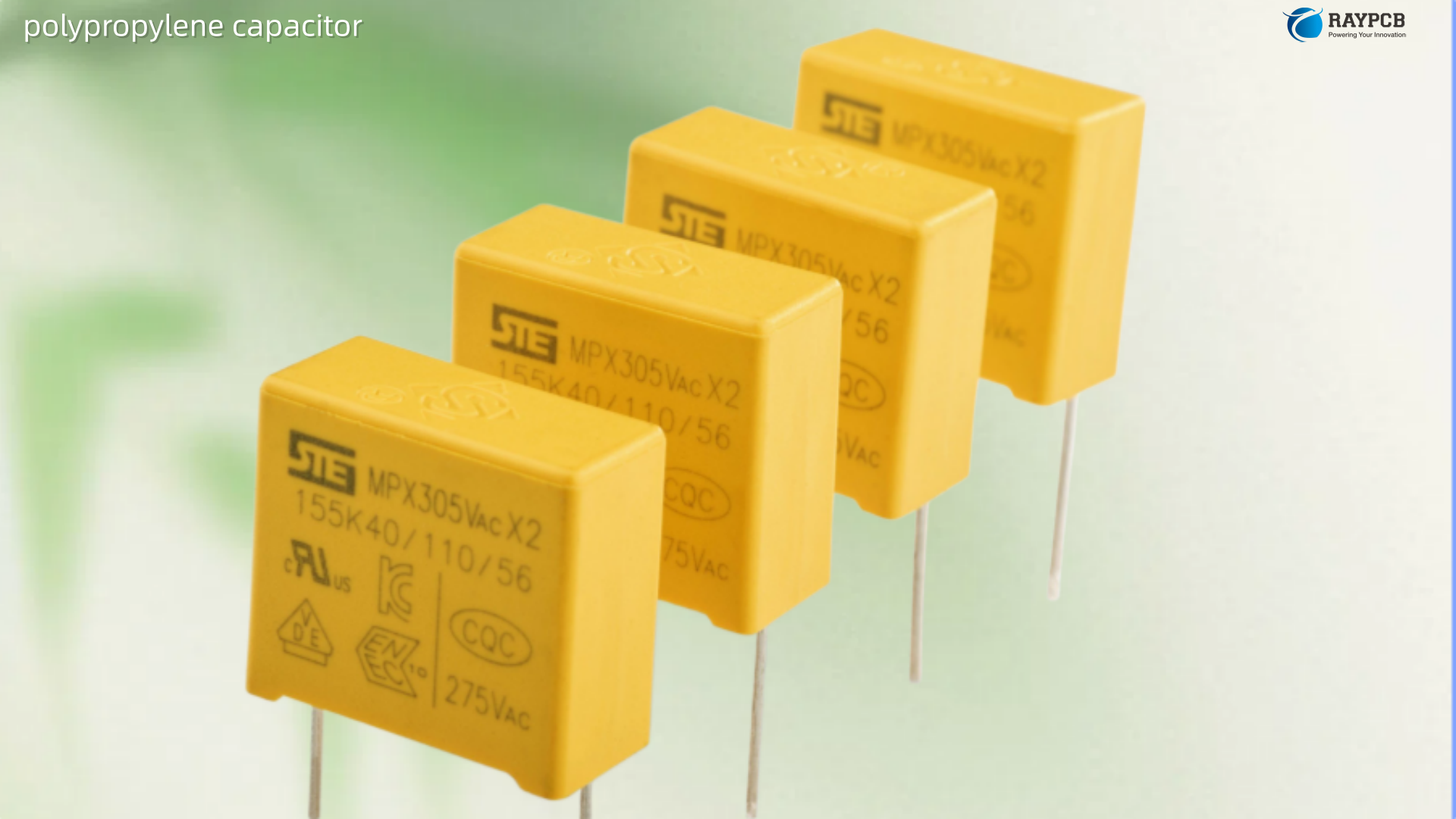
A polypropylene capacitor (commonly abbreviated MKP, from the German Metallisierter KunststoffPolypropylen) is a type of film capacitor that uses polypropylene polymer as its dielectric material. The thin polypropylene film โ€” typically 2 to 20 microns thick โ€” is either coated with a vacuum-deposited metal layer (metallized construction) or paired with a separate aluminum or copper foil electrode (foil construction).

The result is a non-polarized capacitor with genuinely exceptional electrical properties: negligible dielectric absorption, a very low dissipation factor, a near-zero voltage coefficient, and stable capacitance from -55ยฐC to +105ยฐC. For any application where the capacitor’s imperfections would show up in the final circuit performance, polypropylene is hard to beat.

Understanding how a capacitor behaves under real operating conditions โ€” not just at room temperature with no bias โ€” separates clean, robust designs from the ones that come back from the field.

How Polypropylene Capacitors Are Built

Construction method directly affects which specifications you get, so it’s worth understanding the two main approaches before reaching for the datasheet.

Metallized Polypropylene (MKP)

In metallized construction, the electrode is a thin layer of aluminum or zinc (typically 20โ€“50 nm thick) deposited directly onto the polypropylene film surface. Two metallized film strips are wound into a cylinder or stacked in layers, and the ends are connected by the Schoopage process (metal spraying).

The key advantage of metallized construction is self-healing: if a pinhole defect or transient voltage spike causes a local dielectric breakdown, the tiny current vaporizes the thin metal in that spot, clearing the fault and restoring insulation. The capacitor keeps working with a negligible loss of capacitance. This makes metallized MKP the default choice for power electronics, snubber circuits, and any application with voltage transients.

Foil Polypropylene (KP/CK)

Foil construction uses separate metal foil strips โ€” typically aluminum โ€” as electrodes, with polypropylene film acting purely as the dielectric separator. This produces lower ESR, higher peak current handling, and better performance at high frequencies compared to metallized types, because the foil electrode is thicker and more conductive.

The trade-off: no self-healing. A localized breakdown destroys the device. These capacitors are used in precision audio circuits, laboratory-grade test equipment, and RF applications where current handling and low loss matter more than transient survival.

FeatureMetallized (MKP)Foil (KP)
Self-healingYesNo
ESRSlightly higherLower
Peak currentModerateHigh
Size/costMore compact, lower costLarger, more expensive
Best forPower electronics, PFC, snubbersAudio, precision, RF

Key Electrical Properties of Polypropylene Capacitors

This is where polypropylene separates itself from every other common capacitor dielectric. The numbers below aren’t just spec-sheet claims โ€” they have real, measurable consequences in your circuit.

Dielectric Absorption (DA): The Number That Matters Most in Precision Designs

Dielectric absorption is the tendency of a capacitor’s dielectric material to retain some charge even after being discharged. It creates a “memory effect” โ€” after discharging, the capacitor self-charges slightly back toward its previous voltage. In an audio circuit, this manifests as transient smearing and harmonic distortion. In a sample-and-hold circuit, it degrades accuracy.

Polypropylene has a dielectric absorption of approximately 0.01โ€“0.05%. Compare that to polyester film (0.2โ€“0.5%), ceramic X7R (2โ€“4%), and electrolytic (10โ€“15%). For a sample-and-hold holding a precision voltage, or a DAC output filter where linearity determines audio quality, this difference is not subtle โ€” it’s the difference between a working design and one that requires significant compensation.

Dissipation Factor (tan ฮด): Why Polypropylene Runs Cool

The dissipation factor measures how much energy a capacitor wastes as heat when handling AC signals. For polypropylene, tan ฮด is typically 0.0002โ€“0.001 (0.02โ€“0.1%) at 1 kHz, among the lowest of any common capacitor dielectric.

In power applications โ€” resonant converters, PFC stages, motor drives โ€” low dissipation factor means the capacitor generates minimal heat under ripple current stress. In RF circuits, it means high Q factor and sharp filter responses. In audio, it means no measurable signal coloration from dielectric losses.

Voltage Coefficient: Near Zero

Class 2 ceramic capacitors (X5R, X7R) have a significant capacitance change with applied DC voltage โ€” a 10ยตF/16V X7R ceramic can lose 60โ€“80% of its capacitance at 12V DC. This is the voltage coefficient problem, and it ruins filter cutoff frequencies, timing circuit accuracy, and any design that assumes the capacitor value is stable under bias.

Polypropylene capacitors have a voltage coefficient that is effectively zero for practical purposes. The capacitance you measured on the bench with an LCR meter at 1V is the capacitance you get at rated voltage in the circuit. This is non-negotiable in precision filter design and any audio or RF circuit where frequency response flatness matters.

Temperature Stability

The capacitance temperature coefficient of polypropylene is approximately -200 to -250 ppm/ยฐC โ€” slightly negative and very consistent. Across the -55ยฐC to +105ยฐC operating range, capacitance shifts by roughly ยฑ1.5%. For comparison, X7R ceramic capacitors allow ยฑ15% across the temperature range, and actual drift is often worse near the ends.

For RF oscillators, clock circuits, and active filters with tight frequency specifications, this stability matters enormously. A polypropylene capacitor in a tank circuit or tuned filter holds its value predictably across temperature.

Full Specification Comparison

ParameterPolypropylene (PP)Polyester (PET)Ceramic X7RElectrolytic
Dielectric absorption0.01โ€“0.05%0.2โ€“0.5%2โ€“4%10โ€“15%
Dissipation factor (1kHz)0.02โ€“0.1%0.3โ€“1.5%1โ€“2.5%5โ€“20%
Voltage coefficient~0LowHigh (-60% at VR)Moderate
Temp coefficientโ€“200 ppm/ยฐCยฑ500 ppm/ยฐCยฑ15% (X7R)Poor
Max temperature+105ยฐC+125ยฐC+125ยฐC+85โ€“105ยฐC
Self-healing (metallized)YesYesNoNo
Polarity requiredNoNoNoYes
Typical ESRVery lowLowVery low (NP0)High

Where Polypropylene Capacitors Excel: Real Application Scenarios

Audio Crossover Networks

Speaker crossover networks separate frequency bands before sending them to the tweeter, midrange, and woofer drivers. The capacitors in these networks sit directly in the signal path โ€” any dielectric absorption, voltage coefficient, or dissipation factor shows up as audible coloration or phase distortion.

High-end audio designers use polypropylene capacitors in crossovers almost exclusively. Typical values range from 1ยตF to 100ยตF at voltage ratings from 100V to 400V. The self-healing property of metallized MKP types also protects against speaker impedance dips and amplifier transients.

Tube Amplifier Signal Coupling

In tube amplifiers, coupling capacitors block DC bias between stages while passing AC audio signals. The capacitor must be transparent โ€” it should not add coloration, roll off high frequencies, or store charge from previous musical passages. Polypropylene foil capacitors (and the legendary polystyrene types they largely replaced) are the standard choice in vintage-style and high-end tube amp designs.

Values from 0.01ยตF to 0.47ยตF are common in this application, often at high voltage ratings (400V to 630V) to handle the elevated plate voltages in tube circuits.

Snubber Circuits in Switching Power Supplies

Every time a MOSFET or IGBT switches off in a switching power supply or motor drive, the leakage inductance of the transformer or motor windings generates a voltage spike. A snubber circuit โ€” typically a resistor and capacitor in series across the switch โ€” absorbs this energy and limits the spike.

Snubber capacitors see repetitive high-voltage transients, high dV/dt stress, and moderate ripple current. Metallized polypropylene MKP capacitors handle all three gracefully. Their self-healing property provides a genuine safety margin in high-stress designs. Typical values are 1nF to 100nF at 630V to 2000V DC ratings.

RF Resonant Circuits and Filters

For RF designers, the quality factor Q = 1/(2ฯ€ ร— f ร— C ร— ESR) defines filter insertion loss and selectivity. Low ESR and low dissipation factor translate directly to high Q. Polypropylene foil capacitors achieve Q values in the hundreds to thousands at HF and low VHF frequencies, making them suitable for bandpass filters, impedance matching networks, and tank circuits in transmitters and receivers.

At frequencies above ~10 MHz, self-inductance of the capacitor body becomes significant, and smaller physical packages or specialized RF chip capacitors may be necessary. But for HF and low-VHF work (1โ€“30 MHz), polypropylene foil remains competitive with silver mica.

DC Link Capacitors in Inverters and VFDs

Variable frequency drives (VFDs) and solar inverters require DC link capacitors that handle high ripple current, survive temperature cycling, and maintain stable capacitance over years of operation. Large metallized polypropylene capacitors (from 10ยตF to several hundred ยตF) are used in these applications because they outlast electrolytic alternatives in high-temperature environments and exhibit self-healing behavior under voltage transient stress.

EMI Filtering (X2 Capacitors)

Polypropylene is the dominant dielectric used in X2-rated safety capacitors for line-to-line EMI filtering in mains equipment. X2-rated MKP capacitors are designed to fail open rather than short under fault conditions, and they maintain their performance specifications throughout the lifetime of the equipment.

Polypropylene Capacitor Voltage Ratings and Derating

Polypropylene capacitors are available from 63V DC to several kilovolts. For reliable long-term operation, apply the same derating rules as other film types:

Operating ConditionRecommended Derating
DC voltageOperate at โ‰ค 70% of rated DC voltage
AC voltage (peak)Verify against manufacturer’s AC rating curve
Temperature above 85ยฐCDerate voltage per manufacturer curve (typically -2%/ยฐC above 85ยฐC)
Ripple currentKeep temperature rise โ‰ค 10ยฐC above ambient

One common mistake is ignoring the AC voltage rating in circuits with significant AC components. In a resonant circuit or PFC stage, the peak AC voltage plus any DC offset must stay well within the component’s rating. The AC rating for film capacitors is typically 40โ€“60% of the DC rating because AC stress generates dielectric heating even at voltages below the DC breakdown level.

Polypropylene Capacitor Part Number Guide

ManufacturerSeriesTypeVoltage RangeNotes
VishayMKP1839Metallized PP, radial63โ€“400V DCGeneral purpose, compact
KEMETR75Metallized PP, radial100โ€“630V DCHigh reliability
PanasonicECWF(G)Metallized PP, SMD50โ€“310V DCAutomotive grade available
NichiconPPE seriesFoil PP, radial50โ€“630V DCAudio grade
MundorfM-Cap SupremeFoil PP250โ€“800V DCHigh-end audio
Cornell Dubilier940CMetallized PP, radial100โ€“2000V DCPower electronics
TDKB3267Metallized PP, SMD250โ€“305V ACX2 safety rated

Useful Resources for Polypropylene Capacitor Selection

These are actively maintained resources worth bookmarking for component selection and application engineering:

  • Vishay Film Capacitor Application Notesย โ€” www.vishay.com/capacitors/film/ย โ€” Parametric selector and comprehensive application notes for snubber and DC link design
  • KEMET Film Capacitor Design Guideย โ€” www.kemet.comย โ€” Downloadable PDF guides covering resonant circuit sizing, ripple current calculations
  • Cornell Dubilier Technical Papersย โ€” www.cde.comย โ€” Excellent white papers on DC link and snubber capacitor design
  • Panasonic Industrial Capacitorsย โ€” industry.panasonic.comย โ€” Full PP series datasheets including automotive AEC-Q200 grades
  • Digi-Key Parametric Searchย โ€” www.digikey.comย โ€” Filter by dielectric, voltage, capacitance, package, and stock
  • Mouser Electronicsย โ€” www.mouser.comย โ€” Cross-reference and alternate sourcing tool
  • IEC 60384-1ย โ€” General standard for fixed capacitors in electronic equipment
  • AudiophileStyle Forumย โ€” audiophilestyle.comย โ€” Practical community discussions on capacitor measurements in audio circuits
  • The Capacitor Guideย โ€” www.thecapacitorguide.comย โ€” Solid reference for dielectric comparison and application guidance

Frequently Asked Questions About Polypropylene Capacitors

Q1: Why do audiophiles prefer polypropylene capacitors over ceramic types?

The core reason is dielectric absorption. Ceramic X7R capacitors have a DA of 2โ€“4%, which means they hold a residual charge memory of previous signal content. In an audio coupling stage or feedback network, this creates subtle harmonic distortion and transient smearing that’s measurable on a spectrum analyzer and audible to trained listeners. Polypropylene’s DA of 0.01โ€“0.05% is 50 to 400 times lower. The secondary reason is voltage coefficient โ€” ceramic Class 2 capacitors lose a large percentage of their capacitance under DC bias, shifting the frequency response of filter networks away from design values. Polypropylene doesn’t do this.

Q2: Can I use a polypropylene capacitor to replace a polyester film capacitor?

In most cases, yes โ€” and the result will usually be electrically better. Polypropylene has lower loss, lower dielectric absorption, and better temperature stability. The practical constraints are size (polypropylene is physically larger for the same capacitance and voltage) and temperature rating (polypropylene maxes out at +105ยฐC, while polyester handles +125ยฐC). If your circuit runs hot or needs a very compact footprint, the swap may not be practical. For signal-path capacitors, snubbers, and resonant circuits operating within the temperature range, polypropylene is a clean upgrade.

Q3: What’s the maximum frequency where polypropylene capacitors work effectively?

For wound through-hole types, the self-resonant frequency (SRF) typically falls in the range of 1โ€“10 MHz depending on capacitance value and physical size. Below SRF, the component behaves as a capacitor; above SRF, parasitic inductance dominates and it behaves as an inductor. For RF work above 10 MHz, the physical size of standard through-hole polypropylene capacitors becomes limiting. Stacked-film SMD types and RF-optimized polypropylene chip capacitors can push SRF higher. For VHF and above, silver mica or NP0 ceramic capacitors are usually more practical.

Q4: Are polypropylene capacitors suitable for switching power supply output filtering?

Polypropylene capacitors are excellent for snubber networks and resonant circuits within switching power supplies, but they’re not the right choice for bulk output filtering. Their capacitance density is too low โ€” achieving 100ยตF to several thousand ยตF with polypropylene would require impractically large and expensive components. Electrolytic or polymer electrolytic capacitors handle bulk output filtering, with ceramic and film capacitors added in parallel for high-frequency decoupling. In a well-designed SMPS, you’ll often find polypropylene capacitors on the primary-side snubber and electrolytic or polymer types on the secondary-side output filter.

Q5: How do I identify if a capacitor is polypropylene versus polyester?

Check the marking code. Polypropylene capacitors are often marked MKP, KP, or PP. Polyester types are marked MKT, MKS, or PET. The series name in the manufacturer’s datasheet will specify the dielectric explicitly. If you’re working with an unmarked component, the body color can sometimes hint at type (blue or orange for PP in some manufacturers, yellow for PET) โ€” but this is not reliable across brands. When in doubt, the dissipation factor measurement at 1 kHz on an LCR meter with loss measurement capability will distinguish them: polypropylene will show tan ฮด below 0.001, polyester above 0.003.

Conclusion

The polypropylene capacitor earns its reputation not through marketing but through hard electrical numbers. Near-zero dielectric absorption, a voltage coefficient that doesn’t exist, sub-0.1% dissipation factor, and consistent capacitance across temperature โ€” these are properties that matter in real circuit performance, not just data sheet comparisons. Whether you’re designing audio amplifiers where signal fidelity is the whole point, RF circuits where Q factor determines selectivity, or power conversion stages where self-healing and low-loss ripple handling determine reliability, polypropylene capacitors deliver where other dielectrics fall short. They cost more and take up more space than polyester or ceramic alternatives โ€” but in the applications where they’re specified, they earn their place on the board every time.

All specifications are typical values. Always verify against current manufacturer datasheets for design-critical applications.

Polymer Capacitor: Low ESR, Long Life, High Performance

Learn why polymer capacitors outperform standard electrolytics in DC-DC converters. Covers ESR data, ripple current, lifetime, polymer vs MLCC, and top design resources.

If you’ve been designing power supply filter stages or DC-DC converter output circuits for any length of time, you’ve probably noticed that standard aluminum electrolytic capacitors keep causing headaches โ€” electrolyte drying out after a few years in hot environments, ESR rising with age until the ripple rejection drops below spec, or caps failing catastrophically when they overheat during a fault condition. The polymer capacitor exists specifically to solve these problems, and understanding when and how to use it is one of the more practically valuable skills in modern PCB power design.

This guide covers polymer capacitor technology from the ground up: how it differs from conventional electrolytics, the different polymer types and their trade-offs, where polymer capacitors genuinely outperform the alternatives, and how to select and apply them correctly in real designs. Written from a working engineer’s perspective, not a manufacturer’s marketing brief.

What Is a Polymer Capacitor?

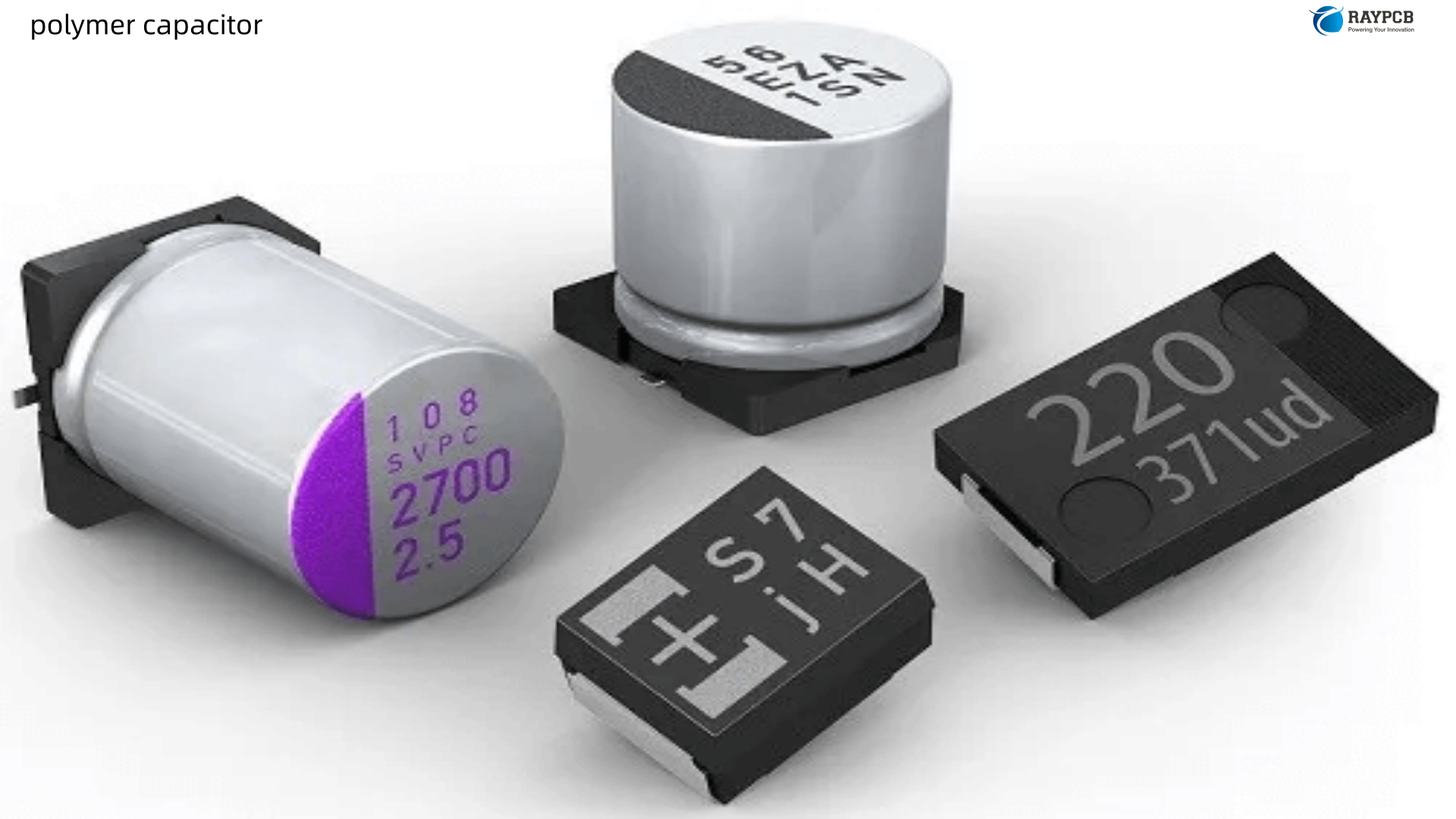
A polymer capacitor is an electrolytic capacitor that uses a solid conductive polymer as its electrolyte instead of the liquid or gel electrolyte used in conventional aluminum or tantalum electrolytic capacitors. The conductive polymer โ€” typically polypyrrole, polyaniline, poly(3,4-ethylenedioxythiophene) (PEDOT), or a polymer blend โ€” functions as the cathode contact to the oxide dielectric while simultaneously acting as the electrolyte that forms and maintains the aluminum oxide or tantalum pentoxide dielectric layer.

This substitution of liquid electrolyte with solid polymer is responsible for every significant electrical advantage that polymer capacitors have over conventional electrolytics: dramatically lower ESR, better high-frequency performance, longer operational life, improved ripple current handling, and a benign failure mode that doesn’t involve electrolyte venting or explosion.

The Two Main Polymer Capacitor Technologies

Polymer aluminum electrolytic capacitors (also called polymer aluminum, OS-CON types, or simply “poly aluminum”) use aluminum foil with an etched surface oxide as the anode, with conductive polymer as the cathode contact. Panasonic’s OS-CON series popularized this technology for power supply applications, and virtually every major passive component manufacturer now offers polymer aluminum capacitors.

Polymer tantalum capacitors use sintered tantalum powder as the anode, tantalum pentoxide as the dielectric, and conductive polymer as the cathode contact. These compete with standard MnOโ‚‚-cathode tantalum capacitors in the same applications but offer substantially lower ESR, improved surge handling, and a non-igniting failure mode โ€” a critical safety advantage over conventional solid tantalum capacitors.

Hybrid polymer aluminum capacitors combine a conductive polymer layer with a small amount of liquid electrolyte. This hybrid approach achieves higher capacitance values and better voltage ratings than pure polymer types while retaining most of the ESR and lifetime advantages.

How Polymer Capacitors Work: The Technology Behind the Performance

Why Conventional Liquid Electrolytics Have ESR Problems

In a conventional aluminum electrolytic capacitor, the liquid electrolyte serves two purposes: it provides ionic conductivity to the oxide layer (enabling the self-healing mechanism when the oxide is damaged), and it acts as the cathode contact. The problem is that liquid electrolytes have inherent ionic resistance. This resistance, combined with the resistance of the aluminum foil and oxide layer, produces the capacitor’s equivalent series resistance.

At room temperature, a typical liquid electrolytic has ESR in the range of 50โ€“500 mฮฉ depending on size and construction. At โˆ’40ยฐC, the liquid electrolyte becomes viscous and its ionic conductivity drops dramatically โ€” ESR can increase by a factor of 5โ€“20ร— at cold temperature, which is why conventional electrolytics perform poorly in cold environments and at high frequencies where the current ripple stress is most demanding.

How Solid Polymer Eliminates These Limitations

Conductive polymers like PEDOT have electronic (rather than ionic) conductivity โ€” they conduct electrons directly, like a metal, rather than relying on ion migration through a liquid. This gives them resistivity orders of magnitude lower than liquid electrolytes. A PEDOT-cathode capacitor achieves ESR values of 5โ€“20 mฮฉ for the same capacitance and voltage rating where a liquid electrolytic would measure 100โ€“300 mฮฉ.

The temperature dependence of electronic conductivity is also much flatter than ionic conductivity. Polymer capacitor ESR increases only modestly at low temperature โ€” typically 2โ€“3ร— from +25ยฐC to โˆ’40ยฐC versus 5โ€“20ร— for liquid electrolytics. This makes polymer capacitors far more suitable for cold-temperature environments without the over-engineering required for conventional types.

Because there’s no liquid to evaporate, polymer capacitors don’t suffer the dry-out failure mode that limits liquid electrolytic lifetime. The polymer can oxidize and degrade at high temperature, but the mechanism is slow and predictable, and the resulting failure mode (gradual capacitance loss) is far more benign than the sudden failure of a liquid electrolytic venting electrolyte into surrounding circuitry.

Polymer Capacitor Types and Their Key Characteristics

Polymer Aluminum (OS-CON Type)

Polymer aluminum capacitors cover the widest capacitance range and are available in both through-hole radial packages and SMD packages. They’re the primary choice for DC-DC converter output filtering, VRM (voltage regulator module) output bypass, and any application where bulk capacitance with low ESR is needed in the 10โ€“2,000 ยตF range.

The SMD polymer aluminum capacitors use a flat can construction that provides a very low profile โ€” useful in high-density designs where tall electrolytic cans would violate height constraints. Through-hole OS-CON types are available in values up to 10,000 ยตF for server and telecom power supply applications.

Polymer Tantalum (POSCAP, KEMET T520/T530 Types)

Polymer tantalum capacitors occupy the low-voltage, high-capacitance-density end of the polymer spectrum. They’re available in the same EIA case codes (A through E) as conventional solid tantalum capacitors, making them drop-in substitutes from a footprint perspective while offering dramatically lower ESR.

The most significant advantage of polymer tantalum over conventional MnOโ‚‚ tantalum is failure mode safety. Conventional solid tantalum capacitors with MnOโ‚‚ cathode are known to ignite and burn when they fail under surge conditions โ€” a serious reliability issue in telecom and defense equipment. Polymer tantalum capacitors, when they fail, fail as open or resistive circuits rather than igniting. This safety advantage has driven widespread adoption in military, automotive, and medical applications where conventional tantalum capacitor ignition is a qualification concern.

Hybrid Polymer Aluminum Capacitors

Hybrid polymer types add a small quantity of liquid electrolyte to the polymer cathode system. The polymer provides the low-ESR primary contact, while the liquid electrolyte enables self-healing of the oxide dielectric under voltage stress and surge conditions. This gives hybrid types better voltage ratings (up to 125V for some grades), better capacitance retention at high frequency, and improved surge robustness compared to pure polymer types.

The trade-off is a slight increase in ESR compared to pure polymer and the reintroduction of the electrolyte evaporation mechanism at extreme temperatures โ€” though the small quantity of liquid means the lifetime impact is much less severe than in conventional electrolytics.

Key Electrical Parameters: What the Datasheet Numbers Mean

ESR: The Number That Matters Most in Power Circuits

ESR (Equivalent Series Resistance) is the dominant parameter for power supply filter capacitors. The output voltage ripple of a DC-DC converter is approximately:

V_ripple โ‰ˆ I_ripple ร— ESR + I_ripple / (8 ร— f ร— C)

For high-frequency converters (500 kHz and above), the ESR term dominates the capacitive reactance term. Reducing ESR from 200 mฮฉ to 15 mฮฉ reduces ESR-dominated ripple by more than 13ร— โ€” a far greater improvement than simply adding more capacitance.

Capacitor TypeTypical ESR (100 ยตF, 16V)ESR at โˆ’40ยฐCESR at +85ยฐC
Standard Al electrolytic100โ€“500 mฮฉ500โ€“5,000 mฮฉ80โ€“300 mฮฉ
Polymer aluminum8โ€“30 mฮฉ20โ€“80 mฮฉ6โ€“25 mฮฉ
Hybrid polymer Al15โ€“50 mฮฉ30โ€“120 mฮฉ12โ€“40 mฮฉ
Polymer tantalum10โ€“50 mฮฉ25โ€“100 mฮฉ8โ€“40 mฮฉ
MLCC (X5R, 100 ยตF)<5 mฮฉ<8 mฮฉ<5 mฮฉ

Note that MLCC (multilayer ceramic) capacitors have even lower ESR than polymer types, which is why modern power supply designs often parallel small MLCC capacitors with larger polymer capacitors โ€” the MLCC handles the very high-frequency ripple while the polymer provides the bulk capacitance.

Ripple Current Rating

Because polymer capacitors have lower ESR, they generate less heat from ripple current for the same ripple current amplitude. This directly translates to higher rated ripple current capability:

Capacitor TypeRipple Current (100 ยตF, 16V, 100 kHz)Temp Rise
Standard Al electrolytic300โ€“800 mA10ยฐC at rated current
Polymer aluminum1,500โ€“4,000 mA5ยฐC at rated current
Polymer tantalum1,000โ€“3,000 mA5ยฐC at rated current
Hybrid polymer Al800โ€“2,000 mA7ยฐC at rated current

Higher ripple current rating directly enables more aggressive converter designs โ€” higher switching frequency, higher power density, and smaller filter inductors without exceeding capacitor thermal limits.

Frequency Response and Impedance Characteristics

The impedance of a capacitor versus frequency follows a curve: capacitive reactance dominates at low frequency (impedance decreases with frequency), ESR dominates at the self-resonant frequency (impedance reaches minimum = ESR), and package inductance (ESL) dominates at high frequency (impedance increases with frequency).

The self-resonant frequency where impedance reaches minimum depends on the capacitance and ESL. For a 100 ยตF polymer aluminum capacitor, SRF is typically 100โ€“500 kHz. Below SRF, the capacitor is effective as a filter element. A standard 100 ยตF liquid electrolytic of the same voltage rating has SRF at a lower frequency (10โ€“100 kHz), making the polymer type more effective for switching converter frequencies of 200 kHz and above.

Voltage Ratings and Derating

Polymer aluminum capacitors are available in voltage ratings from 2V to 100V, with 6.3V, 10V, 16V, 25V, and 35V being the most common for power supply applications. Hybrid types extend to 125V for higher-voltage applications.

Standard design practice calls for derating polymer capacitors to 80% of rated voltage for reliable operation. Unlike conventional tantalum capacitors where 50% derating is standard practice to prevent catastrophic failure, polymer types can tolerate closer to rated voltage โ€” but conservative design still recommends 80% derating for long-term reliability.

Where Polymer Capacitors Excel: Real PCB Applications

DC-DC Converter Output Filtering

This is the application that drove the development of polymer capacitors, and it remains their strongest use case. Modern synchronous buck converters switching at 500 kHz to 3 MHz need output capacitors with ESR in the 10โ€“50 mฮฉ range to achieve the ripple specifications required by processors and FPGAs. Before polymer capacitors became mainstream, this required large banks of through-hole electrolytics. A single polymer SMD capacitor can replace three to five conventional electrolytics with better electrical performance and better reliability.

Intel and AMD CPU socket design guidelines for VRMs (Voltage Regulator Modules) specifically recommend polymer capacitors for the output filter stage, and reference designs from TI, Analog Devices, and Renesas consistently specify polymer aluminum or hybrid types.

Automotive Electronics

The automotive environment is demanding for conventional electrolytic capacitors: โˆ’40ยฐC cold start, +125ยฐC under-hood operating temperature, vibration that fatigues through-hole leads, and 15-year lifetime requirements. Polymer capacitors address all of these challenges simultaneously. AEC-Q200-qualified polymer capacitors from Panasonic, TDK, Murata, and KEMET are standard in automotive power supply, ADAS electronics, and infotainment systems.

Server and Telecom Power Supplies

High-density server power supplies and telecom rectifiers operate continuously at high ripple current with extended MTBF requirements of 100,000 hours or more. Liquid electrolytic capacitors in these applications dry out well before the equipment’s design life. Polymer or hybrid polymer capacitors with 5,000โ€“10,000 hour rated lifetime at maximum operating temperature directly address this reliability gap.

Solid-State Drive and Memory Module Decoupling

SSDs, DDR memory modules, and high-performance computing boards use polymer tantalum and polymer aluminum capacitors extensively for power rail decoupling. The combination of high capacitance density, low ESR, and stable capacitance with temperature makes them well-suited for the demanding decoupling requirements of high-speed memory interfaces.

Industrial Motor Drives and Inverters

Variable frequency drives and motor inverters generate substantial ripple current at the DC bus capacitor. Polymer capacitors handle ripple current more efficiently than liquid electrolytics, reducing thermal stress and extending service life in the harsh industrial environment where motor drives operate.

Polymer Capacitor vs. Competing Technologies

Polymer vs. Standard Aluminum Electrolytic

CriterionPolymer AluminumStandard Al ElectrolyticWinner
ESR8โ€“30 mฮฉ100โ€“500 mฮฉPolymer
Ripple currentVery highModeratePolymer
Temperature rangeโˆ’55ยฐC to +105ยฐCโˆ’40ยฐC to +85/105ยฐCPolymer
Lifetime at 85ยฐC5,000โ€“10,000 hr2,000โ€“5,000 hrPolymer
Maximum voltage100โ€“125V500V+Electrolytic
Maximum capacitance10,000 ยตF1,000,000 ยตFElectrolytic
CostHigherLowerElectrolytic
Failure modeGradual, benignCan vent/explodePolymer

Polymer vs. MLCC for Power Decoupling

MLCCs offer the lowest ESR of any capacitor technology and excellent high-frequency performance, but they have significant drawbacks for bulk power supply capacitance: capacitance drops dramatically with DC bias voltage (an X5R 100 ยตF 6.3V MLCC may only have 30โ€“40 ยตF effective capacitance at 5V), they’re susceptible to cracking from board flex, and they exhibit piezoelectric noise (audible coil whine from the capacitor itself). Polymer capacitors are stable with DC bias and voltage, making them a better choice for bulk capacitance in the 10โ€“1,000 ยตF range while MLCCs handle the high-frequency decoupling in parallel.

Polymer vs. Conventional Solid Tantalum

CriterionPolymer TantalumMnOโ‚‚ Solid TantalumWinner
ESR10โ€“50 mฮฉ100โ€“500 mฮฉPolymer
Surge capabilityGoodPoor (may ignite)Polymer
Failure modeOpen/resistiveCan ignitePolymer
Voltage ratingUp to 35V typicalUp to 50VTantalum MnOโ‚‚
CostHigherLowerMnOโ‚‚
Drop-in replacementYes (same footprint)ReferencePolymer

For any new design targeting defense, medical, or automotive markets where solid tantalum ignition is a qualification risk, polymer tantalum is the correct replacement technology.

PCB Design and Layout Best Practices for Polymer Capacitors

Placement for Power Supply Filter Stages

Place output filter polymer capacitors as close as possible to the switching converter’s output switch node and load connection. The loop formed by the capacitor, inductor, and switching device should be minimized to reduce parasitic inductance that degrades high-frequency filtering. Use multiple vias in parallel for the capacitor ground connection to minimize via inductance โ€” for a 100 ยตF polymer aluminum SMD capacitor, use at least four vias to ground.

Derating and Operating Point Selection

Always calculate the actual DC bias operating point of the capacitor. Polymer aluminum capacitors show less capacitance variation with DC bias than ceramics, but they’re not immune. Verify the capacitance value in the datasheet is specified at the actual operating voltage. For a 16V-rated capacitor operating at 12V, you have reasonable derating margin, but always check the capacitance-versus-voltage curve for the specific part.

Thermal Considerations

Even though polymer capacitors are more ripple-current tolerant than liquid electrolytics, they still generate heat proportional to Iยฒร—ESR. In high-current applications, calculate the power dissipation at maximum ripple current and verify the capacitor body temperature remains within rated limits. Leave adequate clearance around polymer capacitor packages for air flow in natural convection cooling environments.

Useful Resources for Polymer Capacitor Design

These are worth bookmarking and using actively during component selection and circuit design:

  • Panasonic OS-CON Polymer Aluminum Technical Guideย โ€” industrial.panasonic.com/ww/products/capacitors/polymer-aluminumย โ€” application notes, derating curves, and lifetime calculators for the OS-CON series
  • KEMET Polymer Tantalum T520/T530 Series Design Guideย โ€” kemet.com/en/us/capacitors/tantalum/polymerย โ€” includes surge current test data and comparative failure mode analysis vs. MnOโ‚‚ types
  • TDK Polymer Capacitor Parametric Selectorย โ€” product.tdk.com/en/capacitor/polymerย โ€” online selector with ESR vs. frequency data and ripple current calculator
  • Murata SimSurfing Capacitor Simulation Toolย โ€” product.murata.com/simsurfingย โ€” simulate impedance vs. frequency for specific polymer capacitor part numbers
  • Vishay Polymer Electrolytic Application Notesย โ€” vishay.com/capacitors/polymerย โ€” covers hybrid polymer aluminum types for high-voltage applications
  • Nichicon Polymer Aluminum Catalogย โ€” nichicon.co.jp/english/products/polymerย โ€” detailed electrical data for SMD and through-hole polymer aluminum series
  • Digi-Key Polymer Capacitor Parametric Searchย โ€” digikey.com/en/products/filter/aluminum-polymer-capacitorsย โ€” real-time inventory with filtering by ESR, capacitance, voltage, and package
  • Texas Instruments Power Supply Design Seminar (SEM2100)ย โ€” ti.com/power-design-seminarย โ€” includes practical guidance on output capacitor selection for DC-DC converters featuring polymer types
  • AEC-Q200 Qualification Standard (JEDEC)ย โ€” jedec.orgย โ€” the automotive component qualification standard applicable to polymer capacitors in vehicle electronics

Frequently Asked Questions About Polymer Capacitors

Q1: Can I directly replace a standard aluminum electrolytic capacitor with a polymer capacitor of the same capacitance and voltage rating?

In most cases yes, and the circuit will perform better. The lower ESR of the polymer replacement will reduce output voltage ripple in switching converters, improve load transient response, and extend service life. The only scenario where direct substitution might cause issues is in older linear regulator circuits designed with stability margin that assumed a specific minimum ESR in the output capacitor โ€” some linear regulators require a minimum ESR to maintain phase margin, and too-low ESR from a polymer capacitor could cause oscillation. Check the linear regulator’s datasheet for ESR requirements before substituting.

Q2: Why are polymer capacitors rated for lower maximum voltages than liquid electrolytics?

The oxide dielectric formation and maintenance process in aluminum electrolytic capacitors depends on the presence of liquid electrolyte to supply ions for re-forming the oxide when it’s damaged โ€” this self-healing mechanism is what allows liquid electrolytics to be manufactured reliably at voltages up to 500V and beyond. Conductive polymer doesn’t provide ionic self-healing in the same way, which limits the maximum oxide thickness and therefore the maximum voltage rating for practical polymer aluminum capacitors to around 100โ€“125V. Hybrid polymer types extend this somewhat by including a small liquid electrolyte component specifically to enable self-healing at higher voltages.

Q3: Do polymer capacitors really last longer than liquid electrolytics, and how much longer?

The lifetime advantage is real and significant. Standard aluminum electrolytic capacitors are typically rated 2,000โ€“5,000 hours at their maximum operating temperature (usually 85ยฐC or 105ยฐC). Polymer aluminum capacitors are commonly rated 5,000โ€“10,000 hours at 105ยฐC, with some grades achieving 15,000 hours. In practice, the lifetime advantage is even greater than the ratings suggest, because polymer capacitors don’t have the electrolyte evaporation mechanism that causes conventional electrolytics to degrade โ€” they age through a slow polymer oxidation process that’s both slower and more predictable. In 40ยฐC ambient applications running at 70ยฐC operating temperature, a polymer capacitor may realistically last 20โ€“30 years versus 10โ€“15 years for a conventional electrolytic.

Q4: What’s the difference between polymer tantalum (POSCAP, TOKIN) and polymer aluminum capacitors, and when should I choose one over the other?

The primary choice criterion is capacitance density versus voltage rating and package constraints. Polymer tantalum capacitors have higher volumetric capacitance density at low voltages (2.5โ€“10V range), making them better for CPU and FPGA core voltage decoupling where you need maximum capacitance in minimum board area. They’re available in EIA standard tantalum package footprints (A through E), which provides layout flexibility. Polymer aluminum capacitors cover a wider voltage range (up to 100V) and larger capacitance values, making them more versatile for general power supply filtering. If you’re replacing MnOโ‚‚ tantalum capacitors already in a design, polymer tantalum is the natural drop-in replacement. For new designs above 25V, polymer aluminum is the practical choice.

Q5: Are there any failure modes specific to polymer capacitors that I should design for?

Polymer capacitors’ primary failure mechanism is gradual polymer oxidation, which causes capacitance to decrease and ESR to increase over time. Unlike liquid electrolytic failure (which can be sudden and catastrophic โ€” venting, electrolyte spraying, occasionally fire), polymer capacitor degradation is gradual and detectable. The practical design implication is that you should specify end-of-life capacitance and ESR values in your circuit design margin analysis, not just initial values. Design with at least 20% capacitance margin and verify the circuit still meets ripple specifications with ESR doubled from the initial value. Polymer capacitors are also sensitive to reverse voltage โ€” even brief reverse polarization above approximately 1V can damage the polymer layer, so take care with polarity during board assembly and testing.

Polyester (Mylar) Capacitor: Uses, Specs & When to Choose It

Complete guide to polyester capacitors (Mylar/PET): key specs, temperature coefficient limits, uses in coupling and timing, and when to choose polypropylene instead.

There is a capacitor type that sits quietly on tens of millions of boards, rarely causes trouble, never gets discussed in design reviews, and costs so little that engineers barely notice it on the BOM. That is the polyester capacitor โ€” also called a Mylar capacitor, PET capacitor, or MKT capacitor depending on who is writing the datasheet. It is not glamorous. It does not have the precision of a C0G ceramic or the volumetric density of a tantalum. But for a wide range of general-purpose circuit functions, the polyester capacitor is exactly the right tool: inexpensive, robust, non-polarized, tolerant of voltage spikes, and stable enough for most applications that do not need laboratory-grade accuracy.

If you have been specifying X7R ceramics or tantalum electrolytics for everything by habit, this guide will help you see where the polyester capacitor actually belongs โ€” and where its real limitations start.

What Is a Polyester Capacitor?

A polyester capacitor is a type of film capacitor that uses polyethylene terephthalate (PET) as its dielectric material. PET is better known by its trade names โ€” DuPont’s Mylar and Hoechst’s Hostaphan are the most widely cited โ€” which is why these parts are so often called Mylar capacitors in the field. The terms are used interchangeably, and in European documentation you will also see the abbreviations KT (film/foil construction) and MKT (metallized film construction).

The dielectric constant (relative permittivity) of polyester is approximately 3.2, which is higher than polypropylene (2.2) but lower than ferroelectric ceramics. That relatively high permittivity โ€” combined with the ability to manufacture PET film down to 0.7 ยตm thick โ€” is what allows polyester capacitors to achieve compact physical sizes for a given capacitance value. This is why polyester has captured roughly a 40% share of the global film capacitor market, second only to polypropylene.

Film/Foil vs. Metallized Construction

Polyester capacitors come in two internal construction variants, and understanding the difference matters for some applications.

Film/foil (KT) types use separate aluminum foil electrodes wound with the PET film. These have slightly lower ESR and can handle higher instantaneous current surges, making them preferred for pulse applications.

Metallized film (MKT) types deposit a thin aluminum or zinc electrode directly onto the PET film. The key benefit is self-healing: when a local breakdown occurs in the dielectric, the energy of the arc vaporizes the thin metallization around the fault, isolating it without destroying the part. Metallized types are more compact for a given capacitance, lower cost, and the most common type found in general electronics.

Key Electrical Specifications of Polyester Capacitors

Understanding the numbers on a datasheet helps you pick the right part and avoid misapplication.

ParameterTypical Value / Range
Dielectric MaterialPolyethylene Terephthalate (PET / Mylar)
Capacitance Range1 nF to 15 ยตF
Voltage Rating (DC)50 V to 1,500 V (common range)
Toleranceยฑ5%, ยฑ10%, ยฑ20%
Operating Temperature Rangeโˆ’55ยฐC to +125ยฐC
Temperature CoefficientNon-linear; up to +5% to +6% change (25ยฐC to 85ยฐC)
Dielectric Absorption0.2% to 0.5%
Dissipation Factor (tan ฮด)~0.5% to 1% at 1 kHz
Insulation Resistance>10,000 Mฮฉ (typ.)
PolarityNon-polarized
PackageLeaded only (through-hole); not available in SMD for standard PET
Self-HealingYes (metallized types)

Temperature Coefficient: The Critical Limitation

The non-linear temperature coefficient is the specification PCB engineers most often underestimate. Between 25ยฐC and 85ยฐC, the capacitance of a polyester capacitor increases with rising temperature โ€” up to +5% or +6% total change. At low temperatures approaching โˆ’40ยฐC to โˆ’55ยฐC, it dips back down. This non-linear, somewhat unpredictable behavior is acceptable for general-purpose blocking and bypass functions, but it disqualifies the polyester capacitor from precision timing, precision filtering, and frequency-determining circuits where the value needs to stay tight across temperature.

If your application needs stable capacitance over temperature, polypropylene (PP) is the right film capacitor choice, with a much more stable โˆ’2.5% linear temperature coefficient over its operating range. The polyester type trades that stability for smaller size and lower cost.

Dielectric Absorption: Why It Matters in Precision Circuits

Dielectric absorption โ€” sometimes called “soakage” or voltage memory โ€” is a phenomenon where the dielectric retains a partial charge after the capacitor is fully discharged. In polyester capacitors, this is typically 0.2% to 0.5%, compared to 0.02% for polypropylene and near zero for C0G ceramics. In most circuits this is irrelevant. But in sample-and-hold circuits, charge redistribution networks, precision integrators, and DAC/ADC front ends, dielectric absorption introduces a residual voltage error that can corrupt measurements. For those applications, reach for C0G ceramic or polypropylene film instead.

Polyester Capacitor vs. Other Film Types: Side-by-Side Comparison

PropertyPolyester (PET/Mylar)Polypropylene (PP)Polystyrene (PS)
Dielectric Constant (ฮตr)3.22.22.5
Capacitance per VolumeHighLowerLower
Temperature CoefficientNon-linear, up to +6%Linear, ยฑ2.5%Negative, very low
Dielectric Absorption0.2โ€“0.5%~0.02%~0.05%
Max Operating Temp+125ยฐC+105ยฐC+85ยฐC
SMD AvailabilityLimited (PEN preferred for SMD)NoNo
CostLowMediumHigh / hard to source
Best ForGeneral purpose, coupling, blockingPrecision, audio, RF snubbersPrecision (now largely obsolete)
Available Max VoltageUp to 1,500 VUp to 3,000 V+Low-voltage

The conclusion from this table is clear: polyester wins on cost, size, and temperature ceiling. Polypropylene wins on precision, low loss, and dielectric absorption. For a seasoned engineer, this decision usually takes about five seconds once you know what the capacitor is doing in the circuit.

What Polyester Capacitors Are Good For

General-Purpose Decoupling and Bypass

For decoupling on circuits where exact capacitance is not critical and the operating frequency is below the self-resonant point of the part (typically below 1 MHz for common leaded polyester values), polyester capacitors offer a low-cost, robust solution. Unlike aluminum electrolytic capacitors, they have no polarity concern, no aging mechanism, and no electrolyte to evaporate. For bypass duties in analog circuits running at audio frequencies, a polyester capacitor does the job reliably for the life of the product.

For understanding how bypass capacitor placement on a PCB affects decoupling performance, the PCB capacitor design guide at RayPCB provides practical layout guidance that applies equally to film capacitor placement.

Signal Coupling and DC Blocking

High insulation resistance โ€” often exceeding 10,000 Mฮฉ โ€” makes polyester capacitors well suited for DC blocking and signal coupling. In audio preamplifiers, tone control stages, and interstage coupling in analog circuits operating below 100 kHz, a polyester capacitor passes the signal cleanly while blocking any DC offset. The self-healing property of metallized types provides additional robustness if the circuit is subjected to transient voltages beyond normal operating conditions.

Semi-Critical Timing Circuits

Where timing accuracy requirements are moderate โ€” say, ยฑ5% to ยฑ10% is acceptable โ€” polyester capacitors work well in RC timing networks. Oscillators and monostable circuits in non-precision instruments, consumer timers, and basic control circuits all fall into this category. The key word is “moderate.” If your timing window needs to hold tighter than ยฑ2% across the full operating temperature range, move to polypropylene or C0G ceramic.

Audio Circuits: Acceptable for Many Roles, Not All

Polyester capacitors are widely used in non-critical audio coupling positions. For power supply bypassing, interstage coupling in budget gear, and tone control networks, they are entirely adequate and cost-effective. Their dielectric absorption of 0.2โ€“0.5% introduces a small but measurable harmonic distortion component, particularly at lower frequencies. In high-end audio designs โ€” where engineers argue seriously about dielectric materials โ€” polyester is the type most often cited as introducing a slightly gritty or harsh character compared to polypropylene or polystyrene. That comparison matters mainly in the signal path of quality audio equipment. In power supply filtering and non-signal-path roles, the audio distinction is irrelevant.

Noise Suppression and EMI Filtering

Metallized polyester film capacitors are used in across-the-line (X-capacitor) applications and in line-to-ground (Y-capacitor) applications in AC power entry EMI filters. For X-capacitor positions โ€” connected directly across AC line voltage โ€” safety-rated types with appropriate class certification (X1, X2) are specifically designed for this role. The self-healing property of metallized film is essential here, as the capacitor may experience transient overvoltage events from the AC line. Do not use non-safety-rated polyester capacitors in X or Y positions; use parts explicitly safety-certified for mains voltage application.

Replacing Tantalum in Some Low-Voltage Roles

For simple higher-frequency filter circuits, or in voltage regulator or voltage doubler circuits, low-cost metallized polyester film capacitors can provide long-term stability and replace more expensive tantalum electrolytic capacitors โ€” particularly where the capacitance values needed fall within the polyester range (up to ~1โ€“4.7 ยตF practically) and there is no polarity concern.

Where Polyester Capacitors Do Not Belong

Being explicit about limitations prevents misapplication.

High-frequency circuits above 1 MHz: The wound construction of a leaded polyester capacitor introduces significant series inductance. Above a few hundred kHz, the impedance behavior starts to depart from ideal. For RF bypass, high-frequency decoupling, or filtering at switching frequencies above 500 kHz, SMD ceramic capacitors are the correct choice.

Precision timing and frequency-determining circuits: The non-linear temperature coefficient up to +6% rules polyester out. Use C0G ceramic or polypropylene film.

Precision sample-and-hold circuits and integrators: Dielectric absorption of 0.2โ€“0.5% introduces charge memory errors. Use polypropylene or C0G.

Direct AC mains connection (without safety rating): Standard polyester capacitors are not rated for mains-connected applications. Use safety-certified X/Y class types.

Tight-tolerance applications: Polyester is available in ยฑ5% at best for most catalog parts. Polypropylene reaches ยฑ1% and better.

How to Identify a Polyester Capacitor on a Board or in Stock

Recognizing polyester capacitors by appearance prevents substitution errors during repair or assembly verification.

FeatureTypical Appearance
Body shapeRectangular or oval block, sometimes disc-shaped for low values
Body colorYellow, orange, green, or blue (varies by manufacturer)
Lead styleRadial (both leads from same end) or axial (one lead each end)
MarkingsCapacitance in nF or ยตF, voltage rating, tolerance code
Standard codes“MKT” or “KT” in series name; “PET” or “polyester” on label

Common manufacturer color conventions: WIMA polyester capacitors are typically yellow; Epcos/TDK and Panasonic types appear in various colors. Polypropylene types from WIMA are their iconic red. Be careful not to assume color alone indicates dielectric type across brands.

Reading Polyester Capacitor Value Markings

Leaded polyester capacitors use a three-digit code similar to resistors, where the value is in picofarads:

MarkingDecoded Value
10410 ร— 10โด pF = 100,000 pF = 100 nF = 0.1 ยตF
47347 ร— 10ยณ pF = 47,000 pF = 47 nF
22222 ร— 10ยฒ pF = 2,200 pF = 2.2 nF
10510 ร— 10โต pF = 1,000,000 pF = 1 ยตF

The tolerance code follows (J = ยฑ5%, K = ยฑ10%, M = ยฑ20%), followed by the voltage rating.

Useful Resources for Polyester Capacitor Selection

ResourceWhat It OffersLink
WIMA Product CatalogTechnical data, tolerances, and application notes for MKS/MKT serieswima.com
Vishay Film Capacitor SelectorParametric search for Vishay polyester and film capacitor seriesvishay.com
Panasonic ECQ-E / ECQ-B SeriesWidely stocked polyester and polypropylene film capacitorsindustry.panasonic.com
KEMET Film CapacitorsR82, R60 series polyester and polypropylene, with simulation toolskemet.com
DigiKey Parametric SearchFilter by dielectric (PET/polyester), voltage, capacitance, lead styledigikey.com
Mouser ElectronicsWide inventory with datasheet access, filter by MKT/KT/film typemouser.com
Passive Components EUDeep technical articles on film capacitor dielectrics and constructionpassive-components.eu

Frequently Asked Questions About Polyester Capacitors

1. Is a Mylar capacitor the same as a polyester capacitor?

Yes, completely. Mylar is the trade name that DuPont registered for its biaxially-oriented polyethylene terephthalate (BoPET) film. When a manufacturer calls a capacitor a Mylar capacitor, the dielectric is PET โ€” the same material used in polyester capacitors. The two names describe the same component, and they appear interchangeably in datasheets, BOMs, and component databases. You will also see “PET capacitor” and “MKT capacitor” (in European nomenclature) referring to the same part.

2. Can I use a polyester capacitor in place of a ceramic capacitor?

Often, but not always โ€” it depends heavily on what the capacitor is doing. For DC blocking, general coupling, and low-frequency bypass, a non-polarized polyester capacitor is a workable substitute for a ceramic in the same value and voltage range. The important caveats are physical size (leaded polyester capacitors are larger than equivalent SMD ceramics), frequency performance (ceramic outperforms at high frequencies), and temperature stability (X7R ceramic and polyester are broadly comparable, but C0G ceramic is significantly more stable than polyester). Never substitute polyester for a ceramic in a surface-mount footprint โ€” polyester capacitors are not available in standard SMD packages.

3. Why are polyester capacitors not available in SMD packages?

Standard PET film has a maximum rated temperature of 125ยฐC, but the reflow soldering process for SMD components typically peaks at 260ยฐC โ€” well above what PET film can survive without dimensional distortion that degrades the dielectric. Polyphenylene naphthalate (PEN) film has better high-temperature stability and is used for SMD film capacitors. Standard polyester capacitors are made for through-hole assembly only.

4. When should I choose polypropylene over polyester film?

Choose polypropylene when any of these conditions apply: your circuit requires stable capacitance over the operating temperature range (PP changes about โˆ’3% from 25ยฐC to 100ยฐC versus +6% for PET); you need low dielectric absorption for precision sample-and-hold, integrator, or DAC applications; you are designing an audio signal path where distortion introduced by dielectric absorption is audible; or you need high-voltage ratings above 1 kV. The tradeoff is that polypropylene capacitors are physically larger for the same capacitance and cost more. For general-purpose coupling and bypass where these factors do not matter, polyester remains the more practical choice.

5. Do polyester capacitors have a polarity?

No. Polyester capacitors are non-polarized, just like ceramic capacitors. They can be installed in either orientation without any effect on performance or longevity. This is a significant practical advantage over aluminum electrolytic or tantalum capacitors, which require correct polarity and will fail if reversed. In any circuit position where an AC signal or alternating voltage is present โ€” coupling capacitors, crossover networks, tone controls โ€” the non-polarized nature of the polyester capacitor is a straightforward advantage.

Summary: Where the Polyester Capacitor Fits

The polyester capacitor earns its enormous market share by being genuinely excellent at a specific, well-defined set of tasks: general-purpose DC blocking, signal coupling at audio and sub-RF frequencies, semi-critical timing in non-precision circuits, noise suppression in AC power entry filters, and low-frequency bypassing in analog circuits. It does these jobs reliably, inexpensively, without polarity concerns, without aging, and without the failure modes associated with electrolytic types.

It is not a precision component. Its non-linear temperature coefficient and comparatively high dielectric absorption mean it does not belong in frequency-determining networks, precision integrators, or the signal path of high-end audio equipment. In those positions, polypropylene film or C0G ceramic is the engineering-correct choice.

Use the polyester capacitor deliberately โ€” knowing exactly what function it serves and what performance margins your circuit tolerates โ€” and it will likely be one of the most trouble-free parts on your board.

Niobium Oxide Capacitor: The Safer Alternative to Tantalum

Discover why the niobium capacitor is becoming the go-to safer alternative to tantalum on modern PCBs โ€” covering construction, self-arresting failure modes, derating rules, ESR, supply chain benefits, and real-world application guidance for PCB engineers.

If you’ve ever had a tantalum capacitor go up in smoke on a board you were debugging โ€” or worse, in a product already in the field โ€” you know that the “failure by ignition” mode is not just a datasheet footnote. It’s a very real, very expensive problem. The niobium capacitor, and more specifically the niobium oxide (NbO) variant, exists largely to answer that problem. It offers a performance profile similar enough to tantalum to be a drop-in replacement in many low-voltage designs, but with a failure behavior that’s fundamentally less catastrophic.

This article covers everything a PCB engineer needs to know about niobium oxide capacitors โ€” the physics behind why they’re safer, where they work well, where they fall short, and how to navigate sourcing in a market where this technology has both matured and consolidated.

What Is a Niobium Capacitor? Construction and Basic Principles

A niobium electrolytic capacitor is an electrolytic capacitor whose anode is made of passivated niobium metal or niobium monoxide, on which an insulating niobium pentoxide (Nb2O5) layer acts as the dielectric. A solid electrolyte โ€” typically manganese dioxide (MnO2) โ€” on the surface of that oxide layer serves as the cathode.

The manufacturing process is essentially identical to the well-established tantalum capacitor production route. Niobium or niobium oxide powder is pressed and sintered into a pellet as the anode, the oxide layer grows by anodic oxidation, and MnO2 is applied by pyrolysis of manganese nitrate. The result is a chip capacitor in standard EIA case sizes โ€” A, B, C, D, E โ€” that is electrically interchangeable with tantalum in many respects and shares identical PCB footprints.

Two Anode Types: Nb vs. NbO

There are two distinct varieties of niobium capacitors on the market, and the distinction matters:

Anode TypeMaterialKey IssueSolution Used
Niobium metal (Nb)Metallic niobium powderHigh oxygen diffusion from Nb2O5 into anode โ†’ DCL instabilityNitride doping of Nb powder
Niobium oxide (NbO)Hard ceramic niobium oxideLower oxygen diffusion problemNbO is inherently more stable as anode

The NbO variant is the commercially dominant type today and the one most often found in AVX/Kyocera’s OxiCap series. Niobium oxide (NbO) is a hard ceramic material characterized by high metallic conductivity, which is an unusual property for a ceramic. This makes it processable in the same way as metallic powders, giving it practical manufacturability while delivering better leakage stability than niobium metal.

Why Tantalum Has a Fire Problem

To appreciate what the niobium capacitor solves, you need to understand why tantalum fails the way it does. Tantalum capacitors with MnO2 electrolyte have a self-healing mechanism: when a flaw develops in the Ta2O5 dielectric, localized heating converts the MnO2 to Mn2O3, a much less conductive oxide, sealing off the fault. This works most of the time. But when a current surge or overvoltage is significant enough, the dielectric temperature can spike past roughly 500ยฐC, at which point the amorphous Ta2O5 converts to a conducting crystalline form โ€” and the capacitor ignites. The oxygen-rich MnO2 cathode feeds the reaction.

In low-impedance circuits where the power source can deliver large instantaneous currents โ€” power supply rails, high-capacitance filter stages โ€” a tantalum failure can become a board-level fire event. That’s the failure mode engineers talk about in hushed tones at CARTS conferences.

The Self-Arresting Advantage: How Niobium Oxide Fails Differently

This is the core engineering advantage of the NbO niobium capacitor. During a dielectric breakdown event in a niobium oxide capacitor, the temperature rise is significantly lower than for tantalum. The niobium oxide layer tends to grow at elevated temperatures, resulting in a self-arresting feature.

What this means in practice is that when a local fault develops in the dielectric, the NbO suboxides form at the fault site and convert to additional Nb2O5 โ€” repairing rather than propagating the failure. This is fundamentally different from tantalum’s MnO2 mechanism, and it doesn’t end in combustion.

As a result, niobium capacitors reduce the ignition failure mode by 95% compared to tantalum capacitors. This isn’t a marginal improvement โ€” it’s a qualitative change in failure behavior that matters enormously in safety-conscious designs.

Ignition Energy Comparison

ParameterTantalum (Ta)Niobium (Nb)Niobium Oxide (NbO)
Ignition Energy (mJ)Low (~1)Moderate (~10)High (~100โ€“1000ร—)
Burning Rate (mm/s)HighModerateVery Low
Failure ModeShort โ†’ fire possibleImprovedHigh-resistance / self-arresting
DCL StabilityExcellentModerate (nitride doped)Good

The NbO capacitor within its rated voltage is not likely to fail as a short circuit, which makes it one of the safest capacitor technologies in the sub-10V class.

Electrical Characteristics: Where NbO Stands Against Tantalum and Aluminum

Most PCB engineers want to know one thing before switching: does it actually perform like tantalum? The answer is: mostly yes, with some caveats.

Core Specifications Comparison

ParameterTantalum MnO2Niobium Oxide (NbO)Aluminum Electrolytic
Capacitance RangeUp to ~2200ยตF10ยตF to 1000ยตFUp to tens of mF
Voltage RangeUp to 50V+1.8V to 10V (max)Up to 500V+
ESR (typical)ModerateSimilar to Ta MnO2Higher
DCL Leakage0.01CV ยตA (typical)0.02โ€“0.1CV ยตAHigher
Temperature Rangeโˆ’55ยฐC to +125ยฐCโˆ’55ยฐC to +125ยฐCโˆ’40ยฐC to +105ยฐC
Derating Requirement50% (low impedance circuits)20% sufficient20% typical
Failure ModeShort / ignition possibleHigh-resistance / safeOpen or leaky
PolarityPolarizedPolarizedPolarized
PackageEIA Aโ€“E case, SMDEIA Aโ€“E case, SMDRadial / SMD can
Weight (relative)Reference~50% lighterVaries

The 20% derating rule for NbO is one of its most practically useful features. Conventional tantalum capacitors in power and high-surge applications typically require 50% voltage derating โ€” meaning a 10V-rated part is only used on a 5V rail. A single OxiCap capacitor, because of its high reliability and safe failure mode, is derated at only 20%, meaning the same 10V part can operate on an 8V rail. That directly affects BOM cost and board size.

ESR and Frequency Behavior

ESR for niobium oxide is in line with conventional tantalum MnO2 capacitors, which is higher compared to tantalum polymer types. If your design is genuinely ESR-sensitive โ€” tight output ripple specs on a switching converter running at high frequency โ€” you may need to use more paralleled NbO capacitors to match what a polymer tantalum would deliver. For most 3.3V and 5V bulk filter applications, this is not a hard obstacle.

Voltage Limitation: The Main Design Constraint

The ceiling for niobium oxide capacitor designs is 10V rated, with a working voltage of 8V once you apply the 20% derating. That immediately eliminates it from consideration on 12V, 24V, or higher rails. The main applications are 3.3V and 5V lines where safety is the prime focus, such as aircraft or automotive electronic hardware.

If your board has a 5V microcontroller supply rail, a 3.3V core voltage, or any low-voltage I/O filtering need, niobium oxide is firmly in scope. For everything above 8V working voltage, tantalum polymer or aluminum electrolytic will be your go-to.

Supply Chain and Cost: Why NbO Was Created in the First Place

The origin of serious commercial interest in the niobium capacitor goes back to the tantalum supply crisis around year 2000. Tantalum ore โ€” primarily sourced from the Democratic Republic of Congo and other politically unstable regions โ€” experienced severe supply chain disruption, sending prices skyrocketing and forcing many manufacturers to scramble for alternatives.

Niobium is a dramatically different story:

Supply FactorTantalumNiobium
Global abundanceRelatively scarceFar more abundant
Primary sourceDRC, Australia, othersBrazil (dominant, ~90% of world supply)
Price stabilityHistorically volatileMore stable
Cost per pound (relative)High~10% of tantalum raw ore cost
Geopolitical riskHighLow
Ethical sourcing concernsHistorically significantLower concern

Niobium ore is more abundant in its raw state and is less expensive. That abundance also translates to a more stable and ethically sourced supply chain, which is increasingly relevant for OEM manufacturers who need to answer for their component sourcing in ESG reporting.

It’s worth being candid about what happened next: tantalum supply stabilized after 2003, prices came back down, and the urgency to replace tantalum faded. Several manufacturers quietly discontinued their niobium capacitor lines. Vishay, for example, obsoleted its SMD chip niobium capacitors in 2017. Today, the major supplier of SMD NbO capacitors is Kyocera AVX with their OxiCap series, and the technology occupies a specialized niche rather than dominating the market.

That niche, however, is a valuable one for engineers who need to prioritize safety over maximum energy density.

Real-World Applications for the Niobium Capacitor

Where NbO Makes Clear Engineering Sense

Automotive electronics (3.3Vโ€“5V rails): Airbag control modules, in-cabin entertainment systems, and seat position modules all represent applications where an unexpected fire event is unacceptable. High reliability performance of niobium oxide capacitors makes them suitable for high performance industrial and automotive applications such as airbag controls, in-cabin entertainment systems, and seat position modules.

Avionics and aerospace (low-voltage rails): Where MIL-grade reliability is expected but commercial-grade pricing is needed, NbO capacitors deliver a compelling combination. Non-burn failure mode is a hard requirement in many airframe electronics applications.

Medical devices: Any implanted or life-critical device where a thermal runaway event is a hard no-go. The self-arresting failure mode of NbO maps directly to this requirement.

Industrial power supplies (3.3V/5V filtering): DC/DC converter output filtering where tantalum has historically been used and safety margin needs to be increased without a full redesign.

Portable/wearable electronics: Niobium oxide powder is half the density of tantalum powder, which makes niobium capacitors a practical choice for portable and wearable electronic devices where weight budget matters.

Where NbO Is Not the Right Choice

Any rail above 8V working voltage: The 10V maximum rated voltage is a hard limit. Don’t even start the evaluation.

Designs requiring polymer-level ESR: If your converter’s stability analysis demands ESR below what MnO2 technology can deliver, go polymer tantalum.

High-frequency filtering with tight impedance specs: Tantalum polymer or MLCC are better optimized here.

Designs with very high ripple current: Tantalum polymer handles ripple current more efficiently at high frequencies.

For a broader look at how capacitors interact with PCB layout โ€” placement near power pins, via strategy, and ground plane design โ€” the choice of capacitor technology is only one part of the reliability equation.

Layout and Application Guidelines for NbO Capacitors

Despite the much more forgiving failure mode, niobium oxide capacitors are still polarized electrolytic devices, and the same care applies during PCB layout and assembly:

All solid tantalum and niobium oxide capacitors require current limiting resistance to protect the dielectric from surges. A series resistor is recommended, with a recommended impedance of 1ฮฉ per volt of applied voltage. Where this is not feasible, equivalent voltage derating should be used. This is particularly important in low-impedance source circuits โ€” switching converter outputs, large bulk capacitor banks, or any rail that can source significant instantaneous current.

Reverse voltage, even momentarily, can damage or destroy the dielectric. Make polarity marking clear on your silkscreen and verify placement direction in your assembly process documentation.

Thermal profile during reflow should follow standard SMD tantalum guidelines โ€” these capacitors use molded cases with the same dimensional constraints and are compatible with standard wave and reflow soldering processes.

Useful Resources for Engineers Working with Niobium Capacitors

ResourceDescriptionLink
Kyocera AVX OxiCap Series DatasheetFull specs for NOJ, NOS, NOM niobium oxide serieskyocera-avx.com
AVX Tech Summary & Application GuideDeep technical guide including surge, ESR, deratingkyocera-avx.com/docs
AVX Ta & NbO Technology Roadmap (PDF)Original technology paper by Zednicek & Vranakyocera-avx.com/docs
AVX Failure Mode Comparison PaperTechnical analysis of Ta vs. NbO failure modeskyocera-avx.com/docs
Passive Components EU โ€” NbO ArticleStrong editorial summary of NbO advantages vs. Tapassive-components.eu
EPCI โ€” Niobium & Niobium Oxide CapacitorsDetailed technical market overviewepci.eu
Wikipedia โ€” Niobium CapacitorGood structural/physics overview with referencesen.wikipedia.org
Digi-Key Parametric SearchLive inventory search for NbO capacitors by specdigikey.com

5 FAQs About Niobium Oxide Capacitors

1. Can I use a niobium capacitor as a direct replacement for tantalum in my existing design?

For designs operating at 5V or below, very often yes. The EIA case sizes (A, B, C, D, E) are identical, the capacitance values overlap well up to 1000ยตF, and the footprints are interchangeable. You’ll need to verify that the NbO part’s rated voltage meets your derating requirement (20% for NbO vs. 50% for standard tantalum MnO2), which in most cases actually means you can use a lower rated voltage NbO part than you’d need in tantalum. The one thing to watch is DCL โ€” niobium oxide capacitors have slightly higher typical DCL than tantalum, at 0.02โ€“0.1CV ยตA versus 0.01CV ยตA for tantalum. This rarely matters for decoupling and filtering, but check it if leakage is a constraint.

2. Why is the niobium capacitor not more widely adopted if it’s safer than tantalum?

Timing and economics. When tantalum supply stabilized after the 2000โ€“2002 crisis and prices came back down, the primary commercial driver for switching to niobium evaporated. Tantalum polymer capacitors also emerged as a competing lower-ESR, lower-ignition-risk alternative that kept more engineers within familiar tantalum supply chains. The niobium oxide capacitor’s 10V voltage ceiling also limits its addressable market. That said, for safety-critical applications on low-voltage rails, there is a genuine engineering case for NbO that doesn’t depend on price pressure.

3. What is the maximum voltage I can use across a niobium oxide capacitor in practice?

The maximum rated voltage for commercial NbO capacitors is currently 10V. Applying the recommended 20% derating gives a working voltage of 8V. This makes niobium oxide capacitors appropriate for 3.3V and 5V supply rails with comfortable margin, but it rules them out for 12V, 15V, 24V, or higher rails. Don’t attempt to use them above 8V working voltage expecting the self-arresting mechanism to compensate โ€” the safe failure mode is a feature of normal operating conditions, not an excuse to ignore derating.

4. Is tantalum ore from conflict regions still a concern in 2025, and does niobium sourcing help?

Conflict mineral concerns around tantalum (historically linked to coltan mining in the DRC) remain an active issue for supply chain compliance under frameworks like the Dodd-Frank Act and EU Conflict Minerals Regulation. Niobium sourcing is largely dominated by Brazil, which represents roughly 90% of world production and presents a substantially lower geopolitical risk profile. If your organization has ESG reporting requirements or conflict mineral due diligence obligations, switching to niobium capacitors on eligible rails can simplify that process.

5. How does the niobium capacitor compare to polymer tantalum in terms of ESR and safety?

Polymer tantalum capacitors offer lower ESR than either MnO2 tantalum or NbO capacitors โ€” often by a factor of 5โ€“10ร— โ€” and they also have improved safety compared to standard MnO2 tantalum because the polymer cathode doesn’t provide an oxygen source the way MnO2 does. So for ESR-critical applications, polymer tantalum wins. For absolute safety assurance and the non-burn, non-short failure mode, NbO is the stronger choice. The NbO self-arresting mechanism is more robust than polymer tantalum’s reduced-oxygen approach. In practice, the choice between them comes down to whether ESR performance or failure-mode safety is the dominant requirement.

The Bottom Line: When to Specify a Niobium Capacitor

The niobium capacitor is not a replacement for tantalum across the board. It’s a targeted solution for a specific intersection of requirements: low voltage (โ‰ค8V working), bulk capacitance needed in a small SMD package, polarized electrolytic behavior acceptable, and either safety criticality or supply chain ethics driving the decision.

If that intersection describes your next design โ€” automotive, avionics, medical, or any safety-audited industrial product on 3.3V or 5V rails โ€” then NbO deserves a serious look. It won’t save you board space compared to polymer tantalum, and it won’t give you the lowest ESR in the room. But it will give you the quietest failure mode on the market for its capacitance class, and that’s worth a lot when a PCB fire means a product recall, a liability event, or a system that stops saving lives.

The Kyocera AVX OxiCap series is the primary commercial source today. Design-in support, application notes, and derating software are well-documented. Sourcing is real, not theoretical. If tantalum’s failure mode has ever kept you up the night before a product ships, the niobium oxide capacitor is worth putting on your evaluation list.


Suggested Meta Description: A practical PCB engineer’s guide to the niobium capacitor โ€” covering NbO construction, self-arresting failure modes, 95% ignition reduction vs. tantalum, voltage derating rules, ESR comparison, automotive and avionics applications, and sourcing from Kyocera AVX OxiCap. ~2000 words.

Glass Capacitor: Military-Grade Stability for Extreme Environments

Glass capacitors offer military-grade stability, high Q, and hermetic sealing for extreme RF environments. Engineer’s guide covering specs, MIL-PRF-23269, applications, and selection.

Ask any RF engineer who’s worked on avionics, missile guidance, or deep-space instrumentation what capacitor they trust when failure isn’t an option, and glass capacitors come up in the conversation fast. These aren’t the most glamorous components on a BOM, and they’re certainly not the cheapest โ€” but when you need a capacitor that performs identically at โˆ’55ยฐC as it does at +125ยฐC, survives 20,000g shock loads, and doesn’t drift after 30 years in service, the glass capacitor is in a category of its own.

This guide covers everything a practicing PCB or systems engineer needs to know about glass capacitors: their construction, electrical characteristics, military and aerospace applications, how they compare to silver mica and PTFE alternatives, and how to select the right part for your design.

What Is a Glass Capacitor?

A glass capacitor uses specially formulated glass as its dielectric material rather than mica, ceramic, or polymer film. The glass dielectric is fused directly to metal foil electrodes โ€” typically aluminum โ€” under high temperature, creating a hermetically sealed, monolithic structure with no organic binders, no air gaps, and no moisture ingress paths.

The result is a capacitor with properties that are genuinely unusual in the passive component world: near-zero moisture sensitivity, extraordinary mechanical robustness, radiation hardness, and electrical stability across temperature and time extremes that no ceramic or film capacitor can match.

Corning developed the first commercial glass capacitor technology in the 1950s, primarily for military electronics. Corning’s “Mycalex” and later “Pyroceram” glass formulations established the baseline properties that define the technology today. Syfer (now Knowles) and Johanson Technology continued development for RF applications.

Glass Capacitor Construction

Unlike ceramic capacitors where the dielectric is a pressed and sintered powder, glass capacitors are formed by fusing glass ribbons with metal foil layers at temperatures above 600ยฐC. The fusion process creates a true chemical bond between electrode and dielectric โ€” there’s no interface adhesion, no delamination risk, and no moisture pathway.

This monolithic glass-metal structure is then encapsulated in a hermetic glass or ceramic package, completing the isolation from the external environment.

Construction FeatureGlass CapacitorSilver MicaNP0 Ceramic
Dielectric bondingFused (chemical bond)Deposited silver on micaSintered ceramic
Moisture barrierHermetic glass/ceramic sealEpoxy dip coatEpoxy or phenolic
Electrode materialAluminum foilSilverNickel/tin terminations
Organic contentNoneMinimalBinder traces
Radiation sensitivityVery lowLowModerate

Key Electrical Properties of Glass Capacitors

Dielectric Constant and Capacitance Range

Glass dielectrics have a relatively low dielectric constant โ€” typically ฮตr of 4 to 9 depending on the glass formulation. This is comparable to mica (ฮตr 5โ€“8) and means glass capacitors are practical only in the pF to low-nF range, generally 0.5 pF to 10,000 pF for standard catalog parts.

If you need microfarad values, glass isn’t your technology. But for RF coupling, bypass, tank circuits, and filter networks in the picofarad range, the capacitance range covers the vast majority of HF through UHF applications.

Temperature Coefficient of Capacitance

This is where glass capacitors make their strongest argument. The temperature coefficient of capacitance (TCC) for military-grade glass capacitors is specified as ยฑ100 ppm/ยฐC maximum across the full โˆ’55ยฐC to +125ยฐC range, with the best grades achieving ยฑ40 ppm/ยฐC or better.

More importantly, the TCC is linear and repeatable. There’s no hysteresis, no aging drift, and no step change at transition temperatures. The capacitance you measure in a thermal chamber follows a smooth, predictable curve that doesn’t shift between thermal cycles.

Temperature PerformanceGlassSilver MicaX7R CeramicNP0 Ceramic
TCC (ppm/ยฐC)ยฑ40 to ยฑ100+35 to +75ยฑ1500ยฑ30
Operating rangeโˆ’55ยฐC to +125ยฐCโˆ’55ยฐC to +125ยฐCโˆ’55ยฐC to +125ยฐCโˆ’55ยฐC to +125ยฐC
Thermal hysteresisNoneMinimalSignificantMinimal
TCC linearityExcellentGoodPoorGood
Long-term drift<0.1% per decade<0.1% per decade1โ€“5% per decade<0.2% per decade

Loss Tangent and Q Factor

Glass capacitors have loss tangents in the range of 0.0002 to 0.001, which gives them Q factors comparable to silver mica in the HF band. The Q advantage of glass over ceramic becomes pronounced at elevated temperatures โ€” ceramic loss tangent typically worsens significantly above 85ยฐC, while glass remains essentially flat.

Capacitor TypeQ at 1 MHz / 25ยฐCQ at 1 MHz / 125ยฐCQ at 100 MHz / 25ยฐC
Glass5,000โ€“10,0004,500โ€“9,0001,500โ€“4,000
Silver Mica8,000โ€“15,0006,000โ€“12,0001,000โ€“3,000
NP0 Ceramic2,000โ€“5,0001,000โ€“3,000300โ€“800
X7R Ceramic100โ€“50030โ€“15020โ€“80

The hot Q retention of glass capacitors is a key differentiator for applications like engine control units, downhole instrumentation, and avionics where junction temperatures stay elevated during operation.

Insulation Resistance

Glass capacitors maintain extraordinarily high insulation resistance โ€” typically >100,000 Mฮฉ at room temperature and >10,000 Mฮฉ at 125ยฐC. The hermetic construction eliminates moisture-related leakage paths that degrade IR in epoxy-sealed parts over time and humidity cycles.

For precision integrators, sample-and-hold circuits, and electrometer-grade instrumentation, this high and stable IR is operationally significant โ€” it determines how long a charged capacitor holds its voltage without measurable droop.

Military and Aerospace Specifications for Glass Capacitors

Glass capacitors are one of the few capacitor technologies with dedicated military specifications. If you’re designing to MIL-PRF standards, understanding which spec covers glass capacitors is essential for qualification and procurement.

MIL-PRF-23269: The Primary Glass Capacitor Standard

MIL-PRF-23269 (previously MIL-C-23269) is the governing specification for fixed glass dielectric capacitors in military applications. It defines:

  • Capacitance ranges from 1 pF to 10,000 pF
  • Voltage ratings from 100V to 500V DC
  • Temperature characteristics (temperature coefficients coded as P, R, S, T grades)
  • Environmental requirements including humidity, shock, vibration, and thermal cycling
  • Solderability and lead finish specifications

For space applications, parts may additionally be required to meet screening per MIL-PRF-19978 or relevant NASA workmanship standards.

Radiation Hardness

One property that distinguishes glass capacitors from virtually every alternative is radiation hardness. The crystalline structure of glass is not significantly disrupted by ionizing radiation or particle bombardment โ€” there are no long organic molecular chains to break, no charge-trapping defects that accumulate over dose, and no threshold displacement damage mechanisms at relevant dose levels.

This makes glass capacitors preferred in nuclear instrumentation, satellite power systems, and radiation-hardened circuit design where total ionizing dose (TID) requirements might be 100 krad(Si) or higher.

Glass Capacitor Applications: Where They Actually Show Up

Avionics and Airborne Radar

Airborne electronics face wide temperature swings from ground level to cruise altitude, combined with vibration, humidity during ground operations, and EMI from radar transmitters. Glass capacitors appear in radar transmitter coupling networks, IFF transponder oscillators, and ADC reference circuits in flight management computers โ€” anywhere the cost of in-service failure exceeds the component cost premium by orders of magnitude.

Missile Guidance and Munitions Electronics

Fuzing and guidance electronics in missile systems experience extreme shock (thousands of g during launch and maneuvering), wide temperature ranges, and long shelf life requirements of 20+ years. Glass capacitors are qualified for many of these applications precisely because their hermetic, fused construction can survive shock environments that crack ceramic chip capacitors and delaminate epoxy-sealed parts.

Downhole Oil and Gas Instrumentation

Measurement-while-drilling (MWD) and logging-while-drilling (LWD) tools operate at temperatures up to 175ยฐC and pressures exceeding 20,000 psi. The electronics package must function reliably for hundreds of hours in this environment. Glass capacitors, with their flat electrical characteristics at elevated temperature and hermetic sealing against pressurized fluid ingress, are used in the oscillator, ADC reference, and power conditioning circuits of these tools.

Space and Satellite Systems

Satellites must operate for 15โ€“20 years without maintenance in a radiation environment and across temperature swings from โˆ’100ยฐC (eclipse) to +100ยฐC (sunlight). Glass capacitors qualified to space-grade screening appear in power conditioning, timing references, and RF front-end circuits in communication satellites, earth observation platforms, and deep space probes.

Nuclear Plant Instrumentation

Reactor safety instrumentation must function reliably in a high-radiation, high-temperature environment, often for 40-year plant lifetimes. Glass capacitors in radiation-hardened instrumentation circuits meet the combined temperature and radiation requirements that rule out most alternative dielectrics.

High-Reliability Industrial and Medical Electronics

Beyond defense and space, glass capacitors appear in implantable medical devices (where long-term stability and biocompatibility of hermetic packaging matter), industrial metrology equipment, and precision scientific instrumentation where recalibration is expensive and field replacement is impractical.

Glass Capacitor vs. Competing High-Reliability Technologies

A common design decision in mil/aero work is choosing between glass, silver mica, and ceramic (NP0 or Ultra-stable C0G) for precision RF and analog functions. Here’s how the comparison actually shakes out in practice:

Selection CriterionGlassSilver MicaUltra-stable NP0PTFE
Hermetic sealingYes (inherent)No (requires packaging)AvailableNo
Radiation hardnessExcellentGoodModeratePoor
Q at HFVery highHighestHighHigh
Q at elevated tempExcellentGoodModerateGood
Shock/vibrationExcellentModerateGood (chip)Good (chip)
Max frequency~500 MHz~300 MHz~5 GHz~100 GHz
Long-term stabilityExcellentVery goodGoodGood
Moisture resistanceExcellentModerateModerateGood
CostHighModerateโ€“highLowโ€“moderateHigh
MIL-PRF qualifiedYes (23269)Yes (39001)Yes (55681)Limited

Silver mica wins on Q in the HF band at room temperature, but glass wins across temperature and in harsh environments. NP0 ceramic wins on frequency range and availability. Glass wins when the operating environment is genuinely extreme.

How to Specify and Source Glass Capacitors

Selecting the Right Temperature Characteristic Grade

MIL-PRF-23269 defines temperature characteristic grades by letter codes that specify the temperature coefficient range:

Grade CodeTCC (ppm/ยฐC)Typical Application
P+100 ยฑ40Oscillator compensation
R+40 ยฑ40General precision RF
S0 ยฑ40Flat-response filter circuits
Tโˆ’40 ยฑ40Inductor TCC compensation

Choosing the right grade requires knowing your inductor’s temperature coefficient and designing the LC combination for net zero TCC โ€” a technique that’s been used in crystal and LC oscillator design for decades.

Capacitance Tolerance Options

Glass capacitors are available in ยฑ0.25 pF, ยฑ0.5 pF (for small values), ยฑ1%, ยฑ2%, and ยฑ5% tolerance grades. For filter and tank circuits, ยฑ1% or ยฑ2% is standard. For timing-critical references, hand-selection at ยฑ0.5% or better may be necessary.

Voltage Derating in RF Applications

Military workmanship standards typically require 50% voltage derating for capacitors in RF service. A glass capacitor rated at 500V DC should see no more than 250V peak RF voltage in service. Calculate the peak voltage across each capacitor in your design โ€” it’s frequently higher than engineers expect in high-impedance tank circuits.

Procurement and Counterfeit Avoidance

Glass capacitors from legitimate MIL-PRF-23269 sources carry full traceability documentation. Suppliers include Johanson Technology, Knowles (formerly Syfer/Voltronics), Cornell Dubilier, and American Reliance. Buy from franchised distributors or directly from manufacturers for mil/aero programs โ€” the counterfeit passive component problem is real and glass capacitors are not immune.

Useful Resources for Glass Capacitor Design and Procurement

These are the references and tools worth having in your engineering toolkit:

  • MIL-PRF-23269 Specification (DSCC)ย โ€” everyspec.com/MIL-PRF/MIL-PRF-20000-29999/MIL-PRF-23269ย โ€” full text of the military performance specification, free download
  • Johanson Technology Glass Capacitor Product Lineย โ€” johansontechnology.comย โ€” one of the most complete current glass capacitor lines with full electrical data
  • Knowles Precision Devices RF Capacitor Catalogย โ€” knowlesprecision.comย โ€” includes glass and glass-composite options with S-parameter data
  • DLA Land and Maritime Qualified Products List (QPL-23269)ย โ€” landandmaritime.dla.milย โ€” official list of manufacturers qualified to MIL-PRF-23269; essential for mil-spec procurement
  • NASA Parts Selection List (NPSL)ย โ€” nepp.nasa.gov/npslย โ€” NASA’s approved parts database includes glass capacitor entries with flight heritage data
  • KEMET/Cornell Dubilier High Reliability Capacitor Application Guideย โ€” kemet.comย โ€” practical guidance on derating, environmental screening, and life calculation
  • IEEE Xplore: Radiation Effects on Passive Componentsย โ€” ieeexplore.ieee.orgย โ€” peer-reviewed data on TID and SEE effects on capacitor technologies including glass

Frequently Asked Questions About Glass Capacitors

Q1: Can glass capacitors be used in commercial RF designs, or are they only for military applications?

Glass capacitors are available without MIL-PRF qualification for commercial applications, and several manufacturers sell commercial-grade glass capacitors at lower price points. For commercial RF designs where temperature stability, Q, or moisture resistance is critical โ€” think outdoor telecom equipment, oil field sensors, or industrial RF generators โ€” commercial glass capacitors are a legitimate and often underconsidered option. The MIL-PRF qualification adds cost through screening and documentation but isn’t required for commercial use.

Q2: How do glass capacitors compare to MLCC NP0 ceramics for long-term stability?

Over a 20โ€“30 year service life, glass capacitors show less than 0.1% capacitance drift in controlled aging studies. NP0 MLCCs typically show 0.1โ€“0.3% drift over the same period due to slow crystalline relaxation. The difference is small for most applications, but in precision timing references and metrology equipment where calibration intervals are long, glass capacitors’ superior aging stability justifies their cost premium.

Q3: What’s the self-resonant frequency of a typical glass capacitor?

It depends on capacitance value and package. A 100 pF glass capacitor in a standard leaded package has a self-resonant frequency in the range of 200โ€“400 MHz โ€” similar to silver mica of the same value. Smaller values (10 pF, 1 pF) resonate in the GHz range. For use as a bypass or filter element, always verify SRF is above your operating frequency; ask the manufacturer for impedance vs. frequency data if not in the datasheet.

Q4: Are glass capacitors compatible with lead-free soldering processes?

Most modern glass capacitors from tier-1 manufacturers are specified for lead-free reflow at peak temperatures up to 260ยฐC. The glass dielectric itself is unaffected by soldering temperatures โ€” the concern is thermal shock to the fused glass-metal structure. Use controlled ramp rates (3ยฐC/second maximum for leaded parts) and avoid rapid quench cooling. For the most demanding high-reliability assemblies, hand soldering with controlled temperature irons is preferred to reflow.

Q5: Why aren’t glass capacitors more widely used if they have such excellent properties?

Three reasons: cost, size, and capacitance range. Glass capacitors cost significantly more than equivalent NP0 ceramics โ€” often 10โ€“50ร— for the same capacitance and voltage rating. They’re physically larger than SMD ceramics, which conflicts with modern miniaturization trends. And the maximum capacitance is limited to the nanofarad range, ruling out decoupling and bulk storage applications. For the specific niche where high Q, temperature stability, hermeticity, and radiation hardness all matter simultaneously, glass capacitors are unmatched โ€” but that niche is deliberately narrow.

Film Capacitor Complete Guide: Types, Pros, Cons & Applications

A complete guide to film capacitors for PCB engineers โ€” covering all dielectric types (PET, PP, PPS, PEN, PS), construction methods, self-healing, key specs, pros and cons, and real-world applications in power electronics, audio, automotive, and EMI filtering. Includes comparison tables, derating best practices, and useful datasheet resources.

If you’ve spent any time routing high-frequency circuits or designing power conversion stages, you’ve almost certainly reached for a film capacitor at some point. They sit in that sweet spot between electrolytics and ceramics โ€” offering self-healing behavior, low ESR, and excellent long-term stability that makes them indispensable in audio gear, motor drives, power supplies, and RF circuits. This guide covers everything a working PCB engineer needs to know: construction, dielectric types, key specs, when to use them (and when not to), and how to pick the right one from a datasheet.

What Is a Film Capacitor?

A film capacitor is a passive electronic component that stores electrical energy using a thin plastic polymer film as the dielectric material between two conductive electrodes. Unlike electrolytic capacitors, film capacitors are non-polarized, meaning you can connect them in either direction without damaging them. Unlike ceramic capacitors, they maintain very stable capacitance across temperature, voltage, and frequency โ€” a property that matters enormously when you’re trying to maintain timing accuracy or filter precision signals.

The basic construction involves winding or stacking layers of metallized or foil-covered film, then encapsulating the assembly in epoxy, resin, or a plastic case. The result is a component that can handle high voltages, survive demanding thermal environments, and self-heal minor dielectric punctures โ€” something no other capacitor technology can claim.

As a key component on PCBs, understanding how a capacitor behaves under real operating conditions is critical to reliable design. Film capacitors are often overlooked in favor of cheaper ceramics, but for applications where drift, distortion, or voltage-handling matters, they earn their place on the board.

How a Film Capacitor Is Constructed

Understanding construction helps explain why these components behave the way they do. There are two primary build methods:

Wound (Cylindrical) Construction โ€” Two strips of plastic film (with or without a separate metal foil) are wound tightly around a mandrel to form a cylindrical roll. The electrodes are connected via metal spraying (Schoopage process) on both ends. This is the classic construction you see in large through-hole capacitors used in motor drives and audio crossovers.

Stacked (Layered) Construction โ€” Individual film segments are cut and stacked in alternating layers. This geometry allows for flatter packages better suited to SMD mounting and pulse applications where low inductance is needed.

Metallized vs. Foil Electrodes

This distinction matters a lot in real-world circuit design.

FeatureMetallized FilmFoil Film
Electrode materialThin metal layer (~20โ€“50 nm) deposited on filmSeparate metal foil (Al or Cu)
Self-healingYes โ€” thin metal vaporizes at fault pointNo
Current handlingLowerHigher
ESRSlightly higherLower
Size/costMore compact, lower costLarger, more expensive
Typical useGeneral purpose, power electronicsAudio, pulse, precision circuits

In metallized construction, the metal layer is so thin that a voltage spike or defect causes it to vaporize locally, effectively sealing the fault. This self-healing property is why metallized film capacitors are used in AC motor drives and power factor correction circuits where transient overvoltages are routine.

Types of Film Capacitor: Dielectric Materials Explained

The dielectric film material determines most of the electrical and thermal characteristics of a film capacitor. Here’s a breakdown of the five most common types you’ll encounter on datasheets.

Polyester (PET) Film Capacitors โ€” MKT/MKS

Polyester is the workhorse of the film capacitor world. These are the cheapest film capacitors available and are widely used in general-purpose coupling, decoupling, and timing circuits.

Key characteristics:

  • Dielectric constant: ~3.3
  • Temperature range: -55ยฐC to +125ยฐC
  • Capacitance drift with temperature: moderate (~ยฑ5% over range)
  • Voltage ratings: typically 50V to 630V DC
  • Self-healing: yes (metallized versions)

The main limitation is relatively high dielectric absorption (DA) โ€” around 0.2โ€“0.5%. If you’re designing a sample-and-hold circuit or a precision integrator, PET capacitors will introduce memory effects that degrade accuracy. For filtering and bypass applications, though, they’re hard to beat on cost per microfarad.

Polypropylene (PP) Film Capacitors โ€” MKP/MFP

Polypropylene is the precision engineer’s film capacitor. It has the lowest dielectric absorption of any common film dielectric (~0.01โ€“0.05%), near-zero temperature coefficient, and excellent high-frequency performance.

Key characteristics:

  • Dielectric constant: ~2.2
  • Temperature range: -55ยฐC to +105ยฐC (some grades to +125ยฐC)
  • Capacitance drift with temperature: very low (~ยฑ1.5% over range)
  • Voltage ratings: 63V to several kV DC
  • Self-healing: yes (metallized versions)

These are the go-to choice for audio crossovers, snubber networks, resonant circuits, high-frequency filtering, and any precision timing or integrator application. The trade-off is cost and size โ€” polypropylene has a lower dielectric constant than polyester, so for the same capacitance you need more physical volume.

Polyphenylene Sulfide (PPS) Film Capacitors

PPS film capacitors occupy a niche but increasingly important role in automotive and industrial designs. They tolerate temperatures up to +150ยฐC, making them one of the few film capacitor types rated for under-hood automotive use.

Key characteristics:

  • Dielectric constant: ~3.0
  • Temperature range: -55ยฐC to +150ยฐC
  • Capacitance stability: excellent (comparable to PP at room temp)
  • Voltage ratings: 50V to 400V DC
  • Package: primarily SMD chip types

PPS capacitors are available in small SMD packages โ€” 0402, 0603, 0805 โ€” which is unusual for film types. They’re specified frequently in automotive ECUs, motor control ICs, and power modules where both temperature stability and small footprint are required.

Polyethylene Naphthalate (PEN) Film Capacitors

PEN sits between PET and PP in most performance metrics. It offers better temperature stability than polyester and handles slightly higher temperatures (~+125ยฐC to +150ยฐC), while being more compact than polypropylene.

Key characteristics:

  • Dielectric constant: ~3.0
  • Temperature range: -55ยฐC to +150ยฐC
  • Good moisture resistance
  • Compact size

These are used in applications where PET is too unstable and PP is too bulky โ€” particularly in telecommunications, industrial power supplies, and some medical electronics.

Polystyrene (PS) Film Capacitors โ€” KS/MKS

Polystyrene capacitors were once the precision standard for audio and RF applications. They offer extremely low dielectric absorption, a slightly negative temperature coefficient, and very low loss at high frequencies. However, their maximum temperature is only +85ยฐC, and they’re difficult to manufacture in modern high-temperature surface-mount processes, so they’ve largely been replaced by polypropylene in new designs.

Key characteristics:

  • Dielectric constant: ~2.5
  • Temperature range: -55ยฐC to +85ยฐC
  • Near-zero dielectric absorption
  • Excellent Q factor

If you’re restoring vintage audio equipment or working with legacy RF designs, you’ll still encounter these. For new designs, polypropylene achieves similar performance at higher temperature ratings.

Film Capacitor Types at a Glance

TypeDielectricTemp MaxDielectric AbsorptionBest For
Polyester (PET/MKT)Polyester+125ยฐC0.2โ€“0.5%General purpose, coupling
Polypropylene (PP/MKP)Polypropylene+105ยฐC0.01โ€“0.05%Precision, audio, snubbers, RF
PPSPolyphenylene sulfide+150ยฐCVery lowAutomotive, industrial SMD
PENPolyethylene naphthalate+150ยฐCLowCompact, high-temp general purpose
Polystyrene (PS)Polystyrene+85ยฐC~0.01%Legacy precision, RF
PTFE (Teflon)Polytetrafluoroethylene+200ยฐCExtremely lowAerospace, military, extreme environments

Film Capacitor Advantages

Working with these components daily, here are the advantages that actually matter on a real board:

Non-polarized operation โ€” You can drop them into AC signal paths, reversing AC circuits, and bidirectional designs without worrying about polarity. Electrolytics in the same position would fail or explode.

Self-healing behavior โ€” Metallized film capacitors can survive momentary voltage spikes that would destroy a ceramic capacitor. In a snubber or motor drive circuit, this is the difference between a robust design and a field failure.

Low equivalent series resistance (ESR) โ€” Especially in polypropylene types, the ESR is in the milliohm range. This means minimal power dissipation in high-current ripple applications and excellent high-frequency filtering performance.

Excellent stability โ€” Capacitance drift over temperature, voltage, and time is far lower in film capacitors than in Class 2 ceramic capacitors (X5R, X7R). A 1ยตF X7R ceramic can lose 80% of its capacitance at rated voltage due to DC bias โ€” a PP film capacitor doesn’t do that.

Low dielectric absorption โ€” Critical for sample-and-hold circuits, integrators, and DAC output filters. Ceramic and electrolytic capacitors suffer significant DA that corrupts precision analog signals.

Long service life โ€” Properly derated film capacitors have MTBF measured in decades. Their failure mode is gradual degradation (capacitance loss), not sudden catastrophic failure like electrolytic capacitors with drying electrolyte.

Wide voltage range โ€” Film capacitors are available from 50V up to tens of kilovolts, making them suitable for everything from signal circuits to high-voltage power conversion.

Film Capacitor Disadvantages

Being honest about trade-offs is part of good engineering:

Larger physical size โ€” Compared to ceramic and electrolytic capacitors of the same capacitance and voltage rating, film capacitors are physically larger. At high capacitance values (10ยตF+), they can dominate board real estate.

Limited high-capacitance availability โ€” Film capacitors are rarely available above 100ยตF at reasonable cost and size. For bulk energy storage, electrolytics or supercapacitors are necessary.

Cost โ€” Film capacitors are more expensive per microfarad than ceramic X7R types, especially polypropylene grades.

Temperature sensitivity of PP โ€” Polypropylene softens and can shift mechanically above 105ยฐC. If your board runs hot or sits near a heat source, PPS or PEN may be necessary.

SMD availability โ€” While PPS capacitors come in small SMD packages, large-value film capacitors are mostly through-hole. This creates layout challenges on dense SMD boards.

Sensitivity to moisture (some types) โ€” Polyester is more susceptible to moisture-induced drift than polypropylene. Proper conformal coating matters in humid environments.

Key Specifications to Check on a Film Capacitor Datasheet

When selecting a film capacitor for a design, these are the parameters that matter most:

ParameterWhy It MattersTypical Range
Capacitance (C)Primary function1pF to 100ยตF
Rated voltage (VR)Must derate for AC + DC combined50V to 100kV
Temperature coefficient (TC)Stability of capacitance with temperatureยฑ50 to ยฑ1500 ppm/ยฐC
Dissipation factor (DF / tan ฮด)AC loss, heating in power applications0.01% to 2%
ESRLoss and heating at high frequencymฮฉ to ฮฉ
Insulation resistance (IR)Leakage currentGฮฉ to Tฮฉ
Dielectric absorption (DA)Signal memory effect0.01% to 0.5%
Rated current (IR)Max AC current without overheatingmA to A
Self-resonant frequency (SRF)Useful operating frequency limitkHz to MHz
Operating temp rangeSurvival and performance range-55ยฐC to +150ยฐC

One spec that often catches designers out is combined AC and DC voltage stress. The peak AC voltage plus the DC bias must stay below the rated DC voltage. A 250VAC-rated capacitor in a 230VAC application sees 325V peak โ€” always verify against the component’s actual voltage rating, not just the nominal.

Film Capacitor Applications

Power Electronics and Motor Drives

This is where metallized polypropylene film capacitors truly shine. In DC link capacitors for variable frequency drives (VFDs), they handle high ripple current, self-heal from voltage transients, and outlast electrolytic alternatives in thermal cycling environments. Snubber capacitors across IGBT and MOSFET switches are almost exclusively film types for the same reasons.

Power Factor Correction (PFC)

AC capacitor banks for power factor correction use metallized polypropylene or polyester film capacitors specifically because they’re rated for continuous AC voltage. A standard electrolytic would fail immediately. Film capacitors in PFC circuits typically run at 250โ€“690VAC with capacitance values from 5ยตF to several hundred ยตF.

Audio Equipment

Audiophiles and audio engineers alike reach for polypropylene and polystyrene film capacitors in signal paths โ€” particularly in coupling networks, crossover filters, and feedback networks. The low dielectric absorption and flat frequency response prevent the coloration artifacts that ceramic capacitors introduce. Many high-end speaker crossovers use air-core inductors and film capacitors exclusively.

RF and Tuning Circuits

Low-loss polypropylene and PTFE film capacitors are used in RF filters, oscillator tank circuits, and impedance matching networks where high Q factor is essential. Their stability with temperature prevents frequency drift in precision oscillators.

Precision Analog Circuits

Sample-and-hold circuits, integrators, DAC output filters, and instrumentation amplifiers all benefit from polypropylene film capacitors in the feedback or hold positions. The near-zero dielectric absorption is not just theoretical โ€” it directly affects the linearity and accuracy of these circuits.

EMI Filtering (X and Y Capacitors)

Film capacitors used in EMI filters across the AC mains line are designated X capacitors (line-to-line) and Y capacitors (line-to-earth). These safety-rated components are designed to fail open, not short โ€” a critical safety requirement. They must carry IEC 60384-14 certification and are almost exclusively metallized polypropylene or polyester construction.

Automotive Electronics

PPS film capacitors are increasingly specified in automotive ECUs, battery management systems, and DC/DC converters thanks to their AEC-Q200 qualification and +150ยฐC temperature capability. As EV powertrains push bus voltages to 800V and beyond, high-voltage film capacitors become central components.

Film Capacitor vs. Ceramic vs. Electrolytic: Which to Choose?

This is the practical question every design engineer faces. Here’s a quick decision framework:

RequirementBest Choice
Low cost, small size, general decouplingCeramic (X7R/X5R)
High capacitance, bulk energy storageElectrolytic
AC voltage, motor drives, PFCFilm (metallized PP or PET)
Precision analog, low DA requiredFilm (PP or PS)
High frequency, low ESR/ESLCeramic (C0G/NP0) or Film (PP)
Automotive, high temperatureFilm (PPS)
High voltage (>500V DC)Film (PP)
Audio signal pathFilm (PP or PS)

If capacitance stability under DC bias matters โ€” and in many power and signal designs it does โ€” film capacitors will outperform Class 2 ceramics every time. The voltage coefficient of ceramic X7R capacitors is dramatic: a 10ยตF/16V X7R ceramic capacitor at 12V DC may measure only 3โ€“4ยตF in circuit. A polypropylene film capacitor at the same bias doesn’t budge.

How to Read a Film Capacitor Marking

Axial and radial through-hole film capacitors are often marked with a numeric or color-band code:

Numeric code example: 104K 400V โ†’ 10 ร— 10โด pF = 100nF, ยฑ10% tolerance, 400V rating.

Color bands (less common today) follow a similar resistor color code convention for capacitance and tolerance.

SMD film capacitors usually carry printed values in the format nXnn or nnnn following IEC standard EIA-198.

Always verify the marking convention in the manufacturer’s datasheet โ€” there are regional variations, especially between Japanese and European component markings.

Film Capacitor Derating Best Practices

Proper derating extends component life dramatically. As a rule of thumb:

  • DC voltage:ย Derate to 60โ€“80% of rated voltage in normal operation; 50% for long-life or safety-critical applications.
  • AC voltage:ย The AC rating is typically 40โ€“60% of DC rating. Check the manufacturer’s derating curve โ€” AC stress causes dielectric heating.
  • Temperature:ย Operating above 85ยฐC requires voltage derating. Most manufacturers provide a derating curve showing allowed voltage vs. temperature.
  • Ripple current:ย Verify that the combined AC ripple current doesn’t exceed the component’s self-heating limit, typically defined at a maximum case temperature rise of 10ยฐC.

Useful Resources for Film Capacitor Selection

Here are reliable resources that are actively maintained and genuinely useful for component selection and deeper technical reading:

  • Vishay Film Capacitor Selector Guideย โ€” www.vishay.com/capacitors/film/ย โ€” Excellent parametric filtering tool with full application notes.
  • KEMET Film Capacitor Application Guideย โ€” www.kemet.comย โ€” Detailed PDF application notes covering snubber design, DC link sizing, and X/Y safety ratings.
  • Panasonic Capacitor Catalogย โ€” industry.panasonic.comย โ€” Comprehensive PPS, PET, and PP series datasheets with automotive grades.
  • TDK Film Capacitor Productsย โ€” www.tdk.comย โ€” Particularly useful for SMD film capacitor data.
  • Wรผrth Elektronik Application Notesย โ€” www.we-online.comย โ€” Good practical guides on EMI filter capacitor selection (X/Y types).
  • IEC 60384-1ย โ€” The general standard for fixed capacitors for electronic equipment (available via IEC.ch).
  • IEC 60384-14ย โ€” Specific to fixed capacitors for EMI suppression (X and Y safety capacitors).
  • Octopart / Digi-Key / Mouser parametric searchย โ€” Essential for cross-referencing specifications and finding in-stock alternatives.
  • EEVblog Forumย โ€” www.eevblog.com/forum/ย โ€” Active community with practical discussions on capacitor selection and testing.

Frequently Asked Questions About Film Capacitors

Q1: Can I replace an electrolytic capacitor with a film capacitor?

In many cases, yes โ€” but there are important caveats. Film capacitors handle both AC and DC signals without polarity concerns, and they outperform electrolytics in stability and longevity. However, if you need capacitances above 10โ€“100ยตF, film types become impractically large and expensive. For coupling capacitors, timing networks, and signal path applications where the value is 1ยตF or less, film capacitors are often the better choice. For bulk decoupling and energy storage, electrolytics or polymer capacitors remain necessary.

Q2: What does “self-healing” mean in a film capacitor, and should I rely on it?

Self-healing refers to the ability of metallized film capacitors to recover from a localized dielectric breakdown. When a pinhole defect or voltage spike causes a small area of the dielectric to break down, the extreme current density vaporizes the thin metal electrode in that spot, isolating the fault. The capacitor continues operating with only a tiny capacitance loss. You shouldn’t design assuming self-healing will repeatedly save an underrated component โ€” each healing event reduces electrode area. Self-healing provides a safety margin against occasional transients, not a license to under-derate.

Q3: Why do audio engineers prefer film capacitors over ceramic for signal coupling?

The key reason is dielectric absorption (DA). When a capacitor charges and then discharges, some of the charge remains temporarily “absorbed” in the dielectric material. This creates a memory effect โ€” the voltage across the capacitor reflects a trace of previous signals, not just the current one. In audio circuits, this manifests as a subtle coloration or smearing of transients. Polypropylene film capacitors have DA of ~0.01%, while ceramic X7R can reach 2โ€“4%. For audiophiles and recording engineers who spend serious money on precision, that difference is audible and measurable.

Q4: What are X and Y capacitors, and do all film capacitors qualify?

X and Y capacitors are film capacitors specifically designed and safety-rated for use across or to the AC mains line. X capacitors (line-to-line) are rated to fail open rather than short, preventing fire. Y capacitors (line-to-earth) are rated for safe failure to prevent electric shock hazards. These components must carry certification marks (UL, CE, VDE, CQC, etc.) per IEC 60384-14. Not all film capacitors qualify โ€” you must specifically select parts marked and rated as X1, X2, Y1, or Y2 depending on the application voltage and required clearance. Using an uncertified general-purpose film capacitor in an EMI filter mains position is a serious safety violation.

Q5: How do I choose between PET and PP film capacitors for a power supply filter?

Start with the frequency range and temperature requirements. For bulk filtering at 50/60Hz or low-frequency ripple in a switching supply, PET (polyester/MKT) is usually sufficient and more cost-effective. For high-frequency filtering above ~100kHz, snubber networks, or resonant circuits, polypropylene’s lower loss tangent and better high-frequency characteristics are worth the premium. If your board runs above 85ยฐC, PP is limited and PPS should be considered. For applications where capacitance stability over temperature directly affects performance โ€” timing, oscillators, precision filters โ€” PP is the correct choice almost regardless of cost.

Conclusion

Film capacitors are one of those component families that reward the engineers who take the time to understand them. The difference between grabbing the cheapest 100nF part in the stock room versus specifying the right dielectric for the operating conditions can determine whether a design is robust in the field or generates warranty returns. Polypropylene for precision and power electronics, polyester for cost-sensitive general-purpose use, PPS for automotive and high-temperature SMD, and safety-rated film for mains EMI filtering โ€” each has a well-defined place in a design engineer’s toolkit. Understand the application’s voltage stress, temperature range, frequency environment, and accuracy requirements, and the right film capacitor selection becomes straightforward.


Article covers film capacitor types, construction, specifications, advantages, disadvantages, and applications for PCB design engineers. All specifications are typical values โ€” always verify against current manufacturer datasheets for design-critical applications.

Feedthrough Capacitor: The Secret Weapon for EMI Filtering

Learn how a feedthrough capacitor works, when to use it for EMI filtering, and how to select the right type for your PCB design. Practical guide for PCB engineers with comparison tables, selection tips, and FAQs

If you’ve spent any time debugging EMI issues on a PCB, you already know the frustration. You’ve added bypass caps, re-routed traces, maybe even added ferrite beads โ€” and the board still fails radiated emissions. In many cases, the component you’re missing is a feedthrough capacitor. It’s one of those parts that doesn’t get nearly enough credit, yet it’s the go-to solution for serious RF engineers when conventional decoupling just won’t cut it.

This guide covers everything a PCB engineer needs to know about feedthrough capacitors: how they work, when to use them, how they differ from standard capacitors, and how to select and mount them for maximum EMI suppression.

What Is a Feedthrough Capacitor?

A feedthrough capacitor (also called a feed-through capacitor or pi filter capacitor) is a three-terminal capacitive component designed to pass DC or low-frequency signals through a metal chassis, enclosure wall, or ground plane while simultaneously shunting high-frequency noise to ground. Unlike a standard two-terminal capacitor, a feedthrough capacitor has an input terminal, an output terminal, and a ground connection that is made through its outer body or mounting flange.

The key difference here is the series inductance. In a conventional bypass cap, the lead inductance and PCB trace inductance degrade filtering performance at high frequencies โ€” sometimes completely defeating the capacitor’s effectiveness above 100 MHz. A feedthrough capacitor eliminates that parasitic inductance path by making ground contact directly along the signal path, not at the end of a trace.

The result is a capacitor that actually performs like a capacitor at frequencies where it matters most.

How Does a Feedthrough Capacitor Work?

To understand the working principle, think about what happens with a standard decoupling cap mounted on a PCB. The capacitor has two terminals, and high-frequency noise is supposed to divert through the cap to ground. But every bit of PCB trace between the signal line and the cap adds series inductance. That inductance, even a few nanohenries, resonates with the capacitor and creates an impedance peak at some frequency โ€” above that resonance, the cap actually starts looking inductive and stops filtering.

A feedthrough capacitor solves this by using a coaxial geometry. The signal conductor passes through the center of the capacitor body, and the dielectric and outer electrode wrap concentrically around it. The outer electrode connects directly to a ground plane or metal chassis. Because the ground path has essentially zero series inductance (it’s made through the body structure itself), the capacitor provides a continuous, low-impedance shunt path to ground across a very wide frequency range.

This coaxial structure also means the feedthrough cap provides excellent isolation between the input and output sides โ€” useful in shielded enclosures where you need to pass a signal in or out without letting RF leak through the aperture.

Feedthrough Capacitor vs. Standard Bypass Capacitor

Many engineers default to MLCCs for everything, but there are real performance differences worth understanding.

ParameterStandard MLCC (2-terminal)Feedthrough Capacitor (3-terminal)
MountingPCB surface mount or through-holePanel/chassis mount or PCB in-line
Ground connectionVia PCB traceDirect through mounting body
Parasitic inductanceHigh (trace + lead inductance)Very low (coaxial structure)
Effective frequency rangeTypically up to ~100โ€“500 MHzUp to several GHz
Insertion loss above resonanceDegrades rapidlyRemains flat or improves
Best use caseLow-frequency decouplingEMI filtering for power lines, I/O
CostVery lowModerate to high

The bottom line: if your noise problem is above a few hundred MHz, a standard MLCC probably isn’t solving it. A feedthrough cap will.

Types of Feedthrough Capacitors

Not all feedthrough capacitors are built the same way. Here’s a breakdown of the main types you’ll encounter.

Single-Layer Feedthrough Capacitors

These are the most basic form โ€” a ceramic disc or tube with a center conductor and outer ground electrode. They’re cost-effective and widely available in capacitance values from a few pF to several nF. Common in power supply filtering for shielded enclosures.

Multilayer Feedthrough Capacitors (MLCC-Style)

Similar to multilayer ceramic caps but built in a three-terminal, feedthrough configuration. These offer higher capacitance in a smaller body and are available in surface-mount packages that can be placed inline on a PCB trace โ€” an increasingly popular option for board-level EMI filtering.

Pi-Filter Feedthrough Capacitors

These integrate an inductor along with two capacitors (C-L-C topology) in a single feedthrough package. They provide much steeper roll-off than a single capacitor alone and are useful when you need >40 dB suppression of a specific noise frequency. The downside is they’re bulkier and more expensive.

EMI Filter Arrays

Multi-channel feedthrough filter arrays combine multiple feedthrough caps (often 4, 6, or 8 channels) in a single package. Common in connector EMI filter assemblies used in medical, military, and automotive electronics.

Panel-Mount vs. PCB-Mount

Panel-mount feedthrough caps have a threaded or flanged body meant to mount through a metal chassis wall. PCB-mount feedthroughs are placed inline on a PCB trace, with the center conductor carrying the signal and the outer body soldering to a ground pour.

Key Electrical Parameters to Understand

When you’re selecting a feedthrough capacitor, these are the specs that matter:

ParameterWhat It MeansTypical Range
CapacitanceDetermines the cutoff frequency100 pF โ€“ 100 nF
Rated voltageMax DC/AC voltage across the cap50 V โ€“ 2500 V
Current ratingMax continuous current through center conductor0.5 A โ€“ 30+ A
Insertion lossAttenuation provided at a given frequency10โ€“60+ dB (frequency dependent)
ImpedanceGround connection impedance<0.1 ฮฉ typical
Temperature coefficientCapacitance change with temperatureC0G, X7R, Y5V
Operating temperatureUsually -55ยฐC to +125ยฐC for industrialVaries by dielectric

The cutoff frequency (-3 dB point) for a feedthrough cap is approximately:

f_c = 1 / (2ฯ€ ร— R ร— C)

where R is the source/load impedance. But insertion loss curves provided in datasheets are more practical than calculated values for real-world design work.

When Should You Use a Feedthrough Capacitor?

This is the question engineers often ask me. The short answer: use a feedthrough capacitor when you need to:

Filter power lines entering a shielded enclosure. Every wire penetrating a shielded box is a potential antenna. A feedthrough cap on each power conductor at the chassis wall prevents RF from riding in or out on the power lines.

Suppress conducted emissions on I/O lines. Signal lines leaving a PCB can carry common-mode noise above 30 MHz. Feedthrough caps at the connector can knock this down before it ever leaves the board.

Replace a failing MLCC filter solution. If your decoupling network works great at 100 MHz but you’re getting emissions at 500 MHz or 1 GHz, the caps are resonating. A feedthrough cap won’t have that problem.

Meet military or aerospace EMI standards. MIL-STD-461 and similar standards often push you toward feedthrough filtering at the enclosure level as the only reliable way to hit the numbers.

Protect sensitive analog circuits from RF ingress. Medical instrumentation and audio equipment often need feedthrough caps on input lines to prevent RF from demodulating in op-amp inputs.

Insertion Loss: Reading and Interpreting Datasheet Curves

Insertion loss is the most important performance spec for any EMI filter component. It tells you how much attenuation the component provides at each frequency, measured in dB.

For a feedthrough capacitor, the insertion loss curve typically:

  • Shows low attenuation at DC and low frequencies (the cap passes the signal)
  • Rolls off at the cutoff frequency
  • Reaches a maximum attenuation level somewhere in the 100 MHzโ€“1 GHz range
  • May show a plateau or slight degradation at very high frequencies due to residual parasitic effects

When comparing feedthrough caps, look at insertion loss at your specific problem frequency โ€” not just at a single reference point. A cap with 40 dB at 100 MHz may only give you 20 dB at 1 GHz. Check the full curve.

Also note that insertion loss specs are typically measured in a 50ฮฉ system. Real circuits have different impedances, which will shift both the cutoff frequency and the peak insertion loss. For power lines (low impedance), the actual attenuation at high frequencies will often be better than the 50ฮฉ spec suggests.

PCB Mounting Best Practices for Feedthrough Capacitors

Getting the physical installation right is just as important as choosing the right component. Here are the rules I follow:

Minimize the ground loop area. The ground connection of the feedthrough cap should be as short and direct as possible to the main ground plane. Any trace length adds inductance and degrades high-frequency performance.

Mount at the enclosure wall, not in the middle of the board. The whole point of a feedthrough cap is to filter at the boundary between the shielded and unshielded regions. Mounting it elsewhere defeats the purpose.

Use a solid ground plane under PCB-mount feedthrough caps. The outer electrode of the cap needs a low-inductance connection to ground. Multiple vias stitching the pad to the ground plane help considerably.

Keep input and output sides separated. After a feedthrough cap, the filtered output trace should not run parallel to the unfiltered input trace. That coupling will re-contaminate the filtered signal.

Don’t share ground vias with other noisy components. The ground return of a feedthrough cap should be as clean as possible. If it shares vias with a switching regulator or fast digital signal, the filtering effectiveness drops.

Feedthrough Capacitor Selection Guide

Use this table as a starting point when specifying feedthrough caps for common applications:

ApplicationRecommended CapacitancePackage TypeNotes
DC power line, shielded enclosure10 nF โ€“ 100 nFPanel-mount, threadedCheck current rating carefully
Low-speed signal line (<1 MHz)1 nF โ€“ 10 nFPCB-mount inlineVerify signal bandwidth not affected
High-speed digital line (>100 MHz)10 pF โ€“ 100 pFPCB-mount 3-terminal MLCCUse C0G dielectric for stability
RF power input100 pF โ€“ 1 nFPanel-mount, high voltageCheck voltage and current derating
Sensitive analog input100 pF โ€“ 1 nFPCB-mountKeep away from digital return currents
Connector EMI filter assembly100 pF โ€“ 1 nF per pinFilter connector or arrayConsider pre-built filtered connector

Common Mistakes Engineers Make with Feedthrough Capacitors

Ignoring current rating. A feedthrough cap carries the full line current through its center conductor. Underrate it and you’ll see capacitance degradation, heating, or outright failure.

Picking wrong dielectric for the application. Y5V dielectric is cheap but has terrible capacitance stability over temperature and voltage. For EMI filtering where you need consistent performance, use X7R or C0G.

Not bonding the chassis properly. A feedthrough cap is only as good as the chassis ground it’s mounted to. High-impedance chassis bonds due to paint, corrosion, or poor gaskets will kill your insertion loss.

Using feedthrough caps on high-speed differential pairs. Capacitance imbalance between the two conductors of a differential pair can convert common-mode noise into differential noise (and vice versa). Use matched differential EMI filters for diff pairs instead.

Assuming panel-mount feedthrough caps are interchangeable. Thread size, dielectric type, lead spacing, and current rating all vary. Always cross-reference the full datasheet before swapping.

Useful Resources for PCB Engineers

Here are some resources worth bookmarking when working with feedthrough capacitors and EMI filtering:

  • Wรผrth Elektronik ANP008ย โ€“ Application note on three-terminal capacitors and EMI filtering, with measured insertion loss data: www.we-online.com
  • Murata Noise Suppression Products Selection Guideย โ€“ Comprehensive guide to feedthrough, EMI, and filter capacitors: www.murata.com
  • AVX/Kyocera EMI Filter Design Guideย โ€“ Includes transmission line filter theory and insertion loss modeling: www.avx.com
  • TDK EMC Technology Basicsย โ€“ Free PDF covering filter design, parasitic effects, and real-world measurement: www.tdk.com
  • IPC-2141Aย โ€“ Standard for controlled impedance circuit boards, useful when routing traces near feedthrough caps
  • CISPR 25 / MIL-STD-461ย โ€“ EMI test standards that define the performance levels feedthrough filtering must meet in automotive and military applications
  • Coilcraft RF Components Libraryย โ€“ Good reference for parasitic modeling of passive EMI components: www.coilcraft.com

Frequently Asked Questions About Feedthrough Capacitors

What is the difference between a feedthrough capacitor and a regular bypass capacitor?

A regular bypass capacitor has two terminals and connects from a signal or power line to ground via PCB traces. This creates parasitic series inductance that limits effectiveness above ~100โ€“500 MHz. A feedthrough capacitor has three terminals โ€” input, output, and ground through the body โ€” eliminating that inductance path. The result is consistent, wideband EMI filtering up to several GHz. If your EMI problem is above a few hundred MHz, the standard bypass cap probably isn’t cutting it.

Can I use a feedthrough capacitor on a high-current power line?

Yes, but you must check the current rating carefully. Feedthrough caps carry the full line current through the center conductor, and underrating the current causes resistive heating, capacitance drift, and eventually failure. For higher current applications (>5 A), you typically need larger panel-mount feedthrough caps with appropriate thermal management and derating per the manufacturer’s guidelines.

How do I choose the right capacitance value for EMI filtering?

Start with your target cutoff frequency: f_c โ‰ˆ 1/(2ฯ€ ร— Z ร— C), where Z is the line impedance. For a 50ฮฉ line and a 10 nF cap, the cutoff is about 320 kHz. For higher frequency problems, use smaller capacitance. Also check the insertion loss curve at your specific problem frequency from the datasheet โ€” a theoretical value is less reliable than the measured curve. When in doubt, the vendor’s application notes often give starting values for common use cases.

Where should a feedthrough capacitor be physically located on the PCB or chassis?

Always at the boundary between filtered and unfiltered regions. For shielded enclosures, mount the feedthrough cap at the chassis wall so that all noise is filtered before it enters or exits the enclosure. On a PCB without a metal enclosure, place the cap as close to the connector or entry point as possible, with good low-inductance ground connection to the ground plane directly beneath it.

Are there alternatives to feedthrough capacitors for EMI filtering?

Yes. Common-mode chokes, ferrite beads, pi-filters, and LC filter networks can all suppress EMI in certain situations. For conducted emissions on power lines, a pi-filter (C-L-C) often gives more attenuation than a single feedthrough cap. For differential signal lines, a common-mode choke is often better suited. Feedthrough caps are most valuable when you need to filter at a physical boundary (chassis wall, connector bulkhead) or when you’ve exhausted standard decoupling options and still have problems above 200 MHz.

A feedthrough capacitor isn’t a magic fix for every EMI problem, but when you actually need one โ€” typically for shielded enclosure filtering or for pushing suppression above 500 MHz โ€” nothing replaces it. Understanding the coaxial geometry, the parasitic-free ground path, and the insertion loss characteristics will help you deploy it correctly the first time. Add it to your toolkit, and you’ll be reaching for it more than you expect.

Aluminum Electrolytic Capacitor: Complete Guide to Types & Applications

Complete guide to aluminum electrolytic capacitors: how they work, liquid vs polymer types, ESR, ripple current, lifespan, failure modes, and selection tips.

If there is one component that shows up on virtually every power supply board ever made, it is the electrolytic capacitor. That big, cylindrical, sometimes heat-scorched part near your rectifier bridge or converter output โ€” the one engineers blame first when a power supply starts misbehaving after a few years โ€” is almost certainly an aluminum electrolytic capacitor. They are the workhorses of power electronics: cheap, capable of very high capacitance values, and available in voltage ratings from a few volts up to 700 V or beyond.

They also have real limitations. They are polarized, they have relatively high equivalent series resistance (ESR), their capacitance drifts with temperature, and their liquid electrolyte will eventually evaporate. For a PCB engineer, understanding exactly what an electrolytic capacitor is, how it works, and where it belongs โ€” and where it does not โ€” is foundational knowledge that pays dividends on every power circuit you design.

This guide covers all of it: construction, types, key parameters, applications, failure modes, and how to select the right part for your circuit.

What Is an Electrolytic Capacitor?

An electrolytic capacitor is a polarized capacitor that uses an electrochemical process to form an extremely thin aluminum oxide (Alโ‚‚Oโ‚ƒ) layer as its dielectric. Because this oxide layer can be made only a few nanometers thick โ€” roughly 1.4 to 1.5 nm per volt of formation voltage โ€” the effective plate separation is tiny, which is what gives electrolytic capacitors their characteristically high capacitance for a given physical volume.

The three main families of electrolytic capacitors in use today are aluminum electrolytic, tantalum electrolytic, and niobium electrolytic. Aluminum electrolytic capacitors form the bulk of what is produced and used in electronics because of the large diversity of sizes available and their inexpensive manufacturing cost. This guide focuses on the aluminum type, which is by far the most common on PCBs in power applications.

How an Aluminum Electrolytic Capacitor Is Constructed

Understanding the construction helps you understand the behavior and the failure modes.

The capacitor begins with two strips of high-purity aluminum foil (typically 99%+ purity), each 20 to 120 ยตm thick. The anode foil is electrochemically etched to roughen its surface, expanding the effective surface area to 60โ€“150 times its geometric area. This is what allows high capacitance in a small volume. After etching, the anode foil is anodized โ€” passed through an electrolyte bath with a continuous DC voltage applied โ€” to grow the aluminum oxide dielectric layer. The oxide thickness, and therefore the voltage rating of the capacitor, is controlled by the formation voltage. A 450 V capacitor, for example, may use a formation voltage above 600 V to produce an oxide layer roughly 900 nm thick.

The two foils are separated by paper spacers soaked in a liquid electrolyte, then wound into a tight cylinder. Aluminum tab connections are welded to the foils during winding. The wound element is then impregnated with liquid electrolyte under vacuum-pressure cycles and sealed inside an aluminum can with a rubber or resin seal. A pressure-relief vent is scored or built into the top of the can โ€” this is the safety mechanism that causes the familiar “bulging” or “venting” you see on a failed electrolytic capacitor.

Key Parameters Every PCB Engineer Must Know

Before you can select the right electrolytic capacitor for a design, you need to understand the parameters that actually govern behavior in-circuit.

Capacitance and Tolerance

Aluminum electrolytic capacitors are available from 1 ยตF to well over 100,000 ยตF. Unlike ceramic capacitors where tight tolerances are routine, electrolytic capacitors typically carry ยฑ20% tolerance, and some manufacturers specify an asymmetric โˆ’10%/+50% tolerance. This means a 47 ยตF capacitor might measure anywhere from 37.6 ยตF to 56.4 ยตF, or more. For roles like bulk energy storage and power supply filtering, this wide tolerance is perfectly acceptable. For precision timing or filtering applications, you need a different capacitor type.

Voltage Rating and Derating

The voltage rating is the maximum DC working voltage (WVDC) the capacitor can sustain continuously. As a general rule, always derate: operate the capacitor at no more than 80% of its rated voltage under normal conditions, and lower for harsh environments or long-life requirements. Applying overvoltage โ€” even momentarily beyond the surge voltage rating โ€” can cause immediate dielectric breakdown and short-circuit failure.

Also critical: the voltage rating decreases with temperature. For high-temperature operation, some manufacturers specify a “category voltage” (UC) that is lower than the standard WVDC, accounting for reduced dielectric strength at elevated temperature.

ESR โ€” Equivalent Series Resistance

ESR is arguably the most important parameter for power supply applications, yet it is frequently underappreciated by engineers who are new to power design. ESR represents the resistive losses inside the capacitor โ€” caused by the electrolyte resistance, contact resistances, and dielectric losses โ€” and it has two major consequences.

First, it limits ripple current capability. Any AC ripple current flowing through the capacitor generates heat in proportion to Iยฒ ร— ESR. If this internal heating is too high, the electrolyte accelerates its evaporation, directly shortening life. Second, ESR degrades filtering performance. In a switching power supply output filter, for example, the voltage ripple across the output capacitor has a component equal to ฮ”I ร— ESR โ€” a direct function of ESR. High-ESR electrolytic capacitors produce worse output ripple even when their capacitance is technically adequate.

ESR for liquid electrolyte aluminum capacitors typically ranges from tens of milliohms to several ohms, depending on value, voltage rating, and temperature. It decreases with increasing temperature (because electrolyte viscosity decreases), which is one reason a failing capacitor sometimes seems to “work fine” at room temperature but shows problems when cold.

Ripple Current Rating

The ripple current rating is the maximum AC current the capacitor can handle continuously without exceeding a specified internal temperature rise (usually a 10ยฐC core rise above ambient). Exceeding the ripple current rating accelerates electrolyte evaporation and degrades life. Always verify that your actual ripple current โ€” calculated from the circuit, not estimated โ€” is below the capacitor’s rated ripple current at the operating temperature.

Leakage Current

Aluminum electrolytic capacitors have relatively high leakage current compared to ceramic or film capacitors, typically 5 to 20 ยตA per ยตF of capacitance. For most power applications this is not problematic, but in battery-powered circuits or precision hold circuits where the capacitor must retain charge for extended periods, leakage current is a design constraint.

Temperature Range and the Arrhenius Rule

The standard temperature ratings for aluminum electrolytic capacitors are 85ยฐC, 105ยฐC, and 125ยฐC (with specialty types going to 150ยฐC or higher). The single most critical rule in electrolytic capacitor life estimation is the Arrhenius rule: for every 10ยฐC increase in operating temperature, the life of the electrolytic capacitor is reduced by roughly half. Conversely, running a 105ยฐC-rated capacitor at 65ยฐC instead of 85ยฐC dramatically extends its useful life.

This is why thermal management of electrolytic capacitors in power supplies matters so much. A capacitor rated for 2,000 hours at 105ยฐC run at 85ยฐC is effectively rated for around 8,000 hours โ€” a fourfold increase in expected life from a 20ยฐC temperature reduction.

Types of Aluminum Electrolytic Capacitors

Not all electrolytic capacitors are the same. The category has evolved considerably, and modern designs have several distinct subtypes to choose from.

Liquid (Wet) Electrolyte Aluminum Capacitors

This is the classic type โ€” the one your instinct pictures when someone says “electrolytic capacitor.” The electrolyte is a liquid or paste, typically a blend of ethylene glycol, borate salts, and other additives. The liquid electrolyte provides a critical self-healing property: when the oxide dielectric develops a defect, the electrolyte delivers oxygen to the fault site, re-growing the oxide and sealing the leak. This is why liquid electrolytic capacitors can survive brief overvoltage events that would permanently destroy a solid capacitor.

The drawback is limited life driven by electrolyte evaporation. The electrolyte slowly permeates through the rubber seal over time, especially at elevated temperature. As it evaporates, capacitance drops, ESR rises, and the capacitor eventually fails open.

Solid Polymer Aluminum Capacitors

Instead of a liquid electrolyte, these use a conductive polymer (typically PEDOT, polypyrrole, or polyaniline) as the electrolyte. The conductivity of solid polymer is an order of magnitude higher than liquid electrolytes, which translates directly into dramatically lower ESR โ€” often 10 mฮฉ or less for small SMD types.

Because there is no liquid to evaporate, the fundamental wear-out mechanism of the liquid electrolytic capacitor is eliminated. Polymer capacitors have much longer rated lives than liquid types. The failure mode is also safer: instead of a pressurized vent rupture, polymer capacitors fail gradually toward either open or short circuit without catastrophic venting.

The tradeoffs are lower maximum voltage (typically 25 V for SMD polymer types, up to around 100 V for through-hole), and they do not self-heal as effectively as liquid types, meaning transient overvoltage can be permanently destructive.

Hybrid Polymer Aluminum Capacitors

Hybrid capacitors use a combination of both solid polymer and liquid electrolyte. The liquid component restores the self-healing property that pure polymers lack, while the polymer component keeps ESR low. Hybrid types also show lower leakage current than standard solid polymer capacitors โ€” roughly one-third the leakage โ€” and maintain the liquid electrolytic’s resistance to humidity and transients.

Hybrid polymer capacitors are an increasingly popular choice for automotive and industrial applications that need both the ESR performance of polymer and the robustness of liquid types. They cost less than pure polymer capacitors (up to 40% less in some cases) while offering most of the performance benefits.

Non-Polarized (Bipolar) Electrolytic Capacitors

Standard aluminum electrolytic capacitors are strictly polarized โ€” reverse voltage even briefly applied will cause the dielectric to break down and current to flow, potentially rupturing the vent. Non-polarized (NP or bipolar) electrolytic capacitors are constructed with two anode foils of opposite polarity in series, allowing the capacitor to handle AC or alternating-polarity DC. These are used in motor start/run circuits, speaker crossover networks, and AC coupling in audio applications where a polarized cap would be destroyed.

Through-Hole vs. Surface Mount Types

Electrolytic capacitors are available in several physical configurations:

Radial leaded (most common): Both leads emerge from the same end of the cylinder. Standard for through-hole PCB assembly. Available in a huge range of values and voltages.

Axial leaded: One lead from each end of the cylinder. Used in vintage equipment and some audio applications. Less common in new designs.

Snap-in: Large-can capacitors with spade terminals that snap through the PCB. Used for high-capacitance, high-voltage power supply applications.

SMD (Surface Mount): A leaded electrolytic packaged with formed leads and a plastic base plate for surface-mount assembly. Common on compact power supplies and consumer electronics boards.

Screw terminal: Very large capacitors (thousands of ยตF, high voltage) used in motor drives, inverters, and industrial power supplies. Bolt-mounted to heatsinks or bus bars.

Comparison: Liquid Electrolytic vs. Solid Polymer vs. Hybrid

ParameterLiquid ElectrolyticSolid PolymerHybrid Polymer
ESRModerate to high (100 mฮฉ โ€“ several ฮฉ)Very low (5โ€“30 mฮฉ)Low (10โ€“50 mฮฉ)
Ripple Current HandlingModerateHigh (up to 6ร— liquid)High
Max VoltageUp to 700 VTypically up to 100 VUp to ~125 V
LifespanLimited by electrolyte evaporationLong (solid electrolyte stable)Long
Self-HealingYesLimitedYes
Failure ModeOpen (vent/leak)Short or open (gradual)Open circuit
Temperature Stability of ESRESR rises sharply when coldStable across temp rangeStable across temp range
CostLowHigherMedium
Leakage CurrentLowModerate-HighLow
Surge/Transient ToleranceGoodPoorGood
Best ForHigh-voltage bulk storageLow-voltage, high-rippleAutomotive, high-ripple + robustness

Where Electrolytic Capacitors Are Used: Application Guide

Understanding where an electrolytic capacitor genuinely belongs helps you avoid over-specifying โ€” or under-specifying โ€” components.

Power Supply Filtering and Bulk Capacitance

This is the primary home for the electrolytic capacitor. In a linear power supply, large electrolytic capacitors smooth the rectified AC into a stable DC rail by filtering out the 100/120 Hz ripple. In a switching power supply (SMPS), electrolytics handle bulk energy storage on both input (to ride through AC line ripple) and output (to filter the switching frequency ripple). The high capacitance achievable in a compact aluminum electrolytic package โ€” often 470 ยตF to 10,000 ยตF or more โ€” simply cannot be matched by ceramic or film capacitors at comparable cost.

The capacitor design on a PCB must account for the physical placement of bulk electrolytic capacitors relative to heat sources โ€” transformer, power transistors, rectifier diodes โ€” since elevated ambient temperature is the leading cause of premature electrolytic failure in real-world power supplies.

DC Link Capacitors in Inverters and Motor Drives

In variable-frequency drives (VFDs), solar inverters, and EV power electronics, large aluminum electrolytic capacitors (often with screw terminals) form the DC link between the rectifier front end and the inverter output stage. These applications demand high ripple current capability and a long operating life โ€” often 10 to 20 years in industrial service. Capacitor life prediction for DC link applications typically uses the Arrhenius temperature model combined with the actual ripple current loading, and the electrolytic capacitor is frequently the weakest-link reliability item in these systems.

Decoupling and Bypass on Power Rails (Low-Frequency)

At frequencies below 100 kHz โ€” where ceramic MLCC capacitors are far more effective at high-frequency decoupling โ€” electrolytic capacitors provide bulk charge storage for circuits with transient current demands. A microprocessor board typically has large electrolytic or polymer capacitors near the power entry point to handle the bulk charge reservoir, with ceramic capacitors placed directly at each IC for high-frequency bypassing.

Audio Signal Coupling

In AC-coupled audio amplifiers and signal chains, large electrolytic capacitors are used to block DC while passing audio frequencies. The non-polarized (bipolar) type is used where signal polarity alternates. In high-end audio applications, some engineers prefer film capacitors for coupling due to the higher dielectric absorption of electrolytics, but electrolytic caps remain the standard in cost-sensitive consumer audio gear.

Energy Storage (Photoflash, Strobe, Pulse Discharge)

Capacitors designed for photoflash and strobe applications are a special sub-category of aluminum electrolytic. These are optimized for rapid charge-discharge cycles, low equivalent series inductance (ESL), and high peak current delivery. A standard power supply electrolytic capacitor used in a pulse discharge application will fail prematurely from the mechanical and thermal stress of repeated fast discharge cycles.

Motor Start Capacitors

Motor-start aluminum electrolytic capacitors are a specialized non-polarized type designed to provide a phase-shifted current during AC motor startup. These operate under AC conditions and are not covered by standard DC electrolytic capacitor specifications.

Electrolytic Capacitor Failure Modes โ€” What Actually Goes Wrong

PCB engineers working on field reliability need to understand the real-world failure mechanisms in electrolytic capacitors.

Electrolyte Evaporation (Wear-Out Failure)

The dominant wear-out mechanism in liquid electrolytic capacitors. As the electrolyte slowly evaporates through the rubber seal, capacitance decreases and ESR increases. The end-of-life threshold for most specifications is defined as either a 10โ€“20% decrease in capacitance below the rated value, or an ESR increase of 250โ€“300% above its initial value. In power supplies, rising ESR translates into increased output ripple voltage โ€” a symptom that can be measured before the capacitor fully fails.

Overvoltage and Dielectric Breakdown

Applying voltage exceeding the rated WVDC or surge voltage forces excessive leakage current, generates heat, and can puncture the oxide dielectric. If the surge energy is high enough, this results in immediate catastrophic short-circuit failure and possible vent rupture.

Reverse Polarity

Applying reverse voltage drives current through the oxide in the wrong direction. The cathode oxide layer (which is very thin, grown only by natural air exposure) attempts to form under the applied reverse voltage, drawing high current, generating gas, and either destroying the capacitor or activating the pressure vent. Even a brief reverse bias event can permanently damage the dielectric.

Ripple Current Overload

Excess ripple current causes internal temperature rise that accelerates electrolyte evaporation. In a switching power supply, the ripple current through the output capacitor is determined by the inductor ripple current โ€” if the inductor is undersized or the switching frequency is changed, ripple current through the capacitor may exceed the rating without any obvious sign at the system level until the capacitor’s life is significantly shortened.

The “Bad Capacitor” Problem

From 1999 through roughly 2010, a widely circulated stolen electrolyte formula โ€” missing critical stabilizers โ€” caused catastrophic failures of liquid electrolytic capacitors in millions of computers, motherboards, and power supplies. These capacitors showed bulging tops, electrolyte leakage, and ESR increases within months of manufacture. The “capacitor plague” is a cautionary tale about electrolyte formulation quality and the risks of using cheap, unvetted components from low-quality suppliers.

How to Select the Right Electrolytic Capacitor: Practical Decision Framework

When specifying an electrolytic capacitor for a new design, work through these questions in order.

Step 1 โ€” Determine Required Capacitance and Voltage

Start from the circuit requirement: bulk capacitance needed for ripple smoothing (calculated from peak load current and acceptable ripple voltage), and the maximum DC bus voltage including transients. Add derating margin โ€” typically operate at โ‰ค80% of WVDC.

Step 2 โ€” Calculate Actual Ripple Current

Do not skip this. Calculate the RMS ripple current that will flow through the capacitor in your circuit. Compare it against the capacitor’s rated ripple current at the operating frequency and ambient temperature. If your calculated ripple current exceeds the rating, the capacitor will overheat and fail early.

Step 3 โ€” Choose ESR Based on Application

ApplicationESR PriorityRecommended Type
High-frequency SMPS output filterLow ESR criticalLow-ESR liquid or solid polymer
Bulk input capacitor (SMPS)ModerateStandard or low-ESR liquid
DC link (motor drive / inverter)High ripple current capabilityLow-ESR or hybrid polymer
Linear power supply filterLow priorityStandard liquid electrolytic
Low-voltage logic rail decouplingVery low ESRSolid polymer
Audio couplingLow leakageStandard or film cap preferred

Step 4 โ€” Temperature Rating and Expected Life

Select the temperature grade based on the actual operating temperature at the capacitor’s location โ€” not just the ambient air temperature, but the local board temperature near heat-generating components. Use the Arrhenius model to estimate life: if a 105ยฐC-rated cap is operating at 75ยฐC, its expected life is approximately 4ร— its rated hours. For industrial and automotive applications, 105ยฐC or 125ยฐC rated capacitors with a long rated life (typically 5,000 to 10,000 hours minimum at rated temperature) should be your baseline.

Step 5 โ€” Physical Form Factor

Verify that the can diameter and lead pitch are compatible with your PCB footprint. For high-capacitance snap-in types, confirm PCB thickness and hole sizing. For SMD electrolytics, check height clearance if the board is in a tight enclosure.

Electrolytic Capacitor Markings and How to Read Them

Most radial electrolytic capacitors are clearly marked with capacitance, voltage rating, polarity stripe (negative lead marked with a minus stripe), and temperature rating. Here is a quick reference:

MarkingMeaning
1000ยตF 25V1000 ยตF, 25 V max working voltage
105ยฐCMaximum rated temperature
White or gray stripe with minus symbolsNegative (cathode) terminal side
Longer leadPositive (anode) terminal
“Low ESR” or “Low Impedance” in series nameOptimized electrolyte formulation for switching power supply use
“105ยฐC 5000h”Rated 5,000 hours at 105ยฐC
“NP” or “BP” markingNon-polarized / bipolar type

Useful Resources for Electrolytic Capacitor Selection

These are the tools and databases experienced engineers actually use.

ResourceWhat You GetLink
Nichicon Technical GuideComprehensive PDF covering construction, parameters, life calculation formulasNichicon via Mouser
Cornell Dubilier Application GuideIn-depth guide on selection, lifetime, ESR, pulse applicationsCDE Application Guide
Murata SimSurfingImpedance simulation for Murata capacitors including polymer typesmurata.com/en-us/tool/simsurfing
Kemet KSIMSPICE models, ESR and impedance curves for Kemet electrolyticskemet.com/ksim
DigiKey Parametric SearchFilter by capacitance, voltage, ESR, temperature, series, manufacturerdigikey.com
Mouser ElectronicsWide inventory, downloadable datasheets, comparison toolsmouser.com
Panasonic Capacitor SelectorSelection tool for Panasonic aluminum and polymer electrolytic seriespanasonic.com
TDK Product CenterParametric search and download for TDK aluminum electrolytic and polymer seriesproduct.tdk.com
IPC-7711/7721Rework and repair standards covering through-hole and SMD capacitor replacementVia IPC.org

Frequently Asked Questions About Electrolytic Capacitors

1. Can I replace a 105ยฐC electrolytic with an 85ยฐC-rated part to save cost?

This is a common temptation, and almost always a bad idea in a production design. The 85ยฐC-rated part will have a shorter rated life at the same operating temperature, and if your circuit runs the capacitor above 85ยฐC ambient โ€” common in a sealed enclosure near a power transistor โ€” you are operating it beyond its rating entirely. Always use the higher temperature grade for any design where reliability matters. The cost difference between 85ยฐC and 105ยฐC parts is typically negligible compared to the cost of a field failure.

2. What happens if I install an electrolytic capacitor with reversed polarity?

The cathode’s thin, natural oxide layer has only a minimal reverse voltage tolerance โ€” roughly 1โ€“1.5 V. Even brief reverse bias drives high leakage current, generates gas internally, and can rupture the pressure vent. At best, the capacitor is permanently damaged and shows elevated ESR and leakage. At worst, it vents or explodes with enough force to damage surrounding components. Always verify polarity during assembly, and double-check your schematic: the stripe on the capacitor body marks the negative terminal.

3. Why does my electrolytic capacitor bulge at the top?

Bulging (doming) of the top of the can is a classic sign of internal gas pressure from electrolyte decomposition, usually caused by operating above rated temperature, sustained overvoltage, or manufacturing defects. A bulging capacitor is end-of-life and should be replaced. Do not continue operating equipment with visibly bulging electrolytic capacitors โ€” the pressure vent may rupture and spray electrolyte onto the board.

4. What is the difference between standard and “low-ESR” electrolytic capacitors?

“Low-ESR” and “low-impedance” electrolytic capacitors use a different electrolyte formulation with higher conductivity โ€” often water-based rather than ethylene glycol-based โ€” to reduce the resistive losses in the electrolyte. They also typically carry higher ripple current ratings. For switching power supply output filters operating at 50 kHz or above, standard electrolytic capacitors often have ESR that is too high for adequate ripple attenuation, making low-ESR types essentially mandatory. Check the datasheet impedance curves at your switching frequency to make the right call.

5. When should I use a solid polymer capacitor instead of a standard liquid electrolytic?

Use solid polymer capacitors whenever low ESR is critical and your operating voltage is within their rating (typically โ‰ค25 V for SMD, up to ~100 V for through-hole). The ideal applications are output filters on switching converters where low ripple voltage matters, decoupling on high-current processor rails, and designs where you need a longer service life than a liquid electrolytic can provide. Avoid solid polymer types in circuits with transient overvoltage exposure (they do not self-heal) or in applications requiring high voltage. For applications combining high ripple current with occasional transients โ€” like automotive power electronics โ€” the hybrid polymer type gives you the best of both technologies.

Summary: Making the Right Electrolytic Capacitor Choice

The aluminum electrolytic capacitor is not a single part โ€” it is a family spanning liquid, solid polymer, and hybrid electrolyte technologies, each with a distinct set of strengths and failure mechanisms. The liquid type dominates in high-voltage bulk storage and cost-sensitive power supply designs, but should always be selected with temperature, ripple current, and lifetime firmly in mind. The solid polymer type deserves serious consideration wherever ESR matters and voltage permits. The hybrid type is increasingly the smart choice for automotive and industrial reliability requirements.

For every design, do the math: calculate actual ripple current, derate voltage, account for the ambient temperature at the capacitor’s actual location, and apply the Arrhenius rule to estimate realistic life. Avoid the shortcut of picking the cheapest available part that meets the nominal capacitance and voltage โ€” that shortcut is responsible for an enormous fraction of field failures in power electronics worldwide.

What Is Wangling PCB? Materials, Series & How It Compares to Rogers

Wangling PCB explained: full breakdown of F4B, F4BTM, WL-CT and TP material series, key specs tables, and honest head-to-head comparison vs Rogers RO4350B and RT/duroid for RF and high-frequency design engineers. (155 characters)

If you’ve been sourcing high-frequency laminates for RF, radar, or 5G antenna projects, you’ve probably come across Wangling PCB as a cost-effective alternative to Rogers. But is it just a “cheap Chinese copy,” or does it hold its own on the bench? Having worked with both materials across base station antenna builds and phased array prototypes, I can tell you โ€” Wangling deserves a lot more engineering respect than it typically gets in Western forums. This guide breaks down exactly what Wangling PCB is, the full material series with specs, and where it genuinely stacks up โ€” or falls short โ€” compared to Rogers Corporation laminates.

What Is Wangling PCB?

Wangling PCB refers to printed circuit boards manufactured using high-frequency laminates produced by Taizhou Wangling Insulating Materials Factory, headquartered in Taizhou, Jiangsu Province, China. Founded in 1982, Wangling is one of China’s earliest manufacturers of high-frequency, high-speed substrates โ€” giving it over 40 years of production experience in PTFE and composite dielectric materials.

The company’s product portfolio covers PTFE resin high-frequency substrates, organic polymer substrates, multi-layer adhesive sheets, and composite media substrates. These materials are used extensively in aerospace, satellite communications, navigation systems, radar, electronic countermeasures, Beidou satellite systems, and 4G/5G telecommunications infrastructure.

With more than 1,000 customer groups globally, Wangling sits firmly in the tier of serious, defense-grade substrate suppliers โ€” not just a commodity laminate house.

Why Engineers Are Paying Attention to Wangling

The honest reason? Rogers materials command USD $5 to $20+ per square inch, while Wangling F4B-based laminates come in significantly lower โ€” making them attractive for commercial-volume 5G antennas, phased array panels, and cost-sensitive RF designs. But it’s not purely a cost play. Wangling has continuously improved its material formulations, and several series now achieve electrical performance that directly competes with Rogers RO3000 and RT/duroid families in specific frequency ranges.

Wangling PCB Material Series: Full Breakdown

Wangling’s product lineup is wider than most engineers realize. Here’s a structured overview of the main series:

F4B Series โ€” The Foundation PTFE Laminate

The F4B series is Wangling’s original PTFE woven glass fabric substrate, first developed in the early 1980s. It forms the backbone of the entire product line. While the base F4B grade is considered a first-generation material (Wangling themselves recommend upgrading to F4BM or F4BME for new designs), it set the standard for PTFE-based high-frequency substrates in China.

F4B Sub-variants:

MaterialConstructionDK RangeNotable Feature
F4B-1/2PTFE + woven fiberglass~2.55High mechanical strength, basic RF performance
F4BM-1/2PTFE + fiberglass + PTFE film2.17 โ€“ 3.0Lower Df, higher insulation resistance vs F4B
F4BME-1/2PTFE + RTF copper foil2.17 โ€“ 3.0Excellent PIM performance, low conductor loss
F4BMX-1/2PTFE + woven glass fabricWide rangeLower Df, higher resistance than F4BM
F4BM220PTFE + fiberglass~2.20Ultra-low Dk, suited for wide-band designs
F4BM250PTFE fiberglass + ED copper2.50 @ 10GHzDf = 0.0012, excellent signal integrity
F4BM265PTFE + fiberglass + PTFE film2.65 @ 10GHzDf = 0.0013, Rogers RO4350B cost-alternative
F4BM300PTFE + fiberglass3.00 @ 10GHzPrecise Dk control for satellite applications

F4BM265 is currently one of the most specified Wangling materials in commercial RF design. With Dk of 2.65 and Df of 0.0013 at 10 GHz, it’s positioned directly against Rogers RO4350B and offers comparable electrical performance at lower material cost.

F4BTM Series โ€” Ceramic-Filled PTFE for Demanding Applications

The F4BTM series introduces ceramic filler to the PTFE woven glass fabric system. This is where Wangling starts addressing more demanding radar, navigation, and defense requirements.

MaterialDK RangeThickness RangePrimary Use
F4BTM-1/22.55 โ€“ 10.20.254mm โ€“ 10.0mmNavigation, radar, 5G, satellite
F4BTME-1/2CustomVariesNano-ceramic film surface, improved heat dissipation
F4BTMSWider than F4BTM0.254mm+Spaceflight-grade, ultra-fine glass reinforcement
F4BTD SeriesVariesVariesHigh thermal conductivity variant

The F4BTMS is the upgraded version of F4BTM. It uses ultra-thin, ultra-fine glass fiber cloth combined with a large proportion of nano-ceramic in PTFE. The result is reduced glass fiber effect during electromagnetic wave propagation, lower dielectric loss, improved dimensional stability, and reduced X/Y/Z anisotropy. Wangling classifies it as spaceflight-grade, suitable for replacing Western equivalents in aerospace-qualified assemblies.

F4BTME Technical Note

F4BTME uses nano-ceramic film on the material surface alongside low roughness copper foil. The nano-ceramic layer improves surface insulation resistance โ€” the dielectric layer appears gray-white, giving the board a noticeably different appearance from standard F4BM. The F4BME-2-A variant is matched with RTF (reverse-treated copper foil), giving it excellent PIM index performance. This matters for base station antenna designers where PIM is a critical specification.

TP and TF Series โ€” High Dielectric Constant Materials

The TP series is Wangling’s thermoplastic composite material built from ceramics and polyphenylene oxide (PPO) resin โ€” notably without fiberglass reinforcement. This gives the TP series a unique profile:

PropertyTP Series Value
Dielectric Constant Range3 โ€“ 25 (adjustable)
Operating Temperature-100ยฐC to +150ยฐC
Minimum Thickness0.5mm
Copper Cladding OptionsNone (TP), single-sided (TP-1), double-sided (TP-2)
Key ApplicationsGPS antennas, missile-borne systems, fuzes, miniaturized antennas

The ability to precisely tune the dielectric constant by adjusting the ceramics-to-PPO ratio is a genuine engineering advantage for antenna miniaturization work. TF series shares this high-Dk profile but uses PTFE composites instead of thermoplastic.

Both TP and TF series achieve CTE values in X/Y axes similar to copper, providing excellent dimensional stability under thermal cycling โ€” critical for defense and space applications.

WL-CT Series โ€” Thermoset Hydrocarbon Ceramic Composite

The WL-CT series is Wangling’s answer to Rogers RO4000-type hydrocarbon ceramic materials. It’s made from organic polymer, ceramic filler, and glass fiber โ€” a thermoset system rather than PTFE.

PropertyWL-CT Value
DK RangeWide, multiple grades
DfLow dissipation factor
CTE (X/Y Axis)13โ€“17 ppm/ยฐC (matches copper)
CTE (Z Axis)31โ€“50 ppm/ยฐC
ProcessingCompatible with standard FR-4 fab processes

The CTE match to copper in the X/Y plane is particularly important for thermal cycling reliability. The Z-axis CTE of 31โ€“50 ppm/ยฐC ensures excellent plated through-hole reliability even in severe thermal environments. Like Rogers RO4003C, WL-CT materials don’t require special PTFE processing โ€” a meaningful manufacturing cost consideration.

WL-PP Adhesive Sheet Series

For multilayer Wangling PCB construction, the WL-PP series adhesive films are used as bonding layers. WL-PP280 is a ceramic-composite prepreg designed to maintain consistent electrical properties through the lamination process, ensuring multilayer stack-ups retain their designed impedance profile.

Wangling PCB Key Electrical & Physical Properties

For design engineers who need actual numbers before making a material decision, here’s a consolidated spec reference across common Wangling grades:

MaterialDk @ 10GHzDf @ 10GHzPeel StrengthMoisture AbsorptionThickness Options
F4BM2502.500.0012>1.8 N/mm<0.08%0.5mm+
F4BM2652.650.0013>1.8 N/mm<0.08%0.5mm+
F4BM3003.00~0.002>1.8 N/mm<0.08%0.5mm+
F4BTM-1/22.55โ€“10.2LowStandardLow0.254โ€“10.0mm
TP Series3โ€“25LowStandardLow0.5mm+
WL-CTMultipleLowGoodLowMultiple

All Wangling products adhere to IPC-Class-2 standards. Gerber RS-274-X format is standard for design file delivery.

Wangling PCB Applications

The material portfolio maps directly to several demanding application categories:

Telecommunications & 5G Infrastructure โ€” F4BM265 and WL-CT series are widely used in base station antenna feeds, RF filters, and power dividers where cost and volume production matter. PIM-critical designs use F4BME with RTF copper foil.

Radar & Navigation โ€” F4BTM with high Dk variants (up to 10.2) are used in phased array antenna elements, phase shifters, and feed networks. Wangling’s breadth of DK options across the F4BTM range gives radar system designers more substrate tuning freedom than many Western alternatives.

Aerospace & Defense โ€” F4BTMS (spaceflight-grade) and TP series for GPS antenna systems, Beidou satellite systems, missile-borne electronics, and electronic countermeasure equipment. These applications take advantage of Wangling’s radiation resistance and low outgassing properties.

Satellite Communications โ€” F4BM300 is a common choice for satellite link applications requiring tight Dk control. The precise dielectric constant management of this series is well-suited to the frequency stability requirements of L, S, and Ku-band systems.

Power Amplifiers & RF Circuits โ€” Microstrip designs using F4BM series across power dividers, couplers, combiners, and amplifier boards benefit from the low-loss, thermally stable platform.

Wangling PCB vs Rogers: Head-to-Head Comparison

This is the section most engineers actually need. Let’s be direct about what the data shows.

Electrical Performance

ParameterWangling F4BM265Rogers RO4350BRogers RT/duroid 5880
Dielectric Constant (Dk)2.65 @ 10GHz3.48 @ 10GHz2.20 @ 10GHz
Dissipation Factor (Df)0.0013 @ 10GHz0.0037 @ 10GHz0.0009 @ 10GHz
Dk Toleranceยฑ0.05ยฑ0.05ยฑ0.02
Moisture Absorption<0.08%0.06%0.02%

Looking at this honestly: F4BM265’s Df of 0.0013 is actually lower than RO4350B’s 0.0037, which surprises many engineers first seeing these figures. However, RT/duroid 5880 still outperforms on ultra-low-loss applications.

Material & Processing Comparison

FactorWangling F4B SeriesRogers RO4000 SeriesRogers RT/duroid
Base MaterialPTFE + woven fiberglassHydrocarbon/ceramicPTFE
ProcessingRequires PTFE handlingStandard FR-4 compatibleRequires PTFE handling
Dk Stability (temp)GoodVery goodGood
DK Range Available2.17 โ€“ 25 (full lineup)2.55 โ€“ 10.22.17 โ€“ 2.94
Lead TimeShorter (China-based fab)VariableVariable
Global AvailabilityGrowingExcellentExcellent
Certification LevelIPC-Class-2IPC, MIL-spec optionsIPC, MIL-spec options

Cost Comparison

Material CategoryApproximate Cost (per sq inch, raw laminate)
FR-4 (baseline)$0.50 โ€“ $1.50
Wangling F4BM Series$3 โ€“ $8 (estimated)
Rogers RO4350B$5 โ€“ $15
Rogers RO3000 Series$10 โ€“ $20+
Rogers RT/duroid 5880$15 โ€“ $30+

Note: Wangling pricing varies by grade, thickness, copper weight, and order volume. Contact suppliers directly for current pricing โ€” see resources below.

When to Choose Wangling Over Rogers

Wangling makes strong engineering sense in these scenarios:

Choose Wangling F4BM265 when: You’re designing commercial 5G antenna panels, RF filters, or phased array modules where Df performance needs to be competitive with RO4350B but production volume makes Rogers pricing prohibitive. The Df of 0.0013 vs RO4350B’s 0.0037 actually gives F4BM265 a genuine electrical advantage here, not just a cost one.

Choose Wangling F4BTM high-Dk grades when: Your radar or antenna miniaturization design requires substrate Dk above 6.0 and you want a wide selection of thickness options (up to 10mm) that Rogers doesn’t offer in standard catalogue.

Choose Wangling TP Series when: You need a tunable dielectric constant anywhere in the 3โ€“25 range for a specialized antenna or sensor design. No Rogers standard product offers this level of Dk customization.

Choose Wangling WL-CT when: You want thermoset processing (no PTFE handling) for a multilayer RF board, but Rogers RO4003C pricing is hurting your BOM.

When Rogers Is Still the Better Call

Stick with Rogers when: The application is military-qualified and requires MIL-spec traceability on every laminate lot โ€” Rogers provides this documentation more consistently in Western procurement chains. Also, for designs above 40 GHz where RT/duroid 5880’s Df of 0.0009 becomes mission-critical, Rogers remains the reference material. Rogers also has an edge in Dk tolerance consistency at the tightest specifications โ€” their ยฑ0.02 tolerance on some grades is hard to match.

Manufacturing Wangling PCB: What Fabricators Need to Know

PTFE-based Wangling F4B materials require different handling than FR-4 or Rogers RO4000-series thermosets. Key fabrication considerations:

Drilling โ€” PTFE is soft and tends to smear. Carbide-tipped drills, controlled feed rates, and entry/exit materials are required to produce clean via walls. Laser cutting is preferred for 5mil/10mil thin laminates.

Surface Finish Options โ€” Bare copper (no finish) is common for lab prototypes. HASL (Hot Air Solder Leveling), Immersion Gold (ENIG), and Immersion Silver are all supported. For PIM-sensitive designs using F4BME, ENIG is the preferred finish.

Copper Weight โ€” Half-ounce (0.5oz), 1oz, and 2oz copper are available across F4B family materials.

Hybrid Constructions โ€” Wangling F4B materials can be combined with FR-4 cores in hybrid multilayer stack-ups to reduce cost while maintaining RF performance in the critical high-frequency layers. WL-PP adhesive sheets are used for bonding in these constructions.

Solder Mask โ€” Green, black, or no solder mask are the common options for high-frequency Wangling PCBs.

Useful Resources for Engineers

These are the references worth bookmarking if you’re working with Wangling PCB materials:

ResourceDescriptionLink
Taizhou Wangling Official SiteOfficial product datasheets, full series listings, contactwang-ling.com.cn
Wangling Product Ordering GuideExplains model numbering and configuration codeswang-ling.com.cn/allproducts
Rogers Material SelectorCompare Rogers laminate properties and DK/Df datarogerscorp.com
IPC Standards (IPC-4103)Specification for high-frequency base materialsipc.org
Bicheng PCB โ€” Wangling PCB FabricatorSupplier with extensive Wangling series build experiencebichengpcb.com
Microwaves101 โ€” PCB MaterialsIndependent technical reference for microwave substrate comparisonmicrowaves101.com
IPC-Class-2 Qualification StandardManufacturing quality standard reference for PCB assemblyipc.org/ipc-a-610

5 FAQs About Wangling PCB

Q1: Is Wangling PCB a genuine alternative to Rogers, or is it only suitable for low-grade applications?

Wangling is a credible engineering alternative for many RF applications โ€” not just low-grade use. Materials like F4BM265 actually achieve a lower dissipation factor (Df 0.0013) than Rogers RO4350B (Df 0.0037) at 10 GHz, making them genuinely competitive in commercial 5G and radar design. Where Wangling lags is in MIL-spec documentation, ultra-high-frequency performance above 40 GHz, and global supply chain maturity compared to Rogers.

Q2: What is the difference between Wangling F4B and F4BM?

F4B is the first-generation PTFE woven glass fabric substrate โ€” good baseline electrical performance but Wangling themselves recommend moving to F4BM for new designs. F4BM introduces PTFE film into the construction alongside the fiberglass cloth, which lowers dielectric loss, increases insulation resistance, and improves Dk stability. F4BME adds RTF (reverse-treated) copper foil for excellent PIM performance, while F4BMX pushes further on lower Df and higher resistance.

Q3: Can Wangling PCB materials be used in multilayer stack-ups?

Yes. Wangling’s WL-PP adhesive film series is specifically designed for multilayer bonding, and many fabricators build hybrid multilayer constructions combining Wangling F4B RF layers with FR-4 core materials. The WL-CT thermoset series is also suitable for multilayer builds and is processed with standard FR-4 compatible lamination conditions โ€” no special PTFE presses required.

Q4: What surface finishes are compatible with Wangling F4BM PCBs?

Bare copper, HASL (Lead-Free), ENIG (Immersion Gold), and Immersion Silver are all supported. For base station antenna designs where PIM is critical, ENIG with F4BME (RTF copper foil) is the recommended combination. Bare copper is common in microwave lab prototypes and test circuits.

Q5: How does Wangling’s TP series compare to standard PTFE-based substrates?

The TP series is fundamentally different from standard PTFE laminates. It uses ceramics and polyphenylene oxide (PPO) resin without fiberglass, giving it an adjustable dielectric constant from 3 to 25 โ€” far beyond what standard PTFE substrates offer. This tunability makes it invaluable for antenna miniaturization, fuze electronics, and GPS-specific antenna designs. The trade-off is a narrower operating temperature ceiling of 150ยฐC (deformation risk above 180ยฐC) compared to PTFE grades.

Summary: Making the Right Material Call

Wangling PCB has earned its place as a serious contender in high-frequency substrate selection โ€” not just as a cost-reduction shortcut, but as a technically sound choice for a wide range of commercial RF, radar, and 5G applications. With over 40 years of manufacturing experience, a comprehensive material portfolio spanning PTFE to thermoplastic ceramic composites, and F4BM grades that genuinely compete with Rogers on dissipation factor, Wangling deserves to be on your material shortlist.

For defense and aerospace programs with strict MIL-spec traceability requirements, Rogers remains the safer procurement choice. But for commercial 5G infrastructure, phased array antennas, satellite communication hardware, and cost-sensitive RF designs where performance still matters, Wangling F4BM265, F4BTM, WL-CT, and TP series materials offer a compelling engineering and commercial value proposition.

Before finalizing your material selection, always request current datasheets and laminate samples from your fabricator โ€” electrical properties can vary between production batches, and testing your specific impedance-controlled stack-up design with your chosen material is always better engineering than trusting the datasheet alone.