
RAYPCB / RF MATERIALS & FABRICATION
Taconic RF-35TC PCB Manufacturing & Release Guide
Prepare the fabrication release for RF-35TC. Resolve material identity, routing permissions and acceptance deliverables before CAM work begins.
Request a Taconic PCB quote
Freeze the material identity first
TC, TC-A and HTC are different designations. Thermal conductivity depends on specimen and test conditions.
For the electrical properties and design background, open the RF-35TC material guide. Use this page to organize the manufacturing handoff.
Reference trail: Supplier material reference · Grade data sheet · Processing guide. Numerical values are typical material references, not purchase acceptance limits, live stock or guaranteed fabricated performance.
A release pack the fabricator can act on
| Release item | What to specify | Decision it enables |
|---|---|---|
| Fabrication revision | Gerber/ODB++, drill data, outline and a single revision identifier | Match copper, holes and machining to the same release |
| Laminate and foil | RF-35TC, applicable supplier document, core thickness and ordered copper | Confirm sourcing; request approval for any alternate |
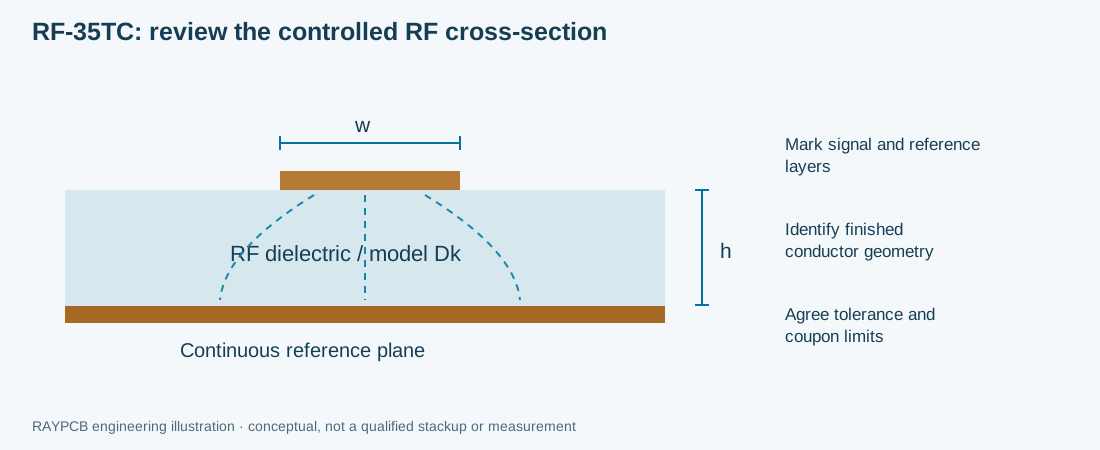
| Stackup | Name each core and bonding layer, pressed thickness and reference plane | Review lamination and controlled-impedance routing |
| RF geometry | Read the C1/C1 125°C condition with the 0.92 W/m·K figure | Separate modeled dimensions from permitted fabrication adjustments |
| Process constraints | Include interface and heat-sink resistance | Resolve the grade-sensitive step before committing the process |
| Inspection evidence | Review conductor heating and laminate loss separately | Agree sample, method, limits and report format |
| Order scope | Quantity, requested date, bare board or assembly, repeat-build requirements | Return a quotation with explicit inclusions and open items |
Three decisions before repeat production
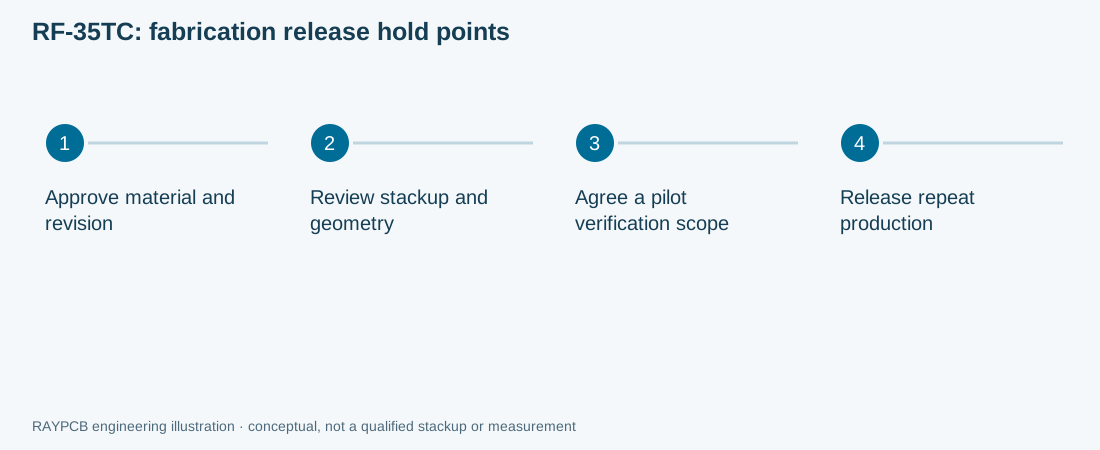
1. Material release. Record the full code and supplier revision on the drawing and purchasing documents. A missing suffix is an unresolved specification, not permission to substitute. If stock is uncertain, separate an alternate proposal from the approved baseline.
2. CAM approval. State whether line-width compensation is allowed, which RF features are protected and who approves a change. Resonators, coupling gaps and antenna elements should not be adjusted under a general impedance permission without design review.
3. Pilot acceptance. Define the coupon, fixture, frequency range and acceptance limits needed for the product. A netlist test establishes continuity; it cannot establish insertion loss or phase performance. Keep prototype findings with the next released revision.
Screen an open geometry question
Use the engineering tool to put a number beside a CAM question. Its result is a starting geometry; the approved stackup and fabrication solver determine the final conductor shape.
RAYPCB ENGINEERING
Taconic RF EngineeringTaconic PCB Design Workbench
Loading Taconic PCB Design Workbench…
Prepare the RF-35TC fabrication quote
Start with material identity, quantity and construction. Add real cost allowances only when you have a basis for them. Multilayer, mixed-material, special bonding and RF-tested builds need a scoped engineering quotation.
RAYPCB ENGINEERING
Taconic RF EngineeringTaconic PCB Cost & Quotation Brief
Loading Taconic PCB Cost & Quotation Brief…
Before comparing quotations, check whether they include the same laminate/foil, panel utilization, surface finish, special drilling and acceptance reports. The tool’s brief can be downloaded or opened in an email draft; attach the actual release files separately.
Keep the approved scope with the next build
| Change trigger | Review before release |
|---|---|
| Material alternate or suffix change | TC, TC-A and HTC are different designations. Thermal conductivity depends on specimen and test conditions. |
| Core, bonding layer or copper change | Recalculate the full cross-section; confirm reference spacing, etch and loss assumptions. |
| Panel or drill process change | Review registration, supported handling and hole-wall requirements. |
| New RF test requirement | Agree fixtures, calibration reference planes, limits and responsibility before including it in the order. |
Manufacturing handoff questions
Can CAM adjust every RF trace to meet an impedance target?
No blanket permission should be assumed. Identify protected resonators, coupling gaps and antenna features, and agree how any proposed geometry change is approved.
What if the requested laminate thickness cannot be sourced?
Ask for the available exact construction and a revised stackup proposal. Recalculate geometry and obtain design approval before substituting a thickness or material.
When does a first article need RF measurements?
When RF performance is part of the acceptance requirement or when a material/process change needs verification. Define the fixture and limits; connectivity testing alone is insufficient.
Can the prototype drawing be used for repeat production?
Use the latest released revision after resolving prototype findings. Record approved material, CAM changes and acceptance results so the next order has an identifiable baseline.
What should accompany the quotation request?
RF-35TC, supplier revision, thickness/foil, fabrication/drill files, stackup, quantity and inspection scope. State any unknowns explicitly so they can be reviewed.
Next useful references: Taconic PCB manufacturing · full Taconic material directory · Material properties and design for RF-35TC · RF-35HTC · RF-35TC.
Send the current fabrication release
Include the revision and any unresolved material or inspection decision. Preliminary files can start the discussion.
Request a RF-35TC build review