
RAYPCB / Buyer resources
RAYPCB / BUYING & ENGINEERING
Largest EMS companies: ranking, revenue basis and supplier fit
Understand the list before using it to choose a manufacturing partner.
The in4ma / EMSNOW 2025 EMS & ODM ranking starts with Foxconn, Wistron and Quanta. Revenue rank describes a defined company universe; it does not qualify a facility for your product.
| 2025 source rank | Company — shortened name | Scope |
|---|---|---|
| 1 | Hon Hai / Foxconn | EMS & ODM Global 100 |
| 2 | Wistron | EMS & ODM Global 100 |
| 3 | Quanta | EMS & ODM Global 100 |
| 4 | Luxshare | EMS & ODM Global 100 |
| 5 | Pegatron | EMS & ODM Global 100 |
| 6 | Jabil | EMS & ODM Global 100 |
| 7 | Flex | EMS & ODM Global 100 |
| 8 | BYD Electronics | EMS & ODM Global 100 |
| 9 | Compal | EMS & ODM Global 100 |
| 10 | Huaqin | EMS & ODM Global 100 |
Source: in4ma / EMSNOW — EMS & ODM Global 100, 2025 revenue ranking. Reviewed October 1, 2026. Source ranks, 2025 company revenue, EMS and ODM combined. This is not a current capacity or quality ranking.
Check the revenue comparison basis
RAYPCB ENGINEERING
Quote and Evidence WorkbenchesEMS revenue basis
Loading EMS revenue basis…
Optional worksheet. No files are uploaded and no enquiry is sent. The guide and examples remain readable without JavaScript.
Which companies appear near the top?
The answer depends on what a ranking includes. In the in4ma and EMSNOW Global 100 table reviewed on 1 October 2026, the first five positions for 2025 company revenue are Hon Hai/Foxconn, Wistron, Quanta, Luxshare and Pegatron. The source combines EMS and ODM businesses. It is not a ranking limited to independent PCB assembly providers, and its order should not be presented as a quality score.
The compact table on this page shows the first ten names from that stated source and year. Open the original publication for the complete list and methodology context. We have deliberately kept the ranking separate from the financial-filing examples below. Combining figures from different publications, periods or business definitions would create a new ranking that neither source actually supports.
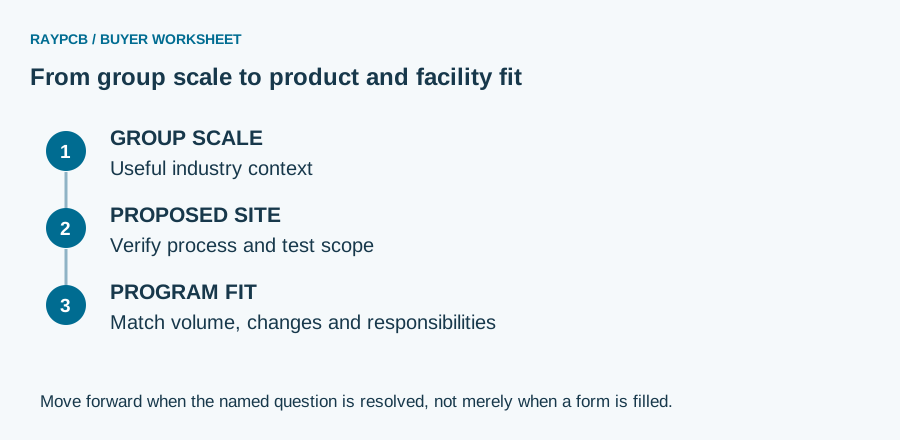
For a buyer, the useful next question is not simply which company is biggest. It is which specific facility and commercial arrangement fit the product, volume, engineering needs and service responsibilities. This guide connects the ranking question to that procurement task. RAYPCB is not assigned a global revenue rank here. If you need a project proposal rather than industry research, the electronic contract manufacturing page describes the route for discussing a defined program.
Source context: in4ma / EMSNOW — EMS & ODM Global 100, 2025 revenue ranking.
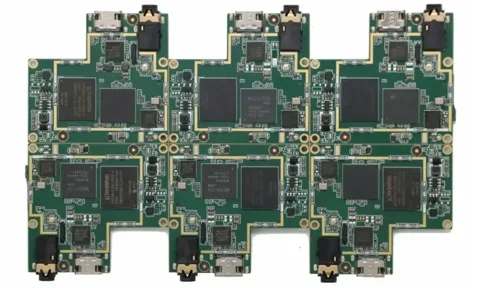
EMS, ODM and group revenue are different boundaries
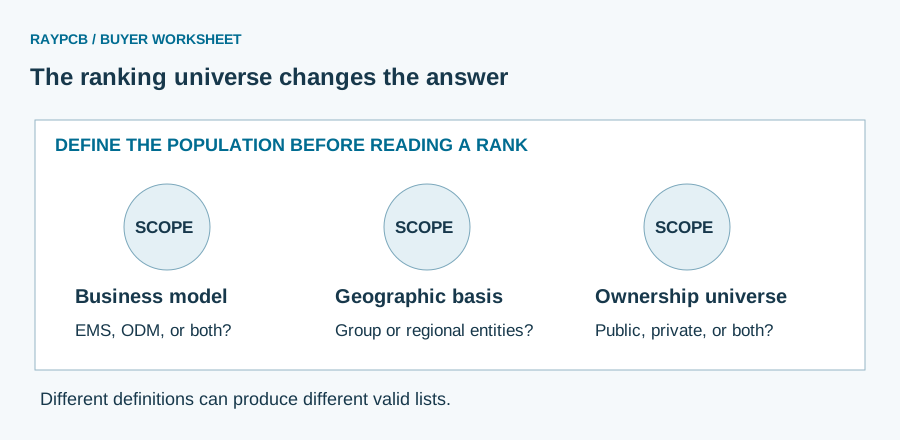
Electronics manufacturing services generally concern manufacturing and related services for an original equipment manufacturer. Original design manufacturing can include a different degree of product design and platform responsibility. Companies may participate in both activities or combine them with other businesses. A group-level revenue figure does not necessarily isolate the revenue generated by the exact service that a PCB or PCBA buyer intends to purchase.
Before using a list, identify the included universe. A global EMS and ODM ranking, a European-entity ranking and a list of publicly traded EMS companies can all be legitimate while producing different orders. A company absent from one list may simply fall outside its scope. Avoid treating those lists as contradictory until the geography, business definition, reporting period and inclusion rules have been compared.
This distinction is especially important for a board-level enquiry. A large diversified group can report revenue from complex systems, sourcing and other operations that are not equivalent to bare-board fabrication or a small assembly project. Its consolidated scale is useful context, but it does not identify the available production line, engineering response model or minimum commercially suitable order. Those details belong in a facility-specific qualification and quotation process.
Read the year and reporting basis before the number
A ranking labeled 2025 and an article published in 2026 are not necessarily inconsistent: the publication may be reporting the previous completed year. Conversely, a 2026 outlook can contain forecasts rather than reported annual results. Record both the publication date and the period represented by the numbers. Updating only the headline year without updating the underlying data makes a list appear more current than it is.
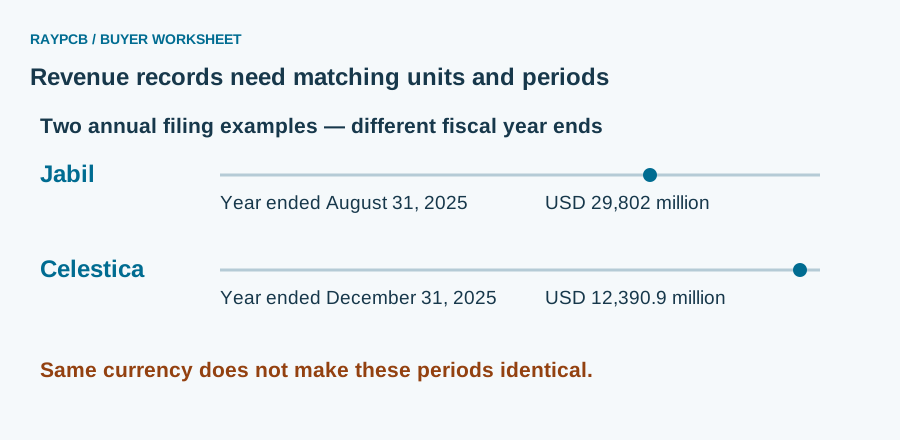
Fiscal year ends can differ between companies. Jabil's 2025 annual filing reports revenue of USD 29,802 million for the year ended 31 August 2025. Celestica's 2025 annual filing reports USD 12,390.9 million for the year ended 31 December 2025. These are examples from SEC filings, not a reconstructed global ranking. Their different year ends remain relevant even though both amounts are annual revenue in US dollars.
The worksheet intentionally marks those example period labels as unmatched. A buyer can inspect the two records without pretending they cover the same dates. Industry ranking publications may use their own consistent normalization or data collection approach; read that approach before substituting a fiscal-year figure into the published order. When sources differ, retain the source and basis with each value instead of silently selecting whichever number supports a preferred ranking.
Source context: SEC — Jabil 2025 Form 10-K, fiscal year ended August 31, SEC — Celestica 2025 Form 10-K, fiscal year ended December 31.
Use the revenue worksheet as a comparability check
Enter two revenue records with currency, period and reporting basis. The worksheet reports missing or mismatched comparison conditions. It calculates a simple difference and ratio only when the declared fields match and both records are actual revenue rather than forecasts. It does not inspect the filings or confirm that the values were copied correctly. Matching field labels are necessary context, not proof of accounting equivalence.
Keep amounts in millions consistently. Entering one company in dollars and the other in millions creates a six-order-of-magnitude error that can look plausible in a badly labeled chart. Do not mix market capitalization, order backlog, quarterly sales and annual revenue. They measure different things. If a common currency is needed, document the conversion method and period separately; this worksheet does not fetch exchange rates.
A numerical gap between companies also does not reveal organic growth, profitability, financial health or manufacturing quality. Acquisitions, disposals, product mix and reporting boundaries can affect the interpretation. This page is intended for industry and sourcing context, not investment advice. Use the tool to improve the quality of a comparison note, then return to the specific evidence needed to evaluate a manufacturing partner.
Translate scale into questions about your program
A large manufacturing group may offer a wide network, substantial sourcing activity and experience managing complex programs. Those possibilities still need to be connected to a proposed engagement. Ask which site would manufacture the product, who would manage the engineering interface and which services the quotation includes. The answer should identify a practical operating arrangement rather than rely on a corporate revenue figure.
Describe the product mix and production pattern. A stable high-volume assembly, a high-mix industrial program and an evolving prototype can require different support models. Frequent engineering changes, low annual quantities or specialized test development may be more important to your decision than group size. Ask how the supplier would handle those characteristics before treating a position in a ranking as evidence of suitability.
Consider the relationship between your expected program and the supplier's commercial model. Clarify onboarding work, engineering charges, material commitments and the resources assigned to the account. Neither a large nor a smaller provider is automatically the right choice. A well-defined program brief allows candidates to explain their fit and identify limitations early, which is more useful than selecting from a league table and discovering mismatched expectations after release.
Qualify the actual manufacturing and test scope
For PCB assembly, check the required board construction, component packages, soldering processes and handling conditions. Where the project extends into cables, enclosures, programming or system integration, define those services separately. A supplier's group-level capabilities may be distributed across different facilities. Ask which operations are performed at the proposed site and which rely on another location or subcontractor.
Quality evidence should match the legal entity, site and service scope. Review current documents and the project acceptance requirements with the responsible specialists. A certification logo or a statement of industry experience is not a complete product-specific control plan. Confirm how inspection results, test records, traceability and nonconformance decisions will be recorded and supplied for your order.
Test ownership deserves particular attention. Identify who develops the test method, provides fixtures and firmware, sets acceptance limits and approves changes. An assembled board that has passed visual inspection has not necessarily passed the product's functional requirements. Use the PCB assembly service and the relevant inspection or testing page to understand the work being requested. The goal is to connect each claimed capability to the actual deliverable and evidence that the customer requires.
Compare proposals without letting rank hide exceptions
Obtain quotations against a common release and a common build scope. Separate bare-board fabrication, components, assembly, test, tooling and logistics where appropriate. Record approved substitutions, customer-supplied materials, excess inventory responsibilities and change-control conditions. The PCB assembly quote guide helps structure the board-level comparison without confusing a low displayed labor price with a complete program cost.
Treat mandatory requirements as eligibility questions. A missing production-location requirement, unapproved material substitution or undefined test responsibility should remain visible rather than being averaged away by a scoring system. A supplier's size cannot compensate for an unmet mandatory condition. Once the essential scope is established, compare the commercial and operational tradeoffs that genuinely remain available.
Consider continuity and transfer arrangements. Ask what happens if the program moves to another site, if a critical component becomes unavailable or if the design changes after purchasing has begun. A global footprint does not mean that every site is interchangeable. Qualification evidence, tooling, process instructions and customer approvals may need to be transferred or recreated. Document the conditions rather than assuming that a large group can move a product without consequence.
Common questions about the largest EMS companies
Is the largest EMS company always the best supplier? No. A revenue ranking measures scale under a stated definition; suitability depends on the proposed facility and program. Why do different lists show different orders? They may include different business models, geographies, years or revenue definitions. Check those boundaries before comparing the positions. Is an ODM automatically the wrong choice for an OEM project? Not necessarily; clarify design ownership and the actual service model.
Can a prototype buyer approach a large EMS company? The relevant question is whether the proposed service and commercial arrangement fit that project. Confirm the route rather than assuming either acceptance or rejection from company size. Does this page rank RAYPCB against the listed groups? No. It supplies source-based industry context and a procurement method, without inventing comparative revenue or customer-program evidence.
For a RAYPCB enquiry, describe the board or assembly, development stage, quantity pattern, sourcing responsibilities and required test scope. Add any mandatory location or evidence requirements. Contact RAYPCB for a project-specific discussion. You can use industry rankings to understand the market while keeping the supplier decision grounded in the product, facility and working relationship that will actually determine the outcome.

