
RAYPCB · ENGINEERING GUIDE
IoT Device Manufacturing: Link Each Unit to Its Firmware, Identity and Test Record
IoT device manufacturing adds identity and lifecycle decisions to the physical assembly of a connected product. A populated board may boot and join a network while still lacking the correct production firmware, ownership state or retained test evidence. The manufacturing route must define how a unit becomes the intended delivered product without exposing credentials or leaving test configuration behind.
This page follows that route from controlled release to final record. The station worksheet estimates complete cycles from declared assumptions, and the optional cost tool compares your entered allowances. Neither checks security credentials, connects to a cloud service or certifies the finished device.
Freeze the product and the provisioning responsibility
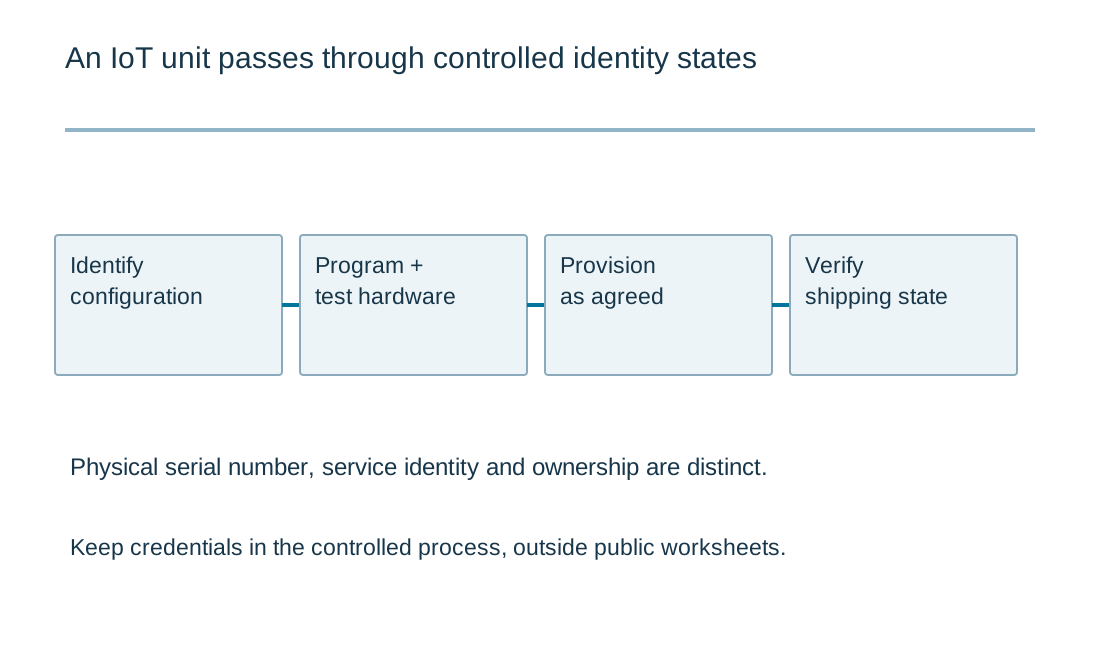
Identify the board revision, BOM variant, firmware image, radio or computing modules and final mechanical configuration. Specify which party assigns identity and which system authorizes the device for service. Physical serial number, network identity and customer ownership may be related, but they are different concepts that need an explicit mapping.
Choose a provisioning workflow appropriate to the platform and product lifecycle. AWS documentation describes several approaches and responsibility boundaries; it is not a requirement to use that service. The design team must decide how credentials are created, delivered, protected, replaced and retired in the actual implementation.
Keep customer credentials and private keys outside public planning files. A manufacturing instruction can refer to a controlled provisioning step without containing the secret itself. Define the minimum access required by the station and how the final product's ownership state differs from the factory test environment.
Separate hardware observations from service enrollment
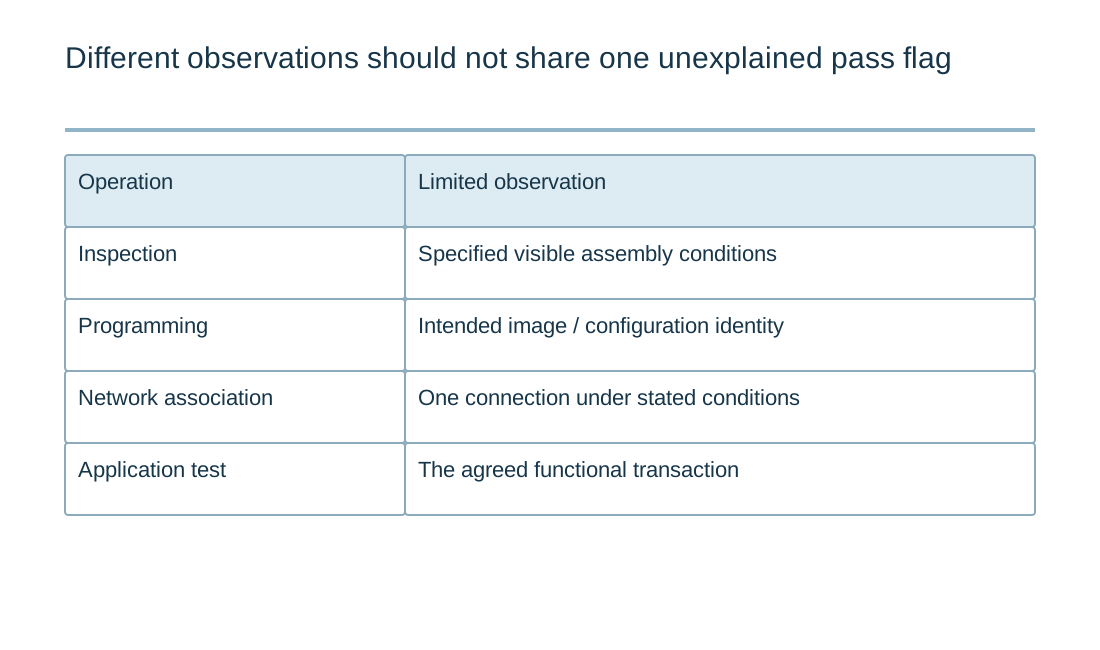
Inspection and electrical tests establish aspects of the assembled hardware. Programming verifies an image or configuration. Network association establishes another limited observation. Enrollment in a service and completion of an application transaction are further steps. Decide which are required and what each passing result actually demonstrates.
For RF devices, specify the agreed radio test method and its conditions rather than assuming that any successful connection proves antenna performance. Enclosure, antenna, cable and installation can affect the final behavior. A board-level fixture may be useful while still leaving product-level wireless verification to a later stage.
The electronic module assembly guide helps define the physical delivery boundary. The IoT embedded-system page owns power, update and recovery architecture. Manufacturing acceptance should follow the released design decisions rather than invent a recovery strategy at the test station.
| Review item | What to establish |
|---|---|
| Release identity | PCB/BOM/firmware variant and the mapping of physical and service identities. |
| Provisioning owner | Controlled credential workflow, access boundaries and recovery. |
| Evidence layers | Hardware, programming, network and application observations separated. |
| Station arithmetic | Full occupancy, usable time, concurrency and first-pass assumptions. |
| Shipping state | Test cleanup, commissioning behavior, records and ownership transfer. |
Production test station capacity
Production test station capacity
Use the current inputs and keep the assumptions
Load the example to see the units and record format, then clear it before entering your own revision. Example values are illustrative and do not select components or establish acceptance limits. Every field needs an intentional value; a blank number is not treated as zero. For CSV input, retain the header and put one item on each row. Quoted cells can contain commas, but duplicate headers and malformed rows are rejected.
Generate a result only after checking the measurement boundary, operating condition and units. Editing an input invalidates the old result and disables its download until you calculate again. An edited example stays labeled as an example. The report is created locally; it does not upload a design, send an enquiry or populate the Contact form. Attach it manually if it helps explain a requirement. You can contact RAYPCB without completing the tool.
| Input | What to establish before using it |
|---|---|
| Review reference | Use a nonconfidential revision label. |
| Station occupancy per unit · s | Include load, programming, measurements and unload when they occupy the station. |
| Independent parallel stations | Integer; stations must actually be able to operate concurrently. |
| Scheduled time · h | Length of the planning interval. |
| Usable scheduled fraction · % | Entered allowance for downtime; not an observed factory performance claim. |
| Units planned | Integer; first-pass cycles only. Retest and yield require separate evidence. |
Optional cost comparison from your own allowances
Use a quotation or a clearly labeled internal assumption for each input. Keep the quantity, construction and inspection scope the same when comparing alternatives. This uncalibrated planning model adds entered values; it contains no current market rates and does not issue a RAYPCB quotation. You can contact the team without completing it.
Assembly scope allowance comparison
Build a traveler around the unit's state transitions
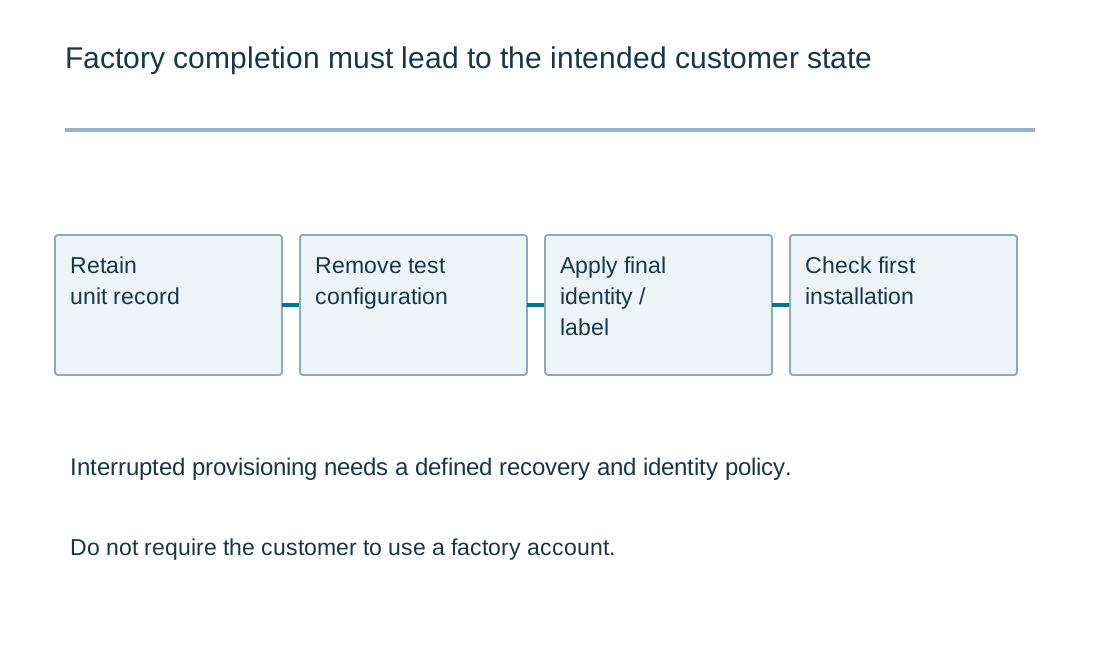
Define the entry and exit state of each operation: identified, inspected, programmed, tested, provisioned and finalized, using the sequence appropriate to the actual process. Record how a interrupted operation is detected and whether it may safely resume. Avoid a station that creates another identity every time an operator repeats a step.
Preserve the relationship between unit identity, configuration and results. A failed unit may need repair and retest without losing its history. If a board is replaced inside an enclosure, the record should follow the approved identity policy rather than silently inheriting an unrelated passing result.
Include final cleanup: removal of temporary credentials, test-network settings or debug configuration as required by the product. Verify the intended shipping state. The customer should not need undocumented factory access to complete normal installation or discover that the device remains bound to a test account.
Plan station capacity using complete operations
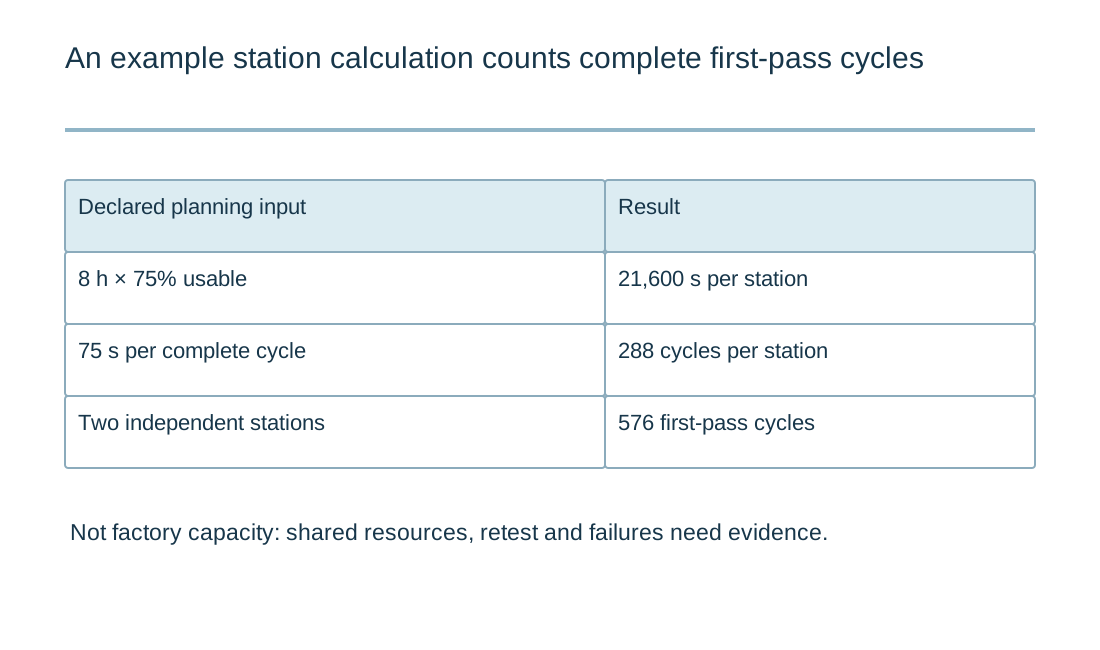
Measure or declare the full time that a unit occupies the station, including loading, programming, communication and unloading when applicable. Define scheduled time and its usable fraction. The capacity model counts complete first-pass cycles for independent stations; it does not infer yield or retest demand.
For an illustrative 75-second cycle, eight scheduled hours and 75% usable time, each station has 21,600 usable seconds and completes 288 cycles. Two independent stations complete 576 first-pass cycles under those assumptions. The example is not a statement about RAYPCB's actual production capacity.
Shared programmers, network services, operators and credential systems can limit concurrency. A parallel fixture does not necessarily create independent stations. Use pilot observations to revise the model, retaining the exact firmware, service and test configuration. A service outage during provisioning should have a defined hold-and-recovery process rather than produce ambiguous unit records.
Compare costs at a consistent release boundary
One-time effort may include fixture development, programming integration and preparation of an agreed test route. Recurring work may include assembly, required observations, identity assignment, labeling and packaging. State who provides modules, fixtures and service access so the quotation covers the actual requested work.
The optional allowance tool adds setup and per-unit values entered by the user. It has no current price database and does not charge or submit an order. Keep quantity, currency, revision and test coverage consistent when comparing scenarios. Retest, yield loss, duties or shipping are not silently inferred.
Do not remove a required verification step solely to improve a displayed estimate. If cost drives a design change, review its impact on architecture, production and customer installation. A simpler product boundary can reduce work, but the resulting behavior and evidence need to remain explicit.
Verify the customer installation state before release
Test the agreed installation journey with a unit in its intended delivered state. A device that works in the factory's already configured network may fail during first commissioning. The smart-home IoT guide illustrates why pairing, ownership transfer and reset are product behaviors rather than afterthoughts.
Retain the final acceptance record and define how field support identifies the installed revision. A firmware change can affect provisioning or test compatibility even when the PCB remains unchanged. Keep those changes coordinated with the release index and station software.
For an enquiry, provide the controlled files, quantity, programming requirements, identity-responsibility outline and agreed test scope. Use nonconfidential references for sensitive provisioning details. The objective is a device whose hardware, firmware and delivery state can be explained and reproduced, with unresolved integration responsibilities visible before production begins.
Separate a connected device from a dependable service
A network connection is only one state of the product. Specify first installation, ordinary operation, unavailable network, expired or replaced credentials, firmware recovery and transfer to another owner. Record what the local device continues doing and which data remain meaningful in each state.
Measure power and communication activity over a representative sequence rather than only an idle interval. Keep operational measurements distinct from production test records and security credentials. For a manufacturing handoff, identify the firmware image, identity assignment responsibility, required test network and cleanup state after testing. Customer acceptance should follow useful behavior, such as retaining valid data or recovering a defined function, rather than a display merely saying connected.
Standards, source context and limits
Use the exact device, system and material documents relevant to the released design. A public reference design demonstrates a particular implementation under its stated conditions; changing its parts, layout, enclosure or firmware creates a different verification task. Standards summaries here identify the type of evidence to request, not every clause of a licensed standard. Component qualification, board workmanship, product validation and regulatory acceptance are separate decisions.
For fabrication scope and the agreed construction requirements, see PCB manufacturing.