
RAYPCB · ENGINEERING REFERENCE
Ventec PCB materials: match the material to the board structure
Compare rigid laminate, signal-integrity, polyimide and thermal routes. Prepare the exact grade and construction for a useful manufacturing review.
Original engineering guidance · References checked September 30, 2026
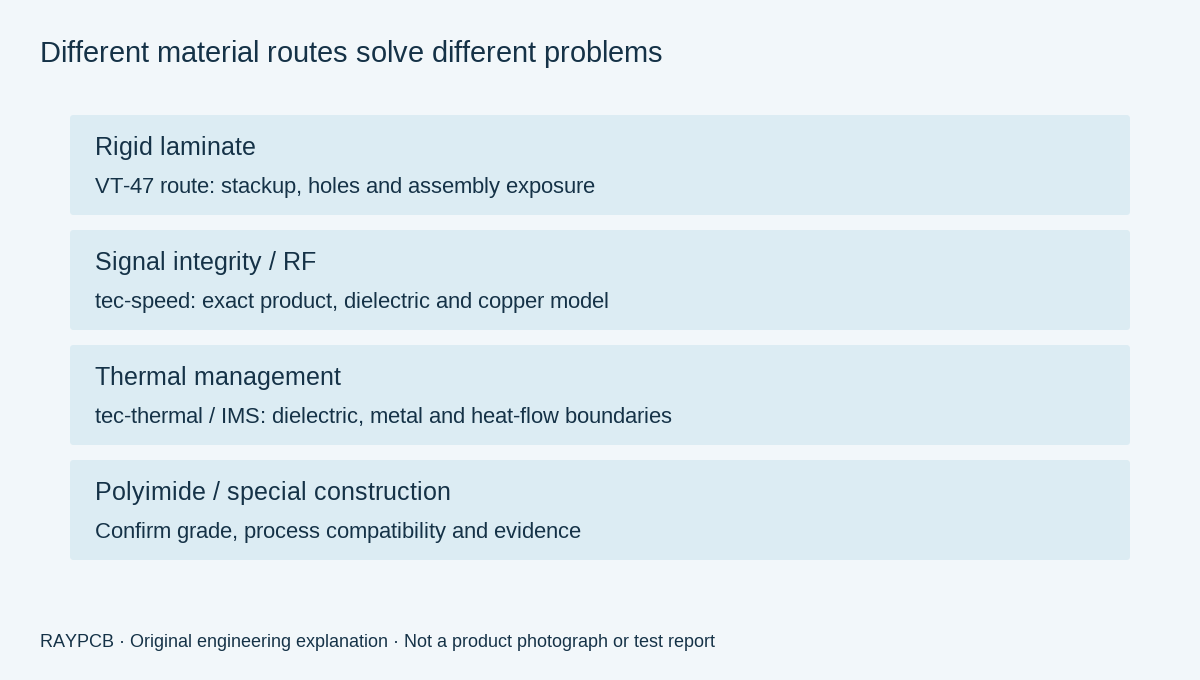
Select a Ventec construction route before comparing grades
Ventec PCB materials cover different board constructions and engineering tasks. A high-Tg rigid laminate, an RF material, a polyimide system and an insulated metal substrate are not interchangeable versions of one product. Start by identifying the board structure and the requirement driving the choice, then specify the exact grade and source document for manufacturing review.
This page is the Ventec brand discovery and project-entry page. It helps you select the relevant route, understand the information needed and prepare an enquiry. The VT-47 PCB page handles that exact grade in more detail. Wider substrate alternatives remain in the PCB materials directory, so the brand page does not need to repeat a complete materials encyclopedia.
Public product information does not confirm RAYPCB inventory or approve a construction for your project. Send the required grade and the drawing, or describe the unresolved engineering task. The response should identify availability, the proposed material set and any conditions requiring review before a quotation becomes a manufacturing release.
Use the product family as a route, not a performance verdict
Ventec's official product directory organizes materials into categories including lead-free assembly, polyimide, signal integrity/RF and thermal management. It also distinguishes bonding and special constructions. These categories are useful for finding the right document; they do not mean that every member meets the same electrical, thermal or mechanical limits.
| Project need | Route to investigate | First engineering question |
|---|---|---|
| Rigid multilayer with specified assembly exposure | Lead-free-compatible FR-4, including VT-47 | Which exact construction and thermal evidence apply? |
| Loss-sensitive channel | tec-speed signal-integrity or RF products | Which grade, foil and model match the frequency and geometry? |
| Insulated metal substrate | tec-thermal / IMS | What are dielectric thickness, thermal path and insulation requirements? |
| Specialized thermal or process requirement | Polyimide or a defined special construction | What process and qualification evidence supports the actual board? |
| Bonding a local or mixed structure | Appropriate bonding material | Is the proposed interface and press sequence compatible? |
The table deliberately asks a different first question for each route. A thermal-conductivity number cannot decide an RF design, and a high Tg cannot establish a satisfactory heat path. Translate the application into measurable requirements before narrowing the material choice. This reduces the risk of comparing unrelated catalogue columns simply because both contain an attractive number.
Ventec's portfolio contains closely named variants. Preserve the exact suffix and the role of the material in the build. A no-flow prepreg, hole-fill material or standard laminate may have different processing and qualification information even when part of its designation is shared. Procurement abbreviations should not remove the distinctions needed by the engineer and fabricator.
For a rigid multilayer, start with the finished stackup
Define the layer arrangement, core dielectric thickness, bonding gaps, finished copper and overall thickness tolerance. Identify controlled-impedance structures and the signal/reference arrangement. Then review whether the selected material construction can meet these finished requirements within the proposed manufacturing route. The brand name alone does not fix any of those dimensions.
Record the actual hole requirements separately from nominal drill sizes. Finished-hole tolerances, via spans, filling and surface conditions affect the process and inspection scope. A high-Tg laminate cannot compensate for a poorly defined hole requirement or establish the fabricator's capability for a particular board thickness. Keep material evidence and finished-feature acceptance in separate but connected records.
If VT-47 is specified, use the focused grade review rather than substituting another Ventec material based only on a similar Tg. Ask about exact core and foil availability, bonding options and relevant supplier processing guidance. A repeat build should refer back to its approved construction, including any permitted alternatives and change-control conditions.
For RF and high-speed routes, compare complete models
A material's Dk and Df need their frequency, test method, conditioning and construction context. The value suitable for a purchasing comparison may not be the design parameter extracted for your actual line geometry. Request the source and identify how the proposed electrical model treats foil roughness, finished conductor shape and reference-plane spacing.
Low-loss resin does not remove connector, via or launch effects. State the channel reference planes and acceptance quantities before comparing simulations or measurements. An impedance coupon and a channel-loss structure answer different questions. For geometry and input preparation, continue to the PCB impedance guide; for a broader manufacturing route, use the RF PCB service page.
Avoid treating unlike material families as direct replacements. A change between resin systems or reinforcement constructions may affect lamination, drilling, dimensional behavior and the data used in the solver. Document which differences matter for this board and require the appropriate engineering approval. The cheapest sheet price is not necessarily the lowest cost for a qualified build.
For IMS, examine thickness and area with conductivity
In an insulated metal substrate, the dielectric between circuit copper and the metal base is one part of the thermal path. A useful first model is one-dimensional conduction through a uniform layer: Rθ = t/(kA), where t is thickness, k is through-plane thermal conductivity and A is effective heat-transfer area. The temperature drop across that layer is heat flow multiplied by Rθ.
For a synthetic 100 µm layer, k = 2 W/m·K and area = 100 mm², the ideal layer resistance is 0.5 K/W. At 5 W through that region, its calculated temperature drop is 2.5 K. Halving the area doubles this ideal resistance. The calculation shows why a conductivity headline without thickness and geometry is incomplete; it does not identify a particular Ventec product.
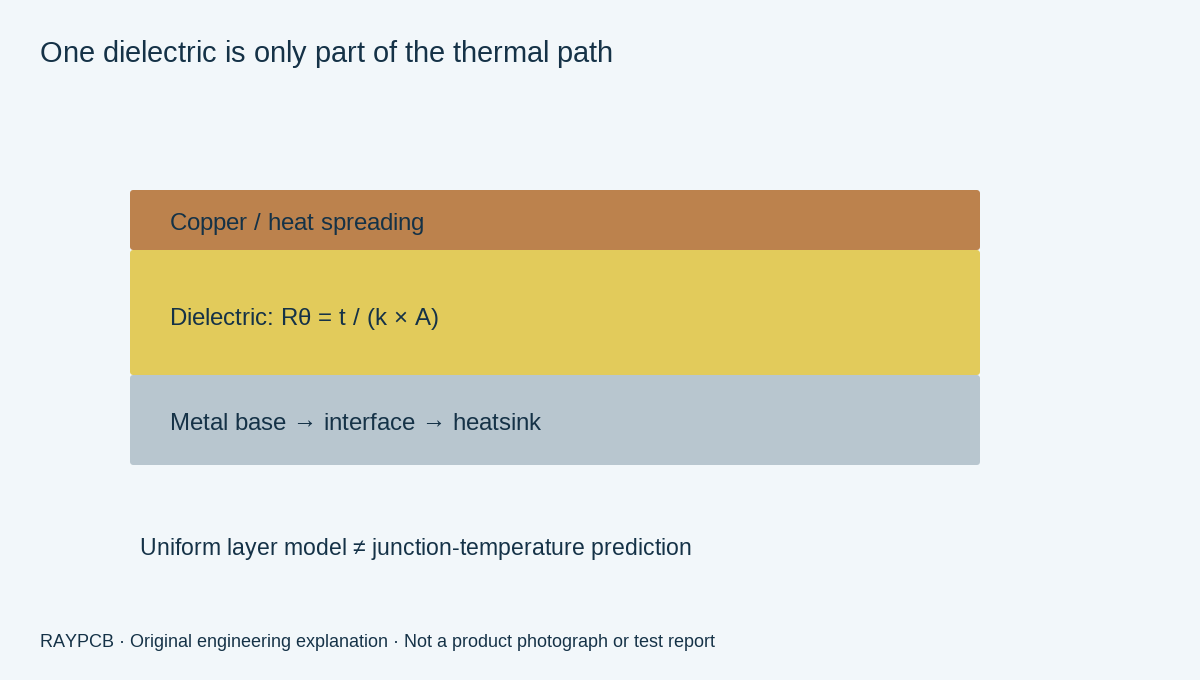
The real assembly also includes spreading in copper and the metal base, interfaces, the heatsink and ambient heat removal. Insulation requirements constrain how thin the dielectric can be. A designer cannot safely select thickness by minimizing thermal resistance alone. Define voltage-related requirements and the applicable qualification process separately from the heat-transfer calculation.
Explore a uniform IMS dielectric contribution
Enter a thickness, source-supported through-plane conductivity, effective area and heat passing through that region. The example values are not guaranteed Ventec data. The model intentionally withholds a result for a multilayer FR-4 or mixed thermal path because a single uniform layer does not represent that construction.
RAYPCB ENGINEERING
Brand MaterialsVentec IMS dielectric thermal-path explorer
Loading Ventec IMS dielectric thermal-path explorer…
The output is a layer contribution, not junction temperature or allowable device power. If the estimated drop is already large, revisit thickness, area and the complete cooling path before fixing the material. If it is small, investigate the other thermal resistances rather than declaring the product thermally qualified. The metal-core PCB engineering page provides the more complete substrate discussion.
Define the documents that support the material decision
Keep the material data sheet, processing guide and required declarations connected to the exact grade and source revision. A public supplier file supports technical investigation; it does not replace an agreed procurement requirement or evidence tied to the supplied lot. State which documents should accompany the order and which are needed before approval.
Do not merge unrelated claims. Halogen-content evidence, material recognition, environmental declarations and product acceptance may have different scopes. If the project requires a specific statement, identify the product and criteria to which it applies. Appearance, board color and a familiar grade name are not substitutes for the corresponding documentation.
For a proposed alternative, compare both source data and the actual feasible construction. Record any change in reinforcement, copper, thickness, process or verification. Where a source is historical, request confirmation that it applies to the intended supply. The absence of a newly dated public sheet is not itself proof of discontinuation, just as a live web page is not proof of local stock.
Estimate the project by construction route
Cost drivers differ across the routes. A multilayer laminate order may be affected by core/prepreg combinations, foil and process count. An IMS request adds dielectric and base-metal construction choices, thermal requirements and mechanical features. A loss-sensitive build may need specialized coupons and measurement. A single brand multiplier would hide these different tasks rather than price them accurately.
RAYPCB ENGINEERING
Brand MaterialsVentec construction cost allowance
Loading Ventec construction cost allowance…
Use actual supplier or internal allowances where available and record their scope. Separate fabrication, one-time setup, incremental material procurement and verification without double counting. The example numbers are invented and the model is uncalibrated. It cannot decide whether a specialty construction is manufacturable, nor does it automatically inherit the engineering worksheet's dimensions or material assumptions.
Connect the request to an actionable review
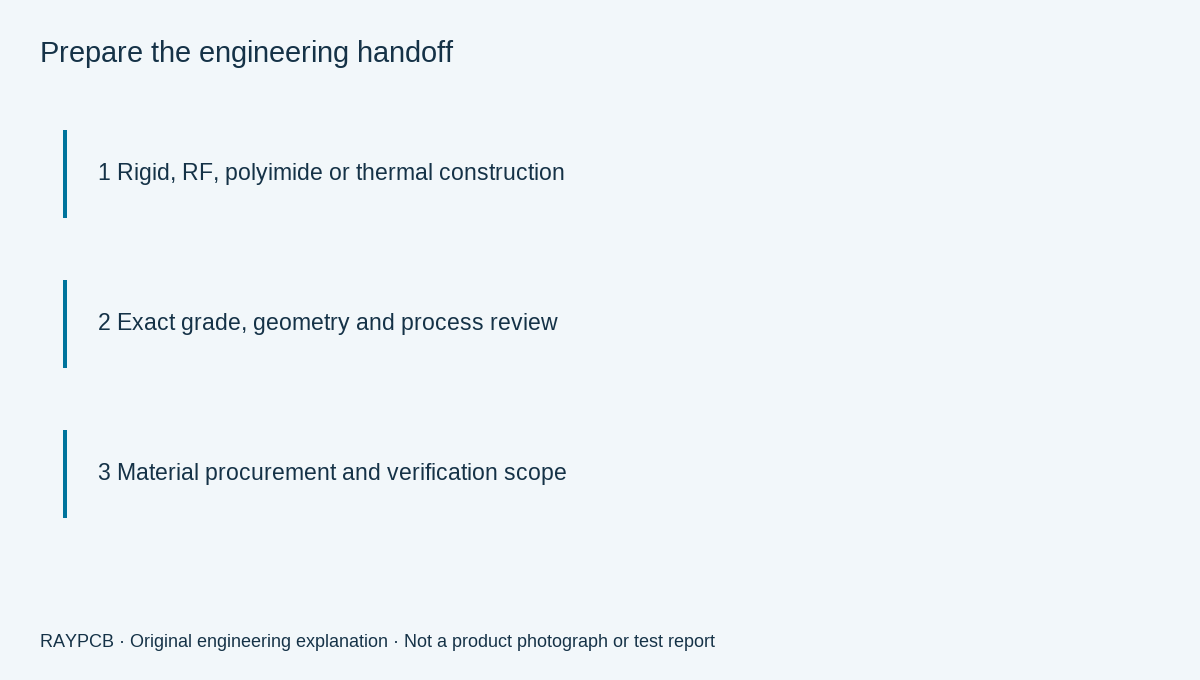
For a rigid or RF board, send manufacturing files, stackup, copper and hole details, quantity and the electrical acceptance needs. For IMS, include dielectric and metal-base requirements, critical mechanical dimensions and the thermal/insulation question. For polyimide or a mixed structure, identify the special process or operating condition that drove the material choice.
Make the substitution rule explicit. “Ventec or equivalent” is incomplete unless the equivalence requirements and approval authority are clear. Identify whether the named grade is mandatory, whether alternatives may be proposed, or whether you need an initial recommendation. If the material is still open, describe the fixed requirements and let the review expose the remaining decisions.
The quotation should make its included scope visible: material identity, construction assumptions, test records and any exclusions. Archive the approved response with the fabrication revision. That record supports repeat orders and avoids silently transferring a price or material statement to a different board. Contact RAYPCB directly when the task is already defined; the tools are optional aids, not prerequisites for enquiry.
Ventec project questions
Does Ventec mean FR-4?
Not necessarily. The portfolio includes several construction families. Specify the exact product and its role in the board rather than treating the supplier name as a substrate definition.
Is higher thermal conductivity always the better choice?
No. Evaluate thickness, effective area, interfaces, the entire cooling path and insulation requirements. The best choice depends on the complete construction and verified operating conditions.
Can VT-47 automatically replace a low-loss RF laminate?
No. Compare the exact electrical models, geometry, processing and acceptance needs. A shared supplier or high-Tg description does not establish RF equivalence.
Can the thermal tool predict the component junction temperature?
No. It isolates a uniform dielectric layer. Device, spreading, interfaces, heatsink and ambient boundaries are outside that model.
Are all listed Ventec products available for my order?
Availability and suitable combinations must be confirmed for the project. Product discovery, current stock and manufacturing approval are separate stages.
Bring the requirement and the drawing together
Send the board revision, construction, quantity and the standard or engineering question you need reviewed. Identify unresolved requirements so the response can address them.
Send requirements for reviewOptional: attach the downloaded worksheet manually. This guidance does not certify a design, approve a shipment or replace the applicable authorized standards.