
RAYPCB · RF materials & manufacturing
AD250C datasheet: Properties & Construction Notes
Interpret supplier electrical and thermal values before assigning design inputs. Review the material data, use the engineering model, and send a defined construction for quotation.
Bring your band, stackup, quantity and acceptance requirements. Preliminary files are welcome for review.
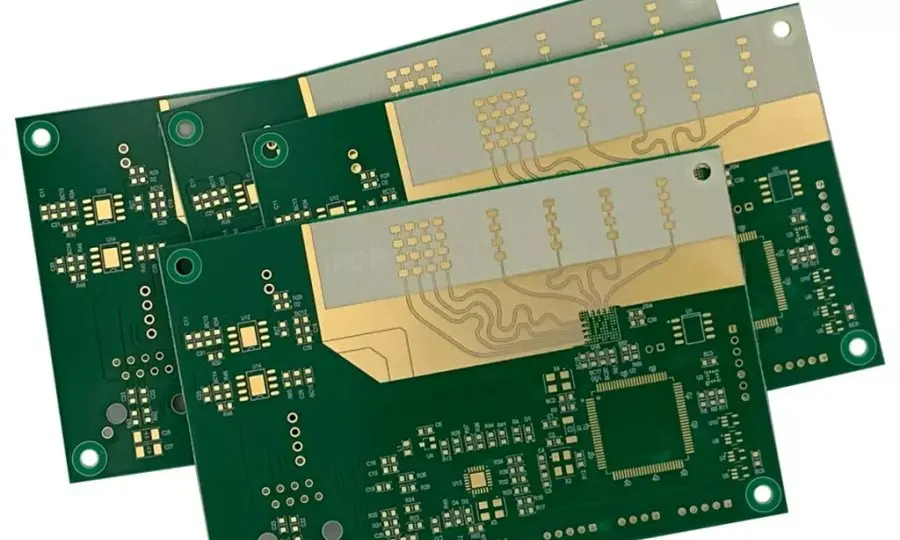
Material data and construction choices
Woven-glass reinforcement provides a structural framework within a PTFE laminate. The glass style, resin system and filler content form a particular construction; they are not interchangeable labels. For a large antenna panel, dimensional consistency and handling can matter alongside dielectric loss. For a small microwave circuit, the local field geometry and conductor features may dominate. Describe both the mechanical format and the RF task before narrowing the material choice.
Low-Dk woven-glass antenna material
AD250C and AD255C are different ordered grades. The published design references are close, but a change can still affect an antenna element or a long feed network. Choose the complete construction, not whichever name happens to be available. Where material orientation and PIM matter, record the foil option and representative test requirements with the drawing.
| Property | Supplier reference | Engineering meaning |
|---|---|---|
| Process Dk | Source-label discrepancy: 2.50 / 2.52 | Rogers web table and linked AD Series PDF assign these labels differently. Confirm the source for the ordered construction. |
| Design Dk | Source-label discrepancy: 2.50 / 2.52 | Rogers web table and linked AD Series PDF assign these labels differently. Confirm the source for the ordered construction. |
| Typical Df | 0.0013 | Property-tool heading: 10 GHz; parenthetical values refer to 2.5 GHz. Check grade notes. |
| Typical thermal conductivity | 0.33 W/m·K | Consult the grade source for direction and method; not a finished-board power rating. |
| Typical X / Y / Z CTE | 47 / 29 / 196 ppm/K | The source table states its temperature interval. Axis and conditions matter. |
| Material flammability reference | V-0 | Supplier material listing, not certification of a fabricated board or assembly. |
Source: AD250C manufacturer product data and the Rogers laminate property tool. Values are material references; purchasing and finished-board acceptance need their own agreed specification.
RF engineering workbench
Use explicit construction inputs. Results can be downloaded or opened as an email draft; the tool does not upload project information.
Worked planning example
Sensitivity example only: assume Dk 2.52, dielectric height 0.508 mm and a 50 ohm target. The zero-thickness microstrip model gives about 1.436 mm width. The Dk is a declared scenario input, not a resolved AD250C design specification; the source-label discrepancy is documented above.
Use the result to inspect scale and sensitivity. Preserve the input units and assumptions in the downloaded brief, then use the actual finished geometry and appropriate solver or measurement method for release.
RAYPCB ENGINEERING
Rogers EngineeringRogers Engineering Workbench
Loading Rogers Engineering Workbench…
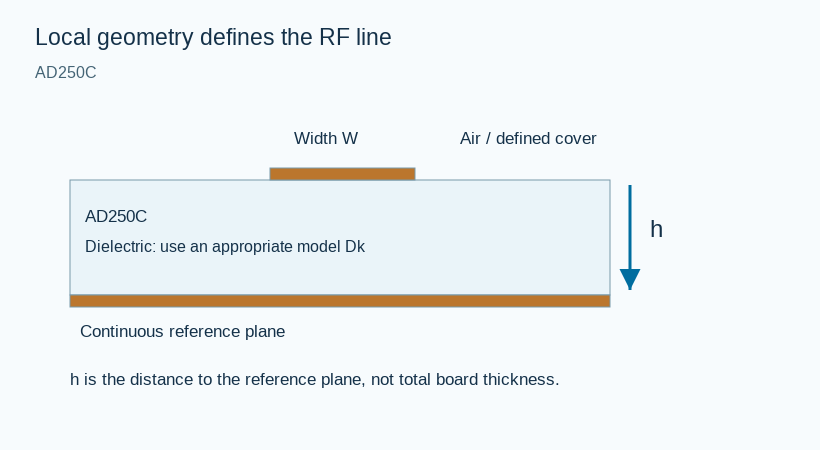
Keep the material record tied to this construction
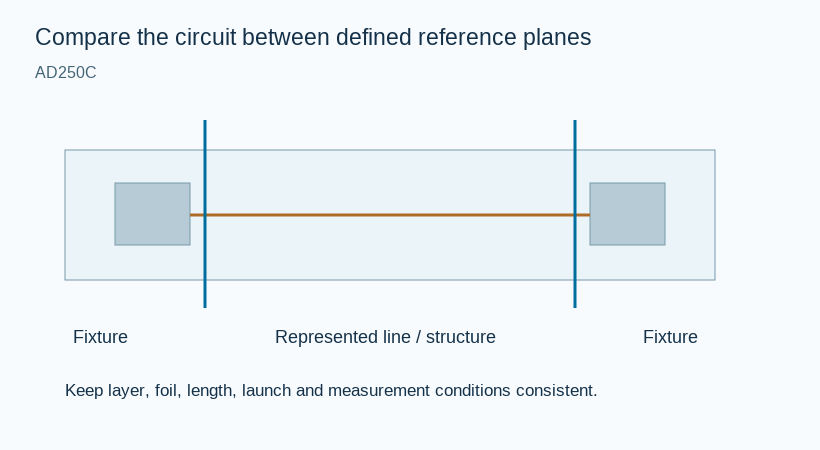
Label dielectric height, copper, reference planes and any bonding layer on the section. Attach the material source revision and the drawing revision to the same record. A changed foil or bonded structure needs a review of both the circuit model and fabrication route.
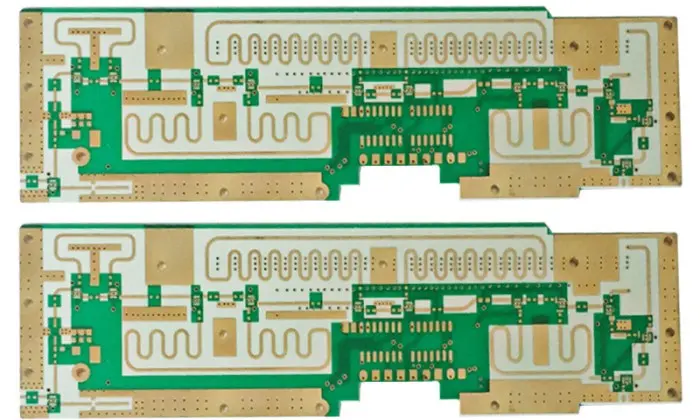
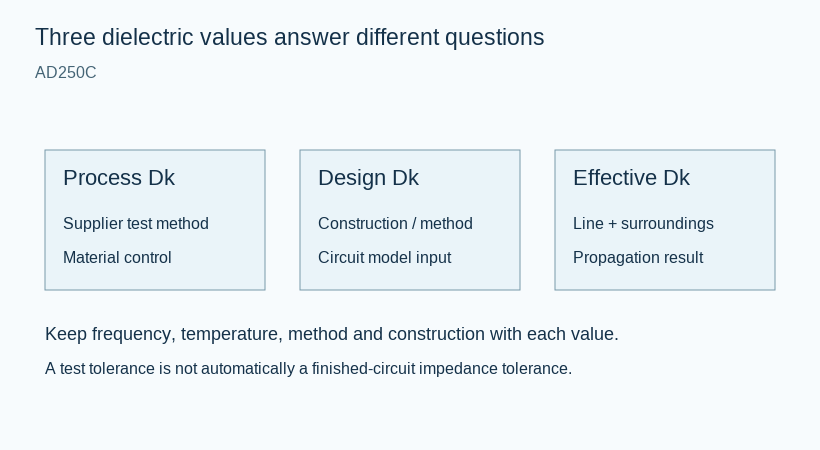
AD250C source-to-design record
| Review point | Input to record | Decision or verification |
|---|---|---|
| Electrical model | Record source URL, document revision, property label, method and frequency. | Resolve a conflicting process/design label before changing a validated model. |
| Construction | Keep the nominal dielectric gauge and foil identity with the property record. | Compare the same construction rather than a family average against a specific ordered grade. |
| Change decision | Name the person approving the model or purchasing change. | Preserve the old calculation and show which circuit result changed under the new assumption. |
The useful output of this page is a controlled material record, not a copied property list. For AD250C, the current linked Rogers web table and the linked AD Series PDF assign 2.50 and 2.52 differently between process and design Dk. Record that discrepancy and obtain confirmation for the construction being released. Do not silently swap labels in an approved RF model.
If an existing design used 2.52, retain the old model as a baseline. Compare a second explicitly labeled assumption and inspect the sensitive line or resonance. The exercise exposes the consequence of the uncertainty; it does not decide which supplier reference applies.
Source review: Rogers AD Series data sheet. Resolve the document and construction used for release; typical values are not finished-board acceptance limits.
Cost planning and a direct RFQ route
Price the construction described by the data
A material data sheet does not contain the complete cost of a circuit board. Procurement needs the exact laminate, dielectric thickness, foil, usable panel format and quantity. A family name with a nominal Dk can leave several materially different offers on the table. Ask which construction is included and whether cutting, special copper, minimum purchase quantities or certification documents affect the quotation.
The cost model below lets you attach your own panel and fabrication allowances to a named construction. Its panel count is geometric bookkeeping; it does not confirm supply availability or predict process yield. A substitute with a lower sheet price can require new models, coupons, fixtures or qualification. Compare that complete change effort with the expected production quantity rather than treating the raw laminate difference as the total saving.
For an enquiry, attach the selected data-sheet revision with the fabrication files and mark any open material decision. If no current construction has been verified, request an identification and availability review first. A fabricator can then distinguish the price of the specified build from the price of a proposed alternative. Keep those offers separate until the design authority has approved the choice.
RAYPCB ENGINEERING
Rogers EngineeringRogers Fabrication Budget & RFQ
Loading Rogers Fabrication Budget & RFQ…
Prefer to send files now? Contact the RAYPCB team with the requested material, construction and quantity. An exact quotation is based on the agreed scope.
Verify the construction that matters to the product
Keep source data separate from your acceptance evidence
Build a short evidence register for the chosen grade. At minimum, record where the electrical values came from, which construction was modeled, and what the finished board will actually be tested for. A supplier sheet, a material certificate, an impedance coupon and a system RF measurement answer different questions. Putting them in separate rows prevents a typical property from being mistaken for proof that the product meets its specification.
For the dielectric model, record frequency, method and any thickness limitation. For the manufacturing record, keep the actual material identity, drawing revision and agreed stackup. For the RF result, define the fixture and reference planes. This allows an unexpected result to be investigated in the correct place: material identity, geometry, measurement setup or a design assumption. Without these distinctions, teams often debate a single Dk value while the real difference lies elsewhere.
An alternate-material evaluation should begin with an explicit delta list. Compare resin and reinforcement, nominal electrical properties, copper construction, thickness options, relevant expansion behavior, bonding and processing. Mark unknown information as unresolved. A matching headline Dk does not close the review, and a different nominal Dk does not by itself prove that the alternative is unsuitable. The consequence depends on the circuit and the dimensions that can be changed.
Choose representative validation structures. A long line can help assess propagation and attenuation, while a resonator, coupled structure, antenna element or high-power assembly may need its own evidence. State why each specimen is included and how its result will influence the material decision. This avoids paying for tests that produce numbers without answering the substitution or procurement question.
Once the construction is accepted, preserve the source revisions and the approved deviations with the manufacturing release. Purchasing should be able to identify a material change before a repeat build begins. If the supplier document is updated, compare the relevant sections and ask whether the ordered construction has changed. The website tool remains a planning aid; the released project record is the reference for the actual order.
RAYPCB ENGINEERING
Rogers EngineeringRogers Construction Explorer
Loading Rogers Construction Explorer…
Questions before the next design or purchase decision
What should this page help me decide?
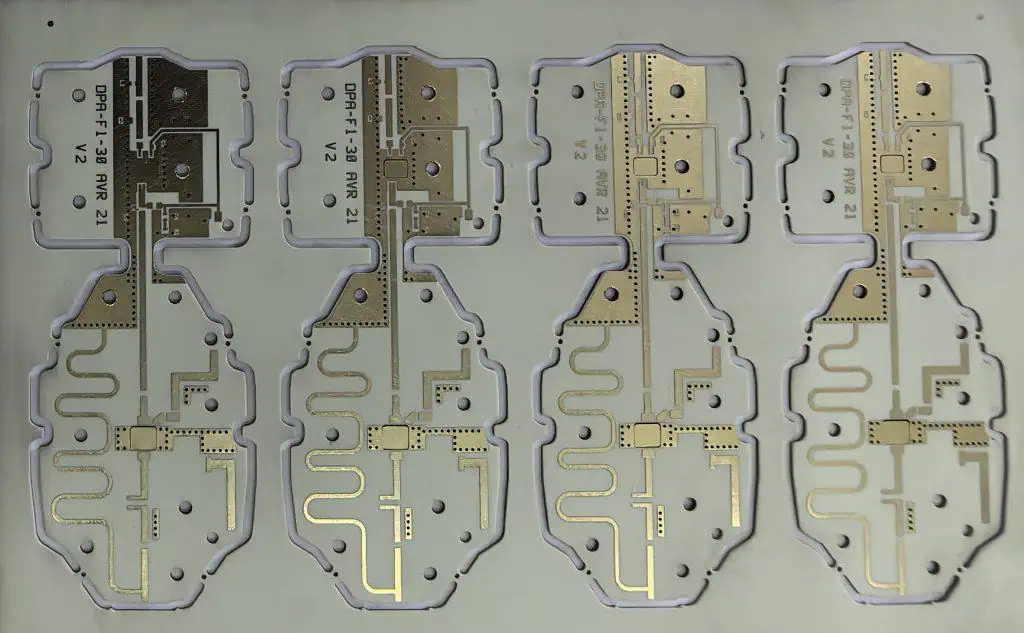
Interpret supplier electrical and thermal values before assigning design inputs. Start with the named construction and the relevant engineering requirement. The photographs show physical circuit examples, while the original-source links and explicit model assumptions support the technical review.
Which Dk should I enter for AD250C?
The Rogers web table and linked AD Series PDF assign the 2.50 and 2.52 process/design labels differently. Confirm the source, method and ordered construction with the supplier before selecting a model input. Effective permittivity is a line-geometry result, not a replacement label for either material value.
What is the most important construction detail here?
AD250C versus AD255C selection. Keep that decision in the released drawing and ask the supplier to identify the offered construction explicitly. For this material, the follow-up verification should address feed geometry, orientation and pim scope.
Does the design tool approve this PCB for manufacture?
No. It calculates the stated preliminary model or organizes a construction brief. Finished copper, transitions, mixed dielectrics, assembly interfaces and process limits may require a more complete review. The downloaded result preserves assumptions so engineering can evaluate the same inputs.
Can I obtain a price without completing the tool?
Yes. Use the direct Contact or email route with your drawing, quantity and construction requirements. The optional budget uses your entered allowances and an explicit panel model; it is not a calibrated RAYPCB tariff. Complex constructions need a file-based quotation.
What should I send with an enquiry?
Include the exact material designation, fabrication artwork, drill data, outline, proposed stackup, copper, finish and quantity. Add the relevant impedance, RF, thermal or mechanical acceptance requirements. If assembly is included, provide the BOM, placement data and test expectations.
Continue with the right engineering task
Original technical references
Supplier documents support material identity, properties and methods. They do not establish current stock or qualify an unspecified finished board. Check the exact grade, construction and document revision for your order.