
Ventec · Identity guide
Ventec VT-5235: Material Verification
Verify the requested low-Dk woven-glass grade.
The exact VT-5235 designation was not confirmed in the reviewed official Ventec portfolio. Properties from similarly numbered Ventec products must not be presented as verified VT-5235 data.
Send preliminary files or a released drawing. Identify the material, quantity and open decisions.
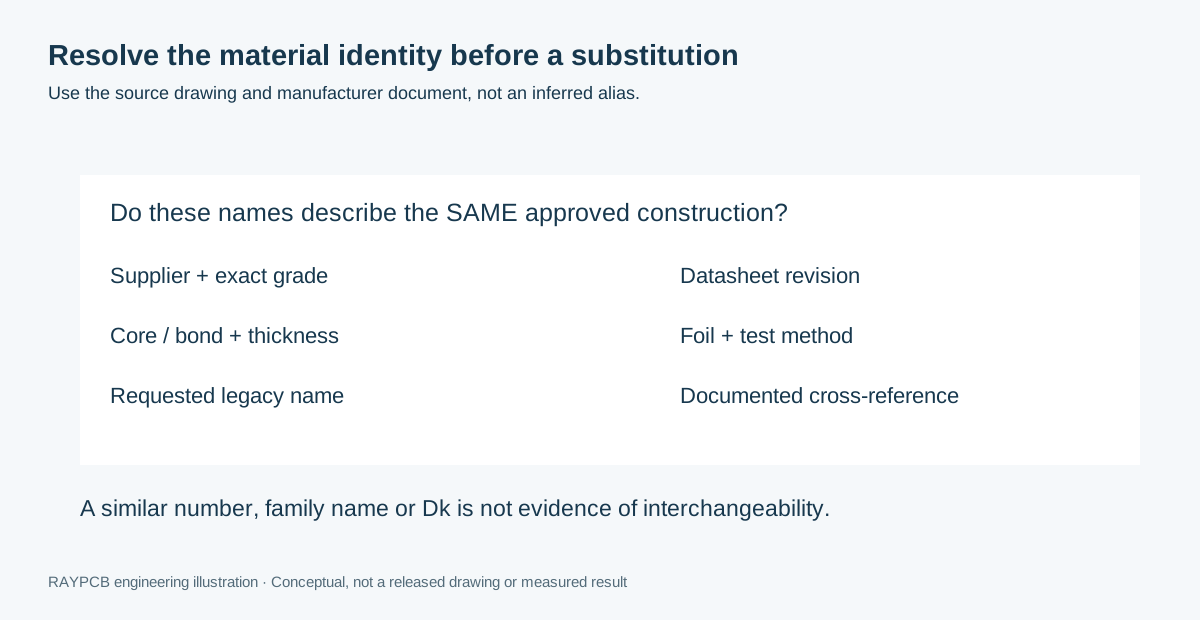
Decision first. Send the manufacturer datasheet and revision or the supplier cross-reference. Until the identity is resolved, calculate only with explicitly entered project assumptions and do not release a substituted grade.
01 / Material evidence
What to know about Ventec VT-5235: Material Verification
| Review item | What to use |
|---|---|
| Material / subject | Ventec VT-5235: Material Verification |
| Primary decision | Verify the requested low-Dk woven-glass grade |
| Exact-grade evidence | Not confirmed in the primary sources reviewed |
| Calculator material preset | None; enter an approved project value |
| Application task | Ventec material identity and sourcing review |
| Useful next step | Send the drawing and material requirement |
The stable legacy URL is retained. This page does not assert that a similarly named material is an approved substitute.
Reference: Ventec — official material portfolio.
02 / Your engineering task
Resolve a material name without inventing an equivalence
Start with the original source of the designation: a controlled drawing, an old purchase order, a supplier label or a material certificate. Capture the spelling, suffix, manufacturer and revision exactly. A near match in an online table is a research lead, not sufficient evidence to rewrite a production specification.
Ask whether the name is a current manufacturer grade, a historical product, a distributor code or a transcription error. Obtain a document that connects the requested name to the supplied material. If the supplier proposes a replacement, request both constructions and the reason for substitution, then define what must be revalidated.
Until that evidence is available, keep calculated examples clearly separate from product claims. Do not assign Dk, loss tangent, temperature capability or stock status from a neighboring grade. The useful enquiry is a material-identification review with the original documents attached, followed by a controlled engineering decision.
| Continue when you need… | Next page |
|---|---|
| Build a shortlist from circuit requirements and verified data | RF and Microwave PCB Material Selection |
| Choose among laminate constructions and material families | PTFE PCB Materials |
| Select a PTFE construction and prepare a buildable RF board enquiry | Teflon PCB |
03 / Engineering calculations
RF design workbench: width, phase and loss
Work with Ventec VT-5235: Material Verification using the exact construction data. Select a line model or a planar passive calculation. Results explain the assumptions and can be downloaded with the entered values.
RAYPCB ENGINEERING
PTFE EngineeringPTFE RF Design Workbench
Loading PTFE RF Design Workbench…
Read dielectric data in the right context
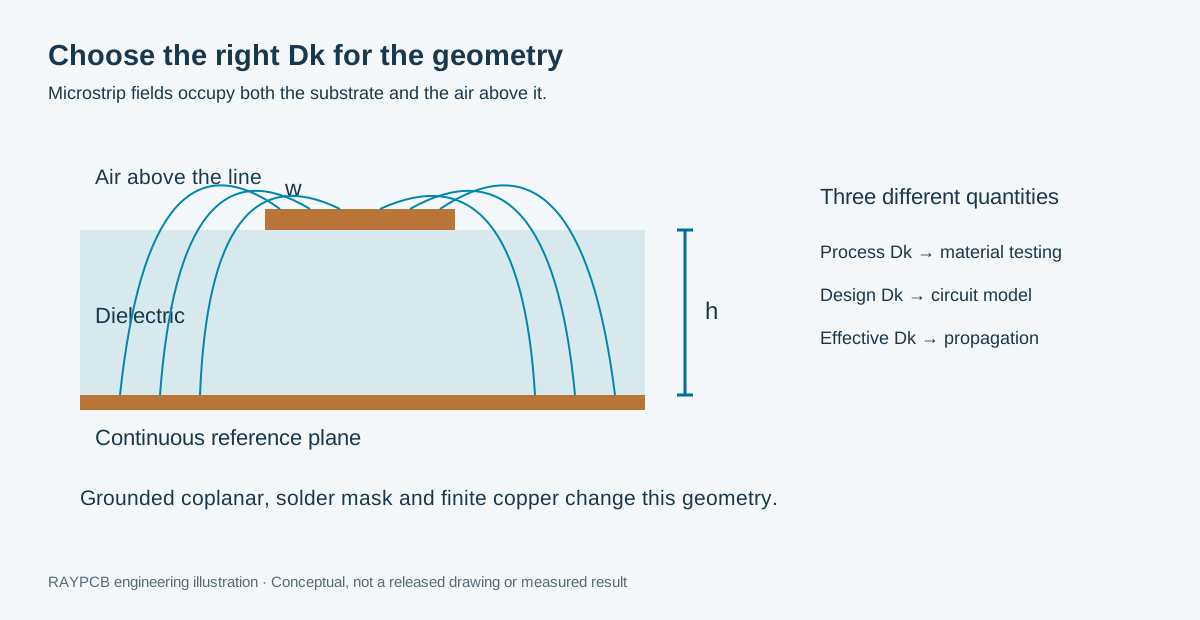
A material data table and a circuit simulation answer different questions. Process Dk is used in a defined material measurement. Design Dk is a supplier modeling reference. Effective permittivity belongs to the transmission-line geometry and includes how its fields occupy the surrounding media. Keep those labels attached when copying values into a drawing, a calculator or an RF model. An unlabeled number is difficult to audit later.
For a microstrip, identify the distance between the trace and its continuous reference plane. Do not enter total board thickness unless that dimension really is the dielectric height. For centered stripline, this workbench asks for total ground-plane spacing. An asymmetric stripline, a coplanar line with backside ground, solder mask over the trace or a mixed-dielectric stack requires a model that actually represents those features.
Use the calculation to establish scale and sensitivity. The workbench uses a zero-thickness, quasi-static line model, so it does not compensate for finished copper, etch shape, roughness, dispersion or transitions. A narrower nominal trace is not automatically a better layout. Check routability and tolerances, then correlate the chosen geometry with a field solver and an agreed fabrication coupon.
04 / Scope and budget
Cost planning and a usable quotation brief
Use this form when preparing a Ventec VT-5235: Material Verification enquiry. You can also go straight to Contact without calculating. The budget is optional and uses your own board-specific cost allowances.
RAYPCB ENGINEERING
PTFE EngineeringPTFE Fabrication & Budget Brief
Loading PTFE Fabrication & Budget Brief…
Compare cost using the same construction and acceptance scope
The laminate price is only one part of a finished RF board quotation. Ordered sheet format, panel utilization, copper, layer count, holes, bonding, handling and inspection all affect the manufacturing plan. Small quantities can carry a larger share of setup and test-fixture effort. An apparent material saving may disappear if it requires a new layout, additional coupons or a repeat qualification build.
For a meaningful comparison, hold the board outline, quantity, acceptance criteria and deliverable constant. Ask which material grade, thickness, foil and bond system each proposal assumes. Separate bare-board fabrication from component purchasing and assembly. Also separate continuity testing from impedance or RF measurements so that a lower price is not simply a smaller test scope.
The quotation tool generates a project brief by default. Optional budget numbers use your entered allowances, not a RAYPCB tariff or current market price. Its scenario range is not a statistical confidence interval. Complex hybrids, metal-backed structures, unresolved grades and special qualification work go to engineering quotation. Freight, tax and any work not explicitly entered remain outside the calculation.
05 / Review the construction
Design-to-build review for Ventec VT-5235: Material Verification
What to send for an engineering quotation
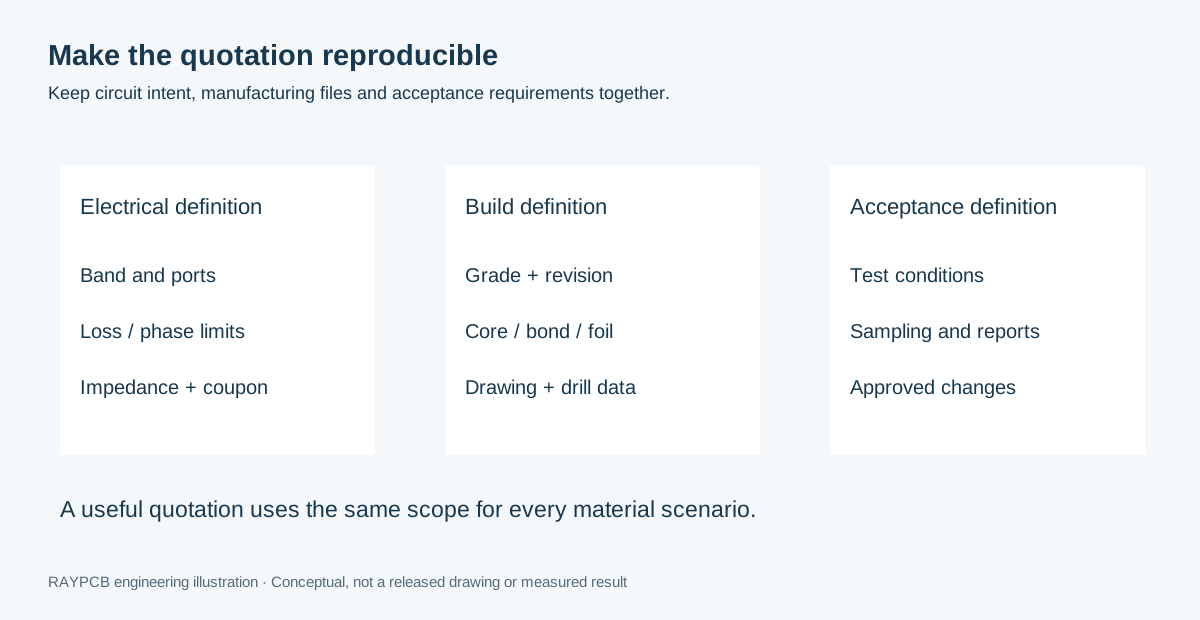
Send the circuit artwork in the agreed fabrication format, drill data, board outline, mechanical notes, quantity and revision. Add a stackup that names every core and bonding layer, dielectric thickness, copper requirement and surface finish. Identify open decisions clearly; a preliminary drawing can start a discussion, but it should not be mistaken for an approved production release.
For controlled impedance, list each target, tolerance, signal layer and reference layer. State whether the requirement is single-ended or differential and provide any intended coupon or test method. For a material-controlled build, include the exact manufacturer designation and the document revision used in design. Describe approved substitutions explicitly, or say that changes require written engineering approval.
If the order includes assembly, supply the BOM with manufacturer part numbers, placement data, assembly drawing and test expectations. Discuss connector attachment, thermal exposure and any fragile or thin RF regions before fabrication. The board material, bonding film and subsequent assembly profile must be reviewed as a system. Sending these details early makes quotations easier to compare and reduces ambiguous assumptions.
06 / Evidence and release
Prepare the next engineering review
Approve the first build and control the next revision
Agree the first-build acceptance plan before the order enters fabrication. Useful records can include material identity, stackup confirmation, dimensional checks, connectivity results, impedance measurements and application-specific RF evidence. The actual list depends on the project. Do not assume that a laminate datasheet, a supplier certificate or a photograph substitutes for finished-board inspection.
When a coupon result differs from the model, compare the same reference structure and test method before changing the material value. Check finished geometry, dielectric height, foil assumptions, fixture influence and calibration. Record any agreed compensation with the drawing revision so that a repeat order does not inadvertently revert to the original nominal dimensions.
Keep an approved build record containing material designation, laminate revision, stackup, circuit revision, permitted substitutions and test limits. Review changes to foil, bond material, panel orientation, assembly exposure or supplier route before treating the next lot as identical. A successful prototype demonstrates that particular build under its test conditions; it does not eliminate the need for controlled production changes.
07 / Practical answers
Questions engineers ask before releasing Ventec VT-5235: Material Verification
What is the most important decision for Ventec VT-5235: Material Verification?
The exact VT-5235 designation was not confirmed in the reviewed official Ventec portfolio. Properties from similarly numbered Ventec products must not be presented as verified VT-5235 data. Send the manufacturer datasheet and revision or the supplier cross-reference. Until the identity is resolved, calculate only with explicitly entered project assumptions and do not release a substituted grade.
Which Dk should I enter in the calculator?
Use the approved design/model Dk for the exact construction. Process Dk is a supplier material-test value; effective permittivity is geometry-dependent. Where this page has no verified single design value, the field remains blank. An example calculation does not establish a product specification.
Does this page confirm current stock or a guaranteed build limit?
No. Material documentation describes a product; it does not confirm current RAYPCB inventory, procurement lead time or the manufacturability of every geometry. Send the grade, drawing, quantity and required acceptance conditions for a project-specific review.
How should I compare a proposed material substitution?
Send the manufacturer datasheet and revision or the supplier cross-reference. Until the identity is resolved, calculate only with explicitly entered project assumptions and do not release a substituted grade. Compare the exact core, bond system, thickness, foil, electrical model, thermal conditions and first-build evidence. Preserve the approved drawing until the proposed change is accepted.
Does the loss calculator predict measured insertion loss?
It estimates the dielectric contribution of a simplified microstrip with an entered constant loss tangent. Conductor, roughness, radiation, mismatch, connectors and test fixtures are excluded. Use a complete circuit model and an agreed RF measurement when total insertion loss is an acceptance requirement.
Can I ask for a quote before every parameter is finalized?
Yes. Send the available files, quantity and intended use, and identify which decisions remain open. State whether you want bare boards or assembly. A preliminary enquiry can establish the next engineering questions without being treated as a released production order.
Original material references
Technical sources identify the material and explain supplier methods. They do not certify a finished RAYPCB board or confirm stock. Check the current exact-grade revision for a production order.
Resolve the grade. Then release the board.
Send the manufacturer datasheet and revision or the supplier cross-reference. Until the identity is resolved, calculate only with explicitly entered project assumptions and do not release a substituted grade.
For a broader fabrication project, see PCB Manufacturing services.