
RAYPCB · RF materials & manufacturing
RO4835T PCB manufacturing
Define the material, finished RF construction and inspection scope for a fabrication quote. Review the material data, use the engineering model, and send a defined construction for quotation.
Bring your band, stackup, quantity and acceptance requirements. Preliminary files are welcome for review.
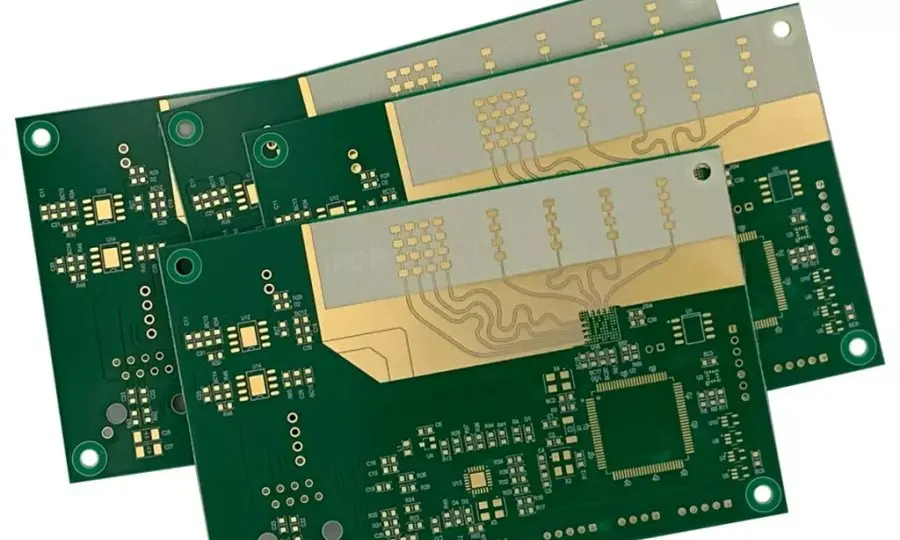
Material data and construction choices
The T suffix is an electrical construction distinction
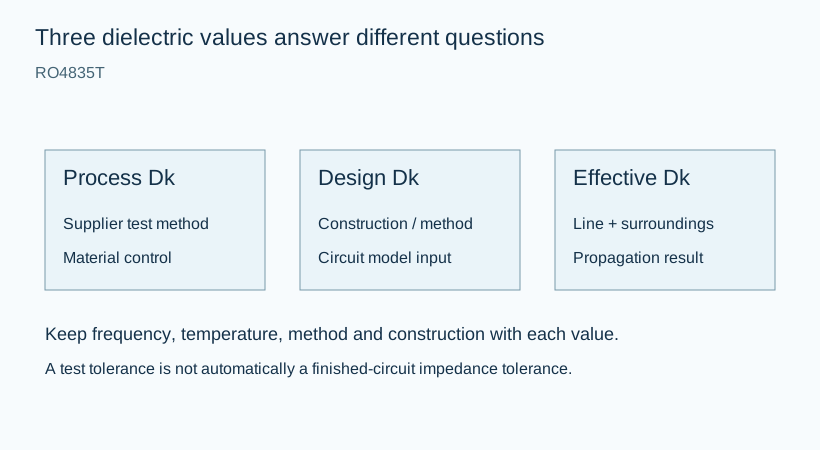
RO4835T has different published dielectric references from RO4835. The suffix must remain visible in material procurement and simulation records. When used in a layered RF structure, name the adjacent dielectrics and bonding products. Do not force an asymmetric construction into a centered homogeneous stripline calculation.
| Property | Supplier reference | Engineering meaning |
|---|---|---|
| Process Dk | 3.33+/-0.05 | Supplier process reference; use the original method and construction. |
| Design Dk | 3.48 | Separate modeling reference. Confirm applicability to the chosen geometry. |
| Typical Df | 0.0030 | Property-tool heading: 10 GHz; parenthetical values refer to 2.5 GHz. Check grade notes. |
| Typical thermal conductivity | 0.53, 0.52@80° W/m·K | Consult the grade source for direction and method; not a finished-board power rating. |
| Typical X / Y / Z CTE | 14 / 16 / 62 ppm/K | The source table states its temperature interval. Axis and conditions matter. |
| Material flammability reference | V-0 | Supplier material listing, not certification of a fabricated board or assembly. |
Source: RO4835T manufacturer product data and the Rogers laminate property tool. Values are material references; purchasing and finished-board acceptance need their own agreed specification.
RF engineering workbench
Use explicit construction inputs. Results can be downloaded or opened as an email draft; the tool does not upload project information.
Worked planning example
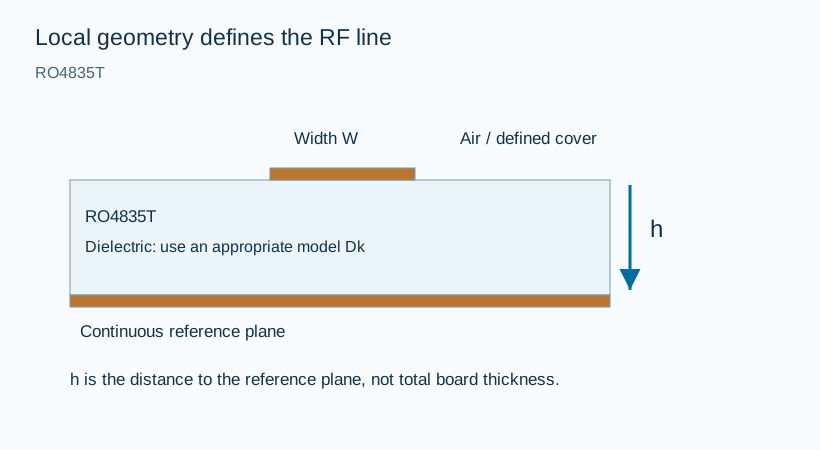
As a calculation example, use the published RO4835T design reference Dk of 3.48, a 0.508 mm dielectric height and a 50 Ω target. The zero-thickness microstrip model gives approximately 1.154 mm trace width and effective permittivity 2.741. At 10 GHz, its guided wavelength is approximately 18.107 mm. The selected height and frequency are example inputs, not an assertion that this is an available or approved material construction.
Use the result to inspect scale and sensitivity. Preserve the input units and assumptions in the downloaded brief, then use the actual finished geometry and appropriate solver or measurement method for release.
RAYPCB ENGINEERING
Rogers EngineeringRogers Engineering Workbench
Loading Rogers Engineering Workbench…
Thermoset RF laminates: a practical route to mixed RF and digital boards
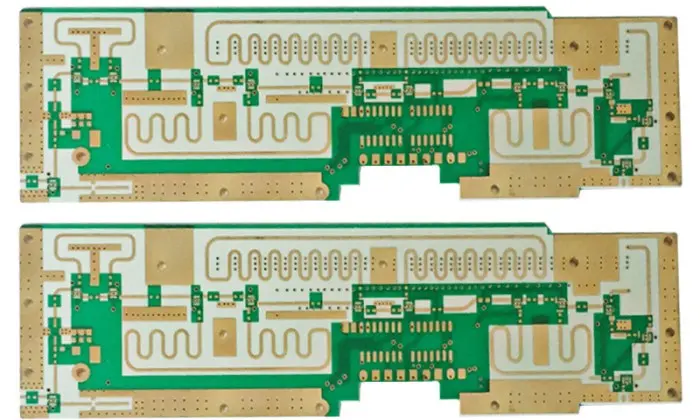
A thermoset RF laminate uses a cured resin system whose fabrication behavior differs from a PTFE laminate. Hydrocarbon-ceramic materials in the RO4000 family provide a useful route for RF circuits and mixed RF/digital constructions, but the family contains distinct grades and product roles. Core laminates, antenna materials, bonding layers and outer copper foils should remain separate entries in the layer drawing. The name RO4000 alone is not a complete stackup.
One common construction places the critical RF line near a controlled reference plane while other layers carry digital routing and power. This can focus premium material where it has electrical value. It also creates a hybrid manufacturing problem: the bonding layer, copper distribution, thermal exposure, drilled connections and overall balance must work together. Cost savings from a smaller amount of RF laminate should be compared with the additional lamination and qualification effort. A hybrid is not automatically cheaper for every quantity or geometry.
Choose the core thickness before locking the trace width. A thin RF dielectric may help confine fields and reduce an unwanted discontinuity, but it also changes line width, coupling and the copper-to-height ratio. Finished copper thickness and etch shape become important when dimensions are small. The preliminary microstrip tool intentionally omits these effects so that its result can be understood and checked. The released geometry should come from a model of the actual structure, including mask or nearby conductive surfaces when relevant.
Treat standard and low-profile copper constructions as deliberate specifications. Lower conductor profile can reduce one contribution to loss, but it does not eliminate dielectric attenuation, mismatch, launch loss or radiation. A material change may also involve construction-specific dielectric behavior. Specify the full grade and foil designation, then compare coupons with the same length and reference planes. Otherwise a measured improvement can be difficult to assign to the material change itself.
Assembly adds its own constraints. Consider connector attachment, local thermal mass, component sensitivity and any exposed RF conductor regions before choosing finish and process sequence. Material flammability data describe the tested laminate construction and should not be presented as certification of a fabricated board, an assembled product or a manufacturing company. Keep the required acceptance evidence in the order rather than relying on a general family description.
Define the board that should be quoted and manufactured
An RF board quotation is most useful when it describes the same construction that the design team intends to release. State the exact laminate grade, dielectric thickness, copper and finished board thickness separately. Add the layer sequence, outline and drill information. For a multilayer, name the bonding products rather than listing only the outer RF core. If a choice is still open, identify it as an engineering question in the request.
Mark the RF dimensions that deserve particular attention. Examples include a narrow coupling gap, a connector launch, a resonator edge or a line routed over a specific reference plane. A controlled-impedance requirement should identify the signal layer, reference layer, target and tolerance. It should also state the coupon or measurement expectations when those are part of acceptance. A generic statement that all traces are fifty ohms is rarely enough to resolve a complex circuit.
Keep finished copper and base foil distinct. Plating and etching can change the conductor cross-section used in the electrical model. Surface finish, solder mask and nearby cover materials can also affect exposed RF structures. Ask the fabrication review to return any proposed change to these assumptions before the design is frozen. An unexplained substitution can make an apparently cheaper quotation difficult to compare with the intended build.
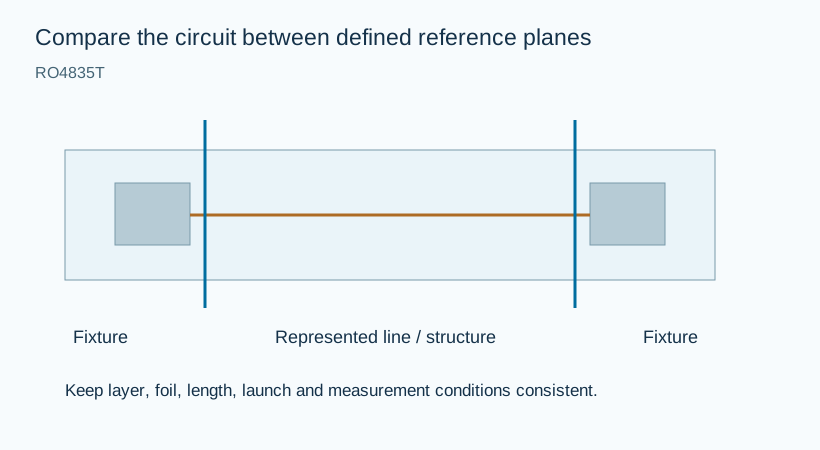
The first build should test the assumptions that matter to the product. A continuity result verifies connectivity. An impedance coupon provides evidence for its represented line structure. RF insertion-loss, phase or filter-response testing requires additional fixtures, reference planes and acceptance conditions. Agree the scope before ordering so that the delivered records answer the intended engineering question.
For assembly, add the bill of materials, placement data, assembly drawing and test plan. Include special connector, heat-spreader or device-attachment requirements early. The fabrication and assembly scopes can then be reviewed together while remaining separately identifiable in the quotation. The direct enquiry route on this page is available without completing the calculators; the tools simply help make the technical brief clearer.
Cost planning and a direct RFQ route
Where the cost changes, and which savings are real
For a small RF order, setup, procurement and test preparation may matter as much as the area of laminate. A panel that holds more circuits spreads some shared effort across more boards, but only if the orientation, tooling and coupon requirements permit that layout. The budget tool uses an explicit rectangular nesting model so that its area assumption can be inspected. It does not assume every visible square millimeter of a panel becomes a delivered board.
Copper foil, core thickness and bonding system are part of the purchased construction. A quotation based on a different thickness or foil is not a clean price comparison, even when the headline material name matches. Ask whether the offered material is standard for the supplier's available construction and whether minimum purchases, special handling or qualification work affect the lot. Availability and lead time must be confirmed for the actual order rather than inferred from a web page.
Complexity can move cost in several directions. A hybrid stack may reduce the amount of premium RF laminate while adding press planning and interface review. Metal backing can improve a thermal path while adding bonding and machining requirements. Extra coupons or RF fixtures can reduce uncertainty but add material, setup and measurement work. Compare the complete project scope instead of ranking designs by laminate price alone.
The optional numerical budget uses cost allowances entered by the visitor. It contains no calibrated RAYPCB tariff and does not claim current market pricing. The model combines the costed panels, one-time setup, batch testing and per-board processing; assembly is included only when selected and entered. Shipping, taxes, process yield loss and unentered qualification are excluded. A zero value means already included or deliberately zero, not unknown.
When geometry, quantity or supply scope changes, revisit the allowances. A per-board processing cost from one batch may not apply to another. The tool clears old allowances on those changes to avoid presenting a stale total. Hybrid, metal-backed, unresolved and more complex multilayer constructions go to engineering quotation. The downloaded brief remains useful because it carries the requirements and assumptions even when a numerical price would be misleading.
RAYPCB ENGINEERING
Rogers EngineeringRogers Fabrication Budget & RFQ
Loading Rogers Fabrication Budget & RFQ…
Prefer to send files now? Contact the RAYPCB team with the requested material, construction and quantity. An exact quotation is based on the agreed scope.
Verify the construction that matters to the product
A measurement plan that answers the design question
Begin with what the prototype must establish. Is the question electrical continuity, line impedance, insertion loss, phase balance, resonant frequency, thermal behavior or mechanical fit? These are different tests and they may require different coupons, fixtures and acceptance limits. A test label without the represented structure and measurement method leaves room for two parties to interpret the result differently.
For RF measurements, define the reference planes and account for the launch or fixture. A raw network-analyzer trace can include connectors and transitions that are not part of the material comparison. De-embedding or a representative reference structure may be needed, depending on the question. Record calibration, frequency span, temperature and the circuit revision with the result. This makes later comparisons more informative than a single unqualified pass statement.
Investigate a disagreement between the model and the board in a controlled sequence. Check the finished conductor dimensions, dielectric height, material construction and measurement setup before changing the Dk to force a fit. The model may omit a nearby cover, a return-path discontinuity or a loss mechanism. Equally, the test fixture may represent a different structure from the intended coupon. Identifying the cause protects the next build from an accidental compensation.
Keep the accepted construction and records together. A successful prototype supports the tested revision under its stated conditions. Changes to material, foil, bond system, geometry, assembly exposure or test scope deserve review before a repeat order is treated as equivalent. The project does not need every possible test; it needs the evidence that resolves its actual risks and acceptance requirements.
RAYPCB ENGINEERING
Rogers EngineeringRogers Construction Explorer
Loading Rogers Construction Explorer…
Questions before the next design or purchase decision
What should this page help me decide?
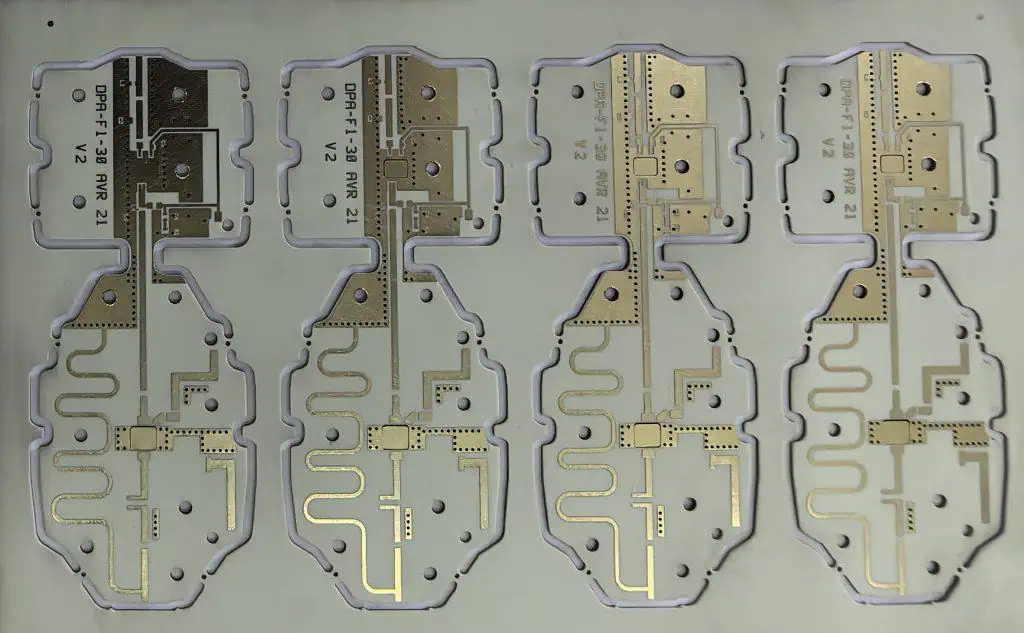
Define the material, finished RF construction and inspection scope for a fabrication quote. Start with the named construction and the relevant engineering requirement. The photographs show physical circuit examples, while the original-source links and explicit model assumptions support the technical review.
Which Dk should I enter for RO4835T?
The supplier process reference is 3.33+/-0.05; the separate design reference is 3.48. Use the value and method appropriate to the actual construction and model. Effective permittivity is a line-geometry result, not a replacement label for either material value.
What is the most important construction detail here?
RO4835T versus RO4835. Keep that decision in the released drawing and ask the supplier to identify the offered construction explicitly. For this material, the follow-up verification should address thin rf layer and hybrid-stack modeling.
Does the design tool approve this PCB for manufacture?
No. It calculates the stated preliminary model or organizes a construction brief. Finished copper, transitions, mixed dielectrics, assembly interfaces and process limits may require a more complete review. The downloaded result preserves assumptions so engineering can evaluate the same inputs.
Can I obtain a price without completing the tool?
Yes. Use the direct Contact or email route with your drawing, quantity and construction requirements. The optional budget uses your entered allowances and an explicit panel model; it is not a calibrated RAYPCB tariff. Complex constructions need a file-based quotation.
What should I send with an enquiry?
Include the exact material designation, fabrication artwork, drill data, outline, proposed stackup, copper, finish and quantity. Add the relevant impedance, RF, thermal or mechanical acceptance requirements. If assembly is included, provide the BOM, placement data and test expectations.
Continue with the right engineering task
Original technical references
Supplier documents support material identity, properties and methods. They do not establish current stock or qualify an unspecified finished board. Check the exact grade, construction and document revision for your order.