
HDI engineering
Microvia Qualification: Evidence & Release Review
Match microvia reliability evidence to the actual via chain, materials and thermal exposure. Prepare a traceable review request with explicit specimens, methods, criteria and unresolved decisions.

The practical decision
Use geometry to identify questions early, then review the complete via chain and assembly/service conditions with the fabricator. Single-level, staggered and stacked structures have different process and verification requirements.
Understand the historical warning without overgeneralizing it
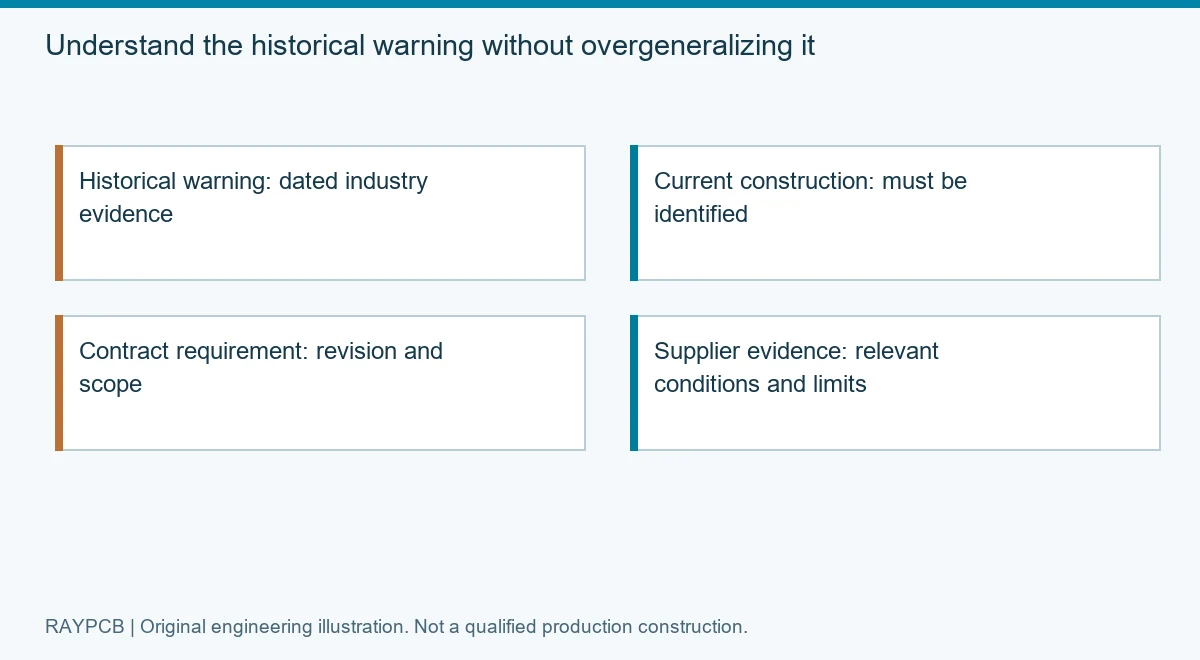
IPC's 2019 microvia reliability warning reported failures that appeared after traditional board acceptance, including during later assembly or service. It highlighted weaknesses at certain microvia interfaces and the limitations of relying on particular inspection approaches alone. The dated warning is important context, but it is not evidence that every present-day stacked construction fails or that a particular supplier's current process is unqualified.
Use that history to ask better questions. Which interface is critical in this design? What thermal exposure will the board experience after bare-board acceptance? What observation would detect a temporary electrical discontinuity during that exposure? A room-temperature continuity result and a cross-section photograph answer useful but different questions. Neither should be presented as evidence for conditions that were not evaluated.
Check the applicable project specification and current document status before selecting a test method or criterion. Do not copy a revision designation from an old article and assume it is the contract requirement. If the customer invokes a particular standard, identify its revision and any addendum or agreed exception. Keep the normative requirement separate from the engineering rationale discussed here. The HDI manufacturing hub provides the construction context; this page helps structure the evidence conversation. A useful supplier response describes what was tested and how it relates to the proposed board, rather than simply repeating that its process follows industry standards. That distinction lets the customer make a reasoned decision without either dismissing the issue or overstating it.
- Define geometryDepth + diameter + layer pair
- Map the chainSingle + stacked + staggered
- Specify processPads + fill + surface
- Agree evidenceConstruction + reliability
Define the construction under review
Identify the board revision, material system, layer pairs and complete via chain. Retain the dimensional convention and process proposal with those records. Qualification evidence must describe a relevant construction rather than a generic microvia label.
Use the microvia structure and capture guide to define entry and target geometry. Use the aspect-ratio and tolerance worksheet for depth-to-diameter arithmetic. This page organizes the evidence needed after those definitions are clear.
Describe the interface that the evidence must represent
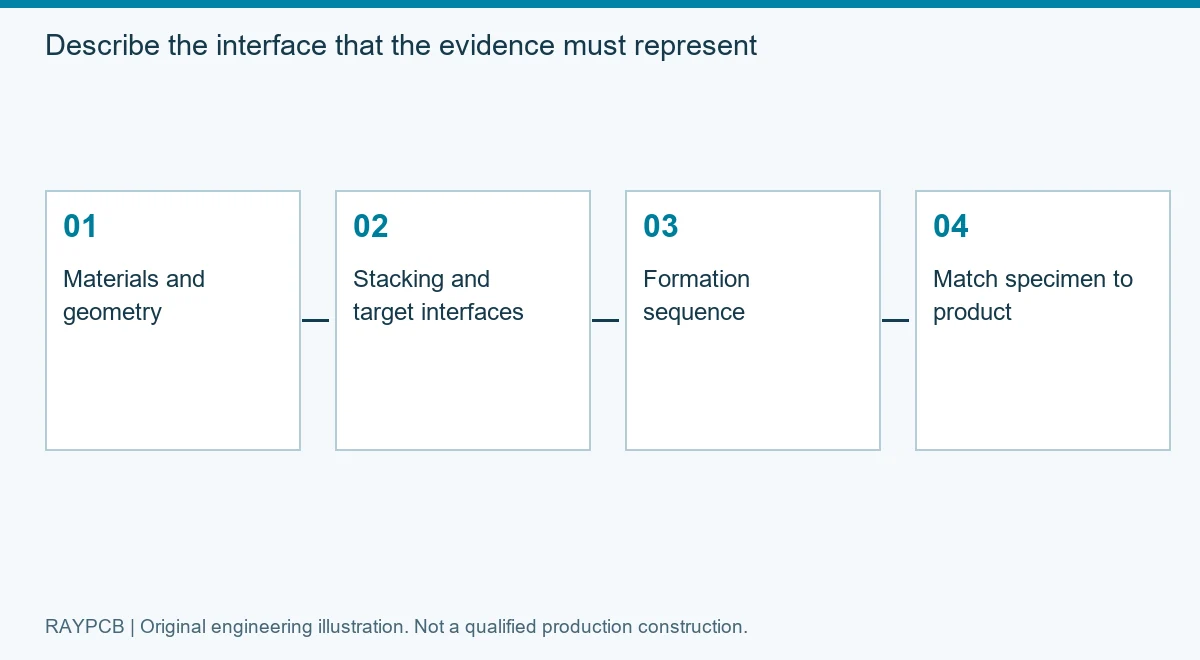
Create a construction fingerprint before reviewing test results. Include dielectric materials and thicknesses, copper construction, via depths and diameters, land geometry, stacking or staggering arrangement, fill/cap requirements and manufacturing sequence. Identify which interfaces are present in the product. A report for a single-level microvia is not automatically equivalent to a report for a stacked interface on a buried connection.
The fingerprint does not need to expose every proprietary factory parameter. It should be detailed enough to determine whether the qualification specimen and product share the features that matter. Ask the supplier to identify relevant differences and explain why the evidence remains applicable or where additional work is proposed. A simple “similar board” statement leaves too much unresolved, especially when the material or sequence differs.
Link this record to the layer and via sequence. The final cross-section shows the geometry, while the sequence explains which interfaces are created before later operations. Keep the aspect-ratio calculation as one geometric input, not the whole qualification basis. For example, two holes can have the same ratio while landing on different surfaces or using different material systems. A useful evidence review therefore begins with a side-by-side construction comparison. Mark features as matched, different with justification, or unresolved. This is more informative than a single supplier score and avoids interpreting a missing document as a failed test. It also creates a change-control baseline: when the construction changes, the team can see which evidence needs reconsideration.
Compare the evidence scope with the proposed build
Consider an illustrative proposal with two connected microvia levels and a specified material system. A report for a different single-level construction is useful background, but it does not automatically qualify the proposed chain. Record what differs and ask the responsible engineer how relevance will be established.
| Record | Compare with this build | Open decision |
|---|---|---|
| Specimen identity | Revision, material, spans and interfaces | Does it represent the proposed construction? |
| Conditioning | Assembly, rework and service exposures | Which exposures are covered or excluded? |
| Method | Procedure, measurement sequence and sampling | Does it address the concern? |
| Criterion | Source, revision and agreed interpretation | Who accepts the result and deviations? |
Review thermal history and electrical observation together
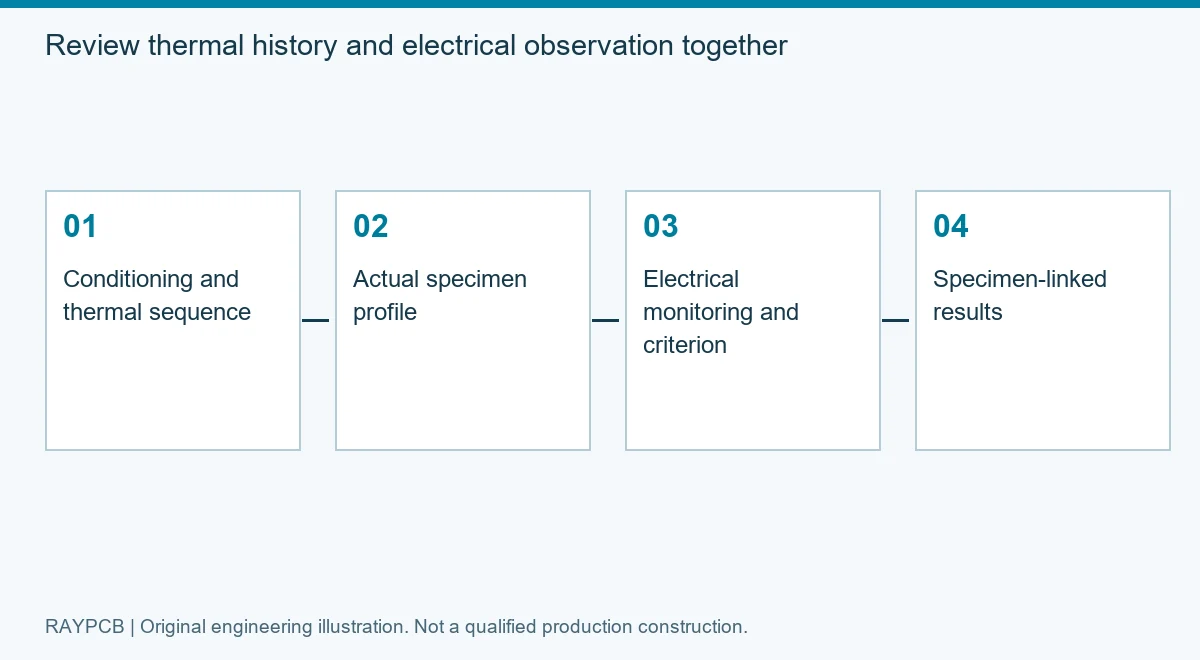
A test description should identify the conditioning and thermal exposure applied to the specimen. Relevant details can include the sequence, number of exposures, measurement locations and how the profile represents the assembly process. Avoid assuming that a nominal oven setting describes the actual specimen temperature. The chosen method and project requirements determine what must be controlled and reported.
Electrical monitoring should be described with equal care. State what circuit is monitored, when measurements occur, instrument resolution and the failure rule. An observation only before and after exposure can miss a temporary discontinuity that occurs during the event. Continuous or event-sensitive monitoring may address a different question, but it still needs a defined setup and criterion. Do not invent a resistance-change threshold from a general article; obtain the applicable method and agreed requirement.
Keep the thermal trace and electrical result associated with the same specimen. A photograph, a profile from another run and a summary pass statement may each be useful, but they should not be assembled into a stronger claim than the records support. Record sample count and individual outcomes rather than only the average. If failures occur, identify the investigation and disposition without extrapolating immediately to every board of that type. If no failures occur, report the tested conditions and sample count, not unlimited lifetime. This evidence discipline makes the review reproducible. It also helps distinguish a genuine construction issue from a fixture, measurement or handling problem, because the relevant conditions and observations are retained together instead of being reduced to one unexplained pass/fail cell.
Review more than one hole
Staggered microvias are offset between successive levels; stacked microvias align through levels. A chain can also connect to a buried via. Show these relationships in a cross-section tied to the layer-pair drill definitions, rather than describing everything as “HDI vias.”
| Structure | Review focus | Supporting information |
|---|---|---|
| Single-level | Hole preparation, landing and fill | Actual dielectric and pad geometry |
| Staggered | Offset, routing area and connection between levels | Layer plan and clearances |
| Stacked | Interfaces and complete chain reliability | Process proposal and verification evidence |
| Buried-via combination | Transition between via structures | Complete cross-section and process sequence |
Map those layer relationships in the HDI stackup and lamination review.
Check coupon relevance and sampling limitations
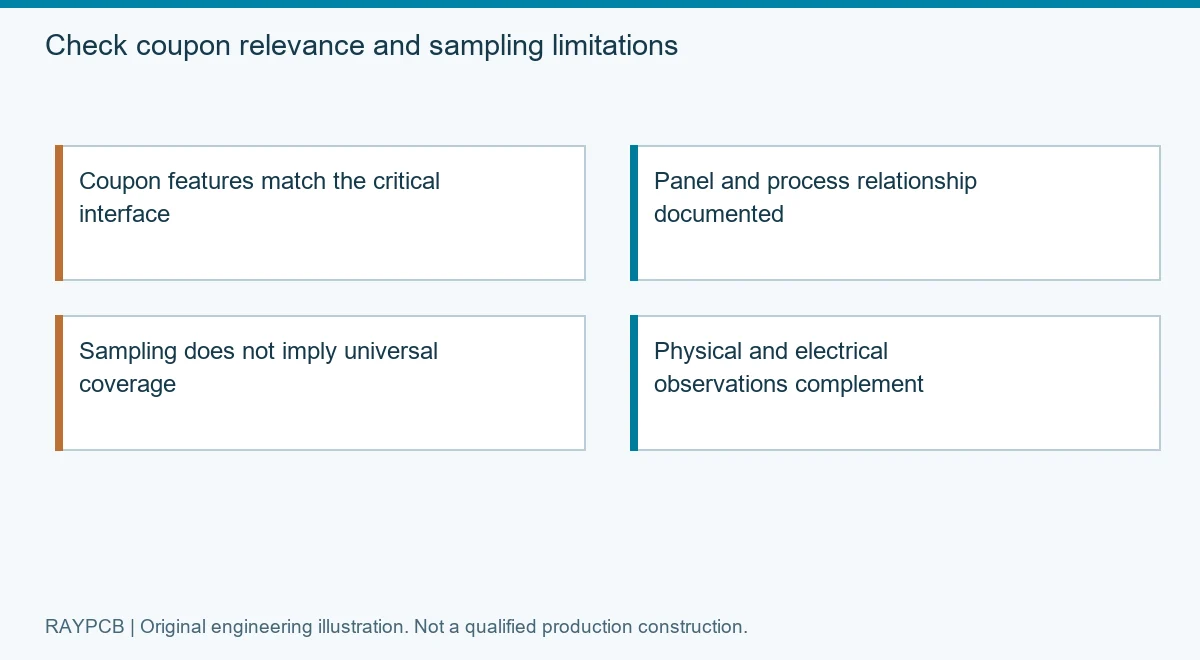
A coupon is useful when its critical features represent the construction under review. Confirm the via arrangement, materials, target interfaces and manufacturing history. The coupon's placement and relationship to the production panel should be described where relevant. A generic chain may provide process information while missing a product-specific geometry or thermal condition. Ask what it represents rather than assuming every coupon is interchangeable.
Sampling introduces another limit. A successful sample does not prove that every production feature is identical, and a small test set does not establish a precise field failure probability. If a statistical claim is needed, define the model, confidence and representativeness requirements explicitly. For many engineering reviews, the immediate task is narrower: determine whether the proposed construction has relevant evidence and whether the lot acceptance plan is agreed.
Use cross-section or other physical analysis as part of a coherent investigation, not as a decorative attachment. The location, preparation and observed feature should be identified. A section that does not intersect the critical interface cannot answer the same question as one that does. Likewise, a visually acceptable section is not a substitute for an electrical observation under the required condition. When evidence is incomplete, record the gap in specific terms: unrepresented interface, missing thermal history, unclear criterion or insufficient specimen identity. This gives the supplier something concrete to resolve. A vague demand for “more reliability data” often produces more documents without improving the decision. The evidence worksheet is intended to make the question precise while preserving the distinction between a missing record and a demonstrated nonconformance.
Agree evidence for the actual construction
IPC has warned that microvia interface failures can appear after fabrication acceptance, including during assembly thermal exposure, and has highlighted limitations of traditional microsections alone. Discuss suitable evidence for the via chain, materials and expected reflow/rework conditions. Room-temperature continuity alone does not demonstrate long-term interconnect reliability.
For a manufacturability discussion, bring the complete chain to the HDI manufacturing review.
Approve with a defined scope and change triggers
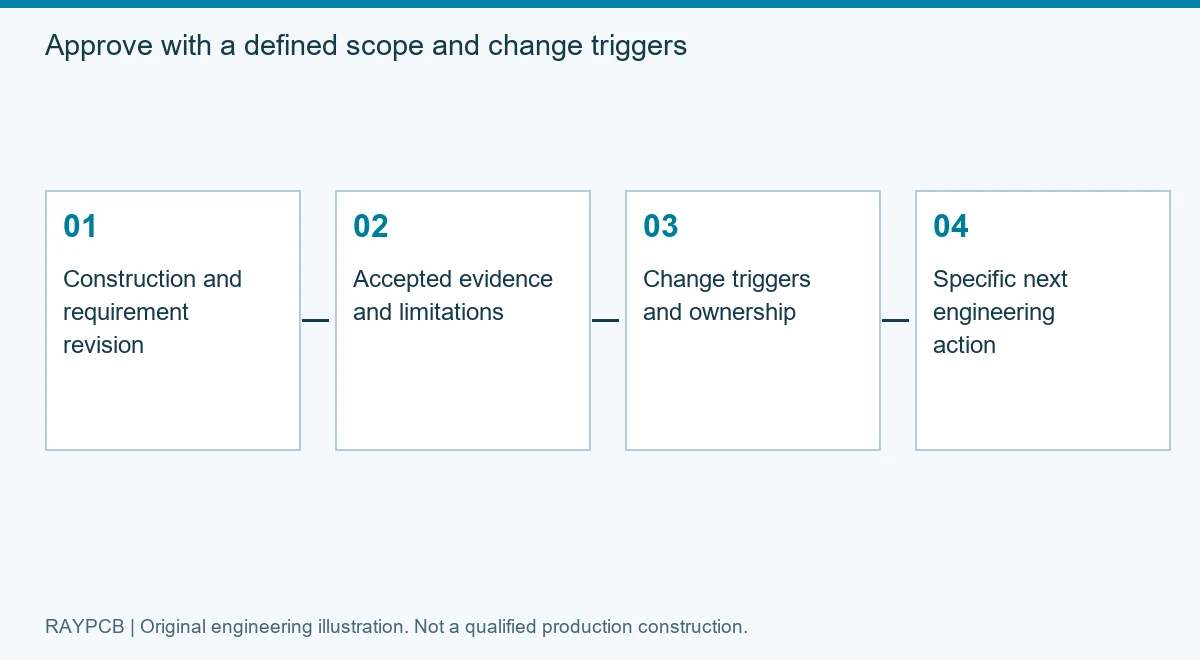
The release record should state the construction reviewed, evidence accepted, requirements invoked and any remaining limitations. Identify the person or role responsible for the engineering decision; do not invent a reviewer identity for a webpage. If a condition is accepted provisionally for development, say so and define what must be completed before the next production stage.
Agree change triggers with the supplier and product team. Material substitution, via geometry change, stacking change or a relevant process-sequence change may require an evidence review. Not every administrative edit needs requalification, but the distinction should be deliberate. Retain earlier records as history and link the current decision to the correct revision. This avoids a common problem in which a valid old report is repeatedly attached to newer constructions without any documented comparison.
For an enquiry, submit the via map, material stack, assembly thermal expectations and product environment through manufacturing review. Ask for evidence applicable to the proposed construction and identify the particular uncertainty. The downloadable worksheet can organize the response without turning it into an unsupported supplier ranking. A strong outcome might be approval within a defined scope, a revised construction with better support, or a targeted qualification plan. Each is more useful than a blanket statement that HDI is reliable or unreliable. The aim is to make the interconnection decision traceable, so the customer knows what has been demonstrated, under which conditions and what changes would require another look.
Separate qualification from lot acceptance
Use the test-method selection guide to distinguish procedure from acceptance criteria. A method number alone does not provide a pass threshold, and a geometrical ratio does not certify reliability.
Separate qualification, lot acceptance and product testing
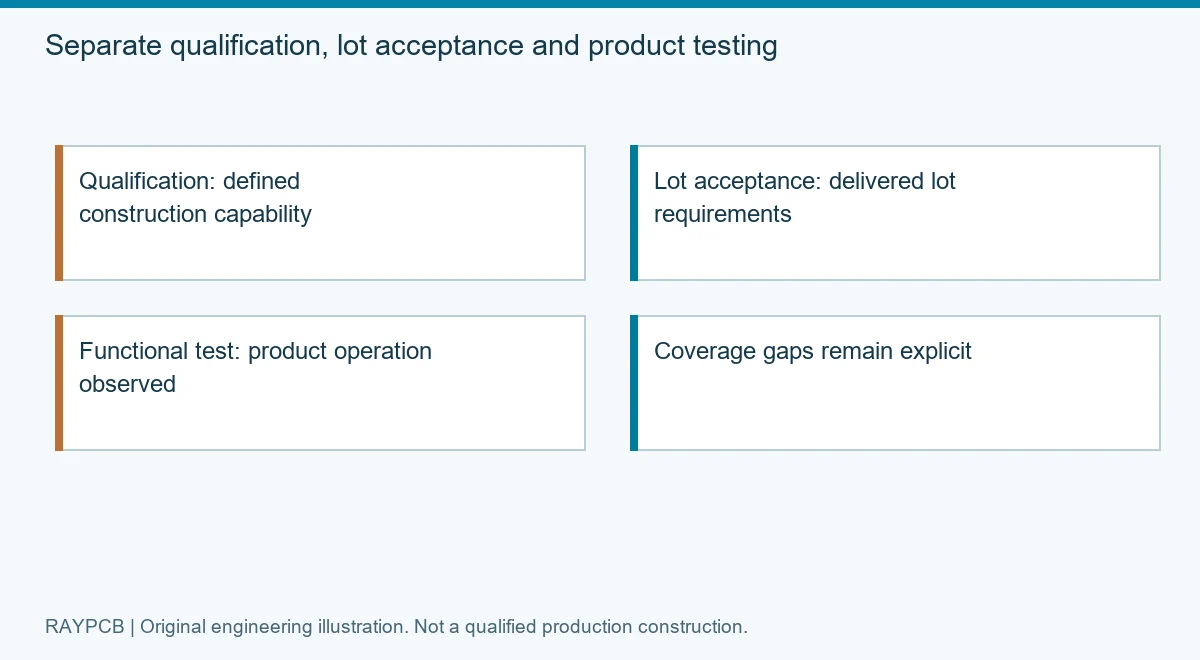
Qualification asks whether a defined construction and process meet an agreed set of requirements under specified conditions. Lot acceptance asks whether the delivered lot satisfies the applicable purchase requirements and inspection plan. Functional testing asks whether the assembled product performs its intended functions under the test conditions. These activities can support one another, but they are not interchangeable.
A functional test may exercise only some connections and may occur after the board has cooled. A bare-board electrical test can cover connectivity without reproducing later thermal loads. A qualification coupon can be designed to expose a particular interface but may not reproduce every product feature. State what each activity covers and what it leaves unobserved. This prevents a test report from being used as a blanket answer to a different question.
For a project review, make an evidence table with requirement, specimen, method, condition, acceptance basis and responsible party. The same table can identify existing evidence, planned work and unresolved scope. Do not mark planned testing as completed or treat a certificate title as proof that the relevant specimen passed. Ask for the result and its construction identity. If the supplier's routine lot plan differs from the customer's qualification need, resolve that before the quote is accepted. The outcome may be a standard lot acceptance process plus a separate qualification activity, not an expansion of every order into a research program. This distinction keeps the request proportional to the product while preserving the evidence needed for a critical interconnection. It also helps purchasing understand why two otherwise similar quotations may include different verification costs.
Working document
Prepare your handoff checklist
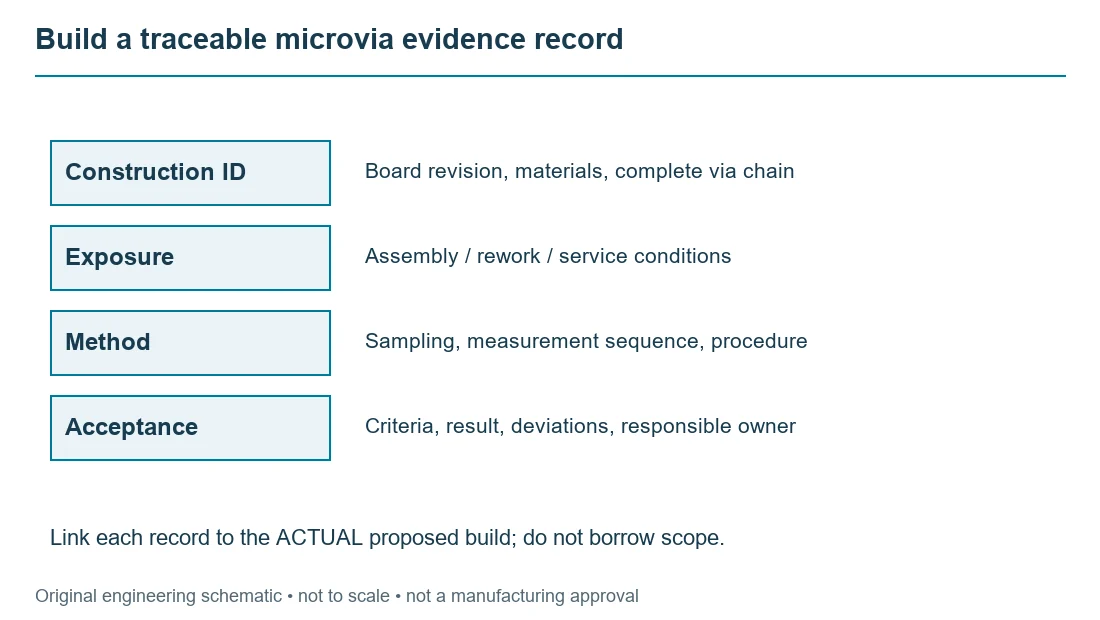
Open the editable text worksheet, save a copy and record the requirement, owner and evidence for each item. Keep unanswered points visible when requesting review.
- PCB revision and application conditions
- Stackup and depth for each via span
- Layer-pair drill definitions
- Diameter convention and pad geometry
- Complete via-chain drawing
- Fill/cap and surface requirements
- Applicable qualification scope, method revisions and acceptance criteria
- Assembly thermal exposure and rework expectations
- Specimen traceability, results, deviations and responsible acceptance owners
The Contact page is a separate enquiry step. Attach your completed worksheet and relevant files there using its available submission options; this page does not automatically transfer your answers.
Questions before accepting the evidence
Does a report for another stack qualify this one?
Not automatically. Compare construction, process and exposure differences, then document the engineering basis for any accepted relevance.
Is a room-temperature continuity result enough?
It answers a limited electrical question. The complete evidence plan should address the intended concern, construction and thermal exposures.
Who decides whether an exception is acceptable?
Identify the responsible design, fabrication and quality owners in the review record. Preserve the requirement, proposed exception and approval before release.
Continue with the next engineering task
Technical references
- IPC: microvia reliability warning and acceptance considerations
2019 reliability background on latent microvia-interface failures. It is not a substitute for the current agreed performance specification.