RAYPCB · ENGINEERING GUIDE
Nelco N4000-2 PCB: Legacy Specification Recovery
A Nelco N4000-2 PCB request usually needs an exact legacy material record before it needs a new property table. The N4000 family contains distinct systems and suffixes. This page helps recover the original N4000-2 requirement without silently replacing it with a better-documented neighboring product.
The Nelco PCB overview provides family context. This stable page is focused on specification recovery, supplier clarification and a controlled alternative decision.
State the exact-source gap clearly
The current official material resources reviewed for this page did not establish a controlled N4000-2 technical sheet for the requested construction. That is a limitation of the available evidence, not proof that the product never existed or is discontinued. Numerical properties are therefore not reconstructed from other N4000 grades.
Ask for the original TDS, drawing revision, material certificate or approved material-list entry. Preserve any laminate and prepreg part numbers. A reseller summary may help locate a document, but it should not become the controlling technical source without verification.
Evidence and construction decision
| Item | Source or model boundary | Action for the design review |
|---|---|---|
| Identity | Exact N4000-2 TDS not verified | Recover original drawing and supplier evidence. |
| Comparison | N4000 family names are not interchangeable | Do not assign N4000-13 values. |
| Orderability | Not determined by historical evidence | Request a current supply response. |
Recover the function behind the old material callout
Identify whether the original choice was driven by thermal exposure, insulation, impedance, mechanical fit or a qualified customer program. The replacement needs to satisfy those requirements, not merely belong to an epoxy family with a similar name.
Separate recovered limits from current engineering assumptions. If a number was inferred during troubleshooting, label it as such. This prevents an unsupported estimate from becoming a permanent purchase requirement when the drawing is revised.
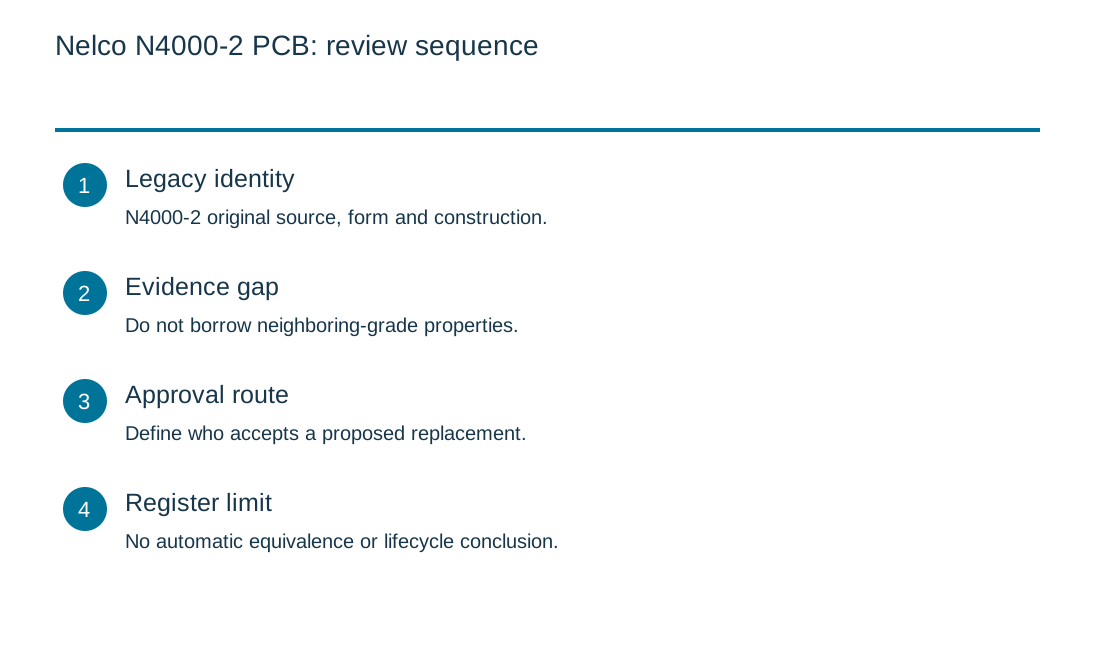
| Review item | What to establish |
|---|---|
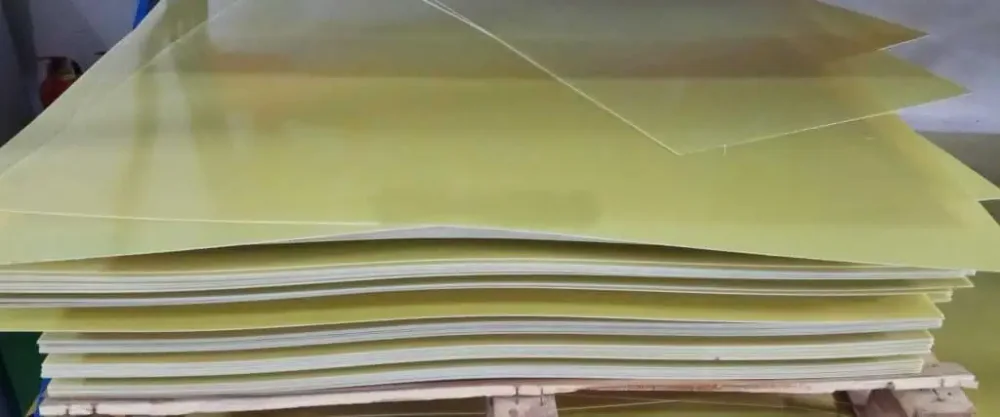
| Legacy identity | N4000-2 original source, form and construction. |
| Evidence gap | Do not borrow neighboring-grade properties. |
| Approval route | Define who accepts a proposed replacement. |
| Register limit | No automatic equivalence or lifecycle conclusion. |
Use the evidence register to make the inquiry specific
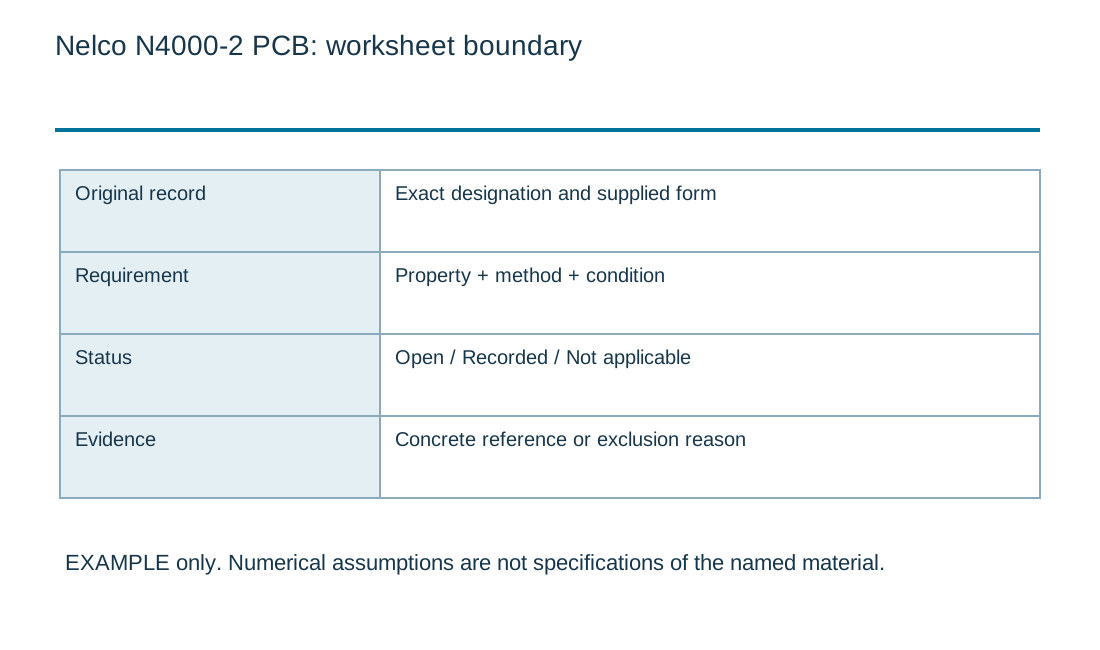
The local worksheet records requirements, status and source references. A recorded row must contain evidence, and a not-applicable row needs a reason. It does not score the material as approved or authenticate the document supplied by a visitor.
Useful separate rows include exact identity, supplied form, construction, thermal requirement, electrical model and current supplier response. Keeping these distinct allows the manufacturing team to answer the open questions without assuming that a recovered brand name resolves the entire stackup.
Nelco N4000-2 PCB requirement register
Nelco N4000-2 PCB requirement register
Use the current inputs and keep the assumptions
Start with the example only to inspect the units and the calculation boundary. Replace every assumption with a value tied to your own document or measurement. An empty numeric field is not zero. The review-reference field is a local label; avoid entering customer names, confidential part numbers or other private information into a public worksheet.
After calculating, read the notes alongside the numerical result. Changing any input invalidates the displayed result and disables its download until you calculate again. For a comparison, keep the units, geometry, material condition and measurement boundary consistent. A long decimal result does not imply equally precise input data. The downloadable record stays on your device and can be attached manually to an inquiry. It is not automatically transferred into the Contact form.
If an input is unknown, identify the person or document needed to resolve it. Do not fill a gap with a favorable generic value simply to obtain a result. You can request a material or fabrication review without using the tool. The arithmetic illustrates a relationship; it does not accept a construction, certify a material, establish current pricing or replace a supplier process specification.
| Input | What to establish before using it |
|---|---|
| Review reference | Nonconfidential revision label. |
| Requirements and evidence · CSV | Status is Open, Recorded or Not applicable. Recorded needs a source reference; exclusions need a reason. |
Optional cost comparison from your own allowances
Use a quotation or a clearly labeled internal assumption for each input. Keep the quantity, construction and inspection scope the same when comparing alternatives. This uncalibrated planning model adds entered values; it contains no current market rates and does not issue a RAYPCB quotation. You can contact the team without completing it.
Optional project allowance comparison
Compare neighboring products without transferring their specifications
N4000-6 FC has a historical fast-cure context. N4000-12 SI has a different signal-integrity task. N4000-13 has current official product information with its own part-number and suffix distinctions. None of their properties should be renamed N4000-2.
If an alternative is proposed, compare exact construction, copper, dielectric intervals, holes and required evidence. State which changes need customer approval. A favorable Tg or Df alone does not establish a drop-in replacement for a controlled design.
Keep supply and cost questions separate from identity
A supplier may be able to discuss a historical grade without offering it in the required form today. Request a dated response covering thickness, copper, quantity and material records. Do not infer availability from an old web page or assume a missing catalog entry settles the lifecycle.
The cost worksheet adds only entered allowances. Include one-time engineering and qualification separately from recurring fabrication and testing. If the material identity is unresolved, the resulting total remains a planning scenario rather than an exact manufacturing quotation.
Close the legacy decision with a controlled record
Send the original files, available source evidence, intended quantity and the reason N4000-2 remains on the drawing. Identify the approval authority and the permitted alternative policy. Include any field or assembly issue that triggered the review.
The desired outcome is an exact-material supply proposal or a documented replacement with clear verification steps. Preserve the old callout and the approved mapping in the change history. The evidence tool helps organize that work; it does not approve equivalence, establish stock or release production.
Resolve the original callout without losing the design requirement
A useful material callout connects the required function to a named document, a measurable condition and an approval owner. Keep the exact grade and supplied form with the thickness basis, copper treatment, test method and substitution rule. This prevents a purchasing shorthand from silently replacing a more precise engineering requirement.
Distinguish typical characterization from a guaranteed supply limit. A typical result may help compare options, but it is not automatically the acceptance value for an incoming lot. If a supplier proposes an alternative, compare the properties that affect this design and the manufacturing evidence needed to use it. Record the decision with a drawing or material-list revision instead of leaving it only in an email thread.
For an inquiry, provide the construction, required quantity, application conditions and any nonnegotiable specification references. Ask which requirements need additional evidence or lead time. A clear open question usually produces a more useful response than a broad request for the best laminate.
An unresolved name is a reason to investigate, not a reason to invent a plausible datasheet. Start with the oldest controlled record that actually belongs to the design. A material label, drawing revision or archived supplier sheet can establish a more useful trail than many websites repeating the same unsourced paragraph. Preserve the exact characters and supplied form while the question remains open.
Ask the supplier to distinguish four possible responses: exact product identified, historical product identified, internal code mapped to a product, or a different product proposed as an alternative. Each response leads to a different approval step. A commercial offer for a replacement does not prove the historical name was equivalent.
If a replacement is needed, define the board requirements independently of the old name. Compare electrical design inputs, thermal exposures, reinforcement, thicknesses, copper and manufacturing compatibility. Decide which previous qualification evidence remains applicable and which work must be repeated. Keep the approved decision with the current drawing while retaining the old callout in the change history.
Do not describe an unverified grade as discontinued merely because a public search did not find it. Equally, do not promise current stock because an old certificate exists. Identity, lifecycle, orderability and suitability are separate questions. The inquiry should identify which answer is needed and what evidence would resolve it.
Standards, source context and limits
Use the edition, amendment and material-document revision named in the purchase agreement. A standards title, marketing label or supplier product family does not establish that a particular lot meets a requirement. Public summaries are useful for scope; the controlled specification and applicable test method govern acceptance.
The examples on this page are illustrative engineering scenarios. They are not RAYPCB production records or guaranteed material values. Source links identify the organizations responsible for the referenced information. Confirm applicability to the exact grade, construction and test condition before carrying a number into a drawing or qualification report. Sources were reviewed on 3 October 2026. A public catalog search is not proof that an unlisted product never existed. Where the exact designation or current technical sheet could not be verified, this page provides a clarification workflow rather than an invented material specification. Current supply, construction availability and qualification remain separate questions.